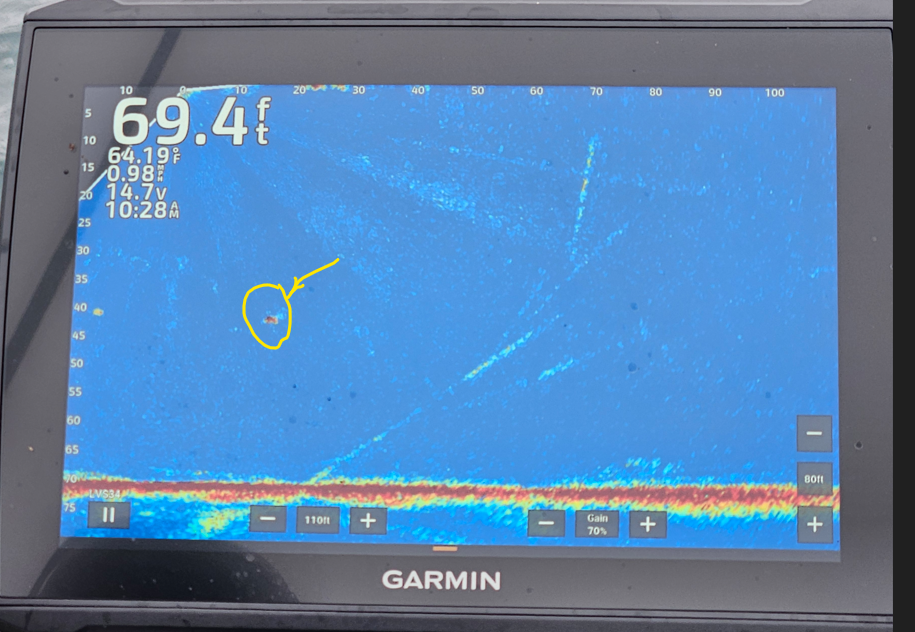
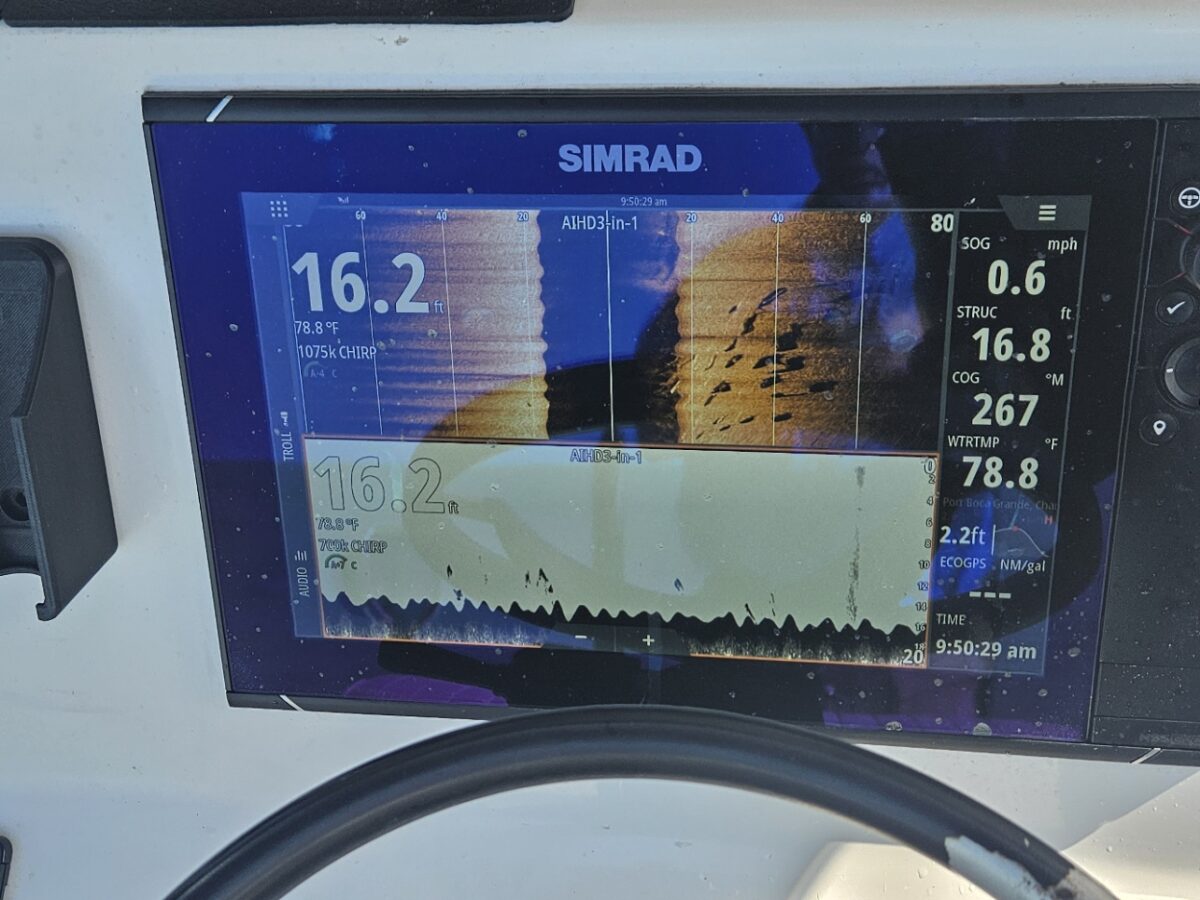
- Garmin, Lowrance and Humminbird manufacture Traditional Sonar as well as Foward Facing Sonar (FFS) units.
- Are Anglers Developing FFS Fear Factor Issues?
- When FFS is allowed in tournaments, do some anglers consider these “pay to win” events?
By Forrest Fisher
There are many examples over what appears to be a technology debate and grassroots angler backlash in bass and/or walleye tournament events that allow Forward Facing Sonar.
Here’s one.
For the past decade, the Innovative Outdoors Walleye Challenge has earned a reputation as one of Western New York’s most respected eastern Lake Erie walleye tournaments. Tournament Directors Jim and Diane Steel have built their reputation the old-fashioned way: treating teams fairly, paying close attention to the details, making sure the scales are accurate, and creating an event that benefits not only competitive anglers but also the Eastern Lake Erie charter-boat industry and surrounding communities. Fishing tournaments are an economic booster shot for local businesses.
So, something about this year’s tournament was surprising.
The field was cut roughly in half.
Last year, more than 40 teams participated, with some teams registering four members. This year, fewer than 20 teams registered.
Around the country, in bass and walleye tournaments, similar results are occurring. Why?
This walleye tournament itself had much of the same formula as earlier protocol. Big Fish Friday offered anglers a chance to have fun, scout and chase one big heavy walleye. The next day (Saturday), was the main competition event with a six-fish box requiring a 20-inch minimum fish with fishing hours from 7:00 a.m. to 3:30 p.m. The shotgun start came from the Chadwick Bay lighthouse in Dunkirk, with teams monitoring VHF Channel 68 for the official countdown and any changes.
Teams could fish the waters of Lake Erie and the Upper Niagara River, including Canadian waters. Boats could carry up to nine rods and reels, although Canadian regulations limited anglers to six. Teams could have two to five anglers, and as is common in major tournaments, winners and selected random teams could be subject to polygraph testing.
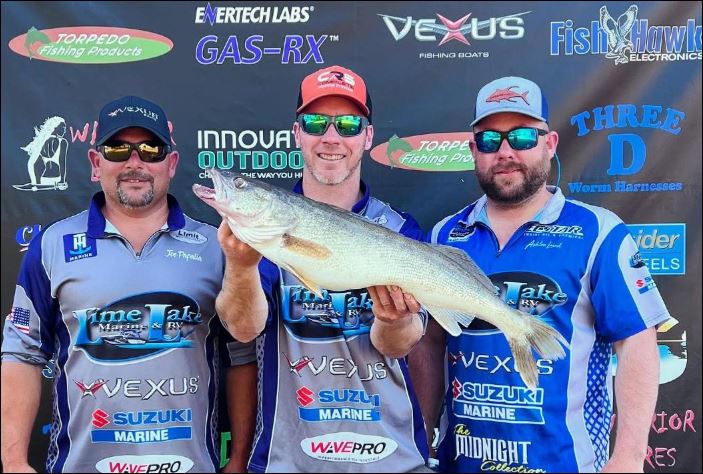
The rules also allowed something that has become increasingly controversial in walleye fishing: anglers could use virtually any fishing technology they wanted, including forward-facing sonar (FFS).
That may be where the story gets interesting.
Is FFS Creating a Fear Factor?
Many Eastern Lake Erie walleye tournaments have moved toward trolling-only formats, eliminating FFS-assisted jigging and other techniques that allow anglers to identify and target individual fish.
The Innovative Outdoors Walleye Challenge does not. Perhaps that has created a psychological divide.
If an angler has spent thousands of dollars outfitting a boat with the newest FFS technology, is that an advantage? Absolutely. But if an angler doesn’t have it, does he or she begin to wonder whether competing without it is even worth the entry fee?
A tournament entry fee can cost a team $300 to $600/team before Calcutta’s and other expenses. That’s real money. Add fuel, lodging, food, boat expenses and time away from work, and nobody wants to show up believing they are already behind.
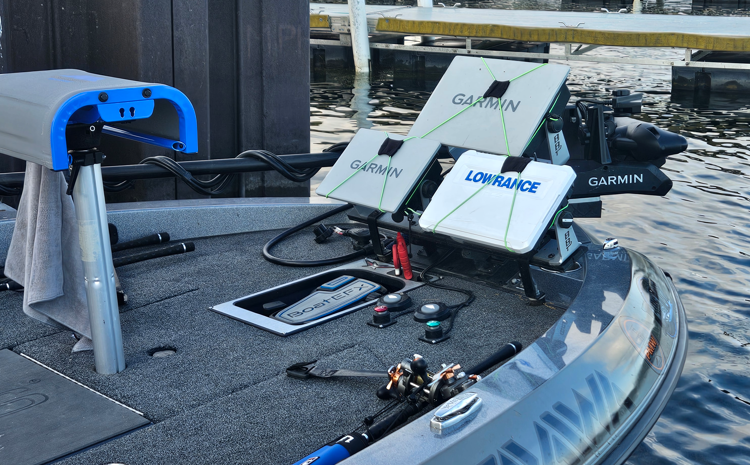
Could some anglers simply be afraid to lose because they don’t have the latest technology?
That’s a question worth asking—not an accusation.
After all, sonar has been changing fishing for generations. Some of us remember the old Lowrance “green box,” which cost about $150 in the 1960s (a lot of money back then) and it seemed like technological magic because it showed a neon-light blip indicating depth on a circular rotational disc. We couldn’t get enough of it.
For the record, $150 in 1957 is worth $1,782.66 today. Surprised? Don’t be. Inflation is real, cost is comparative.
Today, traditional sonar can identify structure and fish with astonishing detail. FFS and 360-degree real-time systems seem to simply represent another step in that sonar technology progression.
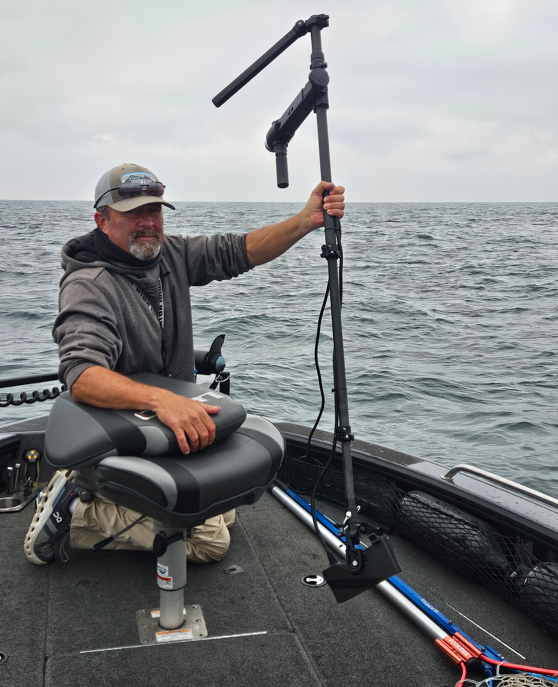
A video screen provides information with any sonar system.
The technology is comparatively expensive, with FFS entry costs reaching $2,000 to $3,000, but history suggests prices will eventually fall as adoption increases, just as they did with traditional sonar.
And anglers seem to want it.
I tried it and can honestly say, it’s absolute fun to see a fish 60 feet down in 100 feet of water, 50 feet out in front of the boat. Then you use your casting skill to cast to it, watch your lure falling toward the fish, then see that fish either move to your lure to inhale it or get spooked away because he was not expecting it. You can measure the demeanor and mood of the fish…hungry or spooky. Then resize your lure or color and find the next fish in a silent drift.
The results tell an interesting story. Captain Craig Sleeman and Team Midnight Express won the main event with 37.25 pounds, earning the big-box trophy and cash.
Captain Ron Morcio and Team Who’s U’r Uncle finished second with 36.52 pounds, including the tournament’s biggest fish at 7.69 pounds. Captain Nicholas Oleksy and Team Thunder Jet were third at 35.90 pounds, followed by Captain Jesse Nussbaum and Team 5-Alive at 34.62 pounds. Team MacAttack, led by Captain Daryll MacNeill, rounded out the top five with 31.98 pounds. Some of these folks used old fashioned sonar, some used FFS.
Big Fish Friday was won by Craig Sleeman, followed by Jesse Nussbaum and Captain Ryan Smith of Team Back-In-Action. Sleeman’s 7.60-pound walleye was Friday’s big fish.
Here’s another interesting comparison. At the popular WNY Walleye Classic held at the Dunkirk Central Avenue Pier in June, Ron Morcio and his team won with 33.05 pounds, while Bud Marsh finished second at 32.71 pounds. Five of the top 10 teams won using trolling tactics, while the other five were using FFS. It was about an even split.
That doesn’t exactly scream that one technology has conquered the other. It’s a big lake. Maybe the real competition is changing. There have been quiet rumors that some tournament managers encouraged teams that had participated in previous Innovative Outdoors events not to register in this tournament this year (because FFS was allowed). Those are local rumors, and they should remain exactly that unless someone is willing to put their name behind them.
But the broader issue is real. As fishing technology advances, tournament organizers are being forced to decide what they want their competitions to measure: the angler, the technology, or some combination of both. Anglers who only troll (no casting, no FFS) typically use down-scan sonar, some use side-scan sonar too, and many use other additive high technology devices to measure water temperature and current speed at the downrigger ball, and more, even video cams. These are all allowed and none of these devices are low cost. Does everyone fish9ng these tournaments have all these devices? No. Yet, they fish the tournaments anyway…that’s fishing. there still is some luck involved, skill too, in trolling only tournaments.
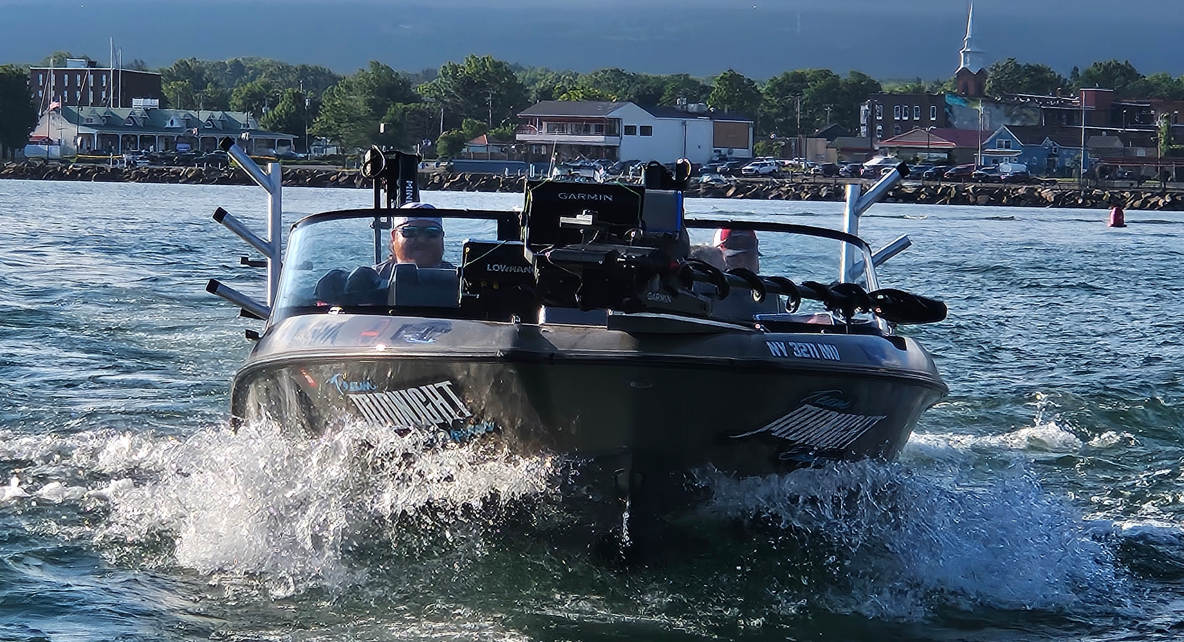
There is no easy answer. Trolling-only tournaments create one kind of challenge. Open-technology tournaments (FFS allowed) create another. Both can be exciting. Both require skill. Both can put anglers on the same Lake Erie chasing the same incredible fish.
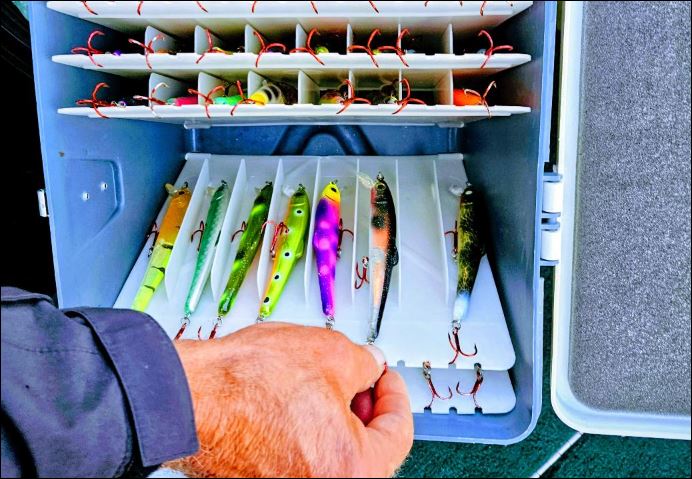
Perhaps the biggest lesson from this year’s Innovative Outdoors Walleye Challenge and tournaments facing a similar question isn’t that FFS is good or bad. Maybe it’s that fear of falling behind technologically can be just as powerful as the technology itself. Older folks that fish old-fashioned style fishing tournaments that rely on gut and instinct factors say that seasoned watercraft skills should not be replaced by staring at a video screen. The debate will continue, for now.
From the world of competitive bass fishing – Kevin Van Dam, one of the world’s most dominant and successful tournament bass anglers has been quoted as saying that FFS has no place in tournament bass fishing. “It’s like spotlighting deer.” Van Dam also said, “It is really efficient. It’s deadly, a lot of fun. I don’t know it’s that sporting.” Every bass angler in the world has learned so much about bass fishing from Van Dam, he has the respect of millions of anglers. We usually listen to those sorts of honest, expert anglers that share their skills.
Competitive fishing has always evolved. From the green box to modern sonar, from paper charts to GPS mapping, from simple rods to today’s sophisticated equipment, progress isn’t going backward.
The challenge for tournament fishing is making sure that progress continues to grow the sport rather than scare people away from it.
Because when nearly 50 percent of the field disappears, everybody should be asking why.
Hopefully, next year, more teams will be back packing every walleye tournament on Lake Erie—technology and all, or not—and ready to compete. Rule and event changes coming for next year will be interesting, for sure.
Gotta love the outdoors.



 like spots along the shore. High above, the first flight of Canada Geese was honking in V-shaped formations. On one tree, there was a small group of brightly colored American Goldfinch birds having a morning singing clutch. Not far away, there was a Sharp-Shinned Hawk to one side of the tree, and a Coopers Hawk on a tree not far away, the other way. All species have their ways in nature; they all struggle to survive each day, just like we people folk, but they have no concern about import taxes and electric bills. I grinned again. It was so good to be here.


 When I got older, Fall was, and still is, my favorite time to be by myself outdoors. It was hunting time. I was in tree stands and blinds hunting deer, turkeys, and ducks. I marveled at the kaleidoscope of colors that surrounded me. I enjoyed the cool nip in the air.
 That urge to be by myself, I have done so many times in my life, is coming on again. It has been building for a few months, and I must go. To a valley, by a creek, surrounded by wooded hills. Maybe I will take my fishing rod. Maybe I will take my hiking shoes. Maybe I will take my camera. Maybe I will take my tent and camp on a hill where I can see the beautiful country around me. Maybe I will take a hammock and hang it between two trees. Maybe, I will take a book. Maybe I will work on a story like this one.
 I will fish a little. Lie around. Read. Gather some firewood. Go for a swim in the creek. Lie around. Contemplate what it was like when Indians or settlers were there. Look at cloud shapes. Lie around. Listen to the water flowing and wonder where it goes on its journey. Skip rocks. Look for arrowheads. Take a nap. Build a campfire. Look at the stars and thank God for what He has done in my life. Thank Him for my family, my church, and all that He has created for me to enjoy all these years, and what few years I have left.


 Dale explains, “Gamma’s extruded monofilament and fluorocarbon lines are molecularly altered, creating filaments with an unprecedented combination of flexibility, shock resistance, strength, abrasion resistance, and low memory when compared to filaments of the same or similar material composition. The patented Gamma processing breaks down the stiff, long-chain molecules created during extrusion and drawing while creating millions of intermolecular bonds to cross-link the structure, resulting in a stronger, more flexible line.”

 Gamma Line is one of those products that anglers may be skeptical about until they actually fish with it for a period of time. Dale says, “I know because I was one of those skeptics. It took an entire season of using 6-pound Gamma Edge on a favorite smallmouth/walleye spinning outfit to sway me. It performed much better than expected. For example, during fall trips for river smallmouth in deep current pools where snagging debris piles frequently occurred, I would accidentally snag debris and hold the boat in the strong current with my 6-pound Gamma. In contrast, others on board caught bass from all around the sunken cover. From then on, all my rods were spooled with Gamma, including daily use of 4-pound test Gamma Panfish Copolymer on a half-dozen customer rods during my stint as a crappie guide.”


 Question: Should a Governor represent the values of the citizens or be a





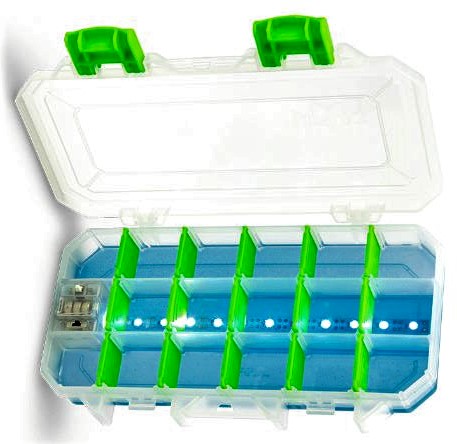

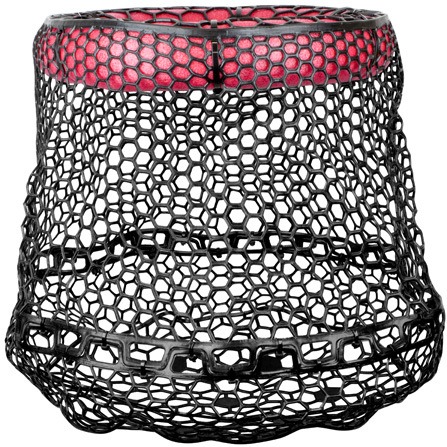
 The Livewell Buddy is a flexible, floating net that allows the fish to move freely thru circulated water and easily fits in any standard Livewell, or it can easily be attached alongside a boat, canoe or kayak that is not equipped with a Livewell to store your catch or your bait fish. It also can be tethered to you when wade fishing. As you fish, simply drop your catch into the Livewell Buddy’s durable silicone net.
 Retrieving your entire catch out of the Livewell Buddy is as simple as grabbing the floatation ring and lifting the Livewell Buddy out, along with your full bounty. There is no need to net or handle the fish, which eliminates the dreaded “fish splash” and “finning” injuries. For culling the smaller fish, the Livewell Buddy is a non-invasive alternative to conventional cull systems. After culling the smaller fish, simply drop the Livewell Buddy back into the water or your Livewell.


 Not too many anglers can resist trying out these new lures. Every year I stock up on more than I should, but they all look so good and some turn out to be valuable additions to my tackle box. If you don’t try them, you will never know if they would work for you or not. Beside, trying them is part of the fun!


 One of the biggest things we can control as deer hunters is our scent, but it’s not easy. We all perspire, we sweat when we walk out with our gear, climb a tree and set up. The gentle wind from whatever direction helps to disperse the “hunter alert” smell to all area wildlife populations. What can we do to get better to remove our human odor and wildlife alarm scent
 ? Read on.
 The 110 Folding Hunter® is one of America’s favorite knives, this version, the 110 Folding Hunter® LT, will undoubtedly follow in suit. Weighing barely over 3 ounces, the LT is created with lightweight molded nylon, drastically reducing its weight while maintaining the same quality as the original Folding Hunter®. The clip point blade is finished with Buck’s advanced Edge2x blade technology for unbelievable sharpness and edge retention out of the box.


 The Right Zone




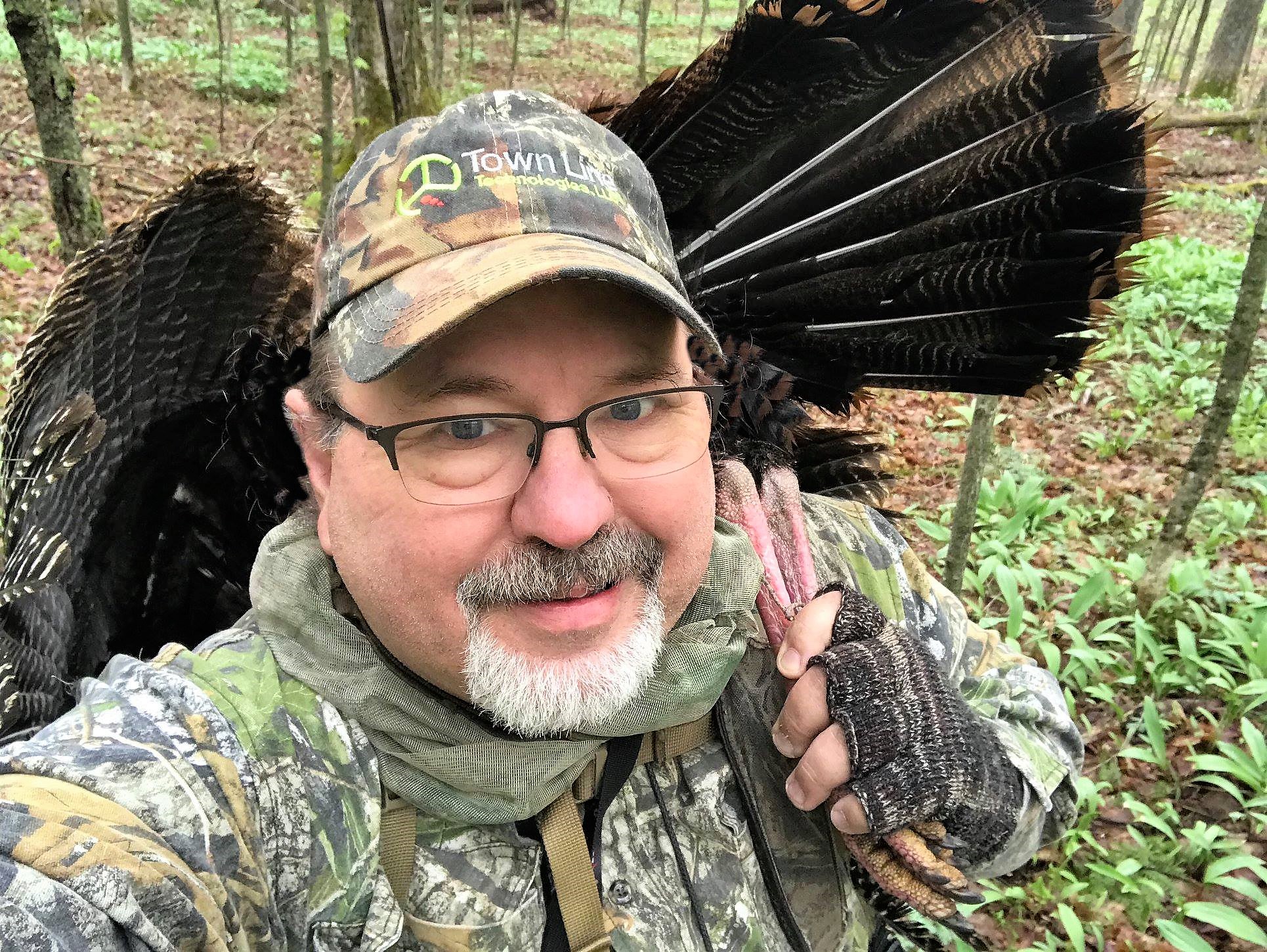
 With a full day’s rest from an epic road trip to Ohio, mother’s day morning hunt proved to be much a surprise in so many ways. Having spotted turkeys in farm fields below public game lands in Truxton, New York – in Cortland County, I thought I might give it a go for a few hours before having to pick up flowers I had on order.
 Knowing the terrain between us, I was able to cut the distance to a hundred yards and settled up against a big old maple tree. Mind you the bird was gobbling every 60-90 seconds without any encouragement.
  The entire hunt lasted a little more than an hour and twenty minutes, with a ton of gobbling and a gobbler after all said and done that ran back up the hill in one big hurry. All in all, a very memorable hunt. Every bit as fast and furious as any hunt I have had on private property. It was a very short walk back up the hill to the truck.


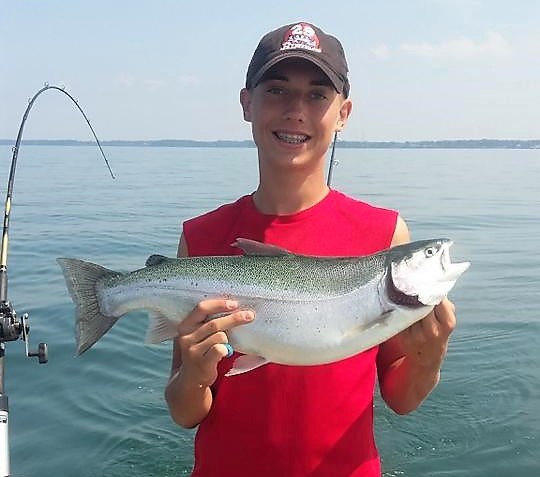



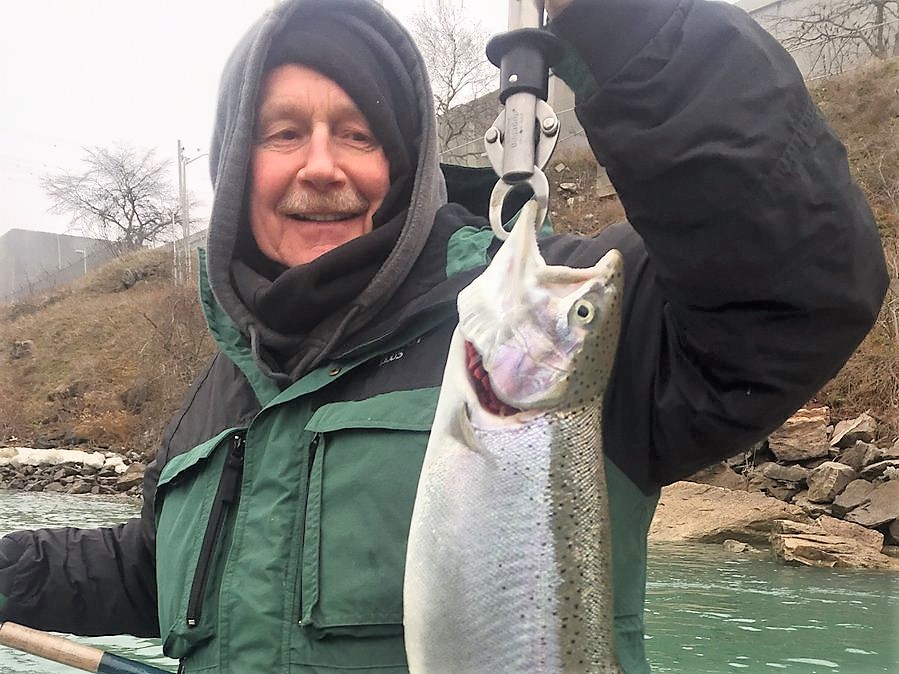


 As anglers we all have a list of lakes, rivers and streams that have the potential to satisfy our ultimate desire; to completely outdo ourselves. This past season (early June) I encountered one such body of water; beautiful Rainy Lake which borders Ontario and Minnesota.
 Picture this, you have a fantastic night sleep in a big comfy bed, then you wake up to hot coffee in your cabin. Next, you are treated to a big delicious breakfast just in time for your guide to grab your gear and whisk you away to the promised land of smallmouth bass, pike and walleye. Oh, and I should mention, they send you on your way with a packed lunch and maybe even a wise crack from Wayne (if you are lucky).
 Fast forward to your return from a day of fast, furious fishing, the kind that one can only daydream about, and you are greeted by Wayne, who wants to get the lowdown on your day. The main lodge is the perfect meeting place after a day on the water to tell as many lies as you want about your exploits. Here you will find a counter full of snacks, a fridge full of whatever you fancy (beer for our group) and a beautiful view as a backdrop to all the fish stories you can stand. To me, this is paradise and exactly what the doctor ordered. What’s next? Well, a delicious three-course dinner in a beautiful wood cabin that’s what. I tell you, I must have gained five pounds during our event and I was not complaining. The cabins are spacious and comfortable, the food is plentiful and so are the fish. Win, win, win and that’s that.
 After breakfast we got prepped and headed out only to be greeted with some of the most horrendous weather I have ever fished in by choice. Severe cold front, high winds and rain had me in doubt and I tell you this, I couldn’t have been more wrong. My partner in crime on this trip, Gary Abernethy (Live Target and those great “Bait Cloud” lures) and I lost count of our catches. It was simply unbelievable. We boated an estimated 90+ fish that day which included smallmouth, pike and walleye. I can’t describe how much fun it was to cast out a crankbait or tandem willow spinnerbait into shallow banks, points and reefs having no idea what would attack it next. Our big fish producer for smallmouth that day was the Live Target Crawfish Square Bill in brown/chartreuse while various spinnerbaits with silver flashy blades accounted for large numbers of pike, smallmouth and the odd walleye.
 My set-up for spinnerbaits/jerkbaits was a 7’ St.Croix (med/heavy) “Mojo Bass” rod which performed flawlessly the duration of the trip. I matched it with an Abu Garcia Ambassadeur reel spooled with 20-pound braid and paired with a 12-pound fluorocarbon leader (Gamma Edge). For the crankbaits, I matched a 5.4:1 cranking reel (baitcaster) spooled with 10-pound fluorocarbon and paired up with a 6’6” medium-action (Jason Mitchell) rod which was buttery perfection for those square bills. Day two was all about shallow diving jerkbaits, which by the way produced one of the biggest smallmouth of the entire trip. Actually, it was a Live Target silver/blue Rainbow Smelt that triggered a post spawn smallmouth to attack. Thanks again Gary.
 This short but successful outing was done on the southern arm with ace guide, Jamie Bruce. Again, we had only a couple of hours on the water and Rainy Lake produced once again. Really, this lake is nothing short of amazing.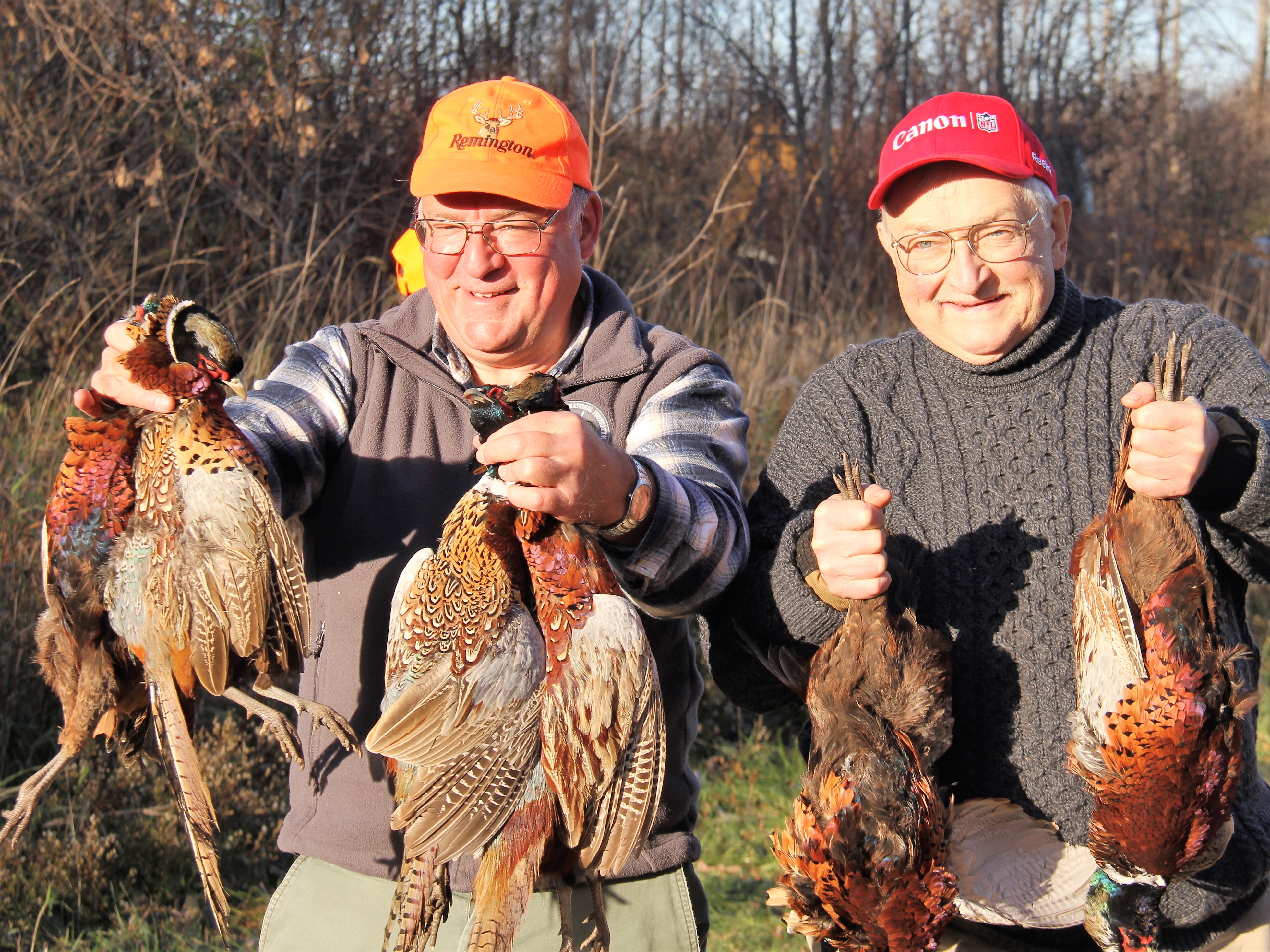
 By Joe Forma
 The hosts at F&B Upland are Fred Paye and Bill Surridge. These great guys run a superb hunt in what they maintain as traditional Western New York bird cover. As we step afield, we are transported back to the 1970’s when Ringed-necks were so prevalent locally. The 200 plus acres of hunting land features standing corn, soybean fields, hedgerows and acres of natural red brush.
 A real highlight of this hunt was George’s grandson, Dom, a 12 year-old super hunter. Andy was really glad to have a youngster along to promote the future of his sport. Dom couldn’t have been a better sportsman even at his young age. He always held his cut-down Remington 20 gauge pump at a proper port arms position, as instructed. He showed no impaired nerves or excitement, but hunted like he had done it a dozen times, not his first time. He was an excellent shot. He downed at least six hard-flying pheasants with single shots. I didn’t see him miss.
 The afternoon hunt was for an additional 25 Ringnecks. The dogs continued their excellent work and showed no signs of fatigue. They are well trained and well exercised, so they never quit, though some of us older sports slowed down just a bit. The shooting was right on the mark though and the birds flushed hard with disconcerting cackling.
 A tribute to all was that not a single bird was lost as a cripple. Great shooting and great retrieving by the dogs. By around 3:00 p.m., there five happy hunters and one old photographer, me, who decided one last push thru the soybean field would do it. It produced our last kill, a long-tailed, beautifully feathered cock bird.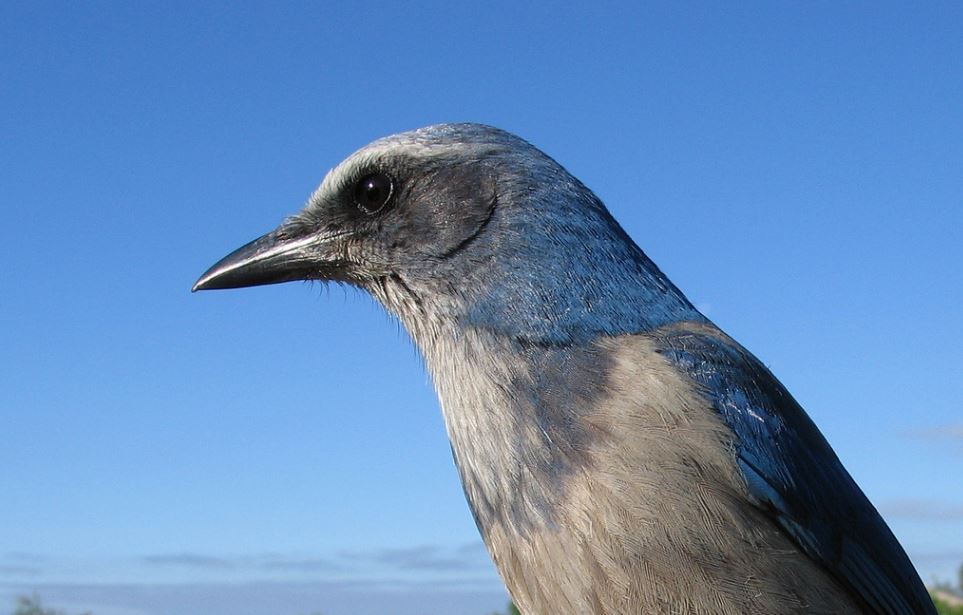


 By Forrest Fisher
 The hookset felt so solid. When I saw the hook-up point of interface, I understood why. It was buried to the sharp-corner bend of the new shank design. The new hook has good retention. The sticky-sharp Piercing PointTM provides a nice path for the surgically sharp hook point to bury itself, removing the old advantage that physics and old-style hook shapes have provided to the fish. Advantage to the angler.


 By Gord Pyzer
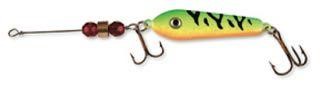 Jason dug deep into his tackle bag and pulled out a Fergie spoon that we intended to use the next day for walleye (above). He removed the wire holding the brass and glass clacker, and tied the noisemaker to the end of his line. Then he attached the same minuscule jig he’d been using without success to the rig’s split ring. After dropping it down the hole, Jason shook the contraption briskly enough that he could feel the brass weight sliding up and down the wire, banging against the glass beads. In short order, he was icing crappie after crappie after crappie (see the opening picture).
 By Jim Low