Ross Camps for Tight Lines, Heavy Fish!

campfireisland1

Rainy Lake is a “Giant Goldmine for Bass, Pike and Walleye!

Ross Camps on Canadian Shield Lakes offer Comfort, Hot Food, Peace, Quiet and Hot Fishing.

They call it Sunset Country. Northwest Ontario. The geological formation known as the Canadian Shield runs through it, dotted with lakes surrounded by rocky, hilly country populated with deer, moose, bear, grouse, and a wide variety of plentiful fish.

“I can look out the office window and see the sunset over miles and miles of water,” says Wayne Howard, who together with partner Pat Howard, owns two fish camps set up with a focus on fishing. One camp is called the Ross Camp on Clearwater Lake and the other is called Campfire Island on Rainy Lake.  “I get on the snow machine in the winter, go 200 yards and start catching some walleyes for dinner.”

The Ross Camp is on 30-plus acres and is open year ‘round.  Campfire Island is closed in the winter, but is open in the warm weather season.

campfireisland3

At the Ross Camp, we have a big parking lot for people with boats and trailers that want to explore the area, we have boats, motors, canoes, little boats for kids to use, a swimming beach, kayaks—all kinds of activities.  It’s very hilly and heavily forested here. To the east it’s all rock.  We’re on the edge of rock country where the lakes are filled with reefs, rock piles and great structure for fishing.”

Howard says, “The primary fish species in the lakes surrounding our Ross Camp include walleyes, pike, smallmouth bass, and lake trout.  Last summer lake trout fishing was very good too.  It’s not difficult to catch 15 to 30 lake trout per day in the 8 to 12-pound range. We get a few that are bigger.  In both winter and summer, we catch them fishing vertically with white, green or smoke color Zoom and Berkley flukes and tubes, all set up on 1/4- to 1/2-ounce jigs.”

“The winter season is great for ice fishermen at Ross Camp, though our Campfire Island facility is closed because you just can’t get to it,” Howard said. “Winter fishing at Ross Camp is for lake trout and walleyes. Walleyes will be around 30 feet deep, and the trout are typically in 45 to 55 feet of water. We use flukes and white tubes, like we do in summer, and it’s a lot of fun. People bring their own snowmobiles and it’s an adventure running snow machines through this country in winter, with a lot of lakes to visit.”

Some people come to hunt whitetails in the fall. “We keep it down to 4 to 6 groups per year,” Howard said. “We want to provide a high-quality experience in a wild setting where you don’t see other hunters. We don’t bait the deer. It’s all fair chase from tree stands and ground blinds.”

campfireisland5

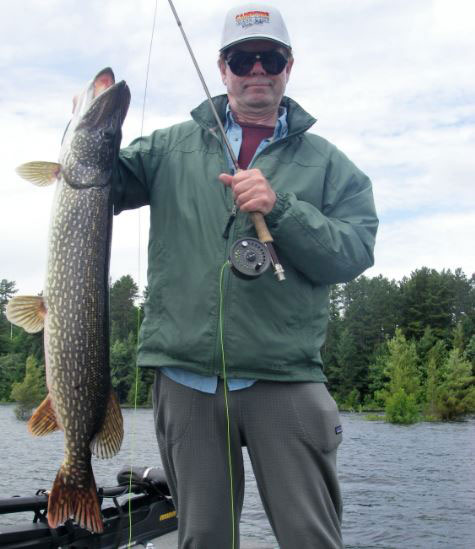
The Ross camp has 12 cabins while Campfire Island has three.  Campfire Island is right on the U.S. border on Rainy Lake. “Boating out to an island cabin in their own craft is an adventure that a lot of fishermen enjoy,” Howard said. “We bought Campfire Island strictly to provide top end fishing the smallmouth and northern pike. The fishing is great and we want to keep it that way, so Campfire is catch-and-release only.  There are huge numbers of big pike close to the causeway near Fort Francis. We love jigging for big pike on the rock piles.”

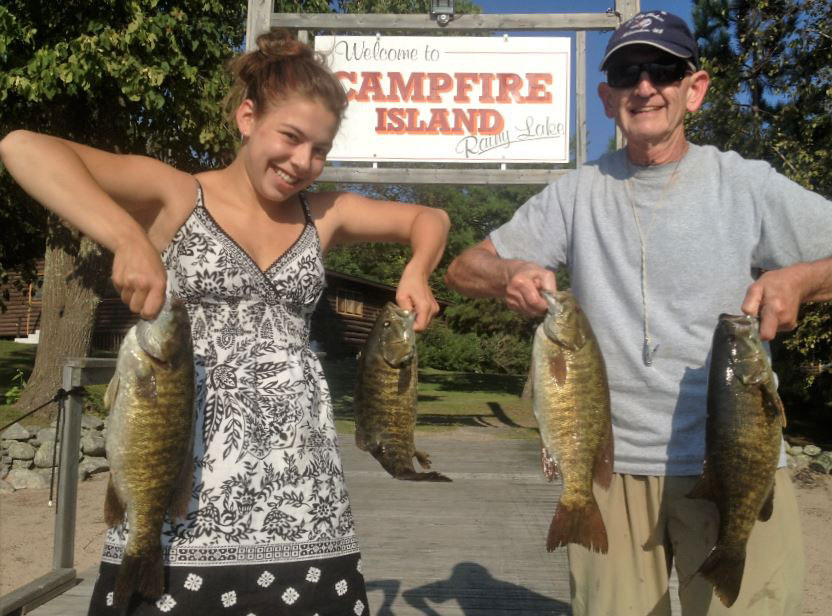
But Howard admits his favorite quarry is smallmouth bass, and bass fishing at Rainy from the base camp on Campfire Island is world class. “I love fishing smallmouths,” he said. “We catch a lot of fish 2-1/2 to 3-1/2 pounds with the occasional fish over 5-pounds. They’re aggressive, they jump, and they’re a lot of fun,” Howard said. “In May, smallmouths are pre-spawn and they gather in the bays on shallow flats. Late May into June they gather again in post-spawn mode, piling up on the first main points leading out of big spawning bays.  Jerk baits are always hot, but tubes and 5-inch Kalin grub jigs in special colors such as cotton candy, sand, or off-green, are fish-catching staples.  I use 1/16- or 1/8-ounce Gopher Tackle Mushroom and Northland Mimic Minnow jig heads most of the time.

In summer you have to hunt for the right pattern and we search with spinner baits over the weeds and rock piles, but I prefer tube jigs or black marabou jigs once we’re zeroed in.  Fall fishing is stupid.  Only one time of year is better and it’s within two days of the ice leaving in spring. The fall binge lasts for weeks, right up to ice-up.  From September through October, it’s really good.”

Try as he might to ignore it, walleye fishing is on fire at Rainy Lake these days. “The action is insane,” Howard said. “In the north arm, you can catch 80 walleyes before lunch.  Some remain shallow through early June in 5 to 8 feet of water and those are the big ones.  That’s where we find the 30 to 34-inch fish, running 10 to 12 pounds.  We caught 5 or more that size last year, running only two trips out of Campfire Island.  They stay mostly back in the bays on little rocky points.  Once walleyes move out to the rock piles at the end of June, we use a jig-minnow or jig-twister tail and pitch to them.  They stay out there right through fall.”
campfireisland4

Howard has lived the life of a fisherman and insists he’s not in the business to get rich. “We bought the Ross Camp when I was in my 20s,” he said. “I thought we couldn’t afford it, but Pat made me think twice about that.  The place was very well maintained and we keep it that way.  The water system is all purified, the septic system is highest quality and brand new.  Little things like that keep us and our guests away from unseen problems. We own it as a lifestyle, not as a means to make money.

“This was the lifestyle we wanted,” Howard added. “We like people, we like the outdoors, love the country, like the challenge—we just enjoy doing it.  Mostly people come here for fishing vacations and that’s the way we like it too. We’ve been here 30 years. We fish smallmouths, walleyes, northern pike and lake trout, primarily, and some muskies too. We have great musky fishing up here, we just don’t do it that often, and there is some great largemouth fishing that gets very little attention too.  We wanted to see if catch-and-release would work at Campfire Island and it did.  People embrace it.”

Those “hills” in Sunset Country were mountains a hundred million years ago, worn down by ice ages and glaciers over 2 miles high.  Clearwater Lake is situated in unique terrain. “The surrounding lakes are incredible,” Howard said. “Clearwater is about 10 miles long, Pipestone Lake is over 20 miles long, with other lakes connected or right next door so you have 80 to 90 miles of lightly-fished water.”

Miles of largely uninhabited, pristine waterways.  Gorgeous scenery in an ancient mountain range. Trout, walleyes, bass, pike, and muskies, and you can drive there.  Excuse me while I start packing.

For more info. contact: Pat and Wayne Howard, 800/363-2018; E-mail, fish@rosscamp.com; Website, http://rosscamp.com.

campfireisland2

Handicapped Life in the Outdoors…WITHOUT Barriers

  • A place designed for individuals with physical disabilities and their families. Big fish are waiting to greet you!
  • Located on beautiful Lake Shebandowan about 50 miles west of Thunder Bay, Ontario, the newly modernized Wilderness Discovery Centre provides outdoor adventure for disabled persons. It’s all about sharing access to the wilderness with them.
  • Visitors can enjoy a 3-season lakefront resort with modern accessibility.  Donations are welcome.
  • Bed lifts, ramp systems, aquatic lift render, grab bars, and additional assistance technology devices are used here.
  • The facility also caters to seniors, military veterans, first responders, non-profit groups, corporate retreats, non-profit groups, families for reunions, and social gatherings.

By Forrest Fisher

With songful loons sounding off at sunrise, the call of a warm breakfast in the Canadian wilds beckons to all. Especially to folks that may require assistance to enjoy a lakeside resort. Visitors to one special place called the Wilderness Discovery Center can now enjoy pontoon boat rides, accessible swimming facilities, dock fishing, lake fishing, and a warm bonfire at the sunset hour right before bedtime.

There are laughs for the fun of it, all from the heart and soul of dedicated camp administrators. The Wilderness Discovery Centre provides active participation to include everyone, regardless of disability and assures an ultimate, safe, outdoor, vacation-style experience. The discovery of “no barriers” is special all by itself.   

At the Wilderness Discovery Centre, visitors are encouraged to enjoy the unique outdoor adventure found here, by staff who maintain the principles of personal independence, dignity, integration, and equal opportunity for everyone. The staff strives to create a no-pressure camping and outdoor experience that affords all guests a “Life without Barriers.” That’s the goal of Mr. Bob Hookham, the President of the Board of Directors of Wilderness Discovery Centre (WDC), and the rest of the Board, since the facility began re-opening in 2019. 

Bob says, “The staff is fun and works to provide a fully accessible family resort that promotes a secure and barrier-free camping experience. Everyone will have fun and enjoy their time together. They work hard to engage the community in a way that fosters these values.”

Bob Hookham

Bob adds, “As able-bodied people, we take many things for granted: Fishing, swimming, having a bonfire, or even just a BBQ. This facility will allow anyone with any kind of disability to do all those things every day of their stay. We have a special pontoon boat designed with wheelchair access so that anyone can go for a lake cruise or go fishing. There will be a lift to lower individuals into the lake for a swim or a boat ride in a fishing boat. Every camper can navigate the camp using the ramp system from their cottage or the main lodge to the beach and bonfire area. They can enjoy these simple pleasures. Life here will afford our guests a ‘Life without Limits.” For the Board of Directors, dedicated volunteers, and committed carpenters, it has been a long and winding road to revamp the facility. Discover an information capsule on the history of this facility at the end of this article.  

By July of 2019, Wilderness Discovery added the final touches to cabins. In a report from TBN News Watch (www.tbnewswatch.com), Bob Hookham estimated the cost for repairs was around $1 million. Today, reservations are open for 2022. Additional revamping and expansion will likely continue with help from local support groups such as the Rotary House in Thunder Bay and many others across Canada and the USA. If you would like to help, please visit https://www.wildernessdiscovery.net/donate/.

The modernized cabins feature an open concept living room, brand new sliding door entryways, sliding glass doors leading to the sun deck with access to a meadow of colorful dandelions. The cabins feature a fully accessible L-design kitchen and 3-piece bathroom with shower stall, dining room, and entertainment area. The cabins are completely furnished, including a fully-equipped kitchen (dishes and cutlery, countertop stove, microwave, pots, pans, toaster oven, coffee maker, dish towels and cleaning supplies), essential bedding and towels (pillow, sheets, blanket, bath/wash towel), fireplace and window air conditioning, a large wrap-around deck with tables/chairs, TV’s and DVD player, with Wi-Fi access in the Main Lodge. Hard to beat all that! To book a reservation, please visit https://www.wildernessdiscovery.net/rooms-cabins/ or call 807-346-9722, or email info@wdcentre.net.

Is there good fishing in Lake Shebandowan? YES! It’s home to big walleye, smallmouth bass and northern pike. Anglers Edge fishermen stars James Lindner and Dave Csanda did a colorful and informative fishing show from the lake. This heartwarming angler duo shares a video presentation where viewers can learn finite details to locate fish in Lake Shebandowan. Lindner uses a Humminbird sonar with a MinnKota Ulterra electric motor, using spot-lock and speed control to demonstrate finding the strike zone while incorporating speed dynamics and position location control to refine angler presentations. The show illustrates how they bring Lake Shebandowan whopper fish to the boat. Lures that imitate whitefish and tullibee are the main forage base.

I plan a donation to the Wilderness Discovery Centre, and I want to visit and fish there soon! Please join me with a donation.


HISTORY: The history of this Centre has always been about helping others. In 1951, the land was deeded by the Carson and Cross families to the YM-YWCA as a summer camp for youth. By the early 1980s, Handicapped Action Group, Inc. (HAGI), had a dream of expanding this camp into a facility that would allow persons with disabilities and their families to enjoy life at the lake. In August 1983, HAGI entered into a 20-year lease to develop the HAGI camp. In 1993-1994, the lease was amended and expired in 2013, followed by yearly extensions until the fall of 2015. In July of 2015, Bob Hookham of the Fort William Rotary and Jeff Jones of the Hill City Kinsmen met with Minister Bill Mauro to discuss the possibility of assisting HAGI to maintain the operation of this facility at Lake Shebandowan. In April 2015, HAGI announced that they would be forced to stop operating the facility unless there was a significant change in the financial picture concerning the facility. In February 2017, negotiations culminated in an official announcement from Minister Bill Mauro regarding a new management group. On April 7, 2017, Wilderness Discovery received its Letters Patent as a Non-Profit Corporation with representatives on its Board of Directors from the Thunder Bay Rotary Clubs, Hill City Kinsmen, HAGI, and the Shebandowan Lake Campers’ Association. In July of 2017, the Corporation and the Ministries signed an Agreement of Purchase and Sale for the Lake Shebandowan Property. Since August 11, 2017, the Wilderness Discovery Centre officially took possession of the Lake Shebandowan facility that HAGI previously operated. Immediate upgrades have been in progress since that time.  

Editor note: All photographs are courtesy of the Wilderness Adventure Centre.