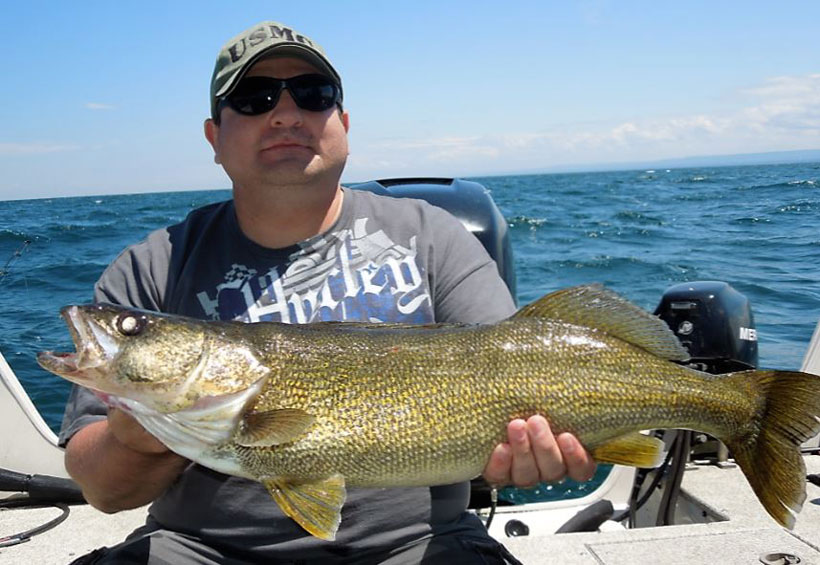
Summer Walleye Secret: How to Find Every Fish in the Lake

summerwalleye

Fishing is full of ironies, paradoxes and incongruities.

A good example is catching walleyes in the summer time when the fish are feeding at their most intense and aggressive pace of the year, eating up to three-percent of their body weight daily. You’d think with the fish pigging out like this every day that they would be easy to catch—and truth be told, they are—but they still manage to drive many anglers crazy.

If you are not catching as many walleyes in the summer as you think you should be, it is most likely because you’re fishing in locations and around structures where there are no fish. So move—but not just anywhere or randomly.

Instead, remember that like all freshwater fish, walleye are cold blooded animals, so the only way they can regulate their body temperatures and stay comfortable is to inhabit the zone of water that is most conducive to their well liking. And the zone in which they feel most contented, at ease and well-off has the register set for between 64 F and 67 F.

Depending on your geographic location, the size of the lake, its average depth and water clarity you may find this optimal temperature zone as shallow as 15 to 20 feet, or as deep as 30 to 40 feet. Regardless, when you find structure and cover in the favorable section of the lake and/or water column, it is usually lights out for walleye.

Of course, you’ll need to select the appropriate “tools” – or the key to open the door to allow you into the zone – which is the subject of this week’s short Fish Talk With The Doc video segment that I recorded for the Fish ‘N Canada TV show.

Just click on the following link for a video explanation and learn how easy it is to dial in on walleye fun in the hot summertime sun. http://www.outdoorcanada.ca/Walleye_fun_in_the_summer_time_sun.

Old-Timer Walleye-Catching Fish Secrets

Understand Depth and Speed, Control Bait Attraction

Big walleye in big deep waters like those found in eastern basin Lake Erie are not always easy to find, but the fish are there if you know how to approach them and how to keep your bait in the fish zone long enough for the fish to find it. After that, HANG ON!

For many traditional deep water (eastern end) Lake Erie walleye anglers, fishing methods have not changed much. Most of the old timers still prefer to troll than cast or drift, and they troll plugs using any of many longline trolling methods. It’s many of the old timers too, that catch most of the big fish. Go figure!

Their reasons are simple. They understand how to do it and they understand all the variations they think they need to make changes on the fly and be successful. Can it ever get any better than that? Do they ever get stumped and admit it? Answer: yes.

What changes? The savvy anglers who will talk details, many won’t, say it is the fish that seem to change their appetite for the lure type. They share that some old lures still work with regularity – like the floating Rapala taken to the desired depth, but many times, it is the brand new lure designs that simply slay the big numbers of fish and the biggest fish too.

Is it because the fish have not yet seen these lures? Do they have a different, more appealing wiggle? Are the lure makers doing a better job of convincing anglers to use the new lures and therefore they are in the water more and maybe even most of the time? Hard to say, maybe all of those reasons.

Some of the old timers I hang with when I can say they have not changed much except one thing. They use more simple means to get to the depth they want to fish. They use quiet speed control (electric motors) and slow down with the shortest possible line to reach the level that the fish (walleye) are suspended at.

Many still use in-line weight systems, 3-way rigs, and clip-on weights with old-fashioned 14, 17 or 20-pound monofilament line and they will not switch. Why? They are catching fish! They reason this way: they say they know the fish always on some kind of feeding timetable and that time can change from day to day. They shy away from 10-color lead core, 400 foot copper, and similar very long line systems. Why? They’re old and they won’t admit they’re lazy, but they do admit they don’t want to reel in a 10-pound fish for 35 minutes and have to go home because they’re tired. Guess that keeps their logic simple!

This modified Renosky lure is extremely effective when using simple speed and weighting system methods to get the bait to the fish.

So they troll around familiar waters with their familiar sinker-weighted, short-line, systems that harbor eddy currents that attract forage baitfish, then they try to match the shimmer and shake and size and color reflections of the type of baitfish they find there.

If they see suspended baitfish, they may be emerald shiners, smelt, shad or perhaps, there are schools of gobies if they see the bait right down near the bottom. They usually tinker with line deployment and weight-size vs. boat speed to connect with fish before very long.

Trolling lure plug types are usually 3-1/2 inches to 5-1/2 inches long, are usually wobble stickbaits and more often than not, they switch back to an old alternative all walleye anglers know, the spinner/worm. They switch between lowering speed and increasing their in-line weight to get into the fish zone, then let the fish decide on when to feed. They repeat the process with their known alternative baits every 15 minutes or so, one line at a time. They are patient anglers and that usually wins them many fish in the cooler.

Stickbait favorites in the eastern end of Lake Erie and many other larger water bodies include the new Bay Rat lures, new Rapala Shad family of lures, the new color Renosky lures, and the new line of Live Target Lures.

On many sunny days in July with a little riffle on the surface, early in the day fishing right after sunrise will find that lures that reflect shades of purple with any other color seems to be a killer. Many modify their lures and hard-lipped about sharing those secrets, but in the end, they say removing the front treble of 3-hook lures allows for a wider wobble at slower speeds and that this modified action catches more fish than other lures changes. They add a 2-3 inch piece of nightcrawler to the center hook and that allows an even wider wobble at slow speed. If the fish are near bottom, orange color lure pigmentation will often turn the fish on.

Spinner/worm style favorites depend on water temperature. There are the choices of Colorado blades, Indiana blades, turtle blades, willow leaf blades, and many other styles, including one-blade, two-blade and bead size and bead spacing variations, clevis size changes for efficiency and blade rattle (with the beads) that can really make a difference.   All have a purpose. Tight lines.

More on that next time!

Tuning Up for Walleye – Part 4

Be Consistent for Good Walleye Action, Catching the Biggest Fish – Not All Luck, Learn from Winners

tuningup1

Considering the recent results of many 2016 Lake Erie walleye fishing tournaments in the eastern basin this year, there are some anglers that have really improved their walleye fishing success and their bankroll too!

There are also a handful of anglers that have once again proven that they are masters of understanding the mystical aura of finding large, elusive walleye, no matter what the conditions. They are repeat top-ten walleye fish catchers in many tournaments almost every year.

As an example, some feel that the Southtowns Walleye Association Annual Walleye Tournament is a contest of sheer luck since it involves the mere single objective of catching one single fish that is the heaviest of all when compared to all the rest of the fish caught by everyone else in the tournament. You know, catching just one fish that is big only involves being in the right place at the right time, right? Question there might be, please share – what place is that?

Some folks reason that such contests would be more of a skill measurement if they involved a combined weight of three fish or five fish over the tournament period (9 days), all weighed in aggregate total. They say, that would be more a measure of skill, not luck. Others argue that such tournaments are too long – they should be multiple fish and only three or four days long, it should be a skill tournament, heaviest bag.

In one sense, all of the rationale could be argued one way or the other, but with a one-fish, biggest fish by weight winner, the good logic of the biggest single fish is that just about anyone can win the big money and that allows all who are entered an equal chance. Is it fair? Yes, as long as all the scales in multiple weigh station locations are calibrated and certified to the same standard. Then it would appear to many that this is very fair.

Back to anglers that consistently are in the top 10 or catch multiple heavy fish every year. How do they do that? There is one (complicated) answer to that. They know what they’re doing and they are ready to catch a monster walleye at all times with any of their tackle and on any rod or reel in their boat.

Be Tackle Ready

They are tackle ready. The have sharp hooks. They fish with new leaders. They tie strong knots. They know their rigging options. They have control of their boat. They know how to use their electronics. They have friends that share. All of these things are key elements of their road to repeated success.

Learn About Weather Effects

There are many other things they know too. They know weather and lake conditions that include wind shifts and the sub-surface currents that form, currents that can drive forage to new locations.

They know that sunny days after a cold front are the worst days to fish. The know that the days following a severe wind blow and thunderstorm are the next worse days to fish – and sometimes, the “bad day” can last two or three days.

They know that the best conditions to catch fish are on Lake Erie water that is medium clear to highly clear is with overcast skies and a slightly choppy surface. The good clarity level allows the walleye to see the forage more easily and the surface disruption keeps them feeding longer, sometimes all day, or it seems from my experience.

Understand Fish Movement and Change

They know bottom types such as mud flats, sand, gravel, rock and weed. They know where newborn forage base populations like to feed as they grow and they check these areas consistently.

They know that after a cold front, the walleye usually head for the bottom and stay there. Close mouthed too, but if you’re going to catch them, it will be dragging a line near the bottom with copper or 10-color or three way rigging with contact.

tuningup2

If you are like most anglers, you think you’re doing all the right things, yet your friend Billy or Joey or Herbie is telling you everything he says he knows, but he is catching lots of fish and you’re not. Do you really trust your friend? Most of us know and do trust our friends, so the question you must answer is why are they catching more than I am?

Does Scent Matter? Yes

The questions are always there, trust me on that one, but the answers and solutions are not really that far behind. Scent is a big deal. Fill your oil and gas reservoirs before you fish? Not good, unless you really get that smell off.

One reason why scent attractants seem to work is that the cover such mistakes, not so much that they attract fish, though there is some truth to the attraction factor too.

You use 20-pound test mono leaders because you think that 20-pound Fluorocarbon doesn’t really make a difference and it costs a lot. With our clear water, these things can often matter. Science has helped us.

Does Boat Noise Matter? Yes

Maybe you are trolling with a 4-stroke and your buddy is trolling with a 2-stroke. They both make lots of underwater noise when the fish are shallow, but the 2-stroke makes less noise. A bow-mounted electric is the quietest and stealthiest, and perhaps, the most effective too, when it comes to catching numbers of fish, but most traditional Lake Erie walleye anglers are trollers with gas motors of one sort or another.

tuningup3

You can see walleyes all over the place and yet, you can’t hook any. If there is a fresh mayfly hatch going on, that’s why. Walleye are opportunists and they feed on whatever is in abundance. You have to put available food resources in your planning when you prepare to fish for the win.

Know the Food Options

Eastern basin Lake Erie forage includes emerald shiners, smelt, shad, gobies and yellow perch. Lure color and actions that imitate these are what you’ll need. Size variations too.

Interestingly, most of the winningest anglers will all share that they have one hot lure or one hot color. Studies show that walleye see orange, yellow and green the best in deep waters, this is not a physics function, it is a walleye sensitivity function.

Sometimes a spinner/worm rig catches all the fish and you have three of them, but only one of those three are doing the job. Why? It could be flicker, flutter, and balance, bend in the blade – hard to tell, but look for these differences.

Lastly, sooner or later, you will have one of these “hot lures” or your friend will shed his curtain and tell you what he is doing exactly. Until that happens, just pay attention to some of the ideas mentioned earlier. Discover your own trail to big fish.

Take Notes, Study Them

Take notes. It helps when you look back on them. Talk to anglers at the dock. Did they go east, west, how deep, how fast did they troll, what kind of rig did they like using? Ask and learn. Add what they share to your own arsenal of knowledge and be strong to share what you know too.

Some anglers have learned the rules of their fishing own fishing road. They know where the turns are. They modify as they need to. They adjust to win and they remember what they did for next time and next year.

Learn to Love Fishing and Sharing

Learning, sharing, winning some cash too. That’s what makes fishing one-fish contests the fun it is. If it’s a skill or luck tournament for you, no matter. Are you enjoying your time on the water and at the dock, and at the weigh station and the fish cleaning station? Let’s face it, most anglers are not pro anglers, but a simple cash purse can make it seem so.

For most of us, fishing is about fun, especially when your name appears in the top 200. Get a notebook, take some notes!

Good luck on the water!

Tuning Up for Summer Walleye – Part 2

Find the Forage, Match Your Lure, Catch Fish!

Bob Rustowicz has been a tournament winning angler for many decades- he fishes hard and often, following bait schools near his favorite fishing areas in Eastern Basin Lake Erie. This 11.42 pound walleye is currently leading the 32nd Annual Southtowns Walleye Association Tournament.

When tournament anglers travel to a waterway that they know, it is often a brand new ball game because everything changes week to week.  Sometimes it’s better not to know the waterway, that way you can’t make the same mistakes by fishing the same way you did last time when you caught fish and now, the conditions are changed.  Bad habits can cause bad fishing days, of course, we all know there are no days that are actually bad days to be out fishing!

You may know where the creek beds and the sunken roads are in reservoir lakes, the offshore shoals and reefs in natural lakes – maps can tell you that too, but it’s the other variables that affect forage location.  Where the forage schools are controls where the predator fish are and what they will strike.  As you choose your lures, this is a big key to catching fish.

Plain and simple, walleye like to eat.  As waters warm, they eat often.  Their metabolism rises and they have no choice, so they stay close to forage school locations.  As anglers, it is up to us to understand how the wind direction and water temperature changes affect the forage.  It pays to know as many details as possible about the forage community.  What types of forage live in the waterway?

On Lake Erie, the deep eastern basin off New York and Pennsylvania offers many forage types, but the primary forage are emerald shiners, rainbow smelt, yellow perch and round goby.  The walleye will key on whichever species has the most abundance where the walleye are located.

Walleye favorites in Lake Erie are the emerald shiners and smelt, so angler lures that mimic those forage types – when those forage types are available, are usually taking fish to the boat.

Usually, the smaller walleye key on the emerald shiner minnows, the larger walleye key on the longer and heavier smelt, but when or the other is in low supply, the fish switch in favor of abundance.  When these two forage are hard to find, the walleye move toward shore into shallower waters and key on the yellow perch.  Again, the walleye locations vary with forage density locations.

So while I am not a biologist, I have been fishing out there for nearly seven decades and have learned from the best of the best anglers.  Today, we have so much equipment to help us cheat fair out there, since it now largely a matter of who can afford the best equipment to catch fish with science and technology helping us figure out where the forage is.  We can monitor, water temperature, wind speed, water current, boat speed, oxygen content and Ph to narrow down where we fish any length of time.

To simplify, watch your graph, study the wind and wave weather maps – the resulting current eddy’s control the flow of phytoplankton and photoplankton. The young of the year emerald shiner and smelt nursery schools feed on these the larger forage is never too far from them.  The walleye are nearby.

The wind maps can be found here: http://www.coastwatch.msu.edu/erie/e3.html.

Wind maps and lake current maps are available for all the Great Lakes at this link sector.  These maps help you locate the surface temperature of interest and help you figure out where the forage are located in their highest density.

Rig up your preferred fishing tackle, just allow for adjusting to the baitfish that you locate to catch fish.  As we transition into summer, the temperature cycles have been fluctuating and the wind shifts the lake currents topsy-turvy, often causing short duration turnovers.  When you leave the dock and head out about a mile or so, check the water temp.  If it’s 45, turn around and go fish somewhere else.  Or, head out about 15 miles to get to the other edge of the thermal break.

Match the hatch is the key rule.  Mimic the forage.  New model lures always seem to catch more fish than old stuff for some reason.  Are the fish educated?  Nope.  It’s just that they seem to always slam new baits, new colors, new sizes better than old stuff.  Can the old stuff still work? Sure it can, but sometimes only on those days when the fish are really gorging themselves.  Funny how that works.

summerwalleye2_3

So I am always trying new lures. The new effective lures from my end include those that look like smelt.  This one from Live-Target Lures simulates an elongated school of baitfish.  I really like it, especially when it’s working!  It’s ideal when walleye are feeding on small baitfish, has a wide body profile, two hook or three hook design dependent on size, it suspends and is silent.  The EBB90S in pearl/olive (color 801) is a 5/16 ounce suspending lure, 3-1/2 inch long that will dive 3-4feet.  It has two hooks in size 4.  The EBB115S is a 4-1/2 inch model and has three hooks in size 6.

summerwalleye2_4

Another of the new lures that has met with recent success is this one from Rapala.  Another of the newbies that has attracted some of the country’s best anglers for many species is the Rapala Shadow Rap (SDR11MBS).  This lure works best when there are also gizzard shad in the forage mix, as sometimes happens here in WNY in spring.  It has flatter sides and offers a swimming minnow action, has a rattle, will suspend and stay there, a very effective lure to cast or troll, especially when fished as a jerk bait.  The moss back shiner color has been my favorite here.  It runs just 2 to 4 feet deep, but works well off the boards with weight or a diving plan or 3-color lead core for the June timeframe.

These lure types are also offered in deeper diving models if you prefer to fish without lead core or weights as the fish head out deeper.

In the Southtowns Walleye Association Tournament on Lake Erie’s eastern basin, the largest fish so far include (June 13th) for first place: 11.42 lbs, second: 10.72, third: 10.51 lbs.  For the junior anglers under 16, first place is 9.52 lbs, second is 7.80 and third is 7.75.    Bob Rustowicz is leading with the big fish.

Tight lines!

Tuning Up for Summer Walleye – Part 1

Lure control, line control and depth control – an Evolution

Finding the fish is only half the battle, now you need to catch them, AND you need to catch the biggest fish to win if you are in a contest. How to do that is part of this series.

Provoking fish to strike even when they are not hungry, that is what wins tournaments.  Veteran anglers that catch their fill of fish on each trip know that finding hungry fish is one approach, but provoking fish to strike will catch fish almost anytime.  Lure control, line control and depth control will help you get there.

The “good lure – bad lure trail” starts a long time ago, in the 70’s.  Crankbait lure manufacturers learned how to mold plastics, imbed hook-holding points, add colors and modify actions to control wobble, wiggle, shake-frequency and other features yet to be defined at the time.

There were also the old cedar, balsa and other wooden lures, which at the time were often not as reliable to keep hooks from pulling out.  The old balsa Rapala’s were the exception and were always a front row seller.  The old lures were all beautiful and traditional, but they didn’t hold up like the plastic lures.

The plastic lures didn’t need to be repainted either, because they had built-in color and internal fish-like markings.  If you remember the term “plastics” from the movie “The Graduate”, it changed the world of the movie actor in the movie, it also really forever changed the world of fishing too.  That’s progress.

In 1973 in Elma, New York, I met master angler, Russ Johnson.  He had learned how to catch fish with plastic lures like no other man alive – that I knew, no other man except, maybe, Buck Perry, the king of controlled depth fishing lures.  A humble man through all of his fish-catching success, Johnson was willing and able to share what he had learned, or I should say, what he invented – because he was the Eastern Basin Lake Erie leading edge fishing technologist back then, with anyone that would venture to ask “how do you do it?”

Even during the hottest of summer seasons, this guy always his limit of walleye or bass, whichever species he was fishing for.

About that same time, the Lowrance “green box” depth sounder brought electronics into the fishing world and “hi tech” had started that new journey for many of us.  It would be a journey into the once very placid world of fishing secrets and hand-me-down traditions for “secret spots”, to another trail, a process for finding fish every time you fish with gadgets that help you see them.  That trail for learning was set!  Except, even if you found the fish, you might find like anglers do today quite often, they just would not bite! You still need to provoke fish to strike to catch them ALL THE TIME.

Finding the right lures to use is based on YOUR EXPERIENCE to understand HOW-TO-TUNE those lures so they deliver their MAXIMUM APPEAL where you place them for fish to see, or for fish to be provoked by, those lures when they are performing during your fishing time on the water. A lure in the right color, but not performing well is ineffective!

Johnson learned to use the new electronics and incorporate it with his fine points of controlling lure action, lure depth and how to eliminate fishless water way before anyone ever wrote about it.  His fish coolers were always open because the fish he caught were so big and so many in count, the coolers were too small!  No joke!

Today, he is in his 80’s and spends much of his time with a similarly aged angler, Bob Carlson, teaching youngsters how to tie proper fishing knots.  When he fishes, he is so good today that catch and release is his common practice because we know better now – you can deplete the fishery.

His favorite lure for catching walleye and bass back then was a Rebel Deep Wee-R, but there was more to it than just using that lure model.  Johnson also controlled his fishing line (diameter size), the lure color, rod length and rod action (resonating parabolics matched with lure type and boat trolling speed), his fishing reel (calibrated for distance deployed by cross-feed revolutions – feet per cross-feed, today we have line counters…much easier), and the boat speed.

There was also the not-so-small matter of his fishing knot and the size of the snap-swivel he attached between the line and the lure.  While Johnson is slowing down a bit today, he uses – to this day, a Palomar knot with a size-2 ball-bearing snap-swivel.  Johnson had fishing down to a science before anyone else called it “the science of fishing”.

The real trick?  First, tuning the lure.  He advised me from the first day, “Never tune any lure from the boat.  Too much swish from the boat that affects the lure action and it will be tuned improperly.  Get to a swimming pool, turn off the filter, cast it out to the other side and then tune it there.”  Of course, you had to first add the snap-swivel and proper knot, trimmed to the shank – so no overlap of the end loop, then after the cast, using a Garcia Mitchell Ambassador 6000, a level wind reel with a cross-feed line pickup, cast it to the other side of the pool and reel it back starting at about 2 miles per hour.

Johnson would say, “Get it running about straight down first, then turn up the speed to 5 miles per hour, that’s about as fast as you can crank with a 6.3 to 1 ratio bait casting reel.  Fine tune the front eye of the lure, but also tune the underside wire hook holders molded right into the plastic – they matter! ”

When you got this technique all set up right, a lure advertised to run 10 to 12 feet down would hit the bottom in 25 feet of water when it was trolled at 2.5 miles per hour and run 125 feet behind the boat with 8-pound Trilene XT monofilament fishing line.  Add thinner 10-pound Fireline today and they go much deeper!

Adjust the line length or the boat speed to modify depth and distance down.  Johnson had a little green book where he kept all his “speed trolling notes”.  Johnson proved that in virtually any body of water, he could devastate any big fish population in a matter of hours, catching mostly the biggest fish.  He controlled all the variables before us modern day anglers called them “variables”.

What Johnson learned all by himself and what he shared with a few lucky angler fishing folks, including me, is more or less common knowledge today.  One thing I know for sure, many anglers don’t heed what they have learned even on their own time within their own domain of fishing experience.  Especially true during tournament time.  He kept a logbook, great advice for every angler – keep a logbook!

Next week starting on June 11, 2016, the biggest amateur walleye association in North America – the Southtowns Walleye Association, will take to Lake Erie to fish for nine straight days looking for the single biggest fish to bring to the scales.  More than 1,000 anglers will seek to find the biggest tournament fish in eastern basin Lake Erie for the largest cash prize – This is a $35,000 tournament!  To check in or sign up, visit: http://www.southtownswalleye.com/tournament.

Getting to the winners circle is never easy, but it is possible for anglers who do learn how to control their variables best. Luck still matters, improving your luck depends more on you.

During the spring to summer transition, when colder water lingers into June, the biggest fish seem to come from the Dunkirk and Barcelona sector.  Then again, the Buffalo to Sturgeon Point fishing zone has yielded many 14 pound monster walleye too.  Finding that big fish and getting it (her) to strike your lure is the challenge.  That’s where the skill of anglers that understand how to search for schooling walleye and that singular local big walleye will play into finding the winners circle.

Use modern tackle, including planer boards, to get the lure away from the noise of your boat will help.  Don’t be afraid to start experimenting.  Change one thing at a time until you find the winning combination; add weight, change lures, colors, troll speed and line trail distances until a fish is caught.  Then switch all lines to that combination and prepare to get sore arms.  It works that way on the good days!

Pray for some good fishing days!  If you happen to be on VHF Channel 68, give a shout to “Baby Bear”, that would be me.  If I’m catching, I’ll share information on where I’m not!

Tune your lures first, keep track of the important things you discover in your logbook.

Wishing everyone who drops a line fishing anywhere in North America the best of good days out there and the best of good luck.