

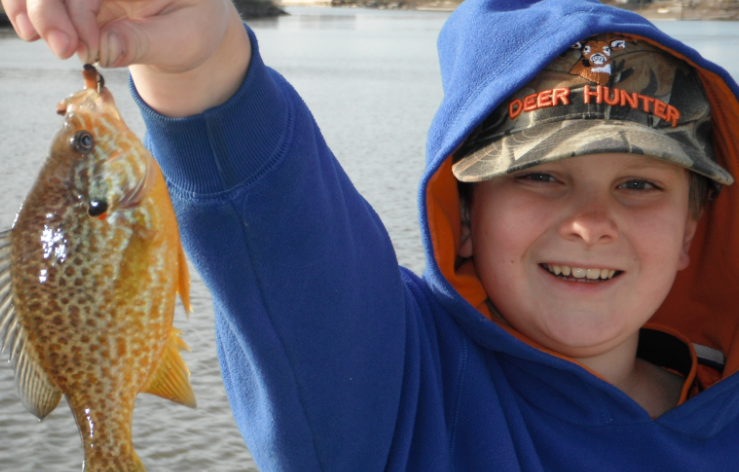
- One Pfleuger steel fishing rod, one shiny level-wind Bronson reel filled with solid black Gudebrod braided line.
- One hook on the end, a sinker a foot above it, a bobber somewhere above that.
- Somehow, we caught plenty of fish! That’s only part of the story.
By Forrest Fisher
I was four years old when my dad first took me fishing at the creek.
There was a two-lane road between our house and the water, and when the snow was gone, riding my bicycle down that road toward the creek felt like the beginning of an adventure.
We had one fishing rod—a Pfleuger steel rod fitted with a shiny level-wind Bronson reel. The line was thick, solid black braided line made by Gudebrod, and our rig was about as simple as it gets: a hook on the end, a sinker about a foot above it and a bobber somewhere above that. No leader!
Simple, yet somehow, we caught plenty of fish.
In those early years, around 1952 and 1953, our bait came from the family garden. I dug little redworms from the compost pile beside the tomatoes. Sunfish were usually first to find them, but by changing the depth of the bobber, we discovered rock bass and smallmouth bass, too.
We fished most Saturdays when Dad was home from his job as a design draftsman. He was one of those WWII veteran fellows who could look at an old mechanical contraption and immediately think of a better way to make it work. He said growing up in the depression made everyone think of new ideas. He replaced bushings with bearings, built clever wooden gadgets for Mom and seemed to have a solution for almost everything.
But there was one thing he never tried to improve.
Every morning, Dad got down on his knees beside his bed, leaning against the footboard, and prayed for a few minutes.
One Saturday morning, I got up early to dig the worms. Then the clouds rolled in and the rain started.
I was crushed. Saturday was fishing day with Dad.
He told me I had better pray for the sun to come out because if the creek became muddy, the fishing probably wouldn’t be very good.
So, I prayed.
I even asked Mom to help. She was at the window, and she smiled as if to say, it’ll probably stop soon.
It did.
That day, I learned something that has stayed with me for more than seven decades: sometimes faith is simply believing that there is a way forward when you can’t see it yet.
I’ve thought about that lesson many times since.
Life isn’t always a clear creek on a sunny Saturday. Sometimes the water gets muddy. Sometimes the problems are big, the answers aren’t obvious, and we’re not sure which direction to go.
When that happens, I try to slow down.
I ask for help from above. I think about Dad. And then I try to make the next right decision.
It reminds me of fishing the creek with Dad. You don’t always know exactly where the next fish is. You make a cast. You pay attention. You adjust the bobber. You try again.
Today, I still get that feeling.
When I fire up the engine at the dock and head a mile or two out onto Lake Erie aboard our now 30-year-old, 21-foot Sylvan Super Sportsman, a boat of my dreams, I face one of life’s most important questions:
Smallmouth or walleye?
I don’t make that decision alone anymore.
I let the grandkids decide.
Either way, I already know we’re going to have the best day ever.
Before leaving the house, I usually get down on my knees for a minute or two and thank God for giving me one more day to enjoy this incredible world—and, most of all, one more day with my grandchildren.
Maybe that’s the real lesson and the real gift Dad gave me. We’re never in this world alone.
Trust doesn’t mean knowing exactly what will happen. Confidence doesn’t mean having all the answers. Sometimes it simply means making the next cast.
If you’re feeling lost these days, these modern days, maybe you don’t need to solve everything today.
Find a dock or a pier. Walk down to a creek. Call an old friend. Take a kid fishing.
Sit quietly beside someone you love. Sip a coffee.
If it helps, ask for a little guidance from above.
The fish may or may not cooperate. Sometimes, somewhere between the first cast and the last one, we find our way again. Solutions can come in many forms.
Gotta love the outdoors.