Close Encounters of the Bird Kind

It’s amazing what you see if you take time to be there for natural events.

birdkind1
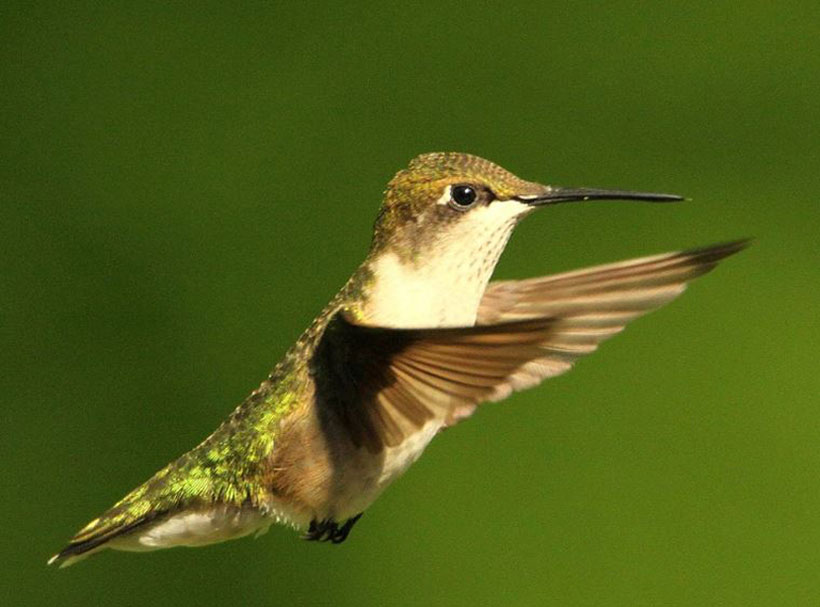
Hummingbirds are among the most amazing flying critters to teach us about airborne direction control.  Joe Forma Photo

A while back, as I sat working on an article, two hummingbirds were playing keep-away with the nectar feeder outside my office window.  One would be peacefully sipping away when the other would scream in from nowhere, doing a passable imitation of an F-16.  Not much later, the roles would be reversed.  Sometimes they banked so sharply that their wings produced a sound exactly like rubber tires squealing on a tight turn.  I enjoyed this show all day long and around sunset, when the intensity of the light outside and in my office were roughly equal, I heard another squeal of wings and glanced up just in time to see one of the hummers fly straight into the screen on my office window!

I thought it would bounce off with a broken neck, but to my amazement, his momentum had merely pushed his beak through the screen’s nylon mesh nearly up to his eyeballs.  As I watched in wonder, the trapped hummer continued the hovering pace of his wingbeats, holding his rear half in the air.  I immediately shouted to my wife to come quick, but nothing short of warp speed would have been quick enough.  After regaining his composure, the little guy threw his transmission in reverse and revved the throttle to full speed.  His beak came unstuck with an audible “Poik!” and after fixing me with his gaze for a nanosecond he was off like a shot.

This fantastic glimpse into the world of hummingbirds required no special equipment of knowledge, only being there to witness it.  That’s often the way with natural revelations.  Some of my most memorable nature experiences have been only peripherally related to hunting, fishing or whatever other pretext took me outdoors.
birdkind2

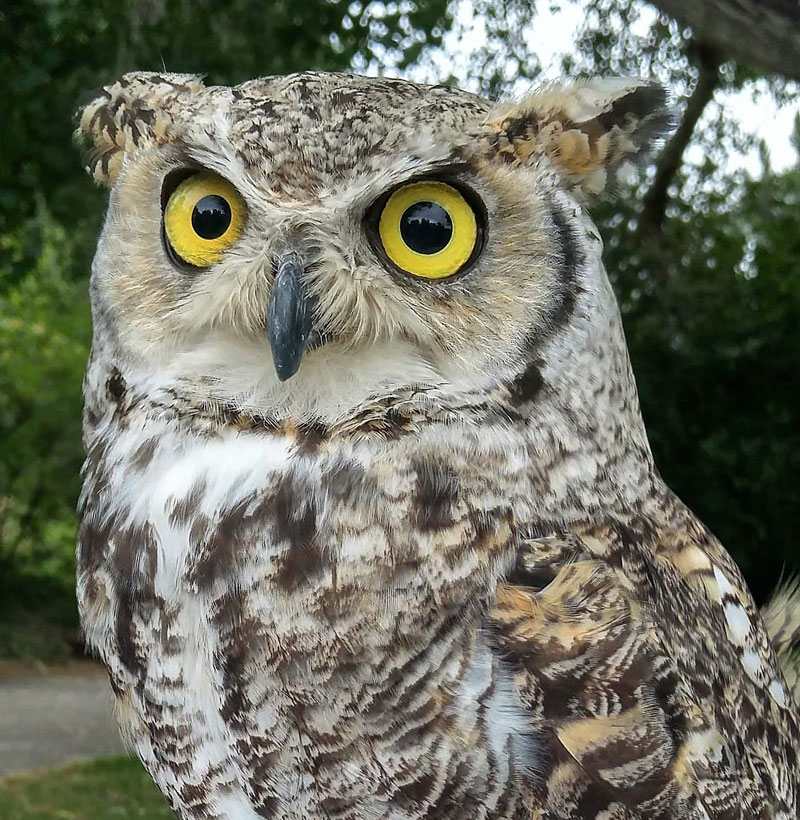
Another one that sticks in my mind occurred as I sat in a tree stand waiting for an unsuspecting deer to wander within arrow range.  I was cold enough to begin thinking of breakfast when a barred owl hooted a couple hundred yards away.  Since I was about to climb down anyway, I hooted back.  Moments later, the owl glided silently past, alighting on a branch a few feet higher than me, perhaps 30 yards away.  He immediately turned on the branch and stared directly at me.  I knew that an owl has the uncanny ability to fix the distance and direction of sound.  I guess that’s not surprising, since they hunt in the dark.  But for this bird to have pinpointed my location from such a distance startled me.  I was in full camouflage, including a face mask, so I didn’t look particularly like a human.  Nevertheless, he had me pegged.

We stared at each other for a long time, neither blinking.  I finally decided that since the jig clearly was up, I might just as well have a little fun.  I hooted at him again.  Within a moment, he launched from his perch with his wings partially folded, quickly gaining speed in his downward swoop on a trajectory right toward my tree.  Unfolding his wings, he completed a parabola that brought him straight up at me.  I might have flinched if I hadn’t been so fascinated.  Just as he came up to my eye level he banked subtly to my right, ticking the tree trunk behind my ear with the tip of his outermost, right wing feather.  The message, as I understood it was, “You’ve been warned.”

Another incident that comes to mind involved a guy I wrote an article about many years ago.  He was going through several hundred gallons of sugar water each year feeding hummingbirds and I paid him a visit to see the swarms of ruby-throats that visited his feeders each day in September.  He would sit in a lawn chair beneath three of his many feeders just enjoying the show.  Sometimes he could get hummers to land on his outstretched finger.

Years later I got a call from the guy.  He thought I would be interested in something he had seen that day.  A roadrunner had taken up residence at his house, and he was really enjoying watching it run down lizards, snakes, grasshoppers and other stuff.  Then, one evening the roadrunner sidled up beneath a nectar feeder and stood still as a statue as birds zoomed in and out.  Then with lightning speed, it jumped up and snatched one of the hummer’s in mid-air.  “Imagine,” he said, “An animal fast enough to catch a hummingbird!”

If you are like me, you might be wondering if the last thing the ill-fated hummer heard was, BEEP-BEEP!

A Chicken named McChick

  • Chickens can be like dogs – they can find a way into your heart. Reasons why are not difficult.
  • On the farm I grew up on, Grandpa called them Chicken Hawks. 
  • The kids from the family next door learned a little more about life that day.
Hudson and Lilly are over for a visit.

By Larry Whiteley

The family next door got a chicken as a pet for their kids. They called it McChick after the McDonalds chicken sandwich. The kids carried it around everywhere. Sometimes, it would come over and roam around our yard without the kids.

At first, I would run it off. Gradually, McChick worked her way into my heart like many dogs in my life had done. McChick could not go on point for quail, flush pheasant, retrieve ducks, or tree a squirrel, but she would leave me an egg once in a while behind a bush. I got to where I would bend down to pet her or pick her up in my arms. When I was burning limbs in my fire pit, she would fly up on the wood pile and cluck away while keeping me company.

I did worry about her. I did not want her to get out on the road and get run over. There were also several neighborhood dogs around. I had also seen a red-tailed hawk flying around. I always knew when it was because the birds would disappear and the squirrels would start making a fuss. On the farm I grew up on, Grandpa called them chicken hawks. We always lost a few chickens to them.

One morning, I walked outside and looked around for McChick but did not see or hear her. Suddenly, I saw movement at the corner of the house and walked over to see what it was. The hawk had McChick pinned to the ground. I kicked the hawk hard to get it off. I was too late. McChick was gone. I picked up McChick and smoothed her feathers. I was sorry that I did not get there sooner. The hawk would not leave its meal and sat on one of our birdhouses, watching me. I put her in a sack and hid it from the hawk before leaving for church.

My buddy McChick visiting with me on the wood pile.

I told my wife what happened. She was worried about how the kids would take it. I texted their mom and told her what had happened. I asked her if she wanted me to bring McChick over so they could bury her. She thought that would be too hard on the kids and asked if I would bury her at our house so they could visit her grave when they wanted to. I agreed.

When I got home from church, I buried her in the shade of several big oak trees where the kids liked to come and sit with me to watch birds on our feeders. I dug a hole and placed her in it. I then took a flat rock, carved McChick into it, and put it at the head of the grave. It was the least I could do for this chicken that had captured our hearts.

Later that day, Mom and Dad brought them over to visit the grave. The kid’s tears flowed. Even the adults were choking back a few tears. They wanted me to tell them what happened with their beloved chicken and see the pictures I took of the hawk.  

That was several months ago. The kids still visit the grave. They will remember this special chicken. So will I. For a little while, in time, God blessed us with a chicken named McChick.

After a few weeks of grieving time, the parents decided to get a new pet for the kids. It was a cat. I know many of you are cat lovers, and that is fine. I have never been attached to cats like I am to dogs or like I was that chicken.

The hawk that killed McChick.
McChick’s Tombstone.

My wife and I have enjoyed feeding birds in our backyard for many years. We have several feeders for songbirds and woodpeckers. Also, houses for the birds so they can raise their babies. We have also planted numerous native plants whose seeds and berries birds love to eat.

Squirrels join the birds at times. We enjoy watching them chasing each other, wrestling, and playing. They are welcome, as long as they do not tear up our bird feeders trying to get to the seed. I put out feeding trays for them so they will not do that.

We have Cardinals, Chickadees, Doves, Sparrows, Wrens, Nuthatches, Bluejays, Juncos, and several woodpecker species during the winter. When spring arrives, they are joined by Yellow Finches, Indigo Buntings, Bluebirds, and more.

Just a few of our bird feeders.

Around mid-March, we start putting up sugar-water feeders for the arrival of my wife’s favorite bird, the Ruby-throated Hummingbird. We also have plenty of native flowering plants to keep them around until they migrate in the fall.

For a short time, in the spring, I put out feeders with grape jelly and oranges to feed the many colorful Baltimore Orioles and Rose-breasted Grosbeaks that stop by on their way to other places.

Watching birds and other wildlife out our windows is more entertaining than anything on our television, computer, or smartphone. The investment we make benefits them when food is scarce. We benefit as well from the joy of watching them. The neighbor kids love to come over to sit and watch them with us.

Now, back to the cat. You cat lovers need to read this whether you feed birds or not. A recent study by the Smithsonian Institution and the US Fish and Wildlife Service estimated that domestic cats kill about 2.4 billion birds a year and have contributed to the extinction of 63 species of birds, mammals, and reptiles.

I have found several dead birds and even a couple of squirrels. I have even watched the cat climb a tree after a squirrel. It is not the cat’s fault. The domestic cat is a predatory species. That means they, much like their wild ancestors, are specialized, solitary hunters.  

Cats and Birds are not a good combination. Bird Conservancy photo

The mere sight and sound of prey triggers a cat’s hunting instinct. Hunting to them is more about fun and entertainment. Quite simply, a cat cannot resist the flapping wings of a bird. Or the movement of a squirrel. If a cat manages to catch a bird or squirrel, they play with it and throw it around. Cats do not usually eat what they kill. As long as their human owners let them outside, they will continue to kill.

I ran the cat off when I saw it in our yard. A couple of times, I even fired a warning shot with my pellet gun. I have put out orange and lemon peels around the bird feeders. The smell of them is supposed to repel cats. But not this cat.

So, is it cruel to keep a cat indoors? Cats are crepuscular, which means they hunt and are active in the evening or early morning. If you want to let them outside, do that from mid-morning to mid-afternoon and then keep them inside the rest of the time. As long as a cat has the space and resources to express all of its natural behaviors and is not frustrated when it cannot go outside, there is no reason it cannot live a happy life inside as a house cat. And, we bird lovers can continue to live a happy life feeding and watching the birds and squirrels.

There are also a few other reasons our neighbors should keep their cat inside. Sometimes, at night, I see their cat out roaming around. I also hear the howl of coyotes. They would love to catch and eat a cat. During the day, when the cat is out, the red-tailed hawk that killed McChick is out there also. It will also kill and eat cats.

My wife and I love the neighbor kids. They call me Grandpa Larry, and my wife Grandma. Hudson and Lilly come over often and are a special part of our lives. I do not want to wipe away their tears again over the loss of another pet. I would not miss the cat, but I still miss a chicken named McChick.