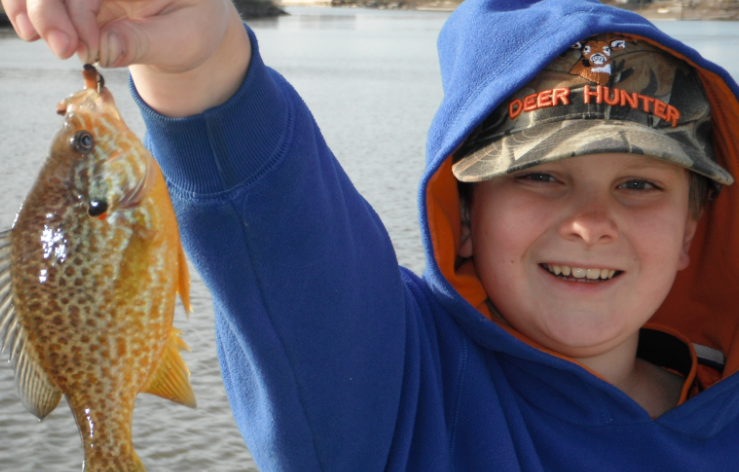
Across the Next Cast – Bobbers and Worms

  • One Pfleuger steel fishing rod, one shiny level-wind Bronson reel filled with solid black Gudebrod braided line.
  • One hook on the end, a sinker a foot above it, a bobber somewhere above that.
  • Somehow, we caught plenty of fish! That’s only part of the story.

By Forrest Fisher
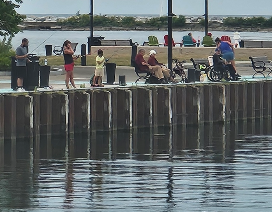
Pier and dock fishing can be simple fun. Forrest Fisher photo.

I was four years old when my dad first took me fishing at the creek.

There was a two-lane road between our house and the water, and when the snow was gone, riding my bicycle down that road toward the creek felt like the beginning of an adventure.

We had one fishing rod—a Pfleuger steel rod fitted with a shiny level-wind Bronson reel. The line was thick, solid black braided line made by Gudebrod, and our rig was about as simple as it gets: a hook on the end, a sinker about a foot above it and a bobber somewhere above that. No leader!

Simple, yet somehow, we caught plenty of fish.

In those early years, around 1952 and 1953, our bait came from the family garden. I dug little redworms from the compost pile beside the tomatoes. Sunfish were usually first to find them, but by changing the depth of the bobber, we discovered rock bass and smallmouth bass, too.

We fished most Saturdays when Dad was home from his job as a design draftsman. He was one of those WWII veteran fellows who could look at an old mechanical contraption and immediately think of a better way to make it work. He said growing up in the depression made everyone think of new ideas. He replaced bushings with bearings, built clever wooden gadgets for Mom and seemed to have a solution for almost everything.

But there was one thing he never tried to improve.

Every morning, Dad got down on his knees beside his bed, leaning against the footboard, and prayed for a few minutes.

The morning clouds brought rain that day, the day that I learned about wishing, hoping and prayer. Forrest Fisher photo

One Saturday morning, I got up early to dig the worms. Then the clouds rolled in and the rain started.

I was crushed. Saturday was fishing day with Dad.

He told me I had better pray for the sun to come out because if the creek became muddy, the fishing probably wouldn’t be very good.

So, I prayed.

I even asked Mom to help. She was at the window, and she smiled as if to say, it’ll probably stop soon.

It did.

That day, I learned something that has stayed with me for more than seven decades: sometimes faith is simply believing that there is a way forward when you can’t see it yet.

I’ve thought about that lesson many times since.

Life isn’t always a clear creek on a sunny Saturday. Sometimes the water gets muddy. Sometimes the problems are big, the answers aren’t obvious, and we’re not sure which direction to go.

When that happens, I try to slow down.
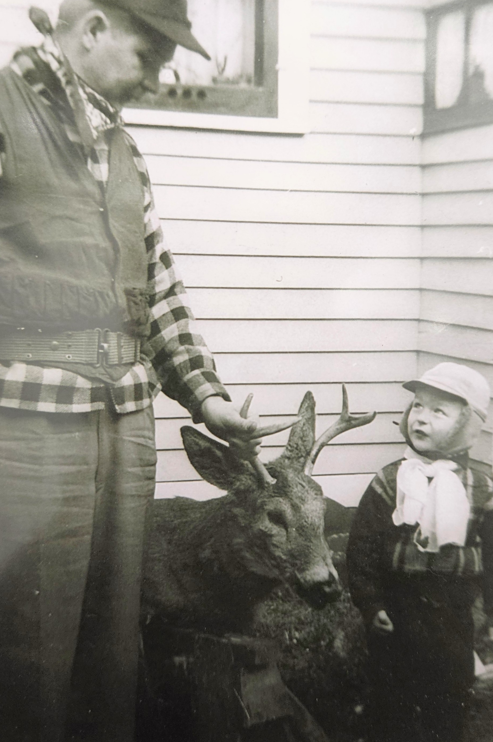
My dad taught me about the outdoors from a very early age. This was 1952. Estelle Barus photo

I ask for help from above. I think about Dad. And then I try to make the next right decision.

It reminds me of fishing the creek with Dad. You don’t always know exactly where the next fish is. You make a cast. You pay attention. You adjust the bobber. You try again.

Today, I still get that feeling.

When I fire up the engine at the dock and head a mile or two out onto Lake Erie aboard our now 30-year-old, 21-foot Sylvan Super Sportsman, a boat of my dreams, I face one of life’s most important questions:

Smallmouth or walleye?

I don’t make that decision alone anymore.

I let the grandkids decide.

Either way, I already know we’re going to have the best day ever.

Before leaving the house, I usually get down on my knees for a minute or two and thank God for giving me one more day to enjoy this incredible world—and, most of all, one more day with my grandchildren.

Maybe that’s the real lesson and the real gift Dad gave me. We’re never in this world alone.

Trust doesn’t mean knowing exactly what will happen. Confidence doesn’t mean having all the answers. Sometimes it simply means making the next cast.

If you’re feeling lost these days, these modern days, maybe you don’t need to solve everything today.

Find a dock or a pier. Walk down to a creek. Call an old friend. Take a kid fishing.

Sit quietly beside someone you love. Sip a coffee.

If it helps, ask for a little guidance from above.

The fish may or may not cooperate. Sometimes, somewhere between the first cast and the last one, we find our way again. Solutions can come in many forms.

Gotta love the outdoors.

Pete’s Stories – Frog’s Croaking, Owls Hooting & Crickets Chirping

  • 98 years young – US Army WWII veteran, full of life and laughs: Life Lessons for us all.
  • Fish tales of the broken braid would keep everyone wide-eyed!
  • Everyone needs to hear the stories about these amazing men and women veterans of the greatest generation. There are not many left.
US Army Tec 5, Gaylord “Pete” Dye, went home to heaven at 98 years young, but he left all of us with life lessons.

By Larry Whiteley

I used to see Pete at church almost every Sunday.  He would be on a bench in the main hallway, telling stories to anyone who would listen.  He knew that I wrote articles for magazines and newspapers about the outdoors.  When he saw me, he always wanted me to come over so he could tell me his fish stories.

Pete would start with, “It was midnight on a hot summer day.  The moon was full, bats are diving in the night sky, and fog shrouds the lake.  I was out fishing by myself in an old wooden boat.  The night was filled with sounds.  Crickets chirping, owls hooting and frogs croaking.  So I take my old fishing rod and throw a top-water bait toward some bushes next to a log.  I let it settle, then start reeling.  It gurgles and wiggles back toward me. Suddenly, a bass, a monster bass, attacks my bait!  It rises from the water with the plug hanging in its jaw.”

Pete would say” I just unhooked that bass and put it back in the water to watch it swim away.” Forrest Fisher photo

Pete always acted out his fight with the bass.  I loved the expressions on his face while he told his story.  Pete would lean back on the bench reeling it in on his imaginary fishing rod.  He would always have a grimace across his face as he turned the reel handle.  His eyes would get big as he described the fish pulling fishing line from his reel.

Sometimes Pete would add to the story with moans about backlashes in his braided line.  He would frown and tell me it required valuable time to untangle.  Then he would smile and proudly tell me that he still got that fish into the boat.  Then he would say, “I unhooked that bass and put it back in the water to watch it swim away.”

Sometimes, he would tell me another story.  It was about another big bass he caught and released, but not on purpose.  “It almost took the rod right out of my hand,” he would say. “When it was close to the boat, it shook loose from the hooks.  I watched it disappear into the darkness of the water.” Of course, like most fishermen, the bass also got bigger each time I heard his story.  Sometimes the bass was so big it was pulling his small wooden boat around.  I listened each time as I had never heard Pete’s fish stories.

Pete is a 98-year-old World War II veteran.  One of “The Greatest Generation.”  He was a U.S. Army paratrooper.  In the European Theater Campaign, he served under General George Patton.  He fought in the Battle of the Bulge and the Battle of Bastogne.  He was also part of the Rhine River Jump.  It is hard to imagine what Pete and all those other men went through fighting for our country.

His daughter Cora told me she flew with her Dad on one of the first Honor Flights for veterans.  Honor Flights are all-expenses-paid trips to the war memorials in Washington, D.C. These flights allow veterans to share this momentous trip with other veterans, remember friends and comrades lost, and share their stories and experiences.

As the plane prepared to land, Cora asked her Dad what it was like back during the war when he was getting ready to land and go into battle.  Pete looked at her and said,  “I don’t know.  I always got on a plane, but I never landed on one.  I was always jumping out of them.”

On Veteran’s Day at church, Pete would bring in a big glass-covered shadow box with all his medals from World War II for all of us to see.  There are many.  He always stood with pride, as all veterans would stand so that we could honor them.  I often saw tears in his eyes as Pete faced the flag with everyone, put his hand over his heart, and we all sang God Bless America.

Up until this year, Pete lived by himself and cooked his meals.  He drove himself to go grocery shopping, other errands, and church every Sunday.  Pete even loved to go out dancing.  He had more energy than most men half his age.  Then cancer reared its ugly head.

Pete is tough.  He is fighting this battle too.  He knows where he is going when his time comes.  I am sure there will be a lot of family and military buddies that will be glad to see him again.  I bet they will get to hear Pete’s fish stories too.

I visited Pete with a friend from our church, Dan Bill, at the home Pete built many years ago.  His daughter Cora seated us in the living room and went to tell Pete we were there.  Pictures of his wife, four children, 10 grandchildren, 25 great-grandchildren, and two great-great-grandchildren were on every wall.  So were pictures of a younger Pete in his army uniform.  The shadow box with all his medals was there too.

I was expecting to see him in bed.  Instead, Pete slowly walked into the room with support from his cane and sat in his favorite chair.  He was glad to see us, but I could tell he was tired and in pain.  We didn’t hear any fish stories that day, but we did hear several war stories.

Every year, we lose more men and women who sacrificed so much for us during WWII.  Less than 30,000 of the 16 million men and women who fought in World War II are still alive.  There won’t be any of them left in a few more years.  Only twenty percent of the 6.8 million men and women who fought in Korea are still alive today.  Veterans like me from the Vietnam era are in their 70s now.  Veterans lucky enough to return home from the Gulf War, Iraq, and Afghanistan came home with scars.  Not just on their bodies but in their minds.

Our kids and grandkids need to hear the stories about these men and women.  When we hear our national anthem, those that kneel need to listen to their stories.  Those who protest and disrespect our flag need to listen to their stories.  Our politicians need to listen to their stories.  Then they need to do everything possible for these men and women.

Stories told among friends are the best. Larry Whiteley (L), Gaylord “Pete” Dye (M), Dan Bill (R)

We all need to take the time to thank our military men and women who served our country or are serving now.  Not just on Veteran’s Day each year.  We need to do it every time we have the opportunity.  If you see a veteran wearing their branch of a military service cap, thank them in some way.  That’s the least we can do for all they did and are doing for each of us.

Every Sunday, when I come in the front door of our church, I still look over at the bench where Pete sat.  I see him in my mind’s eye telling me fish stories.  As I stand before everyone to give the weekly church announcements, I look to where Pete was always sitting a few rows to my left from the front.  I wish he could still be there proudly wearing his World War II Veteran cap.  I miss hearing Pete’s stories. Everyone will.

Special Note: Pete (US Army Tec 5, Gaylord Dye, by real name) went home to heaven last week. I bet he is up there telling stories.