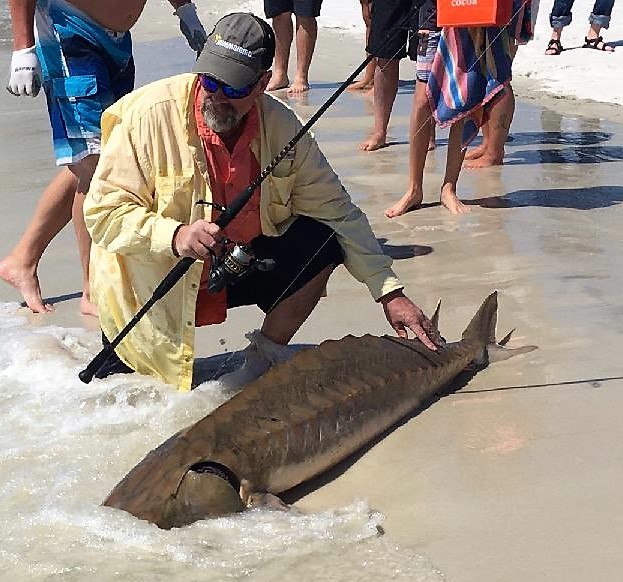
Rare Gulf Sturgeon caught in the Surf – near Orange Beach, Alabama

David A. Rose with a rare Gulf sturgeon caught in the surf at Orange Beach, Alabama.

  • Weighing 120-130 pounds, the rare fish fought for 40-minutes, was landed, then was carefully unhooked, and safely released alive and well.
  • Gear: Penn Battle II – 5000 series spinning reel, 8-ft Penn Battle II surf fishing rod, 20-lb Silver Thread mono, 40-lb test shock leader, and a Dusty Hayes Pomp Rig w-1/0 Circle hooks.
  • Secret: Live ½ shrimp bait, wrapped to hook w/Atlas Mike’s Spawn Net & Magic Thread.

Story by the angler, David A. Rose

When it comes to surf fishing the freshwater beaches of the Great Lakes and inland lakes near my home in the Traverse City, MI area, I can usually hold my own. On the other hand, when it comes to casting and proper fishing in saltwater, I’m an apprentice.

Ever so slowly, though, I learn something new about surf fishing in the Gulf of Mexico. The sugar-sand near Orange Beach, AL, provided the fun. The date was March 6, 2021, and my regular morning catch included the usual whiting, croakers, flounder, Gofftopsail catfish, and the like. Then at about 11:35, one of my two rods signaled another tell-tale hit. The day was about to change! About 40-minutes later, after coming close to spooling me twice, this fish, a Gulf sturgeon over 6-feet in length – a fish with prehistoric roots – was tailed, beached, and released.

This particular fish—one of the rarest species on earth and protected by the Endangered Species Act–would likely have been the all-time world-record catch for hook and line. No one on hand recorded any official length or girth before the behemoth was unhooked and freed to swim away, no worse for wear. I didn’t want to take any chances of injuring the fish.

To get an idea of the sturgeon’s length, I spread out my arms—which have a span of about 6 feet. The nose and tail of the fish were both well beyond my reach. I tried rolling the fish over to remove the hook from its mouth, but it was too heavy. The fish was on the sand, it was impossible to move the fish without possibly harming it, and I estimated that it weighed 120 – 130 pounds. It wasn’t until a large rogue wave rolled in that I was able to gain enough leeway to swing the tail so it could swim out. It still had the hook secured in the mouth, but thankfully, it could swim out, taking about another 100 feet of line with it. I reeled the giant in once more, this time to water about 2 feet deep. That’s when the fish could be turned belly up, and I was able to finally remove the hook.

The rig I used was a hand-tied “Dusty’s Pomp Rig – 2/Drop,” with multi-colored floats made by Dusty Hayes of Sam’s Bait & Tackle, of Orange Beach, AL. The fish ate half of a live shrimp that I purchased from nearby Lost Bay Tackle & Guide Service and I had wrapped with Atlas Mike’s Spawn Net & Magic Thread in orange color.

The fish ate half of a live shrimp purchased from Lost Bay Tackle & Guide Service in Orange Beach that I had wrapped with Atlas Mike’s Spawn Net & Magic Thread. It’s a neat trick that kept the bait tight to the hook during the cast, allowing the scent and sight of the bait to work as it should. The rig was a hand-tied “Dusty’s Pomp Rig – 2/Drop,” with multi-colored floats made by Dusty Hayes of Sam’s Bait & Tackle, also of Orange Beach. The rig is comprised of 20-pound-test Momoi Diamond monofilament and size-1/0 Mustad circle hooks. I fished the rig in the building surf with a 4-ounce pyramid sinker.

The rig is comprised of 20-pound-test Momoi Diamond monofilament and size-1/0 Mustad circle hooks. Mamoi photo

As for my gear, the reel was a 5000 Penn Battle II spinning reel spooled with 20-pound-test Silver Thread AN-40 monofilament, tied up a 20-foot shock leader of 40-pound-test Berkley Big Game mono. I used a Uni-to-Uni knot to bring those lines together. The rod was an 8-foot graphite moderate-fast-action Penn Battle II surf spinning rod rated for 12- to 25-pound mono. As a combination rig, it was enough to subdue the goliath.

Before getting a good look at the fish, there was no doubt in my mind that I had hooked some species of shark. But when its back broke the surface, there was no dorsal fin. By the time the fish was reeled in, over 100 spectators had gathered. When the fish started to tire, an onlooker—who, it was obvious, had some knowledge of fishing—tried tailing it for me. The armor plating of the fish was too slick. So, I asked my wife, Carol, to hand him my Rapala Fisherman’s Gloves. These allowed him to get a firm grip. That’s when the Sturgeon was able to be beached.

An educated guess, at the time, had me thinking the fish was an endangered species. So, I made sure the head and gills stayed in the surf while I posed for a very quick photo and checked for any tags. None of the latter were found.

Earlier that day, I had chosen my casts in the 2- to 3-foot surf along a section of a riptide that was flowing into the Gulf, thinking it would be an area fish would congregate to forage on bait wafting out with the current. My guess was correct. This particular fish was hooked out front of the Phoenix VI condominiums, about ½ mile west of the Perdido Pass jetty.

Gulf Sturgeon reside in the Mississippi Delta and east along Florida’s Gulf side. Via social media, a few people stated they’ve seen Sturgeon breaching at the mouth of Perdido Pass. After another post about this catch on the Alabama Gulf Coast Surf Fishing Facebook page, I hoped that local biologists might become aware of the catch. The ploy worked.

I discovered that the Gulf sturgeon is an anadromous fish (living in saltwater but spawning in freshwater). “Overall, these rare fish spawn in the freshwater rivers of the Gulf region in spring,” says Jeff Powell, assistant field supervisor from the Alabama Ecological Services Field Office for the U.S. Fish and Wildlife Service. Powell added, “Our studies are showing there may be a few that migrate and spawn in the fall, as well. The Gulf sturgeon you landed is most definitely a once-in-a-lifetime catch.”

The one thing I love most about fishing saltwater? You never know what species you’ll hook next. This fish, a species so rare to even see let alone catch, is proof of that.

FLUORO for the COLD FLOW – Winter Trout Fishing with a Fly Rod

Fly Rods for winter fishing can be honest fun. Photo courtesy of Jon Ray

By David Rose

It had been well over a decade since I’d last set foot in the fast-flowing river very near Colorado’s Continental Divide with fly rod in hand. The change in esthetics surrounding the waterway was extreme.

The alteration in environment most obvious was how the once little town at its headwaters had grown so substantially it was now surrounding its banks several miles further downstream. One good thing was there was more angler access to the river; the bad was the rainbows, browns, cutthroat and brook trout in this flies-only catch-and-release section had all been fooled at one time or another by just about every type of fuzz and feather combination one could imagine.

To say the fish that reside here all winter are weary of every offering that wafts past them is an understatement. Luckily, I consulted with those in the know at the local fly shop and was able to catch a few of the finicky fish because of the tips and tricks they shared.

What I found interesting was there was little reform from years ago when it came to the tiny, down-to-size-22 nymph imitations that were suggested I drift under my strike indicator. The one thing the fly-flinging professionals were adamant about this time around, however, was that fluorocarbon leaders were a must if one were to fool a fish into striking.
And it worked.

Winter steelhead can provide an awesome battle, no time to get cold. Photo courtesy of Jon Ray

The rod I packed in my carry-on was a 4-piece, St. Croix 5-weight Imperial, perfect for the miniscule nymphs I bought at the shop. A couple packets of Seaguar’s Knotless Tapered Leaders in size 7X (thinning down to 2-pound test at its tip) were also purchased. A few of my casts were actually flawless enough to fool a few fish; in reality, more fish than the last time I was here. And I do believe it was the presentation of my flies and the hook-setting abilities of this thin 100% fluorocarbon line that made the difference.

Fluoro facts for flies:

Fluorocarbon is now a standard go-to for so many fishing applications, including fly fishing.

“First off, you need to get your fly down into the water column faster in winter,” says Jon Ray, a full-time fly-fishing guide with Hawkins Outfitters near my home waters in Michigan’s Northwest Lower Peninsula. “Casts tend to be shorter this time of year, and the fish are in smaller areas of a river; fluorocarbon tippets allow your fly to sink quicker, as well it will stay in strike zone from the top to the bottom of the drift.”
More fluorine atoms and less hydrogen than monofilament is what makes fluorocarbon pack more mass into the same space. It’s more compressed because the fluorocarbon resins give it close to neutral buoyancy. It’s a great choice for vertical personations, like dangling a fly under a strike indicator.

It also has less stretch due to its denseness, which allows an angler to get good hook sets; especially when using the light-pound-tests lines needed for proper presentations of such minuscule bugs during the winter months.  “And fluorocarbon is thinner than monofilament, which creates less drag in the water helps your fly drift more naturally,” Ray adds. “And if your fly isn’t drifting perfectly with the current, your bug’s not going to get bit. Period.”

Opposites attract:

But it’s not just nymphing on ultra-light tippets that take trout during the winter months, especially when targeting the largest fish in a system.  “While big trout will suck up a little bug once in a while, it’s not their meat and potatoes,” states Fly-Fishing Guide Russ Maddin, who’s created some of modern day’s most popular streamers for trout. “Big fish eat little fish, and I’m not just talking small minnows and whatnot, but other younger, 5- to 8-inch trout in the system, as well.”

Maddin’s been using fluorocarbon tippet material for stripping big streamers for years, and says this tactic is no place for light line and finesse, even when these cold-blooded fish seem lethargic within their ice-water realms.

“You’ll have to slow up your stop-and-go retrieve a little compared to when the water’s warm, with longer pauses in-between pulses, but you really don’t need to lighten up your leaders,” Maddin adds.

Twelve-pound-test (1X in Seaguar’s Max Fluorocarbon Tippet Material) is the lightest Maddin may tie on, but overall 14-pound test (1X in Grand Max Tippet Material) is his go to. No matter the test, it’s the condensed make up of fluorocarbon that keeps his streamers in the strike zone, neither rising or falling on the pause.

Timing and safety:

Two things rookie fly anglers often overlook when their planning a winter’s fly-fishing excursion is the time of day to hit the river, as well, taking a few extra precautionary steps for one’s safety.

Unlike summer months when dawn and dusk may be the best times for catching, smackdab in the middle of the afternoon is usually best for fly fishing in winter. It’s during this time when the waters will warm to their maximum for the day, and all it takes is a half-degree rise in water temperature to turn inactive fish active. And unlike other times of year, the brighter the sun overhead the better the bite can be.

Even if your legs are strong, it’s not only a good idea to have a wading staff with you, but to use it. One quick jab into the river bed and you’ll be able to catch your balance if, say, a rock overturns under foot. Donning ice cleats with small carbide spikes, like the slipover Ice Creepers from Frabill ice anglers wear, will keep you steady-footed if it’s cold enough that ice starts forming on the rocks, or in areas with algae covering the bottom.

Up your odds:

Overall, fly fishing in the heart of winter isn’t all that different than the summer months. Your goal is to imitate nature to a tee with nothing more than feathers and fur that’ve been spun onto a hook.

As I learned from my last trip to the Colorado Rockies, keeping your fly drifting behind a thin, strong, and nearly invisible fluorocarbon leader will up your odds greatly.

Photo courtesy of Jon Ray