

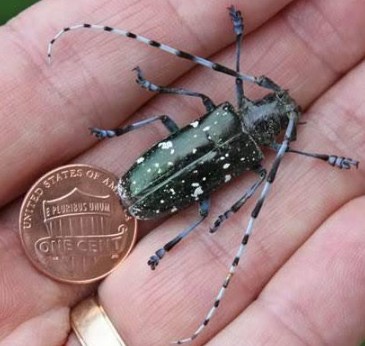
- Watch for Invasive Beetles
- The Asian long-horned beetle attacks many hardwoods, especially in the northeast, including maple, birch, elm, poplar, willow, and ash.
- Most invasive insects are first discovered by ordinary citizens—not scientists.
By Forrest Fisher
By August and into September, most outdoorsmen and women are focused on late-summer fishing, scouting for deer season, or enjoying a walk through the woods. Toward the end of each summer, especially this year, right now (Aug-Sep 2026), offers an opportunity to help protect one of our greatest natural resources—our forests.
The U.S. Department of Agriculture designated August as “Tree Check Month,” encouraging the public to watch for signs of the Asian long-horned beetle (ALB), an invasive insect first discovered in Brooklyn way back in 1996. Although eradication efforts have eliminated the beetle from several infested areas, continued vigilance remains essential to keeping it from spreading.
The Asian long-horned beetle attacks many hardwoods, especially in the northeast, including maple, birch, elm, poplar, willow, and ash. The adults are strikingly notable insects, shiny black with white spots and long black-and-white banded antennae. The real damage, however, is caused by the larvae of this critter, which tunnel deep into the wood, disrupting the tree’s ability to move water and nutrients. Once a tree is infested, it cannot be saved.
Watch for perfectly round exit holes about the size of a pencil in trunks or larger branches. The NYSDEC, among many conservation management organizations asks homeowners to check swimming pool skimmers and filters during the late summer, as backyard pools often trap adult beetles. If you suspect you’ve found one, photograph it and please email the image to foresthealth@dec.ny.gov. They will help organize your data with others to formulate a plan for control with other states.
Unfortunately, the Asian long-horned beetle is not the only invasive pest to challenge our forests. Over the past 20 years, the emerald ash borer has killed millions of ash trees across the state, transforming woodlots, parks, and neighborhoods. My hunting stands were all initially set up from Ash trees. These trees are all gone now because of the emerald ash borer. The hemlock woolly adelgid continues to threaten eastern hemlocks, trees that provide cool shade for trout streams, stabilize streambanks, and offer important wildlife habitat. More recently, the spotted lanternfly has spread into New York and other northeast states, raising concerns for vineyards, orchards, and several tree species.
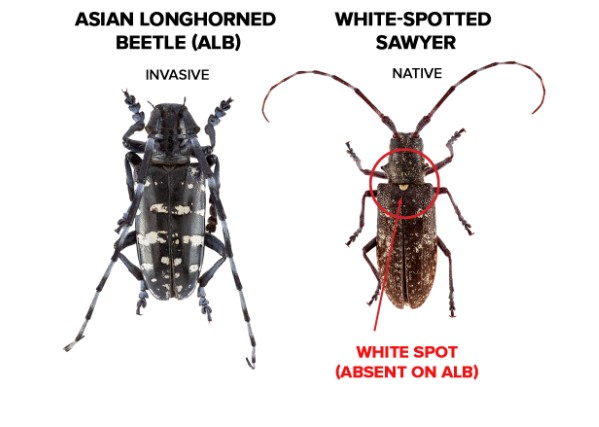
These insects have one thing in common: they arrived without the natural predators and diseases that help keep them in balance in their native habitats. Conservation is, at its core, about maintaining that balance.
Healthy forests support wildlife, protect water quality, provide recreational opportunities, and sustain the outdoor traditions that define much of the country.
Most invasive insects are first discovered by ordinary citizens—not scientists.
A few minutes spent looking closely at the trees around your home, camp, favorite fishing stream, or hunting property can make a real difference.
Early detection gives resource managers the best chance to contain new infestations before they spread.
As this summer passes into fall, enjoy the outdoors as you always do—but take a moment to look up and around. Your observation could help protect the forests that future generations will hunt, fish, hike, camp, and enjoy.
For information on identifying and reporting the Asian long-horned beetle, visit the NYSDEC Forest Health webpage (https://dec.ny.gov/nature/forests-trees/forest-health).
Gotta love the outdoors.