When Cold Front Crappie Won’t Bite – Check the Big River Tailraces

  • Lake Wheeler, Wilson and Pickwick, 0ffer the availability of fishing the tailraces – many species hold there.
  • We caught catfish (blue, channel and flathead), bass (smallmouth, largemouth, spotted and white) and enough drum to fill a roadside trash can.
  • Lodging available at Joe Wheeler State Park, which sits on the banks of the Tennessee River near Rogersville.

By DAVID RAINER, Alabama Department of Conservation and Natural Resources
What do you do after you plan a trip to north Alabama to get in the fall crappie bite and you’re greeted with bluebird skies the day after a cold front? You make lemonade, and the Tennessee River lakes have just the right recipes.

Capt. Brian Barton, Andy Poss and I still wanted to try to catch enough crappie for a small fish fry and headed into the Bear Creek area despite the weather conditions. We found crappie on the forward-facing sonar, but almost all of them had the lockjaw, a common occurrence after a front. We tried small jigs with a minnow, jigs alone and minnows alone, but the crappie just ignored any of the offerings.

The great thing about fishing those lakes, especially Wheeler, Wilson and Pickwick, is the availability of fishing tailraces for anything that will bite a live shad, either a small gizzard shad or threadfin.

After loading Barton’s 23-foot War Eagle boat onto the trailer, we found gizzard shad flicking near the boat ramp on Wheeler. We headed to the Wheeler tailrace with a bait tank filled with the 2- to 3-inch shad. Obviously, as anyone who has fished the tailraces knows, the most productive time to fish is when the generators are running and the water is flowing through the dams.

As required by law, we had donned our life jackets before approaching the dam and headed to the edge of the swift current. Drifting a shad down the edge of the current line with just a split shot started producing action. However, you don’t get to choose the species. You set the hook and take what you get. It may be bass species, catfish species or freshwater drum (known as gaspergou in Louisiana).

Because we tried to catch crappie first, we were a little late to the bite at the Wheeler tailrace due to the generation schedule, which had shifted from afternoon to morning because of the cool nights.

The next morning, we headed to the Wilson tailrace, which doesn’t have quite the dramatic water flow of Wheeler but is still a highly productive fishing spot. The tactics were similar, finding edges to let the bait drift with the current.
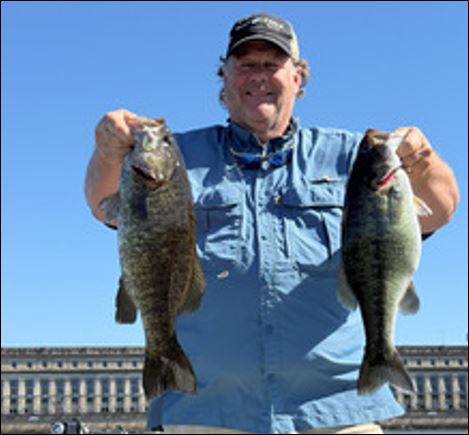
Brian Barton shows off a smallmouth bass (L) and a spotted bass (R) caught in the Wilson Lake tailrace recently. David Ranier photo

By the end of the tailrace fishing, we had caught catfish (blue, channel and flathead), bass (smallmouth, largemouth, spotted and white) and enough drum to fill a roadside trash can.

“In the fall up here, from the end of September all the way until Christmas, shad migrate to the dams, and everything else follows,” Barton said. “You have multi-species action for about three months, solid. When I have clients, I catch bait before I pick them up, and then we go to the tailraces. We may drift, anchor or Spot-Lock (trolling motor feature using GPS to stay in one location) in different areas, but it will always be with a live shad.”

Barton said the Tennessee Valley Authority (TVA) controls how and when he fishes because the agency’s electricity generation dictates current flow.

“The stronger the current, the more the fish are going to be pulled out into the river,” he said. “With a lighter current, the fish are going to be more spread out and harder to catch. Also, the bright sunny days means the fish tend to stick close to structure. On cloudy days, they are more spread out. Ideally, the best day would be good current flow with sunshine.”

Barton said TVA has an app (www.tva.com/environment/lake-levels/tva-lake-info-app) that anglers can use to determine the generation schedule and dam water output for each lake. The app shows what the current flow is for the specific lake, the history for the previous six hours and a projection of water flow for the following two days.

“It (the projections) doesn’t change much,” he said. “But on our trip, you saw it change. It had been afternoon generation. Then we got a cold front with cooler nights, and it changed to morning generation. From now until March or April, it will stay mornings. As it warms up next spring, it’ll flip back to afternoons.

“Ideal current flow below Wheeler Dam would be 30,000 to 50,000 (cubic feet per second), and below Wilson it would be 30,000. Wheeler can generate up to 98,000. If you start getting over 50,000, which is great current, you just go down the river because it’s too tough to battle it near the tailrace. But that really turns the fishing on down the river, where if you’ve got 25,000 or 30,000, you’re pretty much forced to fish closer to the dam because you don’t have enough current down river to position the fish.

“But I want to caution people to not go to that dam unless you know what you’re doing, and, by all means, wear that life vest.”

When he’s fishing with live bait, he’s looking for two different locations where the fish are likely to hold to be able to ambush anything coming out of the tailrace.

“There’s two theories,” Barton said. “There’s site specific fishing on rockpiles, ledges or wood. Most of the time, I do better just drifting. My theory is I go to the spot where I caught them the last trip. That doesn’t always work because the fish move, but I start there first. If I start a drift in 12 feet of water and don’t do any good, then I’ll move up to 8 or 9 feet or I’ll go to 14 or 15. That’s all I do is move my depth. It’s just a matter of if they’ve moved deep or shallow.

“When you’re fishing the tailrace, it’s all about seams. I don’t think bottom structure has anything to do with it. It’s where two currents meet and create a seam or the outside edge of the current. But that’s not just the tailrace. Anywhere you go down the river that has an abutment or anything sticking out can create a current change. That structure may be the size of my garage, and it’s going to create that seam. That’s where the fish are going to be most of the time.”

Barton said when clients ask about a fishing trip, he tells them to expect to catch multiple species of fish in a five-hour trip.

“It could include a miscellaneous sauger or skipjack (herring), but seven species is what two people in this boat are normally going to catch,” he said. “With good conditions, I expect to catch 40 to 50 fish in a five-hour trip. Now, that’s not a great day. That’s just what I expect to catch. And, if you’re lucky, you can catch a four-pound smallmouth. That’s very doable. A five-pound smallmouth is what we call a trophy fish. If I have people who just want to catch smallmouth, that’s what they’re looking for.

“Most of my clients are just people who want a bent rod and to have fun. If they catch a four-pound smallmouth, that’s just a bonus. Most people just want to catch fish, and that’s why I like to call it a multi-species fishing trip.”

Visit www.brianbartonoutdoors.com or call 256-412-0969 for information about fishing on the Tennessee River. Other than the multi-species trips, Barton also does seasonal fishing that targets species like catfish, crappie and bream, both bluegills and shellcrackers (redear sunfish).

When you’re in northwest Alabama, don’t forget about the lodging available at Joe Wheeler State Park, which sits on the banks of the Tennessee River near Rogersville. Joe Wheeler has perfect accommodations for anglers, including the cabins away from the main lodge. The cabins are located on the south side of the Tennessee River near Wheeler Dam. This area has accessibility to both Wheeler and Wilson Lakes. A boat launch for Wheeler Lake is available in the cabin area, and another boat launch is located across Highway 101 at Wheeler Dam for Wilson Lake access. Visit www.alapark.com/parks/joe-wheeler-state-park/cabins for details. Also available is the Fisherman’s Cabin, located near the boat launch on First Creek.

After your fishing trip, Colbert County has an abundance of places to visit, including the Helen Keller home, Fame Recording Studios, Muscle Shoals Sound, the Alabama Music Hall of Fame and the Coon Dog Cemetery. Visit www.colbertcountytourism.org/attractions for more information.

Alabama’s 1st Sandhill Crane Hunting Season Deemed a Success

  • This is the first of four experimental seasons under U.S. Fish and Wildlife Service regulations
  • In Alabama, 400 permits were issued with 3 bird tags/permit (1,200)
  • Alabama permit numbers and management plans are expected to the same for 2021
Click the picture to review Alabama FAQ – understand details, visit the questions and answers here.

By DAVID RAINER, Alabama Department of Conservation and Natural Resources

Another warm winter left Alabama’s duck hunters frustrated, but those who were lucky enough to score a permit for the first sandhill crane season in the state were elated. Although not all of the 400 crane permit holders were able to harvest one of the large birds, those who did, raved about the new hunting opportunity.

Jason Russell of Gadsden, Alabama, and his 17-year-old son, Grayson, both drew permits, which allowed a harvest of three birds each. The first order of business was to secure a place to hunt sandhills in the hunting zone in north Alabama. Fortunately, a friend from Birmingham had connections with a landowner near the Wheeler National Wildlife Refuge, and they were granted permission to hunt. “We were excited to get an opportunity to hunt the sandhills,” said Russell, an avid duck hunter and award-winning decoy carver. “We’d seen them around for years. We really didn’t know the reality of what it would take to kill one. Once we were drawn, we thought we’d give it a shot. We bought decoys and got ready. What was interesting this year, everywhere I went, I saw cranes. At Weiss Lake, at Guntersville, everywhere we went, we at least saw cranes flying.”

On the morning of the first hunt, the Russell’s saw several cranes in the field they planned to hunt and saw several more in the air. After setting up their decoys, both full-body and silhouettes, they settled into their blinds. “Within 20 minutes we had a group of birds fly 15 yards over our decoys,” Jason said. “We ended up letting them go because we were so awestruck that our setup actually worked. We were kind of surprised. Another 20-30 minutes went by and groups of two and three came by. On our first hunt, three of us had permits, and we killed six birds on an afternoon hunt that lasted maybe two or three hours. We were pretty excited that you could actually decoy them. After duck and goose hunting for 30 years, this gives hunting a new twist and new excitement.”

The Russell’s had planned to hunt cranes just like they would geese in an open field with layout blinds. They soon discovered natural vegetation helped them hide much better. “There was some scrub brush sticking up,” Jason said. “I thought, well, let’s at least be comfortable. There was enough brush to where we could get hidden. We put our full-bodies out at 20 yards, hid our faces and kept our heads down. We were shooting decoying birds at 15 to 20 yards.”

The hunters left that area undisturbed for three weeks before attempting a second hunt. They were even more awestruck when they arrived at the hunting land. Jason needed two birds to fill his tags, while Grayson only needed one. “When we got there, there must have been between 200 and 300 sandhills in the field,” Jason said. “After we got set up, three birds came in and I doubled up.” With only one tag left, the cranes seemed hesitant to decoy.

Jason Russell, center, and his two sons, Grayson left, and Jonathan, shows the results of a successful sandhill crane hunt in north Alabama. Photo courtesy of Jason Russell

The Russells soon figured out that trying to mix crane hunting and goose hunting might not work very well. “We had put out full-body goose decoys to try to kill a few geese while we were there,” Jason said. “It was interesting that the cranes seemed to be skirting our decoys. We decided either we were going to have to move or do something different. We made the decision to pull all the goose decoys. By the time we pulled the last goose decoy and got back in the blind, we had a pair of sandhills at 15 yards. My son rolled his out, and we were done. It could have been a coincidence that we pulled the goose decoys and we killed one, but I feel like they flared off of the full-body goose decoys. We were just catching the cranes traveling from one field to another. I guess they decided to drop into our decoys to see what was going on.”

Before the hunt, Russell was afraid that it might be possible to mistake a protected whooping crane for a sandhill crane. That turned out to be an unrealized worry. “One of my fears was being able to identify the birds if we were in low light,” he said. “Sometimes when you get the sun wrong, you can’t see color that well. I thought we were going to have to be really careful to look out for whooping cranes. But that was not a problem. The whooping cranes stood out like a sore thumb. We made sure there was no shooting at all when those were in the area. And we never shot into big groups of sandhills. We never shot into groups of more than four birds. I felt like we didn’t educate them for the most part. If people will be smart and shoot the birds in the decoys or really close, then it will be a good thing for years to come.”

Jason said it was “awesome” that he and Grayson both got permits in the first year of the new sandhill season. “To get to shoot our sandhills together was special,” Jason said. “On our first hunt, we shot into a group of three birds and each of us got one. It was really exciting to get to have that moment of father-son hunting. It was just a neat, awesome experience that we will never be able to share again in waterfowling.”

Jason took his youngest son, 13-year-old Jonathan, on the second hunt to share the experience although Jonathan wasn’t able to hunt. “I just wanted him to see it,” Jason said. “I was excited for him to get to watch and hear the sounds of how loud those birds really are. It was amazing. He carried one of the birds, it was a big, mature bird and he cradled that thing all the way out of the field.”

The excitement wasn’t over for the Russells when they prepared the crane for the dinner table. “Cooking them was phenomenal,” Jason said. “We cooked some one night and took a little to a church group. One of the guys who doesn’t eat wild game said it was the best meal he’s eaten in his life. It was very flavorful. I thought it would be more like a duck, but it wasn’t. We enjoy eating duck, but I could eat way more sandhills. It was just so tender. I’ve always heard sandhills were the ribeye of the sky. Now I believe it. When you put it in your mouth, it tasted like steak. It was tender and juicy. Oh my gosh, it was so good.”

Seth Maddox, the Alabama Wildlife and Freshwater Fisheries Division Migratory Game Bird Coordinator, said the duck season was indeed disappointing, but he was enthusiastic about the first sandhill season.

The final results of the sandhill season won’t be available for a couple more weeks to allow permit holders to complete their post-season surveys. Maddox said he expects the final numbers to be in line with other states with sandhill seasons. “From the hunters we’ve talked to, it seems to be a pretty successful sandhill season,” Maddox said. “We’re expecting a harvest rate of about 30 percent, which will be a little more than 300 birds.” Maddox said the warm winter not only caused diminished duck numbers in Alabama but also affected the sandhill population.

“Sandhill numbers were a little below normal for the birds we typically over-winter here in Alabama,” he said. “Our 5-year average is 15,000 birds. This year, we estimated the population at 12,000, which made for a little tougher conditions for hunters. The birds tended to concentrate in areas closer to the refuges.”

Maddox said the sandhill season is the first of four as an experimental season under U.S. Fish and Wildlife Service regulations. He said the number of permits (400) and tags (1,200) will be the same next year.

Alabama’s sandhill harvest rate is similar to that of Tennessee and Kentucky, which surprises Maddox a bit.

“Our season was probably a little better than I expected,” he said. “Our hunters had never done it before. They had to find people willing to give them access to hunting land. Hunters got to make new friends. I think it was a very successful season.”

Outdoor Alabama’s Wild Eats Page…Find and Share Recipes

  • More and more people are interested in wild table fare, which has made learning to hunt a priority.
  • Outdoor Alabama gives everybody the opportunity to cook wild game with unique recipes.
  • Outdoor Alabama gives everybody a place to share their best recipes.

By DAVID RAINER

Alabama Department of Conservation and Natural Resources

If your hunting season has gone well and you have plenty of wild game to prepare, you may be looking for new ideas on how to put the best dishes possible on the dinner table. Or you could be a novice hunter getting ready to prepare a meal with wild game for the first time and looking for helpful resources.

With that in mind, the Alabama Department of Conservation and Natural Resources (ADCNR) website, Outdoor Alabama, has just what you’re looking for in the new Wild Eats page at www.outdooralabama.com/WildEats. The page features a list of tasty recipes for a variety of wild game.

Courtesy of the Alabama Department of Conservation and Natural Resources.

“The culmination of a hunting or fishing trip is food,” said Billy Pope, ADCNR’s Communications and Marketing Director. “We wanted to provide a platform on Outdoor Alabama that gives everybody the opportunity to cook wild game with unique recipes and a place for everybody to share their recipes.

“We’re asking people to submit their unique recipes for wild game and fish. We’ve already had submissions for stir-fried duck and collard green soup with venison.”

Pope also said ADCNR realizes many late-onset hunters are pursuing wild game with a different mindset from who grew up in a hunting culture.

“People being introduced to hunting or wanting to learn to hunt are doing it for a different reason,” he said. “They want to harvest their own meat, so they know where it comes from. They want sustainable, healthy protein for their families.

“More and more people are interested in wild table fare, which has made learning to hunt a priority. ADCNR’s Adult Mentored Hunting Program has been able to fill the void and introduce new hunters to the art of field-dressing and butchering wild game.”

Justin Grider, ADCNR’s Wildlife and Freshwater Fisheries Division R3 Coordinator, said the process of placing tasty wild game dishes on the dinner table starts well before the hunt.

“Before it’s time to hunt, you need to become proficient with whatever firearm or bow you’re using,” Grider said. “You want to make sure it is shooting where you’re aiming so you can make a good, clean, quick kill. You owe that to the animal as a hunter to make that as quick and painless as possible. When you are proficient with the firearm or bow, it leads to a better end-product when it comes to putting it on the dinner table.”

When the hunter makes a quality shot, it leads to a quick recovery of the animal, and the processing of the animal can proceed without delay.

“The quicker you can get those internal organs and entrails out of that animal, especially deer, and get that body cavity cooled down, the better,” Grider said. “You’re fighting three things – heat, moisture, and dirt. You’re trying to avoid all three.

“Most days in Alabama are relatively warm, so if you don’t have access to a skinning shed, grab a couple of bags of ice from the nearest gas station and throw it into the cavity, so it starts to cool down that body cavity. Make sure you get the ice between the hip joints. There’s a lot of heat down there. When you get that cooled down, it will delay any bacteria growth and meat spoilage.”

Grider said when you’re able to get the animal field-dressed in a reasonable amount of time, it allows you to move to the next step in providing that quality wild game for the family.

“I like to let my deer age for seven days,” he said. “If you have access to a walk-in cooler, you can let it hang and allow that deer to go through rigor mortis. That whole product will start to break down and become more tender. If you don’t have a walk-in cooler, which most of us don’t, you can quarter the deer and age that animal in a 55-quart cooler.”

The key to using an ice chest/cooler is to keep the meat elevated above the ice by using some type of rack or baking sheet to keep the meat from coming in contact with any water from the melting ice. Refresh the ice often to maintain the proper temperature.

“That will accomplish the same result as if you had used a walk-in cooler,” Grider said. “That’s going to lead to your best-tasting product. Any time you can age that meat for seven days, that’s the magic number.”

After the aging process is complete, Grider starts with the hind quarters. He debones the quarters and separates the muscle groups. He trims as much of the connective tissue as possible and decides whether to use the meat for roasts, steaks, jerky or ground venison.

“I start from the back of the animal and work my way forward, all the way up to the neck,” he said. “I save that neck roast for slow cooking to break down the connective tissue and make it really tender. Of course, it depends on your needs. Later in the season, after you’ve got some steaks and roasts set aside, you may focus on grinding the whole thing, so you have plenty of ground meat for the year.”

Grider removes all the venison fat, which can cause the meat to have a gamey taste. Instead, he heads to a butcher shop or grocery store and procures beef or pork fat to mix with the venison for grinding. He tries to get the ratio of venison to fat to around 85-15 or 80-20.

“You can call the day before you plan to grind the meat and ask them to set aside 10 to 15 pounds of fat,” he said. “Venison is so lean, you need to put in a little fat. I’ve seen people use bacon ends, or you can buy a chuck roast and grind that in.”

If your hunt ends in a difficult recovery, Grider says hunting conditions will dictate whether the meat is salvageable.

“If the temperature is above 45 degrees, which is pretty common for most of the hunting season in Alabama, and the deer is out in the field for 6, 8, or 12 hours, be cautious about that end product,” he said. “Bacteria grows so fast. Rancid meat has a distinct odor and color. Use your eyes and nose to make the best judgment.”

When the hunt goes well, and the deer is processed correctly, it’s time to dine on some delicious wild game. One of Grider’s favorite preparations is venison burger, and he depends on the Maillard reaction to help him serve the best dish. The Maillard reaction is a chemical reaction that occurs when browning meat. After that reaction has occurred, the meat won’t stick to the cooking surface.

“When I’m cooking burgers or Korean beef on a grill or cast iron, I’m cooking it so that it gets a crisp, nice brown edge to it,” he said. “That’s the Maillard reaction, and it gives it a better taste. I see people browning meat, and they put it in the pan long enough for it to turn brown. If they leave it in just a little longer and continue to stir it, it gets a nice crispy edge from the Maillard reaction and the breakdown of the sugars. It changes the flavor profile for the better.

“A good way to check on the grill is if you try to flip the burger and it’s stuck to the grill, the Maillard reaction hasn’t happened. If you wait a little longer, it will unstick from the grill, and you can flip it easily.”

Grider said the worst mistake consumers of venison can make is to overcook it. If you’re not going the slow and low route with plenty of liquid, don’t go past medium rare.

“If you cook venison burgers hot and fast on the grill or flattop about 2 minutes on each side, that will leave you with a medium rare burger, which, in my opinion, is the best,” he said. “With a backstrap or inner loins, and you grill it hot and fast, you get a really crispy, tasty outside with a medium rare center. If you cook a burger or loin too long, it gets dry and tough. A well-done venison burger is not palatable.

“If you’re cooking shanks or neck roast, you want to cook it long and slow and keep it in some type of braising liquid.”

When it comes to waterfowl, Grider uses the same techniques that he does for venison, with one exception. He does not trim the fat on waterfowl.

“The only thing is I may go even a little rarer on waterfowl,” he said. “A lot of people just cut the breast out, and you can be missing a great opportunity with the skin and fat. If you’re lucky enough to harvest a duck with a good layer of fat, like early-season teal or wood ducks in a cypress brake, you leave the skin on and add a ton of flavor. You can also pluck the duck and cook the thigh and leg meat, which is delicious.”

Even with small game, Grider prefers to age the meat before he prepares it. He removes the entrails from small game and waterfowl and ages them in the refrigerator.

“Not to say you can’t cook it right out of the woods, but I find that if you age it to break down the protein, it makes for really tasty wild game,” he said.