Western New York Fishing Forecast for Friday, July 22, 2016

Lake Ontario, Niagara River

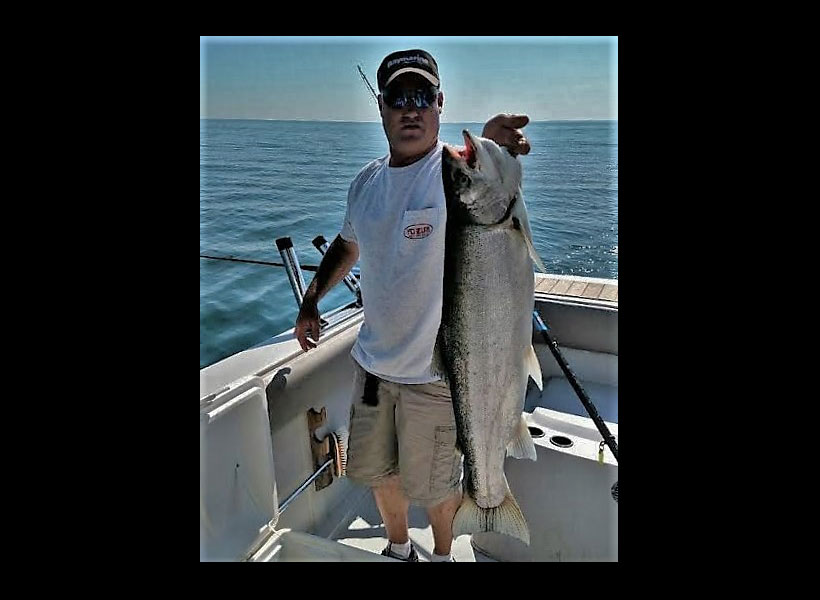
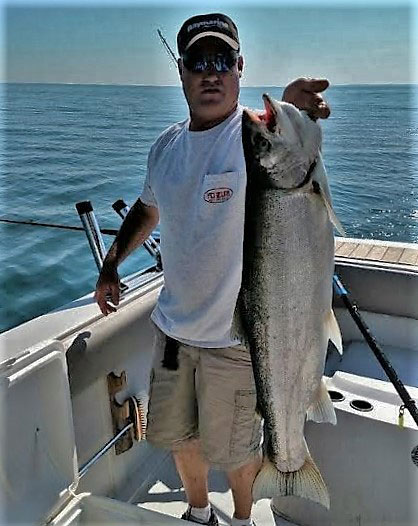
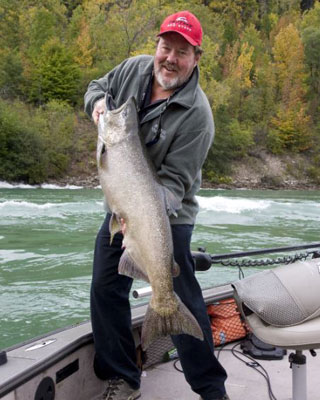
Steve Liebler of Williamsville with his 30.02 Lake Ontario King Salmon

Lake Ontario and Tributaries

Action on Lake Ontario continues to be very good for trout and salmon trollers working out of the mouth of the river, Wilson and Olcott. In the Lake Ontario Trout and Salmon Association’s King Salmon Tournament last weekend, Fisherman’s Daughter came away with the win for big fish – 27 pounds 14 ounces and the 3-2-3 win with 65.56 pounds for three fish! Impressive totals.

Capt. Matt Yablonsky of Wet Net Charters has been doing great all week. Last weekend this was his hot set-up on the Niagara Bar. Morning bite was in 190-205 feet of water around the red can, 40-60 down and an all-spoon bite. Early afternoon bite was 140-150 feet of water, but closer to the Canadian line, 55-80 feet down with still mostly a spoon bite. Silver Streak lures were taking most bites. Afternoon/early evening bite was 100-150 feet of water on the ledge. Tried to turn a few but was never able to. He ended up by 4 mile. He couldn’t keep his spin doctor and A-Tom-Mik flies in the water. Afternoon matures all came on flies.

There has been a good mix of fish off Olcott 40 to 50 feet down over 80 to 100 foot depths. Spoons or flasher-fly rigs. Of course, you can also fish out deep over 300-plus feet of water for a mixed bag of salmon and steelies. Stephen Liebler of Williamsville reeled in a 30.02 pound salmon earlier in the week to take over the lead in the Salmon Division on a flasher-fly. Larry Wills of Lewiston is still leading for the Grand Prize with a 30 pound, 15 ounce fish. Wade Winch of North Tonawanda is still the top steelie catcher, but Alfonse Gouker of Pennsylvania got close Sunday with a 17 and a half pound steelhead weighed in at The Slippery Sinker. Bob Turton of Sanborn lost hold of the lake trout lead when Ephriam Burt weighed in a 24 pound, three ounce fish in the eastern basin around Henderson Harbor. First place brown is still 17.06 pound brown trout caught out of Wilson by Thomas Gies of Ann Arbor, Michigan. The derby continues to July 31 and the website to follow the action is www.loc.org.

Lower Niagara River

Moss is slowly starting to dissipate and bass are starting to cooperate a bit more. The Niagara River Anglers Association Bass Contest is this Saturday, July 23, and you can sign up at Creek Road Bait and Tackle. Crayfish and shiners are the best live baits; tubes and drop shot rigs for artificials.

Upper Niagara River / Erie Canal

While bass numbers have been decent, bass size has been smaller for the Bassmaster pros fishing the bracket tournament right now. Catch some of the live action at www.bassmaster.com. The two top fish catchers going into Thursday action was Kevin Van Dam and Brett Hite with 20 pounds 8 ounces and 21 pounds, 14 ounces respectively. Action continues through Friday.

The Erie Canal Fishing Derby is over as far as the fishing is concerned, but the real excitement will take place at the Awards Ceremony on Sunday in Gasport at the fire hall starting at 3 pm. The unofficial leaders for the different divisions are: Here’s some of the leaders so far: Ron Robel of Wheatfield with a 8.4 sheepshead; Craig Udell of Gasport with a 19.9 pound carp; Patty Young of Kent with a 9-plus pound catfish; Albert Whaley of North Tonawanda with a 7.9 pound pike; Shawn West of Lockport with a 3.58 pound walleye; Joe Cwiklinski of Depew with a 2.9 pound bullhead; and John Justice of North Tonawanda with a 3.8 pound bass. The website is www.eriecanalderby.com.

Bill Hilts, Jr., Director, Outdoor Promotions

Niagara Tourism & Convention Corporation, 10 Rainbow Blvd., Niagara Falls, NY USA 14303
p: 716.282.8992 x.303| 1.877 FALLS US, f:716.285.0809
website | facebook | twitter | blog

Sportfishing has a $30 million annual economic impact in Niagara USA!
Wildlife Habitat, History, Permanently Protected in Montana

wildlifehabitat

From the Director of Communication at Rocky Mountain Elk Foundation headquarters in Missoula, Montana, there is news of success.

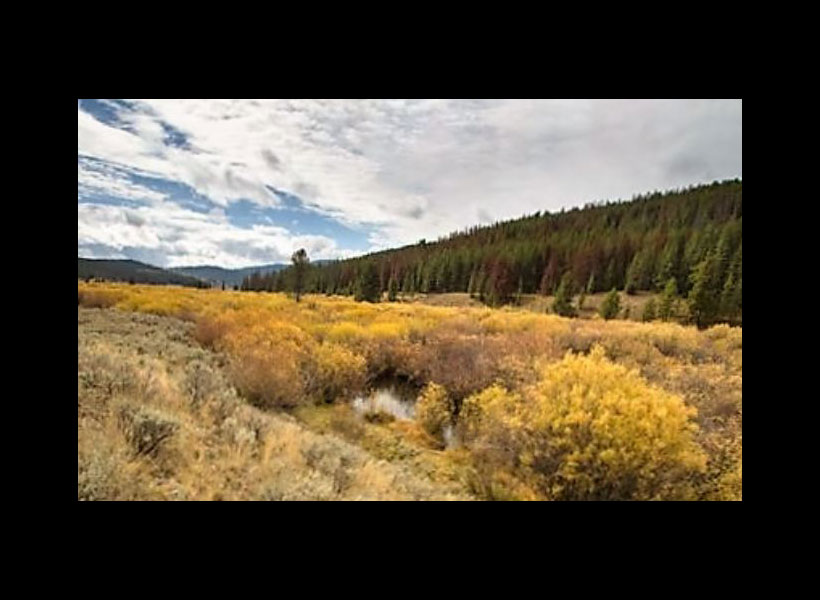
A 320-acre property in southwestern Montana, vital to wildlife and linked to the pages of United States history, is now permanently protected thanks to a successful collaboration between the Rocky Mountain Elk Foundation, a conservation-minded family and the United States Forest Service.

The former Holland Family Ranch is located west of Dillon and was previously an in-holding in the Beaverhead-Deerlodge National Forest. It lies squarely on the Nez Perce National Historic Trail, where Chief Joseph led his Nez Perce tribe away from its pursuers in 1877.

“We appreciate the Holland family for reaching out to us to help conserve and permanently protect this key stretch of habitat,” said Blake Henning, RMEF vice president of Land Conservation. “It is especially rich in wildlife values.”

Elk use the property as calving grounds as well as spring and summer range. It serves as an important wildlife movement corridor between the Big Hole River Valley and the Continental Divide for elk, mule deer, moose and black bear. It is also home to Canada lynx, wolverine, a wide variety of other animal and bird life, and includes more than two miles of fisheries, wetlands and surrounding riparian habitat.

RMEF recently conveyed the tract to the Forest Service thus providing both new and improved public access for hunting, fishing and other recreational activities. “This purchase is a perfect example of how partnerships can conserve wildlife, ecological, recreational and historic values,” said Melany Glossa, Beaverhead-Deerlodge National Forest supervisor. “Working together with RMEF and the Holland family to be a part of this legacy has been a really wonderful experience.”

The Land and Water Conservation Fund, Cinnabar Foundation, Montana Fish and Wildlife Conservation Trust and RMEF provided funding for the project.

If you have questions about the RMEF or are interested in receiving background materials or arranging interviews please contact: RMEF Director of Communication, Phone: 1-800-225-5355, Ext. 481, E-mail: publicrelations@rmef.org.

About the Rocky Mountain Elk Foundation:
Founded over 30 years ago, fueled by hunters and a membership of nearly 220,000 strong, RMEF has conserved more than 6.8 million acres for elk and other wildlife. RMEF also works to open and improve public access, fund and advocate for science-based resource management, and ensure the future of America’s hunting heritage. Discover why “Hunting Is Conservation™” at www.rmef.org or 800-CALL ELK.

Take action: join and/or donate.

Fishing Report: Orleans County, New York Lake Ontario, Lake Alice, Erie Canal for August 11, 2016

The Storms of earlier this week has the lake and the fish all mixed up again. You can find fish anywhere from 60 feet of water all the way out to the 32 line, the trick is getting them to bite. Add to that the fact that today is one of those calm hot days, making things a little more uncomfortable.

These are the conditions that could settle the lake back out again and really turn the fishing on. Even as adverse as conditions are right now, there are still some great fish being entered into the Orleans County Rotary Club Derby which runs through August 21st this year.

Fishing on Lake Alice has also slowed for all of the species including Carp. Fishermen are still catching some Bluegill, Crappie and Perch from the bridges and the bass are still fairly active.

Just a reminder that the 40th Annual Fish Odyssey runs from August 20th to the 28th and the Fall LOC Derby runs from August 19th through September 5th this year.

From Point Breeze on Lake Ontario, the World Fishing Network’s Ultimate Fishing Town USA and the rest of Orleans County. We try to make everyday a great fishing day in Orleans County.

Email: sportfishing@orleansny.com

VanDam Leads Niagara River Bracket Pack

Baits, Spots are Secret (For Now)

Watch Live: http://www.bassmaster.com/classic-bracket

Bassmaster News, BUFFALO, N.Y. —July 20, 2016

After the 2nd day of the Bassmaster Classic Bracket held on the Niagara River out of Buffalo, New York, the Match 1 winner (VanDam) will move on to fish against Match 2 winner (Kreiger) Thursday and Match 3 winner (Hite) will fish against the Match 4 winner (Rojas). Total weights will go back to zero and all anglers will fish six hours from 8:30AM – 2:30 PM. Photo illustration by B.A.S.S.

And then there were four. The first round of the Bassmaster Classic Bracket tournament on the upper Niagara River is over and half the field is driving back home.

The two Elite Series anglers from Arizona are staying though, as Brett Hite dominated and Dean Rojas performed some last-minute heroics during the first round, stamping their tickets to the semifinals.

Michigan’s Kevin VanDam and Koby Kreiger of Florida round out the semifinalists heading into Thursday’s head-to-head clashes in hopes of winning the lion’s share of the $50,000 purse and a berth into the 2017 GEICO Bassmaster Classic presented by GoPro.

The unusual format of this derby has generated a lot of excitement from the anglers and fans watching on Bassmaster.com and WatchESPN, as every second of fishing has been streamed live.

The anglers are also getting updates from BASSTrakk to know how much weight their rival has caught, and officials on each boat immediately weighing and releasing the fish once the information is logged.

“I love this format,” said Rojas, who fished against Alabamian Jordan Lee. “We fished for 5 1/2 hours, and I was losing for all but two minutes of the match. When I caught that last fish, fans got to watch in real time the excitement and incredible circumstance that gave me the win.”

Rojas was 5 pounds behind Lee when he hooked a 3-pounder. He had five minutes left when he hooked another big one. It came off. His next cast produced another bite and he swung another 3-pounder into the boat with two minutes left.

“I’m a slow starter, but I finish strong,” Rojas said. Rojas ended with a two-day total weight of 13-9, and Lee with 12-9.

Hite wasn’t sweating a bit. With the second-heaviest limit on Tuesday, he had a 2-pound cushion over Texan Keith Combs, his first round opponent.

“I knew some big ones lived in my spot, and when they bit early, I felt like I was in good shape,” Hite said.

After boating the biggest limit of the event so far (11-2) in the first two hours of competition, Hite was more than 7 pounds ahead of Combs, who ended the day with just 6-12.

“I felt really good with my weight, so I went exploring for the last hour. I found some stuff that should help me tomorrow,” Hite said.

Speaking of help, Kreiger beat Jacob Powroznik with the help of Jacob Powroznik.

The two anglers are roommates on the Elite Series, and Powroznik vowed to help Kreiger make it to the Classic. Winning this tournament is the Florida pro’s only chance to get there.

Kreiger fished for more than 2 1/2 hours without a bite while Powroznik watched, and even coached, from his boat nearby. Kreiger finally got a bite, and the fish jumped off. With 27 minutes left in competition, Kreiger set the hook and boated a 1-7, enough to finally eclipse Powroznik’s Day 1 total.

“Thank the Lord and thank Jacob Powroznik!” Kreiger said. Powroznik ended the first round with 9-15, and Kreiger moves to the next round with a two-day total of 10-4.

VanDam had nearly a 9-pound lead over Florida pro Drew Benton heading into Wednesday’s elimination match and could have slept through the second session and still won. However, that’s not KVD. He went out and caught 10-4 for a two-day total of 20-8. Benton finished with a final total of 5-10.

“I was watching BASSTrakk and knew Drew was having a tough time, so after I boated one pretty good one, I went practicing,” VanDam said. “Based on what I found, I feel really good about my future in the derby.”

Thursday’s semifinal round on July 21 will pit Rojas vs. Hite and VanDam vs. Kreiger. The weights will go back to zero, and all anglers will fish from 8:30 a.m.-2:30 p.m. ET.

The winner of those two matches will advance to Friday’s championship round. With weights starting from zero again, the anglers will fish head to head from 8:30 a.m.-2:30 p.m. for the title.

Bassmaster LIVE will broadcast coverage of the entire tournament Thursday and Friday, from first cast until the fishing stops, with a camera in every boat.

The payout for the bracket event will be distributed as follows: $10,000 and a Classic berth for first place, $8,000 for second place, $6,000 for third and fourth place (eliminated from semifinals) and $5,000 each for fifth through eighth place (eliminated from quarterfinals).

There was no entry fee for the tournament. The local host for this event is I Love New York. This report is courtesy of www.bassmaster.com

2016 Bassmaster Elite Series Premier Sponsors: Toyota, Minn Kota, Nitro Boats, Skeeter Boats, Triton Boats, Yamaha, Berkley, GoPro, Huk, Humminbird, Mercury

2016 Bassmaster Elite Series Supporting Sponsors: Livingston Lures, Lowrance, Phoenix Boats, Power-Pole, Rapala, Shell Rotella, Shimano, Academy Sports + Outdoors, A.R.E. Truck Caps, Carhartt, Dick Cepek Tires & Wheels

About B.A.S.S.
B.A.S.S. is the worldwide authority on bass fishing and keeper of the culture of the sport, providing cutting edge content on bass fishing whenever, wherever and however bass fishing fans want to use it. Headquartered in Birmingham, Ala., the 500,000-member organization’s fully integrated media platforms include the industry’s leading magazines (Bassmaster and B.A.S.S. Times), website (Bassmaster.com), television show (The Bassmasters on ESPN2), social media programs and events. For more than 45 years, B.A.S.S. has been dedicated to access, conservation and youth fishing.

The Bassmaster Tournament Trail includes the most prestigious events at each level of competition, including the Bassmaster Elite Series, Bass Pro Shops Bassmaster Open Series, B.A.S.S. Nation, Carhartt Bassmaster College Series presented by Bass Pro Shops, Costa Bassmaster High School Series, Toyota Bonus Bucks Bassmaster Team Championship and the ultimate celebration of competitive fishing, the GEICO Bassmaster Classic presented by GoPro.

NOTE: The second group of 4 anglers will be heading back to Anchor Marine on Grand Island, New York. Fans are more than welcome to greet them once they get their rigs out of the launch ramp, so Anchor Marine asks that you give anglers a little space at that time. Since this is a new format, there is not your traditional weigh in at the end of the day. (Anchor Marine, 1501 Ferry Rd, Grand Island, NY 14072, 716-773-7063)

Fishing Report: Orleans County, New York Lake Ontario, Lake Alice, Erie Canal for Wednesday July 13, 2016

The Erie Canal Derby is in full swing with some great fish already on the leader board. With 4 more days left in the derby there is still plenty of time to get out there and catch a winner. On the Erie Canal catches of both catfish and sheepshead are being reported all along the system.

Speaking of derbies, the LOC Summer Derby is just past the half-way point and the 30 pound mark for Chinook salmon has already been broken.

The waters of Lake Ontario off Orleans County have been very active with a great mix of fish, but Chinook salmon has made up the majority of the catches. Fishing has moved out to the 400 to 450 feet depth range, but there are still some fish being produced on those inside waters. What started out slowly has sure picked up to some great fishing on the big lake.

Lake Alice is still producing some nice catches of Crappie and some great catches of bass. The water clarity has improved greatly over the past week or two and now shows a visibility of 5 or 6 feet.

Give a gift of the great outdoors to our youth by taking a kid fishing!

From Point Breeze on Lake Ontario, the World Fishing Network’s Ultimate Fishing Town USA and the rest of Orleans County. We try to make everyday a great fishing day in Orleans County.

Email: sportfishing@orleansny.com

Firearms and Common Sense after Orlando

History, Politics, Facts and the Changing Public View

By Budd Schroeder

firearms
Everyone in America that has been here since the days of old-time values is worried about the thought of a terrorist attack. What has changed? Forrest Fisher Photo

As the investigation of the Orlando terrorist attack continues, many gun owners get nervous about how legislators may attempt to use this atrocity as an excuse to infringe on Second Amendment rights.  They use the line that this is the worst mass shooting in American history.  However, they neglect to mention the massacres that occurred at Sand Creek or Wounded Knee.  That is understandable because the US Army massacred unarmed Indians and that was a government action.

It is a matter of perception and perspective and of course, the government would like those actions forgotten, but they do continue to tell stories about the Little Big Horn where the Indians fought back and annihilated the Seventh Calvary.

Many of the media and politicians are also deceiving the public by calling the gun used in Orlando an “assault weapon.”  This is a misnomer.  An assault weapon is a rifle that is capable of full automatic fire by the use of a selector switch.  That is a truly “military weapon” like a machine gun and is not allowed to be possessed by civilians except under very strict and limited conditions.  They are totally illegal in most states.

Yet, the politicians and liberal media are calling for a ban on their definition of the “assault weapon” and universal background checks.  Most honest gun owners object to these laws because they don’t work and it is further infringements on the Second Amendment.

When those guns were banned in the 90’s there was no significant difference in the gun deaths.  When the law was repealed with the sunset law, there was still a decrease in the number of gun deaths.  What really confuses the anti-gun crowd is that gun sales have skyrocketed, the number of states passing concealed carry permits increased, and what is formally defined as “gun violence” continues to drop.

That is also an emotional label.  Guns are not violent.  The term should be “criminal misuse of firearms.”  That is accurate.  People don’t blame alcohol or the car if a drunk driver kills people.  They blame the person who deliberately drinks until he or she becomes too impaired to make rational decisions and their motor skills are diminished.

Nobody in the media suggests that the real problem is the easy access to alcohol.  In fact, the New York legislators just passed a bill that makes it possible for drunks to start drinking at 10:00 a.m. on Sundays; earlier in some establishments with a special permit.  The drinking laws are strange in other ways.  If a person gets a felony DWI they can never own a gun, although a gun was not involved in the felony.  Wouldn’t it make more sense for a serious charge like a felony involving a car to forbid him from having a driver’s license or owning a car for the rest of his life?

It is a good bet that would never be the law because that could involve politicians, law enforcement officers and people who have power and influence.  That is the way the system appears to work.

On another proposal, the call is for people who are on the “no fly list” to be denied the right to purchase a gun.  Nobody wants a terrorist, criminal, drug addict or a person with mental difficulties, to have a gun.  However, before a person is put on the NICS list for a background check he should be afforded due process as provided by the Fourteenth Amendment.

Since the SAFE act was passed in New York this has become an issue.  A person can be denied his or her gun rights on a report.  There is no due process.  It is grossly unfair and unconstitutional, but what can we expect from a law that was passed literally in the middle of the night by a majority of corrupt politicians?  Two of the architects of the debacle, Sheldon Silver and Dean Skelos were convicted of corruption and have since been sentenced to prison.

When a politician wants to deprive the citizenry of their constitutional rights, it should be the big red flag that they want to destroy the principles upon which the country was founded.  The Second Amendment was placed in such a high place in the Bill of Rights was because the Founding Fathers wanted the people to be more powerful than the government.  We have politicians who appear to not agree with that balance of power and it seems that every time the legislatures end for the year, we lose a right or even a privilege.

Since the Founding Fathers wanted to protect the people against the possibility of despotic government they wanted an armed citizenry.  Since the government controls the military, doesn’t it seem strange that some legislators want to ban military style weapons for civilians?  One former legislator running for office wants to take on the National Rifle Association.

That seems strange since with the criminal misuse of guns that none of the people involved in the shootings were accused of being NRA members.  Maybe that’s because the NRA has a reputation for having responsible, patriotic members.  They are held in higher regard by citizens than members of Congress.

There must be a reason for that.

Orlando – Lone Wolf Attacks, Is There a Safe Haven?

Many Americans May Not Understand the Problem.

See this VIDEO. 

NRA News Desk

From the National Rifle Association continuing episode news program, NRA News Commentator, Dom Raso, a U.S. Navy SEAL veteran, says there are not many things that can compare to serving your country and defending your freedom.  That freedom applies to firearms, too.

“As long as humans exist, there will be weapons in this world.  We’re better off knowing how to use them and apply them for the right reasons—than not knowing how to use them.”

Raso is also the founder of Dynamis Alliance, an organization that offers specially designed gear and customized training programs for all levels of experience.

Hear what Dom has to share with American citizens to better understand his experience and training regarding the potential dangers that may be applicable to many nations of the world.

In the video, Raso says, “We need leaders who will get rid of useless gun-free zone laws that give killers a clear advantage over the law-abiding.”

See the complete video, visit this link:

https://www.nranews.com/series/commentators/video/commentators-the-threat-of-lone-wolf-attacks/episode/commentators-season-6-episode-14-the-threat-of-lone-wolf-attacks

lonewolf2

To join the NRA and learn more, visit this link:  https://joinnra.nra.org/join/join.aspx.

Fishing Report: Orleans County, New York Lake Ontario, Lake Alice, Erie Canal

Wednesday June 29, 2016

Let’s start out with fishing derby news.

This Friday, July 1st, starts the LOC Summer Derby which runs through July 31st.  There is $29,000 in cash up for grabs with a $10,000 grand prize for the biggest salmon.  More information can be found at www.loc.org or by calling 888-733-5246.  Register at any of these Orleans County locations or on-line: Captain’s Cove Resort, 14339 Rt. 18, Waterport, NY, 14571, 585-682-3316, http://fishcaptainscove.com Narby’s Superette and Tackle, 1292 Oak Orchard Rd, Kent, NY, 14477, 585-682-4624, http://www.narbys.com/;  Orleans Outdoors, 1764 Oak Orchard Rd., Albion, NY, 14411, 585-682-4546, http://www.orleansoutdoor.com/.  

Then there is the 26th Annual Erie Canal Derby which runs from July 6th to the 17th this year.  In this event a boat, motor and trailer is the grand prize and in the youth division, a canal trail bike is available.  Great fishing abounds on the Erie Canal. Eligible waters are the Erie Canal from the Niagara River to the Route 98 Bridge, located in the heart of Albion. More than $8,000 in prizes is available. For more information check out their website at www.eriecanalderby.com.

Fishing on Lake Ontario has been good to exceptional over the past week.  Winds have been fairly kind to us and that has kept the fishing in closer to shore, mainly the 90 to 150 feet of water range.  Most anglers are reporting a good mix of fish, mainly Chinook salmon, Lake trout and Steelhead trout with some reporting some exceptional size fish in each category.  With the great weather predicted through the weekend and well into next week, fishing should continue to improve.

On Lake Alice, the Largemouth Bass, Smallmouth Bass and Carp seem to be providing most of the action.  Reports have the bass mostly at legal size with few undersize fish being seen.

The Erie Canal from Middleport to Brockport is in the process of being de-watered for some emergency repairs in two locations, but the portion from Middleport to Albion should be reopened by the end of next week.

The 4th of July is when we celebrate the birth of our great nation and a great way to celebrate is to take a kid fishing, hiking or any other activity that helps our youth to enjoy all that the great outdoors has to offer.

From Point Breeze on Lake Ontario, the World Fishing Network’s Ultimate Fishing Town USA and the rest of Orleans County.  We try to make everyday a great fishing day in Orleans County.

Email: sportfishing@orleansny.com

What You Need this Fall: Elk Calls with Passion

Built by Elk Hunters for Elk Hunters
By Brad Fenson

elkcalls1

I’m already preparing for elk hunts this fall and like every year, I look for any advantage I can find to help me anchor a bull when I head to the woods. Checking out the new Rocky Mountain Hunting Calls (RMHC) at buglingbull.com, I found new items that sparked an interest.  Wanting to learn more, I did some homework and eventually got to talk to the man behind more than 36 years of elk calling history and call innovation.

If you’ve grown up hunting, you know that hunting can define your life.  As hunters, our passion often describes our lifestyle, not just our pastime.  As hunters, we’ve been fortunate to see, and use, so many engineering and technological advancements of our hunting gear in the last 50 years.  It’s impossible for many oldtimers to comprehend the gains.

If my grandfather had the opportunity to try modern firearms, bullets, clothing, boots, calls, and backpacks, he would’ve been in seventh heaven.  With the hunting skills he required back in the day, he would have been lethal with the updates.

elkcalls2

Rockie Jacobsen, owner of RMHC, was just 12 years old when he obtained his first elk license. Of course, he had been along on hunts at a younger age, but once he became the hunter, his passion for elk blossomed.  By age 16 he was calling in bulls to fill his tags.  To this day, his desire to talk with elk is the reason he works all year—simply for the opportunity to be back out hunting.  It is a life-long passion that defines the man today.  Now that’s the kind of guy I want designing the elk calls I use!

Most elk hunters will know of RMHC, which used to be called Bugling Bulls Game Calls.  A change in name was required to better reflect the wide array of game calls they produce, now covering coyotes, hogs, deer, moose, turkeys and elk.  The RMHC’s elk calls themselves have won over 50 World Elk Calling Championships, with 28 wins for the Jacobsen family alone.

RMHC has been in business since 1980 and continued to grow and expand their product lines.  Rockie developed unique designs and new engineering in diaphragm calls, which many other manufacturers have used over the years.  The Palate Plate was patented and used by other call manufacturers who couldn’t come up with a better design.  When it comes to calling elk, Rockie continually strives to improve on this proverbial mouse trap.

Now We Finally Have a Better Call 

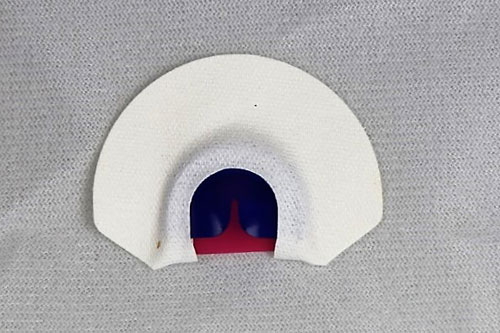
If you use a diaphragm mouth call, you know how effective they are in producing a diversity of bull and cow elk sounds.  The more proficient you are with such a call, the more consistent and realistic you sound.  To help hunters and calling contestants up their game, RMHC has come out with a Tone-Slot Technology (TST) series of diaphragms.  A plastic dome incorporated into the call has a slot running in the center of it, creating a chamber over the latex.

elkcalls3The dome and slot allow the air you blow to center on the diaphragm for better sound, volume and consistency. The slot ensures the proper angle and position of air movement every time, making it easier to use and producing sounds with realistic clarity.

Within the series, you can pick calls to produce specific tones or sounds, like the Rockstar model, which emulates medium to large bull and cow sounds, and can create more nasal cow sounds and high pitch screaming bugles.

With every call, every little detail is examined during production, accounting for the development and use of the new Firestorm Latex.  The new latex is used in RMHC diaphragm calls and comes in yellow, red, gray, and clear, providing more consistency between calls, since they are easier to work.  If you’re a regular user of latex calls, you’ll quickly feel and hear the difference.

The RMHC diaphragm calls are worth a look if you’ve never been able to successfully use a diaphragm placed in the roof of your mouth.  Unlike conventional diaphragms, the new series of calls is placed closer to the front teeth and tipped up.  The first thing the forward placement does is eliminate or reduce the gag reflex some people fight with.

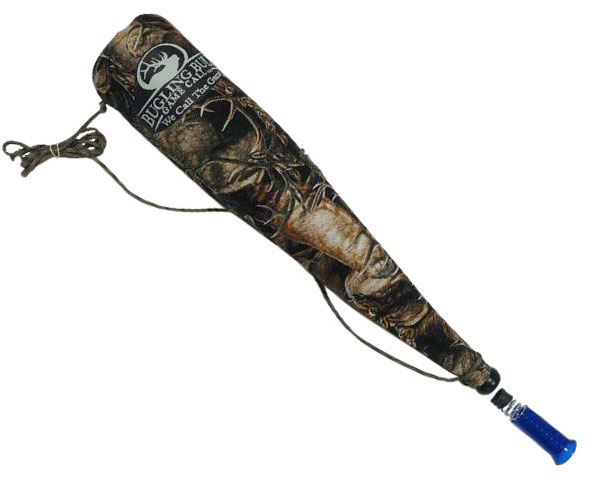
When it comes to bugles, the RMHC systems have a huge following amongst hunters and calling competitors.  The diversity of RMHC mouth calls, tubes and accessories provide the right combination for any elk hunter.  New this year is the Threat Bugle Tube, with a shorter cylinder.

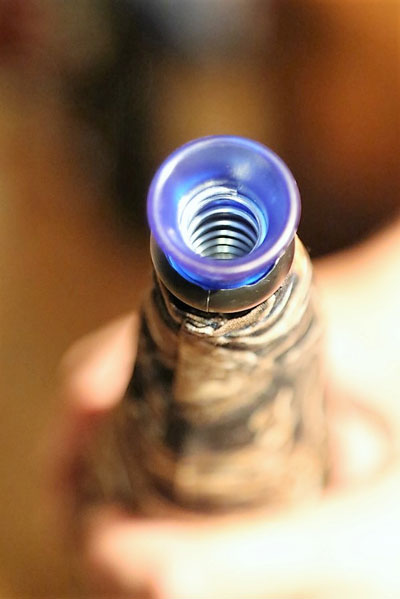
elkcalls5Now, before you start to scoff at a shorter tube producing less volume, understand that the call’s mouth piece includes a spring that is tuned to the specific dimensions of the adaptor it sits in. The grunt tube comes assembled with the spring and adaptor insert making it ready to use with mouth call diaphragms. The spring creates more volume, making the Threat sound as loud as any of its big brothers.  Users will notice it is easier to stabilize higher notes and create raspier low growls, and is just easier to pack or carry around.

elkcalls4The technical name for the new mouth piece and “Insert Innovation is Volume Enhanced Tone Technology, or VETT, making the bugle easier to use and smaller to pack.  There is also a vibration dampener known as the Tube Tamer, placed on the inside of the tube on the large end, ensuring crisp, clear sounds.  This also eliminates plastic vibration and helps produce deeper sounds for chuckling.

I’m already driving my wife crazy practicing with the new calls in the house, car and yard.  I’ve even started placing a diaphragm call in my mouth to chirp and mew when shooting my bow for a real hunting simulation.

Better calls are always a good thing when we want to talk wapiti in the proper dialect or get a leg up on our competition. 

If you’re in the market for a new mouth call or tube, now is the time to try out the ones you’re interested in and start practicing.  Find the calls that work best for you, and make sure you take a hard look at the calls the good folks at RMHC have crafted.

It may be the difference between a happy hunter, or a sore loser!  Check out RMHC products offered on http://www.elk101store.com/calls/bugling-bull.

Sabine Lake, Louisiana Redfish

We caught several above the slot fish including this 30” bruiser. Big bull reds above 40” prowl the same waters.

Big Redfish with Fishing Tom’s Guide Service
By Dick Jones

The medium sized alligator apparently heard the splashing of the fish we’d recently landed and he was eyeing the fish we were catching, but not interfering. When I saw my popping cork make a dive under the surface, I had one eye on the cork and the other on the alligator. The redfish shook his head bulldog fashion and made a couple of drag stripping runs. I could tell he was too big to horse him to the boat and I was concerned that the alligator might decide to come after him. As we slugged it out, I watched the gator. He showed no interest until the fish came to the surface. As we were netting the fish, I noticed him moving in our direction, but he only showed perfunctory interest. Eventually, we boated the red and he was a nice one, about 28 inches long.

We were fishing in the Sabine Lake Wildlife Refuge, south of Lake Charles, Louisiana. Located between Lake Calcasieu and Sabine Lake, it’s only open to the public March 15 to October 15 and until this year, it was not open to charter trips. As of this year, permits are available for guides. It’s as wild a coastal area as I’ve ever seen. We spent half a day there and I didn’t see a single thing that related to civilization. Not a single can, bottle, or piece of paper.

The Sabine Lake Wildlife Refuge is a great place to view birds and other coastal creatures, this six foot gator was curious, but didn’t cause us a problem.

Great fishing, great dining

What’s most remarkable about the Sabine Lake Wildlife Refuge is that you can have dinner in a great restaurant, spend the night in a comfortable, air conditioned room, and get up in the morning and spend the day fishing in a place that’s little different than it was two thousand years ago. Our trip to Lake Charles included dining on gumbo, shrimp, crabs, oysters, crawfish, and a Cajun sausage made of meat and rice, called boudin, at small, family owned restaurants around Lake Charles.

Enjoy the ride

Getting to Sabine Lake requires a serious boat ride of almost an hour. The early part of the ride on the Intracoastal Waterway is pleasant enough, but once we turned into the channel to get to the refuge, the ride into the refuge becomes almost as good as the fishing trip. There are crab pots and signs of civilization until you get to the edge of the refuge, but once in, all signs of humanity disappear. The channel twists and winds through the estuary and is a thrilling and inspirational boat ride in the early morning sunrise.

Generous Louisiana limits make for a heavy cooler.

Primordial angling

Many angling enthusiasts long for a fishing experience outside the normal locations. Outdoor people often find themselves yearning to go somewhere that seems absolutely primordial, a place where one might imagine no person has ever fished before. As the boat glides along the snaking channel that leads into the refuge, one gets the impression that you’re fishing virgin water that few anglers have seen. That impression is fairly close to true since the long ride down the Intracoastal Waterway to the entrance to the refuge discourages all but the most determined anglers.

More than just reds

Sabine Lake is a great place for speckled trout, redfish, and flounder, known as the Cajun Slam, but there are an abundance of black drum and sheepshead as well as less desirable alligator gar. On our trip, between the two boats, we caught every species mentioned. Louisiana keeper limits are much more generous than almost all other Atlantic and Gulf states with the limit on reds at five per day with one fish allowed over the 16 to 27 inch slot. On our trip, all of us caught at least one fish over the 27 inch slot limit.

Choose your tackle

We fished cuts in the estuary where the current was flowing through, carrying bait to waiting predators. This was shallow water fishing; most of the water we fished was only a couple of feet deep. Live shrimp, jig heads and Berkley Gulp or soft plastics work well in Sabine, as does a fly rod in the hands of a skilled caster.

More places for fishing

In addition to Sabine Lake, Fishing Tom’s Guide Service offers fishing trips all over the Calcasieu Estuary, which includes the Calcasieu River, Lake Calcasieu, Black Lake and the shipping channel to the Gulf of Mexico. We had two boats with friends, Michelle and Chris Cerino, of the History Channel’s Top Shot TV series, in a boat with Captain Tom while Cherie and I fished with his son, Tommy. Both boats limited out on reds with the biggest fish being a 30” bruiser.

Best times in Southwest Louisiana are spring and fall with summer offering great fishing. Fishing is good in summer if you don’t mind the heat, and winter offers lots of fish but it’s difficult to catch good weather and wind. The Louisiana license tag describes the state as a sportsman’s paradise and the Sabine Lake Wildlife Refuge is not only a paradise, it’s an unspoiled treasure.

To fish with our guide, contact him on the web at: www.fishingtom.net. For more information on the local area, visit www.visitlakecharles.org.

Western New York Fishing Forecast for Friday, July 8, 2016

Lake Ontario, Niagara River
Lake Ontario and Tributaries

fishreport7_8Fishing for salmon and trout was on fire over the long holiday weekend, evidenced by the leaderboard of the Summer Lake Ontario Counties Trout and Salmon Derby.

John Van Hoff of North Tonawanda targeted the waters off Wilson in 100-plus feet of water and in two days of fishing had 60 releases!! He ended up catching 30-something salmon and some nice steelhead, including one that made it onto the board of the LOC Derby. It didn’t seem to matter what he threw at them as far as his spoon selection, or how he fished them – riggers, copper lines, dipsy-divers. It was the best fishing he’s seen in years. If you are going to be fishing in the lake, make sure you are in the derby.

Ask Capt. Paul Czarnecki of Tri-State Charters, the featured speaker at the next Lake Ontario Trout and Salmon Association meeting set for July 14 in Lockport. He boated a 32 pound King over the weekend, but the customers failed to register for it. The current leader for the $10,000 check is still Tim Condes of Wilson with a 29 pound, 8 ounce king caught on a flasher with cut bait. First place in the Salmon Division is Cory Kyovsky of Branchview Heights, Ohio, with a 29 pound, 2 ounce King out of Wilson. Second place is a 28 pound, 5 ounce King out of Olcott reeled in by Nicolas Curtiss of Overland Park, Kansas. It hit a Spin Doctor and Fly while fishing with Captain Vince Pierleoni out of Olcott in 180 feet of water. He was also the top youth catcher for the salmon division so far at 15 years old. Top brown trout is out of Wilson, a 17 pound, 6 ounce fish caught by Thomas Gies of Ann Arbor, Michigan, caught on an Ice Shadow Moonshine spoon over 220 feet of water, 45 feet down on a rigger with Captain Dan Evans of Wilson. Yes, out deep targeting salmon.

Current lake trout leader is Bob Turton of Sanborn with a 23 pound, 7 ounce fish from the Niagara Bar. He was trolling a Kwikfish lure. First place steelhead is a 16 pound, 3 ounce fish hauled in by Francis Holly IV of Wilson while fishing out of his home port. Yes, all of the current leaders are off the shores of Niagara County! The derby continues through July 31 so there’s plenty of room for improvement and plenty of fish to catch! Go to www.loc.org for a complete leaderboard update.

Lower Niagara River

Moss is still a factor but it seems like things are slowly starting to subside. Lisa Drabczyk at Creek Road Bait and Tackle in Lewiston reports the better action has come around the Coast Guard station and the green can, but it’s been difficult. The slack water near the Fort Niagara launch ramps has produced a few bass, as well. A few walleye have been reported, too. Remember that the NRAA Bass Contest is July 23, register at Creek Road Bait and Tackle in Lewiston or check out the website at www.niagarariveranglers.com for details.

Upper Niagara River / Erie Canal

Moss is still an issue but manageable. Hopefully things will be clear for the new bracket tournament being held from Grand Island to the Peace Bridge by Bassmasters July 19-22. Only 8 boats and no formal weigh in – everything is weighed on each boat live time. Watch next week’s Outdoor Beat with BASS writer Don Barone as he covers the circuit and the new tournament. It starts Wednesday (the show) at 4 pm. The big news is the 26th Annual Erie Canal Fishing Derby underway through July 17. While fish have been coming to the scales early on, there’s plenty of room for improvement. Big bass is a 2 pound fish caught by Albert Whaley of North Tonawanda; biggest pike so far is a 6.7 pound fish reeled in by Michael Boncore of Tonawanda; Amy Schultz has the top bullhead at 0.79 pounds; Ed Lane of Lockport is leading the catfish division with a 3.79 pound fish; first place carp is 14 pounds, caught by Richard Udell of Gasport; and the sheepshead leader is Jacob Velesko of Middleport with a 8.28 pound bomber. No walleye yet.

Go to www.eriecanalderby.com.

Bill Hilts, Jr., Director, Outdoor Promotions
Niagara Tourism & Convention Corporation, 10 Rainbow Blvd., Niagara Falls, NY USA 14303
p: 716.282.8992 x.303| 1.877 FALLS US, f:716.285.0809

Sportfishing has a $30 million annual economic impact in Niagara USA!
Fishing Report: Orleans County, New York Lake Ontario, Lake Alice, Erie Canal

First a big thank you to the Erie Canal crews who got the emergency repairs done quickly and the canal back open in time for the start of the Erie Canal Fishing Derby which starts today and runs through July 17th this year.

Fishing on Lake Ontario has gone past good to GREAT for all of the cold water species.

Fishing in the 100 feet of water range is producing very well, but some are finding great success farther out on the lake.

With the warmer surface temperatures in the lake, fish are being taken somewhat deeper than in the previous several years.

Orleans County has fish entered in each category of the LOC Summer Derby with the exception of Lake Trout.

Speaking of the LOC Summer Derby which runs through the end of July, big fish abound with leaders in each category as follows: Salmon over 29 pounds, Brown trout over 17 pounds, Lake trout over 23 pounds and Steelhead over 16 pounds and this is just the first part of July.

Lake Alice is still producing a good mixed bag of fish, but with the warmer weather all species are moving to deeper water.

From Point Breeze on Lake Ontario, the World Fishing Network’s Ultimate Fishing Town USA and the rest of Orleans County. We try to make everyday a great fishing day in Orleans County.

Email: sportfishing@orleansny.com

Need Citizen Help in Reporting and Reducing Nuisance Bear Incidents in New York State

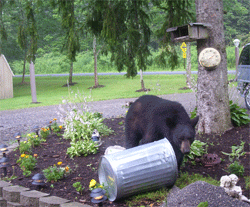
For STO 070620916, picture 1of1Increasing numbers of black bears have been reported in many parts of New York State.

With the onset of warmer weather, Adirondack and northern New York black bears are on the move. The State Department of Environmental Conservation (DEC) has been notified of nuisance bears in the towns of Corinth, Chestertown, Fort Ann and other areas across New York.

Homeowners are reminded of the steps they can take to avoid conflicts with bears. The simplest way to avoid a nuisance encounter is to remove all potential attractants, which in most cases is garbage, bird feeders, pet food, and grills. Here is what you can do to help avoid bear conflicts:

  • Store garbage cans and grills in a secure building or location.
  • Secure lids on outdoor garbage containers with chains and locks and/or protect them with electric fencing.
  • Do not leave garbage containers outside over-night; put them out immediately prior to pick-up.
  • Remove bird feeders and suet.
  • Feed pets indoors and store pet food indoors.

New York residents having problems with nuisance bears or that suspect someone is feeding bears, please report immediately to the DEC dispatch office at 518- 897-1326.

When reported immediately, nuisance bear issues can often be resolved by working with community members to increase public awareness and remove attractants. When nuisance bears go unreported, they may quickly become a significant safety hazard for people and/or pets, and such scenarios often have undesirable outcomes for both people and bears. Please visit the DEC website for additional help in understanding bears: http://www.dec.ny.gov/animals/6995.html.

I Hunt With a Canon

By Jim Monteleone

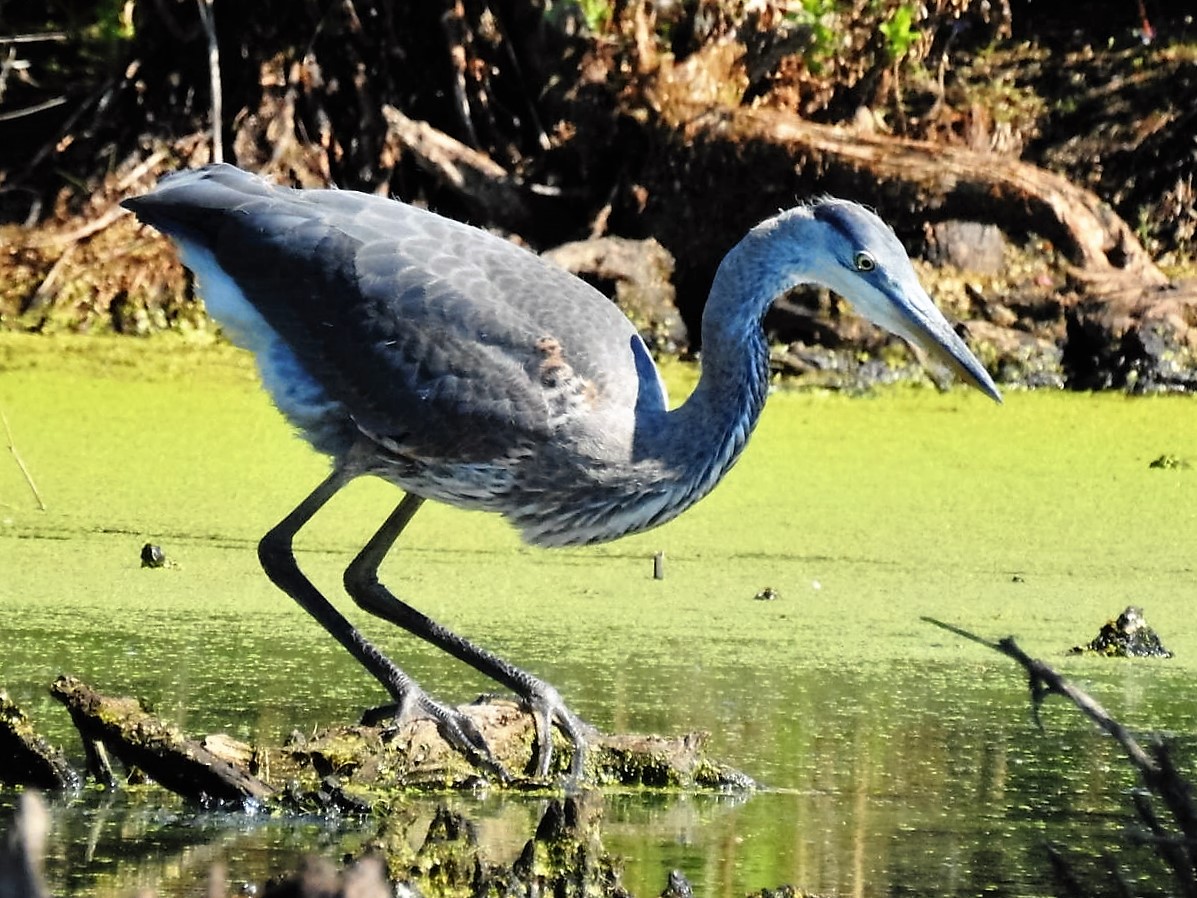
Canon Picture 1of2, Blue HeronI love the outdoors and all its creatures. There are days in the fall when I carry a bow and others when a firearm is the tool of choice. Then there are other days when I carry a Canon. Not a cannon but a Canon. It is a digital camera that offers me the opportunity to shoot quietly and use many of the skills that define success for a hunter.

There is stealth involved and there is a steady hand needed for clear and sharp images. I treat the shutter button much in the same way as I do the trigger on a firearm.

No Limit

The beauty of photography is the many targets we can encounter as well as the absence of a limit, like those that govern hunting with something other than a camera. I choose to hone and refine the skills I have acquired over decades of hunting upland birds, mammals and waterfowl. Now the quarry is as varied as hummingbirds, butterflies, songbirds, reptiles and anything that flies, swims or walks. I have the freedom and the access to creatures of all sizes, and a myriad of places in which to pursue them. I have carried my camera to faraway places like British Columbia one week and to my back yard or a local park the following week.

Developing Patience

Canon Picture 2of2, Blue Heron (1022x1280)Hunting” with a camera requires the same commitment to scouting, stalking and sometimes remaining motionless for long periods of time. In other scenarios being very quiet and inching your way to within mere feet in order to cut the distances between the lens and the subject is an absolute requirement.

My standard equipment, until recently, has been a Canon T3i with either a 55/200mm or 75/300mm lens. These set ups require a maximum distance somewhere between 5 feet and 35 yards for optimum results. The challenges of capturing really good pictures include learning and knowing the habits and habitat of birds, insects, animals, and reptiles.

Lighting is Key

The use of light is a key component. I generally attempt to keep the sun light behind me and on the subject(s). I also choose to shoot in manual focus even on moving subjects. It takes practice, but the principles of wing shooting have allowed me to overcome the technical difficulties associated with animals and birds with explosive flight and retreat instincts. Allow for a wider frame to capture movement and swing the camera through the action without stopping until the shutter has been activated.

My inspiration for long hours and long walks is the desire to bring vivid images of both simple and exotic creatures in their native habitat to those who appreciate nature. My reward is the expressed appreciation by nature enthusiasts for the images and the funds raised in donations of my photography to events that benefit children’s and veteran’s charities.

Nevada Proposes Trail Camera Ban

Many manufacturers in the United States outdoor market produce high quality trail cameras. Priced well under $100, this Wildgame Innovations CLOAK™ 6 LightsOut™ captures 6-megapixel images with a stealthy 36-piece high-intensity black LED infrared flash that is invisible.

We learned last month that the Nevada Board of Wildlife Commissioners recently discussed restrictions regarding the use of trail cameras and proposing new regulations.

No Cam’s during Hunting Season 

The proposed regulation would ban the use of trail cameras for big game hunting between August 1 and December 31 in Nevada wildlife management areas and units.

Trail Cam’s prohibited near Water Holes 

In addition, trail cameras would be prohibited year-round within 200 feet of a spring, waterhole or other water source for any reason.  This includes hunting or scouting for small or big game, wildlife watching and trespass prevention – it even applies to private property.

Other Options? 

“Trail cameras have become a helpful tool for hunters across Nevada and the country,” said Luke Houghton, Sportsmen’s Alliance associate director of state services. “There must be a way to address any issues that have occurred without such as heavy handed approach as an all-out ban.”

Many official big game management organizations and wildlife agencies use trail cameras for data gathering and research.  One immediate concern is whether such a ban would affect their continued research?

About Sportsmen’s Alliance

Thanks to such newsworthy publications as the Sportsmen’s Monthly by Sportsmen’s Alliance (published on-line and as well as in hard copy), hunters and advocates for safe hunting never stop learning about new regulations and proposed changes.

The Sportsmen’s Alliance is a 501(c)4 organization that protects and defends America’s wildlife conservation programs and the pursuits – hunting, fishing and trapping – that generate the money to pay for them.  Sportsmen’s Alliance Foundation is a 501(c)3 organization that supports the same mission through public education, legal defense and research.  Its mission is accomplished through several distinct programs coordinated to provide the most complete defense capability possible. Search out more information on their website located at: http://www.sportsmensalliance.org/.

Fishing Report: Orleans County, New York – June 22, 2016

Erie Canal Rebuild in Progress, Bass Bite is On at Lake Alice

Lake Alice (Waterport Reservoir) offers plenty of rod-buster largemouth bass like this fooled on a Senko Worm fished along weedbeds adjacent to a deep drop-off. Forrest Fisher Photo

To start off, the Erie Canal from Middleport to Brockport will be shut down starting June 27th to drain that portion of the canal.

There are two major repairs that need to be made; one at the culvert overpass at Culvert Road and the other is a culvert wall at Hulberton.  The repair at Culvert Road will be a temporary fix and the permanent fix will be done after the close of the canal season.  When the temporary fix is completed the section of canal between Middleport and Albion will be reopened and the section between Albion and Brockport will remain closed until the permanent repair is completed at Hulberton.

On Lake Alice, anglers are doing well on some nice Largemouth bass casting spinners along the weed beds.  Perch, Bluegills and Rock bass are being taken in 15 to 20 feet of water.

On Lake Ontario, the Spiney Water Fleas are just starting to show up, but not in any great numbers as of yet.  Anglers report show that fishing seems to be good between the 25 and 26 lines, with very good catches of both Steelhead and Salmon.

The Summer LOC Derby starts on July 1st and runs through the end of the month. 

From Point Breeze on Lake Ontario, the World Fishing Network’s Ultimate Fishing Town USA and the rest of Orleans County.  We try to make everyday a great fishing day in Orleans County.

Email: sportfishing@orleansny.com

Lake Erie & Niagara River Status Update

lakeriverstatus

New York State Fishery Biologists Outreach Event – June 21, 2016

An upcoming free seminar to update the public about the status of the Lake Erie and Upper Niagara River Fisheries is scheduled for Tuesday, June 21 from 6:30 to 9:30 p.m., at Woodlawn Beach State Park’s Lodge, Blasdell (Erie County), by the New York State Department of Environmental Conservation (DEC).

The free seminar will begin with informal discussion and poster exhibits, followed by a series of presentation topics on Lake Erie and the Upper Niagara River fisheries.  These will include an opportunity for angler input on a variety fisheries management activities.  The meeting will conclude with questions and an open discussion.

“DEC is committed to sound management of Lake Erie and Upper Niagara River fisheries to maintain high-quality angling opportunities and associated economic benefits,” DEC Regional Director Abby Snyder said.  “This event provides an excellent opportunity for anglers to interact with DEC experts who study and manage Great Lakes fisheries.”

Key members of Lake Erie and Niagara River’s fisheries management and research community will present on Lake Erie fisheries management and assessment activities for steelhead, walleye, muskellunge, research initiatives, and habitat improvement projects.  This seminar is sponsored by DEC’s Lake Erie Fisheries Unit and Region 9 Fisheries offices.  Anyone interested is welcome to attend this free event and registration is not required.

The Lake Erie and the Upper Niagara River rank among New York State’s top fishing destinations, especially for walleye, smallmouth bass and steelhead.

A recent survey (2007) of statewide anglers estimated more than 800,000 angler days spent on these waters.  The estimated value of these fisheries exceeded $22 million to the local New York economy.

For further information contact Don Einhouse, Lake Erie Unit Leader, (716) 366-0228.

Fishing Report: Orleans County, New York Lake Ontario, Lake Alice, Erie Canal


This Dreamweaver Lure color was the Hot Lure when fished with a white fly way back in 2014 and many anglers have enjoyed good success with this color this year too.

June 8, 2016.  

A series of cold fronts moving through our area coupled with strong northwest winds have put a damper on Lake Ontario fishing for today.

The forecast for later this week looks much more favorable which is great, because this weekend starts with the Condor Derby on Friday followed by the 4th Annual Oak Orchard Open Tournament on Saturday and Sunday.  Normally a Northwest wind helps set up our portion of the lake for some great fishing, but I guess we will just have to wait and see what the fishing gods bring us.

Before the nasty northwest winds picked up fishing was good with a mixed bag of species in each catch.  It seemed like the 95 to 150 feet of water range was holding a good number of fish but some fishermen were doing well as far out as 200 feet of water.

Most fish were being taken in the top 80 feet of water but as always some were deeper.

On Lake Alice, the reservoir on the Oak Orchard Creek near Waterport, New York, fishing has slowed slightly, but catches of Bluegill, Crappie and Bass are still being taken.  Just a reminder that Bass season opens the 3rd Saturday of this month so for now it’s still catch and release.

From Point Breeze on Lake Ontario, the World Fishing Network’s Ultimate Fishing Town USA and the rest of Orleans County.  We try to make everyday a great fishing day in Orleans County.

Email: sportfishing@orleansny.com

Fishing Report: Orleans County, New York Lake Ontario, Lake Alice, Erie Canal

Wednesday June 15, 2016

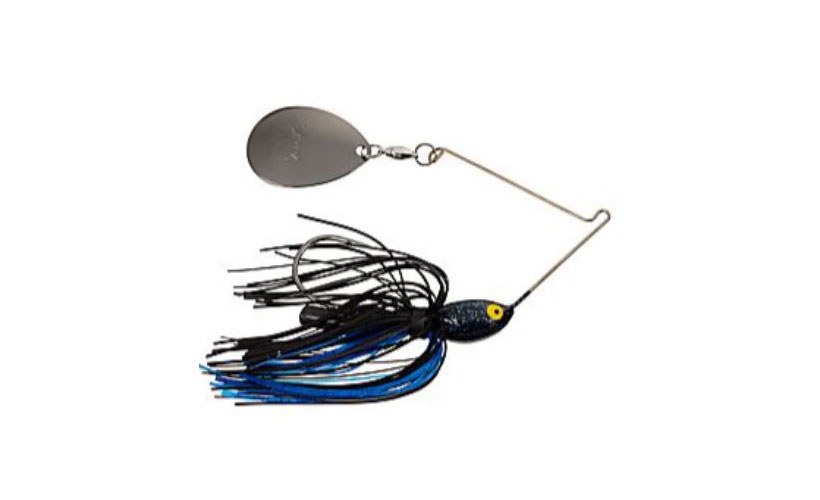
The New York State black bass season opens on Saturday, June 18, 2016, and spinner baits like this Lucky Strike lure from Bass Pro Shops will be among the most popular of artificial lure baits that anglers use to fool ‘ol mossback.

First congratulations to all of the winners in the 4th Annual Oak Orchard Open Tournament.

Although the weather shortened the fishing day, some great catches were brought to the weigh-in that showed the great abilities of all the entries.

It looks like after the storm tomorrow, summer will finally be upon us.

Temperatures will be in the 80’s by the end of the week with an almost perfect Sunday for Father’s Day.

After the storms and winds of the past weekend, Lake Ontario is still trying to settle out to what are more normal conditions.  Right now the picture is scattered, but the best area seems to be the 300 to 400 foot range, with fish coming deeper in the water column.

On Lake Alice fishing has slowed a bit with Bluegill still fairly active.

Of course this Saturday, June 18, 2016, is the opening day of Bass season, so there should be plenty of action along all our shorelines and even on the Erie Canal.  As one person put it, there should be foam on the water from all of the spinner baits being pulled through the waters this Saturday.

From Point Breeze on Lake Ontario, the World Fishing Network’s Ultimate Fishing Town USA and the rest of Orleans County.  We try to make everyday a great fishing day in Orleans County.

Email: sportfishing@orleansny.com

Team Easton Dominates World Archery Championships

Pro Tour Arrow Shafts are Difference
teameaston1

teameaston2With a record 585 competitors from more than 90 nations, the World Archery World Championship in Copenhagen last fall saw Team Easton shooters, exclusively armed with Easton X10 and X10 Pro Tour shafts, sweep the vast majority of the World Titles contested.

Adding a second World Recurve Champion title to his resume, Korea’s Kim Woo Jin dominated his match after a tough qualifier in heavy wind, with his final taking place in front of a screaming, sold-out crowd.

Shooting a perfect 10-10-10 in his final set, Kim took the championship against Netherlands standout and fellow Team Easton shooter Rick Van der Ven, while Team Easton’s Takaharu Furukawa shot his X10’s and Easton Contour stabilizers to take the bronze.

Earlier in the day, Kim led his Korean teammates Oh Jin Hyek and Ku Bonchan to victory in the Gold Medal Team match, defeating Italy decisively, despite a standout effort by Easton shooter David Pasqualucci.

In the race for the women’s recurve title, Korean 2012 Olympic Champion, Ki Bo Bae, took the gold medal in a clutch match against her opponent and fellow Team Easton shooter Lin Shia-Chia of Chinese Taipei. Korea’s Choi Miyun won the bronze medal. All the recurve finalists chose the invincible Easton X10 for their title bids, including the Russian Federation women, taking their first world title in 28 years.

In the hotly contested compound title matches, X10 Pro Tour shooters took a majority of the individual medals awarded, including a historic women’s Gold Medal title for Korea’s Kim Yun Hee, defeating fellow Team Easton shooter Crystal Gauvin in the gold medal final.  Bronze was taken by Easton shooter Sara Lopez of Colombia.

Easton congratulates all competitors for their inspirational performances in Copenhagen.

Since its introduction, the compound-specific X10 Protour has won more titles and set more records for compound archers than all other choices.  For more info, visit: http://www.eastonarchery.com/products/arrows/x10-protour-shafts.

Sage Grouse Initiative Program and Wildlife Conservation

Sage Grouse are incredibly unique and beautiful birds that are benefiting from this unique new program entitled the Sage Grouse Initiative. Photo by Rick McEwan

Sustainable Ranching is Renewable Goal for Field Staff

The Sage Grouse Initiative is a new paradigm for conserving at-risk wildlife that works through voluntary cooperation, incentives, and community support.

The Natural Resources Conservation Service launched SGI in 2010, applying the power of the Farm Bill to target lands where habitats are intact and sage grouse numbers are highest – covering 78 million acres across 11 western states.  While private lands are the primary focus, the Initiative serves as a catalyst for public land enhancements.  Today, the Initiative belongs to the many partners shaping history.

Working together, we are conserving wildlife habitat and managing ranchlands in ways that also create more nutritious forage for livestock.  We are passing on our western heritage of vast skies, unbroken sagebrush-steppe, and room for wildlife and people to roam.

Conservation easements help protect habitat that is critical to Sage Grouse survival. Photo by Jeremy R. Roberts

SGI is now entering its seventh year, has proven to be a model for cooperative, science-based, landscape-scale, habitat conservation.  Our partners are led by the USDA’s Natural Resource Conservation Program, but SGI works hand-in-hand with local community groups, federal and state fish and wildlife agencies, nonprofits, and thousands of agricultural landowners to ensure Farm Bill conservation programs reach their full potential for habitat conservation.

SGI’s partnership positions are funded by a host of participating nonprofit organizations, state fish and wildlife agencies, or federal partners.  We now have over two dozen field staff located in 11 states who comprise our Strategic Watershed Action Team (SWAT).  These dedicated and enthusiastic range conservationists, wildlife biologists, and natural resource specialists continue to deliver on-the-ground conservation results during the first quarter of 2016. The field capacity provided by SGI SWAT partnership positions have enabled NRCS to double the amount of conservation projects across the West.

The Intermountain West Joint Venture takes the lead in coordinating SGI’s Strategic Watershed Action Team.  IWJV also produces quarterly reports to track success on the range, like this new report.  Since 2010, our SWAT team has helped plan or implement the following gains for sage grouse, wildlife, and working rangelands:

  • 2,293,260 acres of rangeland improved to increase sage grouse hiding cover during nesting season. Additional grass cover is expected to increase sage grouse populations by eight to ten percent.
  • 291,613 acres of conifer removed in key nesting, brood-rearing, and wintering habitats. Removing encroaching conifers from sagebrush rangelands eliminates tall structures in otherwise suitable habitat. As birds re-colonize former habitats, increased bird abundance is anticipated.
  • 193 miles of “high-risk” fencemarked or removed near sage grouse mating leks. Marking fences is expected to reduce sage grouse fence collisions by 83%.

In addition, SGI ramped up our science and outreach efforts in 2016, with several new reports, stories, and web tools designed to enhance conservation efforts on the ground.

To learn more or become a volunteer, please visit: http://www.sagegrouseinitiative.com/about/new-paradigm/.

Fishing Report: Orleans County, New York Lake Ontario, Lake Alice, Erie Canal

June 1, 2016

After above-normal temperatures this past holiday weekend, temperatures are returning to a more seasonal levels and with some much needed rain in the forecast.  Fishing conditions should be great.

On Lake Alice, fishing has been very good.  Largemouth bass are in close, Bluegill and Crappie are spread out and some Walleye are being taken at night.

On the Erie Canal, Channel cats are being caught in the 3 to 5 pound class and fishing in the wide waters area is becoming very productive.

Lake Ontario is really turning on with mature salmon in the mix along with good size Steelhead and all the other species being taken. It’s summer in our cold water fishery.  The 200 to 250 feet of water area seems to be the most productive right now.  Junk lines are doing well with most bites coming in the top 40 feet of water, but then there is the occasional bite a bit deeper.

June 10th will be the kick off of the “King of the Oak” series on Lake Ontario with the Condor derby.  The “King of the Oak” series is a best 3 fish series and there are 4 events throughout the summer.

June 11th and 12th is the 4th annual Lake Ontario Oak Orchard Open Tournament.  The 5-Salmon and 5-Trout structure is unique to the tournaments on Lake Ontario and offers some great challenges.

From Point Breeze on Lake Ontario, the World Fishing Network’s Ultimate Fishing Town USA and the rest of Orleans County, Let’s make everyday a great fishing day right here in Orleans County.

Email: sportfishing@orleansny.com

My Grandma Taught Me to Fish

Early Lessons Pay Big Dividends When Kids Grow Up
By Bernard Williams

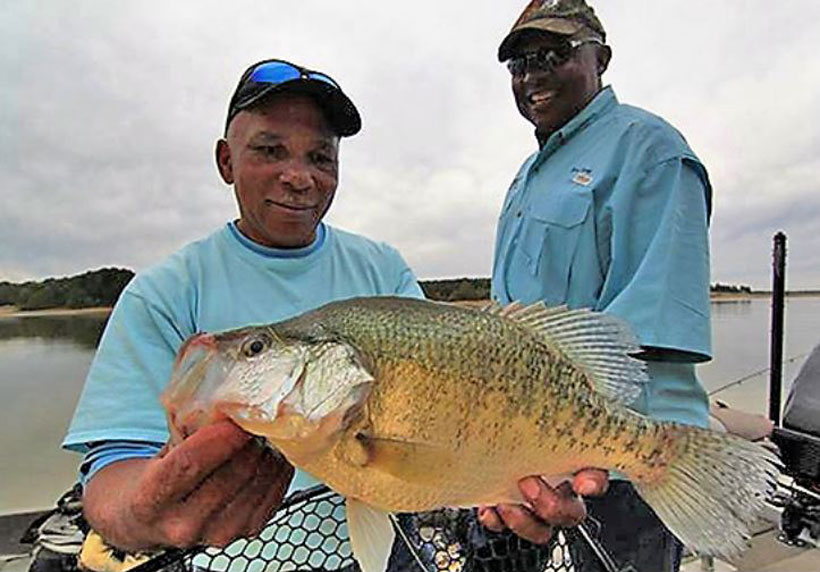
Bernard Williams learned early lessons from his grandmother that instilled a lifelong love of fishing in him. He caught this 3.15-pound whopper crappie at Lake Grenada, Mississippi, with his fishing partner, Don Terry, in the fall of 2015.

My paternal grandmother, Alberta Williams, lived with us.  She had to in her early 80’s when I was born; don’t remember her exact age, but I do know she was around 97 when she passed away.  Well, grandmamma loved to fish.  My mom says she started taking me fishing as soon as I could walk.

I was raised on a small farm. We were poor financially, but I didn’t know it.  My parents worked outside the house as well as on the farm.  My dad raised all our food including cattle, hogs, chickens, corn, cotton, and vegetables.  In those days we only had to purchase flour, sugar and a few other small grocery items.  I would have the time of my life exploring the outdoors as a kid.  I grew up with hunting dogs, and cats––that’s right, we had cats that caught everything from birds to snakes, and a rat or two every now and then.

I remember one morning when I was about 5, she called me from the breakfast table and asked if I wanted to accompany her “down to the pond” as she would call it. We had an 8 or 9 acre farm pond behind the house.  My answer was always “yes ma’am.” In those days you never said just “yes” or “no” to an adult.  I gathered up my pole and away we went.  The pond was about 200 yards behind the house and it was off limits to me as a kid unless I had adult supervision.

Grandma had an innate ability to find a bream bed, I thought it was some kind of magic.  Little did I know, she knew the scent.  She would say, “Boy, you smell that watermelon?”  I would say, “Yes ma’am,” knowing I had no idea.  I just wanted to put my pole in the water.  She would bait my hook with night crawlers we had gathered on the way to the pond.  Dad had a worm bed he’d started long ago.  That worm bed stayed full of night crawlers on one side and red worms on the other side.

She would pitch my worm out near an old stump and then bait her hook and do the same.  This particular day, as soon as my hook sank beneath the surface, a huge hand-size bluegill swallowed my bait and the fight was on. The fish gave a tremendous pull. For a small boy, this feeling caused tremendous excitement, almost to the point of wetting my pants (which is what I did!).  She helped me land the fish and get it into the basket.  Again, she baited the hook and instantly the same thing happened––another hand-sized (or better) bluegill.

I can’t remember exactly how many we caught that day, but I do remember my little sister getting extremely mad about being left out of our fishing adventure.  I’ll never forget the look on my mom and dad’s faces when they returned home to a table full of bluegill fried up with green tomatoes.  Oh boy, it’s kinda like Jerry Clower used to say, “It’ll make a puppy pull a freight train.”

My grandma had only two grandsons.  I was the youngest.  The older one, Johnny, was almost my dad’s age.  Grandmamma looked at Johnny like a son, but looked at me like a grandson.  I’ll never forget the fishing lessons she gave me and the whippings she helped me avoid.

Guess its true, that’s what unforgettable grandmothers are supposed to do––spoil the grandkids.

Wise Women, Fishing Lures, Mother’s Day

By Mike Marsh

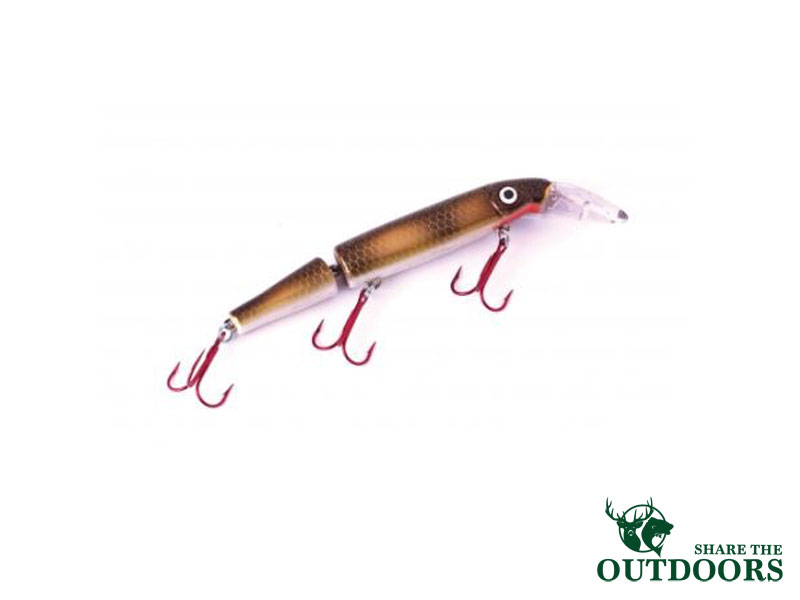
I smiled at the memory of my first fishing lure it was a jointed minnow-imitation called a Cisco Kid. A gift from the true anglers in my family, Grandma Marsh and Great Aunt Catherine, the lure had seen musky duty in the Great Lakes and had tooth scars as proof. They offered me the choice of any lure in their tackle boxes when I traveled “Up North” to attend a family funeral and this one looked most like a real minnow, except for a Rudolph-red splotch on its nose.

Arbella Jones came to our house in Climax, North Carolina, every other weekend, and my mother paid her to help with the cleaning while she went shopping in Greensboro. I wasn’t certain what Arbella meant when she hugged me one day and whispered into my ear, “Your momma is awful good to me. Would you like to come fishing with me this afternoon?”

Mom nodded yes when I asked if I could go. I got my pitiful “gear” together and when the appointed time arrived, she drove me to the end of a dirt road, where 11 children sat on old couches on a front porch that showed gray wood through a ghostly pallor of white paint eroded by weather and neglect. Placing my clunky steel tackle box and fiberglass fishing rod beneath an oak tree, I went inside as the crowd of kids hushed their clamoring and whispered behind my back.

There was no television set, no rug covering the cleanly mopped wood floor, no drapes on the windows and not a picture on the wall. I passed a bedroom where Arbella’s husband was half asleep. A cold chill hit me as he glared and asked, “What’s HE doing here.”

I knew right then that a white child had likely never played at his home. Arbella stood between us, whispering something to him until his face cracked a broad smile.

A five-year-old girl licked peanut butter from a spoon and nibbled a sandwich of baloney folded into a slice of bread.

“Have some, Mister Mike?” she asked.

I shook my head, ashamed to deprive the family of a scrap of food. It was my first glimpse of the poverty that flourished nearly in our backyard.

A few seconds later, Arbella swatted the little girl on the behind and chastised her for not offering me supper. When I tried to explain that she had, but I declined, Arbella frowned and I realized I had injured her pride.

The entire family headed to a local lake in a rusted car and pickup truck. Lining the bank, everyone fished with cane poles except Archie Lee. My wound-fiberglass rod was relegated to worm-and-cork fishing because the antique affair was spooled with Dacron line and my rusty reel was incapable of casting the lightweight Cisco Kid.

Archie Lee spotted the lure in the open tackle box and asked if he could try it. Arbella shot him a warning look. Although a man of 22, he cowered, but I nodded permission and he tied the lure to the monofilament line of a spincast rig. He made his way to the tall grass and willows along the low side of the pond.

I stopped fishing and watched as he cast the lure, retrieved it, and carefully cleaned its hooks of algae. At the fifth cast, the water erupted. The biggest fish I had ever seen launched from the water like a Polaris missile, tossing its head from side to side. Foam marked the surface and water boiled at the point where he submerged.   Then the bass erupted from the water again and all the kids dropped their rods, shouting and clapping as their brother battled the fish.

Suddenly, silence. The water stilled. As quickly as the battle was joined it ended.

“You’d better not have lost Mister Mike’s lure,” Arbella said in a voice that could have frozen the humid August air.

Archie Lee was scared to death of snakes, but was even more afraid of his momma. He waded through the algae-covered water, up to his knees, waist, chest, and then his neck. Finally he ducked beneath the water, felt his way to the end of the line and freed the lure from the submerged log where the bass had scraped the aggravating lure from its mouth.

Dripping wet and towering over me, Archie Lee gently bent down, returned the lure to my tackle box and smiled. I caught my first bass with it later that summer, fishing it on a spincast rod like Archie Lee’s that I bought with money earned doing farm labor beside Arbella’s children. I was so excited when the fish struck the lure and jumped seven times, that I dropped the rod in the mud when I grabbed the fish.

That adrenaline rush, while quieted some over the years, still transforms me back into a ten-year-old kid fishing with my Grandmother Marsh, Great Aunt Katherine and Arbella Jones, whenever I catch a big fish on a lure. They were the piscatorial matriarchs of their families.

I am sure there are other anglers as fortunate as I have been, introduced to the wonders and pleasures of fishing by women who loved fishing as much as they loved children with them.

Grandmothers, aunts and family friends, they were all someone’s mother. I wish I could wish them a happy Mother’s Day, but they are all fishing in the Great Beyond.

If your mother, or someone else’s mother, has ever taken you fishing, hug her hard this Mother’s Day, for you are one of the luckiest people.

My Granny Taught Me to Fish

grannyfishing1

By Everette Wall

I may never make it to Heaven but if I don’t, I’ve been close enough to have an idea of what it’s like.  It was the backseat of an old Buick, surrounded by the thick, heady aroma of lilac bath powder.

It wasn’t what you might think, though.  I was about six years old, sandwiched between my paternal grandmother and one of her friends.  “Sandwiched” is an appropriate term because both ladies were what is known in today’s jargon as “full-figured.”  I didn’t mind, however, because we – including two other women in the front seat – were heading to the coast to go fishing.  For a youngster who loved fishing and his grandma with equal passion, life just couldn’t get any better.  And, I don’t think it ever has.

Those journeys, and others that followed, were a combination of agony and ecstasy.  On one hand they seemed to take forever.  Those were the days before four-lane highways and bypasses in eastern North Carolina and our route wound through the middle of towns like Beulaville and Chinquapin.  Not only that, but the driver didn’t believe in exceeding 45 miles per hour, regardless of the circumstances.  I thought we’d never get there and, if we did, every fish in the ocean would have already been caught.

In Granny’s scheme of things, the time to go fishing was whenever she and her buddies got the notion.  She would just leave Granddaddy a note that said, “Gone to the coast.”  That was his signal to fend for himself until she returned.

For Granny and her cohorts, fishing at the beach was a reprieve from doing laundry, cleaning house, and the other things that made up their day-to-day existence.  It wasn’t that they didn’t love their families and taking care of them, but ever so often, a girl needed a break.  And the weathered, wooden deck of an ocean pier, bathed by a cool breeze as it swayed slightly in the relentless, blue surf was a wonderful place to take one.  Gulls squawked as they wheeled overhead, dipping toward the waves periodically to investigate a possible meal, or maybe just because it was fun.  Farther out toward the horizon, sleek gray forms arched above the blue water as porpoises followed schools of fish down the shore.

The Surf City Pier was Granny’s preferred base of operations.  When she and her entourage arrived, they would take positions along whichever side seemed to be most productive and arrange their rods along the rail.  Then they would settle back on the pier’s weathered benches or in folding chairs to watch for bites.  The tips of Ocean City rods with level-wind Penn reels would dip slowly and rhythmically as waves passed beneath the pier.  Every so often, one would give a quick, definitive jerk.  That was the signal for the angler closest to it to grab the rod and begin cranking.  More often than not a silvery form, sometimes two, would be swung over the rail and flopped onto the deck, to be admired and then tossed onto the ice in a waiting cooler.

Granny and her crew were no fair weather fisherwomen.  Once the battle was joined, they were in it for the long haul.  They would man their stations all day and, often, most of the night.  They knew some of the best fishing was in the wee hours of the morning when most tourists were dozing in their rented cabins and only serious anglers remained at their posts.

If the daylight hours were interesting, nighttime on an ocean pier was magical.  I would curl up in a blanket and stare in wonder at a canopy of stars that looked close enough to touch.  Sometime during the evening I would doze off, immersed in the smell of shrimp and salty air, serenaded by the woosh of waves against the pier’s pilings, and content in the knowledge that Granny was within reach if I should need or want anything.  The rising sun would be my alarm clock, that and the heavy tread of anglers coming out for the early morning bite.

grannyfishing2

Spots, Granny’s favorite species, can be caught pretty much all year, but early fall is the best time.  That’s when the fish begin to congregate to shallow inshore waters in preparation for their winter spawning migration.  It’s the time of year when they are the fattest, many of them sporting bright yellow bellies – evidence of their elevated hormones.  Eventually they make their way offshore to breed. The eggs hatch at sea and the fry, barely a millimeter long, slowly wash back into the estuaries and begin the cycle all over again.

So it is with fish – and sometimes with little boys.  They eventually grow up, move to distant shores and assume lifestyles that insure their existence and that of future generations.  Before it’s all over, however, they return – if not physically, at least in their hearts – to those places that were most special in days gone by.

In one lad’s case that’s an ocean pier, right beside Granny.  It might be a great place to spend Mothers Day.

Free Marine Educational Resources

Connecting Students and Teachers with Marine Science

marineedresources

The Bridge is a growing collection of the best marine education resources available on-line. It provides educators with a convenient source of accurate and useful information on global, national, and regional marine science topics, and gives researchers a contact point for educational outreach. Resources are organized as indicated on the sidebar on the left side of the screen.

Partners
The Bridge is supported by the National Sea Grant Office, the National Oceanographic Partnership Program (NOPP), and the National Marine Educators Association (NMEA).

The Bridge began in 1997 as one of five projects funded by NOPP. The other four are: COAST: Consortium for Oceanographic Activities for Students and Teachers; Enhancing K-12 Science Education Via Satellite-Televised Interactive Technologies; JASON Project – Expanding Student and Teacher Access to Ocean Science Research; Bringing the Ocean into the Precollege Classroom Through Field Investigations at a National Underwater Laboratory.

NMEA members and Sea Grant’s network of educators are actively involved in project administration, serving on the Bridge’s Clearinghouse Coordinating Committee (CCC), and assisting with national information dissemination and site reviews. A Scientific and Technical Advisory and Review (STARS) group advises on scientific content. Project administration and staff are at the Virginia Institute of Marine Science, College of William and Mary.

To learn more, visit: http://web.vims.edu/bridge/?svr=1.

Fire Extinguisher Recall – May Not Put Out The Fire

A voluntary recall from Kidde fire extinguishers includes some models sold to recreational boaters.

Recall for Affected Kidde Models Include Mariner 10, Mariner 110, Mariner 5, and Mariner 5 G

STO Staff Report from BOATUS

As boaters are about to begin the spring ritual of getting their boats ready for the season, Boat Owners Association of The United States (BoatUS) is advising they will need to pay extra attention to the fire extinguishers aboard.

A well-known fire extinguisher manufacturer, Kidde, in conjunction with the US Consumer Product Safety Commission (CPSC), has announced a voluntary recall to replace certain Kidde fire extinguisher units.  A faulty valve component can cause the disposable fire extinguishers not to fully discharge when the lever is repeatedly pressed and released during a fire emergency, posing a risk of injury.  About 4.6 million extinguishers are affected that were sold nationwide between August 2013 and November 2014.

To see if you have an affected fire extinguisher and arrange for a replacement, go to www.cpsc.gov/en/Recalls/2015/Kidde-Recalls-Disposable-Plastic-Fire-Extinguishers.

According to the CPSC, Kidde has received 11 reports of fire extinguishers that failed to discharge, but no injuries have been reported. A February 12, 2015 safety notice from Kidde stated, “Due to our commitment to quality and safety, we have corrected the issue for production going forward, and are working with customers to obtain all recalled units currently in stock.”

Thirty-one models of the disposable fire extinguishers are affected. The extinguishers are red, white, or silver with black plastic valves and ABC or BC rated and manufactured in Mexico between July 23, 2013 and October 15, 2014 and sold at department, home, and hardware stores as well as some marine supply stores. Some of the affected extinguisher models were designed for the boating market and have a nameplate on the front with the names Mariner 10, Mariner 110, Mariner 5, and Mariner 5 G.

If you’d like to know more about how fire extinguishers work, the types needed for boating as well as how many to keep aboard, go to www.BoatUS.org/fire-extinguishers.

About Boat Owners Association of the United States (BoatUS):

BoatUS is the nation¹s largest organization of recreational boaters with over a half million members. We are the boat owners’ voice on Capitol Hill and fight for their rights. We help ensure a roadside breakdown doesn’t end a boating or fishing trip before it begins, and on the water, we bring boaters safely back to the launch ramp or dock when their boat won’t, day or night. The BoatUS insurance program gives boat owners the specialized coverage and superior service they need, and we help keep boaters safe and our waters clean with assistance from the non-profit BoatUS Foundation for Boating Safety and Clean Water. Visit www.BoatUS.com.

My first spring turkey hunt

There is nothing quite so exciting!

By Tony Young

Every hunter is searching for a giant tom turkey on that first opening morning hunt, Tony Young of the Florida Fish and Wildlife shares his 1st Turkey Hunt Success Story with nationwide viewers. Joe Forma Photo

My interest in hunting the quirky-moving, nervous-acting, but beautifully colored wild turkey was piqued about 15 years ago by an old high school friend and bandmate of mine, Todd Bevis.

Todd’s a turkey-hunting fanatic if I’ve ever seen one, and the excitement in his voice that’s apparent every time he tells a hunting story played a big part in my getting the fever to experience spring turkey hunting.

My former in-laws owned a nice tract of land in northern Franklin County with a half-mile of deep creek frontage on a major tributary of the Apalachicola River. Over the years, I enjoyed deer hunting there and took a few fall turkeys, but bagging a good long-beard in the spring takes a bit more skill.

I was ready to learn how to call in and harvest my first spring gobbler.  All I needed was the know-how, and I figured I could get that from Todd and from watching Saturday and Sunday morning hunting shows on TV.

Todd encouraged me to get a box call because he said it would be the quickest and easiest call for me to learn – and the spring season was approaching fast.

He taught me how to do some basic yelps and a single-note cluck and said if I had birds on the property that had really never been called to before, and – if I could sit still long enough – I just might be able to call one in.

But Todd warned me, “Don’t make the mistake some people do in calling too much. Let ’em know you’re there, but let ’em come to you – less is more.”

With that advice in mind, I set out early opening day. I needed to get there a half-hour before first light so I could set my three decoys in place and get situated.

Sunrise wasn’t until 7:45 a.m., so I had about 30 minutes before the sun’s first rays would begin to illuminate the longleaf pine and palmetto flatwoods I’d be hunting.

It was a brisk north Florida spring morning, but as dawn gave way to late morning I knew the weather would warm up and it wouldn’t take long for those pesky, deep-woods mosquitoes to come out of the swamps and start buzzing around my ears. I quickly sprayed myself down with an ample dose of bug spray.

While carrying a jake and two hen decoys in one hand, I toted my shotgun, camo seat cushion and small flashlight in the other and made my way in the dark down a trail that weaved through a patchwork of saw palmettos toward a spot where I often saw turkeys.

The setup was near one of my favorite deer stands, on a ridge that jutted out between a creek and a ravine. It was where turkeys roosted most every evening amid juniper, tupelo and cypress trees hanging over the water.

Before I could even finish setting up my decoys, the sounds of gobbling echoed in the darkness from the creek bottom below. The strange vocalization of three, maybe four, birds was something I’d never heard, and it fascinated me.

I picked out a large pine tree to lean back against to hide my silhouette. Then I used a pair of hand pruners and began to snip some of the surrounding native vegetation of galberry and titi and used the clippings to construct my make-shift ground blind.

I settled in against the tree – my gun across my legs and my box call in my lap – and the sound of gobbling continued to fill the otherwise quiet predawn.

At 7 a.m. it started to get just light enough to see. As I sat facing the hardwoods of the ravine and creek swamp, I could make out my decoys 10 steps in front of me.

About 15 minutes later, when the visibility was noticeably better, I picked up my box call and made my first yelp to make those gobblers think there was an interested hen nearby.

A reassuring gobble answered me right away!

I was so excited I couldn’t believe it – a gobbler actually had responded, just like on those hunting shows.

“What am I supposed to do now?” I wondered. I remembered Todd telling me not to call any more often than about 15 minutes. So I sat quietly in anticipation for what seemed to be the longest 15 minutes of my life, but when I glanced down at my watch, only five minutes had elapsed. After another five minutes of real time had passed, I couldn’t stand it any longer and made another call.

Another gobble immediately followed, but this time it was louder.

This bird actually was coming to me! My first spring turkey hunt was beginning to play out in textbook fashion.

I sat just as still as I could be for another 10 or 15 minutes and called out for a third time.

The “GOBBLE, GOBBLE, GOBBLE, GOBBLE” reply sounded like it was being screamed into my ears. This Eastern turkey was right on top of me!

I couldn’t see him, but he had to be just out of my sight behind the brushy terrain.

A few moments later, the longbeard stepped out from behind a galberry thicket in full strut, and my heart starting pounding. I couldn’t see its legs because gold, iridescent feathers were covering them, but the bird seemed to glide like an apparition as it cautiously made its way toward the decoys.

The way its head was changing colors from red to blue and back again, and the show this gobbler was putting on, was truly a sight to behold. Now I realized what Todd’s and so many other turkey hunters’ infatuation was all about.

Its instinctive, ritualistic courtship dance was so beautiful I almost didn’t want to end it, but the big tom was getting too close, and I knew I’d better take the shot soon for fear he’d spy me.

The opportunity to raise my 12-gauge pump shotgun came when he went behind a palmetto clump at 12 steps, and I fired just one shot when he stepped out the other side.

What a rush!

It was my first spring gobbler, and it had a 9-inch beard. Now what was so hard about taking a spring turkey, I thought?  After all, it was only 8 a.m., and I already had my then daily bag limit after calling just three times.

But like every turkey hunter knows, spring turkey hunting rarely happens that way. Maybe it was beginner’s luck, but whatever it was –

springturkey2I have been hooked ever since.

The Florida Fish and Wildlife Commission has adopted innovative conservation tools and strategies, focusing on incentives for private lands and fish/wildlife management.  Strategies may include enhancing partnerships, incentives, and streamlining regulations.  The FWC’s Community Relations Office produces several feature columns each month.  Each column focuses on a specific element of Florida’s fish and wildlife resources or type of outdoor recreation.

To learn more about Florida Hunting and Fishing, visit: http://myfwc.com.

Orleans County Fishing Report

orleans_county

Lake Ontario, Point Breeze, Oak Orchard River, Lake Alice 

Once we get thru the cold temperatures of last night, more spring like conditions will come into play.  I mean after all May 1st is this coming Sunday.  The Erie Canal opened today, just slightly early of their normal opening date.

On Lake Alice both Bluegills and Crappie have been fairly active along with bass.  Please remember that opening day of bass season is not until the 3rd Saturday in June, so for now it’s catch and immediately release.  Also on the tributaries within Orleans County Bullhead are still being taken by those who know their super-secret hideouts.

On Lake Ontario, the system seems to be fish for brown trout when the mud line is present and if it’s not go out for lake trout.  Over the past few days the surface temperature has dropped about 5 degrees with those wonderful northerly winds.

The story at the Niagara Bar is this weather pattern has kept the Kings from turning on yet, but that could change very quickly with some favorable winds.  The cooler temperatures also mean that we may be able to keep our pen fish a little longer so please give a helping hand with the feeding and cleaning of the pens.

As always, this summer is filled with some of the very best fishing derbies and tournaments you can find anywhere covering all of Lake Ontario.   Why not join in on all of the fun and the possibility of cashing in on some very impressive prizes.  From Point Breeze on Lake Ontario, the World Fishing Network’s Ultimate Fishing Town USA, and the rest of Orleans County, let’s make everyday a great fishing day right here in Orleans County.

Orleans County Tourism
14016 Route 31, West Albion, NY   14411

Hunt Safely – Turkey Season is on

It can be hard to locate 3-year old gobblers, but when you do, successful hunters know that getting up at 3:30 in the morning, in the dark, was worth every effort. Joe Forma Photo

The message from the Kansas Department of Wildlife, Parks and Tourism is a message that applies to turkey hunters across the country as turkey seasons open and run for about a month in multiple states at this time of year – Hunt Safely.

The Kansas Spring Turkey Season opened April 12 and is in full swing through May 31.  Reports from the field indicate that birds are plentiful and responding to hunters’ calls.  However, the tradition of spring turkey hunting, where the hunter hides in full camouflage while imitating the call of a hen, requires special safety consideration.

Turkey hunting can be excellent on state wildlife areas, as well as the nearly 250,000 acres of private land enrolled in the Spring Walk-In Hunting Access Program.  Hunters on public land must always assume other hunters are there, too.  Although hunting in Kansas is safer than playing golf, when you consider injuries per 100,000 participants, one tragic hunting-related accident is too many. A few simple precautions can help ensure you or another hunter don’t become a statistic.

First, NEVER wear the colors black, blue or red, the colors prominent on a tom turkey as it displays for a hen.  Set up to call with a good view in front and a tree wider than your shoulders at your back.  A shoulder-width tree to lean against will protect you if another hunter stalks in from behind.  If you see another hunter, whistle or call out; never wave or move, which could draw fire.  Always assume a sound you hear is another hunter, and act accordingly.  Many hunters will wear a fluorescent orange hat or vest when they walk out after hunting, or if they are successful, they may wrap an orange vest around their bird as they carry it out.  Hunting-related accidents during the spring turkey season are rare, but let’s keep it that way.

Another kind of hunter in the woods this time of year is hunting morel mushrooms and reports from the field indicate that hunters are finding them now.  It is legal to pick morels on state and federal public hunting land as long as they are kept for personal consumption.  Mushrooms collected on state and federal lands may not be sold commercially.  Spring Walk-In Hunting Access land is leased for hunting access only.  Morels found incidentally by turkey hunters on WIHA lands may be collected for personal use.  Mushroom hunters should assume they will encounter turkey hunters on public lands, but potential conflict can be minimized by hunting mushrooms mid-day. Most turkey hunters prefer to be in the woods at daybreak and are often calling it a day by mid-morning.

For more information on KDWPT, please visit www.kdwpt.state.ks.us. 

More about the Kansas Department of Wildlife, Parks and Tourism

KDWPT employs approximately 460 full-time employees in five divisions: Executive Services , Administrative Services , Fisheries and Wildlife , Law Enforcement , Parks and Tourism.

Department History:

  • 1905 – Fish and game laws were organized under the Kansas Fish and Game Department and implementation of a state law requiring a license to hunt.
  • 1911 – The State Fish and Game Department was placed under the supervision of the University of Kansas Board of Regents
  • 1925 – The Fish and Game Department was reorganized as the Kansas Forestry, Fish and Game Commission with three board members appointed by the Governor.
  • 1927 – Commission was reorganized and was given approval to organize a warden service. Fishing licenses required of men 18-70.
  • 1939 – Commission’s three-member board was abolished by the legislature and replaced by a six-member bipartisan commission appointed by the Governor
  • 1943 – Legislature gives the commission full authority to set seasons and dates
  • 1955 – The legislature and Gov. Fred Hall create the State Park and Resources Authority.
  • 1960 – First Kansas boating laws enacted
  • 1987 – Gov. Mike Hayden signs executive order merging the State Park and Resources Authority and Fish and Game Commission to create the Kansas Department of Wildlife and Parks
  • 2011 – Gov. Sam Brownback signs executive order moving the Division of Tourism from the Department of Commerce to the newly renamed Kansas Department of Wildlife, Parks and Tourism

IMR 4007 SCC Powder Recall

powder_recall

If you are a recreational or precision shooter and you hand-load your own ammunition, this is a call to action to inspect your powder inventory and lot numbers.

IMR recently (September, 2015) announced a product safety warning and recall notice for IMR 4007SSC powder sold in 1-pound and 8-pound containers.

IMR received reports that this particular powder may have become unstable due to possible rapid deterioration that could possible result in spontaneous combustion, fire damage or possible personal injury.

The lot numbers of concern are as follows: 10130139, 10131139, 10429139, 10430139, 80425139 and 80426139.  If the number on your container matches one of these lot numbers, stop using the product immediately.

IMR recommends that you fill the container with water immediately to render the product inert and safe for disposal.  Mail, email or fax a copy of the powder label showing the lot number to the contact information below and include your name, address and email.

Replacement product of any other IMR smokeless powder product will be shipped to you for no charge.

If you have already loaded the powder subject to this recall into ammunition, IMR recommends that you pull the bullets, remove the powder and wet the powder with water for safe disposal.

IMR Powder Company deeply regrets any inconvenience this recall may cause, but they always believe in safety first.

Contact information:  IMR Powder Company, 6430 Vista Drive, Shawnee, KS, 66128.  Email: help@imrpowder.com.  Website: www.imrpowder.com.  Telephone: 800-622-4366 or 913-362-9455.  FAX: 913-362-1307.

Civilian Marksmanship Patrol offer Hi-End Competition, Low Cost Ammo

Civilian Marksmanship Patrol offer Hi-End Competition, Low Cost Ammo
Competitive marksmanship is a big part of CMP’s mission. It reinforces firearms safety and enables competitors to further develop their marksmanship skills and in many cases, earn recognition for doing so.

If you’re new to competitive shooting, CMP and its affiliated clubs and organizations continually sponsor clinics and workshops to help everyone get up to speed. Experts extend high recommendations to participate in the CMP – USAMU Small Arms Firing School for pistol and/or rifle during the National Matches at Camp Perry, Ohio. By completing the one or two-day schools, interested individuals will learn the fundamentals of firearms safety and marksmanship.

Remember, the Civilian Marksmanship Program (CMP) is a national organization dedicated to training and educating U. S. citizens in responsible uses of firearms and air guns through gun safety training, marksmanship training and competitions. The CMP is a federally chartered 501(c)(3) corporation that places its highest priority on serving youth through gun safety and marksmanship activities that encourage personal growth and build life skills. Visit the website noted below for more links that will lead you to more information on ammunition and competition.

For more on CMP Competitions, feel free to contact CMP with questions at competitions@thecmp.org or (419) 635-2141 ext. 706 or 714. Visit their website for more information at: http://thecmp.org/competitions/

Lake Erie Committee Announces Walleye and Yellow Perch Harvest Levels for 2016

Maintaining a healthy Lake Erie walleye and yellow perch fishery is the responsibility of fishery scientists and managers from many states and nations that meet each year to discuss the monitoring data behind the delicate balance of understanding a healthy fishery. Forrest Fisher Photo

The binational Lake Erie Committee of the Great Lakes Fish Commission (GLFC), comprising fishery managers from Michigan, New York, Ohio, Ontario, and Pennsylvania, met in Niagara Falls, Ontario, and recommended a total allowable catch (TAC) of 4.937 million walleye and 9.208 million pounds of yellow perch for 2016 (Walleye are allocated by number of fish; yellow perch are allocated in pounds).  These TAC recommendations are an allowable combination harvest of recreational sport fishing and commercial fishing, for 2016 the numbers represent an increase in allowable catch for walleye from 4.114 million fish last year and a decrease in yellow perch from 10.528 million fish.

The Lake Erie Committee’s TAC recommendations are reflective of the status of Lake Erie’s fish populations and take into account the goal of consistent harvest from year to year. The individual provincial and state governments adhere to and implement the TAC recommendations in accordance with their respective regulations and management objectives.

TAC recommendations are produced after extensive lakewide biological assessments, analysis, discussions, and consultations with stakeholders. A central mechanism to discuss walleye and yellow perch management in Lake Erie is called the Lake Erie Percid Management Advisory Group, or LEPMAG. Through this process, stakeholder input directly informs the development of harvest strategies.

A healthy fishery affects the recreational economy and millions of people that utilize the resource.

WALLEYE

The Lake Erie Committee today recommended a 2016 walleye TAC of 4.937 million fish, a 20% increase from the 2015 TAC of 4.114 million fish. The TAC recommendation for 2016 reflects a stable adult population and a moderate to strong hatch in 2014. The 2011, 2010, 2007, and the 2003 year classes continue to contribute to the stability of the walleye fishery and allow for the increase in TAC from last year.

Each Lake Erie jurisdiction is responsible for implementing its portion of the TAC. The Province of Ontario and the States of Ohio and Michigan share the TAC based on a formula of walleye habitat within each jurisdiction in the western and central basins of the lake. Under a 2016 TAC of 4.937 million fish, Ohio will be allocated 2.523 million fish, Ontario 2.126 million fish, and Michigan 0.288 million fish. Most of the walleye harvest comes from the western portion of Lake Erie and, as such, jurisdictions in the eastern end of the lake are outside the TAC area. Harvest limits in the eastern basin are established separately by Ontario, Pennsylvania, and New York and remain in accordance with lake-wide conditions and objectives.

The walleye TAC recommendations are consistent with the Lake Erie Walleye Management Plan, which sets fishery goals and objectives for walleye. The plan is the result of extensive stakeholder and manager input through LEPMAG. In addition, the Walleye Task Group, comprising scientists and field biologists from all Lake Erie jurisdictions, provides scientific advice to the Lake Erie Committee. The committee also takes into account recommendations from LEPMAG and is informed by a model, developed in conjunction with stakeholders and Michigan State University.

YELLOW PERCH

The Lake Erie Committee remains strongly interested in maintaining stability in harvest while ensuring yellow perch sustainability. Consistent with that primary objective, the Lake Erie Committee recommended a 2016 TAC of 9.208 million pounds of yellow perch, a decrease from last year’s allocation of 10.528 million pounds. The decrease in the yellow perch TAC reflects declining abundance in the central eastern basins, coupled with increasing abundance in the western basin. Like the walleye TAC recommendation, the proposed yellow perch TAC is the result of deliberations among the jurisdictions and with stakeholders through the LEPMAG process.

The five jurisdictions on the lake share Lake Erie’s yellow perch established under an area-based formula. Under the 2016 TAC recommendation, Ontario will receive 4.385 million pounds, Ohio 3.876 million pounds, Michigan 0.209 million pounds, New York 0.119 million pounds, and Pennsylvania 0.620 million pounds.

The Lake Erie Committee noted that the lake-wide yellow perch fishery is performing at long-term trend levels and, thus, the overall TAC reflects a relatively small decrease. The performance, however, is not uniform throughout the lake. In some areas, called “management units,” the change in yellow perch abundance (and, hence, allowable harvest) is significantly different in 2016 compared to 2015. The Lake Erie Committee has strived to maintain harvest stability while still responding to specific trends in each management unit. The committee discussed the need to evaluate methods, including population modeling and assessment, for better understanding percid recruitment in the central basin.

THE LAKE ERIE PERCID MANAGEMENT ADVISORY GROUP (LEPMAG)

The Lake Erie Percid Management Advisory Group was first convened in 2010 and serves as the primary method to incorporate stakeholder needs and objectives into the Lake Erie yellow perch and walleye decision-making process. LEPMAG consists of senior representatives from all provincial and state jurisdictions on the lake, recreational fishers, commercial fishers, and other interested organizations. Through LEPMAG, fishery managers and stakeholders work together to identify the harvest policies for Lake Erie percids that meet the needs of all stakeholders while maintaining stability in the percid fishery. Michigan State University’s Quantitative Fisheries Center facilitates the LEPMAG process. Walleye are now being managed under the Walleye Management Plan, which was developed through LEPMAG and formally adopted by the Lake Erie Committee in December, 2015. LEPMAG members are in the process of developing population objectives and harvest strategies for yellow perch in Lake Erie. The objectives and harvest strategies are expected to be completed in the coming years.

THE LAKE ERIE COMMITTEE AND TACs

The Lake Erie Committee comprises fishery managers from Michigan, New York, Ohio, Ontario and Pennsylvania. The committee’s work is facilitated by the Great Lakes Fishery Commission, a Canadian and U.S. agency on the Great Lakes. Each year the committee recommends a TAC for walleye and yellow perch. The TAC represents the number or weight of fish recommended to be caught by sport and commercial fishers without putting the fisheries at risk. The individual agencies implement the recommended total allowable catch.

Spring Sonar Magic, Zero-In on Hot Fishing Spots

“How-To” Insights from BASS Elite Pro Matt Herren

Herren runs LakeMaster PLUS mapping on HELIX10 units to dial in early-season bass. He’s also been making some of his own maps with AutoChart Live, which is built into HELIX 9, 10, 12 and ONIX

Spring is in the air and with it comes the most enjoyable season for fishing.  As everything comes alive, hungry fish of all species begin to prowl the shallows in preparation for their annual spawn.  Step one on their list is to eat everything in sight and where regulations allow, anglers have a distinct advantage for catching many fish and big fish too.  Bass, crappie, walleye and so many other species are all on the move, depending on water temperature.  Modern sonar units provide temperature, a very useful feature for spring fishing.

Understanding the habits and preferred water temperatures for each species is all that is needed to know when to start, but after that, finding those key locations on any lake sector is not as easy as you might think in spring.  This is especially true on lakes with harsh winter conditions and heavy spring winds that often change the lake bottom composition.

Many top anglers like Matt Herren, a bass tournament champion with a history of big time scoring all across the country, narrows his search of any waterway with a method that helps him zero in on the action.  To start, Herren studies the map and selects areas somewhat protected from current: ledges downstream from major points or other structural elements or on inside turns of the main channel. However, a quick look at any LakeMaster chip often reveals dozens of areas that match this criteria. How then, is Herren able to isolate the protective spots?

The key is the efficient use of electronics. In today’s age of depth finders that look down, out and all around the boat, Herren has found it necessary to get intimately familiar with such technology in order to stay one step ahead of his competition.

The first and most important step, he says, is to locate areas with hard bottoms. Herren does so by selecting several intermediate ledges that fit his criteria based on lake level, water color, temperature and graphing with the Side-Imaging feature on his Humminbird ONIX. But, rather than do so utilizing the factory default setting, Herren first makes one small, but important, display change. “I always set my unit on Amber 1 color mode” he says. Doing so allows hard-bottomed areas to brightly glow on the screen, easily revealing key spots.

Humminbird Side Imaging allows quick identification of lighter-colored hard bottom areas from darker, soft-bottomed areas.

Herren’s user-customization doesn’t end with a quick display change. “I also play with frequency changes (on his depth finder) a bunch” he points out. Herren has found that the best 2D SONAR frequency setting on his ONIX often changes as he moves from lake to lake. Whether such an oddity is the result of a chemical change in the water, or the amount of small particles floating within, is not totally understood by Herren; he just knows that changing frequency (say, from 83 to 200 kHz) often reveals the best set-up on a day-by-day basis.

Once hard-bottomed areas are located, Herren keeps a careful eye on his water temperature read-out, knowing such plays a major factor in the stage of the bass spawn. With water temps in the mid-fifties, bass often group up and stage; spawning beginning when the thermometer passes sixty. Herren notes that bass utilizing main lake areas for spawning often do so several weeks after those in protected bays, lengthening the springtime bonanza associated with this season.

Whereas summertime fish will often school on a bare-spot, like a small shell bed, Herren finds springtime fish prefer objects, likely due to these spawning tendencies. “They want to protect their blindside.” Herren mentions of the tendency of spawning bass to nest up against and object like a stump or seawall. This behavior applies to open-water areas as much or more to those near the shoreline, as a bit of cover helps bass guard against nest predators.

When a potentially productive area is located through Side Imaging, Herren scrolls across the ONIX screen and marks each with a waypoint. Then, he deploys his trolling motor and utilizes a different electronic approach to investigate the spot, using both 360 Imaging® and Down Imaging.

Herren says 360 Imaging® has helped him find “new, key areas in spots he’s fished for decades.”

First, it’s important to understand Herren’s view on each of Humminbird’s technologies. “360 Imaging is a fishing application, not a search tool,” he says. By this, Herren means that he utilizes 360 only when on the bow and casting, not for idling purposes, as the 360 sweep time is most conducive as a fishing application. In addition, Herren often isolates the sweep of 360 to reveal objects directly in front of him, within casting distance, making the update time on his screen display much quicker. As credit to the effectiveness of this technology, Herren noted that he’s often found new, key areas in spots he’s fished for decades by utilizing 360, opening his eyes to a vast new world.

Side Imaging is Herren’s bread and butter for fine tuning a spot. While he uses the new Humminbird HELIX units primarily for mapping, Herren sticks with ONIX for depthfinding, especially Side Imaging. “There’s nothing like it” he states, adding “I’ve seen things with that unit that I’d never see with any other.”

As Herren fine-tunes a chosen spot on the trolling motor, he’s constantly continuing his search for small, hard-bottomed areas, or isolated objects that could yield a big bass or two. Herren mentions that he often finds fish on the exact same spot, year after year, during the spring season.

Once “on the juice” Herren’s approach to fishing is fairly basic, using an arrangement of tried-and-true springtime lures. “I like a rattlebait a lot, as well as a chatterbait or spinnerbait.” After getting dialed-in to specific pieces of cover, Herren often wields his trademark Santone Jig to mop up on the competition.

Matt Herren, photo courtesy of B.A.S.S.

But just what makes a good spot great? “It’s a combination of things. Bottom type and cover matter, but maybe so do things like unknown current patterns,” says Herren. It’s a mystery that Herren admits to constantly trying to understand better. Perhaps we’ll never solve the case, but with advancements each year in technology, we’re drastically closer all the time.

About Johnson Outdoors Marine Electronics, Inc.

Johnson Outdoors Marine Electronics, Inc. is a wholly owned subsidiary of Johnson Outdoors  and consists of the Humminbird®, Minn Kota® and Cannon® brands. Humminbird® is a leading global innovator and manufacturer of marine electronics products including fishfinders, multifunction displays, autopilots, ice flashers, and premium cartography products. Minn Kota® is the world’s leading manufacturer of electric trolling motors, as well as offers a complete line of shallow water anchors, battery chargers and marine accessories. Cannon® is the leader in controlled-depth fishing and includes a full line of downrigger products and accessories.

Groups Join Forces to Advocate Outdoor Policy

rmefcsf

The Congressional Sportsmen’s Foundation (CSF) and Rocky Mountain Elk Foundation (RMEF) signed a partnership that will foster greater cooperation to jointly advance the outdoor traditions of hunting, angling, recreational shooting and trapping at the state and national levels of government.  This is where many of the decisions impacting these outdoor activities are made.

Jeff Crane, Congressional Sportsmen’s Foundation President, shared, “Given that CSF and RMEF have long collaborated to advance the interests of America’s sportsmen and women, this formal partnership is a natural fit.  Working side-by-side, both organizations are well positioned to protect our hunting heritage in elk country and throughout the nation.”

The CSF States Program manages the National Assembly of Sportsmen’s Caucuses which currently includes more than 2,000 state legislators in 48 bipartisan sportsmen’s caucuses across the nation. It also works with 33 members of the Governors Sportsmen’s Caucus as a link between lawmakers and the state and federal fish and wildlife management agencies, the outdoor industry and conservation organizations.

David Allen, RMEF President and CEO said, “It’s evident that now, more than ever, we need to educate and engage sportsmen and women, as well as our legislators, about the vital habitat, management and conservation issues and challenges that face our wildlife.  Working even closer with CSF helps us do exactly that.”

“RMEF has a long history of successfully working shoulder-to-shoulder with the Congressional Sportsmen’s Foundation,” said Blake Henning, RMEF Vice President of Lands and Conservation. “This agreement strengthens our resolve and intentions to work together to be more productive and do a greater good on behalf of conservation, wildlife, sportsmen and women.”

The ability to effectively advocate for natural resource and wildlife management policies as well as traditional outdoor interests is dependent on the ability to organize supporters on multiple fronts.

RMEF has nearly 220,000 members, including 11,000 volunteers, who take part in fundraising and on-the-ground conservation and hunting heritage outreach projects across more than 500 chapters in 49 different states.

The new agreement provides an enhanced opportunity to combine CSF’s conservation policy knowledge and network with RMEF’s membership and chapters to effectively guide policy in a way that encourages the participation of sportsmen and women in the legislative process. It also strengthens efforts to make a greater positive collective impact on outdoor heritage, wildlife management, public access, public and private land conservation, and hunter recruitment and retention.

About the Congressional Sportsmen’s Foundation:

Since 1989, CSF has maintained a singleness of purpose that has guided the organization to become the most respected and trusted sportsmen’s organization in the political arena. CSF’s mission is to work with Congress, governors, and state legislatures to protect and advance hunting, angling, recreational shooting and trapping. The unique and collective force of the Congressional Sportsmen’s Caucus (CSC), the Governors Sportsmen’s Caucus (GSC) and the National Assembly of Sportsmen’s Caucuses (NASC), working closely with CSF, and with the support of major hunting, angling, recreational shooting and trapping organizations, serves as an unprecedented network of pro-sportsmen elected officials that advance the interests of America’s hunters and anglers.  For more information, contact Sara Leonard, CSF, (202) 543-6850 x11 or sara@sportsmenslink.org

About the Rocky Mountain Elk Foundation:

Founded over 30 years ago, fueled by hunters and a membership of nearly 220,000 strong, RMEF has conserved more than 6.7 million acres for elk and other wildlife. RMEF also works to open and improve public access, fund and advocate for science-based resource management, and ensure the future of America’s hunting heritage. Discover why “Hunting Is Conservation™” at www.rmef.org or 800-CALL ELK.  For more information, contact Mark Holyoak, RMEF, 406-523-3481 or mholyoak@rmef.org

Rise of Legend Elite Musky Rekindles an Ancient Battle

muskyormuskie

St. Croix Rod has made its choice; what side of the battle-line will you land on?

From their home base in Park Falls, Wisconsin, an old wound has been reopened.  The subject sat silent for so many years, double-decades, but it has resurfaced like an awakened pandemic from beneath the crust of the silent earth.

In this time of steeped “political angler” gamesmanship, where no participant or candidate can seemingly offer a conclusive and straight answer, St. Croix Rod is taking full responsibility for reopening the wound: the age-old, sometimes contentious debate over the correct spelling.

Is it “MUSKY” or “MUSKIE”?

Best we can tell, the polarizing topic respawned with this year’s birth of Legend Elite Musky.  (Yes, St. Croix says “musky”.)  This is best-of-the-best musky fishing tool that got elite anglers off their seats and talking smart about the incredible rod, and as a byproduct, reinvigorated the age-old spelling dispute.  Before delving into the debate, it’s prudent to first share essential Intel about the incredible Legend Elite Musky fishing rod.  “We’ve been working quietly behind the scenes for the past two years to create what serious musky anglers have long awaited,” says Rich Belanger, St. Croix Promotions Director.

muskyormuskie2

Specs point to Legend Elite Musky weighing 10-18% less than the popular St. Croix Legend Tournament, a big deal when you add up the hours, days, weeks and months that serious musky anglers spend on upper body workouts.  The fish of a thousand casts.

“As baits are getting larger and heavier and anglers put in longer hours chasing even bigger fish, the Legend Elite Musky Series represents that dream musky rod family that reduces physical fatigue and keeps anglers fishing longer, raising their odds at trophy fish,” says Belanger.

St. Croix engineering head Dave Schlitter say, “They quite literally went back to the drawing board with the new series.  They cut weight by re-thinking the blank, utilizing SCV carbon fiber, a high-modulus, high-strain material that creates a lighter, quicker, and faster and more responsive blank.”

muskyormuskie3

“The new Legend Elite Musky also features a completely re-designed guide train utilizing Fuji® Torzite® for rings that are harder and half the diameter of the SiC Concept Guide System, and guide frame weight reduction while maintaining optimal guide opening size,” adds Schluter.

With the overall reduced weight in the blank and less mass on the guide train, the rods practically “float” in the hand.  Pick one up and you’ll notice a significant reduction in tip mass.  All that amounts to the lightest (and best) muskie (oops) rods on Earth.

Musky vs. Musky Contest

Now back to the spelling hullaballoo.  Full diplomacy at play, St. Croix wants your spin on this election year controversy and there’s no better free-world means than to put it to vote.  Here’s your chance to tell the world what you think and win a St. Croix Musky rod!  St. Croix is giving you FOUR chances to win!  And, yes, you can win more than once!

  • STEP ONE: Simply fill out the entry form and vote Musky or Muskie. One randomly drawn lucky winner will receive a St. Croix Rod Mojo Musky. Enter once every 24 hours between March 18 and March 24, 2016.
  • STEP TWO: Make a 30 second video (or less) stating your case on Musky or Muskie and why. Load your video on YouTube, or Vimeo. Fill out the Entry Form and submit your video.  One randomly drawn lucky winner will receive a St. Croix Rod Legend Tournament® Musky.  Only one entry per person. Enter March 18 and March 24, 2016.
  • STEP THREE: All submitted videos will be open to public vote between March 25 and April 1, 2016.  The video with the most votes will win a St. Croix Rod Legend Elite® Musky rod. Winner will be announced on April 2, 2016.
  • Instagram Only:  Record a 15 sec. or less video stating your case for Musky or Muskie between March 25 – April, 1.  The video with the most likes wins a Mojo Musky rod.

muskyormuskie4

About St. Croix Rod

St. Croix Rod is a family-owned and managed manufacturer of high-performance fishing rods headquartered in Park Falls, Wisconsin with a 65-year heritage of USA manufacturing. Utilizing proprietary technologies, St. Croix controls every step of the rod-making process, from conception and design to manufacturing and inspection, in two company-owned facilities. The company offers a complete line of premium, American-made fly, spinning and casting rods under their Legend Elite®, Legend® Xtreme, Legend Tournament®, Avid Series®, Premier®, Wild River®, Tidemaster®, Imperial® and other trademarks through a global distribution network of full-service fishing tackle dealers. The company’s mid-priced Triumph®, Mojo Bass/Musky/Inshore/Surf, Eyecon® and Rio Santo series rods are designed and engineered in Park Falls, Wisconsin and built in a new, state-of-the-art manufacturing facility in Fresnillo, Mexico. Founded in 1948 to manufacture jointed bamboo fishing poles for a Minneapolis hardware store chain, St. Croix has grown to become the largest manufacturer of fishing rods in North America.

New York State Big Game Study Tells Tale

New York Study Plan Result is to Educate and Encourage Hunters to Voluntarily Pass-up Young Bucks 

A multi-year study to guide buck management in New York State found deer hunters prefer to harvest older bucks and that further expanding mandatory antler restrictions is not warranted at this time.  Instead, NYS will encourage hunters to voluntarily pass up shots at younger bucks as a management method to best serve the interests of all deer hunters across the state.

“Through this study, The New York State Department of Environmental Conservation (DEC) engaged with the hunting community to determine the best deer herd management practices to benefit both the deer population and our state’s wildlife enthusiasts,” Acting DEC Commissioner Seggos said.  “DEC staff concluded that promoting voluntary restraint was appropriate given the high level of hunter support for increased availability of older bucks. Using a sound scientific approach to wildlife management is an essential strategy to expand hunting opportunities and growing the hunting economy in New York.”

New York State deer check stations examine deer for health and age, providing important details for successful hunters while gathering data for studies.

DEC and the New York Cooperative Fish and Wildlife Research Unit at Cornell University conducted the study in response to long-standing interests expressed by many hunters for DEC to adopt regulations to reduce the take of yearling bucks (male deer younger than 1.5 years old) to increase the number of older bucks in the population  Moving forward, DEC intends to work with several leading sportsmen groups across the state to educate hunters on their important role in deer management, the impacts of their harvest choices and the likely changes in the deer population as more and more hunters voluntarily refrain from taking young bucks.

The study included a statewide survey of 7,000 deer hunters conducted in fall 2013 by the Human Dimensions Research Unit at Cornell University, a nationally recognized leader in surveys to assess public opinions and attitudes on wildlife-related issues.

Rich Davenport (left), as co-chairman of the New York State Conservation Council Big-Game Committee, has worked closely with New York State DEC wildlife biologists and law enforcement to provide statistical analysis and other date to help identify the interests of sportsmen and other important stake holders in the world of whitetail deer in the Empire State. Forrest Fisher Photo

DEC considered six alternatives to increase the proportion of older bucks in the population, including mandatory antler restrictions during all or portions of the archery and firearms seasons, shorter firearms seasons, a one-buck per hunter per year rule, promoting voluntary restraint by hunters, and a no change option.  DEC analyzed these alternatives for each of the state’s seven distinct buck management zones. The decision process weighted hunter values 3:1 over potential impacts on population management and costs, but the survey found that hunter values did not strongly lean in any one particular direction.

“The issue of antler restrictions has divided our deer hunting community for too many years and I am pleased to see that the DEC used a very structured, non-biased decision-making process to determine the outcome,” said Larry Becker, Chairman of the New York Sportsmen’s Advisory Council.  “It is most important that everyone understands that DEC has listened to what the majority of the deer hunters in the State want and that this was the primary factor that drove the final decision.  The hunters spoke and DEC listened.”

DEC and conservation education groups plan to work with sportsmen and women and other stakeholder groups, including the New York State Conservation Council (NYSCC) and Quality Deer Management Association (QDMA), in the coming year to develop a cooperative, educational effort to encourage hunters to pass up shots at young bucks.  It is clear that hunters’ choices can and do affect the age and size of bucks in our deer herd, and when hunters choose to pass young bucks, it can make a difference for other hunters as well.

“The Quality Deer Management Association (QDMA) is pleased New York has engaged its deer hunters at such a high level to learn their values and desires,” said Kip Adams, QDMA Director of Education & Outreach.  “We feel this is a positive step for the DEC and for hunters, and we are extremely supportive of the Department’s proposed educational campaign on the benefits of protecting yearling bucks.”

“The New York State Conservation Council would like to applaud the hard work of both the DEC Deer Team and Cornell University, as well as the hunting community that participated in this important work,” said Rich Davenport, NYSCC Big Game Committee Co-Chairman.  “We look forward to assisting the DEC and other sportsmen groups with educating the hunters of today and tomorrow on the benefits of voluntary harvest restraint and the importance of the management role hunters of New York play.  It’s a critical component to ensure we have healthy deer herds well into the future.”

Detailed technical reports on the analysis of alternatives and results of the hunter survey are both available on the DEC website, along with more succinct summaries of the work that was done.  DEC plans to hold public information meetings later this spring and summer to discuss these results and get hunter feedback on ways to encourage others to pass up shots at young, small-antlered bucks.

The meetings will also provide an opportunity for hunters and others to provide input on other aspects of DEC’s deer management plan, which will be updated in the coming year. The current (2012-2016) statewide deer plan is also available on the DEC website.

Significant SHARE Act Passes House

share_act

The National Rifle Association applauds the passage of HR2406, the Sportsmen’s Heritage and Recreational Enhancement (SHARE) Act last week, on Friday, February 26, 2016. Introduced by Congressional Representative Robert Wittman, the SHARE Act provides enhanced access to public lands and will strengthen America’s hunting, fishing, and sport shooting heritage now and in the future,” said Chris Cox, executive director of NRA’s Institute for Legislative Action. “There will be more resources available for public ranges, more hunter access to public lands, and more opportunities for Americans to enjoy the great outdoors.”

In addition to allowing law-abiding gun owners increased access to carry firearms on land managed by the Army Corps of Engineers, the SHARE Act also protects the use of traditional ammunition and requires that U.S. Forest Service and the Bureau of Land Management plans to facilitate hunting, fishing, and shooting. Finally, the bill would more comprehensively address the interstate transportation of firearms and ammunition for hunters and law-abiding gun owners.

The bill also would authorize the appropriation of $5 million a year to enforce laws related to the illegal trading of ivory. Based on information provided by the affected agencies, the Congressional Budget Office (CBO) estimates that implementing the legislation would cost $24 million over the 2016-2020 period and $1 million after 2020, assuming appropriation of the authorized and necessary amounts.

Because CBO estimates that enacting the bill would affect direct spending, pay-as-you-go procedures apply, however, CBO estimates that the net effect on direct spending would be negligible over the 2016-2025 period. Enacting H.R. 2406 would not affect revenues. CBO also estimates that enacting H.R. 2406 would not increase net direct spending or on-budget deficits in any of the four consecutive 10-year periods beginning in 2026.

HR2406 contains no intergovernmental mandates as defined in the Unfunded Mandates Reform Act (UMRA) and would benefit state agencies by lowering the matching requirement for federal grants that support public shooting ranges. Any costs incurred by those entities would be incurred voluntarily.

HR2406 would impose a private-sector mandate, as defined in UMRA, by eliminating an individual’s existing right to seek compensation for damages occurring at some public target ranges. Based on information from the Department of the Interior, CBO estimates that the cost of the mandate would be small and fall well below the annual threshold established in UMRA for private-sector mandates ($154 million in 2015, adjusted annually for inflation).

The bill now heads to the U.S. Senate, where a similar package (the Bipartisan Sportsmen’s Act of 2015) has already advanced from the Committees on Energy and Natural Resources and Environment and Public Works.

~NRA~

Established in 1871, the National Rifle Association is America’s oldest civil rights and sportsmen’s group. More than five million members strong, NRA continues to uphold the Second Amendment and advocates enforcement of existing laws against violent offenders to reduce crime. The Association remains the nation’s leader in firearm education and training for law-abiding gun owners, law enforcement and the armed services. Follow the NRA on social at Facebook.com/National Rifle Association and Twitter @NRA

Staff – Bill Hilts, Jr.

billhilts_bioBill Hilts, Jr.

Bill Hilts, Jr. of Lockport, New York, is part of an important legacy, carrying a pen, fishing rod and shotgun that  was passed on by his father, Bill, Sr. (who is also an outdoor writer and continues to be at 84 years young). Bill, Jr. has followed his own calling, serving as the Niagara County’s Fishing Promotion Coordinator and Niagara Tourism and Convention Corp.’s Outdoor Promotion Director – positions that have combined to extend over three decades. He is a syndicated columnist in area WNY newspapers; a regular contributor to several magazines (Great Lakes Angler, Lake Ontario Outdoors, NY Outdoor News), has his own TV (Outdoor Beat on LCTV, Time Warner Cable) and Radio (WLVL 1340 AM Lockport, Greater Niagara Fishing and Outdoor Report) shows. He is a past president of the Assn. of Great Lakes Outdoor Writers and New York State Outdoor Writers, also serving on the board of directors for the Outdoor Writers Assn. of America. His writings and photographs have earned numerous awards; his service to the industry has been recognized by his peers, being named NYS Professional Conservationist of the Year, to the NYS Outdoorsman Hall of Fame, and the Niagara County Conservation Wall of Fame among his accomplishments. Sharing the Outdoors is what he does and he is looking forward to doing just that with the regular visitors to this website. Share his experiences and insight into the Great Outdoors, many times accompanied by his wife Sandy. He can be reached at billhiltsjr@gmail.com.

New Winchester M-22 Subsonic Ammo

New M-22 Subsonic™ Ideal for Suppressed, Unsuppressed Semi-Autos

Winchester Ammunition delivered one of the most significant innovations to hit the rimfire world in 2013 with the introduction of the 17 Winchester Super Magnum, but where new rimfire loads are concerned, the company is far from over.

winchesterm22sm

In 2016, Winchester Ammunition continues to invest in its rimfire product line with the development of a new M-22 Subsonic .22 LR round.

The M-22 is designed specifically to function in semi-automatic firearms, while remaining subsonic from both pistol and rifle length barrels. The new M-22 Subsonic features a 45-grain black-plated lead round nose bullet that has the equivalent energy of full velocity 36-grain rimfire products. In addition, the M-22 Subsonic utilizes non-corrosive priming and clean burning powder for reduced muzzle flash.

The M-22 Subsonic was also created with suppressed firearms in mind, but performs just as well in unsuppressed rifles and handguns. During Winchester testing, M-22 Subsonic rounds measured 129 dB from an unsuppressed rifle. That is significantly quieter than a full velocity .22 LR fired from a suppressed rifle, which typically measures around 138 db. With the addition of a suppressor, M-22 Subsonic achieves a remarkably quiet 116 db. M-22 Subsonic will be available in 100-round plastic packs and 800-round bulk packs.

“Suppressed firearms are growing in popularity. This is the perfect round for shooters looking to reduce the noise of each shot even more,” said Brett Flaugher, Winchester Ammunition vice president of marketing, sales and strategy.

The projectile is travelling at 966 fps at 100yards, with 93 foot lbs of energy. Good for plinking too.

About Winchester Ammunition
The iconic Winchester brand celebrates 150 years of legendary excellence in 2016—a historic milestone representing a steadfast commitment to the hunting and shooting sports traditions and future generations of sportsmen. A world leader in delivering innovative products, Winchester is The American Legend, a brand built on integrity, hard work and a deep focus on its loyal customers. Learn more about the history of Winchester by visiting www.winchester.com or connect on Facebook at Facebook.com/WinchesterOfficial. Winchester Ammunition is a proud supporter of the NSSF’s Project ChildSafe. For more information on the Own It? Respect It. Secure It.SM Initiative, please log on to: www.NSSF.org/ORS.

Ethanol Free Gas in Trouble

ethanolfree1

E0, or ethanol-free gasoline for boaters may be hard to come by this summer as a result of the Renewable Fuel Standard mandate forcing more ethanol into the fuel supply. February 24, 2016

In a Press Release summary from Margaret Bonds Podlich, President of BoatUS, we learn about the dire need for boater fuel.  Her story points out many important considerations that you may not be aware of.

E0 (zero-ethanol) gasoline, which is sold at marinas and gas stations, is in effect being pushed out of boat fuel market to make room for the Renewable Fuel Standard-mandated E15 and higher ethanol blends. This means boaters may see shortages of E0 fuel as early as this summer’s boating season.  BoatUS believes boaters need a reliable, trusted fuel to ensure smooth engine operation and safe navigation.

ethanolfree2As Democrat presidential candidates turn their attention to South Carolina, it is worth considering how a particular federal law that both candidates support wreaks havoc on the state’s boaters.  That law is the Renewable Fuel Standard (RFS) and it has led to some significant, albeit unintentional, negative consequences for owners of the roughly half-million boats registered in the Palmetto State (SC).

When gasoline containing ethanol and boats mix, boat owners lose. That’s because of something called “phase separation” – think oil and vinegar – that can turn fuel stored in a boat’s gas tank into corrosive, water-soaked ethanol mixture, unusable in any engine.  Half of those who responded to a recent informal national survey by the Boat Owners Association of The United States (BoatUS) said they have had to replace or repair boat engine or fuel system parts because of suspected ethanol-related damage. The average cost for these repairs was $1,000.

The federal ethanol mandate requires increasing amounts of biofuels – primarily corn ethanol –to be blended into America’s gasoline supply every year.  In part because of the mandate, more than 90 percent of American fuel today is E10, or 10 percent ethanol.  In addition, higher ethanol-blend fuels such as E15 are becoming more prevalent in the marketplace, even though federal law prohibits the use of 15 percent ethanol in marine engines, ATVs, motorcycles, lawnmowers or any cars made before 2001.

Boaters have long preferred ethanol-free gasoline to other fuels, so much so that many refer to E0 as “marine fuel.”  However, our country’s supply of E0 is projected to be reduced dramatically from over 8 billion gallons in 2014 to just 200 million, possibly as early as this summer’s boating season.  E0 is in effect being pushed out of boat fuel market to make room for the RFS’ mandated E15 and other higher ethanol blends.  The prospect of this disappearing act has the boating community in South Carolina and around the country extremely concerned.

Correcting the RFS before it wipes out the availability of E0 for boating families and wreaks additional havoc on marine engines is the responsibility of our next President and Congress.  Ted Cruz, by becoming the first political candidate to win Iowa while opposed to the mandate, shows that supporting the RFS is not a political necessity.  It is now time to fix this broken law.

Thankfully, there are bipartisan ideas to fix the ethanol mandate in Congress, but the question remains whether our elected leaders will act and solve the problem. America’s boaters, and certainly those in South Carolina, hope they will.  For more information, contact www.boatus.com.

All Images in this story are credited to “Boat Owners Association of The United States.

Boat Owners Association of The United States (BoatUS) is the nation’s leading advocate for recreational boaters providing its over half-million members with government representation, fighting against unfair federal taxes, fees and regulations that single out boat owners. BoatUS is also non-partisan and works with state agencies to promote boating laws that make sense.

Easy & Quick Trailer Hook-Up Device

No More Dented Bumpers, Truck Gates & License Plates
No More Lost Fishing Time

trailerhookup

Better Back-Up Safety

Wireless iBall Trailer Hitch Camera puts your eyes where you need them

You know what they say about the early bird?  Turns out, the old ditty applies equally to bass anglers.  So when the big bass start biting, Joe Balog turns to a sweet little trick that gets him on the water just a bit earlier than everyone else.

“Been using this cool new hitch camera,” says the veteran angler.  “Thing connects to any metal surface, including my tail gate or my rear bumper.  Every morning when it’s time to hook the boat, I get ‘er done in record time.  Means I reach to the boat ramp sooner.  Which also puts me on the best bass spots before the crowds arrive. Every minute matters.”

At the end of the fishing day, Balog uses the same wireless iBall Hitch Camera to back his bass boat into the tight confines of a gear-stuffed garage.  The small LCD monitor stays put, plugged securely into his truck’s 12-volt auxiliary plug.  “Just pull the magnetic iBall camera off the bumper and reconnect it to any metal surface in the garage—or even the boat trailer itself (watch the video).  Guides my boat into the tightest spaces, where every inch counts.”

“The iBall camera magnet is so powerful,” says Balog, “that even if I forget to remove it, the device still holds tight across miles of gnarly roads.”  It’s submersible, too, should he back a little too far down the ramp.  Rechargeable and wireless to 100 feet,  the iBall camera is an undeniable timesaver—including a 3.5-inch color LCD with adjustable gooseneck plug and rugged 5.8-GHz wireless camera.

Price?  Around $169.  Awesome new tool.

About Outdoors Insight, Inc.

Creator of Aqua-Vu, the original Underwater Viewing System, Outdoors Insight, Inc. has led the underwater camera category in design, innovation and quality since 1997. The Central Minnesota based company builds many popular outdoors products, such as the iBall Trailer Hitch Camera (iballhitchcam.com) and Odor Check Moisture and Odor Control System (odorcheck.com) featuring Scent-Lok Technology. For more information on Aqua-Vu, visit www.aquavu.com.

Staff – Matt Straw

Matt Straw BIO PICTUREMatt Straw

Matt Straw grew up around trout streams and bass lakes in Michigan. Always fascinated with water, he used his spare time to research baitfish, aquatic insects and limnology in the biology library at the University of Michigan, where he graduated with degrees in communication and English literature, and a teaching certificate.


His professors encouraged him to publish his writings and he did, placing articles with outdoor magazines before graduating. He became a city-desk reporter and five years later held the largest beat in the Advance chain’s history. He was offered a position as staff editor with In-Fisherman magazine, accepted and served there for 21 years. Over that time, he published more words in that magazine than any other writer and appeared in more than 50 TV segments. He now serves as a Field Editor there.


During those years, he introduced such concepts as using bio-diversity to locate panfish, catching smallmouths “in space,” bobber-wacky rigging, pinpointing depths in the water column without downriggers, and many more. He occasionally scooped the angling media with early reporting on things like satellite imagery to find “invisible structure.” His report detailing Great Lakes salmon commonly using depths of 700 feet and deeper scooped all media. His writings on steelhead are recognized throughout the industry as some of the most informative ever published.


Matt has participated in only 20 bass tournaments, but won 4, including the prestigious Sturgeon Bay Open.  He has appeared as a seminar speaker in every major city in the Upper Midwest, from New York to South Dakota. He has been interviewed by dozens of radio and television hosts to comment on outdoor issues. Today, Matt uses his vast multi-species experience to help youngsters find fish and enjoy the outdoors by volunteering to speak and bait hooks for kids groups and outings throughout the Midwest, while continuing to teach angling skills through his writing nationwide.

Staff – Gord Pyzer

Gord PyzerGord Pyzer

Forty-two (42) time national award winning writer, Gord Pyzer is the only person ever inducted into the Canadian Angler Hall of Fame, the Freshwater Fishing Hall of Fame in the United States and the Canadian Outdoor Hall of Fame.


An internationally sought out speaker, Gord is the Fishing Editor of Outdoor Canada Magazine; Field Editor of In-Fisherman Magazine, Television and Radio; Co-Host of the nationally syndicated Real Fishing Radio Show; and the host of “Fish Talk With The Doc” on the Outdoor Journal Radio Show.


Gord blogs weekly for Outdoor Canada Magazine and bi-weekly for the Northern Ontario Tourism portal.

Staff – Fern Fisher

Fern FisherFern Fisher

Fern Fisher resides in East Aurora, New York, where Big Whitetail Deer, Monster Lake Erie Walleye and Slab Crappie are among favorite food preparations. Fern has been home-cooking for her outdoor-minded family and all their friends for more six decades. In that time, she has learned to cook the slow way and the fast way, the easy way and the hard way, learned the difference between using frozen or canned vegetables, and knows the huge taste advantage for best flavor when we cook with fresh garden vegetables from the backyard garden or the Farmer’s Market.


Her expertise for tasty outdoor critter cooking covers a wide range from small game and big game hunting to fish from freshwater and saltwater. Fern has earned multiple “Grammy Awards” from her hungry grandkids where her favorite expression is, “Come and eat, dinner’s ready!”

Staff – Cameron Tait

Cameron TaitCameron Tait

Cameron Tait is a master chef who is internationally recognized as a world class culinary master with excellence in the outdoors with two decades of world-wide culinary competition and mentoring for Olympic Team Canada.


In addition, Cameron is not just a chief cook, he is an active outdoors explorer that loves to fish and hunt, he is pro-staff member for Cabela’s Canada, Alumacraft/Suzuki Marine, MinnKota/Hummingbird, is senior hunting coordinator for youth and ladies hunting with Manitoba Wildlife Federation, is a consultant for Delta Waterfowl and a member of Walleye Anglers Association of Manitoba (WAAM), Central Walleye Trail (CWT), and represented multiple other outdoor companies including St. Croix Rods, Camillus Knives, Cuda Products, Bait Buttons, Wee Hours Tackle, Kamooki Lures and others.
Cameron Tait Pro Staff Logo2

Staff – Dave Barus

Dave BarusDave Barus

Dave Barus is a syndicated outdoor newspaper writer with more than 30 years of experience. His passion has always been to share his love for the outdoors with others and to help “Pass-It-On” to our younger generations, so they can enjoy our incredible world of outdoor adventure through fishing and hunting.


Dave has been humbled to accept recognition awards through decades of volunteer work with many organizations, but he reminds everyone that without the help of his beloved wife and hundreds of volunteers over those years, none of those programs would have ever worked very well.


His special interest continues in a program initiated at the request of the late Mayor of Buffalo, Jimmy Griffin, at the Bison City Rod & Gun Club in Buffalo, New York, called “Teach-Me-To-Fish”.  Tight lines to everyone!

Staff – Joe Byers

Joe ByersJoe & Vel Byers

Joe & Vel Byers are great members of the STO team. Joe is an accomplished hunter with a level of experience that few ever achieve.  Joe hunts with Bow, Gun and Crossbow all over the USA.  In addition to hunting all over the western US Joe has made 20 hunting trips to Africa.


Joe has written about hunting for 25 years producing over 1,000 informative and interesting articles.  Joe and his wife Vel bring a great knowledge and share that with all of us at SharetheOutdoors.

Staff – Kiley Voss

Kiley VossKiley Voss

Kiley is a student at the State University College of Environmental Science and Forestry in Syracuse, New York.


Her goal as a graduate is to assure no extinction of currently living species through science, understanding and proper management all fish and wildlife species in the world.

Staff – Tyler Mahoney

Tyler MahoneyTyler Mahoney

Tyler is a perfect member of the STO Team.   Tyler enjoys everything outdoors and shares that passion for the outdoor sports in a special way.   He is an intense outdoorsman when in pursuit of the biggest buck in the woods or when baiting up for an afternoon of crappie fishing.


Tyler is the Team leader when it comes to sharing the outdoors through the video platform.

Staff – David Gray

David GrayDavid Gray

David has over 36 years of experience serving anglers, hunters and boaters in the outdoor industries. His experience includes operating a Fishing and hunting Store, a Marine Dealership and a Fishing tackle manufacturing business.  And along the way David has fished and hunted with many friends in many places.


David says “I have shared many wonderful days afield and on the water with friends.”  “SharetheOutdoors was created so we could all more fully share our passion and enjoyment of the outdoors with each other.

Staff – Stacy Hedberg

Stacy HedbergStacy Hedberg

Stacy is one of those multitaskers. She is an accomplished business manager. Stacy also knows her way around the outdoors.   She is an outdoor gal.   Stacy is an avid angler and enjoys chasing the run of species.   Walleye, Bass, Panfish, Pike, and Musky are all her favorites.


When not out in her boat you might find her in the deer stand, at the trap range or mentoring her kids and others in the outdoor sports.

My Son’s First Archery Hunt

When you explain to your son that you will go the field above, in the dark, wait for daylight, then help stir the bushes for deer, falling asleep brings on special virtue. Joe Forma Photo

  • One Way to Meet Mr. Big Deer!
  • About the “Tink-Tink” Learning Curve
  • Moments of Joy, Moments of Magic 
When you explain to your son that you will go the field above, in the dark, wait for daylight, then help stir the bushes for deer, falling asleep brings on special virtue. Joe Forma Photo

By Joe McAdams

My son Shawn grew up in an outdoors family.  We hunt, fish, trap shoot and love the outdoors.  When he was 14 years old, he already had 2 years of small game hunting and was proficient with his .22 rifle.  In New York, kids need to turn 12 before it is legal for them touch a firearm, even a bb-gun, but Shawn had been getting “hands-on” exposure to guns and sportsmen as he worked as a “trap kid.”  He then shot trap for 2 years at our local gun club and was now old enough to hunt big game with a bow.

We carefully searched out a bow that would fit Shawn and allow him to use it for a few seasons.  The salesman assured us that although it was a “junior” bow, it was more than capable of putting down a deer.  We practiced all summer with his new bow, attending as many 3D archery events as we could.  The last 3D shoot of the summer was a 30-target event.  The final target was a standing black bear at the far end of a pond – it was a 50-yard shot over water.  I asked him if he wanted to try the shot and without hesitation, he drew back and let the arrow fly.  It found its mark in the bear.  He was ready.

On opening weekend, Shawn and I made our way to our favorite hunting spot.  We were in before daylight and I set him up in his ground blind, then made my way to my tree stand.  We kept in contact over walkie-talkies and waited patiently.  Shawn is a VERY patient hunter, willing to sit quietly for a long time – something he learned while squirrel hunting.  I was the first to break silence and suggested we make our way out for an early lunch.  After I descended from my tree stand, I heard Shawn over the walkie-talkie “dad, dad!  There’s a buck heading your way and he’s coming up behind you.”

I spun around and sure enough – there he was, a beautiful 6-point buck!  There was no time to get back into the tree stand, so I took my shot from the ground.  The hit was solid and into his lungs.  We tracked and located the buck and high-fived each other celebrating the success.  I promised to help Shawn get his deer the next weekend.  It had been a great and unforgettable day.

Shawn was up earlier than usual for hunting this Saturday.  I knew he was particularly excited about our hunting trip this weekend – since this was going to be his hunt and he knew I was going to help him get his deer.

A ground blind is one safe way to help introduce kids to the elements of the hunting woods. Forrest Fisher Photo

Once again, we were in the woods before daylight and I made sure he was all set in his ground blind.  This time, I didn’t get into my stand.  I told Shawn I would make my way to the top of the ridge in hope of pushing something his way.  Slowly and quietly I made my way to the top.  I found a comfortable spot to sit in the goldenrod field until daybreak and waited.

I was awakened by the sound of Shawn calling me in my earphones.  “Dad, dad.  Are you there?  You’re supposed to push for me.”  After assuring him I only dozed off for a minute and was up to the task, I stood up stretching and came face to face with a massive 12-point buck.  He was less than 20 yards away and turned suddenly and with a mighty leap, headed down the ridge – right towards Shawn!  I immediately called to Shawn on the walkie-talkie and told him “oh my God – there’s a huge buck heading your way!”  I saw Shawn starting to peer over the top of the blind and knew that the buck would make him out if I didn’t think of something quick.  I dropped my bow and started whistling and shouting at the buck – waving my arms frantically.  The buck stopped dead in his tracks and turned towards me.  He was 30-35 yards from Shawn facing broadside.  It was perfect!  This was an easy shot for Shawn.

I watched as Shawn rose to a stand and drew back his bow – all the while the buck was still watching me waving my arms and shouting.  Shawn seemed to take forever – and then the buck bolted and headed down a ravine.  I ran down from the ridge as fast as I could – straight to Shawn to find out what happened.  When I got there, he was sitting on the ground and he had tear streaks on his cheeks.  I asked “what happened and why are you sitting on the ground?”

He looked up and said “my knees got all wobbly” with a few more tears.  He told me that when he drew back his arrow he was so excited that he overdrew the arrowhead into the riser and knocked it off the arrow-rest.  He tried hard to rock the arrow back onto the arrow-rest by moving around, but only succeeded in knocking the arrow off the bow completely.  When the buck heard the ‘tink-tink’ of the arrow dropping off the bow, he turned and quickly made his way to safety down a ravine.

Today, 17 years later, my son and I look forward to every moment that we can spend together in the woods hunting or on the water, fishing, because we know in the business of today’s world, those moments are priceless. Joe McAdams Photo.

Shawn refused to give up the hunt for the day – and was unusually quiet over the walkie-talkie.  We didn’t take any breaks and stayed until dusk.  By the time we were packed up and on the way home, Shawn had quickly recovered from the experience.  Our entire ride home was buzzing with excitement about that monster buck and our return to hunt the next weekend.

The destiny of the weeks and years that followed have been an ultimate gift for the both of us.  With every hunt we never stop looking for the luck of the unchangeable big buck – he will remain in our memory for all time.  We understand what good fortune means from those countless years ago, in 1999, when we first went hunting big game together with archery gear.

A friend to hunting and archery, Fred Bear once said, “I come home with an honestly earned feeling that something good has taken place.  It makes no difference whether I got anything, it has to do with how the day was spent.”

Priceless moments are never forgotten.