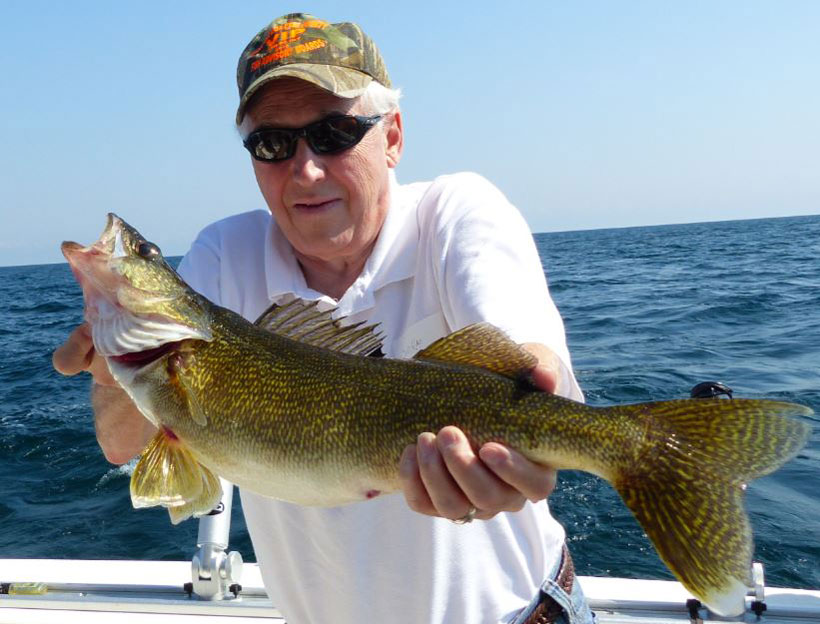
Lightning Bolt Walleye on Lake Erie

Solutions for Thunder and Skittish Fish

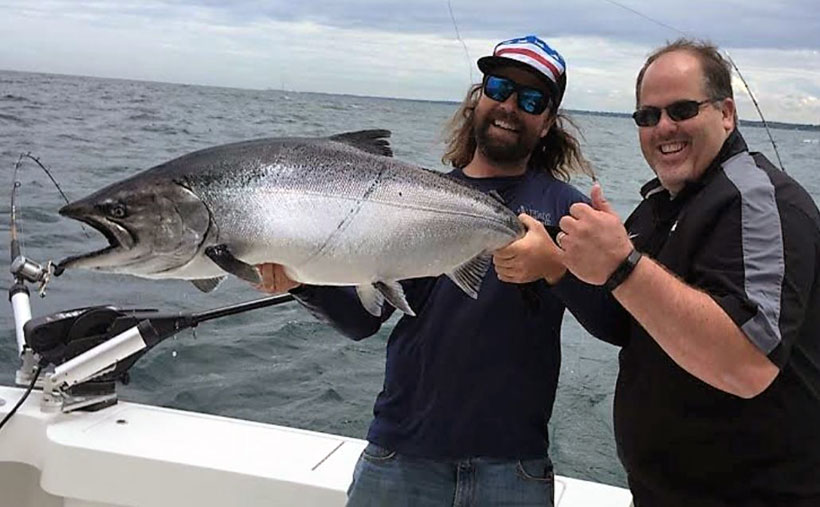
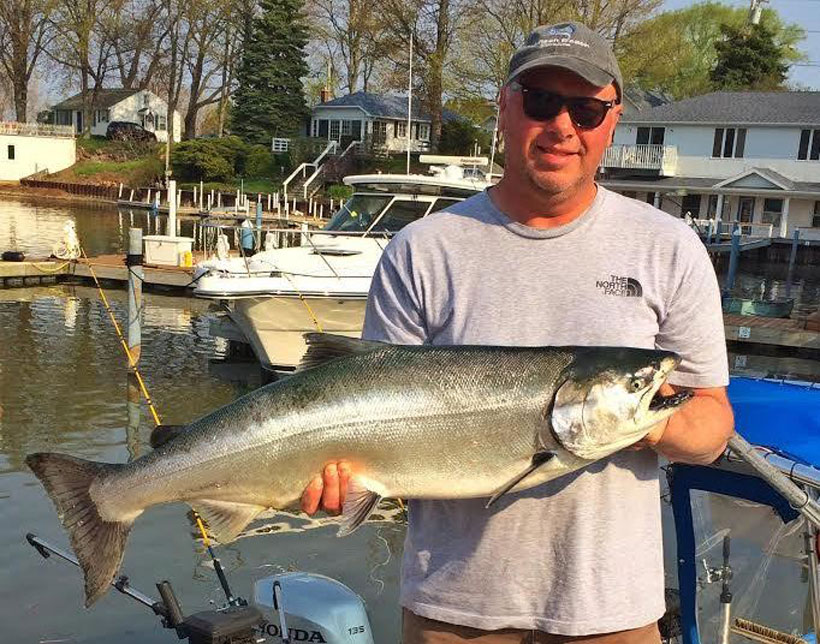
John Mills from Orchard Park, New York, was straining to lift his walleye prize from the clear water depths of Lake Erie while fishing with Captain Jim Skoczylas aboard Ultimate Adventure Sportfishing.

When Mother Nature decides to drop in on your fishing plans, the wind and the rain may not keep you from fishing, but those big bright lightning bolts with clapping thunder will sure turn most of us around.

What’s almost worse, when the cloudburst and natural fireworks happen the night before a fishing day plan for 60 people and the lake turns calm, the fish do too.

That’s what happened for the VIP Fishing Day in Dunkirk Harbor, New York, on Wednesday, August 11, 2016. Our dedicated hosts included Zen Olow (Northern Chautauqua County Conservation Club), Lance Erhardt (Lake Erie Charter Captain’s Association) and Andrew Nixon (Executive Director Chautauqua County CVB) and their supporting crew. The plan was to provide the time and resources for a networking opportunity where 12 charter boats (walleye and bass guides), local expert fishermen, legislators, business owners and Mother Nature, could share conversation. lightningwalleye2There is nothing like a face-to-face meeting of the minds. Issues can often find solutions or at least become identified. This annual event is one an effective way to bring real issues and the potential for discussion and action together on the battlefront of conservation, the outdoors, Great Lakes resources and other factors.

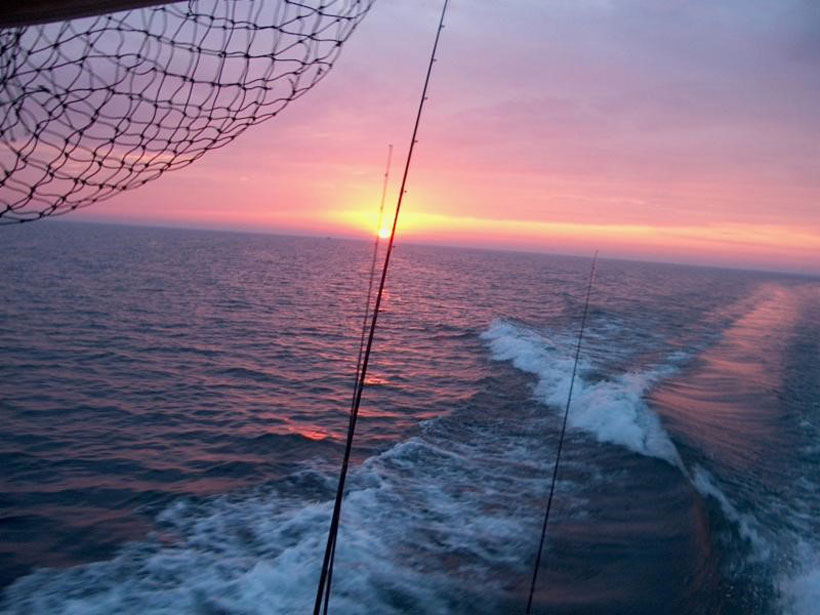
Overnight the lake was a sea of flashing thunder and driving rain, but by morning, the lake was calm and the charter anglers all knew where the schools of walleye had been located over the last few days. So off they went, some of the boats carrying three, four and five of the would-be angler folks to fish catching destinations looking for the sweet song of a screeching drag.

There is nothing like walleye gills and fins to bring a smile to anglers that expect fishing action.

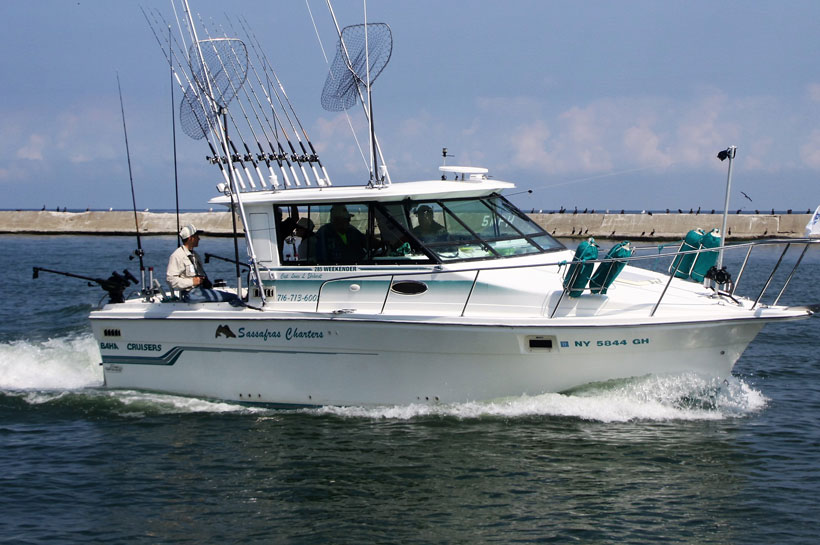
I was aboard the new 31-foot Tiara piloted by Captain Jim Skoczylas (Ultimate Adventure Sportfishing, (716-796-5372) with his first mate, Tom Yetzer, and it was fully equipped with 16 rods/reels, downriggers, diving planes, planer boards, temperature and current speed sensing equipment for surface and down deep detection, and all the lures necessary to fool those fish we call walleye in untold different ways.

We could see the fish suspended 55 to 65 feet down in 91 feet of water, but they decided to play hard to get. Question was why? Answer: Overnight lightning seems to spook both baitfish and predators. I have often wondered if when we see what appears to be a lightning bolt striking the surface of the lake, that the effects are not more serious than we think. Maybe the fish are getting a shock treatment?! Whatever it is, it seems they head for their brick house in the lake bottom and stay there for a bit before thinking about breakfast.

The interconnectivity of water molecules and electrons may have secondary effects that have not been yet explored, since it appeared on this day, that the fish were just going to take a breather.

Running 12 lines at depths of 40 to 65 feet down in 90 feet of water, some with 10 colors of leadcore line with fluorocarbon leaders, some off diving planes, some off downriggers and all displaying either homemade spinner/worm rigs or Bay Rat hard stickbait teaser lures with extra sharp hooks, Captain Jim and First mate Tom had hooked us up with eight fish on a day in waters where 19 or 20 fish in the boat were the norm for four hours of fishing on the days before. Other boats hooked up far less, some had no hookups.

Even secret fishing lures are not overly effective on days following an electrical rainstorm.

The fish we lost were light-biters, even the fish we landed were lightly hooked. Did it matter? It sure made for good conversation time! Maybe it was the best scenario! We caught a few fish and enjoyed more time to discuss issues and answers.

The chef-supreme walleye fish fry and fish chowder lunch with multiple desserts that was shared by all made the mediocre fishing of the storm effects just dissolve. It didn’t matter. Everyone enjoyed a great time networking about life in the outdoors and the incredible natural resource, Lake Erie, which we all work hard to keep as a treasure into the future.

God Bless America!

Program coordinator, Zen Olow, from the Northern Chautauqua County Conservation Club in Dunkirk, New York, is the friendly mastermind that has brought national, state and county legislators to the common discussion table everyone can find when they go fishing for a few hours.

Fishing Report: Orleans County, New York Lake Ontario, Lake Alice, Erie Canal for July 28, 2016

There are only a few more days until the end of the Summer LOC Derby this Sunday, but still enough time to enter and win one of the great cash prizes that are up for grabs.

Next up, will be the Orleans County Rotary Derby running from August 6th to the 26th this year.

On Lake Ontario the storms of earlier this week have shaken things up just a bit. Cold water moved to the inside waters causing fish to move out as far as the 30 line. Not sure just how long it will take for conditions to return to more normal, but I suspect it won’t be too long. Even with all of that some great catches are being reported from those outside waters.

On Lake Alice the Crappie bite seems to have slowed a bit fishing from the bridges, but the bass bit is as heavy as ever.

There is still an occasional Walleye being caught, but not with any consistency.

As always, the Erie Canal provides a broad spectrum of fish species for all to enjoy, offering a great place to enjoy all that the canal has to offer.

From Point Breeze on Lake Ontario, the World Fishing Network’s Ultimate Fishing Town USA and the rest of Orleans County. We try to make everyday a great fishing day in Orleans County.

Email: sportfishing@orleansny.com

Fishing Report: Orleans County, New York Lake Ontario, Lake Alice, Erie Canal for August 3, 2016

Well our old nemesis, the northeast wind, is back and really riling up Lake Ontario big time.

Some are saying that where fish are found this minute, they won’t be there 5 minutes from now.

The good news is that it looks like we have lost the northwest wind, at least for a few days, so hopefully the lake will calm down and return to more favorable conditions.

With all of that being said, those fishing the lake can plan on being in the search mode for a while yet.

On Lake Alice Carp seems to be the most consistent fish being caught right now. Crappie and Bluegill have headed to their super-secret hiding spots and bass fishing seems to be slower than normal.

Hopefully, Mother Nature will give us a break so that fishing conditions can return to more usual conditions for the rest of the summer.

From Point Breeze on Lake Ontario, the World Fishing Network’s Ultimate Fishing Town USA and the rest of Orleans County. We try to make everyday a great fishing day in Orleans County.

Email: sportfishing@orleansny.com

Golden Trout Mother Lode

Like a Peacock and a Goldfish Combined in a Dream, Simply Beautiful!

The Montana Golden Trout at 10,000 feet above sea level in Sylvan Lake showed a marked preference for dry flies while we were there, while those Brook Trout in nearby Crow Lake at an even higher elevation preferred cone-headed wooly buggers.

For the first time in more than two decades, I planned not to attend this year’s annual conference of the Outdoor Writers Association of America. Then fellow member and OWAA Legal Counsel, Bill Powell, asked when I planned to fly to Billings, Montana, for the event. When I told him I wasn’t going because of the expense, he didn’t play fair. He told me that if I skipped the meeting I would also miss a chance to catch California Golden Trout in the Absaroka-Beartooth Wilderness, not far from Yellowstone National Park.

I knew just enough about trout fishing to be aware of this subspecies of rainbow trout, which is native to the South Fork of Kern River in California. I had seen artist Joe Tomelleri’s illustration of a Golden Trout and found it improbable to say the least. His painting looked as if someone had crossed a peacock with a goldfish.

You might wonder, as I did, how the California Golden Trout got to a lake in Montana. The story I heard was that a shipment of Golden Trout was on its way to the East Coast when the train carrying them broke down near Billings. Knowing that the trout would be dead before the train was fixed, some 19th-century angler put a bunch of them into milk cans, strapped them to mules, hauled them 6 miles and up 3,000 feet from the neighborhood of Roscoe, Montana, and dumped them into Sylvan Lake. They have thrived there ever since.

The prospect of seeing these near-mythical fish in person was almost enough to make me raid my retirement account to pay for the trip, almost. But Bill, who has shared many a duck hunt with me and knows my weaknesses, informed me that several writers and photographers whose work I admire and whose company I enjoy already were signed on to make the trip. I registered for the conference immediately and began counting the days until our adventure commenced.

Then reality set in. I had to figure out how I – who live in Missouri, roughly 700 feet above sea level – was going to get from the trailhead at 7,000 feet elevation to the lake at 10,000 feet, carrying a backpack with food, water and camping gear. So, in addition to daydreaming about cool mountain air and ravenous, jewel-like fish, I began hiking 5 miles in hilly terrain with a 35-pound pack twice a week.

The distance and the hills didn’t bother me. At 65 I’m still fairly fit, but I knew that nothing I did around home could prepare me for the thin air I would encounter 9,300 feet farther above sea level. So my excitement was tempered by worry that my lungs wouldn’t be able to supply my legs with enough oxygen to get me up the mountain.

Following a high elevation hike to Sylvan Lake was rewarded with a gracious and delicious meal featuring Golden Trout.

My moment of truth came on July 20, when seven of us set out for Sylvan Lake. Bill, along with Chris Madsen and Jack Ballard, are more or less my age. However, they are accustomed to strenuous hikes at altitude. Hannah Kearse and Birdie Hawkins are in their early 20s. They live at elevations even lower than Missouri, and they too, expressed concern about the hike. Nevertheless, they had 40 years on me. I figured on watching them disappear up the trail ahead of me, not an altogether unpleasant prospect, but not exactly an ego booster either.

The remaining hiker, Tim Mead, of Charlotte, North Carolina, is 78. He was both, my reason for optimism and my worst fear. On one hand, surely I could keep up with a near-octogenarian whose home was at almost exactly the same elevation as mine. On the other hand, what if he left me huffing and puffing in his dust? That would be the end of believing I am in pretty good shape for my age.

I need not have worried. Tim and I made it to the top with enough reserve energy to go straight to the lake after setting up our tents in case the weather turned. We quickly discovered that even Joe Tomelleri’s extravagant rendering of the California Golden Trout could not do justice to the real thing.

Writers are seldom at a loss for words, but when these fish came to hand we were all reduced to the sort of incoherent babbling you expect of an adolescent boy in the presence of Shakira. No superlative can do justice to the visual feast presented by these shimmering amalgams of gold and jewel tones.

Although nothing could match their beauty, the flavor of the 10 Golden Trout we killed that day was a pretty close second. Jack and Chris cooked them in foil with a dab of olive oil to prevent sticking and a pinch of salt for piquancy. Starchy, freeze-dried entrees and brownies with black walnuts, coconut and dried black cherries considerately provided by Bill completed a feast fit for King Midas.

The glacial cirque that cradles Sylvan Lake provides a beautiful backdrop as Tim Mead catches supper.

I thought I would be hiked out after Day 1, but Day 2 offered the chance to hike another 2 miles and 1,500 feet each way to Crow Lake, where Brook Trout were on the menu. These fish proved even more willing than their golden cousins to take a fly. Once again we feasted on the fruits of our “labor.”

Birdie, Hannah and I laid a feast of ramen noodles cooked with fresh zucchini, broccoli and carrots, to which we added foil-cooked Brook Trout. The brownies were gone, so we improvised dessert with excess energy bars, dried fruit and other goodies that no one wanted to carry back down to the vehicles the next day.

The hike out on Day 3 was a breeze, thanks to lighter packs, downhill grades and two days’ altitude acclimation. At the end, we were more than ready for tall glasses of locally brewed beer and half-pound burgers with various wonderful toppings at the Grizzly Bar and Grill in Roscoe.

Backpacking to fish for alpine trout isn’t for everyone. I’m not sure how much longer it will be in the cards for me, but if you want to visit Sylvan and Crow Lakes, take a look at Montana Hiking Trails or AllTrails.com.

Tuning Up for Walleye – Part 4

Be Consistent for Good Walleye Action, Catching the Biggest Fish – Not All Luck, Learn from Winners

tuningup1

Considering the recent results of many 2016 Lake Erie walleye fishing tournaments in the eastern basin this year, there are some anglers that have really improved their walleye fishing success and their bankroll too!

There are also a handful of anglers that have once again proven that they are masters of understanding the mystical aura of finding large, elusive walleye, no matter what the conditions. They are repeat top-ten walleye fish catchers in many tournaments almost every year.

As an example, some feel that the Southtowns Walleye Association Annual Walleye Tournament is a contest of sheer luck since it involves the mere single objective of catching one single fish that is the heaviest of all when compared to all the rest of the fish caught by everyone else in the tournament. You know, catching just one fish that is big only involves being in the right place at the right time, right? Question there might be, please share – what place is that?

Some folks reason that such contests would be more of a skill measurement if they involved a combined weight of three fish or five fish over the tournament period (9 days), all weighed in aggregate total. They say, that would be more a measure of skill, not luck. Others argue that such tournaments are too long – they should be multiple fish and only three or four days long, it should be a skill tournament, heaviest bag.

In one sense, all of the rationale could be argued one way or the other, but with a one-fish, biggest fish by weight winner, the good logic of the biggest single fish is that just about anyone can win the big money and that allows all who are entered an equal chance. Is it fair? Yes, as long as all the scales in multiple weigh station locations are calibrated and certified to the same standard. Then it would appear to many that this is very fair.

Back to anglers that consistently are in the top 10 or catch multiple heavy fish every year. How do they do that? There is one (complicated) answer to that. They know what they’re doing and they are ready to catch a monster walleye at all times with any of their tackle and on any rod or reel in their boat.

Be Tackle Ready

They are tackle ready. The have sharp hooks. They fish with new leaders. They tie strong knots. They know their rigging options. They have control of their boat. They know how to use their electronics. They have friends that share. All of these things are key elements of their road to repeated success.

Learn About Weather Effects

There are many other things they know too. They know weather and lake conditions that include wind shifts and the sub-surface currents that form, currents that can drive forage to new locations.

They know that sunny days after a cold front are the worst days to fish. The know that the days following a severe wind blow and thunderstorm are the next worse days to fish – and sometimes, the “bad day” can last two or three days.

They know that the best conditions to catch fish are on Lake Erie water that is medium clear to highly clear is with overcast skies and a slightly choppy surface. The good clarity level allows the walleye to see the forage more easily and the surface disruption keeps them feeding longer, sometimes all day, or it seems from my experience.

Understand Fish Movement and Change

They know bottom types such as mud flats, sand, gravel, rock and weed. They know where newborn forage base populations like to feed as they grow and they check these areas consistently.

They know that after a cold front, the walleye usually head for the bottom and stay there. Close mouthed too, but if you’re going to catch them, it will be dragging a line near the bottom with copper or 10-color or three way rigging with contact.

tuningup2

If you are like most anglers, you think you’re doing all the right things, yet your friend Billy or Joey or Herbie is telling you everything he says he knows, but he is catching lots of fish and you’re not. Do you really trust your friend? Most of us know and do trust our friends, so the question you must answer is why are they catching more than I am?

Does Scent Matter? Yes

The questions are always there, trust me on that one, but the answers and solutions are not really that far behind. Scent is a big deal. Fill your oil and gas reservoirs before you fish? Not good, unless you really get that smell off.

One reason why scent attractants seem to work is that the cover such mistakes, not so much that they attract fish, though there is some truth to the attraction factor too.

You use 20-pound test mono leaders because you think that 20-pound Fluorocarbon doesn’t really make a difference and it costs a lot. With our clear water, these things can often matter. Science has helped us.

Does Boat Noise Matter? Yes

Maybe you are trolling with a 4-stroke and your buddy is trolling with a 2-stroke. They both make lots of underwater noise when the fish are shallow, but the 2-stroke makes less noise. A bow-mounted electric is the quietest and stealthiest, and perhaps, the most effective too, when it comes to catching numbers of fish, but most traditional Lake Erie walleye anglers are trollers with gas motors of one sort or another.

tuningup3

You can see walleyes all over the place and yet, you can’t hook any. If there is a fresh mayfly hatch going on, that’s why. Walleye are opportunists and they feed on whatever is in abundance. You have to put available food resources in your planning when you prepare to fish for the win.

Know the Food Options

Eastern basin Lake Erie forage includes emerald shiners, smelt, shad, gobies and yellow perch. Lure color and actions that imitate these are what you’ll need. Size variations too.

Interestingly, most of the winningest anglers will all share that they have one hot lure or one hot color. Studies show that walleye see orange, yellow and green the best in deep waters, this is not a physics function, it is a walleye sensitivity function.

Sometimes a spinner/worm rig catches all the fish and you have three of them, but only one of those three are doing the job. Why? It could be flicker, flutter, and balance, bend in the blade – hard to tell, but look for these differences.

Lastly, sooner or later, you will have one of these “hot lures” or your friend will shed his curtain and tell you what he is doing exactly. Until that happens, just pay attention to some of the ideas mentioned earlier. Discover your own trail to big fish.

Take Notes, Study Them

Take notes. It helps when you look back on them. Talk to anglers at the dock. Did they go east, west, how deep, how fast did they troll, what kind of rig did they like using? Ask and learn. Add what they share to your own arsenal of knowledge and be strong to share what you know too.

Some anglers have learned the rules of their fishing own fishing road. They know where the turns are. They modify as they need to. They adjust to win and they remember what they did for next time and next year.

Learn to Love Fishing and Sharing

Learning, sharing, winning some cash too. That’s what makes fishing one-fish contests the fun it is. If it’s a skill or luck tournament for you, no matter. Are you enjoying your time on the water and at the dock, and at the weigh station and the fish cleaning station? Let’s face it, most anglers are not pro anglers, but a simple cash purse can make it seem so.

For most of us, fishing is about fun, especially when your name appears in the top 200. Get a notebook, take some notes!

Good luck on the water!

Fishing Report: Orleans County, New York Lake Ontario, Lake Alice, Erie Canal for July 21, 2016

First congratulations to all of the winners of the 26th Annual Erie Canal Derby. Some great fish were caught which proves what a great fishery the canal provides right at our doorstep. It provides a great place to take a kid fishing on a lazy summer afternoon and enjoy nature.

Another great spot is Lake Alice which is producing Crappie, Bass and some Walleye right now.

Fishing can’t get much better than it is right now in Lake Ontario off the shores of Orleans County. In 80 to 150 feet of water seems to be packed with fish, especially Chinook salmon of all age classes. Although lure types change from day to day, all seem to be working at a steady rate. Colors and patterns vary greatly depending on who you talk to, so as always start with your favorites and go from there. With fishing this close to shore even smaller boats can participate when weather conditions allow.

Don’t forget that the LOC Summer Derby runs through July 31st this year.

Word has it that the lower portion of Oak Orchard River is teeming with Gar pike this year.

From Point Breeze on Lake Ontario, the World Fishing Network’s Ultimate Fishing Town USA and the rest of Orleans County. We try to make everyday a great fishing day in Orleans County.

Email: sportfishing@orleansny.com

Western New York Fishing Forecast for Friday, August 5, 2016

Lake Erie bass fishing can be unbelievable at times, especially when you fish with Captain Frank Campbell

Lake Erie – Walleye and Bass

Closest consistent action for walleye continues to be off Sturgeon Point in 70 feet of water. While trolling worm harnesses or stickbaits are always an option off planer boards, downriggers or diving planes – like Dipsy-Divers, some anglers prefer to use the very basic approach of a three-way rig, bouncing bottom with a worm harness trailing.

Capt. John DeLorenzo of Niagara Falls has been focusing between Sturgeon Point and Cattaraugus Creek in 68 to 73 feet of water to take limit catches of ‘eyes. The recent northeast winds did shut things down a bit and he only had 8 fish on Wednesday. Orange and chartreuse are the best colors, but firetiger does well, too. His basic set-up has the distance from the three-way to the worm harness at 3 feet. His front rods will have a 5 ounce drop weight; the back rods a three ounce weight to avoid tangles. GPS ground speed is normally around 1.3 mph, using his trolling motor to supply the speed he needs. Bass action has been a bit tough. Deeper has been better on the outside of reefs and shoals. Crayfish and shiners; tubes and drop-shot rigs. Start in 25 feet of water and work out.

Lake Ontario – King Salmon, Steelhead

After a hard east-northeast blow last weekend, the lake is just starting to settle back down and resume with some of the great salmon and trout action we’ve seen this summer. Anglers are still experiencing tackle-busting salmon inside of 150 feet of water, starting in 60 feet of water at first light according to Wes Walker at The Slippery Sinker. Meat rigs, flasher-fly or spoons will all take fish, but some days you do have to work harder than others.

Browns have pushed inside of 50 feet of water and the leading youth catch in the LOC Derby was Adam Flachbart of Fairview Park, Ohio with a 14 pound, 5 ounce brown trout, caught off the pier in Olcott on a Yo-Zuri crankbait! Walker also reported a few jack kings came from the pier after the lake rolled over following the storm. Now it’s back to the normal catch of bass, perch and a few crappies. Ditto for warm water fish over in Wilson. Out deep, the 23 to the 26 north line continues to be productive on steelhead and teenager kings. It was actually tougher fishing in the 450 to 500 depth range due to some cold water upwelling.

Niagara County led the charge once again in the Summer Lake Ontario Counties (LOC) Trout and Salmon Derby held July 1-31. Grand Prize catch came from Olcott and Wilson both – Chad Fenstermaker and Mitch Shipman of Ohio were fishing out of Olcott, but ended up north of Wilson in 205 feet of water when a 31 pound, 7 ounce salmon hit their raspberry shadow Moonshine spoon 90 feet back of their dipsy diver set on No. 2. Chad reeled the fish in – his first salmon on his first Lake Ontario fishing trip – to take home the $10,000 check. First place in the salmon division was Larry Wills of Lewiston with a 30 pound, 15 ounce king salmon caught out of Wilson on a purple Warrior spoon – 40 feet down over 400 feet of water. First place brown trout was Guy Witkiewitz of Ontario, NY with an 18 pound, 14 ounce fish caught east of Irondequoit Bay. Second place came from Wilson when Thomas Gies of Michigan reeled in a 17 pound, 6 ounce trout while fishing with Capt. Dan Evans of Lone Wolf Charters. It hit a Moonshine Ice Shadow spoon 45 feet down over 220 feet in front of Wilson. In the Lake Trout Division, Ephriam Burt of Watertown bested Bob Turton on Sanborn with a 24 pound, 3 ounce fish from Henderson harbor. Turton’s Niagara Bar laker tipped the scales at 23 pounds, 7 ounces. He was using a green Kwikfish to take his local trout. Top steelhead came from Niagara when Wade Winch of North Tonawanda hauled in a 17 pound, 10 ounce fish from Wilson. He was using a slide diver, back 185 feet on a No. 2.5 setting over 180 feet of water with a purple Dreamweaver spoon as bait.

Next derby on the calendar is the Orleans County Rotary Derby, set for August 6-21. The Slippery Sinker and the Boat Doctors in Olcott are both registration points.

The inaugural Reelin’ for a Cure team tournament – focusing just on the ladies – will be held out of Olcott on August 19. Get those teams together and plan on fishing! For more info contact Stephanie Pierleoni at 481-6388 for more info. Greater Niagara Fish Odyssey registrations are now online at www.fishodyssey.net and at area registration outlets.

Canadian Open Bass Tournament (Lake Ontario) – Congratulations are in order to Capt. Joe Fonzi of Gasport who placed third overall in the Canadian Open last month out of Kingston, Ontario, on Lake Ontario, with a three day catch of 64.50 pounds. He caught 19.5 pounds, but with a penalty for one dead fish. It may have cost him second place. Day two he reeled in 19.85 pounds of bass, sitting in 8th place. On the third day, he brought in the big bag of the tourney, a five fish total of 25.65 pounds, anchored by a 6.75 smallmouth that was big fish for the day. Steve Boris of London, Ontario, won the tournament with over 67 pounds of bass. Big fish of the tournament was caught by Darren Izumi, son of Canadian legend Bob Izumi, with a 7.2 pound fish. Secret to Fonzi’s success was a drop shot rig approach in 18 to 28 feet of water with goby imitation plastics, running about 27 miles to his favorite fishing hole. He attributes his successful runs to his Ranger 621FS Fisherman that handled the 3 and 4 foot waves admirably and his Cabela’s fishing gear that helped him to deal with the adverse conditions.

Lower Niagara River – Sturgeon Caught!

After a lake roll-over resulted in some great bass fishing at the mouth of the river last Sunday (according to Capt. Steve Drabczyk of Lewiston), those fish scattered and it was a struggle for anglers fishing in the Lower River Fishing Challenge to benefit Cystic Fibrosis, part of the second annual Charity for Children event held Monday and Tuesday.

Moss is no longer an issue, but finding bass and walleye during the dog days of summer was definitely a “challenge” as the name suggested. The most bass any one person caught was Tim Kolb with 5 on Monday; 7 for Dean Hale on Tuesday. Only a few walleye were caught and trollers that hit the lake did produce some salmon and trout on the Niagara Bar. Top salmon catcher on Monday was Jim Weber of Newfane; Tuesday it was Adam Thomas of Amherst with Beneficial Soil #2 – who also won the individual title for the overall contest with 1,305 points. He was fishing with Capt. Mark “Sparky” McGranahan. In the end for the team title, it was Capt. Jim Gordon of Appleton leading the Team event for Beneficial Soil #1 (Frank D’Amico, Joe Manz and Rick O’Brien) with a total of 3,320 points.

The surprise catch of the contest would have been Gary Hall’s 5 foot sturgeon that he fought for a half-hour before losing it at the side of the boat when the hook came out. Quite a thrill!

The 11th Annual Bass Contest to benefit Independent Living of Niagara County will be held at Fort Niagara and the Three-F Club on August 7. Contact 284-4131 Ext. 146.

Upper Niagara River / Erie Canal – Silver Bass Time

Best fishing has been along the east side of Strawberry Island for smallmouth on crayfish, shiners or tubes. The inside of the Strawberry Island horseshoe has been closed due to nesting bald eagles. Bass action has been consistent, but you can catch sheepshead and silver bass from boat and shore if you are using live bait like crayfish or shiners.

In the Erie Canal, the kids will be flocking to the Wide Waters Marina in Lockport on August 13 from 10 am to 2 pm for a special free derby that is open to the public.

Bill Hilts, Jr., Director, Outdoor Promotions

Niagara Tourism & Convention Corporation, 10 Rainbow Blvd., Niagara Falls, NY USA 14303
p: 716.282.8992 x.303| 1.877 FALLS US, f:716.285.0809
website | facebook | twitter | blog

Sportfishing has a $30 million annual economic impact in Niagara USA!

Hilborn vs. Greenpeace – Integrity Won

Fisheries Ecology and Population Modeling

Fisheries Ecology and Population Modeling is defended. Photo: http://www.noaa.gov/fisheries

By Mike Nussman, President and CEO, American Sportfishing Association

Character assassination and innuendo seem to have replaced debate and open discussion of issues these days. If you cannot refute someone’s policy arguments, then invent an allegation, throw mud and make the attack personal.

Surprisingly, I am not describing the 2016 Presidential election.

Rather, I am referring to Greenpeace’s recent misguided attempt to slander Ray Hilborn, Ph.D., an internationally recognized expert on fisheries ecology and population modeling whose research is highly regarded by policy makers around the globe. Dr. Hilborn is professor of aquatic and fishery science at the University of Washington.

Greenpeace, the D.C.-based environmental organization, asserts that overfishing is universal and the oceans are being emptied. However, Dr. Hilborn’s, and his collaborators, scientific research and conclusions continually punch holes in Greenpeace’s desire to turn the world’s oceans into one great no fishing zone. So, with no science of their own to “stand on,” Greenpeace set out to attack the man’s integrity.

This past May, Greenpeace attempted to cast doubt on Dr. Hilborn’s science by challenging the transparency of his funding sources. They challenged Dr. Hilborn’s professional integrity, with accusations that he was furtively pushing a message favorable to the fishing industry – that fishing pressure can remain high without negative impacts on stocks – in exchange for financial gain and research support.

This “lack of transparency” conspiracy theory runs rampant in Washington, D.C., a place I’ve worked for the past 30 years. While Dr. Hilborn has retained his credibility: Greenpeace’s tactics have none.

For the record, Dr. Hilborn was cleared of bias by two of the most respected science research publications, Proceedings of the National Academy of Sciences and Science magazine. Moreover, his employer, the University of Washington, released a statement saying that Dr. Hilborn followed all necessary protocols for publicizing funding and was in full compliance with disclosure rules. Even had these institutions not been probed to vouch for him, he states quite clearly on his website the funding sources for his research.

Environmental groups (e.g., Pew and the Environmental Defense Fund), the commercial sector (e.g. Bristol Bay Salmon Processors) and federal agencies (e.g. National Science Foundation and the National Oceanic and Atmospheric Administration) have all entrusted Hilborn and his lab to conduct studies on various aspects of saltwater fisheries, covering topics such as hatcheries, fishing cooperatives and the influence of changing environmental conditions on fish populations. In fact, Dr. Hilborn and Greenpeace both receive funding from the Packard Foundation.

Something that struck me about Ray Hilborn going back to one of the first times we spoke was how frank he is about what the science says. What, then, can we make of the assertion that his “agenda” is to promote the fishing industry and, as Greenpeace would portray it, to squander our marine resources? This is far from accurate.

In fact, in his own response to Greenpeace’s allegations, Dr. Hilborn thanked Greenpeace for offering him the opportunity to advertise his research and its results. Dr. Hilborn noted that Greenpeace is unable to attack the science; science that threatens their repeated assertions that overfishing is universal and that the oceans are being emptied.

To quote Dr. Hilborn, “On the contrary, it is clear that where effective fisheries management is applied, stocks are increasing not declining, and this is true in North America as well as a number of other places. Overfishing certainly continues to be a problem in the Mediterranean, much of Asia and Africa.”

hilborngreenpeace2Dr. Hilborn’s rigorous and peer reviewed research makes clear that fisheries management works. Greenpeace may not like his conclusions, but, their effort to attack the messenger with false accusations should be repudiated by academia, by commercial and recreational fishermen and other environmental organizations.
Dr. Ray Hilborn is one class act.

For similar stories on a daily basis, visit The Fishing Wire at: Permalink

The Fishing Wire welcomes your comments and actively solicits letters and guest editorials from readers as well as fishery managers, scientists and industry experts in boating, fishing and related equipment. Please send your comments and suggestions to frank@thefishingwire.com.

Wildlife Habitat, History, Permanently Protected in Montana

wildlifehabitat

From the Director of Communication at Rocky Mountain Elk Foundation headquarters in Missoula, Montana, there is news of success.

A 320-acre property in southwestern Montana, vital to wildlife and linked to the pages of United States history, is now permanently protected thanks to a successful collaboration between the Rocky Mountain Elk Foundation, a conservation-minded family and the United States Forest Service.

The former Holland Family Ranch is located west of Dillon and was previously an in-holding in the Beaverhead-Deerlodge National Forest. It lies squarely on the Nez Perce National Historic Trail, where Chief Joseph led his Nez Perce tribe away from its pursuers in 1877.

“We appreciate the Holland family for reaching out to us to help conserve and permanently protect this key stretch of habitat,” said Blake Henning, RMEF vice president of Land Conservation. “It is especially rich in wildlife values.”

Elk use the property as calving grounds as well as spring and summer range. It serves as an important wildlife movement corridor between the Big Hole River Valley and the Continental Divide for elk, mule deer, moose and black bear. It is also home to Canada lynx, wolverine, a wide variety of other animal and bird life, and includes more than two miles of fisheries, wetlands and surrounding riparian habitat.

RMEF recently conveyed the tract to the Forest Service thus providing both new and improved public access for hunting, fishing and other recreational activities. “This purchase is a perfect example of how partnerships can conserve wildlife, ecological, recreational and historic values,” said Melany Glossa, Beaverhead-Deerlodge National Forest supervisor. “Working together with RMEF and the Holland family to be a part of this legacy has been a really wonderful experience.”

The Land and Water Conservation Fund, Cinnabar Foundation, Montana Fish and Wildlife Conservation Trust and RMEF provided funding for the project.

If you have questions about the RMEF or are interested in receiving background materials or arranging interviews please contact: RMEF Director of Communication, Phone: 1-800-225-5355, Ext. 481, E-mail: publicrelations@rmef.org.

About the Rocky Mountain Elk Foundation:
Founded over 30 years ago, fueled by hunters and a membership of nearly 220,000 strong, RMEF has conserved more than 6.8 million acres for elk and other wildlife. RMEF also works to open and improve public access, fund and advocate for science-based resource management, and ensure the future of America’s hunting heritage. Discover why “Hunting Is Conservation™” at www.rmef.org or 800-CALL ELK.

Take action: join and/or donate.

Western New York Fishing Forecast for Friday, July 22, 2016

Lake Ontario, Niagara River

Steve Liebler of Williamsville with his 30.02 Lake Ontario King Salmon

Lake Ontario and Tributaries

Action on Lake Ontario continues to be very good for trout and salmon trollers working out of the mouth of the river, Wilson and Olcott. In the Lake Ontario Trout and Salmon Association’s King Salmon Tournament last weekend, Fisherman’s Daughter came away with the win for big fish – 27 pounds 14 ounces and the 3-2-3 win with 65.56 pounds for three fish! Impressive totals.

Capt. Matt Yablonsky of Wet Net Charters has been doing great all week. Last weekend this was his hot set-up on the Niagara Bar. Morning bite was in 190-205 feet of water around the red can, 40-60 down and an all-spoon bite. Early afternoon bite was 140-150 feet of water, but closer to the Canadian line, 55-80 feet down with still mostly a spoon bite. Silver Streak lures were taking most bites. Afternoon/early evening bite was 100-150 feet of water on the ledge. Tried to turn a few but was never able to. He ended up by 4 mile. He couldn’t keep his spin doctor and A-Tom-Mik flies in the water. Afternoon matures all came on flies.

There has been a good mix of fish off Olcott 40 to 50 feet down over 80 to 100 foot depths. Spoons or flasher-fly rigs. Of course, you can also fish out deep over 300-plus feet of water for a mixed bag of salmon and steelies. Stephen Liebler of Williamsville reeled in a 30.02 pound salmon earlier in the week to take over the lead in the Salmon Division on a flasher-fly. Larry Wills of Lewiston is still leading for the Grand Prize with a 30 pound, 15 ounce fish. Wade Winch of North Tonawanda is still the top steelie catcher, but Alfonse Gouker of Pennsylvania got close Sunday with a 17 and a half pound steelhead weighed in at The Slippery Sinker. Bob Turton of Sanborn lost hold of the lake trout lead when Ephriam Burt weighed in a 24 pound, three ounce fish in the eastern basin around Henderson Harbor. First place brown is still 17.06 pound brown trout caught out of Wilson by Thomas Gies of Ann Arbor, Michigan. The derby continues to July 31 and the website to follow the action is www.loc.org.

Lower Niagara River

Moss is slowly starting to dissipate and bass are starting to cooperate a bit more. The Niagara River Anglers Association Bass Contest is this Saturday, July 23, and you can sign up at Creek Road Bait and Tackle. Crayfish and shiners are the best live baits; tubes and drop shot rigs for artificials.

Upper Niagara River / Erie Canal

While bass numbers have been decent, bass size has been smaller for the Bassmaster pros fishing the bracket tournament right now. Catch some of the live action at www.bassmaster.com. The two top fish catchers going into Thursday action was Kevin Van Dam and Brett Hite with 20 pounds 8 ounces and 21 pounds, 14 ounces respectively. Action continues through Friday.

The Erie Canal Fishing Derby is over as far as the fishing is concerned, but the real excitement will take place at the Awards Ceremony on Sunday in Gasport at the fire hall starting at 3 pm. The unofficial leaders for the different divisions are: Here’s some of the leaders so far: Ron Robel of Wheatfield with a 8.4 sheepshead; Craig Udell of Gasport with a 19.9 pound carp; Patty Young of Kent with a 9-plus pound catfish; Albert Whaley of North Tonawanda with a 7.9 pound pike; Shawn West of Lockport with a 3.58 pound walleye; Joe Cwiklinski of Depew with a 2.9 pound bullhead; and John Justice of North Tonawanda with a 3.8 pound bass. The website is www.eriecanalderby.com.

Bill Hilts, Jr., Director, Outdoor Promotions

Niagara Tourism & Convention Corporation, 10 Rainbow Blvd., Niagara Falls, NY USA 14303
p: 716.282.8992 x.303| 1.877 FALLS US, f:716.285.0809
website | facebook | twitter | blog

Sportfishing has a $30 million annual economic impact in Niagara USA!

Fishing Report: Orleans County, New York Lake Ontario, Lake Alice, Erie Canal for August 11, 2016

The Storms of earlier this week has the lake and the fish all mixed up again. You can find fish anywhere from 60 feet of water all the way out to the 32 line, the trick is getting them to bite. Add to that the fact that today is one of those calm hot days, making things a little more uncomfortable.

These are the conditions that could settle the lake back out again and really turn the fishing on. Even as adverse as conditions are right now, there are still some great fish being entered into the Orleans County Rotary Club Derby which runs through August 21st this year.

Fishing on Lake Alice has also slowed for all of the species including Carp. Fishermen are still catching some Bluegill, Crappie and Perch from the bridges and the bass are still fairly active.

Just a reminder that the 40th Annual Fish Odyssey runs from August 20th to the 28th and the Fall LOC Derby runs from August 19th through September 5th this year.

From Point Breeze on Lake Ontario, the World Fishing Network’s Ultimate Fishing Town USA and the rest of Orleans County. We try to make everyday a great fishing day in Orleans County.

Email: sportfishing@orleansny.com

Plano Simplicity: A is for Access

A-Series Bag is Versatile, Affordable and Perfect!

  • Max storage, small footprint, fast access
  • 12 storage pockets, under $50

planosimplicity1About 25 years ago, when I was a bit younger and doing fishing video’s took way more effort than today, Ron Lindner said to me, “Hey Forrest, I like the way you keep your lures in those Plano storage boxes, sorted by type, then stowed in your backpack.” You know, it just made simple sense. Yet, at the time, nobody in the tackle business made one of those durable bags that could carry individual tackle boxes.

Today, Plano has brought all of us into a new dimension with simple storage for fishermen and outdoor folks. The new systems really mean just more fun for everyone. You know where everything is because you can see it and can find what you’re looking for and use it.

Their A-Series Tackle Bag doesn’t take a lot of space in your boat or truck, yet it van carry five fully loaded Plano 3600 storage boxes in the main compartment. While it at first looks like a camera bag, it’s that durable looking, access is easy and quick with two latch clip in the front of the bag. No zipper to break or slip from your fingers from ice during the cold season or sweat during the hottest days of summer. Click, click, you’re open and have access to your main boxes.

That’s not all, this bag as an interior lid storage system too, with four small slip pockets for holding useful “use-all-the-time” essentials on the interior of the flip open lid.

On the outside of the bag, there are 12 more pockets for secure storage, a few with slip pockets, some with zippered access for security, a few with Velcro closure.

Plano designed this A-Series with an acronym they want everyone to remember: A is for ACCESS. This is the new small bag with big storage for easy access. And, it looks really good too. It’s distinctive and striking in appearance, it’s innovative and it is made to last a long time.

I just went out and bought 10 more 3600 series utility boxes and will use the new A-Series bag for fishing, hunting, hardware, and many other items, depending on the day. It’s versatile and the best part is, I like it!

The 3600 boxes slip and out so easily. I can go everywhere in style with this A-series storage bag for outdoors folks. On the negative side, my wife wants to borrow it all the time for her goodies in other 3600 utility boxes. After 47 years together, we have a common bonding device!

Maybe the best part, even with all that well-designed ingenuity, it is affordable at under $50. Visit: http://www.planomolding.com/ to learn more.

VanDam Leads Niagara River Bracket Pack

Baits, Spots are Secret (For Now)

Watch Live: http://www.bassmaster.com/classic-bracket

Bassmaster News, BUFFALO, N.Y. —July 20, 2016

After the 2nd day of the Bassmaster Classic Bracket held on the Niagara River out of Buffalo, New York, the Match 1 winner (VanDam) will move on to fish against Match 2 winner (Kreiger) Thursday and Match 3 winner (Hite) will fish against the Match 4 winner (Rojas). Total weights will go back to zero and all anglers will fish six hours from 8:30AM – 2:30 PM. Photo illustration by B.A.S.S.

And then there were four. The first round of the Bassmaster Classic Bracket tournament on the upper Niagara River is over and half the field is driving back home.

The two Elite Series anglers from Arizona are staying though, as Brett Hite dominated and Dean Rojas performed some last-minute heroics during the first round, stamping their tickets to the semifinals.

Michigan’s Kevin VanDam and Koby Kreiger of Florida round out the semifinalists heading into Thursday’s head-to-head clashes in hopes of winning the lion’s share of the $50,000 purse and a berth into the 2017 GEICO Bassmaster Classic presented by GoPro.

The unusual format of this derby has generated a lot of excitement from the anglers and fans watching on Bassmaster.com and WatchESPN, as every second of fishing has been streamed live.

The anglers are also getting updates from BASSTrakk to know how much weight their rival has caught, and officials on each boat immediately weighing and releasing the fish once the information is logged.

“I love this format,” said Rojas, who fished against Alabamian Jordan Lee. “We fished for 5 1/2 hours, and I was losing for all but two minutes of the match. When I caught that last fish, fans got to watch in real time the excitement and incredible circumstance that gave me the win.”

Rojas was 5 pounds behind Lee when he hooked a 3-pounder. He had five minutes left when he hooked another big one. It came off. His next cast produced another bite and he swung another 3-pounder into the boat with two minutes left.

“I’m a slow starter, but I finish strong,” Rojas said. Rojas ended with a two-day total weight of 13-9, and Lee with 12-9.

Hite wasn’t sweating a bit. With the second-heaviest limit on Tuesday, he had a 2-pound cushion over Texan Keith Combs, his first round opponent.

“I knew some big ones lived in my spot, and when they bit early, I felt like I was in good shape,” Hite said.

After boating the biggest limit of the event so far (11-2) in the first two hours of competition, Hite was more than 7 pounds ahead of Combs, who ended the day with just 6-12.

“I felt really good with my weight, so I went exploring for the last hour. I found some stuff that should help me tomorrow,” Hite said.

Speaking of help, Kreiger beat Jacob Powroznik with the help of Jacob Powroznik.

The two anglers are roommates on the Elite Series, and Powroznik vowed to help Kreiger make it to the Classic. Winning this tournament is the Florida pro’s only chance to get there.

Kreiger fished for more than 2 1/2 hours without a bite while Powroznik watched, and even coached, from his boat nearby. Kreiger finally got a bite, and the fish jumped off. With 27 minutes left in competition, Kreiger set the hook and boated a 1-7, enough to finally eclipse Powroznik’s Day 1 total.

“Thank the Lord and thank Jacob Powroznik!” Kreiger said. Powroznik ended the first round with 9-15, and Kreiger moves to the next round with a two-day total of 10-4.

VanDam had nearly a 9-pound lead over Florida pro Drew Benton heading into Wednesday’s elimination match and could have slept through the second session and still won. However, that’s not KVD. He went out and caught 10-4 for a two-day total of 20-8. Benton finished with a final total of 5-10.

“I was watching BASSTrakk and knew Drew was having a tough time, so after I boated one pretty good one, I went practicing,” VanDam said. “Based on what I found, I feel really good about my future in the derby.”

Thursday’s semifinal round on July 21 will pit Rojas vs. Hite and VanDam vs. Kreiger. The weights will go back to zero, and all anglers will fish from 8:30 a.m.-2:30 p.m. ET.

The winner of those two matches will advance to Friday’s championship round. With weights starting from zero again, the anglers will fish head to head from 8:30 a.m.-2:30 p.m. for the title.

Bassmaster LIVE will broadcast coverage of the entire tournament Thursday and Friday, from first cast until the fishing stops, with a camera in every boat.

The payout for the bracket event will be distributed as follows: $10,000 and a Classic berth for first place, $8,000 for second place, $6,000 for third and fourth place (eliminated from semifinals) and $5,000 each for fifth through eighth place (eliminated from quarterfinals).

There was no entry fee for the tournament. The local host for this event is I Love New York. This report is courtesy of www.bassmaster.com

2016 Bassmaster Elite Series Premier Sponsors: Toyota, Minn Kota, Nitro Boats, Skeeter Boats, Triton Boats, Yamaha, Berkley, GoPro, Huk, Humminbird, Mercury

2016 Bassmaster Elite Series Supporting Sponsors: Livingston Lures, Lowrance, Phoenix Boats, Power-Pole, Rapala, Shell Rotella, Shimano, Academy Sports + Outdoors, A.R.E. Truck Caps, Carhartt, Dick Cepek Tires & Wheels

About B.A.S.S.
B.A.S.S. is the worldwide authority on bass fishing and keeper of the culture of the sport, providing cutting edge content on bass fishing whenever, wherever and however bass fishing fans want to use it. Headquartered in Birmingham, Ala., the 500,000-member organization’s fully integrated media platforms include the industry’s leading magazines (Bassmaster and B.A.S.S. Times), website (Bassmaster.com), television show (The Bassmasters on ESPN2), social media programs and events. For more than 45 years, B.A.S.S. has been dedicated to access, conservation and youth fishing.

The Bassmaster Tournament Trail includes the most prestigious events at each level of competition, including the Bassmaster Elite Series, Bass Pro Shops Bassmaster Open Series, B.A.S.S. Nation, Carhartt Bassmaster College Series presented by Bass Pro Shops, Costa Bassmaster High School Series, Toyota Bonus Bucks Bassmaster Team Championship and the ultimate celebration of competitive fishing, the GEICO Bassmaster Classic presented by GoPro.

NOTE: The second group of 4 anglers will be heading back to Anchor Marine on Grand Island, New York. Fans are more than welcome to greet them once they get their rigs out of the launch ramp, so Anchor Marine asks that you give anglers a little space at that time. Since this is a new format, there is not your traditional weigh in at the end of the day. (Anchor Marine, 1501 Ferry Rd, Grand Island, NY 14072, 716-773-7063)

Western New York Fishing Forecast for Friday, July 15, 2016

Lake Ontario, Niagara River

fishreport7_15

Lake Ontario and Tributaries

Fishing in Lake Ontario continues to be as hot as the weather – really!

Captain Dan Evans of Lone Wolf Charters in Wilson reports fishing was great earlier in the week – lots of kings and steelhead from 120 to 350 feet of water. He found good temperature from 60 to 75 feet down so he was setting riggers at 45-60-75 feet using spoons in black and glo, green and glo down deeper; orange and silver up higher. Off the divers, he was running green dot spin doctors and hammer flies or white-glo spinnies and hammer flies. He’ll also run copper, using spoons to entice the fish to hit way back behind the boat. He will run lures back from 200 to 350 feet with copper.

Over in Olcott, mature kings have been inside of 200 foot depths according to Wes Walker with The Slippery Sinker. Good mix of steelhead and salmon are being reported. You can also head out deeper to 350-450 feet of water with steelhead and coho’s in the top 50 feet; the bigger kings below 60 foot depths with spoons or flasher-fly.

Smallmouth bass, perch, rockbass and pike are all being caught in the harbors.

The Lake Ontario Counties Trout and Salmon Summer Derby is producing some nice fish, many from right here in Niagara County. While it’s still early in the game for a contest that runs through July 31st, Niagara County has jumped out of the starting gates after the first week to lead every single category. Based on the new structure for the summer competition, every one of the current leaders has already earned some early cash. Larry Wills of Lewiston won $1,000 for the biggest salmon during the first week of action with his grand prize-leading 30 pound, 15 ounce king out of Wilson.

Other species categories earning $250 each were steelhead, led by Wade Winch of North Tonawanda, with a 17 pound, 10 ounce fish; Bob Turton of Sanborn with a 23 pound, 7 ounce lake trout; and Tom Gies of Ann Arbor, Michigan with a 17 pound, 6 ounce brown trout – all caught out of Niagara waters.

Of course, it’s a new week and new anglers can try to cash in. Check out the leaderboard at www.loc.org. You have to be in it to win it! That’s a hard lesson to learn and we hear it every derby. This time it was customers of Capt. Paul Czarnecki of Tri-State Charters who caught a 32 pound salmon. They weren’t it.

This weekend is the LOTSA In-Club Tournament (July 16) and the Curt Meddaugh Memorial event (July 15).

Check out www.lotsa1.org for details.

Lower Niagara River

Moss is still an issue for anglers casting and drifting the section of water below Niagara Falls. Hopefully it will be gone by the time the Niagara River Anglers Association’s smallmouth bass contest is here, set for July 23. Don’t have any of the details yet, so your best bet is to contact tournament coordinator Ed Garcia at 870-5318 for more info.

Upper Niagara River / Erie Canal

Bass are your best option still and moss seems to be getting better. Just in time for some unique fishing to take place. The Bassmaster Bracket Tournament is July 19-22 on the upper river between the north Grand Island Bridge and the Peace Bridge – no Canadian waters. It should be interesting. Weigh in will take place in live time right on the boats, of which there will only be eight. Check out the website at www.bassmaster.com.

Another big contest going on right now is the 26th Annual Erie Canal Fishing Derby, ending on Sunday, July 17th. Like with all of these contests, some really nice fish are being caught and the leaderboard can change overnight. Here’s some of the leaders so far: Ron Robel of Wheatfield with a 8.4 sheepshead; Craig Udell of Gasport with a 20 pound carp; Patty Young of Kent with a 9-plus pound catfish; Albert Whaley of North Tonawanda with a 7.9 pound pike; Phyllis Whaley of North Tonawanda with a 2.5 pound walleye; Joe Cwiklinski of Depew with a 2.9 pound bullhead; and John Justice of North Tonawanda with a 3.8 pound bass. The derby ends Sunday night at 9 pm.

The website is www.eriecanalderby.com

Bill Hilts, Jr., Director, Outdoor Promotions

Niagara Tourism & Convention Corporation, 10 Rainbow Blvd., Niagara Falls, NY USA 14303
p: 716.282.8992 x.303| 1.877 FALLS US, f:716.285.0809

Sportfishing has a $30 million annual economic impact in Niagara USA!

Fishing Report: Orleans County, New York Lake Ontario, Lake Alice, Erie Canal for Wednesday July 13, 2016

The Erie Canal Derby is in full swing with some great fish already on the leader board. With 4 more days left in the derby there is still plenty of time to get out there and catch a winner. On the Erie Canal catches of both catfish and sheepshead are being reported all along the system.

Speaking of derbies, the LOC Summer Derby is just past the half-way point and the 30 pound mark for Chinook salmon has already been broken.

The waters of Lake Ontario off Orleans County have been very active with a great mix of fish, but Chinook salmon has made up the majority of the catches. Fishing has moved out to the 400 to 450 feet depth range, but there are still some fish being produced on those inside waters. What started out slowly has sure picked up to some great fishing on the big lake.

Lake Alice is still producing some nice catches of Crappie and some great catches of bass. The water clarity has improved greatly over the past week or two and now shows a visibility of 5 or 6 feet.

Give a gift of the great outdoors to our youth by taking a kid fishing!

From Point Breeze on Lake Ontario, the World Fishing Network’s Ultimate Fishing Town USA and the rest of Orleans County. We try to make everyday a great fishing day in Orleans County.

Email: sportfishing@orleansny.com

Western New York Fishing Forecast for Friday, July 1, 2016

fishreport7_1a

Lake Ontario and Tributaries 

Some monster fish are being caught out there. Captain Dan Evans of Wilson reported a 32.5 pound salmon hauled in by Todd Garzarelli on Tuesday.  According to Evans with Lone Wolf Sportfishing, fishing for both salmon and trout has been good from 80 to 350 feet of water depending on wind direction.  He was finding 48 degree water 60 feet down, stacking spoons on either side of that temperature break.  Silver-green glo/black colors have been working best off copper rigs and downriggers.  Spin doctors and A-Tom-Mik flies have worked best off the divers.  White with green dot doctors and hammer flies are at the top of the list for him.

He also hit a milestone last weekend when Harry Camardella of Wilson caught the biggest steelie Evans has ever taken off his 32 foot Luhrs, a 20-pound steelhead.  With the LOC Derby starting July 1, don’t be surprised if we break the 20-pound mark for each one of the trout species and 35 for the king salmon division.

fishreport7_1b

Over in Olcott, Capt. Bob Cinelli was using all spoons to take a mix of salmon and trout – including a nice 12 pound Atlantic. Riggers, divers, and coppers.  His best copper rigs were back 350 and 400 feet.  Fish seem to be laid out west of Wilson all the way down the lake.  His best fish catching depth was the 65 to 80 foot zone.

fishreport7_1c

The Lake Ontario Counties Summer Salmon and Trout Derby is slated for July 1-31, 2016.  A total of $29,000 will be up for grabs during July around the lake, including a Grand Prize of $10,000 for the biggest salmon weighed in.  Four different species categories will be offering a $1,000 prize for the biggest fish in each.  In addition, a weekly prize of $1,000 will also be given out to the largest salmon and $250 each to the largest lake trout, brown trout and rainbow/steelhead.  And, if you are a member of the Lake Ontario Trout and Salmon Association, you can win another $500 in cash just for entering the largest salmon caught by a LOTSA member and witnessed by a LOTSA member.

For $10, become a member of a group that’s fighting for every fish in the lake.  Find out more on LOTSA at www.lotsa1.org. For information on the LOC Derby go to www.loc.org. Capt. Paul Czarnecki of Tri-State Charters will give a talk on fall salmon fishing at the next LOTSA meeting on July 14 at Cornell Cooperative Extension Niagara starting at 7 pm.

Lower Niagara River

Lower river action continues to be slow for bass and walleye because of the moss situation, however, some spots in the river where the moss isn’t bad are near launch ramps at Fort Niagara.  Minnows or crayfish work best.  The Niagara River Anglers Association will be holding its annual bass contest on July 23.  To find out more information go to niagarariveranglers.com or call 807-6111 at Creek Road Bait and Tackle.

Upper Niagara River / Erie Canal 

Moss is still a problem in the upper river, too, but according to Scott McKee, president of the Niagara Musky Assn., the most is manageable for trollers and casters pursuing Mr. Toothy.

The 26th Annual Erie Canal Fishing Derby is set for July 6th through the 17th. With more than $20,000 in cash and prizes up for grabs, there should be plenty of anglers lining the banks of the canal from the Niagara River to Albion.  Categories include bass, sheepshead, northern pike, carp, catfish, bullhead and walleye.  To find out more information contact Steve Harrington at 772-7972 or visit the derby website at www.eriecanalderby.com.

In the Hooked on the Tonawanda’s tournament held June 25 and 26, some impressive catches came to the scales including a 22.4 pound carp reeled in by Matt Steffan of Williamsville; a 5-1/4 pound Northern pike hauled in by Dan Dolan of Grand Island; Matt Melendez of Buffalo caught the biggest bullhead, a 1.22 pound fish; Richard Jopp of Buffalo led the charge with a .43 pound perch; and Sean Franklin of Buffalo placed first with a three pound bass.

Bill Hilts, Jr., Director, Outdoor Promotions

Niagara Tourism & Convention Corporation, 10 Rainbow Blvd., Niagara Falls, NY USA 14303
p: 716.282.8992 x.303| 1.877 FALLS US, f:716.285.0809
website | facebook | twitter | blog

Sportfishing has a $30 million annual economic impact in Niagara USA!

I Fish NY Beginners’ Guide to Fresh Water Fishing

Helps Novice Anglers

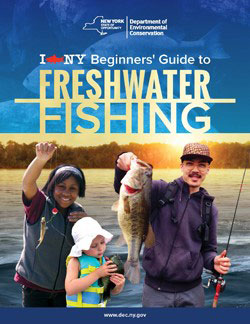
beginnersguideThe New York State Department of Environmental Conservation (DEC) has developed a new instructional (available on-line) manual entitled “The I FISH NY Beginners’ Guide to Freshwater Fishing.” The new manual is part of a series of publications DEC has produced recently to get more people involved in the fun of fishing in New York State.

In New York, fisheries biologists stock more than 2.3 million catchable-size brook, brown and rainbow trout in over 309 lakes and ponds and roughly 2,900 miles of streams across the state each spring.

The I FISH NY Beginners’ Guide to Freshwater Fishing manual can be downloaded at: http://www.dec.ny.gov/outdoor/98506.html. The guide is composed of nine modules that include:

  • The Fishes of New York
  • Basic Fishing Tackle and Techniques
  • Care of Your Catch
  • Safe and Responsible Angling
  • Intermediate Fishing Tackle and Techniques
  • The Waters of New York
  • Fisheries Management
  • Aquatic Life
  • Ice Fishing

The beginners’ guide provides important information for those desiring to get started in the sport of fishing, while also providing a resource for educators to teach students about ecology, fish biology and the fun that is part of the sport of fishing. The manual will also prove helpful to those conducting free fishing events as part of the Governor Cuomo’s expanded free fishing clinic program. Organizations or groups interested in conducting an event can find instructions and an application form on the DEC website at http://www.dec.ny.gov/outdoor/89811.html.

Western New York Fishing Forecast for Friday, June 24, 2016

Lake Ontario, Niagara River
Free New York State Fishing Days This Weekend

fishreport6_24

Lake Ontario and tributaries 

New York State’s Free Fishing Weekend is set for this weekend, June 25-26.  There are plenty of events for the entire family to keep people busy – and happy – right here in Western New York!

In this day and age where nothing seems to be for free any more, the Empire State will offer up an opportunity to fish all around the state without purchasing a license.  You do have to follow the fishing regulations in the water you intend to fish however.

For salmon and trout, action has started to heat up a little bit out of Wilson and Olcott.  Boats have been heading out to 350 feet and beyond off Wilson for a mix of steelies and kings.  Action has been a bit closer off Olcott with some fish being taken in as close as 150 to 180 feet of water – when they can get out there.  Spoons are the primary enticement, but don’t rule out flasher-fly or flasher-cut bait, especially for bigger fish.  Target the top 60 feet according to Wes Walker at The Slippery Sinker.  There are also fish in the 330 to 380 depth contour.

The Summer LOC Derby is set for July 1-31.  Go to www.loc.org for details. More cash is up for grabs.

The Olcott Lions Club will be hosting its annual kids fishing contest on Saturday, June 25 at the Town of Newfane Marina in Olcott from 8 a.m. to noon.  Get the kids out and enjoy the local fishing.

Lower Niagara River

Action in the Lower Niagara River has been plagued by moss, but that doesn’t mean you can’t catch fish.  Capt. Dave Tripiciano organized an outing for young Shelby, a teenager with Muscular Dystrophy last Tuesday out of Youngstown.  Using the expertise of some local fishermen like Tim L., they managed to lift Shelby’s 350 pound wheelchair into the boat and drift for smallmouth around Fort Niagara.  They found an area that was pretty-much moss free and caught bass up to 4 pounds.  Shelby was granted this trip through an organization called Moment of Peace Adventures of Pennsylvania and, in addition to visiting Niagara Falls (and being the first physically-challenged person to utilize the facilities at the re-opened and revamped Terrapin Point), they had a great time.  Tim had been doing very well in that area on smallmouth the two days prior, too.  When he fished in the main river, though, it was a tough go with the moss. Shiners were the best bait, fished off three way rigs.

Upper Niagara River / Erie Canal 

In the Kelly’s Korner’s opening day bass contest, it was Dan Hudson of Tonawanda winning with the best two fish weight of 10.25 pounds.  Not far off the pace was Bob Hubler of Niagara Falls with a total of 10.07 pounds, but he had big fish that hit 5.75 pounds.  He was using a big chub in 40 feet of water to take his lunker catch off Wanaka, where many of the fish came from.  Bass are still available in the river, too, with the bass opener in Canada happening on Saturday, June 25.

There are numerous events that coincide with the New York State Free Fishing Days weekend and at the top of the list is the Tonawanda’s Fishing Tournament sponsored by Gateway Harbor, that will go the entire weekend.  Register for the event if you are an adult for a nominal fee.  Kids under 16 can register for a free youth division.  You are restricted as to where you can fish in the Canal, what amounts to about a one mile stretch between Tonawanda and North Tonawanda from the Niagara River to the City line.  You can register at area tackle shops or stop down to Gateway Harbor in North Tonawanda on Friday to register.  Species categories include bass (both largemouth and smallmouth), bullhead, channel catfish, carp, perch, northern pike and walleye.  The weigh station will be open 7 am to 6 pm on Saturday; 7 am to 3 pm on Sunday.  This is a transition year for the event as the local organizing committee hands the contest off to the Boys and Girls Club of the North Towns.  A new website location for an entry form can be found at www.bgcnt.net and the organization will be taking the lead role after this year.  After last year’s wash out, organizers are hoping for some decent weather to show off the Canal’s angling potential and help to showcase this natural resource.

Speaking of the canal, some local anglers were worried that the dewatering that was going to take place from Middleport to Brockport on Monday, June 27, was going to affect the Erie Canal Fishing Derby July 6-15.  It looks like after three days, the Canal will be opened up from Middleport to Albion; the remainder will be opened by the weekend.

A huge Family Fishing Day will also be taking place out of Broderick Park both Saturday and Sunday this weekend starting at 7 am each day, as well. This is their 8th Annual event.

Bill Hilts, Jr., Director, Outdoor Promotions

Niagara Tourism & Convention Corporation, 10 Rainbow Blvd., Niagara Falls, NY USA 14303
p: 716.282.8992 x.303| 1.877 FALLS US, f:716.285.0809
website | facebook | twitter | blog

Sportfishing has a $30 million annual economic impact in Niagara USA!

Finding the Right Fishing Rod

At St. Croix – So Many Choices, So Little Time!

Not all fishing rods are created equal, but the right fishing rod for you is generally not a secret. You know it when you pick it up. You gotta have it. Most St. Croix fishing rods feel that way to many anglers and there is a reason why. If you want to find out why, there is a way now… tour the factory! Open to the public for the first time this year.

My (most) favorite fishing rod is from when I was just a youngster.  I still have it, there is not even a manufacturer name on it.  This fishing rod was made of early woven fiberglass in the late 1950s, it included a cork handle with two sliding aluminum rings that held my Spin-Joy open face fishing reel in place.  I bought the rod after getting the reel, the rod cost me $1.95.

At 10 years old, I didn’t know a thing about open face fishing reels, but the old gentleman – his name was Mr. Paul, sure did.  He was the owner and proprietor at the United Surplus and Outdoor Store on Broadway in Buffalo, New York.  He sold me.

He asked me how I fished.  The little I knew, I answered, “What do ‘ya mean?”  I was taught to fish very effectively with very simple tackle by my dad, who taught me early that patience was the key.  I was taught to take home what I caught too, dad had lived through the depression and nothing was wasted when your time was the cost of the experience.  Catch and release only started after the angler army became so good at fishing with the help of technology.  All good.

Dad taught me his knots and showed me how to fish with a hook, worm, sinker and sometimes, with a bobber.  I mentioned to Mr. Paul that the bobber was hard to cast because the weight of everything was so much lighter.  Back in those days, there was not much about lures and what all of us kids back then called “all that fancy stuff.”

My interest in fishing was peaked each month when I read the fishing column in Boy’s Life magazine, it was written by Homer Circle.  I learned how to ask questions about fishing gear from that monthly column that I had read since I was a big 8-years old.  Questions like bb-shot, long shank hooks, bass sinkers, cat gut line, quill bobbers and much more.

My reel was advertised as a premium, 2-bushing, open-face, spinning reel and it cost $2.95.  So I needed a rod that Homer Circle had said was different from the fishing “poles” that most people were using at that time.  It had bigger guides and they were on the other side of the rod too, he wrote, whatever that meant.  I couldn’t understand why these would be different at the time.

The reel was loaded with 10-pound test Dacron line because my dad and I didn’t know anything about monofilament yet, it had not been invented yet.  There was cat-gut line out there that was clear and looked like light blue colored plastic string made by a small company called Berkley – I still have the spool it came on.  We bought some a year later.

Painstaking detail is one of the key ingredients that follow superior design at St.Croix fishing rod factory in Wisconsin. Forrest Fisher Photo

The Dacron we had did cast a light sinker far enough to take our 2-inch crab into the deep pool of a local creek near my house.  That hole was full of wild smallmouth bass in the middle of summer.  They weren’t big, but they sure fought hard, jumping, thrashing the water up, and often, getting off.  They were a challenge to catch all the way to shore.  I loved not losing to a fish.  The battle for dominance was on!

That rod Mr. Paul sold me just felt right.  Maybe it was a confidence concept at eight years old that helped me to love that rod so much.  Number one, it was all mine – my own fishing rod, and it cast way farther than my dad’s Branson casting rods that were solid metal.  I felt an advantage that way, if you know what I mean.

After a while, I could thread a needle with my cast and it became second nature to cast at a specific part of the pool and in other parts of the creek.  That rod made me a fisherman!  That rod was “right for me” because at the time with what I was fishing with, it did the job perfectly and I was, of course, quite forgiving about anything that rod did not do right.

That’s what good fishing rods do when you first pick them up, they feel right.  When that happens and your virtual mind can see you working your lure or bait to success, you just know that is the right rod for you.  Part of that virtual mind thing is an experience thing, the other part of it is a “private confidence wish” way before discovering the fish-catching proof on the water.

Hand application of key bonding components allows for perfection to be achieved as rod blank, cork, interface bearing surfaces and your hand all meet in the same place to provide touch, feel, sensitivity, power, confidence and fish-catching secret motif. Forrest Fisher Photo

When you buy a fishing rod that imparts confidence, you know what happens – you catch more fish.  For me, that was 60 years ago.  I’ve searched for fishing rods that impart that special “air of confidence” ever since.  Then just about a month ago, I was fortunate enough to be fishing in Wisconsin with several fellow outdoor communicator folks and we were invited to be among the first of groups to tour the St. Croix Fishing Rod Company.  Man, I was flipping through hoops in my mind about this.  I had flashbacks of articles by Homer Circle from when I was so young.

I had been building my own fishing rods for a few decades just to have the best rods for the money – which I never had that much of, but even then, my homemade custom rods were still a bit pricey.  I knew all about rod wrapping, double-wrapping, splining, rod guide weighting, single foot or double, guide placement, balance for sensitivity or power, AA corks, special rod seats and way more than I ever want to admit that I guess at these days.

Located in the nearby town of Park Falls, WUI   the St. Croix tour really opened my eyes and provided an education on custom rod building that is performed in a factory by over 200 dedicated workers.  Truthfully, I didn’t actually think that anyone would ever be allowed to tour the one USA Company that is so famous for making what pro anglers and non-pro anglers all seem to say are the finest fishing rods on earth.  The St. Croix fishing rods are that famous.

From upper management to the factory and the process-control work force, it was apparent that folks at St. Croix love doing their job and doing it right, it shows from start to finish.

While I have about 40 fishing rods, I only have one St. Croix, a panfish rod, because it was the only rod I could really afford at the time.  The St. Croix rods have been typically fairly high cost when compared to many foreign made fishing rod products, but after this special tour –not on a deserted isle with Gilligan and Maryann and the crew, I understand why the St. Croix rod products cost a bit more.  They are perfect is every way and there are hundreds of models to suit your needs to gain that “air of confidence” that you need before you say to yourself, “I need this rod.”  The bottom line after this tour?  Worth every penny!

St. Croix rods are not simple. Each model is custom-designed and includes high technology process control with trained eyes and the hands of skilled workers that showed such focus that I thought we were in a Space and Defense Plant with traceable materials and processing.  Such were the process controls that we witnessed.  Many other companies may never consider the details we reviewed.

To see for yourself, the St. Croix fishing rod factory tours now are offered daily, Monday through Friday, June 1st through September 30th, and then Mondays, Wednesdays and Fridays from October 1st through April 30th.  St. Croix is closed on major holidays.  Regular tours lasts approximately 90 minutes.  It’s easy to book a visit at http://stcroixrods.com/resources/factory-tour-details, or email at factorytour@stcroixrods.com or call 1-800-826-7042.

The folks at St. Croix have said it before: Not only will you be taking a walk through rod-crafting history, you’ll also get a glimpse of the future of fishing.

FOOTNOTE – St. Croix Rod/Reel SALE:

Looking for an incredible St. Croix value at an unheard of sale price?  Squeeze the trigger on a new St. Croix Triumph X and St. Croix will pair it with a matched Daiwa reel on the house. Not many chances to get a St. Croix rod with a rel for $100, but you can for a limited time.  Premium-quality SCII graphite. Outstanding strength, sensitivity and hook-setting power. Hard aluminum-oxide guides with black frames. Split-grip/premium EVA handle. Fuji DPS or ECS reel seat with black hood(s). 5-year warranty backed by St. Croix Superstar Service.  Your choices are many too!  A 2015 Daiwa Laguna 2000-5BI spinning reel, $40.00 retail value, will be paired with St. Croix TXS50ULM, TXS60LF, TXS66MLF and TXS66MLF2 rods, while a 2015 Daiwa Laguna 2500-5BI spinning reel, $40.00 retail value, will be paired with TXS66MF, TXS66MF2, TXS68MXF, TXS70MF and TXS70MF2 rods. Daiwa reels will possess standard warranty provided by Daiwa.  Check out this link:  http://stcroixrods.com/shop/freshwater/triumph-x-spinning-rod-combo/.

Firearms and Common Sense after Orlando

History, Politics, Facts and the Changing Public View

By Budd Schroeder

firearms
Everyone in America that has been here since the days of old-time values is worried about the thought of a terrorist attack. What has changed? Forrest Fisher Photo

As the investigation of the Orlando terrorist attack continues, many gun owners get nervous about how legislators may attempt to use this atrocity as an excuse to infringe on Second Amendment rights.  They use the line that this is the worst mass shooting in American history.  However, they neglect to mention the massacres that occurred at Sand Creek or Wounded Knee.  That is understandable because the US Army massacred unarmed Indians and that was a government action.

It is a matter of perception and perspective and of course, the government would like those actions forgotten, but they do continue to tell stories about the Little Big Horn where the Indians fought back and annihilated the Seventh Calvary.

Many of the media and politicians are also deceiving the public by calling the gun used in Orlando an “assault weapon.”  This is a misnomer.  An assault weapon is a rifle that is capable of full automatic fire by the use of a selector switch.  That is a truly “military weapon” like a machine gun and is not allowed to be possessed by civilians except under very strict and limited conditions.  They are totally illegal in most states.

Yet, the politicians and liberal media are calling for a ban on their definition of the “assault weapon” and universal background checks.  Most honest gun owners object to these laws because they don’t work and it is further infringements on the Second Amendment.

When those guns were banned in the 90’s there was no significant difference in the gun deaths.  When the law was repealed with the sunset law, there was still a decrease in the number of gun deaths.  What really confuses the anti-gun crowd is that gun sales have skyrocketed, the number of states passing concealed carry permits increased, and what is formally defined as “gun violence” continues to drop.

That is also an emotional label.  Guns are not violent.  The term should be “criminal misuse of firearms.”  That is accurate.  People don’t blame alcohol or the car if a drunk driver kills people.  They blame the person who deliberately drinks until he or she becomes too impaired to make rational decisions and their motor skills are diminished.

Nobody in the media suggests that the real problem is the easy access to alcohol.  In fact, the New York legislators just passed a bill that makes it possible for drunks to start drinking at 10:00 a.m. on Sundays; earlier in some establishments with a special permit.  The drinking laws are strange in other ways.  If a person gets a felony DWI they can never own a gun, although a gun was not involved in the felony.  Wouldn’t it make more sense for a serious charge like a felony involving a car to forbid him from having a driver’s license or owning a car for the rest of his life?

It is a good bet that would never be the law because that could involve politicians, law enforcement officers and people who have power and influence.  That is the way the system appears to work.

On another proposal, the call is for people who are on the “no fly list” to be denied the right to purchase a gun.  Nobody wants a terrorist, criminal, drug addict or a person with mental difficulties, to have a gun.  However, before a person is put on the NICS list for a background check he should be afforded due process as provided by the Fourteenth Amendment.

Since the SAFE act was passed in New York this has become an issue.  A person can be denied his or her gun rights on a report.  There is no due process.  It is grossly unfair and unconstitutional, but what can we expect from a law that was passed literally in the middle of the night by a majority of corrupt politicians?  Two of the architects of the debacle, Sheldon Silver and Dean Skelos were convicted of corruption and have since been sentenced to prison.

When a politician wants to deprive the citizenry of their constitutional rights, it should be the big red flag that they want to destroy the principles upon which the country was founded.  The Second Amendment was placed in such a high place in the Bill of Rights was because the Founding Fathers wanted the people to be more powerful than the government.  We have politicians who appear to not agree with that balance of power and it seems that every time the legislatures end for the year, we lose a right or even a privilege.

Since the Founding Fathers wanted to protect the people against the possibility of despotic government they wanted an armed citizenry.  Since the government controls the military, doesn’t it seem strange that some legislators want to ban military style weapons for civilians?  One former legislator running for office wants to take on the National Rifle Association.

That seems strange since with the criminal misuse of guns that none of the people involved in the shootings were accused of being NRA members.  Maybe that’s because the NRA has a reputation for having responsible, patriotic members.  They are held in higher regard by citizens than members of Congress.

There must be a reason for that.

Orlando – Lone Wolf Attacks, Is There a Safe Haven?

Many Americans May Not Understand the Problem.

See this VIDEO. 

NRA News Desk

From the National Rifle Association continuing episode news program, NRA News Commentator, Dom Raso, a U.S. Navy SEAL veteran, says there are not many things that can compare to serving your country and defending your freedom.  That freedom applies to firearms, too.

“As long as humans exist, there will be weapons in this world.  We’re better off knowing how to use them and apply them for the right reasons—than not knowing how to use them.”

Raso is also the founder of Dynamis Alliance, an organization that offers specially designed gear and customized training programs for all levels of experience.

Hear what Dom has to share with American citizens to better understand his experience and training regarding the potential dangers that may be applicable to many nations of the world.

In the video, Raso says, “We need leaders who will get rid of useless gun-free zone laws that give killers a clear advantage over the law-abiding.”

See the complete video, visit this link:

https://www.nranews.com/series/commentators/video/commentators-the-threat-of-lone-wolf-attacks/episode/commentators-season-6-episode-14-the-threat-of-lone-wolf-attacks

lonewolf2

To join the NRA and learn more, visit this link:  https://joinnra.nra.org/join/join.aspx.

Smallmouth Changes in Wind for Missouri Anglers

Trophy Fish, Regular Fish, Fun Fishing and Healthy Fishery is Goal

Many anglers consider the opportunity to catch a bragging-sized smallmouth more important than the ability to take fish home to eat. If you have an opinion about proposed changes to Missouri smallmouth bass and goggle-eye (rock bass) regulations, visit mdc.mo.gov/contact-engage and share your thoughts with the Missouri Conservation Commission.

At their regular meeting on June 24, the Missouri Conservation Commission heard a staff presentation that leads me to believe that change is in the air for smallmouth bass anglers.

The presentation covered research conducted in recent years, including surveys of angler attitudes about the possibility of more restrictive harvest regulations on smallmouths and goggle-eye.  The goal of these changes would be to increase the average size of fish available to anglers.  The Missouri Department of Conservation (MDC) began looking into this at the urging of the Smallmouth Bass Alliance.

MDC conducted basic field research on the food habits and ecology of smallmouths from the 1960s through the 1980s.  In the 1990s, they studied how far smallmouths move and the types of habitat they use.  Seven years ago, MDC began exploring how increased length and reduced creel limits would affect the size distribution of smallmouth populations.  After this work was done, the agency held open-house meetings and on-line surveys to gauge angler support for a tentative set of recommendations for regulation changes.

For many years now, the statewide length limit on black bass, including smallmouths, has been 12 inches.  The daily limit has been six black bass – largemouth, smallmouth and spotted, in aggregate.  In recent years, however, MDC has been conducting trials of 15- and 18-inch length limits for smallmouths within Smallmouth Management Areas (SMAs) consisting of parts of 11 streams.  At the same time, anglers in the SMAs have been limited to one smallmouth daily in their aggregate limit of six black bass.

During the study, MDC conducted periodic electrofishing samples on the affected areas of the streams.  It also sampled portions of the streams where the more restrictive regulations were not in effect so they could compare results and determine if the experimental regulations were having the desired effect.  Streams included in the experiment were Big Big Piney, Gasconade, Elk, Jacks Fork, James, Little Platt, Meramec, Mineral Fork, Osage Fork of the Gasconade River and Joachim Creek.  The resulting data suggest that the more restrictive length limits did increase the number of larger fish.

In addition, MDC imposed an 8-inch minimum length limit on goggle-eye – also commonly called rock bass – in some streams with the same goal – determining how this affected the size structure of goggle-eye populations.

Based on these data and angler attitudes, MDC Fisheries Division staff say they are developing recommendations that include:

  • Maintaining the 12-inch minimum length limit on smallmouths and daily aggregate limit of six black bass for most streams in the state.
  • Instituting a 15-inch minimum length limit and a daily limit of one for smallmouth bass on most of the streams where more restrictive regulations have been tested.
  • Placing a statewide minimum length limit of 7 inches on goggle-eye.
  • Extending the SMA boundaries on the Jacks Fork, Big, Meramec and Big Piney rivers.

MDC’s Fisheries Division Staff decided not to recommend more restrictive harvest regulations on smallmouth bass on the Current River, where tournament anglers expressed strong objections to the idea.  They also decided to recommend discontinuation of the restrictive smallmouth harvest regulations on the Osage Fork SMA, because data suggested it was not needed there.

These changes would affect only smallmouth bass in the SMA’s.  A minimum length limit of 12 inches would remain in effect for largemouths and spotted bass.

Also during the June 24 meeting, the Conservation Commissioners seemed to like the idea of the changes.  Consequently, MDC Fisheries Division Staff expressed their intention to develop a formal proposal for the Commissioners’ consideration at their upcoming meeting on August 26.

Many smallmouth devotees will hail the proposed regulations as long overdue.  Those who want to catch and keep up to six smallmouths of at least 12 inches daily will still have streams where they can do so.  Those who think the chance to catch a trophy smallmouth is more important than taking fish home will have places to follow their bliss, too.

The Conservation Commission encourages anglers who have preferences in this matter to visit mdc.mo.gov/contact-engage, and express those preferences.  If the commissioners vote to approve the proposed regulation changes, there will be a period for comments afterwards.

If they receive no comments or hear nothing that changes their minds, the regulation will go into effect March 1, 2017.

Fishing Report: Orleans County, New York Lake Ontario, Lake Alice, Erie Canal

Wednesday June 29, 2016

Let’s start out with fishing derby news.

This Friday, July 1st, starts the LOC Summer Derby which runs through July 31st.  There is $29,000 in cash up for grabs with a $10,000 grand prize for the biggest salmon.  More information can be found at www.loc.org or by calling 888-733-5246.  Register at any of these Orleans County locations or on-line: Captain’s Cove Resort, 14339 Rt. 18, Waterport, NY, 14571, 585-682-3316, http://fishcaptainscove.com Narby’s Superette and Tackle, 1292 Oak Orchard Rd, Kent, NY, 14477, 585-682-4624, http://www.narbys.com/;  Orleans Outdoors, 1764 Oak Orchard Rd., Albion, NY, 14411, 585-682-4546, http://www.orleansoutdoor.com/.  

Then there is the 26th Annual Erie Canal Derby which runs from July 6th to the 17th this year.  In this event a boat, motor and trailer is the grand prize and in the youth division, a canal trail bike is available.  Great fishing abounds on the Erie Canal. Eligible waters are the Erie Canal from the Niagara River to the Route 98 Bridge, located in the heart of Albion. More than $8,000 in prizes is available. For more information check out their website at www.eriecanalderby.com.

Fishing on Lake Ontario has been good to exceptional over the past week.  Winds have been fairly kind to us and that has kept the fishing in closer to shore, mainly the 90 to 150 feet of water range.  Most anglers are reporting a good mix of fish, mainly Chinook salmon, Lake trout and Steelhead trout with some reporting some exceptional size fish in each category.  With the great weather predicted through the weekend and well into next week, fishing should continue to improve.

On Lake Alice, the Largemouth Bass, Smallmouth Bass and Carp seem to be providing most of the action.  Reports have the bass mostly at legal size with few undersize fish being seen.

The Erie Canal from Middleport to Brockport is in the process of being de-watered for some emergency repairs in two locations, but the portion from Middleport to Albion should be reopened by the end of next week.

The 4th of July is when we celebrate the birth of our great nation and a great way to celebrate is to take a kid fishing, hiking or any other activity that helps our youth to enjoy all that the great outdoors has to offer.

From Point Breeze on Lake Ontario, the World Fishing Network’s Ultimate Fishing Town USA and the rest of Orleans County.  We try to make everyday a great fishing day in Orleans County.

Email: sportfishing@orleansny.com

Walleye Fish Chili


fishchili1

fishchili_recipe

Tasty, Delicious, Healthy – makes 10-12 servings

  1. Cut fish fillets into 1 x 1 inch cubes and lightly coat with Badia Adobo seasoning (no msg). Allow to sit for at least 30 minutes while preparing the remainder of the recipe.
  2. In a 1-gallon cooking pot, add the olive oil and sauté the onions and sweet pepper, adding the salt, chili powder, pepper and oregano. Stir gently until soft. Aroma is so sweet!
  3. Add the diced tomatoes, kidney beans and tomato paste, stir occasionally until simmering,
  4. Add the cubed fish, reheat to simmering (about 10-15 minutes), remove from heat.
  5. Serve with crackers, hard rolls or rye bread and butter, add a pinch or two of shredded cheddar cheese. Delicious.
  6. Easy to make, low-fat, tasty and healthy. Enjoy!

NOTE: This recipe is a good one that you can pre-prep for a camping trip. Make the chili portion without the fish ahead of time and chill the night before leaving. Place in a 1-gallon storage container and store in your cooler while travelling. Wait until your family catches some fish the next day, clean, rinse, dice and add the Adobo coating. Heat up the pre-made chili, add the freshly caught fish, cook for an additional 15 minutes. Done, delicious!

fishchili2

fishchili3

Targeting Big Fish for Derbies, Tournaments

Lake Ontario Counties (LOC) Trout & Salmon Derby – July 1-31, 2016

Mike Hay of Lake Luzerne, NY caught this king on the Niagara Bar to win the Spring LOC Derby in 2015 – his first time fishing the area.

Catching BIG salmon and trout in Lake Ontario consistently is not an easy proposition. Time on the water is certainly a piece of the formula for success. When fishing in a contest like the LOC derbies, every year we see absolute novices winning the big prizes – usually with a little bit of luck. More often than not, they have a good charter captain or someone else who spends a lot of time on the water to show them the way. Here are some tips from professional anglers who have consistently placed in the money fishing these big water competitions.

“I wish I could say there was a secret lure or special presentation that put big fish in my boat, but there isn’t,” insists Capt. Matt Yablonsky of Youngstown, operator of Wet Net Charters on the Niagara River and the Niagara Bar (www.getthenetwet.com; 716-550-0413). These are some of the things he does to consistently catch big fish:

1) DETAIL-DETAIL-DETAIL: Always pay attention to the detail. Everything is important from knots to swivels; line and water temperature to GPS speed and more. If he ties a knot and it doesn’t look right he re-ties it. If his swivel looks worn, he changes it. If the line has a bad spot in it, he cuts it out. These little things are often overlooked and when the big fish does hit you want to be ready.

The 2015 summer Lake Ontario Counties (LOC) winning King Salmon came from Olcott Harbor area on Monroe County.

2) FOLLOW THE FISH: Who hasn’t heard “never leave fish to find fish!? I like to turn it around,” says Yablonsky. “Once you find fish don’t leave them! What I mean by this is watch the water currents, surface temperatures, wind direction and temperature/speed at the lure. If you figure out a pattern it will help you locate the same school of fish throughout the day and on days that follow. This is most important during the spring and early summer when the schools of fish are tight and pockets of warm water are small.”

3) QUALITY TACKLE: Just to get to the water you need quite a few expensive items: Boat, motor, trailer, electronics, downriggers and a truck to tow all of it. It’s already cost a pile of money just to get to the water. “Don’t go cheap when it’s time to buy fishing tackle. Most of the time it’s the least expensive items that are most important such as hooks, line and swivels. When big fish hit, these are the items that are most likely to fail. You get what you pay for!”

4) HARD WORK AND PERSISTANCE: Once you have the right gear, have found the fish and stayed on them, pay attention to angling details. Begin your search early for that trophy salmon or trout. Don’t miss the morning bite and, more importantly, pack an extra sandwich so you won’t miss the early afternoon bite. This is where the law of averages takes over. The more fish you catch, the better your chances are that you are going to catch the BIG one. “Put your time in and get the net wet,” emphasizes Yablonsky, who has won the Grand Prize in several of the LOC Derbies numerous times with both salmon and lake trout. It’s a numbers game for him, especially with lake trout. “During the spring derby I’ll catch 500-plus lake trout in 10 days. Out of those 500 fish, we catch three to five fish over 20 pounds on average. That’s less than one percent.”

LOC Derby dates for this year are July 1-31 for the Summer; August 19 to September 5 for the Fall. For details on weigh stations and registration outlets, check out www.loc.org. And don’t forget about the 40th Annual Greater Niagara Fish Odyssey Derby slated for August 20-28 with an increase prize structure! Check out www.fishodyssey.net.

Fish Doc Offers Big Fish Prescription

At the extreme eastern end of Lake Ontario, is one of the most consistent performers in competition fishing. Captain Ernie Lantiegne of Oswego, operates Fish Doctor Charters (www.fishdoctorcharters.com; 315-963-8403). Some might say he has an inside track on the salmon and trout fishing – he was a Department of Environmental Conservation fisheries biologist for 22 years. He also spends a tremendous amount of time on the water and some would even claim he thinks like a fish. He is, as the name implies, a doctor of fish, so to speak.

Capt. Dan Evans of Wilson shows off a 20 pound steelhead caught out of his home port just days before the Summer LOC Derby started. The good news is that he released it … so it’s still out there!

Like Yablonsky, his work starts well before there’s any derby or tournament. “Preparation, homework and laying out an effective strategy are vital,” says Lantiegne. “When you finally make it on the water, commitment and confidence are important as you adapt to changing conditions. Sometimes it’s just plain old instinct that takes over.”

Jake Romanack of Michigan shows off a big king taken on the Niagara Bar in May.

Check out the leader board and the press releases on the LOC Derby website. You don’t need a big expensive boat to get it done. Time and time again, small boaters with less equipment find their way to the winners circle each and every event. However, being prepared for that big fish when it decides to rock your world is an important part of that winning philosophy when it comes to tackling trophy salmon and trout. “Don’t leave anything to chance, be it your vehicle, boat and motor, electronics or your fishing equipment.” There is no room for excuses and these bruiser fish have a great knack for finding those inferior links to your fishing approach.

Lantiegne relies heavily on his previous fishing history. He has either a mental or written diary of every spring king he’s caught over 25 pounds and every summer king over 30 pounds. ‘I know where it was caught, what it was caught on and what the conditions were,” says Lantiegne. “Start keeping records if you don’t already. Check out the leaderboards of the derbies because certain areas of the lake hold big fish certain times of the year.”

If big kings are what you’re after, Lantiegne’s approach is relatively simple. “Location is crucial for catching big kings,” says the Oswego captain. “Big kings usually avoid the heavier fishing pressure. I have never caught a king over 35 pounds in a pack of boats. Seek out quieter waters.” He also will focus on certain baits like a flasher-fly combination.

His favorite flasher is a ProChip or HotChip flasher in an eight-inch size. Leader length is critical, too – between 23 and 30 inches from flasher to fly. He fishes slower and deeper than normal, as well, targeting a speed between 2.1 and 2.5 miles per hour.

“Big male Chinooks spend much of their lives in 40 to 43 degree water,” says Lantiegne. “They love the deep freeze, so don’t be afraid to go down after them. Ignore the larger bait concentrations that attract smaller kings. Big boys can’t compete with the smaller, faster salmon for food.”

With the popularity of copper lines increasing in recent years, this is a perfect way to get your bait offering out away from the boat. “Copper lines run from a planer board or down the chute consistently catch my biggest kings every year. I’ve also found that running fewer lines in the water can lead you to catching bigger fish in the long run.”

When you finally do land that big boy, treat that fish with care. Don’t do anything to that fish that will cause it to lose weight, such as causing the fish to bleed from the gills. Keep the fish wet and get it to the scales as soon as possible. Don’t throw that fish on the scale until the weigh master is ready for it, too. An ounce can mean a difference between a grand prize fish and a divisional winner. You also have to be in it to win it. Every year there are heart-breaking stories of derby winning fish that never made it to the scales because someone decided that they would never be able to compete against diehard anglers or didn’t want to spend the money. If there’s a derby going on, take the time to enter and cash in!

What You Need this Fall: Elk Calls with Passion

Built by Elk Hunters for Elk Hunters
By Brad Fenson

elkcalls1

I’m already preparing for elk hunts this fall and like every year, I look for any advantage I can find to help me anchor a bull when I head to the woods. Checking out the new Rocky Mountain Hunting Calls (RMHC) at buglingbull.com, I found new items that sparked an interest.  Wanting to learn more, I did some homework and eventually got to talk to the man behind more than 36 years of elk calling history and call innovation.

If you’ve grown up hunting, you know that hunting can define your life.  As hunters, our passion often describes our lifestyle, not just our pastime.  As hunters, we’ve been fortunate to see, and use, so many engineering and technological advancements of our hunting gear in the last 50 years.  It’s impossible for many oldtimers to comprehend the gains.

If my grandfather had the opportunity to try modern firearms, bullets, clothing, boots, calls, and backpacks, he would’ve been in seventh heaven.  With the hunting skills he required back in the day, he would have been lethal with the updates.

elkcalls2

Rockie Jacobsen, owner of RMHC, was just 12 years old when he obtained his first elk license. Of course, he had been along on hunts at a younger age, but once he became the hunter, his passion for elk blossomed.  By age 16 he was calling in bulls to fill his tags.  To this day, his desire to talk with elk is the reason he works all year—simply for the opportunity to be back out hunting.  It is a life-long passion that defines the man today.  Now that’s the kind of guy I want designing the elk calls I use!

Most elk hunters will know of RMHC, which used to be called Bugling Bulls Game Calls.  A change in name was required to better reflect the wide array of game calls they produce, now covering coyotes, hogs, deer, moose, turkeys and elk.  The RMHC’s elk calls themselves have won over 50 World Elk Calling Championships, with 28 wins for the Jacobsen family alone.

RMHC has been in business since 1980 and continued to grow and expand their product lines.  Rockie developed unique designs and new engineering in diaphragm calls, which many other manufacturers have used over the years.  The Palate Plate was patented and used by other call manufacturers who couldn’t come up with a better design.  When it comes to calling elk, Rockie continually strives to improve on this proverbial mouse trap.

Now We Finally Have a Better Call 

If you use a diaphragm mouth call, you know how effective they are in producing a diversity of bull and cow elk sounds.  The more proficient you are with such a call, the more consistent and realistic you sound.  To help hunters and calling contestants up their game, RMHC has come out with a Tone-Slot Technology (TST) series of diaphragms.  A plastic dome incorporated into the call has a slot running in the center of it, creating a chamber over the latex.

elkcalls3The dome and slot allow the air you blow to center on the diaphragm for better sound, volume and consistency. The slot ensures the proper angle and position of air movement every time, making it easier to use and producing sounds with realistic clarity.

Within the series, you can pick calls to produce specific tones or sounds, like the Rockstar model, which emulates medium to large bull and cow sounds, and can create more nasal cow sounds and high pitch screaming bugles.

With every call, every little detail is examined during production, accounting for the development and use of the new Firestorm Latex.  The new latex is used in RMHC diaphragm calls and comes in yellow, red, gray, and clear, providing more consistency between calls, since they are easier to work.  If you’re a regular user of latex calls, you’ll quickly feel and hear the difference.

The RMHC diaphragm calls are worth a look if you’ve never been able to successfully use a diaphragm placed in the roof of your mouth.  Unlike conventional diaphragms, the new series of calls is placed closer to the front teeth and tipped up.  The first thing the forward placement does is eliminate or reduce the gag reflex some people fight with.

When it comes to bugles, the RMHC systems have a huge following amongst hunters and calling competitors.  The diversity of RMHC mouth calls, tubes and accessories provide the right combination for any elk hunter.  New this year is the Threat Bugle Tube, with a shorter cylinder.

elkcalls5Now, before you start to scoff at a shorter tube producing less volume, understand that the call’s mouth piece includes a spring that is tuned to the specific dimensions of the adaptor it sits in. The grunt tube comes assembled with the spring and adaptor insert making it ready to use with mouth call diaphragms. The spring creates more volume, making the Threat sound as loud as any of its big brothers.  Users will notice it is easier to stabilize higher notes and create raspier low growls, and is just easier to pack or carry around.

elkcalls4The technical name for the new mouth piece and “Insert Innovation is Volume Enhanced Tone Technology, or VETT, making the bugle easier to use and smaller to pack.  There is also a vibration dampener known as the Tube Tamer, placed on the inside of the tube on the large end, ensuring crisp, clear sounds.  This also eliminates plastic vibration and helps produce deeper sounds for chuckling.

I’m already driving my wife crazy practicing with the new calls in the house, car and yard.  I’ve even started placing a diaphragm call in my mouth to chirp and mew when shooting my bow for a real hunting simulation.

Better calls are always a good thing when we want to talk wapiti in the proper dialect or get a leg up on our competition. 

If you’re in the market for a new mouth call or tube, now is the time to try out the ones you’re interested in and start practicing.  Find the calls that work best for you, and make sure you take a hard look at the calls the good folks at RMHC have crafted.

It may be the difference between a happy hunter, or a sore loser!  Check out RMHC products offered on http://www.elk101store.com/calls/bugling-bull.

Sabine Lake, Louisiana Redfish

We caught several above the slot fish including this 30” bruiser. Big bull reds above 40” prowl the same waters.

Big Redfish with Fishing Tom’s Guide Service
By Dick Jones

The medium sized alligator apparently heard the splashing of the fish we’d recently landed and he was eyeing the fish we were catching, but not interfering. When I saw my popping cork make a dive under the surface, I had one eye on the cork and the other on the alligator. The redfish shook his head bulldog fashion and made a couple of drag stripping runs. I could tell he was too big to horse him to the boat and I was concerned that the alligator might decide to come after him. As we slugged it out, I watched the gator. He showed no interest until the fish came to the surface. As we were netting the fish, I noticed him moving in our direction, but he only showed perfunctory interest. Eventually, we boated the red and he was a nice one, about 28 inches long.

We were fishing in the Sabine Lake Wildlife Refuge, south of Lake Charles, Louisiana. Located between Lake Calcasieu and Sabine Lake, it’s only open to the public March 15 to October 15 and until this year, it was not open to charter trips. As of this year, permits are available for guides. It’s as wild a coastal area as I’ve ever seen. We spent half a day there and I didn’t see a single thing that related to civilization. Not a single can, bottle, or piece of paper.

The Sabine Lake Wildlife Refuge is a great place to view birds and other coastal creatures, this six foot gator was curious, but didn’t cause us a problem.

Great fishing, great dining

What’s most remarkable about the Sabine Lake Wildlife Refuge is that you can have dinner in a great restaurant, spend the night in a comfortable, air conditioned room, and get up in the morning and spend the day fishing in a place that’s little different than it was two thousand years ago. Our trip to Lake Charles included dining on gumbo, shrimp, crabs, oysters, crawfish, and a Cajun sausage made of meat and rice, called boudin, at small, family owned restaurants around Lake Charles.

Enjoy the ride

Getting to Sabine Lake requires a serious boat ride of almost an hour. The early part of the ride on the Intracoastal Waterway is pleasant enough, but once we turned into the channel to get to the refuge, the ride into the refuge becomes almost as good as the fishing trip. There are crab pots and signs of civilization until you get to the edge of the refuge, but once in, all signs of humanity disappear. The channel twists and winds through the estuary and is a thrilling and inspirational boat ride in the early morning sunrise.

Generous Louisiana limits make for a heavy cooler.

Primordial angling

Many angling enthusiasts long for a fishing experience outside the normal locations. Outdoor people often find themselves yearning to go somewhere that seems absolutely primordial, a place where one might imagine no person has ever fished before. As the boat glides along the snaking channel that leads into the refuge, one gets the impression that you’re fishing virgin water that few anglers have seen. That impression is fairly close to true since the long ride down the Intracoastal Waterway to the entrance to the refuge discourages all but the most determined anglers.

More than just reds

Sabine Lake is a great place for speckled trout, redfish, and flounder, known as the Cajun Slam, but there are an abundance of black drum and sheepshead as well as less desirable alligator gar. On our trip, between the two boats, we caught every species mentioned. Louisiana keeper limits are much more generous than almost all other Atlantic and Gulf states with the limit on reds at five per day with one fish allowed over the 16 to 27 inch slot. On our trip, all of us caught at least one fish over the 27 inch slot limit.

Choose your tackle

We fished cuts in the estuary where the current was flowing through, carrying bait to waiting predators. This was shallow water fishing; most of the water we fished was only a couple of feet deep. Live shrimp, jig heads and Berkley Gulp or soft plastics work well in Sabine, as does a fly rod in the hands of a skilled caster.

More places for fishing

In addition to Sabine Lake, Fishing Tom’s Guide Service offers fishing trips all over the Calcasieu Estuary, which includes the Calcasieu River, Lake Calcasieu, Black Lake and the shipping channel to the Gulf of Mexico. We had two boats with friends, Michelle and Chris Cerino, of the History Channel’s Top Shot TV series, in a boat with Captain Tom while Cherie and I fished with his son, Tommy. Both boats limited out on reds with the biggest fish being a 30” bruiser.

Best times in Southwest Louisiana are spring and fall with summer offering great fishing. Fishing is good in summer if you don’t mind the heat, and winter offers lots of fish but it’s difficult to catch good weather and wind. The Louisiana license tag describes the state as a sportsman’s paradise and the Sabine Lake Wildlife Refuge is not only a paradise, it’s an unspoiled treasure.

To fish with our guide, contact him on the web at: www.fishingtom.net. For more information on the local area, visit www.visitlakecharles.org.

Western New York Fishing Forecast for Friday, July 8, 2016

Lake Ontario, Niagara River
Lake Ontario and Tributaries

fishreport7_8Fishing for salmon and trout was on fire over the long holiday weekend, evidenced by the leaderboard of the Summer Lake Ontario Counties Trout and Salmon Derby.

John Van Hoff of North Tonawanda targeted the waters off Wilson in 100-plus feet of water and in two days of fishing had 60 releases!! He ended up catching 30-something salmon and some nice steelhead, including one that made it onto the board of the LOC Derby. It didn’t seem to matter what he threw at them as far as his spoon selection, or how he fished them – riggers, copper lines, dipsy-divers. It was the best fishing he’s seen in years. If you are going to be fishing in the lake, make sure you are in the derby.

Ask Capt. Paul Czarnecki of Tri-State Charters, the featured speaker at the next Lake Ontario Trout and Salmon Association meeting set for July 14 in Lockport. He boated a 32 pound King over the weekend, but the customers failed to register for it. The current leader for the $10,000 check is still Tim Condes of Wilson with a 29 pound, 8 ounce king caught on a flasher with cut bait. First place in the Salmon Division is Cory Kyovsky of Branchview Heights, Ohio, with a 29 pound, 2 ounce King out of Wilson. Second place is a 28 pound, 5 ounce King out of Olcott reeled in by Nicolas Curtiss of Overland Park, Kansas. It hit a Spin Doctor and Fly while fishing with Captain Vince Pierleoni out of Olcott in 180 feet of water. He was also the top youth catcher for the salmon division so far at 15 years old. Top brown trout is out of Wilson, a 17 pound, 6 ounce fish caught by Thomas Gies of Ann Arbor, Michigan, caught on an Ice Shadow Moonshine spoon over 220 feet of water, 45 feet down on a rigger with Captain Dan Evans of Wilson. Yes, out deep targeting salmon.

Current lake trout leader is Bob Turton of Sanborn with a 23 pound, 7 ounce fish from the Niagara Bar. He was trolling a Kwikfish lure. First place steelhead is a 16 pound, 3 ounce fish hauled in by Francis Holly IV of Wilson while fishing out of his home port. Yes, all of the current leaders are off the shores of Niagara County! The derby continues through July 31 so there’s plenty of room for improvement and plenty of fish to catch! Go to www.loc.org for a complete leaderboard update.

Lower Niagara River

Moss is still a factor but it seems like things are slowly starting to subside. Lisa Drabczyk at Creek Road Bait and Tackle in Lewiston reports the better action has come around the Coast Guard station and the green can, but it’s been difficult. The slack water near the Fort Niagara launch ramps has produced a few bass, as well. A few walleye have been reported, too. Remember that the NRAA Bass Contest is July 23, register at Creek Road Bait and Tackle in Lewiston or check out the website at www.niagarariveranglers.com for details.

Upper Niagara River / Erie Canal

Moss is still an issue but manageable. Hopefully things will be clear for the new bracket tournament being held from Grand Island to the Peace Bridge by Bassmasters July 19-22. Only 8 boats and no formal weigh in – everything is weighed on each boat live time. Watch next week’s Outdoor Beat with BASS writer Don Barone as he covers the circuit and the new tournament. It starts Wednesday (the show) at 4 pm. The big news is the 26th Annual Erie Canal Fishing Derby underway through July 17. While fish have been coming to the scales early on, there’s plenty of room for improvement. Big bass is a 2 pound fish caught by Albert Whaley of North Tonawanda; biggest pike so far is a 6.7 pound fish reeled in by Michael Boncore of Tonawanda; Amy Schultz has the top bullhead at 0.79 pounds; Ed Lane of Lockport is leading the catfish division with a 3.79 pound fish; first place carp is 14 pounds, caught by Richard Udell of Gasport; and the sheepshead leader is Jacob Velesko of Middleport with a 8.28 pound bomber. No walleye yet.

Go to www.eriecanalderby.com.

Bill Hilts, Jr., Director, Outdoor Promotions
Niagara Tourism & Convention Corporation, 10 Rainbow Blvd., Niagara Falls, NY USA 14303
p: 716.282.8992 x.303| 1.877 FALLS US, f:716.285.0809

Sportfishing has a $30 million annual economic impact in Niagara USA!

My Gray Tree Frog Guest – Warty Marty

The song of the gray tree frog is heard throughout Missouri and the eastern United States, though few people recognize its source.

Standing in my front yard yesterday, waiting for my golden retriever to fetch a retrieving dummy, I glanced at a bluebird house hanging on a cedar nearby.

It’s made of recycled plastic that would be indestructible if the surrounding woods did not harbor gray squirrels. Unfortunately, the bushy-tailed brigands are frightfully common hereabouts, and they feel it is their privilege, if not their duty, to enlarge the hole leading into any cavity to accommodate their girth.

The bird house, with its ragged, squirrel-gnawed opening, languished in my garage until recently, when my wife brought home a galvanized steel bushing designed to repair such rodent vandalism. It was too small to span the capacious portal, so I mounted a piece of plywood to cover the original surface, screwed the bushing in place and rehung the birdhouse, hoping to attract a late-nesting bluebird couple.

Twenty-four hours later I discovered that a new tenant that taken possession of the house. To my surprise, however, it was not blue and feathery, but gray…and warty. To be specific, it was a gray tree frog.

You might think I would be disappointed by this turn of events. In truth, I’m quite pleased. Bluebirds are fair-weather neighbors, arriving after winter has blown its last gale and departing long before November draws its dreary, gray curtain over Missouri skies.

Gray tree frogs, on the other hand, stick with us all year long. They might not be visible for much of the year, but they are out and about long before the first bluebirds of summer arrive and they can be found beside the porch light on evenings well into October. And when the inevitable warm spell occurs in February, they announce to all and sundry that spring is not far off.

This points up another area where gray tree frogs outperform Missouri’s state bird. Whereas the bluebird’s song is a brief, unmusical mumble, the gray tree frog announces itself with a lusty and remarkably birdlike trill that never fails to make me smile. This “song” is doubly remarkable for its volume, which is far out of proportion to the singer’s diminutive size. I would bet that not one in a hundred people, upon hearing a gray tree frog’s voice at dusk or dawn, ever guess that they are being serenaded by an amphibian, rather than a bird.

My warm, fuzzy reaction to the gray tree frog’s trilling song might have something to do with memories of how they helped me introduce my daughter and son to nature. As noted earlier, these little songsters like to hang out beneath outdoor lights, thanks to the smorgasbord of tasty insects that congregates there.

To illustrate this connection, I used to capture inch-long moths and dangle them, fluttering, in front of the 2-inch long frogs. In moments, the hungry amphibian would grasp the offering between its front legs and jam the dry morsels into their gaping maws with apparent gusto. Particularly large, dusty meals might require extra stuffing and several convulsive gulps to swallow, but I have never seen one of these guys start a meal it couldn’t finish. Watching such outsized morsels disappear into such a small creature is a geek-show that would put the carnival side-show freaks of yesteryear to shame.

Beneath the porch light is definitely the easiest place to find gray tree frogs. When perched in the more natural habitat of tree trunks, their mottled gray color and bumpy skin render them virtually invisible. Knowing this, you could be forgiven for mistaking juvenile gray tree frogs for an entirely different species. Young of the year are a bright – somewhere between lime and grass – green.

In one of those astonishing and inexplicable tricks of nature, the gray tree frog has two species, common and Cope’s. The two are visually indistinguishable, and their ranges overlap extensively. So, you may ask, how do herpetologists tell them apart? If you have a highly attuned ear, you might detect a higher pitch in the trill of the Cope’s gray tree frog. If not, and if you own an electron microscope, you count their chromosomes. The common gray tree frog has precisely twice as many as the Cope’s!

Gray tree frogs are common from the Atlantic Coast westward to Minnesota and eastern Texas. During the day you might be able to locate them on the undersides of wooden decks and lawn furniture. They also like to hide beneath the leaves of potted plants and in crevices of window and door casings. This last habit gets more than a few of them squashed.

They are most active at night and on overcast, rainy days, which apparently make them feel so fine they can’t resist singing. While I’m a little sorry my newly refurbished bird house won’t be hosting bluebirds, I’m tickled to know it is being used by a warty-skinned neighbor who shares my love of rainy days.

Fishing Report: Orleans County, New York Lake Ontario, Lake Alice, Erie Canal

First a big thank you to the Erie Canal crews who got the emergency repairs done quickly and the canal back open in time for the start of the Erie Canal Fishing Derby which starts today and runs through July 17th this year.

Fishing on Lake Ontario has gone past good to GREAT for all of the cold water species.

Fishing in the 100 feet of water range is producing very well, but some are finding great success farther out on the lake.

With the warmer surface temperatures in the lake, fish are being taken somewhat deeper than in the previous several years.

Orleans County has fish entered in each category of the LOC Summer Derby with the exception of Lake Trout.

Speaking of the LOC Summer Derby which runs through the end of July, big fish abound with leaders in each category as follows: Salmon over 29 pounds, Brown trout over 17 pounds, Lake trout over 23 pounds and Steelhead over 16 pounds and this is just the first part of July.

Lake Alice is still producing a good mixed bag of fish, but with the warmer weather all species are moving to deeper water.

From Point Breeze on Lake Ontario, the World Fishing Network’s Ultimate Fishing Town USA and the rest of Orleans County. We try to make everyday a great fishing day in Orleans County.

Email: sportfishing@orleansny.com

Need Citizen Help in Reporting and Reducing Nuisance Bear Incidents in New York State

For STO 070620916, picture 1of1Increasing numbers of black bears have been reported in many parts of New York State.

With the onset of warmer weather, Adirondack and northern New York black bears are on the move. The State Department of Environmental Conservation (DEC) has been notified of nuisance bears in the towns of Corinth, Chestertown, Fort Ann and other areas across New York.

Homeowners are reminded of the steps they can take to avoid conflicts with bears. The simplest way to avoid a nuisance encounter is to remove all potential attractants, which in most cases is garbage, bird feeders, pet food, and grills. Here is what you can do to help avoid bear conflicts:

  • Store garbage cans and grills in a secure building or location.
  • Secure lids on outdoor garbage containers with chains and locks and/or protect them with electric fencing.
  • Do not leave garbage containers outside over-night; put them out immediately prior to pick-up.
  • Remove bird feeders and suet.
  • Feed pets indoors and store pet food indoors.

New York residents having problems with nuisance bears or that suspect someone is feeding bears, please report immediately to the DEC dispatch office at 518- 897-1326.

When reported immediately, nuisance bear issues can often be resolved by working with community members to increase public awareness and remove attractants. When nuisance bears go unreported, they may quickly become a significant safety hazard for people and/or pets, and such scenarios often have undesirable outcomes for both people and bears. Please visit the DEC website for additional help in understanding bears: http://www.dec.ny.gov/animals/6995.html.

Western New York Fishing Forecast for Friday, June 17, 2016

Wind Direction Moved Fish Out to 450 Feet

Lake Ontario and tributaries 

Lake action is a little messed up right now with recent winds, however, fish are available if you want to go out there and chase some salmon and trout around.

The Reel Pleasure crew of Sal Macaluso and Captain Bob Fontaine recently took their maiden fishing voyage on the Andrea Raye this season for a four-hour jaunt and managed to hook six fish – they used a variety of tactics that included downriggers, dipsy divers and lead core lines. All had hits using spoons or flasher-fly combos at the magic depth, which was 50 feet down from the surface.  They were over 450 to 500 feet of water straight out of Olcott.  One steelhead was boated; a second was lost at the back of the boat.  Outdoor writer Will Elliott was the only person to bring a fish to the net.

Some brown trout are still available inside of 75 foot depths. With the bass opener this Saturday, June 18, 2016, 18 Mile Creek from Olcott Harbor to the dam could be a good spot.  Also Wilson Harbor.

Fishing should continue to improve as conditions settle back into a normal summer, just in time for the Summer Lake Ontario Counties (LOC) Trout and Salmon Derby set for July 1-31.  Check out all of the details at www.loc.org.

For the youngsters, the Wilson Conservation Club will be holding its county-wide fishing derby from 8 am to noon on June 18.  Make sure you hit the measuring board by noon, too, at the clubhouse located on Route 425 in Wilson.  Awards will follow at 1 pm.

Lower Niagara River

Moss is still an issue and hindering any kind of fishing activity.  Ed Garcia with the Niagara River Anglers Association sends word that the club will be holding its annual bass contest on July 23.  Check them out on Facebook or at www.niagarariveranglers.com.

Upper Niagara River 

The state’s regular bass season opens up on Saturday, June 18 and if you’re looking to keep a few for the frying pan, they must be at least 12 inches long.  More and more, anglers are practicing catch and release on these fish.  Speaking of bass, Kelly’s Korners in Niagara Falls will be holding an opening day bass contest on June 18 and most of the fishermen and women will be hitting Lake Erie.  It’s your best two fish for the day.  Hours are from 5 am to 4 pm that day.  You must be signed up by June 17.  For more information call 716-283-2040.

Remember that bass season doesn’t open in Canadian waters until June 25.

Great Lakes muskellunge season opens on Saturday in New York, too, and catch and release is also being practiced more and more – especially with a 54 inch minimum size for the Great Lakes.  Take special care with this fish if you do catch one to ensure it will survive.

A bunch of kids contests coming up this weekend.  The City of Tonawanda offers up a kid’s derby at Niawanda Park in Tonawanda on Saturday, June 18 from 8 am to noon.  Get there early. On Sunday June 19 – Father’s Day – there will be a Kids fishing derby at Widewaters Marina in Lockport, hosted by the Lock-City Moose Lodge 617.  Registration is at 7:30 am; fishing from 8-11 am.  Call 716-417-4198 for more info.

Bill Hilts, Jr., Director, Outdoor Promotions

Niagara Tourism & Convention Corporation, 10 Rainbow Blvd., Niagara Falls, NY USA 14303
p: 716.282.8992 x.303| 1.877 FALLS US, f:716.285.0809
website | facebook | twitter | blog

Sportfishing has a $30 million annual economic impact in Niagara USA!


I Hunt With a Canon

By Jim Monteleone

Canon Picture 1of2, Blue HeronI love the outdoors and all its creatures. There are days in the fall when I carry a bow and others when a firearm is the tool of choice. Then there are other days when I carry a Canon. Not a cannon but a Canon. It is a digital camera that offers me the opportunity to shoot quietly and use many of the skills that define success for a hunter.

There is stealth involved and there is a steady hand needed for clear and sharp images. I treat the shutter button much in the same way as I do the trigger on a firearm.

No Limit

The beauty of photography is the many targets we can encounter as well as the absence of a limit, like those that govern hunting with something other than a camera. I choose to hone and refine the skills I have acquired over decades of hunting upland birds, mammals and waterfowl. Now the quarry is as varied as hummingbirds, butterflies, songbirds, reptiles and anything that flies, swims or walks. I have the freedom and the access to creatures of all sizes, and a myriad of places in which to pursue them. I have carried my camera to faraway places like British Columbia one week and to my back yard or a local park the following week.

Developing Patience

Canon Picture 2of2, Blue Heron (1022x1280)Hunting” with a camera requires the same commitment to scouting, stalking and sometimes remaining motionless for long periods of time. In other scenarios being very quiet and inching your way to within mere feet in order to cut the distances between the lens and the subject is an absolute requirement.

My standard equipment, until recently, has been a Canon T3i with either a 55/200mm or 75/300mm lens. These set ups require a maximum distance somewhere between 5 feet and 35 yards for optimum results. The challenges of capturing really good pictures include learning and knowing the habits and habitat of birds, insects, animals, and reptiles.

Lighting is Key

The use of light is a key component. I generally attempt to keep the sun light behind me and on the subject(s). I also choose to shoot in manual focus even on moving subjects. It takes practice, but the principles of wing shooting have allowed me to overcome the technical difficulties associated with animals and birds with explosive flight and retreat instincts. Allow for a wider frame to capture movement and swing the camera through the action without stopping until the shutter has been activated.

My inspiration for long hours and long walks is the desire to bring vivid images of both simple and exotic creatures in their native habitat to those who appreciate nature. My reward is the expressed appreciation by nature enthusiasts for the images and the funds raised in donations of my photography to events that benefit children’s and veteran’s charities.

Boating Fun, Precautions, Tips

boatingfun

Don’t Miss the Boat

National Fishing and Boating Week is held the first part of June every year, a time to create a better awareness for these popular outdoor pastimes.  Boating is a natural outdoor activity all across the country and here in the Greater Niagara Region of Western New York, it’s most appropriate because we are surrounded by water.

With two Great Lakes (Erie and Ontario), the Niagara River and the Erie Canal leading the way, boating is a perfect way to spend time outdoors with family and friends.  However, with the fun comes a fair amount of responsibility.  Boating education is extremely important – from how to operate your vessel to what to do in an emergency situation – and should all be part of your wheelhouse of knowledge before you start driving a boat around your local waters, no matter where you are.

boatingfun3

While we can’t cover everything in one simple blog, we can certainly help point you in the right direction to help get you the education that you need. One way is through an organization called the Recreational Boating and Fishing Foundation based in Washington, D.C.  This is their mission statement: “The Recreational Boating and Fishing Foundation’s (RBFF) mission is to increase participation in recreational angling and boating and thereby increase public awareness and appreciation of the need to protect, conserve and restore this nation’s aquatic natural resources.”

Yes, once you become a boater and/or a fisherman, you need to become a steward of these treasured natural resources and water is at the top of the list.  Boating and fishing truly do go hand in hand.  You may not need a boat to go fishing or you don’t have to fish if you have a boat, but combining the two can lead to spending so much more quality time with family and friends.  It can also lead you down the path for outdoor adventures that can last a lifetime.

Getting Started 

The RBFF is an excellent way to get started because there is so much information available on that particular website alone.  You can get into the information that you need before you even select a boat, determining what boat might best meet your needs.  From there you can get into boating basics, boating responsibly and places to boat – all key components for safety and responsibility when it comes to boats and boating.

boatingfun2

In New York, a new boating education law was passed May 1, 2014 that requires any person born on or after May 1, 1996 to have a boating safety certificate to operate a motor boat.  Approved courses are offered regularly by New York State Parks, the U.S. Coast Guard Auxiliary and the U.S. Power Squadrons.  You must be at least 10 years of age to take the course.  You must be at least 14 years of age to operate a vessel.  That said, no matter what your age, if you have never operated a motor boat before, these courses are a good plan of attack to get yourself into the swing of things.

To find out more about boating in the state and to print out a copy of the New York State Boaters Guide, click over to the New York State Office of Parks, Recreation and Historic Preservation at http://nysparks.com/recreation/boating/ and to find out when there will be a course in your area.

The link for classes is http://nysparks.com/recreation/boating/safety-courses.aspx?cnty=Niagara&sort=1.

In addition to the state parks, the U.S. Coast Guard Auxiliary gives a vessel exam blitz that can help keep your boat current as far as safety requirements.  The next vessel exam in Western New York will take place June 25 between 10:00 a.m. and 2:00 p.m. at Youngstown at the Fort Niagara launch ramps.  Contact John Roach at 716-751-2057 for more information.  He also has similar exams on July 9 at Wilson-Tuscarora State Park and August 6 at the Town of Newfane Marina in Olcott.

Invasive Species

New Law on Invasive Species.  As part of an aggressive effort to prevent invasive species from entering and damaging New York water bodies, the State Department of Environmental Conservation (DEC) adopted new regulations earlier that require boaters to remove all visible plant and animal materials from boats, trailers and associated equipment, and to drain boats prior to launching from DEC lands.

The regulations, which are currently in effect, pertain to all DEC boat launches, fishing access sites and other DEC lands where watercraft such as boats, kayak or canoes, can be launched into the water. You should visibly inspect the water craft and remove any mud, vegetation or other organisms that might be clinging to it. In addition, you should drain any water from the vessel, such as from the bilge, live well or other holding tanks that might be in the boat. Drying the boat is also recommended. Again, it’s all part of being a responsible boat owner who is a steward of our natural resources.

4th of July Safety Tips 

If you are out on a boat during the 4th of July holiday – a popular boating time – BoatUS has some safety tips to consider when on the water.  For starters, be cognizant of the boat’s carrying capacity – don’t overload the boat with people!  In addition, make sure that everyone on board has a personal flotation device or life jacket.  The greatest chance for an accident is at night after the fireworks when everyone is heading back to the launch ramp or marina at the same time.  Be careful out there!  It’s not a bad idea to show a little patience and take your time returning to the launch ramp or marina.

If you are going to be boating at night, make sure all the lights are in working order.  If you are a paddler with a kayak or canoe, steer clear of the main boating areas at night and make sure you have Coast Guard-approved navigation lights.  Assume that no one can see you, which could very well be the case.

boatingfun4

Another important consideration is to boat when you are sober – especially at night.  You can face a Boating While Intoxicated charge and it’s an operator’s responsibility to keep everyone on board safe.  Drunk driving on the water will have a negative impact on your driver’s license, too.

Share the Day Plan

Finally, before you head out on the water with any kind of a vessel, make sure you remain consistent with some type of a plan to let other people know where you will be going, who will be going and when you expect to return.  Keep it simple and to the point.  Even if you are at the launch ramp, leave a little note on your windshield with the details of where you are going and when you expect to return.

It’s better to be safe!

Wild Boneheads of Nature

Learn About Deer Sex – Antlers, Genes, Hormones and Nutrition

A trail camera caught this buck in Vernon County, Missouri, while his 207 5/8 B&C antlers were still in velvet

I changed out the memory cards in my trail cameras yesterday.  This always feels like Christmas, not knowing what I will find “under the tree.”  This time, the biggest excitement was a close-up of a buck that stuck its head right into the corner of the frame, showing off a budding set of antlers.

Looking at pictures like this one over the years has brought home to me just how amazing deer antlers are.  Most of you probably know that calling the headgear of deer, elk and moose “horns” is technically incorrect.  Goats and antelopes have horns, which consist of the same material as your fingernails.  Antlers consist of bone.

What you might not know is that during the peak of antler growth in mid-summer, white-tailed deer antlers can grow as much as two inches…a day!

I learned this after noticing almost unbelievable branching in the antlers of a deer I had been monitoring for a few weeks.  This was back before Missouri’s first documented case of chronic wasting disease (CWD).  Back then, I put out corn to attract deer to my trail cameras.  Now doing anything to artificially concentrate deer is irresponsible, because it promotes CWD transmission.

Anyway, because I had the same deer coming to my cameras on a regular basis, it was easy to track the growth of individual bucks by their antlers.  One that I had been watching appeared to be destined to have a nice four-point rack.  Then two more points appeared.  And then two more.  I never see the eight-pointer during deer season, but the astonishing growth of his antlers sent me to reference books and deer biologists for more information.  They said that whitetail bucks with a combination of ample nutrition and the right genes could sustain antler growth of eight inches in a week.  So the guy seen in the first photo here could be a wall-hanger in just a few weeks.

In my imagination, he went on to resemble the deer in the second photo.  This also is a Missouri deer.  It was killed by an Indiana resident Owen Mason last year in Vernon County.  This image was captured with a trail camera on a neighboring farm.  Antler geeks would not forgive me if I failed to mention its official Boone and Crockett score – 207-5/8.

Rapid growth wasn’t the most interesting thing I learned in my modest research into antlers.  Later that year I got a call from a hunter who had shot an antlered doe.  I knew that does sometimes grow antlers, just as some hen turkeys grow beards, but I wasn’t prepared for what I learned.

First, antlered does aren’t as rare as I expected.  Depending on which source you consult, as many as one in 65, or as few as one in 4,437 whitetail does, grow antlers.  It’s all a question of hormones.  Like humans and other mammals, both male and female deer produce testosterone.  Most does have too little to grow antlers, but if plotted on a graph, individual testosterone levels would be a continuum, with most does falling at the low end and a few producing enough of the male hormone to grow pretty respectable antlers.

The most recent download from one of my trail cameras caught this promising little whitetail buck, setting my mind spinning down the antler rabbit hole. Jim Low Photo

The average antlered doe – if that’s not a contradiction in terms – has very poorly developed antlers.  Often they retain some velvet late into the fall and are not thoroughly hardened.  That was definitely not the case with two deer harvested in Missouri in 2011.  One was a nice 9-pointer taken in Platte County.  The other was a 10-pointer that fell to a hunter in Wright County.  Both racks were typical in form and fully hardened.

Because Missouri’s hunting regulations distinguish between antlered and antlerless deer, rather than bucks and does, the hunters had to burn their buck tags, even though their deer were females.   And when I say they were females, I mean that in every sense except antlers.  Biologist tell me that most antlered does are fully functioning females, capable of reproducing.  You can draw your own conclusion about how mating with a 10-point doe might affect the gender identity of a buck.

Diving deeper into deer hormones and gender, it turns out that white-tailed deer can possess characteristics of both sexes.  A fully functional female can have a penis, and an otherwise virile buck can have internal or external female organs.  In most cases, the misplaced genitalia are underdeveloped.  In many cases, they might go unnoticed, but on the other hand, they can leave a hunter scratching his head as he tries to figure out which tag to put on the deer he just shot.

If the ratios mentioned earlier hold true for Missouri, our annual harvest of 280,000 deer could include anywhere from 70 to 8,000 sexually ambiguous deer.  So before you field dress your buck or doe, examine it closely.  Your buddies might think it’s a bit odd when you stroll back into camp humming The Kinks’ gender-bending anthem, Lola.

Nevada Proposes Trail Camera Ban

Many manufacturers in the United States outdoor market produce high quality trail cameras. Priced well under $100, this Wildgame Innovations CLOAK™ 6 LightsOut™ captures 6-megapixel images with a stealthy 36-piece high-intensity black LED infrared flash that is invisible.

We learned last month that the Nevada Board of Wildlife Commissioners recently discussed restrictions regarding the use of trail cameras and proposing new regulations.

No Cam’s during Hunting Season 

The proposed regulation would ban the use of trail cameras for big game hunting between August 1 and December 31 in Nevada wildlife management areas and units.

Trail Cam’s prohibited near Water Holes 

In addition, trail cameras would be prohibited year-round within 200 feet of a spring, waterhole or other water source for any reason.  This includes hunting or scouting for small or big game, wildlife watching and trespass prevention – it even applies to private property.

Other Options? 

“Trail cameras have become a helpful tool for hunters across Nevada and the country,” said Luke Houghton, Sportsmen’s Alliance associate director of state services. “There must be a way to address any issues that have occurred without such as heavy handed approach as an all-out ban.”

Many official big game management organizations and wildlife agencies use trail cameras for data gathering and research.  One immediate concern is whether such a ban would affect their continued research?

About Sportsmen’s Alliance

Thanks to such newsworthy publications as the Sportsmen’s Monthly by Sportsmen’s Alliance (published on-line and as well as in hard copy), hunters and advocates for safe hunting never stop learning about new regulations and proposed changes.

The Sportsmen’s Alliance is a 501(c)4 organization that protects and defends America’s wildlife conservation programs and the pursuits – hunting, fishing and trapping – that generate the money to pay for them.  Sportsmen’s Alliance Foundation is a 501(c)3 organization that supports the same mission through public education, legal defense and research.  Its mission is accomplished through several distinct programs coordinated to provide the most complete defense capability possible. Search out more information on their website located at: http://www.sportsmensalliance.org/.

Fishing Report: Orleans County, New York – June 22, 2016

Erie Canal Rebuild in Progress, Bass Bite is On at Lake Alice

Lake Alice (Waterport Reservoir) offers plenty of rod-buster largemouth bass like this fooled on a Senko Worm fished along weedbeds adjacent to a deep drop-off. Forrest Fisher Photo

To start off, the Erie Canal from Middleport to Brockport will be shut down starting June 27th to drain that portion of the canal.

There are two major repairs that need to be made; one at the culvert overpass at Culvert Road and the other is a culvert wall at Hulberton.  The repair at Culvert Road will be a temporary fix and the permanent fix will be done after the close of the canal season.  When the temporary fix is completed the section of canal between Middleport and Albion will be reopened and the section between Albion and Brockport will remain closed until the permanent repair is completed at Hulberton.

On Lake Alice, anglers are doing well on some nice Largemouth bass casting spinners along the weed beds.  Perch, Bluegills and Rock bass are being taken in 15 to 20 feet of water.

On Lake Ontario, the Spiney Water Fleas are just starting to show up, but not in any great numbers as of yet.  Anglers report show that fishing seems to be good between the 25 and 26 lines, with very good catches of both Steelhead and Salmon.

The Summer LOC Derby starts on July 1st and runs through the end of the month. 

From Point Breeze on Lake Ontario, the World Fishing Network’s Ultimate Fishing Town USA and the rest of Orleans County.  We try to make everyday a great fishing day in Orleans County.

Email: sportfishing@orleansny.com

Tournament Fishing for Everyone

Hobie Bass Open 2016 at Kentucky Lake
Skilled Kayak Angler Field Growing Quickly

Matthew Scotch, fishing from his personally customized Hobie PA12, uses a jig-worm rig to fool another of several largemouth bass he caught in Kentucky Reservoir during the Hobie Bass Open 2016. Forrest Fisher Photo

Kayak Anglers from over 30 states and Canada gathered at Kentucky Dam Village State Park with the opportunity to test their fishing skills on the legendary reservoir fisheries of Kentucky and Barkley Lakes.  Their goal was to win big cash and prizes, with the top spot also earning an all-expense paid trip to represent Team USA for the 2016 Hobie Fishing Worlds – an event that is moving from China to Louisiana, USA, for 2016.

The 2-day fishing event was held this weekend, June 4-5, 2016, with the official tournament headquarters and weigh-in held at the Kentucky Dam Village (State Park) Lakeview Pavilion, just off U.S. Highway 641 in Gilbertsville, Kentucky.

The tournament protocol for weigh-in does not kill one single fish.  It is a Catch, Photo and Release format of fishing and measurement process.  Called “CPR Fishing” in a trademark name fishing tournament process invented by Mike Christopher, anglers work to catch their 3 largest bass (largemouth, smallmouth or spotted bass are allowed) each day in the Catch Photo and Release system.  Simply said, the angler with the largest total inches over the 2-day event will win the third annual Hobie Bass Open.

Software programming mastermind, Michael C. Christopher, is the inventor of the unique iAnglerProgram that allows Catch, Photo and Release (CPR) fishing to work. CPR fishing is the leading edge for future tournament fishing format and it makes data available for research and conservation studies. Most important, it allows fish to be returned alive on the spot, to the area the fish were caught from. Forrest Fisher Photo

What is unique here is worth mentioning.  None of the fish are needed for a physical weigh-in, as they are released alive, moments after being caught.  Above that, they are released right back to where the angler caught them.  Angler proof is provided on digital records.  No damage to the fishery!  No damage to spawning fish.  No dead fish at the marina weigh-in location.  Fun for all.  Clean system.  Clean process.  Clean rules for sustaining tournament angler events into the plans for a green future.

Many say we should mandate all tournament fishing to this manner of no-kill fishing conservation!  Everyone has fun and the fish live –this is with consideration to tournament fishing.  As many do enjoy an occasional fish fry on those non-tournament days.

Steve Barga, a local Kentucky Lake bass pro, often uses some pretty wild and large artificial baits to catch the biggest of bass in this large inland waterway. Forrest Fisher Photo


Why is this important?  Because on a busy and popular waterway, there are as many as three of four tournaments each weekend day.  Hard for the fish populations to survive in that kind of possible continuous live-well habitat.

Also unique, Hobie pays out 100% of entry fees!  The entry fee payout is divided appropriately with one place for every 10 entrants.   There were over 100 entrants in this contest this year.  It is growing quickly from 33 the first year, to 78 the second year to 108 this year, with only a $125 entry fee.

These anglers have formed a brotherhood among themselves, with perhaps the best part of this event, the technique hiding strategies, the sharing of secrets yet to be told and the clamoring applause when someone wins with all of this concentrated talent.

The Hobie fishing tournament format allows ordinary working-class folks to fish for big prizes in kayak rigs made by any manufacturer and let’s face it, anyone can win with a little luck.  After looking at several manufacturer kayaks though, the Hobie stands alone for quality.  They are durable and stable in the water.

Popular rods used included St. Croix, Shimano, Loomis and Daiwa, with reel assortments that included Garcia, Lew’s and Shimano among the popular models observed.  Braided line choices were 20-30 pound text Power Pro, Sufix 832, Seagar Smack-Down and other brands.  Fluorocarbon leader attachment lines in use included Fusion, Berkley Golden and Seagar.  Some anglers used all fluorocarbon or all braid, others were quite simple with straight monofilament of 6 or 8-pound test; get the lines in the water!

Lure choices in the boats included jig/pig rigs, diving crankbaits, plastic worm rigs, floating frogs and simple jig rigs.  Placing the right lure in the right place did the usually expected thing, anglers caught fish.

The early morning bite was shallow on both days, with brighter skies moving the fish offshore to creekbed edges in deeper locations.

Through all the fishing with kayak anglers fishing all along the 100+ mile impoundment, hi-speed bass boats went running by at 60 mph and the fish didn’t seem to mind.  The kayakers use elevated tail flags in hi-visibility colors to assure they are noticed by the anglers in the big rigs.  It seems there is a new kid on the block.

The Hobie Bass Tournament Team includes Tournament Director, A.J. McWhorter (black shirt) – Kevin Nakada (center) and Morgan Promnitz (right) – both tournament administrators, verify angler fish and data submissions for accuracy. Forrest Fisher Photo

The anglers I talked with on the water all seemed to enjoy these two simple things: peace and quiet.  Unlike many other popular bass tournaments we watch on TV, there was no ranting or raving, just simple anticipation, positive tone talk with us on the camera boat circuit, and the anglers even shared what they were using with us.  I found this uncanny and enjoyable.

I found myself secretly pulling for every angler we stopped to talk with.

When it was all over, the 3:00 p.m. tournament ended bell had sounded, anglers needed to be in line to turn in their personal picture puck.  Tournament director, A. J. McWhorter, working with associates, Morgan Promnitz and Kevin Nakada, reviewed the accuracy and status of the considerable data collection submitted by the anglers and organized using the iTournamentAngler.com software created by Michael C. Christopher.  With the winners about to be announced in the Kentucky Dam Lake State Park Pavilion Center, the gentle rumble of good-natured tale-telling quickly turned silent with anticipation.

My heart was hammering at a bit higher rate for one of these lucky anglers.  This was exciting.  There were some wide-eyes across the angler audience, anticipation was higher for some, even youth anglers are part of the mix in a separate youth division.   There was also a few anglers with that savvy, veteran face that reflected many years of long sunshine exposure and much fishing experience.  It is a view that we still call the “confident look,” it exudes proper mental preparation and the knowledge that all is ok, win or not.

Some angler’s fish in this tourney for the pure fun and the enjoyment of being committed to this brand new, leading-edge style of tournament fishing, others are here to do just one thing, fish to win.  Both types get along and there is an obvious air of humility and detailed information sharing in the angler zone when the fishing competition has ended.

The winners are totally humble and gracious. The winner of this tournament event this year was a fine fisherman, his name is Ron Champion.  With 57-1/4 inches on day 1 and 51-1/2 inches on day 2, Champion tallied 109-3/4 points for 1st place cash of $3,500.

Matt Scotch with 108-3/4 points came in second, earning $2,350, while Jay Whalen took third with 106-3/4 inches for $1,500.  Cash payouts went through tenth place to Lucien Gazelle, from Michigan, with 97-3/4 inches for $125.

tournamentfishing5

All of the anglers said they will be back next year.  We are watching the future of modern fishing unfold with these Hobie angler tournaments.

State Parks Offer Fun, Adventure, Awe

Letchworth State Park in Western New York State

The Genesee River flows in splendor and grace over the Middle Falls.

A beautiful hidden oasis, one of many natural wonders in New York State, has earned the title of the “Grand Canyon of the East”.

Why, you wonder?  In addition to having three natural GORGEous waterfalls, Letchworth State Park also contains wonderful overlooks of the gorge that has been carved out by the Genesee River.

Anyone can drive into to the park for a $10 fee per vehicle, which covers the cost of the whole day.  There is also an abundance of camping options, from tenting to bringing a camper, to staying in a cabin or renting out a shelter for a day.

My friends and I – fresh home from college and looking for an outdoor adventure, decided to drive the hour or so and make a day trip.  We found what USA Today described as the “Best State Park in the Nation of 2015.”

We parked at the High Falls and started hiking north to the middle and lower falls.  Yes, this river flows south to north!  Along the way there were breathtaking outlook points and an easy-to-follow trail that kept us mostly next to the river and gorge.  The park offers an additional 66 miles of trails to choose from!

Our trail included several steep walking sectors where various levels of stairs eased the trek and climb, both on the way there and back.  We explored a small creek that ran under a bridge, waved hello to other hikers, and stopped at various outlooks to stare in awe at the intriguing beauty of the Devonian bedrock, shale and limestone, that make up the sides of the gorge.

The Upper and Middle Falls aren’t extremely distant from each other, only about a half-mile; it’s the Lower Falls that’s the most remote and takes up a majority of the hike.

An overlook of the Devonian Bedrock that defines the gorge.

All in all, hiking the Upper Falls to the Lower Falls and back again is a 7-mile excursion (this includes, of course, taking closer looks at “that tree over there” or “this really cool stream over here”).  We all had a fantastic time!  It was a beautiful day and reaching the Lower Falls was worth the effort of the hike, especially with it adjacent to a stone bridge that crosses the gorge.

After we hiked back to the car, we drove through the park at the far entrance so we could view so many of the other wonderful views.  There are many “pull-over” points designated as “Photo-Spots” along the drive.  This park has a diversity of activities and accommodations, including a restaurant, museum and gift shop, while offering kayaking, cross-country skiing, exquisite bird watching and thrilling white-water rafting.

For more information on visiting this park, check out http://nysparks.com/parks/79/details.aspx

Happy Hiking!

Kiley Voss, student at SUNY College of Environmental Science and Forestry

Western New York Fishing Forecast for Friday, June 3, 2016

Lake Ontario, Niagara River
Warm Weather Causing Changes!

fishreport6_3

Lake Ontario and tributaries

Action in the lake has been good for a mix of salmon and steelhead out of both Wilson and Olcott.  Writer Paul Liikala of Ohio was out fishing with Capt. Bob Cinelli out of Olcott earlier this week and they limited out on kings and steelies, with two salmon in the 20 pound class.

Reports coming in show fish in the 250 to 350 foot range in the top 100 feet of water.  Some salmon are down 80 to 100 according to Wes Walker at The Slippery Sinker; steelies in the top 30 feet – but that was before the east blow on Wednesday.  Don’t know what that will do to the lake.  There were some cold water upwellings and some trollers found 39 degree water just 40 feet down in some spots.

Smallmouth bass have been hitting in the creeks and harbors. Remember you must use artificials. Anything goes for pike, though, and Wilson has been a good spot.

A few perch and panfish in both Wilson and Olcott. More perch are being reported off Golden Hill State Park.

A few browns have been caught off the piers on spoons.

National Fishing and Boating Week kicks off on June 4 and continues through June 12 as the country celebrates these popular outdoor pastimes.  Helping to initiate local angling activities is the 25th Annual Kids Fishing Derby at the Iroquois National Wildlife Refuge east of Lockport.  Registration begins at 7:30 am.  The actual contest is from 8 am to 11 am.  There will be three different age categories. The event will be held at Ringneck Overlook on Oak Orchard Road.  Call 585-948-5445 for more info.

The Town of Newfane Marina will host a kids contest on June 25, too. For the adults, the Oak Orchard Open fishing contest will be held Out of Point Breeze in Orleans County June 10-12.  To find out more information call 585-589-3103.

If you would like to learn more about fishing for king salmon in the summer, Capt. Roger Young with Papa Smurf Charters out of Wilson will be the featured speaker at the next Lake Ontario Trout and Salmon Assn. meeting June 9 at Cornell Cooperative Extension Niagara starting at 7 pm.

Lower Niagara River

Fishing changed considerable over the weekend with the unseasonably hot weather.  Water temperatures shot from the 50’s into the upper 60’s and trout were tough to come by, getting chased out into the lake.  Bass have started to turn on even more with artificial baits like tubes and swim baits good options for smallmouth.  Silver bass are still around, too.

The dreaded moss is starting to show up on the scene a bit more, creating problems for both drifters and casters.

Some good news on the stocking front the past week as plants of 33,000 bonus Coho salmon and 8,000-plus brown trout were put into the river.

On the boating ends of things, the U.S. Coast Guard Auxiliary will be hosting a Vessel Exam at the Lewiston Launch Ramp from 10 am to 2 pm on June 4. Call John Roach at 751-2057 for more info.

Upper Niagara River 

Upper river action for bass and panfish is available from the head of the river to Niagara Falls.  Remember bass must be artificial baits only, catch and release until June 18.

Other youth contests coming up include the kid’s derby at Niawanda Park in Tonawanda on June 18 and a kid’s event at Widewaters Marina in Lockport on June 19. It will be held from 7:30 am (registration) until noon. Fishing will be from 8-1 am. Call Phyllis at 417-4198 for more info.

Bill Hilts, Jr., Director, Outdoor Promotions

Niagara Tourism & Convention Corporation, 10 Rainbow Blvd., Niagara Falls, NY USA 14303
p: 716.282.8992 x.303| 1.877 FALLS US, f:716.285.0809
website | facebook | twitter | blog

Sportfishing has a $30 million annual economic impact in Niagara USA!

Lake Erie & Niagara River Status Update

lakeriverstatus

New York State Fishery Biologists Outreach Event – June 21, 2016

An upcoming free seminar to update the public about the status of the Lake Erie and Upper Niagara River Fisheries is scheduled for Tuesday, June 21 from 6:30 to 9:30 p.m., at Woodlawn Beach State Park’s Lodge, Blasdell (Erie County), by the New York State Department of Environmental Conservation (DEC).

The free seminar will begin with informal discussion and poster exhibits, followed by a series of presentation topics on Lake Erie and the Upper Niagara River fisheries.  These will include an opportunity for angler input on a variety fisheries management activities.  The meeting will conclude with questions and an open discussion.

“DEC is committed to sound management of Lake Erie and Upper Niagara River fisheries to maintain high-quality angling opportunities and associated economic benefits,” DEC Regional Director Abby Snyder said.  “This event provides an excellent opportunity for anglers to interact with DEC experts who study and manage Great Lakes fisheries.”

Key members of Lake Erie and Niagara River’s fisheries management and research community will present on Lake Erie fisheries management and assessment activities for steelhead, walleye, muskellunge, research initiatives, and habitat improvement projects.  This seminar is sponsored by DEC’s Lake Erie Fisheries Unit and Region 9 Fisheries offices.  Anyone interested is welcome to attend this free event and registration is not required.

The Lake Erie and the Upper Niagara River rank among New York State’s top fishing destinations, especially for walleye, smallmouth bass and steelhead.

A recent survey (2007) of statewide anglers estimated more than 800,000 angler days spent on these waters.  The estimated value of these fisheries exceeded $22 million to the local New York economy.

For further information contact Don Einhouse, Lake Erie Unit Leader, (716) 366-0228.

Western New York Fishing Forecast for Friday, June 10, 2016

Lake Ontario, Niagara River
Cold Front Turn Fishery Topsy-Turvy

fishreport6_10
Bob George with his first ever muskie, 35 pounds, pushing 50 inches. Congrats! Frank Campbell, Niagara Guide Service (on right), has customers return year after year for good reason. Contact Captain Campbell at 716-284-8546.

Lake Ontario and tributaries 

Rough conditions and cool temperatures the past week has made it pretty rough on the fishermen.  On Monday, we only know of a couple charter captains who braved the waves and while conditions were uncomfortable, they did catch fish.  The most consistent fishing has been in 350 to 450 feet of water with a mix of steelhead and kings in the top 100 feet.

Spoons work best up high; flasher-fly combos work best down deep.  Cold water could be found down 50 feet, so patterns for this time of year are messed up according to Wes Walker at The Slippery Sinker.

There have been some fishing in the 100 to 150 foot range, too. Some browns can be found inside of 40 feet off Olcott and Wilson.  Because of the cold water, some browns can also be caught off the piers.

In 18 Mile Creek in Olcott, the river water was in the mid-60s, so the bass are also starting to turn on all the way to Burt Dam.  Remember bass season doesn’t open until June 18, so if you are going to target bass, make sure you use artificial baits.

Panfish and pike are also available in both Olcott and Wilson Harbors.

Some kids fishing derbies are on the angling docket for the next couple of weeks, including the youth fishing derby sponsored by Faith Lutheran Church on the west side of 18 Mile Creek in Olcott Harbor, it will run from 8:00 a.m. to noon. For more info call Joe Thomas at 531-5815.

On June 18, the Wilson Conservation Club will be holding its annual county-wide fishing derby for the kids from 8:00 a.m. to noon.  Measure your fish by noon at the club located on Route 425 in Wilson.  Awards will be held at 1:00 p.m.  Call 930-7500 for more info.

On June 19, there will be a kids fishing derby at Widewaters Marina in Lockport, hosted by the Lock-City Moose Lodge 617. Registration at 7:30 am; fishing from 8:00 -11:00 a.m.  Call 417-4198 for more info.

Don’t forget about the kid’s derby at the Town of Newfane Marina on June 25, which also happens to occur on our New York State Free Fishing Weekend.

Lower Niagara River

Fishing has really slowed down the past week. Not because the fish aren’t there, but because the dreaded moss has finally arrived in larger quantities to take some of the joys out of fishing in this productive stretch of water.  There are actually a few steelhead still hanging around, but it’s anyone’s guess how long that will be.  Bass is a better option for getting a fish to hit, but the moss really limits how much time you can keep your lures in the water.

Remember that the Catch and Release season is in effect in the Niagara River until June 18 and only artificial lures can be used up until then.  Tube jigs, swim baits and jerk baits are all good options for this time of year.

Upper Niagara River 

Nothing was on fire the week with the cold front weather.  Musky anglers can’t wait for the June 18 opening, next Saturday, and neither can the bass guys, since opening day for bass in New York occurs the same day.

Speaking of bass, Kelly’s Korners in Niagara Falls will be holding an opening day bass contest on June 18 and most of the fishermen and women will be hitting Lake Erie.  It’s your best two fish for the day.  Hours are from 5:00 a.m. to 4:00 p.m. that day.  You must be signed up by June 17.  Best two fish total weight wins the prize money. For more information call 716-283-2040.

Northern pike, perch and other panfish can also be caught throughout the upper river and even into the Erie Canal.

There will be a kids fishing derby at Widewaters Marina in Lockport on June 19, hosted by the Lock-City Moose Lodge 617.  Registration begins at 7:30 am; fishing from 8:00 -11:00 a.m.  Call 716-417-4198 for more info.

Speaking of the Canal, the “Hooked on the Tonawanda’s” giant Fish Derby is set once again for June 25-26, the same weekend as the free New York State fishing days. Check out www.bgcnt.org for details.

Bill Hilts, Jr., Director, Outdoor Promotions

Niagara Tourism & Convention Corporation, 10 Rainbow Blvd., Niagara Falls, NY USA 14303
p: 716.282.8992 x.303| 1.877 FALLS US, f:716.285.0809
website | facebook | twitter | blog

Sportfishing has a $30 million annual economic impact in Niagara USA!

TurkeyFan.com – Lure & Blind All in One

turkeyfan1

New Tactic Device is Deadly Tool

Wanna’ fight?  Turkeys do.  After decades of learning the nuances of yelps, purrs, and clucks I’ve come to the conclusion that the best way to outsmart an old gobbler is to challenge it with a rival.

Ken Byers and I were cruising a large ranch when we spotted two gobblers a quarter mile away casually feeding in a large plowed field.  Given the distance to the birds, we may have been able to get their attention with loud yelping and since they had no hens, possibly coax them closer.

turkeyfan2

Instead, Ken and I sneaked to the edge of the field and raised a turkey tail fan from a bird taken earlier in the hunt.  The toms may not have been able to hear hen calls at great distance, yet nothing passes their keen eyesight unseen.  Immediately, their heads went up like periscopes and they stared intently at this possible intruder.

Ken and I had used this tactic before and learned that it usually works best if one person operates the turkey fan while the other shoots with a bow or shotgun.  Ken peaked from behind the spread turkey tail feathers and quickly whispered, “Here they come.”

turkeyfan3

I laid down at the edge of the field with the Mossberg beside me, while my buddy turned the fan as a real gobbler would do.  The birds came into my view at about 200 yards and it seemed like a feathered horse race with each gobbler intent on kicking intruder butt.  At 20 yards, the  turkeys finally became suspicious and threw on the brakes giving me the perfect shooting opportunity.  Boom! One gobbler began to flop and the other seemed startled by the explosion and walked away slowly.

“Hand me the gun,” whispered Byers and before the second tom could break 30 yards, it was down as well.  Wow! Wow! Wow! What excitement.  Any inkling of frustration from previous hunts instantly evaporated and we tagged our birds and laughed and giggled like school girls all the way back to camp.

turkeyfan4

Betting on Aggression

Will Downard is no stranger to this gobbler Achilles heel and has devised a turkey “fan” that invites a turkey to compete for breeding territory.  It doubles as an effective blind too, plus it’s very easy to carry and deploys in seconds.

“We’ve had such success with this product that we are looking at other animals to decoy,” he said in a brief interview before heading out with this camera operator.  He didn’t elaborate, yet his wry smile indicated that there may be more to TurkeyFan.com than just turkeys.

Downard’s invention carries and deploys like an umbrella with the lower half eliminated so that it forms a semi-circle.  To set it up takes only seconds and the device is large enough to easily disguise a shotgun hunter, bowhunter, or camera operator.  Typically, Downard hunts with his camera man who uses a turkey fan to disguise his presence as well.

The face of the fan/blind has the image of a strutting tom turkey to incite the kind of aggression that gobblers instinctively have.  The image is larger than life and I asked Downard about that.

turkeyfan5

“With turkeys, size doesn’t seem to matter,” he said.  Even though the image is larger than life-size, gobblers aren’t intimidated, especially if there is more than one.”

That same evening, Downard was back in camp with a dandy longbeard and incredible video of the hunt.  Just as he described, the camera operator used a blind to disguise his presence while the shooter, concealed behind the “fan” moved closer to the gobbler.  After watching a big tom come right to the TurkeyFan, the hunter peeked over and shot the bird at five steps.  To see this unique tactic in action go to www.turkeyfan.com and you will be amazed.

Fishing Report: Orleans County, New York Lake Ontario, Lake Alice, Erie Canal


This Dreamweaver Lure color was the Hot Lure when fished with a white fly way back in 2014 and many anglers have enjoyed good success with this color this year too.

June 8, 2016.  

A series of cold fronts moving through our area coupled with strong northwest winds have put a damper on Lake Ontario fishing for today.

The forecast for later this week looks much more favorable which is great, because this weekend starts with the Condor Derby on Friday followed by the 4th Annual Oak Orchard Open Tournament on Saturday and Sunday.  Normally a Northwest wind helps set up our portion of the lake for some great fishing, but I guess we will just have to wait and see what the fishing gods bring us.

Before the nasty northwest winds picked up fishing was good with a mixed bag of species in each catch.  It seemed like the 95 to 150 feet of water range was holding a good number of fish but some fishermen were doing well as far out as 200 feet of water.

Most fish were being taken in the top 80 feet of water but as always some were deeper.

On Lake Alice, the reservoir on the Oak Orchard Creek near Waterport, New York, fishing has slowed slightly, but catches of Bluegill, Crappie and Bass are still being taken.  Just a reminder that Bass season opens the 3rd Saturday of this month so for now it’s still catch and release.

From Point Breeze on Lake Ontario, the World Fishing Network’s Ultimate Fishing Town USA and the rest of Orleans County.  We try to make everyday a great fishing day in Orleans County.

Email: sportfishing@orleansny.com

Get Ready Now for Next Turkey Season!

nextturkey1

Irresistible Calls to Touch a Tom’s Hot Button

Spring gobblers like what they like.  Some will shock gobble an owl hoot, crow call, even a car horn while a similar tom roosting just down the ridge won’t make a peep.

My dad and I used to hunt a small farm that held lots of turkeys.  Since he was in his early 90’s, dad mostly drove around while I hunted on foot.  A particular gobbler loved (or hated) the sound of his old Dodge diesel truck and gobbled voraciously every time dad drove near.  Some locator call huh?

When trying to convince a spring gobbler to go against its nature and approach a hen, you have to find its hot button and make a sound that the mating bird cannot resist.  Since “The Dodge Truck” call works in very limited circumstances, savvy hunters carry a variety of callers and use them singularly or as a duet to light a tom’s fire.  Your turkey vest needs to have at least three kinds of calls: box, pot, and diaphragm, because each has unique characteristics that apply in special situations.  Hunters Specialties (H.S.) makes a wide variety of callers and here’s a good roundup of what’s sure to suck in a gobbler like a Star Trek tractor beam.

Boxes 

The Undertaker Box Call is constructed of engineered laminate wood for increased stability and durability. The call features waterproof chalk on friction surfaces for hunting in any weather conditions and the call is hand tuned to produce perfect high volume hen tones on either side.

Box callers are easy to operate and the sound carries well.  At times in late season, their unique tone will lure gobblers that have become used to other callers.  The new B-Line and Final Roost box calls from H.S. Strut® give hunters two great options for calling in a spring gobbler.

The B-Line Call is constructed with a walnut paddle and poplar box for creating great high-pitched hen sounds.  The call is lightweight and compact.  Finger grooves on the box provide a secure grip while calling.  The Final Roost Call has a walnut paddle with a medium-sized Poplar box to reproduce raspy hen vocals.  The box is contoured for a comfortable, secure grip while calling.  Both the B-Line and Final Roost Calls feature a waterproof paddle and box edge for calling in all weather conditions

Pot Calls

The Undertaker Glass Friction Call features engineered wood in both the pan and striker for increased stability. It has a ready to play frosted glass surface over the new patent pending Aluma-Tune™ sound board with hand tuned cuts for the most realistic hen sounds possible.

Whether glass or slate, pot callers are perfect for making precise, soft, hen sounds.  When you sneak close to a roost, the tom is thundering above you, holding a striker in your hand (like a pencil when you were a kid) gives the extra confidence to make the call sound exactly as intended.  Pot calls have great tone variation and you can use them to locate by loudly cutting or to entice those final steps with soft purrs.

The new Sweet Suzie Snood call from Hunters Specialties™ produces the high pitched hen sounds that drive gobblers crazy with plenty of volume to bring them in from long distances.  The Sweet Suzie Snood is a compact call with a frosted glass over glass surface.  The call is ready to run right out of the package and comes with a carbon striker which works great in wet weather conditions.

Diaphragm Callers

nextturkey4
H.S. Strut® Tone Trough calls come in a variety of cuts including the Split “V” II, Split “V” III (shown above), Double “D”, Cutt’n 2 .5 and Raspy Old Hen. Packaging options include the Starter 2 Pack with the Raspy Old Hen and Double ”D” calls , which is great for new callers.

 A skilled caller may get by using a diaphragm caller exclusively, yet this takes a lot of practice and you can literally overtax your oral muscles by calling so frequently.  The diaphragm is the most difficult of the three main categories to run and some hunters just can’t master its use.  Personally, I love the Tone Trough diaphragms because they operate effortlessly and I can produce quality sounds with little practice.

Unlike box and pot callers, one size does not fit all in the diaphragm world.  Since our mouths and palates differ, you may need to try a variety of callers to find one that makes a good fit.  Even my mother agrees that I have a big mouth, yet I find the smaller, more flexible callers work best for me.  HS offers a variety of diaphragms with the following a few examples:

The Pro 2 Pack includes the Cutt’n 2.5 and Split “V” II for more experienced callers.  Beginning turkey hunters can benefit from the Tone Trough Turkey Tutor package, which includes an instructional DVD, along with the Cutt’n 2.5, Raspy Old Hen and Split “V” II calls.

nextturkey5The new Undertaker diaphragm calls have an aluminum frame which can be easily adjusted for a custom fit to a hunter’s palate.  The calls feature Infinity Latex® for the most consistent tone available.  Three and four-reed models are available with selected cuts to create a wide range of realistic hen sounds.  Each call also comes with the new HS Strut Diaphragm Call Clip, which attaches to the bill of a hunter’s cap and holds the diaphragm call in place for quick and easy access.

Remember, gobblers like what they like.  If one call doesn’t work, switch to another call.  If all else fails, try using two callers at once such as the box and a diaphragm.

When two honeys are hailing at the same time, few toms can resist.

Sound Variation, Turkey Call Options, Cost

nextturkey6For the full line of Hunter Specialties callers, visit www.hunterspec.com.  The H.S. Strut® Premium Flex™ Calls come in a variety of cuts and reed configurations to help both beginning and experienced callers be successful.

The H.S. Strut Premium Flex™ frame uses Infinity Latex® for consistency and durability. Each call is precision built and stretched to create all of the sounds of a wild turkey. Two, three and four-reed versions are available as well as a line of small frame calls for junior callers, women, or anyone with a small palate.

Premium Flex Calls are packaged individually as well as in three and four packs.  New for 2016 is the Legends 4-pack with an instructional DVD featuring tips and tricks for being successful this spring.  It includes the Power Cutter, Power V, Deep Cut and Fang calls.

Premium Flex Calls sell individually for $5.99, three packs for $10.99 and the Legends Four Pack sells for $16.99.

The new Sweet Suzie Snood call from Hunters Specialties™ produces the high pitched hen sounds that drive gobblers crazy with plenty of volume to bring them in from long distances.

The Sweet Suzie Snood is a compact call with a frosted glass over glass surface.  The call is ready to run right out of the package and come with a carbon striker which works great in wet weather conditions.  The Sweet Suzie Snood call also comes with a rougher pad and sells for a suggested retail price of $9.99.

Designed with high quality components and backed by years of hunting experience, the new Undertaker line of premium calls from H.S. Strut® will help hunters put their tag on a gobbler this spring. The Undertaker series includes a box call, pan call and four new aluminum frame diaphragm calls.

The Undertaker box call is constructed of engineered laminate wood for increased stability and durability. The call features waterproof chalk on friction surfaces for hunting in any weather conditions and the call is hand tuned to produce perfect high volume hen tones on either side.

The Undertaker glass friction call features engineered wood in both the pan and striker for increased stability. It has a ready to play frosted glass surface over the new patent pending Aluma-Tune™ sound board with hand tuned cuts for the most realistic hen sounds possible.

The new Undertaker diaphragm calls have an aluminum frame which can be easily adjusted for a custom fit to a hunter’s palate. The calls feature Infinity Latex® for the most consistent tone available. Three and four-reed models are available with selected cuts to create a wide range of realistic hen sounds. Each call also comes with the new HS Strut Diaphragm Call Clip, which attaches to the bill of a hunter’s cap and holds the diaphragm call in place for quick and easy access. The new Undertaker Box Call sells for a suggested retail of $39.99. The Undertaker Pan Call for $39.99 and the diaphragm calls for $12.99 each.

Hunters Specialties’ new line of H.S. Strut® Tone Trough diaphragm calls are great for beginners as well as experienced callers. The calls feature a raised dome that forms a tight seal in the roof of the caller’s mouth. The Tone Trough™ creates perfect pressures for realistic hen sounds. The calls are built with a Premium Flex™ frame and Infinity Latex® for consistent tones.

H.S. Strut® Tone Trough calls come in a variety of cuts including the Split “V” II, Split “V” III, Double “D”, Cutt’n 2.5 and Raspy Old Hen. Packaging options include the Starter 2 Pack with the Raspy Old Hen and Double ”D” calls , which is great for beginning callers. The Pro 2 Pack includes the Cutt’n 2.5 and Split “V” II for more experienced callers. Beginning turkey hunters can benefit from the Tone Trough Turkey Tutor package, which includes an instructional DVD, along with the Cutt’n 2.5, Raspy Old Hen and Split “V” II calls.

Individual calls sell for a suggested retail price of $6.99. The Tone Trough 2 Packs for $10.99 and the Turkey Tutor 3-Pack with DVD for $15.99.

The new B-Line and Final Roost box calls from H.S. Strut® give hunters two great options for calling in a spring gobbler.  The B-Line Call is constructed with a walnut paddle and poplar box for creating great high-pitched hen sounds. The call is lightweight and compact. Finger grooves on the box provide a secure grip while calling.

The Final Roost Call has a walnut paddle with a medium-sized Poplar box to reproduce raspy hen vocals. The box is contoured for a comfortable, secure grip while calling.

Both the B-Line and Final Roost Calls feature a waterproof paddle and box edge for calling in all weather conditions.

The B-Line Call sells for a suggested retail of $14.99 and the Final Roost for $19.99.

For more information about other Hunters Specialties products, log onto the Hunters Specialties website atwww.hunterspec.com, or call a Consumer Service Specialist at 319-395-0321.

nextturkey7

TurkeyFan.com – Lure & Blind All in One

turkeyfan1

New Tactic Device is Deadly Tool

Wanna’ fight?  Turkeys do.  After decades of learning the nuances of yelps, purrs, and clucks I’ve come to the conclusion that the best way to outsmart an old gobbler is to challenge it with a rival.

Ken Byers and I were cruising a large ranch when we spotted two gobblers a quarter mile away casually feeding in a large plowed field.  Given the distance to the birds, we may have been able to get their attention with loud yelping and since they had no hens, possibly coax them closer.

turkeyfan2

Instead, Ken and I sneaked to the edge of the field and raised a turkey tail fan from a bird taken earlier in the hunt.  The toms may not have been able to hear hen calls at great distance, yet nothing passes their keen eyesight unseen.  Immediately, their heads went up like periscopes and they stared intently at this possible intruder.

Ken and I had used this tactic before and learned that it usually works best if one person operates the turkey fan while the other shoots with a bow or shotgun.  Ken peaked from behind the spread turkey tail feathers and quickly whispered, “Here they come.”

turkeyfan3

I laid down at the edge of the field with the Mossberg beside me, while my buddy turned the fan as a real gobbler would do.  The birds came into my view at about 200 yards and it seemed like a feathered horse race with each gobbler intent on kicking intruder butt.  At 20 yards, the  turkeys finally became suspicious and threw on the brakes giving me the perfect shooting opportunity.  Boom! One gobbler began to flop and the other seemed startled by the explosion and walked away slowly.

“Hand me the gun,” whispered Byers and before the second tom could break 30 yards, it was down as well.  Wow! Wow! Wow! What excitement.  Any inkling of frustration from previous hunts instantly evaporated and we tagged our birds and laughed and giggled like school girls all the way back to camp.

turkeyfan4

Betting on Aggression

Will Downard is no stranger to this gobbler Achilles heel and has devised a turkey “fan” that invites a turkey to compete for breeding territory.  It doubles as an effective blind too, plus it’s very easy to carry and deploys in seconds.

“We’ve had such success with this product that we are looking at other animals to decoy,” he said in a brief interview before heading out with this camera operator.  He didn’t elaborate, yet his wry smile indicated that there may be more to TurkeyFan.com than just turkeys.

Downard’s invention carries and deploys like an umbrella with the lower half eliminated so that it forms a semi-circle.  To set it up takes only seconds and the device is large enough to easily disguise a shotgun hunter, bowhunter, or camera operator.  Typically, Downard hunts with his camera man who uses a turkey fan to disguise his presence as well.

The face of the fan/blind has the image of a strutting tom turkey to incite the kind of aggression that gobblers instinctively have.  The image is larger than life and I asked Downard about that.

turkeyfan5

“With turkeys, size doesn’t seem to matter,” he said.  Even though the image is larger than life-size, gobblers aren’t intimidated, especially if there is more than one.”

That same evening, Downard was back in camp with a dandy longbeard and incredible video of the hunt.  Just as he described, the camera operator used a blind to disguise his presence while the shooter, concealed behind the “fan” moved closer to the gobbler.  After watching a big tom come right to the TurkeyFan, the hunter peeked over and shot the bird at five steps.  To see this unique tactic in action go to www.turkeyfan.com and you will be amazed.

Tuning Up for Summer Walleye – Part 2

Find the Forage, Match Your Lure, Catch Fish!

Bob Rustowicz has been a tournament winning angler for many decades- he fishes hard and often, following bait schools near his favorite fishing areas in Eastern Basin Lake Erie. This 11.42 pound walleye is currently leading the 32nd Annual Southtowns Walleye Association Tournament.

When tournament anglers travel to a waterway that they know, it is often a brand new ball game because everything changes week to week.  Sometimes it’s better not to know the waterway, that way you can’t make the same mistakes by fishing the same way you did last time when you caught fish and now, the conditions are changed.  Bad habits can cause bad fishing days, of course, we all know there are no days that are actually bad days to be out fishing!

You may know where the creek beds and the sunken roads are in reservoir lakes, the offshore shoals and reefs in natural lakes – maps can tell you that too, but it’s the other variables that affect forage location.  Where the forage schools are controls where the predator fish are and what they will strike.  As you choose your lures, this is a big key to catching fish.

Plain and simple, walleye like to eat.  As waters warm, they eat often.  Their metabolism rises and they have no choice, so they stay close to forage school locations.  As anglers, it is up to us to understand how the wind direction and water temperature changes affect the forage.  It pays to know as many details as possible about the forage community.  What types of forage live in the waterway?

On Lake Erie, the deep eastern basin off New York and Pennsylvania offers many forage types, but the primary forage are emerald shiners, rainbow smelt, yellow perch and round goby.  The walleye will key on whichever species has the most abundance where the walleye are located.

Walleye favorites in Lake Erie are the emerald shiners and smelt, so angler lures that mimic those forage types – when those forage types are available, are usually taking fish to the boat.

Usually, the smaller walleye key on the emerald shiner minnows, the larger walleye key on the longer and heavier smelt, but when or the other is in low supply, the fish switch in favor of abundance.  When these two forage are hard to find, the walleye move toward shore into shallower waters and key on the yellow perch.  Again, the walleye locations vary with forage density locations.

So while I am not a biologist, I have been fishing out there for nearly seven decades and have learned from the best of the best anglers.  Today, we have so much equipment to help us cheat fair out there, since it now largely a matter of who can afford the best equipment to catch fish with science and technology helping us figure out where the forage is.  We can monitor, water temperature, wind speed, water current, boat speed, oxygen content and Ph to narrow down where we fish any length of time.

To simplify, watch your graph, study the wind and wave weather maps – the resulting current eddy’s control the flow of phytoplankton and photoplankton. The young of the year emerald shiner and smelt nursery schools feed on these the larger forage is never too far from them.  The walleye are nearby.

The wind maps can be found here: http://www.coastwatch.msu.edu/erie/e3.html.

Wind maps and lake current maps are available for all the Great Lakes at this link sector.  These maps help you locate the surface temperature of interest and help you figure out where the forage are located in their highest density.

Rig up your preferred fishing tackle, just allow for adjusting to the baitfish that you locate to catch fish.  As we transition into summer, the temperature cycles have been fluctuating and the wind shifts the lake currents topsy-turvy, often causing short duration turnovers.  When you leave the dock and head out about a mile or so, check the water temp.  If it’s 45, turn around and go fish somewhere else.  Or, head out about 15 miles to get to the other edge of the thermal break.

Match the hatch is the key rule.  Mimic the forage.  New model lures always seem to catch more fish than old stuff for some reason.  Are the fish educated?  Nope.  It’s just that they seem to always slam new baits, new colors, new sizes better than old stuff.  Can the old stuff still work? Sure it can, but sometimes only on those days when the fish are really gorging themselves.  Funny how that works.

summerwalleye2_3

So I am always trying new lures. The new effective lures from my end include those that look like smelt.  This one from Live-Target Lures simulates an elongated school of baitfish.  I really like it, especially when it’s working!  It’s ideal when walleye are feeding on small baitfish, has a wide body profile, two hook or three hook design dependent on size, it suspends and is silent.  The EBB90S in pearl/olive (color 801) is a 5/16 ounce suspending lure, 3-1/2 inch long that will dive 3-4feet.  It has two hooks in size 4.  The EBB115S is a 4-1/2 inch model and has three hooks in size 6.

summerwalleye2_4

Another of the new lures that has met with recent success is this one from Rapala.  Another of the newbies that has attracted some of the country’s best anglers for many species is the Rapala Shadow Rap (SDR11MBS).  This lure works best when there are also gizzard shad in the forage mix, as sometimes happens here in WNY in spring.  It has flatter sides and offers a swimming minnow action, has a rattle, will suspend and stay there, a very effective lure to cast or troll, especially when fished as a jerk bait.  The moss back shiner color has been my favorite here.  It runs just 2 to 4 feet deep, but works well off the boards with weight or a diving plan or 3-color lead core for the June timeframe.

These lure types are also offered in deeper diving models if you prefer to fish without lead core or weights as the fish head out deeper.

In the Southtowns Walleye Association Tournament on Lake Erie’s eastern basin, the largest fish so far include (June 13th) for first place: 11.42 lbs, second: 10.72, third: 10.51 lbs.  For the junior anglers under 16, first place is 9.52 lbs, second is 7.80 and third is 7.75.    Bob Rustowicz is leading with the big fish.

Tight lines!

Fishing Report: Orleans County, New York Lake Ontario, Lake Alice, Erie Canal

Wednesday June 15, 2016

The New York State black bass season opens on Saturday, June 18, 2016, and spinner baits like this Lucky Strike lure from Bass Pro Shops will be among the most popular of artificial lure baits that anglers use to fool ‘ol mossback.

First congratulations to all of the winners in the 4th Annual Oak Orchard Open Tournament.

Although the weather shortened the fishing day, some great catches were brought to the weigh-in that showed the great abilities of all the entries.

It looks like after the storm tomorrow, summer will finally be upon us.

Temperatures will be in the 80’s by the end of the week with an almost perfect Sunday for Father’s Day.

After the storms and winds of the past weekend, Lake Ontario is still trying to settle out to what are more normal conditions.  Right now the picture is scattered, but the best area seems to be the 300 to 400 foot range, with fish coming deeper in the water column.

On Lake Alice fishing has slowed a bit with Bluegill still fairly active.

Of course this Saturday, June 18, 2016, is the opening day of Bass season, so there should be plenty of action along all our shorelines and even on the Erie Canal.  As one person put it, there should be foam on the water from all of the spinner baits being pulled through the waters this Saturday.

From Point Breeze on Lake Ontario, the World Fishing Network’s Ultimate Fishing Town USA and the rest of Orleans County.  We try to make everyday a great fishing day in Orleans County.

Email: sportfishing@orleansny.com

Team Easton Dominates World Archery Championships

Pro Tour Arrow Shafts are Difference
teameaston1

teameaston2With a record 585 competitors from more than 90 nations, the World Archery World Championship in Copenhagen last fall saw Team Easton shooters, exclusively armed with Easton X10 and X10 Pro Tour shafts, sweep the vast majority of the World Titles contested.

Adding a second World Recurve Champion title to his resume, Korea’s Kim Woo Jin dominated his match after a tough qualifier in heavy wind, with his final taking place in front of a screaming, sold-out crowd.

Shooting a perfect 10-10-10 in his final set, Kim took the championship against Netherlands standout and fellow Team Easton shooter Rick Van der Ven, while Team Easton’s Takaharu Furukawa shot his X10’s and Easton Contour stabilizers to take the bronze.

Earlier in the day, Kim led his Korean teammates Oh Jin Hyek and Ku Bonchan to victory in the Gold Medal Team match, defeating Italy decisively, despite a standout effort by Easton shooter David Pasqualucci.

In the race for the women’s recurve title, Korean 2012 Olympic Champion, Ki Bo Bae, took the gold medal in a clutch match against her opponent and fellow Team Easton shooter Lin Shia-Chia of Chinese Taipei. Korea’s Choi Miyun won the bronze medal. All the recurve finalists chose the invincible Easton X10 for their title bids, including the Russian Federation women, taking their first world title in 28 years.

In the hotly contested compound title matches, X10 Pro Tour shooters took a majority of the individual medals awarded, including a historic women’s Gold Medal title for Korea’s Kim Yun Hee, defeating fellow Team Easton shooter Crystal Gauvin in the gold medal final.  Bronze was taken by Easton shooter Sara Lopez of Colombia.

Easton congratulates all competitors for their inspirational performances in Copenhagen.

Since its introduction, the compound-specific X10 Protour has won more titles and set more records for compound archers than all other choices.  For more info, visit: http://www.eastonarchery.com/products/arrows/x10-protour-shafts.

Sage Grouse Initiative Program and Wildlife Conservation

Sage Grouse are incredibly unique and beautiful birds that are benefiting from this unique new program entitled the Sage Grouse Initiative. Photo by Rick McEwan

Sustainable Ranching is Renewable Goal for Field Staff

The Sage Grouse Initiative is a new paradigm for conserving at-risk wildlife that works through voluntary cooperation, incentives, and community support.

The Natural Resources Conservation Service launched SGI in 2010, applying the power of the Farm Bill to target lands where habitats are intact and sage grouse numbers are highest – covering 78 million acres across 11 western states.  While private lands are the primary focus, the Initiative serves as a catalyst for public land enhancements.  Today, the Initiative belongs to the many partners shaping history.

Working together, we are conserving wildlife habitat and managing ranchlands in ways that also create more nutritious forage for livestock.  We are passing on our western heritage of vast skies, unbroken sagebrush-steppe, and room for wildlife and people to roam.

Conservation easements help protect habitat that is critical to Sage Grouse survival. Photo by Jeremy R. Roberts

SGI is now entering its seventh year, has proven to be a model for cooperative, science-based, landscape-scale, habitat conservation.  Our partners are led by the USDA’s Natural Resource Conservation Program, but SGI works hand-in-hand with local community groups, federal and state fish and wildlife agencies, nonprofits, and thousands of agricultural landowners to ensure Farm Bill conservation programs reach their full potential for habitat conservation.

SGI’s partnership positions are funded by a host of participating nonprofit organizations, state fish and wildlife agencies, or federal partners.  We now have over two dozen field staff located in 11 states who comprise our Strategic Watershed Action Team (SWAT).  These dedicated and enthusiastic range conservationists, wildlife biologists, and natural resource specialists continue to deliver on-the-ground conservation results during the first quarter of 2016. The field capacity provided by SGI SWAT partnership positions have enabled NRCS to double the amount of conservation projects across the West.

The Intermountain West Joint Venture takes the lead in coordinating SGI’s Strategic Watershed Action Team.  IWJV also produces quarterly reports to track success on the range, like this new report.  Since 2010, our SWAT team has helped plan or implement the following gains for sage grouse, wildlife, and working rangelands:

  • 2,293,260 acres of rangeland improved to increase sage grouse hiding cover during nesting season. Additional grass cover is expected to increase sage grouse populations by eight to ten percent.
  • 291,613 acres of conifer removed in key nesting, brood-rearing, and wintering habitats. Removing encroaching conifers from sagebrush rangelands eliminates tall structures in otherwise suitable habitat. As birds re-colonize former habitats, increased bird abundance is anticipated.
  • 193 miles of “high-risk” fencemarked or removed near sage grouse mating leks. Marking fences is expected to reduce sage grouse fence collisions by 83%.

In addition, SGI ramped up our science and outreach efforts in 2016, with several new reports, stories, and web tools designed to enhance conservation efforts on the ground.

To learn more or become a volunteer, please visit: http://www.sagegrouseinitiative.com/about/new-paradigm/.

Venison Kabobs – Colorful, Healthy, Delicious

venisonkabobs1

  1. venisonkabobs_ingredFirst, rinse off the meat, then cut your venison back-strap or venison sirloin into cubes of about 1” x 1” size. Cut-off any excess fat, as venison fat tastes bitter and tart.
  2. Add some chicken to the mix too – if you like, cutting to the same size, and then toss into a sealed plastic bag, pour in enough liquid Bragg’s Organic Dressing and Marinade to coat the venison and chicken pieces in the bag when you shake them up. Let them stand in the refrigerator for about 3-4 hours to absorb the healthy goodness that this product delivers.
  3. In the meantime, take a few minutes to slice-up one each of a young green squash (zucchini), yellow squash, red pepper, yellow pepper, green pepper, mushrooms and onion Can you tell I like peppers?!
  4. After the marinade soak time, place one piece each of the venison, chicken, fresh peppers and squash pieces to a wooden skewer, as shown in the picture above, and prepare for the grill.venisonkabobs2
  5. Coat the grill with a light coating of non-stick olive oil.
  6. Pre-heat grill to 350 degrees (or pretty hot if you don’t have one of those cover gages) and place the loaded skewers on the grill for about 20-25 minutes, turning them at least 3-4 times during that period. The key with outdoor grilling is to allow the chicken to reach 165-170 degrees – not too much higher, so it is cooked, but remains juicy.
  7. Remove from the grill, sample to measure cooking completeness to your desired level. Check with a thermometer to insure chicken has reached 165-170 degrees.
  8. Serve with other dinner meal standard foods. We like cottage cheese or brown rice, fresh vegetable (broccoli, green beans, corn, peas, etc.), any other favorite toppings you may like, such as hot sauce.   Add a sprig of fresh parsley or two for even more color. The hot apple pie and ice cream topping is another recipe! My family loves this dinner platter.
  9. Easy, low-fat, healthy! Enjoy.

venisonkabobs3Bragg’s Organic Marinade Information: The Bragg’s Ginger & Sesame Dressing and Marinade is based on the delicious flavor of their famous Bragg Liquid Aminos. Ginger and Sesame seeds are blended into the smooth, zesty dressing, then combined with Bragg Organic Apple Cider Vinegar, Bragg Organic Extra Virgin Olive Oil, Bragg Liquid Aminos, organic honey, organic lemon juice, organic garlic, organic ginger, organic sesame seeds, and natural xanthan gum. Besides bringing salads to life, it can be used to spice up Chinese stir-fry, chicken, or grilled vegetables. This sweet and tangy taste brings you another dressing with the best of the Bragg tradition of eating and living. GLUTEN FREE • NON-GMO

Treasure in Peril

Missouri State Parks REALLY NEED That 0.01% Tax

David Gray’s granddaughter Emory Gray and mom Melissa Gray enjoy Roaring River State Park’s crystalline water.

You might be aware that Missouri’s one-tenth of 1-percent sales tax for parks, soils and water is up for a vote again this year.  In an era when “tax” is a four-letter word, this particular tax is an exception.  It is exceptional because, for starters, Missourians voted to establish it in 1984.  You don’t see that every day.

Many of the lodges and other structures at Missouri State Parks were built by workers with the Civilian Conservation Corps during the Great Depression, providing tangible links to American history.

Even though state parks receive only half of proceeds from the tax, it constitutes more than 75 percent of the operating budget for Missouri’s 53 state parks and 35 historic sites.  Thanks to this stable funding, the Show-Me State has what is generally recognized as one of the best state park systems in the nation.  While it is stable as long as it remains in effect, it requires re-approval by voters every 10 years.  Voters may legitimately ask why they should continue paying for parks when they could reduce their tax burden by voting against it.  There are plenty of convincing economic reasons, such as the fact that for a cost of $6 per person per year the tax generates more than $1 billion in tourism-related sales and directly or indirectly supports more than 14,000 jobs.

But that’s just money and I personally think it’s the least compelling argument for providing funding for our parks.  To illustrate what I think is the most important reason for renewing the parks tax, I can’t think of a better example than that of David Gray’s extended family.  David is a friend of mine.  He is the founder of Ardent Reels, which manufactures high-quality spinning and casting reels in Macon, Missouri.  He recently told me with pride and more than a little fondness about one of his family’s traditions.

Two-year old Emory Gray admires cousin Alex Como’s catch.

Each spring, members of the Gray family come from scattered locations around the nation and converge on Roaring River State Park in Barry County.  Roaring River has been part of Missouri’s park system since 1928 and the focus of the Gray family reunion for 40 years.  The most recent Gray family gathering had attendees spanning four generations and ranging in age from 2 to 95.

That’s a wide age span to please, but Roaring River and Missouri’s other state parks do it with ease.  The park has hiking and handicap-accessible trails, buildings on the National Register of Historic Places, picnic grounds, a swimming pool, nature programs, sites for primitive camping or deluxe motor homes and – of course – world-class trout fishing.

While at Roaring River, Gray regularly runs into out-of-state visitors who express amazement at not having been asked to pay to get in.

“Not having to stop at a gate and pay a per-person or per-vehicle fee seems impossible to them,” he says.  “You pay a nominal fee if you want to camp camping, but in Missouri, you don’t need money to enjoy nature.  I think that’s how it should be.”

“Roaring River is close to my family’s heart,” says Gray.  “We go there to renew our family ties and our spirits.  Honestly, it would break our hearts if we lost the place where we have gathered as a family all these years.  It’s a treasure beyond price.”

Michael Como and his daughter Alex are happy with their nice catch with this Roaring River rainbow trout.

But, it’s a treasure that might very well be lost this year.  If those who value Missouri State Parks don’t go to the polls and show their support, most of the parks – which are owned and operated by the Missouri Department of Natural Resources – would have to be shuttered.  With no money to run them, the DNR likely would be forced to sell most of these treasured places.  Johnson Shut-Ins, Elephant Rocks, Bennett Spring, Meramec, Montauk, Lake of the Ozarks, Ha Ha Tonka, Pomme de Terre, Truman Lake, Mark Twain Stockton, Katy Trail state parks and dozens of others that draw a total of 18 million visitors per year would suddenly be off-limits to Missourians who have built family traditions similar to the Gray family’s.

This is no exaggeration.

The Missouri legislature already has slashed parks funding to the bone.  State parks receive no money from the General Revenue Fund.  Without the sales tax, Missouri’s state parks will virtually disappear.  And don’t confuse this sales tax with the one-eighth of 1-percent sales tax for the Missouri Department of Conservation.  That’s separate fund that is constitutionally separate from other state money.  There’s no way to rob the conservation fund to pay for parks.

If you use any of Missouri’s fabulous parks, or if you see value in having a park system that makes our state a better, more prosperous place to live, vote to renew this tax.  But that’s not enough.  Tell your friends and family that the parks tax is up for renewal and beg them to join you at the polls.  As of this writing, it has not been determined whether the vote will take place in August or November.  Watch this page for more information.

Four generations of David Gray’s family – ranging from 95 to 2 gathered for a photo to commemorate their most recent gathering at Roaring River State Park. “You are always young when visiting Missouri State Parks,” says Gray, “and that is one of the things that make our state parks very special places.”

Celebrate Trails Day at a State Park

National Trails Day – June 1, 2016
Nature Abounds in State Parks… Sharing Some of My Experiences

This timber rattlesnake was calmly sunning itself on the trail to the top of Taum Sauk Mountain. Rattlesnakes pretty much keep to themselves I you let them be, the good part is they usually give you a warning if they sense danger to themselves. Just walk around them.

Nothing could ever take the place of hunting and fishing for me, but they aren’t the only outdoor pursuits I enjoy.  Sometimes, especially in the summer when most hunting seasons are closed, nothing sounds better to me than a day hike with my camera.

Beautiful flowers abound, this spiderwort was one of hundreds growing alongside a trail at Johnson’s Shut-Ins State Park in June.

The American Hiking Society designates the first Saturday in June as National Trails Day and encourages people to get out and sample some of America’s amazing landscapes.  That’s a suggestion I wholeheartedly endorse.  Missourians are incredibly fortunate to live in what is arguably the best state for public hiking trails.  If you don’t believe me, just ask American Trails, a national nonprofit that  works on behalf of hiking, biking and riding trails.  In 2013, American Trails named Missouri the Best Trail State in America.

No wonder, the Missouri Department of Conservation’s more than 1,000 conservation areas have hundreds of miles of designated trails.  Some of those trails are included in the 350-mile Ozark Trail, but for my money, the best trails with the widest range of experience are to be found in parks owned and operated by the Missouri Department of Natural Resources (DNR).

The diversity is stunning, from Civil War battlefields to swamps, prairies, waterfalls and strange volcanic rock formations.

A network of trails short enough for day hikes stitches together Johnson’s Shut-Ins, Taum Sauk Mountain and Elephant Rocks state parks and the 7,000-acre St. Francois Mountains Natural Area.

No other place in Missouri has more to offer day hikers than the relatively small patch of eastern Ozarks that contains Johnson Shut-Ins, Taum Sauk Mountain and Elephant Rocks State Parks.  Besides being able to climb to the highest point in the state, this piece of real-estate offers swimming in pristine water, viewing the  tallest waterfall in the state and clamoring over slick-rock barrens littered with pink granite boulders – some the size of houses!  Some of it is made to order for little kids.  Other parts are definitely for adults, assuming you are interested in serious hiking or rock climbing.  The landscape and the huge variety of plants and animals it supports make this one of the state’s best spots for photography, too.

Of course, not everyone wants to drive to the Ozarks on any given weekend.  Good thing, too.  You couldn’t find room to stand, let alone hike, if everyone showed up at the same time.  So I suggest you visit these extremely popular parks during the week if possible, or you can save yourself a drive by taking advantage of the trails at a state park nearer to home.  The Missouri DNR has a convenient search engine (https://www.visitmo.com/walking-trails.aspx) that enables hikers to get detailed information about parks statewide.

Here is a sampling of the kind of opportunities available at Missouri State Parks:

  • Watkins Woolen Mill State Park north of Kansas City
  • Roaring River, Bennett Spring and Montauk State (trout) Parks
  • Grand Gulf State Park south of West Plains
  • Big Oak Tree State Park in southeast Missouri
  • Meramec State Park southwest of St.  Louis
  • Wakonda State Park north of Hannibal
  • Thousand Hills State Park west of Kirksville
The rushing waters of Johnson’s Shut-Ins State Park create an idyllic summer escape.

The Missouri DNR also operates more than 30 historic sites, including Battle of Lexington, Mark Twain Birthplace, Mastodon, Scott Joplin House, Boone’s Lick, Deutschheim, Dillard Mills, Nathan Boone Homestead, Sandy Creek Covered Bridge and Thomas Hart Benton Home and Studio, to name a few.  If you can’t find something to pique your interest in Missouri State Parks, you might ask a doctor to check for a pulse.

Thanks to the early wisdom of Missourians’ who provided for a dedicated sales tax to support state parks – along with soil and water conservation, you can access most park picnic areas and playgrounds for free.  But that could change.

State parks in Missouri’s western prairie counties have a grandeur unmatched elsewhere in the Show-Me State.

Missouri’s one-tenth of 1-percent sales tax for parks, soil and water is up for renewal by voters this year.  Since that tax provides about three-quarters of the operating budget for state parks, you can bet that most of the parks and trails will be closed should the tax fail to get a majority of voters’ approval.   This proposition titled “Constitutional Amendment 1,” will appear on the ballot in the general election on Nov. 8, 2016.  If you live in Missouri, urge everyone you know who values Missouri’s parks and historic sites, not to mention the state’s soil and water, to vote yes to extend the tax for another 10 years.

Fishing Report: Orleans County, New York Lake Ontario, Lake Alice, Erie Canal

June 1, 2016

After above-normal temperatures this past holiday weekend, temperatures are returning to a more seasonal levels and with some much needed rain in the forecast.  Fishing conditions should be great.

On Lake Alice, fishing has been very good.  Largemouth bass are in close, Bluegill and Crappie are spread out and some Walleye are being taken at night.

On the Erie Canal, Channel cats are being caught in the 3 to 5 pound class and fishing in the wide waters area is becoming very productive.

Lake Ontario is really turning on with mature salmon in the mix along with good size Steelhead and all the other species being taken. It’s summer in our cold water fishery.  The 200 to 250 feet of water area seems to be the most productive right now.  Junk lines are doing well with most bites coming in the top 40 feet of water, but then there is the occasional bite a bit deeper.

June 10th will be the kick off of the “King of the Oak” series on Lake Ontario with the Condor derby.  The “King of the Oak” series is a best 3 fish series and there are 4 events throughout the summer.

June 11th and 12th is the 4th annual Lake Ontario Oak Orchard Open Tournament.  The 5-Salmon and 5-Trout structure is unique to the tournaments on Lake Ontario and offers some great challenges.

From Point Breeze on Lake Ontario, the World Fishing Network’s Ultimate Fishing Town USA and the rest of Orleans County, Let’s make everyday a great fishing day right here in Orleans County.

Email: sportfishing@orleansny.com

Mercer Wisconsin is a Fishing Destination

Wisconsin Musky Season opens Saturday, May 28, 2016!

Musky are well-known for their stubborn appetite and vicious fight all across North America, but in Mercer, Wisconsin, musky like this one – I can attest, will often follow your lure right to the boat before striking. If you’re lucky, they inhale your offering and will provide you with a rod/reel clutching battle of your lifetime. Mercer Musky Mike Vecchione caught this one!

When folks from across the United States think about easy and fun fishing, most consider they need to head for Quebec, Ontario, Saskatchewan or other parts of Canada to “get away from it all” and be assured of fish-catching action.  Not so anymore!

Since I live in New York State and have never had a chance to visit northern Wisconsin before, my visit here was an eye-opener, and it is “Made in the USA”.

Iron County is a beautiful wilderness area with a few small towns and villages where fish and wildlife offer countless opportunities for pristine adventure and new experience.  There are fishing guides here that offer year ‘round fishing, on hard water too.

Musky Man, Mike Vecchione, is a licensed Wisconsin Guide from Mercer, Wisconsin, that took some time to show me the ropes and proved that he knows where “X” marks the spot for several secret lunker musky holes in the Turtle Flambeau Flowage.  He is also a guide for many smaller inland lakes (with giant fish) located in Northern Wisconsin, there are over 200 lakes within 30 miles of Mercer.

Mike is inexpensive and effective for half day and full day charters (how can you beat $250!?).  If you like to cast custom-made musky-killer lures that catch big fish, including northern pike, walleye and big bass, just give Mike a call (715-476-0441 or 715-776-0393).

Listen for Common Loons (Gavia Immer)

Just after sunrise and a scrumptious breakfast at the Great Northern Hotel, (http://greatnorthernmercer.com/) where we could hear two mating loons chitchat with each other, the aroma of the brewed coffee and excitement of fishing conversation just made the day a perfect start.

Coffee in hand, a few water bottles and a few sandwiches from the Mercer Subway in cooler stowage, and only a few lures that Mike had allowed me to view before we left.  The boat rig was a comfy, new Alumacraft with a 4-stroke Mercury engine on the stern and a Minn Kota electric on the bow.  Rods were all stowed and tied down for use as needed, all ready to go.  My heart started pumping a few extra kicks as we headed down the road and talked more about how we would fish – all casting, no trolling.  That’s exciting fishing!  Rod in hand is always exciting.

In less than 15 minutes, we arrived at Murray’s Landing, just five minutes from Highway 51 in Iron County.  While we were in the water in no time, I was impressed that the launch features boat access for trailers, hand launch boats – we saw kayakers there too, and has super-clean restrooms in the parking area.

The Turtle Flambeau Flowage is a pure, clear, sparkling water impoundment that creates a unique reservoir, using the flow from the Turtle River and Flambeau River to create 19,000 acres of waterway for fish, wildlife and semi-remote human adventure, including camping.

Created in 1926, the Turtle Dam provides the Flowage with some 212 miles of winding shoreline, with 95 percent of it publicly owned – that means it is “wild”.

No cabins every 25 yards, no septic system runoff, no leftover garbage from the lawns and backyards that will never be there.  It is pristine.  The dam combines nine lakes, three rivers and several creeks to create a vast and semi captured wilderness solitude zone where fish of many species thrive to become giants, and they are accessible by boats from eight locations.  AND, allowable campsite areas you can rent.  Imagine spending some time with nature here.

We Fished for Musky, Northern Pike, Walleye, Crappie, Bass

mercerwisconsin2As we prepared to cast our first line. Mike showed me with a lesson what he expected from my casting perspective.  I like that.  I like to know what the guide thinks his clients are capable of, it helps the clients jump up a bit to meet the objectives expected.  There is a challenge of sorts.

It wasn’t long after that we discovered chartreuse was the hot color.  Using Mike’s lures, we caught over a dozen fish that included northern pike and smallmouth bass, though we had one musky of about 4-feet in length follow us and turn around when he saw my mustache. Darn sun reflecting of my silver beard.  ARghhhshhcrappppppola!  Or something like that.  Wait a minute, maybe that gargantuan musky saw Mike first?  Ok, I can sleep now.  It’s been a week, finally.  Figured it out.

mercerwisconsin3The trick to success with Mike’s method?  Speed of retrieve and the sonic effect of the custom lure. Mike uses a high speed casting reel or a high speed spinning reel.  Both move the bait back a very brisk pace.

The spinning rig that I used was a Shimano Sienna 2500HD 4BB open-face reel with 30# Power Pro braid (green) and a Shimano Convergence rod, 6’-8”, CVS68MHB medium heavy power with a fast action.

The custom lures are 2-hook rigs that are tuned to perfection with an assortment of Colorado blades and Willow Leaf blades separated by spacers on a heavy wire shaft.  The lure literally sings-a-song-thumping-along during the retrieve in the water.  If you are quiet and don’t talk too much while fishing, you can definitely hear this lure.  So can the fish.  I think the darn thing was talking to me.  “Can you hear me now?”

The lure sonics are a charm, they either drive the fish baddy or they attract the fish, either way, the lures are unique.  The only other options with the lure are size and color.

The lures are called Boonie’s Baits, invented by a family member, Phil Graser, way back in 1978.  Graser caught at least one world record musky on the bait (51-1/2 inches in 1989 on 15# test mono) and was locally known as a musky master.

The hand-made baits are usually available at Turtle River Trading (www.turtlerivertrading.com) in downtown Mercer, when they are not out of stock.  Kurt’s Island Sports is another source in Minoqua, Wisconsin.

Color matters. In 20 minutes of fishing, Mike had changed lures three times and passed me the rod with the undulating Chartreuse wiggle skirt and same color blades.  “Use this one Forrest,” he said.  “This is the color for this morning.  The fish are swinging their tails, following it and once in a while attacking it.”

mercerwisconsin4As we electric motored our way around the islands in the Flowage, I caught six northern pike in the next four hours and a nice smallmouth bass that tipped the scales at just under three pounds.  Mike caught multiple fish and we shared stories of our colorful past fun times.  Fun?  You know it!

Peace, quiet, beautiful nature and the solemn promise of all is well is found here.

We watched eagles soar high overhead and circle our efforts while fishing, they were fishing too.  We only saw three other boats all day long and one of those was a kayak.  Yes, I felt reassured after this day on the water, all is well.

We headed back to clean up and decided to meet for dinner at the Wolf’s Den Restaurant located inside the Great Northern Hotel.  Multiple local tap beers are on the menu here and delicious entrees, as well.  Our other choices were numerous in Mercer too, on previous days, friends and I had savored dinner meals at the Cranberry Inn (www.cranberryinnofmercer.com) and at Heart of the North (www.heartofthenorth.net), both were places that had provided scrumptious dinner offerings and on-tap micro brews.  It’s just one week ago and I can still taste that delicious North Country food from Mercer.  I long for it, except I’m 1,100 miles to the east!

One thing for sure, I’m coming back to Mercer with more friends next time!  Maybe for the Can-Yak Fishing Tournament and Festival set for September 2 -4, 2016.  Check it out at www.Can-Yak.com.

Tuning Up for Summer Walleye – Part 1

Lure control, line control and depth control – an Evolution

Finding the fish is only half the battle, now you need to catch them, AND you need to catch the biggest fish to win if you are in a contest. How to do that is part of this series.

Provoking fish to strike even when they are not hungry, that is what wins tournaments.  Veteran anglers that catch their fill of fish on each trip know that finding hungry fish is one approach, but provoking fish to strike will catch fish almost anytime.  Lure control, line control and depth control will help you get there.

The “good lure – bad lure trail” starts a long time ago, in the 70’s.  Crankbait lure manufacturers learned how to mold plastics, imbed hook-holding points, add colors and modify actions to control wobble, wiggle, shake-frequency and other features yet to be defined at the time.

There were also the old cedar, balsa and other wooden lures, which at the time were often not as reliable to keep hooks from pulling out.  The old balsa Rapala’s were the exception and were always a front row seller.  The old lures were all beautiful and traditional, but they didn’t hold up like the plastic lures.

The plastic lures didn’t need to be repainted either, because they had built-in color and internal fish-like markings.  If you remember the term “plastics” from the movie “The Graduate”, it changed the world of the movie actor in the movie, it also really forever changed the world of fishing too.  That’s progress.

In 1973 in Elma, New York, I met master angler, Russ Johnson.  He had learned how to catch fish with plastic lures like no other man alive – that I knew, no other man except, maybe, Buck Perry, the king of controlled depth fishing lures.  A humble man through all of his fish-catching success, Johnson was willing and able to share what he had learned, or I should say, what he invented – because he was the Eastern Basin Lake Erie leading edge fishing technologist back then, with anyone that would venture to ask “how do you do it?”

Even during the hottest of summer seasons, this guy always his limit of walleye or bass, whichever species he was fishing for.

About that same time, the Lowrance “green box” depth sounder brought electronics into the fishing world and “hi tech” had started that new journey for many of us.  It would be a journey into the once very placid world of fishing secrets and hand-me-down traditions for “secret spots”, to another trail, a process for finding fish every time you fish with gadgets that help you see them.  That trail for learning was set!  Except, even if you found the fish, you might find like anglers do today quite often, they just would not bite! You still need to provoke fish to strike to catch them ALL THE TIME.

Finding the right lures to use is based on YOUR EXPERIENCE to understand HOW-TO-TUNE those lures so they deliver their MAXIMUM APPEAL where you place them for fish to see, or for fish to be provoked by, those lures when they are performing during your fishing time on the water. A lure in the right color, but not performing well is ineffective!

Johnson learned to use the new electronics and incorporate it with his fine points of controlling lure action, lure depth and how to eliminate fishless water way before anyone ever wrote about it.  His fish coolers were always open because the fish he caught were so big and so many in count, the coolers were too small!  No joke!

Today, he is in his 80’s and spends much of his time with a similarly aged angler, Bob Carlson, teaching youngsters how to tie proper fishing knots.  When he fishes, he is so good today that catch and release is his common practice because we know better now – you can deplete the fishery.

His favorite lure for catching walleye and bass back then was a Rebel Deep Wee-R, but there was more to it than just using that lure model.  Johnson also controlled his fishing line (diameter size), the lure color, rod length and rod action (resonating parabolics matched with lure type and boat trolling speed), his fishing reel (calibrated for distance deployed by cross-feed revolutions – feet per cross-feed, today we have line counters…much easier), and the boat speed.

There was also the not-so-small matter of his fishing knot and the size of the snap-swivel he attached between the line and the lure.  While Johnson is slowing down a bit today, he uses – to this day, a Palomar knot with a size-2 ball-bearing snap-swivel.  Johnson had fishing down to a science before anyone else called it “the science of fishing”.

The real trick?  First, tuning the lure.  He advised me from the first day, “Never tune any lure from the boat.  Too much swish from the boat that affects the lure action and it will be tuned improperly.  Get to a swimming pool, turn off the filter, cast it out to the other side and then tune it there.”  Of course, you had to first add the snap-swivel and proper knot, trimmed to the shank – so no overlap of the end loop, then after the cast, using a Garcia Mitchell Ambassador 6000, a level wind reel with a cross-feed line pickup, cast it to the other side of the pool and reel it back starting at about 2 miles per hour.

Johnson would say, “Get it running about straight down first, then turn up the speed to 5 miles per hour, that’s about as fast as you can crank with a 6.3 to 1 ratio bait casting reel.  Fine tune the front eye of the lure, but also tune the underside wire hook holders molded right into the plastic – they matter! ”

When you got this technique all set up right, a lure advertised to run 10 to 12 feet down would hit the bottom in 25 feet of water when it was trolled at 2.5 miles per hour and run 125 feet behind the boat with 8-pound Trilene XT monofilament fishing line.  Add thinner 10-pound Fireline today and they go much deeper!

Adjust the line length or the boat speed to modify depth and distance down.  Johnson had a little green book where he kept all his “speed trolling notes”.  Johnson proved that in virtually any body of water, he could devastate any big fish population in a matter of hours, catching mostly the biggest fish.  He controlled all the variables before us modern day anglers called them “variables”.

What Johnson learned all by himself and what he shared with a few lucky angler fishing folks, including me, is more or less common knowledge today.  One thing I know for sure, many anglers don’t heed what they have learned even on their own time within their own domain of fishing experience.  Especially true during tournament time.  He kept a logbook, great advice for every angler – keep a logbook!

Next week starting on June 11, 2016, the biggest amateur walleye association in North America – the Southtowns Walleye Association, will take to Lake Erie to fish for nine straight days looking for the single biggest fish to bring to the scales.  More than 1,000 anglers will seek to find the biggest tournament fish in eastern basin Lake Erie for the largest cash prize – This is a $35,000 tournament!  To check in or sign up, visit: http://www.southtownswalleye.com/tournament.

Getting to the winners circle is never easy, but it is possible for anglers who do learn how to control their variables best. Luck still matters, improving your luck depends more on you.

During the spring to summer transition, when colder water lingers into June, the biggest fish seem to come from the Dunkirk and Barcelona sector.  Then again, the Buffalo to Sturgeon Point fishing zone has yielded many 14 pound monster walleye too.  Finding that big fish and getting it (her) to strike your lure is the challenge.  That’s where the skill of anglers that understand how to search for schooling walleye and that singular local big walleye will play into finding the winners circle.

Use modern tackle, including planer boards, to get the lure away from the noise of your boat will help.  Don’t be afraid to start experimenting.  Change one thing at a time until you find the winning combination; add weight, change lures, colors, troll speed and line trail distances until a fish is caught.  Then switch all lines to that combination and prepare to get sore arms.  It works that way on the good days!

Pray for some good fishing days!  If you happen to be on VHF Channel 68, give a shout to “Baby Bear”, that would be me.  If I’m catching, I’ll share information on where I’m not!

Tune your lures first, keep track of the important things you discover in your logbook.

Wishing everyone who drops a line fishing anywhere in North America the best of good days out there and the best of good luck.

Polovick Lightning Strikes Twice in Lake Ontario

Master Angler Wins Second Grand Prize, says, “Timing is Everything!”

Marty Polovick of Lockport, New York, believes that lightning CAN strike twice in the same spot, that is, as far as winning the Grand Prize in the Lake Ontario Counties (LOC) Trout and Salmon Derbies and his fishing rod is concerned.

Polovick won his second Grand Prize, this time in the spring contest held May 6-15, 2016, by reeling in a 26 pound, four ounce king salmon to take the $15,000 top prize.  He also earned an extra $500 for big fish of the day and a check for $1,000 by catching the largest salmon by a Lake Ontario Trout and Salmon Assn. (LOTSA) member.  He had previously won a Grand Prize in the 2011 Summer Derby with a 36 pound, 14 ounce king.

On the final weekend of the derby, the weather forecast wasn’t pretty.  They were calling for high winds on the lake Saturday, but not until after 11 am or so.  The crew of Doug Parker of Lockport; Matt Dunn of Newfane; and Matt’s father, Marc Dunn of Lockport along with Polovick boarded Matt’s 27-foot Tiara aptly named “Streaker” out of Bootleggers Cove in Wilson.  The water was flat early in the morning and they headed west to an area off Six Mile Creek where they boated three nice salmon in the high teens.  Using an 8-inch Dreamweaver Spindoctor (white glow and green dots) rigged with a white John King Baithead with a piece of Crowes Cut Bait, they put their downrigger on the bottom in 100 to 110 feet of water.  The fish hit between 8:30 and 9 am, taking Polovick about 20 minutes to reel the king to the boat.  When they hoisted the fish up onto the handheld scale, it was heavier than they thought so they pulled lines and ran into port to weigh their prize catch at Bootleggers.  By the time they finished up weighing in the new leader and filling out the paperwork, it was too rough to go back out into the lake.  Timing is everything.  It’s interesting to note that Parker, Dunn and Dunn tagged teamed to tie for the Grand Prize in the spring of 2014, but the timing was off by a week. They had to settle for first place in the Salmon Division. Again, it was that timing thing…but this time they got it right. They will split the cash up equally between the four of them.

“It was a team effort all the way around,” said Polovick who is no stranger around local Niagara County fishing circles. He is active with LOTSA, serving on its Board of Directors. “We also won this for Pat Comerford of East Aurora who passed away earlier this year. We wouldn’t be here if it wasn’t for him as a mentor and fellow fisherman.” Pat was also a previous LOC Derby winner. Unfortunately, sometimes time is too short.

First place in the Salmon Division was Tracy Lindsay of Seneca Falls, NY with a 25 pound, four once king caught opening weekend, May 7. He was fishing with Capt. Scott Fletcher of Kings Ferry, NY aboard his 25 foot Starcraft named “Blue Moon”; and friends Eric Carlson of North Syracuse and Steve Fiorello of Liverpool, NY. Lindsay won the $2,000 first place prize plus big fish of the day at $500.

“We were fishing west of Wilson about two miles during the Wilson Harbor Invitational Tournament,” said Lindsay at the Awards Ceremony. “We were using a Michigan Stinger “42nd Spoon” working a double header at 7 am. Our downrigger was 130 feet down over 180 feet of water. Twenty minutes later we boated the big fish. It helped us to place second in the WHI, too.” He hopes to use some of the winning proceeds for a new deck at home.

In the Brown Trout Division, Ryan Massey of Oriskany Falls, NY was fishing with Capt. Dave Wilson of Oswego aboard the captain’s 28-foot Baha named “Spankmayer.” Also on board was Ryan’s nine year old son, Aidan, and a couple of buddies from Vermont (Steve and Dave). On the first Saturday, they were fishing east of Oswego when they hooked into a nice fish at 7:45 am. They had been using Otter boards and placed a Smithwick stickbait in blue and silver about 100 feet back of the board. Less than 10 minutes later, they were netting his 16 pound, two ounce brownie.

“It wasn’t the biggest brown that I’ve ever caught, though,” said Massey. “The biggest I ever caught was one better than this one … but I wasn’t in the derby. I would have won. Now the rule is for everyone in the boat to be in the derby and it finally paid off.”

Second place brown trout was a 15 pound, seven ounce fish that was hauled in by Mike Spinelli of Rochester. To go with the whole “timing” theme, he caught is fish the final day of the derby in Irondequoit Bay – because the lake was too rough from high winds.

“I was fishing with Steve Greive of Irondequoit and Dave Allison of Greece aboard Steve’s 25-foot Sea Ray named ‘Skamaniac.’ I knew there were browns in the bay, so we just trolled around with a chartreuse Rebel Fastrac 100 feet behind the board and we hit the fish over 60 feet of water. It only took about five minutes to bring the fish in.”

Greive also had a fish on the board, a 15th place brown at 11 pounds, four ounces; and Spinelli also helped David McGowam of Rush, NY with a, 11th place fish – a 12 pound, eight ouncer caught off Mike’s boat. Both of those fish were caught in the lake.

The lucky Laker Taker was no stranger to the winner’s circle either. Patrick Barber of Niagara Falls was fishing with his brother Richard (also from Niagara Falls) on Friday the 13th. While trolling the Niagara Bar off the mouth of the famed Niagara River aboard the infamous “Killer B’s” Crestliner, the duo was starting to face rough conditions on the lake. Dick wanted to go in. As he started to pull rods, the 27 pound, 8 ounce fork tail hit their chartreuse holographic Kwikfish rigged with Hammerhead cowbells. “And this time my brother was able to net it successfully!” That’s another story for another time.

Richard placed fourth in the spring contest with a 21 pound, six ounce lake trout. All told, their derby winnings are over $80,000 now for the “Killer B’s” fishing squad. It was weighed in at Creek Road Bait and Tackle, a new last minute addition for the spring to save the day in the weigh station department.

Second place lake trout was a 25 pound, 11 ounce fish out-fought by Robert Batchelder of West Burke, Vermont. He was fishing out of Wilson with Norm Paquette of Lyndonville, VT (aboard Norm’s 24-foot Thompson named “Care Free”); Richard Rice of Sutton, VT; and Michael Rice of Lyndonville, VT. They were trolling a flasher-fly rig west of Wilson about half way to the Niagara Bar, 135 feet down over 150 feet of water on the downrigger, when the fish hit on May 10 at 7:15 am. “We use to fish with a friend who made his own ‘Harris’ fly – green, yellow and white with sparkles – behind an E-Chip flasher that was green and white. That’s what we used this time. It was the biggest laker of my life and it came at a good time.” Timing is everything.

Top Youth Lake Trout was a 13 pound, 12 ounce fish reeled in by Zachary Enos of Canandaigua. He “caught it in Lake Ontario” according to his expert testimony, weighed in at Hughes Marina in Williamson.

In the Walleye Division, Tim Farmer of Dexter led the pack with an 11 pound 14 ounce fish from Chaumont Bay off Jefferson County. He was fishing with his sons, Paul and Richard, as well as Jan Coburn of Henderson on the opening day of walleye season, May 7. They were fishing out of the “Lucky Lund,” a 19 footer that does them well. The elder Farmer, a charter captain for over 30 years, attributes his success to the “luck of the Irish … and being at the right place at the right time.” In addition, his mom had passed away around St. Patty’s Day this year and it could have been a little gift from above.

“I like fishing worm harnesses and tried to get the boys to put one out that afternoon,” said Farmer. “They finally listened to me and we put a blue and silver Northland Bait worm harness out 100 feet back from the board. Our next fish was the winner. We thought it was a pike when it hit. This was a proud moment with my boys.” Speaking of the sons, they also place high in the contest, finishing in third and fifth with an 11 pound, six ounce and a 10 pound, 13 ounce fish respectively. They have also placed in the top two in the Walleye Division four times previously, winning twice.

Sometimes the timing is off just a little bit, like Dan Peschler of Pulaski can attest. He weighed in an 11 pound, 14 ounce walleye the day after Farmer’s catch with a fish of the same weight. First angler in to the scales is the tie-breaker. Peschler was fishing with Robert Holdsworth of Pennsylvania at 2 am in Oswego Harbor and his fishing partner was sleeping aboard Peschler’s 16-foot Mini-Fish Magnet, a DuraNautic. The walleye hit a black and silver Smithwick lure trolled 50 feet behind a mini-Off Shore board over eight feet of water. Peschler is another regular in the winner’s circle.

Jared DiFrancesco of Baldwinsville took home the youth trophy in the walleye division with a nine pound, three ounce fish. “We were fishing in 20 to 30 feet of water using planer boards,” the 14-year-old youngster said. “During the week we fished there were a lot of snags. We lost nine lures.”

His lunker walleye was caught on May 8th around 4 pm in the afternoon. The youngster was fishing with his father and Tony Chatt of West Monroe, last year’s Lake Ontario Pro-Am Challenge Cup winner with “Five More Minutes.” The winning fish took a Smithwick stickbait. It was weighed in at Woody’s Tackle in Pulaski. DiFrancesco is a ninth grade student at Durgee Junior High School and plays soccer and is on the track team. Asked if fishing, soccer, and track are his favorite sports the youngster quipped, “No… messing around is my favorite.”

Next up on the LOC Derby calendar is the Summer Derby, set for July 1-31. The Fall Derby is slated for August 19-September 5, 2016. For a complete leaderboard for the spring contest go to www.loc.org.

New York’s 1000 Islands – St. Lawrence River Summer Vacation Treat – Part 2 of 2

Where to EAT!

Appetizer platters are usually not colorful and also tasty, this one was both, to be found at the Channelside Restaurant.

The St. Lawrence River carries the fresh water from the five Great Lakes to the saltwater of the Atlantic Ocean, creating a unique fishery.  The Thousand Islands Region of New York State has a long history as a premier vacation destination, including a long, storied history with angling.

This is the river that Arthur Lawton caught his impressive 69 lb-15 oz muskellunge back in 1957, a record that still stands today in the Empire State.  On the weekend my wife (Sandy) and I visited, it was the opener of walleye and northern pike season.
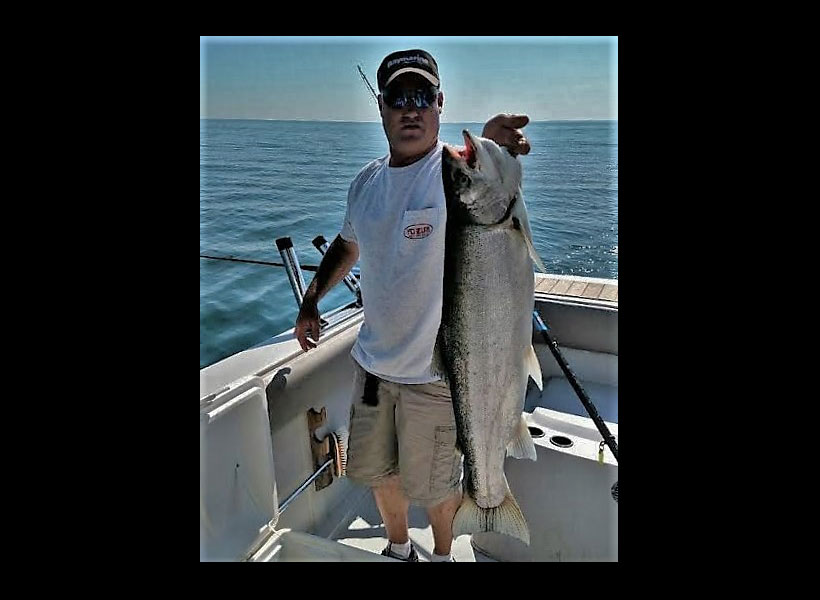
However, this area is also more laid back than many tourist destinations as far as the fish guide community.  When I contacted Allen Benas, the head guy with 1000 Islands Fishing Charters, he didn’t have his boat in and he couldn’t find anyone else that did either.

Boldt Castle is one place that visitors must see, it is mesmerizing with story tales and history.

That’s not to say there isn’t good fishing available this time of year, there is.  For walleye, some of the best action is around the horn near Henderson Harbor and around the mouth of the nearby Black River.  With the Lake Ontario Counties, the Annual Trout and Salmon Derby is going on, anyone targeting walleye can try their luck there if they want the best chance to win.  The leader going into the final day of Derby action was an 11 pound, 14 ounce ‘eye caught off the Black River on opening day.  Check out www.loc.org to see the final leaderboard.

In addition to the fishing that these hotspots have to offer, don’t forget about the many boat tours that are available.  If you’ve never been to Boldt Castle located on Heart Island, you owe it to yourself to take the tour and delve into this tragic love story.  While this may be the most popular of all, Clayton Island Tours is now also offering Rock Island Lighthouse tours, and you have the option of being in a glass bottom boat to take in the river life beneath the surface of the water.  To find out more, log on to www.claytonislandtours.com.

Local wineries are making a name for themselves too.  This time around, we visited the Thousand Islands Winery (www.thousandislandswinery.com).  If you like dry whites (to go with your seafood of course), you’ll want to sample their Chardonnay, Pinot Grigio or semi-dry Riesling, these were “all-approving” to our palate.  There are many other things to sample here too.  Their operation is in the shadow of the 1000 Islands International Bridge.

An important part of all my getaways – short or long – is the food.  Anyone who knows me knows that I like to use dining establishments as important waypoints and landmarks so that folks know where I am at all times!  This time around was no different, starting with The Clipper Inn at Clayton.

This is a fine dining establishment that I’ve never had the pleasure to sample, but it is a restaurant that has been in the Simpson family for 35 years.  The Simpson Family is native to the 1000 Islands area and goes back even farther.  Mary was our waitress and she gave excellent recommendations, starting with our Seafood Pate appetizer and on to our entrees.  My salad was slathered with, of course, 1000 Island dressing.  I had a king crab and Delmonico steak combo that was to die for.  Sandy had a Boston cod dinner that was exquisite.  As is usually the case when the food is this good, I ate way too much.  If you are in the area, this restaurant comes highly recommended.  Check out www.clipperinn.com, remember that you will need reservations.

Our Saturday evening dinner was also exemplary, with the icing on the cake being on the water as the name suggests, at Channelside.  The view is mesmerizing and the food is very good.  We started things out with some Channelside Chips that are reminiscent of nachos, but with a personalized touch and unique flavor. We also had Bang Bang Shrimp, that was a great treat.  My plate for supper was a perch dinner , and then a Haddock fish fry for Sandy.  Both of us left begging for more, if we only could have finished both!  The flavor was special.  Check out the menu, visit www.thechannelside.com.  Our waitress was Lori, also a great server.  The service can make or break a meal no matter how good the food is.

This is the tasty Musky Breakfast Platter from Koffee Kove Restaurant

Breakfasts were at the Koffee Kove Restaurant, where owner Laurie runs a tight ship with more good eats.  While muskellunge fishing was out of season, the Musky Breakfast wasn’t.  Give it a try.  The Everything Omelet was their version of a tasty garbage plate that was also very appealing if you have a hearty appetite in the morning.  They’ve been around for 44 years, so they must be doing something right.

Sandy and I love exploring new restaurants as we can find our way around town. And let’s not forget the 1000 Islands Harbor Hotel either, more good food to chew on if you want to stay close to your lodging.

No stop would be complete without a visit to the 1000 Islands River Rat Cheese shop.  Their aged cheddars are scrumptious and there’s always something new that ends up in our cooler for the trip home.  The fresh cheese curds are to die for (at least if I listened to my doctor)!  To see the wide selection of products go visit www.riverratcheese.net.

This is only the tip of the iceberg (lettuce – with Thousands Islands dressing of course), when it comes to what the area has to offer.  You can find many more offerings at the Chamber of Commerce website at www.1000islands-clayton.com.

This area is also part of Jefferson County, featuring other locations like Sackets Harbor, Henderson Harbor, Watertown and Alexandria Bay.  Ask for a travel guide at www.visit1000islands.com or call 1-800-847-5263.

I can think of thousands of reasons to spend more time there!

Western New York Fishing Forecast for Friday, May 27, 2016

Lake Ontario, Lake Erie, Niagara River, Chautauqua Lake, Finger Lakes

Captain Vince Pierleoni and Team Thrillseeker outsmarted the bruiser King Salmon to finish in the money in the professional division of the Pro-Am Tournament on Lake Ontario last.

Weather Helps Fishing Action! 

We finally saw some west wind blow some fish into local waters, but it wasn’t easy fishing for the Pro-Am tournament last weekend for sure.  According to Capt. Vince Pierleoni of Team Thrillseeker (who placed in the money yet again for the Professional Division), transition time in the lake is rapidly approaching with the super warm weather arriving this weekend.

Combine that with four straight days of calm weather before the recent winds at mid-week – there are some quality king salmon around, but there is no set pattern for a consistent bite.  You can find fish (kings, lakers and steelhead) in 80 to 300 feet of water, from 20 to 100 feet down.

It’s been a mix of techniques and baits working. One approach that has worked better for bigger kings has been a flasher with cut bait.  N&D is one brand type that keeps surfacing around fishing circles as a good brand according to Karen Evarts at The Boat Doctors.  One interesting note is that the fish have been moving around with the more favorable west and southwest winds.  Last Saturday, tournament teams out of Wilson and Olcott all headed west in pursuit of salmon.

Capt. Jim Gordon of Olcott, who was not fishing in the tournament, headed straight out of his home port of Olcott to take a dozen nice kings for customers just a mile or two straight north.  No one did that good in the tournament that day.  In the 32nd annual Lake Ontario Pro-Am Salmon Team Tournament held May 20 to 22 out of Wilson and Olcott, it was the Shark Tank team led by Capt. Greg Gehrig of Oswego leading the way with an impressive score of 599 points in the Classic Division and 391 in the Trophy Division – based on 10 points per fish and a point per pound – to win the tournament.  They also won the ITO flies big fish for the contest with a 24 pound king salmon.  For their efforts, they won more than $29,000.  Second place was Capt. Rich Hajecki and his Yankee Troller team out of Rochester.  They were just 10 points behind the winners in the Classic or 12 fish category.  They won $8,000.  Third place in Trophy was Dirty Goose led by Capt. Casey Prisco with 341 points.  Fourth place was Team Thrillseeker led by Capt. Vince Pierleoni of Newfane with 338.  Third place Classic Division team was Thrillseeker with 505 points.  Fourth was Free Spirit with 498 points led by Capt. Paul Czarnecki of Waterford, PA.

Rochester anglers are happy with yellow perch taken from a marina waterway.

In the Amateur Open on Day One it was Abe DeBadts of Rochester and his Fishin’ Physician Assistant team with a score of 88.49 points.  Winner of Day 2 was Greg Wiacek of Lockport and his Fisherman’s Daughter team with a score of 72.52 points.  For Day Three, it was Mean Machine and Kyle Hovak of North Tonawanda taking the day with a score of 80.10 points.  However it wasn’t enough to win the Amateur Open Cup for the best two days of fishing combined.  That was reserved for Anonymous led by John Muehl of Maryland, NY, who scored 150 points over two days.

Next contest is the Oak Orchard Open set for June 10-12 out of Point Breeze.

The 1st Annual Reelin’ for a Cure is set for August 19 out of Niagara County, an event that will get the ladies out fishing on Lake Ontario and competing for fun prizes while at the same time raising funds for cancer research.

For more info call Stephanie Pierleoni at 716-481-6388.

Lower Niagara River

The first signs of the dreaded moss have started to show up to the dismay of anglers. You can still fish without much of a problem, but be forewarned – it will be here before we know it.

Trout are still available in the river – steelhead and lake trout – and smallmouth bass are starting to turn on now, too.

Shiners and Kwikfish top the list for trout; Kwikfish, tubes, shiners and swim baits will all trick smallies into hitting.  Best areas have been around Fort Niagara, Peggy’s Eddy and the clay banks for bass; Devil’s Hole for the trout and the occasional bass.  You can still pick some of these fish up from shore, too.  Spinners are taking some nice fish.

Upper Niagara River 

The shoreline bite can be good for walleye at night or under low-light conditions as post-spawn fish move in to feed.  Worms work best.  Panfish action has been good around marinas and around Grand Island bays, channels and tributaries.

A couple fishing contests to mark down on your calendar, including a kids fishing contest at the Iroquois National Wildlife Refuge on June 4 at the Ringneck Overlook starting at 8 am; the City of Tonawanda kids fishing contest at Niawanda Park with registration at the bandshell along River Road on June 18 starting around 7:30 am; and a Teach Me To Fish program at the East Aurora Fish and Game Club on June 4.

Lake Erie and Tributaries 

Perch action seems to be picking back up again according to Capt. Joe Fonzi of Thumbs Up Charters.  He had customers out this week, including Salvador, James and Raymond LaChase of Rochester, and they did well between Sturgeon Point and Cattaraugus Creek in 56 feet of water.  The key is finding the fish and staying on them.

The walleye bite has been best at night with stickbaits along the shoreline, but that could be changing this week according to Fonzi, who is anticipating those post-spawn fish to turn on any day.

Bass action around Buffalo Harbor has been decent with shiners, drop shot rigs and tubes.

In the Annual Southtowns Walleye Association In-Club Perch Tournament last Saturday, Ben Slawatucki won the five-fish contest with a weight of 6.98 pounds.  Jim Dolly Sr. was runner-up with 6.81 pounds.  There were nearly 170 anglers in the fun contest that requires the weight of your 5 biggest fish in the tally.  These perch are all post-spawn now

Chautauqua Lake 

Smallmouth bass are hitting three-inch tubes in a pumpkinseed color around Warner’s Bar in 12 to 24 feet of water.  You can also pick up some nice bass by moving into the weed pockets with a black and blue pig and jig according to Craig Robbins of Jamestown.

There is also a top water bite in the mornings and evenings off the Mayville Flats, Rock Island and the point off Lakewood Bar. You can also hit the dicks in Dewittville Bay and along the condos with buzz baits or spinnerbaits in white and chartreuse.

This is opening weekend for inland musky (not Great Lakes) and you can find success throwing over-sized jerk baits and bucktails over weed beds in places like around Wee Wan Chu Cottages and trolling in the southern basin of the lake in Ashville Bay in 10 to 14 feet of water.

Finger Lakes 

Seneca Lake – This Finger Lake will see a busy weekend because of the National Lake Trout Derby that will run through Memorial Day.  Not too many people have been sharing information going into this popular contest, but going into this week lake trout were being taken in 90 to 150 feet of water on spoons, flasher-fly combos and jigs tipped with plastics or live bait.

Atlantic salmon can be found near the surface with stickbaits, spoons or streamers. Good luck! Good to www.laketroutderby.org for information.

Bill Hilts, Jr., Director, Outdoor Promotions

Niagara Tourism & Convention Corporation, 10 Rainbow Blvd., Niagara Falls, NY USA 14303
p: 716.282.8992 x.303| 1.877 FALLS US, f:716.285.0809
website | facebook | twitter | blog

Sportfishing has a $30 million annual economic impact in Niagara USA!

Fins & Feathers Day

Let’s call the fourth Saturday in May what it really is.

Maries River Smallmouths – Jefferson City native Randy Boeller drove all the way back home from Houston, Texas, to catch this hefty smallmouth from the Maries River.

To my knowledge, the fourth Saturday in May is the only date on the calendar when Missouri anglers and hunters all have something to rejoice about.  That’s because the Saturday of Memorial Day weekend is opening day for squirrel hunting and for catch-and-keep fishing for black bass south of the Missouri River.

This year’s squirrel season runs from May 28 through Feb. 15, 2017.  You can fish for largemouth, smallmouth and spotted bass year-round, and you can keep these three black bass species all year anywhere north of the Missouri River and in impoundments statewide.  Though in most streams south of the Missouri River, you may not legally keep black bass until the season opens.  This is designed to give bass protection during their spawning season and during the part of the year when Ozark streams are at very low levels and bass are concentrated in small pools.

Note that I said “most” streams south of the Missouri River.  The area where black bass fishing is restricted excludes what is commonly known as “swamp east Missouri,” the low area that is part of the Upper Mississippi Embayment.  This includes all of Dunklin, Pemiscot, New Madrid, Mississippi and Scott counties, most of Butler and Stoddard counties and tiny bits of Ripley and Cape Girardeau counties.  The actual boundaries are much more precise than this, being demarcated by highways as described in the Conservation Department’s Summary of Missouri Fishing Regulations.  The booklet is available wherever fishing permits are sold or online at http://on.mo.gov/1LwnqRA.

There’s no trick to finding places to hunt squirrels.  Anyplace with trees is sure to have bushy tails.  If you don’t own such land or know anyone who does, there are literally hundreds of conservation areas that are crawling with squirrels.  The Conservation Department makes it easy to find an area near you with its online Conservation Area Atlas. The database is searchable by county, activity or type of facilities.

What might be slightly more complicated is finding the right kind of squirrel.  To me, the “right” kind are fox squirrels, which are about twice the size of gray squirrels, and consequently are more likely to add up to more than one serving apiece.

In principle, finding fox squirrels is easy.  They inhabit open woodlands and areas where wooded acres are surrounded by open ground, especially agricultural land.  This means southwestern and northern Missouri for the most part.  However, you can find fox squirrels throughout the state where forest borders on pasture or row crops.

Black Powder Squirrels – A small-caliber muzzleloader is a good tool for hunting squirrels in the summer, when foliage dictates close shots.

Most of the bass you catch in Ozark streams will be smallmouths, those bronze-backed masters of the aerobatic hook-toss.  In a few streams, however, smallmouths have been fighting a losing battle against an invasion of spotted bass.

I’m not normally one to intervene in a fair fight, but in this case I think anglers have legitimate cause to take sides.  For one thing, the spotted bass’s fighting ability pales in comparison to that of a smallmouth.  Add to that the fact that spots are significantly smaller, on average than smallies, and you’ve got a no-brainer.

To let anglers weigh in on the smallmouth-spotted bass battle, the Conservation Department has removed the minimum length limit for spots on all or parts of the Big, Bourbeuse, Courtois, Meramec rivers and on Huzzah, Blue Springs, Dry Fork and Mineral Fork creeks.  Taking home a limit of six spotted bass of various sizes lets anglers enjoy fish on the table without reducing the supply of hard-fighting smallmouths.

More restrictive length and creel limits apply to smallmouths on various other streams where the Conservation Department is trying to build trophy smallmouth fisheries.  Before heading out, be sure to check the section of the Fishing Regulation Guide for regulations specific to the area you plan to fish.

Stream bassing in Missouri isn’t all about the Ozarks.  Several streams in Northern Missouri have good smallmouth bass populations mixed in with the dominant bucketmouths.  The South Fabius (pronounced (Fabby”) River, which runs through Knox, Lewis and Marion counties north of St. Louis.  This Mississippi River tributary is virtually unknown outside of Northeastern Missouri, but it is notable enough to be included in the Conservation Department’s “Padder’s Guide to Missouri.”

Plenty of other northern Missouri streams also have excellent black bass fishing.  North of the Missouri River there are the North Fabius, Grand, Chariton, Salt and Platte, and in the south you have fine Ozark Border streams, including the Lamine, Moreau and Maries rivers.

Oil up your shotgun and fishing reel.  The fun is about to start!

Spring Crappie Fun

Learning the String of Seasonal Transitions

springcrappiefun1Dogwoods and wild flowers punctuate the forest with color, yet crappies remain in pre-spawn mode.  Spring is well underway before crappies begin to crowd ever-closer to spawning habitat.  Foraging remains the priority.

In many environments, crappies begin to filter out of dense wood cover as new weed growth rises from the bottom.  Plants offer an entirely new menu of invertebrates and the minnows that pursue them.  New cabbage growth is especially attractive for crappies, but elodea, coontail and other weeds, will draw them too.  Not unusual to see crappies in two feet of water or even shallower when the first weeds pop up and many anglers fail to search for these extremely shallow fish.

Reeds become increasingly important to crappies as water temperatures approach 65°F.  The relatively hard bottom that reeds thrive in is preferred by nesting crappies.  In the absence of reeds, crappies may move back into wood to spawn.  Reeds, stickups and wood cover offer the kind of vertical cover they like for spawning.

Before spawning, crappies are moving around from wood to weed cover and back.  They also move shallow during stable weather, then move out past the first breaks into 10 or 15 feet of water to suspend lethargically during cold fronts.  Then, as the spawn progresses, not all crappies spawn at the same time.  Crappies that use small bays and canals spawn early, followed by crappies in larger bays, and finally by main-lake spawners, where the water warms slowest.

springcrappiefun2

Soon after spawning, female crappies abruptly leave to sulk and recuperate in deeper water, while males remain to guard the nests for several days.  Soon after, all crappies begin to spread out into various summer patterns.  Some go to breaks near deep weed lines.  Some follow plankton veils in open water.  Some find brush piles, lay downs, or stake beds.  Some may relate to boulder fields, rocky points, or off-shore humps.  In most cases, crappies alternate between suspending near those cover options and burying themselves within that cover.

So these many movements within such a short period of time keeps anglers on their toes.  My favorite program for finding crappies fast, then catching numbers, from this point in the season (early/mid-May) right through fall is the same every year.

I start each day with a fast, 7-foot ultralight rod from G. Loomis or the St. Croix Panfish Series coupled with a spinning reel the size of a Pflueger President ESP30—not a tiny reel, but not a big one either.  The spool is filled with 4-pound Maxima Ultra-green monofilament and the lure of choice is a 2-inch Kalin, Berkley or Yamamoto Grub, on a 1/32-ounce jig head from Gopher Tackle or Northland.

The idea is to swim the jig slowly on a horizontal plane and the 1/32-ounce head creates the perfect speed for crappies.  Not too fast and not too slow.  The presentation is simple.  Cast, allow the jig to sink anywhere from a foot to 8 feet, depending on the depth of the cover or bottom in the area, point the rod tip down and slowly reel.  Keeping the lure horizontal, not rising or dropping, requires a very slow retrieve.  Watch beside the boat to create the cadence.

springcrappiefun3Monofilament line keeps the light jig from falling too fast in spring and as the water warms into the high 70°F range, I switch to 4 or 6-pound Berkley Fireline in order to speed things up.

Even when crappies won’t bite the grub, the most active fish will follow it, so wear polarized sunglasses and watch closely.  A white, yellow, or chartreuse grub is easy to spot, providing a better chance to scan behind it before crappies spook from the boat.

Once crappies are found, the jig-grub combo may keep right on catching them and may not.  I always have an 8-foot St Croix Panfish Series rod rigged with a small Thill or Northland slip float handy, just in case most of the crappies are spooky or less active.  And, it’s critical this time of year, to be prepared with 2 or 3 different kinds of bait.  Crappies can switch overnight from minnows to invertebrates and back again.  Typical on my boat to find a scoop of crappie minnows, a few dozen panfish leeches, and at least 100 wax worms, maggots, or angle worms on board when chasing crappies.

Critical, too, to use jigs with at least a size #4 hook for crappies, or size #4 to size #2 Aberdeen hooks.  Big crappies can shake loose or rip free from those smaller hooks on the 1/64 to 1/16-ounce jigs we commonly use.

As the blooms of spring fade and the greens of the forest darken, crappies make all kinds of movements involving transitions between different forms of cover and from one kind of forage to the next.  They won’t move far, but anglers have to be prepared to search a little every day.  The rewards are resplendent in sparkling hues of green, gray, blue, and purple, not to mention those golden-brown fillets sizzling in the pan.

New York’s 1000 Islands – St. Lawrence River – Part 1 of 2

ny1000islands1

Summer Vacation Treat – Fishing, Touring, Eating.  Part 1 of 2

The Thousand Islands Region of New York State has a long history as a premier vacation destination combining the picturesque and subtle setting of the area with the tradition of sheer outdoor enjoyment.

The St. Lawrence River carries the fresh water from the five Great Lakes to the Atlantic Ocean.  While the past may conjure up a mystique of monster muskellunge and a bonanza of bass, and other fish species, it is what the present offers that has wonderfully enhanced a recent visit to Clayton, New York, this spring, at the amazing Thousand Islands Harbor Hotel.

The new 1000 Island Harbor Hotel is radiant in the sunset and offers great views, great rooms and great food.

The new 1000 Island Harbor Hotel (www.1000islandsharborhotel.com) is outstanding, offering 105 deluxe guest rooms and suites to visitors to the area. The facility was designed in such a way that a majority of the rooms face toward the majestic St. Lawrence River.

My favorite aspect of the hotel is the Riverside Patio that allows for a great meal and is a perfect place for a perfect sunset.  Open air, gas-fire pits, burned brightly in the fresh air as we relaxed and sampled some great food options.  Throughout this Hart Hotel complex, there were pictures of “the good old days” that reminded guests about those times gone by, but not forgotten.

The Clayton area is one area that remembers their roots very well, a lesson we can all learn from.  All visitors have an opportunity to learn about the rich history the area offers.

Here, I am struggling with safely releasing the fish from the new YoZuri lure, all went well and we released the fish to fight again.

One of our side-trips was an afternoon casting and observing some of the new Yo-Zuri hard crankbaits at nearby Lucky Star Lake in Chaumont, New York.  The lake is just a short drive from historic Clayton.  The lake provides a 2,000 acre wildlife territory that offers both hunting and fishing for customers.  Angling action takes place on a 100-acre lake that’s loaded with bass, pike, crappie and other panfish.

We were greeted by “Bird,” a friendly black lab who lives for retrieving.  While her specialty is rocks and dropping them on your feet (steel-toed shoes are advised), this time around it was sticks.  The first one was over 8 feet long and difficult to throw.  We broke off a smaller piece and started the process of throwing to Bird.  My wife Sandy and I alternated stick-tossing with casting the new lures.  My better half did great reeling in largemouth bass that kept her busy.  I was keeping Bird busy, or maybe it was the other way around!  Either way, we had a great time outdoors that left Sandy saying, “When can we go fishing again?”

This wonderful dog is DzBirddz, 8-foot throw sticks were the norm for this lovable dog.

Lucky Star (www.luckystarranch.com) was recently acquired by Otis Technologies  (www.otistec.com).  Doreen and Jody Garrett were wonderful hosts.  This was a company that was started by Doreen when she was just 16 years old.  For those of you not familiar with Otis, it’s main focus is on modern, high-tech, firearms cleaning. Otis offers a low cost, lightweight and efficient gun cleaning system that you can carry into the field on your belt loop should you encounter a mishap.  That’s what happened when Doreen was hunting with her father years ago.

The company, based out of Lyons Falls, New York, has many more outdoor products with the newest focus on hearing protection, including one example they call the “Ear Shield.”  The Otis Sound-Reduction Chamber Technology does not require any batteries and it does everything you need to protect your ears.  I think they would be great around the house, too, for my wife – when she is mowing the lawn or using the chain saw.

A second form of hearing protection was called Flugz.  These are form-fitted ear plugs that you preform and shape to fit yourself, easily and efficiently, to personalize the reasonably-priced plugs to your own ears.  Check these things out because there is something there that will work for you…and your wife.

Please check out part 2 of 2 on this series next week, to learn more about fishing the St. Lawrence and musky, walleye and bass.  I’ve also included information on the unique and tasty wineries of the area, historic castle places to visit and where to enjoy some of the best food.

In the meantime, you can find out more offering from the Clayton Chamber of Commerce website at www.1000islands-clayton.com.  This area is also part of Jefferson County, featuring other locations like Sackets Harbor, Henderson Harbor, Watertown and Alexandria Bay.  Ask for a travel guide at www.visit1000islands.com or by calling 1-800-847-5263.  I can think of thousands of reasons to spend more time there!

ny1000islands5

The Loon Capital of the USA

Town of Mercer, Iron County, Wisconsin

Mercer, Wisconsin, is the Loon Capital of the world and observing a pair of these beautiful water birds will leave you with indelible composition of chorus and ballad interchange, as if the birds were asking you a question and helping you answer.

No matter how far you have to drive or fly to reach Iron County in Wisconsin, the ride down Highway 51 will allow your mind to embrace nature.  You may also want to keep your camera shutter ready.

Pulling off to the side of the lone north-south road, fresh air, serenity, wildlife and endless wonders of nature share in the peace to be found here.  Whitetail deer, wild turkey, bald eagles, wrens, warblers, porcupines and one of my all-time favorite birds, the rose-breasted grosbeak may offer a view.  The ride to Mercer, Wisconsin, can be a memory-making interval in your life.  It is an unforgettable place to visit.

Above all that, there are Loons in abundance.  There is only one word that seems appropriate for these water birds, that word is “beautiful.”

Just moments after sunrise, the view from my room window at the Great Northern Hotel in Mercer, Wisconsin, is breathtaking. Forrest Fisher Photo

looncapital3Loons are striking in their breeding plumage.  Their iridescent-sheen reflects with the sun, their prominent black and white checkered back, deep red eyes, glossy black bill and the natural philosophical expression of their black head are accentuated by white necklace color pattern that circles their muscular neck.  They are very special and distinct to watch.

When I arrived in Mercer and checked in at the Great Northern Hotel, I only needed to see the waterfront view from my room window to know that I was going to love this place.

There they were, the Loons, two of them, a pair of love birds, swimming neck to neck with each other, constantly looking over to one another and checking in during a ritual of obvious private discussion.  Of course, maybe they were talking with me and I just didn’t know it.  I felt they were discussing my presence near to their nest which had two eggs in it.

looncapital4

Both male and female Loons have the same appearance in color and marking, except the male is usually larger in a mating pair.  They are both equal in beauty and song tone.  Beautiful sounds of nature and wild freedom that echo in the distance and are especially pronounced in the early morning.  Their song seems to carry farther with a fog slowly rising off the morning sunrise moments, occasionally sounding like an intimate conversation between the birds.

looncapital5There was a dock right outside my room at the hotel, right on the shore of San Domingo  Lake.  I tied on a small snap, added a small lure – a random choice, and headed to the water.  I wasn’t sure if I just wanted to just sit down and listen to more of what the Loons wanted to share, or cast my lure.  The feeling was serene and comforting.  It was peacefully magnificent.

After a few minutes, I instinctively reached down to the bail of the lightweight, open-face reel and flipped it open.  The cast gently sent the lure out about 40 feet from the dock –not anywhere near the Loons who seemed quite interested in my every move.

My polarized sunglasses revealed a weed bed not far down from the surface near the point of my lure entry, so I cranked quickly, rod tip high, and after the lure moved only about five feet, it slammed to a jolting stop.  Then the line started moving quickly to the right.  No, this was not a snag!  About the same time, my drag started singing that happy chirping song when it is being tested to protect the line from breaking.  Then the drag started screaming and wailing in perfect angler sheet music.

A few minutes later, a nice 18-inch largemouth bass slid into my open hand.  So perfect a fish.  So perfect a day.  When I reached down, the water was so cold.  I unhooked the fish and released it to live another day.  I grabbed the pocket thermometer in my jacket found the lake to be 42 degrees!

How was it possible that a fish would even think about swimming to catch a lure at that temperature?  Ours is not to ask why or how when success is our friend, so I quickly followed up with another cast.

In six casts, I hooked and landed two more fish of about the same size.  It was an amazing learning moment!  Water too cold, lure swimming very fast, wobbling, making sonic underwater noise and wham!  OK, writing that down in the frozen chapters of stored fishing secrets.  Maybe that’s why the Loons kept looking in my direction too.  Was it the underwater sound of the lure?  Either way, it seemed we had a conversation going on.

In the next three casts, I hooked three more fish and didn’t try very hard to land them.  They tossed the lure and went free.  Tournament release!  The Loons kept watching.

I rested my rod.  In this unmatchable and unique “Land of the Loons,” a trip to that land of special memories, that place where we never stop sharing fun with time and learning from the mentors we continue to meet, sometimes from the view at the dock.  I smiled again.

On some days, life is extraordinary, especially when Loons become part of the regular day in Mercer, Wisconsin.

Sarah Palermo, proprietor of The Wampum Shop, offers hundreds of various Loon collector replicas from small to large, in a quaint shop located in downtown Mercer.

My Grandma Taught Me to Fish

Early Lessons Pay Big Dividends When Kids Grow Up
By Bernard Williams

Bernard Williams learned early lessons from his grandmother that instilled a lifelong love of fishing in him. He caught this 3.15-pound whopper crappie at Lake Grenada, Mississippi, with his fishing partner, Don Terry, in the fall of 2015.

My paternal grandmother, Alberta Williams, lived with us.  She had to in her early 80’s when I was born; don’t remember her exact age, but I do know she was around 97 when she passed away.  Well, grandmamma loved to fish.  My mom says she started taking me fishing as soon as I could walk.

I was raised on a small farm. We were poor financially, but I didn’t know it.  My parents worked outside the house as well as on the farm.  My dad raised all our food including cattle, hogs, chickens, corn, cotton, and vegetables.  In those days we only had to purchase flour, sugar and a few other small grocery items.  I would have the time of my life exploring the outdoors as a kid.  I grew up with hunting dogs, and cats––that’s right, we had cats that caught everything from birds to snakes, and a rat or two every now and then.

I remember one morning when I was about 5, she called me from the breakfast table and asked if I wanted to accompany her “down to the pond” as she would call it. We had an 8 or 9 acre farm pond behind the house.  My answer was always “yes ma’am.” In those days you never said just “yes” or “no” to an adult.  I gathered up my pole and away we went.  The pond was about 200 yards behind the house and it was off limits to me as a kid unless I had adult supervision.

Grandma had an innate ability to find a bream bed, I thought it was some kind of magic.  Little did I know, she knew the scent.  She would say, “Boy, you smell that watermelon?”  I would say, “Yes ma’am,” knowing I had no idea.  I just wanted to put my pole in the water.  She would bait my hook with night crawlers we had gathered on the way to the pond.  Dad had a worm bed he’d started long ago.  That worm bed stayed full of night crawlers on one side and red worms on the other side.

She would pitch my worm out near an old stump and then bait her hook and do the same.  This particular day, as soon as my hook sank beneath the surface, a huge hand-size bluegill swallowed my bait and the fight was on. The fish gave a tremendous pull. For a small boy, this feeling caused tremendous excitement, almost to the point of wetting my pants (which is what I did!).  She helped me land the fish and get it into the basket.  Again, she baited the hook and instantly the same thing happened––another hand-sized (or better) bluegill.

I can’t remember exactly how many we caught that day, but I do remember my little sister getting extremely mad about being left out of our fishing adventure.  I’ll never forget the look on my mom and dad’s faces when they returned home to a table full of bluegill fried up with green tomatoes.  Oh boy, it’s kinda like Jerry Clower used to say, “It’ll make a puppy pull a freight train.”

My grandma had only two grandsons.  I was the youngest.  The older one, Johnny, was almost my dad’s age.  Grandmamma looked at Johnny like a son, but looked at me like a grandson.  I’ll never forget the fishing lessons she gave me and the whippings she helped me avoid.

Guess its true, that’s what unforgettable grandmothers are supposed to do––spoil the grandkids.

Niagara Fishing Forecast for Friday, May 13, 2016

Lake Ontario and tributaries

The Yankee Troller team led by Capt. Rich Hajecki lead the field of nearly 50 competitor boats to take the 2016 Wilson Harbor Invitational Tournament last Saturday. Many of the fish landed were fooled using a 150-foot diver pulling a Familiar Bite Whip Flash/Meat combo off 6-Mile Creek west of Wilson Harbor, New York.

An East wind is the nemesis of Lake Ontario salmon and trout fishermen, and we’ve had a bunch of it the last couple of weeks.  Despite the less than ideal conditions, it was the Yankee Troller team led by Capt. Rich Hajecki leading a field of nearly 50 boats to take the annual Wilson Harbor Invitational Tournament last Saturday – the WHI.  The one day event target’s salmon only and the team scored the tournament limit of six salmon – all kings – and averaged nearly 18 pounds per fish. Pretty impressive!!  There wasn’t anyone close to them.  The team fished from 6 mile to 4 mile in 100 to 225′ of water.  In practice they had some bites on Dreamweaver spoons, but during the event it was all Familiar Bite Meat.

Their best set-up was a 150-foot diver pulling a Familiar Bite Whip Flash/Meat combo.  They also had a similar combo going on a rigger.

The LOC Derby is going on right now and the current Grand Prize leader is Tracy Lindsey of Seneca Falls with a 25 pound, 4 ounce salmon weighed in at Wilson.  The first place lake trout 24 pounds, 1 ounce caught by Brent Burgess of Portland, NY while fishing out of Wilson.  All these fish were caught on Saturday, so the fishing turned on for big fish. Seeking out active fish hasn’t been easy with the east wind.

Wednesday morning, Capt. Kurt Driscoll found some kings in tight around Wilson in 40 to 60 feet of water, all in the top 30 feet, where his deepest rigger was set. He was trolling hot, too – down speed was 3.4 mph using spoons in black-white-green-gold.

The LOC Derby continues until Sunday at 1 pm, May 15.  Awards will be held at Captain Jack’s on Sodus Bay starting at 4 pm.  Check out the leaderboard at www.loc.org.

Don’t forget that Don Johannes and Pete DeAngelo 3 fish- one fish contest is set for May 19. Register by 7 am the morning of the event in either Wilson or Olcott — In Olcott it’s the Slippery Sinker and the Boat Doctors; in Wilson at Bootleggers Cove Marina or the Gas Shack.

The Lake Ontario Pro-Am tournament is set for May 20-22 and the deadline to sign up for everyone is May 16 at 5 pm. Find out everything on the website at www.lakeontarioproam.net.

It’s a celebration of our fishing resources, for sure, an event started up by the late Skip Hartman of Olcott in conjunction with Lowrance Electronics – 32 years ago!

Remember to save those salmon heads from clipped fish.

Lower Niagara River

The big news is that the Devil’s Hole area in Lower Niagara River will be CLOSED on Monday, Tuesday and possibly Wednesday according to National Grid officials.  The culprit is the removal of some old transmission lines and numerous precautions are being taken – including closing boat traffic, Artpark Trail No. 7 and even the Robert Moses Parkway from traffic.  It might be for only 90 minutes per day, but it’s anyone’s guess how long it will really take.  That’s starting Monday, May 16.

Trout are still hanging on as the warm water fish are becoming a bit more active.  Kwikfish are working on lake trout; steelhead prefer shiners. Filming a TV show on the lower river recently with Mid-West Outdoors, we managed to catch seven different species of fish.  The number one species we caught were numerous silver bass in the Wagon Wheel area just south of the launch ramp on swim baits.  While drifting for bass, Bob George with Buck Knives had the surprise of his life – a 50 inch musky!

Check out the Facebook page for Niagara USA Fishing and Outdoors to see a video of it. Because it’s not in season, it was released immediately.  It still provided a nice thrill.  He was using a Strike King Rodent soft plastic bait.  John Antone of Sanborn was fishing with Capt. Steve Drabczyk recently and he managed to catch five different species.  Egg sacs and shiners worked best but the key was using a 7 foot leader.

Some big smallmouth bass in the six pound class were caught last week in the river and at the river mouth during the annual media event utilizing tubes and swim baits.  The key was fishing the baits slow.

Speaking of Television shows, if you want to see Niagara County in a positive light, check out Fishing University next weekend on the Outdoor Channel.  It will air on Friday, May 20th at 12:30 pm, Sat., May 21st at 4:30 pm and Sun., May 22nd at 9:30 am Eastern.  It’s another way to promote our great fishing, as well as the area!

Thanks to Jennifer Pauly and the Lower River Chamber who took the lead on this effort last fall.  The Niagara River Anglers Association will hold their next meeting on Monday, May 16, starting at 7PM at the Jetport Restaurant, 7100 Porter Rd., Niagara Falls.  If you wanna know more about this fishing resource in Western New York, attendance is free.

Upper Niagara River 

Not too many reports to share, but this should be a good time to target panfish around Grand Island and along River Road.  Use minnows if you are targeting perch or crappies.  Bass anglers must still use artificial baits in the river.  Northern pike and walleye seasons are now open, too.

The Erie Canal is open for business and offers some good fishing options this time of year.

Bill Hilts, Jr., Director, Outdoor Promotions

Niagara Tourism & Convention Corporation, 10 Rainbow Blvd., Niagara Falls, NY USA 14303
p: 716.282.8992 x.303| 1.877 FALLS US, f:716.285.0809
website | facebook | twitter | blog

Sportfishing has a $30 million annual economic impact in Niagara USA!

LightFORCE Defies the Dark

LightFORCE bar lighting converts your ATV or UTV to a 24-hour workhorse.

LightFORCE is a Night Force to Uncover New Adventures

ATV’s and UTV’s have become commonplace in hunting camps and on farms and ranches across the country.  The small vehicles that go anywhere are ideal for getting hunters to remote places and moving game back to camp without the back-breaking work.  As often as you may use your favorite 4-wheeler, it’s probably limited to day duty, wasting away half of the thrill-generating go-power for lack of adequate light.

Enter LightFORCE with their incredible new light bars and ultra-powerful, wide-light, illumination beams.  Most headlights on ATV’s are designed like car lights as if you’d be cruising down the highway at 50 miles per hour, instead of close-in illumination that floods an area to do important work.  Field dressing a deer by headlight is worse than doing it in the dark because of the harsh shadows and powerful beams a headlamp produces.  Light bars produce just the opposite effect so that you can safely do essential work after sunset, like unloading your rifle or crossbow, examining a sudden track in the snow, looking for lost items, or evaluating hazards in the trail ahead.  Heck, you can search for morel mushrooms with a light bar! Imagine that, your daytime just found more time.

LightFORCE illumination is designed for safety, action functionality and performance.

Make Your ATV/UTV Shine

LightFORCE LEDs have changed the ATV and UTV market by allowing riders to reap the benefits of super-bright, super-versatile and super-tough LightFORCE light bars.  These are built to take the rugged travel an ATV can deliver.  Every bar in the LightFORCE LED Bar Series is extruded from aluminum and finished with a protective anodized surface-penetrating coating resistant to rain, snow, and ultraviolet light (UV) that will tolerate the harshest conditions.  The LightFORCE products are rugged and impact resistant, further featuring a hard-coated polycarbonate lens for maximum durability with a waterproof rating that meets and exceeds the IP69K standard.  The Ingress Protection (IP) rating system is an internationally recognized scale that relates to proven protection against environmental factors such as liquids and solids.  The numbers “6” and “9” are part of a higher detail definition that the units are dust tight and waterproof, even under high pressure spray.  Durable and safe for adventure outdoor use.

They also feature high-lumen light output with European LED’s tuned within their internal reflectors to produce unparalleled illumination capability.

With multiple mounting options available and complete with a waterproof Deutsch connector — including full wiring harness — the LightFORCE LED light bars deliver powerful performance in a complete package.

Available LightFORCE Options:

Dual and Single Row LED Bars

  • 6” single and dual row
  • 10” single and dual row
  • 20” single and dual row
  • 30” single and dual row

LightFORCE Product Specifications:

  • Input voltage range: 10-36V DC
  • Input cable length: 450mm (17.72”)
  • Operating temperature: -40°C to 63°C
  • Warranty: 3 Years
The LightFORCE hand-held spotlight model has tremendous range, perfect for night scouting purposes, safety around the camp and for general use.

Pick a Spot and Have it Both Ways

Just as light bars are ideal for illuminating close-in terrain, LightFORCE spot lights can spear the darkness like a missile with spot ranges out to 2,000 meters, that’s more than a mile.

Light bars need to be mounted for durability, yet LightFORCE spotlights like the 7-inch Enforcer, a 50-watt handheld unit, offer the ultimate in versatility and convenience.  For users who want more flexibility and agility from their portable lights and want it all wrapped up in a convenient kit, this is the solution.

This kit includes the new generation Cordless Enforcer, complete with a long-lasting, rechargeable Ni-Mh (Nickel-Metal Hydride) battery that is safe, an AC charger and heavy duty waterproof kit bag, complete with rugged YKK zip and a tough exterior ABS base.  To top it off, there’s a red filter to make this a coyote catching machine.

The scope-mounted LightFORCE spotlight model offers advantage for safety and predator hunting.

Whether you need a beam of light for added vision or to shoot predators, the beam will probably shine farther than you can shoot.  Enforcer is the top of the LightFORCE portable range and will give you all the light power you will ever need.  Check out all the LightFORCE illuminating products at www.lightforceusa.com.

Niagara Fishing Forecast for Friday, May 20, 2016

Lake Ontario and tributaries

Marty Polovick of Lockport, New York, won the Grand Prize in the Lake Ontario Counties (LOC) Trout and Salmon Derby that was held May 6-15, reeling in a 26 pound, four-ounce king salmon to take the $15,000 top prize.

Tournament Week Kicks off into High Gear 

Lake Ontario Pro-Am Salmon Team Tournament Week is upon us, with the main event starting on Friday out of Wilson and Olcott.  A total of 50 teams will be competing for some great cash prizes based on a unique scoring system.  East wind continues to be a problem, but action finally turned on for some decent spring salmon fishing on Tuesday for many of the boats.  Exact details are sparse because of the tournament, but many boats were catching fish between Wilson and the Niagara Bar, as well as east of Olcott.  Decent kings, too, in the 20 pound class. A 31 pound king was caught off St. Catharine’s last weekend as the catch was flying around social media circles.

In the Buffalo Sabres Alumni Charity Fishing Outing last Wednesday, a total of 24 boats hit the waters around Olcott.  The captain guiding the crew to the biggest fish was Capt. Mark Vilardo with Kingfisher.  His 19 pound, 3 ounce king took the top prize with numerous in the 18 pound class on other boats.  It was a fun time had by all as the local fishery was showcased.

Look for a mixed bag this weekend at the tournament weigh in at Krull Park at 2 pm each day.  Check out www.lakeontarioproam.net for details.  Marty Polovick of Lockport won the Grand Prize in the Lake Ontario Counties (LOC) Trout and Salmon Derby held May 6-15, reeling in a 26 pound, four ounce king salmon to take the $15,000 top prize.  He also earned an extra $500 for big fish of the day and a check for $1,000 by catching the largest salmon by a Lake Ontario Trout and Salmon Assn. member.  On the final weekend of the derby, the crew of Doug Parker of Lockport; Matt Dunn of Newfane; and Matt’s father, Marc Dunn of Lockport along with Polovick used an 8-inch Dreamweaver Spindoctor rigged with a white John King Baithead and a piece of Crowes Cut Bait (aka N&D Bait) to take the winning fish.  They put their downrigger on the bottom in 100 feet of water.

The lucky Laker Taker was Patrick Barber of Niagara Falls while fishing with his brother Richard (also from Niagara Falls) on Friday the 13th.  They were trolling the Niagara Bar off the mouth of the Niagara River in 25 feet of water on the bottom when the 27 pound, 8 ounce fork tail hit their chartreuse holographic Kwikfish rigged with Hammerhead cowbells on the rigger.  Big brown trout came from Oswego when Ryan Massey of Oriskany Falls reeled in a 16 pound, 2 ounce fish east of the harbor.  First place walleye was weighed in by Tim Farmer of Dexter, an 11 pound, 14 ounce fish from Chaumont Bay.

Lower Niagara River

Devil’s Hole is the place to be for a mixed bag of fish, but with the closure of the gorge early in the week because of the transmission line removal, it forced guides down river to try and target other areas and other fish species.  Kwikfish and minnows are the best baits to use.  Mitch Grant of Virginia was showing off some of his new Rapid Fishing Solutions gear while fishing with Capt. Bruce Blakelock on Tuesday.  They reeled in some nice smallmouth bass on tubes and swim baits.  It won’t be long before the hard baits will be working on the smallies, as those water temps were just starting to hit 50 degrees.  We told you about the green can area working for the Killer-B’s at the mouth of the river on lake trout.  During the derby they reeled in over 100 lake trout.

Upper Niagara River 

KIDS FISHING CLINIC: There will be a Teach Me to Fish Clinic at Bison City Rod and Gun Club in Buffalo on Sunday, May 22 starting at 2 pm.  Get there a little early for registration.  Fish the harbors, inlets and creeks for a mixed bag of panfish and bass around Grand Island and along River Road.  The Erie Canal is open for fishing now, too.

Bill Hilts, Jr., Director, Outdoor Promotions

Niagara Tourism & Convention Corporation, 10 Rainbow Blvd., Niagara Falls, NY USA 14303
p: 716.282.8992 x.303| 1.877 FALLS US, f:716.285.0809
website | facebook | twitter | blog

Sportfishing has a $30 million annual economic impact in Niagara USA!

Hobie Bass Open at Kentucky Lake Dam Village

Tournament bass anglers no longer need to spend $80,000 for a hi-test fishing rig with the technological advent of sophisticated, lightweight material that has allowed foot-powered fishing boats that fit into the back of your truck or on top of your compact car, to create a brand new world of affordable fishing for bug bucks or simple fun – tournaments too. Photo by Christina Weber

June 3-5, 2016 – Epic Bass Fishing Event

If you are a kayak angler and you fish for big bass, you will want to be sure to check out the third annual Hobie Bass Open.  Presented by Marshall County Kentucky Tourism and Kentucky Dam Village, the classic event will take place at Kentucky Dam Village State Park, June 3-5, 2016.

The Hobie Bass Open will be one of a series of qualifying events in the United States and Canada for the 2016 Hobie Fishing World VI Tournament.  The winner will not only take home the crown, cash and prizes, but will also be invited to join Team USA at the World’s next fall, all expenses paid!

Anglers are invited to register for the event by logging onto iAnglerTournament.com.  There is an adult division and a youth division.

The event is conservation oriented and may be setting the accountability checkpoint pace for the way all bass tournaments might be run someday using catch, photograph and release (CPR) rules.  Tournament anglers measure and photograph their top three bass during each of the two days, to be scored by total aggregate length.  Eligible species include largemouth, spotted and smallmouth bass on human-powered kayaks.   No electric motors are permitted in this one.

There are not many tournaments that pay out 100% of the entry fees, but this one does.  That means big bucks for the top anglers.  For non-competitor visitors, there is much to watch and learn from these professional kayak anglers.  Above that, visitors and families will find there is a “Hobie Fun Fest” event held simultaneously from Kentucky Dam Village Beach.  Hobie invites all competitors and the general public to bring their family and friends to join in the festivities that will be held Saturday and Sunday, June 4-5.  The Hobie Fun Fest is FREE and adventurists who enjoy kayaking will discover the incredible opportunity to demo the many forms and sizes of Hobie kayaks, including those cool, new SUP’s (Stand-Up Paddleboards) that you can fish or catch a few comforting sunrays from.  Even elder retirees are saying that these new craft are comforting to them because they offer warm thermal sun ray heat and exercise at the same time.  Check ‘em out here.

There will be raffles and prizes, food and fun, plus media coverage and a look at big fish catching techniques to be shared by onlookers and competitors.  The 1st and 2nd place finishers will qualify for the 6th Hobie Fishing World Championship.  Along with the prize money, the overall winner will collect top prize money plus free airfare, accommodations and entry fee covered courtesy of Kentucky Dam Village and Hobie Cat Company.

Questions about the tournament location and facilities, contact Kentucky Dam Village State Resort Park, Gilbertsville, KY, 42044; phone: (270) 362-4271; web link: http://parks.ky.gov/parks/resortparks/ky-dam-village

Competitors with questions can contact Hobie tournament supervisor, Morgan Promnitz, at MPromnitz@hobiecat.com.

Tournament Sponsors include Lowrance, Power-Pole, Ram Mounts, YakAttack, Fugoo, Daiwa, St.Croix Rods, Bassin’ Magazine, Marshall County Kentucky Tourism and Kentucky Dam Village.

hobiebassopen2

Fins & Feathers Day

Let’s call the fourth Saturday in May what it really is.

Maries River Smallmouths – Jefferson City native Randy Boeller drove all the way back home from Houston, Texas, to catch this hefty smallmouth from the Maries River.

To my knowledge, the fourth Saturday in May is the only date on the calendar when Missouri anglers and hunters all have something to rejoice about.  That’s because the Saturday of Memorial Day weekend is opening day for squirrel hunting and for catch-and-keep fishing for black bass south of the Missouri River.

This year’s squirrel season runs from May 28 through Feb. 15, 2017.  You can fish for largemouth, smallmouth and spotted bass year-round, and you can keep these three black bass species all year anywhere north of the Missouri River and in impoundments statewide.  Though in most streams south of the Missouri River, you may not legally keep black bass until the season opens.  This is designed to give bass protection during their spawning season and during the part of the year when Ozark streams are at very low levels and bass are concentrated in small pools.

Note that I said “most” streams south of the Missouri River.  The area where black bass fishing is restricted excludes what is commonly known as “swamp east Missouri,” the low area that is part of the Upper Mississippi Embayment.  This includes all of Dunklin, Pemiscot, New Madrid, Mississippi and Scott counties, most of Butler and Stoddard counties and tiny bits of Ripley and Cape Girardeau counties.  The actual boundaries are much more precise than this, being demarcated by highways as described in the Conservation Department’s Summary of Missouri Fishing Regulations.  The booklet is available wherever fishing permits are sold or online at http://on.mo.gov/1LwnqRA.

There’s no trick to finding places to hunt squirrels.  Anyplace with trees is sure to have bushy tails.  If you don’t own such land or know anyone who does, there are literally hundreds of conservation areas that are crawling with squirrels.  The Conservation Department makes it easy to find an area near you with its online Conservation Area Atlas. The database is searchable by county, activity or type of facilities.

What might be slightly more complicated is finding the right kind of squirrel.  To me, the “right” kind are fox squirrels, which are about twice the size of gray squirrels, and consequently are more likely to add up to more than one serving apiece.

In principle, finding fox squirrels is easy.  They inhabit open woodlands and areas where wooded acres are surrounded by open ground, especially agricultural land.  This means southwestern and northern Missouri for the most part.  However, you can find fox squirrels throughout the state where forest borders on pasture or row crops.

Black Powder Squirrels – A small-caliber muzzleloader is a good tool for hunting squirrels in the summer, when foliage dictates close shots.

Most of the bass you catch in Ozark streams will be smallmouths, those bronze-backed masters of the aerobatic hook-toss.  In a few streams, however, smallmouths have been fighting a losing battle against an invasion of spotted bass.

I’m not normally one to intervene in a fair fight, but in this case I think anglers have legitimate cause to take sides.  For one thing, the spotted bass’s fighting ability pales in comparison to that of a smallmouth.  Add to that the fact that spots are significantly smaller, on average than smallies, and you’ve got a no-brainer.

To let anglers weigh in on the smallmouth-spotted bass battle, the Conservation Department has removed the minimum length limit for spots on all or parts of the Big, Bourbeuse, Courtois, Meramec rivers and on Huzzah, Blue Springs, Dry Fork and Mineral Fork creeks.  Taking home a limit of six spotted bass of various sizes lets anglers enjoy fish on the table without reducing the supply of hard-fighting smallmouths.

More restrictive length and creel limits apply to smallmouths on various other streams where the Conservation Department is trying to build trophy smallmouth fisheries.  Before heading out, be sure to check the section of the Fishing Regulation Guide for regulations specific to the area you plan to fish.

Stream bassing in Missouri isn’t all about the Ozarks.  Several streams in Northern Missouri have good smallmouth bass populations mixed in with the dominant bucketmouths.  The South Fabius (pronounced (Fabby”) River, which runs through Knox, Lewis and Marion counties north of St. Louis.  This Mississippi River tributary is virtually unknown outside of Northeastern Missouri, but it is notable enough to be included in the Conservation Department’s “Padder’s Guide to Missouri.”

Plenty of other northern Missouri streams also have excellent black bass fishing.  North of the Missouri River there are the North Fabius, Grand, Chariton, Salt and Platte, and in the south you have fine Ozark Border streams, including the Lamine, Moreau and Maries rivers.

Oil up your shotgun and fishing reel.  The fun is about to start!

The Crappie Compass

Crappie Fishing with Straw – Part 3 of 4

Matt Straw is among a handful of true authentic and effective crappie anglers who are willing to share the passion for crappie fishing as well as some of the deepest secrets of just how to catch these tasty and often finicky fish.

Kirk Hansen, Iowa Department of Natural Resources Mississippi River research biologist, has been conducting a tracking study with crappies in river backwaters for many years now.  During the harsh winter of 2013-2014, he watched helplessly as most of the crappies he tracked were destroyed in an extreme high-water event.

“When the islands flood during winter, crappies die,” Hansen said. “They absolutely need to be out of the current when the water is in the 30°F range.  They need current breaks behind islands, in backwaters, completely out of the flow.”

Laboratory observations reveal that crappies can’t even swim upright in water temperatures of 35°F or less.  Crappies just might be the most temperature sensitive fish found in the northern United States, especially when the water is cold.  Crappies spawn in water temperatures approaching and surpassing 70°F, and almost right up to that point they are seeking the warmest water and the greatest stability they can find.

Now look at your boat and all the electronic gadgetry attached.  In spring, the only tools really required to find crappies are the temperature gauge and the trolling motor.  Put the trolling motor down and start hunting for the warmest water in the bay or backwater near those areas where they eventually spawn, fishing as you go.  Where to start?  Two keys:
1) Areas with the most sun exposure
2)    Areas where the wind has been blowing in to shore.

The north side of any lake, bay, or backwater gets the most sun throughout the day.  In the absence of wind, start on the north side.  But if it’s cloudy and windy, the warmest water will be where gentle breezes are blowing into shore.  Heavy winds create waveforms that reach down and pull cold water up to the surface.  On windy days, find areas where the wind has less fetch.

Matt Straw and whopper crappie in spring have met many times, especially when warm pockets of water are found in the back end of quiet bays that are out of the wind.

So many times in spring, a spot 2°F warmer than the rest of the bay will seem to hold 80-percent of all the crappies in that bay.  Crappies move into spawning areas during pre-spawn, but only to feed.  They’re feeding on minnows and invertebrates that are also drawn to the warmest spots, so the draw for crappies is two-fold.  Crappies despise instability.  When temperatures are fluctuating, when cold fronts pass through, when the wind is swirling and gusting from all directions, crappies often move out of the shallows altogether, seeking more stable temperatures and conditions in deeper water.  Which is why crappies are so attracted to narrow boat canals and tiny bays-within-bays during spring—shallow areas that warm quickly with very little exposure to wind.

Working along slowly in the right areas, keeping an eye on the temperature gauge, I like to pitch little 2-inch, white grubs on 1/32-ounce jigs and swim them slowly and horizontally.  Or, I toss slip-float rigs with light jigs tipped with minnows or wax worms.  Pitching jigs and plastics is best with 4 to 6-pound mono, which is thicker and resists the water, keeping the jig from sinking or moving too fast.  With floats I use 4 to 8-pound braided lines, which float, and the jig is tied to a short 6-pound fluorocarbon leader.  The heavier leaders are needed because largemouth bass tend to use the same areas, and crappies need to be pulled away from wood cover quickly.

No matter wind, rain or cold, when Mary Savage and Matt Straw combine for a day of crappie fishing in northern climates, it will be a good day to bring a camera!

Amazing how often crappies completely reject minnows and respond only to the wax worm offerings, and vice-versa. They may not be as selective as trout, but when the menu in the area features an abundance of invertebrates—maggots, wax worms, and angle worms typically out-produce minnows.  If minnows are thick in the area, crappies will ignore those other baits.

To find the best crappie fishing available in any lake, reservoir, or backwater area during spring, keep one eye glued to the temperature readout on the depth finder as you fish.  Pick the right areas to start—where wind and sun work together to warm the water quickest—move slowly, and look for surface disturbances.  Amazing how, some days, finding a spot 1°F warmer than everywhere else makes all the difference.


Niagara Fishing Forecast for Wednesday, May 4, 2016

Jake Romanack with a hefty King Salmon caught trolling with a Mag-Lip 3.5 on Niagara Bar near Fort Niagara, New York.

Lake Ontario and tributaries

Mark Romanack of Michigan reported that his son, Jake Romanack, and his friend, Jarod Higginbotham of Yakima Bait, fished the Niagara Bar Tuesday morning while filming an episode of Fishing 411 TV.

The much anticipated salmon bite has kicked into high gear.  The crew boated three kings over 20 pounds, plus three bonus Coho and countless lake trout.  The Yakima 3.5 Mag Lip plug stole the show producing all the big kings and Lakers.  The top colors included NFL, gold/orange flame and Pay Day.  Most of the fish came in 100 feet of water, east of the Red Can.

Riggers 50 to 60 feet down produced well as did 300-foot wire rigs fished with Off Shore boards.  A few Coho were in the top 20 feet of water.  That’s the best piece of information that we can give you with what is happening starting on Friday.  If you are looking for lake trout, they seem to be all over the place.

Bill Fekete of Ransomville was fishing with his son, Corey, every chance they got, have been doing well on Lakers.  Fire tiger pattern has been working the best – spoons or sticks.  Best depth was 50 down over 70 feet of water on the Niagara Bar for them.  Friday, May 6, kicks off the spring Lake Ontario Counties Trout and Salmon Derby – a 10 day contest that focuses much of the angling effort on the waters off Niagara County.

This is the spot on the lake that offers the best chance at winning the $15,000 Grand Prize for the biggest salmon.  There’s another $25,000 in other prizes, too, with divisions for salmon, brown trout, lake trout and walleye – the latter starting at one minute after midnight on May 7, the opening of walleye season in New York. Check out www.loc.org for details.

Also on May 7 is the start of the Wilson Harbor Invitational Tournament. Best six salmon for the day wins the big bucks, based on 10 points per fish and a point per pound. Less than two weeks after that one is the granddaddy of trout and salmon tournaments, the Lake Ontario Pro-Am Salmon Team Tournament, held out of the ports of Wilson and Olcott May 20-22.  Deadline to register is May 16 at www.lakeontarioproam.net. With a bigger emphasis on the amateurs, each single day is an event with more than 100 percent return on your registration dollar for the Amateur Open and for the Pro Division.

The Don Johannes and Pete DeAngelo Memorial one fish-three fish contest is May 19 this year, another fun event leading up to the Pro-Am. Sign up at the Boat Doctors or the Slippery Sinker in Olcott; Bootleggers Cove Marina or the Gas Shack in Wilson.

Lower Niagara River

Corey Fekete of Ransomville, New York, fishing with his dad (Bill) had a fun day catching lake trout and King Salmon this on Firetiger color spoons on Niagara Bar.

Plenty of excitement around town for the Smelt Festival on Friday, May 6. Things kick off at 5 pm at Lewiston Landing.  Trout fishing has been holding on, but it hasn’t been easy for sure.  Steelhead and lake trout are still available with minnows or egg sacs.  At the mouth of the river, the bass are just starting to turn on (catch and release only, no live bait) and Capt. Bruce Blakelock of Lewiston was guiding Mitch Grant and George Thomas of Virginia, co-owners of the Trailer Hook Pal.  They were in town for a media event that was going on all week and they had some new products to use.  Best baits were tubes and swim baits in a green pumpkin color.  The tubes were rigged with Tube Mate Spinners by Trailer Hook Pal, a new added enticement that really seemed to trigger the fish to hit.  They were just starting to turn on Tuesday and it will continue to improve as the waters continue to warm.  Several fish were over 5 pounds.

Upper Niagara River 

The head of the river at the Buffalo Harbor was really starting to turn on for bass fishing Tuesday. Buddy Prause, VP of Sales and Marketing for Yo-Zuri, was in town from the Florida office, along with three factory reps from Japan.  They were testing some new baits that really seemed to work wonders on the smallmouth, despite 43 degree water around the breakwalls.  All they used were hard baits – specifically the Hardcore Longbill Series in 90 mm Orange Tiger and Ayu, as well as the Hardcore Spin in several different colors.  The blade seemed to mimic the flash of the emerald shiner.  Prause caught is two personal best smallmouth on the trip and they were amazed at how good they worked in the cold water.  The bite was tough overall, too, and plastics did not seem to be as effective.  At least on this day.  May 7 is the opening of walleye, northern pike, pickerel and tiger musky seasons throughout the state. However, tiger musky is still closed on the Great Lakes until the regular musky season opener on June 18 this year.
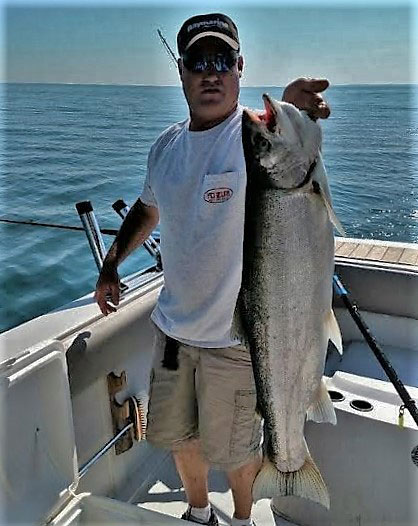
Bill Hilts, Jr., Director, Outdoor Promotions

Niagara Tourism & Convention Corporation, 10 Rainbow Blvd., Niagara Falls, NY USA 14303
p: 716.282.8992 x.303 | 1.877 FALLS US, f:  716.285.0809
website | facebook | twitter | blog

Sportfishing has a $30 million annual economic impact in Niagara USA!

Smallmouth Bass GIANTS are Biting in Buffalo Harbor

Dave Mull caught and released this nice 6lb-7oz smallmouth bass taken in Buffalo Harbor – note Buffalo City Hall in the background. Hefty bass like this one are the norm at this time of year in the City of Buffalo harbor waters of Lake Erie.

Old friend, Dave Mull, took the drive all the way from Paw Paw, Michigan, to test the chilly, 43 degree, Buffalo Harbor waters of Lake Erie.  The reason was simple: BIG BASS are in their customary, pre-spawn, feed cycle.

Fishing Eastern Lake Erie within sight of Buffalo City Hall with guide Jeff Draper, Mull joined forces with Ray Lynch from Realtree and Charlie Puckett of Flambeau Company to search for the giant bass known to be found here during the month of May.

The recent 35-40 degree mornings made fishing a bit chilly, but this crew came prepared with the proper weather gear.  If the fishing was uncomfortable, some of the catching made up for it!

While Mull said the smallmouth were a bit finicky, the trio still caught nine chunky bass, including a personal best for Mull.  The monster smallmouth tipped the scales at 6 pounds – 7 ounces!  Mull is a distinguished outdoor media professional and is digital editor for Midwest Outdoors Magazine and Television and director at Inner Viking Media Services

New York State Department of Environmental Fisheries Biologists report that the best Lake Erie smallmouth bass fishing of the entire year is in the spring near rocky reefs, harbor waters and tributary streams.  The bass caught can make for great fun because the bass are concentrated in those areas, catches of 40, 50 and even more numbers of fish in one outing are not uncommon.  With some of the largest bass caught in spring, anglers do travel from distant places to catch the trophy of a lifetime.  New York now offers a special trophy bass season to support the recreational angler interest in the big bass fishery.

The last five state record smallmouths have come from Lake Erie, with the current record standing at 8 lbs., 4 oz.  Anglers can enjoy this early trophy bass season on Lake Erie, which runs from the 1st Saturday in May until the 3rd Saturday in June, when the regular bass season opens.  During this early season, there is a one fish limit and 20″ minimum size requirement.  The bass are feeding on smelt and emerald shiner forage found in these locations where the water warms up early.

Local anglers concentrate fishing with tube jigs dragged on bottom and flutter tail jigs cast and retrieved (swimming style) near gravel rubble in 10 to 25 feet of water.  Deep diving stickbaits that swim near bottom are also effective.

For more information: visit: http://www.dec.ny.gov/outdoor/58757.html

Map is courtesy of NYSDEC (http://www.dec.ny.gov/docs/fish_marine_pdf/lakeeriesmb.pdf)

Wise Women, Fishing Lures, Mother’s Day

By Mike Marsh

I smiled at the memory of my first fishing lure it was a jointed minnow-imitation called a Cisco Kid. A gift from the true anglers in my family, Grandma Marsh and Great Aunt Catherine, the lure had seen musky duty in the Great Lakes and had tooth scars as proof. They offered me the choice of any lure in their tackle boxes when I traveled “Up North” to attend a family funeral and this one looked most like a real minnow, except for a Rudolph-red splotch on its nose.

Arbella Jones came to our house in Climax, North Carolina, every other weekend, and my mother paid her to help with the cleaning while she went shopping in Greensboro. I wasn’t certain what Arbella meant when she hugged me one day and whispered into my ear, “Your momma is awful good to me. Would you like to come fishing with me this afternoon?”

Mom nodded yes when I asked if I could go. I got my pitiful “gear” together and when the appointed time arrived, she drove me to the end of a dirt road, where 11 children sat on old couches on a front porch that showed gray wood through a ghostly pallor of white paint eroded by weather and neglect. Placing my clunky steel tackle box and fiberglass fishing rod beneath an oak tree, I went inside as the crowd of kids hushed their clamoring and whispered behind my back.

There was no television set, no rug covering the cleanly mopped wood floor, no drapes on the windows and not a picture on the wall. I passed a bedroom where Arbella’s husband was half asleep. A cold chill hit me as he glared and asked, “What’s HE doing here.”

I knew right then that a white child had likely never played at his home. Arbella stood between us, whispering something to him until his face cracked a broad smile.

A five-year-old girl licked peanut butter from a spoon and nibbled a sandwich of baloney folded into a slice of bread.

“Have some, Mister Mike?” she asked.

I shook my head, ashamed to deprive the family of a scrap of food. It was my first glimpse of the poverty that flourished nearly in our backyard.

A few seconds later, Arbella swatted the little girl on the behind and chastised her for not offering me supper. When I tried to explain that she had, but I declined, Arbella frowned and I realized I had injured her pride.

The entire family headed to a local lake in a rusted car and pickup truck. Lining the bank, everyone fished with cane poles except Archie Lee. My wound-fiberglass rod was relegated to worm-and-cork fishing because the antique affair was spooled with Dacron line and my rusty reel was incapable of casting the lightweight Cisco Kid.

Archie Lee spotted the lure in the open tackle box and asked if he could try it. Arbella shot him a warning look. Although a man of 22, he cowered, but I nodded permission and he tied the lure to the monofilament line of a spincast rig. He made his way to the tall grass and willows along the low side of the pond.

I stopped fishing and watched as he cast the lure, retrieved it, and carefully cleaned its hooks of algae. At the fifth cast, the water erupted. The biggest fish I had ever seen launched from the water like a Polaris missile, tossing its head from side to side. Foam marked the surface and water boiled at the point where he submerged.   Then the bass erupted from the water again and all the kids dropped their rods, shouting and clapping as their brother battled the fish.

Suddenly, silence. The water stilled. As quickly as the battle was joined it ended.

“You’d better not have lost Mister Mike’s lure,” Arbella said in a voice that could have frozen the humid August air.

Archie Lee was scared to death of snakes, but was even more afraid of his momma. He waded through the algae-covered water, up to his knees, waist, chest, and then his neck. Finally he ducked beneath the water, felt his way to the end of the line and freed the lure from the submerged log where the bass had scraped the aggravating lure from its mouth.

Dripping wet and towering over me, Archie Lee gently bent down, returned the lure to my tackle box and smiled. I caught my first bass with it later that summer, fishing it on a spincast rod like Archie Lee’s that I bought with money earned doing farm labor beside Arbella’s children. I was so excited when the fish struck the lure and jumped seven times, that I dropped the rod in the mud when I grabbed the fish.

That adrenaline rush, while quieted some over the years, still transforms me back into a ten-year-old kid fishing with my Grandmother Marsh, Great Aunt Katherine and Arbella Jones, whenever I catch a big fish on a lure. They were the piscatorial matriarchs of their families.

I am sure there are other anglers as fortunate as I have been, introduced to the wonders and pleasures of fishing by women who loved fishing as much as they loved children with them.

Grandmothers, aunts and family friends, they were all someone’s mother. I wish I could wish them a happy Mother’s Day, but they are all fishing in the Great Beyond.

If your mother, or someone else’s mother, has ever taken you fishing, hug her hard this Mother’s Day, for you are one of the luckiest people.

Outdoor Adventure in SW Florida is Memorable

The colorful Roseatte Spoonbill is plentiful in Southwest Florida

A little Florida sunshine is a perfect way to recharge your internal batteries.  One of our favorite spots continues to be Southwest Florida, home to the Beaches of Fort Myers and Sanibel (www.fortmyers-sanibel.com).

Mystique

Ever since we were exposed to this outdoor playground through the adventure antics of Dr. Marion Ford and the writings of Randy Wayne White, the area has always presented itself with a certain mystique. While there are plenty of the normal tourist-focused areas that seem to dominate with the snowbirds from January to April, the region never ceases to amaze us as we make that extra effort to see where the back roads will take us and what hidden treasures are available to be revealed for the first time.

Wildlife

The J.N. “Ding” Darling National Wildlife Refuge on Sanibel Island is always at or near the top of our list, the largest mangrove wilderness in the country.  The bird life that inhabits the sanctuary is simply amazing.  This time around, it was the Reddish Egret that was in the spotlight, part of a new telemetry study to learn more about the habits of these rare birds.  As luck would have it, one of the special winged wonders took up residence in front of a group of camera clickers, also allowing birders to check off another feathered friend from a bird bucket list of sorts.  The Darling NWR is also part of a larger complex (also named after Darling) that encompasses the Caloosahatchee, Matlacha Pass, Pine Island, and Island Bay National Wildlife Refuges – a large complex of nearly 8,000 acres.  The majority of the lands (and waters) in these refuges are nesting and roosting islands for the plethora of bird life that either migrate through or call this important habitat home. Check out http://www.fws.gov/refuge/JN_Ding_Darling/About_the_Complex.html.

Adventure – Fishing

One morning we meet with local charter captain Ryan Kane of Southern Instinct (www.southerninstinct.com; 239-896-2341.  No one can appreciate what he does more than me as a fellow sportfishing promoter and ambassador of the area’s natural resources.  Kane really gets it and he’ll do whatever it takes to make each and every outing a memorable experience.

As we met at the Port Sanibel Marina, the outlook wasn’t the best.  Strong winds from the southwest from one direction; freshwater being funneled down the Caloosahatchee River from Lake Okeechobee creating unsettled conditions near the mouth of the river, an estuary of sorts.  This isn’t Kane’s first rodeo, though, he opted to stay in from the Gulf of Mexico waters because of the winds.  Other local charters braved the winds to try and hit the Causeway Reef, an artificial structure that came from the old causeway that connected the mainland to Sanibel, before the winds peaked.  It was holding some nice sheepshead in the four to five pound range – some excellent eaters for the frying pan.  There was a question whether the tradeoff was worth it.  While the captains might think so, the passengers might not.  We went back to the basics and to Kane’s roots.

“This is Shell Creek where my grandfather took me and my brother to fish when we were little kids,” reflected Kane, who’s been guiding full time for six years now.  This is his favorite sheepshead spot and he still fishes it regularly with customers when conditions limit the areas he can target.  “It’s all about figuring out what people want and what would make the best experience overall.  I specialize in families, especially families with children since I have three of my own.  I’ll do just about anything to make each and every experience a memorable one.”

Captain Ryan Kane with a saltwater Sheepshead, loves to take families with children fishing.

No sooner had we started fishing a cut when a large manatee floated alongside his 24-foot Pro-Line that he’s converted into a fishing machine.  My wife Sandy was mesmerized and before it was all over she was petting the soft snout of the marine mammal that some people refer to as a sea cow.  That was the experience that she will remember for the rest of her life … and will keep her coming back for more.  It didn’t hurt that she also reeled in the biggest redfish for the day, allowing her to state: “I could get used to doing this.”

Ryan looked at me with a big smile. “I think that’s what every guy wants to hear from his wife!”  After catching four or five species of fish, we headed out into San Carlos Bay where we found a shoreline island with mangroves and a weed bed. “This looks perfect for redfish – it has everything they would be looking for in this kind of a wind,” said Kane.

Tossing a red jig tipped with a shrimp for bait, he almost immediately hit a fish.  However, it wasn’t a redfish.  It turned out to be our biggest sheepshead for the day.  The next 10 fish were redfish and we had a blast reeling in the magnificent fighters.  We ended up with seven different species for the day including a pile of mangrove snappers, ladyfish, pufferfish, catfish and even a sting ray reeled in by the novice Sandy.  All around us was incredible bird life and the picturesque scenery of places like Sanibel and Captiva islands.  Life is good.

Kane is expanding his business to include a bigger 36 foot boat, a Contender that he will be able to use off-shore as well as inshore when the conditions allow for it.  Families will be more comfortable and the added advantage of having a head on the boat will be worth its weight in gold.

Side Trips

In keeping with the dolphin theme of Florida (even if you are a Buffalo Bills fan), the Wicked Dolphin Rum Distillery in Cape Coral is a new attraction that is really picking up a head of steam (www.wickeddolphinrum.com) not just in Southwest Florida and around the state but around the country.  Billed as Florida’s only true rum distillery made with all local products, this relatively new business that started up in 2012 from a Long Island family (yes, a New York connection) is already award-winning.  We received a private tour from head distiller Dan Termini and he gave us the complete low-down on the sourcing of all the ingredients, the cooking process, the fermentation and the distillation that takes place.  The end result is one great tasting product.  At the top of the list for us was a Coconut Rum that’s become a local favorite.  Don’t rule out the Florida Spiced Rum or the Rumshine.  They make a total of 11 different products currently.  They estimate that some 22,000 people will tour the facility in 2016.  And it’s all natural.

Dan Termini, head distiller of Wicked Dolphin Rum Distillery, offers an educational tour for more than 20,000 visitors every year.

Broadway Palm Dinner Theatre, Fort Myers – If you’ve never been to a classy dinner theatre before (or even if you have), the Broadway Palm does it right night after night with top quality performances (we saw Show Boat), tasty buffet dinner and more.  Check out www.broadwaypalm.com for a list of what’s coming up and what options are available should you be in the area. You won’t be disappointed.

Accommodations

Tip Top Isles Resort and Marina – This is a nice place we stumbled across with some assistance from the tourism office. Resident manager Mark Sturgeon was extremely accommodating and there were quite a few positives that jumped out at us.  One was the fact that they offered pontoon boat rentals at a reasonable price. They had a fleet of seven when we were there.  Room rates were also very reasonable considering it was peak tourist season.  Sturgeon was really high on an off-season special that included a single room for three nights and two half-day boat rentals for two people for less than $300.  Check out www.tiptopisles.com.  It’s conveniently located to Fort Myers Beach and Sanibel Island, as well as many other local attractions.

Outrigger Motel – Located on Estero Blvd. on Fort Myers Beach, this accommodation has a little bit of everything.  It’s also a great place to witness a sunset, Southwest Florida style! Sunsets are a tradition there, with the main gathering place at the Tiki Bar located just off the beach.  If you like shells or shell collecting, this is a prime destination and we haven’t found any place better in the continental U.S.  The shells at the Outrigger this year were the best we’ve ever seen there!  And if there’s a critter inside the shell, you must toss it back!  The rooms are spacious, comfortable and they even have a built-in kitchen if you want to cook up your catch after fishing.  Check out www.outriggerfmb.com for all of the details and seasonal rates.

Protect your Pet – Homemade Flea and Tick Spray

It’s hiking season, camping season, turkey hunting season – it is TICK SEASON too!

These ”black-legged ticks” (Ixodes scapularis) are known to transmit Lyme disease are often carried by mice and other hosts. Photo from Hardin Library for the Health Sciences, University of Iowa

With folks all over the country heading to the comforts of the woodland country in spring, people and pets often complain of flu-like symptoms, aching joints, painful laziness and a host of other issues a few weeks after returning home. Dogs and cats too, can get a nasty disease known as that has recently Lyme disease.

Lyme disease is contracted from a microscopic bacteria transferred to pets and people from the bite of an infected black-legged tick (also known as deer tick).  The largest majority of these ticks are carried about by mice and other rodents, not deer, though deer can also carry them too.   The thing to know about today is that May and June are the two months each year when the nymph stage of these ticks transfer from mice to other hosts.  They feed for about 24 hours (burrow in and suck blood) and this is when they deposit any possible disease infection they may carry – like Lyme disease.

The nymph stage ticks are nearly invisible – smaller than the head of a straight pin, and their bite is nearly painless.  If you have a high pain threshold, you might not even detect it.  The tick nymphs will transfer to dogs, pets and people from many places, but the most common is high standing grass or bushes, like when you’re hiking in fields or trimming your front bushes.

The nymph critters await their host in a sort of open-leg position and have sensors that await the touch of a possible passing host (your leg, your dog, etc.), then attach like sticky bubblegum to dry paper.  Then they climb to soft skin areas and burrow in.  These areas can be anywhere, but are often the groin, armpits, back or the nape of your neck.

protectpet2For people, there is one prevention aid that is lab proven to deter the pests, that is the use of Permethrin (https://sawyer.com/products/permethrin-premium-insect-repellent/) to spray your clothes (not your skin).  Spray the open exterior ends of your pants, shirts, exterior of socks and the exterior of your shoes.  Let dry.  Ticks hate the stuff and will fall off if they should attempt to find your leg.  This protection is good for seven washes.  Needless to say, wearing shorts and hiking in high grass is not recommended.  Sorry.  Wear light colored clothing to allow easy visual detection of the dark colored ticks that may opt to attach on your clothes.

For dogs and pets, there is a simple and effective tick and flea formula that is currently on a Facebook page by Cindy Diane (https://www.facebook.com/cinlight2) that uses a combination of the home cupboard ingredients to control the tick and flea pests on pets, though I use it on myself everyday too.  Ingredients: 8 oz apple cider vinegar, 4 oz warm water, 1/2 tsp salt, 1/2 tsp baking soda and you’ll need a spray bottle.  Mix dry ingredients first, then slowly add to wet as the vinegar and baking soda will react slightly.  Put into spray bottle and spray pets down.  Be careful not to get in pets eyes and ears.  There are additional insights on washing the pets and using this formula, to see them, visit Cindi Diane at the link above.

It’s turkey season, it’s hiking season, it’s camping season, it is tall grass growing season.  It is TICK SEASON too.

protectpet3

Lyme disease is a life-long disease if not detected early and identifying this disease is complicated.  If you are bitten by a tick and can recover the tick, save it for pathology.  Then get to a doctor for clinical evaluation and request doxycycline immediately.  Also request a blood test and insist that it be sent to IGeneX Lab in California (http://www.igenex.com/files/should_know.pdf).  There is an extra cost for this test and the cost is not covered by many insurance companies.  Get whatever the usual tests that your doctor recommends and then also request the IGeneX test.  Do yourself a favor and pay for it.  The option is not worth the difference!

In my recent experience with Lyme patients, this lab is the one lab that can identify if Lyme is actually present in your system – then you can be properly treated.  There are other blood tests that claim they also work, but they are not as reliable from what current Lyme patients have shared with me in interviews directly.

Remember too, ticks carry may other nasty disease pathogens. The best cure is prevention.

Stay aware, stay protected, stay safe!

My Granny Taught Me to Fish

grannyfishing1

By Everette Wall

I may never make it to Heaven but if I don’t, I’ve been close enough to have an idea of what it’s like.  It was the backseat of an old Buick, surrounded by the thick, heady aroma of lilac bath powder.

It wasn’t what you might think, though.  I was about six years old, sandwiched between my paternal grandmother and one of her friends.  “Sandwiched” is an appropriate term because both ladies were what is known in today’s jargon as “full-figured.”  I didn’t mind, however, because we – including two other women in the front seat – were heading to the coast to go fishing.  For a youngster who loved fishing and his grandma with equal passion, life just couldn’t get any better.  And, I don’t think it ever has.

Those journeys, and others that followed, were a combination of agony and ecstasy.  On one hand they seemed to take forever.  Those were the days before four-lane highways and bypasses in eastern North Carolina and our route wound through the middle of towns like Beulaville and Chinquapin.  Not only that, but the driver didn’t believe in exceeding 45 miles per hour, regardless of the circumstances.  I thought we’d never get there and, if we did, every fish in the ocean would have already been caught.

In Granny’s scheme of things, the time to go fishing was whenever she and her buddies got the notion.  She would just leave Granddaddy a note that said, “Gone to the coast.”  That was his signal to fend for himself until she returned.

For Granny and her cohorts, fishing at the beach was a reprieve from doing laundry, cleaning house, and the other things that made up their day-to-day existence.  It wasn’t that they didn’t love their families and taking care of them, but ever so often, a girl needed a break.  And the weathered, wooden deck of an ocean pier, bathed by a cool breeze as it swayed slightly in the relentless, blue surf was a wonderful place to take one.  Gulls squawked as they wheeled overhead, dipping toward the waves periodically to investigate a possible meal, or maybe just because it was fun.  Farther out toward the horizon, sleek gray forms arched above the blue water as porpoises followed schools of fish down the shore.

The Surf City Pier was Granny’s preferred base of operations.  When she and her entourage arrived, they would take positions along whichever side seemed to be most productive and arrange their rods along the rail.  Then they would settle back on the pier’s weathered benches or in folding chairs to watch for bites.  The tips of Ocean City rods with level-wind Penn reels would dip slowly and rhythmically as waves passed beneath the pier.  Every so often, one would give a quick, definitive jerk.  That was the signal for the angler closest to it to grab the rod and begin cranking.  More often than not a silvery form, sometimes two, would be swung over the rail and flopped onto the deck, to be admired and then tossed onto the ice in a waiting cooler.

Granny and her crew were no fair weather fisherwomen.  Once the battle was joined, they were in it for the long haul.  They would man their stations all day and, often, most of the night.  They knew some of the best fishing was in the wee hours of the morning when most tourists were dozing in their rented cabins and only serious anglers remained at their posts.

If the daylight hours were interesting, nighttime on an ocean pier was magical.  I would curl up in a blanket and stare in wonder at a canopy of stars that looked close enough to touch.  Sometime during the evening I would doze off, immersed in the smell of shrimp and salty air, serenaded by the woosh of waves against the pier’s pilings, and content in the knowledge that Granny was within reach if I should need or want anything.  The rising sun would be my alarm clock, that and the heavy tread of anglers coming out for the early morning bite.

grannyfishing2

Spots, Granny’s favorite species, can be caught pretty much all year, but early fall is the best time.  That’s when the fish begin to congregate to shallow inshore waters in preparation for their winter spawning migration.  It’s the time of year when they are the fattest, many of them sporting bright yellow bellies – evidence of their elevated hormones.  Eventually they make their way offshore to breed. The eggs hatch at sea and the fry, barely a millimeter long, slowly wash back into the estuaries and begin the cycle all over again.

So it is with fish – and sometimes with little boys.  They eventually grow up, move to distant shores and assume lifestyles that insure their existence and that of future generations.  Before it’s all over, however, they return – if not physically, at least in their hearts – to those places that were most special in days gone by.

In one lad’s case that’s an ocean pier, right beside Granny.  It might be a great place to spend Mothers Day.

Non-Game Grab Bag Fishing Fun

Fish Catching Fun Just About Everywhere Fish Swim!

These guys put the game back into “non-game” species as the author lands a nice, eating-sized freshwater drum.

I recently got what seemed like the dozenth press release from the Missouri Department of Conservation (MDC) about a new state fishing record.  Looking back over agency releases since the first of the year, I discovered that my perception was a little exaggerated, but not entirely unfounded.  In the first four months of 2016, MDC certified no fewer than seven new records.  That’s more than get submitted in some entire years!

What also struck me just as interesting was the fact that six out of seven of the new records were for fish species that MDC classifies as “nongame.”  This category includes a few surprises, such as the bluegill and green sunfish, but most of the rest are critters that few anglers actively pursue: suckers, carp, buffalo, drum, gar, bowfin and their ilk.

Now there is a widespread perception that these species are somehow less desirable than those classified as “gamefish.”  You might get an argument about that if you asked a devoted sucker-gigger or a 16-year-old whose crappie jig has been inhaled by a 10-pound freshwater drum.  So-called non-game fish can be just as sporty and tasty as their more illustrious kin.  Non-game fish might not win a popularity contest or a beauty pageant, but they definitely are not trash fish.

All this got me thinking about the fact that I’ve never tried fishing for any of these species.  The smallmouth bass is my favorite fish, but being realistic, I know that my home area on the south bank of the Missouri River has more good non-game fish water than smallmouth streams.  I grew up here.  Why have I never tried my hand at these underused fish?

I remembered that one of my co-workers used to enjoy going out about this time of year and catching suckers from a wadable tributary of the Moreau River that runs through Scrivner Road Conservation Area.  I further recalled that his preferred method of stalking these delicious fish was to drift nightcrawlers through riffles.  This is a type of fishing I understand.  Although I long ago left behind bait fishing in favor of artificials, I cut my angling teeth on worms and bobbers.  I’ve been wading small streams in search of smallmouths and sunfish for more than half a century.

So I headed down to the nearest bait shop, where I scored some size 6 bait-holder hooks, size 8 trebles, small barrel swivels and assorted sizes of egg sinkers.  I rigged up half a dozen spinning and baitcasting rods with slip-sinker rigs.  I cut off about 1-foot of monofilament, sliding a sinker up the standing end of the line, then tied on a swivel, tying the foot of monofilament onto the other end of the swivel and finishing up with a hook so it dangled about 9 inches below the swivel.  Then I headed to another Moreau River tributary not 10 minutes from the house.

I knew as I set out that I was a little late by the calendar.  Suckers are most concentrated and therefore easiest to catch during their spawning run.  This usually occurs the last week of April or the first week of May.  Spring came early this year, thanks to warmer-than-average weather, so I probably had missed the hottest action, but I hoped to catch a few slow-starters. Besides, once suckers get this far upstream, they don’t go back down to the big rivers where they spend the winter.  They drift down to deeper holes, sometimes lying at the heads of pools where they can vacuum up morsels washed in at the tail ends of riffles.

Other than being a little late in the spring, conditions were perfect.  The water was a little dingy from recent rains and the creek had a nice, brisk flow.  Areas that will be gravel bars in a few weeks were still under 1 or 2 feet of water.  With high hopes, I tossed out three lines (the most allowed without labeling them with your name and conservation ID number, Then I pulled out the book I was reading at the time, “The Last Full Measure,” by Jeff Shaara. (Great read, btw.)

I didn’t get much reading done and before I knew it, I had a fat, 15-inch channel catfish on the line.  That was followed by several largemouth and smallmouth bass, all of which had to be released, as black bass season is still closed in most streams south of the Missouri River.

Even when there were no fish to unhook, I was kept pretty busy checking lines, refreshing bait and replacing slip-sinker rigs that snagged on rocks or roots.  A couple of hours later I had a 3-pound drum and my original catfish to show for my trouble.  No suckers, but I figure next time I’ll head downstream to a long, deep pool and try my luck there.

There will be a next time. The relaxed pace, ease of access and excitement of not knowing what would turn up on my hook next made me understand why some people target “nongame” fish.

Now, if you’ll excuse me, I’m going to go fry those fish.

The Most Perfect Mother’s Day!

mothersday

All I wanted for Mother’s Day was for my family to come fishing with me. My husband, Jeff, daughter Kendall (15) and son Cole (12).  Kendall does not like fishing, hunting or the outdoors (completely opposite of me!).  Cole likes fishing, but he’s an active 12-year old boy who doesn’t like to sit still, so fishing in a boat gets boring for him.

mothersday2

Regardless, both kids didn’t complain once all day and actually had a great time!  We fished in the 48th Annual one-day Minnesota Bound Crappie Contest on Lake Minnetonka, near Minneapolis.

mothersday3More than 2,000 anglers now fish this contest every year with thousands of dollars in prizes, but the real winner of the day is that together, anglers raise thousands of dollars for “Fishing For Life” organization while celebrating family life and fishing fun too (http://fishingforlife.org/pages/who-we-are).

I fished it as a kid for years, so really wanted my kids to do the same.  The day started off slow fishing with a bobber and crappie minnow.  After minimal fish catching, I thought let’s try casting tube jigs.  On my first retrieve, I caught a crappie!  Then two more!

Cole jumped right on that and was casting like mad.  He’d get a hit and miss, then a hit and catch one, he was hooked.  We were using Southern Pro tubes in chartreuse, but then switched to pink and black.  Using 4-pound clear mono, the light jigs were easy to cast.  We caught bass and sunfish too.  Such fun!

Kendall was completely content just enjoying the sunshine and watching everyone, and I was just glad she was happy to be out in the boat with us.  I love spending time with my kids and it just feels so good to know that we support each other as a family.  We were in a time crunch before the 2:00 p.m. weigh-in deadline.  We sped over to a secret hot spot my cousin, Mike Ferrell, graciously shared with us.

mothersday4It was really windy, so it was hard to cast those tube jigs.  We switched back to bobber and minnow fishing, tossing our casts all the way into the emerging reeds.  After that, we caught one after another and we didn’t want to leave, it was a blast!  Cole caught the biggest crappie of the day out of our boat, weighing in at 0.71 pounds.  Not enough to win the contest, but close!  Cole is hooked on the thrill of the competition and I look forward to getting him out there again soon.

As busy as all of our schedules are nowadays, it really was one of the best days I could have had having my whole family out together.  We had a lot of laughs and made some great memories this weekend!  Our next fishing trip together will be Memorial Day weekend at Sandy Point on Lake Kabetogama and I can’t wait for that.

It was the most perfect Mother’s Day!

Thank you family!

mothersday5

Welfare for Winter-Weary Wildlife

Controlled Burns, Planting Food Plots, Pond Conservation Ideas

The Missouri Conservation Department has information on-line and offers workshops to help landowners conduct prescribed burns safely.

“Hey buddy, can you spare me a food plot? I’ll pay you back in the fall.”  You’ll never hear this line, because deer, turkey and bass don’t ask for handouts.  Life can be harsh for the animals that bring hunters, anglers and nature lovers so much pleasure.  After a tough winter, it’s not a bad idea to lend wildlife a helping hand.  Spring is the right time to start.

For instance, it’s the perfect time to plant a food plot and it’s not too late to plant trees that will provide food and shelter for wildlife and control erosion.

If you farm, this might be the year you decide to leave a few rows of grain for quail and turkeys, or increase the width of buffer strips between crops and stream corridors to improve water quality for fish.  If you have warm-season grasses, you can plan now to use grazing and haying techniques that improve yield and wildlife habitat.

Prescribed burning is one way to improve wildlife habitat.

Instead of letting your wood lot become overcrowded with unhealthy trees, you can conduct timber stand improvement, increasing production of acorns and other forest crops needed by deer and turkeys.  While you are at it, you might fell a few trees around the edges, creating critical woody cover for quail, rabbits and other ground-nesting wildlife.

Did you notice dead fish when your lake or pond thawed this spring?  If so, it makes sense to investigate the cause.  Siltation might have reduced water depth to the point where fish have no place to escape winter’s icy grip.  Fish kills also can result if you have too much aquatic vegetation.

While you are thinking about your lake, consider creating underwater habitat by installing fish-attracting structures.  Usually called brush piles or crappie beds, these underwater habitats create places for tiny invertebrates to grow.  This fuels the growth of aquatic insects, shad, minnows and other food items for bluegill, crappie, bass and catfish.  Fish-attracting structures also do what their name implies – attract fish to spots where you can key in on them with pole and line.

A trip to the local farm supply store for food plot seed will pay dividends this fall.

Lack of expertise is what stops most of us from taking these simple measures for better hunting and fishing.  That is why the Missouri Department of Conservation (MDC) has self-help publications and employs private land services biologists.  It’s their job to help landowners achieve their fish and wildlife management goals.

You can get started by visiting http://mdc.mo.gov/your-property and checking out the resources available there.  To identify the private land services biologist for your area, visit http://on.mo.gov/1Uk3E5d, select your county from the drop-down menu under “Who’s My Local Contact” and get started.

Fish and wildlife really will pay you back.  Honest!

Free Marine Educational Resources

Connecting Students and Teachers with Marine Science

marineedresources

The Bridge is a growing collection of the best marine education resources available on-line. It provides educators with a convenient source of accurate and useful information on global, national, and regional marine science topics, and gives researchers a contact point for educational outreach. Resources are organized as indicated on the sidebar on the left side of the screen.

Partners
The Bridge is supported by the National Sea Grant Office, the National Oceanographic Partnership Program (NOPP), and the National Marine Educators Association (NMEA).

The Bridge began in 1997 as one of five projects funded by NOPP. The other four are: COAST: Consortium for Oceanographic Activities for Students and Teachers; Enhancing K-12 Science Education Via Satellite-Televised Interactive Technologies; JASON Project – Expanding Student and Teacher Access to Ocean Science Research; Bringing the Ocean into the Precollege Classroom Through Field Investigations at a National Underwater Laboratory.

NMEA members and Sea Grant’s network of educators are actively involved in project administration, serving on the Bridge’s Clearinghouse Coordinating Committee (CCC), and assisting with national information dissemination and site reviews. A Scientific and Technical Advisory and Review (STARS) group advises on scientific content. Project administration and staff are at the Virginia Institute of Marine Science, College of William and Mary.

To learn more, visit: http://web.vims.edu/bridge/?svr=1.

Niagara County Fishing Forecast

Lake Ontario, Upper Niagara River, Lower Niagara River

Lake Ontario and tributaries

The first king salmon started showing up in slightly more reliable numbers as anglers prepare for May fishing contests.  However, sharing information as far as locations and details is a bit more difficult.  Remember that a study on king salmon will be starting up on May 1.  The primary focus is three year old kings with an adipose fin clip.  Be sure to save the head of any king with a clip and deposit them into the freezers located at Fort Niagara at the fish cleaning station; Bootleggers Cove and Wilson Boat Yard in Wilson, as well as at Wilson-Tuscarora State Park; in Olcott at the Town of Newfane Marina.  That said, the county Fisheries Board is looking to collect a bit more information including the total number of salmon caught during the month of May.  Pick up at copy of the form at the Town of Newfane Marina or email ncfdb1@gmail.com for a copy.  We need your help!

Trolling the shoreline for browns and Cohos with stickbaits is still an option and the lake trout bite continues to be very good out to 80 foot depths.  Spoons are the lure of choice.  A few trout are still up for grabs in area tributaries, but the warm water fish like bass are slowly turning on to replace the trout.  Derbies and tournaments are starting up for salmon and trout very soon, with the Spring LOC Derby kicking off on Friday, May 6.  There is a $15,000 Grand Prize for the biggest salmon and Niagara County is where you want to be based on previous winners.  Details at www.loc.org on weigh stations and registration outlets.

The Wilson Harbor Invitational Derby is set for May 7. Their website is www.wilsonharborinvitational.com.

The granddaddy of tournaments, the 31st Annual Lake Ontario Pro-Am Salmon Team Tournament is set for May 20-22 out of the ports of Olcott and Wilson. Website is www.lakeontarioproam.net.

Lower Niagara River

Trout are still cooperating for anglers drifting and casting in the lower river, but some trips produce more bass than steelhead or lakers. Minnows or small egg sacs are the top enticement for drifters and are also working for shoreline casters. Spinners are another top casting lure. Boaters have been taking trout in the Devil’s Hole area, but the lower river sections can also be productive if the winds cooperate out in the lake at the Bar. It’s been a little lumpy out there. For all you smelters, the smelt run is still going on but it seems to be on the downhill slide. Remember that the Lewiston Smelt Festival is set for May 6 at Lewiston Landing complete with a smelt fry courtesy of the Niagara River Anglers Assn. and the Lower River Chamber of Commerce.

Upper Niagara River

As the waters slowly start to warm, the perch and panfish action will continue to improve along the river shoreline and around Grand Island.  Bass fishing is all catch and release with no live bait so if you are targeting largemouth or smallmouth, keep that in mind.  Fishing for panfish, though, Emerald shiners are the bait of choice.  Buffalo Boat Harbor is seeing a fair amount of keeper perch being caught on shiners, too.

Bill Hilts, Jr., Director, Outdoor Promotions

Niagara Tourism & Convention Corporation, 10 Rainbow Blvd., Niagara Falls, NY USA 14303
p: 716.282.8992 x.303 | 1.877 FALLS US, f:  716.285.0809
website | facebook | twitter | blog

Sportfishing has a $30 million annual economic impact in Niagara USA!

Fire Extinguisher Recall – May Not Put Out The Fire

A voluntary recall from Kidde fire extinguishers includes some models sold to recreational boaters.

Recall for Affected Kidde Models Include Mariner 10, Mariner 110, Mariner 5, and Mariner 5 G

STO Staff Report from BOATUS

As boaters are about to begin the spring ritual of getting their boats ready for the season, Boat Owners Association of The United States (BoatUS) is advising they will need to pay extra attention to the fire extinguishers aboard.

A well-known fire extinguisher manufacturer, Kidde, in conjunction with the US Consumer Product Safety Commission (CPSC), has announced a voluntary recall to replace certain Kidde fire extinguisher units.  A faulty valve component can cause the disposable fire extinguishers not to fully discharge when the lever is repeatedly pressed and released during a fire emergency, posing a risk of injury.  About 4.6 million extinguishers are affected that were sold nationwide between August 2013 and November 2014.

To see if you have an affected fire extinguisher and arrange for a replacement, go to www.cpsc.gov/en/Recalls/2015/Kidde-Recalls-Disposable-Plastic-Fire-Extinguishers.

According to the CPSC, Kidde has received 11 reports of fire extinguishers that failed to discharge, but no injuries have been reported. A February 12, 2015 safety notice from Kidde stated, “Due to our commitment to quality and safety, we have corrected the issue for production going forward, and are working with customers to obtain all recalled units currently in stock.”

Thirty-one models of the disposable fire extinguishers are affected. The extinguishers are red, white, or silver with black plastic valves and ABC or BC rated and manufactured in Mexico between July 23, 2013 and October 15, 2014 and sold at department, home, and hardware stores as well as some marine supply stores. Some of the affected extinguisher models were designed for the boating market and have a nameplate on the front with the names Mariner 10, Mariner 110, Mariner 5, and Mariner 5 G.

If you’d like to know more about how fire extinguishers work, the types needed for boating as well as how many to keep aboard, go to www.BoatUS.org/fire-extinguishers.

About Boat Owners Association of the United States (BoatUS):

BoatUS is the nation¹s largest organization of recreational boaters with over a half million members. We are the boat owners’ voice on Capitol Hill and fight for their rights. We help ensure a roadside breakdown doesn’t end a boating or fishing trip before it begins, and on the water, we bring boaters safely back to the launch ramp or dock when their boat won’t, day or night. The BoatUS insurance program gives boat owners the specialized coverage and superior service they need, and we help keep boaters safe and our waters clean with assistance from the non-profit BoatUS Foundation for Boating Safety and Clean Water. Visit www.BoatUS.com.

My first spring turkey hunt

There is nothing quite so exciting!

By Tony Young

Every hunter is searching for a giant tom turkey on that first opening morning hunt, Tony Young of the Florida Fish and Wildlife shares his 1st Turkey Hunt Success Story with nationwide viewers. Joe Forma Photo

My interest in hunting the quirky-moving, nervous-acting, but beautifully colored wild turkey was piqued about 15 years ago by an old high school friend and bandmate of mine, Todd Bevis.

Todd’s a turkey-hunting fanatic if I’ve ever seen one, and the excitement in his voice that’s apparent every time he tells a hunting story played a big part in my getting the fever to experience spring turkey hunting.

My former in-laws owned a nice tract of land in northern Franklin County with a half-mile of deep creek frontage on a major tributary of the Apalachicola River. Over the years, I enjoyed deer hunting there and took a few fall turkeys, but bagging a good long-beard in the spring takes a bit more skill.

I was ready to learn how to call in and harvest my first spring gobbler.  All I needed was the know-how, and I figured I could get that from Todd and from watching Saturday and Sunday morning hunting shows on TV.

Todd encouraged me to get a box call because he said it would be the quickest and easiest call for me to learn – and the spring season was approaching fast.

He taught me how to do some basic yelps and a single-note cluck and said if I had birds on the property that had really never been called to before, and – if I could sit still long enough – I just might be able to call one in.

But Todd warned me, “Don’t make the mistake some people do in calling too much. Let ’em know you’re there, but let ’em come to you – less is more.”

With that advice in mind, I set out early opening day. I needed to get there a half-hour before first light so I could set my three decoys in place and get situated.

Sunrise wasn’t until 7:45 a.m., so I had about 30 minutes before the sun’s first rays would begin to illuminate the longleaf pine and palmetto flatwoods I’d be hunting.

It was a brisk north Florida spring morning, but as dawn gave way to late morning I knew the weather would warm up and it wouldn’t take long for those pesky, deep-woods mosquitoes to come out of the swamps and start buzzing around my ears. I quickly sprayed myself down with an ample dose of bug spray.

While carrying a jake and two hen decoys in one hand, I toted my shotgun, camo seat cushion and small flashlight in the other and made my way in the dark down a trail that weaved through a patchwork of saw palmettos toward a spot where I often saw turkeys.

The setup was near one of my favorite deer stands, on a ridge that jutted out between a creek and a ravine. It was where turkeys roosted most every evening amid juniper, tupelo and cypress trees hanging over the water.

Before I could even finish setting up my decoys, the sounds of gobbling echoed in the darkness from the creek bottom below. The strange vocalization of three, maybe four, birds was something I’d never heard, and it fascinated me.

I picked out a large pine tree to lean back against to hide my silhouette. Then I used a pair of hand pruners and began to snip some of the surrounding native vegetation of galberry and titi and used the clippings to construct my make-shift ground blind.

I settled in against the tree – my gun across my legs and my box call in my lap – and the sound of gobbling continued to fill the otherwise quiet predawn.

At 7 a.m. it started to get just light enough to see. As I sat facing the hardwoods of the ravine and creek swamp, I could make out my decoys 10 steps in front of me.

About 15 minutes later, when the visibility was noticeably better, I picked up my box call and made my first yelp to make those gobblers think there was an interested hen nearby.

A reassuring gobble answered me right away!

I was so excited I couldn’t believe it – a gobbler actually had responded, just like on those hunting shows.

“What am I supposed to do now?” I wondered. I remembered Todd telling me not to call any more often than about 15 minutes. So I sat quietly in anticipation for what seemed to be the longest 15 minutes of my life, but when I glanced down at my watch, only five minutes had elapsed. After another five minutes of real time had passed, I couldn’t stand it any longer and made another call.

Another gobble immediately followed, but this time it was louder.

This bird actually was coming to me! My first spring turkey hunt was beginning to play out in textbook fashion.

I sat just as still as I could be for another 10 or 15 minutes and called out for a third time.

The “GOBBLE, GOBBLE, GOBBLE, GOBBLE” reply sounded like it was being screamed into my ears. This Eastern turkey was right on top of me!

I couldn’t see him, but he had to be just out of my sight behind the brushy terrain.

A few moments later, the longbeard stepped out from behind a galberry thicket in full strut, and my heart starting pounding. I couldn’t see its legs because gold, iridescent feathers were covering them, but the bird seemed to glide like an apparition as it cautiously made its way toward the decoys.

The way its head was changing colors from red to blue and back again, and the show this gobbler was putting on, was truly a sight to behold. Now I realized what Todd’s and so many other turkey hunters’ infatuation was all about.

Its instinctive, ritualistic courtship dance was so beautiful I almost didn’t want to end it, but the big tom was getting too close, and I knew I’d better take the shot soon for fear he’d spy me.

The opportunity to raise my 12-gauge pump shotgun came when he went behind a palmetto clump at 12 steps, and I fired just one shot when he stepped out the other side.

What a rush!

It was my first spring gobbler, and it had a 9-inch beard. Now what was so hard about taking a spring turkey, I thought?  After all, it was only 8 a.m., and I already had my then daily bag limit after calling just three times.

But like every turkey hunter knows, spring turkey hunting rarely happens that way. Maybe it was beginner’s luck, but whatever it was –

springturkey2I have been hooked ever since.

The Florida Fish and Wildlife Commission has adopted innovative conservation tools and strategies, focusing on incentives for private lands and fish/wildlife management.  Strategies may include enhancing partnerships, incentives, and streamlining regulations.  The FWC’s Community Relations Office produces several feature columns each month.  Each column focuses on a specific element of Florida’s fish and wildlife resources or type of outdoor recreation.

To learn more about Florida Hunting and Fishing, visit: http://myfwc.com.

Moving Stuff – A Home and Woods Tool

The CLAM LG600 Hybrid Trailer is light, heavy duty, inexpensive

movingstuff1

Need to transfer your deer harvest or 10 cubic feet of timber from the woods to your cabin or truck?  Need to move 600 pounds of topsoil or stone from your truck to that new garden or flower bed?

By hook and tow with a trailer, or by using the convenient hand-lift to push or pull the load, you can do just that with the new LG 600Hybrid from the Polar Trailer line by CLAM Outdoors.

The trailer easily converts from a hand cart with a sturdy, heavy-duty lifting handle, complete with a rigid, safe-support leg, to a tow-behind cart vehicle that can be hauled wherever needed, using a garden tractor or ATV.  That makes it perfect for the backyard lawn and garden, or the cabin and the woods.  It’s a two for one in more ways than one!

Weighing just 55 pounds, construction of this durable trailer is high-tech, using a rust- protected steel frame, a heavy duty polyethylene tub, all mounted on air-filled, soft riding, rubber tires and steel rims, and protected for long term use and reduced wear from wheel rotation friction by robust, weather-sealed ball bearings on a sturdy axle, you can get the payload where you want and unload.  The tub is rust free and ready for a garden hose rinse.

movingstuff2

My wife loves this cart for the yard; I love it for the woods.  What could be better?  Another two for one!

It is sold with a 3-year warranty for under $200.  Polar products are available online and at these top retailers (1500 stores nationwide): Lowe’s Home Improvement, Home Depot, Amazon.com, Mills Fleet Farm, Blaine’s Farm & Fleet, Runnings, L & M Fleet Supply, Tractor Supply and Northern Tool & Equipment.

To locate a dealer near you, visit this link: http://www.clamoutdoors.com/pages/locate-a-dealer.

For additional information on other Clam Outdoors products, visit this link: http://www.clamoutdoors.com

Orleans County Fishing Report

orleans_county

Lake Ontario, Point Breeze, Oak Orchard River, Lake Alice 

Once we get thru the cold temperatures of last night, more spring like conditions will come into play.  I mean after all May 1st is this coming Sunday.  The Erie Canal opened today, just slightly early of their normal opening date.

On Lake Alice both Bluegills and Crappie have been fairly active along with bass.  Please remember that opening day of bass season is not until the 3rd Saturday in June, so for now it’s catch and immediately release.  Also on the tributaries within Orleans County Bullhead are still being taken by those who know their super-secret hideouts.

On Lake Ontario, the system seems to be fish for brown trout when the mud line is present and if it’s not go out for lake trout.  Over the past few days the surface temperature has dropped about 5 degrees with those wonderful northerly winds.

The story at the Niagara Bar is this weather pattern has kept the Kings from turning on yet, but that could change very quickly with some favorable winds.  The cooler temperatures also mean that we may be able to keep our pen fish a little longer so please give a helping hand with the feeding and cleaning of the pens.

As always, this summer is filled with some of the very best fishing derbies and tournaments you can find anywhere covering all of Lake Ontario.   Why not join in on all of the fun and the possibility of cashing in on some very impressive prizes.  From Point Breeze on Lake Ontario, the World Fishing Network’s Ultimate Fishing Town USA, and the rest of Orleans County, let’s make everyday a great fishing day right here in Orleans County.

Orleans County Tourism
14016 Route 31, West Albion, NY   14411

Turkeys by Proxy

Mentoring, First-Time Turkey Hunting, Sharing the Outdoors

Scott Gerlt called in this feisty gobbler on April 22 at a farm in southern Cole County, Missouri. Watching him work the bird, his first bird, and then close the deal was sweeter than shooting one myself.

I don’t recall exactly when I started deriving more pleasure from game shot by others, than from animals I bagged myself.  I suppose it was inevitable that the switch to proxy hunting would begin with the wild turkey, whose pursuit offers rewards too abundant and varied for one person to enjoy properly.  The current 2016 spring turkey season is a good example.

You might think that Missouri’s three-week turkey season would be enough for any sensible person, but turkey hunters are not a sensible lot.  Most of the hunters I know extend the fun by scouting birds they plan to hunt days or weeks before opening day.  I started this year’s turkey season a week before opening day, shadowing a tight-lipped gobbler that had been roosting with five hens about a quarter mile southwest of my back door.  His presence was indicated as much by history as by observation.  His voice had only wafted through my open bedroom window twice, but the biggest, baddest gobbler in our area always roosts in that spot.  A gobble or two was all I needed by way of confirmation.

Old gobblers are choosy.  The long-standing roost near my house has offered a long line of big toms multiple fly-down options: three pastures, a tiny forest clearing and oak-hickory forest, plus dense cedar thicket.  It has something for every combination of weather and mood.

The backyard gobbler’s mood the week before opening day was taciturn.  With all those hens around him, he had little reason to gobble other than pride, which old toms are keenly aware goeth before a fall.

Nevertheless, I had him pegged.  He and his hens were on an unusual pattern.  Thanks to the fact that my neighbor had cattle in all three pastures that ordinarily were the landing strips for the birds.  With dozens of large ungulates cluttering their runway, the yard birds were flying down into the woods and heading north through the woods directly behind my house.

This couldn’t have been better.  Thinning and periodic burning have kept my 5-acre oak-hickory wood lot open and uncluttered by undergrowth.  You can see pretty well from one end to the other, with the exception of declivities between minor ridges.

Opening morning found me snuggled against the trunk of a red oak 50 yards from my back door.  My ghillie suit rendered me virtually invisible.  I have never owned such outlandish garb before this year, but I also have never before hunted turkeys with a crossbow.  I thought I could use the added edge if I was going to be poking a 2X4 up to shoot (I could have used a ground blind, but that violates my personal definition of fair chase unless I’m teaching a wiggly kid to hunt).

A light ground fog shrouded the tree trunks at dawn and my bird issued his first challenge at 5:48 a.m., precisely as he had done the previous morning.  He was on the ground by 6:20, and he and his entourage came straight to my calls.  I know he wasn’t merely following the hens, because his was the first head to appear over the slight rise 25 yards in front of me.  I had him dead to rights, but I was holding out for a jake.

“What?!” You might be thinking.  Here is where the proxy hunting comes in.  This particular tom is the only active gobbler in the area where I have permission to hunt around home.  I’m saving him for my son-in-law, Major Dwight O. Smith, U.S. Army-Retired.  The “Retired” part is brand new – like two weeks ago.  After multiple deployments to Iraq and Afghanistan, Dwight left his band of brothers for civilian life.  Naturally, I’m grateful for his service, but I’m doubly grateful that my daughter’s husband will be with her, out of harm’s way – or at least as much as you can be out of harm’s way with Beth!

So the yard bird is safe, at least until Dwight finds time between selling a home in Virginia, buying one in Kansas City and starting a new job and come to central Missouri to hunt.  In the meantime, if a jake is foolish enough to respond to my calls, he will become dinner when Dwight visits, but, given the relative scarcity of birds around home, that probably won’t happen.

Fortunately, I have another proxy-hunting option.  More than 20 years ago, I met a young man who needed an outdoor mentor.  His family are fine folks, but they don’t happen to be interested in hunting and fishing.  Scott Gerlt was more than interested.  He was obsessed.  I knew the symptoms from my own youth.  So Scott and I became hunting partners.  On balance, I’m sure to have benefited more from our relationship than he has.  Not only have I rediscovered the excitement of first-time outdoor experiences through Scott’s eyes, I now have someone who can teach me about fly fishing.  More important, he calls me and gets me to go do things I wouldn’t do on my own.

As the first weekend of turkey season approached, Scott called and asked if I wanted to hunt with him.  I did.  But since I was saving my yard bird for Dwight, I did something I wouldn’t have done otherwise.  I called friends in southern Cole County and asked if Scott and I could hunt their 400 acres of prime habitat.  “Come on down,” they said.

Tom and Susie Schulz have carried on the work her father, groundbreaking quail biologist, Jack Stanford, had started on their farm.  They have made it a paradise for game from quail and woodcock to deer and turkey.  Unlike my home area, you can take your pick of gobblers to hunt at Tom and Susie’s farm.

Scott and I were there well before dawn, standing in a tunnel-like logging road, when the gobbling began.  We counted at least five toms sounding off from various compass points.  Picking the nearest one, we hot-footed it down the two-track to shorten the distance the gobbler would have to travel to meet us, and hopefully his untimely end.  We set up in a tiny clearing.

Scott Gerlt Tele-checks his gobbler with the Missouri Conservation Department before heading home.

Our gobbler came to us in textbook fashion.  He moved perpendicular to a line between his roost and our calling until he hit the logging road, then turned our way.  We spotted him at about 70 yards, parading back and forth as if in a shooting gallery.  Both our hearts were thumping like trip hammers.  That part of the hunt never changes, never gets old.  What a thrill.

It took 30 minutes of judicious calling to break the gobbler loose and another 15 minutes to lure him another 30 yards down the path.  When the gobbler turned his back to show off his fan, I whispered to Scott to get his shotgun up.  “Don’t you want to shoot him,” he asked.  That’s Scott, always considerate. “No,” I whispered, “I’d rather see you shoot him,” which was the plain truth.  A well-placed 3-inch load of buffered No.  6 lead shot ended the gobbler’s earthly travail.  I’ve shot bigger gobblers, but I have never enjoyed a hunt more, except for the first birds I have helped other new hunters kill.

I was out in our back 40 this morning shadowing the yard bird.  The cattle are in a different pasture now.  The big tom has moved his base of operations, abandoning not only his travel route, but his roost as well.  Seems like the occupant of that roost does the same thing about this time every spring.  It makes hunting him next to impossible, due to topography, but I wouldn’t want Dwight’s first turkey hunt to be too easy.  He’d get the wrong idea about the sport and I have a feeling he will take to the challenge.

When he does shoot his first gobbler, I will commemorate the event with a First Turkey Certificate generated from the Missouri Conservation Department’s website.  I’ll probably be more proud of it than he is.
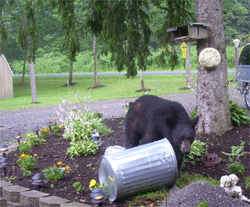
Spring Crappies: Wood to Weeds Dynamics

Crappie Fishing with Straw – Part 2 of 4

woodtoweeds1

In the fall, when weeds begin to die, an exodus takes place.  Refugees with and without vertebrae begin flocking from the decaying flora to more stable environments.

First the insects leave their dying source of food and cover, followed by the minnows and panfish that feed on them.  The most logical refuge for these epiphytic insects becomes wood in the form of brush piles, lay downs, stake beds, logs, and stickups.

In spring, these movements reverse. Eventually. But when spring comes early, with unseasonably warm temperatures arriving weeks ahead of schedule, anglers often find nothing but dead weeds on the shallow flats in their favorite panfish bays.  Though often frequented by crappies right after ice-out, these flats can be devoid of fish life altogether until new weed growth reaches a certain height—tall enough to provide cover, and dense enough to draw insects.

Famous crappie-walleye pro Tommy Skarlis, assaulting a wooden sanctuary for crappies in the backwaters of the Mississippi River in spring.

Most years, the first place to find shallow crappies in early spring will be around wood cover.  Bluegills, too, will be crowded into the branches of fallen trees at this point—especially when big bass, catfish, or pike are on the prowl in the warming waters of those first bays to light up with fish life.

Consummate crappie pro Kyle Schoenherr (All Seasons Guide Service in Illinois), demonstrating how crappies will find and utilize the most dense wood cover available in spring.

A single log laying along bottom, or angling to the surface with one end exposed deadhead style, can hold dozens of crappies.  Amazing how a float rig resting three feet from that log will sit quietly forever while a float pulled right up against it will go down over and over again.  Crappies can crowd into the shadows of a single log like sardines stacked in a can.

Float rigs define the best choice for approaching crappies and wood in spring.  Until waters warm above the 50°F range, crappies may seldom chase a swimming or moving jig with much enthusiasm.  And a vertical drop beneath a pole float or a slip float offers the lowest opportunity for snags.

Down South in lakes like Reelfoot in Tennessee, reaching in toward wood cover with long 12- to 16-foot poles with 6- to 8-pound monofilament lines, vertically dapping around wood cover with slim “pole floats” from the Thill Shy Bite series is popular and effective.  The rig is weighted with a couple split shot and a 1/32- to 1/16-ounce jig baited with a minnow or worm.

Up North we’re more likely to pitch with 7- to 8-foot ultralight rods, 4-pound lines, Northland Lite Bite Balsa Slip Floats, and lighter jigs in the 1/80- to 1/32-ounce range.  Because crappies tend to be targeting small invertebrates this time of year, anglers should be ready to try wax worms and maggots when minnows fail to produce.  Slip floats slide down to a bead and a swivel separating the main line from a leader when reeled in, creating a smaller package that is easier to pitch with accuracy.  When the float lands, the rig weighted with split shot and a jig slides straight down until the float reaches the string or neoprene stopper on the main line, providing less opportunity for the leader to drape over branches and hang up.

Always think about the angle of the sun and where the shadows will be. Though early spring means cold water, and crappies may be “sunning” in the open water nearby, it pays to fish the shaded side first most days.

Next week: Part 3 of 4 –The Crappie Compass.

Lake Ontario Fishing Contests Abound in May

The Thrillseeker Team, one of the most dominant fishing tournament teams on Lake Ontario, did well last year.

The unofficial start of spring on Lake Ontario is the Lake Ontario Counties Trout and Salmon Derby, set for May 6-15 this year (www.loc.org).  This is a big fish contest, focusing in on salmon, brown trout, lake trout and, as of May 7 when the walleye season opens in New York, walleye. More than 4,000 anglers will be hitting the waters of this Great Lake in pursuit of the biggest salmon for the 10 day contest – worth a check for $15,000!  Not bad for doing something that you love.

Fishing contests are not for everyone, but if you are going to be on the water fishing anyway, it’s not a bad idea to ante up and take a chance.  Like the state lottery, you have to be in it to win it.  Every year when I write the press release for the LOC events (there is also a summer and fall contest), every single time there’s a story about the winning fisherman – or woman – who won the prize on their first derby ever, for first fish ever, or first time on Lake Ontario.  The stories, and the memories, are priceless.  There are also the stories of the fish that didn’t get away, but they weren’t in the derby; or not everyone on the boat was in the LOC.  The fall contest Grand Prize is $25,000, pretty serious in the cash department!  That could buy a new fishing boat and lots of tackle!!

Check out the leaderboard on the website to see where the best places to fish are in the spring.  Based on previous success stories, the waters from the Niagara River and the Niagara Bar to 30 Mile Point east of Olcott, New York, affords your best opportunity to take home some cash – year after year.  Part of the reason for the early season success is because of the Niagara River, the biggest flow of water coming into Lake Ontario.  That water is also a bit warmer come May as the waters of a much-shallower Lake Erie funnel their way through the Niagara River system.  These attract the baitfish – smelt and alewives at the top of the list – and in turn those tasty tidbits attract the predator fish.  The predator fish attract the anglers from around the country.  Last year some 40 different states were represented in the LOC events.

Before the spring LOC contest is over, the Wilson Harbor Invitational Tournament will see some 50 teams targeting spring salmon only.  This year, the contest is set for May 7.  The best six salmon will be brought to the scales for a one day event. Grand prize is $25,000.  The competition is fierce as teams focus their energy on catching spring kings.  The key is the size, because scoring is based on 10 points per fish and a point per pound. For information check out www.wilsonharborinvitational.com.

This is all a precursor to the granddaddy of tournaments, the Lake Ontario Pro-Am Salmon Team Tournament – the 32nd annual contest out of the ports of Wilson and Olcott.  No tournament on the lake has been around longer or touched the lives of more fishermen and women.  In the Pro Division, teams are serious when the contest is going on.  Incentives are that more than 100 percent of the entry fee money goes back into the prize structure (unheard of) and an extra $20,000 in cash is being dangled out in front of the teams like a carrot in front of a donkey.  Again, 10 points per fish and a point per pound is the scoring for the day, but there are tournament minimum sizes and, for the Classic Division, the first 12 legal salmon and trout is the goal each day – for three days in a row this year.  Consistency combined with knowledge is needed to place high in this event.  How serious is this tournament?  Observers are provided by each team to go on another boat to make sure the rules are being followed!

In the Amateur Open, the tournament atmosphere is still present, but with a lot less pressure.  No observers are needed.  Each day is a separate contest; best three fish is the goal, a mix of salmon and trout.  It’s a celebration of our fishery and a perfect way to rub elbows with fellow anglers from around the lake.  Deadline to register is May 16.  For more information, visit www.lakeontarioproam.net for rules and registration information.

Competition fishing is not for everyone and there’s still plenty of world class angling opportunities on the lake should you not want to be part of the contests going on.  If the derby or tournament bug bites, though, you could become addicted!

Niagara River Fishing Report – April 21, 2016

John Van Hoff with a 20 pound Niagara Bar laker caught off Lewiston, New York.

Lower Niagara River

Mike Fox of Lewiston reported good numbers of smelt are still being caught in the river, but who knows for how long.  It’s been a much better run than last year.  The Lewiston smelt festival will be held May 6.  Trout action has been decent the past week.  They can be found from Devil’s Hole to the Niagara Bar.  Minnows, egg sacs and wobbling baits like Kwikfish or Mag-Lips are all good baits to use, but it seems to change daily and you need to be flexible.  Steelhead and lake trout top the list; a few browns are also available.  Spoons and spinners top the list of lures from shore.  Warm water fish are starting to pick up.  Remember that the stairs at Whirlpool State Park are closed.

Upper Niagara River

Some keeper perch have been reported in Buffalo harbor area.  Trout should still be available off Unity Island and out of Broderick Park, as well as off Bird Island Pier when you can get out there.  Egg sacs, minnows and spoons or spinners will catch fish.  Use emerald shiners for perch or other panfish along traditional river sites.  Speaking of panfish, they should be turning on soon around Grand Island in the canals, bays and shallows.

Bill Hilts, Jr., Director, Outdoor Promotions

Niagara Tourism & Convention Corporation, 10 Rainbow Blvd., Niagara Falls, NY USA 14303
p: 716.282.8992 x.303 | 1.877 FALLS US, f:  716.285.0809
website | facebook | twitter | blog

Sportfishing has a $30 million annual economic impact in Niagara USA!

Marvelous Mill Creek, Missouri

More than 200 volunteers removed 7.5 tons of trash from the Mill Creek watershed during the Friends of Mill Creek’s annual spring road cleanup.

I am deeply proud of my home state’s conservation history.  Missourians were the first in the nation to realize that forests, fish and wildlife were too precious to trust to the partisan tug-of-war that goes on in state legislatures.  In response to chronic mismanagement of their wild resources, they set up a citizen-led system of conservation governance that remains a model for other states to aspire to.

Damming of Mill Creek resulted in collections of debris like this one and raised the water temperature in some parts of the stream to the point where it was no longer capable of supporting trout.

The only drawback with our system is that it can only maintain and enhance resources on the 1.6 million acres that the Missouri Department of Conservation (MDC) owns or manages.  If you add the 1.5 million acres of the Mark Twain National Forest and the relatively small holdings in state parks and national wildlife refuges, Missouri has something like 2.6 million acres under public stewardship.  That sounds like a lot, but it is only 6 percent of the state’s land area.  No matter how good a job government agencies do on their tiny sliver of land, efforts to maintain the state’s natural resources clearly are going to be won or lost on private land.

In spite of the wonderful conservation legacy we received from our forebears, conservation remains the job of everyday people who treasure the natural world and the physical and spiritual renewal they find outdoors.  And here I finally get to today’s subject, Mill Creek.

Historically, this small stream southwest of Rolla was a little piece of Eden.  The stream corridor is chockablock with springs.  In fact, if you look carefully, you discover that the entire valley is one big spring.  Almost every square foot has water seeping out of it.  Before European settlement much of the valley was what ecologists call a muck fen – land so boggy you couldn’t walk through it.  And meandering down through the middle was a cold, clear stream made to order for trout.

Casting in tight quarters can be challenging on Mill Creek, but the presence of true trophy fish makes it worth the trouble.

God neglected to include trout in Missouri’s native fauna, but humans corrected that oversight as early as the mid-1800s, stocking Mill Creek and other spring-fed streams near railroad lines with rainbow trout hauled in from the West Coast.  The descendants of those first trout continue to thrive in Mill Creek.  The creek also received brown trout stockings starting in the 1940s.

So far so good.  But not all human endeavors in the Mill Creek watershed have been so benign.  Early on, people began “improving” Mill Creek by draining its life-giving wetlands, building roads and towns and damming the creek itself.  This tended to make the once free-flowing creek more sluggish and increase its water temperature.  Still, the creek’s potential remained clear to see.  Eventually, farsighted individuals and groups who recognized how special the creek was coalesced to form the Friends of Mill Creek (FMC).

MDC Fisheries Management Biologist Nick Girondo stands in front of Wilkins Spring, which marks the upper limit of reliable trout fishing water on Mill Creek.

Formed in 1997, FMC is a volunteer, community-based organization that supports landowners in rehabilitating Mill Creek.  Members include landowners, government agencies and corporate sponsors.  At first glance, FMC might seem to be composed of people and groups with conflicting interests.  The organization’s genius lies in focusing on shared goals and values rather than differences.

One of the main ways FMC pursues its goals is the Mill Creek Stewardship Rangers.  This is a group of high-school students directed by the Grand River Conservation Authority (GRCA).  Each summer since 2003, GRCA hires students and a Crew Leaders to undertake rehabilitation projects along the creek, often on private land.  The Rangers are supported by Puslinch Township, the City of Cambridge, the Optimist Club of Puslinch, and local businesses and individuals who donate their time, money and expertise for the betterment of the creek.

MDC Fisheries Management Biologist Nick Girondo stands in front of Wilkins Spring, which marks the upper limit of reliable trout fishing water on Mill Creek

Past projects have ranged from trail maintenance and cattle fencing to removing ponds.  One project involved an in-stream pond that raised peak summer water temperatures in the creek by as much as 7° F, a very bad thing for a trout stream.  FMC created a new channel and turned the former pond was turned into a wetland.  They planted cedars along the banks of the new channel to provide shade, and seeded the area with native grasses.  The whole project took three years to complete, but the results were stunning.  Within a year, brown trout had returned to the creek downstream of the former pond and adult, juvenile, and young-of-the-year trout had populated the new channel.

More recently, several tons of pea gravel, donated by Dufferin Aggregates, has been deposited in a tributary of Mill Creek to create Brook Trout spawning habitat.  Additionally, workers have removed overhanging branches and woody debris blocking a section of the main stream and placed log structures to encourage the creek to find and follow its natural channel.  One of the coolest things I saw when I visited Mill Creek in early April was trout hides created by burying untreated railroad ties along bank edges at water level.  The result is recessed holes where lunker trout can lie just out of the current, waiting to ambush passing morsels.  These are also great spots to drift a dry fly.

Earlier this month, FMC held its annual spring road cleanup, an important tool for keeping ugly and potentially polluting debris out of Mill Creek.  This year’s event drew more than 200 volunteers who removed 7.5 tons of trash from 55 miles of roads in the Mill Creek watershed.

Several floods in recent years have created excellent trout holding habitat on Mill Creek.

Ongoing efforts like these resulted in MDC’s designating Mill Creek as one of only six Blue Ribbon Trout Streams in the state.  These areas are so designated because of their high potential for producing trophy-sized trout. Most of the fish you catch will be 7 to 10 inches, but this is one of the few places in Missouri where you can be sure that trout18 inches or larger are present.  It isn’t easy to fool these wild fish, but the thrill of having one rise to your fly is indescribable.  You can read about Blue Ribbon Trout Areas and regulations at on.mo.gov/1WDHqvB.

The Missouri Trout Hunters website () has this to say about fishing Mill Creek:

“Dry fly fishermen usually have a great time throwing highly visible patterns like Wulffs, Irresistibles, or Humpies.  And throwing big dries can be quite entertaining at times.  Often smaller fish will hit these larger flies so aggressively that they’ll pop straight up in the air.  For a lot of reasons, the fishing here can be a wonderful experience.”

I could go on forever about Mill Creek and FMC, but I think you get the idea. The best way to understand their significance is fish the creek.  To get there, take I-44 to the Doolittle exit west of Rolla and turn south on Highway T. Drive through Newburg and across Little Piney Creek, then turn right on Highway P and watch for the Mill Creek Recreation Area sign on the left.  Take Phelps County Road 7550 to a picnic area.

The fishing from here on upstream is pretty good, though you will find casting space tight in some areas.  If you drive on past the picnic area on CR 7550 you will come to Highway AA.  Turn left and AA will take you to a sign for Pitts Pond, which is fed by Wilkins Spring.  Parking is available on the left just after crossing a concrete slab bridge.  Yelton Spring is upstream from here.  MDC’s Bohigian Conservation Area has access points on both AA and the Forest.

The fishing begins at Yelton Spring and extends all the way down to Little Piney Creek, but the best fishing water is below Wilkins Spring, which dumps around 3 million gallons of water per day into the creek.  Fishing upstream of the bridge is occasionally impossible, as Yelton Spring tends to go dry in the summer.

Localized thunderstorms can swell Mill Creek to unfishable levels pretty quickly.  To save yourself a fruitless drive, check the U.S. Geological Service’s gauge at on.doi.gov/1YFsADa.  It will reveal whether rainfall has caused a spike in stream flow and let you judge how quickly the water level is falling.  Fishing reports are available at the Mill Creek Fishing Reports page.  If you go, return the favor by sharing your experience at .

After you have seen Mill Creek, you might want to be part of its continuing improvement.  Visit FMC’s website – friendsofmillcreek.org/ – and find a way to contribute to their work.  There’s no better way to carry on Missouri’s proud tradition of citizen conservation.

Hunt Safely – Turkey Season is on

It can be hard to locate 3-year old gobblers, but when you do, successful hunters know that getting up at 3:30 in the morning, in the dark, was worth every effort. Joe Forma Photo

The message from the Kansas Department of Wildlife, Parks and Tourism is a message that applies to turkey hunters across the country as turkey seasons open and run for about a month in multiple states at this time of year – Hunt Safely.

The Kansas Spring Turkey Season opened April 12 and is in full swing through May 31.  Reports from the field indicate that birds are plentiful and responding to hunters’ calls.  However, the tradition of spring turkey hunting, where the hunter hides in full camouflage while imitating the call of a hen, requires special safety consideration.

Turkey hunting can be excellent on state wildlife areas, as well as the nearly 250,000 acres of private land enrolled in the Spring Walk-In Hunting Access Program.  Hunters on public land must always assume other hunters are there, too.  Although hunting in Kansas is safer than playing golf, when you consider injuries per 100,000 participants, one tragic hunting-related accident is too many. A few simple precautions can help ensure you or another hunter don’t become a statistic.

First, NEVER wear the colors black, blue or red, the colors prominent on a tom turkey as it displays for a hen.  Set up to call with a good view in front and a tree wider than your shoulders at your back.  A shoulder-width tree to lean against will protect you if another hunter stalks in from behind.  If you see another hunter, whistle or call out; never wave or move, which could draw fire.  Always assume a sound you hear is another hunter, and act accordingly.  Many hunters will wear a fluorescent orange hat or vest when they walk out after hunting, or if they are successful, they may wrap an orange vest around their bird as they carry it out.  Hunting-related accidents during the spring turkey season are rare, but let’s keep it that way.

Another kind of hunter in the woods this time of year is hunting morel mushrooms and reports from the field indicate that hunters are finding them now.  It is legal to pick morels on state and federal public hunting land as long as they are kept for personal consumption.  Mushrooms collected on state and federal lands may not be sold commercially.  Spring Walk-In Hunting Access land is leased for hunting access only.  Morels found incidentally by turkey hunters on WIHA lands may be collected for personal use.  Mushroom hunters should assume they will encounter turkey hunters on public lands, but potential conflict can be minimized by hunting mushrooms mid-day. Most turkey hunters prefer to be in the woods at daybreak and are often calling it a day by mid-morning.

For more information on KDWPT, please visit www.kdwpt.state.ks.us. 

More about the Kansas Department of Wildlife, Parks and Tourism

KDWPT employs approximately 460 full-time employees in five divisions: Executive Services , Administrative Services , Fisheries and Wildlife , Law Enforcement , Parks and Tourism.

Department History:

  • 1905 – Fish and game laws were organized under the Kansas Fish and Game Department and implementation of a state law requiring a license to hunt.
  • 1911 – The State Fish and Game Department was placed under the supervision of the University of Kansas Board of Regents
  • 1925 – The Fish and Game Department was reorganized as the Kansas Forestry, Fish and Game Commission with three board members appointed by the Governor.
  • 1927 – Commission was reorganized and was given approval to organize a warden service. Fishing licenses required of men 18-70.
  • 1939 – Commission’s three-member board was abolished by the legislature and replaced by a six-member bipartisan commission appointed by the Governor
  • 1943 – Legislature gives the commission full authority to set seasons and dates
  • 1955 – The legislature and Gov. Fred Hall create the State Park and Resources Authority.
  • 1960 – First Kansas boating laws enacted
  • 1987 – Gov. Mike Hayden signs executive order merging the State Park and Resources Authority and Fish and Game Commission to create the Kansas Department of Wildlife and Parks
  • 2011 – Gov. Sam Brownback signs executive order moving the Division of Tourism from the Department of Commerce to the newly renamed Kansas Department of Wildlife, Parks and Tourism

Share the Outdoors with a Youth Turkey Hunt

Steve Schicker, host of Forever Wild Outdoor Adrenaline Adventures that appears on The Sportsman’s Channel, and 5-Time New York State turkey calling champion explains what kids need to do to bag that first bird during youth hunting weekend.

New York’s spring youth turkey hunt is just around the corner, set for April 23-24, 2016.  This is a perfect opportunity to give junior nimrods the opportunity to have the outdoor stage all to themselves – along with an adult mentor, of course.  All the young hunter needs is a Junior Hunting license and a turkey permit.  The accompanying adult must also be a current hunting license and turkey permit holder.

There are some ground rules, as there should be.  The adult mentor can assist in the hunt by calling, but they can carry a firearm, crossbow or bow (or attempt to kill a bird during the youth hunt).  We mentioned crossbows.  Junior hunters must be at least 14 years of age if they wanted to try that challenge.  The reason? Crossbows are not classified as archery equipment in the Empire State.  Crazy!

Junior hunters can harvest one bearded bird during the youth hunt weekend.  This would become part of the two-bird bag allowed during the May 1-31 spring season if they are successful early.  A second bird can be harvested starting May 1.  There isn’t a better way to “Share the Outdoors” than to get a kid out turkey hunting!

According to Steve Schicker, host of Forever Wild Outdoor Adrenaline Adventures that appears on The Sportsman’s Channel, now is when you want to be scouting these birds for the youth turkey hunt weekend or opening day for the regular season.

“I like to drive around and glass the fields,” said Schicker.  Locating the birds should be first on your list.  “Whatever you do, don’t call these birds before the season opens,” emphasized Schicker, a five-time New York State Turkey Calling Champion.  “Try to identify where the birds are roosting and then prepare accordingly.”

Once the hunt is underway, though, the emphasis is placed on safety.  Since we are coming off a year when accidents in the field had no fatalities, it’s important to keep that record going.  Hunters are outfitted entirely in camouflage clothing, so there are certain things you can do to make things safer on the whole.  Some of the other things that Schicker pointed out were:
1) Find a big tree to use as a backdrop and to lean against – larger than your shoulders;

2) Don’t stalk what you think is a bird. It could be another hunter;
3) Never where red, white or blue;

4) Never shoot at sound or movement, always identifying your target before you pull the trigger;

5) Always look beyond your intended target;

6) When another hunter moves into your area, speak up loud and clearly. Don’t wave or move;

The Mosquito Repeller in Realtree Xtra Green™ camo is convenient to carry and is suited for hunting use.

When it comes to the actual hunt, Schicker suggested to try and do some things a little differently if you are hunting on public land or areas that receive a lot of pressure.  “You don’t have to actually call to make a difference if you are trying to pull a bird in.  Try scratching the leaves or the ground to make it appear that there’s another bird there.  You can also sound like a bird coming down out of the roost first thing in the morning, too. Figure out what the birds want on any given day.”

On a personal note, there’s one thing I would encourage every turkey hunter to purchase before heading out in the forests and fields.  One of the most valuable tools in my turkey hunting arsenal is my Thermacell Repeller.  It’s a perfect defense against unwanted guests like mosquitos and makes things more comfortable when you are outdoors in potentially adverse situations.  If you have a new hunter with you, it’s a great way to make sure that insects won’t keep them away from a second hunt.  Two new products include Max Life Insect Repellent pads that last up to 12 hours and a tree hanger that can help to give you maximum coverage when in the woods.  Check out www.thermacell.com for details. Good luck, stay safe out there and take a kid out hunting!

Lake Ontario and tributaries Fishing Forecast – Niagara County

Thursday, April 21, 2016

The spring weather has continued and more people have been taking advantage of some inshore trout fishing – browns and lake trout primarily, with an occasional Coho or Chinook also showing up.

For the browns, troll inside of 20 feet with stickbaits or spoons off boards. Look where the water is a little stained if you can find something off color.  Firetiger, rainbow, brown trout and natural colors are all working.  Fish off boards away from your boat.

Lake trout have been everywhere.  John Van Hoff of North Tonawanda was fishing just west of the river in 50 feet of water and couldn’t keep four lines in.  Their biggest Laker was 20 pounds. In front of Wilson it was the same story – Laker’s in 60 feet of water.  Some lake trout have been reported in water as deep as 80 and as shallow as 35 according to Wes Walker at The Slippery Sinker.

In the streams, 18 Mile Creek was down to a trickle on Wednesday and some of the smaller streams could use a fresh slug of water.  We could get some rain on Thursday but we will be at the mercy of Mother Nature.  We are on the downhill slide of the winter trout run, but a few fish are still being reported.  The upswing is with warm water fish species like bass (catch and release), suckers and panfish.

The LOC Derby will be held May 6-15 and registrations are coming in hot and heavy now.  Go to www.loc.org for details or sign up at any Niagara County location.

The Lake Ontario Pro-Am Tournament, set for May 20-22 this year, has a live website now for registrations at www.lakeontarioproam.net.

The Wilson Harbor Invitational is May 7 this year. Website is www.wilsonharborinvitational.com.

Bill Hilts, Jr., Director, Outdoor Promotions

Niagara Tourism & Convention Corporation, 10 Rainbow Blvd., Niagara Falls, NY USA 14303
p: 716.282.8992 x.303 | 1.877 FALLS US, f:  716.285.0809
website | facebook | twitter | blog

Sportfishing has a $30 million annual economic impact in Niagara USA!

IMR 4007 SCC Powder Recall

powder_recall

If you are a recreational or precision shooter and you hand-load your own ammunition, this is a call to action to inspect your powder inventory and lot numbers.

IMR recently (September, 2015) announced a product safety warning and recall notice for IMR 4007SSC powder sold in 1-pound and 8-pound containers.

IMR received reports that this particular powder may have become unstable due to possible rapid deterioration that could possible result in spontaneous combustion, fire damage or possible personal injury.

The lot numbers of concern are as follows: 10130139, 10131139, 10429139, 10430139, 80425139 and 80426139.  If the number on your container matches one of these lot numbers, stop using the product immediately.

IMR recommends that you fill the container with water immediately to render the product inert and safe for disposal.  Mail, email or fax a copy of the powder label showing the lot number to the contact information below and include your name, address and email.

Replacement product of any other IMR smokeless powder product will be shipped to you for no charge.

If you have already loaded the powder subject to this recall into ammunition, IMR recommends that you pull the bullets, remove the powder and wet the powder with water for safe disposal.

IMR Powder Company deeply regrets any inconvenience this recall may cause, but they always believe in safety first.

Contact information:  IMR Powder Company, 6430 Vista Drive, Shawnee, KS, 66128.  Email: help@imrpowder.com.  Website: www.imrpowder.com.  Telephone: 800-622-4366 or 913-362-9455.  FAX: 913-362-1307.

Spring Turkey Woods is a Special Place

turkeywoodsSometimes old friends meet in a familiar place.  If you’re a turkey hunter, you know there is something extra special for those moments when a hunter and the woods come together in search of a nearby gobble.  It’s downright exciting!

There is a special sort of celebration to enjoy because this meeting takes our heart and brings it together with our deep-rooted passion to hunt, to be in the woods. It’s a journey, a special adventure, and we know before we even get there, it will be fun and promising.  That’s how many of us feel when we head out turkey hunting on opening day, wherever the hunt takes us.  There is a thrill, a sense of relief just to be there.  We feel the “YES” of such moments.

A not so old outdoor friend is now sharing some of his secret turkey success so that others can join in the outdoor fervor he has found.  Mike Joyner is an acclaimed nature author and outdoorsman who shares his secrets to success in pursuit of wild turkey in a book entitled “Grand Days in the Turkey Woods.”

From preparation for the hunt, Joyner provides a first-hand account of adventures that will help you in the turkey woods.  He delivers details of personal experiences that make a difference and provides little tips that create a new strategy for every successful hunt plan.

This is more than a “how to hunt” book, Grand Days in the Turkey Woods will appeal to novice and veteran alike.  Joyner brings it all together with considerations for weather and things that can right to make the wind and rain work for you.  He shares thoughts about food supply and the extended challenges we face when hunting new lands, plus the joy and excitement too, that we will find when that plan works for us.  He shares details.

Joyner has pictures and personal notes that he uses for trip plans and there is a lot to learn from here, as he started hunting gobblers back in 1993.  He has achieved hunting success in 14 states, has been honored for his skills with two wild turkey grand slams and a top twenty NWTF gobbler in his home state of New York. .He is a volunteer too, since that experience resulted in nine years of volunteer service to the New York State Wild Turkey Federation / National Wild Turkey Federation, as a board member, where he also served as President for four years.  He knows what he is doing in the turkey woods.

Look for his book in book stores everywhere, on Kindle, in home town libraries or on Amazon at this link: http://www.amazon.com/Grand-Days-Turkey-Woods-Joyner/dp/150011281X.