- Trophy Trout, Trophy Memories
- Trophy Science and Management
- Lilley’s Landing is Popular Spot for Annual Trout Trek

By Jim Low
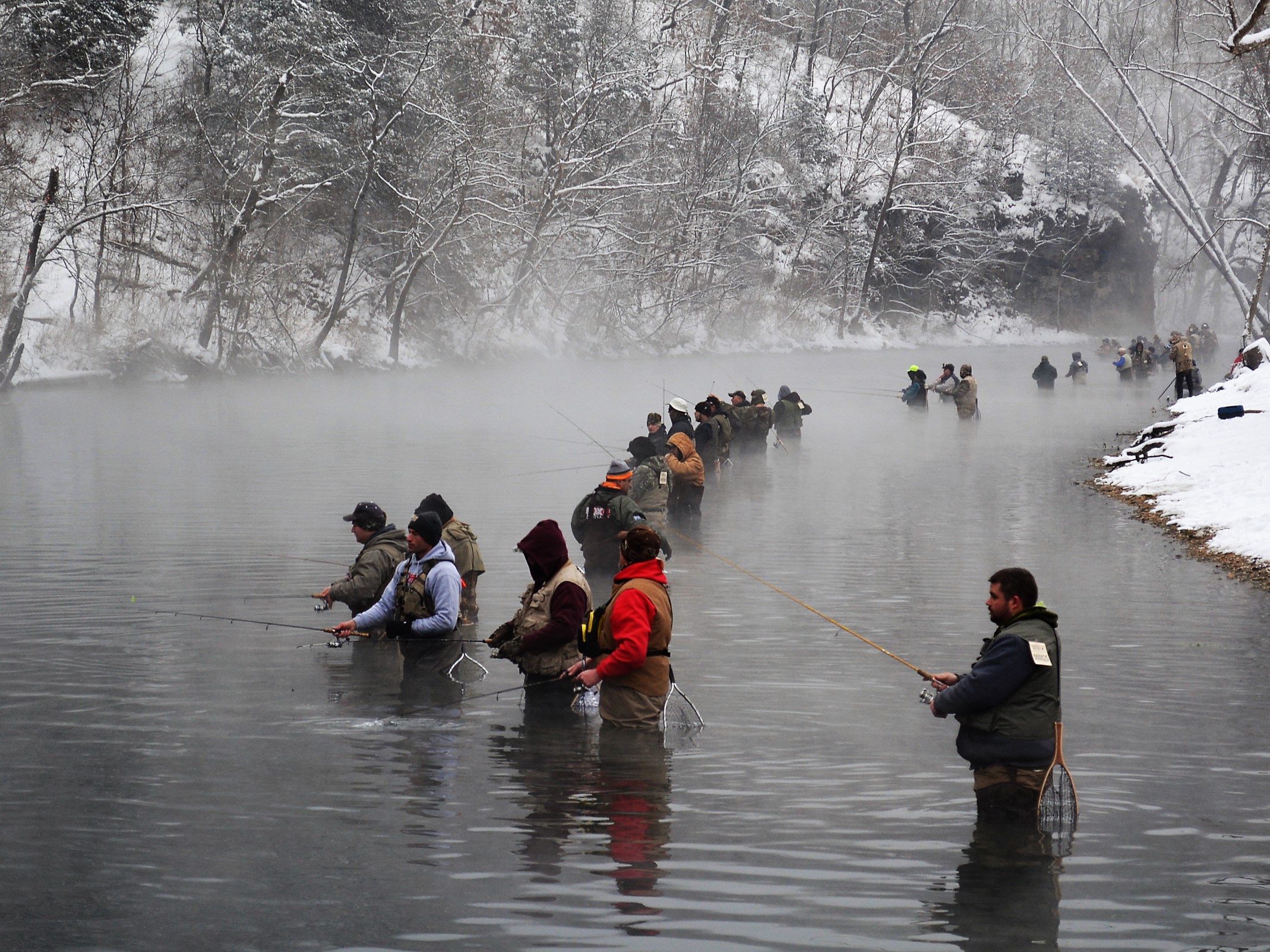
In most of the United States, “March Madness” refers to basketball. In Missouri, the term has a whole different meaning for trout anglers. March 1 marks the opening of the regular fishing season at Missouri’s four trout parks. On that day, depending on weather and what day of the week March 1 falls on, between 8,000 and 10,000 cabin-fevered trout devotees jam the banks of spring branches around the state. At Bennett Spring State Park (SP) near Lebanon, Montauk SP near Licking, Roaring River SP near Cassville and Maramec Spring Park near St. James, most will be giddy about escaping the confines of home and office. Anglers for the most part, cheerfully untangle crossed lines and enjoy a bonhomie that transcends petty differences of religion and politics.
While I am not immune to the party atmosphere of opening day at trout parks, I generally prefer a slightly less frenetic experience. I also enjoy catching and releasing lots of trout during an outing and if there’s a chance of boating a world-record brown trout, well, that’s not a bad thing either.

Taneycomo is a hybrid lake of sorts. While it’s called a lake and there is a dam at its lower end, Taneycomo always has at least a little current. And when the U.S. Army Corps of Engineers is releasing water through Table Rock Dam, which marks Taneycomo’s upper limit, it’s a regular river of water cold enough to have come from an Ozark spring.
Besides a continuous supply of cold water, Taneycomo has an abundance of fresh-water shrimp, more accurately called “scuds.” These, along with hatches of midges, mayflies, gnats, and other insects, are the foundation of a food pyramid that produces an astonishing growth of trout stocked by the Missouri Department of Conservation (MDC). The food is so abundant, it supports monthly stockings of 35,000 to 80,000 rainbow trout, according to seasonal variations in angler numbers. In addition, Taneycomo gets approximately 10,000 brown trout each winter.
While Taneycomo is largely a put-and-take fishery for rainbow trout, MDC takes advantage of its plentiful natural food base with regulations designed to produce trophy trout. All brown trout measuring less than 20 inches must be released immediately and you can only keep one brown trout daily. Rainbow trout between 12 and 20 inches must be released in the portion of the lake from the no-boating or fishing zone below Table Rock Dam downstream to the mouth of Fall Creek. Also in this stretch, only flies and artificial lures are permitted. Scented, soft-plastic and natural baits are prohibited.
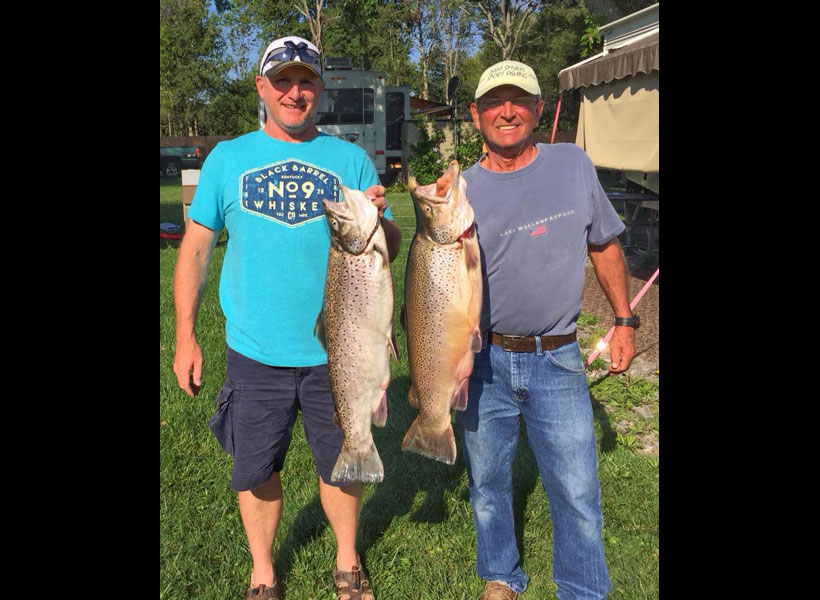
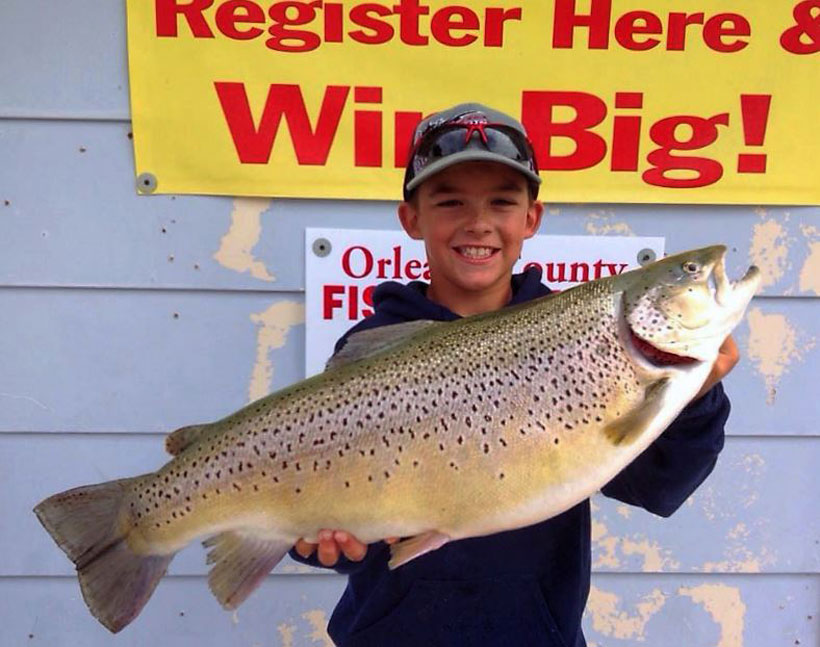
Missouri’s pole-and-line record brown trout, a 28-pound, 12-ounce behemoth, came from Taneycomo in November of 2009. In 2013, Mark Clemishire of Skiatook, Oklahoma, landed a monster rainbow trout just below Table Rock Dam. After measuring and photographing the fish, he did what any serious trout enthusiast would do. He released it to fight another day. A formula yielded a probable weight of 20.5 pounds, based on its 31-inch length and 23-inch girth. That would have bested the state record by 2 pounds, 7 ounces. Taneycomo also produced a 15-pound, 6-ounce rainbow trout that currently occupies the top slot for alternative fishing methods, in this case, a throwline. That record has stood since 1971.

Knowing all this, it’s no surprise that I look forward to what has become an annual pilgrimage to Lilley’s Landing Resort and Marina on the north bank of Lake Taneycomo and the southern fringe of Brawling Branson, Mo. I began going to the resort, operated by Phil Lilley and his family, thanks to the Conservation Federation of Missouri, which sponsors an annual gathering of outdoor media there each winter. In between visiting with old friends and presentations from conservation officials and outdoor manufacturers, we sample Taneycomo’s world-class fishing.
I am not an accomplished fly-fisher, but under the tutelage of Lilley’s guide Duane Doty, I managed to boat more rainbows than I could count. The hatch was dominated by midges, so we mostly floated #16 primrose-and-pearl colored midge imitations beneath strike indicators. My last fish of the trip was a battle-scared 16 ¾-inch rainbow. Since I’ve already admitted to not being the world’s greatest fly-fisher, I’ll go ahead and confess to the unforgiveable sin of killing that big rainbow. I had promised my wife I would bring home meat and I knew that particular fish, having lived for years on a wild diet, would have meat as pink and delicious as a wild-caught salmon.
I take some comfort in the knowledge that hundreds or thousands of larger trout haunt the depths of Taneycomo. It’s entirely possible that one is a world record. And even if you don’t boat a big one, you are pretty sure to land lots of others. There is a Corps of Engineers boat ramp just below Table Rock Dam. The immediate area below the dam also has superb wade-fishing. The water outlet on the north side of the river near the upper parking lot is a favorite hot spot for wader-clad anglers.

Many of the nicely furnished, immaculate rooms at Lilley’s Landing have decks overlooking the lake. The expert guides and friendly, family atmosphere haven’t given me any reason to look elsewhere when I fish Taneycomo. I’m sure that other resorts in the area do fine jobs for their clients, too. You can find them and a bunch of other resorts online. If you see Phil Lilley, tell him I said hello. If you have time, visit MDC’s Shepherd of the Hills Hatchery below Table Rock dam and see where the trout you caught were born.


 By Brent Frazee







 Posted by Forrest Fisher




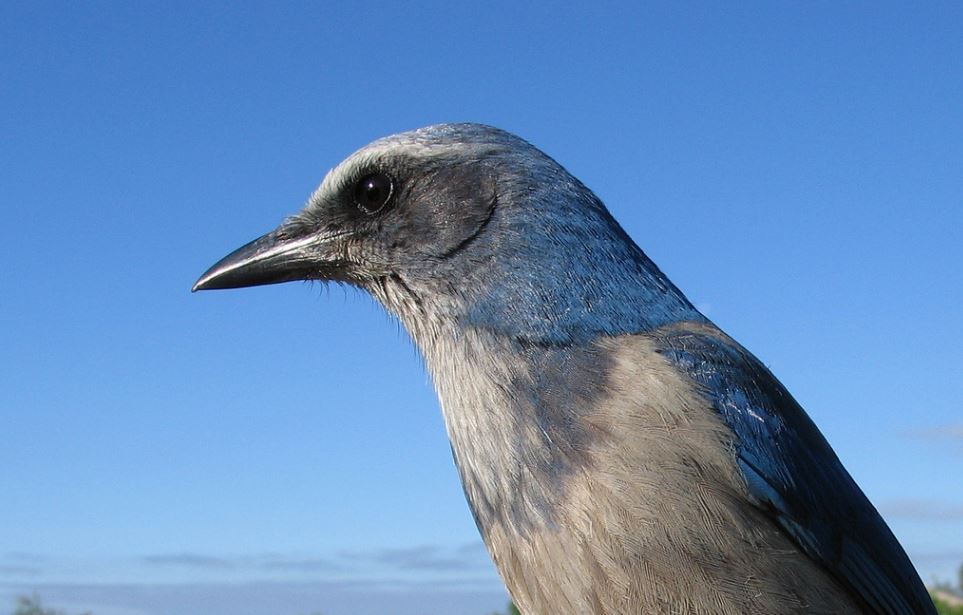
 Scott’s seaside sparrow, Wakulla seaside sparrow, Barbour’s map turtle, Florida Keys mole skink, Florida pine snake, Georgia blind salamander, Florida bog frog, bluenose shiner, saltmarsh top minnow, southern tessellated darter, Santa Fe crayfish and Black Creek crayfish. Threatened species have populations that are declining, have a very limited range or are very small.


 By Jim Low


 Remember that lake trout season opens officially on January 1, 2017. Best baits have been BC Wobbler spoons in chartreuse or orange; in-line spinners in chartreuse or yellow. Upper Niagara River
 By Jim Low




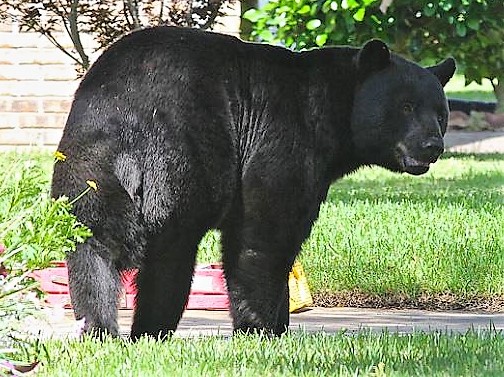

 The FWC plans to release more bear-related videos in the coming months. The short videos help meet the information needs of a busy public.


 By Forrest Fisher



 If you’re packing your snowbird bags already and are planning ahead to hunt in Florida this year, November in Florida is an awesome month to head for the woods. You have the option to hunt small game, wild turkey, boars, bears, deer and more. Regulations are not complicated, but it’s a good idea to download the syllabus for the sector area you plan to visit.







 Five of 31 recent graduates of the NYSDEC Division of Law Enforcement 20th Basic School for Uniformed Officers recently transferred to the Marine Enforcement Unit (MEU) where they will become specialists in marine fisheries law. They will be required to operate some of the DEC’s largest patrol vessels in and around New York Harbor.
 To successfully complete the course, each ECO had to demonstrate precision and efficient competency in all of the tasks required to be a vessel operator in New York’s Marine District. The training concluded on September 23 with nine ECOs completing the course, including the five recent graduates.










 Just like many of us already know, education is the key to success in just about anything in life. From the numbers and illustrations noted on the New York State DEC Hunter Safety Website – and shared here, we can see that New York State’s hunter education courses have proven they are highly effective in fostering safe hunters. Approximately 500,000 licensed hunters spend an estimated 10 to 15 million hunter days afield each year. Recent reports indicate that 2015 had the third-lowest number of hunting-related shooting incidents on record in New York. The 2015 hunting season yielded the first year without a single hunting-related shooting fatality since the 1950s.
 Since DEC’s Sportsman Education Program was first introduced in New York State, the number of hunting related accidents have declined significantly. Reports on the number of hunting-related shooting incidents indicate that 2015 had the third lowest number on record in New York with 23 incidents. Starting with 2013, the last three years were the top three safest in New York with this being the first year on record with zero fatalities.
 Education courses are added continuously throughout the year, so participants should check the on-line system frequently to find a course or call 1-888-HUNT-ED2 (1-888-486-8332) or 518-402-8966.