VanDam Leads Niagara River Bracket Pack

Baits, Spots are Secret (For Now)

Watch Live: http://www.bassmaster.com/classic-bracket

Bassmaster News, BUFFALO, N.Y. —July 20, 2016

After the 2nd day of the Bassmaster Classic Bracket held on the Niagara River out of Buffalo, New York, the Match 1 winner (VanDam) will move on to fish against Match 2 winner (Kreiger) Thursday and Match 3 winner (Hite) will fish against the Match 4 winner (Rojas). Total weights will go back to zero and all anglers will fish six hours from 8:30AM – 2:30 PM. Photo illustration by B.A.S.S.

And then there were four. The first round of the Bassmaster Classic Bracket tournament on the upper Niagara River is over and half the field is driving back home.

The two Elite Series anglers from Arizona are staying though, as Brett Hite dominated and Dean Rojas performed some last-minute heroics during the first round, stamping their tickets to the semifinals.

Michigan’s Kevin VanDam and Koby Kreiger of Florida round out the semifinalists heading into Thursday’s head-to-head clashes in hopes of winning the lion’s share of the $50,000 purse and a berth into the 2017 GEICO Bassmaster Classic presented by GoPro.

The unusual format of this derby has generated a lot of excitement from the anglers and fans watching on Bassmaster.com and WatchESPN, as every second of fishing has been streamed live.

The anglers are also getting updates from BASSTrakk to know how much weight their rival has caught, and officials on each boat immediately weighing and releasing the fish once the information is logged.

“I love this format,” said Rojas, who fished against Alabamian Jordan Lee. “We fished for 5 1/2 hours, and I was losing for all but two minutes of the match. When I caught that last fish, fans got to watch in real time the excitement and incredible circumstance that gave me the win.”

Rojas was 5 pounds behind Lee when he hooked a 3-pounder. He had five minutes left when he hooked another big one. It came off. His next cast produced another bite and he swung another 3-pounder into the boat with two minutes left.

“I’m a slow starter, but I finish strong,” Rojas said. Rojas ended with a two-day total weight of 13-9, and Lee with 12-9.

Hite wasn’t sweating a bit. With the second-heaviest limit on Tuesday, he had a 2-pound cushion over Texan Keith Combs, his first round opponent.

“I knew some big ones lived in my spot, and when they bit early, I felt like I was in good shape,” Hite said.

After boating the biggest limit of the event so far (11-2) in the first two hours of competition, Hite was more than 7 pounds ahead of Combs, who ended the day with just 6-12.

“I felt really good with my weight, so I went exploring for the last hour. I found some stuff that should help me tomorrow,” Hite said.

Speaking of help, Kreiger beat Jacob Powroznik with the help of Jacob Powroznik.

The two anglers are roommates on the Elite Series, and Powroznik vowed to help Kreiger make it to the Classic. Winning this tournament is the Florida pro’s only chance to get there.

Kreiger fished for more than 2 1/2 hours without a bite while Powroznik watched, and even coached, from his boat nearby. Kreiger finally got a bite, and the fish jumped off. With 27 minutes left in competition, Kreiger set the hook and boated a 1-7, enough to finally eclipse Powroznik’s Day 1 total.

“Thank the Lord and thank Jacob Powroznik!” Kreiger said. Powroznik ended the first round with 9-15, and Kreiger moves to the next round with a two-day total of 10-4.

VanDam had nearly a 9-pound lead over Florida pro Drew Benton heading into Wednesday’s elimination match and could have slept through the second session and still won. However, that’s not KVD. He went out and caught 10-4 for a two-day total of 20-8. Benton finished with a final total of 5-10.

“I was watching BASSTrakk and knew Drew was having a tough time, so after I boated one pretty good one, I went practicing,” VanDam said. “Based on what I found, I feel really good about my future in the derby.”

Thursday’s semifinal round on July 21 will pit Rojas vs. Hite and VanDam vs. Kreiger. The weights will go back to zero, and all anglers will fish from 8:30 a.m.-2:30 p.m. ET.

The winner of those two matches will advance to Friday’s championship round. With weights starting from zero again, the anglers will fish head to head from 8:30 a.m.-2:30 p.m. for the title.

Bassmaster LIVE will broadcast coverage of the entire tournament Thursday and Friday, from first cast until the fishing stops, with a camera in every boat.

The payout for the bracket event will be distributed as follows: $10,000 and a Classic berth for first place, $8,000 for second place, $6,000 for third and fourth place (eliminated from semifinals) and $5,000 each for fifth through eighth place (eliminated from quarterfinals).

There was no entry fee for the tournament. The local host for this event is I Love New York. This report is courtesy of www.bassmaster.com

2016 Bassmaster Elite Series Premier Sponsors: Toyota, Minn Kota, Nitro Boats, Skeeter Boats, Triton Boats, Yamaha, Berkley, GoPro, Huk, Humminbird, Mercury

2016 Bassmaster Elite Series Supporting Sponsors: Livingston Lures, Lowrance, Phoenix Boats, Power-Pole, Rapala, Shell Rotella, Shimano, Academy Sports + Outdoors, A.R.E. Truck Caps, Carhartt, Dick Cepek Tires & Wheels

About B.A.S.S.
B.A.S.S. is the worldwide authority on bass fishing and keeper of the culture of the sport, providing cutting edge content on bass fishing whenever, wherever and however bass fishing fans want to use it. Headquartered in Birmingham, Ala., the 500,000-member organization’s fully integrated media platforms include the industry’s leading magazines (Bassmaster and B.A.S.S. Times), website (Bassmaster.com), television show (The Bassmasters on ESPN2), social media programs and events. For more than 45 years, B.A.S.S. has been dedicated to access, conservation and youth fishing.

The Bassmaster Tournament Trail includes the most prestigious events at each level of competition, including the Bassmaster Elite Series, Bass Pro Shops Bassmaster Open Series, B.A.S.S. Nation, Carhartt Bassmaster College Series presented by Bass Pro Shops, Costa Bassmaster High School Series, Toyota Bonus Bucks Bassmaster Team Championship and the ultimate celebration of competitive fishing, the GEICO Bassmaster Classic presented by GoPro.

NOTE: The second group of 4 anglers will be heading back to Anchor Marine on Grand Island, New York. Fans are more than welcome to greet them once they get their rigs out of the launch ramp, so Anchor Marine asks that you give anglers a little space at that time. Since this is a new format, there is not your traditional weigh in at the end of the day. (Anchor Marine, 1501 Ferry Rd, Grand Island, NY 14072, 716-773-7063)

Finding the Right Fishing Rod

At St. Croix – So Many Choices, So Little Time!

Not all fishing rods are created equal, but the right fishing rod for you is generally not a secret. You know it when you pick it up. You gotta have it. Most St. Croix fishing rods feel that way to many anglers and there is a reason why. If you want to find out why, there is a way now… tour the factory! Open to the public for the first time this year.

My (most) favorite fishing rod is from when I was just a youngster.  I still have it, there is not even a manufacturer name on it.  This fishing rod was made of early woven fiberglass in the late 1950s, it included a cork handle with two sliding aluminum rings that held my Spin-Joy open face fishing reel in place.  I bought the rod after getting the reel, the rod cost me $1.95.

At 10 years old, I didn’t know a thing about open face fishing reels, but the old gentleman – his name was Mr. Paul, sure did.  He was the owner and proprietor at the United Surplus and Outdoor Store on Broadway in Buffalo, New York.  He sold me.

He asked me how I fished.  The little I knew, I answered, “What do ‘ya mean?”  I was taught to fish very effectively with very simple tackle by my dad, who taught me early that patience was the key.  I was taught to take home what I caught too, dad had lived through the depression and nothing was wasted when your time was the cost of the experience.  Catch and release only started after the angler army became so good at fishing with the help of technology.  All good.

Dad taught me his knots and showed me how to fish with a hook, worm, sinker and sometimes, with a bobber.  I mentioned to Mr. Paul that the bobber was hard to cast because the weight of everything was so much lighter.  Back in those days, there was not much about lures and what all of us kids back then called “all that fancy stuff.”

My interest in fishing was peaked each month when I read the fishing column in Boy’s Life magazine, it was written by Homer Circle.  I learned how to ask questions about fishing gear from that monthly column that I had read since I was a big 8-years old.  Questions like bb-shot, long shank hooks, bass sinkers, cat gut line, quill bobbers and much more.

My reel was advertised as a premium, 2-bushing, open-face, spinning reel and it cost $2.95.  So I needed a rod that Homer Circle had said was different from the fishing “poles” that most people were using at that time.  It had bigger guides and they were on the other side of the rod too, he wrote, whatever that meant.  I couldn’t understand why these would be different at the time.

The reel was loaded with 10-pound test Dacron line because my dad and I didn’t know anything about monofilament yet, it had not been invented yet.  There was cat-gut line out there that was clear and looked like light blue colored plastic string made by a small company called Berkley – I still have the spool it came on.  We bought some a year later.

Painstaking detail is one of the key ingredients that follow superior design at St.Croix fishing rod factory in Wisconsin. Forrest Fisher Photo

The Dacron we had did cast a light sinker far enough to take our 2-inch crab into the deep pool of a local creek near my house.  That hole was full of wild smallmouth bass in the middle of summer.  They weren’t big, but they sure fought hard, jumping, thrashing the water up, and often, getting off.  They were a challenge to catch all the way to shore.  I loved not losing to a fish.  The battle for dominance was on!

That rod Mr. Paul sold me just felt right.  Maybe it was a confidence concept at eight years old that helped me to love that rod so much.  Number one, it was all mine – my own fishing rod, and it cast way farther than my dad’s Branson casting rods that were solid metal.  I felt an advantage that way, if you know what I mean.

After a while, I could thread a needle with my cast and it became second nature to cast at a specific part of the pool and in other parts of the creek.  That rod made me a fisherman!  That rod was “right for me” because at the time with what I was fishing with, it did the job perfectly and I was, of course, quite forgiving about anything that rod did not do right.

That’s what good fishing rods do when you first pick them up, they feel right.  When that happens and your virtual mind can see you working your lure or bait to success, you just know that is the right rod for you.  Part of that virtual mind thing is an experience thing, the other part of it is a “private confidence wish” way before discovering the fish-catching proof on the water.

Hand application of key bonding components allows for perfection to be achieved as rod blank, cork, interface bearing surfaces and your hand all meet in the same place to provide touch, feel, sensitivity, power, confidence and fish-catching secret motif. Forrest Fisher Photo

When you buy a fishing rod that imparts confidence, you know what happens – you catch more fish.  For me, that was 60 years ago.  I’ve searched for fishing rods that impart that special “air of confidence” ever since.  Then just about a month ago, I was fortunate enough to be fishing in Wisconsin with several fellow outdoor communicator folks and we were invited to be among the first of groups to tour the St. Croix Fishing Rod Company.  Man, I was flipping through hoops in my mind about this.  I had flashbacks of articles by Homer Circle from when I was so young.

I had been building my own fishing rods for a few decades just to have the best rods for the money – which I never had that much of, but even then, my homemade custom rods were still a bit pricey.  I knew all about rod wrapping, double-wrapping, splining, rod guide weighting, single foot or double, guide placement, balance for sensitivity or power, AA corks, special rod seats and way more than I ever want to admit that I guess at these days.

Located in the nearby town of Park Falls, WUI   the St. Croix tour really opened my eyes and provided an education on custom rod building that is performed in a factory by over 200 dedicated workers.  Truthfully, I didn’t actually think that anyone would ever be allowed to tour the one USA Company that is so famous for making what pro anglers and non-pro anglers all seem to say are the finest fishing rods on earth.  The St. Croix fishing rods are that famous.

From upper management to the factory and the process-control work force, it was apparent that folks at St. Croix love doing their job and doing it right, it shows from start to finish.

While I have about 40 fishing rods, I only have one St. Croix, a panfish rod, because it was the only rod I could really afford at the time.  The St. Croix rods have been typically fairly high cost when compared to many foreign made fishing rod products, but after this special tour –not on a deserted isle with Gilligan and Maryann and the crew, I understand why the St. Croix rod products cost a bit more.  They are perfect is every way and there are hundreds of models to suit your needs to gain that “air of confidence” that you need before you say to yourself, “I need this rod.”  The bottom line after this tour?  Worth every penny!

St. Croix rods are not simple. Each model is custom-designed and includes high technology process control with trained eyes and the hands of skilled workers that showed such focus that I thought we were in a Space and Defense Plant with traceable materials and processing.  Such were the process controls that we witnessed.  Many other companies may never consider the details we reviewed.

To see for yourself, the St. Croix fishing rod factory tours now are offered daily, Monday through Friday, June 1st through September 30th, and then Mondays, Wednesdays and Fridays from October 1st through April 30th.  St. Croix is closed on major holidays.  Regular tours lasts approximately 90 minutes.  It’s easy to book a visit at http://stcroixrods.com/resources/factory-tour-details, or email at factorytour@stcroixrods.com or call 1-800-826-7042.

The folks at St. Croix have said it before: Not only will you be taking a walk through rod-crafting history, you’ll also get a glimpse of the future of fishing.

FOOTNOTE – St. Croix Rod/Reel SALE:

Looking for an incredible St. Croix value at an unheard of sale price?  Squeeze the trigger on a new St. Croix Triumph X and St. Croix will pair it with a matched Daiwa reel on the house. Not many chances to get a St. Croix rod with a rel for $100, but you can for a limited time.  Premium-quality SCII graphite. Outstanding strength, sensitivity and hook-setting power. Hard aluminum-oxide guides with black frames. Split-grip/premium EVA handle. Fuji DPS or ECS reel seat with black hood(s). 5-year warranty backed by St. Croix Superstar Service.  Your choices are many too!  A 2015 Daiwa Laguna 2000-5BI spinning reel, $40.00 retail value, will be paired with St. Croix TXS50ULM, TXS60LF, TXS66MLF and TXS66MLF2 rods, while a 2015 Daiwa Laguna 2500-5BI spinning reel, $40.00 retail value, will be paired with TXS66MF, TXS66MF2, TXS68MXF, TXS70MF and TXS70MF2 rods. Daiwa reels will possess standard warranty provided by Daiwa.  Check out this link:  http://stcroixrods.com/shop/freshwater/triumph-x-spinning-rod-combo/.

Smallmouth Changes in Wind for Missouri Anglers

Trophy Fish, Regular Fish, Fun Fishing and Healthy Fishery is Goal

Many anglers consider the opportunity to catch a bragging-sized smallmouth more important than the ability to take fish home to eat. If you have an opinion about proposed changes to Missouri smallmouth bass and goggle-eye (rock bass) regulations, visit mdc.mo.gov/contact-engage and share your thoughts with the Missouri Conservation Commission.

At their regular meeting on June 24, the Missouri Conservation Commission heard a staff presentation that leads me to believe that change is in the air for smallmouth bass anglers.

The presentation covered research conducted in recent years, including surveys of angler attitudes about the possibility of more restrictive harvest regulations on smallmouths and goggle-eye.  The goal of these changes would be to increase the average size of fish available to anglers.  The Missouri Department of Conservation (MDC) began looking into this at the urging of the Smallmouth Bass Alliance.

MDC conducted basic field research on the food habits and ecology of smallmouths from the 1960s through the 1980s.  In the 1990s, they studied how far smallmouths move and the types of habitat they use.  Seven years ago, MDC began exploring how increased length and reduced creel limits would affect the size distribution of smallmouth populations.  After this work was done, the agency held open-house meetings and on-line surveys to gauge angler support for a tentative set of recommendations for regulation changes.

For many years now, the statewide length limit on black bass, including smallmouths, has been 12 inches.  The daily limit has been six black bass – largemouth, smallmouth and spotted, in aggregate.  In recent years, however, MDC has been conducting trials of 15- and 18-inch length limits for smallmouths within Smallmouth Management Areas (SMAs) consisting of parts of 11 streams.  At the same time, anglers in the SMAs have been limited to one smallmouth daily in their aggregate limit of six black bass.

During the study, MDC conducted periodic electrofishing samples on the affected areas of the streams.  It also sampled portions of the streams where the more restrictive regulations were not in effect so they could compare results and determine if the experimental regulations were having the desired effect.  Streams included in the experiment were Big Big Piney, Gasconade, Elk, Jacks Fork, James, Little Platt, Meramec, Mineral Fork, Osage Fork of the Gasconade River and Joachim Creek.  The resulting data suggest that the more restrictive length limits did increase the number of larger fish.

In addition, MDC imposed an 8-inch minimum length limit on goggle-eye – also commonly called rock bass – in some streams with the same goal – determining how this affected the size structure of goggle-eye populations.

Based on these data and angler attitudes, MDC Fisheries Division staff say they are developing recommendations that include:

  • Maintaining the 12-inch minimum length limit on smallmouths and daily aggregate limit of six black bass for most streams in the state.
  • Instituting a 15-inch minimum length limit and a daily limit of one for smallmouth bass on most of the streams where more restrictive regulations have been tested.
  • Placing a statewide minimum length limit of 7 inches on goggle-eye.
  • Extending the SMA boundaries on the Jacks Fork, Big, Meramec and Big Piney rivers.

MDC’s Fisheries Division Staff decided not to recommend more restrictive harvest regulations on smallmouth bass on the Current River, where tournament anglers expressed strong objections to the idea.  They also decided to recommend discontinuation of the restrictive smallmouth harvest regulations on the Osage Fork SMA, because data suggested it was not needed there.

These changes would affect only smallmouth bass in the SMA’s.  A minimum length limit of 12 inches would remain in effect for largemouths and spotted bass.

Also during the June 24 meeting, the Conservation Commissioners seemed to like the idea of the changes.  Consequently, MDC Fisheries Division Staff expressed their intention to develop a formal proposal for the Commissioners’ consideration at their upcoming meeting on August 26.

Many smallmouth devotees will hail the proposed regulations as long overdue.  Those who want to catch and keep up to six smallmouths of at least 12 inches daily will still have streams where they can do so.  Those who think the chance to catch a trophy smallmouth is more important than taking fish home will have places to follow their bliss, too.

The Conservation Commission encourages anglers who have preferences in this matter to visit mdc.mo.gov/contact-engage, and express those preferences.  If the commissioners vote to approve the proposed regulation changes, there will be a period for comments afterwards.

If they receive no comments or hear nothing that changes their minds, the regulation will go into effect March 1, 2017.

Targeting Big Fish for Derbies, Tournaments

Lake Ontario Counties (LOC) Trout & Salmon Derby – July 1-31, 2016

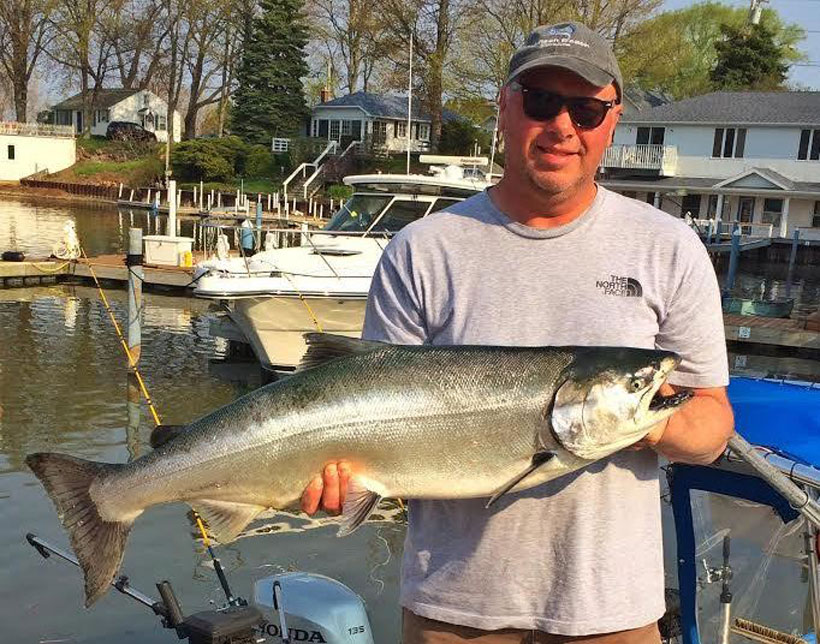
Mike Hay of Lake Luzerne, NY caught this king on the Niagara Bar to win the Spring LOC Derby in 2015 – his first time fishing the area.

Catching BIG salmon and trout in Lake Ontario consistently is not an easy proposition. Time on the water is certainly a piece of the formula for success. When fishing in a contest like the LOC derbies, every year we see absolute novices winning the big prizes – usually with a little bit of luck. More often than not, they have a good charter captain or someone else who spends a lot of time on the water to show them the way. Here are some tips from professional anglers who have consistently placed in the money fishing these big water competitions.

“I wish I could say there was a secret lure or special presentation that put big fish in my boat, but there isn’t,” insists Capt. Matt Yablonsky of Youngstown, operator of Wet Net Charters on the Niagara River and the Niagara Bar (www.getthenetwet.com; 716-550-0413). These are some of the things he does to consistently catch big fish:

1) DETAIL-DETAIL-DETAIL: Always pay attention to the detail. Everything is important from knots to swivels; line and water temperature to GPS speed and more. If he ties a knot and it doesn’t look right he re-ties it. If his swivel looks worn, he changes it. If the line has a bad spot in it, he cuts it out. These little things are often overlooked and when the big fish does hit you want to be ready.

The 2015 summer Lake Ontario Counties (LOC) winning King Salmon came from Olcott Harbor area on Monroe County.

2) FOLLOW THE FISH: Who hasn’t heard “never leave fish to find fish!? I like to turn it around,” says Yablonsky. “Once you find fish don’t leave them! What I mean by this is watch the water currents, surface temperatures, wind direction and temperature/speed at the lure. If you figure out a pattern it will help you locate the same school of fish throughout the day and on days that follow. This is most important during the spring and early summer when the schools of fish are tight and pockets of warm water are small.”

3) QUALITY TACKLE: Just to get to the water you need quite a few expensive items: Boat, motor, trailer, electronics, downriggers and a truck to tow all of it. It’s already cost a pile of money just to get to the water. “Don’t go cheap when it’s time to buy fishing tackle. Most of the time it’s the least expensive items that are most important such as hooks, line and swivels. When big fish hit, these are the items that are most likely to fail. You get what you pay for!”

4) HARD WORK AND PERSISTANCE: Once you have the right gear, have found the fish and stayed on them, pay attention to angling details. Begin your search early for that trophy salmon or trout. Don’t miss the morning bite and, more importantly, pack an extra sandwich so you won’t miss the early afternoon bite. This is where the law of averages takes over. The more fish you catch, the better your chances are that you are going to catch the BIG one. “Put your time in and get the net wet,” emphasizes Yablonsky, who has won the Grand Prize in several of the LOC Derbies numerous times with both salmon and lake trout. It’s a numbers game for him, especially with lake trout. “During the spring derby I’ll catch 500-plus lake trout in 10 days. Out of those 500 fish, we catch three to five fish over 20 pounds on average. That’s less than one percent.”

LOC Derby dates for this year are July 1-31 for the Summer; August 19 to September 5 for the Fall. For details on weigh stations and registration outlets, check out www.loc.org. And don’t forget about the 40th Annual Greater Niagara Fish Odyssey Derby slated for August 20-28 with an increase prize structure! Check out www.fishodyssey.net.

Fish Doc Offers Big Fish Prescription

At the extreme eastern end of Lake Ontario, is one of the most consistent performers in competition fishing. Captain Ernie Lantiegne of Oswego, operates Fish Doctor Charters (www.fishdoctorcharters.com; 315-963-8403). Some might say he has an inside track on the salmon and trout fishing – he was a Department of Environmental Conservation fisheries biologist for 22 years. He also spends a tremendous amount of time on the water and some would even claim he thinks like a fish. He is, as the name implies, a doctor of fish, so to speak.

Capt. Dan Evans of Wilson shows off a 20 pound steelhead caught out of his home port just days before the Summer LOC Derby started. The good news is that he released it … so it’s still out there!

Like Yablonsky, his work starts well before there’s any derby or tournament. “Preparation, homework and laying out an effective strategy are vital,” says Lantiegne. “When you finally make it on the water, commitment and confidence are important as you adapt to changing conditions. Sometimes it’s just plain old instinct that takes over.”

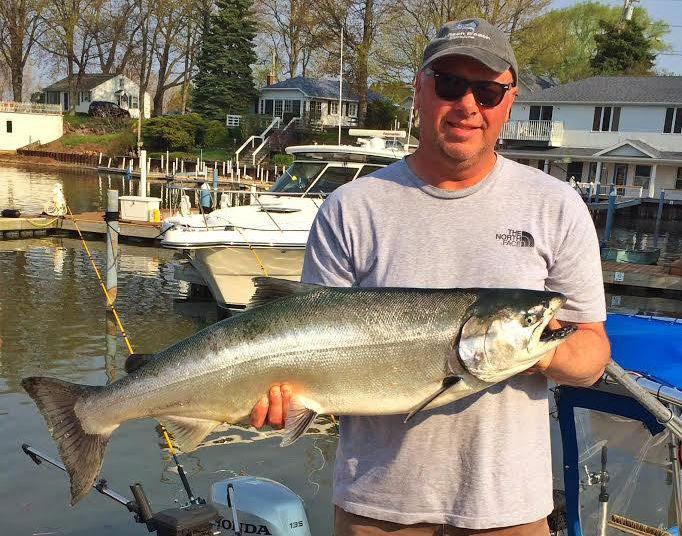
Jake Romanack of Michigan shows off a big king taken on the Niagara Bar in May.

Check out the leader board and the press releases on the LOC Derby website. You don’t need a big expensive boat to get it done. Time and time again, small boaters with less equipment find their way to the winners circle each and every event. However, being prepared for that big fish when it decides to rock your world is an important part of that winning philosophy when it comes to tackling trophy salmon and trout. “Don’t leave anything to chance, be it your vehicle, boat and motor, electronics or your fishing equipment.” There is no room for excuses and these bruiser fish have a great knack for finding those inferior links to your fishing approach.

Lantiegne relies heavily on his previous fishing history. He has either a mental or written diary of every spring king he’s caught over 25 pounds and every summer king over 30 pounds. ‘I know where it was caught, what it was caught on and what the conditions were,” says Lantiegne. “Start keeping records if you don’t already. Check out the leaderboards of the derbies because certain areas of the lake hold big fish certain times of the year.”

If big kings are what you’re after, Lantiegne’s approach is relatively simple. “Location is crucial for catching big kings,” says the Oswego captain. “Big kings usually avoid the heavier fishing pressure. I have never caught a king over 35 pounds in a pack of boats. Seek out quieter waters.” He also will focus on certain baits like a flasher-fly combination.

His favorite flasher is a ProChip or HotChip flasher in an eight-inch size. Leader length is critical, too – between 23 and 30 inches from flasher to fly. He fishes slower and deeper than normal, as well, targeting a speed between 2.1 and 2.5 miles per hour.

“Big male Chinooks spend much of their lives in 40 to 43 degree water,” says Lantiegne. “They love the deep freeze, so don’t be afraid to go down after them. Ignore the larger bait concentrations that attract smaller kings. Big boys can’t compete with the smaller, faster salmon for food.”

With the popularity of copper lines increasing in recent years, this is a perfect way to get your bait offering out away from the boat. “Copper lines run from a planer board or down the chute consistently catch my biggest kings every year. I’ve also found that running fewer lines in the water can lead you to catching bigger fish in the long run.”

When you finally do land that big boy, treat that fish with care. Don’t do anything to that fish that will cause it to lose weight, such as causing the fish to bleed from the gills. Keep the fish wet and get it to the scales as soon as possible. Don’t throw that fish on the scale until the weigh master is ready for it, too. An ounce can mean a difference between a grand prize fish and a divisional winner. You also have to be in it to win it. Every year there are heart-breaking stories of derby winning fish that never made it to the scales because someone decided that they would never be able to compete against diehard anglers or didn’t want to spend the money. If there’s a derby going on, take the time to enter and cash in!

Sabine Lake, Louisiana Redfish

We caught several above the slot fish including this 30” bruiser. Big bull reds above 40” prowl the same waters.

Big Redfish with Fishing Tom’s Guide Service
By Dick Jones

The medium sized alligator apparently heard the splashing of the fish we’d recently landed and he was eyeing the fish we were catching, but not interfering. When I saw my popping cork make a dive under the surface, I had one eye on the cork and the other on the alligator. The redfish shook his head bulldog fashion and made a couple of drag stripping runs. I could tell he was too big to horse him to the boat and I was concerned that the alligator might decide to come after him. As we slugged it out, I watched the gator. He showed no interest until the fish came to the surface. As we were netting the fish, I noticed him moving in our direction, but he only showed perfunctory interest. Eventually, we boated the red and he was a nice one, about 28 inches long.

We were fishing in the Sabine Lake Wildlife Refuge, south of Lake Charles, Louisiana. Located between Lake Calcasieu and Sabine Lake, it’s only open to the public March 15 to October 15 and until this year, it was not open to charter trips. As of this year, permits are available for guides. It’s as wild a coastal area as I’ve ever seen. We spent half a day there and I didn’t see a single thing that related to civilization. Not a single can, bottle, or piece of paper.

The Sabine Lake Wildlife Refuge is a great place to view birds and other coastal creatures, this six foot gator was curious, but didn’t cause us a problem.

Great fishing, great dining

What’s most remarkable about the Sabine Lake Wildlife Refuge is that you can have dinner in a great restaurant, spend the night in a comfortable, air conditioned room, and get up in the morning and spend the day fishing in a place that’s little different than it was two thousand years ago. Our trip to Lake Charles included dining on gumbo, shrimp, crabs, oysters, crawfish, and a Cajun sausage made of meat and rice, called boudin, at small, family owned restaurants around Lake Charles.

Enjoy the ride

Getting to Sabine Lake requires a serious boat ride of almost an hour. The early part of the ride on the Intracoastal Waterway is pleasant enough, but once we turned into the channel to get to the refuge, the ride into the refuge becomes almost as good as the fishing trip. There are crab pots and signs of civilization until you get to the edge of the refuge, but once in, all signs of humanity disappear. The channel twists and winds through the estuary and is a thrilling and inspirational boat ride in the early morning sunrise.

Generous Louisiana limits make for a heavy cooler.

Primordial angling

Many angling enthusiasts long for a fishing experience outside the normal locations. Outdoor people often find themselves yearning to go somewhere that seems absolutely primordial, a place where one might imagine no person has ever fished before. As the boat glides along the snaking channel that leads into the refuge, one gets the impression that you’re fishing virgin water that few anglers have seen. That impression is fairly close to true since the long ride down the Intracoastal Waterway to the entrance to the refuge discourages all but the most determined anglers.

More than just reds

Sabine Lake is a great place for speckled trout, redfish, and flounder, known as the Cajun Slam, but there are an abundance of black drum and sheepshead as well as less desirable alligator gar. On our trip, between the two boats, we caught every species mentioned. Louisiana keeper limits are much more generous than almost all other Atlantic and Gulf states with the limit on reds at five per day with one fish allowed over the 16 to 27 inch slot. On our trip, all of us caught at least one fish over the 27 inch slot limit.

Choose your tackle

We fished cuts in the estuary where the current was flowing through, carrying bait to waiting predators. This was shallow water fishing; most of the water we fished was only a couple of feet deep. Live shrimp, jig heads and Berkley Gulp or soft plastics work well in Sabine, as does a fly rod in the hands of a skilled caster.

More places for fishing

In addition to Sabine Lake, Fishing Tom’s Guide Service offers fishing trips all over the Calcasieu Estuary, which includes the Calcasieu River, Lake Calcasieu, Black Lake and the shipping channel to the Gulf of Mexico. We had two boats with friends, Michelle and Chris Cerino, of the History Channel’s Top Shot TV series, in a boat with Captain Tom while Cherie and I fished with his son, Tommy. Both boats limited out on reds with the biggest fish being a 30” bruiser.

Best times in Southwest Louisiana are spring and fall with summer offering great fishing. Fishing is good in summer if you don’t mind the heat, and winter offers lots of fish but it’s difficult to catch good weather and wind. The Louisiana license tag describes the state as a sportsman’s paradise and the Sabine Lake Wildlife Refuge is not only a paradise, it’s an unspoiled treasure.

To fish with our guide, contact him on the web at: www.fishingtom.net. For more information on the local area, visit www.visitlakecharles.org.

Tournament Fishing for Everyone

Hobie Bass Open 2016 at Kentucky Lake
Skilled Kayak Angler Field Growing Quickly

Matthew Scotch, fishing from his personally customized Hobie PA12, uses a jig-worm rig to fool another of several largemouth bass he caught in Kentucky Reservoir during the Hobie Bass Open 2016. Forrest Fisher Photo

Kayak Anglers from over 30 states and Canada gathered at Kentucky Dam Village State Park with the opportunity to test their fishing skills on the legendary reservoir fisheries of Kentucky and Barkley Lakes.  Their goal was to win big cash and prizes, with the top spot also earning an all-expense paid trip to represent Team USA for the 2016 Hobie Fishing Worlds – an event that is moving from China to Louisiana, USA, for 2016.

The 2-day fishing event was held this weekend, June 4-5, 2016, with the official tournament headquarters and weigh-in held at the Kentucky Dam Village (State Park) Lakeview Pavilion, just off U.S. Highway 641 in Gilbertsville, Kentucky.

The tournament protocol for weigh-in does not kill one single fish.  It is a Catch, Photo and Release format of fishing and measurement process.  Called “CPR Fishing” in a trademark name fishing tournament process invented by Mike Christopher, anglers work to catch their 3 largest bass (largemouth, smallmouth or spotted bass are allowed) each day in the Catch Photo and Release system.  Simply said, the angler with the largest total inches over the 2-day event will win the third annual Hobie Bass Open.

Software programming mastermind, Michael C. Christopher, is the inventor of the unique iAnglerProgram that allows Catch, Photo and Release (CPR) fishing to work. CPR fishing is the leading edge for future tournament fishing format and it makes data available for research and conservation studies. Most important, it allows fish to be returned alive on the spot, to the area the fish were caught from. Forrest Fisher Photo

What is unique here is worth mentioning.  None of the fish are needed for a physical weigh-in, as they are released alive, moments after being caught.  Above that, they are released right back to where the angler caught them.  Angler proof is provided on digital records.  No damage to the fishery!  No damage to spawning fish.  No dead fish at the marina weigh-in location.  Fun for all.  Clean system.  Clean process.  Clean rules for sustaining tournament angler events into the plans for a green future.

Many say we should mandate all tournament fishing to this manner of no-kill fishing conservation!  Everyone has fun and the fish live –this is with consideration to tournament fishing.  As many do enjoy an occasional fish fry on those non-tournament days.

Steve Barga, a local Kentucky Lake bass pro, often uses some pretty wild and large artificial baits to catch the biggest of bass in this large inland waterway. Forrest Fisher Photo


Why is this important?  Because on a busy and popular waterway, there are as many as three of four tournaments each weekend day.  Hard for the fish populations to survive in that kind of possible continuous live-well habitat.

Also unique, Hobie pays out 100% of entry fees!  The entry fee payout is divided appropriately with one place for every 10 entrants.   There were over 100 entrants in this contest this year.  It is growing quickly from 33 the first year, to 78 the second year to 108 this year, with only a $125 entry fee.

These anglers have formed a brotherhood among themselves, with perhaps the best part of this event, the technique hiding strategies, the sharing of secrets yet to be told and the clamoring applause when someone wins with all of this concentrated talent.

The Hobie fishing tournament format allows ordinary working-class folks to fish for big prizes in kayak rigs made by any manufacturer and let’s face it, anyone can win with a little luck.  After looking at several manufacturer kayaks though, the Hobie stands alone for quality.  They are durable and stable in the water.

Popular rods used included St. Croix, Shimano, Loomis and Daiwa, with reel assortments that included Garcia, Lew’s and Shimano among the popular models observed.  Braided line choices were 20-30 pound text Power Pro, Sufix 832, Seagar Smack-Down and other brands.  Fluorocarbon leader attachment lines in use included Fusion, Berkley Golden and Seagar.  Some anglers used all fluorocarbon or all braid, others were quite simple with straight monofilament of 6 or 8-pound test; get the lines in the water!

Lure choices in the boats included jig/pig rigs, diving crankbaits, plastic worm rigs, floating frogs and simple jig rigs.  Placing the right lure in the right place did the usually expected thing, anglers caught fish.

The early morning bite was shallow on both days, with brighter skies moving the fish offshore to creekbed edges in deeper locations.

Through all the fishing with kayak anglers fishing all along the 100+ mile impoundment, hi-speed bass boats went running by at 60 mph and the fish didn’t seem to mind.  The kayakers use elevated tail flags in hi-visibility colors to assure they are noticed by the anglers in the big rigs.  It seems there is a new kid on the block.

The Hobie Bass Tournament Team includes Tournament Director, A.J. McWhorter (black shirt) – Kevin Nakada (center) and Morgan Promnitz (right) – both tournament administrators, verify angler fish and data submissions for accuracy. Forrest Fisher Photo

The anglers I talked with on the water all seemed to enjoy these two simple things: peace and quiet.  Unlike many other popular bass tournaments we watch on TV, there was no ranting or raving, just simple anticipation, positive tone talk with us on the camera boat circuit, and the anglers even shared what they were using with us.  I found this uncanny and enjoyable.

I found myself secretly pulling for every angler we stopped to talk with.

When it was all over, the 3:00 p.m. tournament ended bell had sounded, anglers needed to be in line to turn in their personal picture puck.  Tournament director, A. J. McWhorter, working with associates, Morgan Promnitz and Kevin Nakada, reviewed the accuracy and status of the considerable data collection submitted by the anglers and organized using the iTournamentAngler.com software created by Michael C. Christopher.  With the winners about to be announced in the Kentucky Dam Lake State Park Pavilion Center, the gentle rumble of good-natured tale-telling quickly turned silent with anticipation.

My heart was hammering at a bit higher rate for one of these lucky anglers.  This was exciting.  There were some wide-eyes across the angler audience, anticipation was higher for some, even youth anglers are part of the mix in a separate youth division.   There was also a few anglers with that savvy, veteran face that reflected many years of long sunshine exposure and much fishing experience.  It is a view that we still call the “confident look,” it exudes proper mental preparation and the knowledge that all is ok, win or not.

Some angler’s fish in this tourney for the pure fun and the enjoyment of being committed to this brand new, leading-edge style of tournament fishing, others are here to do just one thing, fish to win.  Both types get along and there is an obvious air of humility and detailed information sharing in the angler zone when the fishing competition has ended.

The winners are totally humble and gracious. The winner of this tournament event this year was a fine fisherman, his name is Ron Champion.  With 57-1/4 inches on day 1 and 51-1/2 inches on day 2, Champion tallied 109-3/4 points for 1st place cash of $3,500.

Matt Scotch with 108-3/4 points came in second, earning $2,350, while Jay Whalen took third with 106-3/4 inches for $1,500.  Cash payouts went through tenth place to Lucien Gazelle, from Michigan, with 97-3/4 inches for $125.

tournamentfishing5

All of the anglers said they will be back next year.  We are watching the future of modern fishing unfold with these Hobie angler tournaments.

Lake Erie & Niagara River Status Update

lakeriverstatus

New York State Fishery Biologists Outreach Event – June 21, 2016

An upcoming free seminar to update the public about the status of the Lake Erie and Upper Niagara River Fisheries is scheduled for Tuesday, June 21 from 6:30 to 9:30 p.m., at Woodlawn Beach State Park’s Lodge, Blasdell (Erie County), by the New York State Department of Environmental Conservation (DEC).

The free seminar will begin with informal discussion and poster exhibits, followed by a series of presentation topics on Lake Erie and the Upper Niagara River fisheries.  These will include an opportunity for angler input on a variety fisheries management activities.  The meeting will conclude with questions and an open discussion.

“DEC is committed to sound management of Lake Erie and Upper Niagara River fisheries to maintain high-quality angling opportunities and associated economic benefits,” DEC Regional Director Abby Snyder said.  “This event provides an excellent opportunity for anglers to interact with DEC experts who study and manage Great Lakes fisheries.”

Key members of Lake Erie and Niagara River’s fisheries management and research community will present on Lake Erie fisheries management and assessment activities for steelhead, walleye, muskellunge, research initiatives, and habitat improvement projects.  This seminar is sponsored by DEC’s Lake Erie Fisheries Unit and Region 9 Fisheries offices.  Anyone interested is welcome to attend this free event and registration is not required.

The Lake Erie and the Upper Niagara River rank among New York State’s top fishing destinations, especially for walleye, smallmouth bass and steelhead.

A recent survey (2007) of statewide anglers estimated more than 800,000 angler days spent on these waters.  The estimated value of these fisheries exceeded $22 million to the local New York economy.

For further information contact Don Einhouse, Lake Erie Unit Leader, (716) 366-0228.

Tuning Up for Summer Walleye – Part 2

Find the Forage, Match Your Lure, Catch Fish!

Bob Rustowicz has been a tournament winning angler for many decades- he fishes hard and often, following bait schools near his favorite fishing areas in Eastern Basin Lake Erie. This 11.42 pound walleye is currently leading the 32nd Annual Southtowns Walleye Association Tournament.

When tournament anglers travel to a waterway that they know, it is often a brand new ball game because everything changes week to week.  Sometimes it’s better not to know the waterway, that way you can’t make the same mistakes by fishing the same way you did last time when you caught fish and now, the conditions are changed.  Bad habits can cause bad fishing days, of course, we all know there are no days that are actually bad days to be out fishing!

You may know where the creek beds and the sunken roads are in reservoir lakes, the offshore shoals and reefs in natural lakes – maps can tell you that too, but it’s the other variables that affect forage location.  Where the forage schools are controls where the predator fish are and what they will strike.  As you choose your lures, this is a big key to catching fish.

Plain and simple, walleye like to eat.  As waters warm, they eat often.  Their metabolism rises and they have no choice, so they stay close to forage school locations.  As anglers, it is up to us to understand how the wind direction and water temperature changes affect the forage.  It pays to know as many details as possible about the forage community.  What types of forage live in the waterway?

On Lake Erie, the deep eastern basin off New York and Pennsylvania offers many forage types, but the primary forage are emerald shiners, rainbow smelt, yellow perch and round goby.  The walleye will key on whichever species has the most abundance where the walleye are located.

Walleye favorites in Lake Erie are the emerald shiners and smelt, so angler lures that mimic those forage types – when those forage types are available, are usually taking fish to the boat.

Usually, the smaller walleye key on the emerald shiner minnows, the larger walleye key on the longer and heavier smelt, but when or the other is in low supply, the fish switch in favor of abundance.  When these two forage are hard to find, the walleye move toward shore into shallower waters and key on the yellow perch.  Again, the walleye locations vary with forage density locations.

So while I am not a biologist, I have been fishing out there for nearly seven decades and have learned from the best of the best anglers.  Today, we have so much equipment to help us cheat fair out there, since it now largely a matter of who can afford the best equipment to catch fish with science and technology helping us figure out where the forage is.  We can monitor, water temperature, wind speed, water current, boat speed, oxygen content and Ph to narrow down where we fish any length of time.

To simplify, watch your graph, study the wind and wave weather maps – the resulting current eddy’s control the flow of phytoplankton and photoplankton. The young of the year emerald shiner and smelt nursery schools feed on these the larger forage is never too far from them.  The walleye are nearby.

The wind maps can be found here: http://www.coastwatch.msu.edu/erie/e3.html.

Wind maps and lake current maps are available for all the Great Lakes at this link sector.  These maps help you locate the surface temperature of interest and help you figure out where the forage are located in their highest density.

Rig up your preferred fishing tackle, just allow for adjusting to the baitfish that you locate to catch fish.  As we transition into summer, the temperature cycles have been fluctuating and the wind shifts the lake currents topsy-turvy, often causing short duration turnovers.  When you leave the dock and head out about a mile or so, check the water temp.  If it’s 45, turn around and go fish somewhere else.  Or, head out about 15 miles to get to the other edge of the thermal break.

Match the hatch is the key rule.  Mimic the forage.  New model lures always seem to catch more fish than old stuff for some reason.  Are the fish educated?  Nope.  It’s just that they seem to always slam new baits, new colors, new sizes better than old stuff.  Can the old stuff still work? Sure it can, but sometimes only on those days when the fish are really gorging themselves.  Funny how that works.

summerwalleye2_3

So I am always trying new lures. The new effective lures from my end include those that look like smelt.  This one from Live-Target Lures simulates an elongated school of baitfish.  I really like it, especially when it’s working!  It’s ideal when walleye are feeding on small baitfish, has a wide body profile, two hook or three hook design dependent on size, it suspends and is silent.  The EBB90S in pearl/olive (color 801) is a 5/16 ounce suspending lure, 3-1/2 inch long that will dive 3-4feet.  It has two hooks in size 4.  The EBB115S is a 4-1/2 inch model and has three hooks in size 6.

summerwalleye2_4

Another of the new lures that has met with recent success is this one from Rapala.  Another of the newbies that has attracted some of the country’s best anglers for many species is the Rapala Shadow Rap (SDR11MBS).  This lure works best when there are also gizzard shad in the forage mix, as sometimes happens here in WNY in spring.  It has flatter sides and offers a swimming minnow action, has a rattle, will suspend and stay there, a very effective lure to cast or troll, especially when fished as a jerk bait.  The moss back shiner color has been my favorite here.  It runs just 2 to 4 feet deep, but works well off the boards with weight or a diving plan or 3-color lead core for the June timeframe.

These lure types are also offered in deeper diving models if you prefer to fish without lead core or weights as the fish head out deeper.

In the Southtowns Walleye Association Tournament on Lake Erie’s eastern basin, the largest fish so far include (June 13th) for first place: 11.42 lbs, second: 10.72, third: 10.51 lbs.  For the junior anglers under 16, first place is 9.52 lbs, second is 7.80 and third is 7.75.    Bob Rustowicz is leading with the big fish.

Tight lines!

Tuning Up for Summer Walleye – Part 1

Lure control, line control and depth control – an Evolution

Finding the fish is only half the battle, now you need to catch them, AND you need to catch the biggest fish to win if you are in a contest. How to do that is part of this series.

Provoking fish to strike even when they are not hungry, that is what wins tournaments.  Veteran anglers that catch their fill of fish on each trip know that finding hungry fish is one approach, but provoking fish to strike will catch fish almost anytime.  Lure control, line control and depth control will help you get there.

The “good lure – bad lure trail” starts a long time ago, in the 70’s.  Crankbait lure manufacturers learned how to mold plastics, imbed hook-holding points, add colors and modify actions to control wobble, wiggle, shake-frequency and other features yet to be defined at the time.

There were also the old cedar, balsa and other wooden lures, which at the time were often not as reliable to keep hooks from pulling out.  The old balsa Rapala’s were the exception and were always a front row seller.  The old lures were all beautiful and traditional, but they didn’t hold up like the plastic lures.

The plastic lures didn’t need to be repainted either, because they had built-in color and internal fish-like markings.  If you remember the term “plastics” from the movie “The Graduate”, it changed the world of the movie actor in the movie, it also really forever changed the world of fishing too.  That’s progress.

In 1973 in Elma, New York, I met master angler, Russ Johnson.  He had learned how to catch fish with plastic lures like no other man alive – that I knew, no other man except, maybe, Buck Perry, the king of controlled depth fishing lures.  A humble man through all of his fish-catching success, Johnson was willing and able to share what he had learned, or I should say, what he invented – because he was the Eastern Basin Lake Erie leading edge fishing technologist back then, with anyone that would venture to ask “how do you do it?”

Even during the hottest of summer seasons, this guy always his limit of walleye or bass, whichever species he was fishing for.

About that same time, the Lowrance “green box” depth sounder brought electronics into the fishing world and “hi tech” had started that new journey for many of us.  It would be a journey into the once very placid world of fishing secrets and hand-me-down traditions for “secret spots”, to another trail, a process for finding fish every time you fish with gadgets that help you see them.  That trail for learning was set!  Except, even if you found the fish, you might find like anglers do today quite often, they just would not bite! You still need to provoke fish to strike to catch them ALL THE TIME.

Finding the right lures to use is based on YOUR EXPERIENCE to understand HOW-TO-TUNE those lures so they deliver their MAXIMUM APPEAL where you place them for fish to see, or for fish to be provoked by, those lures when they are performing during your fishing time on the water. A lure in the right color, but not performing well is ineffective!

Johnson learned to use the new electronics and incorporate it with his fine points of controlling lure action, lure depth and how to eliminate fishless water way before anyone ever wrote about it.  His fish coolers were always open because the fish he caught were so big and so many in count, the coolers were too small!  No joke!

Today, he is in his 80’s and spends much of his time with a similarly aged angler, Bob Carlson, teaching youngsters how to tie proper fishing knots.  When he fishes, he is so good today that catch and release is his common practice because we know better now – you can deplete the fishery.

His favorite lure for catching walleye and bass back then was a Rebel Deep Wee-R, but there was more to it than just using that lure model.  Johnson also controlled his fishing line (diameter size), the lure color, rod length and rod action (resonating parabolics matched with lure type and boat trolling speed), his fishing reel (calibrated for distance deployed by cross-feed revolutions – feet per cross-feed, today we have line counters…much easier), and the boat speed.

There was also the not-so-small matter of his fishing knot and the size of the snap-swivel he attached between the line and the lure.  While Johnson is slowing down a bit today, he uses – to this day, a Palomar knot with a size-2 ball-bearing snap-swivel.  Johnson had fishing down to a science before anyone else called it “the science of fishing”.

The real trick?  First, tuning the lure.  He advised me from the first day, “Never tune any lure from the boat.  Too much swish from the boat that affects the lure action and it will be tuned improperly.  Get to a swimming pool, turn off the filter, cast it out to the other side and then tune it there.”  Of course, you had to first add the snap-swivel and proper knot, trimmed to the shank – so no overlap of the end loop, then after the cast, using a Garcia Mitchell Ambassador 6000, a level wind reel with a cross-feed line pickup, cast it to the other side of the pool and reel it back starting at about 2 miles per hour.

Johnson would say, “Get it running about straight down first, then turn up the speed to 5 miles per hour, that’s about as fast as you can crank with a 6.3 to 1 ratio bait casting reel.  Fine tune the front eye of the lure, but also tune the underside wire hook holders molded right into the plastic – they matter! ”

When you got this technique all set up right, a lure advertised to run 10 to 12 feet down would hit the bottom in 25 feet of water when it was trolled at 2.5 miles per hour and run 125 feet behind the boat with 8-pound Trilene XT monofilament fishing line.  Add thinner 10-pound Fireline today and they go much deeper!

Adjust the line length or the boat speed to modify depth and distance down.  Johnson had a little green book where he kept all his “speed trolling notes”.  Johnson proved that in virtually any body of water, he could devastate any big fish population in a matter of hours, catching mostly the biggest fish.  He controlled all the variables before us modern day anglers called them “variables”.

What Johnson learned all by himself and what he shared with a few lucky angler fishing folks, including me, is more or less common knowledge today.  One thing I know for sure, many anglers don’t heed what they have learned even on their own time within their own domain of fishing experience.  Especially true during tournament time.  He kept a logbook, great advice for every angler – keep a logbook!

Next week starting on June 11, 2016, the biggest amateur walleye association in North America – the Southtowns Walleye Association, will take to Lake Erie to fish for nine straight days looking for the single biggest fish to bring to the scales.  More than 1,000 anglers will seek to find the biggest tournament fish in eastern basin Lake Erie for the largest cash prize – This is a $35,000 tournament!  To check in or sign up, visit: http://www.southtownswalleye.com/tournament.

Getting to the winners circle is never easy, but it is possible for anglers who do learn how to control their variables best. Luck still matters, improving your luck depends more on you.

During the spring to summer transition, when colder water lingers into June, the biggest fish seem to come from the Dunkirk and Barcelona sector.  Then again, the Buffalo to Sturgeon Point fishing zone has yielded many 14 pound monster walleye too.  Finding that big fish and getting it (her) to strike your lure is the challenge.  That’s where the skill of anglers that understand how to search for schooling walleye and that singular local big walleye will play into finding the winners circle.

Use modern tackle, including planer boards, to get the lure away from the noise of your boat will help.  Don’t be afraid to start experimenting.  Change one thing at a time until you find the winning combination; add weight, change lures, colors, troll speed and line trail distances until a fish is caught.  Then switch all lines to that combination and prepare to get sore arms.  It works that way on the good days!

Pray for some good fishing days!  If you happen to be on VHF Channel 68, give a shout to “Baby Bear”, that would be me.  If I’m catching, I’ll share information on where I’m not!

Tune your lures first, keep track of the important things you discover in your logbook.

Wishing everyone who drops a line fishing anywhere in North America the best of good days out there and the best of good luck.

Polovick Lightning Strikes Twice in Lake Ontario

Master Angler Wins Second Grand Prize, says, “Timing is Everything!”

Marty Polovick of Lockport, New York, believes that lightning CAN strike twice in the same spot, that is, as far as winning the Grand Prize in the Lake Ontario Counties (LOC) Trout and Salmon Derbies and his fishing rod is concerned.

Polovick won his second Grand Prize, this time in the spring contest held May 6-15, 2016, by reeling in a 26 pound, four ounce king salmon to take the $15,000 top prize.  He also earned an extra $500 for big fish of the day and a check for $1,000 by catching the largest salmon by a Lake Ontario Trout and Salmon Assn. (LOTSA) member.  He had previously won a Grand Prize in the 2011 Summer Derby with a 36 pound, 14 ounce king.

On the final weekend of the derby, the weather forecast wasn’t pretty.  They were calling for high winds on the lake Saturday, but not until after 11 am or so.  The crew of Doug Parker of Lockport; Matt Dunn of Newfane; and Matt’s father, Marc Dunn of Lockport along with Polovick boarded Matt’s 27-foot Tiara aptly named “Streaker” out of Bootleggers Cove in Wilson.  The water was flat early in the morning and they headed west to an area off Six Mile Creek where they boated three nice salmon in the high teens.  Using an 8-inch Dreamweaver Spindoctor (white glow and green dots) rigged with a white John King Baithead with a piece of Crowes Cut Bait, they put their downrigger on the bottom in 100 to 110 feet of water.  The fish hit between 8:30 and 9 am, taking Polovick about 20 minutes to reel the king to the boat.  When they hoisted the fish up onto the handheld scale, it was heavier than they thought so they pulled lines and ran into port to weigh their prize catch at Bootleggers.  By the time they finished up weighing in the new leader and filling out the paperwork, it was too rough to go back out into the lake.  Timing is everything.  It’s interesting to note that Parker, Dunn and Dunn tagged teamed to tie for the Grand Prize in the spring of 2014, but the timing was off by a week. They had to settle for first place in the Salmon Division. Again, it was that timing thing…but this time they got it right. They will split the cash up equally between the four of them.

“It was a team effort all the way around,” said Polovick who is no stranger around local Niagara County fishing circles. He is active with LOTSA, serving on its Board of Directors. “We also won this for Pat Comerford of East Aurora who passed away earlier this year. We wouldn’t be here if it wasn’t for him as a mentor and fellow fisherman.” Pat was also a previous LOC Derby winner. Unfortunately, sometimes time is too short.

First place in the Salmon Division was Tracy Lindsay of Seneca Falls, NY with a 25 pound, four once king caught opening weekend, May 7. He was fishing with Capt. Scott Fletcher of Kings Ferry, NY aboard his 25 foot Starcraft named “Blue Moon”; and friends Eric Carlson of North Syracuse and Steve Fiorello of Liverpool, NY. Lindsay won the $2,000 first place prize plus big fish of the day at $500.

“We were fishing west of Wilson about two miles during the Wilson Harbor Invitational Tournament,” said Lindsay at the Awards Ceremony. “We were using a Michigan Stinger “42nd Spoon” working a double header at 7 am. Our downrigger was 130 feet down over 180 feet of water. Twenty minutes later we boated the big fish. It helped us to place second in the WHI, too.” He hopes to use some of the winning proceeds for a new deck at home.

In the Brown Trout Division, Ryan Massey of Oriskany Falls, NY was fishing with Capt. Dave Wilson of Oswego aboard the captain’s 28-foot Baha named “Spankmayer.” Also on board was Ryan’s nine year old son, Aidan, and a couple of buddies from Vermont (Steve and Dave). On the first Saturday, they were fishing east of Oswego when they hooked into a nice fish at 7:45 am. They had been using Otter boards and placed a Smithwick stickbait in blue and silver about 100 feet back of the board. Less than 10 minutes later, they were netting his 16 pound, two ounce brownie.

“It wasn’t the biggest brown that I’ve ever caught, though,” said Massey. “The biggest I ever caught was one better than this one … but I wasn’t in the derby. I would have won. Now the rule is for everyone in the boat to be in the derby and it finally paid off.”

Second place brown trout was a 15 pound, seven ounce fish that was hauled in by Mike Spinelli of Rochester. To go with the whole “timing” theme, he caught is fish the final day of the derby in Irondequoit Bay – because the lake was too rough from high winds.

“I was fishing with Steve Greive of Irondequoit and Dave Allison of Greece aboard Steve’s 25-foot Sea Ray named ‘Skamaniac.’ I knew there were browns in the bay, so we just trolled around with a chartreuse Rebel Fastrac 100 feet behind the board and we hit the fish over 60 feet of water. It only took about five minutes to bring the fish in.”

Greive also had a fish on the board, a 15th place brown at 11 pounds, four ounces; and Spinelli also helped David McGowam of Rush, NY with a, 11th place fish – a 12 pound, eight ouncer caught off Mike’s boat. Both of those fish were caught in the lake.

The lucky Laker Taker was no stranger to the winner’s circle either. Patrick Barber of Niagara Falls was fishing with his brother Richard (also from Niagara Falls) on Friday the 13th. While trolling the Niagara Bar off the mouth of the famed Niagara River aboard the infamous “Killer B’s” Crestliner, the duo was starting to face rough conditions on the lake. Dick wanted to go in. As he started to pull rods, the 27 pound, 8 ounce fork tail hit their chartreuse holographic Kwikfish rigged with Hammerhead cowbells. “And this time my brother was able to net it successfully!” That’s another story for another time.

Richard placed fourth in the spring contest with a 21 pound, six ounce lake trout. All told, their derby winnings are over $80,000 now for the “Killer B’s” fishing squad. It was weighed in at Creek Road Bait and Tackle, a new last minute addition for the spring to save the day in the weigh station department.

Second place lake trout was a 25 pound, 11 ounce fish out-fought by Robert Batchelder of West Burke, Vermont. He was fishing out of Wilson with Norm Paquette of Lyndonville, VT (aboard Norm’s 24-foot Thompson named “Care Free”); Richard Rice of Sutton, VT; and Michael Rice of Lyndonville, VT. They were trolling a flasher-fly rig west of Wilson about half way to the Niagara Bar, 135 feet down over 150 feet of water on the downrigger, when the fish hit on May 10 at 7:15 am. “We use to fish with a friend who made his own ‘Harris’ fly – green, yellow and white with sparkles – behind an E-Chip flasher that was green and white. That’s what we used this time. It was the biggest laker of my life and it came at a good time.” Timing is everything.

Top Youth Lake Trout was a 13 pound, 12 ounce fish reeled in by Zachary Enos of Canandaigua. He “caught it in Lake Ontario” according to his expert testimony, weighed in at Hughes Marina in Williamson.

In the Walleye Division, Tim Farmer of Dexter led the pack with an 11 pound 14 ounce fish from Chaumont Bay off Jefferson County. He was fishing with his sons, Paul and Richard, as well as Jan Coburn of Henderson on the opening day of walleye season, May 7. They were fishing out of the “Lucky Lund,” a 19 footer that does them well. The elder Farmer, a charter captain for over 30 years, attributes his success to the “luck of the Irish … and being at the right place at the right time.” In addition, his mom had passed away around St. Patty’s Day this year and it could have been a little gift from above.

“I like fishing worm harnesses and tried to get the boys to put one out that afternoon,” said Farmer. “They finally listened to me and we put a blue and silver Northland Bait worm harness out 100 feet back from the board. Our next fish was the winner. We thought it was a pike when it hit. This was a proud moment with my boys.” Speaking of the sons, they also place high in the contest, finishing in third and fifth with an 11 pound, six ounce and a 10 pound, 13 ounce fish respectively. They have also placed in the top two in the Walleye Division four times previously, winning twice.

Sometimes the timing is off just a little bit, like Dan Peschler of Pulaski can attest. He weighed in an 11 pound, 14 ounce walleye the day after Farmer’s catch with a fish of the same weight. First angler in to the scales is the tie-breaker. Peschler was fishing with Robert Holdsworth of Pennsylvania at 2 am in Oswego Harbor and his fishing partner was sleeping aboard Peschler’s 16-foot Mini-Fish Magnet, a DuraNautic. The walleye hit a black and silver Smithwick lure trolled 50 feet behind a mini-Off Shore board over eight feet of water. Peschler is another regular in the winner’s circle.

Jared DiFrancesco of Baldwinsville took home the youth trophy in the walleye division with a nine pound, three ounce fish. “We were fishing in 20 to 30 feet of water using planer boards,” the 14-year-old youngster said. “During the week we fished there were a lot of snags. We lost nine lures.”

His lunker walleye was caught on May 8th around 4 pm in the afternoon. The youngster was fishing with his father and Tony Chatt of West Monroe, last year’s Lake Ontario Pro-Am Challenge Cup winner with “Five More Minutes.” The winning fish took a Smithwick stickbait. It was weighed in at Woody’s Tackle in Pulaski. DiFrancesco is a ninth grade student at Durgee Junior High School and plays soccer and is on the track team. Asked if fishing, soccer, and track are his favorite sports the youngster quipped, “No… messing around is my favorite.”

Next up on the LOC Derby calendar is the Summer Derby, set for July 1-31. The Fall Derby is slated for August 19-September 5, 2016. For a complete leaderboard for the spring contest go to www.loc.org.

Spring Crappie Fun

Learning the String of Seasonal Transitions

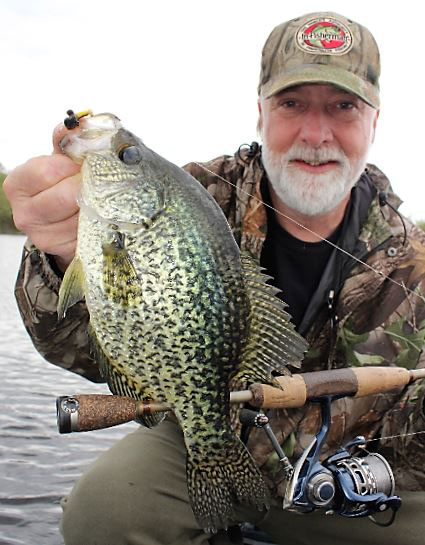
springcrappiefun1Dogwoods and wild flowers punctuate the forest with color, yet crappies remain in pre-spawn mode.  Spring is well underway before crappies begin to crowd ever-closer to spawning habitat.  Foraging remains the priority.

In many environments, crappies begin to filter out of dense wood cover as new weed growth rises from the bottom.  Plants offer an entirely new menu of invertebrates and the minnows that pursue them.  New cabbage growth is especially attractive for crappies, but elodea, coontail and other weeds, will draw them too.  Not unusual to see crappies in two feet of water or even shallower when the first weeds pop up and many anglers fail to search for these extremely shallow fish.

Reeds become increasingly important to crappies as water temperatures approach 65°F.  The relatively hard bottom that reeds thrive in is preferred by nesting crappies.  In the absence of reeds, crappies may move back into wood to spawn.  Reeds, stickups and wood cover offer the kind of vertical cover they like for spawning.

Before spawning, crappies are moving around from wood to weed cover and back.  They also move shallow during stable weather, then move out past the first breaks into 10 or 15 feet of water to suspend lethargically during cold fronts.  Then, as the spawn progresses, not all crappies spawn at the same time.  Crappies that use small bays and canals spawn early, followed by crappies in larger bays, and finally by main-lake spawners, where the water warms slowest.

springcrappiefun2

Soon after spawning, female crappies abruptly leave to sulk and recuperate in deeper water, while males remain to guard the nests for several days.  Soon after, all crappies begin to spread out into various summer patterns.  Some go to breaks near deep weed lines.  Some follow plankton veils in open water.  Some find brush piles, lay downs, or stake beds.  Some may relate to boulder fields, rocky points, or off-shore humps.  In most cases, crappies alternate between suspending near those cover options and burying themselves within that cover.

So these many movements within such a short period of time keeps anglers on their toes.  My favorite program for finding crappies fast, then catching numbers, from this point in the season (early/mid-May) right through fall is the same every year.

I start each day with a fast, 7-foot ultralight rod from G. Loomis or the St. Croix Panfish Series coupled with a spinning reel the size of a Pflueger President ESP30—not a tiny reel, but not a big one either.  The spool is filled with 4-pound Maxima Ultra-green monofilament and the lure of choice is a 2-inch Kalin, Berkley or Yamamoto Grub, on a 1/32-ounce jig head from Gopher Tackle or Northland.

The idea is to swim the jig slowly on a horizontal plane and the 1/32-ounce head creates the perfect speed for crappies.  Not too fast and not too slow.  The presentation is simple.  Cast, allow the jig to sink anywhere from a foot to 8 feet, depending on the depth of the cover or bottom in the area, point the rod tip down and slowly reel.  Keeping the lure horizontal, not rising or dropping, requires a very slow retrieve.  Watch beside the boat to create the cadence.

springcrappiefun3Monofilament line keeps the light jig from falling too fast in spring and as the water warms into the high 70°F range, I switch to 4 or 6-pound Berkley Fireline in order to speed things up.

Even when crappies won’t bite the grub, the most active fish will follow it, so wear polarized sunglasses and watch closely.  A white, yellow, or chartreuse grub is easy to spot, providing a better chance to scan behind it before crappies spook from the boat.

Once crappies are found, the jig-grub combo may keep right on catching them and may not.  I always have an 8-foot St Croix Panfish Series rod rigged with a small Thill or Northland slip float handy, just in case most of the crappies are spooky or less active.  And, it’s critical this time of year, to be prepared with 2 or 3 different kinds of bait.  Crappies can switch overnight from minnows to invertebrates and back again.  Typical on my boat to find a scoop of crappie minnows, a few dozen panfish leeches, and at least 100 wax worms, maggots, or angle worms on board when chasing crappies.

Critical, too, to use jigs with at least a size #4 hook for crappies, or size #4 to size #2 Aberdeen hooks.  Big crappies can shake loose or rip free from those smaller hooks on the 1/64 to 1/16-ounce jigs we commonly use.

As the blooms of spring fade and the greens of the forest darken, crappies make all kinds of movements involving transitions between different forms of cover and from one kind of forage to the next.  They won’t move far, but anglers have to be prepared to search a little every day.  The rewards are resplendent in sparkling hues of green, gray, blue, and purple, not to mention those golden-brown fillets sizzling in the pan.

Hobie Bass Open at Kentucky Lake Dam Village

Tournament bass anglers no longer need to spend $80,000 for a hi-test fishing rig with the technological advent of sophisticated, lightweight material that has allowed foot-powered fishing boats that fit into the back of your truck or on top of your compact car, to create a brand new world of affordable fishing for bug bucks or simple fun – tournaments too. Photo by Christina Weber

June 3-5, 2016 – Epic Bass Fishing Event

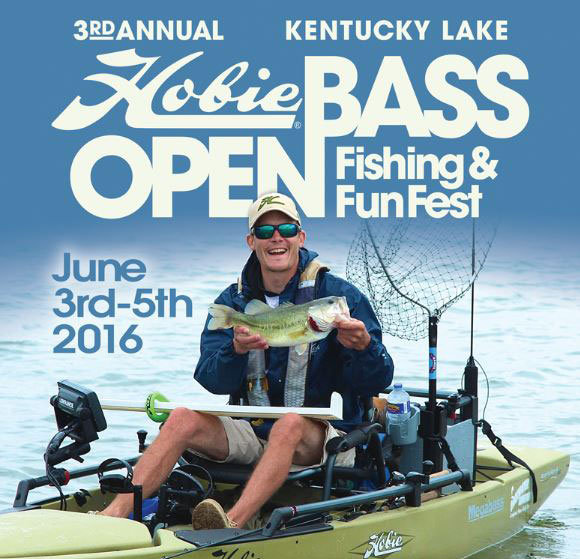
If you are a kayak angler and you fish for big bass, you will want to be sure to check out the third annual Hobie Bass Open.  Presented by Marshall County Kentucky Tourism and Kentucky Dam Village, the classic event will take place at Kentucky Dam Village State Park, June 3-5, 2016.

The Hobie Bass Open will be one of a series of qualifying events in the United States and Canada for the 2016 Hobie Fishing World VI Tournament.  The winner will not only take home the crown, cash and prizes, but will also be invited to join Team USA at the World’s next fall, all expenses paid!

Anglers are invited to register for the event by logging onto iAnglerTournament.com.  There is an adult division and a youth division.

The event is conservation oriented and may be setting the accountability checkpoint pace for the way all bass tournaments might be run someday using catch, photograph and release (CPR) rules.  Tournament anglers measure and photograph their top three bass during each of the two days, to be scored by total aggregate length.  Eligible species include largemouth, spotted and smallmouth bass on human-powered kayaks.   No electric motors are permitted in this one.

There are not many tournaments that pay out 100% of the entry fees, but this one does.  That means big bucks for the top anglers.  For non-competitor visitors, there is much to watch and learn from these professional kayak anglers.  Above that, visitors and families will find there is a “Hobie Fun Fest” event held simultaneously from Kentucky Dam Village Beach.  Hobie invites all competitors and the general public to bring their family and friends to join in the festivities that will be held Saturday and Sunday, June 4-5.  The Hobie Fun Fest is FREE and adventurists who enjoy kayaking will discover the incredible opportunity to demo the many forms and sizes of Hobie kayaks, including those cool, new SUP’s (Stand-Up Paddleboards) that you can fish or catch a few comforting sunrays from.  Even elder retirees are saying that these new craft are comforting to them because they offer warm thermal sun ray heat and exercise at the same time.  Check ‘em out here.

There will be raffles and prizes, food and fun, plus media coverage and a look at big fish catching techniques to be shared by onlookers and competitors.  The 1st and 2nd place finishers will qualify for the 6th Hobie Fishing World Championship.  Along with the prize money, the overall winner will collect top prize money plus free airfare, accommodations and entry fee covered courtesy of Kentucky Dam Village and Hobie Cat Company.

Questions about the tournament location and facilities, contact Kentucky Dam Village State Resort Park, Gilbertsville, KY, 42044; phone: (270) 362-4271; web link: http://parks.ky.gov/parks/resortparks/ky-dam-village

Competitors with questions can contact Hobie tournament supervisor, Morgan Promnitz, at MPromnitz@hobiecat.com.

Tournament Sponsors include Lowrance, Power-Pole, Ram Mounts, YakAttack, Fugoo, Daiwa, St.Croix Rods, Bassin’ Magazine, Marshall County Kentucky Tourism and Kentucky Dam Village.

hobiebassopen2

The Crappie Compass

Crappie Fishing with Straw – Part 3 of 4

Matt Straw is among a handful of true authentic and effective crappie anglers who are willing to share the passion for crappie fishing as well as some of the deepest secrets of just how to catch these tasty and often finicky fish.

Kirk Hansen, Iowa Department of Natural Resources Mississippi River research biologist, has been conducting a tracking study with crappies in river backwaters for many years now.  During the harsh winter of 2013-2014, he watched helplessly as most of the crappies he tracked were destroyed in an extreme high-water event.

“When the islands flood during winter, crappies die,” Hansen said. “They absolutely need to be out of the current when the water is in the 30°F range.  They need current breaks behind islands, in backwaters, completely out of the flow.”

Laboratory observations reveal that crappies can’t even swim upright in water temperatures of 35°F or less.  Crappies just might be the most temperature sensitive fish found in the northern United States, especially when the water is cold.  Crappies spawn in water temperatures approaching and surpassing 70°F, and almost right up to that point they are seeking the warmest water and the greatest stability they can find.

Now look at your boat and all the electronic gadgetry attached.  In spring, the only tools really required to find crappies are the temperature gauge and the trolling motor.  Put the trolling motor down and start hunting for the warmest water in the bay or backwater near those areas where they eventually spawn, fishing as you go.  Where to start?  Two keys:
1) Areas with the most sun exposure
2)    Areas where the wind has been blowing in to shore.

The north side of any lake, bay, or backwater gets the most sun throughout the day.  In the absence of wind, start on the north side.  But if it’s cloudy and windy, the warmest water will be where gentle breezes are blowing into shore.  Heavy winds create waveforms that reach down and pull cold water up to the surface.  On windy days, find areas where the wind has less fetch.

Matt Straw and whopper crappie in spring have met many times, especially when warm pockets of water are found in the back end of quiet bays that are out of the wind.

So many times in spring, a spot 2°F warmer than the rest of the bay will seem to hold 80-percent of all the crappies in that bay.  Crappies move into spawning areas during pre-spawn, but only to feed.  They’re feeding on minnows and invertebrates that are also drawn to the warmest spots, so the draw for crappies is two-fold.  Crappies despise instability.  When temperatures are fluctuating, when cold fronts pass through, when the wind is swirling and gusting from all directions, crappies often move out of the shallows altogether, seeking more stable temperatures and conditions in deeper water.  Which is why crappies are so attracted to narrow boat canals and tiny bays-within-bays during spring—shallow areas that warm quickly with very little exposure to wind.

Working along slowly in the right areas, keeping an eye on the temperature gauge, I like to pitch little 2-inch, white grubs on 1/32-ounce jigs and swim them slowly and horizontally.  Or, I toss slip-float rigs with light jigs tipped with minnows or wax worms.  Pitching jigs and plastics is best with 4 to 6-pound mono, which is thicker and resists the water, keeping the jig from sinking or moving too fast.  With floats I use 4 to 8-pound braided lines, which float, and the jig is tied to a short 6-pound fluorocarbon leader.  The heavier leaders are needed because largemouth bass tend to use the same areas, and crappies need to be pulled away from wood cover quickly.

No matter wind, rain or cold, when Mary Savage and Matt Straw combine for a day of crappie fishing in northern climates, it will be a good day to bring a camera!

Amazing how often crappies completely reject minnows and respond only to the wax worm offerings, and vice-versa. They may not be as selective as trout, but when the menu in the area features an abundance of invertebrates—maggots, wax worms, and angle worms typically out-produce minnows.  If minnows are thick in the area, crappies will ignore those other baits.

To find the best crappie fishing available in any lake, reservoir, or backwater area during spring, keep one eye glued to the temperature readout on the depth finder as you fish.  Pick the right areas to start—where wind and sun work together to warm the water quickest—move slowly, and look for surface disturbances.  Amazing how, some days, finding a spot 1°F warmer than everywhere else makes all the difference.


Smallmouth Bass GIANTS are Biting in Buffalo Harbor

Dave Mull caught and released this nice 6lb-7oz smallmouth bass taken in Buffalo Harbor – note Buffalo City Hall in the background. Hefty bass like this one are the norm at this time of year in the City of Buffalo harbor waters of Lake Erie.

Old friend, Dave Mull, took the drive all the way from Paw Paw, Michigan, to test the chilly, 43 degree, Buffalo Harbor waters of Lake Erie.  The reason was simple: BIG BASS are in their customary, pre-spawn, feed cycle.

Fishing Eastern Lake Erie within sight of Buffalo City Hall with guide Jeff Draper, Mull joined forces with Ray Lynch from Realtree and Charlie Puckett of Flambeau Company to search for the giant bass known to be found here during the month of May.

The recent 35-40 degree mornings made fishing a bit chilly, but this crew came prepared with the proper weather gear.  If the fishing was uncomfortable, some of the catching made up for it!

While Mull said the smallmouth were a bit finicky, the trio still caught nine chunky bass, including a personal best for Mull.  The monster smallmouth tipped the scales at 6 pounds – 7 ounces!  Mull is a distinguished outdoor media professional and is digital editor for Midwest Outdoors Magazine and Television and director at Inner Viking Media Services

New York State Department of Environmental Fisheries Biologists report that the best Lake Erie smallmouth bass fishing of the entire year is in the spring near rocky reefs, harbor waters and tributary streams.  The bass caught can make for great fun because the bass are concentrated in those areas, catches of 40, 50 and even more numbers of fish in one outing are not uncommon.  With some of the largest bass caught in spring, anglers do travel from distant places to catch the trophy of a lifetime.  New York now offers a special trophy bass season to support the recreational angler interest in the big bass fishery.

The last five state record smallmouths have come from Lake Erie, with the current record standing at 8 lbs., 4 oz.  Anglers can enjoy this early trophy bass season on Lake Erie, which runs from the 1st Saturday in May until the 3rd Saturday in June, when the regular bass season opens.  During this early season, there is a one fish limit and 20″ minimum size requirement.  The bass are feeding on smelt and emerald shiner forage found in these locations where the water warms up early.

Local anglers concentrate fishing with tube jigs dragged on bottom and flutter tail jigs cast and retrieved (swimming style) near gravel rubble in 10 to 25 feet of water.  Deep diving stickbaits that swim near bottom are also effective.

For more information: visit: http://www.dec.ny.gov/outdoor/58757.html

Map is courtesy of NYSDEC (http://www.dec.ny.gov/docs/fish_marine_pdf/lakeeriesmb.pdf)

Wise Women, Fishing Lures, Mother’s Day

By Mike Marsh

I smiled at the memory of my first fishing lure it was a jointed minnow-imitation called a Cisco Kid. A gift from the true anglers in my family, Grandma Marsh and Great Aunt Catherine, the lure had seen musky duty in the Great Lakes and had tooth scars as proof. They offered me the choice of any lure in their tackle boxes when I traveled “Up North” to attend a family funeral and this one looked most like a real minnow, except for a Rudolph-red splotch on its nose.

Arbella Jones came to our house in Climax, North Carolina, every other weekend, and my mother paid her to help with the cleaning while she went shopping in Greensboro. I wasn’t certain what Arbella meant when she hugged me one day and whispered into my ear, “Your momma is awful good to me. Would you like to come fishing with me this afternoon?”

Mom nodded yes when I asked if I could go. I got my pitiful “gear” together and when the appointed time arrived, she drove me to the end of a dirt road, where 11 children sat on old couches on a front porch that showed gray wood through a ghostly pallor of white paint eroded by weather and neglect. Placing my clunky steel tackle box and fiberglass fishing rod beneath an oak tree, I went inside as the crowd of kids hushed their clamoring and whispered behind my back.

There was no television set, no rug covering the cleanly mopped wood floor, no drapes on the windows and not a picture on the wall. I passed a bedroom where Arbella’s husband was half asleep. A cold chill hit me as he glared and asked, “What’s HE doing here.”

I knew right then that a white child had likely never played at his home. Arbella stood between us, whispering something to him until his face cracked a broad smile.

A five-year-old girl licked peanut butter from a spoon and nibbled a sandwich of baloney folded into a slice of bread.

“Have some, Mister Mike?” she asked.

I shook my head, ashamed to deprive the family of a scrap of food. It was my first glimpse of the poverty that flourished nearly in our backyard.

A few seconds later, Arbella swatted the little girl on the behind and chastised her for not offering me supper. When I tried to explain that she had, but I declined, Arbella frowned and I realized I had injured her pride.

The entire family headed to a local lake in a rusted car and pickup truck. Lining the bank, everyone fished with cane poles except Archie Lee. My wound-fiberglass rod was relegated to worm-and-cork fishing because the antique affair was spooled with Dacron line and my rusty reel was incapable of casting the lightweight Cisco Kid.

Archie Lee spotted the lure in the open tackle box and asked if he could try it. Arbella shot him a warning look. Although a man of 22, he cowered, but I nodded permission and he tied the lure to the monofilament line of a spincast rig. He made his way to the tall grass and willows along the low side of the pond.

I stopped fishing and watched as he cast the lure, retrieved it, and carefully cleaned its hooks of algae. At the fifth cast, the water erupted. The biggest fish I had ever seen launched from the water like a Polaris missile, tossing its head from side to side. Foam marked the surface and water boiled at the point where he submerged.   Then the bass erupted from the water again and all the kids dropped their rods, shouting and clapping as their brother battled the fish.

Suddenly, silence. The water stilled. As quickly as the battle was joined it ended.

“You’d better not have lost Mister Mike’s lure,” Arbella said in a voice that could have frozen the humid August air.

Archie Lee was scared to death of snakes, but was even more afraid of his momma. He waded through the algae-covered water, up to his knees, waist, chest, and then his neck. Finally he ducked beneath the water, felt his way to the end of the line and freed the lure from the submerged log where the bass had scraped the aggravating lure from its mouth.

Dripping wet and towering over me, Archie Lee gently bent down, returned the lure to my tackle box and smiled. I caught my first bass with it later that summer, fishing it on a spincast rod like Archie Lee’s that I bought with money earned doing farm labor beside Arbella’s children. I was so excited when the fish struck the lure and jumped seven times, that I dropped the rod in the mud when I grabbed the fish.

That adrenaline rush, while quieted some over the years, still transforms me back into a ten-year-old kid fishing with my Grandmother Marsh, Great Aunt Katherine and Arbella Jones, whenever I catch a big fish on a lure. They were the piscatorial matriarchs of their families.

I am sure there are other anglers as fortunate as I have been, introduced to the wonders and pleasures of fishing by women who loved fishing as much as they loved children with them.

Grandmothers, aunts and family friends, they were all someone’s mother. I wish I could wish them a happy Mother’s Day, but they are all fishing in the Great Beyond.

If your mother, or someone else’s mother, has ever taken you fishing, hug her hard this Mother’s Day, for you are one of the luckiest people.

My Granny Taught Me to Fish

grannyfishing1

By Everette Wall

I may never make it to Heaven but if I don’t, I’ve been close enough to have an idea of what it’s like.  It was the backseat of an old Buick, surrounded by the thick, heady aroma of lilac bath powder.

It wasn’t what you might think, though.  I was about six years old, sandwiched between my paternal grandmother and one of her friends.  “Sandwiched” is an appropriate term because both ladies were what is known in today’s jargon as “full-figured.”  I didn’t mind, however, because we – including two other women in the front seat – were heading to the coast to go fishing.  For a youngster who loved fishing and his grandma with equal passion, life just couldn’t get any better.  And, I don’t think it ever has.

Those journeys, and others that followed, were a combination of agony and ecstasy.  On one hand they seemed to take forever.  Those were the days before four-lane highways and bypasses in eastern North Carolina and our route wound through the middle of towns like Beulaville and Chinquapin.  Not only that, but the driver didn’t believe in exceeding 45 miles per hour, regardless of the circumstances.  I thought we’d never get there and, if we did, every fish in the ocean would have already been caught.

In Granny’s scheme of things, the time to go fishing was whenever she and her buddies got the notion.  She would just leave Granddaddy a note that said, “Gone to the coast.”  That was his signal to fend for himself until she returned.

For Granny and her cohorts, fishing at the beach was a reprieve from doing laundry, cleaning house, and the other things that made up their day-to-day existence.  It wasn’t that they didn’t love their families and taking care of them, but ever so often, a girl needed a break.  And the weathered, wooden deck of an ocean pier, bathed by a cool breeze as it swayed slightly in the relentless, blue surf was a wonderful place to take one.  Gulls squawked as they wheeled overhead, dipping toward the waves periodically to investigate a possible meal, or maybe just because it was fun.  Farther out toward the horizon, sleek gray forms arched above the blue water as porpoises followed schools of fish down the shore.

The Surf City Pier was Granny’s preferred base of operations.  When she and her entourage arrived, they would take positions along whichever side seemed to be most productive and arrange their rods along the rail.  Then they would settle back on the pier’s weathered benches or in folding chairs to watch for bites.  The tips of Ocean City rods with level-wind Penn reels would dip slowly and rhythmically as waves passed beneath the pier.  Every so often, one would give a quick, definitive jerk.  That was the signal for the angler closest to it to grab the rod and begin cranking.  More often than not a silvery form, sometimes two, would be swung over the rail and flopped onto the deck, to be admired and then tossed onto the ice in a waiting cooler.

Granny and her crew were no fair weather fisherwomen.  Once the battle was joined, they were in it for the long haul.  They would man their stations all day and, often, most of the night.  They knew some of the best fishing was in the wee hours of the morning when most tourists were dozing in their rented cabins and only serious anglers remained at their posts.

If the daylight hours were interesting, nighttime on an ocean pier was magical.  I would curl up in a blanket and stare in wonder at a canopy of stars that looked close enough to touch.  Sometime during the evening I would doze off, immersed in the smell of shrimp and salty air, serenaded by the woosh of waves against the pier’s pilings, and content in the knowledge that Granny was within reach if I should need or want anything.  The rising sun would be my alarm clock, that and the heavy tread of anglers coming out for the early morning bite.

grannyfishing2

Spots, Granny’s favorite species, can be caught pretty much all year, but early fall is the best time.  That’s when the fish begin to congregate to shallow inshore waters in preparation for their winter spawning migration.  It’s the time of year when they are the fattest, many of them sporting bright yellow bellies – evidence of their elevated hormones.  Eventually they make their way offshore to breed. The eggs hatch at sea and the fry, barely a millimeter long, slowly wash back into the estuaries and begin the cycle all over again.

So it is with fish – and sometimes with little boys.  They eventually grow up, move to distant shores and assume lifestyles that insure their existence and that of future generations.  Before it’s all over, however, they return – if not physically, at least in their hearts – to those places that were most special in days gone by.

In one lad’s case that’s an ocean pier, right beside Granny.  It might be a great place to spend Mothers Day.

Non-Game Grab Bag Fishing Fun

Fish Catching Fun Just About Everywhere Fish Swim!

These guys put the game back into “non-game” species as the author lands a nice, eating-sized freshwater drum.

I recently got what seemed like the dozenth press release from the Missouri Department of Conservation (MDC) about a new state fishing record.  Looking back over agency releases since the first of the year, I discovered that my perception was a little exaggerated, but not entirely unfounded.  In the first four months of 2016, MDC certified no fewer than seven new records.  That’s more than get submitted in some entire years!

What also struck me just as interesting was the fact that six out of seven of the new records were for fish species that MDC classifies as “nongame.”  This category includes a few surprises, such as the bluegill and green sunfish, but most of the rest are critters that few anglers actively pursue: suckers, carp, buffalo, drum, gar, bowfin and their ilk.

Now there is a widespread perception that these species are somehow less desirable than those classified as “gamefish.”  You might get an argument about that if you asked a devoted sucker-gigger or a 16-year-old whose crappie jig has been inhaled by a 10-pound freshwater drum.  So-called non-game fish can be just as sporty and tasty as their more illustrious kin.  Non-game fish might not win a popularity contest or a beauty pageant, but they definitely are not trash fish.

All this got me thinking about the fact that I’ve never tried fishing for any of these species.  The smallmouth bass is my favorite fish, but being realistic, I know that my home area on the south bank of the Missouri River has more good non-game fish water than smallmouth streams.  I grew up here.  Why have I never tried my hand at these underused fish?

I remembered that one of my co-workers used to enjoy going out about this time of year and catching suckers from a wadable tributary of the Moreau River that runs through Scrivner Road Conservation Area.  I further recalled that his preferred method of stalking these delicious fish was to drift nightcrawlers through riffles.  This is a type of fishing I understand.  Although I long ago left behind bait fishing in favor of artificials, I cut my angling teeth on worms and bobbers.  I’ve been wading small streams in search of smallmouths and sunfish for more than half a century.

So I headed down to the nearest bait shop, where I scored some size 6 bait-holder hooks, size 8 trebles, small barrel swivels and assorted sizes of egg sinkers.  I rigged up half a dozen spinning and baitcasting rods with slip-sinker rigs.  I cut off about 1-foot of monofilament, sliding a sinker up the standing end of the line, then tied on a swivel, tying the foot of monofilament onto the other end of the swivel and finishing up with a hook so it dangled about 9 inches below the swivel.  Then I headed to another Moreau River tributary not 10 minutes from the house.

I knew as I set out that I was a little late by the calendar.  Suckers are most concentrated and therefore easiest to catch during their spawning run.  This usually occurs the last week of April or the first week of May.  Spring came early this year, thanks to warmer-than-average weather, so I probably had missed the hottest action, but I hoped to catch a few slow-starters. Besides, once suckers get this far upstream, they don’t go back down to the big rivers where they spend the winter.  They drift down to deeper holes, sometimes lying at the heads of pools where they can vacuum up morsels washed in at the tail ends of riffles.

Other than being a little late in the spring, conditions were perfect.  The water was a little dingy from recent rains and the creek had a nice, brisk flow.  Areas that will be gravel bars in a few weeks were still under 1 or 2 feet of water.  With high hopes, I tossed out three lines (the most allowed without labeling them with your name and conservation ID number, Then I pulled out the book I was reading at the time, “The Last Full Measure,” by Jeff Shaara. (Great read, btw.)

I didn’t get much reading done and before I knew it, I had a fat, 15-inch channel catfish on the line.  That was followed by several largemouth and smallmouth bass, all of which had to be released, as black bass season is still closed in most streams south of the Missouri River.

Even when there were no fish to unhook, I was kept pretty busy checking lines, refreshing bait and replacing slip-sinker rigs that snagged on rocks or roots.  A couple of hours later I had a 3-pound drum and my original catfish to show for my trouble.  No suckers, but I figure next time I’ll head downstream to a long, deep pool and try my luck there.

There will be a next time. The relaxed pace, ease of access and excitement of not knowing what would turn up on my hook next made me understand why some people target “nongame” fish.

Now, if you’ll excuse me, I’m going to go fry those fish.

Fire Extinguisher Recall – May Not Put Out The Fire

A voluntary recall from Kidde fire extinguishers includes some models sold to recreational boaters.

Recall for Affected Kidde Models Include Mariner 10, Mariner 110, Mariner 5, and Mariner 5 G

STO Staff Report from BOATUS

As boaters are about to begin the spring ritual of getting their boats ready for the season, Boat Owners Association of The United States (BoatUS) is advising they will need to pay extra attention to the fire extinguishers aboard.

A well-known fire extinguisher manufacturer, Kidde, in conjunction with the US Consumer Product Safety Commission (CPSC), has announced a voluntary recall to replace certain Kidde fire extinguisher units.  A faulty valve component can cause the disposable fire extinguishers not to fully discharge when the lever is repeatedly pressed and released during a fire emergency, posing a risk of injury.  About 4.6 million extinguishers are affected that were sold nationwide between August 2013 and November 2014.

To see if you have an affected fire extinguisher and arrange for a replacement, go to www.cpsc.gov/en/Recalls/2015/Kidde-Recalls-Disposable-Plastic-Fire-Extinguishers.

According to the CPSC, Kidde has received 11 reports of fire extinguishers that failed to discharge, but no injuries have been reported. A February 12, 2015 safety notice from Kidde stated, “Due to our commitment to quality and safety, we have corrected the issue for production going forward, and are working with customers to obtain all recalled units currently in stock.”

Thirty-one models of the disposable fire extinguishers are affected. The extinguishers are red, white, or silver with black plastic valves and ABC or BC rated and manufactured in Mexico between July 23, 2013 and October 15, 2014 and sold at department, home, and hardware stores as well as some marine supply stores. Some of the affected extinguisher models were designed for the boating market and have a nameplate on the front with the names Mariner 10, Mariner 110, Mariner 5, and Mariner 5 G.

If you’d like to know more about how fire extinguishers work, the types needed for boating as well as how many to keep aboard, go to www.BoatUS.org/fire-extinguishers.

About Boat Owners Association of the United States (BoatUS):

BoatUS is the nation¹s largest organization of recreational boaters with over a half million members. We are the boat owners’ voice on Capitol Hill and fight for their rights. We help ensure a roadside breakdown doesn’t end a boating or fishing trip before it begins, and on the water, we bring boaters safely back to the launch ramp or dock when their boat won’t, day or night. The BoatUS insurance program gives boat owners the specialized coverage and superior service they need, and we help keep boaters safe and our waters clean with assistance from the non-profit BoatUS Foundation for Boating Safety and Clean Water. Visit www.BoatUS.com.

Lake Ontario Fishing Contests Abound in May

The Thrillseeker Team, one of the most dominant fishing tournament teams on Lake Ontario, did well last year.

The unofficial start of spring on Lake Ontario is the Lake Ontario Counties Trout and Salmon Derby, set for May 6-15 this year (www.loc.org).  This is a big fish contest, focusing in on salmon, brown trout, lake trout and, as of May 7 when the walleye season opens in New York, walleye. More than 4,000 anglers will be hitting the waters of this Great Lake in pursuit of the biggest salmon for the 10 day contest – worth a check for $15,000!  Not bad for doing something that you love.

Fishing contests are not for everyone, but if you are going to be on the water fishing anyway, it’s not a bad idea to ante up and take a chance.  Like the state lottery, you have to be in it to win it.  Every year when I write the press release for the LOC events (there is also a summer and fall contest), every single time there’s a story about the winning fisherman – or woman – who won the prize on their first derby ever, for first fish ever, or first time on Lake Ontario.  The stories, and the memories, are priceless.  There are also the stories of the fish that didn’t get away, but they weren’t in the derby; or not everyone on the boat was in the LOC.  The fall contest Grand Prize is $25,000, pretty serious in the cash department!  That could buy a new fishing boat and lots of tackle!!

Check out the leaderboard on the website to see where the best places to fish are in the spring.  Based on previous success stories, the waters from the Niagara River and the Niagara Bar to 30 Mile Point east of Olcott, New York, affords your best opportunity to take home some cash – year after year.  Part of the reason for the early season success is because of the Niagara River, the biggest flow of water coming into Lake Ontario.  That water is also a bit warmer come May as the waters of a much-shallower Lake Erie funnel their way through the Niagara River system.  These attract the baitfish – smelt and alewives at the top of the list – and in turn those tasty tidbits attract the predator fish.  The predator fish attract the anglers from around the country.  Last year some 40 different states were represented in the LOC events.

Before the spring LOC contest is over, the Wilson Harbor Invitational Tournament will see some 50 teams targeting spring salmon only.  This year, the contest is set for May 7.  The best six salmon will be brought to the scales for a one day event. Grand prize is $25,000.  The competition is fierce as teams focus their energy on catching spring kings.  The key is the size, because scoring is based on 10 points per fish and a point per pound. For information check out www.wilsonharborinvitational.com.

This is all a precursor to the granddaddy of tournaments, the Lake Ontario Pro-Am Salmon Team Tournament – the 32nd annual contest out of the ports of Wilson and Olcott.  No tournament on the lake has been around longer or touched the lives of more fishermen and women.  In the Pro Division, teams are serious when the contest is going on.  Incentives are that more than 100 percent of the entry fee money goes back into the prize structure (unheard of) and an extra $20,000 in cash is being dangled out in front of the teams like a carrot in front of a donkey.  Again, 10 points per fish and a point per pound is the scoring for the day, but there are tournament minimum sizes and, for the Classic Division, the first 12 legal salmon and trout is the goal each day – for three days in a row this year.  Consistency combined with knowledge is needed to place high in this event.  How serious is this tournament?  Observers are provided by each team to go on another boat to make sure the rules are being followed!

In the Amateur Open, the tournament atmosphere is still present, but with a lot less pressure.  No observers are needed.  Each day is a separate contest; best three fish is the goal, a mix of salmon and trout.  It’s a celebration of our fishery and a perfect way to rub elbows with fellow anglers from around the lake.  Deadline to register is May 16.  For more information, visit www.lakeontarioproam.net for rules and registration information.

Competition fishing is not for everyone and there’s still plenty of world class angling opportunities on the lake should you not want to be part of the contests going on.  If the derby or tournament bug bites, though, you could become addicted!

Spring Crappies: Wood to Weeds Dynamics

Crappie Fishing with Straw – Part 2 of 4

woodtoweeds1

In the fall, when weeds begin to die, an exodus takes place.  Refugees with and without vertebrae begin flocking from the decaying flora to more stable environments.

First the insects leave their dying source of food and cover, followed by the minnows and panfish that feed on them.  The most logical refuge for these epiphytic insects becomes wood in the form of brush piles, lay downs, stake beds, logs, and stickups.

In spring, these movements reverse. Eventually. But when spring comes early, with unseasonably warm temperatures arriving weeks ahead of schedule, anglers often find nothing but dead weeds on the shallow flats in their favorite panfish bays.  Though often frequented by crappies right after ice-out, these flats can be devoid of fish life altogether until new weed growth reaches a certain height—tall enough to provide cover, and dense enough to draw insects.

Famous crappie-walleye pro Tommy Skarlis, assaulting a wooden sanctuary for crappies in the backwaters of the Mississippi River in spring.

Most years, the first place to find shallow crappies in early spring will be around wood cover.  Bluegills, too, will be crowded into the branches of fallen trees at this point—especially when big bass, catfish, or pike are on the prowl in the warming waters of those first bays to light up with fish life.

Consummate crappie pro Kyle Schoenherr (All Seasons Guide Service in Illinois), demonstrating how crappies will find and utilize the most dense wood cover available in spring.

A single log laying along bottom, or angling to the surface with one end exposed deadhead style, can hold dozens of crappies.  Amazing how a float rig resting three feet from that log will sit quietly forever while a float pulled right up against it will go down over and over again.  Crappies can crowd into the shadows of a single log like sardines stacked in a can.

Float rigs define the best choice for approaching crappies and wood in spring.  Until waters warm above the 50°F range, crappies may seldom chase a swimming or moving jig with much enthusiasm.  And a vertical drop beneath a pole float or a slip float offers the lowest opportunity for snags.

Down South in lakes like Reelfoot in Tennessee, reaching in toward wood cover with long 12- to 16-foot poles with 6- to 8-pound monofilament lines, vertically dapping around wood cover with slim “pole floats” from the Thill Shy Bite series is popular and effective.  The rig is weighted with a couple split shot and a 1/32- to 1/16-ounce jig baited with a minnow or worm.

Up North we’re more likely to pitch with 7- to 8-foot ultralight rods, 4-pound lines, Northland Lite Bite Balsa Slip Floats, and lighter jigs in the 1/80- to 1/32-ounce range.  Because crappies tend to be targeting small invertebrates this time of year, anglers should be ready to try wax worms and maggots when minnows fail to produce.  Slip floats slide down to a bead and a swivel separating the main line from a leader when reeled in, creating a smaller package that is easier to pitch with accuracy.  When the float lands, the rig weighted with split shot and a jig slides straight down until the float reaches the string or neoprene stopper on the main line, providing less opportunity for the leader to drape over branches and hang up.

Always think about the angle of the sun and where the shadows will be. Though early spring means cold water, and crappies may be “sunning” in the open water nearby, it pays to fish the shaded side first most days.

Next week: Part 3 of 4 –The Crappie Compass.

LIVETARGET Baitball Series: Lure Concept is Revolutionary

lureconcept1

Anglers everywhere have watched fish feed in a frenzy at one time or another.  A bait school swims by and a hungry bass, crappie, walleye or other larger predator on the feed leaves his lair and you witness a spectacle to behold, as surface commotion and water splash causes bait fish to fly in all directions.  Then just as suddenly, a huge fish swirls its tail and returns to the deep.  Over in an instant! Yikes and wow!  You begin to tremble a bit.  Been there?

Such moments in fishing are among those instant memory flash points that we never forget.  You wonder why when your lure was cast in another direction, why that fish made his move way over there, in a different place.  Such wonders of fishing keep us coming back.

In the spring of year and at other times of the year too, the largest of predator fish need to feed more often than their smaller counterparts.  The biggest fish are often caught during cold fronts, they eat more often, that is that.  The bigger fish seek efficiency too, they search for a school of bait.  It’s the easy way to feed and they have it figured out.  When we see it happen as fishermen, it is a spectacle, but the truth is, big fish feed like that very often, but not always on the surface where we can see them.

When LIVETARGET Lures came out with their BAITBALL SERIES, you can understand why these beautifully colored jerkbaits caught my attention.  I ordered a few in different colors and was amazed at the quality of the construction.  Perfect balance right out of the box, high quality lure components, sharper than sharp hooks, and perfectly functional in the design.

lureconcept2

The overall effect was ultra-realistic with the multiple-minnow appearance and the translucent body, with multiple little minnows in the baitfish color of your choice.

Not long ago I fished with several Elite Series Bass Professionals, including Darrin Schwenckbeck, an exclusive jerkbait success story all by himself.  Darrin taught me how to work a jerkbait about a half dozen different ways, but we always used the same style lure, a minnow style stickbait that would suspend.

When LIVETARGET came out with the appealing color patterns and the unique Baitball minnow profile, fishing a jerkbait became a whole new adventure of more frequent fish-catching.

LIVETARGET offers the Baitball idea in several different style lures too, including a rattlebait that is perfect for casting around and through light weed beds.

Cast it, jerk it down, pause it, twitch-twitch, jerk it down and reel, and repeat.  Vary the frequency and casting distance to change the effect of the dynamic internal rattles that sync in sound with the hooks that rap up against the body of the lure to create two distinct underwater echoes that seem to fish-calling clatter sounds.  Minnows mating?  Not sure.

When you stop the lure to pause, it stays right there, as if it was injured and beckoning to a finny predator.  Whatever these lures sound like to us anglers with an underwater mic doesn’t matter much, because it doesn’t take long to see that the fish think it’s a signal to gobble-up an easy meal.

Not sure how LIVETARGET came up with the idea, but the results have been surprising and is still a big secret among many tournament anglers.  Throw it around points and shoals, tree trunks and other cover to see the appeal this lure series offers to resident fish.  I like to fish it often, since you can cover so much water so very quickly, looking for those fish that are on an active feed.

The LIVETARGET Baitball Series has changed the way many anglers think about a jerkbait.  It also explains how this company has won “Best Lure of the Year” so many consecutive times at the ICAST Show.

Check out the LIVETARGET Baitball Series line-up:
http://www.livetargetlures.com/freshwater/emerald-shiner-jerkbait

Try one and see.

Lending a Hand to Lake Ontario King Salmon Study

Dan Knuth from Utica, holds up one of the heavily schooled, monster spring King salmon found off Niagara Bar in Lake Ontario. They are called “SCREAMERS” for good reason, they will smoke a weak reel drag and snap a line during a burst run, but right now Lake Ontario fish scientists need angler help.

If you fish Lake Ontario, like the Beatles song goes, we all need a little help from our friends – and this is the perfect time to lend a hand … while you are fishing!

The Niagara County Fisheries Development Board working with the New York State Department of Environmental Conservation (DEC), Niagara River Anglers Association (NRAA) and Lake Ontario Trout & Salmon Association (LOTSA) want to get a better understanding of the makeup of the large number of Chinook salmon that show up along the Niagara County shoreline every May.

This coming May (2016), many of the three-year-old class of Chinook salmon will have their adipose fin missing (clipped) if they were raised in the Salmon River Fish Hatchery.  And if that fin is clipped, the fish will have a coded wire tag implanted in their head that identifies their stocking type (direct versus pen reared) and their stocking location.  Biologists need the head for the study.

kingsalmonstudy2

In order to obtain this information, we need the help of all anglers fishing Lake Ontario out of the ports of Fort Niagara/Youngstown, Wilson and Olcott.  We are requesting the head from any Chinook salmon caught in the month of May that is harvested for food and has the adipose fin missing.  Only 3-year old kings with the adipose fin missing.  These heads can be placed in a bag and then in freezers located at Fort Niagara, Wilson and Olcott in specific locations (Fort Niagara State Park next to the fish cleaning station; Bootlegger’s Cove Marina next to the ship’s store; Wilson Boat Yard next to the Gas Shack; Wilson-Tuscarora State Park near the fish cleaning station; and the Town of Newfane Marina (Olcott) adjacent to the fish cleaning station. The DEC will collect the heads from the freezers, as well as analyze the data so that it can be used as another piece of information to help with management of the king salmon program.

This is the last year class of Chinook salmon that were clipped and marked in the lake.  Therefore, it is our last chance to capture this important data to help with managing the Chinook salmon program in Lake Ontario.  Assisting with this program is a win-win situation for all – you will be helping yourself as well as your fellow anglers.  We all need a little help from our friends!

Just a quick comment on the spring salmon fishery in Niagara and Lake Ontario: One of the best places to be in the entire Great Lakes in the spring is anywhere from the Niagara Bar off the mouth of the Niagara River to 30-Mile Point east of Olcott, New York.  This is where the salmon hang out because of the forage that’s available.

When the kings are in, it’s some of the best salmon fishing you’ve ever seen anywhere.  These fish are champion fighters.  Catching a 15-pound fish in the spring is like catching 30-pound fish in the fall, tearing out 100 yards of line like an NFL running back in an open field run looking to the end zone – without any contract disputes or ham strings to worry about!

To find out more information, check out www.niagara-usa.com and click on the fishing section.  A free map outlines all of the information you need to know to get you connected.

Thanks for your help!

It’s all About the Fish and Some Help from Friends

penrearing1
Salmon and trout rearing pens have delivered a powerful addition to the Lake Ontario and Lower Niagara River recreational fish industry. This beautiful cold-water monster was caught April 10 near Lewiston, New York, below Niagara Falls. Frank Campbell/Niagara Region Charter Service Photo

It’s all about the fish.  Fishing groups and other business organizations are getting ready to start putting their pens together in an effort to accept salmon and trout from the New York State Department of Environmental Conservation (DEC).  Pens?  Are we talking writing implements?  What’s the explanation?

penrearing3

Since 1998, groups have been building holding pens for salmon and trout in Lake Ontario for a two-fold purpose: improve the survival rates of the fish being stocked; and to imprint the fish to a particular area or body of water.  This is crunch time and early to mid-April is usually when volunteers rally to get the annual effort kicked off.

For example, the Lake Ontario Trout and Salmon Association (LOTSA) in Niagara County, New York, spearheads an effort in the Port of Olcott at the Town of Newfane Marina.  Since 2005, the group has been building these holding pens to house some 67,000 Chinook salmon for three to four weeks.  The club added another pen in 2006 to hold 3,500 steelhead.  It’s all about the fish.

On April 9 at 9:00 a.m., volunteers convened at the Town of Newfane Marina in Olcott to assemble the pens and secure the netting.  This is all in preparation for receiving the fish from DEC on April 13 at 1:00 p.m.  Things start to happen quickly once that is complete, but much more volunteer support is always needed.  When the fish are in the pens, they must be fed 4 or 5 times a day.  Fishermen and women; youngsters with their Dads; Boy Scouts and other groups, all pitch in to lend a hand at feeding the adopted fish for the port.  If you are local or nearby to the area and want to know more, go on the LOTSA website at www.lotsa1.org to sign up or identify additional information.

penrearing2

During recent studies conducted by DEC, the agency discovered that fish survival rates in the pens actually out-survive the direct stocked fish at a rate of better than two to one – good news when you are trying to get the biggest bang for your angling buck.  However, the study isn’t over with yet.  This is the final year for checking fish that have been fin clipped and outfitted with coded wire tags in the snouts of the kings, many of which were reared in pens first.  Local angling leaders are pushing to expand those efforts, too, by getting more people involved with the collection process.

penrearing4

Led by LOTSA and the Niagara County Fisheries Development Board, the interested parties are hoping to get freezers in place by May 1 at Fort Niagara in Youngstown, New York, to complement the freezers in Wilson and Olcott.

Because of all the big fishing contests during the month of May, it is hoped that many of the participants will cooperate and look for the missing adipose fin, giving them cause to save the head of the fish and ultimately the coded wire tag for biologists.  All the information of that fish is on the tag – including where and when it was stocked.  The study should be completed this coming fall after the salmon run – three-year old fish that will be facing their end of its life cycle.

Again, this is more information to allow DEC to better manage the fishery.  There are 10 different pen-rearing projects along the south shore of Lake Ontario as far as the Empire State is concerned; more on the Canadian side of the lake.

It’s a perfect way to “share the outdoors.”

It’s all about the fish!

Lake Erie Committee Announces Walleye and Yellow Perch Harvest Levels for 2016

Maintaining a healthy Lake Erie walleye and yellow perch fishery is the responsibility of fishery scientists and managers from many states and nations that meet each year to discuss the monitoring data behind the delicate balance of understanding a healthy fishery. Forrest Fisher Photo

The binational Lake Erie Committee of the Great Lakes Fish Commission (GLFC), comprising fishery managers from Michigan, New York, Ohio, Ontario, and Pennsylvania, met in Niagara Falls, Ontario, and recommended a total allowable catch (TAC) of 4.937 million walleye and 9.208 million pounds of yellow perch for 2016 (Walleye are allocated by number of fish; yellow perch are allocated in pounds).  These TAC recommendations are an allowable combination harvest of recreational sport fishing and commercial fishing, for 2016 the numbers represent an increase in allowable catch for walleye from 4.114 million fish last year and a decrease in yellow perch from 10.528 million fish.

The Lake Erie Committee’s TAC recommendations are reflective of the status of Lake Erie’s fish populations and take into account the goal of consistent harvest from year to year. The individual provincial and state governments adhere to and implement the TAC recommendations in accordance with their respective regulations and management objectives.

TAC recommendations are produced after extensive lakewide biological assessments, analysis, discussions, and consultations with stakeholders. A central mechanism to discuss walleye and yellow perch management in Lake Erie is called the Lake Erie Percid Management Advisory Group, or LEPMAG. Through this process, stakeholder input directly informs the development of harvest strategies.

A healthy fishery affects the recreational economy and millions of people that utilize the resource.

WALLEYE

The Lake Erie Committee today recommended a 2016 walleye TAC of 4.937 million fish, a 20% increase from the 2015 TAC of 4.114 million fish. The TAC recommendation for 2016 reflects a stable adult population and a moderate to strong hatch in 2014. The 2011, 2010, 2007, and the 2003 year classes continue to contribute to the stability of the walleye fishery and allow for the increase in TAC from last year.

Each Lake Erie jurisdiction is responsible for implementing its portion of the TAC. The Province of Ontario and the States of Ohio and Michigan share the TAC based on a formula of walleye habitat within each jurisdiction in the western and central basins of the lake. Under a 2016 TAC of 4.937 million fish, Ohio will be allocated 2.523 million fish, Ontario 2.126 million fish, and Michigan 0.288 million fish. Most of the walleye harvest comes from the western portion of Lake Erie and, as such, jurisdictions in the eastern end of the lake are outside the TAC area. Harvest limits in the eastern basin are established separately by Ontario, Pennsylvania, and New York and remain in accordance with lake-wide conditions and objectives.

The walleye TAC recommendations are consistent with the Lake Erie Walleye Management Plan, which sets fishery goals and objectives for walleye. The plan is the result of extensive stakeholder and manager input through LEPMAG. In addition, the Walleye Task Group, comprising scientists and field biologists from all Lake Erie jurisdictions, provides scientific advice to the Lake Erie Committee. The committee also takes into account recommendations from LEPMAG and is informed by a model, developed in conjunction with stakeholders and Michigan State University.

YELLOW PERCH

The Lake Erie Committee remains strongly interested in maintaining stability in harvest while ensuring yellow perch sustainability. Consistent with that primary objective, the Lake Erie Committee recommended a 2016 TAC of 9.208 million pounds of yellow perch, a decrease from last year’s allocation of 10.528 million pounds. The decrease in the yellow perch TAC reflects declining abundance in the central eastern basins, coupled with increasing abundance in the western basin. Like the walleye TAC recommendation, the proposed yellow perch TAC is the result of deliberations among the jurisdictions and with stakeholders through the LEPMAG process.

The five jurisdictions on the lake share Lake Erie’s yellow perch established under an area-based formula. Under the 2016 TAC recommendation, Ontario will receive 4.385 million pounds, Ohio 3.876 million pounds, Michigan 0.209 million pounds, New York 0.119 million pounds, and Pennsylvania 0.620 million pounds.

The Lake Erie Committee noted that the lake-wide yellow perch fishery is performing at long-term trend levels and, thus, the overall TAC reflects a relatively small decrease. The performance, however, is not uniform throughout the lake. In some areas, called “management units,” the change in yellow perch abundance (and, hence, allowable harvest) is significantly different in 2016 compared to 2015. The Lake Erie Committee has strived to maintain harvest stability while still responding to specific trends in each management unit. The committee discussed the need to evaluate methods, including population modeling and assessment, for better understanding percid recruitment in the central basin.

THE LAKE ERIE PERCID MANAGEMENT ADVISORY GROUP (LEPMAG)

The Lake Erie Percid Management Advisory Group was first convened in 2010 and serves as the primary method to incorporate stakeholder needs and objectives into the Lake Erie yellow perch and walleye decision-making process. LEPMAG consists of senior representatives from all provincial and state jurisdictions on the lake, recreational fishers, commercial fishers, and other interested organizations. Through LEPMAG, fishery managers and stakeholders work together to identify the harvest policies for Lake Erie percids that meet the needs of all stakeholders while maintaining stability in the percid fishery. Michigan State University’s Quantitative Fisheries Center facilitates the LEPMAG process. Walleye are now being managed under the Walleye Management Plan, which was developed through LEPMAG and formally adopted by the Lake Erie Committee in December, 2015. LEPMAG members are in the process of developing population objectives and harvest strategies for yellow perch in Lake Erie. The objectives and harvest strategies are expected to be completed in the coming years.

THE LAKE ERIE COMMITTEE AND TACs

The Lake Erie Committee comprises fishery managers from Michigan, New York, Ohio, Ontario and Pennsylvania. The committee’s work is facilitated by the Great Lakes Fishery Commission, a Canadian and U.S. agency on the Great Lakes. Each year the committee recommends a TAC for walleye and yellow perch. The TAC represents the number or weight of fish recommended to be caught by sport and commercial fishers without putting the fisheries at risk. The individual agencies implement the recommended total allowable catch.

Spring Sonar Magic, Zero-In on Hot Fishing Spots

“How-To” Insights from BASS Elite Pro Matt Herren

Herren runs LakeMaster PLUS mapping on HELIX10 units to dial in early-season bass. He’s also been making some of his own maps with AutoChart Live, which is built into HELIX 9, 10, 12 and ONIX

Spring is in the air and with it comes the most enjoyable season for fishing.  As everything comes alive, hungry fish of all species begin to prowl the shallows in preparation for their annual spawn.  Step one on their list is to eat everything in sight and where regulations allow, anglers have a distinct advantage for catching many fish and big fish too.  Bass, crappie, walleye and so many other species are all on the move, depending on water temperature.  Modern sonar units provide temperature, a very useful feature for spring fishing.

Understanding the habits and preferred water temperatures for each species is all that is needed to know when to start, but after that, finding those key locations on any lake sector is not as easy as you might think in spring.  This is especially true on lakes with harsh winter conditions and heavy spring winds that often change the lake bottom composition.

Many top anglers like Matt Herren, a bass tournament champion with a history of big time scoring all across the country, narrows his search of any waterway with a method that helps him zero in on the action.  To start, Herren studies the map and selects areas somewhat protected from current: ledges downstream from major points or other structural elements or on inside turns of the main channel. However, a quick look at any LakeMaster chip often reveals dozens of areas that match this criteria. How then, is Herren able to isolate the protective spots?

The key is the efficient use of electronics. In today’s age of depth finders that look down, out and all around the boat, Herren has found it necessary to get intimately familiar with such technology in order to stay one step ahead of his competition.

The first and most important step, he says, is to locate areas with hard bottoms. Herren does so by selecting several intermediate ledges that fit his criteria based on lake level, water color, temperature and graphing with the Side-Imaging feature on his Humminbird ONIX. But, rather than do so utilizing the factory default setting, Herren first makes one small, but important, display change. “I always set my unit on Amber 1 color mode” he says. Doing so allows hard-bottomed areas to brightly glow on the screen, easily revealing key spots.

Humminbird Side Imaging allows quick identification of lighter-colored hard bottom areas from darker, soft-bottomed areas.

Herren’s user-customization doesn’t end with a quick display change. “I also play with frequency changes (on his depth finder) a bunch” he points out. Herren has found that the best 2D SONAR frequency setting on his ONIX often changes as he moves from lake to lake. Whether such an oddity is the result of a chemical change in the water, or the amount of small particles floating within, is not totally understood by Herren; he just knows that changing frequency (say, from 83 to 200 kHz) often reveals the best set-up on a day-by-day basis.

Once hard-bottomed areas are located, Herren keeps a careful eye on his water temperature read-out, knowing such plays a major factor in the stage of the bass spawn. With water temps in the mid-fifties, bass often group up and stage; spawning beginning when the thermometer passes sixty. Herren notes that bass utilizing main lake areas for spawning often do so several weeks after those in protected bays, lengthening the springtime bonanza associated with this season.

Whereas summertime fish will often school on a bare-spot, like a small shell bed, Herren finds springtime fish prefer objects, likely due to these spawning tendencies. “They want to protect their blindside.” Herren mentions of the tendency of spawning bass to nest up against and object like a stump or seawall. This behavior applies to open-water areas as much or more to those near the shoreline, as a bit of cover helps bass guard against nest predators.

When a potentially productive area is located through Side Imaging, Herren scrolls across the ONIX screen and marks each with a waypoint. Then, he deploys his trolling motor and utilizes a different electronic approach to investigate the spot, using both 360 Imaging® and Down Imaging.

Herren says 360 Imaging® has helped him find “new, key areas in spots he’s fished for decades.”

First, it’s important to understand Herren’s view on each of Humminbird’s technologies. “360 Imaging is a fishing application, not a search tool,” he says. By this, Herren means that he utilizes 360 only when on the bow and casting, not for idling purposes, as the 360 sweep time is most conducive as a fishing application. In addition, Herren often isolates the sweep of 360 to reveal objects directly in front of him, within casting distance, making the update time on his screen display much quicker. As credit to the effectiveness of this technology, Herren noted that he’s often found new, key areas in spots he’s fished for decades by utilizing 360, opening his eyes to a vast new world.

Side Imaging is Herren’s bread and butter for fine tuning a spot. While he uses the new Humminbird HELIX units primarily for mapping, Herren sticks with ONIX for depthfinding, especially Side Imaging. “There’s nothing like it” he states, adding “I’ve seen things with that unit that I’d never see with any other.”

As Herren fine-tunes a chosen spot on the trolling motor, he’s constantly continuing his search for small, hard-bottomed areas, or isolated objects that could yield a big bass or two. Herren mentions that he often finds fish on the exact same spot, year after year, during the spring season.

Once “on the juice” Herren’s approach to fishing is fairly basic, using an arrangement of tried-and-true springtime lures. “I like a rattlebait a lot, as well as a chatterbait or spinnerbait.” After getting dialed-in to specific pieces of cover, Herren often wields his trademark Santone Jig to mop up on the competition.

Matt Herren, photo courtesy of B.A.S.S.

But just what makes a good spot great? “It’s a combination of things. Bottom type and cover matter, but maybe so do things like unknown current patterns,” says Herren. It’s a mystery that Herren admits to constantly trying to understand better. Perhaps we’ll never solve the case, but with advancements each year in technology, we’re drastically closer all the time.

About Johnson Outdoors Marine Electronics, Inc.

Johnson Outdoors Marine Electronics, Inc. is a wholly owned subsidiary of Johnson Outdoors  and consists of the Humminbird®, Minn Kota® and Cannon® brands. Humminbird® is a leading global innovator and manufacturer of marine electronics products including fishfinders, multifunction displays, autopilots, ice flashers, and premium cartography products. Minn Kota® is the world’s leading manufacturer of electric trolling motors, as well as offers a complete line of shallow water anchors, battery chargers and marine accessories. Cannon® is the leader in controlled-depth fishing and includes a full line of downrigger products and accessories.

Super-Tantalize Your Fish Connection

fishconnection1

Add a Little Wiggle to Your Lure Flash, Vibration or Wobble, or your Swim Jig, You Could DoubleUp Your Hook-Ups!  Old Fashioned Pork Rind and the New Synthetic Trailers Can help get it Done.

Ever wonder what a walleye, black bass, stripe bass or flounder, or any fish – freshwater or saltwater, is thinking when they unequivocally commit to smashing your artificial lure and taking off on a drag-screaming burst across the waterway?  Probably nothing but breakfast, lunch or dinner!  But wait, is there more to consider?  Of course, you know there just might be.

fishconnection2

Could it be that your lure doesn’t look anything like what the fish normally feeds on, but the silhouette, the slinky presentation of an easy meal, the tantalizing and graceful allure of a stimulating bait all combined to remove any decision that the fish had to make?  He slammed it because he is a predator!  He might not even have been hungry, but he couldn’t help it.  He (or she) wanted it!  BADDA-BING, BOOM!

As lifelong fishermen and outdoor adventurers, many of us know that the search for that next new bait is an everlasting search.  That next new action that will tantalize fish and charm them into chomping at the mere sight of your presentation is the goal when we attend outdoor shows, seminars and read magazines that direct us to You-Tube websites for a better connection.

We all search to find a lure that can cause a reaction sort of strike where fish will crunch and munch at first glance, no questions asked.  When my better half and I joined some friends at the Florida Sportsman Show in Fort Myers last month, I went through that same everlasting “find-the-new-lure checklist.”  That’s when we met Bruce Millar, a charter captain and inventor from the state of Maine.

His invention from the north was heading south!  His new lure attachment gizmo is patented, nearly indestructible and it seems that fish everywhere find it somewhat irresistible.

The lure is actually quite inexpensive and is an attachment tail that resembles old-fashioned pork rind.  Yet, it is better than port rind as it can hold a scent that you apply, offers an incredible tantalizing action as an addition to any spinner, spoon or jig baits, and it never dries out – left it on my boat in the sun for a week to proof this point.  Best part, rind-like lures are always bringing fish to you.

fishconnection3

I tried these things as an angler and outdoor adventurer, I had never met Millar.  Today, I need to give him a call because I need a few more of these tails for my medium to giant-size spinner baits in search of those elusive giant freshwater Florida bass this month.  Thing is they work in saltwater for flounder and stripe bass too, and so many other species that all have this occasional urge to feed.  You get the picture.

Check out his website and see for yourself at www.otterlures.com or call 860-912-4894.  They come in various sizes and multiple color assortments.  I can’t wait to trail these on the Great Lakes for wary, clear water walleye.  We all know this, the bottom line is “irresistible action”.  It’s that simple.

Walleye Tamer and Culinary Champion, Cameron Tait, Shares Walleye Catching Secrets – Vertical Jigging

Kamooki Smart-Craw Vertical Jigging Lure

World class culinary master, Cameron Tait, not only teaches others how to cook their wild fish and seafood, but he is also an amazing angler that has experienced success fishing for walleye all over North America.

ReelBait Flasher Jig

In this session, Cameron Tait is sharing his favorite vertical jigging lures for walleye on Lake Winnipeg in Canada, but these baits are also perfect for enticing the same fish right after first ice out, all across North America.  That means, keep these in mind to try out in the next few days and weeks, and again in fall as waters chill before ice-up.

Tait’s fish-catching expertise relies on some of the brands and gear that many of us have, but hearing about these lures first-hand is key to compete understanding.  St. Croix rods, braided gel-spun line (6-lb), with specific favorite lures from ReelBait (Flasher Jig), Kamooki (Smart-Craw), Freedom (Jigging Minnow), Yozuri and LiveTarget are a Tait’s favorites.

Live Target Jigging Lure
Freedom Minnow Jigging Spoon

REELBAIT Flasher jigs embody some of the legendary original Walleye Flasher Jig characteristics, but are refined with a few cosmetic tweaks and color schemes, combining the best attributes of the horse-head jig and the stand-up jig to produce perfect fish-catching vibration and flash. The fluttering willow-leaf blade imitates a small dying baitfish.

Lastly, a new tool that is finding its way into everyone’s tackle bag is the Kuda Pliers that feature a titanium finish and have a cutter sharp enough for cutting braided line on the first try.

Rise of Legend Elite Musky Rekindles an Ancient Battle

muskyormuskie

St. Croix Rod has made its choice; what side of the battle-line will you land on?

From their home base in Park Falls, Wisconsin, an old wound has been reopened.  The subject sat silent for so many years, double-decades, but it has resurfaced like an awakened pandemic from beneath the crust of the silent earth.

In this time of steeped “political angler” gamesmanship, where no participant or candidate can seemingly offer a conclusive and straight answer, St. Croix Rod is taking full responsibility for reopening the wound: the age-old, sometimes contentious debate over the correct spelling.

Is it “MUSKY” or “MUSKIE”?

Best we can tell, the polarizing topic respawned with this year’s birth of Legend Elite Musky.  (Yes, St. Croix says “musky”.)  This is best-of-the-best musky fishing tool that got elite anglers off their seats and talking smart about the incredible rod, and as a byproduct, reinvigorated the age-old spelling dispute.  Before delving into the debate, it’s prudent to first share essential Intel about the incredible Legend Elite Musky fishing rod.  “We’ve been working quietly behind the scenes for the past two years to create what serious musky anglers have long awaited,” says Rich Belanger, St. Croix Promotions Director.

muskyormuskie2

Specs point to Legend Elite Musky weighing 10-18% less than the popular St. Croix Legend Tournament, a big deal when you add up the hours, days, weeks and months that serious musky anglers spend on upper body workouts.  The fish of a thousand casts.

“As baits are getting larger and heavier and anglers put in longer hours chasing even bigger fish, the Legend Elite Musky Series represents that dream musky rod family that reduces physical fatigue and keeps anglers fishing longer, raising their odds at trophy fish,” says Belanger.

St. Croix engineering head Dave Schlitter say, “They quite literally went back to the drawing board with the new series.  They cut weight by re-thinking the blank, utilizing SCV carbon fiber, a high-modulus, high-strain material that creates a lighter, quicker, and faster and more responsive blank.”

muskyormuskie3

“The new Legend Elite Musky also features a completely re-designed guide train utilizing Fuji® Torzite® for rings that are harder and half the diameter of the SiC Concept Guide System, and guide frame weight reduction while maintaining optimal guide opening size,” adds Schluter.

With the overall reduced weight in the blank and less mass on the guide train, the rods practically “float” in the hand.  Pick one up and you’ll notice a significant reduction in tip mass.  All that amounts to the lightest (and best) muskie (oops) rods on Earth.

Musky vs. Musky Contest

Now back to the spelling hullaballoo.  Full diplomacy at play, St. Croix wants your spin on this election year controversy and there’s no better free-world means than to put it to vote.  Here’s your chance to tell the world what you think and win a St. Croix Musky rod!  St. Croix is giving you FOUR chances to win!  And, yes, you can win more than once!

  • STEP ONE: Simply fill out the entry form and vote Musky or Muskie. One randomly drawn lucky winner will receive a St. Croix Rod Mojo Musky. Enter once every 24 hours between March 18 and March 24, 2016.
  • STEP TWO: Make a 30 second video (or less) stating your case on Musky or Muskie and why. Load your video on YouTube, or Vimeo. Fill out the Entry Form and submit your video.  One randomly drawn lucky winner will receive a St. Croix Rod Legend Tournament® Musky.  Only one entry per person. Enter March 18 and March 24, 2016.
  • STEP THREE: All submitted videos will be open to public vote between March 25 and April 1, 2016.  The video with the most votes will win a St. Croix Rod Legend Elite® Musky rod. Winner will be announced on April 2, 2016.
  • Instagram Only:  Record a 15 sec. or less video stating your case for Musky or Muskie between March 25 – April, 1.  The video with the most likes wins a Mojo Musky rod.

muskyormuskie4

About St. Croix Rod

St. Croix Rod is a family-owned and managed manufacturer of high-performance fishing rods headquartered in Park Falls, Wisconsin with a 65-year heritage of USA manufacturing. Utilizing proprietary technologies, St. Croix controls every step of the rod-making process, from conception and design to manufacturing and inspection, in two company-owned facilities. The company offers a complete line of premium, American-made fly, spinning and casting rods under their Legend Elite®, Legend® Xtreme, Legend Tournament®, Avid Series®, Premier®, Wild River®, Tidemaster®, Imperial® and other trademarks through a global distribution network of full-service fishing tackle dealers. The company’s mid-priced Triumph®, Mojo Bass/Musky/Inshore/Surf, Eyecon® and Rio Santo series rods are designed and engineered in Park Falls, Wisconsin and built in a new, state-of-the-art manufacturing facility in Fresnillo, Mexico. Founded in 1948 to manufacture jointed bamboo fishing poles for a Minneapolis hardware store chain, St. Croix has grown to become the largest manufacturer of fishing rods in North America.

Fish Stocking in New York Provides Fun Opportunities

Atlantic Salmon fingerlings are stocked in Lake Ontario

In New York State, the inland trout and landlocked salmon seasons open on April 1.  This is a special day in the outdoor arena from an angler’s standpoint, on par with the opening of bass, walleye and musky seasons to name but a few.  However, with the fact that Great Lakes tributaries have open trout fishing opportunities through the fall, winter and spring, the inland opener has lost a little of its luster.  One of the things that has helped the state raise the level of enthusiasm, though, has been the many fish stocking programs – giving enthusiasts more fish to catch in places that may have never seen a certain species before.

More important than the season opener, is where and when the fish are actually going to be stocked!  One case in point is the stocking of trout in waters like Oppenheim Park Pond in Wheatfield, New York and Hyde Park Lake in Niagara Falls, New York.  Even the outflow of Hyde Park Lake, Gill Creek, receives healthy fish stockings in April to allow for some inner city opportunities for trout where casual anglers have never seen them before.  Trout stockings normally take place by the second week in April for these small inner city waters, after the opening day frenzy that sees many fly casters and worm dunkers alike sharing the most popular waters in New York’s favorite trout areas.

The purists of the sport may head to areas that do not receive supplemental plants of fish. Those are the areas that support native populations of trout, sustained through natural reproduction. Those fish can offer a bit more of a challenge.  It all depends what your preference is.  The important thing is that people are fishing and enjoying the great outdoors in a manner that is fun and satisfying.

Dr. John Syracuse and his daughter, Sydney, admire a handsome brown trout that started in a stocking program.

New York is blessed with some fantastic inland trout waters.  The Catskill and Adirondack regions have world renowned reputations.  That said, there are other trout haunts within the Empire State and one of the best ways to take a short cut to find out where those secret spots are is through reading.  A recent book penned by friend and fellow outdoor scribe J. Michael Kelly of Marcellus, New York, entitled “Trout Streams of Central New York” (www.burfordbooks.com), offers up his own personal trout insights – a treasure chest of angling information to anyone who wants to target trout.  It comes highly recommended for novice and veteran anglers alike.  I can’t wait to sample a few!  His words are like the aroma wafting from a favorite restaurant, it gets your inner juices flowing for a taste.

Getting back to the stocking scene, hatchery trucks will be hitting the streams and small lakes a week or two before the start of the season in late March, allowing the fish to become acclimated for opening day excitement.  In many cases, fish are stocked well into the season.  New York actually started the whole stocking craze back over 150 years ago with the opening of the Caledonia fish factory in 1864. It still functions today, one of 12 facilities the state operates for annual stockings.  Check out the NYSDEC website at www.dec.ny.gov for a complete list of stocking dates, numbers and locations.  Grab a rod and get out there!

Heritage fish raising in New York, this is the Caledonia Fish Hatchery in 1934, raising trout in the cold-water raceways.

Undeniable Hollow Frog is a Live Target

Bass Inhale Surface Intruder Frogs in Southern States RIGHT NOW!

hollowfrog_video
Watch Video Here

The Koppers Fishing and Tackle hollow-body floating frog is a very life-like artificial bait found in tackle stores under the Live Target brand name. The colors, hooks, action and weight of this lure are premium and perfect for catching big bass, lots of them. The story of how I learned – Forrest Fisher

As a pre-high school kid in 1960 that couldn’t wait for summer so my buddy and I could fish for bass, I learned early that the biggest bass seemed to live in cover, especially near lily pads and in some areas under surface-matted weeds.

Big Bass and hollow-body floating frogs in the right color are the right bait in Florida during early spring, with fish even whacking them in open water. Here, snowbird Tom Marks, a Great Lakes Charter Captain, is enjoying some fun in the sun with one of his favorite floating frog baits.

We discovered this quite by accident when our small motor quit one day and a strong wind blew us in toward shore where our 12-foot boat hung up on the edge of a very thick weed bed.  Unable to move under power, the oars were tied down securely and we had to undo those, so following the protocol that we were taught by my dad, we did the next best thing – we dropped anchor.

OK, we were safe.  A little scared and frustrated too, I asked, “Jeepers, why did we end up here?”  Since I was always looking for an excuse to cast a line anyway and neither of us knew much about motors, we took out the rods and decided to wait for another boat passing by.  This turned out to be a good plan.

We were five feet from the edge of the weeds and getting our lines out there into the wind would be tough.  We tried anyway to no avail.  All we had was hooks and split shots that we had planned to use to dunk worms and crabs along the weed edge.

Fish the hollow-body frog in the toughest to get-to places to find big bass. Be sure to use the right line, a stout rod and a Baitcasting reel with durable gears.

I had just been gifted with a pack of Crème plastic worms, there were five in the package and of all things, they were sort of slimy and purple in color!  Finding them in the tackle box, we threaded them on to the size 1 hooks we had and decided to toss them toward a tiny opening in the weeds.  The wind was at our back now and this would be easy.

Of course, we missed the opening in the weeds and landed about a foot away.  Not knowing anything about rigging weedless, we were hung up right away.  The hook point was buried in the thick mat.  We tried to pull it out, we could see it there, but it was firmly stuck.  We didn’t want to break our new line, we had shoveled a lot of driveways to earn the money to buy this new Berkley “Cat-Gut” line (monofilament), because the guy in the tackle store said it was the best, the fish couldn’t see it.

Frustrated, we shouted at the weeds, hollered at the motor, screamed out loud at the wind and then the weirdest thing happened that nearly scared us both off the boat and into the water.  No, it wasn’t lightening.

The weeds exploded!  The noise from the splash near our lure was loud! It was a fish!  More bellowing, more screaming, and finally, a broken line.  Wow.  Now some bad news bawling was in my mind, but we toughed it up.  The fish was a monster with a very wide tail, that’s all we actually saw, but that’s all we needed to see.

We sat there bewildered.  “Oh my gosh!” I shouted to my buddy.  Did you see that?!  “That was the biggest fish ever saw,” he said.  I agreed.  We tied on another worm the same way, why switch now” It was un-weedless, hook protruding and we got the same snag on the surface-matted weeds.  This time, nothing.  We did this about 10 times.  We caught a lot of weeds.


hollowfrog5
Check out this blog for more info on hollow-body frogs, but note that the Live Target hollow-body frog is Number 1 in the ratings: http://bassjunkiesfrogpond.blogspot.com/2012/06/koppers-live-target-hollow-body-frog.html

On the 11th try, in a different direction from the original explosion, it happened again!  Kabooom!  A fish exploded on our weed-stuck, hook-exposed worm.  This was no accident now. There were fish that actually lived here!  The age of discovery had just occurred.

Soon after, a passer-by saw us and we waved him over to get the tow back to the dock and kindly thanked him for the courtesy.  Both of us were still shaking from our encounter.  We didn’t want to share this with anyone, actually, but we decided to tell my dad.  He remembered there was an ad in the last issue of Field and Stream magazine about a weedless lure, a floating frog.

Now we couldn’t wait to get home.  There it was on one of the last pages.  We begged my dad to buy us one and after we agreed to pay him back for it, we dropped the stamped envelope into the post box and waited.  Three weeks later, there is was, one solid-green color plastic frog that floated and had two hooks sort of buried upside-down on each side of the top of the lure, allowing it to ride the weeds without foul hooking, so it said.  It was quite a weird-looking concoction to us at the time.

The instructions said to cast it right into the weeds.  Two weeks later we did that.  We went back to the very same spot where our boat had landed that windy summer day about a month earlier.  This time, using a Bronson casting reel and 25 feet of 20-pound test black color braid line laying on the floor of the boat (casting it like a fly rod, these were old reels!), I casted the lure out to a small opening in the weeds. I missed.  It went five feet past.  I twitched the lure that glided smoothly over the weeds, it was almost to the opening now.

Hook point sharpness and durability to maintain sharpness is a key ingredient for all anglers. Live Target hollow body frogs are also properly positioned and use Owner Hooks that are razor edge sharp to penetrate the hard bone mouth of the biggest fish and hold.

BLAM!  A huge fish blasted the surface and sent weeds flying in all directions.  I reared back to set the hook and pulled.  I had the fish on!  It was fighting and pulling back and it went down and buried itself into the weeds.  After digging a bit, we did get the fish, a 6-pound monster largemouth!  Excited was not the right word, both of us were ready to pee our pants.

Nobody else we knew fished this way.  Over time as we grew up, we bought newer and better tackle, and watched ever since those early days in 1961, how floating frog lures have evolved to the highly technical manner of their shape and function today.

Since then we have worked to find the best of the best, there are many companies that market floating frog lures today.  One of the most effective floating frog lures we have found is made by one company in Ontario, Canada, Kopper Fishing & Tackle.  In the United States and elsewhere too, this incredible frog lure is marketed under the brand name of Live Target Lures.  They are worth every penny they cost.

Why are they the best?  Simple reasons.  Quality construction, flawless in-the-weeds performance, flawless fish hook-up performance, easy and proper casting weight, tantalizing action – even in open water, and perfect color scheme options.

Gimme my rod! Gotta go!

http://www.livetargetlures.com/freshwater/frog-hollow-body

Ross Camps for Tight Lines, Heavy Fish!

campfireisland1

Rainy Lake is a “Giant Goldmine for Bass, Pike and Walleye!

Ross Camps on Canadian Shield Lakes offer Comfort, Hot Food, Peace, Quiet and Hot Fishing.

They call it Sunset Country. Northwest Ontario. The geological formation known as the Canadian Shield runs through it, dotted with lakes surrounded by rocky, hilly country populated with deer, moose, bear, grouse, and a wide variety of plentiful fish.

“I can look out the office window and see the sunset over miles and miles of water,” says Wayne Howard, who together with partner Pat Howard, owns two fish camps set up with a focus on fishing. One camp is called the Ross Camp on Clearwater Lake and the other is called Campfire Island on Rainy Lake.  “I get on the snow machine in the winter, go 200 yards and start catching some walleyes for dinner.”

The Ross Camp is on 30-plus acres and is open year ‘round.  Campfire Island is closed in the winter, but is open in the warm weather season.

campfireisland3

At the Ross Camp, we have a big parking lot for people with boats and trailers that want to explore the area, we have boats, motors, canoes, little boats for kids to use, a swimming beach, kayaks—all kinds of activities.  It’s very hilly and heavily forested here. To the east it’s all rock.  We’re on the edge of rock country where the lakes are filled with reefs, rock piles and great structure for fishing.”

Howard says, “The primary fish species in the lakes surrounding our Ross Camp include walleyes, pike, smallmouth bass, and lake trout.  Last summer lake trout fishing was very good too.  It’s not difficult to catch 15 to 30 lake trout per day in the 8 to 12-pound range. We get a few that are bigger.  In both winter and summer, we catch them fishing vertically with white, green or smoke color Zoom and Berkley flukes and tubes, all set up on 1/4- to 1/2-ounce jigs.”

“The winter season is great for ice fishermen at Ross Camp, though our Campfire Island facility is closed because you just can’t get to it,” Howard said. “Winter fishing at Ross Camp is for lake trout and walleyes. Walleyes will be around 30 feet deep, and the trout are typically in 45 to 55 feet of water. We use flukes and white tubes, like we do in summer, and it’s a lot of fun. People bring their own snowmobiles and it’s an adventure running snow machines through this country in winter, with a lot of lakes to visit.”

Some people come to hunt whitetails in the fall. “We keep it down to 4 to 6 groups per year,” Howard said. “We want to provide a high-quality experience in a wild setting where you don’t see other hunters. We don’t bait the deer. It’s all fair chase from tree stands and ground blinds.”

campfireisland5

The Ross camp has 12 cabins while Campfire Island has three.  Campfire Island is right on the U.S. border on Rainy Lake. “Boating out to an island cabin in their own craft is an adventure that a lot of fishermen enjoy,” Howard said. “We bought Campfire Island strictly to provide top end fishing the smallmouth and northern pike. The fishing is great and we want to keep it that way, so Campfire is catch-and-release only.  There are huge numbers of big pike close to the causeway near Fort Francis. We love jigging for big pike on the rock piles.”

But Howard admits his favorite quarry is smallmouth bass, and bass fishing at Rainy from the base camp on Campfire Island is world class. “I love fishing smallmouths,” he said. “We catch a lot of fish 2-1/2 to 3-1/2 pounds with the occasional fish over 5-pounds. They’re aggressive, they jump, and they’re a lot of fun,” Howard said. “In May, smallmouths are pre-spawn and they gather in the bays on shallow flats. Late May into June they gather again in post-spawn mode, piling up on the first main points leading out of big spawning bays.  Jerk baits are always hot, but tubes and 5-inch Kalin grub jigs in special colors such as cotton candy, sand, or off-green, are fish-catching staples.  I use 1/16- or 1/8-ounce Gopher Tackle Mushroom and Northland Mimic Minnow jig heads most of the time.

In summer you have to hunt for the right pattern and we search with spinner baits over the weeds and rock piles, but I prefer tube jigs or black marabou jigs once we’re zeroed in.  Fall fishing is stupid.  Only one time of year is better and it’s within two days of the ice leaving in spring. The fall binge lasts for weeks, right up to ice-up.  From September through October, it’s really good.”

Try as he might to ignore it, walleye fishing is on fire at Rainy Lake these days. “The action is insane,” Howard said. “In the north arm, you can catch 80 walleyes before lunch.  Some remain shallow through early June in 5 to 8 feet of water and those are the big ones.  That’s where we find the 30 to 34-inch fish, running 10 to 12 pounds.  We caught 5 or more that size last year, running only two trips out of Campfire Island.  They stay mostly back in the bays on little rocky points.  Once walleyes move out to the rock piles at the end of June, we use a jig-minnow or jig-twister tail and pitch to them.  They stay out there right through fall.”

campfireisland4

Howard has lived the life of a fisherman and insists he’s not in the business to get rich. “We bought the Ross Camp when I was in my 20s,” he said. “I thought we couldn’t afford it, but Pat made me think twice about that.  The place was very well maintained and we keep it that way.  The water system is all purified, the septic system is highest quality and brand new.  Little things like that keep us and our guests away from unseen problems. We own it as a lifestyle, not as a means to make money.

“This was the lifestyle we wanted,” Howard added. “We like people, we like the outdoors, love the country, like the challenge—we just enjoy doing it.  Mostly people come here for fishing vacations and that’s the way we like it too. We’ve been here 30 years. We fish smallmouths, walleyes, northern pike and lake trout, primarily, and some muskies too. We have great musky fishing up here, we just don’t do it that often, and there is some great largemouth fishing that gets very little attention too.  We wanted to see if catch-and-release would work at Campfire Island and it did.  People embrace it.”

Those “hills” in Sunset Country were mountains a hundred million years ago, worn down by ice ages and glaciers over 2 miles high.  Clearwater Lake is situated in unique terrain. “The surrounding lakes are incredible,” Howard said. “Clearwater is about 10 miles long, Pipestone Lake is over 20 miles long, with other lakes connected or right next door so you have 80 to 90 miles of lightly-fished water.”

Miles of largely uninhabited, pristine waterways.  Gorgeous scenery in an ancient mountain range. Trout, walleyes, bass, pike, and muskies, and you can drive there.  Excuse me while I start packing.

For more info. contact: Pat and Wayne Howard, 800/363-2018; E-mail, fish@rosscamp.com; Website, http://rosscamp.com.

campfireisland2

The Next Frontier of Ice Fishing is Here

How the HydroWave Mini Rings the Dinner Bell for Hungry Lunkers

nextfrontier
Photo by: Mark Courts

I am convinced that sound and vibration are the next big frontiers in fishing. It is a subject that has intrigued me for many years now, and the more I delve into it, the more certain I am that we’re on the cusp of a revolutionary new understanding about the role these two factors play in our fishing success.

As a matter of fact, I can picture a not-too-distant future when anglers will concern themselves as much or more about sound and vibration as they do about the size, shape, profile and color of their lures.

This is because the factors that attract fish to our lures and then trigger them to strike are different than what anglers imagine. The popular perception is that a fish sees our lure swimming through the water and is attracted by its appearance. That’s why anglers spend so much time fretting over the color of their lures, and attempting to “match the hatch” with lures that resemble the baitfish that big predator fish are eating.

This is a good strategy—at least as a starting point. But there is so much more that many anglers miss. Once attracted to our bait, a big walleye, bass, lake trout, salmon, muskie or pike will often follow and inspect it, sometimes for several minutes, waiting for clues that suggest that it’s alive and edible. But here’s the twist: significant study has shown that these fish are triggered to strike by the sound and vibration emitted by the lure, which is picked up by the sensory receptors in the fish.

This is precisely why lures like soft-plastic swimbaits are often swallowed so greedily by walleye and bass, and large double-bladed bucktails attract and trigger so many gargantuan muskies and enormous northern pike. The sounds and vibrations these lures emit are so accurate, natural and real that following fish are obliged to strike.

Now, I know what you’re thinking.

Imagine if we could produce a natural, life-like sound system that would pull fish towards our boats and our ice fishing holes, and then trigger them to bite. Well, stop imagining—it’s here.

Click on this link to read the rest of this incredible story:

http://www.outdoorcanada.ca/How_using_sound_and_vibration_can_help_you_ice_more_big_fish

Women Bring Ice Fishing new Fame, Recognition and Fun Adventure

2016 Women Ice Angler Project (WIAP) is Successful Event

womeniceanglers1

womeniceanglersGetting my camera shutter to stay functional when the air is cold enough to freeze water can cause me to think twice about heading out to ice fish in winter.  No matter how long many of us have been trying to fool finny critters in winter, we normally don’t find advice from lady ice anglers.  Why?  Until now we could not find any.  Those days have changed!

Today, thanks to the leadership of a few adventurous women folk, we have found ladies that provide effective example and clear communication with great video and still photography for all of the rest of the ice fishing world.  All I can say is, WOW!

Led by Barb Carey, founder of the WI Women Fish (WI stands for Wisconsin) and organizer of the Women Ice Angler Project (WIAP), fellow women anglers included CLAM Ice Pro, Shelly Holland; Kristine (K. J.) Houtman, outdoor author of many outdoor books including a children’s book series (visit http://www.fishonkidsbooks.com/); photographer, Hannah Stonehouse Hudson (http://stonehousephoto.zenfolio.com/); Clam Power Stick pro’s Bonnie Timm and Rikki Pardun; and long-time fishing instructor, Holly Hanson.

womeniceanglers2

These ladies challenged themselves, the weather and the fishing from a lady-owned ice fishing headquarters location, Cyrus Resort, on Lake of the Woods near Baudette, Minnesota.  Gathering great photos of women in the sport of ice fishing, the ladies carried the message that ice fishing is an outdoor winter fun sport for gals to enjoy.  Eater-size walleye and sauger provided great meals and one monster northern pike were among catches made. The big, nearly 40 inch water wolf was successfully released to spawn and fight another day.

Carey says, “If we can encourage new women to try this sport and at the same time raise the bar and mentor women who already love ice fishing, but would like to take their passion to the next level, then we’ve succeeded.”

The ladies, all excellent professional communicators, wanted to meet a second objective to provide quality ice fishing photos that showcase ladies in the outdoors, especially on the ice, for tourism and product promotions.  Award-winning photographer Hannah Stonehouse Hudson of Stonehouse Photography is part of why sponsors signed on.

womeniceanglers4

I learned something about taking better pictures in the cold when Stonehouse shared, “The colder it is, the happier I am.  I know that sounds weird, but often the light is just better when it is really cold.” Go figure! Yep, we never stop acquiring a new focus from others that understand more about what they do best in the professional world.

Host lodge for the event was Cyrus Resort, a woman-owned outdoor resort that provides year-round access for visitors to Lake of the Woods. Owner Lori Vinje said, “We were very happy to have this project here and the fishing was great.  There’s so much to offer in our area along with fishing year round, including golf courses, small gift shops, snowmobile trails and Zippel Bay State Park. We were happy to see the Public Relations side of this kind of project to talk about our wonderful area. We want folks to know they’re welcome here all year.”

Vexilar appreciates the quality of photos available to sponsors. “We want to encourage anyone to get into fishing; whether different cultures or different ages. We want to support more women getting involved and empower them,” Corey Studer said, promotions manager at Vexilar. “I’m married to a beautiful wife and have two wonderful twin daughters who like to fish. This is a great fit for us.”

Joe Henry, Executive Director with Lake of the Woods Tourism, provided additional support for the project and said, “These ladies do a great job sharing their special message to a group of people I might not be able to reach.  “They’re capturing real life and it gives great return on investment, helping us continue to build Lake of the Woods business down the road.”

womeniceanglers3

Outdoor First Media (OFM) with Keith Worral filmed the event and will continue to post photos and stories about the on-ice lady adventure at facebook.com/womeniceanglerproject, IceFishingFIRST.com and theiceangler.com.

All lady anglers are encouraged to post their ice fishing photos and share their stories with #womenonice.  “Our sponsors are totally behind the message that women can and do enjoy this great ice-fishing sport.”  The Women Ice Angler Project sponsors include Clam Outdoors, Chevrolet, Vexilar, Jiffy, Aqua Vu, Outdoor First Media, The Great Wild Radio Show, Fish on Kids Books, Stonehouse Photography, WI Women Fish, Cyrus Resort, and Lake of the Woods Tourism Bureau.

For more information, contact Barb Carey at icefishher@gmail.com or call 608-692-7386.

All photo credits in this story: ©Stonehouse Photography.

Nice job ladies!

Hockey Star Invites Anglers to find Giant Walleye

Former National Hockey League star, Rob Ray (Rayzor), now a revered NHL-TV color commentator, loves to fish and contributes support to help others understand the Lake Erie walleye fishery resource through two major walleye fishing tournaments from Dunkirk, New York. Forrest Fisher Photo

When a national hockey league star that everyone wants to meet offers to sponsor a 100% cash payout walleye fishing tournament in Lake Erie, guess what?  There are a record number of participants! The result is fun, camaraderie, technique talk and many long-winded fishing tales, including the relatively small size of the biggest fish caught, many are just over 10 pounds for recent 2015 eastern basin Lake Erie walleye tournaments.

Anglers that fished eastern basin Lake Erie for walleye in the late 1980’s share that many bigger fish were typical back then.  It was not unusual to catch one or two really big fish, 12 or 13 pound fish, during an extended weekend of fishing.

In 1986, just fishing for fun with a senior Lake Erie mentor, Russ Johnson, we caught six 11-pounders, four 12-pounders and one 14-pounder, not mention several hundred fish from eight to 10 pounds while fishing the forage-attracting eddy currents within five miles of Van Buren Point, not far from Dunkirk Harbor (New York).


Listen to Dave Mercer and Henry Waszczuk on learning more about forage and bait while understanding the fish species they are trying to catch. Do wiggling lures, wobbling lures or other lures (visit https://www.youtube.com/watch?v=VHYIm5CP_KU) complete the job of finding and fooling big fish best?Walleye limits diminished for serious walleye anglers through the late 90’s and early 2000’s, but while they are back to the norm for most knowledgeable anglers today (2015), there is one difference, there are not that many fish over 10-pounds brought to the scales these days.  This is confirmed by the final standings of multiple summer tournament walleye competition events.  Some big fish are caught, but not many.  What happened has many anglers thinking.

Is it the predator-prey relationship index?  Is it too many non-native invasive species like the round goby?  Too much clear water?  The Zebra mussels must be responsible!  The deep water where the giant summer walleye live is cleaner and clearer than ever before, with 25 to 40 foot Secchi disc readings, and there is no obvious algae issue in the deep eastern basin of Lake Erie.

Regulatory agencies are not sure either, but each of the recent hatch years show solid walleye hatches, so it appears the predator population numbers are good.  Some say it must be El Nineo!  Last year we had 36 inches of winter ice off Buffalo, this year boats can be launched for perch fishing in February. Anglers ask, “What’s up?”


In this graphical depiction of a bait ball and predator from Live Target Lures, the idea of the predator-forage feeding frenzy is made clear. One reason why bait-ball style lures have been very effective for anglers (see: https://www.youtube.com/watch?v=YXuup8tBS2w).

While no one actually can provide sound scientific rationale for the shift in catch size, changes in the lake have certainly occurred.  There have been changes in the fishermen too, anglers are much more efficient today.  They have learned how to run high-tech line rigs, find fish with side- scan sonar and can zero in on fish locales pretty fast.

Still, when all that happens the way it all should as an angler develops modern-day proficiency, the fish are not massive.  The walleye giants seem to be gone.

In 2015, eastern basin walleye schools were hard to find, but they were eventually located.  Word spread and the walleye had moved down from their usual thermocline zone of 60 to 70 feet from the surface into 110-115 foot depths.  They were feeding on schools of deep smelt to find survival forage.  The temperature was 49 degrees down there! Brrr!  Bait-forage type imitation lures used during that time were effective for many anglers.

Have the giants disappeared because the emerald shiner forage base has diminished?  Have the emerald shiner schools been compromised and have they met some form of Mother Nature demise?  Many ask this question, some blame the ice boom placed at the head of the Niagara River, the variable weather or possible fish diseases.

Some question the long and numerous fishing contests that take place during or immediately following the post-spawning cycle.  Are some contests removing the big walleye spawners from eastern basin waters that occasionally are caught before the migratory walleye from the western basin arrive?  Final standings in early season contests have dozens of fish tipping the scales over 10 pounds, but not in the late summer contests. Where did the big girls go by late summer?  Are they gone? Seems impossible to escape 100’s of boats with skilled anglers and gear all summer.

The migratory walleye schools swim all the way from western basin Lake Erie (Ohio) each June to the eastern basin of Lake Erie to escape the warm summer water and reduced oxygen levels suspected there (from algae blooms).

Modern fishing gear is not the problem in finding the fish, as high tech anglers have plenty of gear that will satisfy all questions. Forrest Fisher Photo

Is it time to form a larger study group with the New York State Department of Environmental Conservation (NYSDEC) or consider creating an international management agency to regulate Eastern Basin Lake Erie Tournament Regulations, a Tournament Board of Governors?  A group that would require the New York State Department of Environmental Conservation and the Ontario Ministry of Natural Resources to work together to approve walleye tournament action and time of year, length of event, number of participants, etc.

It would seem that since Ohio Lake Erie fishing regulations in tributary and western basin Lake Erie waters also allow fishing and harvest during spring walleye spawning cycle periods that the concern for the spawning time period of contests should not be valid concern in eastern basin Lake Erie.  Are there other factors at work?

There are plenty of fish to catch in summer, but no giants. Why?  These are things that a lot of anglers think about.  One thing for sure, it’s food for thought, for all of us.

To learn more about the two major Rob Ray (Rayzor) sponsored walleye fishing contests in eastern basin Lake Erie with 100 percent cash payback, contact Mark Mohr at markmohr37@gmail.com or via phone at: 716-998-9871.

Tight lines!

Why Hire a Guide?

hireaguide

When you book with a professional guide, time of day, air and water temperature, as well as, moon phase, tide, and feeding patterns of the fish all come into play.  When you are discussing your trip, your captain is looking at all of these factors, as well as any historical data he may keep in the form of logs for the specific time of the year you are fishing.  Fish move from location to location throughout the year following their food source.  Your captain will know these patterns and tailor your trip to all the aforementioned factors.

By far the most common question I get is as a Captain is, “Why is it I never seem to catch any fish when I go out? I use the same bait, the same gear, and fish similar areas, but the fish just are not there.”  Well actually, they probably are.  There are many factors involved in a memorable day of catching fish.

hireaguide2

Most recreational anglers fish when they can.  Day to day life makes it difficult for most to just drop what they are doing and run to the ramp when a major solunar event is occurring, or a strong tide is about to happen and the fish are going to go into a strong feeding mode.  A professional guide will use this information when booking with you to ensure a successful day on the water.  The ability to preplan your trip and pick the right day with the right set of circumstances is a major advantage to you when heading out to catch that trophy snook or tarpon you’ve always dreamed of landing.

Another advantage is that your captain will have local knowledge of the areas you would like to fish.  This, combined with time on the water, is a winning combination to locate and land the big ones.  Let’s face it, most recreational anglers don’t have an average of 200 days a year on the water to study migratory and feeding habits of the local stocks of fish, nor do they usually spend more than a few hours a week fishing a specific area.

Most saltwater fish switch between food sources and will forage throughout the year searching different locations for different food sources.  Knowing when and what the fish are feeding on is key.  Most people in the area I fish, use live-scaled sardines throughout the year.  Neither time, tide, nor temperature matter; only the pursuit of sardines.  When and if they fill their bait wells, they will then pull up to a random mangrove, fill a chum bat with 30-40 sardines that they have wounded, and chum the mangrove.  Success is random and requires a good amount of time looking for and catching bait and then time even more time searching for fish that are willing to eat a live sardine.  Not to mention the added cost of having to prepare a chum mixture to catch the bait.  Your guide will not only know where to get the day’s bait, but will also know where to find the fish willing to eat it.  Spots are rarely, if ever, random with a guide.

hireaguide3

A variety of techniques are also a big part of a guided fishing trip.  There are many times throughout the year that cut bait may be more productive than live bait. There have been times where a lure or a jig will out-fish live bait.  Your guide will know this and will utilize all the tools at his disposal to bring fish over the rail.  Many people here on the west coast of Florida will utilize live shrimp as a bait all year long, never realizing that in the warmer months shrimp is only really going to be a productive bait for snapper in deeper water.  Redfish and snook may take a live shrimp, but you will have to weed through a lot of junk fish which makes for a very frustrating day on the water.  Late fall, winter, and very early spring are the best times for shrimp.

Our guide is our teacher.  Click here to learn about more:

http://inshore2offshore.com/reports.htm

Ethanol Free Gas in Trouble

ethanolfree1

E0, or ethanol-free gasoline for boaters may be hard to come by this summer as a result of the Renewable Fuel Standard mandate forcing more ethanol into the fuel supply. February 24, 2016

In a Press Release summary from Margaret Bonds Podlich, President of BoatUS, we learn about the dire need for boater fuel.  Her story points out many important considerations that you may not be aware of.

E0 (zero-ethanol) gasoline, which is sold at marinas and gas stations, is in effect being pushed out of boat fuel market to make room for the Renewable Fuel Standard-mandated E15 and higher ethanol blends. This means boaters may see shortages of E0 fuel as early as this summer’s boating season.  BoatUS believes boaters need a reliable, trusted fuel to ensure smooth engine operation and safe navigation.

ethanolfree2As Democrat presidential candidates turn their attention to South Carolina, it is worth considering how a particular federal law that both candidates support wreaks havoc on the state’s boaters.  That law is the Renewable Fuel Standard (RFS) and it has led to some significant, albeit unintentional, negative consequences for owners of the roughly half-million boats registered in the Palmetto State (SC).

When gasoline containing ethanol and boats mix, boat owners lose. That’s because of something called “phase separation” – think oil and vinegar – that can turn fuel stored in a boat’s gas tank into corrosive, water-soaked ethanol mixture, unusable in any engine.  Half of those who responded to a recent informal national survey by the Boat Owners Association of The United States (BoatUS) said they have had to replace or repair boat engine or fuel system parts because of suspected ethanol-related damage. The average cost for these repairs was $1,000.

The federal ethanol mandate requires increasing amounts of biofuels – primarily corn ethanol –to be blended into America’s gasoline supply every year.  In part because of the mandate, more than 90 percent of American fuel today is E10, or 10 percent ethanol.  In addition, higher ethanol-blend fuels such as E15 are becoming more prevalent in the marketplace, even though federal law prohibits the use of 15 percent ethanol in marine engines, ATVs, motorcycles, lawnmowers or any cars made before 2001.

Boaters have long preferred ethanol-free gasoline to other fuels, so much so that many refer to E0 as “marine fuel.”  However, our country’s supply of E0 is projected to be reduced dramatically from over 8 billion gallons in 2014 to just 200 million, possibly as early as this summer’s boating season.  E0 is in effect being pushed out of boat fuel market to make room for the RFS’ mandated E15 and other higher ethanol blends.  The prospect of this disappearing act has the boating community in South Carolina and around the country extremely concerned.

Correcting the RFS before it wipes out the availability of E0 for boating families and wreaks additional havoc on marine engines is the responsibility of our next President and Congress.  Ted Cruz, by becoming the first political candidate to win Iowa while opposed to the mandate, shows that supporting the RFS is not a political necessity.  It is now time to fix this broken law.

Thankfully, there are bipartisan ideas to fix the ethanol mandate in Congress, but the question remains whether our elected leaders will act and solve the problem. America’s boaters, and certainly those in South Carolina, hope they will.  For more information, contact www.boatus.com.

All Images in this story are credited to “Boat Owners Association of The United States.

Boat Owners Association of The United States (BoatUS) is the nation’s leading advocate for recreational boaters providing its over half-million members with government representation, fighting against unfair federal taxes, fees and regulations that single out boat owners. BoatUS is also non-partisan and works with state agencies to promote boating laws that make sense.

Stop Spinning your Wheels this Winter

spinningwheels1

I’d be a very rich man If I had a dollar for every person who believes that the reason they don’t enjoy the same results as some of the more successful anglers is because they don’t have access to secret lures, covert baits, hush-hush scents and cloak-and-dagger waypoints.

The reason this view is so out of whack is because the key to success most days is not in the big picture or the grand scheme of things, but rather in the subtle, often cunning and clever refinements.

The little things really do add up most days to making a huge difference in your fishing success. And if you enjoy ice fishing as much as I do for walleye, black crappies, yellow perch and bull bluegills, I have a brilliant refinement for you.

spinningwheels2

Truthfully, it is a game changer.

In fact, here is what I want you to do this winter to prove it to yourself. Use one of the new single action fishing reels like the Rapala R-Type Ice Centerpin and prepare to be amazed for one very simple reason. Because of the natural way that your line comes off the spool, and goes back on – like a fly reel – and because there is no drag system to twist your line, it never coils and develops a memory.

As a result, when you drop your lure or bait down the hole, it remains dead still and doesn’t spin like it does when you use a spinning reel. And if there is one thing that walleyes, perch, crappies and bluegills detest with a passion, it is a lure or bait that twirls around in circles, as they stare at it and size it up.

spinningwheels3

It is the subject of this week’s video blog that I shot the other day while ice fishing on Northwestern Ontario’s majestic Lake of the Woods.   How good was the fishing? In two days, the yellow perch action was non-stop with only two or three fish measuring as small as 12-inches. The vast majority averaged over 13-inches in length, with so many 13.75 to 14.25 inch jumbos approaching two-pounds that it was spellbinding!

Click on the following video and see for yourself.


Giant Bass, Find ‘Em Right Now!

February Bass Bonanza begins with “No Snow” Down South

bassfishing1

Spring fishing is something that everyone all around the country simply cannot wait for.  While many enjoy the hard-water action and great success during the winter months up north, not everyone can handle the cold.  Aches and pains seem to migrate to between the ears when the mercury drops and folks all start to think about spring.

Why? Well, almost everyone looks forward to the fish-catching action we find for many freshwater species as those colorful spring flowers start to pop and the birds begin to warble and chant through the morning collection of their annual mating jukebox.

For some lucky folks, springtime and good fishing starts really early in the year, for example, in Florida, where professional fishing guide, Tom Marks, visits his mom to test many freshwater lakes and ponds that he calls, “Friendly waters down south.”  Some of these are on golf courses.

Tom Marks, a Hamburg, New York, resident and professional fishing guide hooked another monster largemouth bass, 10-8, while fishing in Florida. This is the third time Marks caught a bass over 10 pounds in his life, quite a feat!

Last year, Marks was rewarded with a monster largemouth bass that tipped the official Florida scales at 13 pounds-12 ounces, a healthy bass.

With his home near Buffalo, New York, you might understand why Marks looks forward to a southern trip in winter.  Living on the Great Lakes, Marks is a professional guide, he catches big fish throughout the year.  With this last big fish, he may have achieved a mark that few pro’s anywhere in the country ever achieve, that is, catching three bass in the last three years all over that magic 10-pound mark.  Some folks can fish their entire life with hopes of catching a 10-pound bass someday, but never do.  It is a giant wish on the bass fishermen’s bucket list, for sure.

You have to understand that Marks is a retired engineer that took his scientific mind from the desk to the water and he thinks his way through every fishing situation.  This tends to make the end result a good possibility that good luck fishing will be realized.

Humble as Marks is, he says, “Catching big fish does take a bit of luck, you know, you have to pay attention all the time.”  Those folks that know Marks say he never really talks too much about what he is thinking, he just catches fish and then shares his rod with his friends.  He catches fish every day too, even when other charter captains on the fishable waters that he is either guiding on or competing in, are wondering where the fish went for a vacation day.  That probably tells the rest of us ordinary anglers that he is not just lucky, but that he has a system, a logical approach to find fish and attract fish, then entice them to strike.

Spinnerbaits in various sizes, brands and colors are a big part of the big-fish arsenal that Marks uses to fool the monster bass he shares his secrets about. Visit Tackle Warehouse online for a complete assortment. Be sure to check out the Strike King brand, among the favorites of Marks.

Asked about his big feat, Marks says, “It’s funny fishing the smaller lakes in Florida, I scoot around in some places, always with permission from local ownership, sometimes on a golf cart loaded up with rods and tackle.  I was telling my wife I feel like I am on a bass boat because I run as fast as the cart will go from “spot” to “spot”, then I race back to the house, not for weigh-in, but for dinner.  It’s so much fun!”  So how does he know which golf course ponds to fish?  He says he depends more on the weather, as it seems many of the ponds have fish, many of them big fish, and yes, he does have a plan that he insists he calls lady luck.

He adds, “Many Florida ponds and lakes have almost no structure in the form of plants or weed lines.  Some are more than 20 feet deep, bowl sharp, with almost no bottom structure.   Sometimes there are flood control culvert pipes here and there, surface dams and drain tube, sometimes that is the structure!  There are some points with drop-offs that fish hang on.  I think I have figured out how to catch the bigger fish.”

In reviewing his notes, Marks shares, “In steady weather, folks casting a line can catch a ton of smaller bass in the one to three pounds range.  Now, when the cold front comes to pass and the weather is windy with cold air and a clear, bluebird sky, the bite is off for the average bass.  Most folks go home, they know that rule, but I have found that the giants are still feeding!  It’s exciting!  It’s the one time I can get my lures to the big fish before the aggressive smaller bass wack the baits.”

"Cold fronts are among the best times to catch big bass," says expert, Tom Marks. The proof is in the photograph!
“Cold fronts are among the best times to catch big bass,” says expert, Tom Marks. The proof is in the photograph!

Marks continues, “During the post-front hours, I catch very few fish, but they tend to be much bigger than average.”  Marks says, “In the two weeks after I caught that big bass, I missed a few other real giants, but maybe we can save those for next year.”   Marks caught the monster trophy (which he released after one picture), on an artificial lure.  He really nailed it hard, stripping 14-pound fluorocarbon right away.  It never jumped or broke the surface, so I had no idea what I hooked was that big.  The fish made several good runs before I got it close to the bank where I could see what it was, this is where I start talking to the fish. “Don’t come off!  Please don’t come off!  At least not until I could get a solid grip on its lip.”

It was an amazing day for Marks, “As I brought this fish in I could see my spinner bait was broken, but I had two hooks on the lure and they were both in its mouth (I use a trailer hook).  I kept just enough pressure on the lure to guide it to my hand, what a relief it was to lift it out of the water.  I ran it over to my golf cart to weigh it on my Berkley “Boka” grip scale. There was no one around to take the picture I was headed back to the bank to let it go when a golfer came up and wanted to see the bass.  I showed him and he took the picture with my iPhone. I got it back in the water real quick.  I came back several times to that golf course “water trap,” no floating bass, so I know it made it.  Actually I have never seen any bass floating, I get them all back in pretty quick.”

So whether or not you may feel Marks is extremely lucky or simply extremely good at fishing, either way, you might want to check his calendar availability for early spring bass in Florida where the air is warm too.  There are not that many open dates (I checked), but what I was extremely surprised at was the low rates that Marks charges his clients for hire.  I asked him about his all-day charter low fees ($225) and Marks said, “Well, you know, I have enjoyed my job and our great fishing all over this great country for all of my life.  In a sense, I’m just trying to give back a little and help other folks learn a little bit about my systems for catching fish, no matter what the conditions.  I charge enough to cover my boat gas, some fishing supplies and to pay my taxes, that’s all I need.  I might raise them a little this year to be fair.”

Marks guides for many species and he also offers photo-trips, sightseeing and “ECO” conservation trips.  Visit his website at http://gr8lakesfishing.com or call him direct at 716-997-6919.  There is nothing like on-the-water-education from someone that knows their way around.

Secret to Icing Reluctant Walleyes

Are they biting light? Turn ’em on with these teasing tactics

reluctantwalleyes1

When a big fish shows up on your sonar screen, there’s a natural tendency to drop your lure in front of its face. But trying to make it easy for a fish to bite rarely works. So how do you get the fish to bite? By making it harder for them! If you understand the species you’re targeting, you can trigger their predatory urges by tempting, teasing and goading them into attacking your bait.

Since walleye are the largest North American member of the perch family, you’d think you could fire up a school by using the same teasing tactics that work on yellow perch (coming soon!), but that’s rarely the case. Maybe it’s because perch are more gregarious and huddle together in greater numbers, so their competitive instincts are that more intense. Or it could be that yellow perch just aren’t the brightest bulbs on the Christmas tree. I suspect it’s a blend of the two.

That said, I will use the same larger lures for walleye that I use for aggressive perch: W3 Jigging Raps and W30 Warblers (but tipped with minnow heads) and ¼-ounce Freedom Minnows. I’ll also use a fluorescent orange or chartreuse/orange ¼-ounce ReelBait Flasher Jig tipped with a lively minnow, and a lipless crankbait such as the Kamooki Smartfish (below), LiveTarget Shad or Rapala Rippin’ Rap.

reluctantwalleyes2

When I can’t see any walleye on the sonar screen, I’ll drop one of these baits to within a foot or two of the bottom and pause for 10 seconds. Then I’ll pop it up briskly and pause for another 10 seconds before letting it fall back down to repeat the process.

The thing you always have to remember when ice fishing for walleye is that your presentation consists of two very distinct phases: attraction and triggering. You jig your lure to attract the fish, then trigger them into biting by teasing them.

reluctantwalleyes3
Bay of Quinte Gold in Ontario for Bob Rustowicz of Western New York! From this past Saturday (January 30, 2016), Rustowicz warns, “Last of the safe ice up there, above freezing temps next 4 days and longer daylight hours will end the ice season there, for now.”

The problem is, you can never count on walleye to do anything consistently. Sometimes when you’re lifting and shaking your lure as if you’ve had too much coffee, one fish will rush in and smack it without hesitation. But then two minutes later, you’ll have to tease the next fish forever to entice a bite. Consider that there may be a solution! Click below to check it out.

http://www.outdoorcanada.ca/Ice-fishing_Friday_The_secret_to_icing_reluctant_walleyes

Earn $100 Reward in North Carolina Fishing Program

taggedfish1

The North Carolina Division of Marine Fisheries is offering anglers a special reward for reporting and returning any tags caught with certain fish species Division researchers are studying the migration, growth, habitat use and population status of striped bass, red drum, spotted sea trout and southern flounder in North Carolina.  Other recent division tagging studies include dolphin, yellow perch and white perch.  
 
Such fish tagging programs are a vital part of a fishery manager’s tools for assessing fish populations. Conducted properly, tagging can yield a wealth of information about movement patterns, habitat utilization, population structure and mortality rates of fish.  
 
All fishermen who encounter tagged fish are asked to return the tag data.  It is only through returned tag and species information that the division collects the data necessary for this tagging program to succeed.

taggedfish2

When you encounter a tagged fish, please cut off the tag(s), then write down the tag number, catch date, location and total length of the fish.  Save the tag and other information, and call the division at 800-682-2632 or report the tag on-line at http://portal.ncdenr.org/web/mf/report-tag-online Those who return red tags to the division with the catch information will receive a $100 reward.  Those returning yellow tags will receive a hat, $5 or other reward.  All tag returns are also entered into a division end of year drawing.

taggedfish3

This study began on July 1, 2014. This project is funded through the Coastal Recreational Fishing License program.

Hats off to the principal investigators that include Steve Poland – Spotted Seatrout (Steve.Poland@ncdenr.gov); Sean Darsee – Striped Bass (Sean.Darsee@ncdenr.gov); Michael Loeffler – Southern Flounder (Michael.Loeffler@ncdenr.gov); Lee Paramore – Red Drum (Lee.Paramore@ncdenr.gov); Laura Lee – Stock Assessment (Laura.Lee@ncdenr.gov).

Red Tide Outbreak in Southwest Florida

redtide1

The Florida Fish and Wildlife Conservation Commission reports a bloom of Karenia brevis, the Florida red tide organism, persists along Pinellas, Hillsborough, Manatee, Sarasota, Charlotte, Lee, and northern Collier counties in Southwest Florida.

Many red tides produce toxic chemicals that can affect both marine organisms and humans. The Florida red tide organism, K. brevis, produces brevetoxins that can affect the central nervous system of fish and other vertebrates, causing these animals to die. Wave action can break open K. brevis cells and release these toxins into the air, leading to respiratory irritation.  For people with severe or chronic respiratory conditions, such as emphysema or asthma, red tide can cause serious illness. The red tide toxins can also accumulate in molluscan filter-feeders such as oysters and clams, which can lead to Neurotoxic Shellfish Poisoning in people who consume contaminated shellfish.

Is it OK to eat local finfish during a red tide?
Yes, it is safe to eat local finfish as long as the fish are filleted before eaten. Although toxins may accumulate in the guts of fish, these areas are disposed of when the fish are filleted. However, it is never a good idea to eat dead or distressed animals, especially in a red tide area, because the reason for the animal’s strange behavior or death cannot be absolutely known.

Does cooking or freezing destroy the Florida red tide toxin?
No, cooking or freezing does not destroy the red tide toxin. Furthermore, the toxin cannot be seen or tasted.

Report of Concentration Levels:

redtide2

Karenia brevis was detected in low to high concentrations in 9 samples collected in and alongshore of Pinellas County; background to medium concentrations in 22 samples collected inshore of Hillsborough County; low to medium concentrations in 18 samples collected in, along, and offshore of Manatee County; background to high concentrations in 35 samples collected in, along, and offshores of Sarasota County; very low to medium concentrations in 10 samples collected in, along, and offshore of Charlotte County; background to high concentrations in 31 samples collected in, along, and offshore of Lee County; and very low to medium concentrations in 2 samples collected offshore of northern Collier County.

Respiratory irritation continues to be reported in several bloom areas of Southwest Florida.  Forecasts by the USF-FWC Collaboration for Prediction of Red Tides show a slight southern movement of bloom waters in Southwest Florida over the next 3 days.

Background concentrations of K. brevis were also observed in one sample collected offshore of Okaloosa County in Northwest Florida. Along the Gulf Coast, samples were not collected in the past week from Walton, Gulf, Franklin, Wakulla, Jefferson, Taylor, or Citrus counties.

How to Prevent Barotrauma in Fish

BarotraumaVideoIntro2
Hi folks – I have a favor to ask and that is to please click on and watch the following video clip. It is about a unique new way to combat barotrauma (uncontrolled decompression of internal gas) in fish like walleye, bass, perch, crappies, pike and muskies that have a closed swim bladder, using a product I discovered at the ICAST Show.

I think is the best conservation fishing tool I’ve ever come across. And full disclosure: I am not sponsored by theBarotrauma2 company (called EcoLeeser) nor have they paid me a penny to endorse their product. Matter of fact, they don’t even know to endorse their product. Matter of fact, they don’t even know I’ve reviewed it here. I have been testing the RokLees for more than a year now in open water as well as through the ice, and it is brilliant.

As many anglers know, every 28 feet you go down in the water column represents one atmosphere of pressure. So, when you hook a fish in deep water and bring it up, its eyes bulge and its swim bladder expands because of the reduction in pressure. In the extreme, its blood vessels can even burst and the fish can haemorrhage.

In divers, the problem is known as “the bends” or “rapture of the deep”. And, the way it is counteracted is by a long, slow and steady ascent to the surface often taking half-an-hour or more, so that your body can adjust to the changes in pressure and expel the life threatening gases.

But, that is not feasible with fish. Imagine, taking 45-minutes to land a walleye, bass or muskie that you hooked in deep water. Anglers have looked for other solutions including fizzing, or sticking a hypodermic needle into the swim bladder to expel the build up of air.  Even worse, some have resorted to deflating the stomach sticking out of the fish’s mouth mistakenly thinking it is the air bladder.

I won’t go into all of the cons of fizzing, but know there are very few, if any, natural resource agencies that support the procedure.

Anglers, too, often mistakenly believe that if they reel a fish up slowly to the surface, they can reduce the risks of Barotrauma3barotrauma; whereas in fact, a slow retrieve exacerbates the situation and gives the air bladder more time to expand even further.

Indeed, for over 30 years, prior to retirement I worked for the Ontario Ministry of Natural Resources, and when I was the District Manager in Kenora, our conservation officers would routinely scoop up dead and floating walleyes following major tournaments with clear evidence (intestines and organs hanging out of the punctures) that the fish did not survive.

Ditto in the winter, when our fisheries’ technicians would put underwater cameras under the ice in popular crappie ice fishing locations and spot dead crappies floating just under the surface of the ice for as far as they could see. The crappies had “drowned” because they had expended so much energy fighting the effects of a distended swim bladder after they were released that they subsequently popped up to the surface like a cork and died.

The RokLees, on the other hand, was developed to safely return these fish to the bottom, or the depths where they were caught. In fact, it was specifically designed for rockfish along the Pacific west coast, where anglers routinely hook the fish in several hundred feet of water. If it works at these depths for rockfish, imagine how well it will perform on walleye, bass and other fresh water fish caught in much shallower water.

Indeed, I recently loaned my RokLees to the fisheries’ consultant working with the Ontario Ministry of Natural Resources on the Winnipeg and English River systems in Northwestern Ontario. They are live netting and tagging lake sturgeon as part of a population study, but inadvertently, they are also catching extremely large walleyes. Fish in the 10-, 12- and 13-pound category.

They were so impressed with the success of the RokLees for successfully releasing the large walleyes that they immediately ordered several of the inexpensive tools for the technicians.

If you watch the following video clip you’ll see how it works.

South Dakota Ice – Great Perch Fishing!

When two professional angler friends head out to fish one of the coldest parts of the country, there are two things that are nearly certain.  The first, there is probably going to be good ice in mid-January, the second is, they will probably find the fish and catch a bunch.

Ted-Takasaki-with-Lake-Poinsett-Yellow-Perch

That is just how it went for Ted Takaski, world famous walleye tournament angler, and his partner for the day, Scott Bauer, his long-time fishing friend.

RATTL'N FLYER SPOON
RATTL’N FLYER SPOON

Ted said, “We set up to fish on Lake Poinsett in South Dakota in 16 feet of water using a Rattlin’ Flyer spoon tipped with a minnow head.  The Rattlin Flyer Spoon is a hybrid jigging spoon made by Lindy that offers an erratic, gliding action.  It also offers the sound of an attention-grabbing brass rattle.  The spoon is made from non-lead alloy and anglers say it provides perfect weight balance.  It comes in variety of colors patterns and in sizes from 1/16 ounce to 1/4 ounce and while light, is heavy enough for the ‘feel’ and downward momentum skilled ice spooner’s like to have.

Later in the day, we switched to packing the treble hook on the lure with wax worms one on each tine.”  While many ice fishing trips will find the fish meek about hard and fast presentations, sometimes spooking them, that was not the case on this day. Takasaki added, “Pounding the bottom and lifting was the best action.  It seemed like the pounding action attracted the fish and as soon as I lifted the spoon, the fish would bite.  If they didn’t bite immediately, I would keep pound and bringing it off the bottom up to a foot.

Humminbird-Helix5-Ice-Sonar

Takasaki and Brauer used a new Humminbird Helix 5 ice sonar machine to extend their underwater view.  Takasaki says, “This sonar did a great job marking fish and giving me and Scott the confidence to stay where we were.  I like using a graph unit vs. flasher as it gives me history vs missing a fish if I am not looking at the unit 100% of the time.  I was using an Avid Glass ice rod from St. Croix and it has such a limber tip that I was able to see the subtle bites and just lift setting the hook.  It is a tremendous advantage.

If you’re feeling perky about braving the chill, the glacial lakes of South Dakota will provide some great ice for you to fish for the next several months.

Ice Line Systems, be Minute-Man Ready!

The main problem with ice fishing is line. Monofilament needs to be replaced every year. Fluorocarbon gets stiff, bouncing off the spool like a Slinky. Braids carry water back to the reel like a bucket brigade, locking the spool in solid ice. Not anymore. Modern lines do better!

The main problem with ice fishing is line. Monofilament needs to be replaced every year. Fluorocarbon gets stiff, bouncing off the spool like a Slinky. Braids carry water back to the reel like a bucket brigade, locking the spool in solid ice. Not anymore. Modern lines do better!

Learn About the Amazing New Ice-Fishing Lines

Ice fishing is now a multi-billion dollar industry worldwide. High-ticket items like underwater cameras and portable shelters fly off the shelves. Popularity is at an all-time high, meaning the industry is listening. Line manufacturers are tripping over themselves to produce better, more functional connections between you and the fish.

Fling a crappie into a tackle shop in December and it’s bound to hit a new braided line designed specifically for ice fishing. These lines have space-age coatings with syllables in the double digit range. Like “polytetrafluoroethylene.” Causes carpel tunnel among writers! The techno-abbreviation is PTFE, it is the chemical compound substance used to coat PowerPro Ice-Tec. Water slips off before it can freeze. Berkley Fire Line Micro Ice, Tuf-Line DuraCast Ice, Sufix 832 Ice Braid—these and many other specialty braids are built to shed water and stay flexible in extreme cold.

The great thing about braided line is never having to replace it. Braid never breaks down.Minute-Man Picture2 No spooling up with new line year after year.  Put the rods away, reels attached, at last ice and forget them until ice-up. Then grab the rods and go. Freedom. However, braids don’t stretch. Hooks can pull out, and braids are opaque. Light doesn’t pass through as it does with mono or fluorocarbon. Even though braids are extremely thin, fish can see them better against most backgrounds. Now you need a leader that a fish can’t see quite as well and a leader that lasts as long as the braid.

Fluorocarbon is, of course, the most invisible of all lines (same reflective coefficient as water) and it doesn’t break down from heat or UV either. However, flourocarbon tends to be stiffer than mono. Spooling up with it was a bad idea for years, but that changed too. Many companies now have fluorocarbons designed to be spooled up—like Seaguar’s InvizX and AbrazX lines. Raven Invisible is a leader material, but very supple and thin. Intentionally or not, these and several other new fluorocarbon lines behave and lay quietly on the spool in extreme cold.

Having all these new lines to play with, I created what I call Minute-Man systems for each species that allow me to leave lines on spools for years while making presentation more effective than ever before. For panfish, bass and walleyes, the spool is almost filled with one of the new ice braids. For panfish, its 4-pound test. For walleyes and bass, 6 to 8-pound goes on first. Using a spider hitch to create a doubled line at the end of the braid, I tie in 20 to 50 feet of fluorocarbon using back-to-back uni-knots. For panfish, I use 4.5-pound Raven Invisible and tie direct to tiny jigs and hooks. With larger fish, I use 5.6- or 6.8-pound versions and a Berkley Cross-Lok Snap attached to the end of the line for quick lure changes. Most winters, that knot never needs to be retied. The leader knot can last for years.

For steelhead, salmon, and brown trout, I spool up with at least 120 yards of InvizX or AbrazX and tie direct to hooks or jigs. Bigger and faster fish like those can bury leader knots in the bottom of the hole pretty deep, but experience says fluoro fools more trout than mono in clear water. Luckily, these Seaguar lines designed to be spooled up have great shock and abrasion resistance—two critical requirements for speedy trout and salmon.

New polyester and braided tip-up lines from Celsius, Sufix, Mason, HT Enterprises and others are more flexible, too. Thickness is required to safely hand-line a giant toothy green thing up through the ice, and it needs to be a little slippery. That, so line can immediately be fed toward the hole when a big pike turns and takes off. Most tip-up lines are black, but the new Sufix Metered Tip-Up Braid alternates bright colors every 5 feet, revealing how deep the minnow or deadbait is set. Pretty convenient.

Rather than tie a quick-strike rig directly to a thick, opaque, tip-up line, I tie 6 feet of 40-pound Toray Superhard or Ande FCW50-40 Fluorocarbon to the end of the tip-up line using a swivel to connect the two lines. Yes, the swivel can get caught in the bottom of the hole, but not until the end of the battle when the pike is close and tired—so the line never breaks and pike typically pull it free themselves (hooks getting caught in the ice under the hole is a bigger problem). Guides have shown me how much more effective it can be to hide the connection between quick-strike rig and braid by hooking every fish we caught on several occasions.

Ice-up can be a sudden thing. Like the Minute-Men of the Revolution, be ready to roll out the door with dependable gear at hand when called upon. Always be ready!

Magic Bullets for Winter Steel

Matt Straw Steelhead Fishing

Light snow falling as you step into the woods.

One set of footprints in the snow, leading to the river.

Old tracks, made more than a week ago.

Suddenly your heart skips a beat.

Those are your tracks!

No one has been here but you for weeks!

No doubt about it, then.  You feel almost certain, steelhead will be there, in a half-dozen pools at the end of this trail through the cedars and pines.  Put your hood up, so that snow brushed from low-hanging branches can’t find your neck.

Fishing alone, again.

Nobody else would come.

Can’t blame them, really.

Most people don’t consider it a good time, watching immobile fingers invent new shades of purple.  What they don’t Winter Steelhead Fishingrealize is the power of human adrenalin.  When silver-and-pink missiles with fins erupt from a winter stream and they are tethered to a thrashing float rod that you hold in your hand, fingers not only regain color and feeling, they stay warm for hours afterward!  Fish on!  Who can be cold?

Wading in rivers during winter is always warmer than ice fishing.  Out on the ice, the wind sucks the heat right through your clothes.  In a small river valley, the wind is something that only makes treetops dance.  When you get cold, just walk to the next pool, getting warmer with each step.

Another great thing about winter wading is the predictability of the quarry.  Steelhead often concentrate in wintering pools, especially during the toughest winter conditions.

Here’s how I find winter pools:

  • Begin searching based on the precipitation event that brought fall-run steelhead into the river in the first place.  Big rains and high water will draw them way up river.  Smaller rain events and lower flows will keep them closer to the ocean or the big lakes.
  • Within the segment of river chosen, find the area with the lowest current flow gradient. Identify these areas where the land slopes the least with topographic maps or just by paying attention to current speed.  The object is to find the slowest current areas, especially when the water is 34°F or less (a stream thermometer is one of the best tools to use for locating steelhead during any season).
  • Within the area of lowest current flow gradient, look for pools that widen out—where the river is wider than average. This spreads and slows current further, especially in areas with noticeably low gradient.
  • A wintering pool doesn’t have to be very deep. In fact, 3 to 4 feet, depending on clarity, is about optimum.  Especially when the water is 32°F and would be frozen if not moving, steelhead like to feel a little sun on their backs.  Not that deep pools can’t be wintering pools. The slow water is the primary draw.
  • The keys are slow, straight, and even currents.  Steelhead may use current breaks like logs, but in the coldest water the turbulence created by current breaks becomes uncomfortable.
  • Straight pools or wide, slow runs tend to be better than bending runs and pools for the same reason.  Steelhead try to avoid turbulence.  In a straight pool, steelhead tend to locate dead center in winter.  In a bend pool, winter steelhead tend to hold on the inside of the bend, where the water is slower and less turbulent.

Winter Steelhead FishingSteelhead are more aggressive in flowing 33°F water than any other species I’ve encountered—and that includes lake trout.  Big rainbows do seek shelter from the cold, but stay in flowing water.  Slow, yes.  Stagnant, no.  Steelhead crush the same lures, baits, jigs, flies, and beads they strike all year, but the effectiveness of some presentations trails off as the water dips below 37°F.  Personally, I prefer beads or jigs baited with fresh steelhead eggs tied into spawn bags with nylon mesh (such as Redwing Tackle Spawn Netting) fished under a stream float.  The keys to presentation:


  • Steelhead won’t move far to intercept a bait or lure in cold water, meaning the water has to be covered both incrementally and methodically.
  • To cover the water incrementally, start with your shortest cast and end with the longest cast. That ensures you won’t “line” a fish before giving it a chance to take a bait.
  • To cover the water methodically, make each cast only a few inches longer than the last one.
  • Use small jigs (1/80 to 1/32 ounce) to present baits like waxworms, plastic nymphs or spawn bags.  A jig anchors a bait in the flow.  Using a bare hook allows the bait to waft around—something steelhead like in warmer water.  In cold water, it’s more effective to have a slow, steady drift that stays put.  Steelhead won’t chase as much and tend to be put off by things that slip, slide and dance around.
  • When the banks are locked in ice and snow, rivers tend to drop and clear.  Long, thin fluorocarbon leaders are a must. (I use Raven Invisible 4.5- and 5.6-pound leaders.)
  • Use the smallest or least obtrusive floats possible.  Most of the time, I use clear plastic floats from Drennan, Ultra, or Red Wing during winter.

When the snow is falling, steelhead seem ghost-like, undulating slowly in the current.  The colder the water, the more wraith-like they become.  Find the slowest water they’ll accept.  Step carefully, working slowly into position.  The rings from footfalls seem to go on forever in slow, placid wintering pools.  Take your time baiting up.  No sudden movements.  No bright clothes.  Stand still during each drift and those ghosts will materialize into solid form, muscling into the quiet scene to transform into rod-bending, silver-bullet, demons.


How To Fine Tune Your Ice Fishing Sonar Unit

A good percentage of ice anglers, I suspect, never fully realize the potential of their sonar units -especially flashers – because they turn them on and then fail to adjust them properly.

Fine tuning is absolutely essential if you want to know the size of the fish you are seeing on the screen. Honest truth, I’ve had folks out on the ice with me and they have spent an interminable amount of time trying to catch the “big fish” they were convinced they could see, because the signal it was returning was so big, bright, bold and red. But when they finally landed it, the fish was tiny.

So, how do you fine tune your sonar unit so that it will tell you everything you need to know about the size of the fish you can see on the screen? Well, click on the following video, look over my shoulder and I’ll show you how to do it.

How to Sharpen Your Knife like a Pro

A confession and story by World Class Outdoorsman, Gord Pyzer, and a How-To video tutorial from Olympic Winning Chef, Cameron Tait.

Knife SharpeningI have to confess, for years I’ve been fanatical about the sharpness of the knives I use to fillet fish and field dress moose and deer.  But, as particular as I am, I’ve always known that somehow, some way, I could get them even sharper.

Thanks to fishing friend, Cameron Tait, I now know the secret.

Cameron is a two-time gold-medal winning chef who represented Canada at the Culinary Olympics.  These days he teaches at the Paterson Global Foods Institute at Red River College in Winnipeg, and if you’ve ever had a chance to taste his wizardry, you know what I mean when I say that it gives new meaning to the term finger lickin’ good.

Even if you haven’t sampled one of Cameron’s mouth-watering masterpieces, however, you’re in for a treat. Starting with the 2016 Ice Fishing Special issue (out in mid-December) he is going to be contributing fish and wild game recipes to Outdoor Canada magazine that are easy to prepare in the field (or at home), and featuring the freshest basic ingredients. How good are they?

Well, last winter buddy Bob Izumi joined up with me for a late winter lake trout ice fishing expedition and as a surprise, I invited Cameron to join us and cook a special shore lunch out on the ice.

Knife SharpeningNeedless to say, Bob was so impressed, he featured almost none of the actual fishing, devoting almost the entire show segment to Cameron (Real Fishing Television) and his lip-smacking tour de force out on the ice. Which brings us back to the subject of sharp knives.

I recently handed Cameron the well-worn Rapala knife that I’ve used to filet more walleye, trout, salmon, pike and perch than Captain Highliner, and the Buck knife I have used for over 40 years to field-dress moose and deer, and asked him to give me a grade. He rubbed his finger over the edge, scrunched up his nose and said: B-minus.

B-minus?! Are you kidding me? I thought the edges were worthy of at least an A-plus. Well, after he finished sharpening them with a trio of Japanese water stones they were that sharp.  In fact, they were so razor keen that he effortlessly removed the hair from his arm with the blades.

But enough talk.

Sharpening your knife like a world-renowned chef is a tip too good not to share, so I filmed the entire process, which you can watch at the link below. With a little bit of practice, you’ll soon be putting a razor-sharp edge on all of your hunting and fishing knives—just like the pros. VIEW VIDEO HERE.

Ice Fishing – “Be a Line Watcher”

People are often shocked when I take them fishing or present a seminar at a sport show and tell them that many days when I am successful, I won’t feel a single fish bite.

They always respond the same way, by asking, “If you don’t feel them bite, how do you know you have them on?”

The answer is that I’ve become a line watcher.

In other words, I keep my eyes glued on the short section of line between my rod tip and where it enters the water. And if I see it tighten up, even slightly, I know that a fish has taken my bait.

Just as often, however, I’ll often see the line go limp, signalling a bite as well. Crappies, in particular, are notorious for spotting your bait, rising up ever so slowly, sucking it in and swimming up even higher. When they do it, you’ll see your line go slightly slack, signalling a bite.

But enough words. Click on the following short video and watch as I explain how you can double, triple, maybe even quadruple the number of fish you catch this winter, simply by watching your line.

Walleye Move to Find Forage in Eastern Basin Lake Erie

Captain Dan Ruppert (center)

Fishing
Captain Dan Ruppert (center) with teammates Art Wind Jr. (left) and Scott Wind (right) had to settle for 8-pound and 9-pound fish to win the Northern Chautauqua County Conservation 3-day August walleye fishing contest in Dunkirk, NY.

When top anglers fished eastern basin Lake Erie for walleye in the late 1980’s, many fish were caught. It was not unusual to catch one or two 12-pound fish during two extended days of weekend fishing. In 1986, just fishing for fun with my senior Lake Erie mentor, Russ Johnson, we caught six 11-pounders, four 12-pounders and one 14-pounder, not mention several hundred fish from eight to 10 pounds while fishing the waters within five miles of Van Buren Point, not far from Dunkirk Harbor (New York). While limits of walleye are still the norm today (2015) for many anglers, not that many fish over 10-pounds are brought to net. This is confirmed by the final standings of multiple summer tournament walleye competition events. Some big fish are caught, but not many. So what has happened?

Perhaps, there are too many non-native invasive species like the round goby? The eastern basin walleye have definitely been lighter in weight this year, but they were longer than ever before too. The deep water where these summer fish live is cleaner and clearer than ever before, with 25 to 40 foot Secchi disc readings, and there is no obvious algae issue in the deep eastern basin of Lake Erie. Add that this past summer, huge schools of walleye had moved from their usual thermocline zone at 60 to 70 feet from the surface, down into the schools of smelt to find forage and feed. The fish were in 117 feet of water, the temperature was 49 degrees down there!

Has it been the early season 10-day fishing contests that have removed a large number of heavy, resident (eastern basin homebody), female, walleye spawners from eastern basin waters before the migratory walleye arrive? Final standings in such early season contests has literally dozens of fish tipping the scales over 10 pounds, but not in the late summer contests.

The migratory walleye schools swim all the way from western basin Lake Erie (Ohio) each June to escape the warm summer water and reduced oxygen levels suspected there (from algae blooms).
Is there a lack of forage? Emerald shiners are among the primary forage for walleye and yellow perch base, the once huge schools of these baitfish are missing this year.

Perhaps it is time to form an international Eastern Basin Lake Erie Tournament Regulations Board of Governors that would require the New York State Department of Environmental Conservation and the Ontario Ministry of Natural Resources to approve walleye tournament action for length, number of participants and time of year. Food for thought.

Color Secrets for Ice Jigs

Tungsten JigWhy is the other guy catching all the fish? Could be one of a million reasons, but when sitting side-by-side on the ice, the list narrows to scent, bait type, jig action, line diameter, line type, lure type, lure size, and lure color.

Color may seem like the most trivial factor in that group, but not when all else is equal and the other guy is still catching all the fish. Having walked the hard water with folks like Dave Genz, Al Lindner, Tony Roach, Mark Martin, Brian “Bro” Brosdahl, and many other giants of the ice-fishing industry, and having ogled their color choices carefully over the years, I break down color like this:

A good jig box has more shades in it than a carton of crayons. The main factors to consider when trying to pluck a color from that rainbow are these: 1) Water Color, 2) Thickness of ice, 3) Amount of snow cover, 4) Depth, 5) Time of day, 6) Mood of the fish.

Water color: Sometimes it pays to start with a multi-colored jig, like a parrot, perch, or fire-tiger pattern. It’s like playing the trifecta instead of trying to pick a single winner from a pack of options. Sometimes, just a dash of the right color will trigger a take. Think primary colors and natural colors in clear water—like white, black, brown, gray, olive, or beige. Dial down the brightness of metal lures. Think glow or fluorescent shades of chartreuse, orange, lime green, or blue in heavily stained or very cloudy water. Use single colors in clear water, but contrast colors in stained or cloudy water. Use bright metallic flash to attract in cloudy water. In between those extremes, mix and match according to the other following factors. For metallic attraction and flash, I start with gold in cloudy water, copper in stained water, and silver in clear water.

Ice Thickness: Under thin ice, use natural and primary colors more often. Under thick ice, use glow colors and bright metallic flash more often.

Snow Cover: Same as above—go natural with no snow cover in clear water, and choose incrementally brighter colors as snow deepens. Under thick ice and heavy snow, it’s dark down there. The most consistent color used by experts in that condition, in all water colors, is glow orange coupled with bright metallic flash matching the water color. Don’t be alarmed when glow chartreuse or glow blue works better, but be moderately shocked if fish prefer jigs without glow.

Depth: In shallow water, successful colors tend to be more natural. The deeper the jig has to go, the more fluorescence or glow coupled with bright flash it should have. However, under thin ice on bright, sunny days in clear water, don’t be surprised if a duller, more natural shade attracts more strikes. But also consider how reds become gray only a few feet down, followed closely by orange and yellow, while colors at the blue-green end of the spectrum tend to remain visible much deeper—all due to wave length. Wider frequencies in the wave length of colors cause them to disappear quicker. But fluorescent and glow paints of all shades maintain color much deeper than standard finishes.

Time of Day: Before the sun rises, just after sunrise, just before sunset and after the sun goes down, glow colors tend to work best in all conditions. During the remainder of the day, other factors should influence color choice.

Mood of the Fish: Aggressiveness among fish under the ice is controlled, to some extent, by these factors: 1) Fishing pressure, 2) Weather, 3) Time of year, 4) Forage abundance, 5) Oxygen content. Cold fronts can make fish lethargic, and heavy pressure can make them wary. Early and late in winter they tend to be more aggressive than during mid-season. Dense forage abundance and low O2 counts can make them lazy. Match colors to mood the same way the experts match colors to water conditions. Wary, less-aggressive fish tend to respond better to natural colors with less flash, while aggressive, lightly pressured fish tend to race up and eat anything that moves—suggesting the use of the brightest, most highly visible color combinations possible.

All of which has little to do with the science of how fish see color. Or the fact that, on some lakes, the same colors tend to work best all winter long no matter what the conditions are. And some of these things are contradictory—such as the fact that aggressive fish in ultra-clear water under thin ice just might crush the brightest glow jig in the box all day long. These are general guidelines describing a place to start every day. Just don’t tell the other guy you have a system. Let him be the control factor, going “eenie-meanie-minie-mo” every morning. One of you will stumble across the right color, eventually.

Western New York for Whale-Sized Walleye

  • Thriving with walleye and smallmouth bass, Lake Erie is the most biologically productive of all the Great Lakes.
  • The “Come-Fish-Lake Erie Program” provides one and all with access to many choices of affordable charter fishing services.
  • Fishing with artificial lures, live bait, and planer boards – Lake Erie walleye fishing from Chautauqua County, NY, was exciting, educational AND tasty!
Look at those teeth! Keep your fingers in your pocket!

By Dr. Peter Brookes

As all three (!) of my social media followers know, I’m mostly a fly angler. But I recently went over to the “dark side” and did some—this is hard for me to write…deep breaths, deep breaths—spin fishing.

Yes, I said spin fishing…even trolling on a powerboat.

Perhaps even more egregious for a fly angler, I kept the fish I reeled in from the depths of Lake Erie. And then going even more off the rails for a fly fisher, I cooked and ate my catch of walleye and yellow perch when I got home.

Phew!

I’ve been keeping that secret bottled up for a bit now; it’s so good to get it off my chest. Indeed, despite going astray, it was such a fabulous trip that I wanted to share it with you all—fly anglers or otherwise.

I was invited to Western New York (WNY) by the Chautauqua (pronounced” “shaw-taw-kwa”) County Visitors Bureau to do some fishing on Lake Erie and Chautauqua Lake in early August. It’s a six-to-seven-hour drive—plus stops—from the DC area through rural Maryland, Pennsylvania and then into the Empire State.

It’s a beautiful trip north through some very picturesque countryside.

My destination was Chadwick Bay in the town of Dunkirk. The first thing I noticed when I arrived on the sunny August day was the seemingly endless expanse of blue water and the cool breezes coming off Lake Erie.

It was in the high 70s and a welcome drop in temperature from the DC area.

At one point, I mentioned to the hotel staff that my air conditioner was having a hard time keeping my room cool. Without a second thought, she told me: “The AC is working really hard today…it’s almost 80 degrees out there.”

Being from DC, I burst out laughing.

Our ride for the day. Safe and comfy with Captain Jim Klein, even in the waves.

I was very excited about getting back to WNY and out onto Lake Erie. I grew up along the Lake in a town called Orchard Park, the well-known home of the Buffalo Bills and some very snowy winters. (Go Bills!)

Orchard Park is often one of the places the cable weather channels report from when WNY gets a big snow. Last NFL season, the Bills had to move a game with the Browns out of town to Detroit due to an impending November snowstorm.

I left WNY for the Naval Academy (courtesy of the late Rep. Jack Kemp) and, after my Navy time, settled in the DC area. I’ve been back a few times for steelhead fishing (on the fly), but it had been a few years, so I was really looking forward to getting back “home.”

We’d planned for two days of fishing, but a weather front came through the day before my arrival, making the Lake a little too rough for a comfortable ride on Day One.  As one charter captain said to me at a lunch gathering, “If the Lake looks like it’s covered in fluffy white sheep, don’t go fishing.”

Indeed, when he shared that with me, I laughingly wondered if he had “Ovinaphobia” (i.e., a fear of sheep), but then I looked out at the Lake and saw the white caps. It actually looked quite pastoral, as if there were gently rolling hills of blue dotted with a large flock of chalk-colored lambs happily grazing.

Not a very nautical saying—using sheep, that is—but it’s great advice.

On Day Two, we made a run for the Lake to hit a weather window before the winds and waves picked up. Out from shore a mile or two, our charter captain, Jim Klein, hustled to get our trolling lines in the water.

The first set of trolling lines out! Planer boards and diving planes were rigged with lines to reach the thermocline.

I was gobsmacked at how technical the fishing was. We used both artificial lures, live bait, and planer boards, trailing the boat at different depths and distances behind and out to the side, away from the boat.

In no time, we were reeling in good-sized walleye and yellow perch.

I’d heard that Lake Erie walleye could be big, but I have to say that I had no idea.  The first walleye exceeded 20-inches and a couple of pounds.  Locals told me that they catch walleye over 30-inches regularly, tipping the scales at five to six pounds.

No “Dirty-30 Club” membership card for me this time, but it turns out that Lake Erie is a world-class walleye fishery and, not surprisingly, the home of some very big walleye fishing tournaments.

After a couple of runs up and down the coastline, as predicted, the winds and the waves started to pick up; it was time to head into port. I’m OK with following seas, but a head sea coming right at you can be a bit uncomfortable—even for a salty old Navy guy.

I loved the Chautauqua County fishing, the mild summer weather, and getting back to WNY. But I was also really happy to see Lake Erie thriving. In the 1960s, Lake Erie was “dead” due to the pollution that poured in from the heavy industries and large cities that ring the Lake.

In fact, in 1969, the Lake infamously caught fire near Cleveland.

But now, Lake Erie, which is the 11th largest freshwater lake in the world, is now the most biologically productive of all the Great Lakes. Besides (great tasting) walleye and perch, it’s also a top fishery for lake trout, musky, steelhead, and largemouth and smallmouth bass.

Not too shabby!

My first Lake Erie walleye!

My only regret is that due to commitments at home, I didn’t have more time to root around the area more, including visiting Jamestown, the historic Lake Erie lighthouses, local wineries, the Concord Grape belt, the famous Chautauqua Institute—and some childhood friends.

Of course, being disappointed in this case only means one thing: I’m going to have to go back soon.

Editor Note: Dr. Peter Brookes is an award-winning outdoor writer. Brookesoutdoors@aol.com


Toby Keith Acquires Iconic Fishing Brand: Luck E Strike

  • Fishing Legend Jimmy Houston among Team Reviving Historic Company
  • Luck E Strike: An American Original Since 1970
  • Redman Spinner will be 1st lure to lead new red/white/blue packaging and product line
Singer, songwriter, and entertainer Toby Keith, has acquired Luck E Strike. He is a fisherman too.

Singer, songwriter, and entertainer Toby Keith, pictured left, has acquired Luck E Strike, a bait and tackle brand name as ingrained with top-tier anglers as weekend recreationists.

Endorsed by National Fresh Water Fishing Hall of Famer Jimmy Houston and operated by sporting goods industry vets Jeff Williams (General Manager) and Todd Hempen (Operations Manager), the company is relaunching this summer with a new focus on its traditional American-made division in Greenwood Ark., while maintaining the current assortments sold nationwide, as well as a new slogan: “An American Original Since 1970.”

For the singer of “Made in America,” Luck E Strike occupies a special place in the world of outdoor sports. “They’ve got a lot of history,” Keith says. “It’s one of the earliest fishing brands universally stocked in national retailers.”

In the bass fishing world, Luck E Strike is well known for tackle kits, hand-crafted crankbaits, and its Redman Spinner Bait. The latter was designed by Houston, who used it successfully for decades, and it led to his two 1st Place Finishes at the Bassmaster Classic. Trading in its prior yellow and black packaging, the Redman Spinner will be the first lure to lead the company’s new red, white, and blue packaged product line in the coming months. Details and timeline are forthcoming.

The company’s biggest brand ambassador is the host of the 46-year-running Jimmy Houston Outdoors television show. “Jimmy is one of about three big legends in the fishing world,” Keith says. “He has been a spokesperson for Luck E Strike for decades and started building his Redman Spinners out of diaper pins and selling them to Walmart.”

National Fresh Water Fishing Hall Of Famer Jimmy Houston.

Houston asserts this acquisition will make an impact in the world of fishing. “In addition to being one of the best singers and songwriters, Toby Keith is an incredible patriot,” he says. “Tying those two together in an American lure company known for making outstanding bass and crappie lures at great prices is so exciting. As his friend, I’m happy seeing the fire in his eyes over this company. It’s a big deal for the fishing industry as a whole to have him involved and bringing this brand back to where it ought to be.”

Having fallen on hard times, the company had been in disarray. “They needed a new focus and vision, and I happened to be standing at the door ready to pick up the pieces,” Keith says.

“I’ve got a house on a lake where they hold a lot of fishing tournaments, and I became friends with Jeff, who has built two big tackle brands,” he continues. “He reached out and told me Luck E Strike was for sale, and he was as interested as I am in rebuilding it.”

Luck-E-Strike-General-Manager-Jeff-Williams (Left)-and-Luck-E-Strike-Operations-Manager-Todd-Hempen (Right)

Williams is an accomplished angler, bait and tackle developer, and businessman whose brands have included Team Catfish and Fle-Fly. “Everyone knows Luck E Strike and its industry-leading lures,” Williams says. “It’s a working folk’s brand, and Toby Keith is the right person at the right time to build this thing back up. We’re already hard at work rebuilding wholesale relationships and vetting tackle manufacturers, domestically and abroad. Luck E Strike will be a global tackle brand, with Toby’s involvement.”

Hempen has more than 30 years of retail and supply chain experience with some of the biggest names in sporting goods, including Bass Pro Shops, Walmart, and Amazon. “I am honored to be working with Toby and this team to revitalize the Luck E Strike brand,” Hempen says. “This will be a big deal for Toby’s fans and the faithful Luck E Strike customers.”

Known for his prodigious work ethic, Keith is ready to go. “This team is so good, and the brand and product speak for themselves,” he says. “Through the years, Luck E Strike has sold hundreds of SKUs nationally at major retailers. Unfortunately, that business has dwindled some, but we will build that backup and add some rod-and-reel combos, apparel, fishing tools, and tackle systems. We will put this brand back at the level it deserves.”

“I’m a nostalgic guy, and that’s part of it, but this is great stuff,” he continues. “I know a bunch of pro anglers, and they’re all telling me if I can get them the stuff, they’ll fish with it.” With the expertise and marketing muscle Toby Keith is investing in, it’s a safe bet they will be one of many companies using and having success with Luck E Strike lures.

About Toby Keith: Arguably the most prolific self-directed creative force in the country’s modern era, Toby Keith has amassed 42 top 10 hits, 32 No. 1s, 40 million albums sold, and more than 10 billion streams largely on the strength of his own songwriting and producing, and under the banner of his own Show Dog Nashville record label. Among his many accomplishments, the New York-based all-genre Songwriters Hall of Fame (2015), the Nashville Songwriters Hall of Fame (2021), and BMI Icon (2022) are his most treasured.


Catching Saltwater Fish – Keep it Simple

  • Light rods, light lines, artificial lures and lots of fish.
  • Finding the forage and simulating their size and color was key.
  • Savvy lures, special action-assist knots, using stealth – learning the how-to.
  • Fun fishing near Pine Island, Florida.
One of many speckled Sea Trout I caught fishing with Captain Dave Chorazak of Inshore Dream Fishing Charters.

By Forrest Fisher

Just before sunrise, it was still dark, I was greeted with a friendly handshake and a confident, fish-catching happy face by Captain Dave Chorazak of Inshore Dream Fishing Charters.  “My cooler has lots of ice and water bottles; you can add anything you like. It looks like we’re going to have some great weather today. Let’s go see how the fish feel about that!” I was pumped.

As we idled out from Pineland Marina on the west side of Pine Island, birds in the nearby mangroves were singing assertive tunes of good luck to us. I made that assumption. They may have been begging for a free meal, but this fishing trip was artificial lures only.

I am excited and eager to learn more about how to fish the saltwater without live bait, and to understand the gear, the right rods, reels, lines and all that.

Pine Island is just north of Fort Myers, where tens of thousands of folks are still recovering from the devastation of Hurricane Ian storm damage. The storm affected an area about 75-100 miles wide across the Gulf of Mexico shoreline of southwest Florida, where the sea water level rose to 20 feet above the normal. Hard to imagine.

But today, the waters of Pine Island Sound were calm and serene as we were looking out from the marina departure channel. Captain Dave said, “We’re going to fish some of the mangrove-filled inshore bays out here, and we’ll probably see some Osprey and Bald Eagles, and many other birds too.” My camera was ready. “Right now, the waters in the bays and islands are filled with good baitfish. They find the gentle eddy currents that form on one side or the other of the many islands. Finding the little currents allow us to find that forage without much difficulty, and then we cast near to those areas with hopes to catch bigger fish with lures that resemble the forage.” He made it sound pretty easy: 1-2-3 go!

He added, “Any moving tide can work for us. I have some proven waypoints to try that hold solid fish at times if we’re lucky. We’ll be casting from the boat toward the shoreline to try our luck.” The Captain’s voice was inspiring and confident. “Put your Polaroid sunglasses on, tighten your hat strap. You don’t mind if we pick up some speed?” I could only grin and holler, “Me? Mind speed? Let’s hit it!”

He pushed the throttle forward, and the sleek 20-foot Action Craft bay boat hopped out of the water and came to life. The Mercury outboard roared, and I glanced over to the dash to see we were going 45 mph in just a second or two. With the pre-fish talk and the sound of the engine, my anticipation and anticipation gained a mountain of fish-catching momentum. This was thrilling, even without any fish on the line. The boat skimmed along so smoothly, so comfortably.

We were at waypoint number one in a very short time.

Dave added, “Pine Island is the largest island on the Gulf Coast of Florida, it’s part of Lee County. Pine Island Sound forms part of the Intracoastal Waterway, and if you look out west that way, you can see Cayo Costa Island. There are a few smaller islands of some fame, too, like Cabbage Key, a tourist stop with a restaurant for private boats and tour boats. A little south is Captiva Island and then Sanibel Island, both famous vacation places. The fish don’t care. We have lots of fish for everyone to catch.” This soft-spoken fishing expert was very convincing.

About 5 minutes after we started casting, the first fish said hello with a tail swish and surface water blast. A handsome 27-inch speckled trout came aboard.

The boat electronics provided speed, sonar, navigation and communication. Our first stop was a secluded bay. It was so quiet. An Osprey screamed and flew overhead, right above the boat about 20 feet, looking to see if we were delivering breakfast. I talked to the handsome bird, “No baitfish here, ‘ol friend.” He hovered for a moment, came in right above the boat, and then off he went to tend to a nearby nest of young Osprey. His mate was also nearby.

We fished slowly with electric bow motor control.

The 7-foot 6-inch spinning rods were loaded with light lines. The 10-pound test braided line allowed for longer casts to spooky fish – the water was so clear. The 20-pound fluorocarbon leader provided abrasion durability to survive contact with clam and oyster beds, and one or two of my famous errant mangrove tree casts.

One hot fish-catcher was a plastic jerk bait on a weighted weedless hook that provided hours of unforgettable topwater strikes and fish-catching moments.

A double-uni knot tied the leader to the braid. The lures were tied to the leader using a loop knot that Dave described as a knot that provides more wiggle and action. The result was a wide walk-the-dog action, surface and sub-surface, with the lures. We never stop learning.

The artificial lures were from an assortment of Captain Dave’s secret casting baits. The lures resembled the forage: threadfin, pilchards, herring and glass minnows. These minnows flood the inshore waters to feed on algae and plankton as the waters warm with the season. It didn’t take long to find fish.

About 5 minutes after we started casting, the first fish said hello with a tail swish and surface water blast. “Fish on!” Dave hollered. About a minute later, a handsome 27-inch speckled trout came aboard. A beautiful giant trout, it was a picture-perfect fish.

Using Rapala saltwater lures and plastic jerk baits on weighted weedless hooks, the next 3 hours were filled with unforgettable topwater strikes and fish-catching moments. It was sheer, impressive, fishing fun.

The artificial lures from Captain Dave Chorazak’s secret casting baits resembled the forage: threadfin, pilchards, herring and glass minnows.

We motored around the islands, positioning to try various spots. Fishing the moving tide locations to catch several fish species, including snook, speckled trout, ribbon fish, redfish and others.

I managed to lose quite a few fish while bringing about 10 good fish to the boat. I learned by Dave’s example about how to work the baits and what baits work best under what conditions.

We released all the fish to catch on another day, big ones and small ones.

Conservation is key to keeping any fishery healthy, and I was in full support of releasing the fish. We were careful not to damage each fish we landed. It was great to see the clear waters and growth of new seagrass in this vibrant spring fishery.

Captain Dave Chorazak was a volunteer firefighter from Hamburg, NY, near my old hometown, and he was a good friend of my son-in-law, Dieter Voss. That’s how we met a few weeks back, when we all went out for dinner to a tasty Mexican restaurant (Lime Tequila) in Port Charlotte. I was a tournament walleye and bass angler from my history up north, so it was easy to “talk fishing” with Dave at dinner. Some secrets he shared with us at dinner and on the fish trip were provided in confidence, but I’m sure Dave would share these with any customer that asks. You’ll need to sign up for a trip to learn about his fish-catching lures, special knots, the seemingly foul-proof weighted hooks (I hooked plenty of mangrove trees high up and didn’t lose a single lure!), and his tactic secrets that put a lot of fish on my line in a very short time.

Speckled sea trout were on the bite, and they provided fast fun across a variety of baits. We caught snook and other species as well.

This trip was one of the most peaceful, fun-filled, fish-catching days I’ve ever enjoyed over my last 55 years of fishing all around the country.

It was my first experience in a “Bay Boat,” and I discovered these slick craft allow access to shallow bays and flats where no other boat types can go. They are fast, have a large fore and aft deck for casting and a ton of storage lockers and live wells. Captain Dave Chorazak’s boat provided 20 feet of safe, fish-catching space. 

I plan to bring my grandson next time. He is going to really enjoy this. The charter cost is quite affordable ($350), and I look forward to fishing here again soon. Fishing from his flats boat, an open flat platform boat, there is plenty of room for casting, but there is no shade – so bring sun protection. I wore sunscreen and a 360-degree shade-making hat, a fully-aerated long sleeve hoody, and fishing gloves.

The Florida sun is great, but it is hot, even in April, and can damage your skin with nasty sunburn if you go out unprotected. The Captain provides water, but you can bring along other beverages and snacks to add to his onboard cooler. All the tackle and bait and fish licenses are included in this affordable pricing. Hard to beat.

Visit https://inshoredream.com/ to learn more or to make a reservation.

Note: Upon departing the marina, I noted the presidentially famous Tarpon Lodge Restaurant to the south and Randell Research Center to the north of the marina roadway entrance. Many former U.S. Presidents have stopped at Trophy Lodge for their famous seafood menu. The Randell Research Center (RRC) is part of the Florida Museum of Natural History, offering programs dedicated to sharing the archaeology, history, and ecology of Southwest Florida. Their motto is, “As we learn, we teach.” That’s the way I felt fishing with Captain Dave Chorazak.


Wacky Worms that LAST: Flip ‘em, Skip ‘em, but You Can’t Rip ‘em OFF

  • Ever catch 10 bass on the same plastic worm? Nobody has! Be honest. BUT I JUST DID!
  • Patent-pending plastic baits with TANTALIZING soft action, multiple color choices, scent-impregnated, chewy and DURABLE.
  • Xstended Life Bait APEX STICK WORM from MTO Lure Company
Using 4/0 circle hooks and the Apex Stick Worm from Xstended Life Baits, every hookup was perfect. This was bass #4 on the same worm. One key to catching quick multiple fish was tossing right back to the same spot with no loss in time. Reason? We did not lose any of the wacky-rigged Apex Stick Worms…for the whole day! Astonishing!  

By Forrest Fisher

When former Elite Series bass Pro, Darrin Schwenckbeck, shared that he was winning local lake tournaments in New York State because of a new plastic worm, I had to ask more. Does it have a unique smell? Special shape? Is color the difference? New color? Where did you get it? “No to all of that.” He said, “I gotta get you in touch with my buddy, Bill Alexander. I think he has something here that will be a big hit in the fishing world. Tell him I asked you to contact him, and maybe he can send you some of these to try. He calls them Apex Stick Worms – they don’t break off the hook when you hook a fish. Above that, they are supple, and they cast like a bullet. Easy to skip off rocks or docks and rip through weeds with no torn-off worms. You’re going to love these things. I’ll text you his contact info.”  

I trust Darrin’s judgment, but I was still a little skeptical about a plastic worm that does not break off. What about the action? So a few minutes later, I talked to jovial and knowledgeable Bill Alexander, an amateur angler who has fished the pro circuits, won a few, and recently retired from the aerospace manufacturing world. Not a lazy guy, Alexander promised to invent a better plastic bait product that would last. Alexander said, “I love to fish plastic worms wacky style…you know, hooked in the middle without using an o-ring, so the hook is in the right position for every cast – it’s hooked through the worm itself. Much better hook-up ratio. This method is so deadly, but the one problem is that fish bite the worm off, and you go through bags of worm baits to keep fishing. It’s expensive, and I hate to waste time re-rigging, not to mention we are leaving plastic worms all over the lake. It’s another form of contamination. Our baits are made from recyclable plastic and it does not melt in your tackle box.” Alexander added, “After several years of prototype manufacturing with my partner, Paul Williams, we worked to develop a new plastic worm bait that can help everyone: parents fishing with kids or pro anglers fishing for big cash. Both groups can have more fishing fun.” Adding a wide, ear-to-ear grin, Alexander said, “One last thing, you know our packaging is not fancy, but I never caught a bass on the package before.” 

Alexander is a confident, soft-spoken, humble sort of guy. Not sure he realizes that his invention might change the plastic bait fishing world. Especially with on-the-water trials from Elite Series bass-pro anglers like Schwenckbeck and others. They gave their new, patent-pending product line the name of Xstended Life Baits, manufactured by the MTO Lure Company. The process can be used with plastic worms, drop-shot baits, creature baits, chatter-bait trailers, and more. See a listing of Xstended Life baits farther into the story. 

The APEX STICK WORM requires about 5 seconds of a scissors clip to separate from the as-shipped packaging shown above. Easy to cast, thick and hefty in appearance, 5-1/4 inches long, and available in four or five color combinations. Fished wacky style, they require NO USE of an ORING; the result is more hook-ups with each strike.

Ask yourself how hard it would be to introduce something new in the plastic bait fishing market. Why would that be hard? Because they all have the same flaw. They all break off quickly. That’s what Bill Alexander wanted to fix. That’s what he and Paul Williams have fixed! Plus, there are endless plastic bait styles, sizes, colors, and shapes. You get the picture. To make something new would be difficult.

Not long after, Alexander invited me to test their new Apex Stick Worm in a challenge with one of his long-time tournament boating partners, Gary Day. Of course, I accepted in a micro-blink! A few weeks later, we were bass fishing on a freshwater lake near Lakeland, Florida. Both of these guys are fun-minded fishermen but with a heavy focus on fish-catching. The challenge was to see how many fish (bass) I could catch using just ONE of the new plastic Apex Stickbait worms that Alexander and Williams had invented and perfected. 

Dubbed the APEX STICK WORM,” I was immediately impressed with the perfect size, feel, and weight of the worm. Easy to cast, thick and hefty in appearance – the look and size of the worm (5-1/4 inches) that big bass see and suck in without hesitation. And, in my sweetheart color choice, my favorite for Florida stained-lakes: Blue-black with embedded microscopic blue/gold/red flakes. “Ooooh, I whispered out loud after looking over four or five color combinations that Bill offered to try. Can I hook one of these up?” 

“The way we sell them right now,” Bill said, “A pair of Fisker scissors (Walmart) is used to separate them from each other. You do that the night before the tournament. Try it.” I cut the mesh to separate one worm from the 5-pack cluster of worms held together by the screen-like mesh material.

We may sell them a different way in the future, pre-separated, but for now, the patented material and manufacturing process provides the product in this manner.” I had no problem with the 5-second scissors effort.   

With a 4/0 circle hook in my left hand, I lifted the worm straight overhead with my right hand and peered along its length to select the approximate middle of the worm for hook placement. As I moved to thread the hook into the worm, Bill said, “Now watch the tiny seamline and thread the hook across that to get the best action and durability.” So I did. Bill used a different color, and Gary used a different color yet.

A moment later, rods ready, the 200 horsepower Merc lifted Gary’s 19-foot Ranger out of the hole in a moment and away we went. Joking and quipping as we skipped across the lake at about 55 mph, the warm Florida sunshine made the start of this day perfect.

Inventor, Bill Alexander, checks his Apex Stick Worm after landing 7 bass to this point. “Ready for more,” he grins.

About 5 minutes later, Gary slowed up and said, “Let’s start here, there is a sand bar and weed line edge along these reeds, and there may be some good bass on this structure.” He switched the motor off, hopped up front and dropped the electric bow motor. We silently scooted closer to the start point of our fishing. “I brought some neighbor kids out here the other day, and we caught some nice fish. That’s why I’d like to start here.”

A few seconds later, the Talon silently slid into the sand to steady the boat about 50 feet from the reeds. Gary advised that we cast into the reeds, along the reeds or out into the open lake side until we find where the fish are. 

All of us started with open-face spinning reels and braided line. Gary was upfront casting that way, Bill in the middle casting into the beckoning reeds, and I was in the back casting toward the transitional weed edge in the deeper open water. Not more than 10 minutes later, Gary yelped, “There’s one! Here’s a good one, guys. I’m hooked up with a nice one.” Not long after, Bill slipped the net under a bass that checked in at 5-11 on the Rapala scale. What a nice fish to start the day. We took a picture and carefully released this nice whopper. About 5 minutes later, I was slowly reeling and stopping, reeling and stopping, to let the wacky-rigged worm undulate downward as it settled into the deep weed edge. I felt the slightest tap-tap tap on my St. Croix Avid rod. The circle hook did an excellent job, and by lifting the rod gently and reeling, the fish was on. A few minutes later, we checked in that beautiful bass at 4-13.

Only 30 minutes on the water, I was hoping that Bill wasn’t getting tired from his net-man job. We joked about that. Gary moved the boat down along the reed a few minutes later, and on the first cast in the new spot, Bill hollered, “Hey, there’s one, guys! Got ‘em.” I ran over to pick up the net as the fish was acrobatic, dancing all over the surface as Bill battled another whopper. That one checked in at 4-14. Wow. 

“We’re all still using the same worm we started with,” Bill said, smiling. Over the next 4 hours, the three of us caught 26 bass – all of us using the same worm we started with.

All of us were fishing wacky style. Gary had caught 10 on his one worm.

Some fish were caught along the deep weedline transition, some in the reeds, and others under the boat docks as we skip-cast into the shadow line at high noon.

As we watched an alligator snoozing on shore, we gave the rods a rest to share a sandwich lunch from Bill, some turkey sticks and ice water that my better half had packed up in the shoulder-carry Grizzly cooler. We talked about the incredible fishing and these amazing, durable plastic worms. Just then, an Osprey soared overhead a hundred feet away, hovering high above some schooling baitfish.

Gary said, “I think that bird is telling us it’s time to pack up and head for home, guys.” 

Learn more about the Xstended Life Bait products by watching the online YouTube videos from Northeast Bass Fishing with Mark Filipini at https://youtu.be/zCXFiLl-43c. You can order this new product directly from MTO Lures at PO Box 286, Sylvan Beach, NY, 13157. For prices and info, simply email Paul Williams at Pwilliams9@twcny.rr.com or Bill Alexander at walexander2@twcny.rr.com

CLICK THE PICTURE ABOVE to visit Northeast Bass Fishing (https://youtu.be/zCXFiLl-43c) with Mark Filippini on YouTube for more details on these new durable plastic baits. A sample pack that includes 5 Apex Stick Worms, 4 Predator Drop-Shot baits, 4 Icicle Drop-Shot baits and 4 NED Rig-style baits is available. To learn more about low-cost pricing, simply Email Paul Williams at Pwilliams9@twcny.rr.com or Bill Alexander at Walexander2@twcny.rr.com for details. 

How to Choose the Perfect Fly Rod

  • Find the Perfect Fly Rod FOR YOU.
  • FISH SPECIES – a big factor in determining Fly Rod Selection.
  • Rod Length, Line Weight, and Rod Action are among the CRITICAL CHOICE FACTORS.
By Lacy Jo Jumper

A thoughtfully-selected fly rod can make or break the on-the-water experience, and knowing which type you need isn’t always as straightforward as it seems. Fly rods vary in weight, length, and action, and when it comes to choosing the right fly fishing rod, it all boils down to where you are fishing and the type of fish you’re targeting. So, which fly rod is perfect for you? Whether you’re a beginner or a seasoned fly fisherman, Wild Water Fly Fishing will help you explore the different types of fly fishing rods that are available and can provide everything you need to know for a successful day on the water.

Fly fishing is a sport of personal preference and style. Choose a versatile fly rod that suits the environment – both the water and its surroundings – that you’ll fish the most. Don’t be surprised if a rod serves you well one day and not the next, as locations and fishing conditions change. When selecting a fly rod, it is important to take line weight, rod length, and rod action into consideration. These variables are the distinguishing factors among fly rods, and next, we’ll explore each of these variables in-depth.

Line Weight

First things first: What are you hoping to catch? The size of the fish, as well as the type of water body it inhabits, will determine the weight of your fly rod. As a general rule of thumb: The larger the fish and the rougher the water, the heavier the line should be.

If you’re fishing for large trout or smallmouth bass, you’ll most likely find yourself wading and fishing in small to medium-sized rivers, streams, and potentially lakes. Targeting these types of fish will require a 7 or 8-weight fly rod. When up against largemouth bass, carp, or salmon in lakes, large rivers, open freshwater, or inshore saltwater, you’ll need to up the ante as far as fly rod length and line weight are concerned, in which case you’ll want a 10-weight line.

Lighter rods lend better to creeks, small rivers, and gentler lakes. The higher the river or lake intensity, the heavier your rod should be. Saltwater species also tend to be stronger and faster than freshwater fish. They fight longer, requiring a heavier line weight and a heavier fly rod that can duke it out with these fish.

Rod Length

Fly fishing rods can range from very short (around 6 feet) to very long (12 to 14 feet.) There are advantages and disadvantages to each. A long rod provides extra reach for roll casting and covering more water. They’re also better for mending, drifting, steering, and lifting fish through long drifts. They’re ideal for medium-sized rivers and lakes. Long rods require extra space for casting. If there are a lot of trees, brush, or other obstacles, a shorter rod may work better. Short rods are best when you’re targeting smaller fish or fishing in smaller streams. They’re also great for children to use as they learn. As a child develops their skills and grows taller in height, they can eventually work their way up to a longer rod. If you’re looking for a middle-of-the-road rod or a rod that is highly recommended, start with a 9-foot rod.

Rod Action

Now that we’ve discussed rod length and line weight, next we’ll explore the different kinds of rod action. Rod action refers to a rod’s ability to bend under pressure and revert back to its natural shape. The tip section of any rod will always have the most flex. Anglers with more advanced casting skills can cast further and in windier conditions with a fast-action rod. These rods typically bend ½ or ⅔ towards the tip. Fast-action rods also have the stiffness required to forcefully land heavier fish.

Wild Water recommends starting with a medium-fast action fly rod to help learn casting. This rod isn’t too soft or fast and will still be useful and give great casting performance once you learn fly fishing. We also recommend a 9-foot rod unless you have a specific type of fly fishing you want to do. A medium-fast action rod will bend deeply to half its length with minimal line in use. This type of rod is universally suitable for most fly fishing methods.

Are You Ready to Fly Fish?

When choosing the right fly fishing rod, keep in mind that you won’t use that same fly rod for the entirety of your career.

Fly anglers will build their fly rod collections over time. It’s common to go between rods, depending on where you’re fishing, what you’re targeting, and how you’re casting, on any given day or time of year. As you become more confident and experienced, your preferences will most likely change as you try different rod lengths, actions, and line weights.

For more fly fishing tips, stay tuned to Wild Water Fly Fishing’s blog or check out our learning pages!

About Wild Water Fly FishingWild Water Fly Fishing represents a dedication to bringing friends and family together by providing everything you’ll need to gear up for a trip to the lake. If you’re a parent or grandparent wanting to nurture a kid’s interest in fly fishing, Wild Water provides the best tools to make your fly fishing trip an unforgettable experience. Wild Water Fly Fishing is the only company to focus exclusively on affordable, easy-to-use fly fishing starter packages for all species of fish. Learn more about Wild Water Fishing by visiting us at https://www.wildwaterflyfishing.com/.

A Day with the New DEC Region 9 Director at Walleye MECCA Destination – Dunkirk, NY

Julie Barrett O’Neill, the new Director for NYSDEC Region 9, is a hands-on manager that loves to share conversation about the outdoors.
  • Need a limit catch of Walleyes? Visit Dunkirk, NY, in Chautauqua County. 
  • NYSDEC Region 9 has a new hands-on Director that knows the ropes: Julie Barrett O’Neill

By Mike Joyner

One can easily state that any and all ports of access to Lake Erie lead to the walleye capital of the world. You would be correct, just as your fishing partners’ may counter declarations. Rather than debate the issue, I’ll lead us into the “declaration of Dunkirk” as a “must experience” port of launch and a favored choice to pursue a great fishing experience on Lake Erie. As reported in recent years by myself and legions of the outdoor media, the 2022 walleye season on Lake Erie is consistent with all the observations and claims as a “Walleye Mecca” of prior years. Yes, folks, it’s that good!

This year’s VIP Fish Day, held annually every August, would greet us with mixed clouds, moderate temperatures, and the calmest waters I have ever experienced on this Great Lake. This year’s event was coordinated by Jim and Diane Steel of the Innovative Outdoors team. A well-organized and super friendly event. Lots of familiar faces and many new ones. The event pairs Charter Captains with outdoor writers, local legislators, business leaders, and members of the NYSDEC Fisheries group. The group of outdoor writers present would hail from Indiana, Pennsylvania, Virginia, Maryland, Ohio, Rhode Island and New York.

As a fishing partner, I would be paired up with Julie Barrett O’Neill, the new Director for NYSDEC Region 9. We would join Captain Hans Mann of Buffalo Harbor Outfitters on his 21′ Warrior boat for a morning of outstanding fishing.

Captain Hans Mann of Buffalo Harbor Outfitters treats his guests with comfort and fish-catching aboard his 21′ Warrior boat. The city of Dunkirk is in the background.

Our trip out into the harbor was inspirational for all its beauty and the lake’s calmness. We would be heading out to 60′ – 90′ depths to troll for walleyes that had been, in recent days, hanging near the bottom. Just 30 minutes into setting up the lines, we were already into fish as we started our first trolling run. Although we ran a pattern of depths, those we had out deep with dipsy divers and worm spinner jigs made it happen. The fish-catching started off with Julie landing the first walleye. We both would catch our limit for the day and release others back to the lake. To this day, in my humble opinion, walleye is one of the best fish to eat and is a welcomed treat in our home.

The fishing was fantastic, and the conversation during our trip was even better! Julie comes into her new role as Region 9 Director with an impressive resume. She is as passionate about the resource as any of us. Julie is incredibly excited about the outlook for Lake Sturgeon, which is making significant progress in the North American conservation story. Having a Director that is hands-on and very comfortable with fishing tackle is a good thing for us sportsmen. As I have, you’ll find her very approachable, friendly and knowledgeable. I would also learn that Hans is just as passionate about fishing for muskies and very involved as a board member of the Eastern Lake Erie Charter Boat Association. I can tell you Hans runs an efficient setup and is directly dialed in on walleyes. I can easily envision how he takes his ‘A’ game to muskies. I found Hans to be a great boat captain and super friendly. They are genuinely great people to enjoy time out on the water with. We would discuss many topics concerning the fisheries, future development, and the current issues with proposed windmills. In a few hours on a beautiful morning, all the essential goals of the VIP event were being met on a 21′ boat. The future for Eastern Lake Erie has a bright future, in my view.

The event concluded with a great lunch at the Northern Chautauqua Conservation Club. As in the past, we got updates on issues concerning the lake, the latest research, and the fishery outlook.

The Dunkirk pier fish-cleaning station is crowded with everyday anglers taking fillets home for dinner. Ice and free fishing advice are available here, plus you can observe an assortment of fish cleaning tools and methods.

It is a beautiful format to promote not only the great fishery and recreational opportunities of the area but also puts the significant stakeholders together in the same room, the same boat, to further the communication needed for developing the resource. The event is fully supported by the following organizations: Chautauqua County Visitors Bureau, Erie County Fisheries Advisory Board and the Eastern Lake Erie Charter Boat Association.

www.tourchautauqua.com

https://www3.erie.gov/environment/fisheries-advisory-board

www.easternlakeeriecharters.com

www.buffaloharboroutfitters.com

www.innovative-outdoors.com

-MJ
© 2022 Mike Joyner- Joyner Outdoor Media

Learn about Saltwater Fishing…for Kids, Adults (online/interactive fun game)

  • Get hooked on marine conservation with an interactive online game
  • Easy to use, fun to watch, educational, instructive 
  • For kids and adults

By Forrest Fisher (in support of Florida Fish & Wildlife Conservation Commission for Educational Youth Outreach).

As students return to the classroom for the new 2022 school year, educators and parents can encourage continued learning about conservation and the outdoors through the fun of fishing. Check out the “Gone Fishin” game below! 

Click on “Let’s Go Fishing,” and the game takes you to another screen where you can choose fishing By Boat or By Shore. Very cool.

The Florida Fish and Wildlife Conservation Commission (FWC), in partnership with “Pubbly,” a digital education company, created five interactive games that engage and educate students on marine fisheries conservation. Jump in and make a splash this school year with interactive games today at FloridaFishing.Pubbly.com. 

Take a virtual fishing trip, match habitats with Florida fish species, remove trash and invasive lionfish from a reef, learn proper fish handling techniques and complete a virtual fish dissection.

From above, I choose “By Shore,” and the game takes us to a checklist of things to bring along (see below, on the left). As you click on each item, an illustration pops up and provides a useful and friendly audio message with details to know. Very cool.

Games are geared for fourth grade and up but can be enjoyed by students and adults of all ages. Once you finish the checklist and click “Ready,” the screen changes to a beach scene where the viewer can cast a line, catch a fish, learn about catch and release or keep and clean. Very cool.

One other very useful item is fish identification. There are many species of saltwater fish that swim in saltwater. Many of them are similar, but the program provides pictures and explanations about the fish.

Click on the picture to lean more about Lane Snapper. Many other species are provided in the Fish ID portion of the saltwater outreach and education programs. See the link at the left.

These activities bring marine science to your fingertips, providing accessible education to your home or classroom and tips to use when you head out on your saltwater fishing trips. Very cool.

Learn more about FWC’s saltwater outreach and education programs at MyFWC.com/Marine by clicking “Outreach & Education Programs.” There are multiple programs to help everyone learn more about fishing in saltwater (freshwater too).  For questions, contact Marine@MyFWC.com or 850-487-0554. 

Click on the picture above to reach this FWC education outreach page.


Your purchase of fishing equipment, motorboat fuel and a fishing license supports aquatic education and outreach efforts. Learn more at MyFWC.com/SFR. See more about the details of where your money goes when you buy a license and fishing gear.  Click the picture below.  Note: All illustrations and photographs have been furnished by Florida FWC and FloridaFishing.Pubbly.com

Fishing is GREAT at Destination Niagara USA

Fishing the Niagara bar on Lake Ontario is HOT!

Alan Garrison of Wheatfield with a 26-pound salmon he reeled in on the Niagara Bar last Sunday using flasher and fly.

By Frank Campbell

The final weekend of the Lake Ontario Counties (LOC) Trout and Salmon Derby is this weekend, and Joe Miller of Honeoye is still leading for the $25,000 Grand Prize with a 28-pound, 14-ounce king salmon reeled in off Point Breeze in Orleans County. Both trout leaders changed this past week. In the Steelhead division, Daryl Jenkins of Factoryville, Pennsylvania, gave his charter skipper Capt. Vince Pierleoni of Thrillseeker an early 60th birthday present when he weighed in a 13-pound, 6-ounce Olcott fish. For the brown trout category, Kathryn Covin of Howard, Pennsylvania, took over the top slot with a 16-pound Wilson fish. The derby ends at 1 p.m. on Labor Day, with the awards to follow at 3 p.m. at Riley’s Bar and Grill in Sodus Bay. Check out www.loc.org for a complete leaderboard.

The Greater Niagara Fish Odyssey fishing contest is now over. The awards ceremony will be held on Sept. 25 at 3 p.m. at the NYPA Wildlife Festival. There are numerous winners for both the adults and the kids. Check out the Fishing Chaos website or fishodyssey.net for a complete list. Remember that it will all change when the first-place winners are put into a hat and randomly drawn by Carmen Presti representing the Primate Sanctuary.

Scott Rohe of Cheektowaga caught this salmon while trolling in front of Olcott last week. 
Mike Rzucidlo of Niagara Falls with a 29-inch walleye from the lower Niagara River he caught from shore at night. 

In the fishing department, the weather put the fishing on hold for a few days, but the mature king salmon are starting to show up on time. According to Capt. Mike Johannes of On the Rocks Charters out of Wilson, it has been a tough grind in 90 to 200 feet of water for staging kings. The salmon have been very finicky, but the bite can be very good when you are in the right place at the right time. The water from Olcott to the Niagara Bar has been producing some big kings. It has been mostly flashers and flies, but some days flashers and meat have been best. Magnum and medium-sized spoons are always an option, especially out deep. Johannes has been running riggers 50 feet down to just off the bottom. Anglers run divers anywhere from 100 to 220 feet back, depending on the day and the depth.

Niagara Bar action has been good to very good for mature king salmon, according to John Van Hoff of North Tonawanda, while trolling aboard the Terminator. His crew primarily ran flashers and flies, and they caught mature king salmon from the Canadian line all the way to Six Mile Creek. Cut bait has turned on between the Niagara Bar and Wilson, and there were good reports of decent salmon fishing.

John Van Hoff (left) holds up a 26-pound salmon he caught last Sunday with Kevin Guenther of Niagara Falls on the Niagara Bar. 
Parker Costello of Lockport caught some bass in Devil’s Hole last Friday fishing with Capt. Frank Campbell of Lewiston.

Capt. Tim Sylvester of Tough Duty Charters reports that the offshore bite off Olcott has been decent from the 26 to the 30 line, catching a mix of salmon and trout. There have been a few mature kings off the port in 100-200 feet of water, but it has been a slow pick.

In the Niagara River, Lisa Drabczyk with Creek Road Bait and Tackle reports that walleye action is still good, and the bass fishing has been consistent. For walleye, some of the river drifts are holding fish, as well as the Niagara Bar area around the green buoy marker. From shore and boat, the bass are hitting off the NYPA fishing platform, on the Bar and around the Fort. Crayfish is the top live bait that most people are using.

Wear a wonder. Shop Niagara Falls USA apparel, drinkware, and gifts at the Niagara Falls USA Official Visitor Center, or browse our online shop.
Destination Niagara USA, 10 Rainbow Blvd., Niagara Falls, NY 14303; p: 1-877 FALLS US | 716-282-8992 x. 303


Casting the Caloosahatchee – Saltwater Fishing Fun

  • Forage fish, predatory fish, wildlife, nature critters…and people in boats – all share in the bounty provided near Sanibel Island and nearby Estuaries. 
  • Fishing friends gather, stories form and grow, grins occur, and life is good with fishing. 

By Forrest Fisher

Sunshine and grins are a big part of fishing with friends, especially on the Caloosahatchee River near Fort Myers. Fishes and nature abound here.

As my grandson and I turned the corner to head toward the boat landing, a spectacular sunrise moment in full bloom appeared before us. The morning cloud formations in brilliant “glow orange” were above description. The white puffs were soaring up to 40,000 feet or more and reflecting with the glimmering orange radiance of the sunrise yet below our visible horizon. It was spooky, it was cool, and it was fantastic – all at the same time.

The white puffs of clouds were soaring with the glimmering orange radiance of the sunrise yet below our visible horizon. It was spooky, it was excellent, and it was fantastic – all at the same time. 

“Good morning, guys! There’s hot coffee over here,” hollered Rich Perez and his dad, Rich Perez, Sr. It was 6:28 a.m., and they were both loading up the 2-wheeled gear-carry tram to move our fishing rods, tackle, coolers and foodstuffs from the parking area to dock and the boat. Grinning with his usual positive anticipation for the day ahead and looking at the tram, Rich Sr. said, “This thing is such a blessing!” A seagull hollered approval as he flew over our group and may have scented a whiff of Italian sub sandwiches below as if to ask, “Got anything down there for me?” Somehow the seagulls always know where to look for their next food morsel, especially near the beach.

My grandson Collin, myself, a neighbor friend Dustin, Rich Sr. and Rich – the five of us loaded the boat and headed down the Caloosahatchee River with grins for the day ahead and anticipation for tight lines to be shared. The 300HP Yamaha on the stern quickly poked the 24-foot Key West center console bay boat up to 40 mph. As we approached the Cape Coral Bridge, Rich hollered and pointed to see all the fish rising just off the main channel. In the approximately 1-mile-wide river section, we watched seagulls dive for baitfish pushed toward the surface by predator fish below. We saw an occasional fin or two as the fish would sweep and roll over to grab their breakfast.

Collin Voss with the first fish of the day, a young-of-the-year Jack Crevalle. His first “Catch and Release” of the day.

“Guys, let’s get some spoons tied on and see what those fish are,” Rich added. Collin tossed a ½-ounce Johnson Silver Sprite spoon near the mixing boils about 50 feet from the boat. His first cast yielded a nice 20-inch ladyfish, then another and another – the kid was on ladyfish fire. ”There’s another one!” he said. Rich suggested we keep a few of these for cut bait if we couldn’t find any pilchards with the cast net later. We all traded the casting rods to share in the brief fun. Collin caught his first-ever Jack Crevalle during the baitfish melee. A little one, but we had to take a pic.

The sun had just popped up behind us as we headed under the 90-foot-high span of the Cape Coral Bridge. The boat traffic was minimal, a good thing, but it was early. We slowed for the two no-wake zones along the way to protect shallow water migrating Manatee from boat damage. We waved to other recreational boaters and anglers alike, and everyone was happy to be sharing the day. Then we headed west under the Sanibel Causeway bridge and to Matanzas Pass near Fort Myers beach. We searched for full blooms of baitfish clouds on the sonar, hoping to find pilchards or threadfin herring. We checked all the usual bridge abutment spots, anchored pilings and permanent buoys, and Rich threw the 12-foot net, but the counts were nil. Just as we were set to depart the area, a young-of-the-year snowy egret landed on the bow. Apparently looking for a few minnows that he anticipated he could steal, but there were none. The white feathers of the bird and the black beak allow this bird to be startlingly beautiful to watch. It has been said by others that the white color signifies attributes of purity, dignity and tranquility, while black provides a symbol of mystery, elegance and sophistication. On we went to share in mystery and tranquility!

The Sabiki rig allowed us to catch about 30 threadfin shad for bait, plus the cut bait that we had from the ladyfish caught earlier.

Rich explained that although it takes a little more effort to catch and fish with bait fish, he added, “It is the hunt for the bait that tells what is going on with the fishery on the day we fish, and that this is all part of the challenge for a fishing day, at time. He added, “Live bait fish are still among the most effective ways to catch fish, wherever you fish.”  My grandson and I have fished with many friends that catch their baitfish in various ways. Everyone has their most effective personal style of capturing bait. No doubt, the cast net is the most effective where it is legal, but there are minnow traps, seine nets, pinfish traps and, of course, those trusty multi-hook Sabiki rigs. The Sabiki rig is for when the bait is too deep or is quicker than the descending cast net. Only moments later, “What do you guys think? Should we try the Sabiki rigs?” We all signaled a hearty yeah. Tying these on with a 3-ounce bottom weight makes it easy to drop and lift in 10 to 20 feet of water. The rigs featured 7-hooks tied in dropper-loop style, and the sharp, tiny hooks were colored with chartreuse yellow imitation feathers. With an outgoing tide, we caught about 30 threadfins in just a few minutes after moving to deeper water near the bridge abutments. Rich drove around slowly to find the clouds of fish near the bottom. Hey, this bait fish fishing was fun!

Rich moved us to the isolated mangrove shoreline between Punta Creek and Jewfish Creek. The mangrove side was shallow, and in this location, the opposite side of the boat was near a sector of deep drop-offs linked up with the Okeechobee Waterway. A transitory fish channel. A fish hawk flew by just moments later and decided to hover over the boat. He might have spotted the cut bait Rich had prepared on the stern. We waved at him, and he moved on. A sight to see, but all the sea birds seemed hungry.

Dustin working the shadows with his skip-casting artform was looking for Snook hiding in the shade that might need a tasty tidbit of threadfin. 

Our day went on, moving from time to time, casting the live bait to the shadows on the mangrove side (Size 3/0 hooks with 30-pound fluorocarbon leader off 30-pound braid) and throwing DOA shrimp-style jigs on the deep water side. We enjoyed an excellent time fishing, some tasty sandwiches, cold beverages on ice in the Yeti, and jokes and laughter. We hooked up with many different fish species but lost many of them on this day. Rich Sr. had hooked up with three Snook that simply outsmarted his total control of rod, reel and drag. He had words that were shared with the intelligent fish, but then all that changed in just one quick instant.

Rich Sr. said, “Hey, I got one! Look at this” He lifted his rod and touted a giant blue crab on board. The crab immediately went into toe pinching mode, adding one more saga of yelping to the fish trip. Just then, a dolphin emerged a few feet from the boat. He, too, was fishing for a meal. Beautiful to see all these critters of nature in one day on the water.

Overall, Collin may have hooked and lost more fish than Rich Sr., but he simply shared a grin with each release that he called “good conservation practice.” Collin was dubbed with a new nickname before the trip ended. Nice going, “CR!” After a few quips from the fishing crew and hearty laughs, Collin said, “OK, what does the CR stand for?” Someone shared, “It means Catch and Release. You earned a new title, CR!” We all laughed out loud. Honestly, that was very unlike Collin; he was a sure hook and catch guy, but not today. He shouted out an answer to everybody on the boat, “Captain Rich, I need more practice. When can we fish again?!” Hearty laughs followed again.

Just then Rich hooked into something that was taking his 30-pound braid out on the drag setting. Whatever it was, the tug of war went on for about 10-minutes before Collin reached for the net. There is was, a nice Jack Crevalle. An adult this time.  Rich said, “Man these guys fight so hard!”

The trip was full of chuckling moments, the kind that lasts a lifetime in our minds of these extraordinary times to be remembered. We had caught Snook, Jack Crevalle, Ladyfish, and many forms of baitfish – those on rod and reel including Threadfin and Pilchards, and a blue crab, and we enjoyed the peace of observing many sea birds and a dolphin. All close-up.
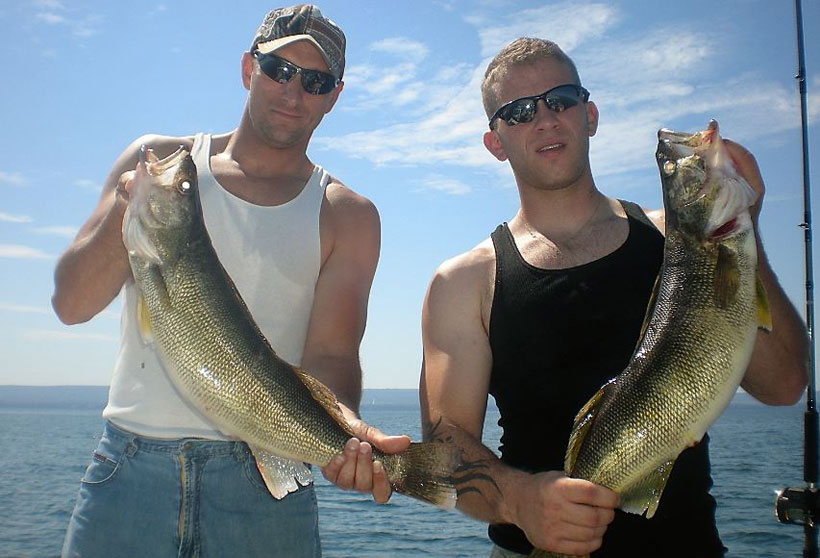
As we watched the usual afternoon storm clouds forming on the eastern horizon, it was after 12 noon, and we had agreed with Captain Rich that it was time to head back. Just a mile from the boat dock, the clouds decided to open up with a sturdy fresh water rinse. All of us and our gear received a wash down. With the earlier temperature nearing 95 degrees, it felt good. I prayed with a silent Our Father, too, as we all heard the thunder claps and watched lightning strikes in the distance on each side of the river. A moment later, we were safe at the dock.

Thank you, Lord, for this day. Amen. I can’t wait until we fish again!

Boat Captain Rich Perez knows how to share the fun of fishing, even when you have to hunt for live bait. One awesome day on the water! Rich Perez photo.


Simple Spinners Fool Smart Summer Fish – “Andy Magic!”

  • Muskoka Lake Fishing Fun for walleye, northern pike, smallmouth bass and largemouth bass
  • Single-blade spinner rigs fool big and little fish…when presented in the “fish zone.”
  • How-to, what-to, when-to with expert angler, Andy Wilbur, sharing one of his secrets.
Andy Wilbur says, “There is a captivating charm and sort of bonding magic with the fish when you catch ’em on lures you make.”

By Forrest Fisher

You know, the older we get, the more we forget! I discovered this last week during a fun fishing trip with good friends to Muskoka Lake in our nearby north, about 100 miles above Toronto.

For many years now, about a dozen outdoor buddies have banded together to make this trip up north because there seems to be an uncommon mutual interest in the outdoors, in the peace and enjoyment of special fishing moments and evening round table campfires.

Add clear starlight skies after dark with an occasional streaking meteorite (a good luck shooting star), the northern lights on some nights, and never-ending conversations about guns, bows, new equipment, new outdoor seasons, and anything else that pertains to the outdoors…and you get it. All the ingredients of a great trip and lots of relaxing fun happen during these away-from-home sessions.

There was a new addition to the band of Muskoka fishing brothers this year. His name was Andy Wilbur. He lives in Central New York, and he had successful heart surgery just two weeks ago.

Understanding that, he wanted to make the trip anyway because he had always turned down previous invitations, and maybe, just maybe, this was a special year for a “big fish”. There is always that story-tale thought!

It turned out to be more than that for the big-hearted new guy. Andy readied his 17-foot Lund moored at the dock and walked up to where the group was still unpacking to ask, “Does anyone want to join me for a few first casts while I check out my boat?” A quick answer came from 12-year old Zack Buresch, “Can I go?”

So Zack and his dad, Karl, a marine infantry veteran, both jumped in the boat and off they went.

At Muskoka Lake, The Andy Wilbur magic spinner lure was a smaller size 1 Colorado blade, most were silver in color, but copper, gold and painted red/white spinner blades worked too.

About 30 minutes later, we could see the trio returning to the dock. We walked down to help Andy get the boat retied safely and to make sure he didn’t do anything silly after his hospital event. “How did you do?” asked Craig Sauers. “Any good?” Zack hopped vertically about 3 feet straight up and onto the dock, grinning, and said, “I caught my first walleye with Mister Andy!! Look, here it is!”

The fish was 23-inches long, golden yellow in color, a prize all by itself, but that was not all. There were two more on the stringer! The boys caught three beautiful walleye in 30 minutes on a waterway where walleye are known to exist but are rarely caught with any consistency.

After the excitement went into a brief rest mode, everyone wanted to know how, what, where, and all the details.

Chris Sauers asked, “Were you electric motor trolling Andy?”

“Nope, just casting from my anchored boat,” he answered with a whitebeard grin. “Andy just showed us some new magic boys,” Karl said, “I think you might want to see how Andy fishes!” Zack was still beaming.

Andy explained his new old trick for catching walleye here was just as simple as his open water boat. He used an unassuming spinner and worm rig with just a few beads and a single-snelled hook, threaded a half-nightcrawler onto that hook and then cast the line out. In front of the rig, a few split-shots that are heavy enough to take the rig down to the bottom in 20 feet of water or so. Then he simply reeled it back very slowly. Spinner flash, worm scent, color from the beads…..wham! Fish on!

One-fish luck can happen to anyone, but three fish in short order is a demonstration of something more than luck.

There it was, “Andy Magic.” Maybe this was why Andy finally made the trip this year. He had some unique fish-catching charm to share that would change how the “band of Muskoka brothers” fish for all time.

Young Zack Buresch, 12-years old, caught bass, northern pike and unforgettable fun memories at Muskoka Lake, all on the Andy magic homemade lures. 

Andy mentioned that he had brought his spinner parts just in case he needed to make some more. Needless to say, there was a spinner/worm rig-making seminar on the kitchen table in the cabin five minutes later. All 12 guys (a big place) were rigged up with at least one. Young Zack had a few extra!

Andy shared with everyone that there is nothing more special to him than watching a youngster hook his fish on a rig that he can tie. “There is captivating charm and bonding magic with the fish when you catch ’em on lures you make,” Andy says. His words hit an exclusive memory chord with me.

The whole experience took me back in a time warp to a time when my dad, who just recently passed away, showed me how to make fishing lures for the first time. A new lane was opened in my mind. This experience with Andy had opened up a direct link I forgot about when I was a kid, to a time when dad was passing on his local fishing lore.

When dad always taught us to save money because we didn’t have too much of that. He knew I loved to fish (he taught me), so he took me aside one day and brought a fishing lure components catalog to my side. The Herter’s catalog was my favorite (I still have a 1953 version), but Netcraft was a close second. With that, he shared the details of how to make a spinner and worm lure. Not a fancy spinner/worm rig like we use on open Lake Erie today, but a straightforward rig, like what Andy was using.

At Muskoka, the blades we used mainly were smaller size 1 Colorado blades, most were silver in color, but copper, gold and painted red/white spinner blades worked too. Just like dad taught me, Andy showed us to slip a clevis into the tiny hole located at one end of the blade first, then slip the line through the clevis, add four or five small beads and tie on a size 4 hook bait-keeper hook, where we threaded a small worm for bait.

Dad would say, “You just need to use enough beads so that when the beads are strung onto a leader, they take about as much space as the blade is long plus a little. That way, the blade doesn’t hit the hook where you put a small worm, and it will turn OK when you cast it out and reel it back.” Andy sounded just like dad. Then he would say, “You can use any color beads you want, but red or green always seem to work well.”

The “Band of Muskoka Fishing Brothers” share laughs and fresh-caught fish for dinner.

Andy said these very same words like it was 55 years ago, at least as I remember it all. Magical, mystical, extraordinary, the conversation brought all those things.

The trip was simply outstanding, the boys enjoyed moments to never forget, and a massive release of sharing went on. No boasting or bragging, that would not be the way for anyone in this humble group of likable outdoor friends. Just fish tales, simple humor, a few practical jokes, and a lot of fun in the outdoors. It doesn’t get any better! The Canadian beverages were pretty good too!

That wasn’t all. On the last night of the stay, another old friend joined us to fish. Young eight-year-old Alex Denz, joined Andy and Chris in the now-infamous “Andy walleye boat.” Alex hooked into a whopper 23-inch walleye on the simple rig as sunset turned to nightfall.

“Yes!” said Alex, “this is the best day of my life! I love walleye fishing, but I could never catch one! Now I caught one! Yes! Thank you, Mister Chris and Mister Andy!”

Fishing is so much fun! Congrats Alex! Andy presented Alex with the spinner rig with which he caught his first walleye. A wall-hang prize and treasure for the youngster!

The whole experience of “going back to simplicity” made me think about how things have changed here on Lake Erie. Tackle shops sell spinner and worm rigs now that feature photo-prism blades with unique beads that cost seven dollars these days! Wow! In a bad economy, some things never change, like the rising cost of lures. Not sure the high-priced spinner/worm lures work any better than existing Lake Erie models out there for half the price.

Nothing tastes so good as deep-fried, fresh caught walleye

However, one word to the wise. Even the half-cost models are complicated. What if we all went back to tying our own simple one-spinner blade rigs with a few beads and only one hook? The blade turns at about a half-mile per hour! Fish attractor? Yes. Right color? Yes, we can make them any color.

Right size? We’re going to find out!!

Do you know what I’m doing today? It’s time to get simple and see if these simple rigs, which can also be used effectively in a very slow drift, work up here for hard-to-catch Lake Erie walleye.

We finished the Muskoka trip with lots of walleye for our every other day fish fry up there. We caught walleye like never before in a lake where walleye are only caught once in a great while. There is a new old lure in Muskoka town today!

You might want to try it in Lake Erie and the Finger Lakes and other places too.

The “Andy magic rig” really works that well!


Zack and his dad with a pair of behemoth largemouth bass from fishing near the Muskoka Lake weedbeds.
40+ inches each of Muskoka Lake northern pike, a good catch for the Chris Sauers family on those good days.

A GREAT FISH STORY

Stockton Lake white crappie are large, plentiful, fun to catch and tasty!

  • Answering the Call
  • Learning about Life, Love, Fishermen and Jesus
  • Stone Creek Lodge, Stockton Lake…a Place to Visit
  • Great Fishing Trips, Vacation Fun…Creating a Legacy and Passion for Sharing

By Larry Whiteley

As a young man Kris Nelson loved to go fishing every chance he had.  He fished in all the lakes and streams of southwest Missouri near his hometown of Willard. While other young men were playing sports or doing things they shouldn’t, Kris was fishing.

When he graduated from high school he worked and saved his money, then got into buying houses, fixing them up and selling them for a profit. His success gave him the time and money to go fishing.

In 2008, when the housing market went bust, Kris lost virtually everything and had to go out and find a job. Through it all though he still found a way to go do what he loved. Fishing helped him through the tough times.

While working at a factory job in Springfield, a friend told him, “Kris, what are you doing here? This is not for you. Your heart is in fishing.” Not long after, he found out about a job in Florida as a fishing guide, so he sold his boat and off he went to follow his dream.

In 2011 after a few years of guiding and even being captain of a charter fishing boat, Kris decided it was time to go back home to the Missouri Ozarks.

Stockton Lake walleye can be elusive, but Kris Nelson (guide) says, “There are ways to find them!”

Shortly after getting  back from Florida he was fly fishing for trout below the dam on Lake Taneycomo and having great success, when another fisherman who wasn’t having the same success came up to him. He wanted to know if he would show him how he was catching them. Kris patiently helped and then smiled as the man started reeling in fish.

Crappie fishing is prime time fishing fun at Stone Creek Lodge.

It turned out the man was in Branson with some friends and he asked Kris if he would guide him and his buddy’s the next day, and they would pay him. Since he needed the money, Kris agreed, but he didn’t have a boat, so he rented one from Lilley’s Landing and Resort. The day was a success and the fishermen were happy.

That got Kris to thinking that maybe there were other fishermen willing to pay him for guiding them on Lake Taneycomo. Unable to afford a boat to guide, a good friend named Justin Hayden loaned him his boat and Kris’s guide business was off and running.

He eventually saved enough money to buy his own boat and began expanding his guiding business to Stockton Lake and Pomme de Terre Lake, as well as Lake Taneycomo.  He called his business, “Tandem Fly Outfitters.”

About that time, another very special thing happened in Kris’s life. His cousin set him up on a blind date with a beautiful girl named Amanda and he was totally hooked.

Another chapter in the life of Kris and Amanda began in 2017. He was doing so many guide trips on Stockton, he started renting a room at Stone Creek Lodge. That way, he wouldn’t have to drive back and forth to Branson each day. The owner of the lodge had noticed how Kris’s guide business was thriving and approached him about buying the lodge.

Amanda had to drive back and forth a lot so she could be with Kris when he wasn’t guiding, so the two talked it over and decided to take a big step and buy it. To make it all even more special, three days after writing up a contract on the lodge, they found out Amanda was pregnant and they are now the proud parents of a pretty girl named Lilly.

Today you will find Amanda and Lilly running the lodge, snack shop and tackle store, while Kris is out on the water making sure their customers are having a good time and catching lots of fish. When the day’s work is done, you will usually find Kris walking around their property with one arm around Amanda, holding Lilly in his other arm and smiling.

I have fished both Taneycomo and Pomme de Terre with this young man and, to be honest with you, I have been with guides all over the U.S. and Canada, but I have never had a better fishing guide. He is knowledgeable and wise far beyond his age. You will catch fish and you will catch a lot of them. I would not hesitate in recommending Kris Nelson to anyone wanting to experience a great fishing trip.

God has been good to Kris Nelson and, in his wonderful Ozarks accent, he is quick to give Him all the credit and praise for what has happened in his life. I would just bet his favorite bible verse is Matthew 4:19. Look it up and you will understand what I mean.

After reading this, I think you will probably agree that the amazing life of Kris Nelson, his family and their business, all makes this a really great fish story.

To book a trip with Kris go to his Facebook page @Tandem Fly Outfitters or call the lodge at 417-276-1700.

Amanda, Kris and Lilly Nelson offer top fishing fun and share their joy for life and love with everyone that has ever met them.  Meet these great friends of mine at Stone Creek Lodge on your next outdoor adventure.  Larry Whiteley Photo

Niagara River/Lake Ontario Fish are NOT SOCIAL Distancing, THEY”RE ON THE BITE!

NIAGARA USA King Salmon bite BEGINS!

  • Shore fishing is VERY GOOD…spoons and spinners…bring a camera!
  • Niagara Falls USA Fishing Forecast for April 8, 2020, from Destination Niagara USA
  • Boat fishing is good for Kings, Lakers, Steelhead, the Big Bass are just starting up
Stephanie Pierleoni of Newfane went fishing with her husband, Capt. Vince Pierleoni, out of Olcott this week and reeled in this king salmon.

Social distancing is critical when it comes to fishing, both onshore and in a boat.

COVID-19 continues to expand across the state and slowing that curve is important and we are moving forward. We are fortunate in that our boat launch ramps are still open, and we have plenty of shore fishing options available to us. Please stay safe out there and use your head to limit the spread.

With hatchery fish stocking taking place both in the Great Lakes waters and inland waters, please take note that there are special distinctions between both areas. The Great Lakes waters include lakes Erie and Ontario and the tributaries up to the first impassible barrier (such as a dam). Trout and salmon that are stocked as fingerlings and yearlings follow a certain protocol – put, grow and take. They are not meant to be taken immediately after they are stocked in places like the Wilson or Olcott harbors.

Nancy Colavecchia of Niagara Falls caught her biggest bass ever in the upper Niagara River this week.

For the Lake Ontario basin, the minimum size for browns, rainbows, and Pacific salmon is 15 inches in length. Some people have been catching and keeping trout well under that size close to shore. There are certainly more regulations than just these (such as new rules in the tributaries for brown trout (1 per person) and rainbow/steelhead (1 per person with a minimum size of 25 inches) and it’s important to know them before you head out.

The big news is that there have finally been reports of smelt being taken in the lower Niagara River. While Lewiston Landing (the sand docks) didn’t produce anything, they did get some at Artpark, to the south, and from docks to the north. The best time was after 11 p.m.

Mike Rzucidlo of Niagara Falls with a dandy lower river brown trout he caught from shore using a No. 4 spinner.

Fishing in the lower river for trout continues to be good to very good depending on who you talk to. Steelhead, brown trout and lake trout are all being caught by anglers fishing from boat and shore. Water visibility is about 5-6 feet.  Spinners from shore are still producing trout in the gorge. Boaters are drifting minnows, egg sacs or running plugs like Kwikies or MagLips off three-way rigs. Bass are starting to turn on as the waters warm up both in the lower and upper rivers. It was around 45 degrees this week.  

Matt Tall of Wilson caught this 23-pound king salmon fishing with Capt. Tyler Morrison out of Wilson this week.

Some more exciting news is that the king salmon fishing has started to turn on in Lake Ontario.

Matt Tall of Wilson and Capt. Taz Morrison out of Wilson worked their lures in 30 to 80 feet of water to take some nice kings and lake trout. They caught kings to 25 pounds. Conditions change almost daily, says Tall, with things warming up so fast. They were running stickbaits and spoons mostly, working in 46 degrees surface temperature. The temperature doesn’t change much until you get out to 90 feet of water.

Mike Ziehm of Niagara Falls caught this big steelhead in the lower Niagara River this week from shore in the gorge area.

Lake trout are eating everything in sight. James DeGirolamo of Derby reports that they were fishing anywhere from 180 to 220 feet of water straight out from Olcott. They had meat rigs and spoons working, with trout and salmon hitting most everything, but spoons are the way to go.

Capt. Tyler Morrison of West End Charters shows off a 25-pound king salmon he caught this week out of Wilson.

Terry Swann of Wilson reports that bullheads are biting at the Wilson-Tuscarora Park boat launch and in the West Branch of 12-mile Creek. Worms and shrimp seem to be the bait of choice.

A few nice perch are showing up too. Pier action has been good for trout in both Wilson and Olcott. Spoons and spinners or live bait under a float work best.

Tributary action has slowed a bit and with the rains from last night and more is forecasted through Friday. It will probably muddy things up and create higher flows.

Stay safe out there.

Bill Hilts, Jr. – Outdoor Promotions Director

Inline image 2
Destination Niagara USA
10 Rainbow Blvd.
Niagara Falls, NY 14303
p: 1-877 FALLS US | 716-282-8992 x. 303
 

The Last Cast

Time for One Last Cast

  • Sunrise, Sunset, Starshine…life-long breathtaking moments
  • Family, Fishing, Memories, Doctors…and Reality 
  • Radiation, Chemo…Time to Re-Rig 
A Morning Alone on the Lake

By Larry Whiteley

He was alone on the lake. The sunrise was breathtaking. He had seen lots of mornings but none this beautiful. His first cast landed near some bushes. He felt the thump and set the hook. The largemouth came out of the water, trying to shake the bait. It fought hard but soon tired. He gently lifted it from the water, smiled, and released it.

There would be many more fish to visit with that morning. One was the biggest smallmouth he had ever caught in all his years of fishing. The sunlight glistened off its bronze body. He managed to take a selfie of him and the fish. As he hit send on his smartphone, he smiled. A son texted back, “Nice one, Dad.” Another son replied, “Good fish, old man!” A grandson asked, “What did you catch it on?” His wife texted, “Are you doing okay, and how are you feeling?” He smiled and texted back each of them with only the words “I love you” and then went back to fishing.

The Thrill of Fishing

It suddenly occurred to him that he had not heard or seen another boat all morning. Kind of felt like he was fishing on his own private lake. He heard crows, ducks, and geese. He saw deer and turkey at the water’s edge. Birds were flittering around everywhere and singing their songs. A hummingbird even came buzzing by thinking he was a big flower. He said to himself, “Is this what heaven will be like for a fisherman like me?” He smiled again.

Sometimes even the blind squirrel finds the nut.

The afternoon sun was high and hot. He motored into a shaded cove and shut off the engine. The slight breeze felt good there in the shade. He tied the boat to a tree, sat back, and relaxed. Thoughts of the first fish he ever caught went through his mind. He saw the bobber, the worm, his cane pole. He felt the little perch squirming in his hand. The particular feeling, he had that day alone on that creek, was unlike any other. He was hooked. It was the first of many fish he would catch in his lifetime.

As he stretched out in the boat, he looked up at the sky and saw a cross formed by clouds and a jet stream. He grinned and said, thank you. More memories flooded his mind. He wished his Dad would have taken him fishing, but he didn’t. He thought of times he took his son’s fishing, recalling the look on their faces when they caught their first fish. He wished he hadn’t been so busy trying to make a living and would have taken his boys fishing more. But, they both grew up to be fishermen. They both became good husbands, fathers, and Godly men. Their kids became fishermen too. They had a dad that took them and a papaw too. There was no doubt in his mind that his grandkids would also take their kids fishing. He smiled once more and was proud. He hoped that more people would discover the magic of fishing and pass it on.

With the gentle rocking of the boat, his eyes got heavy. A nap came easy. It was a much-needed rest. The hospital visits and all the medicine had taken its toll. Late afternoon, he awoke to the screeching sounds of an eagle flying in the sky above him. It was out fishing too.

As he lay there watching the eagle, he wished he had more time left. He thought that he would go back to Canada fishing for walleye and pike with his son and grandson. Travel with his other son and grandson’s to the Northwood’s for those good-eating yellow perch. Going back to catch a snook or grouper in Tampa Bay or speckled trout at Gulf Shores would also be on his list. A limit of crappie, some trout fishing, or maybe catfishing would be good too. Grabbing a mess of suckers and frying them up on the river bank would really be fun, one more time. He even thought about going wade fishing in a creek or sitting on a farm pond, on the bank. Alaska salmon and halibut fishing were on his bucket list. So was fishing for redfish. It had never happened, and now there was not enough time.

It Was Like Heaven Was Opening

The sunset was beautiful in the western sky. The bats began their dance with the approaching darkness, it was feeding time. He listened to the owls and the whip-poor-wills as they started their nightly chorus. The smell of new-mown hay and someone’s campfire drifted through the air. He knew he should be heading home. His wife would be worried. In the gathering dusk, he wanted to fish just a little longer.

The doctor had told him the radiation and chemo was not working. This was his last time to fish. He was at peace with that because he knew where he was going. He had messed up his life at times. He had made mistakes. He had gotten his life straightened out and was walking the path he should have been all along. He wished he had more time to tell his wife and family he loved them and make more memories. He wished he had more time to say to others that no matter what they did wrong, they could still go where he was going.

A Reminder From Above

The boat roared to life, and he headed for his favorite fishing spot near the ramp to make another cast or maybe two. In the half-light, he cast toward the bank. The topwater bait gurgled across the surface. A massive bass slammed it, and the fight was on. When the battle was finally over, and he lifted it out of the water, it was bigger than the one earlier in the day. He removed the bait from its cavernous mouth, lowered it back into the water, and in the dim light, watched it swim away. He looked up into the night sky filled with millions of stars and, with a tear in his eye and a smile on his face, said, “thank you!”

“Just one more cast,” he told himself. The lure hits the water. A fish engulfs it. The battle begins and then suddenly stops. He’s snagged. The line snaps. “That’s okay,” he says to himself and smiles again. Too dark now to re-rig. It’s time to go home. He looked up at the night sky, and it looked as if heaven was opening. It was his last cast.

College Team Bass Fishing – Lake of the Ozarks is “On-Fire!”

  • Kansas State Collegiate Bass Team
  • A Day in the Life of a College Angler
  • Tournament Planning in Calculus Class
My Partner, Tyler Nekolny (left) and I weigh in 14-15 on Day 1, was exciting for our Kansas State Fishing Team.

By Hunter Whiteley

My partner and I took 11 days to fish the B.A.S.S. Carhartt College series Midwest regional and the FLW regional.  At Lake of the Ozarks, all I can say is, “The lake is on fire.”  The lake is fishing hot, better than I have ever seen it fish.  

Every single day, we landed a fish that went 5-pounds plus, with multiple days producing more than one.  Breaking down the lake was a handful.  We found the pattern to be secondary points that had the channel swing up against them with a flat on the other side.  It didn’t matter what type of rocks were on the flat.  Then for bigger bites we would back off to long tapering points that had structure on them.  These didn’t produce the numbers we needed but when you got a bite it was a good one.

Understanding these patterns had us feeling comfortable going into the B.A.S.S. regional which was a three-day event.  The first day we caught our limit early and moved out to find the bigger bites.  Culled once and lost a big one.  We weighed 14 pounds-15 ounces, good enough to put us in 20th place and good enough to put us inside the cut-line, but we needed another good day on Day 2.

Day 2 rolls around and we had a cold front move through and shut down our fish.  At about 10:30 we go to move and have motor issues.  This put a damper on our fishing and we only weighed two fish for 7 pounds-7 ounces.  This cut our tournament a day short due to not making the cut, but on the other hand – the bright side, this gave us a day to go over our plan for the FLW Regional and catch up on some sleep and school work.

Hunter Whiteley and Tyler Nekolny on the run to their next spot. Ronnie Moore Photo

The FLW started really well.  We roll into our first stop and put two fish in the box. On our next stop we fill our limit and cull three times. This is when I knew it was going to be a special day.  Then, surprisingly, the day got tough.  We didn’t have another bite till an hour before weigh in.  

We moved to key in on the bass pushing shad up against wave breaks.  We culled two more times before we had to weigh in.  Good stuff.

We walk up to the tanks and were listening to weights and knew that we had made the prize-cut, but not sure how high we would finish.  We weighed in 18 pounds- 2 ounces, good enough to put us in 4th place and make the cut to fish the national championship.

I would like to also congratulate two other teams from Kansas State:

Sheldon Rogge and Travis Blenn, on qualifying for the B.A.S.S. College National Championship.  

Quinn Fowler and Josh Schraad for qualifying FLW National Championship.

My next tournament is a club tournament on Milford Lake in Kansas.  It will be a tournament that is dominated by smallmouth bass and will help us learn more about how to compete using different fishing tactics.

Our Kansas State College fishing team members (left to right): Sheldon Rogge, Grant Srajer, Travis Blenn, Tyler Nekolny, Hunter Whiteley, Josh Schraad, Quinn Fowler, Payton Miller, Adam Fuchs, Shaun Finn.

A WINTER FISHING TRIP WHERE IT’S WARM


By Larry Whiteley

Joe Henry with a couple of JUMBO PERCH caught while ice fishing in Lake-of-the-Woods, Minnesota.

We have been having high temperatures in the teens and single digit temperatures at night here in Missouri and that doesn’t count the wind chill index.

In my old age I don’t like being cold so I’ve been day dreaming a lot lately about going fishing some place where it’s nice and warm. But, I’m not thinking about warm beaches, blue oceans and saltwater fishing. I’m thinking about calling my friend Joe Henry, the Executive Director of Tourism at Minnesota’s Lake of the Woods, and booking an ice fishing trip to “The Walleye Capital of the World”.

Ice fishing huts in Minnesota are called a “Fish House” and are not just wind shelters, they are warm, cozy and comfortable for a several days without coming back to shore.

As I write this on a Sunday morning in southwest Missouri the temperature in Baudette, MN, is minus 29 and the high is going to be minus 18. Plus they have a wind chill warning. So you’re probably saying “You got to be crazy Whiteley because there is no way you can be warm fishing in temperatures like that.”

When someone who has never been ice fishing thinks about it they imagine sitting outside over a hole in the ice bundled up in so much clothing you can barely move and still being cold. At Lake of the Woods people from all over the country come to experience ice fishing because instead of fishing in the cold you fish in the warm.

Arnesen’s Sleeper fish house offers outdoor adventure in below zero cold with full comfort and lots of fish.

After you check-in to your toasty warm resort you get into heated track rig transportation. They take you across ice up to several feet thick to your personal ice fishing house that has been placed where the guides know the fish are. The ice fishing holes have already been drilled for you and your fishing equipment and bait are waiting. Once inside your insulated ice fishing house you will be taking off some of your clothes because the thermostat is set at a very comfortable 70 degrees.

Now the fun begins! You pull up your seat, grab your fishing rod and lower your bait into the hole. It usually doesn’t take very long before you feel a tug on your line and set the hook. Usually a delicious walleye comes up through the hole but it could also be an equally delicious sauger, yellow perch or crappie. You could even be surprised with a huge northern pike.

To reach your fish house in comfort, a full equipped, warm, Bombardier will transport you from the lodge to your destination, and back. Proprietors come out to check on you and call to be sure you don’t need anything. Fun times.

Joe tells me that you might hope that tug on your line is an eelpout. A member of the cod family and also called burbot, it is affectionately known as “Poor Man’s Lobster” because of its firm flesh, high fat content and mild, buttery taste. Take the backstrap and tail meat from the fish, boil it in either salt water or 7UP and then dip it in melted butter just like you would lobster. It’s an ugly fish with a large belly and eel-like tail but locals say their true beauty is in the eating.

Joe Henry is an expert at catching walleye and perch on Lake-of-the-woods, but the catch can also include crappie, yellow perch, eelpout and many other fish species.

Ice guides will come around and check on you and at the end of the day they will pick you up in the warm track rig and transport you and all your fish back to the warmth of the lodge.  They even clean your fish and the resort will cook them up for you if you would like.

You might want to even catch a transport back out on the ice to check out the famous Igloo Bar at Zippel Bay Resort. This popular spot offers a big screen TV, a full bar and limited hot food menu. For a small fee you can even ice fish in the bar.

For a really special experience consider staying in one of the sleeper fish houses with a furnace and cook stove fueled by propane as well as comfy bunk beds.  Joe says, “It’s like ice camping but in the warmth and with all of the amenities. Spending a few nights on the ice i

s cozy and good for the soul.  It is so neat stepping outside of the fish house on a clear night and seeing stars and the Milky Way like they have never been seen before.  The sky is absolutely awe inspiring and if you’re lucky, you might even see the northern lights.”

I think a sleeper fish house is what I want to do. Imagine with me catching fish all day, cooking them up on the stove, enjoying the night sky, getting a good warm night’s sleep out on the ice, and then getting up the next morning in my underwear and catching more fish. Now I am sure you don’t want to think about that last image so O.K., I’ll wear a bath robe.

The famous “Igloo Bar” on the ice is run by Zippel Bay Resort and is well known to many ice anglers that frequent Lake-of-the-Woods from Baudette, MN.

This beautiful area of Minnesota offers great fishing year round with anglers traveling thousands of miles to fish these waters. Besides the fish already mentioned you can also catch smallmouth bass, muskie, lake sturgeon, lake trout, lake whitefish, tulibee, as well as white suckers and redhorse which is another story for another time.

I was at an Association of Great Lakes Outdoor Writers conference at Sportsman’s Lodge in Baudette, MN back in September of last year and all of us writers and even our wives caught lots of walleye, sauger and even lake sturgeon while fishing the Lake of the Woods and the Rainy River that runs by the lodge.

The warm winter ice fishing though sounds like something really special that needs to be added to my “bucket list” so I am going to call Joe at (800) 382-FISH (3474) as soon as I finish this article and book a warm ice fishing trip to Lake of the Woods, Minnesota.

After looking at all the pictures Joe sent me of him with fish it is obvious he has a really tough job. I might just have to ask him if he needs a good Lake of the Woods Assistant Director of Tourism to help him out with all those fish.

If you want to try warm ice fishing or the great fishing at other times of the year you can go to their web site at www.LakeoftheWoodsMN.com for more information.


FINDING HIDDEN TREASURE in SUMMER

  • They Exist Near Your Home
  • They Beckon for Your Next Cast
  • They Can Hold State Record Fish

By Larry Whiteley

I love to find hidden treasure, but not the gold or silver kind.

Hidden treasure for me is finding jewels of rarely fished small waters.  By small waters, I mean privately owned farm ponds, strip pits, businesses with water retention ponds, and even golf course water hazards.  Places a lot of people don’t even pay attention to or don’t even know they are there.

Many city parks departments and state fisheries departments stock small waters for public fishing, but a lot of these get very little fishing pressure.

There are thousands of these hidden small water treasures across America and are great places to catch fish in uncrowded conditions.  Most are full of bass, crappie, perch, hybrid bluegill and catfish.  All you have to do is search them out.

They are perfect for just walking the bank, launching a small johnboat, canoe, kayak or float tube. If you only have a few hours to fish, they are great! You can pretty well count on certain areas holding fish every time you go.

Unless they are public waters though, they are private and accessible only by permission from the landowner or the person in charge.  You can try calling, but it is much better to get permission in person.  Be courteous and thankful.  You might also offer to share your catch if they allow you to keep fish.

My best tip for catching fish on small waters is to make as little noise or vibration as possible.  In small bodies of water fish can see you.  In fact, vibrations travel farther in small waters, so even if they can’t see you, they can tell someone is near the edge of the water.  If fishing from the bank, walk up quietly and stay out of sight.  It’s a good idea to even wear camouflage clothing.

Look for channels, humps, brush piles, lay down trees, weed beds, moss, cattails, lily pads, logs and tree stumps — anything that offers habitat for feeding fish.

For catfish, go with all the normal stinky catfish baits, as well as worms and I also like using shrimp bait.  If it’s crappie you’re after, jigs and minnows are always good, but I have also caught some really big crappie in small water on crankbaits and spinnerbaits.

Perch jerkin’ is always fun and even more so if you go with ultra-light equipment. If the small waters happen to be stocked with hand size hybrid bluegill, you are in for a real fight and a great time.  

For baits, look around for natural baits the fish are already feeding on. Catch some of these natural baits and impale them on a hook or match them as close as possible with artificial baits you have in your tackle box.

The crown jewel in the hidden treasure of small waters is the largemouth bass. America’s most sought after fish can grow very large in small waters, as long as the forage is right.  So don’t let the size of a lake fool you into thinking there are no big bass in it.

Remember, George Perry’s world record bass came from Montgomery Lake in Georgia which is little more than a muddy slough — the silted-in remnants of an oxbow off the Ocmulgee River that continues to flow just a few yards away. Studded with cypress knees and shaded by Spanish moss, it is narrow enough to cast completely across.

Dixon Lake, a small city lake located in Escondido, California, is well known for several potential world record bass.  One was caught and released and another was found dead.

I personally believe that the next world record largemouth bass could very well come from small waters like a pond, small lake or strip pit.  It might just be your state’s record bass, but you would settle for that wouldn’t you?

With spinnerbaits and crankbaits, I can make a lot of casts and cover a lot of water.  Plastic worms are good too, and use frog baits through the moss and lily pads.  If I am fishing at night there’s nothing like the heart-stopping moment when a big bass hits a topwater bait.

After you are done fishing for the day, make sure you leave the property more clean than when you arrived.  Now, go find the person that gave you permission and thank them for a great day, and offer to share your catch if you kept fish.  Ask if you can come again, is it OK to bring a family member or two…and should you contact them each time?

Now, clutch them to your chest and love them like a wealthy uncle because yea verily I say unto you, these places are small treasures worth their weight in gold. Well, clutching them to your chest and loving them may be a little much, but make sure you let the property owners know you appreciate them.

Do everything you can do to insure you can keep coming back.  Lastly, keep your small waters to yourself and don’t tell any of your fishing buddies where you found your hidden treasure.


WHERE TO FIND MISSOURI JACK SALMON

  • Secrets to Finding and Catching Jack Salmon
  • Hot Lures can be Simple Lures When They Work
  • Missouri Fishing With a Special Friend   

By Larry Whiteley

Daron Whiteley and keeper Jack Salmon.

Many years ago during a beautiful spring in the Missouri Ozarks, a good friend of mine, Bob Nelson, invited me to go fishing with him for a fish he called “Jack Salmon”.  I had never heard of such a fish so I went along mainly out of curiosity.

He took me north to Stockton Lake and a creek called Turnback.  We walked up creek and found this fish with the funny name as they headed upstream to spawn.  Casting spinner rigs and spoons the fight was a whole lot of fun in the swift water.  We caught our limit and the fish weren’t the only thing hooked that day.

Just when I thought this special day was over and it couldn’t get any better, it did. Bob fileted the fish, started a campfire on a gravel bar, pulled a cast iron skillet from his truck, added some lard, cut up some potatoes and onions, opened a can of beans, covered the filets with cornmeal and cooked up a meal I still remember over 40 years later.

A plate of delicious Jack Salmon.

Unless you are as old I am, if you tell someone you are going fishing for Jack Salmon they will probably look at you kind of funny.  Today most of us know them as the delicious, fun-to-catch walleye.

When you talk about walleye most fishermen think of the legendary fishing in the Dakota’s, Minnesota, Wisconsin and several of our northeastern states.  They might also think of the fabulous walleye fishing on Greer’s Ferry Lake in Arkansas or Old Hickory Lake in Tennessee.

And I, like many of you, have made several trips to fish legendary Canadian lakes for walleye.  The next time I go, I’m going to ask them if they have ever heard of a Jack Salmon.

Sometimes I wonder why I ever go out of state after walleye.  We have some really good walleye fishing right here at home.  In fact, the Missouri state record is 21.1 pounds, caught in 1988 at Bull Shoals Lake by Gerry Partlow.  That’s bigger than 90% of the famous walleye states I just mentioned.

Walleye are native to some areas of Missouri and in some waters they naturally reproduce.  However, in most of our large and small lakes, and reservoirs as well, as some streams and rivers they have to be stocked to keep up with fishing pressure.  The Missouri Department of Conservation started stocking walleyes in the 1970s and now stock 1.2 million a year all over the state.

Lakes that receive walleye stockings include Bilby, Bull Shoals, Jacomo, Lake of the Ozarks, Longview, Long Branch, Mozingo, Norfork, Pomme de Terre, Smithville, Stockton, Table Rock, and Truman.  The Mississippi, Black and Current Rivers are also known for good walleye fishing.

During the spring, walleyes will run up rivers and streams that flow into or out of a lake to spawn.  Just like they were doing the day Bob Nelson took me fishing for Jack Salmon.  They can also be found in areas of lakes with gravel or rip rap where they will also spawn.

Wherever you go walleye fishing in Missouri, make sure you check the season, length and possession limits of the water you are fishing because they can vary.

If you are new to walleye fishing, just realize it won’t be easy.  If you’re willing to go without a little sleep, that’s good.  Walleye feed actively at night.  If you don’t mind bad weather, that’s good too.  Walleye will sometimes bite the best when the weather isn’t best.

There are other times you can catch walleye.  Early morning, low-light conditions from a half hour before to a few hours after sunrise are also good.  I have better luck though, fishing a couple of hours before sunset to right up until dark sets in.

A dark, cloudy day is usually always good because the fish will sometimes feed all day.  If it is a bright sunny day they will be at 20 feet or more trying to get away from the sunlight that penetrates the water.

Spoons, crankbaits and plain jigs, or jigs tipped with a minnow or nightcrawler, are good most of the time.  Nightcrawlers and leeches work well on slip-sinker rigs. Trolling at 1 to 1.5 mph can also be effective.

Anna Whiteley with a Stockton Lake Jack Salmon a little under the size limit, the fish was released without harm.

Last year on Stockton Lake, my grandson Hunter, granddaughter Anna and I, did exceptionally well catching walleye.  We used 1/8 ounce Roadrunners with gray shad bodies and hammered willow leaf silver blades.  My son, Daron, caught his walleye with a crappie spinnerbait.

Walleye are usually not going to hit your bait hard.  When they take it, you might just feel a hesitation or a little bump and think your bait just ran into something.  That hesitation or bump just might be a Missouri Jack Salmon and you better set the hook.

To learn more about Jack Salmon, I mean walleye fishing, in Missouri, go to the Missouri Department of Conservation web site and search for walleye.