Adirondack Mountain Fishing Guides

Finding Help to Catch Ausable River Brown Trout

Veteran Adirondack fly-fishing guide, Ken Khalil, educated our group on how to fish muddy, fast-rising water in the Ausable under conditions when most anglers would have opted for extra coffee over a long, late breakfast.

A top priority of many baby boomer, wanna-be trout anglers is to keep up with that ever-aging bucket list as we age.  Among my priorities is to fish more with a fly rod and learn about what many fly rod anglers all seem to say and share, “fly fishing is so relaxing- once you’ve tried it, you’ll never go back!” So when some fishing friends wanted to make a trip to the Adirondack Mountains to fish the infamous Ausable River for brown trout, I was all ears.

Amidst the majestic mountains and winding roads above the quaint Adirondack Olympic village of Lake Placid, site of the world famous 1980 USA-Russia hockey game known as the “Miracle On Ice”, we met up during an evening rainstorm. Over a few local microbrews, we discussed our hopeful plan to fish the morning.

Since we had never fished here before, hiring a guide was a logical choice for day one and that turned out to be a great decision.  We met with Ken Khalil, a local guide of over 20 years experience and this artist of the stream showed us how to catch brown trout in high muddy water conditions.  This was on a day that all of us thought we would be relishing a late breakfast due to the weather.  Guides that know what they are doing are a pleasure to fish with and learn from.

There were four of us and step one was to go over everyone’s gear and that included the rod, reel, line, leaders, knots, waders, wading staff and fly assortment.  I had brought along a rod that I had made myself some 40 years ago from a yellow-color fiberglass Fenwick FL90-6 blank (90 inches long made for a 6-weight line).  It has a soft action, is limber and is only gently loaded with level 5-weight line and an 8-foot leader.  While most of the world has switched to more modern materials, our guide saw my “different” rod and was immediately attracted to ask some questions about it.

With a humble, inquiring voice, he finally asked if he could try it out.  Of course, I agreed, he could show me how to use it!  We never stop learning.  After 15 minutes or so, explaining to all of us how we would start fishing, he directed us to take a spot on the stream then came over to me to say, “I am so impressed with your rod, I love the action, the delivery, the usability of the rod in general.” I felt like a million bucks!  He explained the difference between some of the very expensive graphite models sold in many stores today and the old action.  Special old-gear moments are priceless and never to be forgotten, especially when on a famous trout stream with a world class guide!

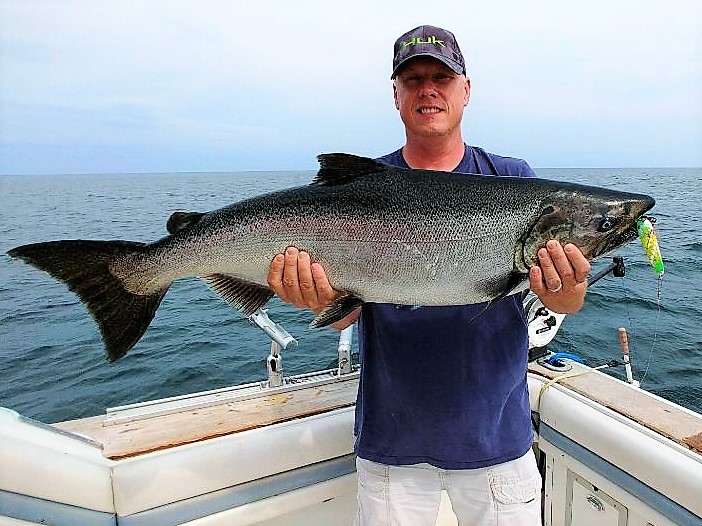
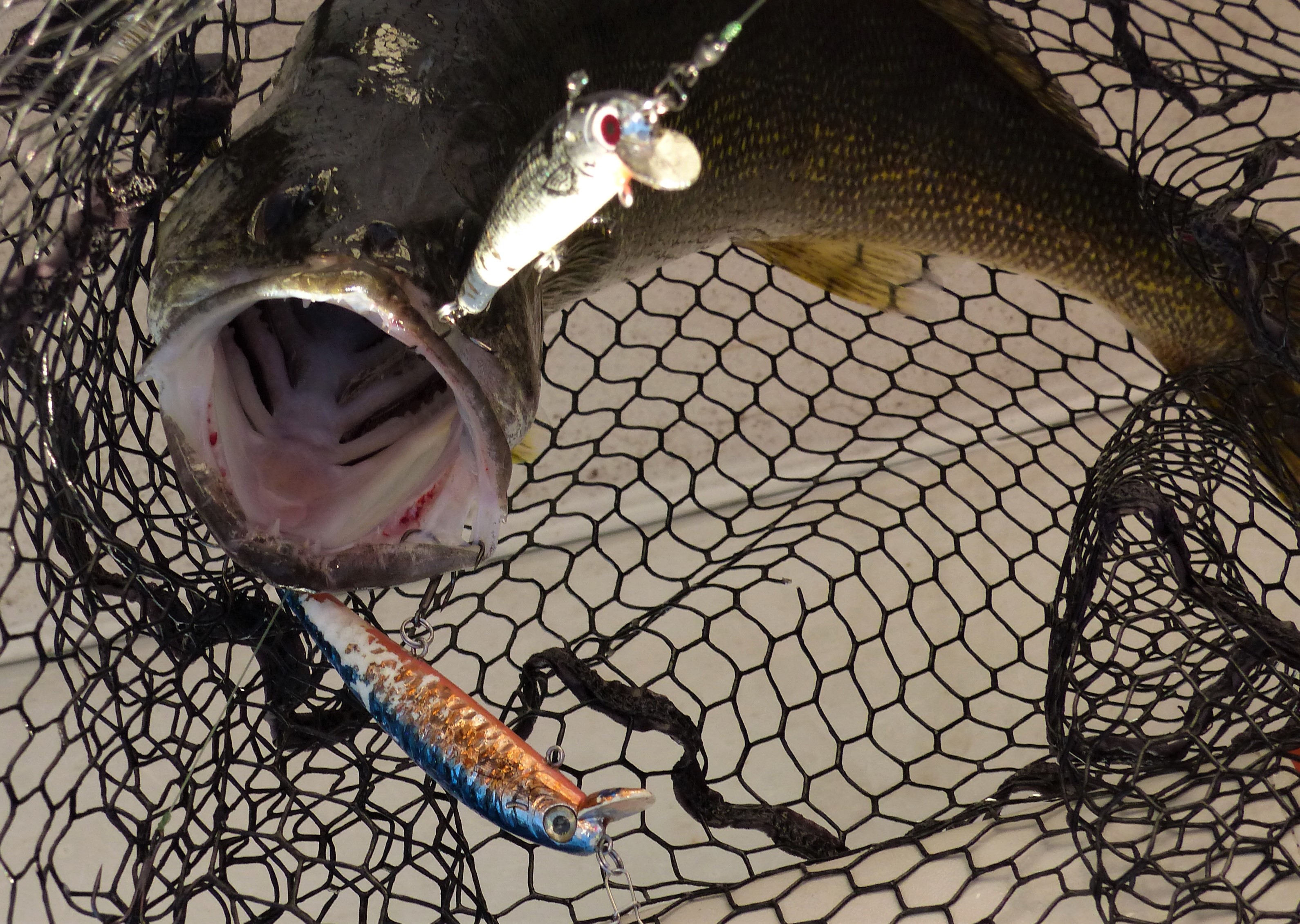
Ausable River brown trout are handsome and beautiful, notice the secret streamer-nymph style fly in the jaw of this fish that fooled so many trout on this day.

With the fast-flowing, muddy water, no one expected to catch anything.  We praised the courage of our guide for even attempting to bring our group to the stream.  Little did we know, Ken Khalil was an expert with fast-rising, off-color (muddy) water on the Ausable.  Between the four of us, we landed and released 11 trout in less than three hours!

When a guide expert shares his techniques and talents during extreme conditions, you tend to remember that fellow for all time.  Khalil is one of those who instructed us individually within our own capable performance, adjusting leaders and fly types and sizes until he fine-tuned all of us to be effective.  Go figure!  All this for less than $200 each.

The lighthearted Khalil provided my skill-set and aging, but never-used fly rod, with a custom-made Matuka fly that he ties up for his guests.  I dubbed it the ruby-throated Khalil Matuka and got him to give us all a very funny laugh in the light rain.  “It’s a pattern some others use too, I didn’t invent the name of the fly, but now you’ve made it unique Forrest!” He replied with a confident grin.

The design he offered allowed the fly to flutter and wiggle as we stripped it back after casting cross-current.  It looked alive and like something between a minnow or other bait fish, such as perhaps, a sculpin, but also, several terrestrial-looking critters too.  It worked well since the fish only got to see this for a quick moment, or there goes lunch!  The fish struck at the fly instinctively and with a ferocious wallop.  What fun we had!

I was instructed to cast about 10 feet upstream of a quickly forming eddy current area and then retrieve in stripping fashion, quickly, across the meddle of the reversing riff.  Wham!  Happened several times.

The secret fly to catching Ausable brown trout in muddy water when most anglers cannot see three inches under the surface and one would consider that the fish would not see it as well. The fish could find this fly!

While fishing on an evening trip, we were fortunate to see much wildlife also found in the area along Route 86.  This included three curious deer who watched me and my attempt at a fly casting demonstration, which admittedly, was not very good.  During the same trip, we were amazed by a large 30-pound beaver that worked on building his dam a bit higher.  We watched a beautiful Osprey soar from high overhead to latch onto a three-pound brown trout, then rise rapidly, screeching his usual call, an eerie sound amidst the gentle trickle sound of the river.  Several good reminders that the Adirondack’s are still a very rugged and wild area that now also enjoy moose and black bear populations on the rise.

For more information on fishing the Ausable River or Sarnac River area of the Adirondacks, contact one of the following folks that we met there:

  1. Jones Outfitters, located right in Lake Placid Village, 2419 Main Street, Lake Placid, NY, contact proprietor Chris Williamson, 518) 523-3468
  2. Expert guide, Ken Kalil, email: ken@adkwildlife.com, phone (518) 524-2697 or website: http://www.adkwildlife.com/Home_Page.php.

For the latest river conditions and fishing reported a frequently updated link can be found here:  http://www.orvis.com/fishing_report.aspx?locationid=5998.  The New York State inland trout fishing season opens April 1, but much of the Ausable is open all year long and is a catch and release stream, so be sure you know where you are.  Check the game syllabus. We released all of our fish.

Lastly, guess what?  They were right!  I’m officially hooked on the fun memory of learning new things about fishing with a fly rod in my hand and the peacefulness we enjoyed on this trip.  None of us can wait to get back there again!

Wishing tight lines to all.
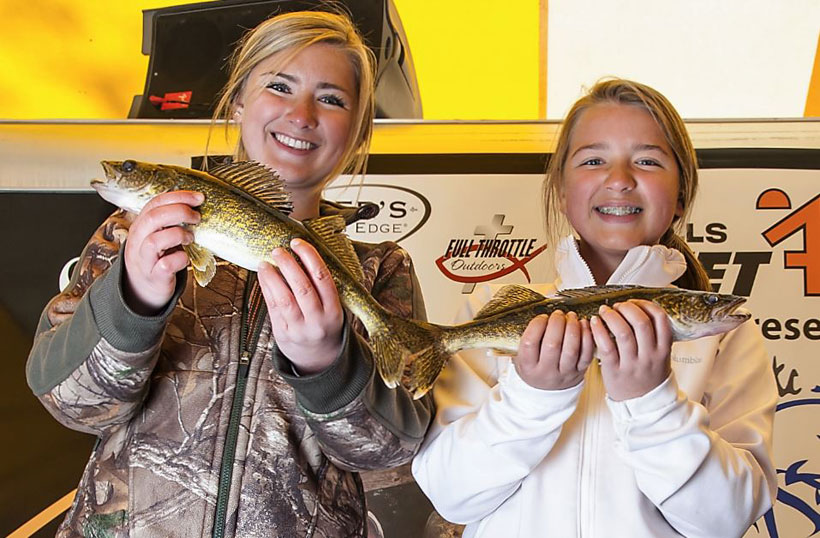
Al Lindner Invites Anglers to Fish or Help Sponsor Anglers in June Tourney – Minnesota Fishing Challenge

allindner1

1-Day Event will Benefit Teens and Adults with Needs

Al Lindner asks, “How many angler tournaments test multi-species skills? One of the best is the Minnesota Fishing Challenge, where anglers can choose one of several species or go for the brass ring in the Sportech Mixed Bag event.”

Host Al Lindner says, “This is a crazy fun event. It’s held on Gull Lake near Brainerd, one of the state’s classic fish factories, but the best part is that anglers are giving back to the community. We’re raising funds for people facing alcohol and drug addictions. I know we can make a difference for boys, girls, men, women, and their families by raising funds for Minnesota Adult and Teen Challenge. We’re fishing to save lives.”

The Minnesota Fishing Challenge, presented by Mills Fleet Farm, will be held June 3 and 4, 2016, when fish of all species should be in metabolic overdrive in this region. Every contestant has many opportunities to succeed. For a team entry fee of $100, anglers can choose to compete for titles in various divisions, including Lindner Media Bass, Navillus Walleye, Nor-Son Pike, Nor-Son Panfish, and the aforementioned Sportech Mixed-Bag.

“Bunches of prizes are being offered,” says tournament Development Director, Jim Kalkofen. “The AquaVu Early Bird prizes for teams entered by April 8 include a Pasha Lake Camp deluxe fishing adventure in Ontario.” There will be some five AquaVu underwater viewing systems awarded, somebody will win a fishing trip with Steve Pennaz, host of Lake Commando TV, a 5-day stay at Sandy Bay Beach Resort at Gull Lake and more. Ten teams will win Rapala wind-shirt pullovers, and there’s more.

allindner2

The top 10 teams in each division win great merchandise prizes, including rods, reels, tackle, trolling motors, ice shelters, guided fishing trips and much more. Flatline Outdoors will award five Mathews bows (by draw) to students in middle and high school. Other prizes include fishing trips with Al and Ron Lindner, Walleye Dan, and other top-notch anglers. In addition, Sea Foam will recognize 10 teams with a Second Chance award.

“Bag limits are kept low so everybody stays in contention all day,” says Kalkofen, adding, “The limit will be 3 walleyes, 3 bass, 3 panfish, 1 pike, and people can enter any or all of those divisions,” he added. Al Lindner said, “We want to maximize the number of teams to help with the fund raising. Last year we raised $250,000 to help teens and adults with problems, our goal this year is to raise $300,000.”

Register online at http://givehope.mntc.org/site/TR?fr_id=1100&pg=entry by April 8 to be eligible for the Early Bird awards. To support a favorite team with online giving, go to www.givehope.mntc.org/fish.

For more information, contact Rachael Biggar by phone at 218-833-8764 or by email at rachael.biggar@mntc.org.

allindner3

A Special CASE for “Border Water Walleye and PERFECT Boneless Fillets”

  • Expert Guides DO Simplify Catching Fish – with simple JIGS
  • Rainy Day BLESSINGS on the Rainy River  
  • One BEST Fillet Tool CAN SIMPLIFY Cleaning Walleye by the Dozen

By Forrest Fisher

Nature and the peaceful wilderness to be found near Sportsman’s Lodge in Baudette, Minnesota, will create NEVER-FORGET memories for all that visit. Forrest Fisher Photo

We arrived in the front lobby of Sportsman’s Lodge on the Rainy River in Baudette, MN,   The weather was cold and nasty, and VERY rainy.  We were in a momentary downpour.  I looked disappointed, my better half smiled at me and joked, “It’s ok, it’s gonna be good luck, it’s raining and we’re on the Rainy River!  I couldn’t help, but smile back.

Hungry Lake-of-the-Woods walleye are asking anglers, “What’s for Dinner?”  Forrest Fisher Photo

We were one step closer to the fishing the Walleye Capital of the World that we had read about so often, not to mention a few decades of dreams.

What I didn’t know was that the number of fish to catch in the Rainy River and Lake of the Woods was beyond the normal angler’s day of fantasy fishing.  We discovered a brand new REALITY here, an iconic, never-forget celebration of most-ever-walleye-caught memories.

Not long after we arrived, we were fishing with Captain Ralph Christofferson (218-634-1342) aboard his 27-foot Sportcraft, a beautiful, fully-equipped, big water vessel.  Lake of the Woods offers about 1,700 square miles of fishing with more than 14,500 islands and 65,000 miles of shoreline.  Impressive fishery numbers and with plenty of forage in the form of emerald shiners, tulibees and various crustaceans.

We boated out to the lake and anchored, only a 10-minute ride with that giant 454 Chrysler engine humming us into competition with throngs of honking Canada Geese that were nearby.

Captain Ralph provided everyone his hand-made, 6-foot 2-inch, personally customized, St. Croix fishing rods to use.  The rods were light .and beautiful, a pleasure to hold.  Perfect balance.

Captain Ralph Christofferson provided the expertise that enabled us to catch walleye and sauger at the unbelievable rate of more than 20 fish per hour.  Forrest Fisher Photo

The rods were geared up with an open-face spinning reel, 6-pound test monofilament (P-line) and gold-plated 3/8 ounce jigs tipped with a salted emerald shiner minnow.  The minnows were “slid” onto the hook with Captain Ralph’s “secret twist.”

It didn’t take long to discover active fish at our anchored spot.  In less than 3 hours, we landed more than 50 walleye and sauger. Captain Ralph said, “It’s sort of a slow day.”  In the words of our young friends and millennials, OMG!  Except, he wasn’t kidding!

We kept our daily limit of 4 walleye and 2 sauger each, and there was five of us.  Yes, we had a cooler filled with 30 fish and ice, ready for the pan or the freezer.  We arrived at the dock, it was a short walk to the Sportsman’s Lodge state-of-the-art fish-cleaning house.  There were plastic bags, foam trays for holding the clean fillets, saran wrap, ice and lots of bright lighting.  I could see the light.  Indeed, in more ways than one.

While some anglers use an electric knife to clean fish, most old-timers know there is about 15 percent waste with that method.  I’m an old timer and I had a brand new fillet knife that I received on my birthday.

A manual fillet knife job will yield the most meat for the plate.  If you consider some of the catches for the week – and we ate most of the fish right on site the day we caught them – you might think that manual filleting the fish was a tough task, but not so.

My 6-inch W.R.Case fillet knife is unequalled as an angler tool and doubles as my favorite kitchen tool.

It’s not work if you a knife like mine, a new 6-inch Case, fixed-blade, fillet knife (Model BR12-6 SS).  My Case fillet knife is so sharp and rigid, but also provides some bend in the blade if you press a bit, to be flexible, making it so simple to use.  It seems to never lose its really sharp edge and we cleaned so many fish with it.

Every now and then, I touch up the edge with a very gentle stroke on a carbide diamond wedge, then a final stroke or two using a very smooth Arkansas super-fine stone and water.

One other thing about this knife, it is ergonomically perfect to fit my hand. It feels just right, you know, comfortable and solid.  The steel blade and formed poly-handle are melded as one, permitting full control, and it works like a hot poker through butter.  Even with potatoes, onions, carrots and sausage, you get the idea.  It’s my favorite all-around cutting tool.

Many things we buy in the USA are now manufactured elsewhere, but W.R.Case knives are made in the USA (http://www.wrcase.com/knives/), one more of many reasons why I like them.

The bottom line for a good knife: can it hold an edge?  Indeed.  This thing holds an edge like no other fillet knife I have ever used, and I have used most of them.  I’m not sure what kind of steel alloy this Case knife uses, but whatever it is, please tell them to never change it.

My grandkids will want one of these 20 years from now and, of course, my Case will be here ready and waiting.

Last, this knife is an easily affordable investment at about $25-$30 cost.  Check google for the best price or go direct to W.R.Case.

Love this knife, the expert guides and this deluxe accommodation where we caught all these fish just a short boat ride and simple drop-jig cast away.  Dreams are made of this.

We’ll be back soon (http://sportsmanslodges.com/).


Aldo Leopold would say, “START GROUSING!”

  • The ruffed grouse has had a long run of bad luck in Missouri, but time is still turning.
  • The father of modern wildlife management spent time here documenting the bird’s decline.
A hardbound copy of Leopold’s grouse report occupies a reverential place on my bookshelf, thanks to my alert and indulgent wife who spied it in an antique shop. Jim Low Photo

By Jim Low

In 1886, legendary trap shooter A.H. Bogardus reported shooting 50 ruffed grouse as a diversion, while spending most of his time chasing turkeys in Clinton County, north of Kansas City.  In 1918, an observer reported seeing 30 “partridges” a day in Oregon County in the heart of the Missouri Ozarks.

The next year, he could find none.  The story was much the same in other parts of the north-central United States, as documented by no less an authority than Aldo Leopold.

The man who would become the father of scientific wildlife management spent part of 1928 and 1929 crisscrossing a huge triangular area defined by Ohio, Minnesota and Missouri.  He focused on the current and historic abundance of bobwhite quail, cottontail rabbits, ringneck pheasants, prairie chickens, wild turkeys, waterfowl and white-tailed deer.  His sources included direct observation, popular hunting literature and interviews with hunters and landowners.  The resulting Game Survey of the North Central States was commissioned by the Sporting Arms and Ammunition Manufacturers’ Institute.  It was an early example of how hunting and the industry that supported it would put up the cash to make conservation a reality.

A hardbound copy of Leopold’s report occupies a reverential place on my bookshelf, thanks to my alert and indulgent wife who spied it in an antique shop.  For the princely sum of $15, I acquired a window into conservation history.  I had occasion to take it down today after reading through a report by Jason Isabelle, a resource scientist with the Missouri Department of Conservation.

The report was intended to update the Missouri Conservation Commission on a collaboration with the Quail and Upland Wildlife Federation.  The report documents Missouri’s stubborn refusal to give up on a magnificent game bird that has continued to hold a place in Show-Me State hunters’ hearts and imaginations, long after it lost its place on our landscape.

Leopold’s work showed that ruffed grouse once occupied all but Missouri’s southwestern and northwestern counties.  Although Missouri was at the far southwestern edge of the species’ original range, the plucky little birds were locally abundant wherever there was forest.  Until the 1920s, that was most of the state.  Ruffed grouse probably benefitted from early settlement.  Their habitat requirements include impenetrable thickets that spring up when tracts of hardwood forest are logged off and then allowed to regenerate naturally.  A patchwork of mature forest interspersed with regenerating clear-cuts of various ages is what “ruffs” need.  Logging only becomes the enemy of ruffed grouse when cut-over land is converted to row crops or pasture.

Leopold’s work showed that ruffed grouse once occupied all but Missouri’s southwestern and northwestern counties.  Jim Low Photo


That worked to the ruff’s advantage throughout the 19th century.  Settlers and city dwellers alike used wood to heat their homes, and farmers needed pole timber for fence posts.  Annual timber harvested guaranteed the renewal of habitat for grouse, not to mention quail and rabbits.

The LEGEND of the Leopold Map shown above provides interesting insight into Leopold’s findings. Jim Low Photo

Then things changed.  Leopold made a perceptive connection between the fate of ruffed grouse and America’s transition from renewable to fossil fuels when he wrote, “Petroleum, coal, and steel are rapidly making the woodlot a useless appendage to the farm, which must be grazed ‘grouseless’ to pay its keep.  Sportsmen should realize that a wood-burning gas plant for farms, or even an efficient wood-burning furnace, would do more to keep woodlots, and hence, grouse, on the map of rural America than many new laws or sermons on conservation.”


Of course, that was not in the cards.  Progress proceeded apace and continues today.  The 19th century’s patch-quilt of forest, regenerating clear-cuts, crop fields and pastures has disappeared.  In the northern half of Missouri, it has been replaced by mega-farms where corn and soybeans extend as far as the eye can see, unbroken by fence or woodlot.  In southern Missouri, we increasingly have unbroken tracts of forest.  Most Missourians are unaware that their state currently has significantly more forest acreage than it did before European settlement.  And since clearcutting became a dirty word, the supply of prime grouse habitat where hunters can experience the thrill of the ruff’s explosive flush, has steadily dwindled.

But Missouri’s state motto isn’t purely negative.  Citizen conservationists – hunters once again – have always taken the attitude that someone has to show them that the ruffed grouse can’t be brought back.  Next week, we will look at Missouri’s long – and continuing – history of grouse restoration efforts.

-end-

A Yeti for Your Drink

Serve Yourself Comfort, Hot or Cold!
By Doug Howlett

yeti

Every year, companies develop and introduce new products that serve an entirely new purpose or make minor enhancements to an existing category of products. Few products ever redefine an entire market, but that is exactly what Austin, Texas-based Yeti has done with the cooler industry.

Until Yeti arose from the minds of two brothers, Roy and Ryan Seiders, coolers were pretty much one-inch thick or less molded plastic containers that held ice, food and drinks for part of a day before requiring more ice. There was little difference between one model to the next. They were made like many products today, arguably effective, but with an eye toward creating the most affordable product available to appeal to the consumer. This often resulted in cooler tops that bent or caved when sat upon, latches or handles that broke and coolers that needed to be replenished with ice daily or even multiple times a day in order to keep the storage compartment cool.

Yeti has changed that!

The Seiders brothers sought to design a cooler that was the best insulated storage device that money could buy. Virtually no expense was spared. Their products aren’t cheap, but then neither are the materials they are made with. They are thick, sturdy, and long-lasting, and made to be with you like your best pictures – for all time.

The results and data speak for themselves. A cooler that can hold ice for many days and keep items inside as cold as a refrigerator. For serious outdoorsman looking for a cooler as rugged, durable and well-suited for the adventures they pursue, Yeti comes with uncompromising quality.

My first Yeti experience came during a spring turkey hunt in Florida. It was only March, but the spring south Florida sun burned into the low 80s each day. Three mornings into the hunt, we opened the Yeti Roadie 20 that had been sitting in the guide’s truck since the start of our trip and some ice still remained. I was admittedly impressed. Yeti was still a fairly new company then, but since that time, has evolved as a virtual status system for the outdoorsman who wants only the best.

“We make things to work well, functional and simple,” says Ben O’Brien, Yeti hunting marketing manager. “The lid will be the strongest, the zipper will be best, the handles will be the sturdiest; there is a no compromise approach on quality at Yeti.” This approach has made the difference in forging an entirely new niche within the cooler business.

Product Line Expands

For a “Cooler Company,” it might seem strange that one of the hottest items they sold last Christmas, was a stainless steel travel cup.

Yeti’s Rambler Tumblers, available in both 20-ounce and 30-ounce versions, were the best-selling item Yeti sold during the holiday and continues to fly off shelves, especially the 30-ounce Yeti Tumbler. So how does a cup fit in the mix of product offerings by a cooler company?

yeti2“The Yeti Tumbler, when you think about it, is a natural extension of what we were already doing in a lot of ways with thermal vacuum insulation,” says O’Brien. “Thermal vacuum insulation is the best insulating property available. By combining that with a stainless-steel, kitchen-grade exterior, which is the perfect exterior because it doesn’t sweat, we built a Yeti-quality cup for any drink, hot or cold.”

Indeed, the Yeti Tumbler keeps coffee hot and iced drinks cold longer than any other travel cup available thanks to its double-wall vacuum insulation. It’s a tapered design is made to fit perfectly in most vehicle drink holders without sacrificing liquid-containing space. The thick plastic lid boasts a tight-fitting elastomer O-ring to maintain the insulating properties and provide a leak-preventing seal if toppled over, and is clear. This is great, so you can see how much drink is left in the cup. Because it doesn’t sweat, it is safe to set on any surface. It’s the perfect complement to any adventure or simple trip up the road.

For the person seeking Yeti-quality, but maybe not yet prepared to invest in a cooler-priced item, the 30-ounce Tumbler, at $39.99, is a much more manageable price-point to begin a personal Yeti collection.

yeti3

“It’s a symbol of what Yeti is,” says O’Brien, as he theorizes when asked why it was among the most sought after items at Christmas. “Yeti has become sort of a status symbol in some ways, it epitomizes the outdoors and uncompromising quality”

The company continues to foster that approach to quality for more products as well. In addition to their well-known hard coolers, they now offer soft-sided coolers, the Rambler Tumblers, Rambler Bottles and most recently, even a Rambler Lowball Mug, which makes for the perfect camp cup. And you can continue to expect more.

“A lot of companies are starting to try and copy us now. Some had the tumblers, but not the coolers, while some had coolers, but not any type of drinkware,” says O’Brien. “But for a company to be built on a hard cooler, soft cooler and drinkware, that is uniquely Yeti.”

America Needs More Boy Scouts

Boy Scouts

My wife, Stephanie, and I just spent the weekend Christmas shopping in Chicago. Our annual trip through the aisles of Michigan Avenue and State Street is a fun change of pace from the streak of hunting and fishing trips that usually dot my calendar throughout the year. While in many ways I would consider Chicago a great American city, my perception of our third largest city took a few body punches on this trip. In my opinion, Chicago is suffering.

We saw marches, boisterous demonstrations from disenfranchised youth, leagues of tired, stressed-out workers, and in general, observed a city of people with their bolts over-tightened. Hundreds and hundreds of police officers, visible in the accompanying photo, lined the streets in an effort to maintain civility. Life is complicated everywhere, but have we stooped so low that we’re willing to accept this as “normal” in one of our greatest cities?

Our work at Powderhook is about getting people into the outdoors. Fundamentally, we believe a connection to the natural world helps people gain a sense of place and perspective, and helps them learn to value the world around them. Certainly the outdoors can be one vehicle for exposing people to a value system, but in a place like Chicago it is flat difficult to access those experiences. The war on traditional values is alive and well.

Boy ScoutsAccording to Census Data, nearly 2/5 children in America is growing up in a single-parent household. Of the remaining 3/5 of American kids, two-thirds are members of dual-income families, leaving Moms and Dads of any household less and less time to lead a family. Only 17% of Americans attend religious services each week, the lowest number ever recorded, eroding the value systems taught by our faith-based institutions. As our melting pot urbanizes, gains weight and hustles to make a living, must we accept that our values are changing? Or, is there something we can do to preserve the important things as the superfluous tides roll in and out?

Chicago, and all of America, needs more Boy Scouts. Along with groups like Girl Scouts, 4-H, FFA, FCCLA, and others, these organizations exist to teach fundamental values that can be tough to find in other places. They seemed really tough to find last weekend in Chicago.

Read this excerpt from the Boy Scouts website:

The Boy Scouts of America is one of the nation’s largest and most prominent values-based youth development organizations. The BSA provides a program for young people that builds character, trains them in the responsibilities of participating citizenship, and develops personal fitness.

For over a century, the BSA has helped build the future leaders of this country by combining educational activities and lifelong values with fun. The Boy Scouts of America believes — and, through over a century of experience, knows — that helping youth is a key to building a more conscientious, responsible, and productive society.

To me, this sounds the America we once knew and wish to see once again. Mahatma Gandhi once said, “If we could change ourselves, the tendencies in the world would also change. As a man changes his own nature, so does the attitude of the world change towards him. We need not wait to see what others do.” I think he’s right. Time to go get my kids signed-up.


About the author: Eric Dinger is the co-founder and CEO of Powderhook.com, an app built to help people hunt and fish more often. He can be reached at eric@powderhook.com.

A Tiny Stream System for Trout

Secrets of Stream Babble, Stream Gurgle and Stream Whisper

Wild brook trout from a stream are among the most highly prized gifts of nature, especially when your trip is simple and productive.

My neighbor likes to take a folding camp chair to the local trout stream before the season opens, sit by the water’s edge, and just listen.  Often the banks are covered with snow, but he doesn’t mind.

“The babble of water running through a quiet woods is the purest form of therapy,” he says.  “For me, it’s better than meditation.”

When the trout season opens in April, the banks of the little stream may yet be covered with snow.  Or the leaves could be out, painting the forest that bright shade of emerald we only see in spring.  Or something between those extremes.  We never know as we prepare vests, rods, and reels in the weeks prior—and it doesn’t matter.  Being in the forest, listening to a stream gurgle and whisper past rocks and fallen trees, is a real world, far from the soul-killing artifice of computers, spread sheets, bills, economies, and urban sprawl.

brooktrout3

It might as well be the other side of the moon.

We tread along on the day of the opener, from a wide spot on an “Unimproved Road” down into the little river valley.  The streams we like during the early season—the ones closest to home—are small.  All are less than 20 feet across from bank-to-bank and can be crossed almost anywhere with a pair of knee-high boots.
Not to say these streams are only good early in the season.  The tactics we use work all summer and into fall, when the trout season closes again.

Small-stream trout can feel the vibration of footfalls near the stream.  And, because a hole more than 4 feet deep is almost unheard of, trout are never far from the surface—meaning they can easily see your approach.  So we slip quietly down to the water, keeping our heads low, often fishing from our knees.

brooktrout2The first spot I directed my partner Mary to is the best “hole” on the stream.  No more than 2 to 3 feet deep, it has broken water over more than half the surface, created by a riffle above the head of the pool.  The stream is only 12 to 14 feet across at this point, depending on water levels.  Wild marigolds and trilliums stand by her feet as she takes the hook from its arbor on the rod blank.  It’s been a warm, early spring, and the water is already 50°F.

We would only find trout under broken water that day.  A disturbed surface distorts the trout’s vision and hides your approach, often allowing a careful angler to hook trout in lies only a few feet away.  Our rods were 8-foot ultralights from the St. Croix Panfish Series.  The line is 4-pound test Maxima Ultragreen or Berkley FireLine (braided line doesn’t absorb water, and therefore doesn’t sink toward the end of the day).

We have a teeny stream float on the line—like a little Red-Wing Tackle Black Bird, tiny clear-plastic Brennan Loafer, or bitsy Thill Shy Bite.  Immediately below that we crimp on two or three very small split shot—just enough to stand the float up.  Below that we tie on a minuscule #10 SPRO Power Swivel, to which we tie about 2 feet of 4.5-pound Raven Invisible 100% Fluorocarbon.  The rig terminates with a size #10 or #12 Owner Mosquito Hook, baited with a single waxworm or tiny red worm.

Here is the smallest Drennan Loafer, in the background (left) is the Red Wing Black Bird and (right) Thill Mini Shy Bite.

All the weight is up by the float.  The bait is allowed to swing freely in the current.  In a tiny stream, it’s impossible to float a bait too high.  Trout will see it anywhere, from the bottom right up to the surface.  No need to put weight by the hook.  And, we used the same two hooks all day long this day—never snagging up, which can spook the entire pool.

The greatest advantages of using tiny floats for small-stream trout: Trout always bite down on a live bait first.  The moment they bite, the float goes under.  If you set immediately, the hook is always in the mouth—not the gullet or stomach.  You can safely release every trout, all day long.

The float keeps the hook in their mouth by resisting, keeping the line tight.

Floats keep the bait off bottom most of the time, avoiding snags, leaves and detritus that foul the hook.
And, most important of all, tiny floats allow you to drift a bait way downstream, well beyond the “spook zones” all around you and your partner.

As it drifts, time stands still.
The forest whispers.
The stream burbles.
The birds sing.

When the float darts under, it leaves no doubt as to why.  Most of the trout are under 10 inches long, some coming from drifts only 6 inches deep under broken water (another advantage of having no weight near the hook).  Though this stream has produced browns in the 7-pound range, our biggest this day will be a brook trout only a foot long.  But the sides are adorned with sparkling gems of blue and red that quickly disappear as the trout darts from my hand back to the relative security under a rippling surface.  High above the tree tops wave in a wind that never reaches the valley floor where the stream makes its way through emerald alleys to a lake far below.

A Versatile Tool for Outdoor Folks

multicutter1

For Gardeners, Hunters, Hikers, Fishermen and others too

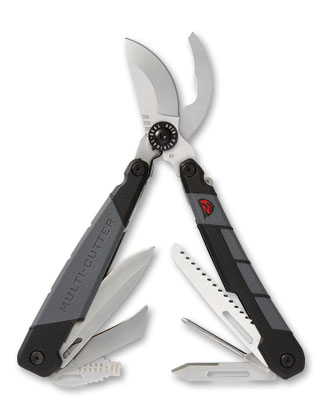
Every so often, you find something among all the functional items out there for sportsmen that can really make a difference in your outdoor experience.  Last summer I found one of those items, it is the Real Avid Multi-Cutter.  I have used this cool tool while fishing, hunting, working in the yard and while working on my truck in an emergency to cut and replace a brake line.

multicutter2

The Multi-Cutter provides serious, portable cutting power in the field.  It will easily clip bird bones, help you field dress a deer (it will cut a ½ inch thick bone!), saws through branches when you’re setting up your tree stand, and work with you and for you in a hundred other uses.

multicutter3

The hefty cutting jaw is strong, plus there are other assorted useful sportsmen tools that fold out and then retract into a convenient carry package.  There is a limb saw, a claw point knife blade, a drop point knife blade and a versatile tree step starter.  Shotgun shooters can change their choke tube with an internal wrench that will fit all common shotgun sizes, along with a pin punch that will help you easily break down your firearm actions for regular or emergency field maintenance.  The tool has a rubber grip to stay firmly in the control of your hand hold.

When closed up and retracted, the tool is compact and will slide neatly into a durable nylon sheath with a belt loop.  It’s with me all the time these days.  Retail cost is under $40.  To see a video, visit http://www.realavid.com/multi-cutter-box.html.


African Snake Bites Man on Staten Island

  • Lucky Man Survives Gaboon Viper Bite
  • Snake Was Illegal
  • Man Had No Permit

New York – A Staten Island was bitten on the hand by a deadly Gaboon Viper (Bitis Gabonica) while the man was

Decapitated head of the Gaboon Viper snake that bite a Staten Island man while cleaning the cage of the snake. The man survived.

cleaning its cage and was transported to Jacobi Medical Center in Bronx County.  The Gaboon viper is a snake species found in the rainforests and savannas of sub-Saharan Africa and is venomous.

On March 11, Environmental Conservation Officer (ECO) Wesley Leubner was on patrol in Westchester and Putnam counties when he heard a news report of a venomous snake bite in Staten Island.  ECO Leubner contacted Richmond County ECO Michael Hameline regarding the report.

ECO Hameline and ECO JT Rich visited the NYPD 121st Precinct in Staten Island to obtain detailed information about the snake.

After being bitten, the subject cut the snake’s head off with a knife and called 911.  NYPD arrived on scene and located the deceased Gaboon Viper, as well as a Red-Tailed Columbian Boa. Both snakes were secured by NYPD’s Emergency Services Unit and transported to the New York City Animal Care and Control office in Manhattan.

The subject was fortunate that the bite was a “dry” bite, meaning that no venom was injected into his hand.  He was able to check himself out of the hospital Saturday morning.  On March 12, ECOs Hameline and Rich interviewed the subject, who admitted to possessing both snakes without the required permits.  The subject was issued a summons for violating NYC Law pertaining to illegal pets, as well as a summons from the DEC for possessing a venomous reptile without a permit.

The case will be heard in Richmond County Court in May. The deceased vi

A Red-Tail Columbian Boa was also an illegal pet (due to no permit) in the same household.

per was seized into evidence; the constrictor is being cared for by NYC animal care and control.


New York State Department of Environmental Conservation (DEC) Environmental Conservation Officers (ECOs) enforce the 71 Chapters of NY E

nvironmental Conservation Law, protecting fish and wildlife and preserving environmental quality across New York.


In 2016, the 286 ECOs across the state responded to 26,400 calls and issued 22,150 tickets for crimes ranging from deer poaching to corporate toxic dumping and illegal mining, the black market pet trade, and excessive emissions violations.

“From Montauk Point to Mount Marcy, from Brooklyn to Buffalo, the ECOs patrolling New York State are the first line of defense in protecting New York’s environment and its natural resources, ensuring that they exist for future generations of New Yorkers,” said Commissioner Basil Seggos.  “They work long and arduous hours, both deep in our remote wildernesses and in the tight confines of our urban landscapes.  Although they don’t receive much public fanfare, the work of our ECOs is critical to achieving DEC’s mission to protect and enhance our environment.”

Advances in Fishing Line are Remarkable

lineadvances1Thinner, Stronger, Shock-Tough, Low Memory, Long Life

Since I retired from an engineering job in space and defense a few years ago, I have researched quite a few things that make my time in the outdoors more useful and efficient.

Just as when weekend anglers spend their hard-earned cash on fishing line, they are looking for just one fundamental thing, to land that biggest of fish safe and sure.

I interviewed pro bass anglers about fishing line because they work their lines the hardest, casting all day long, out and back, out and back.  These guys want the same thing – the best line to bring big fish that strike their presentations back to the boat.

I figure like many other anglers, there is too little time to gamble on hooking and losing a big fish once we’re casting or trolling lines.  Time on the water is scarce for a lot of us, time out there is limited by other demands in life.  So when I’m there, I work really hard to assure there is very little that will compromise my luck or skill for total success on the water.

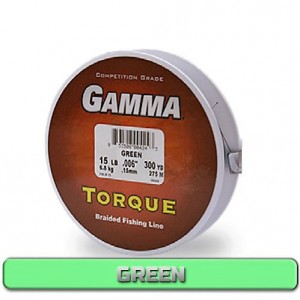
As science and private industry have advanced, new and better fundamental strength factors in fishing lines have become better too.  The new lines add flexibility, longevity, shock resistance, abrasion resistance, high UV resistance, low memory and also deliver an affordable lower price, especially the new Gamma Torque braided line.  On top of all that, I discovered that Gamma Torque is priced lower than many other braided lines out there.  Now that is also something that many anglers want to know more about.  Anglers I shared the new Gamma Torque braided line with could only say one thing: “What’s the name of that line again?” Off they went to the tackle store.

I shared the knots to join the nearly invisible Gamma Edge 100 percent fluorocarbon line with the Gamma Torque braided line and explained some of why the Gamma Edge fluorocarbon really does give anglers the “Edge” in fishing.  Invisibility with flexibility, strength, long life and small diameter are key!

Gamma lines, including the new Gamma Polyflex, a copolymer fishing line, have advanced their affordable and efficient product with a fancy science-based name called “molecular alteration,” similar to a fundamental basis called “Nanotechnology”.  This is the once futuristic science of tiny sizing, a science used to also develop high strength structural materials and high power batteries.

The resulting Gamma fishing lines are so unique, they are patented.

The high tech Gamma lines allow longer casts.  When I first used the Gamma Torque braided line, I needed to finger the spool a bit more because my lures were flying so far – the line is so tiny and friction free.  The result was more accurate casts, more action on lures and more confidence in my ability to do more with no extra effort.

lineadvances2Several dozen bass pros use the Gamma fishing lines now, day-in and day-out.  Brent Chapman, bass pro, says, “Gamma is by far the best fishing line in the industry.  Most fisherman underestimate the importance of high quality line.  Fishing line is the only connection between the angler and the fish… I only trust Gamma!  Winning the 2012 Bassmaster Angler of the Year title is a direct effect of getting those bass into the boat.”

One more example: 6-pound test Gamma Torque braided line measures 0.002” inch thickness and has an actual break test of 14.0 pounds!  This line is made of 100 percent Spectra Fibers.  For comparison, this line is one fourth as thick as a single strand of hair for most people.  Very thin.

The list price for 225 feet of this braided line is under $9.  Use it on casting and spinning rigs where you need strength and sensitivity, especially vertical jigging lures and drop-shot rigs.   For diving planes and walleye trolling, the 30 or 40 pound test is efficient.  For yanking big bass from deep weedbeds, this line has the ultimate in abrasion resistance with the thinnest diameter, the 60 pound test works well.

The Gamma Torque braided line is so thin that most anglers opt to use the 20-pound test Gamma Torque braid instead of the lighter weight lines that Gamma offers, then tie on an 8-pound or 10-pound leader of Gamma Edge fluorocarbon to insure invisibility of the presentation at the terminal end.

All you need to ask yourself is, why would so many professional anglers use the Gamma fishing lines when they are competing for a $1,000,000 in prize money?

The answer is clear, especially once you try this stuff.

For more information on the Gamma Fishing Line, visit this link: http://gammafishing.com/gamma-difference/.

Aging Turkeys, by the Numbers

  • Older gobblers aren’t always bigger, but their spurs are.
  • Keep an outdoor journal, like building a time machine.

By Jim Low

Spurs tell more about a turkey’s age than its weight or beard. Jim Low Photo

Math has never been my strong suit, but a recent trip down memory lane sent me reaching for pencil, paper and a calculator.  As I often do when a hunting season approaches, I pulled my outdoor journals off the shelf to refresh my memory about past turkey hunts.  Reading the vital statistics of gobblers that have fallen to me and friends got me wondering how old those birds were, and how their ages related to their weight, beard length and spur size.

Turkey biologists learned long ago that the most reliable indicator of a gobbler’s age is spur length.  A bird with spurs measuring less than half an inch are sure to be jakes.  Nine times out of 10, if a bird’s spurs are ½ to 7/8 inches long and straight, with relatively blunt ends, it is 2 years old.  Spur growth slows down after that, making it difficult to separate 2- and 3-year-olds.  Birds with slightly pointier, curved spurs measuring 1 to 1½ inches long can be either 2 or 3 years old.  If you bag a gobbler with needle-sharp, scimitar-shaped spurs longer than 1½ inches, you’ve got a bird that has survived at least four summers and winters.

Curious how my birds stacked up, I made a table listing these characteristics for the 21 gobblers that I took the trouble to record in detail.  Nine had spurs long enough (averaging 1¼ inches) to fall into the 2- to 3-year-old cohort.  Seven were 2 years old, with spurs averaging eight-tenths of an inch.  The remaining four, and four were jakes, with mere nubs for spurs.

The older gobblers’ beards averaged 10.1 inches, compared to 10 inches for 2-year-olds.  This is leaving out one gobbler that had 1-3/16-inch spurs and no beard at all, only a patch of thick, dark skin where a beard should have been.  Also, I only counted the longest of three beards sported by a 2-year-old killed last year.  If you include the two shorter ones, the 2-year-old birds average beard length climbs to an impressive 11.9 inches.

The longest spurs among the older toms measured 1-3/8 inches.  They had pronounced curves and were sharp enough to be dangerous, but their length leaves little doubt that I have never killed a truly old bird.  The heaviest gobbler in my records was a 2-year-old that had 7/8-inch spurs and tipped the scales at 26.5 pounds.  Overall, the two 3-year-olds were heavier than the deuces, but only by 14 ounces.  The four jakes (yearling males) averaged 14.75 pounds.  The honors for longest single beard – 11.5 inches – also went to a 2 to 3-year-old gobbler.  But on average, the older gobblers’ beards were virtually identical length.  All this proves the rule that weight and beard length are not reliable measures of age.

Seeing how gobblers bulk up between one and three years of age, you might expect older birds to outweigh 2-year-olds by a bigger margin.  The fact that they don’t is probably because the older, more dominant gobblers have less time to eat while they are busy kicking 2-year-old toms’ butts and chasing hens.  Those same gobblers likely weigh more in the fall, after they have time to bulk up on acorns.

Delving into journal entries reminded me how written records bring memories to life like nothing else, including pictures.  Details that make days afield special quickly slip away unless captured while they are still fresh in our minds.  This hollows out our recollections.  If you don’t keep a journal, consider starting.  It doesn’t have to be time consuming.  I use 6- by 8-inch books with blank, lined pages.  They are available in most book stores or online for next to nothing.  One lasts me two to four years, depending on how much time I spend outdoors.  I keep the current one on my bedside table and make entries before going to sleep.  Once you establish the routine, it’s automatic.

Most of what I record is factual – when and where I went, who was with me, what we caught, killed and saw, weather and habitat conditions and animal behavior.  But I also include thoughts, feelings and anecdotes, like when someone’s dog made a spectacular retrieve or knocked his new Citori into 10 feet of water.

The accumulated knowledge has practical uses, but I expect the real payoff to come years from now, when I no longer can do the things I love most.  Then, I will be able to sit by the fire, reliving my outdoor life.  If I’m lucky, there will be some tykes to regale with tales from my storied past.

Backcountry Hunters and Anglers (BHA) is working National Policy issues that AFFECT ALL SPORTSMEN

Click the Picture to Take Action.

Backcountry Hunters and Anglers (BHA) is working on national policy issues that affect all sportsmen, here is an update:

National Monuments 

BHA responded in force to the Trump administration’s unprecedented rollback of monument protections on more than 2 million acres of American public lands. Thanks to many of you who have spoken up, we’ve been sending a clear message that this decision undermines the longstanding bipartisan legacy of the Antiquities Act. We’ve responded to this historic attack with a series of ads, press releases and opinion articles. To make sure you have the facts needed to respond accordingly, we’ve compiled Frequently Asked Questions to help you better understand our stance.

Greater Sage Grouse

Our sagebrush ecosystems play a critical ecological role that not only supports the sage grouse, but mule deer, pronghorn, elk and a multitude of other species. For decades, habitat loss and degradation from development, invasive species and fire and have negatively impacted these iconic places. BHA has fought hard to see conservation plans implemented but a small faction in Congress and the current administration is intent on unraveling this historic collaborative conservation success. After BHA and our partners successfully averted attempts to scuttle conservation plans in defense spending legislation, the Interior Department issued a notice of intent to consider amending all, some or none of the 98 management plans. According to the DOI notice, this review is a result of one plan’s failure to prepare an environmental impact statement for its sagebrush focal areas. BHA and our chapters around the West have attended public meetings and submitted comments to the BLM. We’re remaining diligent and we will let you know as more comments and action are needed.

Arctic National Wildlife Refuge 

Despite widespread opposition from sportsmen and many others, the Senate passed a tax bill earlier this month that includes a provision to open the Arctic National Wildlife Refuge to energy development. With House and Senate legislation now combined into a package that will likely be sent to President Trump for his signature before Christmas, the refuge, home to the largest migratory caribou heard in the world, is a backcountry treasure at risk Check out this video that features national board member J.R. Young, his wife Renee and Alaska volunteer extraordinaire Barry Whitehill. It’s not too late to let your members of Congress know where you stand.

Mountain Bikes in Wilderness 

Earlier this month the House Natural Resource Committee held a hearing on the latest version of a Trojan horse bill to allow mountain bikes and other forms of mechanized recreation in wilderness. Our position on maintaining traditional uses and intact habitat in wilderness area remains unchanged, and we’d welcome your help in making this position known by writing a letter to the editor, setting up meetings with your members of Congress or sharing your opinion on social media. If you can lend a hand, please let us know. Find a rundown of many of the issues that BHA is actively working on here.

Sabinoso Wilderness Grand Opening sabinoso.jpg

A huge shout-out to the New Mexico chapter for responding in true BHA fashion to the opening of the Sabinoso Wilderness for the first time. BHAer Brad Jones was the first citizen to go through the gates, which opened on Nov. 10. Brad authored a great opinion column giving thanks, and the chapter convened a celebratory hike on Dec. 9! Thanks go to New Mexico’s U.S. Senate delegation and Interior Secretary Ryan Zinke for their efforts to open the Sabinoso, pictured below:

Thanks to all of you for supporting Backcountry Hunters& Anglers. If you’re not yet a member of our organization and you’d like to get involved with your local BHA community, please join us here. 

Backcountry Hunters & Anglers http://www.backcountryhunters.org/

Apply for Florida Alligator & Fall Hunt Permits in May

  • Phase 1 Drawing May 12 – 20, 2017
  • 6,000 Permits Issued by Random Drawing

By Tony Young

May is here, and so is the start of the Phase I application period for applying for alligator and fall quota, special opportunity and national wildlife refuge hunt permits. Mark your calendar, set yourself an alarm, whatever you have to do to remind yourself – just don’t forget to get in all of your fall hunting permit applications in time for Phase I.

Alligator hunt permits

Since 1988, the Florida Fish and Wildlife Conservation Commission (FWC) has offered hunters the opportunity to take part in its annual statewide recreational alligator harvest that runs Aug. 15–Nov. 1. These special night hunts provide a hunting adventure unlike any other. Alligators are a conservation success story in Florida. The state’s alligator population is estimated at 1.3 million and has been stable for many years.

Phase I application period

The application period for the Phase I random drawing begins May 12 at 10 a.m. and runs through May 22. More than 6,000 alligator harvest permits will be available.

Hunters can submit their application for a permit that allows the harvest of two alligators on a designated harvest unit or county. Applicants must be at least 18 years of age by Aug. 15 and have a valid credit or debit card to apply.

Applications may be submitted at any county tax collector’s office, license agent (most retail outlets that sell hunting and fishing supplies) and at GoOutdoorsFlorida.com. External Website Applicants must provide their credit card information when they apply. If you change your mind on where you’d like to hunt, you are able to make updates to your hunt choices all the way up until the application period closes.

License/permit costs

The alligator trapping license/harvest permit and two hide validation CITES tags cost $272 for Florida residents, $22 for those with a Florida Resident Persons with Disabilities Hunting and Fishing License, and $1,022 for nonresidents. The cost for applicants who already have an alligator trapping license is $62.

Phase II and III application periods

Any permits remaining after the first phase will be offered during the Phase II random drawing May 26–June 5. Those who were awarded a permit in Phase I may not apply during Phase II. Remaining permits will be available in Phase III to anyone who did not draw a permit in either of the first two phases, and they may be applied for June 9-19.

Leftover application phase

If any permits remain after Phase III, there will be a fourth-phase issuance period beginning at 10 a.m. on June 22 until all permits are sold. Anyone may apply during Phase IV, even if they were awarded a permit in one of the earlier phases. Customers who are able to purchase additional permits will be charged $62, regardless of residency or disability.

What to expect if you get drawn

Within three days of an application period closing, applicants can expect to see an authorization hold on their credit card, verifying there is a sufficient balance to cover the cost of the permit. However, this does not mean they were awarded a permit. Once the credit card authorization process is complete, the lottery drawing will be held. All successful applicants will be charged, while those who were unsuccessful will have the authorization hold lifted from their credit cards.

Successful applicants should expect to receive their alligator trapping license/harvest permit and two CITES alligator tags in the mail within six weeks of payment. Alligator trapping licenses are nontransferable. All sales are final, and no refunds will be made.

For more information on alligator hunting or the application process, see the “2017 Guide to Alligator Hunting in Florida” by going to “MyFWC.com/Hunting” and then click on “Alligator” under “By Species.”

Fall quota hunt permits

The FWC offers thousands of quota hunt opportunities each year. Hunters can choose to apply for fall quota hunts for deer and wild hogs. There also are special hunts for families, youth, people with disabilities, bowhunters and those hunting with muzzleloaders.  

A quota is the maximum number of hunters allowed on a particular wildlife management area. The FWC’s Quota Hunt Program prevents overcrowding on such areas and provides quality hunts. Quotas also help control game harvests. The FWC sets quotas based on an area’s size, habitat, game populations and regulations.

There are several types of quota permits, most of which are issued by random drawing, and the Phase I application period for these fall quota hunts is May 15–June 15. I’m talking about archery, muzzleloading gun, general gun, wild hog, youth, family, track vehicle, airboat and mobility-impaired quota hunt permits.

You may apply for each of the hunt types, and there is no fee to do so. But unless exempt, you must have an up-to-date $26 management area permit (or a license that includes one) when applying for a quota permit. If you do not have this, the system won’t accept your application.

The FWC offers youth deer hunts on Camp Blanding WMA in Clay County and on Andrews WMA in Levy County. If you have children between the ages of 8 and 15, and you want them to have a chance to experience one of these great hunts, apply for a youth quota hunt permit – 160 kids will get this opportunity. During these hunts only the youngsters may hunt, and they, along with their adult supervisors, are the only people allowed on the area.

There will be family quota hunts on 28 WMAs, and if drawn, the permit requires one adult take one or two youths hunting. The adult may not hunt without taking along a youngster.

Hunters certified by the FWC as mobility-impaired may apply for Mobility-impaired Quota Permits that allow exclusive access to general gun hunts on nine of the state’s public hunting areas.

If you want to get the jump on one of these hunts, apply May 15–June 15 at GoOutdoorsFlorida.com, External Website or have a license agent or tax collector’s office apply for you. To find out if you’ve been selected, log onto your customer account at that same web address after 10 a.m. on June 19.       

If you don’t get drawn for a particular quota hunt, you’ll get a preference point for next year’s drawing, which will improve your chances of being selected. If you’re unable to use your quota permit and you return it at least 10 days prior to your hunt, you’ll get your preference point restored.

Special-opportunity fall hunts

If you haven’t been seeing the quantity or quality of game you’d like, I suggest applying for a Special-Opportunity Fall Hunt Permit. For the past 20 years, the FWC has offered these unique fall-season hunts for deer, wild hog and released quail on arguably the state’s best public hunting lands. Maybe it’s time you looked into getting in on the action and experiencing the hunt of a lifetime.

These extraordinary hunts offer large tracts of land with an abundance of game and low hunting pressure. All deer hunts allow you to take only mature bucks with at least one antler having four or more points, 1 inch or longer. Wild hogs also are legal to take during the deer hunts, and there is no size or bag limit on hogs.

These special-opportunity deer and wild hog hunts take place in central Florida on Fort Drum, Lake Panasoffkee, Triple N Ranch and Green Swamp West Unit WMAs. Camping is legal on all areas.

There is one seven-day general gun deer and hog hunt on the 20,858-acre Fort Drum WMA in Indian River County. The hunt costs $50, if you get drawn. 

Lake Panasoffkee, in Sumter County, has eight four-day archery hunts for deer and hog on 8,676 acres. The permits are $100 for each hunt.

There are two seven-day general gun deer and hog hunts at Triple N Ranch in Osceola County. The permit costs $175 for each of the two hunt dates.

Pasco County’s Green Swamp West Unit, where the state’s highest-scoring deer on record was taken, has two archery hunts for deer and hogs on its 34,335 acres. There are also three general gun hunts for deer and hogs. All are four-day hunts costing $100.

All special-opportunity permit holders can bring one non-hunting guest if they wish during the deer and hog hunts.

The FWC also has released-quail hunts on the Carr Unit of Blackwater WMA in Santa Rosa County. With these hunts, you must bring and release your own pen-raised quail. These are seven-day (Saturday through Friday) hunts that run 16 consecutive weeks. 

There’s just one permit available for each week, and if you’re lucky enough to draw one, you and up to three of your friends will have the entire 250 acres to yourselves. The permit costs $100 for each week.

Special-opportunity hunt permits are transferable by simply giving the permit to another person. Permit holders under age 16 or those who are certified mobility-impaired, may have a non-hunting assistant accompany them during all special-opportunity hunts.

If you’d like to take part in one or more of these hunts, you may apply at GoOutdoorsFlorida.com, External Website county tax collectors’ offices or most retail outlets that sell hunting and fishing supplies beginning 10 a.m. on May 15. The application period runs through midnight of June 15.

You may apply for as many special-opportunity hunts and dates as you like to increase your chances of being selected, but you must include the $5 nonrefundable application fee for each one. Hunters are limited to drawing only one permit per hunt area, though.

Special-opportunity results are available in rounds, and you may pay the cost of the selected hunt at GoOutdoorsFlorida.com External Website or at any license agent or tax collector’s office. If you don’t claim your permit by paying for it in full by the claim deadline for each round, you forfeit it, and it’ll be available to the next customer waiting in line in the next round.

National Wildlife Refuge hunts

There are also several fall hunts on five national wildlife refuges that you may apply for during the same Phase I application period of May 15–June 15. These National Wildlife Refuge hunts offer yet another unique and limited opportunity to hunt on well-managed habitat with healthy game populations and low hunting pressure. However, no guest permits are available for any of these hunts. And if you get drawn, you must pay for your permit by the claim deadline, or you forfeit it, and it’ll be available during the next application period which is first-come, first-served.

On the 21,574-acre Lake Woodruff External Website in Volusia and Lake counties, you can apply for archery and muzzleloading gun hunts for deer and hog. There is no fee to apply, but if you get drawn, the permit costs $27.50.

You can apply for archery hunts on Brevard County’s 140,000-acre Merritt Island. External Website External Website There is no cost to apply, but if you get drawn, the permit is $27.50.

Just south of Tallahassee, you may apply for archery, general gun and mobility-impaired hunts on the 32,000-acre St. Marks. External Website Each of these hunts cost $5 to apply for and if you get drawn, the permits are $27.50.

On Franklin County’s 11,400-acre St. Vincent Island, External Website you can apply for primitive weapons hunts for the exotic and enormous sambar deer. It’s $5 to apply, and $37.50 to buy the permit should you get drawn. 

Lower Suwannee, External Website in Dixie and Levy counties, has a $15 permit you can purchase that allows you to hunt the entire fall and spring season on the 53,000-acre refuge. You may purchase this permit anytime between May 15 and up to the last day of spring turkey season.

So whether it’s a gator permit you want, or a fall quota, special-opportunity or refuge hunt that you’re after – or all of the above– here’s wishing you success getting one of these great permits.

An Open Letter to the Anti-Hunter, Makes us ALL THINK

  • Animal Lives Matter, All Animals
  • Are We Divided?
  • 13 Million Americans Hunt, What Are They Thinking? 

If you don’t approve of hunting, for whatever reason, I want you to know I appreciate you taking a minute to read this letter. My intention is to offer a couple facts about hunting you may not know. I don’t expect to change your mind altogether, but I do hope to provide some information that may create a more informed conversation.

You’re right. Our civilization has changed such that many people no longer need to directly participate in the food chain. Cities of us can go to grocery stores for the food we once grew or killed for ourselves. So, why then does hunting still matter?

You’re right. All living things have value. Animal lives matter, and that’s all animals, not just the one whose hair is stuck to your shirt right now. If that’s true, how can someone argue killing an animal is not only justified but important?

The on-going debate surrounding the value and ethics of hunting litters our news feeds and newspapers, often serving to divide those that hunt from those that don’t. I hunt. If that divides me from you, we need to talk, because it’s possible the very reason you oppose hunting may be among the most important reasons to support hunting.

The biosystems of our planet are under attack, and humans are largely to blame. Earth is experiencing record high average temperatures each year, and humans are devastating natural habitat on all continents at record pace. So, what are the facts about hunting? If they were better understood, could all people who love animals, and all people who care about the health of our planet find common ground?

Annually, over 13 million people hunt, nearly 40 million people fish, and more than 40 million people target shoot. The only emotion-based fact I’ll present in this letter is the following: hunting is a way of life for a lot of people. Most are ethical, well-meaning people. Some are not, just like any other cross-section of humanity. I started with this, because we’re already at an impasse if we can’t agree here. I’m an example of a hunter, so I’ll speak for myself. Many of my most cherished memories are times when I’ve been hunting. Hunting and fishing are a part of who I am, part of the way I look at the world, and part of my value system. Hunting doesn’t define me, no more than does being a Bernie Sanders voter, or homosexual, or Muslim define someone else. But hunting is absolutely part of my identity. There is literally nothing anyone can say to make me change that. Can we agree hunting is important to lots of people like me?

Okay, enough of the feely stuff.

Wildlife and wild lands are owned by the public, as prescribed by the Public Trust Doctrine. Each state has a fish and wildlife agency, which was given the responsibility to manage all wildlife via what’s called the North American Model of Wildlife Conservation. Where success is measured by the proliferation of wild animals, this model of wildlife management is among the most effective in the history of mankind. See, we humans are a highly invasive species. Every day we till up wildlife habitat to grow more food, to build more infrastructure, and to meld the natural world to fit our every whim. The North American Model of Wildlife Conservation is one of the only proven barriers standing between wild places and animals and their decimation. And its implementation is not cheap.

Nearly every economic, social, and cultural trend is eating away at the prospect of wild animals thriving into the future. Except, perhaps ironically, hunting, fishing and recreational shooting. You’ve probably heard the argument, “hunters pay for conservation.” The extent to which this statement is true can be debated, but it is a fact that hunting plays a major role in conservation. Between 50-80% of all money spent on conservation in the United States, nearly three billion dollars, comes through one of three sources (in order of size): hunting/fishing license sales; excise taxes paid on hunting/fishing/recreational shooting gear; and donations to conservation non-profits. Hunting and fishing license sales are a pretty well understood concept. However, most people don’t know that sportsmen of generations past lobbied for and passed Pittman-Robertson (PR), the act that placed a tax on hunting and recreational shooting gear, then later Dingell-Johnson (DJ), the act that placed a tax on fishing gear. The funds from all three sources; licenses, donations, and excise taxes are used by your state fish and wildlife agency, as well as a myriad of non-government organizations, such as Ducks Unlimited, to do the work of managing wild places for wild animals.

Without PR/DJ, sustainability of our wild lands and wild things would face serious headwinds. One must have only a rudimentary understanding of economics to understand why. If left without protection and management, wild places would soon turn into farms, ranches, and housing developments. To fund that protection, some wild animals were given a “value,” quantified by the license fee paid to hunt or catch them. No true sportsman or woman would argue the value of a living thing can be quantified in dollars; it’s simply the only scalable way anyone on earth has come up with to ensure the necessary habitat exists to sustain all species. It’s a trade-off – kill some of the deer to make it economically viable to keep and manage the land on which all deer and most all other species live.

But, couldn’t we get conservation funding into the budgets of all levels of government; local, state, and federal?

The answer is probably yes, but the economics again tell a dooming story. Public lands, such as state recreation areas or national forests, are largely viewed as a sink on the tax base, especially in more developed or more agrarian areas of our country. No one pays property taxes on this land, and it’s more difficult to tie tax revenue back to it from tourism or other uses than it is to tax income from corn production on the same parcel. Thus, privatizing land for development or production is a strategy governmental entities use to increase their tax base. If you were a politician and your constituents were asking you to choose between health care for babies or keeping our public land public, what would you do? The debate over control of our public lands is a shining example of what will happen to our wild places when it’s time to sharpen the budget pencil.

Some of the favorite non-profit organizations of anti-hunters have taken to buying land. An example is the Humane Society of the United States’ Wildlife Land Trust. The novice biologist in me says, “Great, more land for wild things.” But any wildlife biologist, for or against hunting, will tell you leaving land unmanaged is an untenable solution. Sure, it’s cheaper for the Wildlife Land Trust, but unmanaged land does little or nothing for wildlife. Nature used to do the management work for us. For thousands of years prairie habitat burned, invigorating successional habitat growth. Ignited by lightning, forest fires would burn until they simply went out. Today, firefighters feverishly dowse wildfires with chemicals and water in hopes of saving human life and assets. Ever been on a hike through a dense forest? Did you notice how animal diversity was most prolific outside of the most dense areas – perhaps where the forest opened up to a grassy area? Most woodland species are not adapted to compete in the most dense, unbroken forest cover. Just as most prairie species are not adapted to compete in the most dense, unbroken grassland areas.

The way I see it, it’s perfectly reasonable that you do not hunt.

But, I want you to understand hunting plays a very serious role in the real-world conservation that sustains nearly all species of plant and animal on Earth.  All people are in a lifelong dogfight to preserve the living things that inhabit our planet, especially you and me… since I took the time to write this letter and you took the time to read it.  The left and right, the greenies and oil barons, the anti and pro-hunters – we’re all bound to this watery rock and can only take from it so much before we endanger the wild animals and places in our way. Let’s stop arguing and get to work.

Sincerely,

Eric Dinger, Founder of Powderhook

About Powderhook: Powderhook is the outdoor help desk. With free maps and depth contours, thousands of events, plus the local scoop you can’t get anywhere else, a good day in the outdoors is only a download away no matter your experience level.  http://blog.powderhook.com/an-open-letter-to-hunters/.


Arctic Grayling Fishing in Alaska

Fishing near Fairbanks is Pure, Pristine, Sacred

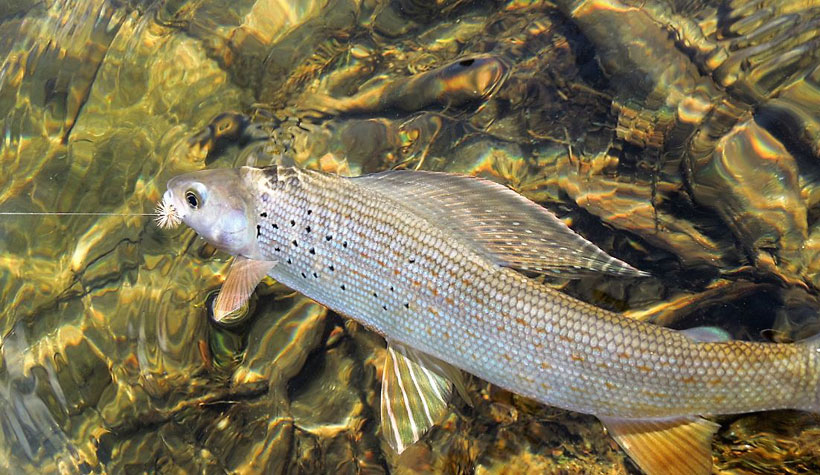
Arctic grayling are among the most handsome fish to see in person, especially on the end of your lightweight fly line in the pristine, pure waterways of central Alaska. Forrest Fisher Photo

There are some places where adventure into the outdoors is beyond the realm of imagination, Alaska is one of those places.

While many people head to Alaska to take an adventure cruise, catch giant Halibut in the saltwater, or simply see glaciers, Alaska also offers some of the most spectacular freshwater fly-fishing for a myriad of species.

When we visited there just a few years ago, finding the next best fishing spot in the world was as easy as stopping the truck alongside a meandering stream and taking out your fly rod. There were other options that can also offer more excitement, like renting an all-expense included trip via a charter service or float plane, where certified Alaskan guides will open the door for you to take your next cast to a honey hole that no one else may ever find.

There are so many lakes and streams in Alaska that there are probably quite a number of secret fishing holes and most of them are filled with quite a few different species of fish that most of us can easily catch. One of the big questions for most visitors is deciding what to fish for, there are so many species! The next big question is where to fish and where to stay for non-Alaskan visitors like we were.

There are very luxurious hotels with bonus accommodation amenities and there are many more rustic lodge type facilities. Either way, you and Mother Nature will make great friends. The type of rental housing is just another decision that once-in-while visitors to Alaska, like us, have to think about.

Wherever those accommodations might be, you are sure to find fresh air, exhilarating views and unspoiled wilderness. During our last 2-week visit, there were several times I simply took out a folding chair and sat there for an hour, realizing that I was experiencing a trip of a lifetime. It eventually registered that the view we had at the moment was probably a view that no one else might have ever seen, there is so much remoteness.

My better half and I enjoyed easy fishing fun by fly casting lightweight leaders on #4 floating fly lines for Arctic Grayling during a good part of the trip. We used a guide service to learn the ropes a bit at first, then stopped and tried it on our own. Best part was the feeling that we could be successful with little training. Fun? Yes, unforgettable fun!

One of the remote areas not far from Fairbanks, Alaska, we conducted a road trip to fish the Chena River after being trained by a local guide, Reinhard Neuhauser, Alaska Fishing & Raft Adventures (website: www.akrivertours.com, e-mail: info@akrivertours.com). Forrest Fisher Photo

We flew into Fairbanks and rented a vehicle. Our plan was to learn more about the unspoiled spirit of the terrain and nature treasures to be found in this culture of the Alaskan wilds – as long as we were traveling where there was a road. That was our one prerequisite. Traveling by road vehicle from place to place, my wife and I felt a primordial connection to the dimension we came to realize about this special land. We felt as if we had come to learn a place of new reverence with unspoiled landscapes. There was a fresh developing sanctity for this place called Alaska.

Wherever we cast a line, we found unspoiled adventure. One thing for sure, you will discover that even with just one trip, the journey will linger as memories of sacred vision to reflect on.

Fish, hunt or just visit with a camera, we plan to spend more time in Alaska in the near future. For a quick look at a simple fishing experience to be found there, we found this link to help share what Alaska is all about: https://www.travelalaska.com/Things%20To%20Do/Fishing.aspx.

Plan ahead, make a few calls, then do it. Life is too short!

Asian Carp Blitz in Kentucky

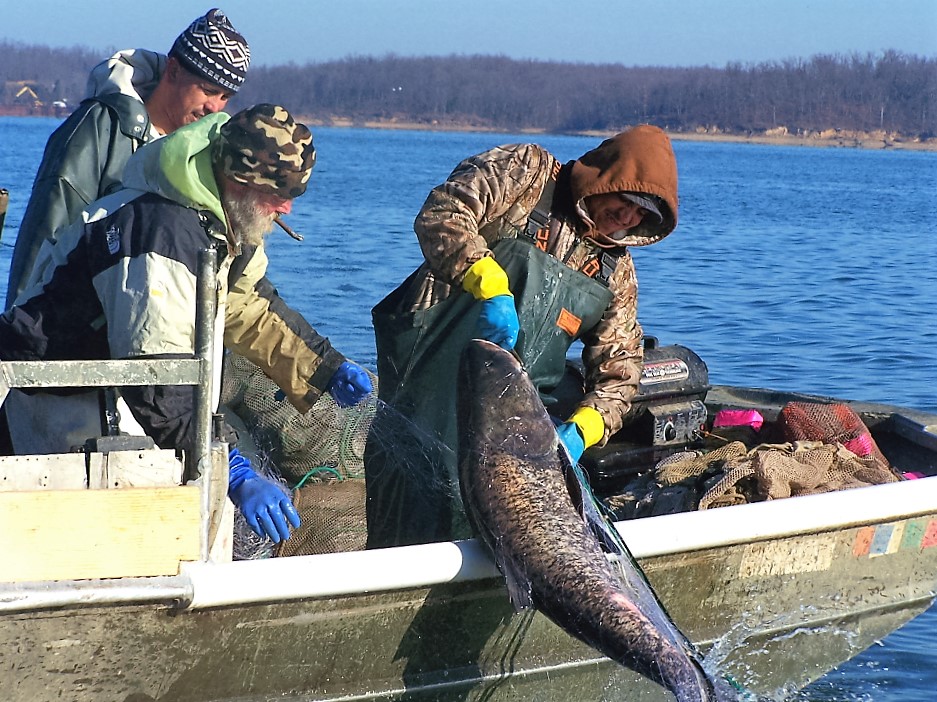
Invasive Asian Carp are big, plentiful and are a slimy mess in Kentucky and Barkley Lakes, especially once they are aboard your boat, KFW is testing the waters for data collection. Photo is courtesy of Kentucky Department of Fish and Wildlife

-November 8-10, 2016

-Goal: Asian Carp Population Survey

-Benefit: Collected Fish Sold to Fish Processors

Invasive Asian Carp are big, plentiful and are a slimy mess in Kentucky and Barkley Lakes, especially once they are aboard your boat, KFW is testing the waters for data collection. Photo is courtesy of Kentucky Department of Fish and Wildlife

By Forrest Fisher

If you have ever fished Kentucky Lake or Barkley Lake for bass or crappie, especially in a tournament, you might have some idea about the size of the Asian Carp population there, but it’s just an idea.  There are lots of ‘em!  Anglers can catch them occasionally when fishing for game fish species.  They fight incredibly hard and are fun to land until you get them into the boat.  Their outer layer is sheer slime, it very slick and almost pasty. They are not native in the lakes and are an invasive species that the Kentucky Department of Fish and Wildlife is trying to understand more about.

Kentucky is working with federal agencies, in cooperation with volunteers, commercial anglers and fish processors, and is launching a “Carp Blitz” on November 8-10 to help gauge the population of invasive Asian Carp in Kentucky and Barkley lakes.  At least a dozen sampling crews will be netting, electrofishing and working with licensed commercial anglers to collect as many Asian carp as possible during this three-day period.

“This very large effort is primarily a sampling or data collection exercise which, if deemed successful, will be repeated annually in order to provide relative abundance and population demographics of Asian carp in Kentucky and Barkley Lakes,” said Ron Brooks, fisheries director for the Kentucky Department of Fish and Wildlife Resources.  Other participating agencies will include the Tennessee Wildlife Resources Agency and the U.S. Fish and Wildlife Service.

Kentucky Lake at sunrise from Kentucky Lake State Park and Marina is a beautiful way to start the day! Hotel accommodations are reasonable at the State Park. Forrest Fisher Photo

In 2013, Kentucky Fish and Wildlife sponsored Carp Madness, a first of its kind tournament for commercial anglers whose primarily goal was the thin the Asian carp population in the two western Kentucky lakes.  It proved successful, as a handful of participants collected more than 83,000 pounds of Asian carp during the two-day tournament.

Brooks believes if weather conditions are good, the Carp Blitz effort will easily eclipse the Carp Madness tournament.  State and federal fisheries crew will use electrofishing equipment to drive the wary Asian carp into the waiting nets of the commercial anglers.

“All Asian carp harvested will be donated to the commercial anglers assisting with this effort,” Brooks said.  “Kentucky’s fish processing businesses will purchase all fish harvested.”

As part of the effort, researchers with Murray State University are working with Kentucky Fish and Wildlife to tag fish with telemetry markers.  This will allow researchers to discover the movement patterns and habitat use of Asian carp in Kentucky and Barkley Lakes.

We’ll pass on what we learn of this effort as results are communicated.  Kentucky Lake is an incredible fishery and recreational resource for all to enjoy.

American Outdoor Sportsman of the Year

Lisa Snuggs accept her award from Legends of the Outdoors Hall of Fame founder, Garry Mason. Photo by Rob Simbeck

  • Lisa Mcdowell Snuggs 
  • Legends of the Outdoors Hall of Fame
Lisa Snuggs accept her award from Legends of the Outdoors Hall of Fame founder, Garry Mason. Photo by Rob Simbeck

By Jill J Easton

Lisa McDowell Snuggs was chosen as the 2016 American Outdoor Sportsman of the Year by Legends of the Outdoors Hall of Fame.  She was picked for her dedication in helping outdoor communicators – which she does 365 days a year as Executive Director of The Southeastern Outdoor Press Association (SEOPA).

Garry Mason, the founder of the organization, nominated Lisa because of her efforts to keep hunting and fishing a vibrant part of American culture, by encouraging quality outdoor communications. Her long relationship with some of the best voices of the outdoors, encourages excellence.

“Without outdoor writers, whose stories are so important, many people would not be able to see, appreciate and understand the love of the outdoors that many of us in the outdoor industry have,” said Mason. “Lisa plays a big part in making that happen and we are very proud to honor her as this year’s American Outdoor Sportsman of the Year.”

Lisa in her own Words

Lisa McDowell was born into the world of outdoor communicators.  Her dad Bodie, was an outdoor writer for the Greensboro Daily News in North Carolina.  As one of the two youngest siblings in a large family, she and her brother Mark often went along when he went out on assignment.

“Going with my dad meant checking out all the local farm ponds, dove fields and campgrounds,” Lisa said.  “It also meant regular visits to the area city-owned lakes, sportsmen’s’ clubs, and events.  More Sunday afternoons than not were spent at the local gun club.

I learned early on that everybody has a story and they are willing to tell it if you’re willing to listen.  I’ve always loved the outdoors and I’ve always enjoyed writing as well, though, until SEOPA, most of my writing is done in conjunction with a piano or guitar.

When he went to SEOPA and Outdoor Writers of America meetings, we went along and I met some of the outstanding outdoor communicators working in the 1960s and 1970s.”

Her first job was working for The Plastic Development and Research Company (PRADCO, a fishing lure company).  Along the way the talented singer and songwriter made four albums and wrote numerous outdoor-related songs.  In 2000 she became executive director of the Southeastern Outdoor Press Association a position she currently holds.

Talk about SEOPA

“The term outdoor writer includes people who share stories on paper, radio, television, video, through photography, art, blogs, websites and through songs.  It always starts with a story. It’s the words that all mediums have in common.

Anybody who enjoys reading, watching and/or listening to outdoors stories should thank an outdoor writer. They play a big part in keeping the heritage sports of fishing, hunting, camping, boating and shooting alive.

If you are interested in learning more about SEOPA, or any of the regional or national outdoor writer groups, they all have excellent websites.  For communicators that would enjoy finding help from the excellent speakers that share information at our conferences, the newsletter and more than 400 writers and outdoor-related companies, check us out. The qualifications for membership are listed on the website and applications can be completed on line.”

What personality characteristic makes you a good linchpin for SEOPA?

“Being a good listener, and I’ve been told I have the heart of a servant.  I enjoy helping people. Figuring out how SEOPA members can help each other and seeing it happen is so rewarding.”

What part of the job do you enjoy most? 

“The most rewarding project so far is working on the Lindsay Sale-Tinney award.  It’s a scholarship that brings an aspiring young communicator to the conference each year.  The award was established in 2011 by Stu Tinney, the founder of Striper Magazine, in honor of his late wife Lindsay.

Of the six recipients so far, four are still SEOPA members and seem to be well on their way to establishing themselves as outdoor communicators.  Meeting these young people and getting them and other young people involved in SEOPA is an honor.

Lindsay Sale-Tinney loved helping young people learn about the outdoors.  She was a talented writer, photographer, angler, equestrian and all-around good person.  She would be proud of the work we’re doing in her name.  The award is a part of the Outdoor Journalist Education Foundation of America.  People can find out more about it at by visiting seopa.org and clicking on OJEFA.”

Describe your work in the outdoor industry

“I worked for PRADCO for 10 years starting in 1986 as the company’s outdoor writer liaison.  I showed new products to the media at the annual fishing tackle trade show produced by the American Sportfishing Asssociation.  Back then it was called the AFTMA show, which stood for American Fishing Tackle Manufacturers Association (now it’s known as iCAST).  I also represented the company at several outdoor writer conferences each year.  Because of attending the SEOPA and OWAA conferences when I was a kid, I knew many folks in the industry. Working with PRADCO allowed me to get to know even more writers and broadcasters from all over the country.

In the mid-90s, I worked with a group of investors in Tennessee who were marketing sporting goods on television.  When that didn’t work out I took a temporary job working for Castlerock Productions when they were in Tennessee filming “The Green Mile.”  The exterior of my house was used as Tom Hanks’ house and I ended up working for the construction division of the film company.  When that came to an end, I managed an office for a small manufacturing firm for a couple years until the opportunity with SEOPA came along in 2000.  It was meant to be!”

Who are some of the famous outdoor folks you have met, known and worked with?

“Outdoor communicators and the people they write about are the best people in the world.  It’s almost like a secret society.  I guess all groups of kindred souls feel the same way – you know – birds of a feather, but there’s just something special about “my” group.

Some of the folks I’ve met and called friends in this business include Tom Gresham and his dad Grits, Homer Circle, Forrest and Nina Wood, Ronnie “Cuz” Strickland, Ray Scott, Jim Zumbo, Mark Sosin, Tom Kelly, Tes Jolly and Jimmy Houston.  Lots of professional anglers who fished on the circuits in the 80s or earlier like Bobby and Billy Murray, Rick Clunn, Zell Rowland, Hank Parker, Roland Martin, Bill Dance, and of course Sugar Ferris who founded Bass’n Gals for women like Kathy Magers and Linda England.

I think it’s interesting that so many country music artists enjoy fishing and hunting, too.  I met Merle Haggard at a Bassmasters Classic in the 1980s and presented special fishing lure packages to George Jones and Travis Tritt when they were producing PSAs for the fishing industry in the early ‘90s.  Music and fishing go together.”

In addition to your work with outdoor writers you are a musician, how has this affected your outdoor career?

Music has always been a big part of my life.  It’s given me so many opportunities and introduced me to some of my favorite people.  My first job was playing the piano during Sunday buffet at the Holiday Inn.  I got $5 and all I could eat.  As a bonus the chief taught me the secret of his fried chicken!  When I was 17 I started playing in a family-owned restaurant every Wednesday night and one weekend a month.

Lisa Snuggs with a wintertime bass caught in a small lake at Sumter Farms near Geiger, Ala., on the far western edge of the Alabama Black Belt Region. Photo by Jeff Samsel

“Then dad got me a gig singing a few outdoorsy songs and Amazing Grace to kick off the Sunday session of Indiana University’s American Fishing Institute when it came to Raleigh.  After hearing me sing, Billy Murray told me I should sing Ramblin’ Fever with the words changed to Fishin’ Fever.  I said, “You write ‘em down and I’ll sing ‘em.”  He scribbled down the changes and that became the first song about fishing I recorded.  I wrote more than a dozen fishing and outdoor-related songs after that, recorded two albums in the mid-80s and recut some of them and a few new ones in 1996.

SEOPA conferences were great memories when I was a kid.  Tom Rollins, the first executive director, played the guitar and would always sing a few songs after the banquet on the last night. People would gather and sing along.

 Tom and his wife Mona came to visit us in North Carolina several times and he always brought his guitar along.  When I began attending SEOPA on behalf of PRADCO, I was glad to see the sing-along tradition was still in place.  By then I was able to participate in earnest instead of just listening.  Then, when I was hired by SEOPA we kept gathering on the final night to “pick and grin.”  It was always just a casual get together and a way to relax after a busy conference.  One president was so impressed by all the talent in the room that he insisted it become an official part of the conference.

These days it’s a part of the dinner program and is sponsored by the National Wild Turkey Federation, Pheasants Forever, Ducks Unlimited and Winchester. Representative from these organizations enjoy sharing their conservation messages in such a festive yet intimate setting.”

What are your favorite outdoor activities?

“Fishing is my favorite outdoor activity, though I haven’t done much of it lately. When I said that to Uncle Homer one time he said, ‘You have to make time, like you would for anything else that’s important.’  He was right, of course.  Most anglers agree that catching a fish is the proverbial icing on the cake of being outdoors.

Fishing forces you, as one of my songs says, “to leave it all behind.”  I have fished in so many beautiful places and I remember thinking about (and feeling sorry for) all the people in the world who have no idea such peaceful places exist.  There’s just nothing like feeling you have thousands of acres of water to yourself as you make just one more cast at sunset.  You have no choice but to relax.

Another favorite activity is simply walking around in the woods, especially in winter. It’s even better with someone who knows more about plants and animals than you do.”

AR-15 Provides High Accuracy in 6.5 Creedmoor from Diamondback Firearms

  • Long Range Ballistic Flight, High Accuracy
  • Recoil Reducing Stock for Low Recoil
  • Affordable (under $1,300)

Diamondback Firearms, a top-tier, Florida based manufacturer of quality pistols and rifles, has introduced their new DB1065CB AR-15 rifle, chambered in 6.5 Creedmoor, to market.  The 6.5 Creedmoor is growing rapidly in popularity because of its superior ballistic performance over .308 and other long-range calibers.  The 6.5 Creedmoor is the fastest growing caliber for tactical shooters and is a great selection for medium to long range (500 to 1,000 yds.) shooting.

Ballistically speaking, when compared to the .308, the more aerodynamic 6.5 Creedmoor performs exceptionally well, with a very noticeable reduction in recoil.

The Mako Group is excited to partner with Diamondback by featuring the revolutionary FAB Defense GL-Shock Recoil-Reducing Stock and the AGR-43 rubber over-molded pistol grip on this new model rifle. The state-of-the-art GL-Shock has a unique, patented “Anti-Rattle” mechanism with no protruding parts, so as not to get snagged, and comes with a built-in silicone chrome alloy—perfect for your AR15/M4/M16.

The AGR-43 pistol grip comes with multi-textured rubber features for a more secure grip. It provides a better shooting angle, heightened control and less wrist fatigue and hinged floorplate for battery storage.

Other features of the DB1065CB AR-15 rifle include a 20” stainless steel fluted barrel, the 15” Victor M-Lok rail and the Double Side Port Muzzle Break.

The DB 6.5 Creedmoor will be offered in Black (MSRP $1,229.00) and FDE (MSRP $1,259.00), which will make it one of the most affordable in the market.

About Diamondback Firearms: Diamondback is located in Cocoa, FL and has been family operated for over 30 years. Diamondback Firearms was created in 2008 with the DB380 and DB9 pistol series. DB has evolved to now include the DB10 rifle/pistol series with .308 and 6.5 Creedmoor calibers offered. DB15 rifle/pistol series with .223/5.56, 300 BO, and 9mm calibers offered. In January 2017 DB Firearms moved into a brand new 40,000 sq. ft. state of the art facility, which will also include Diamondback Barrels Division and CNC machines. All Diamondback products are manufactured in the USA.

About The Mako Group: The Mako Group is the exclusive U.S. distributor of the finest tactical equipment and weapon accessories that have been proven in combat. Designed for law enforcement agencies and militaries worldwide, Meprolight night sights and optics, FAB Defense weapon and personal defense accessories, Front Line Holsters and RTS Target Systems are available at firearm retailers everywhere. Connect with The Mako Group on FacebookTwitter, Instagram and YouTube to stay up-to-date on the latest news and products. For more information visit www.themakogroup.com.

Angling Tips to Help Trout and Salmon Beat the Heat…from NYSDEC

Heat stressed fish often seek pockets of cold water.

In New York, trout and trout anglers have benefited from abundant rainfall and cool weather conditions this spring that promote the growth and survival of trout and salmon.

Heat stressed fish often seek pockets of cold water.

However, with the forecast for high temperatures this weekend through next week, it is important to remember that trout and salmon are coldwater sportfish that can experience serious physical stress whenever water temperatures climb above 70° Fahrenheit. Heat stressed fish often seek pockets of cold water created by upwelling groundwater, small feeder streams, or water released from deep reservoirs. These refuges allow trout to avoid or recover from potentially fatal levels of heat stress. You can help by taking the following precautions during your warm weather fishing trips.

  • Avoid catch and release fishing for heat stressed trout. Trout already weakened by heat stress are at risk of death no matter how carefully they are handled.
  • Don’t disturb trout where they have gathered in unusually high numbers. Because these fish are likely to be suffering from heat stress and seeking relief, responsible anglers will not take unfair advantage of their distress.
  • Fish Early. Stream temperatures are at their coolest in the early morning.
  • Go to Plan B! Have an alternate fishing plan ready in case water temperatures are too high at your intended destination. Consider fishing a waterbody that is less prone to heat stress or fishing for a more heat tolerant species like smallmouth bass.

When fishing tailwaters, such as those below New York City water supply reservoirs, remember that the cooling influence of reservoir releases will not extend as far downstream during periods of intense heat. By paying attention to water temperatures and adapting fishing strategies to changing conditions, anglers can help New York State’s trout and salmon beat the heat.


Only you can prevent aquatic invasions. Clean, Drain and Dry your fishing and boating equipment after every use.

AMMO: 338 LaPua – Discussion & Facts

  • Understanding Ammunition for Your Hunt
  • Compare ballistic coefficient, velocity, energy and momentum – a Discussion

By Andrew Chamberlain (Creator of “Chamber-It” on Facebook)

The 338 Lapua is a cartridge with a huge fan base.

One almost does not need to introduce or say much about it. I will say this about the 338 Lapua, it is as capable and as impressive as people say it is.  There are a lot of other cartridges that do what people say the 338 Lapua does well, but what makes the 338 Lapua so unique? Not necessarily what it does, but what it does uniquely. I believe everyone can appreciate what makes the 338 Lapua so special and also recognize the hype that also causes some of the descending opinions.

The Lapua can push a very high ballistic coefficient (B.C.) bullet at a fairly decent muzzle velocity for a very long distance. That is, in my opinion, the simplified version of much of the hype (that is true), but may not be put in proper context.

Look at the 300 Win Mag and what it can do with high B.C. projectiles. Then look at the 7mm and even the 6.5mm cartridges. Suddenly the 338 Lapua may not look quite as impressive. Then consider the fact that the projectile can weigh from 250 – 300 grains (not 208, 180, 160 or even 129 grains, but 300). Then consider the momentum this projectile still carries, even when the drop in velocity is so dramatic that the energy has dropped from 5,000 ft-lbs to 590 ft-lbs (this is the approximate energy when a 300 grain projectile transitions to subsonic velocity…less than 1,000 ft/sec). It will still have 43 lbs-ft/sec momentum, which is slightly more than a hot-loaded 357 magnum with a 180 grain slug delivers at the muzzle. Also consider that a 250 – 300 grain 338 caliber bullet is quite long and heavy, which provides great stability in flight through wind, and fog. It even gives a good fight against the rain.

Many look at the 338 Lapua as the ultimate big game and dangerous game cartridge. This may not be a very good argument. Though the 338 Lapua gives a marked improvement over the 338 Win Mag and it gives a slight numerical improvement over the 375 H&H (which initially sounds like something). However, finding a controlled expansion copper or solid flat nose 300 grain 338 caliber slug can be very hard to do (though they do exist). Then comparing the 338 Lapua to the likes of a 416 Rigby, 404 Jeffery, 458 Win Mag or 458 Lott, the comparison starts to be a bit silly.

So in short, don’t just look at the stats. The numerical nature of ballistics or the “hot points” thrown at the consumer can at times only tell half the story. And sometimes tell even less. The 338 Lapua is an impressive cartridge and is very good at doing a handful of things, but it is often touted as the best at something that it may not be intended to be used for at all.

The Ammo Performance Specs poster is a hand-picked selection of some of the most popular hunting cartridges and represent velocity, energy, momentum and recoil for each cartridge in a bar graph with numeric value. Accurately compare one cartridge with similar cartridges of interest. Click on the poster to order.

Factory Load vs. Hand Load The 338 Lapua is one of those rare cartridges where Factory Loads and Hand Loads compete very well with each other. However, hand loading does give a slight edge (20-80 ft/sec) over factory loads in common bullet weights. For some, this minimal difference does not merit hand loading, for others, this little extra, as well as the control and consistency they can derive, make it all worth it. One could mention availability and economics as well.

Quick Ballistics – 338 LaPua

  • Bullet weight = 180 – 300 grains
  • Bullet Velocity = 3,450 – 2,600 ft/sec
  • Optimal Load; Precision => 300 grains @ 2,750 ft/sec = 5,036 ft-lbs Energy & 117.9 lbs-ft/sec Momentum.
  • Hunting => 250 grains @ 3,100 ft/sec = 5,334 ft-lbs Energy & 110.9 lbs-ft/sec Momentum

Comparative Ballistics w/338 LaPua

  • 338 Win Mag: 250 grains @ 2,690 ft/sec = 4,016 ft-lbs Energy & 96.1 lbs-ft/sec Momentum
  • 340 Weathrby: 250 grains @ 2,960 ft/sec = 4,863 ft-lbs Energy & 105.6 lbs-ft/sec Momentum
  • 338 Lapua: 250 grains @ 3,100 ft/sec = 5,334 ft-lbs Energy & 110.9 lbs-ft/sec Momentum
  • 375 H&H: 270 grains @ 2,870 ft/sec = 4,937 ft-lbs Energy & 110.7 lbs-ft/sec Momentum
  • 378 Weathrby: 270 grains @ 3,1800 ft/sec = 6,061 ft-lbs Energy & 122.7 lbs-ft/sec Momentum
  • 416 Rigby: 400 grains @ 2,565 ft/sec = 5,842 ft-lbs Energy & 146.6 lbs-ft/sec Momentum
  • 458 Lott: 500 grains @ 2,350 ft/sec = 6,130 ft-lbs Energy & 167.9 lbs-ft/sec Momentum

The 338 Lapua is a great cartridge and is highly capable of a lot of things. Keeping it in proper context of usage allows one to see what is truly neat or impressive about this cartridge.

Good Hunting! Be Safe. Visit us at www.chamberit.com.


AMMO PRODUCT WARNING AND RECALL NOTICE

m22_recall

PRODUCT RECALL for WINCHESTER® 22 Long Rifle RIMFIRE AMMUNITION.

AMMUNITION Olin Corporation, through its Winchester Division, is recalling two (2) lots of M*22™ 22 Long Rifle 40 Grain Black Copper Plated Round Nose rimfire ammunition.

Symbol Number: S22LRT; Lot Numbers: GD42L and GD52L

Winchester has determined the above lots of 22 Long Rifle rimfire ammunition may contain double powder charges.  Ammunition with double powder charges may subject the shooter or bystanders to a risk of serious personal injury and/or death, or cause firearm damage, rendering the firearm inoperable.

DO NOT USE WINCHESTER® M*22™ 22 Long Rifle RIMFIRE AMMUNITION WITH LOT NUMBERS GD42L or GD52L.  The ammunition Lot Number is imprinted (stamped without ink) on the left tuck flap of the 500-round carton as indicated here.  The 1000-round intermediate carton does not have a Lot Number.

To determine if your ammunition is subject to this notice, review the Symbol Number and Lot Number.  If it is Symbol Number S22LRT with a Lot Number containing GD42L or GD52L immediately discontinue use and contact Winchester toll-free at 866-423-5224 or visit http://www.winchester.com/Product-Service/Pages/Contact-Us.aspx for free UPS pick-up of the recalled ammunition.

This notice applies only to Symbol Number S22LRT with Lot Numbers GD42L and GD52L.  Other Symbol Numbers or Lot Numbers are not subject to this recall.

If you have any questions concerning this 22 Long Rifle rimfire ammunition recall please call toll-free 866-423-5224, write to Winchester (600 Powder Mill Road, East Alton, IL 62024 Attn: S22LRT Recall), or contact Winchester Customer Support online

Autumn Color, Nature, Wilderness Air and Fresh Coffee at Lake George

  • Business Takes a NEW Direction
  • Lure of Autumn Bass Fishing, Lake Trout, Landlocked Salmon
  • Sights of Colorful Foliage
  • Plans for Waterfowl Hunting, Stream Fishing for Brook Trout

By Forrest Fisher

Rising fog from mountain valleys appear like slices of horizontal white pie resting between high, dark mountain peaks of the Adirondacks in the Lake George area. Forrest Fisher Photo

My workday plan was busy with a business trip from New York City to Montreal.  The airport traffic was heavy, the security lines long, longer than ever, the sky was clear and it was a beautiful day.  I was not happy with bumper to bumper traffic conversation between the interstate roadway vehicles and the morning disc jockeys were in a rant about their bummed weekend.  They made the congestion worse.  Then I suddenly realized, “I can drive!”

About two hours or so up the northbound highway, the traffic was gone and I discovered a wonderful sense of peace and quiet.  I left the long lines of airport security, the chaos of baggage, laptop checks and body scans behind.  All gone.  All replaced by a road trip drive that would change my persona for the day, maybe forever.

There was a faint sliver of fog rising from the valleys that appeared like slices of horizontal white pie resting among the high and very dark mountain peaks of the Adirondacks in the background.  Driving down Highway 87, the road signs announced Lake George and despite the near-darkness, I noticed that the autumn scenery was stunning in this particular area.  Signs advertised fly fishing, Hudson River rafting, rail trail bikes, historical sites, boating, biking, hiking and more.  These diverted my mind and were tempting me to consider a new daytime destination, maybe as just a momentary, side-of-the-highway, homesteader.  Yes, I thought, pull over, if only just to watch the enchanting sunrise.

Highway 87 runs north-south and Exit 21 and 22 provide easy access to Lake George Village and Dunham’s Bay Resort, where I found morning coffee. Photo: www.visitadirondacks.com

Rocky bluffs jutted upward and outward along the freeway, as I tried to focus on driving and not the scenic beauty.  That was just not possible.  The scenic views were an immediate visual award, an instant lottery prize win, just for making this drive.  I sensed myself grinning to the view, perhaps that was one honest measure of my sheer contentment.

A few minutes later, in the distance, the brilliant orange ball of morning sun began to tiptoe upward.  It was only a dull orange color sky at first, and then the first sliver of the sun crest rose just above the lowest horizon in the east.  I pulled off the roadway at Exit 21 and decided I needed a cup of java just to watch the morning light.  Driving down Beach Road in Lake George Village, sort of exploring too, my business trip had become an adventure.

I continued along Highway 9L just for a few minutes, it was October and many business places were already closed for the season, but it was so quiet, so enjoyable.  Then I came to Dunham’s Bay Resort (www.dunhamsbay.com).  I went in and asked about coffee. Yes!  They had fresh java and all the mixings, it smelled so good.  I toasted a cup to my decision to drive and thought about those poor folks that were probably still waiting in the airport line, grinning again.

A cup of fresh morning java from Dunham’s Bay Resort catered to my view of the morning sunrise at Lake George. Rose Barus Photo

I moved to the front of the resort and sat in one of the outdoor lawn chairs.  The warm Lake George water and chilly mountain air caused a fog to form on Dunham’s Bay right in front of the resort.  It became thick and started to settle before it started to rise.  I went back in for more coffee.  With cup number two, I realized I was looking at the highest mountain tops to the west, visible above the fog.  They suddenly emerged into a sea of brilliant color as the sun lit them up.  A flock of ducks went squawking by in flight, high overhead, that I heard, but could not see.  My brief adventure continued.  The natural intense lighting of the sun was doing everyday work.  I was inspired by the dazzling beauty and the coffee tasted so good.

An immediate urge for home ownership in the area seemed an almost immediate necessity.  How did I ever miss this Lake George area before?  Perhaps, if only for now, I might try for a short stay.  No.  Maybe on the way back, I thought, that way I could stay a day or maybe two.  Today, back to reality, there were meetings planned and work to do.

Vibrant autumn foliage was evident along Highway 87 and the pristine upper Hudson River. Rose Barus Photo

I realized that with the flight reservation and airport plan from the start, my fly rod was not with me.  On the next drive north, there might have to be a stopover.  Imaginary fog would be the cause, I’d need to pull over to stay safe.  Again, I’m grinning.  What a plan.  I realize that this drive to a brief coffee stop has me totally energized.

A new essence for realizing the seasons of the year was added to my list of “important things,” the autumn colors of October on Lake George are unforgettable.  Perhaps I must remember to do this again, maybe when NOT ON BUSINESS next year, I thought to myself.  It is a family type of destination, I could bring everyone, the grandkids too.

Historic sites abound near Lake George Village, adding the need for a second or third trip to “see it all.” Forrest Fisher Photo

My cellphone is activated and the calendar is reserved one year ahead around the seasons and the scenery just recorded only to memory.  Of course, I’ll never forget this day.

The backcountry is a new priority.  I return to the ribbons of roadway heading north with a new vision of the stunning foliage and clean, spring-fed, waterways that are abundant here.  These waters are filled with trout and untainted crustaceans.  Pleasantly now, I’m in a new comfort zone for effective business and again, I’m grinning.  Driving was such a good idea.

Time spent in the Adirondack Mountains of New York during autumn are positively special.  October is the month of color transition in the Lake George area of the Adirondack Mountains and lush green leaves turn to brilliant colors of bright yellow, orange and red.  They are unforgettable.

Color and visions from morning light to sunset are remarkable all around Lake George.  Accommodations are at low rates and fishing charters are still running.  The crisp air is right for a fall getaway.

Not sure I can wait for next time!

For Lake George information, visit www.visitlakegeorge.com or call the Warren County Tourism Department at 518-761-7653.   

Anti-Tick Tactics – Protect Yourself

This national Lyme disease map from the Center for Disease Control and Prevention (CDC) provides an illustration of the approximate distribution of predicted Lyme disease risk in the United States. Note that Western New York is at high risk.

Warm weather is back. Hooray!  Break out the camo clothes and turkey calls, fishing rods and binoculars.  It’s time to enjoy the great outdoors again, but as you pursue outdoor fun, don’t forget that there are some less-than-desirable things pursuing you as well.  Foremost among those things are ticks, there are several types, but deer ticks- also known as black –legged ticks (Ixodes scapularis), have recently become known as the “bad boys.”  They’re very, very tiny, hard to see, and their bite is nearly painless.

For as long as I can recall – and I can recall more years than like – ticks have been a source of concern beyond the “ick” factor.  Back in the day, we worried about tularemia and Rocky Mountain Spotted fever.  More recently, we have added Lyme disease, Lyme-like disease, Ehrlichiosis, anaplasmosis, babesiosis, borreliosis and probably a few others that haven’t crossed my radar yet.

Tick identification and relative size by stage in comparison. Courtesy of the Center for Disease Control (CDC).

The good news is that many of us will not get any of these maladies.  The bad news is that the chances of getting them are NOT ZERO and the consequences are potentially life-changing.  You want to do everything you can to reduce your chances of getting any tick-borne disease.

The additional good news is that there are excellent and very effective means of avoiding ticks.

Your first line of defense is clothing.  Long-sleeved shirts and long pants make it harder for ticks to reach your skin.  The wide variety of lightweight fabrics that wick moisture away from the skin makes it much more pleasant to dress for tick defense than it used to be.  Choose light colors to make it easy to see ticks that hitch a ride before they find an opening in your defenses.  You can further enhance clothing’s protective value by tucking pants legs into boots or using rubber bands to hold cuffs snug against your ankles and wrists.

These clothing measures are most effective when combined with chemical repellants.  Far and away the most effective of these is permethrin.  This chemical is lethal to ticks on contact, and they know it.  Just drop a tick on permethrin-treated clothing and see how it scrambles to get off!

Permethrin-based repellants are amazingly effective and because they work on all mites too, they also provide protection against the dread chigger mite.  Permethrin has low toxicity to humans and is poorly absorbed by skin.  It’s odorless once it dries, however, it is a toxin.  So the recommended method of usage is by spraying on clothing.  This is the best of all possible approaches anyway.  Once sprayed on clothes, permethrin-based repellants remain effective even after several washings. It’s actually not the water and detergent that remove it, but rather abrasion.  So to retain tick repellency as long as possible, wash garments on gentle cycle and line-dry them, rather than running them through a clothes dryer.

Do be aware that cats are more sensitive to permethrin than dogs or other mammals.  If you have cats in your home, keep them away from areas where you are spraying clothing, and change clothes before inviting Fluffy up on your lap.

I buy my permethrin in bulk online and treat several changes of clothes at once.  I lay the garments out on the driveway and spray one side, let them dry for a few minutes and then turn all the shirts, pants and socks over and repeat the process.  I keep treated clothes separate from the rest of my wardrobe so I know which ones to wear to the woods.

The next-most-effective tick deterrent is DEET (N, N-Diethyl-meta-toluamide).  Experts aren’t sure how DEET works, but there’s no question that it does.  Like permethrin, it is supposed to be applied to clothing, not skin.  Unlike permethrin, DEET comes off in the wash. It melts plastic, which is another significant disadvantage, and it smells awful and continues to smell as long as it is effective.  You don’t want to get this stuff in your eyes, but it works.

If you want real protection, go with permethrin or DEET.

Of course, even with the best of protection, you are going to get bitten occasionally.  This doesn’t have to be a problem. Your biggest risk of infection comes when a tick has fed for a while and regurgitates some of its stomach contents into your skin. This is most likely to happen some time after it attaches to you, so early removal is very important.

It’s hard to see every place on your body, so it makes sense to do a tick check with a friend as soon as possible after outings. (Insert joke here.)  When you find a tick DO NOT use one of the old methods of removal, such as touching it with a hot pin or covering it with a turpentine-soaked cotton ball. These methods will almost certainly cause the tick to regurgitate, which is the last thing you want.

ticktactics3

Instead, use the following procedure:

  • Use sharp, needle-style tweezers or your fingers covered with rubber gloves or a piece of tissue paper to grasp the tick as close to the skin as possible.
  • Avoid squeezing the tick’s body.
  • Pull the tick slowly and steadily straight away from the skin until it pops free. This can take a few minutes.
  • Disinfect the bite area and tweezers/fingers with alcohol.

Then you have two choices, save the tick for medical analysis and review (place it in a tissue and insert in a pill bottle) or destroy the tick.  If you live in an area with high density to Lyme disease, save it and get the tick analyzed, and get to a doctor.  If not, it’s up to you.  I usually drop them in a jar of alcohol, a fire, etc.  They’re nasty critters and deserve it, or you can just flush it down the toilet, like my wife does.  If you are removing lots of ticks, it’s handy to use a piece of duct tape to corral them until you decide their fate.

Most tick bites are no big deal. However, you should keep an eye on them to be sure you don’t develop a bullseye rash at the bite site. If you do, get to a doctor for treatment.  Tick-borne diseases don’t mess around and you shouldn’t either.

It’s actually possible to have serious medical problems even if you don’t get one of the more dangerous tick-borne diseases from a bite.  Pay special attention to any tick bite on the head or neck. The proximity to the head and its sensitive neural tissue poses an increased risk of serious side effects from tick-borne diseases.

Besides the tick-borne diseases listed above, some people are particularly sensitive to the substances that ticks inject into bite victims, just as some people are extra sensitive to shellfish or peanuts.  For these unfortunate few, any tick bite is extremely unpleasant and some can be dangerous.  Tick toxicosis begins with reddening and swelling at the bite site.  If you get a reaction that goes beyond the usual slight redness at the bite site, seek medical help right away.  It’s not worth the risk of having it get worse.

Under no circumstances let fear of ticks keep you from enjoying the outdoors.  Be prepared by taking the proper precautions and enjoy the outdoors.

Anglers, Avoid a Boat Fire: Pay Attention to these Six Things!

boatfire

Flame on a boat is a really scary experience. On my boat, smoking is not encouraged.  There are open gas ventilation vents, nearby gas lines, it seems common sense.  Losing your boat to careless fire is a heartbreaking experience, not to mention it might shorten your life too!  There are other reasons to be aware though.  Read on.

Fire ranks number five among all reasons for boat losses according to the BoatUS Marine Insurance Program claim file history.  Data never goes around the corner to find the truth.  Dig a little a deeper and those claims files also identify six specific areas that lead to most-reported boat fires.  If every boater paid attention to these six things, over a third of all fires aboard boats would be prevented.  So what are the top six ways boat fires happen?  Here are some lessons to take home?

26% of fires are due to “Off-the-boat” sources: Over a quarter of the time, a BoatUS member’s boat burns when something else goes up in flames – the boat next to theirs, the marina, their garage, or even a neighbor’s house. It’s every boater’s responsibility to prevent fires, but when all else fails, having a good boat insurance policy is the last backstop.

20% of fires are due to “Engine Electrical”:  For boats older than 25 years, old wiring harnesses take a disproportionate chunk of the blame here. A good electrical technician can put one together for you as most boats of this age had relatively simple electrical systems.

15% of fires are due to “Other DC Electrical”:  The most common cause of battery-related fires is faulty installation of batteries – reversing the positive and negative cables or misconnecting them in series (when they should be in parallel).  So take a picture.  Label the cables.  Use red fingernail polish to mark the positive lug.  By gosh do everything to hook it up right the first time.

12% of fires are due to “AC Electrical”:  Most AC electrical fires start between the shore power pedestal and the boat’s shore power inlet.  Inspecting the shore power cord routinely (connector ends especially) and for boats older than 10 years, inspecting or replacing the boat’s shore power inlet, could prove wise.

9% of fires are due to “Other Engine”:  This one is all about when an engine overheats due to blocked raw water intake or mangled impeller, the latter of which can also happen after experiencing a grounding or running in mucky waters.  Be sure to check the engine compartment after getting underway and replace your impeller at least every other year.

8% of fires are due to “Batteries”:  This fire fact is for the outboard folks to pay attention to.  On older outboards, by far the most common cause of fires is the voltage regulator.  At 10 years of age, failure rates on these important electrical components begin to climb.  Once it hits 15 years old, it’s time to replace.

Take Action: Does your boat insurance cover boat fires?  It is an easy thing to get a free boat insurance check-up and quote by calling the BoatUS Marine Insurance Program folks at 800-283-2883.  Online, just click over to http://www.BoatUS.com/insurance.

Aqua-Vu Aligns with ‘Electronics Doc’

electronicsdoc1

Underwater camera leader taps pro, Bruce Samson, to help expand educational outreach of angling electronics.

Fishing today has become an educational outreach ritual all by itself.   Modern fishing has helped folks try very hard to step outside their circle of comfort to adjust their thinking on what fish look like using side-scan sonar, 3D sonar, multi-color sonar and many other new sonar features.  One thing that cannot be changed and requires far less thinking is underwater visual confirmation – you get what you see.  Enter the world of underwater camera refinement and the world of AquaVu.

Apart from most angling electronics today, learning to use an Aqua-Vu underwater camera is simple.  Deploy the optics and watch the screen. The fish you see through the lens are the same fish you strive to catch—no guesswork necessary.  That said, the best anglers have learned to employ a full armada of electronics—sonar, GPS and underwater viewing—to gain the most complete aquatic perspective.
Among a growing delegation of angling tech-heads, Dr. Bruce Samson likely leads the modern electronics charge.  A longtime user of Aqua-Vu underwater viewing systems, Samson recently reconnected with the Minnesota-based angling optics company, adding a critical component to his popular educational programs.

Doc Samson— a legendary tournament angler who conducts a series of comprehensive electronics seminars at retail locations as well as special on-the-water events—says, “An Aqua-Vu underwater camera is an indispensable element in his fish finding arsenal.”

“Even with the amazing images displayed by modern sonar, every angler needs an Aqua-Vu to see what’s really down there; to confirm or refute what you think you’re seeing on sonar,” adds Samson. “For species identification alone, an Aqua-Vu is a must-have tool.

“Most folks think cameras only work in clear water,” he adds. “But the truth is, even in heavily stained water in summer, an Aqua-Vu still clearly shows me the fish species I’m seeing on sonar. And when fish are buried in vegetation or wood, it’s the only tool that clearly reveals what’s living there.”

Adding even more convenience, says Samson, is the modern ability to connect an Aqua-Vu camera directly to a video-enabled sonar unit. “Both the Aqua-Vu Micro and the Multi-Vu Camera System attach directly to my boat’s main sonar, so I can view underwater video and sonar images side-by-side on the same bright, colorful LCD. It’s an awesome one-two fish-finding punch.”

Aqua-Vu president Ben Gibbs extols Samson’s strong presence in social and other media and notes a new cooperative concept called What Is It? “Doc has been a longtime supporter of Aqua-Vu and we’re excited to partner with him on an official basis. His ‘What is it’ concept presents powerful, visual underwater images that help folks recognize why an Aqua-Vu is such an important fishing tool.”

electronicsdoc2

Via Facebook, consumers are presented with a sonar image and asked to identify what’s on the screen (What Is It?).  A week later, an Aqua-Vu video clip reveals the answer.  The first to correctly identify the species or scenario wins a new Aqua-Vu underwater viewing system. To date, the contest has garnered thousands of entries from curious consumers, with plans to continue well into 2016.

“We recognize the growing demand for fishing electronics,” says Gibbs. “And the need to continually teach folks simple ways to use our underwater viewing technology to put more fish in their boats.

“Data from AnglerSurvey.com has revealed huge growth in sales of underwater cameras during the past two years,” adds Gibbs. “As Doc says, anyone who fishes needs an Aqua-Vu to discover what’s really below the surface. Through great online, on-water and retail learning, anglers can get the most from our underwater camera technology.”

From my own field tests with the AquaVu gear, it is flawless and is educational at all times, especially when you drop the cam and take a look to confirm your sonar.  Then you find what you suspected, a school of 50 walleye and they are all in their periodic state of rest.  Not interested!  But yep, now you at least have confirmation and you know, walleye do get that way at times and, Yep, your sonar is still working.

We never stop learning!  The AquaVu has helped me to learn more about many critters and other things that live beneath the surface of the lake and the sea.  It has helped me decide which baits to throw and how to change to be more effective.

Check out the Aqua-Vu assortment of affordable underwater camera products at: http://www.aquavu.com/Products/Aqua-Vu-Viewing-Systems.

Bacon Butter Potatoes – from the Walleye Capital of the World

Ingredients:
2 bottles (12 oz. each) medium-bodied ale (3 cups)
4 pounds red-skinned potatoes
8 slices thick-cut bacon
1/4 cup butter
1 small onion, chopped
1/2 teaspoon freshly ground black pepper
Salt

Directions:
1. Bring beer to a boil in a 5- to 6-qt. pot that can hold a steamer basket snugly. Meanwhile, cut potatoes into bite-size pieces and put them in a steamer basket. When beer boils, put steamer basket of potatoes in pot, cover, reduce heat to low, and steam until potatoes are tender when they are pierced with a fork (about 15 minutes).
2. Meanwhile, cook bacon in a frying pan over medium heat until crisp. Drain bacon on paper towels, chop, and set aside. Pour off fat in pan, but don’t wipe out or rinse. Return pan to medium heat and add butter and onions. Cook, stirring occasionally, until onions start to brown (about 10 minutes).
3. Meanwhile, put potatoes in a serving dish, reserving beer in bottom of pot. Add 3/4 cup beer and reserved bacon to onions, scraping up any browned bits from bottom of frying pan.
4. Pour bacon mixture over potatoes, add pepper, and stir gently to coat. Add salt to taste. Serve hot or warm.

Recipe is courtesy of Lake of the Woods Tourism: https://lakeofthewoodsmn.com/bacon-butter-potatoes/; Phone: 1-800-382-FISH (3474); Email: info@lakeofthewoodsmn.com.


Ban on Lead Fishing Tackle Issued

The American Sportfishing Association is hopeful that new leadership at the U.S. Fish and Wildlife Service will REPEAL this directive and develop public policy in a way that is open, inclusive and based on science. Forrest Fisher photo

  • New U.S. Fish and Wildlife Service Policy 
  • Non-Toxic Tackle Required by 2022
  • ASA Says Fishing Tackle Ban Blindsided Anglers
The American Sportfishing Association is hopeful that new leadership at the U.S. Fish and Wildlife Service will REPEAL this directive and develop public policy in a way that is open, inclusive and based on science.  Forrest Fisher photo
The American Sportfishing Association is hopeful that new leadership at the U.S. Fish and Wildlife Service will REPEAL this directive and develop public policy in a way that is open, inclusive and based on science. Forrest Fisher photo

Posted by Forrest Fisher

On the day before President Obama left office, the U.S. Fish and Wildlife Service issued an edict to phase out the use of traditional fishing tackle on the hundreds of thousands of square miles of public lands under their management.

Director’s Order No. 219 will, “Require the use of non-toxic ammunition and fishing tackle to the fullest extent practicable for all activities on Service lands, waters and facilities by January 2022, except as needed for law enforcement or health and safety uses, as provided for in policy.”

ASA views this unilateral policy to ban lead fishing tackle, which was developed without any input from the industry, other angling organizations or state fish and wildlife agencies, as a complete disregard for the economic and social impact it will have on anglers and the recreational fishing industry.  ASA is hopeful that new leadership at the U.S. Fish and Wildlife Service will repeal this Director’s Order and develop public policy in a way that is open, inclusive and based on science.

Scott Gudes, vice president of Government Affairs for the American Sportfishing Association (ASA), the trade association that represents the recreational fishing industry, issued a statement of behalf of the industry.  “The sportfishing industry views this unilateral policy to ban lead fishing tackle, which was developed without any input from the industry, other angling organizations and state fish and wildlife agencies, as a complete disregard for the economic and social impact it will have on anglers and the recreational fishing industry.”

Gudes further said, “In the limited instances where lead fishing tackle is demonstrated to harm local wildlife populations, the sportfishing industry supports actions to minimize or eliminate these impacts.  However, unnecessary and sweeping bans such as this Director’s Order will do nothing to benefit wildlife populations and instead will penalize the nation’s 46 million anglers and hurt recreational fishing-dependent jobs.”

Gudes concluded, “A sound, science-driven and durable policy could’ve been crafted with input from industry and the broader recreational fishing community.  We are hopeful that new leadership at the U.S. Fish and Wildlife Service will repeal this Director’s Order and develop public policy in a way that is open, inclusive and based on science.”

About the ASA:

The American Sportfishing Association (ASA) is the sportfishing industry’s trade association committed to representing the interests of the sportfishing and boating industries as well as the entire sportfishing community. We give the industry and anglers a unified voice when emerging laws and policies could significantly affect sportfishing business or sportfishing itself. ASA invests in long-term ventures to ensure the industry will remain strong and prosperous, as well as safeguard and promote the enduring economic, conservation and social values of sportfishing in America. ASA also gives America’s 46 million anglers a voice in policy decisions that affect their ability to sustainably fish on our nation’s waterways through Keep America Fishing®, our national angler advocacy campaign. America’s anglers generate more than $48 billion in retail sales with a $115 billion impact on the nation’s economy creating employment for more than 828,000 people.  To learn more, please visit: http://asafishing.org/membership/.

Basic Pistol Shooting & Safety Course Online

pistolsafety2

NRA sponsored course welcomed by the rapidly growing population of new firearm owners in the United States.

The National Rifle Association is excited to announce the NRA Basics of Pistol Shooting Course is now available on-line.  Firearms enthusiasts may learn pistol safety, handling and shooting techniques in their own homes, at their own convenience.  Moving to an on-line course format allows basics of pistol shooting and firearm safety to reach even more households across the country.

Interested participants may enroll today at https://onlinetraining.nra.org.

Designed and developed by experts to accommodate busy schedules, the web-based course takes a blended learning approach to firearms training with both on-line and physical components.  Students have 90 days to work through 11 on-line lessons at their own pace before registering for an NRA Certified Instructor-led phase at a local range to demonstrate their level of understanding and retention of course material.

pistolsafety

“America has more first time gun owners than ever and the NRA remains dedicated to being the number one provider of firearm training,” said Executive Director of NRA General Operations, Kyle Weaver.  “Thanks to our online courses and network of more than 125,000 NRA Certified Instructors, it has never been easier to learn basic firearm skills.”

To learn more about buying the right handgun for your protection, the NRA offers multiple references, but this link will share some of the most important points of information that all new gun owners may want to consider: http://www.americanrifleman.org/articles/2015/12/14/handgun-buying-guide/.

About the National Rifle Association
Established in 1871, the National Rifle Association is America’s oldest civil rights and sportsmen’s group. Five million members strong, NRA continues its mission to uphold Second Amendment rights and is the leader in firearm education and training for law-abiding gun owners, law enforcement and the military. Visit http://nra.org.

Barcelona Walleye RUSH OUTDOORS to Offshore Bite for TV

  • WHO: Rush Outdoors TV & Barcelona Charters Teams Up to Catch Fish
  • WHERE: Eastern Basin Lake Erie, Barcelona Harbor, Chautauqua County, New York
  • WHAT: Catching Walleye and Lake Trout
  • HOW: Troll Speed: 2.3-2.5mph; Water Depth: 130-135 feet; Fish Depth: 75-85 feet; Water Temp: 66 degrees
  • GETTING TO THE FISH: Downriggers, Divers, 8-color and 10-color leadcore
  • PROVOKING A STRIKE: Custom-painted Stickbaits, Homemade Spoons, Handmade Spinner/Worm Rigs

By Forrest Fisher

Tim Andrus, outdoor mentor and star of Rush Outdoors TV, lands a nice 5-pound walleye near Barcelona Harbor, New York.  Forrest Fisher Photo

NY Outdoor News editor, Steve Piatt, (http://www.outdoornews.com/new-york/) gave me a ring last week and asked if I could fill in for him to do a Rush Outdoors TV Show taping with network outdoor stars, Tim Andrus and John Lenox.  You know my answer! “Uh, let me think about it Steve.” ….clear the decks!  “No I’m not busy, why?” 

The next day, I received a phone call from John and we met yesterday at dockside at Barcelona Harbor in Chautauqua County, New York, and I was introduced to Captain Brad Smith and his wonderful wife and 1st Mate, Darcy, of Barcelona Charters (http://barcelonacharters.net/). Their 28-foot Marinette Fisherman boat is docked near Monroe Marina.   

Captain Brad Smith ran 10 well-equipped lines with no tangles and 31 fish boated over the day. Forrest Fisher Photo

It was about 8AM, the winds were SSE at 8mph, the sky was clear and blue, the sun was coming up quick in the eastern horizon and there were 14 rod/reel rigs set to go aboard this comfortable, well-outfitted, boat. 

Tim said, “I think we’re ready to go Captain Brad.” With a friendly and crisp response and a “welcome-to-my-boat” grin, Captain Brad answered, “Wait a minute, I gotta get my coffee cup and give the fish a chance to wake up.  I’ll be right back.”

That’s how our day started.  Very relaxed.  The stage was set for a fun day with fun people aboard a big boat with a kitchen and rest room, built to find fish, catch them or release them, store the keepers in a cooler and bring everyone back to port safely with pictures and reality fish tales to share.

“Which way we going honey,” Darcy asked Captain Brad.  “I think we’ll try east today, if that doesn’t work, we’ll swing back to west.”  Captain Brad took the helm and we skirted the excavator rig barges still working on clearing the harbor-mouth after last winter’s storm seige.  The storm opened the breakwall and after it was breached, the harbor filled with sand, stone and debris. 

Action outdoor star of Rush Outdoors TV, Tim Andrus, was aboard and John Lenox, co-star, activated several camera’s throughout the day to capture the non-stop action we found fishing with Barcelona Charters.

With Captain Brad Smith setting and running 10 lines without a single tangle, and Darcy Smith running the boat to waypoints and adjusting the trolling speed, the twin 318 Chrysler engines came alive as we headed for a secret offshore shoal about 3 miles away in 78 feet of water.  Slowing down a half-mile short of the waypoint, Captain Brad hopped down and started setting lines. 

With John Lenox on the left, Tim Andrus on the right, we enjoyed 7 double-headers through 4-hours of fish catching. Forrest Fisher Photo

This guy should have a different name, perhaps “Flash.”   That name would be more suitably correct for this elderly, young-minded, genius fisherman.  By the time we arrived, the lines were all in and we were ready for action. 

As the bottom came up, Darcy keep us all up to date with live reports. “There’s big fish at 75 feet, there’s a bait school at 55 feet, there’s two fish at…,” and so on.  “The water temp is 66 degrees.”  Tim and John and I were enjoying the live feed of all this data.

As Darcy read off depth, speed, water temp and fish sightings, Captain Brad would adjust the lines.  He had three 10-color Sufix non-stop (very thin) 18-pound test lead core lines on the starboard side, three 8-color lead core on the port side, two wire-line diving planes on each side and two downriggers, with all the lines set to the fish depth that Darcy monitored.  What a team. 

“Berkley XT Fluorocarbon leaders are part of my fish attack,” says Captain Brad.  “The leadcore lines, divers and riggers all use different leader lengths, but I think the nearly invisible line is important, and it has different flex to the lure too.”

John Lenox caught many walleye like this one, perfect table fare, over the trip. Forrest Fisher Photo

As the water depth dropped off, we hooked up with our first fish, a small walleye, then another, then another.  Double headers happened over the next three hours…SEVEN TIMES.  Imagine that.  “Hey Tim, can you slide to the right, I gotta net John’s fish,” Captain Brad would say.  “Hey Forrest, can you slide to the left, I gotta net Tim’s fish.”  What a day. We shared fish stories from times past – we all hunt, fish and share passion for the outdoors.  There was not time for many stories.  We were busy catching fish.  Fun busy.

What makes a fun fishing day like this happen?  The word is out that the “deep walleye bite” is pretty much over in eastern Lake Erie.  Guess we know the deep bite is still VERY GOOD.

There were only two boat trailers at Barcelona Harbor this day, and these were bass boats. 

A fish-filled day like this happens when you find a charter captain that understands how to use his gear to find the fish and can figure out a way to meet them half-way to provoke a strike.  He knew which lures to switch to, colors to try.  He understood the difference between tape flash differences underwater and sun angle relationships with the lures he used.

Tim Andrus landed his biggest ever lake trout, a 20 pound-7 ounce monster fork tail, on a Captain Brad Smith homemade spoon. Forrest Fisher Photo

There is much to learn from this gentleman of a charter captain and his 1st mate who fish like this.  The fine points of successful fishing are in the details.

Captain Brad Smith (left) and his 1st mate and wife, Darcy Smith, offer a friendly, enjoyable fishing day aboard their 28-foot Marinette Fisherman charter boat, rigged and moored at Monroe Marina, Barcelona Harbor, Chautauqua County, New York. Forrest Fisher Photo

Leader length, type of line, knots, terminal connection hardware, hook types and sizes, flash, glow tape, these things all matter. 

Captain Brad is well booked for the next 7 days or so, but there is still time to catch fish after that.  Don’t call ghostbusters.  Go check your calendar.

The fish were DEEP, 75 down in 130 feet, but once we found them, running the lines over the fish produced big time.  Have never witnessed a more efficient charter crew.  

Amazing fun that ended with a cooler made to lift with not less than 4-people!  We landed 31 fish in four hours, keeping 17 walleyes for the pan, 3 lake trout for the smoker and several giant, sweet-tasting, silver bass.

That’s a fun fishing day!  If you plan to come visit, just click on http://www.tourchautauqua.com for lodging and general information about this area.  Watch Rush Outdoors TV (http://www.rushoutdoors.com/ or https://www.facebook.com/rushoutdoors.uncut/) to note several more visual details I agreed not to disclose in writing.  See you then.

(left to right) Forrest Fisher, John Lenox and Tim Andrus,with a nice photo summary of the bigger fish caught on the fun trip. Captain Brad Smith Photo.

Barracuda Fishery-New Size Limits in South Florida

A slot limit will contribute to barracuda conservation by eliminating harvest pressure on the youngest, most vulnerable fish while also conserving larger fish, which are responsible for the vast majority of reproduction. Jim Tunney Photo

  • Effective January 1, 2017
  • Slot Limit of 15 to 36 inches Fork Length
  • Allows One Fish Harvest over 36 inches per Boat
  •   No Closed Season
A slot limit will contribute to barracuda conservation by eliminating harvest pressure on the youngest, most vulnerable fish while also conserving larger fish, which are responsible for the vast majority of reproduction.  Jim Tunney Photo
A slot limit will contribute to barracuda conservation by eliminating harvest pressure on the youngest, most vulnerable fish while also conserving larger fish, which are responsible for the vast majority of reproduction. Jim Tunney Photo

By STOadmin

Starting Jan. 1, new recreational and commercial size limits for barracuda will be effective in Florida State waters and federal waters off Collier, Monroe, Miami-Dade, Broward, Palm Beach and Martin counties only.

These changes were adopted at the Florida Fish and Wildlife Conservation Commission’s (FWC) November meeting in St. Petersburg and include:

  • A recreational and commercial slot limit of 15 to 36 inches fork length.
  • Allowing the harvest of one fish larger than 36 inches per person or vessel per day, whichever is less.

“Change starts with the people that care about the resource.  South Florida stakeholders saw an issue in their area, and it is through their actions and conservation ethics that these reasonable management changes were brought about.  For that, I am thankful,” said FWC Commissioner Robert Spottswood.

In recent years, stakeholders in southeast Florida and the Florida Keys who fish and dive have voiced concerns about seeing declines in barracuda numbers.

Barracuda data is limited due to their complex life history and behaviors; however, there has been a declining trend in the number of barracuda observed during underwater surveys conducted in the Keys in recent years, as well as a declining trend in the average size of those barracuda.

A slot limit will contribute to barracuda conservation by eliminating harvest pressure on the youngest, most vulnerable fish while also conserving larger fish, which are responsible for the vast majority of reproduction.

The FWC also addressed concerns for this species in 2015 when they set recreational and commercial bag limits for barracuda in south Florida of two fish per person and six fish per vessel.

Staff will continue to monitor barracuda through data collected during FWC Fish and Wildlife Research Institute underwater surveys and ongoing recreational and commercial catch data collection.  Recreational anglers can report their catches using data-reporting programs like the Snook and Gamefish Foundation’s iAngler app and Angler Action website.

For information on barracuda, visit MyFWC.com/Fishing and click on “Saltwater Fishing” “Recreational Regulations” and “Barracuda.”

Backwoods Hunters & Anglers – It was a Thanksgiving Tuesday!

Thanks to all Public Land Owners who supported Backwoods Hunters & Anglers (BHA) on #GivingTuesday.  We raised $25,818, crushing our goal of $10,000!

Special thanks go to BHA Legacy Partners Ben Bailey, Blake Fischer, Paul Moseley and Adam Ratner for collectively matched the first $10,000 raised.  We’d also like to thank the team at Hunt-to-Eat for their generous contribution of $3500, which put us well over the $10,000 mark at 9:00 p.m. on Tuesday night (11/28/2017).

Welcome to new BHA Life Members Debra Gale, Charlie Noyes, John Soderquist and Tara Wertz, along with the other new members who joined BHA yesterday. Not a member yet or want to confirm your membership status? Learn more here.

A big backcountry high five goes to the following for their support of our public lands:

$1000+: Ben Bailey, Blake Fischer, Hunt-to-Eat, Paul Moseley, Jared Oakleaf, Adam Ratner, Thomas Squeri, J.R. Young

$100-$500: Reid Alexander, Karla Bird, Jason Burton, Jock Conyngham, Sean Carriere, Mike Doering, Javin Elliff, Thomas Filgo, Roger Furlong, Christopher Hagness, Tim Harris, Chris Hennessey, Nick Hoefer, Jonny Holton, Thom Jorgensen, Sam and Cheryl Kaywood, Tom Kuekes, Gregory Koch, Daniel Lichtenberg, Darren Limesand, Joshua McDonald, John Milam, Andrew Miller, Richard Pond, Jesse Riggleman, Scott Robinson, Mark Rupp, Matthew Sarchet, Jon Schwedler, John Sigler, Ben Tackett, John Tautin, Land Tawney, Tara Thomas, Matthew Thorburn, Scott Thorburn, Tom Tolliver, Kelly Tuerffs, Leo Walter IV, Bradley Young, Matthew Yost

Again, thanks to all who made this #GivingTuesday BHA’s most successful yet! Here’s to keeping public lands in public hands! Onward & upward– Land Tawney CEO/President, Backcountry Hunters & Anglers

Backcountry Hunters & Anglers http://www.backcountryhunters.org/

Best Florida Fishing Guides – Easy to Find Now

Time to Drop the Snow Shovels and Head South to Fish

fishingguides1

For many of us northern country folks, there comes that one point during our long winter months when it seems like the snow will never stop falling, your back is aching, the forecast is for a 10 degree colder day tomorrow and the wind just gusted at 25 mph to greet the morning darkness. You head for your truck to get to work late – you had to shovel and it won’t start.  Ugh! You mutter a few unmentionable words.  Have you been there?  It’s a treasured moment!  A memorable moment of the wrong kind.

You head back to the house, pick up the phone to call your boss, apologize because you’re going to later getting in than you thought now, the line is busy and it doesn’t switch to the machine.  Ugh #2!  You try to settle down, a nice hot cup of coffee helps.  Mmmm, even the thought of hot coffee has you wiping off the shrug you had.  Then as you pour out the java, like a flash of good fortune, there it is on the table.  Last Sunday’s paper with a half-page color ad: “VISIT FLORIDA, WARM UP YOUR FISHING RODS!” Instantaneous thoughts occur. You smile.  It’s a Machiavellian grin.  You contact your better half, check your piggy bank and, of course, you both agree, why not?  Let’s do it!

fishingguides2
A father-son team from Buffalo, New York, cannot say enough about their trip with iTrekkers, check out their video report for yourself at: http://www.itrekkers.com/

Five minutes later, you have called your boss and like it was perfect, now he isn’t in, but his machine come up and you leave a message, “See you in a week!”  Sorry boss.  You’re still smiling, wider now.  You look, there are flights, low cost too, for a round trip   to Florida if you book this instant.  Click. You got ‘em.  Two tickets to paradise for a week. YES!  Next search, google is already up, need a fishing guide for two days.  Wow, there are lots of ‘em.  Which one is a good guide? You read a dozen reviews, some folks are not happy, some are downright feeling cheated, plus they paid hundreds of dollars. AND, no fish. You get discouraged.  Erase that forlorn moment.  This is supposed to be a happy time!

It is a happy time, because today, there is a better way to find a good guide. Simply switch over to a new fishing guide service, www.iTrekkars.com, which will work for almost all of Florida if you are heading near a saltwater beach area.  These guys offer veteran charter captains that are bonded, know their stuff, know the waterways, have hi-performance fishing boats, hi-performance tackle, have all of the right baits for your target species and, just in case, they guarantee your money back if not satisfied

They connect anglers with the best fishing captains in Florida. Imagine, here is a charter service that believes when you are purchasing a charter, you shouldn’t have any surprises and should be able to trust the captain you choose.  You can search, compare and book right on their website with a 100% money-back guarantee that you will have an amazing experience on the water.  I took a trip with iTrekkers last week and they made it seem easy to have fun out there, not to mention one of the best fishing days with several bonus ecological photo opportunities I have ever had fishing saltwater.

Some fish made the 20-pound braid scream off the reel, testing the 25-pound test fluorocarbon leader and chemically honed Owner circle hooks that was cast into one of those secret pockets that these vetted captains seem know wherever they take you. It was an awesome half day of fishing!  In all, we hooked up with about 30 fish across seven different species.  It was an education in efficient fishing simplicity and fun on the water.

iTrekkers founder, Tom Mulliez says, “The whole idea started about five years ago after another failed attempt to find a good fishing charter when my family and I were on vacation in Hilton Head, South Carolina.  It always amazed me that you never knew what you were going to get. That your only resources were the guide-owned websites and testimonials on review sites that can be bought or manipulated.”  The thirty something Mulliez adds, “Often times, the boat was not as advertised or it was “in the shop,” apologies were made even before leaving the dock.  Then the guide turned out to not as qualified as he made himself seem to be.  There was not a trustworthy solution where the reviews were real, the guides were amazing and I could feel safe and secure that the amount of money being spent would drive the value and experience I was expecting.”

fishingguides3
The iTrekkers managemant team is comprised of owner and founder Tom Mulliez (right), veteran charter captain and sales manager, Jason Semeyn (center) and Nick Strite, photojournalist and online specialist. All three are veteran anglers and outdoor conservationists that understand the ecological details of the seaway waters they send their certified staff of over 50 qualified charter captains to fish.

Just bring yourself. No bait is required. No tackle is required. No license is required. It’s all part of the service.  Do bring a cooler, sunscreen, hat, sunglasses, and your giant smile for some great photographs.  Check ‘em out.

Bassmaster Classic: Lake Conroe, Houston, TX

Photo Credit: BASS
  • World’s Top 52 Anglers Compete for $300,000 Prize
  • Tournament is Life-Changer for Anglers
  • Bassmaster Classic Expo (FREE) at George R. Brown Convention Center

HOUSTON/B.A.S.S. — Aside from the impressive $300,000 first-place prize and internationally renowned world title, the stakes are high at the 2017 GEICO Bassmaster Classic presented by DICK’S Sporting Goods taking place in Houston and on Lake Conroe, Texas, Friday through Sunday.  The world’s Top 52 bass anglers will vie for a title that has been known to change lives, make relatively unfamiliar anglers into superstars and turn struggling professional fishing careers into overnight successes.

For some, the stakes couldn’t be higher.

Randy Howell of Guntersville, Ala., came from behind on the final day to win the 2014 Bassmaster Classic on famous Lake Guntersville.

“It was a dream come true, no doubt about it,” said Howell. “The Classic is the pinnacle of professional fishing, just like the World Series and the Super Bowl. It’s a title that sticks with you forever, and makes you a part of history.”

The 18-year veteran pro angler said his Classic victory not only impacted his personal life by fulfilling a long-time dream, but it also tremendously benefitted the business side of his career.

“Earning that title was such a huge blessing for my family and me,” he said. “It has created countless opportunities for me to meet with other dedicated anglers and talk fishing, share my personal story and my faith with the fishing community all across the country.”

Fully understanding the gravity of winning the Classic, Casey Ashley of Donalds, S.C., won the 2015 Bassmaster Classic in front of his hometown crowd on Lake Hartwell.

“There’s no doubt that making a living in this sport can be very challenging,” said Ashley. “After winning the Classic, I found there to be more opportunities to work with sponsors and better earn a living. But winning in South Carolina, where I grew up and learned how to fish, was the icing on the cake for me.”

Ashley believes winning a second title would be monumental, joining only a select few who have claimed multiple Classic wins.

“My high school baseball coach taught us that being satisfied turns into complacency, and that’s when success ends,” the 33-year old angler said. “My dream as a kid was to win the Classic, and to say I’m living my dream is absolutely the truth, and something I’m very thankful for. I know being unwilling to settle has been very important to my career. I promise you there’s something special about winning the Bassmaster Classic, especially your first one, but I want to do it again, and it doesn’t matter where.”

Every angler in the classic hopes to be holding the biggest bag of live fish for a few days in a row.  Is it luck or is it skill, for the $300,000 first prize?  Watch Live.  Forrest Fisher Photo

In its near 50-year history only five anglers have won multiple Classic titles, including: Rick Clunn (4), Kevin VanDam (4), Bobby Murray (2), Hank Parker (2) and George Cochran (2). Only Clunn and VanDam won back-to-back Classics, 1976-77 and 2010-11 respectively.

At this point, the only angler with a shot at joining the ranks of winning two in a row is the reigning 2016 Bassmaster Classic champion Edwin Evers of Talala, Okla.

“Tournament anglers are a competitive bunch of people, and every one of us on the Elite Series wants to win every event, especially the Classic,” said Evers. “I’ve had a great career, and I feel very blessed and fortunate to do what I do. Winning last year’s Classic after competing in so many before, and coming so close numerous times, is a championship I’m very humbled by.”

The 16-time Classic qualifier said winning a second title in Houston would mean just as much as it did on Oklahoma’s Grand Lake O’ the Cherokees last year.

“I’m a long ways from hanging it up,” Evers said. “Every opportunity I’m given to compete at the Classic, you can bet that I’m going to give it everything I’ve got and fish for the win. Winning the Classic is the best thing that can happen to a bass angler. But winning several or even back-to-back titles? That’s an experience I truly hope I get to have this year.”

He said winning the Classic has lasting impacts for anglers across the age and experience spectrum.

“The Classic is the biggest stage in fishing, and earning the title of world champion is surreal. By winning, you’ve become a part of history,” he said. “Looking at many of the young anglers fishing this year’s Classic in Houston, I realize a win would propel them to a whole new level. It would easily make their careers, and I’d be truly happy to see that happen. But I’m not going to just let them have it; I’ll be there to win again, too.”

For more information, please visit: www.Bassmaster.com/tournaments/2017-geico-bassmaster-classic.

Berkley® Choppo is Smash Hit Topwater Lure

Chef Todd’s first Choppo bass could be an Illinois first!

  • Strip Pit Largemouth Bass LOVE ‘EM
  • Choppo Plopper Action is NEW and DEADLY
  • Designed by Bassmaster Elite angler Justin Lucas

The Berkley® Choppo, one of 10 lures introduced with Berkley’s new topwater line at ICAST 2018, played to smashing reviews from Illinois strip mine bass…and a prominent Peoria angler/chef.

The Berkley® Choppo is an easy-to-use top water lure with a durable, cupped, propeller tail that produces maximum surface disturbance and swims straight at a variety of speeds. This is the MF Frog finish.

By Mike Pehanich

The “Plopper” lure concept took the fishing world by storm a few years ago when River2Sea’s 2008 introduction, the Whopper Plopper, suddenly factored into big tournament and TV-host catches. The excitement it generated hasn’t dimmed yet.

Ploppers feature a thick single-arm propeller that produces a plopping gurgle that drives fish nuts and, better yet, draws them from a distance.

If there’s a downside to ploppers, it is price. Original River2Sea Whopper Ploppers generally cost from $12 to $22. That’s why tackle junkies with an ear to the rail got itchy with rumors that Berkley would enter the plopper category with their own iteration.

Berkley’s hardbait strategy has been relatively cautious, but quite successful to date. The simple formula is this: take a proven concept, let pro anglers modify and tweak it to proven performance, and then finally produce and market it at an angler-friendly price.

That marketing formula is in evidence again with the Choppo 90 and 120 – the two sizes of topwater lures filling the “plopper” niche in Berkley’s new 10-item topwater line that made its debut at ICAST 2018 (Orlando July 11-13). The Choppo will retail for $9.99 in both sizes.

Choppo Works the Pits

A coveted Choppo bait arrived at my door under cardboard cover in advance of ICAST 2018. Would it prove to be the real deal? I headed to central Illinois to test it on strip pit bass.

Chef Todd launches at Lake X, the perfect spot to test a topwater lure.

I consulted with Chef Todd Kent, multi-species angler and head chef at Jim’s Downtown Steakhouse in Peoria. For Choppo’s Illinois debut, he suggested Lake X, an unmanaged private lake accessible only with purloined map, secret handshake and promise of first-born grandchild, or in this case, agreement to let him fish the Choppo that day.

I opted for the latter.

“I’ll catch a bass on the Choppo within the first 15 minutes on the water,” Chef Todd predicted.

A weak cold front had pushed through the night before, but I took the bubble trail in the wake of Chef Todd’s first cast with the Choppo to be a good omen.

“I like it,” said the chef, a few casts into the day. “The propeller produces a little deeper ‘plop’ than R2Sea. It’s a little different.”

The strip pit featured a long, steep-sided, main lake with two narrow arms running perpendicular to the main lake. Deadfall and sunken timber provided cover shallow and deep. Algae mats sat in protected pockets between wood.

It seemed a prime topwater setting, so good, in fact, that we were surprised when our first 10 or so casts drew no response.

A washtub explosion ended the drought. Todd leaned back on the bite and his fish went airborne.

“Ten minutes,” he said as he hefted his fish, just a tad under three pounds. “I said I’d have a bass on the Choppo within 15 minutes. Amen.”

The chef let the thought simmer for a few casts. Then the prospect of fame – however fleeting, took hold.

“I’ll bet that was the first bass taken on a Choppo in Illinois,” he said. “Yeah. I’ll stake my claim to that,” I responded.

The worm bite we expected to flourish that morning never developed, but finesse jigs and flippin’ jigs with craw-style and beaver-style plastic trailers drew a flurry of action. A swim jig with swimbait produced nice fish as well.

But we missed the topwater bite and despite the bad omen of high cloudless skies, we pulled out the high-riders again at 11:00 A.M.

The Choppo went down in an angry spray within minutes. Another well-muscled bass hit it a few casts after that. The unexpected mid-day topwater bite was on. Choppo would prove to be the day’s MVP.

Chef Todd’s first Choppo bass could be an Illinois first!

“I’m really impressed with this Choppo 120,” said Chef Todd, high praise from an angler with a healthy stockpile of the lure that pioneered the category. “It has a more defined plopper tail sound. The head design is a little narrower, and it has a nice side-to-side roll. The tail rides a little higher, too. And it has great hooks.”

Designed by Bassmaster Elite angler Justin Lucas, the Choppo 120 is just under 5-inches (120 mm) long. Weighing a full ounce, it casts a mile, allowing the angler to cover water quickly. Six weights in two belly chambers and a tapered nose deliver the tantalizing roll that helps convert tail-plopping fish attraction into hard strikes.

And, yes, it has extremely sharp Fusion 19 hooks.

The Choppo 90 is the 120’s little brother. Its smaller dimensions of 3-1/2 inches (90 mm) and ½ ounce weight, add to its versatility.  It makes for an easier meal for a wider range of predators. Justin Lucas testifies to its effectiveness on smallmouth bass in particular.

Current colors are Sexy Back, Perfect Ghost, MF Shad, MF Frog, MF Bluegill, Maverick, Ghost White, Ghost Bluegill, Bone and Black Chrome.

Unlike many topwater lures, the Choppo does most of the work for you. Just cast and wind with rod tip raised to maintain a high-riding, waking movement. Vary your speed until you dial in the fish’s preference for the day.

You’ll likely be mesmerized by that plopping sound and tantalizing spray until the inevitable explosion awakens you from the spell!

Read more at http://www.berkley-fishing.com/berkley-bait-hard-bait-berkley/berkley-choppo/1454439.html.

Bass Pro Founder, Johnny Morris, Achieves High Honor

Cited for Prestigious Beretta and SCI Foundation
2016 Conservation Leadership Award
johnnymorris

Joseph Hosmer, President, Safari Club International Foundation, announced that on Tuesday, February 2, 2016, Johnny Morris, founder and CEO of Bass Pro Shops, was honored with the prestigious Beretta and SCI Foundation Conservation Leadership Award for demonstrating extensive international hunting experience and a lifetime of commitment to wildlife conservation and education though volunteer service and philanthropy.

Over the years, Johnny Morris has made giving back to conservation a hallmark of his company since he first began selling fishing tackle in the back of his dad’s liquor store in 1971.  Over the course of several decades, Morris has dedicated himself to inspiring people, especially youth and families, to love, enjoy and conserve the great outdoors.  He has heavily invested in efforts to conserve our natural resources in a variety of ways.  From wildlife and fisheries conservation to introducing young people to the outdoors to cultivating the next generation of natural resource stewards, he is supporting the conservation community at national and local levels.

A conservationist at heart, Morris recognizes the need for citizens to take a strong position in the careful management and use of our natural resources.  Using his entrepreneurial success as a platform for that cause, he has made significant contributions of time and resources to many conservation organizations, such as National Wild Turkey Federation, Ducks Unlimited, Rocky Mountain Elk Foundation, Quality Deer Management Association and the National Fish and Wildlife Foundation. Because Morris strongly believes that hunters and target shooters are America’s first and best conservationists, he works hard to share our outdoor heritage and foster a new generation of conservation stewards.  He is deeply committed to providing youth development opportunities and community outreach and education.

Morris will build on his legacy this year with the opening of the Wonders of Wildlife National Museum & Aquarium – one of the largest, most immersive conservation attractions in the world, in Springfield, Missouri.  Primarily funded and operated by the nonprofit Johnny Morris Foundation, Wonders of Wildlife consists of an all-new 1.3-million-gallon aquarium adventure showcasing 35,000 live fish, mammals, reptiles and birds, and an immersive wildlife museum that brings visitors eye-to-eye with the greatest collection of record-setting game animals ever assembled. The 315,000-square foot experience celebrates the critical role responsible hunting and fishing plays in wildlife conservation and inspires visitors to enjoy, love and conserve the great outdoors.

As recognition of the award, Morris received an elegant trophy designed by Beretta and hand crafted in their Italy factory, and in addition a custom gold and sapphire award pin created by jeweler Madeleine Kay.

Morris was announced as the winner at the Beretta and SCI Foundation Conservation Leadership Award elegant black-tie gala which was attended by over 380 guests, including honored guests Cav. Ugo Gussalli Beretta and his wife Mrs. Monique Gussalli Beretta.  The evening consisted of the “Oscar-style” award ceremony, a gourmet dinner, an elite live auction, silent auction, and live entertainment featuring emcee J. Alain Smith, host of the Rugged Expeditions television show, classical guitarist Daniel Vera and Joe Wiegand as Teddy Roosevelt.

Other finalists for the 2016 Award included Ron and Jackie Bartels, Ralph and Deb Cunningham, Robert Model, Byron and Sandra Sadler, and A.C. (Charles) Smid – all of whom were eminently qualified to receive the award.  This year’s finalists will automatically be eligible for next year’s award along with any future nominees.

Safari Club International Foundation is a 501(c)(3) non-profit organization that funds and directs worldwide programs dedicated to wildlife conservation and outdoor education. Any contribution may be tax deductible under Internal Revenue Code section 170(c) as a charitable contribution to the extent permitted by law. Tax deductible amount of gift is reduced by the “Fair market Value” of any goods, services, or advantages that a sponsor receives for the donation.

EIN #86-0292099

Our thanks to Howard Communications for the content and details of this story.

Big Birds Keep ECO’s Busy – Onondaga County, NY

ECO Damrath untangling fishing line from the great blue heron

Injured Bald Eagle from Cross Lake. NYSDEC Photo

  On July 6, Lt. Dave McShane and ECO Paul Sherman responded to a report of an injured Bald Eagle on an undeveloped island on Cross Lake. The eagle had been spotted by kayakers unable to provide specific information on the location of the raptor.

The two officers searched the island, but failed to locate the bird. The following day, DEC received additional reports of eagle sightings with detailed location information. ECOs Don Damrath and Mark Colesante responded and searched again, eventually spotting the injured eagle in a blown-down tree.

Approaching cautiously, ECO Damrath persuaded the eagle into a cage. The injured eagle, a two-year-old female, was taken to a raptor rehabilitator where it was determined the bird likely had a broken left wrist. The eagle was transported to the Cornell University Wildlife Health Center for X-rays and further evaluation.

ECO Damrath untangling fishing line from the great blue heron

On July 9, ECO Damrath was dispatched to the Seneca River Dam in Baldwinsville after receiving reports of an injured great blue heron. ECO Damrath arrived to find the bird entangled in monofilament fishing line after going for the bait being used by a 14-year-old fisherman. Moving quickly to prevent additional injury as the line tightened around the bird’s body, the ECO freed the bird from hook and line. The bird immediately flew off.

The young fisherman’s mother thanked ECO Damrath for his assistance and shared her son’s desire to become an Environmental Conservation Police Officer when he grows up.

Big Buck Stories Start with the Moon

Big bucks begin the ritual of searching for hot does in their mating cycle ahead of when the female deer are ready. According to predictions, the 2016 rut will be late this year, after November 14th. Joe Forma Picture

Ever since I was a little kid, watching the sky for the moon, the stars, and now satellites and the space station, has always been an exciting encounter. Getting older, when it seems I need fewer haircuts, has allowed me to connect that deer and the moon are synchronized through a master system that some experts say they understand. According to experts that follow the moon, the rut for 2016 will be a late event, set to occur about one week after November 14th, the date for the traditional rutting moon.

Yet, regardless of the 2016 moon cycle right now, whitetail deer seasons across the country are either open or are set open very soon based on calendar dates. The reality of big game archery hunters afield will be noted by vehicles parked along traditional hunting areas wherever they exist.

Deer will usually not be “fast on the move” this early ahead of the main rut, but no matter, it is always great to be in the deer woods. The fresh air, the silence, the time away from modern life, allows hunter folks to hear crispy, outdoorsy, none-essential sounds that are hard to describe any other way, and they are somehow appealing.

Crunchy autumn leaves as they gently break off from tree limbs make a distinct departure sound and again a distinct landing sound, as they meet the earthen floor. With a gentle wind and enough leaves are falling, a hunter can be moved to think there is something walking in the woods. Something like a deer. So it’s a special and uniquely exciting experience as we begin to hunt this fall.

Summer to autumn is a time of year that marks a normal change for all of us. Starting with the shortened hours of daylight, the first week in October is when the hours of daylight actually become less than the hours of nighttime. Hence, while most of us think of this phenomenon as simply – “winter is around the corner”, the tilting axis of our Earth in this annual position of orbit around the sun comes into reality in this manner. Without additional explanation, the change in daylight hours is real and that causes deer (and other critters too) to begin their hormonal trigger to transition toward their mating mood.

Traditionally, the first full moon after the autumn equinox (September 21) is called the farmers “Harvest Moon”, it will occur on October 16. It’s late this year, most farmers will already have made their harvest. With the increasing hours of more darkness than daylight, nocturnally-minded deer become instinctive to mate. The problem is, a majority of the doe’s (female deer) are usually not ready until at least another month passes.

Between the Harvest Moon and the next full moon that occurs on November 14, said to be known to the Indians as the “Hunters Moon” (for good reason), hunters will find areas in the woods where hot bucks mark the domain of their territory. Scrapes on the ground below favored licking branches, with accompanying antler rubs on nearby trees. The cycle of bucks and doe’s is fun to watch from a tree stand.

Studies show that really big dominant bucks can roam a rather large area of five or six miles and call it “their territory.” Smaller bucks always bow to the giants, so being on stand to even see a giant buck is really a simple matter of timing and luck.

To properly attach a Hunter Safety Systems full body harness and restraint to the tree, it’s got to be high to perform properly. Photo courtesy of Hunter Outdoor Communications LLC

Look for larger scrapes and rubs on giant trees to put yourself in an area of larger deer, then use your portable climbing tree stand to elevate to a vertical position where you can situate yourself downwind from the scrapes and rubs and be in a favorable position to make the perfect arrow placement.

Use of a trail camera will confirm the size of the bucks and does that visit the scrape you are monitoring. Since many deer are more active after dark, the new ultraviolet sensing cameras work to record all the deer activity without being detected by the deer. Many hunters use a Stic-N-Pic mechanical camera stand to hold the camera at an exact position or angle (see http://www.sticnpic.com/), I have one of these and they work very well.

While trail-cam technology can offer some advantage, just hunting the scrape is sufficient to provide you with a hunter awareness advantage. The problem with a trail cam is that hunters want to check them regularly “to see” what has come through. Doing that will leave hunter human scent in the stand area and work against the hunter, so smart hunters with trail cam’s get the memory chips and switch in new chips to review when it’s raining.

For tree stand hunters, portable or fixed, please be sure to use a full body harness that is designed to assure your safety. Don’t go vertical without a proven full body harness (visit http://www.huntersafetysystem.com/).

Large bucks or small, hunters with arrows still have to calm their nerves and make the perfect shot to succeed. One thing most successful hunters share is that they have learned never to look at the horns. Experienced hunters say that you really need to train yourself into that mental mode and it is hard to do.

After first noting that the deer you have spotted is a buck you would like to harvest, look only at the perfect target spot. From then on – in your mind, many make believe they are target shooting. Your nerves will be more in control, so say experts. My heart starts pounding a bit with any deer I see during bow season, but after hunting with arrows these last 50 years or so, the tremble and shake is better, but not gone. It’s still exciting!

Keep in mind, during that one week period after the Hunters Moon, bucks will run across roads and only care to chase the scent of a doe in heat, forgetting about their scrapes and rubs, and anything else including the scent of a hunter. It’s a good time to be hunting. The bucks simply chase the does that are ready to breed and stay with them until they succeed. When the does are ready and not one minute sooner, that is usually the week that many big bucks are taken.

The bucks are only looking for doe’s in heat, hence, they ignore just about everything else. So to become part of that chemical scent message telegram in the woods, that is the time for hunters to use “doe-in-heat” scent with a dragging line to their stand, put up a few odor canisters (check your state laws), and try to mimic the smell of a female deer that is trying to find a buck.

Stay calm, shoot straight, enjoy the harvest.

Beginner’s Luck Wins Again!

Summer Lake Ontario Fish Derby Shares Big Cash

beginnersluckFor Chad Fenstermaker of Warren, Ohio, this was a maiden voyage on Lake Ontario out of Olcott, fishing with Capt. Mitch Shipman of Signature Charters. Little did he realize he was about to make derby history by setting the pace in the 7th Annual Lake Ontario Counties (LOC) Summer Derby held July 1-31, 2016 – winning the $10,000 Grand Prize by reeling in a 31 pound, 7 ounce Chinook salmon the final weekend of the contest. They also won the $1,000 weekly salmon prize.

It started Friday morning, July 29. Weather was a bit rough but they decided to head out in Shipman’s 21-foot 2010 Ranger 620 named Signature Charters about 10 am. At around 12:30 pm, pulling a Raspberry Shadow Moonshine spoon 90 feet back on a Dipsey-Diver set on No. 2 over 205 feet of water somewhere north of Wilson off Niagara County, the big fish hit.

“It took out over 500 feet of line when we hooked the winner,” said Fenstermaker, reeling in his first and biggest salmon ever. He told the crowd at Captain Jack’s in Sodus Point that he will split the Grand Prize with Captain Mitch. Fenstermaker is a signal maintenance employee for Norfolk Southern Railroad and is also in the Air Force Reserves. His share of the money will probably go for a honeymoon. He was married to his wife Rachel last November and they’ve not had that special celebratory trip yet. Remember Chad, Niagara Falls is the honeymoon capital – a perfect place after your Niagara USA king!

First place in the Salmon Division was Larry Wills of Lewiston, NY with a 30 pound, 15 ounce king salmon reeled in on July 8. The fish held up in the race for Grand Prize for three weeks before the last weekend heroics. Fishing with his brother-in-law Don Stephenson and Timothy Wills aboard Wills’ 24-foot Penn Yan “Reel Therapy,” they made a last minute decision to take off from work late in the day and meet at the Wilson launch ramp. “You need a pass in the derby if you want to get on the boat,” said Wills at the awards gathering. “It was my biggest salmon ever and it took about 40 minutes to bring to the net.” They were fishing straight out from Wilson 40 feet down over 400 feet of water with a purple colored Warrior spoon off the downrigger, hooking the fish at 6:30 pm. They won $1,000 for first place plus $1,000 for the weekly salmon prize.

Second place salmon winner was Doug French of Webster, NY with a 30 pound, 3 ounce king salmon he caught aboard the 31 foot Baha named “Missdemeanor.” He was fishing with his brother Matt; his father, Bob; and friend Tom Lombardozzi in the Salmon Creek Shootout on July 23. They were fishing west of Sandy Creek in 200 feet of water, using a meat rig that was composed of a Minon Twinkie in Mirage color and cut bait behind a wire dipsy. It was also big fish for the Shootout. French won $400 for second place in the LOC Salmon Division plus $1,000 for the weekly salmon prize.

Top Youth salmon catcher was Nicolas Curtiss of Overland Park, Kansas with a 28 pound, 5 ounce fish reeled in off Olcott while fishing with Capt. Vince Pierleoni and Thrillseeker on a spin doctor and A-Tom-Mik fly. He placed 13th overall in the division. John Powell of Niagara Falls, NY weighed in the largest salmon by a Lake Ontario Trout and Salmon Association member to win an extra $500 in addition to his 11th place winnings. The fish checked in at 28 pounds, 8 ounces and was caught out of Wilson. It was interesting to note that the 20th place salmon weighed in at 27 pounds, 7 ounces.

In the Brown Trout Division, Guy Witkiewitz of Ontario, NY set the pace by reeling in a personal best 18 pound, 14 ounce brownie to win the $1,000 first place prize and the $250 weekly prize. “We were fishing east of Irondequoit Bay on July 28 at 10:30 am when the fish hit,” said Witkiewitz. He was fishing with Capt. Andy Sykut aboard Andy’s 31-foot Tiara aptly named “Candy” for his Andy’s Candy business. Trolling an Oscar Moonshine spoon behind a dipsy diver back 200 feet over 80 feet of water, the duo teamed to net the fish successfully and get it to Mitchel’s Bait and Tackle right away. They have been fishing derbies since 1975.

Second place Brown Trout went to Thomas Gies of Ann Arbor, Michigan with a 17 pound, 6 ounce. He caught the fish on July 3 and it held up almost the entire derby. Fishing with Capt. Dan Evans of Lone Wolf Fishing Charters out of Wilson, they were trolling over 220 feet of water – an unusual place for a big brown – especially since they had been catching salmon. Gies’ personal-best brown bit an Ice Shadow Moonshine spoon 45 feet down. They were fishing out of Evans’ 32 foot Luhrs that sports the name “Lone Wolf.”

Top Youth Brown also came in through some unique circumstances. Adam Flachbart of Fairview Park, Ohio was casting off the pier in Olcott with his dad when a 14 pound, 5 ounce trout grabbed hold of his Yo-Zuri crankbait – “a color they don’t make any more.” While the fish didn’t make the Top 20, he still received a nice trophy for his efforts.

In the Lake Trout Division, the winning catch this time around came from Henderson Harbor as the east and the west continue to have a slug-fest from derby to derby. Ephraim Burt of Watertown was fishing with angling buddies Chuck Trump and Joe Sabadish took the lead on July 16 and never looked back when they weighed in a 24 pound, 3 ounce laker. They caught the fish in 130 feet of water right on the bottom, using a downrigger to get the green spin-n-glow into the fish zone. They caught the fish at 7:30 am out of a 25-foot Chapparal named “Ramblin’ Rose.” The fishing team also connected with 4th place when Trump reeled in a 20 pound, 9 ounce fish; and 6th place when Sabadish weighed in a 19 pound, 13 ounce lake trout.

Second place laker went to the Western Basin when Bob Turton of Sanborn registered a 23 pound, 7 ounce fork-tail, a fish he caught with his father (Roger) on July 3 for the early lead. Fishing from their 19-foot Crestliner named “RT and Son,” they were trolling the Niagara Bar with a green Kwikfish lure in 80 feet of water. They caught the fish at 10:30 am and it took them about 15 minutes to reel the fish to the net. “Dad” also managed to place a fish on the board, a 19 pound – 1 ounce Lake Trout that finished in 12th.

Top Youth laker taker was Owen Herholtz of Fulton, NY with a 19 pound, 13 ounce Henderson Harbor fish caught on a flasher and fly on July 20. The fish placed 5th in the competition.

The Rainbow-Steelhead Division saw a tight battle for first. Wade Winch of North Tonawanda was crowned the overall champ by virtue of his 17 pound, 10 ounce personal best trout. He caught the winning fish with Pete Baio while fishing out of a 21 foot Cruisers named “S & K.” They were trolling off Wilson in 180 feet of water using a purple Dreamweaver spoon behind a slide diver set back 185 feet on a No. 2.5 setting. It hit their offering at 8 am. This was the first time the two anglers fished together.

Just two ounces back for second place was Alfonse Gouker of N. Versailles, Pennsylvania. He caught the personal best steelie out of Olcott while fishing with Dave Pasquale (Captain Dave) and John Cyprowski aboard Captain Dave’s 24 foot Imperial boat named “Way-In.” They were fishing straight out from Olcott in 230 feet of water using a spin doctor and green A-Tom-Mik fly behind a dipsy diver set on No. 3 and pulled behind 220 feet of line. They caught the fish at 9 am. Gouker was driving the boat when he jumped up to grab the rod.

Top Youth division catch was a 16 pound, three ounce fish winched in by Francis Holly IV of Wilson. It ended up in 4th place overall. Fishing straight out of Wilson with his father, Francis Holly III, they were in 90 feet of water, using downriggers 40 feet down with green Stinger spoons when they hit a double – a salmon and a steelhead. They boated both with a lot of luck. Francis III also placed 15th in the Steelhead Division with a 12 pound, 5 ounce fish. They were fishing out of their 21-foot Sea Nymph named “Blue.”

Next up on the derby calendar is the “Return of the King” Fall LOC Trout and Salmon contest slated for August 19 through Sept. 5. Over $66,000 in cash will be up for grabs including a $25,000 check for the largest salmon; daily prizes for largest salmon ($500), brown trout ($200) and steelhead ($200). For more information or to find a list of weigh stations and registration outlets, go to the derby website at www.loc.org.

Beyond the Rod and Reel

Share life with others. Make new friends in the outdoors. Lead by example.

Summertime fun from the clean sand of Lake Erie surf includes such treasure as colorful sea glass, great for a new adventure with kids young and old.  Forrest Fisher Photo

Kayakers are searching for places to try out their new toys, birds are looking for places to wet their wings and cool off, and for anglers, hunters, hikers, campers and even outdoor photography buffs, the climate is testing their limits too. Tell me something I didn’t know, you say.

In the northeast United States, which includes Western New York, Cazenovia Creek, Buffalo Creek, Cayuga Creek and Tonawanda Creek are all feeling the swagger of the hot, dry summer we are experiencing.

Creek water flow all around the northeast is slow and low, almost nil, though the eastern Lake Erie beaches and surf do allow relief from the heat for swimmers and there are collections of colorful sea glass treasures to be found along the surf line for extra fun.

The dog days of summer are good for many things and one of them a tasty chicken dinner from the grill. It’s a good time to support local organizations, the VFW and Legion Posts, Boys and Girls Clubs, many others.

My bride and I enjoyed every tasty bite of just such a dinner recently and as we consumed our tasty morsels of goodness, we watched a blue heron search for his dinner in the nearby creek. Wings spread wide as he soared down the nearly dry creekbed, his search did not appear successful within our view.

A Blue Heron in search of the lunch while sailing and hovering over a nearly waterless creekbed in New York State. Jim Monteleone Photo

Then two hummingbirds buzzed by and a half-dozen doves started cooing away in the shade of a nearby tree. A crow cawed once or twice downstream and above all this adventure in tasty chicken consumption, oohing and awing on our end– it was that good, I felt safe and content, and surprised that we didn’t render a surprise attack from a hungry coyote or fox while we were making all that savory noise of palate-satisfying jubilation.

Summer days like this are a good time to catch up with old friends too and share musings and memories in conversation about life, the outdoors, kids and the fun of new challenges in the modern adventure of surviving tomorrow.

Our outdoorsy conversation did not escape the topic of the presidential election, taxes, titles and time-honored traditions too. We also talked about many new things in the outdoors that more people need to know much more about right now, namely, Lyme disease.

An increasing number of people have been stricken by this affliction in the northeast United States and the disease appears to be spreading westward at an alarming rate. It all started in the early 70’s in Lyme, Connecticut, hence the name of the affliction. Lyme disease is not curable once it is established in a person, they can only hope to find treatment to attain remission. It’s nasty and what’s worse, it appears that many health insurance companies do not recognize the disease for treatment, so folks have to pay out of pocket. Go figure that one out!

Many outdoor folks know that deer ticks (black-legged ticks) are responsible for the bite that can infect people with Lyme disease, but many do not know that the ticks are carried and spread largely by mice, not deer. No matter where you live, we all see mice. If you have mice around your home and yard, get rid of them and stay safe from attracting the Lyme disease carriers.

Thought for this week:
Share life with others.
Make new friends in the outdoors.
Lead by example.

BASS FISHING HALL OF FAME ANNOUNCES 2016 INDUCTEES

basshalloffame_logo

A former United States president, a noted bass fishing educator, and one of the most innovative designers of soft plastic lures will join the current 59 members when they are formally inducted into the Bass Fishing Hall of Fame in March. During their fall meeting, the Bass Fishing Hall of Fame Board of Directors honored former President George H.W. Bush, Billy Murray and Gary Yamamoto at the Hall’s annual induction dinner.  The event took place at the DoubleTree Hilton in Tulsa, Oklahoma, on Thursday, March 3.

“While serving as both the Vice-President and as our President, George Bush took exceptional interest in fisheries, water access and conservation issues.  President Bush is also a pretty good angler himself according to fellow Hall member Ray Scott,” said BFHOF Board president Sammy Lee.  “Billy Murray has helped thousands of bass anglers find more fishing success through his involvement with the Bass Fishing Institute and his idea for a traveling “Hawg Trough”, and Gary Yamamoto continues to develop some of the best baits out there.  Yamamoto is an accomplished angler in his own right.”

basshalloffame1

Gary Yamamoto Yamamoto, founder of Gary Yamamoto Custom Baits, is credited with numerous innovations in the design and manufacturing of soft plastic lures.  His Senko is one of the most important lure developments in recent years and his other creations, including the Hula Grub, are mainstays in anglers tackle boxes the world over.  A very successful professional angler in his own right, Yamamoto sponsors numerous pros in the United States, Europe and Japan, and is also publisher of Inside Line Magazine.

basshalloffame2

George H. W. BushThe 41st President of the United States, George H.W. Bush had a major and positive impact on sportfishing in general and bass fishing in particular during his term in office.  As Vice President, Bush played a key role in the passage of the Wallop-Breaux amendments to the Sport Fish Restoration Act, which generates more than $650 million per year for sportfish restoration, access and other fishing and boating projects.  In 2014 he received the inaugural Keep America Fishing Lifetime Achievement Award for his lifelong personal commitment to recreational fishing and conservation of America’s fisheries and wetlands.  During his term as President, Bush established the first national policy goal of “no net loss” of wetlands, he established 56 new wildlife refuges, restored 3 million acres of wetlands and signed the Clean Air Act reauthorization that required cleaner burning fuels. A personal friend of Ray Scott, Johnny Morris and other leaders in the sportfishing industry, Bush used the “bully pulpit” of his office to promote recreational fishing.

basshalloffame3

Billy Murray Billy is the twin brother of fishing legend Bobby Murray.  While his brother is best known for his tournament prowess, Billy was making a name for himself behind the scenes within the industry.   Murray has been all over the bass fishing world.  In 1975, Murray formed and organized the Bass Fishing Institute, a forerunner of today’s Bass University.  Murray traveled the country with a select group of anglers educating tens of thousands on bass fishing.  As part of that effort, Murray created a 30-feet long traveling aquarium commonly referred to as the “Hawg Trough.”   Those aquariums are still used today and are a common part of the fishing world.  Murray, an employee of PRADCO for almost three decades, also was instrumental in designing many of today’s popular lures.  In addition, he served as cameraman/producer for 10 years on the “Fishin’ Hole” show in its early years of becoming the longest running outdoor show on television. In the 1990s, Murray, along with his brother Bobby, starred in their own television show “The Guys,” that aired on ESPN.

About The Hall of Fame — The Bass Fishing Hall of Fame is a nonprofit organization dedicated to all anglers, manufacturers, tackle dealers, media and other related companies who further the sport of bass fishing. In February 2013 the board of directors announced the completion of a decade-long, exhaustive quest to secure a permanent home with the selection of Cullman, Alabama as the future site of the Hall – and what will now be the International Bass Fishing Center. The IBFC site will be constructed as a joint project with the City of Cullman, Cullman County and the City of Good Hope – a project that includes an adjacent civic/convention center, all of which will be housed on the 110-acre parcel known as the Burrow property. The Hall will enjoy a dedicated 30 acres of the property, which will include ponds, gardens and an aquatic-education center. The entire project is estimated to cost in excess $17 million with structures that will encompass 101,000 square feet. Dependent on fundraising efforts, the BFHOF Board hopes to break ground in fall 2016. Support the BFHOF by becoming a member. Call 888.690.2277 for more information.

Beat the Heat: Catch a Trout

Rainbow trout grow fat and develop vivid colors eating natural food in Missouri’s wild-trout waters.

Trout Parks in Missouri

This is the time of year when the only way to enjoy time outdoors is to have all or part of your body immersed in water. It’s the perfect time of year to immerse yourself in one of Missouri’s many trout waters.

The Show-Me State has a wealth of trout-fishing options, thanks to five cold-water hatcheries operated by the Missouri Department of Conservation (MDC). Missouri’s four trout parks – Bennett Spring, Meramec, Montauk and Roaring River – each has an MDC hatchery to supply its needs, and MDC’s huge, modern Shepherd of the Hills Hatchery at Branson rears trout for the world-famous Lake Taneycomo trout fishery, plus trout streams and the winter urban trout fishing program in cities around the state. In all, these hatcheries crank out 1.6 million stockers a year. If that number doesn’t astonish you, your astonishment threshold is much lower than mine!

But that’s just a number. The proof of Missouri’s trout fishing is in the catching, and the catching is good. The daily limit in trout parks is four fish. If you are willing to rise early and know what you are doing, it’s no great challenge to hit this mark. Savvy trout anglers know that the water just outside trout park boundaries can be even more productive than fishing inside the parks.

These two anglers were well on their way to a limit of four fish each at Montauk State Park.

This raises the question of permits. You need a daily trout tag ($3 for adults, $2 for anglers 15 and younger) to fish inside trout parks. You don’t need this tag outside the parks, but you do need a fishing permit if you are age 16 through 64. Also – very important – you need a Trout Permit ($7 for adults, $3.50 15 and younger) if you want to keep trout caught anywhere outside of trout parks.

There is some fine print to consider at Roaring River State Park, and you would do well to acquaint yourself with special regulations that apply on the 23 blue-, red- and white-ribbon trout streams. All this is listed in the annual Summary of Missouri Fishing Regulations, which is available wherever fishing permits are sold or at www.mdc.mo.gov.

It’s worth noting here that while MDC operates hatcheries at Missouri’s trout parks, it does not own the parks. Meramec Spring Park, just outside St. James, is owned and operated by the James Foundation. The other three are owned and operated by the Missouri Department of Natural Resources (DNR). In addition to trout fishing, these state parks offer park stores with fishing gear tailored to local conditions, restaurants, swimming pools, hiking trails and campgrounds and cabins where you can retire for cool beverage.

Believe it or not, the DNR might have to shutter its trout parks if park-loving voters fail to turn out for Missouri’s general election November 8. The November ballot will include a vote on whether to renew the one-tenth of 1-percent sales tax for parks, soil and water. This tax comes up for renewal by voters every 10 years. The tax provides about three-quarters of the operating budget for state parks, so you can bet that most of the parks and trails will be closed should the tax fail to get a majority of voters’ approval.

This proposition will be titled “Constitutional Amendment 1.” The DNR will be forced to shut down or dramatically reduce fishing opportunities at Bennett Spring State Park, which has been a haven for Missouri anglers for 93 years, if the parks tax fails to get voter approval. If you value this legacy, tell everyone you know to vote yes to extend the tax for another 10 years.

But I digress. My personal favorite among Missouri’s incredible array of trout waters is the North Fork of the White River. This gorgeous stream meanders through Douglas and Ozark counties on its way to Lake Norfork. The 8.6-mile stretch of the North Fork from the upper outlet of Rainbow Spring to Patrick Bridge is a designated Blue-Ribbon Trout Management Area. That means anglers can only use artificial lures and flies, you can only keep one trout a day, and it must be at least 18 inches long. In practical terms, this guarantees a high-density of 12- to 18-inch trout and superb catch-and-release fishing. It also ensures there are plenty of adult trout to spawn each year and maintain the North Fork’s wild trout population.

Trout caught here and in Missouri’s other wild trout streams are impossible to confuse with hatchery-reared fish. Their colors are beyond belief, and their flesh – if you catch a keeper and can bring yourself to eat it rather than taking it to a taxidermist – is simply out of this world. It has the color of wild-caught salmon and rich, complex flavor. Smoked on a charcoal grill, it puts store-bought product to shame.

The Summary of Fishing Regulations has a wealth of information about the North Fork and other Missouri trout waters. After perusing it in the air-conditioned comfort of home, grab your fishing gear and wade into the chill waters of your chosen stream for some of the world’s best trout fishing.

BASS PRO SHOPS assisting TEXAS RESCUE EFFORTS

  • Bass Pro Shops assisting in Texas rescue and relief efforts in wake of Hurricane Harvey 
  • More than 80 boats deployed for rescue efforts, donations for immediate relief

HOUSTON – Aug. 28, 2017: Bass Pro Shops is coordinating with local, state and federal agencies – including police, fire and rescue teams on the ground – to support ongoing rescue and relief efforts related to Hurricane Harvey. The outdoor company is providing more than 80 Tracker boats to government agencies and rescue organizations in Houston and other impacted communities in Texas.

In the immediate wake of the storm, Bass Pro Shops is also supporting disaster response organizations by donating truckloads of relief supplies totaling $40,000. The contributions support Convoy of Hope, a Springfield, Missouri-based humanitarian organization, and the American Red Cross. Donated supplies include protein-rich foods like Uncle Buck’s Premium Jerky and peanuts for those in the field.

Bass Pro Shops has seven retail locations and seven boating center locations in Texas, including three in the greater Houston area. The company is supporting impacted associates through its Bass Pro Cares Fund, which provides support for critical living expenses in times of devastating need.

The company remains in close contact with the governor’s office, first responders and associates on the ground to monitor response efforts and assess ongoing needs. Bass Pro Shops encourages all customers and community members who want to support relief efforts to donate directly to the American Red Cross.

About Bass Pro Shops®: Bass Pro Shops is a leading destination retailer offering outdoor gear and apparel in an immersive setting. Founded in 1972 when avid young angler Johnny Morris began selling tackle out of his father’s liquor store in Springfield, Missouri, today more than 100 retail and marine centers host 120 million people annually. Bass Pro Shops also operates White River Marine Group, offering an unsurpassed collection of industry-leading boat brands, and Big Cedar Lodge, America’s Premier Wilderness Resort. Under the visionary conservation leadership of Johnny Morris, Bass Pro Shops is known as a national leader in protecting habitat and introducing families to the outdoors and has been named by Forbes as “one of America’s Best Employers.”


Bear Awareness Dawning in Missouri

The Largest Wild Mammal in the “Show-Me State” Should Not Be a Source of Fear, but Deserves Respect

Hundreds of bears like this healthy adult male roam Missouri’s Ozarks. A few have ventured as far as the Iowa border.

Eugene Gerve was awakened by the furious barking of his dog one May night.  When he shined a spotlight into his yard in Webster County, Missouri, he was startled to find a 300-pound black bear a scant 15 feet away, rapidly emptying a cat food dispenser.

Gerve is one of a growing number of Missourians who have learned to take bears into account, whether they are at home or at play.  The new awareness results from a black bear restoration program conducted by the Arkansas Game & Fish Commission in the 1950s and 1960s.  The program’s success guaranteed that bears – who can’t read signs – would eventually cross the state line and repopulate their historic range in Missouri.

They began doing that at least as early as the 1980s and more likely in the ‘70s.  Interestingly, Missouri probably would have gotten its own bear population without Arkansas’ help.  DNA studies strongly suggest that bears in Webster and Douglas counties, which has Missouri’s highest-density population of the animals – are genetically distinct from Arkansas bears who probably stem from a remnant population that survived near-extermination in the 19th and 20th centuries.

Wherever they came from, the Show-Me State has an estimated population of several hundred black bears.  Although they are much more common south of I-44 than in the northern two-thirds of the state, there have been confirmed sightings all the way from the Arkansas border to the Iowa State line.  So no matter where you live, hunt, fish or camp, you might encounter a bear.

Bears are least likely to run afoul of humans in the fall, when “hard mast” food items – mostly acorns, are abundant.  Spring and early summer are another matter.  Bears are lean and hungry after their winter fast, and there’s little for them to eat besides grass and tender young vegetation.  Things ease up a bit as summer progresses and berries and other “soft mast” become available.  So the time you need to be most concerned about bears is from now until nuts start falling.

With that in mind, here are some thoughts about living with bears.

AROUND HOME 

Gerve’s experience illustrates the main point to remember for preventing bear problems at home.  Bears are not finicky eaters.  Berries, roots, small animals, carrion, pet food, grain bins, bird seed, garbage and barbecue grills all are equally enticing to their sensitive nose.  So it’s important not to leave these where bears can get at them.  If you live north of the Missouri River, you probably don’t have to invest in bear-proof garbage cans, but it would be wise to keep containers of bird seed, pet or livestock food in locked buildings.

IN CAMP

You need to adjust your attitude if you travel south of the Missouri River to float, fish, backpack, camp, hunt or picnic.  If possible, keep coolers and other food containers locked in vehicles when unattended, along with trash.

When float-camping, bring along bear-proof containers, such as sturdy coolers with sturdy latches.  Army-surplus ammunition cans are available in sizes large enough to accommodate all the non-perishable food you need for a couple of days.  Never bring these containers or anything that smells like food into a tent or soft-sided camper at night.  Hunger sometimes overwhelms the natural shyness of black bears enough to try to snatch food from under the nose of sleeping people.  A slight miscalculation can result in a bear grabbing a camper’s foot instead of a hot dog.

When you are fortunate enough to bring fish or game back to camp, show the same caution with the harvest as you would with store-bought food stuffs or garbage.  Don’t leave gut piles or other offal lying around camp or in the water nearby.  Keep them far from camp or put them in trash bags and keep it where foraging bears can’t smell or reach them.

BRUIN FACE-OFFS

Even if you observe the foregoing cautions, you might end up face-to-face with a bear.  I incurred such an event!

It’s important to remember that black bears are naturally afraid of people.  Thousands of years of fighting losing battles with humans have removed most of the aggressive black bears from the gene pool, so when confronted by a human, 99.99 percent of black bears run away (unlike grizzly bears, which don’t live in Missouri).  We will get back to that 0.01 percent of black bears in a minute.

Black bears and people end up face-to-face in two ways.  One is when a bear is lured close to people by the promise of food.  A bear that is rummaging in garbage, raiding a cooler, or guzzling nectar from a hummingbird feeder generally heads for the high timber when a human shouts at them, honks a horn or bangs pots and pans – all from indoors and at a safe distance, of course.

If a bear ever fails to hightail it when humans appear, call the nearest Missouri Department of Conservation office, conservation agent or law-enforcement agency for help.  Bears are protected in Missouri and shooting one just because it showed its face where it isn’t welcome can earn you a hefty fine.  If imminent loss of safety is involved, that’s another story.

The other way that bears and people end up in confrontations is surprise encounters.  A bear foraging for berries might not hear a hiker walking silently along the Ozark Trail.  Similarly, a bear has no way of knowing that it is approaching a deer hunter sitting in a tree stand.  In cases like these, it’s up to the human to defuse a potentially dangerous situation.  This is very important.  Please heed.

Missouri Department of Conservation Resource Scientist Jeff Beringer places a GPS tracking collar on a sedated bear. Information from the collar, along with genetic data from blood samples, will help the Missouri Department of Conservation determine how many bears Missouri has, where they live and where they came from.

Proximity is a very important consideration in handing bear confrontations.   Just like people, bears have a personal space inside of which they feel threatened.  Spying a bear 50 yards away, before it sees you, is a very different situation than looking up and seeing a bear that has just seen you 15 feet away.

In the first instance, the thing to do is to quietly leave the area.  If the bear notices you as you are leaving, it might stand up on its hind legs.  This is not a threat.  The bear is simply trying to get a better look at you and figure out what you are.  Don’t make eye contact, which bears perceive as aggressive.  Instead, speak in a calm, conversational voice (letting the bear know that you are a human) and slowly back away until the bear is out of sight.  Then quietly leave the area.

If you are uncomfortably close to a bear when you first see it, don’t turn and run or make any other sudden moves that might startle the bear.  Again avoiding eye contact, back away.  When surprised at close distance, a bear may feel threatened whatever you do.  In such cases, black bears often snap their jaws and stamp their feet.  This is the bear trying to intimidate you.  It is not a sign that it is about to attack.  If you back away without eye contact, the bear almost certainly will leave the area once it is sure you are not a threat.

It is not uncommon for black bears to make bluff charges to scare off a perceived threat.  This is incredibly frightening.  I have been bluff charged by a bear that I knew was restrained by a foot snare and I still fell over backwards in absolute terror.  The good news is that bluff charges are just that – bluffs.  If you do not react aggressively, the bear will leave after having given you a good scare.  If you are made of sterner stuff than I was, the best way to react to a bluff charge is to look away and stand still.  When the bear backs off, take your cue and back away slowly.

GOING TO EXTREMES 

Now we get to that troublesome 0.01 percent of cases where a bear turns aggressive.  These usually result when a female bear perceives a threat to her cubs.  Contrary to popular belief, you don’t actually have to get between the sow and her cubs to trigger a protective attack.  Just being too close for her comfort can be enough.

The best way to avoid this scenario is to make noise wherever you go.  A sow that knows you are coming will get her cubs out of your way.  If you see a bear cub, immediately leave the area the way you came.

A far less likely scenario is an encounter with that rare black bear that has lost its natural fear of people.  Such bears do attack people on very rare occasions.  However a bear attack begins, do not try to run away.  The best track-and-field athletes in the world could not outrun a bear on level ground, let alone in the woods.

The black bear experts I have interviewed over the years advocate fighting back if you are attacked.  Unlike grizzlies, which are not deterred by resistance, black bears have been repelled by small adults using nothing more than bare fists, rocks, sticks or whatever other weapons were at hand.

While I understand this, I also know that not everyone has the mental makeup to put up a fight in the face of an angry bear.  I honestly don’t know if I could.  If you find yourself unable to fight, then wrap your hands and arms around your neck and head and curl up in a fetal position.  In all likelihood, the bear will stop when you no longer seem like a threat.

If the attack continues for more than a few seconds, the bear might actually be trying to kill you.  At that point, you have no choice, but to screw up your courage and convince the bear that it will have to pay a high price for your life.

Having said all this scary stuff, I want to emphasize that more people die of bee stings, drowning, bicycle accidents, falls at home and infected hangnails than die of black bear attacks.

If you scour news media and historic records going back 200 years, you will be lucky to find a dozen cases of fatal black bear attacks.  These are wild animals that deserve tremendous respect, but they do not pose a significant threat to people.

Don’t let overblown fears provoked by Hollywood horror flicks keep you away from Missouri’s outdoors!

Best Walleye Fishing in 30 Years! New York’s Eastern Lake Erie

  • 2017 Angler Survey Catch Rates are nearly THREE TIMES GREATER than 30-Year Average
  • Anglers Harvested More than 70,000 Walleye in 2017
  • Walleye Fishing Expected to Remain Exceptional for Years to Come
While fishing Lake Erie with Captain Dan Korzenski of Hooked-Up Sportfishing from Dunkirk Harbor, NY, Ted Kokur and his three buddies landed more than 20 walleye in a morning of fishing. Korzenski is a noted trolling expert with charter openings for 2018 (716-679-9320, dkkorzenski@hotmail.com).

Stickbaits, spinner/worm rigs and spoons fished in, or just above, the thermocline in summer last year, produced limits of walleye for anglers near and far.  The New York State Department of Environmental Conservation (DEC) announced that walleye fishing on Lake Erie during the 2017 season experienced the highest recorded success in nearly 30 years.

Captain Korzenski is a local professional charter captain and shares his fish-catching success methods with all of his clients on each trip, if they want to know how.  A good thing if you own a boat and want to come back and try walleye fishing with your own tackle.  The local stopover bait and tackle store for daily catch rate success is Bill’s Hooks (5139 W. Lake Rd., Dunkirk, NY; 716-366-0268), just a few miles south of the city of Dunkirk on Route 5.  Visit with Gerri Begier there and allow yourself to learn about hot lures, snaps, swivels, fluorocarbon, leadcore line, rods, reels and a dozen other things you never knew about walleye catching, lure making and finding fish if have the time.

Commissioner Basil Seggos said, “The New York State waters of Lake Erie are world famous for outstanding angling opportunities for walleye, smallmouth bass, and yellow perch,  Our Lake Erie waters have consistently ranked among the top three most heavily fished waters in the state and the fishery generates more than $26 million in economic activity annually.  Anglers should take advantage of Lake Erie’s current conditions and experience this world-class walleye fishery for themselves in 2018.”

DEC has conducted an angler survey on Lake Erie to estimate fishing quality and fish harvest annually since 1988.  In recent years, walleye fishing quality has been generally increasing.  Survey results for 2017 revealed record-high walleye catch rates that are nearly three times greater than the 30-year average.  DEC estimates that anglers harvested more than 70,000 walleyes in 2017, a level not achieved since 1989.

Walt Gaczewski of Elma, New York, 80 years young, full of smiles, has his hands full walleye fishing with charter captains from the Eastern Lake Erie Charter Boat Association (www.great-lakes.org/ny/elecba; 716-672-4282) last summer.  Steelhead, giant smallmouth bass, yellow perch and white bass are also secondary catches during Lake Erie walleye fishing outings off Chautauqua County, NY.

This exceptional fishing was due in large part to contributions of strong walleye reproduction in 2010, 2012, 2014, and 2015.  Recent evidence also suggests that walleye reproduction was strong again in 2016.

Walleye are one of the most popular gamefish in New York, as they put up an exciting fight during the catch and make for a tasty meal on the table.  Walleye are aptly named because of their unique eyes that have a reflective layer of pigment called the tapetum lucidum, which allows them to see very well at night and during other low-light periods.  This layer also gives walleye their “glassy-eyed” or “wall-eyed” appearance.

Lake Erie is continually ranked among the world’s top walleye fishing destinations by angler publications with an abundance of trophy-size walleye ranging from 8-10 pounds, with local tournament winners often landing fish exceeding 11 pounds.

If you are looking to organize an office party outing, Captain Lance Ehrhardt from the Lake Erie Charter Boat Association (716-672-4282) can provide a listing of local charter captains that catch fish.  Erhardt prefers to keep the live bait worms on shore – he is a stickbait expert, but has clients reporting summer catches of more than 40 walleye a trip during hot summer outings.  Imagine that!

Given that walleye typically live 10 years or more in Lake Erie, combined with excellent reproduction rates in recent years, anglers should experience continued, exceptional walleye fishing in future years.

For the latest Lake Erie fishing hotline report updated weekly in summer, visit http://www.dec.ny.gov/outdoor/9217.html.  For lodging and other information for vacation planning, wine country tours, microbrewery locations, campsites, boat launches and more, visit http://www.tourchautauqua.com/.

Boat speed, surface temperature, bottom temperature and frequent turns into “secret lake areas” where fish are found allow anglers to reap schooled walleye benefits.


BASS PRO SHOPS welcomes 2018 FISHING SEASON by asking anglers to trade in gear and help CONNECT KIDS to NATURE

SPRINGFIELD, Mo. — Bass Pro Shops is celebrating the return of fishing season and inviting customers to trade in used gear to be donated to local charities in exchange for big savings. The 2018 Spring Fishing Classic is a free celebration taking place February 16 – March 4 at Bass Pro Shops locations across the United States (March 2 – 18 in Canada and Alaska).

Customers that donate used rods and reels (in working order) can receive trade-in savings of up to $200. The used fishing equipment will be donated to local nonprofit organizations. Bass Pro Shops has donated nearly 290,000 products to youth-focused nonprofit organizations as part of the company’s mission to inspire everyone to enjoy, love and conserve the great outdoors.

The Classic also includes free fishing seminars for all skill levels, pro appearances at Bassmaster University (Bassmaster University not applicable in Canada), activities for women and children and free giveaways. Visitors will also see a variety of special offers to upgrade their gear before they hit the water.

“The annual Spring Fishing Classic—a free event that reaches more than seven million people each year—provides great opportunities for families to get ready for fishing season and creating lifelong memories together on the water,” said Bass Pro Shops communications manager Katie Mitchell. “We encourage all anglers to participate in our rod and reel trade-in program which has collected and donated about 290,000 products to local organizations that teach young people to enjoy and appreciate the outdoors.”

Free Seminars and Family Events

The 2018 Spring Fishing Classic again offers opportunities to learn from the pros during Bassmaster University hosted by some of the greatest anglers in the sport. Local pros will also host free fishing seminars throughout the 17-day event. For a full list of sessions and special appearances, visit www.basspro.com/classic.

Women’s Fishing Workshops

Available with introductory fishing information and helpful tips on Saturday, March 3 at 1:30 p.m. (Saturday, March 17 at 1:30 p.m. at Alaska and Canada locations). The first 25 seminar attendees of each advertised local pro seminar and the Women’s Fishing Workshop will receive a Bass Pro Shops protective dry box.

Next Generation Weekend

Offers free activities focused on teaching kids the basics of fishing. Kids activities are available from noon to 5 p.m. on March 3 and 4 (March 17 – 18 at Alaska and Canada locations). Free activities include casting challenges, a fishing workshop, fun craft, and a photo download.

Special Offers

A number of special offers are available during the Spring Fishing Classic:

Customers using a Bass Pro Shops credit card to purchase new gear throughout the Spring Fishing Classic can receive up to $100 via instant rebate. (U.S. locations only)

Attendees can also enter for a chance to win a fishing trip with Garmin professional angler Jason Christie. The winner will receive a one-day fishing trip, a Garmin echoMAP Plus Fishfinder, a $500 Bass Pro Shops gift card, travel and accommodations—a total retail value of $4,999. Register at the stores or online at www.basspro.com/classicsweeps.

Enter for a chance to receive a Bass Pro Shops gift card valued up to $2,400 with the purchase of select boat models from Tracker Marine.

For trade-in program details, event times and information on qualifying offers visit www.basspro.com/classic.


Become a Citizen Scientist for Black Bear Research in New York New “iSeeMammals” App

By NYSDEC

iSeeMammals is a new citizen science project of DEC and the New York Cooperative Fish and Wildlife Research Unit at Cornell University. It collects data to help researchers and DEC biologists study the distribution and size of the black bear population in New York. iSeeMammals will help researchers collect data from more areas than researchers can cover in the field.

Participation is open to all. iSeeMammals collects information about where and when users identify bears or bear signs (scat, tracks, hair, markings) while hiking or on their personal trail cameras. Photographs of observations, repeat hikes, and trail cameras set up for multiple months are strongly encouraged. An app for data collection and submission is available for free download in Apple and Android stores.

Visit iSeeMammals.org to:

Learn more about the project

Access photo galleries of iSeeMammals data as photos are submitted

Get information on bear ecology and bear management in New York

See extras like quizzes, contests, and giveaways

Training workshops and seminars may be available; inquire via their contact form. 


Big Beast Bass Adventures at Conesus Lake (NY)

  • Silent Presentation is KEY
  • Simple Fishing Rigs can be MOST EFFECTIVE
  • Quality Line, Sharp Hooks, Stiff Rod can help ASSURE Hookup & Catch
Simple Fishing can be effective, things to consider and details are part of this fish-catching story. Forrest Fisher Photo

By Forrest Fisher
When does the adventure of a short fishing trip become special?
After that unforgettable connection to big fish success.
When the fun is non-stop spontaneous.
When you realize something very good happened that was not totally expected.
When you’re fishing with your grandson!
That’s when. Grandkids grow up too quick, but they sure create some great memories that become more than special. Here’s one trip story that is time-honored in my “greatest gift” memory scrapbook.
Bass boats with 250HP engines whizzed from spot to spot around the lake, their engines echoing brilliant monotones of sheer power among lake cottages and the luscious green hills. You could sense the connection to new technology watching them.
There were jet-ski rigs too, and water skiers, and brave stand-up paddle board folks, and kids in tow on floating rafts behind family-sized pontoon boats – there was lots of mid-afternoon activity. Fun activity.
There was also one bright-yellow 12-foot Mirrocraft aluminum boat with two anglers and only two fishing rods. In the sun, the yellow boat rig was easily visible from a half-mile, but looking from the bottom up, it was so bright that it matched the sunshine. An uncommon mode for fishing stealth.
There was no gas-powered engine on the transom. It was a very common, simple, durable, car-top fishing boat with wooden oars for normal motion, except for one thing: On the bow was mounted an old-time, cable-drive, foot-pedal controlled Johnson 12V electric motor on a cross-piece of pressure-treated board. The battery was in a case in the back of the boat for weight distribution and a shielded electric cable, duct-taped along the side of the boat, made the power connection. A Lowrance X-50 sonar unit, tiny in size and volume, but effective, was also hooked in, providing underwater eyes for depth awareness.
The rig offered stealth movement in sheer silence. It provided more ability to work a quiet fishing line around weedbeds, docks, and rocks and buoy markers, maybe even more stealth than one of the new $85,000 bass boat rigs.
With a 15-pound cannon-ball anchor for holding position in the wind, it was simply efficient. In fact, it was a pretty slick-looking fishing rig in a class all by itself. Even with movement, it did not spook fish – big bass, that were nearby.
The fella driving the boat was my grandson. I’m so proud that he shares a similar passion for the outdoors, like I do, and that his father does too – now a long-standing family tradition. It’s the kind of passion and tradition that keeps us all curious to learn more about new things we find when we spend time in the outdoors. It helps to bring us back to meet adventure in the outdoors time and again, and that next time can never be far away.
His fishing rigs are simple, but like the boat, are totally functional. He has thought this out. The boat and fishing rigs are assembled to hook and land big black bass.
His humble Shimano open-face spinning reel is mounted on a 7-foot long, semi-stiff graphite rod (Carbon-X, S-15) with 10-pound Gamma braid line that has 6-feet of 16-pound fluorocarbon Sun Line leader tied to the end. The leader is dock-tough line, thin in diameter and is nearly invisible. The 10-pound braid allows feathered casts for short pinpoint casting, or into the wind with a little “wrist-reach” for long distance.
Terminal tackle includes heavy-wire size 3/0 VMC hooks, the same kind used by many of the Elite Series pro anglers. His favorite bass bait? Friend and bass pro-staffer, Scott Callen, recommended the Sun Line and the 6-inch Big-Bite-Baits “TRICK STICK” plastic worms. My grandson rigs them Texas-style to be weedless (not wacky). An assortment of worm colors is visible in the clear plastic Plano tackle box on the boat seat, and there is only one box. My grandson adds, “Why complicate simple fishing, but just gotta make sure you have that green-pumpkin red flake in there.”
A check with Ted’s Bait & Tackle in Lakeville, N.Y. (opens at 6AM every day, (585) 429-0587), helped with the plastic worm color selection. Proprietor Ted Decker and associate, Bill Brizzee, know the lake and what’s working, and they provided advice about the Big Bite Bait worm colors. Brizzee says, “Yeah, you know they’re priced right ($1.99) in a 5-pack package and we go through ‘em pretty quick when the fish are biting – like this time of year, especially that green-pumpkin color and black w/red sparkle color.”
My grandson stood up in the rig and said, “This little boat is so easy to take places, it is so stable in the water and so safe, and so crafty inside the areas I like to fish. The weed lines, the tree blow-downs near inlet and outlet creeks, the docks, and if you splash-cast up into the shade of whatever structure you can find – even in 6-inches of water, so that your worm entry makes little or no sound, it just settles and sinks – the fish just jump on it. Getting the presentation right is fun! It took me a few years to get better at good casting though.” I knew about those fun years, “Look, you caught a 40-foot hemlock tree!” More good memories.
He went on to show me his nearly perfected casting technique,splash-casting, and on the second cast, he said, “There he goes, he’s movin with it.” He reared back and set the hook two-handed. “Got ‘em! Fish on!” He smiled with that look of fun and approval. Not using the net, he reached over the side and lipped the big bass. One picture later the fish went back to swim another day.
He did that 11 more times in the next two hours. The largest for this day was a healthy 4.65 pounder and the smallest was a 13-incher. All of the fish were plump and with good color.
Sunfish and perch make up a large part of the bass diet here, but why they like plastic worms is still anyone’s guess. I suppose they look like a salamander, leech, snake, nightcrawler or other edible live bait forms too, but one thing for sure, the fish like ‘em – or hate ‘em, because they seem to destroy them.
Before fishing, we reviewed the Conesus Lake Fishing Forum on Facebook at this link: https://www.facebook.com/ConesusLakeFishingForum/. We noted that there is a weekly, 3-fish, Tuesday evening fun bass contest open to all anglers that begins at the state launch in the central portion of the lake.
Exactly where did we fish? We launched at the north end of the lake and followed the directions and advice provided by the NYSDEC to fish the lake. Visit this link: http://www.dec.ny.gov/outdoor/25575.html.
We worked the weedbed edges, shadow side of some of the docks, and we also did some deep jigging in 25 feet of water. Found success there too, but switched to using sonar-style vertical jig baits there.
Advice for the next trip? Leave no docks and weedbed drop-offs unexplored, don’t forget the water bottles and the peanut butter/jelly sandwiches.
Tight lines everyone.

Bass Fishing Escape to Cassadaga Lake

  • Drop-Shot Rigs Simplify Lure Location
  • Venom Worms Offer Unique Action on Drop-Shot Rigs
  • Colors, Bottom-Weight, Make a Difference

By Forrest Fisher

Scott Gauld showed us that big smallmouth bass and big largemouth bass can live together in the unique, healthy underwater habitat of Cassadaga Lake. Forrest Fisher Photo

When the wind on Lake Erie kicks up waves that churn over the top of the 7-foot breakwall at Chadwick Bay in Dunkirk, New York, it’s too rough to go bass fishing there.  In Chautauqua County, though, there are many other inland lake options that can offer the green light on those days. 

Mike Joyner and I had joined fishing educator, tournament bass angler and longtime friend, Scott Gauld, at Cassadaga Lake, a little waterway located near the village of Lily Dale, just 15 minutes away.  See: http://www.dec.ny.gov/outdoor/26964.html.   

We launched at the state boat access located on the Middle Lake, the scene was pristine, not crowded and offered two floating docks for launch and retrieve. 

Giant fluffy clouds masked a brilliant blue sky and there was a rising red glow of sunrise glimmering over the trees in the eastern horizon.  But surprisingly, to the north, there was another cloud line of demarcation, as a cold front with dark rain clouds was visible in that direction.  They seemed to hover there and we hoped they would stay away.  They did and we didn’t get wet. 

A Drop-Shot rig and “Standout Hook” are effective when used with a properly hooked Venom plastic worm. Forrest Fisher Photo

Scott explained that we would try our luck by fishing the weedline in the Lower Lake (there were three lake parts to Cassadaga Lake: Upper, Middle and Lower) and that would put our lures in about 10-12 feet of water.  He described the details that we start out by trying one of his old favorite baits he had used successfully there several times before, while fishing with his dad. 

He reached into a storage compartment on his new Nitro bass boat to hand each of us a 4-inch Salty Sling plastic worm (Venom Lures), then helped us rig up in drop-shot style using rather unique Size 1 “Standout hooks.” 

Green-pumpkin copper and green-pumpkin candy were the plastic worm color choices.   

We were using 7-foot Quantum rods with Sixgill open-face fishing reels loaded with 8-pound test Berkley Nanofil braided line that had 6-feet of Stren fluorocarbon leader (8-pound test) tied on to the end of the braid.  Scott said, “The braid will give us better feel and the fluorocarbon will help keep us in stealth mode so the fish can’t see our line.” 

I felt like we had a distinct advantage, such was the confidence in Scott’s voice.

The “Standout Hook” allows for perfect presentation and perfect hook set to allow release of the fish unharmed in any way. Forrest Fisher Photo

The plan was to toss the drop-shot rigs a few feet in front of the boat and allow them to reach bottom, then lift slightly and check, sense, feel for the slightest tap from a feeding fish.  Both smallmouth and largemouth bass lived in the lake, but so did crappie, walleye and musky too.  Lots of possibilities.

The standout drop-shot hook was tied about 8-10 inches above a specially made 1-1/4 ounce sinker made by the Western New York Bassmasters fishing club, that allowed for quick descent and positive contact with the bottom.  Scott demonstrated what to look for and how to react with a demonstration.  “Cast out, let it hit the bottom, lift the rod ever so gently, feel for a fish, watch the rod tip, if you get no reaction from a fish, then lift the rod tip and gently swing the bait toward the boat a foot or two – watching it the whole time, then drop it to bottom again and repeat.” 

We observed this process while he cast a few times and visually showed us how to work the bait back to the boat.  What he stressed for us to know and learn was to sense for that possible VERY LIGHT TAP, the strike signal, from a feeding fish.  A moment later, he said, “There’s one! Fish on.”  He lifted his rod tip to set the hook and started reeling.  A beautiful, healthy, 3-pound largemouth bass came aboard about 30-seconds later.  My camera woke up to capture this really handsome fish. 

We were having a friendly contest with two buddies in another boat. Hardy, old time anglers and long-time friends, Leon Archer and Wayne Brewer, were fishing with pro bass angler, Scott Callen, in another bass boat.

Mike and I grinned at each other because it seemed that Scott had insight and skill for this Cassadaga Lake waterway.  The fish went into the live well to be released after we weighed them and finished fishing later in the morning.  The plan was for each boat to weigh in a three fish bag of bass for the top-gun honor.  A little friendly competition.

One moment later, Mike hooked a smallmouth bass and brought it aboard.  We caught several fish along the weedline and enjoyed just working the baits and learning this new fishing method.  

The Rattle-Shake swim jig lure tipped with a white Venom Skip Shad tail fooled at least one musky while I had been casting for bass. Fun! Forrest Fisher Photo

We caught many other fish, smaller bass, a perch, and then I even hooked-up with a giant musky.  He looked like about 45-inches or so, maybe a 30-pounder, using one of Scott’s Rattle-Shake swim jig lures tipped with a white Venom Skip Shad tail.  The big fish swirled at my bait, grabbed it, and took off with my line like a freight train to Texas.

Then, in less than five seconds, he spit it back toward the boat, the line went twang, and the bait went airborne as it came flying back right past my ear.  WOW!  The rod was a just little too light to set the hook into the jaw of that monster, but what a huge fishing moment! I’ll never forget that fish.  Unforgettable memories are made of this.  Pure fish power.

Our three biggest bass tally weighed in at a little under 10-pounds.  A very nice morning of fishing, fun, good natured joking, busted laughing and serious hook setting above talk-to-fish expressions.  There were one or two comic expression, “Oops, that one got me,” or “I should’ve set the hook sooner,“ or “Thought that was a weed.”  Fishing with friends, it’s the best.

One other new secret to learn on this trip was the covert hooking of the plastic worm.  The worm was hooked by pushing the hook point right through the worm diameter about a half-inch from the heavy end of the worm, so the rest of the worm just dangled freely.  It looked so very real in the water.  Tantalizing.  

The rod, the line (type and size), the hooks, the weight, and where you cast was important too, but the most important thing was the technique of hooking up the Salty Sling worm to the hook.  That’s what gave the worm the action that provoked the fish to strike.

It was deadly.

The best part of the fish day can be the rabble-rousing jokes that fly among fishing buddies that share their love for the outdoors with a rod and reel. From L to R: Leon Archer, Wayne Brewer, Scott Callen, Mike Joyner and Scott Gauld.  Forrest Fisher Photo

I added a little diagram to the “fishing secrets” book I keep after each trip for future use and to share with some youngster learning to fish along the way when the chance to help a kid occurs.

Cassadaga Lake is a sleeper lake for sure.  When the bigger nearby waterways of Lake Erie and Chautauqua Lake are too rough with wind or rain, this is one secret spot to be aware of. 

Lots of cooperative fish for catching and releasing for the fun of fishing. Especially with friends. Right now, you know at least one way to fish and what to do when you get there.

Tight lines everyone!

Bass Pro Shops and Cabela’s to Merge

The famous wild nature art and mounts in Cabela’s and Bass Pro Shops will now share a new commonality in business that may be really excellent for all outdoors folks. Forrest Fisher photo

Springfield, Missouri and Sidney, Nebraska – October 3, 2016 –

  • Loyalty Programs Remain Unchanged
  • Merger Will Provide Benefits for Outdoorsmen

Bass Pro Shops and Cabela’s Incorporated (NYSE:CAB), two iconic American outdoor companies with similar humble origins, and with a shared goal to better serve those who love the outdoors, today announced that they have entered into a definitive agreement under which Bass Pro Shops will acquire Cabela’s for $65.50 per share in cash, representing an aggregate transaction value of approximately $5.5 billion.

In addition, upon closing Bass Pro Shops will commence a multi-year partnership agreement with Capital One, National Association, a wholly-owned national banking subsidiary of Capital One Financial Corporation (NYSE: COF), under which Capital One will originate and service the Cabela’s CLUB, Cabela’s co-branded credit card, and Bass Pro Shops will maintain a seamless integration between the credit card program and the combined companies’ retail operations and deep customer relationships. All Cabela’s CLUB points and Bass Pro Shops Outdoor Rewards points will be unaffected by the transactions and customers can continue to use their credit cards as they were prior to the transaction. Capital One intends to continue to operate the Cabela’s CLUB servicing center in Lincoln, Nebraska.

A driving force behind this agreement is the highly complementary business philosophies, product offerings, expertise and geographic footprints of the two businesses. The essence of both Bass Pro Shops and Cabela’s is a deep passion to serve outdoor enthusiasts and support conservation. The combination brings together three of the nation’s premier sporting brands: Cabela’s, a leader in hunting; Bass Pro Shops, a leader in fishing; and White River Marine Group, a worldwide leader in boating, which is part of Bass Pro Shops.

Bass Pro Shops, Cabela’s and White River Marine Group represent the best of American entrepreneurship, innovation and devotion to customers. The combined companies will strive to provide a remarkably enhanced experience for customers, increased opportunities for team members and greater support for conservation activities.

CABELA’S

Founded in 1961 by Dick, Mary and Jim Cabela, Cabela’s is a highly respected marketer of hunting, fishing, camping, shooting sports and related outdoor merchandise. Today, Cabela’s has over 19,000 “outfitters” operating 85 specialty retail stores, primarily in the western U.S. and Canada. Cabela’s stores, catalog business and e-commerce operations will blend seamlessly with Bass Pro Shops and White River Marine Group. Over the past 55 years Cabela’s has built a passionate and loyal base of millions of enthusiasts who shop both at its retail stores and online.

BASS PRO SHOPS

Bass Pro Shops, founded in 1972 by avid young angler Johnny Morris, is a leading national retailer of outdoor gear and apparel, with 99 stores and Tracker Marine Centers located primarily in the eastern part of the U.S. and Canada. Morris started the business with eight square feet of space in the back of his father’s liquor store in Springfield, Mo., the company’s sole location for the first 13 years of business. Johnny’s passion for the outdoors and his feel for the products and shopping experiences desired by outdoor enthusiasts helped transform the industry. Bass Pro Shops, which employs approximately 20,000 team members, has been named by Forbes as one of “America’s Best Employers.” The company also operates Big Cedar Lodge, America’s Premier Wilderness Resort, welcoming more than one million guests annually to Missouri’s Ozark Mountains.

WHITE RIVER MARINE GROUP

In 1978, Morris revolutionized the marine industry when he introduced the world’s first professionally rigged and nationally marketed boat, motor and trailer packages. Tracker quickly became and has remained the number one selling fishing boat brand in America for the last 37 years running. White River Marine Group offers an unsurpassed collection of industry-leading brands including Tracker Boats, Sun Tracker, Nitro, Tahoe, Regency, Mako, Ranger, Triton and Stratos.

MANAGEMENT COMMENTARY

“Today’s announcement marks an exceptional opportunity to bring together three special companies with an abiding love for the outdoors and a passion for serving sportsmen and sportswomen,” said Johnny Morris, founder and CEO of Bass Pro Shops. “The story of each of these companies could only have happened in America, made possible by our uniquely American free enterprise system. We have enormous admiration for Cabela’s, its founders and outfitters, and its loyal base of customers. We look forward to continuing to celebrate and grow the Cabela’s brand alongside Bass Pro Shops and White River as one unified outdoor family.”

“Cabela’s is pleased to have found the ideal partner in Bass Pro Shops,” said Tommy Millner, Cabela’s Chief Executive Officer. “Having undertaken a thorough strategic review, during which we assessed a wide variety of options to maximize value, the Board unanimously concluded that this combination with Bass Pro Shops is the best path forward for Cabela’s, its shareholders, outfitters and customers. In addition to providing significant immediate value to our shareholders, this partnership provides a unique platform from which our brand will be extremely well positioned to continue to serve outdoor enthusiasts worldwide for generations to come.”

“This opportunity would not be possible without the contributions of the many wonderful Cabela’s, Bass Pro Shops and White River team members,” Morris said. “All three companies are blessed to have been built by the extraordinary efforts of many tremendously talented, dedicated people throughout our respective histories, and we’re thrilled to consider what the combined team can achieve going forward.”

Following the closing of the transaction, Bass Pro Shops intends to celebrate and grow the Cabela’s brand and will build on qualities that respective customers love most about Cabela’s and Bass Pro Shops. In addition, Bass Pro Shops recognizes the strength of Cabela’s CLUB Loyalty program and intends to honor Cabela’s customer rewards and sees potential over time to expand the program in the combined company.

Bass Pro Shops appreciates and understands the deep ties between Cabela’s and the community of Sidney, Nebraska. Dick, Mary and Jim Cabela founded their company in Sidney in 1961, and the company has flourished with its base of operations there ever since. Bass Pro Shops intends to continue to maintain important bases of operations in Sidney and Lincoln and hopes to continue the very favorable connections to those communities and the Cabela’s team members residing there.

Bass Pro Shops Founder and CEO Johnny Morris will continue as CEO and majority shareholder of the new entity, which will remain a private company with a continuing long-term view of supporting the industry and conservation. Morris earned a reputation as a leading retailer and conservationist. In 2008, the National Retail Federation named him as Retail Innovator of the Year. In 2015, the same organization named him as one of 25 People Shaping the Future of Retail in America. In 2012, The Association of Fish and Wildlife Agencies named Morris Citizen Conservationist of the Year.

“Conservation is at the heart and soul of Bass Pro Shops. Bass Pro Shops and Cabela’s share a steadfast belief that the future of our industry, and the outdoor sports we all love, depends – more than anything else – on how we manage our natural resources,” said Morris. “By combining our efforts, we can have a profound positive impact on the conservation challenges of our day and help foster the next generation of outdoor enthusiasts.”

PREFERRED FINANCING

Bass Pro Shops is proud to have secured preferred equity financing from the Merchant Banking Division of Goldman Sachs and Pamplona to facilitate the transaction. Goldman Sachs has committed $1.8 billion and Pamplona has committed $600 million for a total preferred financing commitment of $2.4 billion.

The Merchant Banking Division of Goldman Sachs is one of the leading private equity investors in the world, focusing on assisting large, high-quality companies with best-in-class management teams to achieve their growth objectives. The division brings significant experience and a strong track record of success in supporting industry-leading founder-led businesses. Pamplona Capital Management is a New York and London based specialist investment manager established in 2005. Pamplona is currently managing its fourth private equity fund, Pamplona Capital Partners IV, LP, which was raised in 2014. Pamplona invests long-term capital across the capital structure of its portfolio companies in both public and private market situations.

TRANSACTION DETAILS

The transaction provides Cabela’s shareholders with a premium of 19.2% to Cabela’s closing share price on Sep. 30, 2016, the day prior to announcement of the transaction, 39.7% to the closing share price on Dec. 1, 2015, the day before Cabela’s announced its exploration of strategic alternatives and 57.1% to the 90-day volume weighted trading average prior to Dec. 1, 2015. Immediately prior to closing, Capital One will acquire certain assets and assume certain liabilities of Cabela’s World’s Foremost Bank. The cash proceeds from this transaction will remain with Cabela’s until it is acquired by Bass Pro Shops.

The transaction agreements were unanimously approved by Cabela’s Board of Directors following a comprehensive review of strategic and financial alternatives.

The transaction, which is expected to close in the first half of 2017, will be completed through a cash merger and is subject to approval by Cabela’s shareholders, as well as regulatory approvals and other customary closing conditions.

J.P. Morgan served as exclusive financial advisor to Bass Pro Shops and Latham & Watkins served as Bass Pro Shops’ legal counsel, with expert assistance from O’Melveny & Myers. Goldman, Sachs & Co. served as financial advisor to The Merchant Banking Division of Goldman Sachs and Davis Polk & Wardwell LLP served as legal advisor. Goldman, Sachs & Co. also served as advisor to Bass Pro Shops on the bank transaction, and Morrison & Foerster served as legal counsel. BofA Merrill Lynch, Wells Fargo Securities LLC, Citigroup Global Markets Inc., RBC Capital Markets, UBS Securities LLC, and Goldman Sachs are providing debt financing to support the transaction. Guggenheim Securities served as exclusive financial advisor to Cabela’s and Sidley Austin LLP and Koley Jessen P.C., L.L.O. served as Cabela’s legal counsel.

The Kessler Group and Credit Suisse acted as financial advisers to Capital One and Wachtell, Lipton, Rosen & Katz and Chapman and Cutler acted as legal advisers.

Bear Hunting BANNED in British Columbia

  • POLITICS TRUMPS SCIENCE IN BC’S GRIZZLY BEAR DECISION
  • 100 Outfitters Negatively Impacted
                                  Photo courtesy of Guide Outfitters of British Columbia (www.GoABC.org)

One week ago, we learned from the Guide Outfitters of British Columbia (www.GoABC.org) that the provincial government announced the complete ban on grizzly bear hunting in British Columbia (BC).

Two independent scientific reviews confirmed that grizzly bears are well managed in British Columbia.  Experts estimating that there is a healthy population of approximately 15,000 grizzly bears.  Strict hunting regulations have been in place since 1976 and the harvest rate is consistently at 2%, well below the sustainable harvest rate of 6%.  In the Auditor General’s report, Carol Bellringer stated, “The greatest threat to grizzly bears is not hunting, but rather, human activities that degrade grizzly habitat.”

In August Minister Donaldson said, “It’s not about the numbers. It’s a matter of society that has come to the point in BC where they are no longer in favour of the grizzly bear trophy hunt.”

“It is truly disappointing that we throw history and science out the window,” says Michael Schneider, president of the GOABC.  “We expect our government to make informed decisions for wildlife conservation based on the best facts and best available science.  Emotional decisions have great risk of unintended consequences.”

About 100 outfitting businesses will be negatively impacted by this decision; many will not be able to survive the financial loss.   For more information, contact Scott Ellis at (604) 541-6332.

About the GOABC: The GOABC is a nonprofit society that was established in 1966 to represent the guide outfitting industry to government, and advocate for science-based wildlife management. Currently, the industry directly employs approximately 2,000 people in rural communities and our industry generates over $116 million annually.

Our vision is for a province with a strong and stable guide outfitting industry and abundant big game populations for all to enjoy, both today and in the future. As passionate advocates for wildlife, the GOABC is the recognized voice of the guide outfitting family. With integrity and professionalism, GOABC promotes conservation, stewardship, and sustainable use of wildlife. Learn more at www.goabc.org.


Big Cash for Eastern Lake Erie Walleye Anglers – Southtowns Walleye Association Tournament

  • Hot Walleye Bites, is it YOUR TURN?
  • CHANGE Lures, Speed, Turn Radius, Time of Day You Fish
  • CHECK Colors, Leaders, Hooks – Control Hand Odor Scent
Catching big walleye during tournament time is about making changes to adapt your style to the fishery of the day. Learn from what the lake offers each day.

By Forrest Fisher

Many anglers in the Northeast USA and especially in Western New York, have a preference for Lake Erie walleye fishing.  Many of them are ready for Southtowns Walleye Association (SWA) Tournament action that will begin very soon. 

Walleye fishing is center-stage over the first few weeks of June, especially June 10-18, when many anglers will be entered in the 33rd annual Southtowns Walleye Association Walleye Tournament.  This is a 9-day/1-fish tournament where the single biggest fish wins. That means any lucky angler can win.

BIG CASH PRIZES: SWA offers cash awards for the top 200 places, with the top 10 places winning big money.  The top prize can be as much as $8,000 in cash plus prizes.  Last year, Jim Horbett took 1st place with his 11.63 pound walleye.  See Bob Fessler or Don Mullen for info, or call 716-462-9576, or visit www.southtownswalleye.org to enter, but do it soon, as registration is closed after the tournament begins.    

The Lake Erie eastern basin walleye resource is healthy and getting bigger with local spawning stocks that can also include migratory western basin fish, which may begin to arrive when summertime is imminent.  We’ll have to wait and see if the area will receive some hot weather to make that west to east migration happen before the tournament ends.

Moving around, making changes, searching the shallow water, the mid-depths and deep water – out there, look for suspended fish in the top 25 feet, these changes can be the key to finding an isolated school of walleye whoppers.

POST-SPAWN WALLEYE:  Local walleye anglers already know that the fish are around and are here in good numbers after the last few weeks of spring fishing. The males that have been caught at night are beautiful fish in the 3 to 7 pound range, not prize winners, but freezer fillers, or are perfect for pictures and catch and release fishing fun.  As the season evolves after the area experienced a very rainy May, the larger females will be recovering from their post-spawn doldrum period and will be hungry. 

The fish will be deeper during the day, but at night, will be feeding in the shallow upper water layer offshore, and also, some fish will be very near to shore during the early part of the tournament (at night).  This fishing can be hit or miss, but if you don’t try it, you’ll never know.

EARLY START:  If you have been fishing like many do, early riser at 330AM, trailer hook-up, travel and launch before sunrise, lights on, lines in, great bite and then suddenly, NO BITE.  What happened?  Simple to figure out if you think about it.  Most of the fish have been on the feed all night, especially during full moon or bright moon periods.  They’re done eating! 

Notice I said, “most of the fish.”  So don’t give up, there will be isolated schools that have yet to feed, but think about night fishing once or twice during the tourney.

Spinner-Worm Rigs are often a top choice for local area anglers, but color, blade shape, bead size and boat speed can make a sound (noise) difference that matters. Willow leaf? Colorado? Indiana blade? Copper? Nickel? Brass? Pick on and vary from there.

LURE OFFERINGS:  What about your lure offerings?  Well you never know what will work until you try, but most anglers use shallow running sticks or spinner-worm rigs and weight the lines to reach the fish at whatever their level, usually 15 to 25 feet from the top.

COLOR & LIGHT PENETRATION: Colors matter for some of us, though not sure the fish care much of the time, but the variable with color is light penetration. If the fish are on the feed, wham!  There will be fish on your line no matter what you are using.  If not, check your lure for action, assure your leaders are healthy, hooks too, then get out there.

The rest of the time when the goggle eyes are not on the feed, you may have to provoke them.  By nature, walleye are night predators, but most anglers in SWA fish daytime. Maybe some anglers are getting old?  Nahhhh!  We just like to see the hooks and jawbones we need to avoid burying in our hand with natural light.

Matching bait offerings to forage options can produce instant fish on the line. Color matters in shallow line sets.  Don’t be afraid to change to something nobody else is using! Old lures can work today too.

BIG FISH CONSISTENCY:  Anglers that win the prize for most fish and biggest fish are often the same anglers year after year.  Reasons why may be widely varied, but not for them. Winning anglers are adaptive.  They change lure style, lure size, color, shape, and they consider all their tackle box options.  Get creative, know what you have in your tackle box.  Know to change your boat travel orientation with wind direction.  Turn more, turn less, swing wide and slow, or wide and fast, but change.

AVOID NO-CHANGE: Be careful not to get into that same “catch-no-fish” pigeon hole that happened once or twice last year or that last time that you never told anyone about.  If you are fishing with the same lure and using the same technique at the same speed and wondering what’s going on, you know it’s time to consider CHANGE.  Explore a bit. Get creative. In your heart of hearts, you know when something needs to change, so do it.   

THINK ABOUT CHANGE: Should you change WHEN you go fishing?  Start at 3PM instead of 3AM?  That’s your call, but what you change is up to you when you’re not catching fish.  Fish move, water temperatures swing with wind shifts, eddy currents push forage to new locations, creek outflows can attract or repel forage and predators, take advantage of these things. Talk with others.  After all that, there is one more thing, keep it simple so you can do it again.  Write it down if you have to, add it to your logbook.  Keep a logbook. Update after every trip.  You will not believe what you learn from your own notes a week from today.

The Rainbow Smelt Banana Bait from LiveTarget Lures offers another option for lure selection.  It made some novice anglers feel like old pro’s last year. It has wiggle, wobble and a sound-making shake.  When it’s time to CHANGE, you will know.

MAKE YOUR OWN CHANGE: Look at a lake map, study your sonar map, evolve to get smarter with each trip on the water and rationalize what is going on, or you can call a best friend that seems to be catching fish!  It’s really up to you to discover the new methods that will work for you. 

After each tourney, I’ve always shared what was working for me and my friends in the boat with others.  It’s what every fishing club is all about.  It’s why some friends share their secrets during the tournament.  It’s how many anglers invent their next new change, by combining what they do with others that have shared to create a new approach.

WALLEYE TRACKING STUDY: Lastly, a new research initiative on Lake Erie – east to west and USA to Canada, that started in 2015 uses acoustic telemetry to track walleye movement. Researchers are studying the west-to-east and east-west fish migration that affects the New York walleye fishery.  A $100 reward can be yours if you catch one of the walleye that have a tracking device, just call DEC (716-366-0228) and report each tagged fish along with returning the internal acoustic tag.

Good luck on the water!


Don’t spin your wheels! Hobie offers guide to kayak cart selection

Without a set of wheels, a loaded kayak can be tough to transport a long ways to the water.

By Mike Pehanich

Getting a kayak from your vehicle to the water can sometimes be the toughest challenge of the day. Save time and energy for the fish by outfitting your kayak with a set of wheels!

One of the kayak angler’s most important accessories seldom reaches the water.

The kayak cart!

Wheeled kayak carts enable the angler to transport the craft from vehicle to remote launch areas with tackle and accessories already aboard.

Three “Plug-in” kayak carts from Hobie (L to R): 1) Hobie’s Trax 2-30 is an inflatable style ideal for transport over soft ground such as sand or mud; 2) Hobie’s Heavy Duty Cart (225-pound load capacity) is durable and best suited to pavement and coarse gravel or rock terrain; 3) Hobie’s Standard Plug-in cart is economical and offers a 150-pound load capacity.

Tire options enable the kayak owner to match cart selection to land surface. Carriage design will vary, too. Some carts are specifically made for kayaks while others double as transport devices for canoes and other small craft as well.

Some kayak manufacturers design or recommend specific carts to fit scupper holes in their kayaks. This style of cart generally simplifies mounting and transport.

Some carts require straps to secure the kayak during transport.

A cart functions as a fulcrum. If you select a cart designed for variable positioning, you may have to adjust cart location to the size, weight and locations of your load for best results. Positioning the cart near the center of the cumulative kayak mass is a safe and generally effective strategy.

2017 Hobie Bass Open champion Jay Wallen wheels his way to prime launch areas with Plug-in carts, including the Heavy Duty Plug-in Cart stored behind the seat of his Pro Angler in this photo.

Wheeling ‘em in

Airless wheels eliminate a major cart maintenance concern, but inflatable wheels offer advantage over soft terrain.

“The inflatable style wheels are great for soft mediums, especially sand and mud,” notes Kevin Nakada of Hobie. “They spread the kayak’s weight and load over a larger surface area. You may want some bounce to your wheels when you are hauling a loaded kayak over sand dunes.”

Hobie’s Trax 2-30 Plug-in Kayak Cart has pneumatic tires and small diameter rims that prevent pinching and valve damage under heavy loads. The cart has a 242-pound capacity. Tires can be deflated, too, for better performance on soft terrain.

Hobie’s Plug-in kayak carts fit the scupper holes of most of the manufacturer’s craft. They are easy to install and remove and facilitate transport from vehicle to water – even when weighted with a tackle and accessories.

Hobie’s standard cart is economical and efficient when hauling the kayak over a range of ground conditions. But hardcore kayakers concerned with durability and reliability over paved launch areas or hard, coarse gravel or rock terrain might opt for a tougher, more durable set of wheels. Hobie’s Heavy Duty Plug-in Cart fills the bill and offers a 225-pound load capacity, too.

Kevin Nakada uses Plug-in kayak carts to transport kayaks from motor vehicle to water’s edge, where adventures with smallmouth bass like this bronze specimen sometimes begin.

“We also have a stowable fold-up style called the Hobie Fold and Stow Plug-in Cart,” says Nakada. “It’s compact, so you can take it on the water with you. It comes with a storage bag you can fit in your front hatch so you don’t have to walk your wheels all the way back to your vehicle if you’ve had a long haul to reach water.”

The Fold & Stow Plug-in Cart from Hobie, held here by Hobie’s Steve Oxenford, breaks down easily to fit into a carrying bag or the large front cargo hatch featured on a variety of Hobie kayak models.

The Plug-in carts are all designed to fit the scupper holes of Hobie kayaks for quick and easy set-up and transport. Wheels are detachable on all models.

Some specialty manufacturers also make carts to fit kayak scuppers. Make sure any such cart choice adapts to your kayak before making the purchase.

Odds are you’ll love your set of wheels!

Fishing Report from Capt. John Oravec of Tightlines Charters: Aug. 7, 2018 – Lake Ontario, Orleans County, NY

Lake Ontario King Salmon are on the bite near Orleans County, Lake Ontario, NY.

There is a lot of great fishing going on this week off the “Oak” in Orleans County. One group of fishermen, charter and “Rec” boats are coming back to port happy by trolling 55 to 135 ft of water, mainly east of the harbor from the west end of the “Flats” to the “Devil’s Nose”. Actually, I think that if anglers launched at Bald Eagle, they will find a pile of big fish right out front and save a lot of fuel in the process.

FYI, if you have a hankering for pudgy brown trout try smaller stingers, slims and the like. Downrigged and slow-trolled weaving from 50 to 60. If a hot morning bite is your cup of tea, set up at daybreak then set up at 120 ft overall, get your speed right and watch the rods fly! One special tip: these king salmon are on the feed, low light activity is crazy. Try not to waste this prime time running gobs of lines early. Put down two or three riggers, vary your leader, drop back lengths, mark fish, vary your speed and direction and get in on the action!

Update! A little bird told me yesterday that several boats had crazy fishing fun out on the “30 line” on a big mixed bag of Chinook and whopper Steels 55 to 75 down with a 12 pound weight. This location corresponds to roughly 450 feet to 550 feet of water for any newcomers. I believe this area will become very consistent, next week as well.

Remember to go over your rig for all safety equipment which includes fresh flares, working VHF marine radio, and a fully charged cell phone. There are certain basics for a solid offshore fishing trip plan including an AM start, staying with the fleet, weather updates, plenty of fuel and an adequate crew to handle the action. This zone is shared by both up bound and down bound freighter lanes so always be aware of shipping traffic. Go to www.Boatnerd.com for updated vessel locations and vessel names.

Orleans County waters are now a double banded red hot fishing area. Have fun, be safe and please cull your catch, keeping larger adult fish and just the fish you wish to enjoy on the table.

Captain John Oravec, captjohnoravec.com
Tight Lines Charters
1857 Countyline Rd.,  Lyndonville, NY 14098
Boat/Mobile: 585-590-2045

Capt. Johnny Oravec is a 43 year veteran of Orleans County charter captain of the 33 foot Trojan the “Troutman 2”. Capt Johnny has been helping Great Lakes anglers learn and develop fishing techniques by writing for the In Fisherman Magazine TV and Radio.Visit our Fishing Report on OrleansCountyTourism.com, including weather forecasts and our “At the Oak, Orleans County” Facebook feed.

Florida’s statewide alligator harvest begins Aug. 15

Florida alligators are numerous these days. Forrest Fisher Photo

Recreational hunting is one part of managing the state’s healthy alligator population.

Florida’s statewide alligator harvest, nationally and internationally recognized as a model program for the sustainable use of a renewable natural resource, begins Aug. 15. The Florida Fish and Wildlife Conservation Commission (FWC) issued more than 7,500 permits, including an additional 1,313 county-wide permits, as a method to help manage the alligator population.

Alligators are a conservation success story in Florida. They were included on the original federal endangered species list in 1967. Conservation efforts allowed the population to rebound, and they were removed from the list in 1987. Today, the state’s alligator population is estimated at 1.3 million alligators and has been stable for many years.
For over 30 years, the Statewide Alligator Harvest Program has been providing sustainable hunting opportunities throughout the state. The FWC establishes management units with appropriate harvest quotas based on research and proven science to ensure the long-term well-being of the alligator resource.

Recreational alligator hunting is just one part of the FWC’s overall approach to managing the species. The FWC’s Statewide Nuisance Alligator Program (SNAP) is another. People who believe a specific alligator poses a threat to people, pets or property should call FWC’s toll-free Nuisance Alligator Hotline at 866-FWC-GATOR (866-392-4286). When someone concerned about an alligator calls the Nuisance Alligator Hotline, we will dispatch an FWC-contracted nuisance alligator trapper to resolve the situation.

In addition, as part of a comprehensive effort to achieve alligator management goals, the FWC has issued an additional 21 Targeted Harvest Area permits that encompass 79 new areas. THA permits allow a managing authority to work directly with a designated FWC-contracted nuisance alligator trapper, making the process for removing nuisance alligators more proactive and streamlined.

THA permits, which have been in use for almost two decades, define the area’s boundaries, the duration of the permit and how many alligators can be removed. Currently, there are 260 THA permits issued that cover 1,460 sites throughout the state with more THAs expected to be added.

Serious injuries caused by alligators are rare in Florida. The FWC works diligently to keep Floridians and visitors informed about safely coexisting with alligators, including providing informational tools such as a video, infographic, and brochure.

Niagara Falls USA Fishing Forecast for August 15, 2018 – from Destination Niagara USA

Paige Rosenberger got into the NIagars County Lake Ontario fishing fun this week, fishing with her family aboard On The Rocks Sportfishing with Capt. Mike Johannes.

  • East wind has shifted action, but the bite is HOT
  • Spoons and flasher-fly combo’s are effective
  • Look for Kings to start staging off Niagara River mouth 

The Rosenberger family with a great salmon catch out of Wilson, fishing with Capt. Mike Johannes of On The Rocks.

Lake Ontario has three different fishing derbies going on this weekend.

The Orleans County Rotary Derby has been going on for 2 weeks, ending this Sunday, August 19 and Niagara County is part of it. On Friday, August 17, the Fall Lake Ontario Counties or LOC Derby started up for 18 days, offering contestants a chance to earn $25,000 for the largest salmon. Finally, the


Jay Zuppa and his crew display their salmon catch out of Wilson, fishing with Capt. Joe Gallo of Two Bulls Sportfishing.

Greater Niagara Fish Odyssey Derby is set for August 18 to 26 in Erie, Niagara and Orleans counties. Cash prizes for the adults, merchandise prizes for the kids. If you were to catch a big salmon or trout, and you were entered in all three contests, you could conceivably win all three competitions. For the LOC Derby, find out more information at www.loc.org. Species categories include salmon, brown trout and rainbow/steelhead trout. For the fish odyssey, check out www.fishodyssey.net. Species categories include salmon, smallmouth bass, lake trout, walleye, carp and brown/rainbow trout. Kids can fish in a special youth division for free.

The leading fish in the Orleans County contest is currently a 29-pound, 14-ounce king salmon reeled in by Joseph Miller of Harrisburg, Pa.  Top rainbow trout is a 12 pounder caught by Dan Heglin of Gardner, Mass.  Big brown is 14 pounds, 13 ounces, weighed in by Michael Grager of Lyndonville.  Brian Gambell of Hilton is still leading the lake trout division with a 17 pound, 12 ounce fish.  The Orleans derby ends Sunday.

The bite has been good offshore since the big east blow on Friday, that according to Capt. Matt Yablonsky of Wet Net Charters.  There are fish spread out from 300 to 450 feet of water off Wilson and Olcott.  The hot spot has been changing every day.  Start shallow and go north till you start getting bites according to Yablonsky.  He has been using a mix of spoons and flasher-fly combinations.  He hasn’t had to run any meat yet.  As things settle back in, look for staging fish off the creek and river mouths.  Target the area out front of Wilson and Olcott for mature kings in 50 to 150 feet of water. J-Plugs, magnum


Sara holds up a 20 pound salmon that was reeled in by Frank Davis of E. Amherst. They were fishing with Capt. Joe Gallo of Two Bulls Sportfishing.

spoons, flasher-flies and cut bait were all working on kings.  Don’t forget about the Niagara Bar for staging fish, too, as we advance later into the summer.  Some salmon have been seen Porpoising in the lake.

Capt. Arnie Jonathan of AJ’s Guide Service found walleye fishing to be very good in the lower Niagara this past week.

Capt. Arnie Jonathan of AJ’s Guide Service says that the walleye fishing in the lower river has been good the past week.  Leeches fished off three-way rigs have been effective.  Some anglers prefer the old standby, a Yellow Sally fly, spinner and a worm fished off a three-way rig.  Standard worm harnesses will also work, but you will catch other species of fish too, when using live bait…like sheepshead. S mallmouth bass action has been good for crab drifters.

The NYPA fishing platform is still producing a mix of fish. Mike Rzucidlo of Niagara Falls caught 6 bass and a couple big sheepshead the last time out using a small white tube that he super-glues to a small jig head. While standing on the platform looking down, you will often see muskies, gar pike, carp, bass, suckers and more.

The 5th Annual “End of Summer” Free Kids Fishing Derby will take place on August 25 at Widewaters Marina in Lockport.  Registration starts at 8 a.m. and fishing will be from 10 a.m. to 2 p.m.

MONSTER CATCH puts spotlight on Illinois Lake Trout COMEBACK

Capt. Shawn Keulen’s monster lake trout, held here by Jordan Keulen, was within short reach of the Illinois state record. It also drew attention to the remarkable restoration of successful lake trout spawning on the reefs off the Illinois shoreline.

By Mike Pehanich

  • Shawn Keulen’s 36-pound laker reported as 2nd largest fish taken from Lake Michigan so far this season
  • Lake trout reproduction on Illinois reefs best on all Lake Michigan
  • Goby addition to diet touted as key to natural laker reproduction

 Capt. Shawn Keulen’s 36-pound lake trout was a big fish that shed light on an even bigger story — that lake trout are spawning successfully off Illinois shore and creating another world-class fishery.

On Sunday, July 29, Lake Michigan guide Capt. Shawn Keulen brought a giant lake trout to boat. The head looked menacing and atavistic, a throwback to some species of prehistory. Its weight registered over 36 pounds on at least one scale, according to local reports.

But to long-time followers of the Lake Michigan fishery saga, the catch was big beyond its physical dimensions.

Keulen’s laker is believed to be the second largest salmonid caught by hook and line this season, and it came within short reach of the Illinois state record lake trout of 38 pounds, 4 ounces, caught by Theodore Rullman in August of 1999.

More significantly, the catch highlights the revival of successful lake trout reproduction in Lake Michigan following decades of failure and disappointment.

“Illinois waters are loaded with lake trout,” said Rob Wendel, manager of the Lake Michigan Angler bait and tackle shop in Winthrop Harbor (www.lakemichiganangler.com ; phone 224-789-7627). “You can catch as many as you wish. It’s that good.”

First mate Jordan Keulen holds Capt. Shawn Keulen’s monster lake trout. The 36-pounder is believed to be the second largest salmonid taken from Lake Michigan this season.

Laker comeback

The monster laker, the largest reported from Lake Michigan this season, stirred recollections of the bold efforts of Great Lakes biologists, anglers and volunteers to establish or reestablish viable populations of salmon and trout to Lake Michigan 60 years ago. The lake trout was the species impacted most heavily by a devastating sea lamprey invasion and locust-like alewife propagation in the middle of the 20th century.

Angler conservation with catch and release can help populations survive.

The resultant program brought exciting Coho and Chinook salmon populations to the lake and buttressed fading steelhead numbers. But extensive efforts by Great Lakes states to bring back a self-sustaining population of the lake trout, a native predator, showed little success for almost half a century despite substantial annual stockings by the four Lake Michigan border states and the U.S. Fish and Wildlife Service.

That story line has changed dramatically in recent years, and, to the amazement of most, Illinois waters have staged the greatest lake trout comeback on the entire lake.

Careful release and life continues for a once endangered Lake Michigan population.

“We’re seeing high rates of non-stocked fish, wild lake trout, in our samples,” explained Vic Santucci, a Lake Michigan biologist for the Illinois Department of Natural Resources. “Anglers are also seeing more wild fish showing up in their catch due to our mass marking project in which we mark stocked fish with adipose clips and coated wire tags. We are seeing probably on average over 40 percent wild fish in our population since 2012.”

Reef madness

Lake trout are spawning successfully on reefs located off Illinois shores, most notably Julian’s Reef and Waukegan Reef. In fact, reefs from Chicago to the Wisconsin state line may host the most active and successful lake trout spawning grounds on the entire lake.

“As far as we know from annual samples, our percentage of wild fish is highest here in the southern basin,” continued Santucci. “We are seeing the highest percentage of wild trout in our samples. There are a lot of trout on the Midlake Reef in Wisconsin…but the last numbers I saw were in the high teens and 20- to 25-percent range (for wild fish). They go lower than that as you survey waters farther north.”

Light tackle lake trout angling is becoming popular sport throughout the Great Lakes. That’s Jeff Slater of Seaguar showing off a handsome specimen.

For bedding lakers, the cobble composition of the reefs is part of their charm. The chunk rock and small boulders comprise a lake bottom “where eggs can get into interstitial spaces and be protected from predators yet still get oxygen,” according to Santucci. Ironically, shells of dead quagga mussels, an invasive mollusc, may also factor to lake trout favor in the evolving structure of the reefs.

Going goby!

Forage mix also seems to be working to lake trout favor. And the lowly round goby, long viewed as an ecological nemesis, may be the unheralded hero of the wild lake trout revival.

“The prevailing theory is that our lake trout suffered from a dietary deficiency when they were eating alewives almost exclusively,” noted Wendel. “Now their diet has switched over to goby and other forage species as well. The diverse diet is healthier for the lakers, and the results are evident in lake trout catches today.”

Santucci acknowledges the theory and finds it credible. He noted that gobies are rich in thiamine, believed to be the long-missing yet critical nutrient for successful lake trout reproduction.

“Lake trout feed on just about anything they can catch,” he said. “In past decades, their diet consisted primarily of smelt and alewives, especially alewives. The gobies they consume today are quite possibly adding more vitamin B, thiamine, to their diet.”

Wendel reports fabulous and consistent lake trout fishing off Illinois shores, though anglers often need to plumb triple-digit depths to catch them in late summer. But ballooning lake trout numbers in Illinois waters have reinvigorated angler interest in the species. Spring shore fishing along the Chicago lakefront is now popular sport, and light tackle techniques have brought out the fighting best in a species often berated for its performance at the end of a lead core line in 100-foot depths. Many are finding the fish can fight!

So, welcome to Illinois, lake trout mecca!

Follow the Illinois pages of Share the Outdoors for more Lake Michigan news and how-to fishing information throughout the year.

Niagara Falls USA Fishing Forecast for Wednesday, August 22, 2018 – Destination Niagara USA

Scott Rohe of Cheektowaga with his leading Odyssey salmon at 22 lb. 14 oz.

  • Lots of fish near Lower Niagara River and Lake Ontario
  • Tournaments offering large prizes for many age groups
  • King Salmon on the big bite with right winds
Taven Lukehart, 14, caught a 21.5 pound king salmon out of Olcott Harbor to take over the early lead in the Junior Salmon Division of the Greater Niagara Fish Odyssey.  He weighed it in at the Boat Doctor’s in Olcott.

We’re at the half-way point of the Greater Niagara Fish Odyssey Derby, ending on Sunday, August 26 at 1 p.m. It’s still not too late to enter, especially for the kids who can fish for free in a special Junior Division. There is over $1,000 in kids prizes up for grabs. Check out www.fishodyssey.net for details.

Some nice fish have already come to the scales, like the 10 pound, 6 ounce walleyes weighed in by Charles Hoy of Niagara Falls in the adult division AND by

Gabby Hovak of North Tonawanda caught this 13 pound, 7 ounce steelhead east of Olcott to take over the trout division of the kids in the Fish Odyssey AND the Steelhead Division for the Fall LOC Derby! She caught it on a Finn Tackle spoon.

Ethan Brolinski of Lewiston in the Junior Division! Both were caught on the Niagara Bar at the mouth of the Niagara River. Biggest salmon so far is a 22 pound, 14 ounce king hauled in by Scott Rohe of Cheektowaga, caught out in front of Olcott on a spin doctor and cut bait. Steve Olay of Ransomville has first place rainbow/brown so far with a 11 pound, 1 ounce steelie. Richard Barber of Niagara Falls is the top laker taker with a 19 pound, 2 ounce Niagara Bar fish. Dave Stahura, Jr. of Lackawanna has the big bass so far, a 5 pound, 7 ounce smallmouth from Lake Erie. Michael Boncore of Buffalo is leading the carp division with an 18 pound, 6 ounce Lake Ontario fish. For the kids, Gabby Hovak of North Tonawanda is leading the trout division in the Odyssey. She is also leading the entire field in the Fall LOC Derby with her 13 pound, 7 ounce steelhead caught east of Olcott on a Finn Tackle spoon over 400 feet of water. Taven Lukehart of Reynoldsville, Pa. has the top salmon at 21 pounds, 5 ounces out of Olcott on a spoon. Gabriella Geiger of Lackawanna is current leader in the bass division with a 4 pound 8 ounce Lake Erie smallmouth caught on a tube. Jacob Velesko of Middleport is leading carp catcher with an 18 pound, 15 ounce fish from the Oak and Abigail McGrath of Niagara Falls is leading the panfish division with a 10 ounce perch. Get out there and catch some fish!

Congratulations are in order for the “Reelin’ for a Cure” tournament held last Friday out of Wilson and Olcott. Top ladies team in the 3rd annual event was the Legacy Ladies captained by Rob Wescott of Hamlin. They scored 166.30 points for their best 6 fish based on 10 points per fish and a point per pound to best 20 other boats in the fun contest. They also raised funds for “Look Good, Feel Better” as a support for ladies suffering from cancer.

Niagara River walleye action has been good the past week with worm harnesses or yellow sally-spinner-worm rigs catching fish. Bass action has been good in the river, too, with crabs and shiners at the top of the list for getting fish to hit according to Lisa Drabczyk at Creek Road Bait and Tackle.

In the lake, the salmon and trout fishing has been hampered a bit the last few days from an east wind that has brought in cold waters. Head out deep to 350 to 450 foot depths in the top 100 feet to target a mix of salmon and trout. There were some trollers working the waters from 180 to 220 feet picking up some matures on Tuesday, but it’s a blow day today again so we don’t know what’s happening inside right now.

Scott Rohe of Cheektowaga with his leading Odyssey salmon at 22 lb. 14 oz.

Best baits for mature kings have been spin doctors and flies, flashers with cut bait (Karen Evarts at The Boat Doctors in Olcott says the N & D Cut Bait has been flying out the doors) and J-plugs first thing in the morning. Spoons are also catching fish. Hot colors have been white, black and green.  The LOC Derby runs through Labor Day and the leading fish right now is a 28 pound, 6 ounce fish for the $25,000 Grand Prize. It ends on Labor Day. Check out the leaderboard at www.loc.org.

Don’t forget the kids fishing derby at Widewaters Marina on the Erie Canal in Lockport August 25 from 10 a.m. to 2 p.m. Registration starts at 8 a.m.

Bill Hilts, Jr. – Outdoor Promotions Director

Inline image 2
Destination Niagara USA, 10 Rainbow Blvd., Niagara Falls, NY 14303

KC Chiefs Ticket Fundraiser to benefit Conservation Federation of Missouri

Press Release

Are you a football fan? You can now support your football team and the Conservation Federation of Missouri at the same time. Click on the link below and enter the promo code CONFEDMO when you buy your tickets for 2018 Kansas City Chiefs games. You can get tickets for $33.50 with $10 going to CFM.

Promotion allows you to get tickets for these games:

Preseason
Packers vs. Chiefs 8/30 at 7:30 p.m.

Regular Season
Jaguars vs. Chiefs 10/7 at noon
Bengals vs. Chiefs 10/21 at noon
Cardinals vs. Chiefs 11/11 at noon

Link: http://www.chiefs.com/ticketfundraiser/
Promo Code: CONFEDMO

Thank you for your support!

About the Conservation Federation of Missouri

The Conservation Federation of Missouri (CFM) has been instrumental in the promotion and protection of Missouri’s natural resources and outdoor heritage since 1935. As “The Voice for Missouri Outdoors,” CFM is the leading advocate for the conservation community of our state.

Visit our website at http://www.confedmo.org

Orleans County, NY – Fishing Report from Capt. John Oravec of Tight Lines Charters, August 14, 2018.

Lake Ontario King Salmon are on the bite near Orleans County, Lake Ontario, NY.

It is the “high season” off the Oak for Lake Ontario salmonid sportfishing and the fleet is crushing quality silver fish in many areas!

Fishermen, Fisherwomen and especially Fisherkids are seeing ACTION from 200-550 ft of water, running spoon programs 45 to 75 ft down.

The big northeast winds early Thursday rolled cold water onto the ledges raising the thermocline to 30 ft inside of the 100 ft hump. Capt. Mike Grager and son Jason made a great read, hitting a 14#+ football brown which is leading the Albion Rotary Derby in the Brown Trout division!  

A couple tips from CJO: upcoming #1 strategy this week is to try and fan out setting up off Johnson Creek or Shadigee westbound or the “Little Flats” to Bald Eagle Harbor to the east. There is a river of good fishing water flowing past Orleans County.  The fleet is here because yes, fish concentrations are wonderful, but also, Orleans County merchants offer services like lodging, tackle, dining, marina support and boat ramps for the complete fishing trip package, not to mention a savvy fleet of charter boats.

See you out there!

Captain John Oravec
www.captjohnoravec.com   

Tight Lines Charters
1857 Countyline Rd * Lyndonville, NY 14098
boat/mobile 585-590-2045 

Capt Johnny Oravec is a 43 year veteran of Orleans County charter captain of the 33 foot Trojan the “Troutman 2”. Capt Johnny has been helping Great Lakes anglers learn and develop fishing techniques by writing for the In Fisherman Magazine TV and Radio.

Visit our Fishing Report on OrleansCountyTourism.com, including weather forecasts and our “At the Oak, Orleans County” Facebook feed.

Unbelievable, True Missouri Fishing Stories

By Payden Hays As first seen on mahoneyoutdoors.com…


Fish stories usually have one common thread between them: exaggeration. Most of us have been guilty of adding a pound or two to our catch or stretching our arms a little farther apart than we know the fish actually was. However, with social media instantly connecting us with other anglers and their fish, photographic evidence of some unbelievable fish being caught is rolling in. Here are three quick, unbelievable fishing stories from Missouri.


The Prairie Lee Spillway Trout:

While Tyler Mahoney and his girlfriend, Sami Thomas, fished the spillway in early spring, they were expecting to catch a few bass and maybe a crappie or two. So when Sami reeled in a rainbow trout, they were a bit surprised. Trout were never stocked in the spillway or Prairie Lee, the lake that feeds into it. Aside from this fact, rainbow trout need cold running water to survive. So how did it end up in there? The best explanation is that it was caught out of one of James A. Reed’s trout ponds and dumped in the spillway.


The Spoonbill in Jacomo:

This is a fascinating story. In 1974, 23 spoonbill were stocked in Lake Jacomo. Since spoonbill cannot reproduce in this lake and there were never anymore stocked, it was almost unbelievable when Stephen Delgado stumbled across one that had just died in early June of 2018. The nearly seven foot fish had survived in Jacomo for over forty years without being caught or seen. A true testament to the phrase “you never know what your going to catch!”


The Longview Sturgeon:

Most people have never seen a sturgeon let alone caught one. However, a lucky dock fisherman at Longview Lake had a rare encounter with one while crappie fishing. Catching the rare fish is only the beginning of this story. The amazing part is that sturgeon were never stocked. After viewing the photo, Jake Allman, the biologist for Longview, concluded it was most likely a Pallid Sturgeon, which are native to the Missouri river. Our best guess is this sturgeon swam from the Missouri river up the Little Blue River and held in the small stream while the dam was built and Longview lake was created thirty plus years ago. It is simply amazing that this fish, which is estimated to be fifty to one hundred years old, made such a long journey and survived. The amount of change this sturgeon had to adapt to during its journey to a new environment is hard to imagine. Couple all that with the fact that Longview is a heavily fished lake and I think you have the perfect recipe for an unbelievable fishing story.

Catch a Florida Memory with south Florida angler, Allison Stattner

Learn more about Catch a Florida Memory programs and submit catches today at CatchaFloridaMemory.com.

In the Catch a Florida Memory program, catch-and-release fishing and responsible fish handling practices are encouraged to help minimize stress on fish. Anglers do not have to harvest their catches to qualify! Florida FWC Photo

By Amanda Nalley – Florida FWC

Allison Stattner is rocking the fishing world. A participant in Florida’s Saltwater Angler Recognition programs, Stattner is one of only a handful of elite Saltwater Fish Life List “30 Fish Club” members, joining the ranks when she checked the permit of a lifetime off her list back in May. This means she has caught and documented 30 of 71 different species of fish in Florida and has been rewarded for her fishing efforts.

The Florida Fish and Wildlife Conservation Commission’s (FWC) Saltwater Fish Life List is part of the Catch a Florida Memory program and is designed to increase the diversity of saltwater fish targeted by anglers, reducing fishing pressure on the most commonly sought-after fishes. The wide array of species also leads anglers to try different fishing locations and techniques, expanding experiences for avid anglers and cultivating interest in fishing for those new to the sport.

Stattner’s permit was caught while fishing out of Bahia Honda Key. She was ready to head back in from a day of tarpon fishing, but the captain suggested that she throw out one last bait before slack tide.

“The reel started screaming faster than any other tarpon bites,” said Stattner. “We waited for the fish to jump. Nothing. Maybe 15 minutes later I started to see color off the bow – my permit daydream!” Stattner posed for a quick photo with her catch, then released the estimated 35- to 40-pound permit back into the water.

Only 10 other anglers currently hold the “30 Fish Club” distinction for Catch a Florida Memory’s Saltwater Fish Life List.

Anglers receive prizes and recognition as they work on their Saltwater Fish Life List, starting with the “10 Fish Club.” The “50 Fish Club” and “71 Fish Club” distinctions have yet to be reached, so the big question is: Who will complete their Saltwater Fish Life List and become the first Life List Master Angler?

The Florida Fish and Wildlife Conservation Commission’s (FWC) Saltwater Fish Life List is part of the Catch a Florida Memory program and is designed to increase the diversity of saltwater fish targeted by anglers

The Saltwater Fish Life List isn’t the only way to get recognized through Catch a Florida Memory. Anglers of all ages and skill levels can also earn prizes when they submit a Saltwater Grand Slam (three specified fish caught in 24 hours) or Saltwater Reel Big Fish (30 different species that meet a minimum qualifying length).

Catch-and-release fishing and responsible fish handling practices are encouraged to help minimize stress on fish, and anglers do not have to harvest their catches to qualify. Photos of the angler with each fish are required.

For more information:

U.S. Secretary of Commerce Applauds Pilot Program to Allow States to Manage Recreational Red Snapper Fishing in Gulf of Mexico

Red Snapper

The Department of Commerce and NOAA Fisheries will work closely with each state agency and the Gulf of Mexico Fishery Management Council to provide support during the two-year pilot study on Red Snapper. NOAA Photo
  • New two-year pilot program grants partial management responsibility of the Gulf of Mexico red snapper fishery to the five Gulf states. 

Secretary of Commerce Wilbur Ross commended the innovative, two-year pilot program that grants partial management responsibility of the Gulf of Mexico red snapper fishery to the five Gulf states. Red snapper caught by private anglers in state and federal waters off Alabama, Mississippi, Florida, Louisiana, and Texas will be covered by the program.

“Granting these experimental fishing permits to all five states continues the work we started last year to expand recreational fishing opportunities through coordinated, Gulf-wide seasons,” said Secretary Ross. “We are going to give the States the opportunity to demonstrate effective management that improves recreational opportunities for all Americans. We will be working closely with the states and the Gulf Fishery Management Council to ensure effective conservation and management of the red snapper stock.”

In response to congressional direction and the Gulf states’ interest in managing recreational fishing for red snapper, the U.S. Department of Commerce and NOAA Fisheries encouraged the states to submit exempted fishing permit applications to test new and innovative ways to manage recreational red snapper fishing. The permits allow those states to manage recreationally caught red snapper in both state and federal waters, and test data collection methods through two-year pilot programs. Each state will set its own 2018 and 2019 private angling red snapper season, monitor red snapper landings, and close the private angling season when the state’s assigned quota is reached.

“As a Texas native, I know how valuable the red snapper recreational fishery is to coastal businesses of the Gulf of Mexico,” said Chris Oliver, assistant administrator for NOAA Fisheries. “We appreciate the states’ willingness to work with us to test a new management strategy that supports rebuilding this population, while improving fishing opportunities for anglers.”

The following state agencies each submitted exempted fish permit applications: Florida Fish and Wildlife Conservation Commission, Alabama Department of Conservation and Natural Resources, Mississippi Department of Marine Resources, Louisiana Department of Wildlife and Fisheries, and Texas Parks and Wildlife Department.

The Department of Commerce and NOAA Fisheries will work closely with each state agency and the Gulf of Mexico Fishery Management Council to provide support during the two-year pilot study.

Last updated by Office of Communications on August 19, 2018

Turn August ‘dog days’ into ‘frog days’ on Illinois lakes, pits and ponds

Big bass often situate themselves in shade provided by thick, sloppy surface vegetation. The author used a frog to lure this hog from hiding.

  • Hollow-bodied frogs draw bites from bass in thick cover even during the hottest weeks of the season
  • Find fine froggin’ areas on natural lakes, reservoirs, ponds, strip pits, backwaters, development lakes and more
  • Tackle match-ups and frog selection improve hook-up ratio

By Mike Pehanich

Sure, bass fishing in Illinois can get iffy during the August doldrums, but big fish are still there for the frogmen of summer!

Illinois waters have met the dreaded Dog Days. That’s the excuse many anglers use to binge-watch Netflix series in an air-conditioned family room and ponder the coming football season rather than try their luck with doldrums bass. But for those willing to contend with the elements and buck their lethargy, August can produce some surprisingly good catches. And you don’t necessarily have to plumb deep water for structure-oriented bass to cash in on the action!

Some shallow water bass are there for the taking all through late summer on most bass waters. Many sit unmolested and far from a fish hook for weeks on end by hiding in dense, impenetrable cover where few lures can travel – with the exception of members of the faux frog family!

And, just to dump more cold water on any lingering “too-hot-for-bass” sentiments, I harken back to the Nories Frogfest events that I covered and competed in a few years ago. The bass on the Chattahoochee River tournament waters — Eufaula and Seminole — had no problem rising to the occasion during that hot and steamy month of August. In fact, many 6- to 9-pound largemouth came to weigh-in. And if you think Illinois is hot and steamy in August, spend some time on those Alabama/Georgia/Florida boundary waters!

The slop flies when a bass hits a frog in classic froggin’ habitat. I brought all the right tools to this battle.

Hollow-bodied frogs were designed to ride across the roof of the matted vegetation and pad beds that house summer bass. Their dual-hook configuration creates a cradle for the frog body. Designed and weighted to ride with the hook points up and tucked tight to the plastic, artificial frogs amaze and delight with their ability to travel snag-free through the jungle.

I took my faux frogs out for a doldrums test run two weeks ago on a central Illinois strip mine lake with water temperatures already well into the 80s. The fake amphibians did not disappoint. Fishing a duckweed-lined strip pit with a Jackall Iobee frog, I watched the moss fly on a number of explosive strikes. More importantly, I managed to convert nearly all those strikes into landed fish.

Frog fish almost anywhere

Part of the beauty of this late season frog fishing is that you can catch bass frequently from the most unassuming of waters.

I find fish ready to gulp a frog on Illinois waters from the Wisconsin state line to the Ohio River.

Ken Frank employed a Nories NF 60 frog to lure this thick-bodied bass from a small northern Illinois community development lake.

Fishing with angling buddy Ken Frank on a small housing development lake, we enjoyed exciting and, at times, even frantic froggin’ action in and around nasty vegetation that grew to the surface. One largemouth literally knocked my Nories NF 60 frog nearly two feet into the air. But that was just the beginning of the high-flying act.  The bass followed the bait through the air in an arcing leap and somehow nailed that frog on the way down! A short time later, Ken took a five-pound-plus bass — his largest frog bass to date — on another Nories NF 60.

Natural lakes nearly always feature bays and flats with emergent vegetation, pads, matted aquatic vegetation and other prime areas for frogging.

Scout out the back bays and creek arms of reservoirs as well as thick beds of milfoil and other thick-growing vegetation on main lake flats.

Farm ponds and golf course water hazards are prime froggin’ waters, too. (Get permission to fish first.)

I’ve chronicled some of my best frogging days in central Illinois before including outings with Chef Todd Kent on strip mines and Illinois River backwaters. Fertile strip mine lakes, quarries and draw pits with emergent vegetation like cattails and reeds or with overhanging trees and deadfall can be prime locations for frogging.

The key on all of these waters is to find suitable habitat – usually lily pads, matted jungles of dense aquatic growth, duck weed or brush cover — and to cast your frog into the most inviting locations within that stretch or patch of habitat. Target edges and pockets and unusual mixes of cover such as stumps or transitions from one type of aquatic plant to another. As matted vegetation begins to decay later in the season, target any “cheesy” area marking decay. Bass position themselves in the hollows they create.

Jackall’s Iobee Frog is an excellent walking frog and claims a high hook-up ratio, too.

On some lakes, even “habitat” becomes optional. I’ve fished a number of small lakes and ponds where bass holding tight to bank or sea wall will take a frog placed right against the shoreline or even eased into the water from the bank.

Retrieves

Frog retrieves vary in speed, style and cadence. Try to develop at least two basic retrieves:

1) a chugging/lunging stylethat imitates a frog working his way through the grass, and

2) a back-and-forth walking stylethat enables you to work the frog enticingly in open water or, better yet, keep a struggling frog in front of the bass’s face in a hole or pocket within a grass bed.

As a general rule, I fish a frog relatively quickly to cover water and find fish but slow my retrieve if I draw a strike or see other signs of active fish. Over time, however, you will learn to interpret the fish’s “sign” language and dial in quickly on what frog retrieve the bass want.

Tackle and timing

Tackle and timing are key! Employ a rod with muscle and backbone but with a tip soft enough to allow you to work the lure – and the fish to grab and hold on – before a mighty “heave-ho” hookset.

As for line, braid is the only way to go. Mine generally ranges from 50- to 65-pound test. Braid of that measure is strong enough to drive a hook home in thick cover and drag 10 pounds-plus of vegetation and fat bass to boat.

Conventional frog patterns can be “confidence” baits to froggin’ newcomers. And they catch plenty of bass!

Avoid the temptation to strike at the first sign of surface commotion. Often a bass will miss the bait entirely on its first swipe or merely pull the lure down by its skirted legs. It often needs a second gulp to get the bait securely into its mouth.

Make sure the bass has hold of the frog before you set the hook. Consider that moss and vegetation and water will hit the air before the bass has the lure in its mouth. The temptation to strike immediately can be overwhelming, but control your nerves and wait for evidence that the fish has taken the frog before you pull the trigger.

Still, I don’t recommend the “Count to three” or “Count to 10” advice that many fishermen suggest. The chances of the fish either rejecting the faux frog or taking it down dangerously into its gills and gullet are just too great for me to recommend the practice.

My approach requires some practice and experience, but the rule is simple. When the frog disappears, drop the rod tip and reel just enough to feel some sign of the fish’s presence. Then set the hook. Hard!

Frog fashion

Frogs come in a lot of tantalizing colors these days. No doubt, you will develop your favorites, but the only critical decision to make here is to have a mix of light-bellied frogs and dark-bellied frogs. Keep in mind that the fish rarely sees more than half the frog at any given time, and the view is from below. Often the view of the lure is filtered by matted vegetation that masks everything but the frog’s profile.

I divide my frog colors into three categories: 1) conventional green patterns, 2) other white or light-bellied baits, and 3) brown, black and other dark bellied baits. If I have at least one frog from each category with me on a good “froggin’” day, I am confident at least one of them will catch bass.

Up the hook-ups

Missed strikes and lost fish can make frog fishing one of the most frustrating of angling pursuits. That’s why frog fishermen are on a never-ending quest to improve their hook-up ratio.

A good guide to frog color selection is to arm yourself with white or light-bellied frogs, dark-bodied frogs, and conventional “frog” colors.

I outlined some bare tackle basics earlier. While more and more anglers have caught on to the importance of rod, reel and line selection to frog fishing success, many still don’t realize that the type of frog they use matters, too.

Many good frogs have hit the market in recent years, but I’ve found my best hook-up ratio comes by far when I am using the Nories NF 60and Jackall Iobee frogs. Their Japanese creators clearly factored “improving hook-ups” into their design task. Both are premium-priced lures, but well worth the investment.

Among more popularly priced frogs, the Booyah Pad Crasher delivers a high percentage of hook-ups. If you like to modify your frogs by placing BBs in the body cavity for better frog visibility in really thick slop, you may feel more comfortable doing so with this economical but quite effective frog.

Note: The Nories NF60 had almost disappeared from the American market in recent years, but Munenori Kajiwara, owner of Japan Import Tackle (https://www.japanimporttackle.com) in Wheaton, Illinois, informs me that Nories is bringing back the NF 60 this coming month and that he will be well-stocked for the late summer/fall frogging season and 2019. Lee’s Bait & Tackle (www.leesglobaltackle.com; phone 847-593-6424) in Elk Grove Village, Illinois, will be among Illinois dealers carrying these and other baits in the Nories line.

Triple Spur Turkey taken in New York Woods

There are only two reports of birds with triple spurs, this one was taken by a veteran hunter in Columbia County, New York.

The New York State Department of Environmental Conservation (DEC) Hunting & Trapping Newsletter brings news of a veteran spring turkey hunter from New York that bagged a bird with rare triple spurs

This spring, retired DEC biologist and avid turkey hunter Bill Hollister knew he had found something rare after he bagged a gobbler in Columbia County. Once he had the bird in hand, he saw that it had three spurs on each leg!

In general, most gobblers have spurs and the length of the spurs is an indication of a bird’s age. On rare occasions, a gobbler will fail to develop one or both spurs and even more rare still, is a gobbler with two spurs on a leg. A bird with triple spurs is almost unheard of.

There are only two reports of birds with triple spurs, this one was taken by a veteran hunter in Columbia County, New York. 

Over the past decade, DEC staff have examined thousands of legs from turkeys killed by hunters in the fall and have seen missing spurs and double spurs, but never a triple spur.

From the Mississippi Department of Wildlife, Fisheries, and Parks: “Mature gobblers without spurs, or with only one spur, comprise less than two percent of the total harvest. It is more common for gobblers to be missing a spur on only one leg than to not have any spurs. Another abnormality is when gobblers have multiple spurs.

According to Lovett Williams, a renowned turkey biologist in Florida, less than two dozen gobblers with double spurs have been reported.

There are only two reports of birds with triple spurs – one of which is from Mississippi.”

A triple spur is quite the find!

For more New York hunting news, visit https://www.dec.ny.gov/.


King Salmon on the MOVE TO YOUR LINE near Niagara Falls USA

David Salvalzo of Derby with the winning king in the Summer LOC Derby, 28 pounds, 10 ounces while fishing out of Wilson. Click for Story.

  • Kings are on the move Early and Close to Shore!
  • Spoons, Lures, Meat…all working
  • Fishing Forecast and Tournament Results (August 2, 2018) 
Alicia Joyce Salvazo, holds up the winner caught by her husband, David, after weighing in at the Wilson Boat Yard.

August is a crazy time of year for fishing because of the number of fishing contests and because the fishing is usually so darn good. Salmon are reaching their peak size as they slowly migrate back to the areas they were stocked or the places they were spawned and call home.

Niagara County is blessed with 30 Miles of Lake Ontario shoreline and the ports of Wilson and Olcott top the list of popular locations. One great spot is the Niagara Bar, launching at Fort Niagara and Youngstown at the mouth of the Niagara River. There are mixed reports across the board on what people are doing for success. Kings have been reported as close (to shore) as 100 feet of water and as deep as 400. Other good lake depths have been 165 feet, 200 feet, 275 feet and others. Depth for lures have been 60 to 100 feet down, depending on temperatures and where fish are on the graph.

Capt. Mike Johannes was hitting fish this morning 75 feet down over 400 foot depths off Wilson using a Green Jeans spoon and 400′ copper with a paddle and meat.

If you look at the LOC Derby leaderboard for the winners, magnum spoons by Moonshine, Michigan Stinger and Dreamweaver were all in the mix. Spin Doctors and flies, as well as meat offerings will catch fish for you, especially if you are targeting matures.

Speaking of the LOC Derby, David Salvalzo of Derby caught a 28-pound, 10 ounce king salmon while fishing out of Wilson to win the $10,000 Grand Prize in the Lake Ontario Counties Summer Trout and Salmon Derby. He also won the $1,000 weekly prize for the biggest salmon. Jim Maziekien of Blairstown, NJ was just 3 ounces back to place first in the Salmon Division. Big Brown trout was a 19 pound, 5 ounce fish reeled in by Aron Brophy of Montgomery Center, Vermont. His fish was just one ounce bigger than Kurt Charland’s Orleans County fish. For the lake trout, Steve Burkowski of Rochester took top honors with a 21-pound, 15-ounce Braddocks Bay fish. You guessed it, the fish was one ounce bigger than the runner-up that was caught on the Niagara Bar by Ed Klejdys of North Tonawanda. Top steelhead was a 14 pound, 8 ounce fish caught by Rick Droshin of Oswego. The next LOC Derby is August 17 through Labor Day.

Matt Wilson of Lewiston releasing his big sturgeon, was caught in the Lower Niagara River on a crab while bass fishing.

The next derby on the lake is the Orleans County Rotary Derby August 4 through 19.

The Reelin’ for a Cure ladies tournament for cancer is August 17 out of Wilson and Olcott.

The Wilson Bicentennial salmon tournament was finally held last Saturday and the winning team was Claire Bear out of Wilson with a three-fish weight of 88.24 pounds. Second place was Dublin’ Up with 84.74 pounds and third was Summer School with 83.38 pounds. Big fish was Papa Smurf with a 20.98 pound king salmon.

In the Lower Niagara River, the moss is pretty much history and bass and walleye are the order of the day. However, every once in a while you end up with a surprise catch. For example. Matt Wilson of Lewiston was bass fishing with a crab and hooked into a 6-foot long sturgeon that was estimated at 100 pounds. It was quickly released. These fish are a protected species.

Bill Hilts, Jr. – Outdoor Promotions Director
Inline image 2
Destination Niagara USA, 10 Rainbow Blvd., Niagara Falls, NY 14303

Smallmouth Fishing Honey Hole near Joplin, MO

As first seen on mahoneyoutdoors.com….

I travel an awful lot for my day job. As a medical sales rep, I travel across Missouri and Kansas frequently (70k miles in last 15 months to be exact…ugh). The driving can get old, but I try to have some fishing gear with me everywhere I go. I was in Joplin, MO recently and discovered a good smallmouth fishing spot while I was in town.

I started by asking a couple of my buddies for some tips on where I might try. Paden Bennett, founder of the That’s a Good Fish brand and Ryan Walker, founder of the Ozarks Smallmouth Alliance, both recommended I look at Shoal Creek.

A quick google maps scouting session helped me pinpoint a spot that looked like a good access point. There appeared to be deep holes and water flows the fish might be sitting near. Grand Falls was the place to be, I decided.

I arrived about 7pm and there were a lot of people around in the main hole below the falls. There had to be fish sitting in there, but I moved downstream due to all the activity. I fished some timber and eddys that looked real fishy. It only took a few casts and had my first smallie on the bank. As a proud supporter of the Ozarks Smallmouth Alliance, I was happy to #freethefighter and let him swim back to his home to fight another day. My Ned Rig produced several more smaller fish as the night went on.

Near sunset, the crowd cleared and I made my move back to the main hole. It was hard to believe you could find such truly breathtaking scenery so close to town and so easily accessible.

There were a few younger guys with some GoPros strapped to their chest throwing whopper ploppers up close to the falls. I thought they must know something I don’t, but I honestly didn’t see them catch a fish.

I stood up on a rocky bluff behind them and casted my Ned Rig out as far as I could and found a hole that started producing fish on cast after cast. The most I got in a row was five. A lot of the fish were nice quality too, hovering around the 12-13 inch mark.

Luckily, I was able to have someone snap a quick photo of me as they were heading to their vehicle.

If you’re going smallmouth fishing near Joplin, I definitely recommend this spot. Come prepared with some dirty tennis shoes you don’t mind getting wet. There will be some places downstream you’ll want to fish to kill some time before the crowd clears. That’s when you can make your move back to the falls. I was throwing a Ned Rig with the small Z-Man finesse TRD worm in California Craw pattern. My jig head was a 1/6th oz. It was non-stop action the last 45 minutes and I could not have had more fun during an evening of work travel.


To see more stories like this one covering outdoor news from around Missouri, follow along at https://mahoneyoutdoors.com.

Niagara Falls USA Fishing Forecast: Aug. 9, 2018

Scott Rohe of Cheektowaga caught this 23.4 pound salmon while trolling off Olcott with a flasher-fly combo.

  • King Salmon are Staging in Lake Ontario off Niagara River
  • Bass and Walleye Hitting in River
  • Contests in Progress and in the Future, Sign-Up

Scott Rohe of Cheektowaga, NY, caught this 23.4 pound salmon while trolling off Olcott Harbor with a flasher-fly combo.

Salmon fishing in the lake is moving along at a steady clip and the Niagara River action is improving.

In the Niagara River, it won’t be long before the first salmon will be making their way through the system. In the meantime, bass and walleye suffice. Mike Rzucidlo of Niagara Falls hit the Artpark shoreline for action and he managed to catch 5 bass using 2-inch tubes in 2 hours of fishing. Then he hit the New York Power Authority fishing platform and caught some huge Rudd by tossing those same 2-inch tubes. In the 13th Annual Bass Derby run by Independent Living of Niagara County at Lewiston, George Rohr, fishing with Capt. Arnie Jonathan of Lockport, reeled in the first place bass with 15 minutes to spare – a 3.72 pound smallmouth that hit a crayfish.


Mike Erdt of Williamsville, NY, with an King he caught off Olcott Harbor last weekend.

In Lake Ontario, Salmon have started to show the early signs of staging with mature kings available in 80 to 150 feet of water during the morning; maybe even closer than that with J-plugs, meat and flasher-fly before the sun comes up. Out deep, it’s been easy picking for a mix of salmon and trout.

Scott Rohe of Cheektowaga hit the water Sunday with Mike Erdt of Williamsville and they went 8 for 11 on kings with the biggest being a 23.4 pound salmon that hit a flasher-fly combo. There was no specific pattern as they hit fish on the riggers at 45-55-65 feet and off the divers 120 and 220 feet back. Spoons, flasher-flies and cut bait all caught fish.

In the Orleans County Rotary Derby, in which Niagara County waters are eligible and Olcott is a weigh station at The Slippery Sinker, the current Grand Prize leader is a 26 pound, 14 ounce king salmon weighed in by Mike Schaeffer of Sligo, Pa.  Top Rainbow trout is a 12 pounder reeled in by Dan Heglin of Gardner, Mass. First place lake trout is 17 pounds, 12 ounces caught by Brian Gambell of Hilton. There’s plenty of room for improvement though and still lots of fishing left through August 19.

The next LOC Derby is August 17 through Labor Day. Grand Prize for the biggest salmon is $25,000. Find out more info at www.loc.org.

The Greater Niagara Fish Odyssey is set for August 18 to 26 and people are already starting to sign up. Kids 15 and under can fish for free. Check out www.fishodyssey.net.

Mike Rzucidlo of Niagara Falls with a big Rudd caught off the NYPA fishing platform.
Greg Pratt caught his first walleye ever while fishing the lower Niagara River.

The Reelin’ for a Cure ladies tournament to benefit a cancer-related charity is August 17 out of Wilson and Olcott. Put together a ladies team and compete for just $250. If you need a boat, tournament organizers may be able to find one for you. Entry fee is $250. Contact Stephanie Pierleoni at 481-6388 for more information or go on the Reelin’ for a Cure facebook page or website.

The 5th Annual End of Summer Free Kids Fishing Derby will take place on August 25 at Widewaters Marina in Lockport. Registration starts at 8 a.m. and fishing will be from 10 a.m. to 2 p.m. Lots of prizes! See you there!

Bill Hilts, Jr., Director, Outdoor Promotions

Niagara Tourism & Convention Corporation, 10 Rainbow Blvd., Niagara Falls, NY USA 14303
p: 716.282.8992 x.303| 1.877 FALLS US, f:716.285.0809
website | facebook | twitter | blog

Sportfishing has a $30 million annual economic impact in Niagara USA!

Grandson helps Grandpa catch giant rainbow trout at Lake Taneycomo

The big rainbow trout were biting on Lake Taneycomo over the weekend. Payden Hays and his Grandpa, George Hays, both residents of Lee’s Summit, made the trek down to Branson over the weekend. Their goal was to help George, who has fished his whole life, catch his very first trout.

They rented a boat from Lilley’s Landing Resort and Marina and took off to Monkey Island, a place where Payden has found success in the past when other spots won’t produce. Sure enough, the fish were there. In less than an hour, George had landed his very first trout at 86 years old!

When the fishing slowed, they made a move down lake past the Landing. It was a good move. Within minutes, they were seeing giant rainbows coming after their marabou jigs. George casted out and felt a slam. Fish on! A couple minutes later, his second trout was in the boat, only this time it was a lunker! The beautiful rainbow trout was 23.5 inches long and weight 3-pounds, 13-ounces. It was the biggest rainbow Payden had ever seen caught over several years of coming to Lake Taneycomo.

Visit Lilley’s Landing to learn more about how you can schedule your next trip to Lake Taneycomo too!


To see more stories like this one covering outdoor news from around Missouri, follow along at https://mahoneyoutdoors.com.


Orleans County, NY – Fishing Report from Capt. John Oravec of Tight Lines Charters, August 21, 2018.

Capt. Johnny Oravec is a 43 year veteran of Orleans County charter captain of the 33 foot Trojan the "Troutman 2".

Giant Brown Trout caught off the 50′ Ledge by Cleveland Angler “Big Pat”

Long days + heavy catches + loads of high quality silver fish = the “High Season” for anglers that are visiting and fishing the Trout and Salmon Grounds of Orleans County! Longtime known as “Home of the King”, the ongoing migration offers all year classes of Chinook plus a “mambo” brown trout ledge fishery.

Right now, mature Kings…15 to 22 pound average (yes, the Sharks!), are staging along 20 miles off the Orleans County coast. Search the 45 to 100 foot drop offs.  Take advantage of boat launch access at Bald Eagle, Golden Hill and of course the “Oak”, public as well at the East Lake Breeze ramp.

Tactically, try mixing a flasher, fly rig or flasher – cut bait set up on wire Dipsies, keeping spoons on the riggers for big Browns. Try bright glow, chartreuse, frog patterns that local merchants like Narby’s carry along with the fresh herring, aka “meat”.

The offshore at 250 -500 feet is again a consistent band for medium Kings, coho and steelhead.  Please try to release steelhead for breeding. Everything is hitting 40 to 70 down. A Long Island boat, Total Chaos, reported big coho over 600 ft. 

The LOC Derby is underway so make sure to support and enter. Follow minimum weigh-in sizes, release a few and have fun.

Now go get ’em!

Captain John Oravec
captjohnoravec.com  

Tight Lines Charters
1857 Countyline Rd * Lyndonville, NY 14098
boat/mobile 585-590-2045 

Capt Johnny Oravec is a 43 year veteran of Orleans County charter captain of the 33 foot Trojan the “Troutman 2”. Capt Johnny has been helping Great Lakes anglers learn and develop fishing techniques by writing for the In Fisherman Magazine TV and Radio.

Visit our Fishing Report on OrleansCountyTourism.com, including weather forecasts and our “At the Oak, Orleans County” Facebook feed.

Why We Fish…Eastern Basin Lake Erie

How sweet it is to fish Eastern Basin Lake Erie for WALLEYE! Mike Joyner Photo

  • Plentiful Walleye, Bass, Yellow Perch, Steelhead, Lake Trout, Musky
  • Fun, Adventure, Camaraderie, Unforgettable Memories
  • Tasty Eating, Extraordinary New Friends, Discovery
Ken Perrotte (L) and Mike Joyner head for the fish cleaning station at Dunkirk, a busy place after a 4-hour fish trip from Chadwick Bay Marina. Fishing secrets and happy moments afloat are shared within these walls. Forrest Fisher Photo

By Forrest Fisher

For all of us that fish Lake Erie for walleye from New York or Canada, this summer has been one to remember. The fish have been cooperative, close to home and more plentiful than ever before. The eastern basin has finally become much like the western basin, in that you can catch walleye by many means when 41 million fish reside nearby and you are fishing with something that represents a forage item that walleye savor.

Boat launch action at Buffalo Harbor State Park, Erie Basin Marina, Sturgeon Point Marina, Sunset Bay State Park, Hanover Launch, Dunkirk Harbor and Barcelona Harbor has been busy and steady. Boat trailer plates can be noted from many states in the parking lots, not something that is new to WNY, but the sheer repetitive volume each day and each weekend is new. Visitors fish for walleye, perch and bass too, and catch bonus 20pound lake trout and leaping steelhead that provides an additional test of angler durability. It’s pretty exciting to say, “Fish On!” You never know what species might be there, though walleye are the norm.

Like kids in search of candy, these repetitive fishermen need more. They need a fish-catching refill whenever time allows and, even if they must drive a few hours, they come. Even Ohio anglers are heading to WNY! Now that’s a switch!

If we ask the visitors or locals why they fish, the answers are far and wide. Some say, “It’s just fun, I like the way they taste.” Others say, “I eat, therefore I fish.” Many of us say the same about hunting. Still others add, “I want to fill my freezer for winter, I don’t ice fish and fish are expensive in the store.” Add, “I like just like it” or “I wanted to fish with my grandkids,” or “My wife wanted me to cut the grass so I came fishing,” or “I just love being here, I don’t care if I catch fish.” There’s more, you’ve heard them now and then.

Mike-Joyner (L), NYS Outdoor Writers Association – President, and Capt. Jim Steel (Dreamcatcher Sportfishing Charters) share a picture moment after a nice catch near Van Buren Point in Lake Erie.  Forrest Fisher Photo

I asked Captain Jim Steel, a Lake Erie charter captain (Dreamcatcher Sportfishing) who works the Sunset Bay-Dunkirk area, why he fishes. The soft-spoken master captain says, “Because I Iike to fish. I like to share our incredible resource with others. My first mate is Rich Fliss, both of us never stop thinking about fishing. Even when we’re deer hunting, we text each other from the tree stand and exchange ideas for gear and new rigs to try next, to fish better with. My wife (Diane) is also a coast guard certified first mate, we are first aid/CPR certified too. We are all drug-tested. We follow the rules and people know, they’re safe here.” Captain Jim Steel has a big heart and he shares his tactics, his gear choices, line sizes, snap-swivel choices, all that. Even his thinking about strategy for the fish day and why. He explains gear choices for the day, right down to lure picks (Renosky’s, Bay Rat’s, Challenger’s, Chatterstick’s, etc.), colors, actions and depth placements. Visit his website at www.dreamcatchersportfishing.com or call 716-983-7867 to visit aboard his 31-foot Tiara (w/rest room).

Lures that make a difference, like this one, include color, buoyancy, hook size, snap connector choice and leader length. Forrest Fisher Photo

While some people fish to simply fill their freezers, fishing for Lake Erie walleye is more than a grocery trip for most anglers. For Captain Jim Steel and so many others, it is a passion. It is a new experience to enjoy each and every time. Steel adds, “You know, each trip is such fun because so often we take people fishing that have never been here before. Watching them enjoy reeling in a big catch is an unlimited fun moment for them and for us.”

Steel says, “The fishing changes day to day and so while it may appear that all of our tackle rigs in the rod holders are a bit overwhelming, many are often quite different from each other. Some rod/reel rigs have light line, some have heavy line, some are rigged for lead-core line, others for downriggers, still others for other specific purpose. We use varying types of leader lines too. Whatever the fishery demands for us to do to catch fish that day, we are prepared. That’s one of the reasons why we are busy with repeat anglers using our services all summer. We use new Okuma rod-reel tackle each year, it all works and we avoid malfunctions to be sure folks enjoy the best day without problems.”

Like a hunter looking through his binoculors for game in the deer woods, Steel and others that have stepped up to the now affordable hi-tech sonar gear, can search with down scan and side scan electronics to find fish. The sonar adds excitement to the trip. “There’s one,” says a client watching the screen. “You can sense the excitement and anticipation in their voice.”

Modern sonar can identify schools of walleye and other fish species, making the fishing a bit more fun with anticipation. Forrest Fisher Photo

For many of us regular fishermen, we share our fishing spirit all summer long, all the while, in pursuit of our quarry, the wily walleye.  We share our enthusiasm. We share our reverence and respect for the fishery, big fish and little fish. We embrace the army of anglers that enjoy and share in these same things. Together we are a brotherhood of men and women and kids that love the outdoors with a passion that cannot be equaled. As a brotherhood, we define a time-worn trail to pass along to younger generations.  First encounters, indescribable moments in time – the one that got away, the one that didn’t, the one that won the prize.

Dan Tone, mentor of the Erie County Federation of Sportsmen and founder of the Western New York Environmental Federation, and an honored member of the NYS Outdoorsman’s Hall of Fame, shares his humble smile while fishing Lake Erie last month. Forrest Fisher Photo

We share in orange sunrise moments, peaceful sunsets and at night, even the Milky Way and twinkling stars in their constellation positions add to our unforgettable moments during our fishing time. Each of these, we share with the same appreciation of where we are and what we are doing when we are fishing. We embrace such moments and they help make us who we are. We are fishermen. We are special, especially in today’s world.

Each fishing day, the goal is to encounter that first fish. Sometimes it takes a while longer, so we change lures, colors, and tactics. That’s fun too.

Last month (August), my grandson and I were set up to troll a few miles from the south gap of Buffalo Harbor. Using 5-color lead core lines, short leads off the downriggers and diving planes too, we fished for about 45 minutes to catch 7 walleyes on stickbaits and weighted-willow blade spinner-worm rigs. About an hour of no strikes, my grandson asked, “Ya know Dziadz, I sort of miss how we used to fish for bass. Can we do that again sometime?” I answered, “Sure! How about now?” He quickly asked, “We don’t have any of our lightweight rods do we?” They were in the storage locker, so off we went to the rocky structure of Seneca Shoal.

Using Heddon Sonar’s, jigging Rapala’s, drop-shot rigs with ElaszTech plastic worms in peanut butter/jelly color rigged 20 inches off the sinker with size 2 VMC hooks, fished with 20# Gamma braided line and 8# Gamma fluorocarbon leaders, and casting Storm 360GT 5-inch jig tails, we landed 24 bass and 7 more walleye in the next 2 hours. Wow. The afternoon was unforgettable. For all time. Reasons why we fish are simple. Indelible. Fun. It keeps us ageless wonders from the 50s young for a day.

We live in an incredible time on an incredible fishery because the resource of Lake Erie is in our backyard. We are the lucky ones. Why we fish? It’s about expectations, adventure, friends, fun and working hard to make it all happen. Checking gear, camaraderie, sharing secrets and embracing the spirit of the catch, even when we don’t catch ‘em, that’s why we fish.  You might have many reasons. All good.

The future of fishing, our clean waters and our kids depend on you sharing why we fish with that youngest generation of today. Kids today need to hear it from their master mentors. Parents. Grandparents. Charter captains. Those expert Southtowns Walleye anglers that go to those long meetings on Southwestern Boulevard. That’s us. The future depends on us. That’s you and me.  So get busy, go tell those kids you know why we fish and invite them along. Be gentle, be thorough. Laugh hardy. Create special moments not to be forgotten. This year, our fishery will help.

Share some of the best time to be found on the planet in WNY fishing for Lake Erie walleye.

For more information on eastern basin Lake Erie, accommodations and access points, visit www.tourchautauqua.com.

For the latest fishing report, visit the Lake Erie fishing hotline: www.dec.ny.gov/outdoor/fishhotlines.html.

For maps, fish details, charter captains and fishing clubs, visit: http://www2.erie.gov/hotspot/index.php?q=fishing-maps.

Editor Note: Forrest Fisher is one of the 17 original founding members of the Southtowns Walleye Association, is a syndicated outdoor columnist over the last 36 years with feature stories in local newspapers, state, regional and national outdoor magazines.

Late-summer musings …

Ah, the mysteries of life. Food for thought in the throes of this heat wave.

By Brent Frazee
• Why is it that you catch fish on a new lure, get excited, and buy a bunch of them, only to find out that it was a one-trip wonder?
• Why is it that no one talks about lures such as electric-blue plastic worms or gadgets such as the Color-C-Lector, once the rage in fishing, anymore?
• Why is it that lure companies have such short-term memory? Those revolutionary baits they introduced last summer are quickly forgotten when the new models are unveiled.
• Why is it that those crappie or bass that were just a fraction short of being a keeper never seem to grow to the desired size the next year?
• Why is it that the fishing can change so quickly – from boom to bust – in only one day without any discernible change in conditions?
• Why is it that an artificial bait can often outfish the real thing, a nightcrawler or a minnow?
• Why is it that a fish at the end of your line always looks so much bigger in the water than in the boat?
• Why is it that photos seldom do justice to the big bluegills you catch?
• Why is it that two fishermen can fish side by side with nearly identical equipment and one will catch all the fish?
• Why is it that a catfish will bite strange baits such as hot dogs or soap?
• Why is it that bass fishermen who constantly boast of having great practice rounds seldom finish high in tournaments?
• Why is it that some pros can talk of a 5-pounder getting away at the boat and know exactly how much that fish weighed?
• Why is it that some experts say that luck plays no part in fishing? The record books are full of lucky fishermen.
• Why is it that a fisheries biologist doing an electrofishing survey will find a big bass in a spot you had just cast to with no luck minutes earlier?
• Why is it that you can toss a lure right into the middle of a school of surfacing white bass and not even get a hit?

Ah, the mysteries of life. Food for thought in the throes of this heat wave.


Stay up-to-date with all of Brent’s stories at www.brentfrazee.com.

THE RIGHT SIDE: The Problem with America is Liberal Leftists

Freedom is not free and military veterans know that better than anyone else. Forrest Fisher photo

Birds understand freedom of expression, but answer to an order of rule that many have yet to understand. Forrest Fisher Photo

By Budd Schroeder – July 16, 2018

America is heading for deep trouble and it is because of the actions and philosophy of the liberal leftists and socialists. Actually, socialism is high on the agenda of the left and is getting big pushes from the major media and many colleges and universities.

The state of New York seems to be one of the test markets for this movement and because of it, falls in the top three categories having the reputation of the highest of tax burdens, political corruption and bureaucracies.

New York is a leader in corruption which is now getting the publicity it deserves regarding the pay for play activity in Albany.  While Washington has the accusation of being a swamp, the state’s capital can be likened to a sewer.  The way it is being governed with its “three men in a room” is what is creating the stink of deliberate corruption.

At the head of the problems and the leader of the leftists is Governor Andrew Cuomo. He passes obnoxious and unpopular bills literally in the middle of the night with a “message of necessity.”  It is a pet bill of his to deny constitutional rights to honest, law abiding gun owners.

The way he did this would make logical people believe that he no longer views himself as an elected official, but rather fancies himself to be a king.  He loves to act as if his word is law, and the SAFE Act gives credence to that opinion.

The liberal media will denigrate President Donald Trump because of a Tweet made or a sentence in one of his speeches that does not come under their definition of “politically correct.”  The comparison gives credence to the complaint by conservatives that the liberal media and politicians are more than willing to use a double standard in reporting and speaking.

Just look at the history of the Muller investigations.  It is another good example of the differences regarding the left and the right.  It is obvious that the commission started out with bias and a double standard regarding corruption.  Hillary got a pass with her destruction of her emails.  The left didn’t make an issue out of that event, but had it involved Donald Trump they would have called for criminal penalties.

But, true to their code, the liberals pursued the Muller investigation with biased staff, lies, accusations and questionable FISA documents. The investigation has not shown any collusion between Donald Trump and Russian hacking of emails and other data.  The reporting of the involvement of a couple of FBI management people is now drawing attention where it belongs – with corrupt individuals within an honorable division of government.

The details of the exposure of the mistakes of this investigation are proving to be very damaging to the Obama administration as it has been shown that much of the hacking of government data by Russian operatives was done during the Obama administration. However, the liberal media seems to believe that it isn’t worth their time to dig into it.

Back to the “test market” in New York.  At one time, Andrew Cuomo put together the Moreland Commission to “root out corruption.”  Not much value came out of it and when it looked like the AG was getting close to the head of the dragon who could be the major influence in corrupt practices, the governor disbanded it.  In politics, timing is a huge consideration when making decisions.

This is an important year for the citizens in New York.  Two major seats are up for election.  They are for governor and senator.  Senator Kirsten Gillibrand is the senator and doesn’t seem to have much competition in this race.  Her opponent is running a very low key campaign.  A future column will address this.

However, it is worth mentioning that Senator Gillibrand has been very vocal about her anti-life stance on abortion and that she will do whatever she can to oppose the nomination of Brett Kavanaugh for Supreme Court of the United States.  He is the most highly qualified, but not to her standards.  She deserves input from her constituents.

The other person, Governor Andrew Cuomo has a viable opponent in Marc Molinaro who is a candidate making his run on a platform almost opposite to the practices of Cuomo.

Molinaro is campaigning on a platform of lower taxes to give the working public a break and debt reduction instead of debt increases with more borrowing. He proposes having a state auditor to review state contracts to eliminate the sweetheart deals and the pay for play practices currently used, and makes the government more transparent in its lawmaking and enforcement policies. The scandal of the Buffalo Billions is just one example of the corruption,

In a recent interview he expressed his problems with the SAFE Act where honest law abiding gun owners can lose their Second Amendment rights on accusations and false reports.  Many New York gun owners suffered the loss of four constitutional and civil rights because of the current provisions and have no hope under the present administration to get relief from the injustice.  Also, it did nothing to curb the criminal misuse of firearms.

Molinaro is now traversing the state to inform the citizens that there is hope for this state to keep it from being a socialist haven with sanctuary cities. It is rumored that Cuomo wants to make New York a Sanctuary State and inviting illegal immigrants (actually invaders) to partake in benefits paid for by taxpayers. The pardoning of more than 20,000 criminals and giving them the right to vote is another disagreement by this challenger.

It will be an interesting year for politics and almost a decision of good versus evil when it comes to government.

Hopefully, the citizens will be motivated to break the chains of corruption and choose to improve the quality of legislators who are chartered to represent, not rule them.  Go for it.

EDITOR NOTE: The opinions expressed here are the solely the opinions of the author and are provided for independent thought and comment.  

Hobie Bass Open 2018: Tyson Peterson first to repeat as Hobie Bass Open champion, returns to Hobie World Event

Tyson Peterson became the first repeat winner at the Hobie Bass Open on Kentucky and Barkley lakes.

  • 2015 Hobie Bass Open winner Tyson Peterson takes 2018 crown
  • Peterson and Komyati to fish Hobie World Fishing Championship 8
  • Eric Siddiqi takes back one-day tournament record
  • Kristine Fischer (3rd place) earns first Top Five finish by female angler
Big fish can bring a big smile at tournament time.

By Mike Pehanich

The 2018 Hobie Bass Open on Kentucky Lake, won by Tyson Peterson, featured a plethora of records and firsts.

Gilbertsville, Ky — Tyson Peterson rode out rough water and a heavy charge from the field to post a 121.75-inch total and a wire-to-wire win at the 2018 Hobie Bass Open on Kentucky and Barkley lakes.

“Being the first to win the Hobie Bass Open twice and returning to the Hobie Worlds is amazing,” said Peterson who took home a $5,000 winner’s purse from the event, sponsored by Hobie Cat and the Kentucky Lake Convention & Visitors Bureau.

(L to R) Kristine Fischer (3rd Place) became the first female kayak angler to earn a Top Five finish at the event. Tyson Peterson hoists his $5,000 winner’s check. Joe Komyati, competing in only his second kayak bass tournament, took home $3,000 and runner-up honors.

The Hobie Bass Open is a Catch/Photo/Release event with scores based on the best cumulative length drawn from three-fish daily limits. This year’s tourney featured other noteworthy performances and highlights:

  • Joe Komyati’s second place finish, coming in only his second kayak bass tournament, earned him a spot on the Hobie World Fishing Championship roster with winner Tyson Peterson.
  • Kristine Fischer became the first female to place in the Top Five. Her 114.75-inch total earned her third place and $2,000.
  • Cincinnati area angler Eric Siddiqi saw his Hobie Bass Open one-day tournament record topped by leader Tyson Peterson on Day One, but he regained that record on Day Two with a 65-inch total.
  • Defending champion Jay Wallen, also from Lexington, KY, earned a sixth place finish with a 105.25-inch total.
  • Perennial contender Ron Champion (fifth place) caught 19- and 18-inch bass casting crankbaits in the final minutes of the tournament to notch a 110-inch total and another Top Five finish.
  • Anthony Shingler’s 11th hour decision to fish the tournament paid off when dropshot and Carolina rigs took him to a 114-5-inch total and fourth place.
  • Cole Kleffman recorded one of the tournament’s largest smallmouth, a 19-incher, to win the youth division.
  • Matt Scotch, from Ft. Worth, Texas, captured the overall Big Fish crown with a 22.5-inch largemouth that edged out Eric Siddiqi’s 22.25-inch fish for top honors.

Joshua Stewart, Drew Russell, Guillermo Gonzalez and Joe Meno filled out the Top 10.

First to repeat at Hobie World Event

Tyson Peterson became the first repeat winner at the Hobie Bass Open on Kentucky and Barkley Lakes.

Peterson, who won the tournament on the same waters in 2015, is the first repeat winner in the event’s five-year history. He and runner-up Joe Komyati (117 inches) qualified for the 2019 Hobie World Fishing Championship as the tournament’s top two finishers.

Eric Siddiqi (left) lost his one-day Hobie Bass Open tournament record to Tyson Peterson on Day One, only to regain the record with a 65-inch Day Two total. Siddiqi, who also had the second largest bass of the tournament, here shakes hands with Big Fish winner Matt Scotch (22.5 inches).

Hobie will announce the site of Hobie World Championship 8 later this year.

Tyson Peterson is looking forward to his return to the event, which pits top anglers from around the world on waters few of them have fished.

“The Hobie Worlds are amazing,” said Peterson. “You pick up so much from other anglers and from fishing new waters and species.”

Does the new champ have a preferred location?

“Australia would be cool,” said Peterson. “But fishing the World’s itself is enough. The destination doesn’t matter.”

Orleans County, NY – HOME OF THE KING!!! – Lake Ontario Fishing Report, July 30, 2018 –

Ready at the Ready! King Salmon are everywhere when you fish Lake Ontario in the right place off Orleans County, NY!

This week’s fishing report is from Capt. John Oravec of Tightlines Charters.

Ready at the Ready! King Salmon are everywhere when you fish Lake Ontario in the right place…Orleans County, NY.

As Sonny and Cher once sang: “And the Beat Goes On!” There is a steady traffic of fishing boats. I counted over 50 on the weekend rigged for Salmon action and getting it! Boats from Vermont, Ohio, New Jersey, Michigan, Indiana, Connecticut, Maine and Pennsylvania.

The stable wind pattern has created a broad pattern of fishing depths which will let you catch fish anywhere from 160 to 350 feet of water – AKA the mid “28 line”.  The salmon and now “bonus steelhead” are lying 60 to 80 feet down.  Remember that when to trolling in deep water currents, wily trollers add extra cable footage to consistently reach feeding fish.  Please remember to release the steelhead and smaller salmon! Those immature fish are the future fish population!

Watch the changing weather systems mid-week and bring rain gear to be sure.  Also, be ready, pull your lines and boogie to home port at any sign of thunderstorm activity. Be safe.

I saw many charters heading in early Sunday, limited out, their boats full of happy “salmon whooped” anglers.  My boys from Columbus are already set on coming back in 2019.

If you are still considering a fishing visit this year, go to www.OrleansCountyTourism.com for all your trip planning info.  See you on the water in Orleans County – Home of the King!!!

Capt. John Oravec, www.captjohnoravec.com, Tight Lines Charters, 1857 Countyline Rd. Lyndonville, NY,  14098; Phone (boat/mobile): 585-590-2045.

Capt. Johnny Oravec is a 43 year veteran of Orleans County charter captain of the 33 foot Trojan, the “Troutman 2.” Capt. Johnny has been helping Great Lakes anglers learn and develop fishing techniques by writing for the In-Fisherman Magazine TV and Radio.

Visit our Fishing Report on OrleansCountyTourism.com, including weather forecasts and our “At the Oak, Orleans County” Facebook feed.

From Point Breeze on Lake Ontario, the World Fishing Network’s Ultimate Fishing Town USA and the rest of Orleans County, let’s make everyday a great fishing day right here in Orleans County!

Sincerely, The Team at Orleans County Tourism; www.OrleansCountyTourism.com, 14016 Route 31 West, Albion, NY 14411; 1-800-724-0314


Light Wizards of the Midnight Woods

We discovered this book while visiting the Black Caddis Ranch B&B and it started us on a new adventure with the outdoors that we will enjoy or all time. Radim Schreiber Photo.


We can all connect to nature with our visits with fireflies. They seem to talk with us if you listen, especially in Tionesta, Pennsylvania. Click picture for a visit to the Firefly Experience. Radim Schreiber Photo

By Forrest Fisher

The half-moon rising in the distant eastern sky was dim and sheltered by scattered, giant, white clouds. The openings in the clouds allowed us to see millions of stars and the vastness of the Milky Way as we have never seen before. There were no streetlights anywhere within miles of this cheerful and peaceful mountaintop place and the crackle of the fire was adjusting to the new log. It provided the perfect music to especially enjoy this time of day.

Our adventure into the outdoors took a wonderful turn this summer when Peggy tossed a new log onto the simmering campfire. The sunset was just about complete, a stream of beautiful tinsel sparks rose upward. It was a warmly coded skyward message to life in the night woods, and to us, that darkness had arrived.

Rose, my wife of 49 years, had a warm smile like she often does, as she was discussing some fine points of nature and observing wildlife with our granddaughter. Kiley was completing a summer research internship for the State University of New York Environmental School of Forestry in Syracuse, New York, as a senior college student. I sensed that science and adventure were finding common ground. Rose had questions about the recipe to observe the ancient winged ancestors that lived here, just as they started to light nearby fields and forest.

Peggy’s sister, Barb was visiting with her two nieces, Molly (9) and Carly (12), and the girls had noticed the blinking lights of the fireflies too.  Molly noticed them first, “Aunt Peggy, look there! There they are! Wow! They’re beautiful!” Carly added, “Why do they light up and blink like that Aunt Barb?” A short silence followed as Barb looked to Peggy who prepared to answer, “Well, the fireflies that light up are the boy fireflies and they’re calling to the lady fireflies to show them where they are. They’re looking for a date. It’s that simple.”

The flight of the fireflies applauded with intricate light beams in a code that seemed to match the rhythm and Ukulele tone of music around the campfire.  

Peggy smiled. Barb smiled. Rose and Kiley smiled. Carly answered, “Oh, ok, I get it.”

Just then Molly rose from her fireside chair and ran onto the backyard lawn. Molly cheered, “Look at all the fireflies!” The back lawn was skirted by a knee-high grassland meadow around the backyard perimeter. Kiley went to Molly and added to the conversation about fireflies and explained the great job that her Aunt Peggy and Uncle Ken had done with helping everyone in the whole world understand more about fireflies at this ranch.

Rose and I shared thoughts about these intriguing airborne insects of the night. Do they carry a message for us all? It seems that fireflies offer magic and wonder to every outdoor adventure where the land and air is clean, like here, in the middle of this wonderful Pennsylvania woods just south of the Allegheny National Forest, in Tionesta, Pennsylvania.

We all sat there in awe of all the twinkling airborne light forms. Hundreds and hundreds of them. My mind transcended to an effortless zone of harmony and wonder for a moment, a thought-binding moment.

There is mystical, divine and magical experience from the light of a true firefly experience like this. I sat back into my chair and looked at the embers of the fire, then upward to the thousands of stars of the Milky Way shining bright. How lucky we were to be here.

Just then Kiley started to strum her Ukulele, sharing the chords played with Molly and Carly. She said, “This is a C, E minor, F, G and A minor, that’s it, pretty easy with a little practice,” Would you like to try it? That was Peggy’s que to bring her Ukulele out from the house to join in. Two Ukulele’s at the same campfire! We all knew this was one special night for our memory book of perfect medley. Kiley and Peggy were strumming and singing “Somewhere over the Rainbow” and the flight of the fireflies surrounding us seemed to be applauding with their brilliant intricate flashes in some sort of light beam code. Where is Peter Pan? I was thinking. Like the two ladies playing the music and all of us singing or humming along (I can’t sing), were on their stage. Tin Man and Judy Garland were there in spirit. There were bears, wolves, trout and other critters of nature alive in our campfire talk.

That’s when I learned that we can talk to fireflies.

We can question them. They reply. Feel the connection by virtue of the extraordinary light gallery.

We discovered this book while visiting the Black Caddis Ranch B&B and it started us on a new adventure with the outdoors that we will enjoy or all time. Radim Schreiber Photo. 

We can all connect to nature by our visits with fireflies. Such visits require no special gear. A comfortable chair, perhaps, a glass of wine from a grape aging specialist, Gregg Stoos, and a quiet campfire with friends.

The fireflies, like guiding spirits, dance to challenge the darkness with their light.

They hover and move silently through the darkness.

Their movement and motion with different color light can appear to write a letter or a symbol. Are these the source for early Greek symbols? The roots of math? My mind wanders and wonders.

The fireflies provide a sure source for wonder…are they sharing a language not yet known to us? A secret code? Perhaps early settler groups to North America could understand this code? I ask myself. Is it a computer code? A binary switch of sorts? A prismatic code not yet known to us? Does it lead to a vault of undiscovered knowledge?

Whatever signals the night light beacons of the fireflies share, to watch them is enlightening.

All these thoughts, yet, so many questions in wonder, how can that be? I ask myself.

I realize I am so relaxed, so mesmerized by the flight of these miracle insects that fly with lighted inspiration. Everyone sitting around the campfire is too.

The Black Caddis Ranch B&B and Cabins in Tionesta, Pennsylvania, offered all the comforts of home and more, with delicious breakfasts, peaceful parlor rooms, and new friendships with fireflies and hummingbirds. Click the picture for more.

Just being near these fragile airborne creatures of the night is such a reward to cherish. For us astonished onlookers, their intricate behaviors seem to share a virtue of loving life and respect for one another.

As the music lessened, the magic around the campfire was evident to all. This Black Caddis Ranch place is a really special place, as we were isolated to the darkness of this perfect night with a band of chivalrous fireflies that led us to enjoy a nighttime gallery of airborne art to appear all around us.

Kiley added, “Each firefly species is different and has a season. Their season can be predicted by growing degree days, it’s a sort of farm language. Synchronous fireflies (Photinus carolinus) are out during June about the time the orange daylilies bloom and usually peak at end of June. The “big dippers” or photinus pyralis, start to appear at the beginning of July.” Rose and I returned home the next day to sit in our backyard about three hours north. We saw some fireflies there too, but nothing like what we saw in Tionesta, Pennsylvania.

Peggy and Ken Butler host a wonderful Bed & Breakfast Lodging House called the Black Caddis Ranch in Tionesta, Pennsylvania, it is home to the Pennsylvania Firefly Festival, and I guess we know why now. There is firefly magic in this special place. The spacious accommodations are wonderful and are modernized amidst a home that was built in the 1800’s. Real wood floors and walls and kitchen tables, a giant stone fireplace in the front parlor, complete with homemade pancakes and maple syrup from nearby trees, and a myriad of other breakfast goodies, this all made this place that sort of place that my better half and I search for…and only hope to find. Peggy and Ken, and many close friends, are the originators of the Pennsylvania Firefly Festival (PAFF, https://www.pafireflyfestival.org/) that is hosted at their ranch, but there are fireflies present on most summer nights.  It’s a magical place.

We’re going back to be inspired by the night flight of fireflies, the Milky Way, a quiet campfire and honest friends. The daytime song and buzz of hummingbirds adds to the peace and magic found here.

For more info: Ken and Peggy Butler – Black Caddis Ranch B&B and Cabins, 13558 Route 666, Tionesta, Pa., 16353. Phone: (814) 463-7606. Web: www.blackcaddisranch.blogspot.com and also https://www.pafireflyfestival.org/.


Hunting for Beginners – Getting Started

A hunters first deer provides an unforgettable smile into the heritage of our ancesters. Forest Fisher Photo

  • Hunting is Inexpensive
  • Hunting is Ethical
  • Hunting is Challenging and Builds Character
Hunting with a mentor can provide understanding of animal habits, calls and safety awareness. Forrest Fisher Photo

Compiled by Dave Barus, this story is shared in detail through the courtesy of the Ohio Department of Natural Resources – Division of Wildlife.

Harvest Your Own Natural Food

Hunting is a source of natural, free-range, and inexpensive food. Not to mention the meat is lean and healthy!

Hunting is one of the most inexpensive and ethical ways to fill your freezer with natural, free-range meat, but taking up hunting can be challenging and intimidating.

Don’t let this discourage you.

We can help you with all the information and resources you’ll need to safely and responsibly hunt and harvest your own local food.

The Challenge

On a hunt, your senses are sharpened. Awareness of your surroundings is heightened. This is more than observing the environment – it’s active engagement. Hunting challenges the mind and the body. It demands skill, knowledge, and patience. It also brings us closer to nature and understanding our natural environment.

A young hunter’s first deer provides an unforgettable smile and an understanding of why hunting is healthy and resourceful. Forrest Fisher Photo

Conservation

Hunting in the United States is highly regulated, which helps make it a safe, sustainable, and highly popular activity. The sale of hunting licenses, permits, and stamps provides much-needed funds to wildlife research and management programs. Ethical hunters care about the environment. Without proper conservation, our wild spaces could be lost.

Ecological Balance

Ohio hunters play a critical role in the control of deer and other animal populations, which are carefully studied by the Division of Wildlife. The length of hunting seasons and other regulations are directly related to the need to thin or extend species numbers in the state. Without the help of Ohio hunters, a few of the risks include uncontrolled deer populations devastating crops and creating hazards for drivers on roads and highways throughout the state.

For learn more, please visit: http://wildlife.ohiodnr.gov/hunting-trapping-and-shooting-sports/hunting-and-trapping-basics/hunting-for-beginners.

Editor Note: Many other states have similar “get started” young hunter or “1st time” hunter programs, but this program explanation from Ohio does a good job of providing all the right things to know in very little space. Hats off to Ohio! Dave Barus

Going to Disneyworld or WOW?

Wonders of Wildlife is dedicated to Johnny Morris’s mother and father who always found the time to take him fishing.

  • Johnny Morris, the Walt Disney of the Outdoors, Opened WOW in 2017
  • Museum offers more than 1.5 miles in Authentic, Immersive Habitats
  • Celebrating People who Hunt, Fish and Act as Stewards of the Land and Water
  • Walk to the depths of the Ocean here!

By David Gray

Kids love it.  The Aquarium was recently voted the best in the USA, it is spectacular. 

Thinking about taking the kids to Disneyworld? 

It’s expensive, but you know the kids enjoy it.  Did you know there is a less costly alternative the kids will enjoy and the adults will too?!  It is WOW, the Wonders of Wildlife Museum and Aquarium. 

WOW recently opened in Springfield, Missouri, immediately adjacent to Bass Pro Shops.  A creation of Johnny Morris, the Aquarium and Museum is one of those places to visit that cannot be properly described by the written word. 

WOW is not a place you visit, it is a place you experience.  Visit once, you immediately realize it is a concept intended for our kids and adults of this century.  It appeals to your eyes, ears, and vision to share in the wonder of nature, animals, fish, birds and our human civilization into the future.  You will want to return.

Kids of all ages love it.  The Aquarium was recently voted the best in the USA, it is spectacular.  It is not just one aquarium, there are many aquariums displaying fresh and salt water fish in their natural settings. 

You and the kids will find yourselves looking at the aquarium, under the aquarium, over the aquarium and even walk inside an aquarium with live fish all around you.  It is an all-day activity.  On my recent visit, I never saw one youngster that lost interest.  It is a certainly a big “wow” for the kids.

Wonders of Wildlife is dedicated to Johnny Morris’s mother and father who always found the time to take him fishing.   

The Wonders of Wildlife Museum and Aquarium is one of those places to visit that cannot be properly described by the written word. 

A great family vacation is waiting.  Visit Wonders of Wildlife one day in the near future.  Visit Bass Pro Shops the next day. 

Head down to Branson, Missouri, just a short drive south of Springfield, for family fun at Silver Dollar City and take in many other family attractions. 

The best may be a day of fishing on Table Rock Lake or Lake Taneycomo. 

A plaque in the Aquarium says “Take a kid fishing, you’ll be glad you did.”   Your kids will be glad you found the time to take them fishing.

Springfield, Missouri, is in middle of the Ozarks region, which sits in middle of the continental United States.  It is easy travel from any part of the country.  Commercial flights are available to Springfield and Branson airports.  Driving on I-44 from St. Louis, it is less than 3 hours to a great WOW family experience.

Visit www.BransonGrups.com or call 1-800-268-4014 or more info.

Watch the video to understand just how this incredible place will appeal to your inner nature and passion for the outdoors. 


https://www.youtube.com/watch?v=hXQGA1W1JPc

Why these hot, humid dog days of summer actually mean great fishing

w

Debunking the “summer doldrums” myth

Bass, walleye, northern pike and other fish actually enjoy the stifling heat and humidity

By Gord Pyzer

Gord Pyzer and his grandson Liam enjoy summer smallmouth bass fishing, and they share things to know.

It is early in the morning as I write this, and the sweat is already running down my back, soaking my T-shirt and dripping off the end of my nose. And get this, the forecast for Kenora this afternoon is predicting a Humidex reading of 104°F. It’s the same thing, or worse, across much of the country.

So, we’re well into the dog days of summer, right? When the fishing gets brutally tough, right? Well, no, that isn’t right.

Fact of the matter is, there’s nothing the bass, walleye, northern pike, muskellunge, yellow perch and black crappies enjoy more than the stifling heat and humidity that’s blanketing the country.

Oh, for sure, the conditions make fishing a challenge for the angler, who needs to wear light, sun-smart clothing, slather on the sunscreen, don a wide brimmed hat and stay well hydrated. But the weather is nothing but a bundle of joy for the fish.

Think about it: largemouth bass and smallmouth bass are members of the sunfish family and relish bathtub temperatures. They shivered away the winter, lying on the bottom of the lake, for many of the past months, surviving like bears in a state of torpor. In fact, a significant percentage of the population perished under the ice, especially those individuals that failed to build up sufficient energy reserves last fall.

It’s the same thing with the walleyes, muskies and most of the other warm- and cool-water species. Life simply couldn’t be better than it is right now.

If this is the case, however, why do so many of us think that the fishing is the pits, and refer to the period as the summer doldrums? Ironically, it’s because the fish have moved to the summer cottage and most of us, quite simply, have failed to come along for the ride.

Another important reason is that the fish have so many different choices of where to eat and what to dine on, that it can be a chore for some anglers to sort through the various options. Think about the angler who says, “But I caught them here a month or two ago using a #5 Mepps spinner.”

Hello, that was in the spring—it’s summer now!

Learning more about summer fishing.

Let’s take walleyes as the perfect case in point, because they are eating as much as five percent of their body weight every single day. My grandson Liam and I were out the other day fishing for smallmouth, and just before noon we decided to enjoy a walleye shorelunch. I know, it’s a tough job but someone has to do it.

Anyway, Liam dropped me off on shore and I started to collect some driftwood for the fire and fashion a crude rock circle on which to lay the frying pan. But before I could strike the match to get the fish feast underway, he was flipping walleyes into the boat left, right and centre. They were gorging so intensively…Click here for the rest of the story: http://www.outdoorcanada.ca/Debunking-the-summer-doldrums-myth.


“Living on the Ledge” with Jay Wallen at Kentucky and Barkley lakes

Topwater bites early in the morning and on overcast days are “bonus fish” to the versatile Tennessee angler.


  • Kayak bass fishing star Jay Wallen provides ledge fishing tips
  • Texas rig and Carolina rig worms and heavy jigs are key deep water tools
  • Foot-controlled Mirage Drive on Hobie Pro Angler aids boat control
Jay Wallen, who competed in the Hobie Fishing World Championship 7 this spring, is a force to be reckoned with wherever he launches his Hobie Pro Angler 14.

By Mike Pehanich

To WIN summer tournaments often means mining big bass from deep-water “ledges.” Here kayak pro Jay Wallen reveals some of the secrets to “living on the ledge.”

Jay Wallen is a force to be reckoned with in kayak fishing wherever he launches his Pro Angler 14.  But nowhere is the Tennessee angler more feared than at the annual Hobie Bass Open held on Kentucky and Barkley Lakes each June.

His stellar kayak bass tournament record had included two third-place finishes in the Hobie Bass Open on Kentucky Lake already before his HBO victory in 2017. This past June, he notched another Top Ten finish at the event, sponsored by Hobie Cat and the Kentucky Lake Convention & Visitors Bureau, placing sixth with a 105.25-inch total.

Kentucky and Barkley lakes have tutored him well. Last year’s lessons earned him a $4,000 winner’s purse and a trip to the Hobie Fishing World Championship-7 event, held in April at Lake Vanern in Amal, Sweden.

Wallen is quick to cash in on any hot bite these classic TVA waters might offer, but year-in and year-out, the deep water “ledge” bite on the classic river-bed  and creek-bed structure separates the men from the boys in this tournament competition.

The pattern is familiar on all of the Tennessee River impoundments. Following the spawn – largemouth, smallmouth and spotted bass gradually retreat to this prime structure. There they feed on roving schools of shad.

“A lot of guys like to fire up a school with a deep-diving crankbait. A swimbait can go with that, too, because you can control its depth,” says Wallen. “But my favorite ways to catch ledge bass are with a jig or a large worm, Texas-rigged or Carolina-rigged. There’s just something about feeling that bite!”

Texas-rigged and Carolina-rigged worms fished with heavy football jigs are among Jay Wallen’s key baits for ledge bass.

Worms and jigs so rigged give him a shot at bass even when the fish are not in a chasing mood. The beauty is that they will produce during an aggressive bite as well.

At the 2017 Hobie Bass Open championship, Wallen fished a 12-inch Texas-rigged worm behind a ½-ounce bullet sinker on his G. Loomis rods to get his ledge bite going. The bite transitioned to a ¾-ounce football jig with a Zoom Fat Albert soft plastic trailer on Day Two.  For added attraction, he dunked the tail into a garlic flavored Spike-It dip.

“A ½-ounce jig falls more slowly and seems to work better in the 15- to 20-foot range,” says Wallen. “When the sun is up and fish are holding tighter to the bottom, I go to the ¾-ounce jig.”

Kayak fishing has long been associated with shallow water techniques, but anglers like Wallen have brought the kind of deep-water savvy and sophistication to the game generally associated with elite levels of bass boat competition.

Wallen emphasizes the importance of boat control when working the 10- to 30-foot depths common to ledge fishing.  The challenge gets significantly tougher in open water when reservoir wind and current can influence movement of boat and bait. Wallen relies heavily on Hobie’s foot-controlled Mirage Drive for boat control.

“If it weren’t for the Mirage Drive, I wouldn’t be fishing out of a kayak,” he says. “I’ve fished other styles of kayak and drive systems, and I spent too much time controlling my boat and not enough time fishing.”

Back-up plan

Wallen’s strength as a tournament angler stems as much from versatility and ability to adapt, as from mastery of tough techniques.

He looks for secondary ledges along the beds of the Tennessee River tributary creeks when wind and current blow him off favored main lake ledges.

And he is ever ready to cash in on skinny water opportunities in the countless arms and bays of the big impoundments.

“You can’t overlook shallow water opportunities,” he advises, noting that topwater bites early in the morning and on overcast days frequently lead to big fish. “Those are bonus fish. Any fish I can catch shallow in the morning amounts to work I don’t need to do later in the day.”

Topwater bites early in the morning and on overcast days are “bonus fish” to the versatile Tennessee angler.

Lake Erie Walleye Hammer Forage off Chautauqua County, New York, during Summertime TV Shoot

Rush Outdoors TV Star, TIm Andrus, had a great day on Lake Erie from Barcelona Harbor in Westfield, NY, fishing with Captain Brad Smith of Barcelona Charters.

  • Secrets to Finding Out Where Summer Walleye Live?
  • Color is a Factor, Pearlescent Coatings Improve Attraction Rates
  • Check Terminal Tackle and Leaders to Assure Hooked Fish come to Net
When the bite is on, walleye can wack two planer board lures on the same feeding surge. Hungry fish! Forrest Fisher Photo

By Forrest Fisher

Captain Brad Smith had an ear to ear grin as we walked up to his dock at Monroe Marina on Barcelona Harbor in Westfield, New York.  “Good morning guys!” He greeted us. His sweetheart 1st mate, Darcy Smith, was right by his side and shared, “It’s going to be a great day.”  John Lenox and Tim Andrus, stars of Rush Outdoors TV, and myself, couldn’t agree more. It was so good to be on the water at sunrise with a calm wind and a fishing crew that understood the changing moods of the megapixel walleye (see them on your sonar) that migrate to eastern basin Lake Erie during summer. Summer walleye can be tricky to catch. I had a feeling today would not be one of those days. The big smiles when we arrived were way too happy!

Captain Brad said, “Let’s get on board and ready up guys.” The 28’ Marionette was so big and solid with a large deck area out back, rest room down below and state of the art electronics, there was no doubt about safety, comfort and fun for everyone aboard.  The rig can accommodate seating a fishing party of 6 guests.

Captain Brad Smith (L) and Rush Outdoors TV Star, Tim Andrus, share line setting strategy as the day begins. Forrest Fisher Photo.

As we shared conversation, coffee and Tim Horton donuts, Captain Brad explained that the area had sustained some extended north wind and the stable water layers that had been setting up may have moved. He pointed to the dashboard sonar, “Look there, the water temp fell about 8 degrees overnight to 66, so we may have to search a bit, but I have a good idea on where to start.” Being a curious fisherman, I asked, “How do you figure that out?” Captain Brad replied, “You make sure you have friends that are scuba divers and share your fillets once in a while. It’s easy after that!” Everyone laughed a bit.

Captain Brad pointed over to the boat moored right alongside his common dock, it was the giant scuba diving boat of Barcelona. “My friend runs that one over there and he shares where the fish are with wind changes, I’ll share some of that with you all as gear up.”

After checking the leaders on the 12 rods set to fish, then helping us understand the secrets to good line terminations with top notch snap and swivel hardware, and good knots, he looked up at Darcy and said, “Are you ready honey?” Darcy smiled back,”Just waiting on you dear.” The inboard engine exhaust fans had already been on for a few minutes. Captain Brad gave the all clear with a circle wave with his thumb up. “Let’s start ‘em up!” The sheer power and growl sound from the twin 418 Chrysler engines roared to life. It was satisfying to be here.

Tim didn’t miss a word on the plan for where we might find fish, John was double-checking the camera gear.  We slowly backed out of the dock and headed for open water along the Chautauqua County shoreline toward Pennsylvania (southwest). Boat speed was slow at first, checking sonar and probes, the water temp was coming up.  When we reached the “right zone” about 8 miles out, the temp had quickly changed to 74 degrees, Captain Brad started to set lines. Nothing more exciting than fish-catching expectations when those reel clickers start sounding off.

Walleye averaging 3 to 5 pounds are common off the Barcelona Harbor deep in eastern basin Lake Erie. Forrest Fisher Photo

The pro that he was, Captain Brad dropped two very large planer boards in the water, one on each side of the boat, two sea anchors, also one on each side. When the boards reached about 150 feet out, he set three 4-color leadcore lines on one side and three 7-color lines on the other. “It’s a school effect thing, it works,” He shared. Then two dipsey lines were set on each side and one downrigger line on each side. A total of 12 lines! He made that all look so easy. In between line deployments, Darcy was reading off sonar observations, “Four fish at 40, two fish at 35, one lone fish at 90 – probably a lake trout. We are in 115 feet of water.” “What’s our speed dear?” Captain Brad asked. “2.2 miles per hour, changing a bit from 2.0 to 2.4 with the quartering chop,” Darcy replied.”  “That’s a good start for now,” Brad shared with his usual ear to ear confidence grin, sunshine gleaming a bright, self-assurance flash off his white teeth.

The dive boat that was next to us at the dock passed us as we slowly went looking for those occasionally elusive walleye, but no sooner did the distant wake reach us, when one of the planer lines soared backward. “There’s one! Who’s up?!” Brad said. We all shared on the hookups to bring the fish in.  Just a few minutes later, a nice 4-pound walleye was aboard. Tim held up the healthy fish for a film shot and another line popped. It was going to be a great day indeed.

The Barcelona Harbor Dive Boat Service usually has a full complement of divers on weekends, as they search deep water offshore wrecks for fun and adventure. They share fish information too! Forrest Fisher Photo

Captain Brad had deployed an array of spoons, stickbaits and spinner/worm rigs, most of them non-commercial homemade lures with homemade colors that he had learned to use through the years, mostly from his mentor, Captain Mike Cochran. Additionally, Captain Brad’s son is also innovative with colors and unique lure designs, stickbaits and spoons, that complement catching fish aboard Barcelona Charters. “Born here, built here, I like the way my kid makes lures, especially the colors,” Captain Brad added. “Renosky lures work too,” Captain Brad added.

Many of the lures had a sort of clear pearlescent attraction film color on them, all handmade at home. Many wish the lures were for sale, but they’re not. They work, maybe that’s what counts.

A handmade clear shiny film applied to the lures was a trigger that worked to perfection on this trip. Forrest Fisher Photo

The first fish came aboard at 7:50 a.m., after that, we caught one fish on an average of every 6 to 10 minutes through 11:16 a.m., it was busy fun! The longest stint of no fish through that time was 19 minutes. Quite amazing.  John tossed a quarter in the drink one time, after 15 minutes of no releases, with Tim quipping, “It’s a tradition when it slows down, a toast to Odin.” TV star, Tim Andrus, was taking abuse from John too, as John said, “Captain Brad, don’t know how you did it, but you got Tim to work today!” Tim was helping out with setting and resetting lines to the boards. Actually, it was a busy time, a good busy time.

Tim responded, “Hey Forrest, what’s that sound, can you hear that snap, crackle, pop? Oh, oh, sorry, that’s John’s bones, it happens every time he is landing another fish.” We laughed and joked the whole trip. Tim was helping net and stow the fish after catching and caught a fin on the thumb. John didn’t let that pass, “Don’t worry Tim. Pain heals, chicks dig big scars and glory lasts forever!” We all laughed again.

John Lenox caught a few coldwater fish species, incuding steelhead, Coho salmon and a large lake trout. Forrest Fisher Photo

Not to allow any silence to sneak in between reel drag sounds, Brad chided in, “Know what’s the best part of a trip out here with Barcelona Charters? It’s Brad and Darcy!” Saturday Night Live would be proud this group. Hardy fun! Laughing all the way.

Lots of camera footage was recorded and my camera shutter made history, frequent click and shoot mode in action. Already, more than 30 fish had entertained us through the morning, 26 of them came to the boat net. That tally included one steelhead, one lake trout and one Coho salmon! The rest were mostly walleye, some to 7 pounds, but we also caught yellow perch, silver bass and white bass. Seven species! A great day of fun and fish-catching.

Captain Brad Smith shows off the future of the walleye fishery for years to come, as this size walleye is prevalent in the 2018 walleye catches. The Lake Erie fisheries scientists estimate that 41 million walleye reside in Lake Erie right now. Forrest Fisher Photo.

How do you spell fun? W-A-L-L-E-Y-E! Especially if you ask Tim or John, as our catch rate may have exceeded expectations. The bottom line? We forgot life for a moment, we had so much fun. The viewers will too, when they see this show. John wasted no time in booking another charter for his family a few weeks down the road.

One thing to remember when you fish with a charter captain and first mate that understand their job, they like to share. We all learned a lot, including new ways to fillet fish, as we watched Captain Brad after returning to the dock.

Time to fillet, the best part of a succesful walleye adventure. Forrest Fisher Photo

If you’re out this way, contact Captain Brad of Barcelona Charters at 814-602-9899 or email: brad@barcelonacharters.net. Look for the fishing TV show by checking on-line at http://www.rushoutdoors.com/.

Tight lines!

DEC Seeks Pool Owners for Citizen Science Survey of Invasive Beetle

Asian Longhorned Beetle. NYSDEC Photo

  • Finding Infestations of Asian Longhorned Beetles Early Saves Money and Trees
Asian Longhorned Beetle. NYSDEC Photo

State Department of Environmental Conservation (DEC) Commissioner Basil Seggos today encouraged New York pool owners to participate in DEC’s annual Asian Longhorned Beetle Swimming Pool Survey during the month of August. This is the time of year when Asian Longhorned beetles (ALB) emerge as adults and are most active outside of their host tree. The goal of the survey is to look for and find these exotic, invasive beetles before these pests cause serious damage to our forests and street trees.

“The majority of invasive forest pest infestations are found and reported by members of the public, making citizen science a vital component for protecting our urban and rural forests,” said DEC Commissioner Basil Seggos. “Pool monitoring offers a simple, economical approach to surveying for Asian Longhorned Beetles and gives the public a chance to take an active role in protecting the trees in their yards and communities.”

DEC is requesting that people with swimming pools periodically check their pool filters for any insects that resemble ALB and either email photos to foresthealth@dec.ny.gov or mail insects to DEC’s Forest Health Diagnostics Lab for identification, Attn: Jessica Cancelliere, 108 Game Farm Road, Delmar, NY 12054.

People without pools can also help by learning how to recognize the beetle, as well as the signs it leaves behind:

  • ALB are about 1.5 inches long, black with white spots and have long, black and white antennae.
  • These pests leave perfectly round exit holes, about the size of a dime, in branches and tree trunks.
  • Sawdust-like material called frass will collect on branches and around the base of the tree.

ALB is a wood boring beetle native to Asia that was accidentally introduced to the United States through wood packing materials. These pests attack a variety of hardwoods, including maples, birches, and willows, among others, and have caused the death of hundreds of thousands of trees across the country.

The New York State Department of Agriculture and Markets (DAM) has worked diligently to manage the ALB infestations in our state and succeeded in eradicating the invasive beetle from Staten Island, Manhattan, Islip and Eastern Queens.

For more information on ALB and the Pool Survey visit DEC’s website.

Niagara Falls USA Fishing Report & Forecast: Wednesday, July 11, 2018

Kurt Charland of Victor caught this Orleans County brown that is the new LOC Derby leader at 19-pounds, 4-ounces.

King salmon fishing continues to be good to very good on Lake Ontario. With the good is the bad though. The sea fleas have been a nuisance. A new LOC Derby leader came to the scales out of Wilson this past week when Scott Foster of North Tonawanda recorded a 26-pound, 15-ounce King to take over the lead for the $10,000 Grand Prize. Another notable catch was a 19-pound, 4-ounce brown trout that tipped the scales for Kurt Charland of Victor, NY, while he was fishing out of Bald Eagle Marina in Orleans County. A 21-pound Niagara Bar lake trout was weighed in by Steve Klejdys of North Tonawanda this week, to take over the lead for the weekly prize as he sat in 4th place. The leaderboard is posted at www.loc.org.

Mike Schweizer of Orange County, NY holds up a decent Niagara Bar King Salmon.

If you want a reason to get into this month-long derby, ask Capt. Tom Pearse of Grand Island. His customer, Cole Welcomer of Harrisburg, reeled in a 36-pound, 41-inch long king salmon while fishing out of Olcott this past week. It’s not a fish story. There are pictures. No. They weren’t in the derby. If you are looking for mature kings, run flasher-flies or meat rigs 90 to 110-feet down over 90 to 140 feet of water according to Wes Walker at the Slipper Sinker in Olcott.

Cole Welcomer of Harrisburg, PA, shows off a 36-pound King Salmon he caught last week while fishing with Capt. Tom Pearse and the Summer School Boat out of Olcott Harbor.

Boaters are also picking up Kings 60 to 80 feet down over 150 to 250 feet of water, fish the top 60 feet if you want to try for steelhead or Coho salmon with spoons. On the Niagara Bar, John Van Hoff of North Tonawanda had good success over the weekend fishing spin doctors and flies as well as spoons over 150 to 200 feet of water.

In the Niagara River, action has been slowed by the excessive moss. Live bait, like shiners and worm harnesses, can still produce some fish, including bass and walleye, but you really have to work for them.

The popular Erie Canal Fishing Derby is going into its final weekend and some impressive catches have already been weighed in from Albion to the Tonawanda’s. Check the 22 pound carp reeled in by Lee Hathaway of Gasport or the 10 pound sheepshead hauled in by Michael Boncore of Buffalo! Rob Robel of Newfane is leading the catfish division with nearly a 10 pounder and top walleye is almost 9 pounds, caught by Joe Torregrossa of Grand Island. Richard Hawes of Lockport picked up the leading pike at nearly 8 pounds and Judy Woolson of Lockport is tops with a 1-1/2 pound bullhead. Mike Wrobel of Newfane is the bass division leader with a 3.77 pound fish. For a complete leaderboard check the website at www.eriecanalderby.com. The derby ends at 9 p.m. on Sunday. The awards will be at the Gasport Fire Hall on July 22 starting at 3 p.m.

The Lake Ontario Trout and Salmon Association has its club tournaments coming up July 20 and 21. Find out more at www.lotsa1.org.  On July 22, there will be a Wilson Bicentennial Tournament fun event and $10,000 in prize money for a big fish, three fish format out of the 200 year old port. Call Mike Johannes at 523-1727 for info.

Bill Hilts, Jr. – Outdoor Promotions Director

Destination Niagara USA, 10 Rainbow Blvd., Niagara Falls, NY 14303

p: 1-877 FALLS US | 716-282-8992 x. 303, f: 716-285-0809

www.niagarafallsusa.com

facebook | twitter | Instagram


Niagara Falls USA Fishing Forecast for Wednesday, July 18, 2018 – from Destination Niagara USA

Steve Nichols of Connecticut caught this 27 pound, 3 ounce salmon while fishing with Capt. Mike Johannes of On The Rocks Charters out of Wilson. No, they were not in the LOC Derby.

Niagara Falls USA Fishing Forecast for Wednesday, July 18, 2018 from Destination Niagara USA

Scott Rohe of Cheektowaga was doing well on kings off Olcott in 200 to 300 feet of water, hitting double-digit kings like this 22 pounder with spin doctors and flies.

Salmon fishing continues to be very good in the lake out of Wilson, Olcott and out of Fort Niagara on the Niagara Bar. It’s too late to sign up for the Lake Ontario Trout and Salmon Association’s club tournaments July 20 and 21, but it’s not too late to sign up for the Wilson Bicentennial Trout and Salmon Tournament July 22. Call Mike Johannes at 523-1727. The contest is only $100 per boat and it’s a Big Fish, 3-fish tournament. Make sure you are in line for the weigh in at Bootleggers Cove Marina in Wilson by 3 p.m. There is $10,000 in prize money up for grabs as the community prepares to celebrate its 200th anniversary.

Scott Rohe of Cheektowaga did well off Olcott in 200 to 300 feet of water. His best rigger was 60 feet down, 20 feet behind the ball with a spin doctor and fly. The two-face spinny and a stud fly did the trick. His 85 foot rigger also took a couple of fish as did some divers set back 180 feet on a No. 3 setting. A green Pro Troll paddle in front of a green hammer fly was the ticket. His biggest was 22 pounds.  With the Lake Ontario Counties Trout and Salmon Derby going on until July 29, your odds of catching a winning fish are better than playing the lottery. Time and time again, possible winning fish are caught by people who did not enter the contest.

Steve Nichols of Connecticut caught this 27 pound, 3 ounce salmon while fishing with Capt. Mike Johannes of On The Rocks Charters out of Wilson. No, they were not in the LOC Derby.

Steve Nichols and his son Arri are the latest victims of fate. They were fishing east of Wilson with Capt. Mike Johannes of On The Rocks Charters over the weekend and Steve reeled in a 27-pound, 3-ounce king salmon on a 400 foot copper rod rigged with a custom painted flasher and meat. Nope, no derby ticket.

The leading fish is a 26-pound, 15 ounce Wilson fish hauled in by Scott Foster of North Tonawanda. Of course, that could change this weekend with a flurry of fishing events from LOTSA and the Wilson Bicentennial contest.

Bob Migra of Lorain, Ohio heard about the good king fishing and decided to give it a try. Most of their fish were 15 to 26 pounds. Yes, 26 pounds. No, they weren’t in the derby. The 26 pounder was caught in the afternoon in 140 feet of water just east of Wilson. They also caught steelhead over 10 pounds in 400 feet of water.

In the meantime, Capt. Joe Gallo of Two Bulls Sportfishing hit the water last weekend outside Wilson in 250 feet of water using a meat rig on a long copper line. His reward was a 26-pound king that is in third place on the LOC board.

In the Niagara River, the dreaded moss situation is slowly starting to dissipate, giving local anglers more of a reason to chase bass and walleye both above and below the Falls.

A big bass tournament is coming to Buffalo next week when the Costa FLW Series Tournament hits Safe Harbor Marina July 26 to 28. Weigh-ins each day will be at 2 p.m. on Thursday and Friday. Saturday’s weigh-in for the Top 10 anglers, based on the first two days of fishing, will be at Cabela’s in Cheektowaga at 3 p.m. The FLW Foundation will be sponsoring a Unified Fishing Derby out of Safe Harbor Marina on Saturday morning, July 28, from 11 a.m. to 1 p.m. The event is for any kids under 18 years of age and special Olympic athletes of all ages. To pre-register contact tom-bassman@hotmail.com.

Bill Hilts, Jr. – Outdoor Promotions Director

 
Inline image 2
Destination Niagara USA, 10 Rainbow Blvd., Niagara Falls, NY 14303

Farlow Leads Day 1 on FLW Lake Erie Bass Tourney

Jared Rhode did well catching giant Lake Erie smallmouth bass near Buffalo, NY.

FLW Costa Series/Northern Division: Lake Erie – Buffalo, NY

  • WHEN: Early Bite was Best
  • WHAT: Rigs – TOP 5 PATTERNS…Drop Shots and Tubes were effective
  • WHERE: Sand/gravel and rock/gravel bottom areas held fish
  • Fishery: 4lbs-4oz separates top 44 places!
  • Big Bass of Day: 6lbs-6oz
JT Kennedy – FLW Photo

by Colin Moore/Courtesy of FLW

EDITOR NOTE: Day 2 and Day 3 of this contest were cancelled. The leaders shown here on Day 1 are the contest winners and placements for day 1 are the final placements. Congrats to all the competitors. Lake Erie can offer windy days that are dangerous to bass boats and FLW chose to be safe to protect the anglers and their gear from any possible tragedy. Hats off to Ron Lappin and FLW Tournament Management.  Dave Barus, Editor

July 26, 2018- Buffalo, NY: Lake Erie’s exceptional fishing was on full display in the opening round of the Costa FLW Series Northern Division tournament presented by Polaris and hosted by Buffalo Niagara Sports Commission. Forty-four limits weighing at least 20 pounds each were caught. Even co-anglers got in on the smallmouth bonanza, as nine of them brought back limits that totaled 20 pounds or better.

Though Neil Farlow of St. Catherines, Ontario, leads the 169 pros fishing the event with 24-4, there’s not much daylight between him and the rest of the top 50. Farlow is one ounce ahead of Ben Wright of Peru, N.Y., and a difference of 4 pounds, 4 ounces separates the Canadian from Bill Chapman of Salt Rock, W.Va., who’s in 44th place with 20 pounds.

Farlow didn’t provide many details about his day, except to say that he fished spots in Canada and the U.S. and culled a couple of times.

“I used drop-shot rigs and tubes, and tubes seemed to work better when the wind got up in the afternoon,” says Farlow, whose 6-6 smallmouth was the big fish of the day. “I’m running a Ranger 522D deep-V, so the wind wasn’t that big a problem for me. Tomorrow [Friday] I’m going to do what the wind lets me do. Either I’m going to run my spots or stay longer on some and really fish them out.”

Farlow says mixed bottoms of rock and gravel, or gravel and sand, produced best for him. Perhaps even more critical is the timing of the bite. Many of the anglers with the 20-pound-plus sacks were in the first few flights and reported that the smallmouths started eating as soon as the anglers reached their first destinations. As the day progressed, however, the bite got slower.

Though the wind was manageable Thursday morning, it built during the day, and by late afternoon 6-foot waves could be seen crashing over the seawall that shelters the harbor from the wind’s main force.

Stronger winds ranging to about 15 mph and gusting to more than 26 mph caused Friday fishing competition to cancel.

Tournament director Ron Lappin said, “Current plans call for the tournament to continue Saturday morning with all of the 169 boatloads of pros and co-anglers fishing. That presumes the weather forecast will be better and the heavy waters topping 5 feet on Friday morning will subside. As it now stands, Saturday’s round will determine the final standings.”

With the change in schedule, Saturday, July 28th will be the final fishing day with weigh-in’s starting at about 1:00 p.m. at Buffalo Harbor State Park and Safe Harbor Marina, not Cabela’s. Check this link for other possible updates: https://www.flwfishing.com/tournaments/costa.

Day 1: Top 10 pros

  1. Neil Farlow – St. Catherines, Ontario – 24-4 (5)
  2. Ben Wright – Peru, N.Y. – 24-3 (5)
  3. Charles Sim – Nepean, Ontario – 23-3 (5)
  4. JT Kenney – Palm Bay, Fla. – 23-2 (5)
  5. J Todd Tucker – Moultrie, Ga.  – 22-15 (5)
  6. Austin Felix – Eden Prairie, Minn. – 22-12 (5)
  7. Moo Bae – West Friendship, Md. – 22-8 (5)
  8. Travis Manson – Conshohocken, Pa. – 22-6 (5)
  9. Philip Jarabeck – Spout Spring, Va. – 22-5 (5)
  10. Jason Kervin – Auburn, Maine – 22-3 (5)
  11. TJ Lacey – Selwyn, Ontario – 22-3 (5)

Full Results

Top 5 FLW Angler Patterns from Lake Erie – Day 1

Buffalo Harbor State Park, Safe Harbor Marina – Buffalo, N.Y.

Neil Farlow – FLW Photo

Neil Farlow ­– St. Catherines, ON. – 24-4

Even under the best of circumstances Neil Farlow isn’t much of a talker, but he let his fishing do the talking for him on day one of the Costa FLW Series Northern Division derby presented by Polaris and hosted by Buffalo Niagara Sports Commission on Lake Erie out of Buffalo, N.Y.

Farlow, of St. Catherines, Ontario, was tight-lipped about his spots and his lure choices in the opening round, but probably he’s not doing a lot differently from the rest of the field. Drop-shot rigs and tube jigs, in that order, seemed to be the approach du jour among pros and co-anglers alike. Farlow also indicated that bottom composition changes were key and attracted more smallmouths.

Friday’s semi-final round is expected to produce more exceptional stringers, and perhaps changes in the top 10, where only a pound and an ounce separate 10th place from first place. Meanwhile, here’s a look at some of the anglers trying to tip Farlow out of the top spot.

Ben Wright – FLW Photo

Ben Wright ­– Peru, N.Y. – 24-3

The New York angler brought in one of the biggest smallmouths of the day, a 5-pound, 7-ounce fish. He caught it and others dragging a drop-shot rig around the Waverly Shoal area. Wright culled five times and says the fish he was on didn’t show any particular preference to the bait color he was using.

“I was fishing a shoal with a lot of rock and where the bottom changed from gravel to chunk rock,” he says. “There was also a breakline in 31 to 39 feet down. The fish bit pretty good early in the day, but it really slowed down around midday.”

Wright was fishing with a Lew’s reel with Seaguar Finesse Fluorocarbon.

Charles Simms -FLW Photo

Charles Sim – Nepean, Ontario – 23-3

Sim hedged his deep-water bets by trying to get a shallow jerkbait bite going along the Canadian shoreline. It didn’t work, so he did what just about everybody else was doing: He fished a 30-foot-plus breakline that featured a rock-to-sand transition.

“I wound up with a drop-shot rig in my hand. I culled about five fish during the day,” he sats.

JT Kennedy – FLW Photo

JT Kenney – Palm Bay, Fla. – 23-2

A lot of people have mistaken Kenney as a shallow-water specialist more accustomed to flipping and pitching jigs and rigs into shallow cover. Kenney fished like a local on day one and was culling fish by midmorning. His best spot was a rocky bottom in 30 to 33 feet of water.

“I could see all kinds of bait at the bottom, and when the drop-shot got around the bass they ate it,” says Kenney. “The slower I fished it, the better they liked it. I thought they would bite better later in the day when the sun came out and the wind got up, but it didn’t seem to make much of a difference.”

Kenney credited his 7-foot, 3-inch Halo spinning rod fished with 10-pound-test Sunline Super FC Sniper Fluorocarbon line with helping him feel faint bites better.

J. Todd Tucker – FLW Photo

J. Todd Tucker – Moultrie, Ga. – 22-15

“I caught about two dozen keepers today – all of them on a drop-shot rig,” says the Georgia pro.

Tucker went against type as one of the few U.S. anglers to travel into Canadian waters to catch his limit. He ran about eight miles from the takeoff point at Safe Harbor Marina to fish a rock bottom in about 35 feet of water. Isolated rocks were critical to his approach.

Tags: colin-moore  headline-story  2018-07-26-lake-erie-buffalo

King Salmon Move Near Shore RIGHT NOW! Lake Ontario, Orleans County, NY – July 24, 2018

It's Spoon Time!

Lake Ontario Fishing News from Tightline’s Charters – July 24, 2018.

By Capt. John Oravec

It’s Spoon Time! See more photos – http://captjohnoravec.com/photos.htm 

The Lake Ontario waters off Point Breeze – simply put – are teaming with big king salmon after a big nor’easter storm caused the inside water to roll over.  A classic upwelling, the salmon are feeding closer to the shoreline and near the surface!

I heard from a duo hailing from New Jersey and West Virginia that they had super action in close, plus one of the biggest salmon yet for 2018 – a 40″ 27 plus pounder!

Another group of trollers plowed thru fog only to find lots of schoolie kings and scrappy steelhead 30 to 40 feet down over 400 feet depths. Hot lure wise the consensus is spoons! Spoons! Spoons!  Try to simplify a lure spread with a couple downriggers and a trailing 10 color leadcore or 250 ft. copper Flatline. The water is very clear, less can catch more.

Your local tackle shops have the prime baits and accessories to repair all the breakage during salmon wars like this! Be careful when running offshore. Have plenty of fuel, safety gear and stay in sight of the boat fleet.

Go get ’em!

Capt. John Oravec, www.captjohnoravec.com, Tight Lines Charters, 1857 Countyline Rd., Lyndonville, NY, 14098; Phone: boat/mobile 585-590-2045

Capt. Johnny Oravec is a 43 year veteran of Orleans County charter captain of the 33 foot Trojan the “Troutman 2.” Captain Johnny has been helping Great Lakes anglers learn and develop fishing techniques by writing for the In-Fisherman Magazine TV and Radio.

Visit our Fishing Report on OrleansCountyTourism.com, including weather forecasts and our “At the Oak, Orleans County” Facebook feed.

From Point Breeze on Lake Ontario, the World Fishing Network’s Ultimate Fishing Town USA and the rest of Orleans County, let’s make everyday a great fishing day right here in Orleans County!

Sincerely, The Team at Orleans County Tourism

Fishing, Sightseeing & Fun Boat Cruise Adventure for a Windy Florida Day

Speckled Trout Fun near Captiva and Sanibel Islands in Lee County, Florida.

  • Big Boat Comfort and Capability Allows for an Unforgettable Cruise Adventure
  • Enjoy Watching Loggerhead Turtles, Dolphins, Pelicans, Eagles, Osprey and Nature at Work
  • Fishing Fun – Sea Trout, Barracuda, Hammerhead Shark and Stingray
Dolphins followed us out and the ladies enjoyed every second of this personal adventure at sea. Forrest Fisher Photo

By Forrest Fisher

Vacation time in Florida can be such fun! My better half discovered that we were not far from Sanibel and Captiva, the shell treasure chest of the world. So Rose started to search out the adventure trail and found there were charter boats for fishing that would conduct shelling and eco-tour trips too. We had a match! Love that woman.

One phone call later, the date was set and the plan was solid with friends from Michigan to join us aboard Southern Instinct Charters with Captain Ryan Kane (http://www.southerninstinct.com/).  The plan, according to my better half, was to compromise fishing and touring, weather permitting, but there is not much weather that can hold back the capability and comfort aboard Captain Kane’s 36-foot long Contender.  With triple engines, getting to wherever you want to go is not an issue and it doesn’t take long to get there at about a mile a minute.

The long boat gave the four of us plenty of room to move around and we enjoyed comfy seating while listening to the stereo tunes of golden oldies and country western music. While the boat doesn’t appear to have a rest room, it does! The ladies were thrilled. I thought to myself, “We can do this again and stay longer!”

Remote islands near Sanibel and Captiva offer secret shelling treasure adventures for those that approach by boat. Forrest Fisher Photo

Bob and Shirley Holzhei, from Michigan, met Rose and I at 7:00 a.m. at Port Sanibel Marina. Captain Kane had the ice chest coolers filled with chilled beverages, snacks and plenty of water.  Live bait was in the rear well and we had an access ladder just in case we needed to search the offshore beaches for pirate treasure. This charter boat was perfect in every way, I knew we were in for the time of our life on this day.

One sad thing was that while the sky was clear of storm clouds, the weather report offered that the invisible wind was sending waves five to seven feet on the outdoor gulf waters. It looked like we might be looking at a rescheduled trip. Not for Captain Kane, he said, “OK, let’s go kids! No planning calendar today! We’ll just go out and have some fun. We’ll see how it really looks and if it’s too rough, we’ll tour North Captiva and Cayo Costa islands to be safe. We’ll fish for speckled trout with popping bobbers and live shrimp. We’ll have a great day! We’ll do the deep sea fishing to waters less travelled on another day. Sound ok?” Who could say no?!

Captain Kane was so reassuring, we were thrilled to be heading out of the marina with a cast of pelicans and dolphins that had found their way in there.  But we were not in Disney, this was real. The ladies loved every second. They never stop talking about it, even months later

The three giant outboard engines hummed up from idle speed to flyaway throttle and we were getting somewhere fast. Yikes! This was fun. About 5 miles out (4 minute drive time, we were airborne), Captain Kane said, “Looks like we made a good call, it’s so rough out there.”

I thought, for sure, there was no better way to spend the day with friends and it turned out to be a trip we will never forget.

We toured deserted outer islands and watched dolphins chase the boat, Rose said they were talking to us, but I thought they were playing. We watched loggerhead sea turtles – some were nesting on the isolated beaches, we saw a mother and father eagle feeding their young with fresh fish, watched ospreys capture fish after a 300 foot nose-dive, and we enjoyed a slow ride along areas protected from heavy surf. This was an adventure like none other.

Bobbers and live bait fishing is productive when the Captain knows where to anchor the boat. Forrest Fisher Photo

Not long later, Captain Kane asked about fishing and we were all in. The fishing license is included with Captain Kane’s charter license, so everyone wanted a rod. We anchored in a protected inshore area near a sandy point and deserted natural island where the tide current was holding shrimp and baitfish not far from the boat. Good captains know these gentle weed lines, clam beds and secret spots from years of trial and error.

Using a slip bobber that created a popping sound when pulled with a circle hook just below, offered a live shrimp to a hungry trout attracted by the sound. It did not take long for Captain Kane to have all of our lines in the right place.

A few minutes later, Shirley hollered, “Hey, I think I have one, it’s pulling so hard. Bob, please come help me.” Bob said, “I can’t, I got one too!” Forrest, “I don’t want to lose the rod, can you come back here please, Bob has a fish on too.” I hollered back, “I do too!” Rose was the only one that had just reeled her line in to check the bait and shared, “I’m coming back there to help you Shirley, hang on.” Captain Kane was helping everyone at the same time. Fun?! Are you kidding?! This was incredible. Unforgettable! Not your ordinary fire drill. Memories are made of this. Shirley landed a small hammerhead shark and was ecstatic, and scared too. “I caught a shark! Can you believe it?” Captain Kane was careful, but sure-handed with the small shark and Shirley had a chance to touch the skin. “It feels like sandpaper!” She screamed a bit. I think they were happy tones.

Shirley Holzhei landed a small hammerhead shark and enjoyed the thrill of touching the sandpaper-like skin for the first time. Forrest Fisher Photo

We landed 25 trout in only an hour or so, a shark, caught some wonderful warm sunshine. We also hooked a giant barracuda and lost it, then hooked and landed a giant stingray that took us 45 minutes to bring in. What a battle that was! Bob and I had to switch places a few times and do the anchor dance, under the line, over the line, under the line…stretch, oooohhhh, aaaahhhhh, ouch, roll, turn, don’t lose the rod. Man, what a time! More than 50 pounds in size, we landed the nearly 4-1/2 foot long winged sea creature that resembled a spaceship shape from a TV space show.

Rose Barus caught trout after trout, I think she might have been the hot fishing line in the boat. Forrest Fisher Photo

Captain Kane removed the stinger to make the large critter safe while aboard while we prepared to release back to nature, then gave me the 5-inch long stinger with directions to placed it in a bottle for safe travel home and soak it for 2 days in bleach to sterilize the poison normally found on the stingray barbs. “The stingray will grow it back,” said Captain Kane, “And the stingray is not harmed in any way.”

Captain Kane uses Dan James Fishing Rods in his boat because they are durable, lifetime guaranteed and made locally in Fort Myers (http://danjamesrodcompany.com/). They are guaranteed for life.

The 7’ lightweight fishing rods we used were so light, so strong and so just right.  I had to ask, what pound test was on that rod? “10 pound braid,” said Captain Kane. “Some of these rods, like the one that you caught that big stingray with, are new fishing rods in the development stage. I use only Dan James Custom Fishing Rods made right here locally in Fort Myers (http://danjamesrodcompany.com/). They cost more, but they are guaranteed for life, and Dan is a disabled military veteran and close friend, we fish often. You would never know he is disabled, he is an example for all of us who might think we have troubles. We share ideas about how to make fishing better for clients, how to make better boat adventure tours, better fishing rods and how to enjoy every single day we live life with our family and friends. We both share that kind of passion for our families and the outdoors.”

The stingray we landed took 45 minutes to bring aboard. Forest Fisher Photo

Captain Kane added, “Dan tests his rods with me and other charter captains, but in the shop too, you wouldn’t believe some of the abuse he wreaks on these blanks while testing them. He puts his rods together to be light and sensitive, yet uses a strong, high modulus blank so folks don’t get tired using the rods and can fish with confidence even when they hook a big fish like you did with that lightweight rod. You can push the limits with his rods.”

We headed back to the marina and all of us were happy to be on the water with such a knowledgeable captain. We explored and enjoyed some of the best that Southwest Florida has to offer. Captain said, “When you come back during summer, the winds are always lower in the warm months and we can run far without much trouble. We have natural and artificial reefs out here that hold giant gamefish like Tuna, Snapper, Grouper, Wahoo, Cobia, and more. We’ll do an offshore trip to have some fun with these, I’ll call you when it gets good! How’s that sound?”

Like music to my ears Captain Ryan. C’mon summer!

About Fort Myers: Our accommodations were nearby, but there are numerous choices. Visit this link for more info on charter fishing, lodging, beaches, hotels and Islandology (https://www.fortmyers-sanibel.com/islandology). 

Islandology, a new word for most of us. Very interesting video. Check it out. Click the picture.

First-Time Grant Opportunity for Trees for Tribs Program

Trees for Tribs has engaged about 10,000 volunteers in planting more than 114,000 trees and shrubs at approximately 650 sites across New York State. NYSDEC Photo

Projects must use native trees and shrubs for planting, and must occur within the eligible funding locations. See www.dec.ny.gov/animals/113412.html for a map of eligible areas. NYSDEC Photo

Approximately $525,000 in grant funding, made available by the state’s Environmental Protection Fund (EPF), is now available through the new Trees for Tributaries Grant Program to support riparian tree planting projects for communities across New York State. This funding is available to municipalities, academic institutions and not-for-profits, for projects that will plant trees and shrubs along streams to improve wildlife habitat, water quality and storm resiliency.

Projects must use native trees and shrubs for planting, and must occur within the eligible funding locations. Visit www.dec.ny.gov/animals/113412.html for a map of eligible areas. Grant amounts will range from a minimum of $11,000 to a maximum of $100,000. Priority will be given to projects that engage community partners and volunteers in their tree planting activities, as well as those that create a stream buffer width of 35 feet or more.

Applications are due by 3:00 p.m. on September 7, 2018. The Trees for Tributaries Grant Program Request for Applications (RFA) is available on DEC’s website www.dec.ny.gov/animals/113412.html and through the NYS Grants Gateway website grantsreform.ny.gov/. All grant applicants must register in the NYS Grants Gateway system before applying. Not-for-profit applicants are required to “prequalify” in the system, so it is recommended the process be started well in advance of the grant application due date.

Trees for Tribs has engaged about 10,000 volunteers in planting more than 114,000 trees and shrubs at approximately 650 sites across New York State. NYSDEC Photo

A “How to” webinar will be offered Wednesday July 25th, 2018 at 10 AM to educate potential applicants on the grants process, see Trees for Tributaries Grant Program webpage for details. General questions about the grants program may be directed to Mary Hegarty, DEC’s Trees for Tributaries Statewide Coordinator, NYS DEC, 625 Broadway, Albany, NY 12233-4250, treesfortribs@dec.ny.gov.

The grant program is a part of the New York State’s Trees for Tribs Program, which works to restore plant buffers along New York’s tributaries (small creeks and streams that flow into larger rivers and lakes) using native bareroot trees and shrubs provided by the Saratoga State Tree Nursery. These restored buffers stabilize streambanks, prevent erosion, increase flood water retention, protect infrastructure, and improve wildlife and stream habitat. Since 2007, Trees for Tribs has engaged about 10,000 volunteers in planting more than 114,000 trees and shrubs at approximately 650 sites across New York State.

To learn more about the Trees for Tributaries Program, visit www.dec.ny.gov/animals/77710.html.
To learn more about the Saratoga State Tree Nursery, visit www.dec.ny.gov/animals/7127.html.

Trulock Dove Choke Tube TEST RESULTS With Federal High Bird Shotshells

Trulock Choke Tube Test Results TO KNOW

By George Trulock

Trulock Choke used for the test provided a 0.017 inch constriction.

We recently tested two similar dove loads from Federal using our new Trulock Dove Choke in the Mid-Range choke constriction.

The choke that we used for these specific tests was of the extended mobile style and had a .707 inch exit diameter.

The shotgun used was a Benelli Super Nova with a .724 inch bore which works out to a .017 inch constriction.

All tests were done at a measured 35 yards.

We had intended to also test our Trulock Dove Choke Long Range version but due to an increase in wind gusts that portion had to be post poned to a later date.

Shells used were Federal High Bird

The shells used were Federal High Bird loads.


One had 1.250 oz., 7.5 size shot, 1330 FPS.

Compare one target density to the other.


The other was 1.125 oz., 7.5 size shot, 1275 FPS

Note the interesting similarities and differences.

A 10-shot string was completed for each load.

Both loads gave very good patterns with minimal holes.

Both loads averaged 80% at 35 yards.

If you’re Looking for the right choke? CALL: 1-800-293-9402 or look us up online: http://trulockchokes.com/.


Niagara Falls USA Fishing Forecast for June 28, 2018 by Destination Niagara USA

Mike Rzucidlo of Niagara Falls hit a walleye in Cayuga Creek off Cayuga Island.

You are never too old to catch fish! Here is 83 year old Barry from New Jersey with a king salmon caught off Olcott with Capt. Vince Pierleoni and Thrillseeker.

This coming weekend is the start of the Lake Ontario Counties (LOC) Trout and Salmon derby, set to kick off June 30 and run through July 29. The summer contest runs for a month, offering up $29,000 in cash prizes. Included in the mix is a $10,000 Grand Prize for the largest salmon and $1,750 in weekly prizes – $1,000 for salmon and $250 each for lake trout, brown trout and rainbow/steelhead … every week. If you are going to be fishing in Lake Ontario the next month, it’s worth rolling the dice and taking a chance. Last year it was Sandra Brown from Pennsylvania fishing the Niagara Bar during the LOTSA in-club tournaments who walked away with the big prize. Find out more at www.loc.org.

Fishing for salmon and trout continues to be good off the ports of Wilson, Olcott and Point Breeze. While east winds have put a bit of a damper on the comfort end of things, it hasn’t seemed to affect the fishing that much.

For Capt. Joe Gallo of Two Bulls Sportfishing out of Wilson, he’s seen consistent fishing right in front of his home port 40 to 80 feet down over 100 to 160 feet of water. He also caught fish in 250 to 300 feet of water, running a couple of afternoon trips with Capt. Alan Sauerland of Instigator Charters. Spoons, flasher-flies and cut bait on twinkie rigs all produced fish. On Monday afternoon they were 14 for 18 on salmon and trout in 4 hours of fishing. They had 30 bites Sunday afternoon.

Capt. Mike Johannes of On the Rocks Charters caught a limit on Sunday for his customers hitting those same waters and running primarily a spoon program of Green Hulk and Geezer spoons. He was hitting some fish up high using sliders off his riggers and 100-foot and 200-foot copper line set-ups.

Gianni Etopio of Youngstown, NY, has been catching some nice carp off the New York Power Authority Fishing Platform in the lower Niagara River.  This NYPA fishing area offers free angler access to some of the best fishing water in the Lower Niagara River.

The lake is a good place to be with the forecasted heat wave starting this weekend. Cooler water temperatures will serve as a natural air conditioner.

In the Erie Canal, the 28th Annual Stephen Harrington Erie Canal Fishing Derby will be starting July 4 and run through July 15. All of the details can be found at www.eriecanalderby.com. This year’s event will remember its founder who passed away last fall.

Mike Rzucidlo of Niagara Falls hit a walleye in Cayuga Creek off Cayuga Island near the Upper Niagara River outflow.

As far as the Niagara River is concerned, there are still a few trout hanging around the river. Devil’s Hole in the lower river has produced a few steelies and the upper river has a few trout hanging around, too. Capt. Joe Czyrny of Anglers Obsession Charters hit a brown trout this week while drifting a worm harness in the upper river. For the most part, though, it’s been bass and walleye. Live bait like minnows, shiners and worm harnesses is a good approach. Tubes, drop shot rigs and body baits will catch fish, too.

Mike Rzucidlo of Niagara Falls was in his canoe this week working the waters around Cayuga Island and actually caught a walleye in Cayuga Creek. Some nice largemouth in the main river around the island, too. He’s still hitting an occasional pike but they are starting to scatter.

Mike Rzucidlo of Niagara Falls hit a largemouth bass off Cayuga Island.

Gander Outdoors will be holding a grand opening on Saturday, June 30 starting at 9 a.m. The store is located at 880 Young Street, Tonawanda.

The NYS Summer Classic statewide tournament starts July 1. Check out www.nyssummerclassic.com.

If you missed the Summer Bash kids fishing contest on Hyde Park Lake in Niagara Falls last Saturday, you really didn’t. With the rain issues, that event was rescheduled for Sept. 22 in conjunction with National Hunting and Fishing Day and another free fishing day.


Bill Hilts, Jr. – Outdoor Promotions Director

Inline image 2
Destination Niagara USA, 10 Rainbow Blvd., Niagara Falls, NY 14303

Still jacked! How the Chatterbait Jack Hammer led Dwayne Taff to $100K KBF championship payday

After Dwayne Taff celebrated his historic $100,000 win at the 2018 KBF National Championship awards ceremony, he thanked many people, but only one lure — the Chatterbait Jack Hammer.

It took awhile for Dwayne Taff to put his win over 751 competitors on Kentucky Lake and Lake Barkley during the 2018 Kayak Bass Fishing (KBF) National Championship into perspective. Acknowledging his own place in bass tournament history was almost as overwhelming as his win.

“I looked at the payout at the Bassmaster Classic at Lake Hartwell the week before, and after Jordan Lee’s $300,000 winner’s check, the second place award dropped to $50,000,” said Taff following the the March 23-24 tourney. “The KBF National Championship is right up there now with the biggest events in the sport.”

Not only was his winner’s purse of $100,000, courtesy of electric motor maker and title sponsor Torqeedo, almost triple that of any prior kayak victor’s take, but it will rank among the largest first place tournament awards slated for the 2018 bass fishing season, equaling the first place checks to winning pros at Bassmaster Elite and FLW Tour events.


Jacked!

The magnum winner’s purse wasn’t Taff’s only takeaway. He caught his two 5-fish limits over the two-day event on one lure, the Chatterbait Jack Hammer.

“It was a totally new addition to my tackle arsenal. I hit the jackpot with it, too!” he laughed.

Through magazine articles and You Tube videos, Taff had tracked Brett Hite’s FLW and Bassmaster success with the Jack Hammer, a high-end Chatterbait variation that Hite himself had co-designed with Japanese lure designer Morizo Shimizu. The bait, a top-of-the-category product distinguished by its hunting action, premium components and lightning-quick responsiveness, is marketed in the U.S. through a joint effort between Z-Man and EverGreen International of Japan.

Z-Man’s Chatterbait has mushroomed into a family of lures that have expanded the utility and fish-catching capability of the bladed jig concept.  With models like the Chatterbait Freedom, Diezel Chatterbait, Chatterbait Flashback, Chatterbait Mini, Chatterbait Elite and Chatterbait Jack Hammer, Z-Man has Chatterbait varieties available at five price levels and distinguished by variations in components, features, and sizes.

The Chatterbait Jack Hammer, the Cadillac of the line, features premium components including a stainless steel blade for better vibration, a heavy wire Gamakatsu hook, double wire bait keeper, and premium snap. A blade protector design feature, flat bottom and low center of gravity highlight some of its subtle design distinctions.


The hunt is on!

Taff went through a frustrating odyssey trying to find the lure. He finally found the Jack Hammer in a Dick’s store in Houston and bought one.

One.

A la Hite, he added a Yamamoto Zako trailer. He had tracked the soft plastic trailer down in a tackle store in Paducah, Kentucky, just prior to the tournament.

Taff failed to find fish “doing the Kentucky Lake thing” on deep ledges during the unseasonably cold pre-fish days, so he decided to fish the way he knew best. “I didn’t have any confidence in what I was doing so I told my buddies, ’I’m fishing shallow. I’m going Texas!’” Taff recalled. “We rarely fish deeper than 10 feet in Texas.”

He tied on the Chatterbait Jack Hammer.

“I planned to used it as a search bait, thinking I could cover a lot of water with it,” he said. “Unlike other bladed jigs, it doesn’t come up to the surface on you or stop vibrating. You don’t have to jerk it or pop it to get started again in the middle of your retrieve. When the Jack Hammer hits the water it starts pulsing right away, and it doesn’t stop. I don’t care how fast or slow you retrieve it. It outperforms every bait in the category.”

Taff had a five-fish limit by 9:00 A.M. on Day One. He fished a 100-yard stretch of bank only 1- to 2-feet deep with an adjacent ditch 4- to 6-feet deep.

“In the early morning, the bass were on the ledge, tight to the bank,” he explained. “But they dropped into the ditch when the sun came up.”

Nearly all his fish came from the relatively sparse hard cover in the area, primarily fallen trees and stick-ups.

He left the area early on Day One, knowing he was in contention for the big prize. He hoped that he had not spooked all the bass there and that the area would replenish itself with new fish as well.

He was right.

But Day Two was not without suspense.

Taff hung his lone Jack Hammer on his very first cast!

“I had already caught two fish off that tree, and I am thinking ‘I am going to hit that tree just to the left…and I am going to catch a fish,’” he recalled. “It’s my first cast in the dark, and I throw it right in the middle of the tree. I hung my Chatterbait (Jack Hammer) on my first cast! I am thinking that I screwed it up, scared all the fish. I jerk it again, trying to get it out of the tree…Right then, the line moves off to the left, and I set the hook. The fish had just come in and grabbed it out of the tree! That’s how I started my morning.”

The fish measured 22.5 inches, the largest fish reported that hour and among the largest caught in the entire tournament.

“She was full of eggs, probably weighed 6 or 7 pounds,” he said, basking in the recollection.

He moved 20 feet down the bank and landed another bass, a 19-3/4-incher.  Minutes later, he added a 15-3/4-inch fish to his tally.

Only a half hour into Day Two, he had three quality keepers to his credit.


Tackle talk

Taff emphasized the importance of the role tackle match-ups played in his $100,000 payday. The combination consisted of a strong medium power rod from the McCain kayak series, an Abu Garcia Revo reel with 5:1 gear ratio, and 12-pound Seaguar fluorocarbon line.

“I used mostly a straight retrieve. The 5:1 gear ratio enabled me to keep the retrieve slow in that 51-degree water,” assessed Taff. “The rod enabled me to get a good hookset. When I felt the bait stop chattering, I knew a fish had hit and was coming toward me. With that McCain rod, I could still get a good hookset.”

The Jack Hammer he used was the BHite Delight; the trailer color was green pumpkin.


A game of quarter inches

But the game changed on Day Two after Taff’s 30-minute opening gambit. The wind changed direction, and the morning’s mist turned to steady rain.

“I couldn’t get Numbers Four and Five to bite over the next few hours,” recalled Taff. “So I left the area for another bank with a few stick-ups. There I got a 12- and a 12-3/4 inch fish. But I knew I probably wouldn’t remain at the top with those fish, so I just kept grinding.”

Unable to upgrade his catch, he began to paddle back to the bank where he had started the day’s fishing. Rounding a point, he ran into one of his angling buddies who told him the camera crew was looking for him.

He cringed at the added pressure of fishing in front of the camera.


“I considered going the other way, but I was heading back to my Honey Hole, my Money Hole!” he said.

He worked up and down that bank an estimated 30 times with the eyes of camera and onlookers upon him. At one point, the cameraman lamented that he had a lot of fish on film but had yet to capture a hookset on camera.

“Five minutes later the Jack Hammer took a 14-inch fish,” Taff recalled. “The camera man asked me how critical I thought that 14-incher was. I said, ‘That could be the difference in winning $100,000. I just upgraded by two inches.’”

And it was! Taff topped his closest competitor, Joshua Stewart, by 1-3/4 inches with a 10-fish total of 173.5 inches.

“That 14-incher wasn’t the most impressive fish on film,” said Taff, sporting a $100,000 grin. “But he WAS the money fish!”

NSSF Opens 2018 BSA Grant Program for Applications

Target shooting programs are among Scouting’s most popular activities, helping scouts of all ages learn safe firearms handling skills while encouraging mentoring and teamwork.

Target shooting programs are among Scouting’s most popular activities, helping scouts of all ages learn safe firearms handling skills while encouraging mentoring and teamwork.  Forrest Fisher Photo

July 3, 2018; NEWTOWN, Conn. — The National Shooting Sports Foundation® (NSSF®), the trade association for the firearms industry, is pleased to announce the launch of its annual grants partnership with the Boy Scouts of America Councils. Through this partnership, individual BSA Councils can receive a portion of $100,000 in NSSF-provided grant funds for use in developing and expanding their target shooting and marksmanship troop activities. Target shooting programs are among Scouting’s most popular activities, helping scouts of all ages learn safe firearms handling skills while encouraging mentoring and teamwork.

2018 marks NSSF’s eighth year supporting the BSA Council Grant Program in this manner, underscoring the time-honored practices of firearms safety, marksmanship training and shooting sports participation with the Boy Scouts. Additionally, the BSA’s recent decision to allow young females to join its ranks provides a fresh avenue for showcasing the excitement and fun of the shooting sports to an entirely new audience.

BSA Councils wishing to apply for grants should visit the grant guidelines and application procedures found here. Councils awarded funds through NSSF’s BSA Grant Program must use those grants to purchase equipment and supplies for their shooting sports activities from an NSSF Member Retailer. The full list of these retailers is available at nssf.org/retailers/find. Examples of qualifying purchases are ammunition, eye and ear protection, firearms, targets and shooting vests. For more information on this special program and qualifications, contact Ann Gamuf, NSSF Shooting Range Services Coordinator, at agamuf@nssf.org or 203-426-1320 ext. 247.

About NSSF
The National Shooting Sports Foundation is the trade association for the firearms industry. Its mission is to promote, protect and preserve hunting and the shooting sports. Formed in 1961, NSSF has a membership of more than 12,000 manufacturers, distributors, firearm retailers, shooting ranges, sportsmen’s organizations and publishers. For more information, log on to www.nssf.org.

Help Protect Newborn Wildlife, Especially When Managing Habitat

Healthy whitetail deer management practices are key to healthy wildlife. Jim Monteleone Photo

Newborn fawns can be hard to see! Use caution when managing lands.

In warm weather, fields and yards quickly become a jungle of wild flowers, grasses and other greenery. While those fields of green may be a chore to landowners, it provides habitat for many animals. Ground nesting birds use these areas to construct their nests and raise their young.

Rabbits and white-tailed deer will also give birth in these dense grasses. In the first few weeks following birth, female deer will leave their fawns in secure places while they look for food. This can leave fawns susceptible to unexpected threats like lawn mowers and tractors.

You can help by conducting a walkthrough before mowing, but a fawn’s camouflage and sit-and-stay behavior make it difficult to spot.

It’s best to wait until later in the summer to conduct your first mowing to make sure that fawns, rabbits and birds have matured and are capable of escaping from mowers and tractors.

Visit DEC’s website to find more information about what to do when encountering fawns and other young wildlife.

New Yorkers should keep their distance and not to disturb newborn fawns or other young wildlife as many animals are in the peak season for giving birth, the New York State Department of Environmental Conservation (DEC) cautions.

It is not unusual to see a young bird crouched in the yard or a young rabbit in the flower garden, both apparently abandoned. Finding a fawn deer lying by itself is also fairly common. Many people assume that young wildlife found alone are helpless and need assistance for their survival, however, in nearly all cases this is a mistake and typically human interaction does more damage than good. Those that see a fawn or other newborn wildlife should enjoy their encounter but keep it brief, maintain some distance and do not attempt to touch the animal.

Young wildlife quickly venture into the world on shaky legs or fragile wings. While most are learning survival from one or both parents, some normally receive little or no care. Often, wild animal parents stay away from their young when people are near. For all of these young animals, the perils of survival are a natural part of life in the wild.

White-tailed deer fawns present a good example of how human intervention with young wildlife can be problematic. Most fawns are born during late May and the first half of June. While fawns are able to walk shortly after birth, they spend most of their first several days lying still. During this period a fawn is also usually left alone by the adult female (doe) except when nursing. People occasionally find a lone fawn and mistakenly assume it has been orphaned or abandoned, which is very rare. Fawns should never be picked up. If human presence is detected by the doe, the doe may delay its next visit to nurse.

A fawn’s best chance to survive is by being raised by the adult doe. Fawns nurse three to four times a day, usually for less than 30 minutes at a time, but otherwise the doe keeps her distance. This helps reduce the chance that she will attract a predator to the fawn. The fawn’s protective coloration and ability to remain motionless all help it avoid detection by predators and people.

By the end of its second week, a fawn begins to move about more and spend more time with the doe. It also begins to eat grass and leaves. At about ten weeks of age, fawns are no longer dependent on milk, although they continue to nurse occasionally into the fall. During August, all deer begin to grow their winter coat and fawns lose their spots during this process.

Should you find a fawn or other young wildlife, If You Care, Leave It There. In nearly all cases that is the best thing for the animal. DO NOT consider young wildlife as possible pets. This is illegal and is bad for the animal. Wild animals are not well suited for life in captivity and they may carry diseases that can be given to people. Resist the temptation to take them out of the wild. For more information and answers to frequently asked questions about young wildlife, visit the DEC website

FWC provides important Alligator Safety Advice

Report nuisance alligators by calling 866-FWC-Gator (392-4286).

Alligators can be dangerous.  Florida Fish and Wildlife Conservation Commission Photo

Alligators become more active during warm weather months, and it’s not uncommon to see them throughout the state. Most interactions consist of seeing alligators at a distance. However, if you have a concern about a specific alligator, the Florida Fish and Wildlife Conservation Commission (FWC) urges you to call their toll-free Nuisance Alligator Hotline at 866-FWC-GATOR (392-4286).

“The FWC places the highest priority on public safety,” said Eric Sutton, FWC’s executive director. “When someone calls our Nuisance Alligator Hotline to report an alligator they believe poses a threat, we dispatch one of our contracted nuisance alligator trappers to resolve the situation.”

Although alligator bite incidents resulting in serious injury are rare in Florida, the FWC recommends taking precautions when having fun in and around the water. Alligators inhabit all 67 counties in Florida and can be found anywhere there is standing water. Reduce the chances of conflicts with alligators by swimming only in designated swimming areas during daylight hours. Also keep pets on a leash and away from the water.

Because alligators control their body temperature by basking in the sun, they may be easily observed. However, the FWC urges people to keep their distance if they see one. And never feed alligators because it is dangerous and illegal.

The FWC also works to keep Floridians and visitors informed, including providing advice about Living with Alligators.

Learn more about alligators at MyFWC.com/Alligator.


Humminbird® Gives Anglers Ability to Share AutoChart® Live Map Intelligence with New Service – AutoChart LiveShare

Where's the fish? LiveShare can help. It's a free online service that allows Humminbird users to download AutoChart Live mapping information from others.

LiveShare is a free online service that allows Humminbird users to download AutoChart Live mapping information from others. Imagine that! 

RACINE, Wis., July 10, 2018 – Today Humminbird® announces a new extension of its AutoChart® Live mapping capability – AutoChart LiveShare. LiveShare is a free online service that allows Humminbird users to download AutoChart Live mapping information from others and add it to their own map collection, as well as upload their own AutoChart Live sonar data to a global community. AutoChart LiveShare reinforces Humminbird’s commitment to providing enhanced mapping capabilities to anglers around the world.

Launched in 2015, AutoChart Live gives anglers the ability to map the depth, vegetation and changing bottom hardness of their favorite body of water. This data can be used to add details to existing LakeMaster® maps, or obtain information on bodies of water unavailable in the Humminbird LakeMaster collection. Until now, the only way anglers could share this valuable information was by physically copying the data from an AutoChart Zero Line Map Card. LiveShare changes this dramatically.

How it works is simple – Anglers go to the AutoChart LiveShare website – https://chartselect.humminbird.com/liveshare – and open a free account to gain access to the service. Choose to upload AutoChart Live map information from their Zero Line map card, or, select any available mapping data and move it to a Zero Line Map Card. This information can be used in AutoChart Live-compatible Humminbird fish finders, where anglers can target key depths or pair it with an i-Pilot® Link™-equipped Minn Kota® trolling motor to follow any depth contour line.

“AutoChart Live puts the power in anglers’ hands to map the depths of uncharted waters,” said Ray Schaffart, Humminbird brand manager. “Adding the capability to share this information with fellow anglers around the world creates a community that is the backbone to real-time map availability. It also makes our technology shareable among millions of Humminbird owners, whether they fish freshwater or saltwater.”

Anglers can easily create an AutoChart LiveShare account or, if they have a ChartSelect® account, they can sign in today. In order to utilize the LiveShare service, you must have a HELIX® 12, 10 or 9 model, a GPS-equipped HELIX 7/5 G2/G2N, or any SOLIX® or ONIX® model, along with an AutoChart Zero Line map card. For users that do not have a compatible unit, you can still participate by uploading Humminbird track files and viewing LiveShare information on the website.

For more information on Humminbird’s AutoChart LiveShare, visit Humminbird.com.

About Humminbird:

JOHNSON OUTDOORS FISHING is comprised of the Minn Kota®, Cannon® and Humminbird® brands. Minn Kota® is the world’s leading manufacturer of electric trolling motors, as well as a complete line of shallow water anchors, battery chargers and marine accessories. Humminbird® is a leading global innovator and manufacturer of marine electronics products including fish finders, multifunction displays, autopilots, ice flashers, and premium cartography products. Cannon® is the leader in controlled-depth fishing and includes a full line of downrigger products and accessories. Visit Humminbird at http://www.humminbird.com.  JOHNSON OUTDOORS is a leading global outdoor recreation company that inspires more people to experience the awe of the great outdoors with innovative, top-quality products.  The company designs, manufactures and markets a portfolio of winning, consumer-preferred brands across four categories: Watercraft, Fishing, Diving and Camping.  Visit Johnson Outdoors at www.johnsonoutdoors.com.  

Niagara Falls USA Fishing Forecast for July 5, 2018 – from Destination Niagara USA

Scott Foster of North Tonawanda, NY, took over the lead in the Lake Ontario summer LOC Derby with a 26 pound, 15 ounce Wilson King salmon on a DW spoon. Click picture for story.

Bill Winch of North Tonawanda caught this 20 pound king on the Niagara Bar while fishing with John Van Hoff (holding fish) of N. Tonawanda.

Lake Ontario is continuing to offer up a mix of good fishing opportunities for Salmon and Trout.

Scott Foster of North Tonawanda took over the lead in the Summer LOC Derby with a 26 pound, 15 ounce salmon while fishing out of Wilson with a Dreamweaver spoon on July 5. No other details because the derby continues through July 29.

Top lake trout is 21 pound, 15 ounces caught by Steve Burkowski of Rochester. It is just 1 ounce better than Ed Klejdys’ Niagara Bar laker. Randy Snyder of Marion is top brown trout catcher with a 13-1/2 pound Wayne Co. fish. Top steelhead is a 12 pound, 13 ounce fish reeled in by Bob Holdsworth of PA. Check out www.loc.org for the complete leaderboard.

John Van Hoff of North Tonawanda headed out on the 4th and had some fireworks out on the Niagara Bar with some feisty king salmon up to 21 pounds. The water was messed up a bit from earlier east wind. They caught their fish from the drop off to 270 feet of water, 40 to 75 feet down with spoons and flasher-fly combos due to cold water issues.

Niagara River action has been hampered by the dreaded moss monster again, making it difficult to keep your bait or lure in the water too long. Gianni Etopio of Youngstown is still catching some nice carp off the NYPA fishing platform on corn.

The popular Erie Canal Fishing Derby started July 4 and there are plenty of people fishing from the Niagara River to Albion through July 15th this year. Some nice catches are already on the board like Chris Fletcher of Gasport with a 16.59 pound carp. It’s a great family contest that offers up 7 different species categories for young and old alike. Fish from a boat or fish from shore, there are plenty of great prizes to give away. For more information or to see the updated leaderboard, check the website out at www.eriecanalderby.com.


Chance Porter of Silver City, New Mexico with a 9-1/2 pound walleye from the lower Niagara River while fishing with Capt. Joe Marra of Lewiston.

If you want to learn how to fish for walleye, the next monthly LOTSA meeting at 7 p.m. on July 12 will feature Lake Erie Charter Captain Jim Skoczylas talking about summer walleye fishing. The meeting will be held at Cornell Cooperative Extension Niagara, 4487 Lake Avenue, Lockport. Their club tournament is coming up July 20-21 so get registered. Check out www.lotsa1.org.

Will Elliott of Pavilion passed away last Sunday. Here he holds up a Niagara County steelhead he caught last summer while fishing out of Olcott. He was only 78 year old.

Also, the Wilson Bi-Centennial Tournament is July 22, a big fish, 3-fish contest that costs only $100 per boat. There should be some great prizes. For more information contact Mike Johannes at 523-1727.

On a sad note, our condolences to the family of outdoor writer Will Elliott who passed away last Sunday. The long time writer for the Buffalo News and NY Outdoor News was well loved and admired. His legacy lives on through the many people he touched through fishing education, his many writings and through his seminars. Long a friend to Niagara Falls USA, he will be missed.

Bill Hilts, Jr. – Outdoor Promotions Director

Destination Niagara USA, 10 Rainbow Blvd., Niagara Falls, NY 14303
p: 1-877 FALLS US | 716-282-8992 x. 303, f: 716-285-0809
www.niagarafallsusa.com

facebook | twitter | Instagram

It’s Fawning Season…things to Know…things to Help

Healthy whitetail deer management practices are key to healthy wildlife. Jim Monteleone Photo

Photo by Art Jacobson, retired DEC biologist

Fawns are frisky, healthy, delightful and ready to play with anyone that will return the favor.  Mostly their brothers and sisters, and mother. There are lots of them right now.

Most fawns in New York are born in late May or early June, and the first few months are a critical period for survival.

Fawn survival is heavily influenced by habitat quality, and those fawns that have good hiding cover and quality forage have the odds in their favor.

You can improve habitat for fawns on your lands by promoting native forbs in fields and forests.

• Avoid mowing large fields until mid-August –  mowing fields in June can kill or injure fawns. Large, un-mowed fields provide excellent cover from predators and high quality native forage for fawns and their mothers.

• Create patches of young forest within your woodlot – removing overstory trees and allowing more sunlight to penetrate to the forest floor, will stimulate growth of herbaceous plants and new tree seedlings. Fawn survival is typically lower in wooded areas than in areas with some agriculture and fields, but increased greenery on the forest floor improves cover for fawns, helping them to stay camouflaged and protected from predators. It also provides more food for the fawn and its nursing doe. Overstory tree removal is best done during winter or another period outside of the breeding, nesting or brood-rearing season for many wildlife species.

• Keep winter in mind – Thinking ahead to winter projects, it is much easier to identify trees by their leaves than by their bark. Summer can be a good time to mark trees for winter-time cutting projects designed to enhance year-round browse and cover. Contact a DEC forester or biologist for advice.

• DEC reminds you, if you happen to find a fawn: If you care, leave it there!  For more information and answers to frequently asked questions about the care of young wildlife, visit DEC’s website.

Employing these simple practices can help fawns survive into adulthood. After all, healthy fawns have a better chance of becoming healthy adults and improve our opportunity to let young bucks go and watch them grow!

National Program Critical for Recreational Access

Nature and the Wild need much support to sustain their heritage. Click on this short story to learn much more.


Cow Island

MISSOULA, Mont.—A funding mechanism with a long name provides long-lasting benefits for hunters, anglers, hikers and others seeking improved access to America’s wild landscapes.

The Rocky Mountain Elk Foundation recently partnered with the Bureau of Land Management (BLM) to leverage more than $1 million in appropriations from the Land and Water Conservation Fund (LWCF) Priority Recreation Access program to open or improve access to nearly 55,000 acres of public land across four states.

Congress recently boosted LWCF to $425 million—a $25 million increase over 2017 but it did not permanently reauthorize the program which is set to expire September 30.

“LWCF is absolutely vital if we want to continue to permanently protect and provide access to habitat for elk and other wildlife,” said Blake Henning, RMEF chief conservation officer. “The Rocky Mountain Elk Foundation calls on Congress to permanently reauthorize this crucial program.”

RMEF’s most recent LWCF project was the conveyance of a 93-acre tract of land, known as the Cow Island Trail project, to the BLM that improves access to more than 6,000 acres of adjacent public land in north-central Montana’s Missouri River Breaks region.

“Expanding access to public lands for hunting and fishing is one of the BLM’s top priorities,” said Brian Steed, BLM deputy director for policy and programs. “Partnering with RMEF allows us to utilize critical funding to secure access to parcels like the Cow Island Trail project, which in turn broadens access now and ensures it for the future.”

Below is a list of RMEF-BLM projects utilizing LWCF-Priority Recreation Access funding.

      RMEF Project                                LWCF Funding

  • Cache Creek, California                   $321,000
  • Cow Island Trail, Montana               $97,500
  • La Barge Creek, Wyoming                $192,000
  • Tex Creek IV, Idaho                         $400,000

LWCF helps conserve wild and undeveloped places, cultural heritage and benefits fish, wildlife and recreation. Its funding comes from royalties paid by energy companies drilling for oil and gas on the Outer Continental Shelf. The royalties bring in $900 million annually, most of which is diverted to other federal programs.

“It takes great partners like the BLM to provide improved access opportunities for sportsmen and women but it also takes funding. These LWCF-Priority Recreation Access funds are absolutely critical in both conserving prime wildlife habitat and opening or improving access to it,” added Henning.

If you have questions about the RMEF or are interested in receiving background materials or arranging interviews please contact:

RMEF Director of Communication, Phone: 1-800-225-5355, Ext. 481 or E-mail: publicrelations@rmef.org.  For specific news in a state, please contact one of our Regional Directors.

About the Rocky Mountain Elk Foundation:
Founded over 30 years ago, fueled by hunters and a membership of more than 227,000 strong, RMEF has conserved more than 7.3 million acres for elk and other wildlife. RMEF also works to open and improve public access, fund and advocate for science-based resource management, and ensure the future of America’s hunting heritage. Discover why “Hunting Is Conservation™” at www.rmef.org, www.elknetwork.com or 800-CALL ELK.
Take action:
join and/or donate.

BOATUS ALERT: NEW YORK’S RECREATIONAL BOATERS NEED TO ACT NOW

Boaters in New York State may be negatively affected by a proposed new legislation that would require all boaters to go back to boating school, regardless of age or experience.

  • Proposed legislation to have ‘adverse impact’ on boating

By Scott Croft

Tens of thousands of boaters will be affected by newly proposed legislation in New York State.
WHAT: The New York Senate and Assembly are considering legislation, SB 9092 and AB 9806a, that would require all boat operators in the Empire State to complete a boating safety course within one year. Currently only those born after May 1996 must meet this requirement. While Boat Owners Association of The United States (BoatUS) firmly supports boater education, these bills will have an adverse impact on boating in New York.
WHY: With our experience as a leading advocate of boating safety for more than 50 years, BoatUS recognizes the bills’ proposed expansion to require education for all New York boaters within such a short time period would be nearly impossible to meet. With a limited number of approved instructors, expansion of classes to meet demand will be a challenge. And for those taking paid courses, the costs will undoubtedly increase. As the state’s only authorized provider of a free New York online boating safety course, it is our assessment that SB 9092 and AB 9806a are a step backward in making boating safety education more accessible for all New York boaters, anglers and sailors.
HOW: Please contact your state representatives now to ask them to oppose these bills and urge them to work with BoatUS and others in the recreational boating safety community to develop smart improvements to the state’s boating safety laws.
Click Take Action to be taken to a prefilled message.
WHO: BoatUS is the nation’s largest advocacy, services and safety organization with more than 33,000 dues-paying members in New York and more than a half million nationwide. BoatUS is the boat owners’ voice on Capitol Hill, helps ensure a roadside trailer breakdown doesn’t end a boating or fishing trip before it begins, and when boats break down on the water, TowBoatUS brings them safely back to the launch ramp or dock, 24/7. The BoatUS Marine Insurance Program gives boat owners affordable, specialized coverage and superior service they need. BoatUS also helps keep boaters safe and our waters clean with assistance from the member-funded 501(c)(3) nonprofit BoatUS Foundation for Boating Safety and Clean Water.