NOVEMBER MUSKY MADNESS! Niagara Falls USA

Niagara River Mucky Madness! Happening Now.

Musky, Brown Trout, Coho, Walleye, Bass…Fish-Catching Madness: Niagara Falls USA – Full Report, Nov. 21, 2018

Double on Musky! Brad and Virgil Mosiman were fishing with Capt. Ted Kessler of Grand Island on the upper Niagara River this week.

The place to be this week is the Niagara River both above and below Niagara Falls. The musky are on their usual hot fall bite.

In the Upper Niagara River, Capt. Ted Kessler was reporting some good musky action recently, including a double-header for two brothers – Virgil Mosiman of Kenai, , and his brother Brad from Warsaw, NY, with 47-inch and 38-inch ‘skies while fishing with Capt. Ted Kessler of Grand Island in the Upper Niagara River. The musky season closes on Nov. 30 in the upper river and Lake Erie, as well as the rest of the state, except for the Lower Niagara River and Lake Ontario.

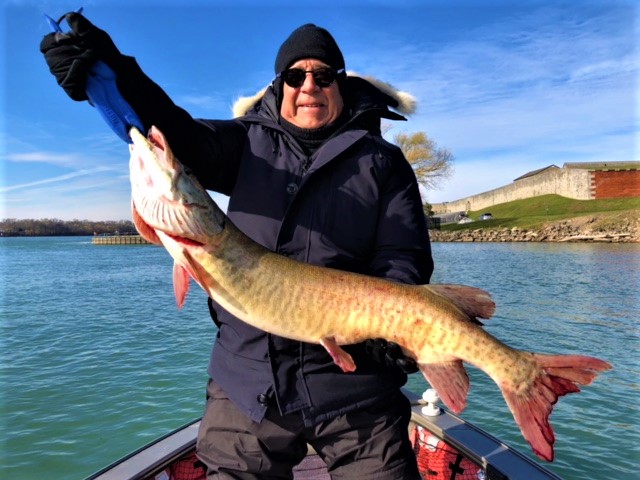
Gary Hall of Niagara Falls with a nice lower Niagara River musky. The season is open until Dec. 15 in the lower river.

Gary Hall of Niagara Falls had a good day fishing with Capt. Frank Campbell on Monday and he was rewarded with a big musky on a MagLip lure in silver and chartreuse. The musky season is open until Dec. 15 in the Lower Niagara River and Lake Ontario. The Niagara Musky Association will be hosting the John Henning Memorial Musky Tournament on Dec. 2. Call Scott McKee at 225-3816. You must be a member to participate.

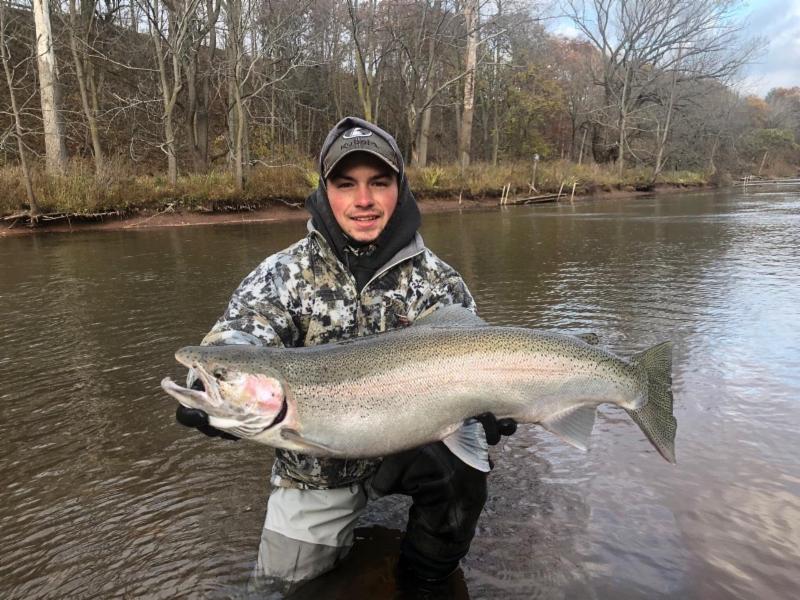
Ethan Bronschidle of Newfane caught this nice steelhead at Burt Dam.

Also at the top of the list the past week in the lower river has been the steelhead and brown trout. As of Monday, river conditions were near perfect according to Capt. Chris Cinelli of Grand Island. Pink egg sacs were the ticket for steelhead in Devil’s Hole and along Artpark. Head down river for brown trout. Egg sacs were working on them as well.

Lake trout continue to be caught too, as part of incidental catch. Lake trout season is closed until the end of the year.

Dick Hill of Maryland caught this lower Niagara River steelhead this week.

One popular fishing spot will be closing for the winter on Nov. 30 at dusk – the NYPA fishing platform in the gorge, including the parking area and stairs. They’ll be shutting down for the season due to the winter conditions. This also includes the Upper Mountain Road access point for the reservoir.

Mike Rzucidlo of Niagara Falls is still picking up a few fresh salmon and some walleyes at the NYPA fishing platform on spinners and jigs. Swimbaits work, too.

Action in the streams off Lake Ontario has slowed for browns and steelhead, as well as the occasional late king salmon. We’ve heard a few Coho’s being caught, too. Water has been slightly stained and conditions aren’t too bad, but fish have been finicky.

It’s a good bet that many people are hunting. There hasn’t been a lot of fishing pressure.

Have a happy and safe Thanksgiving!

Bill Hilts, Jr., Outdoor Promotions Director

Destination Niagara USA, 10 Rainbow Blvd., Niagara Falls, NY 14303
p: 1-877 FALLS US | 716-282-8992 x. 303, f: 716-285-0809
www.niagarafallsusa.com

facebook | twitter | Instagram

Loaded Gun on ATV Leads to Illegal Deer Harvest in New York

Joe Forma Photo

On Nov. 17, Environmental Conservation Officer Shea Mathis spotted two hunters walking along the railroad tracks in the town of Wheatfield, Niagara County, NY.

The two claimed they had a lousy morning hunting and had not taken any deer.

ECO Mathis checked their licenses and found their deer tags attached. A third member of the hunting party pulled up on an ATV with a loaded muzzle-loader over his shoulder. While issuing a ticket for possessing a loaded firearm on a motor vehicle, ECO Mathis was contacted by ECO George Scheer, who had received information that a male had shot two bucks with a muzzle loader that morning in the same area.

While ECO Mathis was issuing the ticket, one of the hunters left on the ATV and headed to a residence. ECO Scheer traveled to the location and found the subject. After a brief interview, ECO Scheer located a nine-point and 10-point buck, both untagged, in the back of a pickup truck. One of the hunters admitted to shooting both bucks that morning, just minutes apart.

Tickets were issued for possessing a loaded firearm on a motor vehicle, taking big game over the limit and failure to tag deer as required. The second buck was seized as evidence and donated.

New York State Department of Environmental Conservation (DEC) Environmental Conservation Police Officers (ECOs) enforce the 71 Chapters of NY Environmental Conservation Law (ECL), protecting fish and wildlife and preserving environmental quality across New York. In 2017, the 301 ECOs across the state responded to 26,400 calls and issued 22,150 tickets for crimes ranging from deer poaching to corporate toxic dumping and illegal mining, the black market pet trade, and excessive emissions violations.
If you witness an environmental crime or believe a violation of environmental law occurred, please call the DEC Division of Law Enforcement hotline at 1-844-DEC-ECOS (1-844-332-3267).

“From Montauk Point to Mount Marcy, from Brooklyn to Buffalo, the ECOs patrolling our state are the first line of defense in protecting New York’s environment and our natural resources, ensuring that they exist for future generations of New Yorkers,” said Commissioner Basil Seggos. “They work long and arduous hours, both deep in our remote wildernesses and in the tight confines of our urban landscapes. Although they don’t receive much public fanfare, the work of our ECOs is critical to achieving DEC’s mission to protect and enhance our environment.”

Outdoor Edge® Introduces RazorMax – Replaceable Fixed-Blade Knife

The overwhelming popularity of the Outdoor Edge replaceable-blade folding knives—the Razor Pro, the RazorBlaze and the RazorLite EDC™—has led to the introduction of the RazorMax, the company’s first fixed-blade knife to also feature the patented RazorSafe replaceable blade system.

The Outdoor Edge RazorMax ascends to a new level by becoming first in the line to accept both 3.5-inch drop-point replacement blades as well as a new 5-inch boning/fillet blade, making it the complete solution for preparing big game, from start to finish. The new RazorMax allows you to field dress, skin, debone and process game into perfect cuts for the table—all with a single tool.

With two blade sizes available for the RazorMax that interchange quickly, safely and easily, the perfect blade for the job is just a button push away. The included blades are Japanese 420J2 stainless steel, heat treated and hand finished to a surgically sharp edge. The 3.5-inch general-purpose drop-point blade is a true workhorse for field-dressing and skinning. The 5-inch boning/fillet blade is designed for processing meat quickly and efficiently. Each blade locks securely into the RazorMax’s black-oxide coated blade holder, providing the strength and rigidity of a traditional knife to the 3.5-inch blade, while allowing ample flex for the 5-inch boning and fillet blade.

The thermoplastic rubber (TPR) grip on the RazorMax is molded with an alternating pattern of Outdoor Edge’s signature mountain range for a very positive nonslip grip with the ergonomically shaped handle that prevents tiring and cramping during extended periods of use.
The RazorMax is available with either a black or blaze orange handle and comes complete with a lightweight nylon belt sheath that features a removable pouch for storing spare blades.

It will be available in the second quarter of 2019 for a suggested retail price of $79.95

About Outdoor Edge: Founded in 1988 and headquartered in Denver, Outdoor Edge is a leading designer and manufacturer of knives and tools. Today, Outdoor Edge continues to innovate and develop state-of-the-art products for outdoor enthusiasts, game processors, survivalists, handymen and others who require the very best knives and tools available for leisure, work and everyday-carry needs. The company prides itself in offering a variety of products that undergo extensive field-testing in harsh, rugged environments resulting in durable, long-lasting products that come with a lifetime guarantee. For additional information on Outdoor Edge and its full line of products write to: Outdoor Edge, 5000 Osage Street, Suite 800, Denver, CO 80221; call toll-free 800-477-3343; email moreinfo@outdooredge.com; or visit www.outdooredge.com.

Make a difference! Create wildlife habitat in your Florida backyard

Your backyard can be a gathering place for birds, butterflies, frogs, flying squirrels and more. Attract native species by offering food, water, cover and space for them to raise their young, and your yard will be transformed into a welcoming habitat for wildlife.

Today, the Florida Fish and Wildlife Conservation Commission (FWC) is introducing Backyards and Beyond, a campaign challenging Floridians to make a difference and have fun by creating a refuge for wildlife in their own backyard.

“Imagine your backyard as a place where butterflies are attracted by flowers, songbirds are gobbling up seeds and berries, and frogs, bats and lizards are eating mosquitoes and other insects,” said Jerrie Lindsey, FWC’s director of Public Access Services. “Your efforts to create wildlife habitat at home will have a positive impact because animals need places to live beyond our wildlife management areas. Backyards and Beyond is also a great opportunity for you and your family to enjoy watching wildlife.”

Five easy ways to become involved in Backyards and Beyond:

  1. Turn your yard into a diverse wildlife habitat by adding native plants. A variety of native trees, shrubs and plants will provide natural food and cover for wildlife. A flowering native plant or shrub, for example, can provide nectar and pollen for butterflies and other beneficial insects, which in turn may be a meal for birds, lizards and frogs.
  2. Attract native wildlife to your yard by providing the four basics: food, water, cover and enough space for raising young. By doing so, we increase the number and variety of species that visit our yards, improving our chances to observe them more closely.
  3. Document wildlife activity in your backyard. Submit photos via iNaturalist to Florida Nature Trackers projects, and even create a species list for your own backyard.
  4. Create a butterfly garden, build a nest box for birds or add a brush pile for small animals like earthworms, birds, toads and lizards in your backyard. Planting a Refuge for Wildlife is an easy-to-understand guide to these projects and other ways that your backyard can support native wildlife. This illustrated publication created by the FWC and Fish & Wildlife Foundation of Florida can be ordered online at WildlifeFlorida.org.
  5. Go beyond your backyard. Invite family and friends to explore Florida’s outdoors at wildlife management areas, local and state parks, state and national forests, and national wildlife refuges. Use Florida Nature Trackers to document what you see.

People who create a wildlife refuge in their backyards will contribute to conserving Florida’s wildlife and habitats. By documenting animals observed in their backyards, they also generate valuable information. FWC biologists will be able to see the wildlife photos submitted to Florida Nature Trackers and use the data to help direct their efforts to research and manage native species throughout the state.

Remember, wild animals do not need supplemental feeding from people. Naturally-occurring insects and native plants with nectar flowers, edible fruits, nuts and seeds provide nourishment for most butterflies, birds and small animals. Pet food, corn and other supplemental feed can encourage unwanted visitors.

Need help getting started? Explore the Backyards and Beyond website for more information on how you can get involved.

While Backyards and Beyond is a statewide campaign, there is also a local initiative in Leon County and the city of Tallahassee, involving the FWC and partners. You can participate by joining the Backyards of Leon County project.

What if you live in an apartment, townhouse or condominium — and don’t have a backyard? You can still participate. Plant native flowers in containers on your front steps, on a balcony or in a window box. Work with neighbors to add native plant life to shared spaces like playgrounds, parks and other open areas in your development or community. Get children involved by bringing Backyards and Beyond to groups such as the Boy Scouts, Girl Scouts or a school, church or community youth group or homeowners association. No matter where you live, you can make a difference.

Go to FloridaNatureTrackers.com/Backyard for more information.

Orleans County, NY – STREAM fishing report – November 27, 2018

Griffin Howey’s Brown Trout caught from Oak Orchard Creek.

Thanks to rain yesterday/last night AND a return to above-freezing temps, AND a little bit of snow melt, AND no more thirsty vegetation, AND groundwater now reasonably recharged after the droughty summer/early fall – all the tributary flows are on the rise and off color.
Flows in the Oak are slightly high consisting of turbine water with about 2 plus feet of visibility.

Water color may get dirtier over the next day or two, but should stay short of getting muddy. Flows are pretty similar to the earlier fall flows we had during Erie Canal supplemental water feed. The other area smaller tributaries have slightly high and dirty flows with one foot or less of visibility. Any earlier icing conditions should be clear now with a forecast through at least this week and weekend showing no real good prospect of those icy conditions returning in the short term.

Griffin Howey’s with a nice November steelhead from Oak Orchard Creek.

Smaller tributaries should be cresting about today and then slowly clearing and on the retreat. Flows in the Oak are likely to stay up as they are now through the week, give or take, depending upon hydropower operations at Waterport Dam or any more precipitation.
It’s a real nice, later fall-style fishery, good flow window to redistribute browns and draw in late fish, and/or some more steelhead. Some of the zombie salmon should be flushed out too.

No major lake effect snow (LES) forecast here, some wet snow with little to no accumulation is expected today, changing over to better chance at a few inches of accumulations Tuesday and Wednesday. Heavier accumulations are expected south of here.
Fishing pressure has measurably decreased for the beginning part of this week thanks to the calendar and likely PA and OH big game season openers.

Anglers should look for a mix of spawning and post spawn browns and some steelhead.

Provided by Ron Bierstine, Oak Orchard Tackle & Lodge.
Visit our Fishing Report on OrleansCountyTourism.com, including weather forecasts and our “At the Oak, Orleans County” Facebook feed.
From Point Breeze on Lake Ontario, the World Fishing Network’s Ultimate Fishing Town USA and the rest of Orleans County, let’s make everyday a great fishing day right here in Orleans County!
Sincerely, The Team at Orleans County Tourism

Niagara Falls USA Fishing Forecast for Nov. 30, 2018


Nancy Colavecchia and Mike Rzucidlo of Niagara Falls show off a double header in the lower Niagara River.

It’s November 30 and there are quite a few noteworthy occurrences that take place.

For example, muskellunge season closes today with one exception – the lower Niagara River and Lake Ontario. The upper Niagara River produced a few nice late-season fish, like the 50-inch trophy reeled in by Rebecca Gaulteri of Hamilton, Ontario. She was fishing with Capt. Chris Cinelli of Grand Island over the weekend and managed to catch the fish of a lifetime. Joining her was her husband, Francesco and her dad Chris Mills (who also caught a 45-inch fish the same morning).

John Anthone of Sanborn shows off a 49 inch upper Niagara River musky he caught Nov. 29 while fishing with Capt. Chris Cinelli of Grand Island.

John Anthone of Sanborn hit a 30-plus pound 49 inch musky on Nov. 29, also fishing with Capt. Chris Cinelli.

Below Niagara Falls, water was stained, but still fishable after the most recent storm. The lower river had been hot the past week as waters cleared and trout fishing took off. Lisa Drabczyk at Creek Road Bait and Tackle in Lewiston reported that beads, egg sacs and Kwikfish/MagLips lures (all fished off three-way rigs from boats) has been good to very good for a mixed bag of trout.

Just ask 87-year-old George Gregory of Lewiston who was fishing with his son Kurt and Capt. Joe Marra of Lewiston. They caught double-digit trout over the long weekend using primarily egg sacs, catching steelhead up to 13 pounds and some nice browns. What had them talking though, was a lake trout that both father and son caught at the same time. Remember that lake trout season is closed on the NY side until Dec. 31. However, on the Canadian side of the river, the lake trout season opens on Dec. 1.

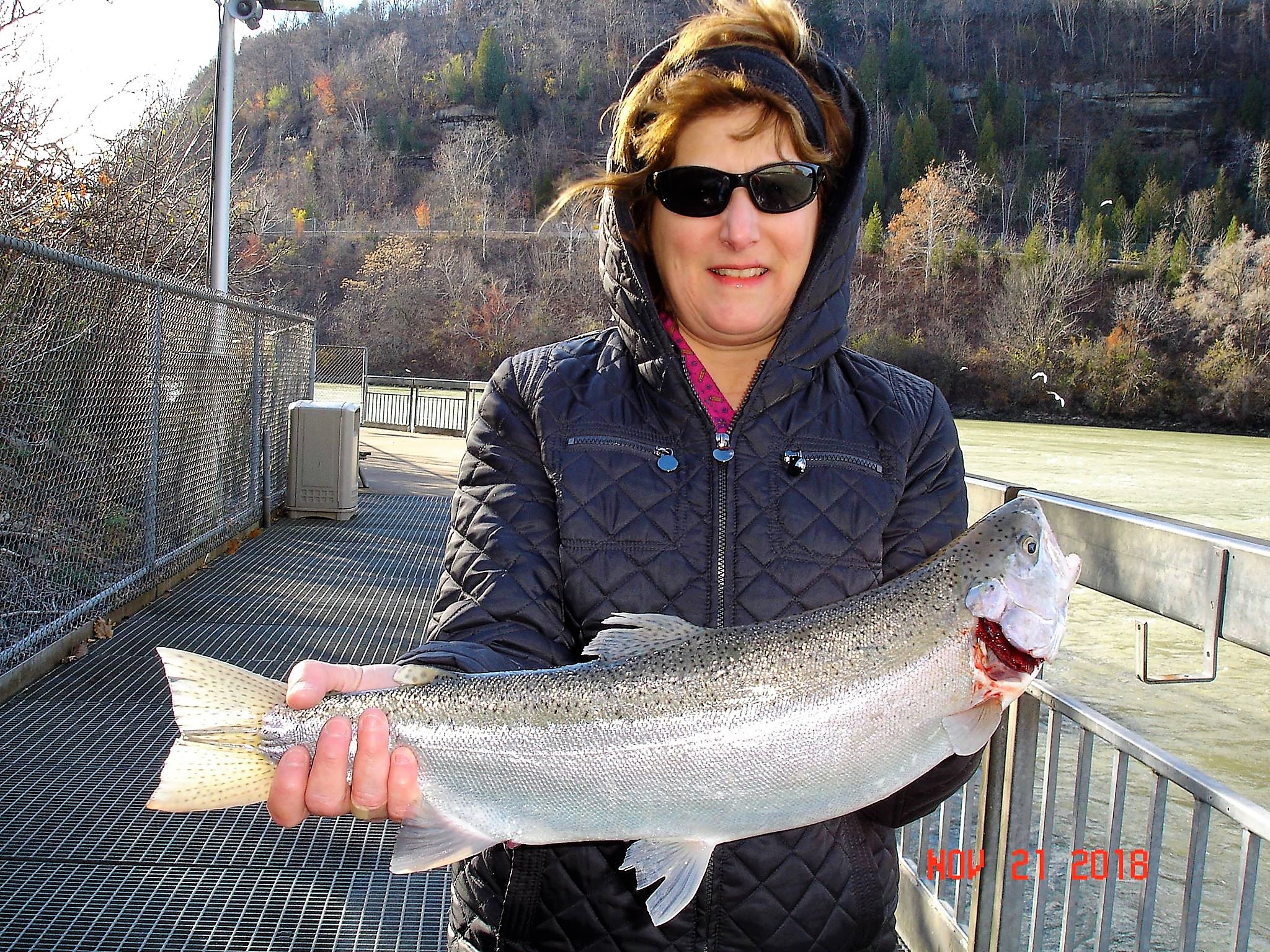
Shore fishermen are still doing well with the good conditions, especially off the NYPA fishing platform. However the platform closes at dusk on Nov. 30.  Nancy Colavecchia of Niagara Falls caught her first-ever steelhead with a green egg sac while fishing off the platform.  She was fishing with Mike Rzucidlo of Niagara Falls who caught nearly double-digit steelies on egg sacs and 4 walleyes on jigs. Drabczyk also reported that spinners and beads are also working in chartreuse, orange and pink colorations.

Nancy Colavecchia of Niagara Falls caught her first steelhead off the NYPA fishing platform this week.

The Niagara Musky Association will be hosting the John Henning Memorial Lower River Musky Tournament, a catch-and-release event, that will be held Dec. 2 from 7 a.m. to 4 p.m. You must be a member of NMA. Contact Scott McKee at 225-3816.

Fishing has been a bit slow in some of the Lake Ontario tributaries for steelhead and browns. Karen Evarts at The Boat Doctor in Olcott says that there are fish (mostly browns) around, but not much pressure from anglers. Hot baits in the tributaries have been spikes, egg sacs and beads. Gianni Etopio of Youngstown has been using his own hand-tied marabou jigs to take a mix of salmon, steelhead and browns.

Dec. 1 starts up the catch and release season for bass fishing. The only exception is for Lake Erie were anglers can keep one fish if they so desire, but the minimum size is 20 inches in length. Consult the DEC regulations at www.dec.ny.gov.

Bill Hilts, Jr. – Outdoor Promotions Director

Inline image 2
Destination Niagara USA; 10 Rainbow Blvd.
Niagara Falls, NY 14303
p: 1-877 FALLS US | 716-282-8992 x. 303;f: 716-285-0809


Wild turkey: A different twist for a Thanksgiving favorite

FWC photo by Andy Wraithmell

Click the Photo above for a video recipe that is mouth-watering delicious!

Thanksgiving is a favorite holiday for all who cherish its traditions involving friends, family and food. Some love preparing dishes from recipes that have been passed down through the generations. Others enjoy experimenting with new flavors. An interesting culinary trend is using organic ingredients and serving wild turkey for Thanksgiving is a delicious, clean-eating option. 

“Florida’s abundant wild turkey populations can provide the ultimate locally-sourced, organic Thanksgiving feast when knowledge, skill and good fortune come together for a successful hunt,” said Chef Justin Timineri, executive chef and culinary ambassador for Florida Department of Agriculture and Consumer Services. “We’ve developed several mouthwatering wild turkey recipes for the big day and ways to serve leftovers using a variety of Fresh from Florida products.” 

Wild turkey cottage pie, scrumptious. Click the picture for the recipe.

Wild turkey is a tasty and versatile protein. Fresh from Florida chefs adapted several recipes to use wild turkey ranging from Tikka Masala, an Indian dish traditionally served with chicken, to wild turkey quesadillas and wild turkey cottage pie (a take on shepherd’s pie). Because wild turkey meat is low in fat, techniques for cooking them differ from domestic birds, and the Fresh from Florida chefs provide recipes and tips on how to prepare tender, juicy meals. 

The Sunshine State is home to robust populations of two wild turkey subspecies: the eastern and the Osceola wild turkey. Florida is unique because the Osceola subspecies lives nowhere else in the world but on the state’s peninsula.  

“Turkey hunting in Florida is a chance to experience the outdoors in a very special way,” said Roger Shields, wild turkey program coordinator for the Florida Fish and Wildlife Conservation Commission (FWC). “However, wild turkeys are extremely wary and possess sharp eyesight and excellent hearing so hunting them is a challenge.” 

The FWC uses scientifically proven wildlife management strategies and professional expertise to meet conservation objectives and perpetuate sustainable turkey hunting opportunities. You can learn more about wild turkeys, including their behavior, habitat needs, and where they live in Florida at MyFWC.com.

Links to photos, video and recipes: http://myfwc.com/news/resources/columns/hunting-news/.

Fishing Chautauqua County, NY – as an Outdoor Writer LOOKING TO LEARN

Wade Robertson with a nice walleyue whopper, one of 30 nice 'eyes hooked that day.

  • Lake Erie offers access to schools of giant walleye from May to October
  • Chautauqua Lake provides opportunity for Monster Musky, Largemouth and Smallmouth Bass, and Walleye
  • Local Wineries and Microbrew Houses provide after hour and weather options that are unforgettable
Rob Oram, Fred Dwaileebe and Don Staszyck (L to R) with some nice size Chautauqua Lake walleyes.

By Wayne Brewer

Chautauqua County is located in the southwest corner of New York State. Lake Erie is on its’ northern border and Chautauqua Lake is located in the center of the county. Both Lake Erie and Chautauqua Lake are premier walleye lakes and also have excellent musky and bass fisheries.

Andrew Nixon, Director of the Chautauqua County Visitors Bureau, and Dave Barus, Fishing and Hunting Promotions Consultant for the Bureau invited me to participate in the Chautauqua Outdoor Media Fall Fish Camp. Dave organizes and hosts the fish camps. The goal of the Outdoor Media Camps is to introduce visiting outdoor media members to the fishing and hunting opportunities in Chautauqua County.

Our “Fish Camp” on Point Chautauqua at 6060 Orchard Road was a great campsite.

Although the camp focus is on fishing, there is a lengthy list of other activities to do such as deer hunting, winery tours, visits to state fishing access sites and hatcheries, hiking nature trails – like those offered at Panama Rocks Scenic Park, touring museums such as the Roger Tory Peterson Institute and sipping tasty beer at local micro-breweries. The 4-day camp is a great get away to fish, communicate with other outdoor writers to share ideas and enjoy some excellent homemade meals, all the while taking so much that Chautauqua County has to offer.

Our campsite was a private home located on Point Chautauqua, just off Route 430 at 6060 Orchard Road. It is a year-round heated two-story cottage with four bedrooms that could sleep nine or ten individuals. It has a fully equipped kitchen, dining room, living room, two bathrooms, a screened porch and washer/dryer. The cottage is located one street from Chautauqua Lake and had a path down to the lake where there was a dock and an available 14-foot aluminum boat for our use. Anyone that wants to bring their own boat can launch it a few miles down Route 430 at Long Point State Park and maintain it on a mooring buoy near the dock. The cottage is available to rent and anyone interested can visit: www.chautauqualakerental.com or email to: kvtabor@yahoo.com.

Upon arrival at the camp I met our host, Dave Barus, and the other attendees. They were Jim Proffitt, an outdoor columnist from Ohio, Wade Robertson, an outdoor columnist from Pennsylvania and his guest from Olean, New York, Fred Dwaileebe. After “meeting and greeting” we decided to have dinner at Guppy’s Restaurant and Tavern a couple of miles down Route 430. The restaurant has a full menu that ranges from wings and pizza to burgers, soups and salads, along with nightly specials. I had a great platter of mussels steamed in garlic butter wine sauce and topped with fresh tomatoes. I highly recommend stopping in Guppy’s anytime you’re in the area.

The fishing itinerary for the first day had Jim Proffitt and Dave Barus fishing for walleyes on Chautauqua Lake with Chautauqua Bassmaster Don Staszyck. Wade Robertson and Fred fished for walleye on Lake Erie with Captain T.J. Yetzer (Reel Time Charters, 585-764-2006). I fished Chautauqua Lake for musky and walleye with Frank Shoenacker (Infinity Charters, 585-406-5764 or http//www.infinitycharters.com). Frank uses a 17-1/2 foot Lund when he guides on Chautauqua Lake, though he also guides on Lake Erie with a 25-foot Pro-Line.

After enjoying Dave Barus’ “hole in one eggs,” sausage, toast, home fries and hot coffee for breakfast, we all made our own box lunches for ourselves and guides before heading out.

Captain Frank Shoenacker (Infinity Charters) holding one of several healthy white perch we caught on jigging Rapala lures.

I met Frank at Long Point State Park Marina on Route 430, located just a few miles south of our camp. We trolled for musky on the north end of the lake at about 3.5 miles per hour. We used Shimano rods with Penn reels strung with 80-pound braided line, and tipped with a couple of feet of 80-pound fluorocarbon line. The lures we used included RW Smith homemade musky lures, perch-colored Wiley musky lures and very large green spoons with black dots. We trolled several areas where Frank had been having success catching muskies, but the big lunkers were not feeding as a cold front was heading in.

We then switched to some lighter tackle and drifted for walleye using one-ounce perch-colored mooneye shimmer minnows and Rapala jigging raps. We were marking all kinds of fish, but like the musky, the walleye were also suffering from lock jaw, however, the white perch kept us busy. Some of them were nice size, so we focused on catching them. Frank told me that, “You fish for what’s biting!” So we did and had a great day catching one white perch after the other, bringing a few dozen home for a great fish fry.

Frank and I talked about walleye fishing on Chautauqua Lake and he told me that he considered the best time of the year to catch walleye was mid-May to mid-June. That time of the year he trolls along the outside edge of the weeds along shore with a slip-sinker worm rig because the bait stays in the cover of the weeds. Then as the bait moves out into deeper water, the walleye follow. He then drifts and jigs for the walleye using jigs. His preferred jigging lure is a Rapala jigging rap.

Don Staszyck with a couple of the walleyes he, Jim Proffitt and Dave Barus caught.

When Frank and I returned to the marina, we met Don Staszyck, Dave and Jim. We discovered that Don had a couple of secret hot spots for walleye, as each of the three anglers had limited out with 15 walleye, though they had also released at least that many again. Wade and Fred had a great day on Lake Erie and had limited with 24 walleyes as well.

Lunch and dinner each day was provided by Dave Barus and most of the delectable meals (secret recipes) were prepared by his wife Rosalie. Our meals included venison chili, homemade potato salad, chicken Alfredo, walleye cheek chowder, Sahlen’s grilled hot dogs and Rosalie’s mouthwatering homemade apple pie. During and after dinner, our outdoor clan invited our guides to join us as we shared excellent wine from Johnson Estate Winery, Merritt Estate Winery and Liberty Vineyards, all of these just a few minutes away.

Mother Nature threw us a curve on the second day of the fish camp. Wade Robertson and I were to fish Lake Erie for bass and walleye with Captain Yetzer, but the lake had six to seven-foot waves. It was just too rough to fish, but this was not an issue because when Dave Barus plans these events, he always has backup plans and alternative activities lined up. Dave had made arrangements for us to fish Chautauqua Lake for bass with Chautauqua Bassmaster President, Mike Russo.

Mike Russo and Wade Robertson with a couple of smaller Chautauqua Lake bass. 

Mike checked out a few areas earlier that morning before he picked us up and caught a couple of bass. Not long after, we headed back to fish these areas, but the wind picked up and the lake became angry. We threw everything in the boat at the bass, including spinnerbaits, jigs, grubs, crankbaits and even live bait, but could not entice even one hit. The bass had shut down completely. We tried different locations all over the lake until we entered a small channel that Mike said had put tournament anglers on the winner’s podium. It looked and felt promising, but we had no luck catching bass.

Julie Szur showing us one of the flies she makes and uses on Chautauqua Creek streams.

Half way down the channel, where it widened out, Mike and Wade were tossing spinnerbaits when a “cloud” of nice sized yellow perch swarmed up chasing them. We immediately decided to fish for the perch. Mike and Wade used the minnows and I used a small white plastic grub below a bobber. We caught perch on practically every cast. Not all the perch were keepers, but Wade and I ended the day with about 70 fish.

That night Julie Szur, a local fly fishing consultant and guide on stream fishing tutoring, joined us for dinner and gave a very interesting presentation that included a discussion different fly varieties and various fly-fishing techniques. Julie is an extremely knowledgeable and accomplished stream fishing expert. View her website at: www.flyfishingjulieszur.com and contact Julie at flyfishjulie@gmail.com or call 716-481-6619.

The next day Lake Erie continued with high seas, so instead of fishing for walleyes, Dave, Jim, Wade and I met Julie at Chautauqua Creek to check out the steelhead fishing. Dave and I were photographers while Jim, Wade and Julie fished. The creek was low and clear with very few fish, but Julie did entice one fish to strike her speckled streamer.

Julie Szur with her dog “Brookie” and Wade Robertson fishing for steelhead in Chautauqua Creek near Westfield, NY.

The Chautauqua Fall Fish Camp was an exciting and unique experience. All of us caught a lot of fish even though the wind kept some us off Lake Erie. It’s terrific to fish in Chautauqua County because there are several bodies of water to and no matter the weather, the waterways support a variety of different species of fish. There are six lakes in the county and 50 miles of Lake Erie shore line. There is no place in the county more than a few miles from open water. So, if you cannot fish one lake, you can fish another. If one species of fish is not co-operating, there are always other species to fish and if you cannot fish, there are plenty of other activities in the county to enjoy and have a great time. I highly recommend putting Chautauqua County at the top of your “places-to-visit” list.

For more information go to: www/tourchautauqua.com or call at (716) 357-4569. Be sure to request a Chautauqua County Visitors Guide to use as a reference for planning your getaway to Chautauqua. To keep updated on news and events, sign up for the monthly e-newsletter. For day-to-day news, join in the conversation on the Chautauqua County Facebook.

You can also check out Visit Chautauqua, to receive a downloadable APP for helping plan your trip.

Niagara Falls USA Fishing Forecast for Wednesday, Nov. 14, 2018

Mike Rzucidlo of Niagara Falls has been hitting his salmon using a No. 4 spinner.
Mike Rzucidlo of Niagara Falls with a walleye off the NYPA fishing platform in the lower Niagara River.

After a week of muddy water in the Niagara River, the fishing is slowly starting to improve to the delight of boaters and shore anglers. Mike Rzucidlo of Niagara Falls saw a slight green tint show up in the lower river on Tuesday and he grabbed his gear to head down to the New York Power Authority (NYPA) fishing platform in the gorge. Using a pearl zoom swimtail, he took a couple of walleyes. He switched to a No. 4 spinner and caught a couple of late-run king salmon. When he switched to a jig he managed to catch a small rainbow trout. The fishing platform is normally shut down for the winter on Dec. 1, unless we see some ice. If we do, the platform will be shut down early. Keep that in mind. A couple of boats hit the lower river yesterday under marginal conditions and the fish were hungry. Gold 3.0 MagLips worked off three-way rigs, as did beads and egg sacs. They caught a mixed bag of fish that included steelhead, brown trout and lake trout.

Ethan Bronschidle of Newfane had this brown trout hammer his black jig just before dark.

Remember that lake trout season is closed so be sure to release those fish quickly and unharmed. Bass are still available in the lower river, too. If you want to try and target smallmouth, head down river from Lewiston and bounce swim baits off the bottom.

Justin Lee of Niagara Falls hit the Lake Ontario tribs and caught this dandy brown recently.

With the start of the Southern Zone regular big game season on Saturday, Nov. 17, look for fishing pressure in the Lake Ontario tributaries to lessen considerable. Burt Dam and 18 Mile Creek, as well as 12 Mile Creek in Wilson have both been good for trout fishing the past week according to Karen Evarts at The Boat Doctors.  There have been quite a few brown trout hanging around, some late-run salmon and a few steelhead. Eggs, jigs tipped with wax worms and spikes, crystal meth and sucker spawn, beads and more beads are all catching fish. Colors seem to be changing every day. White woolly buggers, pink and orange eggs, egg sacs with a white bead – plenty of options to use and many (if not all) seem to be working.

We will try and update this by next Wednesday but if we don’t have a safe and happy Thanksgiving.

Bill Hilts, Jr. – Director, Outdoor Promotions

Niagara Tourism & Convention Corporation, 10 Rainbow Blvd., Niagara Falls, NY USA 14303
p:
716.282.8992 x.303| 1.877 FALLS US, f:716.285.0809
website | facebook | twitter | blog

Sportfishing has a $30 million annual economic impact in Niagara USA!

Kayak trolling

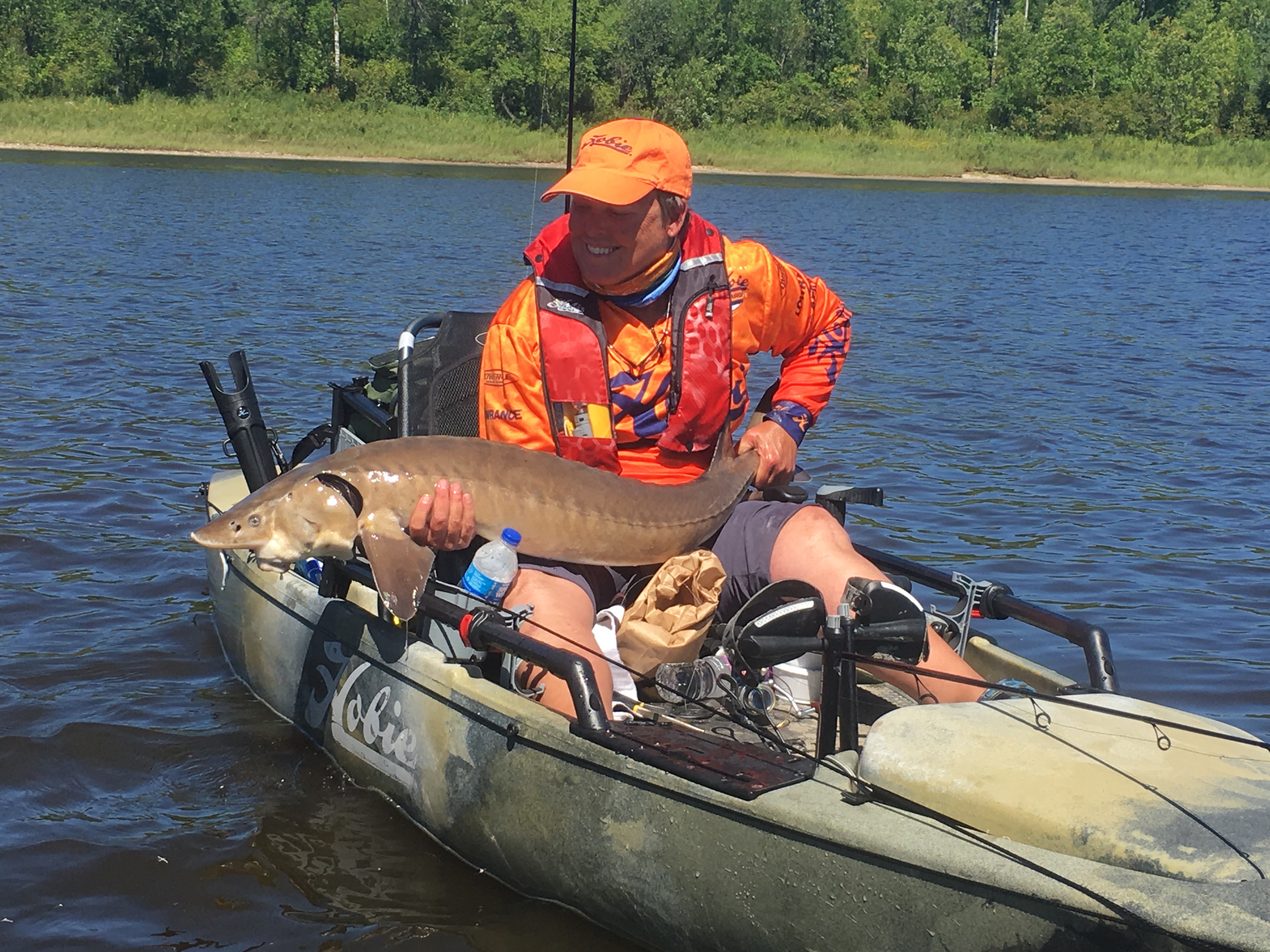
Kevin Nakada of Hobie holds a hefty smallmouth caught trolling on an offshore reef on Lake of the Woods.

Add systematic trolling to your kayak angling skills

By Mike Pehanich

Kayak anglers would do well to adopt one of fishing’s most misunderstood, underrated and underutilized approaches to mapping structure and finding fish. And Torqeedo motors can make the practice many times more effective!

Trolling is an angling art probably as old as the dugout canoe.

Today, however, some anglers view it with a jaundiced eye.

Rob Wendel trolls for giant Lake Michigan steelhead, brown trout and salmon out of a Hobie Pro Angler 14 and 17 outfitted for big fish.

Attitudes toward trolling generally stem from waters fished and species pursued. Tournament bass anglers tend to snub the practice. Fishermen pursuing species like trout, salmon or walleye over the broad expanses of the Great Lakes and other spacious waters regard it as a critical means of finding fish spread across vast watery acreages.

Opinions vary, but kayak anglers in general have been fairly open-minded about trolling. For many, however, it is simply a way to keep a lure working while traveling to the next target location. Relatively few treat it as a technique worthy of practice and refinement.

Too bad! Knowledge, ambition and experience can transform trolling from a passive practice to a fine angling art. What’s more, refined trolling techniques can make anyone a better angler and shorten the learning curve on new waters, large and small.

Why troll?

Authors of the trolling “hate mail” cite reasons that don’t always mesh. They may view trolling as too boring or too easy or second cousin to “snagging.” Some complain that it takes no skill, that it is a game of dumb luck, then later argue that it is unfair or too deadly. Some simply dismiss it on aesthetic or philosophical grounds, scolding the practice for its detachment.

Wilderness Systems markets a Helix electric motor tailor-made for its kayaks.

But advanced trolling is a blend of science and art, success hinging on knowledge, strategy and repeated practice and refinement.

Buck Perry, the father of structure fishing, taught anglers how to find fish and map bottom structure with the use of versatile lures, called “spoonplugs,” that excelled as trolling and mapping tools. He developed these baits in 1946 – years before Lowrance put popular sonar units into fishing boats. Designed to run at very specific depth ranges, spoonplugs communicated to Buck and his followers structural contours, drop-offs, points, grasslines, and bottom content. When used in the right way with Perry’s systematic approach, they caught fish – big offshore fish that other anglers missed.

The 1 HP Torqeedo Ultralight 403 is a lightweight electric motor designed specifically for kayaks. It enables precise speed control, a critical variable in successful trolling.

Modern bass boat fishermen have the advantage of electronics and fishing platforms that Buck Perry never dreamed of. For better or worse, few today include in their arsenals the precision trolling approach that was the linchpin to Perry’s success.

But, for all their beauty, convenience and functionality, bass boats are not well suited to the kind of precision trolling Perry did or modern day successors do today. Smaller and more agile craft are far more effective under the guidance of a well-schooled troller.

The kayak advantage

Kayaks, on the other hand, comprise a category of very agile watercraft, and kayak anglers would do well to factor sophisticated trolling practices into their angling strategies whether tournament money, a better day’s fishing, or simply better knowledge of a new lake are at stake. Done with skill and deliberation, trolling can help one learn and map water quickly and find concentrations of fish that might otherwise never see your lure.

Here are a few good reasons to add advanced trolling techniques to your skill set.

  • Trolling enables the angler to fish large structural elements, eliminate unproductive water, and locate prime structure in a short period of time.
  • Knowledge gained about a body of water from systematic trolling can help anticipate fish movement.
  • Kevin Nakada of Hobie holds a hefty smallmouth caught trolling on an offshore reef on Lake of the Woods.

    Trolling is useful in finding active suspended fish.

  • The trolling tools available today are the best to date, and you can tailor them to specific needs.
  • The variety and range of trolling lures available today is extensive, and a number of lure manufacturers and trolling experts now provide guidelines for running specific lures at precise depths.
  • With rifle sighting and marker buoys, a skilled troller can overcome the limitations of lower end electronics – or even no electronics at all.
  • And, yes, trolling still gives you a shot at catching fish when you are simply dragging the bait behind you on your way to a target location.

Advantage of electric motors

Trolling effectiveness hangs on the tools in play and the angler’s ability to use them.

Well-selected rod, reel and line combinations enable lures to run with desired action at selected depths and even telegraph bottom content.

Craft and propulsion variables matter, too.

These durable Ram rod holders are made to tackle big fish.

Increasingly in play in KBF tournaments, electric motors offer the kayak angler the advantage of highly accurate speed control.

The lithium battery-based motors of Torqeedo, title sponsor of the 2018 KBF National Championship and its landmark $100,000 first place purse, lift control capabilities to a new level.

  1. Precise speed control– Lure speed is a critical variable — second only to depth control in importance – in triggering strikes. The Torqeedo Ultralight 403 motor, Hobie Evolve and Wilderness Systems Helix kayak motors provide real-time digital speed readout measured to 0.1 mph accuracy.
  2. Hands-on rod control– With rod in hand, an experienced troller can read bottom content (soft bottom, rock, gravel, shells) and lure action and detect short strikes through lure vibration. Paddle propulsion forces a troller to leave the active rod in a rod holder.
  3. Speed– Contrary to popular belief, lures do not always have to be trolled slowly to be effective. In fact, trolling at speeds well upward of five mph often trigger strikes in warm water conditions.
  4. Map App and add-ons – A free Torqeedo app employs a Bluetooth transmitter module (Apple and Android only) for wireless link between onboard computer and smartphone. Phone display includes analogue speedometer, a GPS map screen showing real-time boat location, waypoint and zoom-in capability and other navigational and battery life information. Mapping and waypoint marking capability enable an angler to pinpoint productive areas and return to them easily.
  5. Light weight–The Torqeedo, Hobie and Wilderness Systems motors and their power sources were designed specifically for kayak propulsion. They add little to the total weight of the craft and do not compromise safety or maneuverability.
The author took this big largemouth trolling a sunken road bed.

Embrace trolling or let it go, but before you dismiss it from your game plan, consider it as an approach to map and learn water quickly, pinpoint fish-holding structure, and add more fish – often big fish – to your catch.

Strategic trolling can catapult your on-the-water education and multiply your fish totals. Embrace the art and science of the practice and see what happens!

Outdoors Apocalypse, “New Kids” can provide New Leadership

Help raise funds to help the Conservation Alliance protect wild lands and waters across North America for future generations.

  • New Ecology, New Nature, New Adventure
  • New Gear, New Kids…Old Fun in a New Way

By Forrest Fisher

Teddy Roosevelt National Park in North Dakota can offer a new view to age-old rocks and mountain formations – a great place to explore.

Summer is warmer and starts earlier, winter is warmer and shorter. We have a longer rainy season each year. Modern generations are convinced that nature is changing. 

New forms of fun have evolved to welcome millions of millennials to the outdoors where they escape to thrills with a welcome rush of fun, sometimes for just a moment or two.

The “new kids” bungee cord, hike, run, breathe fresh air, hear the surf crashing, ski downhill on snow-covered mountains, skin dive to photo-shoot fish on coral reefs – any of these a short flight from home. A usual manner of departure for their modern millennial day. They enjoy the wind moving through their hair, are protected from UV rays with modern sunscreen and meet accepted new standards of our apparent new age.

Outdoor participation is in a state of change in our modern outdoors, but it is about the millennial modern perspective, insulated within a well-planned, undeterred call for momentary adrenaline through nature. Then it’s back to work. Some millennials work 20 hour days, mostly on a keyboard.

As we approach Thanksgiving, is it time to rethink the feast of nature?

There are times when the truth of the woods, nature itself, is under question by the city folks, many millennials themselves. The new nature includes getting lost and resting easy to find yourself, sometimes in solitude, sometimes with a friend.

A roll-up air mattress that fits into the backpack with comfort to be found in a pop-up camp tent to enjoy a great night of sleep under the stars.

Pinnacle Dualist Complete is a great pocket-sized camp set for hiking and biking.

In your backpack, you remove your Pinnacle Dualist, it is the ultimate mess kit with stove and tiny isobutane fuel supply – total weight: 27 ounces. The kit integrates everything for hot meals and warm drinks in an impossibly small footprint.

No plastics allowed, no cigarettes, just filtered stream water, sustainable supplies, all with efforts to provide for a better future in nature and time away.

A clean future.

A green future.

A sustainable future.

Maybe these “new kids” reached their campsite on a rock-proof mountain bike. New products today can provide increased range for adventure.

Silence is the special gift of such new adventure, interrupted only by the sound of a lazy campfire, glimmering fireflies from a nearby field and woods. There is expectation for surprise looking skyward for a meteor to zoom across the night darkness.

That’s a moment to make a timely wish for peace in the world.

Nature by itself is a natural celebrity. A place where your internal clock is secure and a new secret to sync your body system is discovered. The “new kids” live true with such adventure.

Microlite Stainless Vacuum bottle is efficient, lightweight and affordable.

There is time to write a handwritten letter to someone you know that needs a letter.  A sip of purified mountain water from your Microlite water bottle that keeps liquids hot or cold for all day. Delicious.  

Nature is truly grand.

Morning light provides a new connection to the day ahead. It’s hard to miss the “new day” vindication of mixed color, hues of yellow, orange and red. It’s a beautiful planet you think to yourself.  You sense a new and sudden perfection with nature at this moment. You welcome your relaxed state of mind.

Friendship, wildlife, nature, conservation – all linked at this moment. 

Your mind wanders a bit, then you think back to mankind centuries old to realize the bonus, this is the same morning sunlight that people 5,000 years ago watched come over the horizon. So times have not changed, you option in thought. You do know though, that this overnight experience has provided an uplift for you.

Nature is truly grand.

Human nature is a bit like Mother Nature with the seasons of spring, summer, winter and fall, you imagine. The seasons restore each other. Maybe Mother Nature has not changed all that much then or, you option, maybe it has. There is time to ponder this question.

Can there be a new algorithm to slow down this latest “new kids” generation that seeks to find instant solutions through the assortment of so many keyboard tools.

Jeans, T-shirt, sneakers, ball cap and sunglasses is all you really need to “fit in.” Soong as you have a battery cord and charger.

So we ask, “Is this the new nature or the old nature? “The “new kids” nature is…you accept, extraordinary.

Some parts of our planet can provide an age-old view into our changing nature.

Sunset arrives with an orange glow.

The clouds rest.

The wind is silent now too.

An owl hoots in a nearby tree.

It’s time for millennials to join up with nature to find adventure in the outdoors.  It’s time for millennials to understand why hunting and fishing are important to our future and our ecology.

Us older folks could use the new leadership, don’t be afraid to ask us for a match.

Holiday Sportsman Show Online Open for Business

  • Holiday Sportsman Show is FREE, is Online, Is Open for Business
  • Cash in on Sales, No traffic, No Crowds
  • Sales Benefit to Military Veterans, Youth, Conservation
Sample of a show booth for Simms Fishing Products. Click the picture to enter.

The much-anticipated Online Holiday Sportsman Show is officially open for business. Tour the virtual exhibit halls for fabulous savings from the comfort of your home. With exhibitors in a number of individually labeled halls, selecting the perfect gifts for outdoor enthusiasts on your list is easier than ever.

Open until Dec. 31, the Holiday Sportsman Show offers even greater sales to visitors of the show, https://holidaysportsmanshow.com, with the purchase of a $15 Fundraiser package with additional Savings and Discounts. This gift package directly benefits our youth and U.S. veterans, and it also opens the door to more than $5,000 of exclusive savings for a wide range of gifts and products.

For more information on the package, the groups it benefits and to find out how to order one, visit https://holidaysportsmanshow.com/2018/#/fundraising/friendsofheroes/deals.

The Holiday Sportsman Show is easy to navigate and has a wide selection of highly sought-after outdoor brands to choose from. Cash in on the sales without dealing with the lines, traffic, crowds and headaches of venturing out to the malls. Sit back, relax and have a stress-free holiday shopping experience at the Holiday Sportsman Show from now until Dec. 31.

The main lobby of the Holiday Sportsman Show, click to enter. Once there, use the “guidepost” on your upper right to navigate the halls and booths in the show.

About the Holiday Sportsman Show: The Online Holiday Sportsman Show is a property of Vexpo Marketing, L.L.C., based in Missouri. Vexpo Marketing develops digital products designed to serve outdoor activities and outdoor consumers, including businesses and organizations that provide goods and services for outdoor recreation. A project of special dedication has been to bring traditional sports shows to a digital platform to give consumers sports show experiences in the online world. Vexpo Marketing properties include the Holiday Sportsman Show, North American Sport Show, Share the Outdoors website, and the National Wildlife Art show, all in consideration that support of conservation, youth and veterans organizations through fund-raising efforts and philanthropy is a service of great importance.

For information on how to participate in the show, contact Brooke Droese at brooke@vexposhows.com, or call her at (816) 246-5626.

Hunting Works for America Expands Again, Thanks to NSSF

  • Stakeholders educate public and elected officials about importance of hunting
  • Hunter taxes, fees, surcharges fund conservation efforts to benefit wildlife
  • Hunting Works For America program represents more than 1,500 businesses, organizations and associations across 19 states

By Bill Brassard

NEWTOWN, Conn. — The National Shooting Sports Foundation® (NSSF®), the trade association for the firearms industry, is proud to announce that the Hunting Works For America footprint has grown to include Maryland. Hunting Works For Maryland joins 18 other states, including most recently Ohio, as the 19th state to be included in the award-winning Hunting Works For America program.

Hunting Works For America, through its state chapters, is an initiative that seeks to bring a broad range of stakeholders together in order to educate the public and elected officials about the importance of hunting. Shooting sports organizations, conservation groups, businesses, and other non-traditional hunting entities such as chambers of commerce, convention and visitors bureaus and other trade associations, have come together to form Hunting Works For Maryland and share their interest in the economic impact of hunting.

The newly formed Hunting Works For Maryland partnership has more than 65 partner organizations and will be adding dozens more in the weeks and months to come.

“A strong appreciation for the outdoors and outdoor sports is evident in the money spent by the 88,000 people who hunt in Maryland every year,” said Chris Dolnack, NSSF Senior Vice President and Chief Marketing Officer for NSSF. “Hunters contribute $32 million in state and local taxes each year, thanks to their considerable spending on their favorite pastime. The average hunter in Maryland spends $3,000 a year, which translates into $128 million in salaries and wages and an economic ripple effect of $401 million.”

Taxes, fees and surcharges that hunters pay when they purchase licenses, tags and equipment fund Maryland’s conservation efforts, which benefit game and non-game species, as well as anyone who enjoys the outdoors.

Hunting Works For Maryland launched today with a press conference across the street from the State House in the Annapolis Visitors Center. It is co-chaired by Deb Carter, Executive Director of the Maryland Association of Campgrounds; Ruth Toomey, Executive Director of the Maryland Tourism Coalition; Senator John Astle representing District 30; and Delores Jones state, General Manager of the Holiday Inn Express and Suites in Chestertown.

Hunting Works For America launched in 2010 with just three states: Arizona, Minnesota and North Dakota. Since then the program has grown, adding chapters in Iowa, Missouri, Pennsylvania, Colorado, Washington, Oregon, Alabama, South Dakota, New York, Illinois, Michigan, Wisconsin, and Utah. All totaled, the Hunting Works For America program now represents more than 1,500 businesses, organizations and associations representing tens of thousands of stakeholders.

Becoming a member of Hunting Works for Maryland is absolutely free of charge. Visit www.HuntingWorksforMD.com to learn more about becoming a partner and the program, including leadership, members, social media opportunities and local hunting seasons.

About NSSF: The National Shooting Sports Foundation is the trade association for the firearms industry. Its mission is to promote, protect and preserve hunting and the shooting sports. Formed in 1961, NSSF has a membership of more than 12,000 manufacturers, distributors, firearms retailers, shooting ranges, sportsmen’s organizations and publishers. For more information, log on to www.nssf.org.

Big Game Hunters NEED to Control Human Scent

  • Kill Odor-Causing Compounds for Long-Lasting Odor Protection
  • Scent Control for Hunters’ Clothing and Gear
  • Hair, Body Wash and Laundry Scent Control Products

DANVILLE, Ala. (Nov. 6, 2018) — ElimiShield® HUNT Scent Elimination Spray, which bonds to all types of fabrics, rubber, metal and other surfaces to continually kill odor-causing compounds for long-lasting odor protection, is now available in a one-gallon bottle. The gallon bottle is ideal for refilling the spray bottle as well as for dipping gear rather than spraying. Whether it is a bow release, hunting clothes, a pack or other gear, completely submerging into the ElimiShield® HUNT solution is easy and ensures that everything is completely coated for optimal elimination of odor-causing bacteria and other elements.

ElimiShield® HUNT Scent Elimination Spray’s proprietary formula combines a unique “one-two-punch” approach to scent control for hunters’ clothing and gear. First, existing malodors are neutralized at the source. This action is rapid and thorough. Second, human body odor is controlled before it ever forms by mechanically killing odor-causing compounds via electrically charged, microscopic carbon molecules (Carbon 5150 Molecule) that pierce the membranes of odor-causing elements. This design is far superior to other products on the market that merely attempt to absorb human body odor after it has already formed. Once the ElimiShield® HUNT solution dries on a surface, it forms a long-lasting bond. Commonly used in hospitals and health clinics, ElimiShield brings a clinical approach to the hunting industry for odor control.

To see how ElimiShield works, check out the Rotten Meat Test video.

For the best results in staying completely undetectable in the field, ElimiShield recommends using all four HUNT products in the three-step odor elimination system developed specifically for hunters. Step A is personal hygiene, including Core Body Foam—the outdoor industry’s only FDA-compliant scent-elimination product—as well as a Hair & Body Wash. Step B is laundering hunting clothes with ElimiShield® HUNT Laundry Detergent. Step C is the Scent Elimination Spray.

The new ElimiShield® HUNT Scent Elimination one-gallon bottle is available from Amazon for a suggested retail price of $44.99. The 23-oz. bottle is also available from Amazon for a suggested retail price of $15.99. All ElimiShield products carry a money-back guarantee if the user is not completely satisfied.

About ElimiShield Scent Control Technology: The patented, proprietary, nanotechnology formula in ElimiShield HUNT products leave a microscopically abrasive shield that eliminates odor-causing particles on contact. This mechanism is far superior to other methods that either poison bacteria or attempt to absorb human odors after they form. In addition to the nanotechnology, certain ElimiShield products include bio-based ingredients to neutralize malodors that are encountered in the field, ensuring all surfaces remain scent-free. Hunter Safety System, the industry leader in treestand safety, is the exclusive distributor of ElimiShield HUNT products to the outdoor industry. For information on this line, contact Hunter Safety System, 8237 Danville Road, Danville, AL 35619; call toll-free 877-296-3528; or visit www.ElimiShieldHunt.com.

Packable Treestand Climbing Sticks – a “Safety Perfect” Great Holiday Gift

  • Hunter Safety in Treestands Require Getting There Safely
  • Portable Ladder Sticks for Climbing Trees 
  • Easy Install and Easy Removal are a BIG PART of Hunter Safety

By Aaron McCaleb

Hunters typically have a lot of gear, so pay close attention to what they are taking into the field. Every tree-stand hunter has a few critical accessories. They have a safety harness that must be maintained to keep them strapped to the tree. This harness is a life saver and will catch them in the case of a fall. Additionally, they have to  use something to reach their stands. They may use a full-sized ladder, screw-in steps or climbing sticks. Regardless, they have yet to experience the most packable and most stable climbing system available.

Understanding their needs makes the holiday season easy for hunters and hunting families. We are either finishing up our fall hunts or just getting started with late season deer hunts. It’s time to celebrate and enjoy harvest from the field that may never even hit the freezer.

Gift buying is easy because hunting season is fresh and we are always thinking about improving our gear and game. The only difficult decisions are figuring out what gear is ready for an upgrade.

Not only will they be safer on late season hunts, they will have a lighter load to carry into the field. Stacked Outdoors ladder sticks stack like red solo cups and only weigh 2.35 pounds per stick. The one piece polymer construction eliminates nuts, bolts and other moving parts that are prone to failure. If your friend, significant other or family members are spending any time in tree stands, the Stacked Outdoors climbing sticks will make the perfect gift this Christmas.

Stacked Outdoors has revolutionized the climbing stick market with a model that is more packable and more stable than any other option available. If you think your hunter has everything, they don’t have a set of Stacked ladder sticks. Grab a full set of 4 so they get up and down the tree easily and safely for many hunting seasons to come. They will be thrilled when they see a pair is waiting under the Christmas tree.

LADDER STICKS FEATURES

  • Longer tree straps than our competitors
  • Tree straps include large hand loop for easier grip and tightening
  • Bigger Surface Area with Aggressive Tread Design for your Boots
  • No Assembly or Moving Parts that can Fail or Break
  • Solid One-Piece Design
  • Stack together like red solo cups
  • Dual Strap Post Design for added Stability
  • Heavy Duty Polyester Straps
  • Shoulder Strap Included 

LADDER STICKS SPECIFICATIONS

  • Weight: 2.35 lbs per stick and 9.4 lbs per set of 4 without straps
  • 300 lb load capacity
  • Ladder Stick Length: 21″
  • Distance Between Steps: 17.25″

Introductory Pricing: Single Stick – $48.99 or Stack of 4 – $179.99

About Stacked Outdoors: After 20 years in a treestand, Stacked Outdoors founder Brad recognized a need for a more packable and safer set of climbing sticks. After a friend fell off of an inadequately designed ladderstick from an “industry leader” Brad set out to build a safer model. The result was not only a safer set of climbing sticks but a lightweight, more durable, more stable, and the most packable set of climbing sticks on the market. Stacked Outdoors has changed the ladder stick market completely. Use Stacked Outdoors ladder sticks if you want to be more mobile in the field and safer in the tree.

For more information, please visit: WWW.STACKEDOUTDOORS.COM


Orleans County, NY – STREAM fishing report – November 13, 2018

By Ron Bierstine, Oak Orchard Tackle and Lodge

Some cool, fall weather is hanging in with slightly colder temps forecast through the mid-week and a chance for snow or rain showers. No significant lake effect snow is expected here on the immediate WNY big Lake Ontario Plain. The greatest impact is forecast for south of the area. Flows in the Oak are still real good by typical fall standards – slightly high and slightly stained. These higher than average fall flows are no doubt, in large part, responsible for drawing in the good mixed bag action that has been going on in the Oak. Kings are fading some now with the occasional greener fish, but it’s mostly older and zombie fish. Browns are spread out and well upstream with what’s been plenty of quality fish hooked up. Good to see plenty of those fish released. It’s been mostly males, but just lately some more females. There should be plenty of good action ahead if there are reasonable flows and weather.

Steelhead are a little less common now then earlier. It could be less over all fish numbers (a good case for an earlier season catch and release) or they could be in tight at the dam. Monday’s reports were generally good for most guys having good or better action on the Oak and other area smaller tributaries.

Smaller tributaries are now back on the drop and clearing to about moderate flows and mostly clear water color. Although fishing pressure is still up there, it is lessening and more manageable now with the chance to fish some different spots through the day as guys move out or around. All that water can, for the most part, handle the fishing pressure on the Oak. Look for continued lowering flows in the smaller waterways and the chance for sluggish fish with any more drop in water temps that could occur with some cold nights. The consistent Oak action should continue as long as there are no major or prolonged change in water flows.

Visit our Fishing Report on OrleansCountyTourism.com, including weather forecasts and our “At the Oak, Orleans County” Facebook feed.

Niagara River / Lake Ontario Trib’s – Fishing is GOOD! Fishing Report for Niagara County, NY

Paul Carlone of Hamburg caught this lower river lake trout while he was fishing for steelhead.

  • Free Fishing Day in New York State: Nov. 11, 2018
  • Upper Niagara River Musky Fishing is Hot
  • Burt Dam has a Fresh Run of King Salmo
  • Niagara Falls USA Fishing Forecast for Wednesday, Nov. 7, 2018
Danny Jankowiak of Buffalo took this steelhead in the lower Niagara River on a jig.

Make sure you mark Nov. 11 on your calendar. That’s now a “free fishing day” in New York State. No license is required and it’s a great opportunity to reach out and take a vet fishing. Remember you do have to abide by the NYS fishing regulations wherever you are going to wet a line.

Winds are continuing on the local front today which created a mess of the water conditions in the lower Niagara River. If the shore casters can locate a little clean water along the shoreline, you might have a chance at catching a trout. For sure, the land-bound fishermen will be fishing before the boaters in the lower Niagara River. 

Michael Cardmone with his brown trout caught from the NY Power Authority Fishing Pier.

Just prior to the winds, action in the lower river was good for trout. Steelhead were hitting MagLips and beads for boaters and shoreline anglers were tossing spoons, spinners, jigs, eggs or egg imitations to take fish. Along Artpark, steelhead are available, but the lake trout have been very aggressive. Remember that lake trout season is closed and fish should be released quickly and unharmed. Downriver, bass are still hitting swimbaits on a consistent basis.

Paul Carlone of Hamburg, New York, caught this lower Niagara River lake trout while he was fishing for steelhead.

In the upper Niagara River, the muskellunge fishing action the past week improved for Capt. Chris Cinelli of Grand Island as he saw fish up to 51 inches come to his boat the last several days. The big one was caught by Ray Dietz of Youngstown. He also caught a 48-inch fish the same day.

In the Tim Wittek Memorial Catch and Release Musky Tournament run by the Niagara Musky Association last Sunday, first place when to Anthony Scime of Tonawanda with a 46-inch fish that was caught on a Red October Baits tube. Second place went to John Miller of Lackawanna with a 42-inch fish, also caught on a Red October Baits tube. Third place went to Hans Mann of Alden with a 35.5-inch musky and caught on a Red October Baits tube for a sweep of the winners. A total of 19 anglers competed in the “iron man” contest. Musky fishing will stop for now until the water can clear.

In Lake Ontario, water was high and stained in many of the streams but that didn’t stop people from trying to catch both salmon and trout according to Karen Evarts at The Boat Doctor’s in Olcott. There were plenty of fish around.

Gianni Etopio of Youngstown, New York, caught this salmon in a favorite Niagara County stream.

A fresh batch of silver kings came into Olcott and headed up to Burt Dam. Many of the smaller streams to the east and to the west are also holding fish because of the recent rains. We heard 12 Mile Creek had some fresh salmon in it. Egg sacs, beads, jigs tipped with wax worms or spikes were all catching salmon and trout. Bait or lure colors keep changing from day to day because of the unpredictable water conditions. Green and orange egg pattern flies have been taking some fish, too.

Pier action has been spotty. If you see any illegal fishing activity going on, please call the toll-free hotline at (844) DEC-ECOS and report it with as much information as possible. You can remain anonymous.

The regular big game season (whitetail deer and black bear) opens in the New York State Southern Zone next Saturday, Nov. 17.  It might not be a bad idea to wear an orange hat when you go fishing. Pressure on the streams will probably be less due to the opener.

Good luck out there and stay safe.

Bill Hilts, Jr. – Outdoor Promotions Director

Inline image 2
Destination Niagara USA, 10 Rainbow Blvd., Niagara Falls, NY 14303

Oak Orchard River – Lake Ontario, FISHING REPORT (Orleans County, NY)

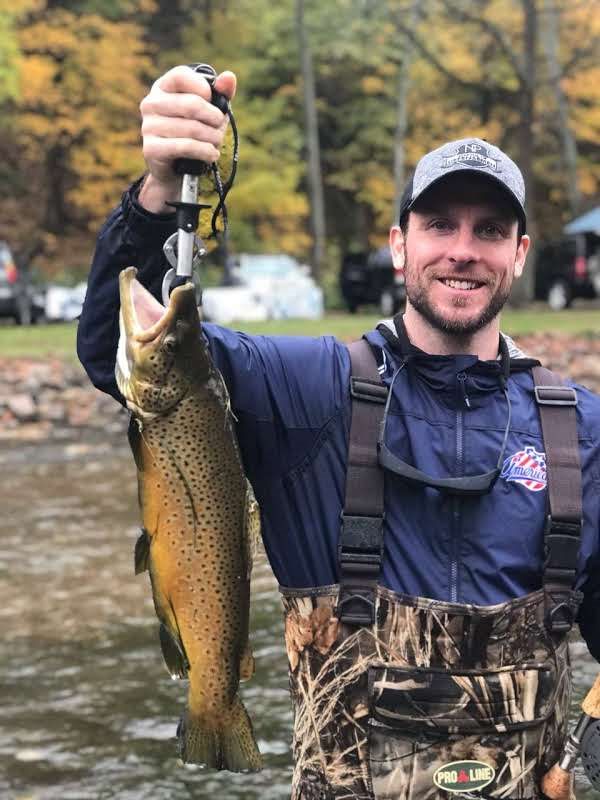
Rochester Amerk Nathan Paetsch and his Brown caught at the Oak (Courtesy M. Walsh)

This week’s STREAM fishing report is from Ron Bierstine from Oak Orchard Tackle and Lodge, November 6, 2018.

Rochester Amerk’s hockey player,  Nathan Paetsch, with a nice Brown he caught on Oak Orchard River (Courtesy M. Walsh).

We had a bit more rain last night and this morning that should maintain flows. Forecast is for any serious precipitation to have moved out of the area this morning and then followed by a wind advisory through tomorrow. Next chance at precipitation and colder temps is this weekend. Flows in the Oak are slightly high with slightly stained water color of about 2 ft of visibility. Flows consist of turbine water and fluctuating overflow levels thanks to hydro-power operations. During this leaf fall period, and especially with wind and rain, look for at least daily water level fluctuations.

Some anglers remark that when flows temporarily go down, the numbers of fish revealed in the Oak is a little humbling! There are a lot of browns and some steelhead, and of course still Kings. Plenty of greener Kings are still around, look for still some non-zombie Kings through November.

Smaller tributaries, especially, will have Kings later in the fall since that salmon run really didn’t crank up for upstream gravel action until just last week. Fishing pressure is definitely intense at times, seems less now through this mid-week period. Most all anglers report good action for mixed bag chances on browns and steelhead and Atlantics and Kings and Coho’s.

Rochester Amerk’s Adam Wilcox & Nathan Paetsch at the Oak (Courtesy M. Walsh)

The Oak’s higher stained flows can at least help tolerate a bit more fishing pressure. Other area smaller tributaries perhaps stalled some now from dropping back down (thanks to that precipitation last night and today) for this mid-week period. Look for medium, slightly-high and stained flows in the tributaries to the west and quicker retreating medium flows in the tributaries to the east. Green Kings, browns and steelhead are now spreading out upstream in those smaller waterways.

Provided by Ron Bierstine, Oak Orchard Tackle & Lodge


Visit our Fishing Report on OrleansCountyTourism.com, including weather forecasts and our “At the Oak, Orleans County” Facebook feed.
From Point Breeze on Lake Ontario, the World Fishing Network’s Ultimate Fishing Town USA and the rest of Orleans County, let’s make everyday a great fishing day right here in Orleans County!
Sincerely, The Team at Orleans County Tourism
Stay Connected
Facebook   Twitter   LinkedIn   Pinterest


November “Outta’ the Woods” – It’s a Special Time

Young hunters, like Kingston Johnson here, practice until they're proficient with a bow and arrow before heading to the FLORIDA hunting grounds with an adult mentor. Forrest Fisher Photo

  • Outdoors and Hunting Families Provide a Powerful Sense of Community
  • Hunt Deer and Hogs over a Bait Pile on Private Lands – it’s OK, but NOT OK on any Florida WMA’s
  • Season Dates, General Regulations Explained Below

By Tony Young

With much of the Panhandle still coping with the devastation from Hurricane Michael – a recovery that may take months – we continue to be proud of the spirit, perseverance and fortitude of those who were affected. Our responding officers have seen firsthand people lending a hand to neighbors, friends and strangers; contributing essential items to those who lost everything; being more patient; and expressing gratitude. The kindness and compassion has been uplifting.

As Thanksgiving nears, celebrating that powerful sense of community will be top of mind for many. For the hunting community, it’s a wonderful time of year to remember those who introduced us to hunting. And the holiday gives us a great opportunity to pay it forward by taking someone else hunting such as a neighbor, friend, family member or coworker.

There are many people who didn’t grow up hunting but became interested in experiencing it and enjoying the benefits of eating healthy, organic protein as adults. Denise Helms, the Florida state chapter president of the National Wild Turkey Federation, is a perfect example. She didn’t go on her first hunt until she was 24 years old when a friend invited her to go turkey hunting on public land.

“I’m game for anything, so I went along. I just like being outdoors,” Helms said.

Helms loved the experience of sitting in a homemade palmetto blind, taking in the sunrise through an oak hammock and hearing wild turkeys gobble for the first time.

“Country singer Eric Church said it best with his lyric, ‘Walking barefoot through the mud will knock the rust right off your soul,’” Helms said. “And so does being in the woods.”

However, Helms didn’t immediately catch the hunting bug. She married and moved to Colorado, and it wasn’t until she moved back to the Sunshine State 12 years later that she had the opportunity to go hunting again. In 2008, she harvested her first turkey, deer and wild hog.

By engaging herself in hunting, Helms has gained a whole new family.

“Acquaintances turned into friends who turned into family – people who care about conservation, support me incorporating hunting into my life and help me succeed,” Helms said. “It’s a great feeling having mentors like that who I can learn from.”

Helms admits she’s not a hunting master yet, so she hasn’t personally guided anyone on a hunt. But she’s been doing her part in passing down the hunting tradition by volunteering with her local NWTF chapter and serving on its board since 2011. Helping plan and host a Women in the Outdoors event for other women further ignited her passion for hunting.

“I feel like what I’m doing is making a difference at all levels – and I like that,” Helms said.

General gun season

General gun season runs Nov. 3 – Jan. 20 in Zone C, and Dec. 1 – Feb. 17 in Zone B. In Zone A, the second phase of general gun season is Nov. 17 – Jan. 6. In Zone D, the first phase always starts Thanksgiving Day (Nov. 22) and lasts four days (until Nov. 25).

During general gun season, only legal-to-take bucks as they are defined in each Deer Management Unit may be harvested. Don’t forget you need to purchase a $5 deer permit first. On private land, the daily bag limit for deer is two. Bag limits and other regulations for deer on WMAs can differ, so before you hunt download the specific WMA brochure ONLY available at MyFWC.com/WMAbrochures and through the Fish|Hunt FL app. These brochures are no longer being printed. 

You may hunt wild hogs on private lands year-round with no bag or size limits. Similarly, on most public lands there are no bag or size limits, and hogs are legal to take during most hunting seasons except spring turkey. On a few public hunting areas, specific bag and size limits do apply, so check the online WMA brochure to be certain.

Hunters are allowed to take deer and wild hogs over feeding stations on private land, but that’s not the case on WMAs, no matter the season or game species.

New this year, hunters are allowed to use pre-charged pneumatic (PCP) air guns firing single bullets or arrows to take deer during general gun season on private lands and on WMAs, if the gun is at least .30 caliber.

It’s illegal to take deer using rimfire cartridges or non-expanding, full-metal case ammunition. Shooting a swimming deer also is against the law.

Deer-dog hunting

All free-running dogs used in pursuing or hunting deer must wear a collar or tag displaying the name and address of the dog’s owner. Hunters must contain their dogs to the tract of land they have permission to hunt.

There are several ways to accomplish that: Equip and monitor dogs with devices that allow remote tracking and behavior correction; only deer-dog hunt on large tracts of land; make sure there are adequate cut-off roads that will enable you to keep in front of the dogs; and don’t turn out more dogs than your hunting party can manage.

Hunters using dogs to take deer on private lands must register that property before doing so. No-cost, statewide deer-dog registration is required during all open deer-hunting and training seasons when taking or running deer with dogs is permitted. However, this registration doesn’t apply to hunters hunting or training with deer dogs on public lands and WMAs.

This mandatory registration may be issued to hunting clubs, landowners or anyone who has permission to hunt deer with dogs on a particular tract of land as long as the required application is completed and approved. Application forms are available at all regional Florida Fish and Wildlife Conservation Commission (FWC) offices and online at MyFWC.com/Deer. Applications should include proof of landowner permission or a copy of the written hunting-lease agreement, and a general map of the property showing boundaries and a legal description.

Once you’ve registered with the FWC, you’ll be issued a unique registration number that must be attached to the collars of all dogs used to pursue deer on registered properties during any open deer-hunting or deer-dog training season when taking or running deer with dogs is permitted. Hunters must possess copies of their registration while they’re hunting or training with their dogs.

WMAs that don’t require a quota permit

Florida’s WMAs offer a wide range of hunting opportunities from quota/limited entry hunts, special-opportunity hunts, and public hunting areas where hunters can walk on to hunt. There are 46 WMAs where hunters don’t need a quota permit to hunt some or all of the general gun season. So, if you didn’t apply or get drawn for a quota hunt, don’t worry, there’s plenty of opportunity spread throughout the state. You can find those WMAs not requiring a quota permit at MyFWC.com/WMAbrochures at the bottom of the webpage.

Private land doe days

Within the general gun season are antlerless deer days, better known to us hunters as “doe days.” These dates differ for each of the state’s 12 DMUs. To learn when these antlerless deer opportunities occur in your DMU, refer to the “2018-2019 Florida Hunting Regulations” handbook, which you can pick up at your tax collector’s office, FWC regional office or by downloading it online at MyFWC.com/Hunting.

During these doe days, the daily bag limit is one legal antlered deer and one antlerless deer, or two legal antlered deer. Unlike archery season, you may not take two antlerless deer in one day, unless you have antlerless deer tags issued for the private land you hunt. Also, regardless of the season, deer gender or the number of permits, hunters are never allowed to harvest more than two deer per day under any circumstances. And except for a few, most WMAs do not have antlerless deer days.

Fall turkey

Fall turkey season starts on the same date as general gun season in zones B, C and D but ends a little earlier. It runs from Dec. 1 – Jan. 27 in Zone B; Nov. 3 – Dec. 30 in Zone C; and Nov. 22-25 and Dec. 8 – Jan. 13 in Zone D. In Zone A, the second phase of fall turkey season is the same as the zone’s second phase of general gun: Nov. 17 – Jan. 6. Hunters may only take bearded turkeys and gobblers, and they must have a turkey permit ($10 for residents, $125 for nonresidents) to hunt them.

You may harvest up to two turkeys per day on private land, if you’d like, but that would tag you out for the entire fall season because you’re only allowed to harvest a total of two turkeys during the archery, crossbow, muzzleloading gun and fall turkey seasons combined. In Holmes County, the harvest of fall turkeys is not allowed at all. And there’s not a fall turkey season on WMAs, however, on a half-dozen areas, turkeys are legal to take during general gun season.

As with deer, PCP air guns are now a legal method of taking turkeys during fall turkey season, but they must be a minimum of .20 caliber or be the type that shoots arrows.

You’re not permitted to hunt turkeys with dogs or with recorded turkey calls, and you’re not permitted to shoot them while they’re on the roost or when you’re within 100 yards of a game-feeding station when feed is present.

Bobwhite quail

Quail season this year runs Nov. 10 – March 3, and the daily bag limit is 12.

Miscellaneous regulations

Shooting hours for deer, fall turkeys and quail are a half-hour before sunrise to a half-hour after sunset. All legal rifles, shotguns, muzzleloaders, air guns (PCP .30 caliber for deer, .20 caliber for turkeys), bows, crossbows and handguns may be used to take each of these resident game animals during the general gun, fall turkey and quail seasons.


Illegal firearms and ammunition are defined as centerfire, semiautomatic rifles having magazine capacities of more than five rounds, and fully automatic firearms. Other prohibited methods for taking game include shooting from a moving vehicle and herding or driving game with a vehicle.

License and permit requirements

The first thing you’ll need to participate in one or more of these hunting opportunities is a Florida hunting license. Residents pay just $17. Nonresidents have the choice of paying $46.50 for a 10-day license or $151.50 for 12 months.

If you want to hunt on a WMA, you also must purchase a management area permit for $26.50. And don’t forget to obtain the brochure about the WMA you’re going to hunt because dates, bag limits and rules differ greatly for each area. These are available only online at MyFWC.com/WMAbrochures and through the Fish|Hunt FL app.

All necessary licenses and permits are available at your tax collector’s office, retail outlets that sell hunting and fishing gear, by calling toll-free 888-HUNT-FLORIDA (486-8356) or by going online at GoOutdoorsFlorida.com.

Being thankful

November is a time to be thankful, especially now, knowing that so many Floridians will be recovering from Hurricane Michael for many months ahead. For those who can give their time or resources to help, please do so however you can. Resources are available through the Fish & Wildlife Foundation of Florida and the Volunteer Florida organizations.


NY Hunters Voluntarily Choosing to Pass Up Young Bucks Pays Dividends

A hunters first deer provides an unforgettable smile into the heritage of our ancesters. Forest Fisher Photo

In the southeastern Hudson Valley (Wildlife Management Units 3F, 3G, 3N, and 4Z) of New York, the proportion of older bucks in the deer harvest has never been higher. In 2017, three out of every four antlered bucks were 2.5 years old or older, and this remarkable accomplishment happened with hunters freely able to choose what type of buck they want to harvest.

graph

For decades, hunters in this area were accustomed to taking mostly small-bodied, small-antlered yearling bucks, and these 1.5-year-old bucks comprised 65-75 percent of the buck take each year. Around 2000, that tradition really began to change. By 2008, the balance had solidly tipped towards older bucks with more than 50 percent of the annual buck take being 2.5-years or older with larger bodies and larger antlers. In recent years, the ratio has fully flipped with 65-75 percent of bucks being older-aged bucks.

bucks

To be sure, other things have happened with this deer population. Overall, there are fewer deer in this area than 20 years ago, and as a result, hunters are seeing and taking fewer deer than they did previously. However, the smaller population size doesn’t explain the shift towards older bucks in the harvest.

Some might suggest the shift towards older bucks is due to fewer hunters or reduced harvest rate which could result in greater survival of young bucks.

While we don’t have data specific to these variables for the southeastern Hudson Valley, we know the number of deer hunters statewide has been fairly stable for the past decade.

Too, we can reasonably assume that if shifts in hunting pressure and harvest rate were the primary driver affecting buck age structure, the same would be true for the adult does. However, the proportion of older does in the female deer harvest has stayed virtually unchanged for the past 40 years.

We know many hunters in New York are voluntarily opting to pass up shots at young, small-antlered bucks.

The effects of hunter choice in the southeastern Hudson Valley are dramatic and a great example for hunters everywhere of what can be accomplished when hunters choose to Let Young Bucks Go and Watch Them Grow!

aging
Skulls and antlers of three bucks taken off the same property. Photo courtesy of Jeff Peil, retired DEC biologist.

Celebrate “Deer Season” with Helpful Hunting Tactics from Mossy Oak

Mossy Oak to the New Deer Season Rescue...visit 3 video stories on-line.

  • Check out 3 All-New, On-Demand Video’s from MossyOak.com

It’s November 2018, time to welcome back deer season, the time of the year when the leaves are changing, the mornings are crisp and the whitetail woods are starting to come alive. Welcome to “Deer Season.”

To celebrate the pursuit of America’s favorite game animal, Mossy Oak is proud to offer three all-new free digital whitetail-specific titles to MossyOak.com.

Follow the saga of a cattle farm turned whitetail haven on Mossy Oak’s “Home Grown.” “Home Grown” follows landowner, Austin Musselman and his team as they tell the story of the evolution of Mussleman’s farm and how they manicured the property into what became the home property for one of Kentucky’s largest whitetails ever taken by a hunter, along with several other true giant bucks.


Mossy Oak’s second title, “Shooters,” will reveal the evolution of some of the biggest bucks and best hunts captured by the Mossy Oak cameras throughout the company’s 30-plus-year history.

The third title featured in “Deer Season” is “Victory Outdoors.” In line with Mossy Oak’s brand culture, “Victory Outdoors” is all about immersion in the complete outdoors experience and embracing hunting as a way of life. This season will feature six films, bringing viewers deer hunts from the great whitetail hunting states of Iowa, Kentucky, Nebraska and South Dakota.

“Something comes alive in all of us at Mossy Oak this time of the year,” said Ben Maki, Chief Marketing Officer and Senior Vice President at Mossy Oak. “In honor of the heart of deer season, cold weather moving across the country and the rut drawing near, we’ll have new episodes of different whitetail series every few days through the end of November dropping on Facebook, YouTube and MossyOak.com. As always, it’s all completely free to watch on-demand, commercial free.”

Check back every week as Mossy Oak adds new episodes to each of these titles throughout the month of November.

To learn more about Mossy Oak, or to enjoy free, timely and entertaining hunting and outdoors content, visit https://www.mossyoak.com.  Established in 1986, Haas Outdoors Inc. is headquartered in West Point, Miss., and is home of Mossy Oak. For more than 30 years, Mossy Oak has been a leading outdoors lifestyle brand that specializes in developing and marketing modern camouflage designs for hunters and outdoors enthusiasts. The Mossy Oak Brand and patterns can be found on a multitude of products worldwide. Haas Outdoors Inc. is the parent company of Mossy Oak, BioLogic, Capture Productions, MOOSE Media, Nativ Nurseries, Nativ Living, GameKeepers, GameKeepers Kennels and Mossy Oak Properties.Mossy Oak is the official camouflage of the National Wild Turkey Federation, Ducks Unlimited, Quality Deer Management Association, and Mack’s Prairie Wings and the official pattern of B.A.S.S., MLF and Cabela’s Collegiate Bass Fishing Series.

Follow Mossy Oak on Facebook, Twitter, Instagram, Google+, Pinterest and YouTube.

NY Big Game and Small Game Seasons are Underway

Giant gray squirrels are not uncommon in the southern tier forest lands of New York State. Forrest Fisher Photo

Hunters and Trappers Favorite Time of Year…Open Season

Hunting seasons for big game like whitetail deer and black bear are underway with the archery season. Likewise, many small game species, like ruffed grouse, pheasant, rabbit, squirrel, and wild turkey, are also open and in progress.

Hunting and trapping seasons for bobcat, raccoon and fox, and trapping seasons for fisher and mink began in some regions of the state on October 25th. Be sure to check the New York State Hunting and Trapping Regulations Guide for the season dates and regulations for your hunting or trapping area.

Wild turkey hunting in the Southern Zone began October 20th and runs through Nov. 2nd. Hunters are required to have a turkey permit, and the statewide season bag limit is one bird of either sex.

Remember, harvest reporting is critical to wildlife management, and by regulation, hunters must report their harvest of a turkey within seven days of taking the animal. DEC encourages hunters to, “Take it, tag it, and then report it.

Trappers should note special permit requirements are required for fisher and marten trapping seasons. Fisher season began on October 25th in many WMUs and fisher and marten season began today in the Adirondacks. All fisher and marten trappers must obtain a special, free permit from their regional wildlife office, submit a trapping activity log, and submit the skull or jaw from harvested fishers and martens.

Giant gray squirrels are not uncommon in the southern tier state forest lands of New York State. Forrest Fisher Photo

DEC’s wildlife managers rely on the information supplied by trappers to help manage populations of these popular furbearers. To obtain a free fisher or fisher/marten permit, trappers should contact their regional wildlife office or apply by e-mail at wildlife@dec.ny.gov.

Only one fisher or fisher/marten permit is needed to trap these species anywhere in New York where the season is open. For more information, see page 54 in the Hunting and Trapping Regulations Guide. 

As always, please follow the basic rules of hunter safety to protect yourself and other hunters this season.

Oak Orchard River Fishing Report – Orleans County, New York

Photo courtesy of Ron Bierstine

Depending upon your perspective, the area escaped the most recent heavier precipitation.  Most of the past weekend’s significant rain hit south of here and so the Oak flows should be maintained at what’s been a real nice medium flow or barely greater and mostly clear. 

The other area smaller tributaries with local, smaller watershed might have come up from real low to just low for now. 

With greenery slowly capturing less water and the ground now a bit wetter, the next significant precipitation could show some runoff for higher flows in the smaller tributaries.  Showers are in the forecast Wednesday and there is the chance for a soaking rain Thursday and Friday.  Any rise in flows in the smaller tributaries will likely move a bunch of staged up salmon and trout upstream for good action.  Forecast temperatures thru this week look pretty agreeable with highs around 50 F.

Fishing pressure was high last weekend and now seems down and more agreeable so far thru this week.  Water temps are dropping back into the high 40’s now with colder nights.  Kings are definitely still present and still strong at or nearer the dam.  Some are showing signs of zombie wear while green stragglers are still moving upstream. 

Downstream frog water or lower river or river mouth action for Kings is probably more hit or miss now. 

Upstream fast water and dam action on the Oak is real good for mixed bag chances at browns, steelhead, Atlantics, Coho’s and Kings. Some guys remark that the Kings are real active biters. 

As we’re moving into November, look for more guys concentrating on trout chances and less on Kings.  We’re in a bit of a transition between camps right now so I think that’s why the fishing pressure has eased some.  Should be lots of good action still ahead.

Provided by Ron Bierstine, Oak Orchard Tackle & Lodge

Visit our Fishing Report on OrleansCountyTourism.com, including weather forecasts and our “At the Oak, Orleans County” Facebook feed.

From Point Breeze on Lake Ontario, the World Fishing Network’s Ultimate Fishing Town USA and the rest of Orleans County, let’s make everyday a great fishing day right here in Orleans County!  Sincerely, The Team at Orleans County Tourism

Sacred Water at Devils Lake: Legend of the Lake Monster

"Legends of Black Lake monsters supercede pictures and tales of monster walleye that exist here. Secrets are many," says Bob Holzhei, story writer.

  • Devils Lake, Part 2: Legend of the Lake Monster       
  • Walleye, Northern Pike, Crappie, lots of fish here
  • Lures and Baits of all sorts Catch Fish on Devils Lake
We caught lots of walleye every day we fished, usually between 50 and 100 each time, but there was always some mystery about that “Lake Monster Legend.” Forrest Fisher photo

By Bob Holzhei

Early European-Americans termed the lake “Bad Spirit Lake” because of high salinity water, making it unfit to drink.  With summer, mirages were often seen across the water and the lake was referred to as “Spirit Lake,” as reflected in the Spirit Lake Indian Tribe.

Published reports of a “Lake Monster” date as far back as 1894, while Native American legends go back much further about a Loch Ness serpent in Devil’s Lake.

It is said locally that the monster is not often seen, but here is what we saw on one day when we fished the lake.  Forrest Fisher photo

Whether fact or fiction, stories of the Devil’s Lake Monster have been reportedly sighted and recounted in many newspapers, including the New York Sun in 1984, the Bismarck Tribune in 1895 and the Wichita Beacon in 1904.

All descriptions of the serpent indicate it has alligator jaws and glaring red eyes, a tail stretching to 80 feet long and it usually appears at sunset during August.  The serpent moves slowly, often seen about a half mile from shore and reported to circle the lake twice a day.  A slimy green color, the serpent’s motion sends gentle surface waves along from head to tail with the wake visible as it pushes along.

Early accounts of the Devil’s Lake Monster may be sensationalized accounts reported in newspapers in order to draw tourists to the area. Whether fact or fiction, my camera did accompany me on a guided fishing trip to Devil’s Lake in August. Today I can attest that our guide did fish more than a half mile from the mainland shore. Hmmmm.

While we chuckled about the fabled monster chronicles, Devils Lake in North Dakota is an angler’s dream and is open to fishing all year long. Ice fishing is especially fun here with heated huts and the aroma of smoked sausage on the grill.

No matter the time of year, multiple species here keep every angler in action for most of the fishing day. Foot-long perch are common, walleye in all-sizes – from eaters to wall hangers are the usual resident and non-resident angler focus, northern pike ranging from 5 to 10 pounds are the largest predator fish, while white bass, panfish (crappie and bluegill) and trout, provide a variety of fishing opportunities at Devil’s Lake. It’s fun to fish here.

Baitcasting rigs are the norm here, as you never know how big that next walleye monster might be, that’s not a legend. Forrest Fisher photo

A variety of popular fishing strategies include slip bobber fishing, rigging, jigging, casting, trolling with crankbaits and enticing hungry fish with bottom-bouncers when the usual hot bite is off, which is not very often. We caught over 50 walleye each day of our fishing.

My friend and our guide on Devils Lake was Al Freidig, he shared secrets and how to catch fish in this vast waterway. Forrest Fisher photo

The Devil’s Lake Basin is the second largest body of water in North Dakota after Lake Sakakawea.  Once the lake reaches a high level of 1,458 feet, it flows into the Sheyenne and Red Rivers, though overflow occurred only twice in the last 4,000 years. Historically the area is the site of the Dakota people who relocated there as a result of The 1867 Treaty with the United States.

One of our favorite 3-way rig bottom-bouncing baits on Devils Lake, these worked very well.

The lake stretches over 380 square miles with an average maximum depth of about 47 feet. Lots of room for fish and fishermen, and the Devils Lake monster.

Hold onto your rod.  You never know, you could become a legendary friend.

For more info on where to stay or who to call for guide services, contact:  https://www.ndtourism.com/cities/devils-lake.


Musky, Bass, Brown Trout, Coho’s, King Salmon…ALL BITING NOW in Niagara County, NY

  • Tribs hold king salmon, brown trout and steelhead now
  • Egg sacs in chartreuse, orange or pink and nymphs, glo bugs, woolly buggers are HOT
  • Upper Niagara River musky fishing picks up with downturn in water temps
Ethan Bronschidle of Newfane caught his personal best brown trout over the weekend, a 14 pound Niagara County trophy.

Oct. 31, 2018 – Niagara Falls, USA: Burt Dam and 18 Mile Creek continue to be good for king salmon, brown trout and steelhead according to Karen Evarts at The Boat Doctors in Olcott. Skein, egg sacs or egg imitations are the way to go. Maribou jigs and beads are also working.

Sandy Troutman of Butler, Pa. with her first King Salmon from Burt Dam.

Chartreuse, orange and pink egg sacs have been working, along with nymphs, glo bugs and woolly buggers in purples, browns and blacks. Peach and orange beads have been catching fish, too.

The Olcott and Wilson piers have been producing some pike and steelhead for casters using spoons and spinners. Water flow is still an issue in many of the smaller streams in the lake. When they do get water, it pulls fish in and many times those fish will be stranded in some of the deeper holes. If you notice any illegal activity, use your phone to call 844-DEC ECOS.

Anthony LaRosa of Lewiston with a NYPA fishing platform King Salmon.

Lower Niagara River fishing is switching from salmon to trout, and some lake trout are starting to move in. Remember lake trout season is closed right now. Shore fishing guru Mike Rzucidlo of Niagara Falls has been tossing jigs and No. 4 spinners to take salmon, walleye, steelhead and lake trout (all released quickly and unharmed) off the New York Power Authority Fishing Platform. If we don’t see any snow and ice, expect the platform to remain open until Dec. 1 at least.

Mike Rzucidlo of Niagara Falls with a Lower Niagara River lake trout caught from shore.

Rzucidlo has also done well in the gorge, especially along the Artpark trail. If you would prefer to target smallmouth bass, the bronzebacks have been on a fall feed and Capt. Frank Campbell of Niagara Falls reports that his hot bait was a Strike King Rage Swimmer producing fish up to almost 6 pounds. They were taken downriver and action was fast for the most part.

In the upper Niagara River (above Niagara Falls), Capt. Chris Cinelli of Grand Island reports decent musky action as waters start to cool and fish move in to winter over.

Local angler Joe Soldaczewski caught this 49-inch muskellunge in the upper Niagara River Sunday while fishing with Capt. Chris Cinelli of Grand Island.

This past week he caught fish up to 49 inches long using a three-way rig and a special set-up involving live bait. Timing is perfect for the Tim Wittek Memorial Catch and Release Musky Tournament on Sunday, Nov. 4. It is hosted by the Niagara Musky Association from 7 a.m. to 4 p.m. You must be a club member to participate. Cost for tourney is $25. For more info call Scott McKee at 225-3816. The club’s month meeting is Tuesday, Nov. 6 at the Eldredge Club, 17 Broad Street, Tonawanda starting at 7 p.m. Five different members will talk about different fall musky fishing points. It should be a good one. As of Nov. 1, you are now required to wear a personal flotation device if you are on or in a water craft 21 feet in length or smaller. It’s a good idea anyway.

Capt. Frank Campbell of Niagara Falls shows off a 5-plus pound smallmouth from the lower Niagara River caught on a Strike King Rage Swimmer over the weekend.

Bill Hilts, Jr.- Outdoor Promotions Director

Destination Niagara USA; 10 Rainbow Blvd., Niagara Falls, NY 14303
p: 1-877 FALLS US; 1-716-282-8992 x. 303; f: 716-285-0809
www.niagarafallsusa.com

facebook | twitter | Instagram


EPA MERCURY ROLLBACK Exposes Communities, Kids, and Wildlife to Increased TOXIC POLLUTION

Buddy Seiner Photo

  • Standards Plan to weaken protection for Americans…Mercury Contamination ROLLBACK
  • Mercury is toxic to children and pregnant women

By Casey Skeens

Washington, DC: Oct. 9, 2018 — The National Wildlife Federation urged the Environmental Protection Agency (EPA) to halt moves to weaken standards designed to protect Americans against mercury pollution. The regulatory move, which runs counter to centuries of scientific consensus on the health hazards mercury poses to people and wildlife, would undercut the 2011 Mercury and Air Toxic Standards (MATS).

“Mercury is toxic to children and pregnant women — damaging the central nervous system and harming fetal development. When we fail to reduce mercury from sources like coal plants, it winds up in our waterways and builds up in our food chain, especially within fish populations” said Collin O’Mara, president and CEO of the National Wildlife Federation. “The Administration’s proposal is so unconscionably bad that the regulated power industry — which has already invested more than $18 billion to reduce these incredibly harmful pollutants —opposes it. This rollback is as reckless as it is dangerous to our communities and wildlife. We urge EPA to keep the mercury standards in place to keep Americans safe.”

The EPA has submitted a proposal for White House review that would severely limit consideration of health benefits that justify the existing strict mercury standards for coal-fired power plants. Next steps may include a proposal to directly weaken or undo the emissions requirements.

Based on the EPA’s own projections, maintaining the MATS rule would annually avoid:

  • Up to 11,000 premature deaths
  • Nearly 5,000 heart attacks
  • 5,700 hospital and emergency room visits
  • 130,000 asthma attacks

 Read more about the dangers of mercury poisoning in NWF’s recent blog.

Boots to FIX Achy-Breakee Knees – I’m a brand new, old Outdoor Guy


  • Midsole support and solid heel fit helped heal my knee bones
  • Semi-automatic shoe-lacer, especially good for old guys 
  • For hunting – they’re scent-free, waterproof and handsome to deer to stare at while I draw my bow
Click the boot to see how the shoe-lacing system works.

By Forrest fisher

In my short seven decades of hunting, hiking, fishing and camping, I have bought and tried virtually every boot ever made on the market. Most of them are pretty good and they work well for their intended purposes. Somehow without my knowing, time has passed and it seems I got old. First the back, then the knees, you know how things go when you wear out parts – especially in cold weather.

Then I had a chat with my long-time outdoor pal, Kim Emery, and she shared that there was this new boot that everyone was raving about for comfort.  It was waterproof, you could get insulated or uninsulated, and if you wanted to save your back from bending over too far to tie the shoelaces, you could get them with the new, semi-automatic, wind-up shoe-lacer…push to lock, pull to release. Kim said, “You’re gonna like these Forrest.”  When a trusted friend tells you that, they got ordered, they were on their way.

As soon as I received them, the shipping box wrapper lasted about 4 seconds until I reached the Irish Setter boot box. First off, they are handsome. Second, they were so lightweight. I felt myself hurrying to get my sneaker shoes off to slip into my new size 14 handsome boots. My heart was actually racing a bit, they looked so good. Would they fit? Would they work for me?

My wide foot slithered into them like a hot knife into warm butter. Wow, I thought, they feel really good. I stood up after figuring out the tighten-me-now shoe lace mechanism and there I was. I took a few careful steps. Then I hollered over to my better half, “Honey, come see these new boots! They’re amazing, they feel good, they help my knees, I can’t believe it!”

Smiling ear to ear, “I’m going hiking out back dear,” I was yelping. Underfoot and knee comfort like never before. Even my back felt good. I called Kim to share my surprise with this newfound hope for more time outdoors. Today, I wear them everywhere, every day – hunting, fishing, walking, shopping…everywhere. They are MY BOOTS. Good for uneven, even, rugged and un-rugged earth.

I researched them to learn more, because they are not only comfortable, they are warm and dry all day too. What are they made of? They are Irish Setter model 2890 boots and it turns out they use modern technology in putting these together, but without getting into the fancy names, they work. They even have odor elimination for smell-free feet when you hunt big game critters, like I’m doing today.  I’ve had them a month and I’ve mistreated these like every other boot I have owned and they still look new. They don’t know what foot-dragging and toe-kicking abrasion means, they look brand new. AND, most of all, I can walk all day without looking to rest on my butt. That new shoe lace mechanism is called the BOA® lacing system. Only one word for these boots: LIFESAVERs! Irish Setter model 2890.

About Irish Setter: Based in Red Wing, MN, Irish Setter is a division of Red Wing Shoe Company that produces a full line of performance hunting boots and rugged outdoor casual footwear. Irish Setter continues to use leading technologies and the finest materials to offer customers the highest quality outdoor footwear. For more information about Irish Setter’s heritage, products and retailers, visit www.irishsetterboots.com.


Devil’s Lake, North Dakota – Part 1, Walleye Expectations Exceeded!

Mike Schoonveld caught our largest walleye of the day, but we hooked more than 75 fish, some nice perch too, in a half-day on the water. Imagine that.

  • Devils Lake is located in East-Central North Dakota – 1000 Shoreline Miles of Walleye Access
  • More than 100 Fishing Guides are Certified to provide Services on Devils Lake
  • Best Walleye Baits: Jigs, Crankbaits, Crawler Harnesses
Outdoor writer Dave Barus with the first walleye of the day.

By Bob Holzhei

There are 105 registered fishing guides who regularly host avid anglers to fish Devil’s Lake, North Dakota, many of them will find the fishing adventure of their lifetime. High expectations?  Not really, especially when a person considers there is steady fishing action success experienced throughout the year, including ice fishing. The 180,000 acres of Devils Lake provide more than 1,000 miles of shoreline.

Walleyes were targeted the first day of fishing on Devil’s Lake, however, there are northern pike, perch, crappie, panfish, trout and white bass among other popular angler species. 

When even I can catch walleye at the rate of 10 per hour, YOU KNOW the fishing is great at Devils Lake, ND.

The annual Association of Great Lakes Outdoor Writer’s annual conference was held in September at Bismarck Mandan, North Dakota, and writers from all over the country discovered history, fishing, hunting and wonderful people. While there, an invitation was extended by Tanner Cherney, a host with the Devil’s Lake Convention & Visitor’s Bureau to join him and others at Devil’s Lake to experience their excellent walleye fishery.

My wife Shirley and I arrived late at Devils Lake, but we were just in time to meet local guide groups and experience the walleye fishing on nationally renowned Devil’s Lake.

Mike Schoonveld caught our largest walleye of the day, but we hooked more than 75 fish, some nice perch too, in a half-day on the water. Imagine that.

Captain Al Freidig, our local guide for the afternoon put my fishing partner, Dave Barus, and myself on the walleye. A total of 28 walleye were caught, many in the 12-14-inch range that speaks well for the future fishery here, all of these were caught and released, and we kept four for the table.

Crawler harnesses with nightcrawler bits on number 2 and 4 hooks were tied-up using 14-pound Berkley Fireline, these produced the steady action. Fenwick rods paired with Abu Garcia reels provided for easy fun in catching these fish in 18 to 27 feet of water. We used white spinner blade colors on the harnesses with the hooks baited with a half-nightcrawler.  Bottom bouncing over a rocky structure near drop-offs was the fishing strategy for the day. 

A professional fishing guide for 18 years, Freidig is sponsored by Devil’s Lake Tourism and he knows his stuff. He was entered in the North Dakota Fishing Hall of Fame in 2015 and is still active in lake access management, as well as maintaining boat ramps and cleaning stations Tobe free of charge and open to the general public. Freidig says, “Hang on guys, you’ll enjoy my 20-foot Ranger Fisherman and 250 horsepower Merc.” He zoomed us across the open lake to reach a variety of fishing spot in record time.

The best part of every trip, making room in the freezer. Mike Schoonveld (right) and I enjoyed using this wonderful fish-cleaning station located right at the Sleep Inn Hotel in Devils Lake.

Freidig’s boat rule is a good one for future conservation promotion, as he asked us to only keep walleye over 16 inches in length, allowing the smaller eyes to grow over the next year. We sure agreed to that idea. If you haven’t been here yet, put it on your bucket list.

For additional information: Devils Lake Convention & Visitor’s Bureau P.O. Box 879 Devils Lake, North Dakota 58301, www.devilslakend.com, 701 662-4903, or contact Tanner Cherney: e-mail – tanner@devilslakend.com, 701-662-4957. Contact guide, Al Freidig al@realestate7.com 701-662-7171.

Outdoor Edge® kicks off FREE FIELD-TO-FREEZER Gear Giveaway

  • “Helping Hunters Enjoy the Hunt, Field to Table,” says David Bloch – Outdoor Edge founder
  •  Outdoor Edge Razor Pro Knife Set & Game Pro Processor Kit, Koola Game Bags, Weston Meat Grinder, Hi Mountain Seasonings, Bradley Smoker

DENVER (Oct. 25, 2018) — To celebrate the fall hunting season nationwide, Outdoor Edge has kicked off a giveaway that offers everything a hunter needs to take the harvest from field to table. This fabulous $800 prize package includes products from Outdoor Edge, Koola Buck, Weston, Hi Mountain Seasoning and Bradley.

The prize package includes RazorPro Knife from Outdoor Edge, a 12-piece Outdoor Edge Game Processor Kit, an Outdoor Edge illuminated Grill Beam Tong/Spatula, a four-pack of Koola Buck XL Antimicrobial Game Bags, a Weston Electric Meat Grinder, a Hi Mountain Seasonings Jerky Cutting Board and assorted seasonings (https://www.himtnjerky.com/) to make mouthwatering meals, including jerky, and a Bradley Original Smoker.

RazorPro Knife Set offers the ultimate choice for never having a dull blade.

Entering this $800 give-away is free and easy. Just visit the Outdoor Edge Facebook Page, click on the contest tab on the left (https://www.facebook.com/outdooredge/) and enter your name and email address. Participants can enter once a day. Additional entries can be obtained by getting friends to like the page and enter the contest. Participants can enter as many times as is valid before the closing deadline of 11:59 PM on Dec. 2.

“The ultimate goal of this give-away is to get hunters to enjoy the entire hunting experience, from field to table,” said David Bloch, Outdoor Edge’s CEO and founder. “Wild game is healthy, lean and delicious making it the best form of protein I know of. The key is proper care from the field all the way to the grill to prevent any gamey flavors. This giveaway package has everything needed to prepare fabulous game meals for friends and family.”

Hi Mountain offers jerky kits and meat processing seasonings for every hunter.

About Outdoor Edge: Founded in 1988 and headquartered in Denver, Outdoor Edge is a leading designer and manufacturer of knives and tools. Today, Outdoor Edge continues to innovate and develop state-of-the-art products for outdoor enthusiasts, game processors, survivalists, handymen and others who require the very best knives and tools available for leisure, work and everyday-carry needs. The company prides itself in offering a variety of products that undergo extensive field-testing in harsh, rugged environments resulting in durable, long-lasting products that come with a lifetime guarantee. For additional information on Outdoor Edge and its full line of products write to: Outdoor Edge, 5000 Osage Street, Suite 800, Denver, CO 80221; call toll-free 800-477-3343; email moreinfo@outdooredge.com; or visit www.outdooredge.com.

Lake Ontario – Orleans County STREAM FISHING REPORT from Ron Bierstine from Oak Orchard Tackle & Lodge – October 23, 2018

By most all accounts, there is good action on the Oak.  Brown trout numbers are definitely picking up and fish reportedly are on the move.  Some steelhead have been reported every day too.  The end of this past weekend and beginning of this week have been good for hookups around the Archers Club and it sounds like plenty of fish are in the downstream frog water too.  Legit light line deep drifts have been the ticket there. 

Oak Orchard stream-run King Salmon. Patrick Carl photo

Salmon numbers are still strongest at or nearer the dam.  Kings in smaller numbers are still migrating from downstream and that will probably be the MO from here out with fish trickling in over a prolonged period.  There are not a lot of dying or zombie fish yet so that tells me there are still plenty on the “run” ahead.  Look for Kings well into November which really hasn’t been a new scenario these past few years.

Fishing pressure was high over the weekend but thus far seems more manageable this week.  Flows are real nice at medium-ish on the Oak compared to lower and clearer flows in the other area smaller tributaries.  Scattered numbers of fish are in those smaller upstream watercourses.  There was some precipitation last night and a decent downpour today so the flows in the smaller waterways may bump up slightly while flows in the Oak should be pretty well maintained. 

Big Joe on the Oak. Patrick Carl photo

Leaf fall is becoming more prevalent so look for the chance for water level fluctuations on the Oak thanks to hydro-power operations.  Seasonably cool weather, if not cold, in the forecast through the week should put more Kings on gravel and keep encouraging what has already been pretty good numbers of steelhead and brown trout migrations.

Provided by Ron Bierstine, Oak Orchard Tackle & Lodge

Visit our Fishing Report on OrleansCountyTourism.com, including weather forecasts and our “At the Oak, Orleans County” Facebook feed.

From Point Breeze on Lake Ontario, the World Fishing Network’s Ultimate Fishing Town USA and the rest of Orleans County, let’s make everyday a great fishing day right here in Orleans County!

Sincerely,

The Team at Orleans County Tourism

Friends in Service of Heroes – F.I.S.H. – We Can All Help Their Cause

The Holiday Sportsman Show is proud to announce “Friends in Service of Heroes,” a veteran support organization as a deserving beneficiary of this sportsman show event.

A wise person said, “True greatness is not how much one achieves, but how much one gives.” Friends in Service of Heroes gives 100% of every dollar raised for the benefit of veterans and their families.

Click the image above to see a short video from a military veteran to learn about F.I.S.H. – it is our turn to serve.

F.I.S.H. is a 501(c)(3) nonprofit established in 2013. Our mission is to make a positive impact and improve the quality of life for our troops, veterans and their families. We are here to serve the heroes that have sacrificed so much to enable all of us to enjoy the freedoms that we have today. There is nothing more fundamental to our country than the freedom which these great Americans provide to all of us. Freedom is not free and the sacrifice can never be repaid. F.I.S.H. is honored to stand in the gap and do what it can to serve those that have served our nation.

The Holiday Sportsman Show believes participation in outdoor sports activities creates a positive effect on the individual, the community and our country and is honored to support the men and women who have defended our freedom by supporting Friends in Service of Heroes.
The Holiday Sportsman Show is a digital online Holiday Sales Promotion for quality companies and businesses serving outdoor sports consumers. If your brand would like information on how to boost 4th quarter sales in the Holiday Sportsman Show while taking advantage of a zero cost marketing fee promotion.

To help F.I.S.H. please contact: Brooke@vexposhows.com

Winchester Repeating Arms Adds Sporter Model to the XPR Rifle Line

For hunters that prefer the appearance and warmth of a wood stock, Winchester Repeating Arms® has introduced a new Sporter model to the XPR® bolt-action rifle line.

The new rifle features a close-grained Grade I walnut stock with crisp checkering on the pistol grip and fore-end for a classic look and feel. A flattened fore-end profile provides added stability when shooting from sandbags or a rest.

At the heart of any accurate rifle is the barrel and the XPR Sporter does not disappoint. The top-quality chromoly steel barrel is button rifled and thermally stress relieved. A target-style crown protects the rifling. The action is precision bedded to ensure the barrel is free-floating.

The XPR Sporter comes in 12 popular calibers from 243 Win. to 338 Win. Mag. — including the 6.5 Creedmoor round. Barrel lengths are 22″ for short action calibers, 24″ for short magnum and standard long action rounds and 26″ for magnum calibers.

The XPR Sporter sells for an MSRP of $599.99.

Features:

  • M.O.A. Trigger System
  • Bolt unlock button
  • Nickel Teflon® on bolt body
  • Detachable box magazine
  • Close-Grained Grade I walnut stock
  • Perma-Cote® matte black metal surfaces
  • Inflex Technology recoil pad
  • Steel recoil lug
  • Receiver is machined from solid steel bar stock
  • Two-position thumb safety
  • Button-rifled, free-floated steel barrel
  • Recessed target crown

For more information on Winchester Firearms, visit winchesterguns.com.

Woodstock Snake Too Close for Comfort

Northern Copperhead safely captured from the backyard and released to a nearby woods habitat.

On October 3, Environmental Conservation Officer Jason Smith received a call from a resident of Woodstock (New York) regarding a snake close to his home.

The caller was not certain of the species, but was concerned the snake might be venomous. ECO Smith met the caller at his residence and found the snake in a small rock pile next to the back door.

The ECO identified the snake as a Northern Copperhead, one of New York State’s three venomous species.

After coaxing the snake into a bucket, ECO Smith released it in nearby state lands with more suitable habitat.

Editor Note: While venomous northern copperheads are not commonly noted in western New York, timber rattlesnakes have been more commonly observed and recorded (Facebook reports with pictures and site location) with increasing frequency in central and south central New York, including areas of Letchworth State Park and southward into Pennsylvania.  Hikers and campers be aware that many areas of New York State are home habitat for these snakes that have useful purpose in nature.  Watch where you walk and be prepared with a Johnson’s Snake Bite Kit (Walmart – about $12), a handy vacuum suction kit, that is also useful for bee stings, wasp stings, etc. – take care. Dave Barus 


Statewide Survey of New York Landowners about Black Bears is Underway

Bear

DEC is partnering with the Center for Conservation Social Sciences (CCSS) at Cornell University on a survey of roughly 11,000 randomly-selected New York landowners to better understand public perceptions of and preferences for black bear population levels. The survey is being sent out this fall to owners of both large and small residential properties, and covers both rural and urban areas.

The questionnaire asks about positive and negative experiences people have had with bears, their perception of population trends, and their views on the potential benefits of and detriments to living among bears. The information from this survey will be used in conjunction with biological data about bear abundance and information on conflicts between people and bears to set population objectives for various parts of the state.

People who receive the survey are encouraged to respond. Collecting information from the public on their view of appropriate wildlife population levels and the potential impact of wildlife on people is an important part of decision-making in wildlife management.

Questions about the survey can be directed to CCSS at 607-255-2828 or wfs1@cornell.edu. For more information, visit the DEC website on Black Bear and read the “New York State Black Bear Management Plan”. Questions about the black bear management program can be directed to 518-402-8883 or: wildlife@dec.ny.gov.

A Hunter’s Role in New York State Wildlife Management

Cory Dente of Delmar NY with a 10 point buck he harvested in the 2018 early bowhunting season. Cory reported his harvest through the HuntFishNY mobile app.

Did you know that only about 50 percent of hunters report their deer, bear and turkey harvests each year, even though it’s required by law?

Did you know that a hunter can be fined up to $250 for failing to report?

Reporting a harvest within seven days of take is not only your legal obligation, it’s also essential to proper wildlife management.

When hunters report their harvest, they are playing a crucial role in the management process, providing important biological data which is used to help estimate the number of deer, bear and turkey in each area of New York State and set management objectives.

At a time when hunter numbers are declining, it’s more important than ever for hunters to take seriously their role in wildlife management, to be good role models and mentors for younger generations, and to do their part to preserve their hunting traditions.

Reporting your harvest is easier than ever, so this fall please remember to Take It, Tag It, Report It!

Visit our website for details on Game Harvest Reporting.


Salmon & Trout Time is NOW for Niagara River/Lake Ontario

Michelle Jones of Pittsburgh, Pa. reeled in this nice Burt Dam brown trout this week.

Gabriela Yip from Calgary, Alberta, Canada, came to fish with her dad, Tom Warda of Niagara Falls and Capt. Joe Marra of Niagara Rainbow Charters in the Lower Niagara River.

Lower Niagara River salmon fishing is still going on and some trout are starting to move in. There are salmon and trout at Burt Dam, too, but things have been a hot and cold, depending on whom you talk to.

Karen Evarts at the Boat Doctor’s in Olcott, NY, reports only fair action off the piers, usually early morning or at dusk for spoon and spinner casters. There has been quite a few salmon and trout being reported off the Route 425 pier, but don’t rule out the Wilson piers off the main harbor for browns and steelhead with an outside shot at an occasional salmon. Egg imitations will also work at any of these spots.

A pink bead worked for one angler on 18 Mile Creek for a beautiful Atlantic salmon. At the dam in Burt, brown trout top the list of preferred targets, followed by steelhead and salmon.

Practice catch and release when you can. Small boaters have been fishing some of the deeper holes with egg skein and picking a few salmon up, too.

Trolling with J13 Rapala’s is another option in the creeks at Olcott and Wilson. In the lake, there aren’t too many people heading out, but fishing can be good out deep (over 300 foot depths) for a mix of salmon and trout. Staging fish off the creek mouth has been limited so far at Wilson and Olcott.

Michelle Jones of Pittsburgh, Pa. reeled in this nice Burt Dam brown trout this week.

In the Niagara River, it’s been more of a mixed bag with salmon still leading the way. Boaters are bouncing bottom with three-way rigs and a chunk of treated egg skein to take Kings, Coho’s, steelhead and a variety of other fish. Casting from shore, Mike Rzucidlo of Niagara Falls scored on 4 different species of fish one day while tossing No. 4 spinners off the NYPA Fishing Platform.

The Niagara Gorge is still producing salmon up to the Whirlpool and the steelhead are starting to show up, too. Using a float to drift eggs or egg imitations is starting to work.

This is also a good time to target big smallmouth bass downriver toward Fort Niagara and on the Niagara Bar if the winds cooperate. Upper river bass action can also be good. And as waters finally start to cool down, muskellunge fishing should start to improve as fish start to move in and winter over. There should still be some walleye around, too.

In New York, pheasant hunting season opens up for all hunters on Saturday, Oct. 20th and your best bet is to head to those areas that have been stocked by the state Department of Environmental Conservation. Take note that three state parks in Niagara County – Joe Davis, Wilson-Tuscarora and Golden Hill – these are “permit-only” for the first three Saturdays. However, there are other stocked locations in Somerset, Newfane and at the Tonawanda State Wildlife Management Areas.

Mike Rzucidlo of Niagara Falls took a salmon and a steelhead, one off the NYPA platform and one in the gorge.

Next Saturday, Oct. 27, is the start of duck and goose seasons in the Western part of New York State. If you want to go for a blind at Joe Davis, Fort Niagara, Wilson-Tuscarora or Golden Hill state parks, drawings will take place on Thursday’s starting Oct. 25 at the Fort Niagara Maintenance Building, 6:30 p.m. Sharp! There may be some issues at Wilson-Tuscarora due to launch ramp renovations. Those are being worked out right now. If your preference is the upper river at Beaver Island, the West River Parkway, Motor or Strawberry islands, the lottery drawings will take place every Monday, Wednesday and Friday starting Oct. 26 at the Beaver Island Clubhouse starting at 6:30 p.m. When attending these lottery drawings, make sure you have your license, a signed duck stamp, your HIP number and your waterfowl identification certification card.

Mike Rzucidlo of Niagara Falls

Bill Hilts, Jr.- Outdoor Promotions Director

Destination Niagara USA; 10 Rainbow Blvd., Niagara Falls, NY 14303
p: 1-877 FALLS US; 1-716-282-8992 x. 303; f: 716-285-0809
www.niagarafallsusa.com

facebook | twitter | Instagram

High-Floating “Odin” Top-Water Walking Bait DISTURBS BIG BASS Surface Popper Peace, Provoking Strikes

  • New Lure offers Sight, Sound and Scent attraction
  • Walk-the-Dog Style Action Lure
  • High Buoyancy adds to Retrieve Ease and Strike-Provoking Magic
This line of Odin lures is available in five hand-painted and signed lures to choose from—Blue Bird, Old Gold, Overcast, Silver Side and Tiger Side.

The Odin “Frigg” is a half-ounce popper designed with a large cupped face to churn plenty of water and create the surface disturbance that attracts bass and other freshwater fish. With five hand-painted and signed lures to choose from—Blue Bird, Old Gold, Overcast, Silver Side and Tiger Side—there is one for every fish and fishing situation.

Designed primarily for freshwater fishing, Odin Lure Company’s new floating “Frigg ½ ounce Top-Water Walking Popper” features a built-in fish-attracting rattle chamber and a patented bait well. The rattle sound chamber is a fish-strike provoker, the bait well can be filled with Odin’s specially crafted fish attractant (called Fish Smack) to leave an irresistible scent trail for those feeding fish that are simply “hungry.”

Purchase Odin Lures online at www.odinlures.com or call 603-718-1320.

This half-ounce floater lure was designed to be worked on the surface in the typical “walk-the-dog” retrieve. This side-to-side motion mimics an injured fish and triggers the natural feeding instinct of other fish. The lightness and buoyancy of this lure make it easy to work when wagging from side-to-side or dancing on the retrieve. The irresistible Fish Smack emitting from the Frigg Lure’s “laceration ports” and trailing the lure will provide extra incentive to strike, should you be sloppy in the retrieve or break your tempo. The scent will keep the fish’s attention as you regain your cadence. With the trifecta of sight, sound and scent, fish can’t resist the floating Frigg half-ounce Top-Water Walking Popper.

Like all Odin products, the Frigg half-ounce lure is proudly made in the USA. This lure comes equipped with two quality VCM treble hooks for a solid hook. Both hooks are securely attached with rustproof stainless steel split rings. All five half-ounce lures are currently available online at www.odinlures.com for a suggested retail price of $19.95 each. Freshwater Fish Smack is sold separately and is available in two flavors—Stormy Smelt and Rise-and-Shine—for a suggested retail of $12.95 each.

This line of Odin lures is also available in a freshwater Frigg 0.75 oz. Sinking Lipless Jerk Bait, saltwater Frigg 1.5 oz. Floating Top Water Popper and a saltwater Frigg 2.5 oz. Sinking Top-Water Popper. Additional Fish Smack flavors are available for saltwater fishing.

About Odin Lure Company – Initially began as the Oozzie Jig Company in 2012, is re-entering the fishing market this year with the new Odin name, new and larger US manufacturing facilities, new owners and a full lineup of new products. Headquartered in Hudson, New Hampshire, Odin Lure will offer a variety of U.S.-made saltwater and freshwater fishing lures. Initially, products will be sold exclusively online at www.odinlures.com. For additional information on Odin Lure Company, write Odin Lure Company, 71 Pine Road, Hudson, New Hampshire 03051 or call 603-718-1320.


Lake Ontario – Orleans County, Stream Fishing Report for Oct. 16, 2018…from Ron Bierstine, Oak Orchard Tackle & Lodge

Courtesy of Mike Walsh at the Oak

Most guys are targeting salmon, although more trout anglers are in the mix now too.
There’s likely to be plenty of Kings around for a while yet. Guys are reporting good numbers of fish massed in the last of the slow water areas and there are likely salmon still passing through the lower river. Don’t look for many fish to linger downstream and it looks like most of the angling pressure there is easing up.

The nice cool weather continues after some strong winds yesterday and forecast again later today. I don’t doubt these westerly strong winds are pushing salmon and browns from the Lake and into the Oak.

There was a little bit of rain yesterday and there are more showers in the forecast tomorrow. Any chance at snow should be southwest or southeast of the area.
Fishing pressure has been pretty spotty on the Oak with the most consistent water flow at medium or just greater and clear. For this mid-week period, so far, it may ease up some.

In the Oak, the Kings are spreading out now on different days. Most of the salmon are still in real good shape. No real zombie presence yet. Steelhead numbers are good to excellent, a real nice fall bonus so far. Browns are showing up more and more and most of the browns hooked up so far are bigger males. Some have been in the teens. A few Coho’s and Atlantics are in the mix too.

The other area smaller tributaries have those low to moderate flows, but determined salmon are still making their way upstream for scattered numbers of fish. In the Oak, expect daily water level fluctuations especially on windy days thanks to hydro-power operations. The Archer’s Club catch and release fly fishing contest is scheduled for the latter part of this week. Details as follows…


From Point Breeze on Lake Ontario, the World Fishing Network’s Ultimate Fishing Town USA and the rest of Orleans County, let’s make everyday a great fishing day right here in Orleans County!
Sincerely,
The Team at Orleans County Tourism

A Safari for Hunters and Non-Hunters – a Great Gift, Somerby Safari Outfitters

What sets one safari outfitter apart from the rest? Outfitters that cater not only to hunters, but to the whole family, non-hunters too. When non-hunters need not worry about being bored, hunters have a better time. Enter Somerby Safaris, they offer a wide array of unique, African experiences for non-hunters to enjoy. From cuddling lion cubs to taking an elephant back ride, to experiencing cultural villages showcasing the fascinating tribes of South Africa…they will find the time of their life! So will you, the hunter.

Drom and Sune Beukes have grown Somerby Safaris into.one of South Africa’s premier hunting outfitters, producing world class trophies for overseas sportsman through ethical, fair-chase hunting. Due to the quality and diversity of their hunting areas, hunters will find plains and big game hunting safaris with extraordinary experiences in untamed Africa. Somerby Safaris offers more than just an African hunting safari, they offer a complete safari adventure with custom hunting packages tailored to fit the hunter’s wants and needs. In addition, they can arrange a wonderful photo safari for non-hunters.

Somerby for Schools is a related initiative that was started after Drom and Suan Beukes had several generous hunters at various times ask them how they could help their community in South Africa. This effort is specifically focused on bettering the lives of children in underprivileged schools and orphanages. Over the last few years, many hunters have donated goods or funds to underprivileged schools and orphanages in and around their hunting areas. What started off small has turned into a wonderful heartwarming enterprise with a vast amount of hunters donating school supplies, warm clothing for the cold winters, sporting equipment, food and even appliances.

Get detailed information about Somerby hunting and photo safaris, great pictures and exciting stories about hunting in Africa at the 2019 SCI Hunters Convention set for Jan. 9-12 in Reno, Nevada. Look for Booth #2756 and #2758 with answers for questions and to discover more about what sets Somerby Safaris apart from the rest.


To register to attend, click here – www.showsci.org

About the SCI Hunters’ Convention: Safari Club expects upwards of 24,000 worldwide hunters to visit Reno, Nevada, January 9-12, 2019.  The SCI Hunters’ Convention represents the largest and most successful event to raise money for advocacy to protect hunters’ rights. The 2019 Hunters’ Convention will be held at the Reno-Sparks Convention Center with over 452,000 square feet of exhibits and almost 1,100 exhibiting companies. Register and book rooms at www.showsci.org

Becoming an SCI Member: Joining Safari Club International is the best way to be an advocate for continuing our hunting heritage and supporting worldwide sustainable use conservation, wildlife education and humanitarian services.

JOIN NOW: www.joinsci.org

Safari Club International – First for Hunters is the leader in protecting the freedom to hunt and in promoting wildlife conservation worldwide. SCI has approximately 200 Chapters worldwide and its members represent all 50 of the United States as well as 106 other countries. SCI’s proactive leadership in a host of cooperative wildlife conservation, outdoor education and humanitarian programs empowers sportsmen to be contributing community members and participants in sound wildlife management and conservation. Visit the home page www.safariclub.org or call 520-620-1220 for more information

Can-Am Outlander MAX 6×6 DPS ATV…Get ‘Er Done, it’s Hunting Season

  • Tri-mode DPS and Updated Passenger seating
  • Priced under $10,000 USD
  • 1,650-lbs towing capacity

The new Can-Am Outlander MAX 6×6 4DPS 450 ATV, complete with true six-wheel traction and an incomparable versatility, is built to haul gear and get the job done. Along with a few of its own functional features, like its clever rear platform, the six-wheeled vehicle was purpose-built to be every bit as capable as its larger displacement siblings, but also introduce the 6×6 segment to new customers. For 2019, it receives the 6×6 family’s enhanced wheelbase, Tri-Mode DPS and updated passenger seating amenities and styling, while at the same time retailing for less than $10,000 USD, making it truly an affordable workhorse.

– Rotax engine
A 38hp Rotax single-cylinder, liquid-cooled engine offers great all-around performance to overcome tough chores and challenging terrain. Regardless of temperature or altitude, EFI ensures optimal performance from the engine at all times.
– CVT transmission with extra-low L gear
The CVT (Continuously Variable Transmission) means no shifting is required. The system includes standard engine braking, P / R / N / H / and Extra Low. The CVT housing has 13 bolts to ensure a proper seal and also includes an integrated drain plug. The extra-low L gear provides unmatched comfort for low-speed riding and an exceptional and smooth traction when pulling heavy loads.
– Relocated air intakes
The engine’s air intake and CVT inlets have been positioned as high as possible on the Outlander MAX 6×6 DPS 450 to improve breathing while navigating wet and muddy conditions.
– Tri-Mode Dynamic Power Steering (DPS)
The Tri-Mode DPS system features three modes (MIN, MED and MAX) allowing riders to select the desired amount of steering assist to adjust to the terrain requirements and to his riding style. All modes offer less assist at high speed to keep maximum steering feel to the rider and more assist at low speed to reduce steering effort.
– Visco-Lok QE auto-locking front differential
For situations that require optimal traction and as much contact with the terrain at hand, the Outlander MAX 6×6 offers both 4×6 and 6×6 with its Visco-Lok QE. In 4×6 mode, all four, rear wheels provide traction. Once 6×6 is selected, the system intelligently transfers power from the slipping front wheel to the opposing wheel with traction and is not hampered by speed or rev limiters. The system progressively and automatically locks and requires no additional buttons to push or levers to hold.
 – Double Torsional Trailing arm Independent (TTI2) rear suspension
The Outlander 6×6 vehicles use an industry-exclusive, four-wheel independent rear suspension that eliminates scrub and camber changes. The wheels pivot up and down rather than in a butterfly motion. This ensures the vehicle moves only in the direction you point it and is designed to improve traction and optimize transfer of power to the ground. Offering a five-way preload adjustable shocks and 8.8-in. (22 cm) of suspension travel, it can soak up rough terrain while keeping the rider comfortable and focused on the trail.
– Quick-release sway bar
With its integrated Quick-Release Sway Bar, owners can adjust the amount of articulation from the rear TTI to improve the ride for both heavy loads or when unloaded.
– Double A-arm front suspension
The front double A-arm suspension supplies dive-control geometry for better cornering and vehicle-braking dynamics. The 9-in. (23 cm) suspension travel increases trail comfort and capabilities in rough terrain.
– 10.5-in. ground clearance
When combined with its impressive suspension travel, Visco-Lok QE and true 6×6 capabilities, the 10.5-in. (26.7 cm) ground clearance on the Outlander 6×6 makes conquering rugged terrain a snap.
– 214 mm disc brakes with twin-piston calipers
The 2019 Outlander 6×6 ATVs feature four outboard 214mm hydraulic disc brakes with twin-piston calipers, front and rear, for superior stopping power.
– Standard centre skid plate
The high-strength centre skidThe high-strength centre skid plate is made from proven materials and is designed for supreme protection and has the ability to slide over certain obstacles.
 
– 12-in., cast-aluminum wheels with centreless design
Centre-less 12-in (30.5 cm) cast-aluminum wheels offer a stylish, unique look and reduced weight but improved strength in strategic areas.
– 26-in. Carlisle ACT Radial tires
The 450 package includes the proven 26-in. (66 cm) ACT Radial tires for a smoother ride, increased durability and better shock absorption.
– 500-W Magneto
This package provides a 500-W magneto, enough to power accessories like a winch, extra lights or heated grips.
– 1,650-lbs. towing capacity
Fully equipped to move a load, the Outlander MAX 6×6 450 has a reinforced 2-in. (5 cm) receiver hitch and a 1,650-lbs. (750 kg) towing capacity that comes standard.
– Large 5.4-Gal. (20.5L) fuel tank
The Outlander 6×6 vehicles have a capacity of 5.4-Gal. (20.5 liters), which means one can ride longer and work harder.
– Front Steel racks with LinQ quick-attach accessory system and rear cargo platform with extenders
The Outlander MAX 6×6 450 ATV has front steel rack, offering the rider improved sight lines while driving without a loaded front rack and the ability to connect LinQ quick-attach accessories. The unique rear cargo platform is designed to be versatile and adaptable for hauling a wide variety of loads and includes added cargo extenders.
– 470-lbs. (163 kg) combined rack capacity
The Outlander ATVs are made to work, with 470-lb. (163 kg) combined rack capacity. They can tote up to 120-lbs. (54 kg) up front and another 350-lbs. (159 kg) on the rear cargo area.
– 2.9-Gal. (10.9 L) water-resistant rear storage compartment
A convenient, 2.9-Gal. (10.9 L) water-resistant rear storage compartment is located in front of the rear cargo area.
– 90-in. (228.6 cm) wheelbase
The 2019 Outlander MAX 6×6 450 gets the family’s longer wheelbase. The added 90 in. length allows the passenger to sit in front of the rear axle for improved handling and comfort. The stretched design also improves the ride and handling for single riders.
– Dynamic Passenger Comfort (DPC)
The Outlander MAX 6×6 ATVs have passenger-influenced ergonomics mimicking those found on the Outlander MAX models. DPC ergonomics means comfortable seating, cushioned ride and placing the passenger in an optimal riding position. The seating system allows for gradual bending of the backrest and pivoting to reduce kick back during acceleration / braking, as well as offering engineered enhancements like regressive flex and formed grooves for improved comfort.
– Passenger handholds
The angled rear passenger handle position allows for flex while riding and also reduces the overall impact to the passenger’s hands. The handles also allow for numerous hand positions to enhance the riding experience and comfort level for the passenger. For one-up use, the rear seat has integrated handles that don’t limit rear rack space or prohibit single-rider comfort.
– Passenger footrests
The Outlander MAX 6×6 features foot pegs with angles and depth that cater to the rear passenger. The footrests also have a third row of grips to improve lateral footing.
– Multi-function digital gauge
Tells the rider everything in one easy glance. Our easy-to-read multi-function gauge is equipped with a digital information center, including a speedometer, tachometer, odometer, trip meter, gear position, hour meter, engine hour meter, temperature and engine lights, fuel gauge and clock.
– Radio Frequency (RF) Digitally Encoded Security System (D.E.S.S.)
D.E.S.S., an anti-theft device, includes both a performance key and regular key. Can-Am is the only manufacturer to offer a factory-installed anti-theft device as standard equipment.
– 70-W lighting
Equipped with dual 35-W front headlights, with selectable high and low beams, for superb visual clarity.
– Colors available
The Outlander 6×6 450 is available in green.
Can-Am, Rotax, DS 250, DS 90, Outlander, Renegade, Commander, Maverick, Maverick X3, Defender, D.E.S.S., LinQ, TTI, TTA, SST, Visco-Lok QE, DPS, XT, X and the BRP logo are trademarks of Bombardier Recreational Products Inc. or its affiliates. All other trademarks are the property of their respective owners.
*According to manufacturer-reported data to the California Environmental Protection Agency Air Resources Board (CARB)


The Woman Angler & Adventurer Podcast: Barb Carey and Captain Cassy Geurkink talk fishing at Lake of the Woods

Walleye, walleye everywhere at Lake of the Woods - if you know where to find them. Listen in to the podcast with Barb Carey and Lady Captain, Cassy Guerkink at www.thewomanangler.com.

  • The Woman Angler & Adventurer podcast, visit: www.thewomanangler.com
  • Barb Carey talks with Lady Captain Cassy Geurkink, the Only Woman Charter Captain on Lake of the Woods
Captain Cassy Guerkink (right) and her dad fish aboard her safe and comfortable 27 ft Sportcraft.

The Woman Angler & Adventurer Podcast with hosts Angie Scott and Barb Carey meet with Captain Cassy Geurkink, a lady charter Captain on Lake of the Woods in Minnesota.

Cassy’s passion for fishing started as a small child. Her parents were tournament anglers and she and her sister grew up in the boat. She grew up fishing on Mille Lacs Lake and fished whenever she could. 

After her father moved to the Lake of the Woods area, Cassy came to visit and fell in love with the area. The vast waters of Lake of the Woods is a special place and she wanted to be on the water as much as she could. She went to work in the office at Border View Lodge and, shortly after, asked to be able to work as a Captain. She went to school to get her captain’s license and has worked as a regular charter captain for the last 5 years.

Cassy is the only female captain working on Lake of the Woods, and even though some customers are initially hesitant, they soon find out that Cassy can put them on fish and create a wonderful experience on the water.

Listen in at www.thewomanangler.com/26 as Barb talks to Cassy, you will learn a bit more about fishing from her story. She may even give us some secret fishing tips, she is so successful for a reason!

If you find yourself in the Lake of the Woods area, call 1-800-PRO-FISH and request to book a trip with Cassy!

The Woman Angler and Adventurer podcast can be found at www.thewomanangler.com and on iTunes, Spotify, Google Play, Stitcher, Sound Cloud, You Tube or wherever podcasts are found!

Trinity Oaks – Making a Life-Changing Difference, Says “Hunter Outdoor Communications”

Trinity Oaks provides hunting, fishing and outdoor activities to make a meaningful difference in the lives of underprivileged kids, terminally ill children and combat veterans.

  • Provides Outdoor Adventure and Fun for Underprivileged Kids, Terminally ill Children, Combat Veterans
  • Offers Once-in-a-Lifetime Hunting and Fishing Experiences to Purple Heart Recipients
  • Honors the Caretakers of our Wounded Vets and Mentorship Fallen First Responders

SAN ANTONIO, TX – Sept. 24, 2018: Hunter Outdoor Communications’ public relations program for Trinity Oaks will encompass the development and implementation of an aggressive communications plan focusing on the organization’s traditional outdoor markets as well as new markets that will address the importance of hunting in conservation.

Trinity Oaks, a 501(c)(3) nonprofit organization founded on the premise that active participation in the outdoors is a powerful, healing, and fundamentally life-changing experience, announced today that they have partnered with Hunter Outdoor Communications to handle its public and media relations. This appointment is effective immediately.

“We are very excited to be working with Trinity Oaks, as we truly support and believe in the work of the organization to help people in need.” said Mike Nischalke, vice-president and owner, Hunter Outdoor Communications. “Trinity Oaks works with families of children with terminal illnesses and disabilities, disadvantaged children from the inner cities and surrounding communities. As a Marine Corps veteran, I was immediately drawn to this organization by the help and respect Trinity Oaks provides to combat veterans suffering from both emotional and physical wounds. We look forward to spreading the word about the work of the Trinity Oaks team.”

In 2007, San Antonio native Tom Snyder founded Trinity Oaks. The organization’s mission is to use hunting, fishing and outdoor activities to make a meaningful difference in the lives of underprivileged kids, terminally ill children and combat veterans. Each year, Trinity Oaks offers at least 50 events at no expense to those who can benefit from once-in-a-lifetime hunting or fishing experiences.

Every year, the organization hosts as many as 1,000 children living in difficult circumstances and teaches them how to respect and properly handle firearms. It also hosts fishing trips, quail and big-game hunts for these kids. Trinity Oaks facilitates Dream Trips hunting excursions for terminally ill kids who are passionate about hunting.

Dream Trips has become a hallmark of Trinity Oaks, and the organization honors Purple Heart recipients and combat veterans with hunting or fishing bucket-list trips to create lasting memories while providing emotional healing. Trinity Oaks also honors the caretakers of our wounded vets with an annual Holiday UnSung Heroes Retreat at its Guadalupe River Camp near San Antonio.

The StarKids Program forges lifelong mentorship relationships for children of fallen first responders through learning hunting and shooting skills with a peer-volunteer from the parent’s police force or squadron.

Trinity Oaks operates with a 98-percent volunteer base and two paid employees—a part-time executive director and a full-time meat processor—and all of its events, hunts and fishing trips are made possible by donations. Trinity Oaks’ Meat Mission Program is able to process more than 100,000 pounds of game meat per year. That equates to 9,000 pounds of processed meat per month, or more importantly, 1,150 wholesome, high-protein meals per day for soup kitchens, homeless shelters, group homes, and orphanages in Texas and northern Mexico.

All of these Trinity Oaks’ programs are organized from San Antonio and at sites across Texas, as well as through national and international partnerships with dozens of volunteers, nonprofits, and other agencies. For more information on Trinity Oaks, visit www.trinityoaks.org, or call 830-928-3085.

Orleans County, NY – King Salmon Lake and Trib Fishing Report for Sep. 25, 2018

This week’s FINAL LAKE fishing report is from Capt. John Oravec of Tightline’s Charters, September 25, 2018. 

Get Ready! The coming weeks are an exciting time for big fish, kings and browns and are now available to the small boat angler fishing in close, out to 20 ft. of water, as well as the shoreline/pier and creek boat anglers.

I finished my tremendous 1000+ fish season with a brace of 22 pound kings for a local couple who recently walked on Troutman 2 for a late day troll. Be sure to come rigged with J-Plugs, jointed Rapala’s and assorted, diving, rattle style crankbaits in bright glo and florescent colors.

Make sure hooks are in top condition, extra sharp too, as river run salmonids grow teeth and their jaws get leather tough! There has been a lot of rough stormy weather limiting boats, so the catch report right now is light. But this same weather sets up favorable conditions for anglers who frequently fish the estuary piers and river mouth flats with stained river outflow plumes that hold river bound monsters!

I want to thank all Great Lakes Anglers who have come to Orleans County this open water season on Lake Ontario. Everyone who did, shared exciting fishing action that was consistently terrific from May to mid-September. Wow, 2018! Yeah Baby!

“Troutman,” Captain John Oravec, Email: captjohnoravec.com  

Tight Lines Charters
1857 Countyline Rd * Lyndonville, NY 14098
boat/mobile 585-590-2045 

Capt. Johnny Oravec is a 43 year veteran of Orleans County charter captain of the 33 foot Trojan the “Troutman 2”. Capt Johnny has been helping Great Lakes anglers learn and develop fishing techniques by writing for the In Fisherman Magazine TV and Radio.

Myself, I must move onto the St. Lawrence/1000 Islands and the Niagara River so this fisherman is deferring the fresh Orleans County Fishing Report to Orleans County expert  Ron “the Licorice Man” Bierstine of Oak Orchard Tackle and Lodge for the Fall action from the Oak’s mouth upstream as well as other area streams. 

I am available at captjohno@netzero.net and 585-590-2045 (boat/mobile)  for questions or info. Thanks and Fish On!  Troutman -Out!

THANK YOU, Troutman, for your weekly reports!

Orleans County Stream Fishing Report for Sep. 24, 2018, is from Ron Bierstine, Oak Orchard Tackle & Lodge

So far, kind of a mixed bag of salmon catching opportunities.  We have now finally strung together a few nights of cool weather helping to lower water temps some.  Still no big precipitation events – next chance of rain thru tonight and tomorrow. 

Lakeshore winds remain mostly non-prevailing between East or South.  It would be interesting to see what a few days of westerly winds would do for on shore movements of fish. 

Anglers are catching some salmon from the Oak river mouth to the lower river to the last of the slow water to the fast water gravel and to the dam.  No big slug of fish reported in any one particular spot.  Fishing pressure remains moderate and spread out thru all those spots. There are now reports of a few fish in fast water areas downstream of the dam and in the typical staging spots in the last of the slow water areas.  Those fish are likely moving to those spots stealthily some at least because there is not a lot of Lower Oak boiling around staging. 

So in other words, fish for now don’t seem to be hanging around the lower river area much in traditional spots like say at the Bridges.  Flows in the Oak (supplemented with Erie Canal feed 24/7) remain good if not up some and certainly higher and more productive then the natural runoff. So far, low flows of the other area smaller tributaries.  

Provided by Ron Bierstine, Oak Orchard Tackle & Lodge

Visit our Fishing Report on OrleansCountyTourism.com, including weather forecasts and our “At the Oak, Orleans County” Facebook feed.

From Point Breeze on Lake Ontario, the World Fishing Network’s Ultimate Fishing Town USA and the rest of Orleans County, let’s make everyday a great fishing day right here in Orleans County!

Sincerely,

The Team at Orleans County Tourism

Hungry fish, Great Food, New Best Friends – Welcome to Stone Creek Lodge

  • Southern Hospitality that is Matchless
  • Fish-Catching that is Unforgettable
  • New Friends that Make Time Extraordinary
Nothing like fresh crappie for that family and friends campfire dinner at the end of the day. Payden and Tyler at Stone Creek Lodge helped us catch lots of ’em.

By David Gray

A warm welcome is something you feel if it is real. Nestled in the Missouri Ozark hills near Stockton Lake, everything about hospitality is real at Stone Creek Lodge. I know it’s real because it’s genuine.

My SUV swung quietly into the parking lot of the Stone Creek office as I noticed a guy wiping down his boat. About the same time, he waved the way you wave to a good friend, like a glad-to-see-you greeting. I thought he might have mistaken me for someone he knew, but I would soon find out the guy with the wave was Kris Nelson, who with his wife Amanda, own and operate Stone Creek Lodge.   

Soon after that wave, I raised the bar of my surprise yet more. When you walk into Stone Creek Lodge you are a friend, not because you are a customer, but because the people who own and work there are just that way – genuine friendly folks that want to share the adventure of the outdoors with you.  

Stone Creek Lodge has many ways to satisfy their friends, who originally came is as customers. A fine line to draw there.

Their fully stocked tackle store includes the effective lures, the right line, terminal hardware, floats and hooks, jigs of the right color and size, plastic tails and plastic worms too, and a great selection of live bait. The Lodging has rooms that any fisherman can call home.    

The lodge office even has a snack bar with pizza. Famous pizza too. Mention pizza and most folks immediately brag on their favorite pizza establishment or brand. This pizza could win an award downtown, not to mention at any fishing lodge. The Stoner Creek pizza is great, best part, you can get your pizza with a conversation they call “fishing talk.” It doesn’t get any better than good advice with your pepperoni.  

Nice to enjoy a fishing lodge that delivers so much before you even get on the water.

The fishing on Stockton Lake is nearly boundless, with over 25,000 acres to explore. This Missouri Corp of Engineers reservoir straddles Cedar, Dade and Polk counties in the southwest Missouri Ozarks. Close by are the friendly adventure supply towns of Stockton and Bolivar. Stockton is only 6 miles travel, but Bolivar, about 45 minutes away, is a larger city of 15,000 with a special charm where folks visit the Polk County Museum and Dunnegan Gallery of Art. Don’t miss the Town Square either!

Kris and Amanda Nelson, owners Stone Creek Lodge, create new best friends on a daily basis.

While there are a number of excellent lakes in this part of Missouri, both large and small waterway, many offer good fishing for several species, Stockton Lake stands out with really great fishing. Anglers vie for multiple species including black bass, crappie, walleye and white bass, and you can catch all four species on the same day.

Stockton also delivers a special pleasure. Close your eyes and let your guide take you down the lake in any direction. Open your eyes and you might think your guide has whisked you away to a wilderness fly-in Canadian Lake. The Stockton shoreline is unspoiled with simple, natural beauty, as there are no lake homes on the water at Stockton. It’s great to feel like you are not fishing in someone’s back yard all the time.

Some people are born fisherman. Kris Nelson, the owner and head guide, is one of those. Very few guides are blessed with the fishing skills of Kris Nelson. He knows the lake, finds the fish, shares methods and expertise, teaches you how to catch them and after 10 minutes with him, you feel you have known him for years.  Another new friend.

Kris Nelsen and David Gray shared great fishing in a very shot time on the water.

Last Friday, September 21, with late summer weather hanging on, we measured high water temps, the fishing should have been tough and slow. It was anything but slow, with Kris and JT teaching me how to catch them. First jigging for crappie, then chasing white bass – the action was fast and fun. Kris and JT both sharing and helping with knowledge learned thru many days on the water at Stockton. I realized quickly that the goal of a late September fish fry for friends on shore was not in doubt.

You will be welcome at Stone Creek Lodge.  

You will enjoy the visit, the lodge, the fishing and the fun adventure that comes with laughter.  Great medicine for a getaway that you and I need more often than not. Especially when it’s affordable.

My advice is to come and relax here when you can, go fishing with these fine folks and take some fillets home for later. It will help you remember the fun you enjoyed here, like it has for me.  One thing for sure, you will always feel that warm welcome here.

To know more about Stone Creek Lodge, phone them at 417-276-1700, or go online and visit www.stonecreekmo.com.


KING SALMON on the Bite! Niagara Falls USA Fishing Forecast, Wednesday, Sept. 26, 2018: from Destination Niagara USA

Fall is in the air.  Oct. 1 is the opening of a long list of different hunting seasons, including the Southern Zone opening of the early archery season for deer and bear.

With so many things going on, it’s the perfect time to go fishing! The rains that fell Tuesday night into Wednesday morning were a welcome sight. Early season salmon action in the lower Niagara River finally turned on the past week. Devil’s Hole is the place to be, fishing from a boat. Drift treated egg skein from a three-way rig.

Capt. Tony LaRosa of Lewiston with a Devil’s Hole salmon caught this week.

Shore anglers are picking up a few fish by casting spoons and spinners or drifting egg skein under floats. That action has already improved since the rains. Mike Rzucidlo of Niagara Falls was three for five on salmon last night with salmon egg skein. Bass and walleye are still available downriver toward Stella Niagara and the Fort.

Mike Rzucidlo of Niagara Falls caught this 20 pound salmon from shore in the gorge using salmon egg skein.

In the upper Niagara River, some bomber bass have been caught the past week on live bait and tubes.

Over in Wilson and Olcott, good salmon and trout action is still being reported out in deep water, 300 to 400 foot depths. Pierhead trolling is still working for king salmon from boat. Spoons, J-plugs and meat are all working according to Karen Evarts at The Boat Doctor’s in Olcott.

Pier action had been a little sporadic, but things have turned on for salmon and the occasional trout off the piers casting spoons or spinners. Yesterday there were reports of large numbers of salmon hanging off the ends of the piers in Olcott. Cast orange or firetiger color Cleos or Gems.

Vince Cerrone and Gordie LaPorte, former local captains, hold up king salmon caught while fishing with Capt. Ernie Calandrelli of Lewiston.

A few salmon and trout are being reported at Burt Dam and 18 Mile Creek, but the big run hasn’t really started there. We’ll see what happens as a result of the rain. It could be happening right now.

A few notes, like lake trout season closes on Sep. 30 in Lake Ontario.

There are a few youth hunts coming up like the Youth Deer Hunt Oct. 6-8, the youth waterfowl hunt Oct. 13-14 and the youth pheasant hunt Oct. 13-14.  Oct. 1 is the deadline for applying for Deer Management Permits.

Bill Hilts, Jr. – Outdoor Promotions Director

Destination Niagara USA
10 Rainbow Blvd.
Niagara Falls, NY 14303
p: 1-877 FALLS US | 716-282-8992 x. 303


Bluffing For Big Bass at Lake of the Ozarks

Lake of the Ozarks fishing has been popular for decades and it's fun no matter where you fish. Discover some tips about how to catch the big fish here.

  • Understanding Quality Bass Movements
  • Docks, Shadows, Bluffs, Back Creek Coves…and Buzz Baits
  • Best Fishing Times…Where and When
Swimbaits, Buzz Baits, Weighted Jigs and Docks can be old friends for bass anglers, knowing where and when is one key to success. Forrest Fisher Photo

By John Neporadny Jr.

Bluffs and docks could be a winning combination for Lake of the Ozarks anglers this autumn.

“I would start in the morning and hit as many bluff end docks as I could because those big fish will come up and suspend under those docks in the fall,” says James Dill of James Dill Guide Service and owner of Crock-O-Gator  Bait Company.  “I have caught a lot of big fish on an isolated dock that other people just blow by.”

Quality bass that usually hang along the bluff drops during the summer start suspending when the shad move to the surface in the fall.  The bass suspend under the bluff-end docks sitting over depths of more than 50 feet and use the boathouses as ambush points to pick off shad.  Dill notes this pattern works best when the water temperature drops into the 70-degree range from mid-September to November.

The local guide tempts these suspending bass with a black, 3/4-ounce, Crock-O-Gator Head-knocker Buzz Bait, with a gold blade, which he retrieves on 17-pound fluorocarbon line along the sides of the dock, all the way to the front ends. “I will start out reeling it pretty fast, then I will slow it down until I catch a couple,” says Dill.  “You may hit a bunch of docks and not catch too many, but sooner or later when you do catch a fish, doing that, it is going to be a good one.”  Most of the strikes occur on the front corners of the docks although Dill occasionally catches some fish midway down the sides of the docks.

The bluff pattern works for Dill on the whole lake, but when he’s fishing the lower end, he usually throws a Zara Spook on 14-pound monofilament around the docks in the clearer water.  Dill advises any angler practicing for a tournament should run the lake and search a 15-mile stretch for isolated docks on the bluff ends.  “See how many of those docks you can find in a certain area,” says Dill, who warns anglers to avoid fishing those docks during practice.

Another main lake pattern that produces quality fish for Dill in early October involves stair-stepping a jig down bluff shelves, structure that big bass live on year-round. Dill opts for a 3/4-ounce Crock-O-Gator Reaction Jig or a 1-ounce football jig in dark colors (brown, green or black/blue) tipped with a bulky plastic trailer in the same color. He keys on shelves in the 15 to 18 foot range where he pops the jig off a shelf and lets it fall quickly to the next shelf.  The local guide repeats the process until the lure drops off into the channel.

Dill likes to make a milk run of bluff docks before 10 a.m. and makes about five to eight casts per dock.  Once the sun rises higher in the sky and casting shadows around the docks, Dill leaves the docks and moves to the back of creeks and coves to target shallow docks.  “If it is quiet and nobody has been back there you can catch big fish out of a foot of water,” says Dill.

The buzz bait still produces later in the day for Dill if he throws it to the shady areas of the docks. Then he likes to flip the buzzer into the wells where the lure’s buzzing sound echoes off the boat hoists. “It sends a whole different sound in there especially on those shallow docks,” reveals Dill. “When you flip all the way to the back and you bring that buzz bait out, it is echoing through there. If there is a fish within 50 yards, he is coming to eat that thing.”

Swimming a jig along the sides and in the wells of shallow docks also produces heavyweight bass for Dill in early October.  Dill advises looking for bluegill, but keeping a safe distance from the docks.  “If you are pitching those docks and there are bluegill that are 4 feet out looking into those dock corners there is a big fish there,” says Dill.

Bass can be found just about anywhere under a shallow dock, but the bigger fish tend to hide in hard-to-reach areas such as the walkways behind the dock cables and those small cracks in the flotation. “You have to hit those spots where nobody else has hit,” says Dill.

                                                                            Click to view!

For information on lodging and other facilities at the Lake of the Ozarks or to receive a free vacation guide, call the Lake of the Ozarks Convention & Visitors Bureau at 1-800-FUN-LAKE or visit the Lake of the Ozarks Convention and Visitors Bureau web site at www.funlake.com.

Copies of John Neporadny’s book, “THE Lake of the Ozarks Fishing Guide” are available by calling 573/365-4296 or visiting the web site www.jnoutdoors.com. The guide also has a special chapter on how touring bass pros Denny and Chad Brauer, and Guido and Dion Hibdon, fish their home waters throughout the year. Another chapter covers Winning Bass Tournament Patterns that reveal how Central Pro-Am, Wal-Mart BFL and Bassmaster events have been won since the 1990s.

Florida Bears more ACTIVE this time of year

Bears are hungry at this time of year, but It is illegal in Florida to intentionally feed bears or leave out food or garbage that will attract bears and cause human-bear conflicts. FWC Photo

In fall, Florida black bear activity increases as bears begin a natural process of putting on fat for the winter. The Florida Fish and Wildlife Conservation Commission (FWC) reminds people to be BearWise to help prevent conflicts with Florida’s largest land mammal.

To be prepared for winter, bears require around 20,000 calories a day and will eat anything that’s convenient. Getting food from a garbage can often provide bears with more calories in a shorter amount of time than foraging in the woods. This easy source of calories draws more bears into areas where people live and work, which can be potentially dangerous for both people and bears. Keeping garbage secure not only helps keep people safe but also helps bears. 

“We are assisting local governments with advice and funding to help them be more BearWise,” said Dave Telesco, head of the FWC’s Bear Management Program. “But everyone has a role. The best way people can help is by keeping trash secure from bears.”

Since 2007, a total of $2.1 million of BearWise funding has been provided to local governments. Over $1.4 million of this was provided with support from the Legislature and Gov. Scott, and $680,000 from the Fish & Wildlife Foundation of Florida using proceeds of the Conserve Wildlife license plate.

To keep bears wild and away from your home, follow these simple tips:

  • Secure household garbage in a sturdy shed, garage or a wildlife-resistant container.
  • Put household garbage out on the morning of pickup rather than the night before.
  • Secure commercial garbage in bear-resistant dumpsters.
  • Protect gardens, bee yards, compost and livestock with electric fencing.
  • Encourage your homeowner’s association or local government to institute ordinances to require trash be secured from bears.
  • Feed pets indoors or bring in dishes after feeding.
  • Clean grills and store them in a secure place.
  • Remove wildlife feeders or make them bear-resistant.
  • Pick ripe fruit from trees and remove fallen fruit from the ground.

It is illegal in Florida to intentionally feed bears or leave out food or garbage that will attract bears and cause human-bear conflicts. If you see or suspect that someone is feeding or attracting bears, call the FWC’s Wildlife Alert Hotline at 1-888-404-FWCC (3922).

You can also help people and bears stay safe by remembering to watch for bears while driving. This time of year, bears are traveling across more roads in search of food, which results in more bear-vehicle collisions. Every year over 230 bears are killed on Florida roadways. The FWC advises drivers to be aware of their surroundings as they drive in bear country, especially around dusk and dawn, and when there is forest on both sides of the road. The FWC works with Florida Department of Transportation to post bear crossing signs in areas that receive particularly high levels of vehicle-bear collisions.

For more information on Florida black bears, including how to reduce conflicts with them, visit MyFWC.com/Bear and click on “Live BearWise.” There you can click on “brochures and other materials” to view “Vehicle Collisions with Bears” one in a series of FWC’s Living with Florida Black Bears videos.  

Niagara River Salmon-Snagger Lawbreakers are Caught

Observant anglers spotted a shore angler snagging salmon and breaking the law. Time to blow the whistle.

  • Weighted snag hooks drop below the fish and when an angler lifts sharply, the hook points snag the fish in the body, often injuring many fish never caught. The snagging method is illegal in New York. NYSDEC Photo

    Salmon Snagging is Illegal in New York State

On Sep. 19, Environmental Conservation Officers George Scheer and Shea Mathis were on boat patrol in the Lower Niagara River when they were approached by a group of fishermen in another boat.

The anglers reported an individual in a red shirt blatantly snagging fish from shore about a mile upriver along the Gorge Trail in Niagara Falls. From their patrol vessel, the ECOs could not navigate that far upriver due to strong currents and underwater obstructions.

The ECOs piloted their vessel back to its mooring in Youngstown and drove to Niagara Falls, hoping to catch the subject before he left the scene.

In Niagara Falls, the ECOs walked the trail and spotted the subject in the red shirt making repeated and exaggerated jerking motions of his fishing rod. Three other individuals were with him.

The four were ticketed for attempting to take fish by snagging, possession of snatch hooks, and fishing without valid licenses.

Good job gentlemen!

Rainbow Trout, Howling Coyotes, Bugling Elk and Fishing with Kids…a Labor of Educational Love

  • Fishing, Life, Discovery
  • Freshwater Streams, Insects, Dry Flies, Rainbow Trout
  • Autumn, Badlands, Sunrise, Adventure

By Buddy Seiner
The smell of a South Dakota autumn day can bring a rush of reactions within one’s brain. The strongest among them for me is the desire to fish, fueled mostly by memories of epic angling adventures of old.

Autumn fishing days just always seem to produce the perfect combination of scenery, serenity and success on the water. What better time, then, to take children fishing? The fish are hungry, food is prevalent and beautiful weather will have their sense of adventure tingling.

With National Public Lands Day gracing the United States on September 22, it made for a perfect excuse to take my children outside for a South Dakota adventure. And so, that is how we found ourselves camping in the back of my pickup truck at Iron Creek Lake, south of Spearfish, South Dakota, the evening prior to Public Lands Day.

Elk hunters and a few cabin owners were our only company this evening. The pack of coyotes howling over the ridge brought a backbone chill that made the kids shiver with excitement. A full moon shone through the tinted windows of my topper as we relaxed carefree under fleece blankets and zero degree sleeping bags. Sunrise for these kids would not need to hurry.

The next morning reminded me of how lucky I am. Despite temperatures in the low 40’s and cover jostling matches replacing precious sleep time, these kids were up before the sun and ready for our next adventure. No complaining, no whining, no challenges. Just positivity and a youthful exuberance that acted as a catalyst for my adventure anticipation. First on the schedule for our day celebrating public lands…fishing in the Black Hills National Forest.

The number one rule for fishing with kids is to give them plenty of opportunities to catch. Bluegills and perch will often play the role of prey in this situation, but on this day, hungry rainbow trout took the lead. Iron Creek Lake is full of them. Early morning ripples indicated a school of fish feeding along a shallow weedline.

As a fly angler, I’m always searching for feeding activity and possible food sources, and I’m constantly equipped with a box of Black Hill’s bugs, hand-tied to my liking, begging for the approval of any trout that will pay attention.

The aforementioned list of autumn attributes returns to relevancy when I write that the fish were hungry and the food was abundant. Small baitfish were stealthy and swimming about, pale morning duns (mayflies) were emerging from the weeds below the surface, and dragonflies were skimming the water in constant danger of becoming the next trout meal.
When fish are actively feeding on many different food sources, using a fly that will initiate an instinctive reaction can sometimes be the best bet. A small, unweighted, thin mint fly attached three or four feet below a clear bobber provides just enough weight to reach the threshold of hungry fish and it did not take long for them to accept our offering.

“FISH ON!” I exclaimed, hoping my kids would come running.

The oldest was first to respond, eagerly snatching the rod and taking over the tug-of-war battle.

A big rainbow trout emerged from the mirror-like lake and dove for the weedline. Before long, the shimmering scales of the rainbow were reflecting the early morning sun’s rays like a disco ball at a dance. Its colors brought audible sounds of surprise and wonder from the children. “It’s important to always keep a fish in the water,” I explained. If you are going to take a photo, do so very quickly. Four seconds out of the net, and back into the water went the hungry trout. The clear water provided the perfect window to watch as it swam back toward the feeding frenzy of fellow fish.

Boy, did we hook into fish that morning! Not all of them made it to net, however. Trout have an uncanny ability to throw a hook, unlike any other species, but that didn’t matter to any of us.

The reverberating echoes of “FISH ON!” hanging over the northern Black Hills that morning was enough to give any angling-minded individual a nice shot of dopamine (or a nagging rush of envy). By 9:30 we packed up and headed to Spearfish, South Dakota.
There is a lot that should and could be said about Spearfish, but I’ll just share that I plan to live there someday. That should suffice to indicate my level of appreciation for this town and the amenities that exist, and it is not only because of the great fishing. We began the morning at the Termesphere Gallery where the kids ooed and awed over spectacular art and a unique gallery setting. It is a must stop while in Spearfish.

The other never-miss location in Spearfish is the D.C. Booth Historic National Fish Hatchery and Archives. I did a story about it for the Fish Stories Archive, of course, the fish are always a highlight, but we also took time to tour the grounds, making a special stop in Ruby’s Garden. It’s a wonderful place to enjoy the quiet.

After lunch in the park, it was time to celebrate National Public Lands Day with a visit to Badlands National Park. This 244,000 acre park protects one of the most rugged, harsh, and spectacular environments on the planet. Bison, bighorn sheep and prairie dog sightings are all but guaranteed in this landscape, with many other species making possible cameos. We pulled into Sage Creek Campground and were immediately greeted by two large bull bison grazing the hills near the entrance. For it being midday, the campground was already occupied with many tents and vehicles.

The yellow jackets and tiny biting insects were also abundant, and the “sweltering” heat was an unwelcome surprise for late September. We quickly set up camp before seeking refuge from the bugs and heat in nearby Wall Drug. Wall Drug donuts are a thing of legend, so we purchased a few for the next morning’s breakfast before driving the Badlands Loop at sunset. The views were nothing short of spectacular. The kids were having a hard time retaining their appreciation for landscapes, but we were fortunate to find a long-eared owl in the town of Interior. It allowed us close enough to say hi, but did not want to be photographed. Darkness soon consumed the Badlands and we joined a caravan of other campers headed for Sage Creek.

The drive back to Pierre was more quiet than normal. I assume the 6-year-old and 2-year-old were just a bit worn from the short adventure. The 10-year-old finally piped up after 30 minutes of driving to prove that her silence was spent in careful reflection.

“Dad…thanks for taking us camping,” she said with a grin. “We are lucky kids.”

Click on the “Fish Stories” image to visit that website.

My tiny heart skipped a beat and likely grew a few sizes in that moment. Yet another reminder of how lucky I am to have kids that appreciate the outdoors and the experiences they have in them. Admittedly, that gratitude was not at all expected on my part, but it was exactly what I needed after a great weekend enjoying our public lands.

Buddy Seiner – President, Fishing Buddy Studios; Founder of Fish Stories Archive (http://fishstories.org/) and podcast Listen to some awesome Fish Stories.

Lake Ontario – Orleans County, Stream Fishing Report for Oct. 2, 2018…from Ron Bierstine, Oak Orchard Tackle & Lodge

  • Salmon are Staging
  • Look for Big Runs to Begin in Oak Orchard River soon

So far, it is kind of a mixed bag for salmon-catching opportunities.  We have now have strung together a few nights of cool weather helping to lower water temps some.  Still no big precipitation events – next chance of rain thru tonight and tomorrow. 

Lakeshore winds remain mostly non-prevailing between East or South.  It would be interesting to see what a few days of westerly winds would do for on shore movements of fish.  Anglers are catching some salmon from the Oak Orchard river mouth to the lower river to the last of the slow water to the fast water gravel at the dam. 

No big slug of fish reported in any one particular spot.  Fishing pressure remains moderate and spread out thru all those spots. There are now reports of a few fish in fast water areas downstream of the dam and in the typical staging spots in the last of the slow water areas.  Those fish are likely moving to spots, stealthily, some at least, because there is not a lot of Lower Oak boiling around staging.  So in other words, fish for now don’t seem to be hanging around the lower river area much in traditional spots like say at the Bridges. 

Flows in the Oak (supplemented with Erie Canal feed 24/7) remain good if not up some and certainly higher and more productive then the natural runoff so far low flows of the other area smaller tributaries.  

Provided by Ron Bierstine, Oak Orchard Tackle & Lodge

Visit our Fishing Report on OrleansCountyTourism.com, including weather forecasts and our “At the Oak, Orleans County” Facebook feed.

From Point Breeze on Lake Ontario, the World Fishing Network’s Ultimate Fishing Town USA and the rest of Orleans County, let’s make everyday a great fishing day right here in Orleans County!

Sincerely,

The Team at Orleans County Tourism

Bristol Bay, Alaska – VOTE YES for SALMON

Mining near Bristol Bay, Alaska – PLEASE VOTE YES for SALMON


By Chris Wood

Some bad ideas rise above others: New Coke, Diet Water, the Red Sox trading Babe Ruth to the Yankees. One of the worst ideas of all time? The proposal to build a mine in the headwaters of Bristol Bay, Alaska.

Vote Yes for Salmon

Scientists during the during the Obama Administration said the mine was too risky. Then, the Trump Administration breathed new life into it. This November, the voters of Alaska will decide whether the state should have the authority to say no to a mine, such as Pebble, that can cause irreparable harm to salmon streams.

Seven rivers drain into Bristol Bay. One is the Nushagak—every year one of the top chinook salmon producing streams in the world. Another is the Kvichak; it supplies nearly half of the world’s wild sockeye salmon. A Canadian mining company, the Pebble Partnership, has proposed building a massive gold and copper mine in the headwaters of these two rivers.

Bristol Bay is the world’s most important salmon fishery. Every year, it sustains a $1.5 billion salmon industry that provides more than 14,000 family wage jobs. The village of Igiugig, population 70, sits at the outflow  of the Kvichak. Last week, Brian Kraft, the owner of Alaska Sportsman’s Lodge, and I, took his daughter, Dakota, to school in Igiugig by boat. Students are more likely to arrive by ATV and boat to school than by car. “Stop Pebble Mine” stickers adorned several ATVs, and more than one student was wearing a “Wrong Mine, Wrong Place” shirt.

Brian and Dakota Kraft outside of school

The Alaska economy is highly dependent on the development of its natural resources. That is what makes the widespread opposition to the Pebble Mine from communities such as Igiugig so unique. Native villages and local communities in the Bristol Bay region oppose the Pebble Mine by more than 75 percent. Their opposition stems from the fact that salmon have provided them sustenance, and cultural and natural touch-points for a millennia.

Outside of school

The Bristol Bay landscape is about the size of West Virginia, with only 8,000 people living in it. The Pebble Partnership proposes to industrialize this wilderness quality landscape with roads, pipelines, a power plant, stream crossings, and other associated development to process and move the ore from the earth to the market. Their preliminary mine plan called for filling more than 4,000 acres of wetlands. It also calls for a tailings pond more than one-third of a mile deep and a mile long to forever store the toxic tailings produced by the mine. The landscape is seismically active. Surface water and groundwater mingle freely in the area. The likelihood of the mine’s toxic tailings contaminating the Kvichak and the Nushagak is high.

Ground and surface water mingle in Bristol Bay

On the boat ride back to his lodge, I asked Brian why native villages such as Igiugig are so opposed to the mine. He said, “In the lower 48, we have spent more than $15 billion to try to recover imperiled salmon and steelhead. Most of those fish remain on the brink of extinction. The cost of keeping Bristol Bay’s salmon runs intact is a lot less expensive than trying to recover them after we destroy their habitat.”

It is David versus Goliath. Opponents of the ballot measure have raised $9 million to the $1.2 million raised by those in support. This year 62 million sockeye returned to their natal waters in Bristol Bay to spawn—the highest number of fish to return since 1893. In a few weeks, the voters of Alaska will decide if that represents a high-water mark against a future of decline and loss or a new normal because the state had the good sense, and the authority, to say “no” to the Pebble Mine.

Vote Yes for Salmon.

Chris Wood is the president and CEO of Trout Unlimited. He lives in Washington, D.C., and works at TU’s Arlington, Va., headquarters.  This message was paid for by Trout Unlimited’s Alaska Program, Anchorage, AK, Nelli Williams, Alaska Director. The top three donors to Trout Unlimited’s Alaska Fish Habitat Initiative Fund are Dan Michels, Wasilla, AK; Alaska Fishing Unlimited, Port Alsworth, AK; and Josh Grieser, Anchorage, AK.

Niagara Falls USA Fishing Forecast for Wednesday, Oct. 10, 2018 – Destination Niagara USA


The Niagara River salmon action is still going strong according to reports from shoreline casters and boat drifters. From shore, Ricardo Davila of Wheatfield was doing well tossing Booker glow in the dark spinners. Rich Pisa of Kenmore was drifting egg skein under a float along the shoreline around the Whirlpool. Mike Rzucidlo of Niagara Falls was tossing No. 3 spinners to take his first lake trout of the year off of Artpark. At the Sanddocks in Lewiston, Gianni Etopio of Youngtown was using a soft splittail plastic on a jig to take some walleye and even a salmon the last week. Charter guys like Capt. Frank Campbell of Niagara Region Charters are still reporting success in Devil’s Hole drifting treated egg skein on a three-way rig. Mike Cardamone of Lewiston was 5 for 8 on Salmon on Tuesday. A few steelhead are starting to show up, too. With air temperatures plummeting into the 50s this weekend, look for fishing to turn on again.

Olcott fishing action has not been consistent, but when it’s on it’s great according to Karen Evarts at The Boat Doctors. Pier action is a bit spotty for hardware chuckers tossing spoons and spinners. Egg skein will also work, off the piers and up the creek from a boat. Burt Dam is seeing some salmon and a few brown trout being caught. Over in Wilson, Joel Spring of Ransomville caught a big salmon off this kayak, dragging him around the harbor for a while. Pier casters are picking up some trout and an occasional salmon there, too. Out in the lake, head out deep for a mix of salmon and trout if the weather cooperates.

This weekend is the youth hunters for waterfowl and pheasant. Early archery season is still going on and other small game opportunities are also available such as for woodcock, rabbit and squirrel.

If you are into fly fishing or you are looking for a way to start up the activity, look no further than the Orvis Shop in Williamsville. This coming Saturday are two sessions on steelhead fishing – Steelhead fly fishing 101 and steel-heading Cattaraugus Creek. Sunday has a steelhead tube fly seminar and a fly tying session focusing on steelhead favorites. Call 276-7200 to see if openings are still available.


Bill Hilts, Jr. – Outdoor Promotions Director

Destination Niagara USA
10 Rainbow Blvd.
Niagara Falls, NY 14303
p: 1-877 FALLS US | 716-282-8992 x. 303
f: 716-285-0809
www.niagarafallsusa.com

facebook | twitter | Instagram

Home Fishing MO-Kan Kayak Fishing Series returns MO-Kan Kayak Fishing Series returns

With the help of Sportsman’s Outfitter and Marine out of Belton, MO, the MO-Kan Kayak Fishing Series will be returning, starting with an event on October 13th at La Cygne Reservoir.

Tournament Info

Registration will be at 6:00am with the Captain’s meeting at 6:30am. Launch time will be announced at the 6:30am meeting. The tournament entry fee will be $45, cash only. There will be an additional Big Bass entry fee option of $5, cash only. Sportsman’s Outfitter is matching each $5 entry for Big Bass!

There is a daily park/fishing fee at La Cygne. Passes are $3 for non-motorized boats (kayaks). You must have a pass on your boat to be on the water at this lake. There are no other fees collected for this lake/park.

Divisions:

Adult Division:  Payout for Top3, Prizes for Top5

Youth Division:  Prize for Top Youth Angler (under age 18)

La Cygne Reservoir Park and Lodging Info

The link to the La Cygne Reservoir Park information is HERE. 

You will have the option to camp. Both primitive options or trailer hookups are available if bringing a camper. View that info HERE. If you are interested in arriving early and staying at the cabins and motel just as you enter off the highway, please contact:

  • Cabin Ridge – 913-757-3999 (ask for Janet)
  • 22072 Valley Rd, Lacygne, KS 66040
  • Google Maps link is HERE.


Joe Falco, owner of Sportsman’s Outfitter and Marine, became the new Jackson Kayak dealer for the greater Lee’s Summit area in the last year. As a result, he wanted to become more involved in the sport and has since helped with the resurgence of the Mo-Kan series, which is led directly by Jason Griffith.

There will be Jackson Kayak demos at the majority of these tournaments and lots of prizes. In the future, there will be a tournament on Lake Jacomo, a popular bass fishing lake in Lee’s Summit.

To stay up-to-date on all the future tournament events, be sure to visit their website: https://www.mokankayakfishing.com/.

ELK in Pennsylvania, 420-inch Giant Bull, harvested by Raffle Winner

  • Keystone Elk Country Alliance (KECA), a visionary conservation success story
  • KECA mission: conserve, enhance Pennsylvania Elk Country for future generations
  • Raffle proceeds generate funding for Elk Country visitor center, public educational classrooms, land protection
Matthew Martinichio with his giant bull elk.

A lucky hunter from Binghamton, New York, Matthew Martinichio, was selected from 9,945 tickets in the KECA Elk Tag Raffle drawing held August 19, 2018 at the Elk Expo at the Elk Country Visitor Center, located in Benezette Township, Elk County, Pa.  Matthew was not present when his name was pulled from the “squirrel cage” by a young boy selected from the audience.  Matthew is an avid duck and turkey hunter, but he does not hunt deer and actually did not own a rifle prior to this hunt.  Matthew’s grandfather, Joe Villecco, from Port Crane, New York, purchased the ticket for Mathew.  Matthew’s Grandfather, 82, was there during the hunt.

Elk Expo KECA Elk Tag Drawing on Aug. 19, 2018, with Founding Chairman, John Geissler.

It has become a tradition to immediately call the winner from the CEO’s office.  The group consisted of KECA’s Founding Chairman of the Board John Geissler, Rawley Cogan CEO KECA, Elk County Outfitter owner Jack Manack, and guides Bryan Hale and Kim Rensel, Pennsylvania Game Commission North Central Region Director Dave Mitchell, and Brad Clinton Executive Producer TomBob Outdoors.  Matthew harvested an 8 x7 mature bull elk on Saturday September 22, 2018 while hunting with Elk County Outfitters.

“The rut had been slow because of warm weather, high temperatures near 86 degrees and humid”, stated Jack Manack, owner of Elk County Outfitters.  “A cold front came through Friday evening and we anticipated a good hunt on Saturday”, Manack said.  We started hunting on Wednesday September 19, and we actually saw the bull Matthew harvested and we passed on him”, said Manack.  “Obviously we did not get a good enough look at him or we would have taken him then,” Manack said.

Saturday morning at 9 a.m., Martinichio killed the 850 pound (estimated) live weight bull.  Manack green-scored the bull at over 410”.  The official score will not be known until the 60 day drying time is complete.  “Pennsylvania’s Elk Range is awesome,” stated Martinichio.  “I have never been there before and the experience of harvesting this huge bull was a once-in-a-lifetime experience and that my Grandpa was there with me was very special.  It was very emotional when my Grandpa and I walked up to the bull,” stated Martinichio.   “We called to the bull and he answered, but he did not come right to us.  We had to make a few moves to get a shot at him,” said Martinichio.

Jack Manack ECO and Matthew Martinichio.

“The KECA Elk Tag Raffle provides a unique opportunity for one hunter to harvest a mature bull elk in Pennsylvania, but everyone that purchased a ticket is a true conservationist and a winner.  We sincerely thank everyone that purchased a ticket for their support of this unique raffle.  Pennsylvania’s elk herd and its habitat are the beneficiaries,” stated Cogan.

Elk County Outfitters owner Jack Manack stated, “We are just happy to be a small part of what KECA does and provide this hunter a truly once-in-a-lifetime experience.”  “KECA is very fortunate to have generous donors like Elk County Outfitters supporting our mission and we thank Jack and his guides for their long-term support”, stated Cogan.  Martinichio agreed, “Jack and his guides were great, they really know elk,” stated Martinichio.

The 2018 KECA Elk Tag Raffle generated $180,650 in gross tickets sales.  KECA’s Elk Tag Raffle proceeds from past years were used to complete phase I and II of KECA’s outdoor classroom on the campus of the Elk Country Visitor Center, educational programs for thousands of students and guests, many habitat improvement projects totaling thousands of acres and a permanent land protection project.

The Keystone Elk Country Alliance (KECA) completed their first permanent land protection project in 2016; a 9-acre tract located adjacent to the Elk Country Visitor Center in Benezette Township, Elk County, PA.  The property consists of white pine and hemlock with mixed oak and hickory over story, including two small streams which merge on the property and flow into the Bennett’s Branch of the Susquehanna River.  The water is clean and runs year around.  No mining or acid mine drainage has occurred on the property.  There are no buildings or structures on the property.  Proceeds from KECA’s Elk Tag Raffle were used to purchase this property.

TomBob’s cameraman, Ben Gnan, filmed the entire hunt with Matthew.  Be sure to tune into TomBob Outdoors Friends in Wild Places this fall to see the KECA Elk Tag winner Pennsylvania bull elk hunt on your favorite network.

The Keystone Elk Country Alliance is a Pennsylvania based 501 (c) (3) wildlife conservation organization.  KECA’s mission is to conserve and enhance Pennsylvania’s Elk Country for future generations.  KECA operates the Elk Country Visitor Center.  Visit www.ExperienceElkCountry.com for more information. 

Click on the picture to learn more.

Expiring Land and Water Conservation Fund a ‘Stunning’ Failure

Wildlife, including wild horses, thrive where clean air, clean water and conservation practices are upheld. Forrest Fisher Photo

  • Program Invests in Parks, Trails Central to Our Wildlife Heritage, Public Lands
National Wildlife Federation Photo

By Mike Saccone, National Wildlife Federation

WASHINGTON, DC — Congress’s inability to permanently reauthorize and fully fund the Land and Water Conservation Fund, one of the United States’ most successful and popular conservation programs, is a “stunning failure,” the National Wildlife Federation’s President and CEO Collin O’Mara said today. O’Mara said Congress should quickly reverse course and revive the critical 1960s-era conservation program.

“The Land and Water Conservation Fund is the most successful land conservation program in our nation’s history. Congress’s inability to prevent its expiration is a stunning failure and a betrayal of more than a half century of broad bipartisan support,” O’Mara said. “America’s wildlife heritage, outdoor recreation opportunities and public lands are the envy of the world and drive our $887 billion recreation economy.

“President Johnson said, in signing the Land and Water Conservation Fund into law following its near unanimous passage, ‘True leadership must provide for the next decade and not merely the next day.’ We call upon Congress to heed these sage words and take bold action to ensure that this critical conservation program does not fall victim to gridlock in Washington.”

The Land and Water Conservation Fund uses fees from offshore oil and gas development — at no cost to taxpayers — to invest in urban parks and sports fields, walking and biking trails, historic sites, national parks and other open spaces. The National Wildlife Federation worked closely with Interior Secretary Stewart Udall, Senator Clinton Anderson and Representative Wayne Aspinall to help secure initial passage in 1964 and worked with subsequent Congresses to increase the program’s funding and improve its programmatic impact in 1968, 1970 and 1977.

For the past four years, the National Wildlife Federation has helped lead the charge to permanently reauthorize and fully fund the program, including issuing reports this year on how it supports hunters and anglers as well as families’ access to outdoor recreation..

For more , please visit https://www.nwf.org/.

Niagara Falls USA Fishing Forecast for Wednesday, Sept. 19, 2018

The King Salmon are on the big bite in the Lower Niagara River and Lake Ontario...read the details!

Ashley Dobbs of Ocala, Fla. was in town attending Travel Media Showcase in Niagara Falls USA and took a side trip fishing. She caught her first fish every – a 20 pound salmon…on a worm harness while she was fishing for walleye. What a story!

National Hunting and Fishing Day is Saturday, September 22, a tradition since 1972. As you look around Niagara Falls USA, there are a number of exciting events going on this weekend, including the two-day Wildlife Festival sponsored by the New York Power Authority and the Niagara Co. Federation of Conservation Clubs. The event is held at the NYPA Visitors Center in Lewiston next to NU and it runs from 10 a.m. to 5 p.m. both days with a huge emphasis on getting the kids in tune with nature and the outdoors. In honor of NHF Day, New York State has announced that Sept. 22 will be a free fishing day in the state.

The Niagara River Anglers Association’s fishing pond is a popular attraction at the Wildlife Festival every year at the Power Vista in Lewiston, the area’s National Hunting and Fishing Day celebration Sept. 22-23. Photographer: Anne Dykstra.

No one needs a fishing license, but you do have to abide by the fishing regulations in the state and on the body of water you intend to fish. This is a great opportunity to share your expertise with someone who you’ve always wanted to take on the water. It could be a neighbor or friend, a co-worker or a family member. Make the effort and it could make a huge difference in a person’s life. There is a kids fishing derby on Saturday morning at Hyde Park Lake in Niagara Falls from 8 a.m. to 11 a.m., followed by canoeing and kayaking starting at 12:30 p.m. The fishing derby is for kids ages 6 to 16 years old. Get down there and get the next generation fishing.

Gianni Etopio of Youngstown, NY, caught this king salmon from shore off the NYPA fishing platform in the Lower Niagara Rive this week.

Lake Ontario salmon and trout fishing continues to be very good, especially out deep from 300 to 400 feet of water off Wilson and Olcott. Quality steelhead in the double digit range have been reported consistently on a spoon bite along with a mix of mature and immature salmon. If you are looking for some big boys, try trolling the pier heads at Wilson and Olcott at first light with J-plugs, cut bait behind a flasher, flasher-fly or a magnum spoon.

Shawn West of Sanborn caught this salmon off the Olcott pier this past week on a KO Wobbler.

Pier casters are picking up some fish tossing spoons with anything blue in the color pattern according to Karen Evarts at The Boat Doctors. Wilson harbor has been producing some nice pike according to Joel Spring of Ransomville. Fishing with a jointed X-Rap, he managed 3 nice pike fishing off his kayak on Tuesday of this week. Bowfin were hitting in the west branch of 12 Mile Creek.

Mike Cardamone of Lewiston caught this king salmon in Devil’s Hole fishing with Capt. Frank Campbell of Niagara Region Charters

Lower Niagara River fishing is continuing to improve for salmon in the Devil’s Hole area and boat captains have switched from plugs to treated salmon egg skein fished off three-way rigs. While it’s far from the peak, they are picking up some fish consistently. The fishing platform at the power project is producing some kings on spoons, jigs and eggs. During the Travel Media Showcase event hosted by Destination Niagara USA in Niagara Falls at the Doubletree, four of the attendees were participating in a “Hooked on Adventure” fishing tour. Ashley Dobbs of Ocala, Fla. was fishing with a worm harness along the Stella drift in the lower river when she hooked into a 20 pound salmon. On a worm! That’s one of the best things fishing the lower river – you never know what you are going to catch. She was one happy camper for sure and hooked for life. It was her first fish ever!

Joel Spring of Ransomville is still using his kayak to take some pike from Wilson harbor. This one hit a jointed X-Rap plug.

Bill Hilts, Jr. –Outdoor Promotions Director

Inline image 2
Destination Niagara USA, 10 Rainbow Blvd., Niagara Falls, NY 14303

Orleans County LAKE ONTARIO and STREAM fishing report for Sep. 18, 2018

Orleans County LAKE fishing report for Sep. 18, 2018, is from Capt. John Oravec of Tightlines Charters

Well, the weather for many enjoying the Orleans County fishing action, it has been wonderful this week!

There are a few matures in the mud-line area in the estuary and up the Oak Orchard River to the Waterport Dam. Most of the hookups at the river mouth are low-light morning flurries by trollers using bright J-plugs in silver bullet and various glow patterns. Don’t forget the venerable J -13 Rapala, Rattle Trap and Crocodile spoons for flat-lining. Please remember the big majors run extra-long when hooked in the shallows so be careful leaving the channel. 

The in-shore ledge and shallow flats action has typically slowed for the big fatties under clear, calm-water conditions. Also, when trolling the flats, move away when someone that hooks up and keep your planer board close to the boat. They will still give you an edge.

Because of the stable, calm weather, a large gang of trollers have located a strong down temp break/alewife raft of schooling silver fish over 300 to 400 ft of water and WOW!  By fishing a north/south troll pattern with rigs at 35 to 70 feet we found crazy king/steelhead action with the best steelhead action of the year!

The fleet is widespread west to east, uncrowded, so when you find a hot spot circle back, play with speed and direction and watch your rods fly! Most of the kings are skips to low teenager class.  The steelhead show plenty of 22″-25″ keepers, but it’s the 7 to 11 pounders that are ripping up the surface. Just tons of fun! Some charters have returned to running spoon sliders with fast action results reporting 30 hit mornings and early limit boxes.

One important note: please cull your catch, releasing smaller size fish. Those 1 to 5 pounders are the next year’s tackle breakers! I don’t see this mid-water 300 to 400 ft fishery moving much, but please remember it’s mid-September with cold fronts and hurricane remnants frequently passing with windy conditions. Stay in a group, have updated forecasts and at the hint of incoming weather and wind, pull rods and boogie to the inshore waters and try there or call it a day. Upcoming windy, wavy rainy weather is forecast this late week and that combination will stir sulking matures for good big fish action close to the Oak’s harbor mouth. Count on it!

“Troutman,” Captain John Oravec, Email: captjohnoravec.com     

Tight Lines Charters
1857 Countyline Rd * Lyndonville, NY 14098
boat/mobile 585-590-2045 

Capt. Johnny Oravec is a 43 year veteran of Orleans County charter captain of the 33 foot Trojan the “Troutman 2”. Capt Johnny has been helping Great Lakes anglers learn and develop fishing techniques by writing for the In Fisherman Magazine TV and Radio.

Orleans County Stream Fishing Report for Sep. 17, 2018, is from Ron Bierstine, Oak Orchard Tackle & Lodge: 

So far, the area can’t catch much of a break for some consistent cool weather or precipitation or a good NW blow on the Lake.  Winds are mostly light, E or SE making for mostly stalemate conditions.  Forecast is for still warm temps thru the beginning part of this week and then cooler toward the mid and end of week.  A chance of rain yet most of the remnants of Florence are forecast mostly south of the area. 

For now, there is sporadic salmon action at the Oak Orchard river mouth and lower Oak by persistent casters.  A few legit still-fishermen and bobber-drifters are now plying the migration routes or staging spots with eggs or skein.  Usually, greater concentrations of fish are required for good egg/skein success.  A few casting anglers report some brown trout and steelhead hook ups too.  There are some anglers drifting the mid to slightly high (reported) and mostly clear flows at the Waterport Dam.  There are a few salmon there – the typical early fish that don’t linger downstream.  Probably the only survivable coolish and oxygenated water is there at the dam. 

The other area smaller tributaries have mostly low and clear flows with probably scattered migrations and some salmon scouting those trib mouth and lower river areas in the low light or at night periods.  Hopefully with some consistent cooler or wetter weather, or favorable winds, there will be more salmon near shore and river mouth and lower river staging action.

Provided by Ron Bierstine, Oak Orchard Tackle & Lodge

Visit our Fishing Report on OrleansCountyTourism.com, including weather forecasts and our “At the Oak, Orleans County” Facebook feed.

 From Point Breeze on Lake Ontario, the World Fishing Network’s Ultimate Fishing Town USA and the rest of Orleans County, let’s make everyday a great fishing day right here in Orleans County!

Sincerely, The Team at Orleans County Tourism

TRULOCK TIP…GET A SHOTGUN THAT FITS!

  • Help Your Shotgun Shoot Where You Look, Get it Fitted.
  • Tune Your Fitted Shotgun With the Right Choke
  • Choke Tubes are a Shooters Best Friend…Learn More

By Blake Tabb

Understanding chokes, pellet density, range, and percent of pellets on target at a variety of ranges will make you more successful on the target range or the next time a flock of big honkers descend on your blind.

The excited chatter of big honkers descending on the blind echoes through your head like a reoccurring dream. The big birds cup their wings, drop their feet and start to backpedal for a landing and are so close you can see the ridges on their tongues when they honk. The command is yelled to “take them!”-hunters emerge from blinds. Who can hit a moving target that can change direction in a fraction of a second?

The straight shooters in the crowd and those at the trap and skeet range are the ones who have a shotgun that fit properly. The fit of a shotgun is considerably more important than it is with rifles. The basics of shooting come into play, where a rifle is aimed, a shotgun is pointed. Your eye creates the critical line down the barrel and acts the same as the rear sight on a rifle. If your shotgun fits properly and you can mount it to your shoulder the same every time, the result should be that your shotgun shoots where you look.

The main considerations are the length of pull, drop at the comb and at the heel, but for most, it’s not critical to know those dimensions. Most important is that you mount your shotgun so your eye looks straight down the barrel where you should see the bead, but not the top surface of the rib. Many shotguns on the market come with a spacer kit and adjustable combs to help ensure a proper fit.

When your shotgun is shooting where you are looking, you can maximize your hit rate by utilizing different choke tubes. Trulock Choke Tubes specializes in constriction tubes that maximize the effective shot pattern at a specific distance and for a particular target.

Hunters often carry an assortment of chokes to maximize their shotgun pattern on decoying birds or those birds that might be a little decoy shy. Trap, skeet, and sporting clay shooters can benefit greatly by packing a close-range choke like a cylinder, skeet or improved cylinder or a mid-range choke such as skeet 2 or modified choke to break intermediate range targets.

It’s easy to spot a shooter who uses a shotgun that fits. More birds fall from the sky and more clays shatter into pieces. Choke tubes are a hunter or target shooter’s best front-end offense to hitting more targets.

Explore the many options of choke tubes to fit most shotguns at trulockchokes.com.

The staff at Trulock Chokes prides itself on providing excellent service and an excellent line of products. In the event you are not completely satisfied with your purchase you can return it for a refund or exchange within 60 days from the date of purchase – with other firms, the moment you open it, you own it. For more information, please visit WWW.TRULOCKCHOKES.COM.

Life Outdoors? Make it Hot, Cold and Cost-effective!

Twist top (screw-on) is non-leak style and can hook onto your backpack or belt loop.

  • Irreplaceable Item for Family Fun Outdoors
  • Hot or Cold Vacuum Bottle for All-Day Use
  • Unbreakable, Unleakable, Efficient, Lightweight, Affordable & Colorful

By Forrest Fisher

Gotta love space age stuff when we ordinary folks can benefit for a few dollars of our hard earned pay.

My daughter was in a hurry to meet up with her family for a long overdue camping vacation. The kids were waiting in the van outside the house all prepped and ready to find some peace, quiet and campfire time. She had been up all night finishing up lesson plans for her school, she is a teacher, and was anxious about not forgetting anything for her family of 6. She said aloud, not looking at any list, “Check, check, check, and oh! I can’t forget the hiking jug. So, so important.” After that, she ran downstairs to the basement to bring back her water bottle.

“What’s that?” I was asking because I had not seen this purple-colored water bottle before. “Get a new water bottle?” She said, “Dad, I’m in hurry. Thanks for coming over to take care of the dog, the fish, the rabbit, the birds and the turtles, but I don’t have time to tell you about this one right now. I gotta go, everyone is outside and waiting for me. Just one thing dad, we never go out anywhere without this jug these days, it keeps things hot or cold for all day. It’s a life-saver, it’s a Microlite vacuum bottle. Bye dad, love you!”

Twist top (screw-on) is non-leak style and can hook onto your backpack or belt loop.

With that, off she went, the van with mom and dad and four kids went off into the horizon of the outdoors for a few days. How she does it, I’ll never know. To be young, right?

Of course, I wasn’t going to settle for that too-simple answer of…“it’s a life-saver.” I wanted to know more. That’s me, a continuous researcher when it comes to finding better gear for the outdoors. I went online and Googled it. “Microlite Vacuum Bottle.” There it was, carried by GSI Outdoors (www.gsioutdoors.com). There are many sizes, but I noted she was carrying the larger size, that made it the 1000 ml model (33 ounces or about 1 qt.). 

I read that the GSI Outdoors Microlite 1000 is a stainless steel insulated vacuum bottle with a twist top, unleakable if you follow instructions, and is the perfect bottle to keep hot coffee, hot tea or hot soup just the way you poured it in (hot) for about all day (18 hours). On the other end, for hiking, biking, working around the woods, watching for shooting stars in an all-nighter, or resting in your tree stand waiting for mister big – it’ll keep your water ice cold for as long as 32 hours. What impressed me too, was how small it was to be so keenly efficient. That’s how it is advertised too, smaller (thinner walls) and lighter (it only weighs 13 ounces!).

Gotta love space age stuff when we ordinary folks can benefit for a few dollars of our hard earned pay.

The Microlite vacuum bottles are made from specially treated stainless steel (18-8), they’re durable and unbreakable, won’t rust, making them totally cost-effective for my day outdoors. The bottle top was a secure screw-on (twist-on) top and I noted right away that it was available in nice earth tone colors that would work for an all-day backpack sit in the woods with my camera or bow.

The Microlite vacuum bottles offer a variety of top lock styles, colors and sizes. Click the picture above for a video of options (under 30 seconds).

Last, important to provide the forecast of life expectations for this $34 bottle, GSI Outdoors products like this are covered by a Lifetime Warranty against material and workmanship defects. You just call 1-800-704-4474 or email: contact@gsioutdoors.com and you’re able to ask questions and get answers. That’s a good deal for something that will last a lifetime.

I ordered one through Amazon and I’m hoping it comes in before my daughter gets back.

Yep, surprise!

I can see her smile right now. I’m going to ask her, “What’s unbreakable, unleakable, efficient, lightweight, affordable and colorful? This is a test.”

Giving back to teachers….fun too.

Life is entertaining when you get to watch the birds and the bees after feeding the dog, the fish and the turtles. You might know how that goes if you have kids and grandkids. If you do, you now know that perfect gift.

Enjoy every day you can get outdoors!

Kayak angling for sturgeon brings new sport to the Northwoods

Barb Carey, founder of WI Women Fish shows off the day’s first sturgeon, caught from a Hobie Pro Angler.

By Mike Pehanich

Sturgeon ancestry dates back to the dinosaurs. But catching these giants from a kayak, is a fresh new sport!

For us outdoor folks, Northwoods travel comes with great expectations. Anticipation grows feverish when the destination is a renowned fishery.

My destination this August was the Rainy River, fabled for its seasonal runs of walleye, cherished as the fertile connecting water to the diverse fisheries of Rainy Lake, its source to the east, and Lake of the Woods, the million-acre drainage to the west.

I arrived at River Bend’s Resort (www.riverbendsresorts.com)on the Rainy River, a short boat ride from the river’s mouth at the southeast corner of Lake of the Woods. My imagination waxed rosy with visions of walleye gobbling jigs, cartwheeling smallmouth bass, and lightning-quick attacks from northern pike and musky.

However, my hosts from Hobie Cat, the resort and Lake of the Woods Tourism had added a new wrinkle. They had relegated the game species the area is noted for to back-up roles. First we would challenge lake sturgeon, known more as a fish of mystery and an evolutionary survivor than as a target for sport fishermen.

My hosts had added another twist to the hunt. We would take the ancient brutes on from Hobie kayaks.

A sturgeon relies on the complex set of sensory and feeding organs in its nose including barbels to locate desirable forage and a highly functional snout made to stir up lake bottom and suck in food like a vacuum.

Anatomy of a sturgeon

One look at even an artist’s rendering of a sturgeon is enough to tell you that its family roots reach deep into the geological past. Credit its gift for survival to crude yet efficient characteristics acquired early in its evolution — a streamlined body built on bone and cartilage; a tail strangely fashioned for speed and maneuvering; an oddly tapered snout; an armor-like exoskeleton highlighted in younger specimens by a jutting serrated backbone; a complex set of sensory and feeding organs in its nose including barbels to locate desirable forage; and a highly functional snout made to stir up lake bottom and suck in food like a vacuum.

Sturgeon grow BIG, too, a trait that makes any species more desirable. Paul Johnson, the resort owner who served as both our guide and host, has witnessed catches of sturgeon up to 62 inches in length and 75 pounds. The river’s hook and line record, caught just this past May (2018), measured 75 inches in length and weighed well over 100 pounds.

Our Rainy River sturgeon had a comeback story to tell as well. Before the middle of the 20thcentury, overharvest and pulp mill pollution had endangered sturgeon populations in the region. Common sense initiatives set the stage for a mighty comeback. Environmental regulations led to improved water quality, and enlightened conservation measures and catch-and-release practice ushered in the robust, invigorated population found in the Rainy River and adjacent waters today.

It is a species more than worthy of protection. Sturgeon can live to a ripe old age, with some able to live 150 years or more and reach weights in excess of 200 pounds.

Pursuit

A sturgeon breached 50 yards offshore within minutes of my arrival at River Bend’s Resort, leaving no doubt that this was sturgeon country.

“In peak season in April, it’s boat-to-boat across the river along the Minnesota portion of the Rainy River,” explained Paul Johnson, who with wife Brandi owns River Bend’s and Walleye Inn resorts in Baudette, Minn.

Minnesota opens limited “keep” seasons for sturgeon in spring and summer, but most fishermen are content to release their quarry after doing battle. “A lot of sturgeon fishing’s popularity has to do with the size of the fish,” continued Johnson. “Most anglers aren’t targeting sturgeon to keep them. They just want the opportunity to catch these prehistoric monsters.”

Despite the clear presence of sturgeon in the area, local guides opined that we would find bigger numbers upstream near the town of Birchdale.

Catching sturgeon from Hobie kayaks offered a new challenge to anglers.

We launched our kayaks — a couple of Hobie Pro Angler 14s and i11S inflatable models along with several of the new Hobie Compass kayaks —  above Birchdale. Two sets of rapids made for a scenic and modestly adventurous start. From there, we eased our way toward prime sturgeon haunts, catching smallmouth bass, walleye, sauger and northern pike along the way.

Breaching sturgeon gave our party of eight a fair hint of where to anchor, though we wished we had had sonar units to pinpoint holes and other key feeding areas. We spread out along the river, and settled in for the game of patience known as sturgeon fishing.

Tackle and technique

We geared up with tackle tailored to a big fish brawl – mostly medium heavy to heavy rods and reels spooled with 50- to 65-pound braid.

Terminal tackle consisted of a swivel, short monofilament or fluorocarbon leader of no less than 20-pound test, a #2 to #4 circle hook and adjustable bell sinkers from one to four ounces in weight.

Our bait selection was an unglamorous mix of two to three nightcrawlers and recently thawed emerald shiners, the latter added “extra scent for the sturgeon to find the bait,” in Johnson’s words.

Jody Rae shows off her prize catch, a lake sturgeon, a throwback to prehistory.

The art of anchoring

We learned quickly that anchoring a kayak for sturgeon fishing in a moderately swift stream like the Rainy River is damn near an art form all its own.

“We use a breakaway buoy anchor and an anchor trolley system,” explained Kevin Nakada, the Hobie pro who guided us through the paces of this new skill. “With the system, you can position the kayak to fish comfortably in the current yet detach the kayak quickly from the anchor to fight the fish.”

The buoy anchor consisted of a 3.5-pound anchor and several feet of heavy anchor chain that more than doubled the anchoring weight. Sixty feet of anchor rope ran from the chain to the buoy, a conventional bumper buoy generally used to protect moored boats from banging into a dock. A 7-foot tagline, terminated with a bowline loop, ran from the buoy to the anchor trolley, a pulley system positioned on the starboard sides of our kayaks. The trolley allowed us to position the anchor tagline at the starboard stern of the kayak. Anchored thus, we could fish comfortably downstream without our kayaks struggling sideways in the current.

Fish on!

Barb Carey, founder of WI Women Fish, a Wisconsin-based organization dedicated to teaching women to fish with skill and confidence, earned the first hook-up. Sturgeon on, she freed her kayak from the buoy anchor and took off on a summer sleigh ride.

All of us within earshot rallied to her shout, detaching, too, from our anchor tethers and pedaling the Mirage Drives to close the quarter mile or more distances between us. The sturgeon made sure we had time to witness Barb’s battle and photograph the prehistoric fish.

Sturgeon are bulldogs in battle. They dive deep, pull drag and put serious strain on tackle. The highlight of many sturgeon battles, however, is a surprising aerial display.

Barb’s fish obliged with a writhing perpendicular leap. The sturgeon’s hang time drew cries of excitement from the convergence of kayakers. The fish’s size and profile doubled the excitement.

For anglers like Barb Carey, sturgeon fishing is all about the catch…and safe release!

Even a modestly proportioned sturgeon possesses considerable strength, evidenced in the tugboat rides it took the kayaks upstream and down. Interestingly, the drag of the kayak allows the angler to battle these big fish even with limited line capacity.

Paul slugged it out with another sturgeon an hour later. Then action lagged for the rest of the afternoon.

Evening was closing in when writer Jody Rae’s rod bent into a throbbing arc. Whoops and hollers signaled a special fish, and we all converged on the day’s closing action. When the fish finally tired after a long battle, Kevin Nakada snared it with a tail noose. He carefully led the subdued fish the short distance to shore where Jody and fish posed for photos.

It was a fitting end to a fabulous adventure, a meeting with a fish from prehistory on legendary water during the dawn of a new sport.

Paul and Brandi Johnson, owners of River Bend’s and Walleye Inn (www.riverbendsresorts.com)resorts in Baudette, MN, run guided fishing trips for sturgeon as well as for other Lake of the Woods and Rainy River sport fish (walleye, northern pike, sauger, perch, smallmouth bass and crappie). Hobie kayak rentals are available as well. Contact Lake of the Woods Tourism (www.LakeoftheWoodsMN.com ; 1-800-382-FISH ) for additional information on sport fishing, lodging and area activities.


Mentor the Next Generation of Hunters and Shooters- get help from NSSF and Walker’s Game Ear

NSSF

Eva Shockey provide a video clip with an offer for mentors to step up and receive some free hearing protection as they participate in this program. Click the picture for the video.

NEWTOWN, Conn. — The National Shooting Sports Foundation® (NSSF®) and Walker’s have launched a mentor initiative that encourages experienced target shooters and hunters to invite new individuals to the range or field.

The campaign is part of NSSF’s Mentor Pledge initiative developed to facilitate growth of the shooting sports community through education, safety and fun.

As an incentive, NSSF and Walker’s are providing free Razor Ear Muffs (valued at $69.99) to the first 2,000 mentors. Participants must sign a pledge online and share a photo or short video of their experience with a new hunter or shooter in order to claim their reward.

“We are thrilled to play a part in supporting the next generation of hunters and shooters,” said Ben Smith, Vice President of Sales & Marketing at Walker’s. “This partnership with NSSF is the perfect opportunity for our company to give back to the shooting sports community.”

“Research shows that 24 million American’s have an interest getting started hunting or target shooting and that Being invited by a friend or family member is by far the best way to get new folks to the range or field,” said Jim Curcuruto, Director of Research & Market Development at NSSF. “This program aligns with NSSF programs such as National Shooting Sports Month and First Shots that provide introductions to the shooting sports.”

Remember to teach the Four Main Rules of Firearm Safety:

  1. Treat all firearms as if they are loaded: By treating every firearm as if it is loaded, a habit of safety is developed.
  2. Always keep the firearm pointed in a safe direction: A “safe direction” means that the gun is pointed so that even if an accidental discharge occurred, it won’t cause an injury.
  3. Always keep your finger off the trigger: Rest your finger outside the trigger guard or along the side of the gun until you are actually ready to fire.
  4. Always know your target and what is beyond: For outdoor shooting, make sure you have an adequate backstop for your bullets to impact. Know what’s beyond that backstop, too, and keep your shots within the safe shooting zone.

To learn more about this mentoring initiative and to take the pledge, visit the mentor pledge webpage.

About NSSF: The National Shooting Sports Foundation is the trade association for the firearms industry. Its mission is to promote, protect and preserve hunting and the shooting sports. Formed in 1961, NSSF has a membership of more than 12,000 manufacturers, distributors, firearms retailers, shooting ranges, sportsmen’s organizations and publishers. For more information, log on to www.nssf.org.

About Walker’s: For over 25 years Walker’s has developed innovative solutions for hearing protection and enhancement. The Walker’s line of products is widely considered the industry standard for shooting protection and safety. With the introduction of advanced digital circuitry & nano-tech water repellence, Walker’s continues to raise the bar. For more information, visit www.walkersgameear.com.

Niagara Falls USA Fishing Forecast for September 6, 2018 – Destination Niagara USA

Pier Fishing is just beginning to "Get Hot!"

  • Fall Lake Ontario Counties Trout and Salmon Derby Winners – BIG FISH!
  • Kings are coming in closer to shore each day, BE READY
  • New York Power Authority hosting Wildlife Festival Sept. 22/, 10 a.m. to 5 p.m.
Braden Petrucci with his winning 14 pound steelhead caught out of Olcott Labor Day weekend.

The days are getting shorter as Pacific salmon slowly migrate closer to their home ports.

Last Saturday morning, Keegan Walczak of East Amherst was casting a spoon off the Olcott pier when he caught the first salmon of the year. A few more were caught over the weekend by other anglers. This is the first sign that we’re getting close to some fall fishing, but we still have a ways to go. High temperatures will be in the 60’s over the weekend and we will see some cool rain on Sunday so that should make a difference.

In the meantime, the Niagara Bar is holding fish at the drop-off according to some mixed reports.

Keegan Walczak of Amherst with the first salmon off the Olcott piers this year.

Off Wilson, the salmon were stacking up in 40 to 80 feet of water according to Kyle Duncan of Newfane. He was fishing with Capt. Carl Martin of Dublin Up Charters and doing very well on matures. Duncan says use spoons and cut bait early in the day and switch over to spoons later, using your electronics to help identify prime areas. These fish could feed at any time so stay on them until you figure out what they want. Flasher-fly combos were also catching numbers of fish, including brown and rainbow trout while boaters are targeting salmon.

Kyle Duncan of Newfane caught this salmon with Capt. Carl Martin of Dublin Up Charters.

Off Olcott earlier in the week, 60 to 90 feet was a good depth contour to follow. J-plugs, flasher and cut bait, flasher-fly and magnum spoons were all producing fish early in the day.  Russell Pray of Kesseville went fishing Labor Day weekend with his buddy Rick Coon of Kesseville and they were greeted with a torrential downpour out on the waters in Eastern Lake Ontario. In the middle of the downpour, a rod went off so Pray went and started to fight a king salmon – a fish that took nearly 400 feet of line in a matter of seconds. Twenty minutes later, after fighting (and losing) another salmon, 4 foot waves and a very long leader on their dipsy diver, they netted a 31 pound, 4 ounce salmon – his biggest ever in the lake – to take home the Grand Prize check for $25,500 to win the Fall Lake Ontario Counties Trout and Salmon Derby that ended on Labor Day. That story would have been secondary had Kyle Kraft of Ohio insisted to his buddy that he get into the derby. Fishing with Capt. Frank Campbell, they caught a 32 pound salmon on the Niagara Bar – but everyone on the boat must be in the derby.

In the salmon division, Eric Beaver of Locust Gap, Pa. was just 3 ounces behind Pray when he reeled in a 31 pound, 1 ounce king, winning a check for $5,500.

Taz Morrison of West End Charters shows off a daily brown trout winner while fishing out of Wilson.

One angler who didn’t wait until the last minute was David McGowan of Rush who reeled in the winning brown trout – a 16 pound, 4 ounce fish reeled in on the first day of the 18 day derby while fishing off Braddocks Bay. Jason Dale of Lockport caught the second place brown trout off Wilson on Monday morning of Labor Day (the final day of the derby), a 15 pound, 12 ounce brownie on a customized Stinger spoon.

Braden Petrucci of Coal Center, Pa. caught the winning steelhead out of Olcott Labor Day weekend, a 14 pound fish caught on a Moonshine spoon – his biggest steelhead ever. The second place steelhead was caught the same day – September 1 – a 13 pound, 11 ounce fish reeled in by Anthony Alonzo of Monongahela, Pa., also fishing out of Olcott. No salmon yet in the lower Niagara River, but bass and walleye are still snapping.

Some nice walleye are coming from shore along Artpark. Here’s one Mike Rzucidlo of Niagara Falls caught this week on a No. 3 spinner.

Shore anglers have been using plugs and spinners off Artpark to take some nice walleye and bass both. The better fishing has been at night.

Remember that Sept. 22 is a kids fishing derby on Hyde Park Lake in Niagara Falls starting at 8 a.m. and NYPA will be hosting a Wildlife Festival Sept. 22 and 23 from 10 a.m. to 5 p.m. each day to honor National Hunting and Fishing Day weekend.

Good luck and good fishing!

Bill Hilts, Jr.- Outdoor Promotions Director

Destination Niagara USA, 10 Rainbow Blvd., Niagara Falls, NY 14303

James A. Reed Dove Hunting yields great dove hunting

Contributed by Tyler Mahoney of Mahoney Outdoors. Tyler Mahoney is a Rockhurst University-educated outdoors fanatic who works to support his hunting and fishing habits. Read more of his next-generation insight at mahoneyoutdoors.com.

Every year, there is great anticipation for the dove hunt at James A. Reed Memorial Wildlife Area near Lee’s Summit, MO. The area touts great wheat and sunflowers on an annual basis. You can expect to see lines out the door of anxious hunters hoping to grab a spot in their favorite field.

During my scouting, field 63 was the place I wanted to be. There were literally hundreds of doves flying the day before hunting was allowed on September 4th. I showed up at 9:45am thinking I was getting there early enough. Boy was I wrong. The guy in front of picked the last available spot for 63, so I was forced to make a decision to go somewhere else. I chose field 57, which didn’t have as many sunflowers on the ground when I walked it previously.

Luckily, it usually doesn’t matter a whole lot where you hunt the first two days at Reed because there are birds everywhere. My girlfriend, Sami Thomas, and I made it out at 2pm on the 4th and picked our spot. Shooting was already going on all around us.

It wasn’t long before we got in on the action, too. We had several birds down before a short downpour of rain interrupted the hunt. There was a large system moving through the area and unfortunately we didn’t come too prepared with rain gear. The doves didn’t fly during the rain, but as soon as it stopped, they were out in full force.

By 5:30, I was up to 14 birds, and unfortunately ran into a string of bad luck trying to get my 15th. Sadly, I think I went through an entire box of shells to finally get the last one.

The cool thing about hunting James A. Reed is that hunters have a much better chance at taking a “banded” bird. They band many of the doves on annual basis right there at Reed. My 15th bird should have been my second of the day, but another hunter that was having a difficult time downing some birds shot at the same time I did. I elected to let him have it since I was so close to a limit. When he raised it up and shouted it was a banded bird, I slightly second guessed my decision. But he deserved it too!

My good friend, David Gray, who was lucky enough to grab a spot in field 63, also downed a banded bird as well. Both of ours were banded at Reed and born in 2018.

Many people think that the first two days at Reed are the only good days of the year before all the doves get blown out from the hunting pressure. They aren’t wrong, but it doesn’t hurt to check back in the area later in the season. Sometimes a new flock of birds arrives ahead of a cold front.

Five days later I returned to a different field after hearing reports of more birds and limited out even faster than I did the first day. There were also some large flocks of pigeons flying around, which are not protected by the Missouri Wildlife Code. You can shoot those too and they are just like a giant dove.

Keep in mind, you must check in ahead of time at the main office before going out to hunt any of the fields at Reed. When you are done hunting, you must turn in your card that records the number of doves you shot. You must also have a plug in your shotgun while hunting. Unfortunately, hunting isn’t allowed in the morning, but you can start at 1pm until sunset.

Good luck out there and be sure to check all hunting regulations to make sure you are good to go!

Niagara Falls USA Fishing Forecast: Wednesday, Sept. 12, 2018 – from Destination Niagara USA

Mike Rzucidlo of Niagara Falls was fishing along Artpark when he hooking into this lunker bass on a No. 3 spinner

Buffy Frank of Lockport was casting a Booker wobbler when she reeled in this big northern pike off the Olcott pier.

Fall was in the air last weekend as cooler temperatures and rain triggers some early movement into the Niagara River and closer to the mouths of area streams.

Staging kings off Wilson and Olcott were finicky the past few days, forcing boats to head out for more stable conditions starting in 300 feet of water off Wilson and Olcott. It was a spoon program for Capt. Mike Johannes of On the Rocks to take a mix of salmon and trout out deep. His last trip he was 7 for 13 on salmon and trout – not as good as it’s been but it kept his customers happy.

Clarence “Peanut” Chamberlain caught this staging king salmon off Wilson fishing with Capt. Taz Morrison of West End Charters.

Staging kings should be cooperating again soon. Use J-plugs, flashers with cut bait, flasher-fly or magnum spoons for the kings and some trout are also available in the same waters.

Chris Trzaska of Buffalo caught this steelhead off the Wilson pier on a Booker No. 4 spinner.

The piers at Olcott were hot on Monday and Tuesday according to Karen Evarts of The Boat Doctors in Olcott.  J13 Rapalas in perch and firetiger were working for Mark Vogt of Newfane Tuesday, but Booker glow spoons and spinners have been catching fish, too, according to Evarts.

Nothing to speak of in 18 Mile creek yet.

In the Niagara River below Niagara Falls, small schools of mature salmon were seen moving up into the gorge area. Lisa Drabczyk of Creek Road Bait and Tackle was reporting salmon action off the NYPA fishing platform in the gorge over the weekend and early this week. Nothing from boats in Devil’s Hole. Bass and walleye are still hitting from shore along Artpark and further down river, too, for boaters dragging crabs, shiners and worm harnesses along the bottom on 3-way rigs. The river water temperatures dropped 5 degrees from last week, but so far that has not made a huge difference. If cooler temps prevail, it could trigger more of a river run of kings.

In the meantime, make sure you mark Sept. 22-23 on your calendar for activities. Sept. 22 is a kids fishing derby at Hyde Park Lake in Niagara Falls from 8 a.m. to 11 a.m. Young anglers from 6 to 16 are eligible. Register at the Oasis Pavilion off Robbins Drive in the park.

Mike Rzucidlo of Niagara Falls was fishing along Artpark when he hooking into this lunker bass on a No. 3 spinner

Sept. 22 and 23 is the NYPA’s Wildlife Festival, co-sponsored by the Niagara County Federation of Conservation Clubs in honor of National Hunting and Fishing Day. The event is held on the visitor center grounds adjacent to Niagara University both days from 10 a.m. to 5 p.m.

And just so you know, Saturday Sept. 22 is a free fishing day in New York State being declared by the state in honor of National Hunting and Fishing Day. Everyone 16 years of age and older do not need a license, but you must abide by the regulations.

Good luck and good fishing!

Bill Hilts, Jr. – Outdoor Promotions Director

Inline image 2

Destination Niagara USA, 10 Rainbow Blvd., Niagara Falls, NY 14303

Orleans County, NY – Fishing Report from Capt. John Oravec, Tight Lines Charters – August 28, 2018.

  • Alert! The big sows are in!!!
Capt. Johnny Oravec is a 43 year veteran of Orleans County charter captain of the 33 foot Trojan the “Troutman 2”.

After a long day on Monday 8/27/18, guiding two2 separate veteran groups to a bunch of  mature Kings 80 down over 120 on cut bait, I switched programs. Troll moved to rough structure in 60′ of water and got more 15 to 22 pound Kings!

The Oak Orchard River is running from heavy rains and the sharks are whiffing river scent already! There is no need to fly around 5 to 10 miles out. You may be leaving big fish action!

On that subject, everyone in the Orleans County area mourns the loss of Mr. Carl Hazel from Barre Center, NY. Carl and a fishing partner were trolling a 20 ft. rig and went down in extremely choppy water many miles out. We all appreciate the big efforts by the Orleans County Sheriff, USCG, Canadian Coast Guard, civilian anglers and a skilled Canadian Freighter Pilot in the recovery efforts in tough conditions. Please use every possible source of weather and lake condition information. Be prepared with USCG survival gear, anchor, rope, signaling kit, cell phone and distress flag. Make part of your strategy on big water to leave a float plan.  Stay with the pack, watch the weather and keep your speed reasonable.

The LOC Derby runs to Labor Day. The winner lurks off the Orleans County coastline and this angler is fishing in close!

Now go get ’em!

Captain John Oravec
captjohnoravec.com  

Tight Lines Charters
1857 Countyline Rd * Lyndonville, NY 14098
boat/mobile 585-590-2045 

Capt Johnny Oravec is a 43 year veteran of Orleans County charter captain of the 33 foot Trojan the “Troutman 2”. Capt Johnny has been helping Great Lakes anglers learn and develop fishing techniques by writing for the In Fisherman Magazine TV and Radio.

Visit our Fishing Report on OrleansCountyTourism.com, including weather forecasts and our “At the Oak, Orleans County” Facebook feed.

Niagara Falls USA Fishing Forecast for Wednesday, August 29, 2018 – Destination Niagara USA

Chris Taylor of Grand Island is holding a 29 pound, 7 ounce Niagara Bar king salmon he caught Sunday morning to win the Salmon Division of the Fish Odyssey Derby. He's also leading the Salmon Division of the LOC Derby that ends on Labor Day. Mike Mongan (L) and Walt Zebker, both of Grand Island, were also fishing on the boat.

Capt. Frank Campbell of Niagara Region Charters holds up a 32-pound Niagara Bar king salmon caught by Kyle Kraft of Ohio. 

Mature king salmon are moving closer to their natal streams and are starting to darken up in Lake Ontario.

Crazy winds have riled things up a bit, making fishing a bit more difficult.

The Niagara Bar finally turned on for big fish as a 32 pounder was caught, as well as a 29-pound, 7 ounce king. Flasher-fly and flasher with cut bait top the list of enticements on the drop off near the red can.

Chris Taylor of Grand Island is holding a 29 pound, 7 ounce Niagara Bar king salmon he caught Sunday morning to win the Salmon Division of the Fish Odyssey Derby. He’s also leading the Salmon Division of the LOC Derby that ends on Labor Day. Mike Mongan (L) and Walt Zebker, both of Grand Island, were also fishing on the boat.

Olcott Harbor reports have some fish in close. but hit it early, before the sun comes up. One of the better areas has been 250 to 350 feet of water out in  front of Olcott. The microwave tower and the power plant are both good landmarks for fall fishing, too. Fish 70 to 90 feet down. Out a bit deeper, 400 to 500 feet of water, steelhead have been hitting spoons. Just ask Gabby Hovak of North Tonawanda and Tom Milleville of Sanborn, a couple of winners in the Fish Odyssey this past week.

Speaking of the Odyssey, the 42nd Annual Greater Niagara Fish Odyssey Derby concluded last Sunday and plenty of big fish and last minute heroics came to the scales by both young and old alike. For the adults, Robert Geiger of Lackawanna won the bass division with a 5-1/2 pound Lake Erie smallmouth bass and then proceeded to win the $3,000 Grand Prize in a special drawing of all first place winners. Chris Taylor of Grand Island caught the biggest salmon on the final day of the derby, a 29 pound, 7 ounce Niagara Bar king that is currently first place in the LOC Derby. It also won a special $700 LOTSA prize for the biggest salmon caught by a member.

Chris Walczak of Amherst caught this northern pike off the piers at Olcott while casting for salmon and trout this week.

Milleville of Sanborn caught the big steelhead, a 12 pound, 7 ounce fish reeled in off Olcott. Top lake trout came from Lake Erie when Jerry Bielicki of Akron hauled in a 22 pound, 14 ounce fish. Jason Henning of Machias was first in the carp division with a 23 pound, 4 ounce Lake Alice carp and Eric Majka of Niagara Falls took top honors in the walleye division with an 11 pound, 1 ounce lower river ‘eye. He also took a special $500 for the largest walleye caught by a Southtowns Walleye Assn. member. Grand prize in the Junior Division went to Ethan Bronschidle of Newfane, earning the right to be in the drawing by catching a 35 pound, 3 ounce carp. Wow! Top salmon was caught in the last hour of the derby, a 22 pound, 10 ounce Olcott king weighed in by Alex Heath of Sanborn. That’s 2 years in a row! Gabby Hovak of North Tonawanda had the big trout at 13 pounds, 7 ounces, a fish that’s also leading the Steelhead Division of the LOC Derby. Gabriella Geiger, Robert’s daughter, was top bass catcher with a 5 pound, 1 ounce Lake Erie fish and Abigail McGrath of Niagara Falls took top panfish with a 10 ounce rock bass from Lake Erie. The walleye division winner was Ethan Brolinski with a 10 pound, 6 ounce lower Niagara River fish. He was dragging a Berkley Flicker Shad on the bottom when the fish hit. He also won the drawing for a bike from the Primate Sanctuary.

The LOC Derby ends on Monday, Sept. 3. If you are going fishing, get in the derby. One unlucky angler caught a 32 pound salmon last weekend, only to find out one person wasn’t in. He could have won $25,000.

Niagara River action has been good for walleye and bass with no confirmed reports of salmon in the gorge yet. They should be there very soon. Michael and Alyssa Cardamone of Lewiston had a banner bass day earlier this week when they caught more than 15 bass in just a couple hours of fishing. They were caught on crabs.

Good luck and good fishing!

Bill Hilts, Jr. – Outdoor Promotions Director

Inline image 2
Destination Niagara USA
10 Rainbow Blvd.
Niagara Falls, NY 14303
p: 1-877 FALLS US | 716-282-8992 x. 303
 

ENDLESS OPPORTUNITIES – Chautauqua County, New York is a premier destination for anglers

Chautauqua Lake is noted as a popular Musky fishery.

  • Bass, Walleye, Lake Trout, Musky…Imagine
  • All-you-can-eat Crab Legs
  • Sandy Beaches for kids and family fun
  • More than 20 Wine Tasting Vineyards within 20 minutes drive
Imagine this….6-pound smallmouth bass, daily limit walleye catches (6/person), musky, very large lake trout…it really is an opportunity for Endless Fun. Tyler Frantz Photo

By Tyler Frantz

DUNKIRK, New York- As the 150 Mercury engine on Buffalo-native Ken Christie’s Triton bass boat sliced across choppy roller waves, sending a chilling spray of Erie lake water onto our exposed faces with each downward smack of the bow, I felt the nervous excitement of a daredevil kid preparing for his first BMX stunt in unchartered territory.

It was my first time fishing lake Erie, and though the skies looked a bit ominous, my outlook was bright for the incredible angling opportunities I’d been told exist there.

Just the afternoon before, Pennsylvania Outdoor Writers Association’s newly retired Executive Director Dennis Scharadin and I had arrived at Sunset Bay Beach – home base for Chautauqua County Fish Camp – surprised to find a bustling Jersey Shore-like beach scene with sand, lakefront condos and upbeat tiki bars just a few miles down the road from the rural backwoods territory owned by the historic Seneca nation.

It had been a welcoming reception into camp, featuring a colorful dinner discussion with fellow writers at Cabana Sam’s Restaurant, where crab legs came “all you can eat” and Schuylkill County-folk would be happy to learn there was Yuengling Gold Pilsner on tap.

But the light-hearted banter of the previous evening now shifted to a serious focus on fishing, the real reason for making the 5-plus hour drive north- to sample some of what northwestern New York has to offer the traveling outdoorsman.

It took scant convincing, for with the first cast of a drop-shot tube into 27-feet of water, my rod tip was pulsing under the weight of a six-pound smallmouth- my very best bass to date.

Moments later….(Click the picture below to learn the other exciting details of this incredible trip.)

Cabana Sam’s (in the background) and their sandy Lake Erie beach is near and dear to the hearts of families looking for summer fun. Tyler Frantz photo

Hobie Revolutionizes an Icon with the All-New 2019 Mirage Outback®

  • Quieter, Faster, More Stable
  • Drop-down Rudder
  • Massive Storage, H-Rail Deluxe
  • Freshwater-Saltwater EXCITING!
The 2019 Hobie Mirage Outback offers many features that make this model even more desirable to have. Photo by Hobie

By Matt Aboussie
OCEANSIDE, CALIFORNIA. (August 27, 2018) – Hobie, the leading manufacturer of pedal kayaks and other premium watercraft, today announce a new evolution of the world’s most popular pedal kayak, the Mirage Outback. The new Outback blends technical innovation and twenty years of consumer feedback to continue the Mirage’s position as the best kayak on the water.

“The Outback is the world’s best-selling kayak for a reason,” says Doug Skidmore, CEO of Hobie. “We’ve kept all of the attributes that made it so popular but continue to push the limits of what the ultimate pedal kayak can offer. With the advancement of the Outback, we’ve created a next-generation kayak that is unmatched in versatility, features, and thoughtful design.”

The new Outback reflects decades of refinement, consumer feedback, and innovation. A sleeker, fine-tuned hull design allows the Outback to cut through the water quietly and more quickly. The wider, 34” standing deck works beautifully as a casting platform for anglers and provides more space and stability. The MirageDrive 180 with Turbo Fins now comes standard in all Outback kayaks and delivers superior speed and thrust, with the ability to quickly shift into full-power reverse. The new drop-down rudder maximizes durability and maneuverability, while the addition of dual steering makes for ambidextrous control.

“The new Outback proves that performance doesn’t come at the price of comfort,” says Keeton Eoff, Director of Global Development at Hobie, referring to the new, spacious Vantage CTW seat with an additional inch and a half of width. “Or that the ultimate fishing kayak that screams “get out there” can’t also be the most versatile recreation kayak on the market.” New storage compartments, cargo hatches, and mesh compartments mean more flexibility to bring gear you might’ve had to leave at home. The Outback also incorporates Hobie’s revolutionary Guardian Transducer Shield, introduced just last month at ICAST 2018.

The new Outback transforms the most trusted pedal kayak on the market into a truly legendary companion on the water. Ready to take on your most ambitious excursions, the new Hobie Outback is here.

The new Outback will be available for purchase through Hobie dealers this fall, at a starting MSRP of $2799. Click the picture above to learn more about the new features.

About Hobie: Since 1950, Hobie has been in the business of shaping a unique lifestyle based around fun, water and quality products. From their headquarters in Oceanside, California, Hobie Cat Company manufactures, distributes and markets an impressive collection of watercraft worldwide. These include an ever-expanding line of recreation and racing sailboats, pedal-driven and paddle sit-on-top recreation and fishing kayaks, inflatable kayaks and fishing boats, plus a complementary array of parts and accessories.

Orleans County, NY – Fishing Report from Capt. John Oravec of Tight Lines Charters, Sep. 4, 2018.

Orleans County King Salmon in Lake Ontario are on the BIG BITE!

From a tired Captain, the day after Labor Day…

Fish on and Happy Labor Day from everyone at Orleans County Tourism, the Fishing Fleet and the supporting area merchants that make coming to the “Oak” the top Great Lakes Fishing Package again this year!

Whether you are a local fisher-person going out for a couple of hours of great fishing with our famous sunsets or one of the out-of-state rigs I see every day slipping out the harbor at sunrise – go get ’em!

Weather systems typical for Labor Day week have repositioned the thermocline from 25 to 40 down early in the week to 70 feet down over the weekend.

More boats had good luck in the mid-water (150-250 feet). Another hotspot developed in 50 to 70 FOW west from Johnson’s Creek to Chrome Dome. Remember, mature river-bound kings, browns and coho sniff out duckweed lines and Johnson Creek can be a strong drawing force.

A NOTE ABOUT THE CURRENT NOW: THE RIP IS PUSHING FROM NORTHEAST TO SOUTHWEST SO WATCH YOUR GROUND SPEED ON ANY KIND OF WEST TROLL. IF FISH AREN’T LOOKING AT AND HITTING YOUR SPREAD, THROW OUT THE BAG! THEN, WHEN ON THE EAST TROLL, THROTTLE UP and WATCH YOUR GPS SPEED…AND MAKE THE RODS POP! THIS CAPT HASN’T CHANGED LURE COLORS IN A MONTH (300 fish later). I focus on speed, vary lead lengths, use flouro-carbon line and stealth spreads. It matters!

While some may think that with derbies now over, that’s it! Don’t believe it! With the high percent of mature fish in the daily catch, plus good soaking rains pushing rich water out of the tributaries, ledge-staging big mature Kings will become the target in the coming weeks. Then followed by pierhead, shallow water J-plug trolling and pier casting. River runs can start early in a year like this.
There is plenty of big fish action ahead.

There is less overall boat traffic, good availability with area charters and lodging operators and plenty of fish. Fish on! Oil the reels, get fresh, strong line, tie new knots.

Shark wars are coming!

See you on the Orleans County Ledges no deeper that 120 ft.

“Troutman” – Captain John Oravec; Tight Lines Charters
1857 Countyline Rd * Lyndonville, NY 14098
Boat/Mobile: 585-590-2045; Email: captjohnoravec.com

Capt Johnny Oravec is a 43 year veteran of Orleans County charter captain of the 33 foot Trojan the “Troutman 2”. Capt Johnny has been helping Great Lakes anglers learn and develop fishing techniques by writing for the In Fisherman Magazine TV and Radio.
Visit our Fishing Report on OrleansCountyTourism.com, including weather forecasts and our “At the Oak, Orleans County” Facebook feed.

The Land of Giant Pike – Cree River Lodge, Saskatchewan

Giant Great Northern Pike are the norm for Cree River Lodge anglers.

  • Pike grow to OVER 50 inches here! TRUE GIANTS.
  • Catch 100’s of Fish Each Day of your Stay
  • Lindy Hammered Spoons and Muskie-Size Spinnerbaits Work Best for Pike
  • Catch Walleye Casting from the Dock!

By Mark Nelsen

Babe Winkleman and I share in the magical moment of catching a truly large Great Northern Pike. There are much larger pike here too. Ryan Schiller photo.

I’ve led a blessed life. As the former host (now retired) of Cabela’s Ultimate Adventures Television Show, I have fished and hunted around the globe, including a great number of fantastic fishing lodges in Canada.  My most recent fishing trip to Canada for a different TV show, has been by far, the most productive in terms of quantity and quality of fish.

When my phone rang recently and Fishing Hall of Fame legend Babe Winkleman was on the line, it didn’t take long to answer – the phone or his question. Would I accompany him to Saskatchewan to fish at the acclaimed Cree River Lodge with owner Pat Babcock? Cree River Lodge is noted for being the land of giant pike. In addition to monster pike, the lakes and rivers of this fishery are teeming with walleye and you can even find trophy grayling in a few spots. But Babe’s invite was to target big pike, and I was soon headed north to extreme northern Saskatchewan.

Cree River Lodge is unique in that there is virtually zero fishing pressure on this incredible water. It’s the only fishing operation in the area and there are hundreds of miles of water at your disposal.

It’s hard to sleep at night at Cree River Lodge, even after a hard day of catching giant fish, because the nighttime sky show of the Northern Lights is so amazing. Ryan Schiller Photo.

If you like adventure travel combined with great fishing, this is a place that should be on your must-go list. Babe Winkleman has been here several times with TV cameras in tow to film his show Good Fishing, and I was honored to be his guest for a few days at Cree River Lodge.

The lodge itself is a comfortable hub, with an elevated boardwalk leading to each cabin. Cabins have electricity, running water, private baths and heaters if needed. The generous and delicious meals are served in the main lodge. Anglers can bring their own tackle or the lodge can provide everything you need. There’s even a tackle shop in the lodge with all the proven artificial baits for sale on the spot should you run out or need backup. Great boats, gear and guides round out this ideal location.

Pike fishing for giants is so much fun among good friends, from L to R: Joe Marshall, Mark Nelsen, Pat Babcock (owner of Cree River Lodge) and Babe Winkleman. Ryan Schiller Photo

Medium-light spinning outfits are the popular choice to target walleyes, while heavier baitcasting outfits are the perfect option for pike. We used both braid and mono for pike and both worked equally well. Jigheads with plastics worked perfectly for catching more shore-lunch sized walleyes than you could ever eat (you can literally catch a walleye every cast and catch enough for lunch in five minutes from the lodge dock). If you want to target large walleye, a lot of anglers opt to troll for them pulling Hot’N’Tots. For pike, we stuck mostly with Lindy Hammered spoons or muskie-size spinnerbaits, which worked great, but you will pick up pike while jigging for walleye as well, so be prepared to lose some rigs when that happens. I call it getting “zing-powed.” It happens.

The giant pike up here are noted for their sheer vicious power and indescribably coloration. We released all the pike that we caught. Ryan Schiller Photo.

The other thing that will happen to you is that a big pike will hit your hooked-up walleye as you bring them in. It occurs every day here, so be prepared when it happens boatside and you get the surprise of your life!

On our trip, I had a goal to beat my best-ever pike (which was 40”). I did that the first afternoon, shortly after arriving at the lodge. We were jigging for walleye when a 41.5” pike hammered my jig and I had an awesome 10-minute battle with that fish on my light spinning outfit. A quick measurement and we released her back to the water, as they do with all the big pike at Cree River Lodge.

Also known for Grayling fishing, this is a must-go-to destination if your ever wanted to catch giant Northern Pike. Mark Nelson Photo

I broke that new record over and over each day, finally ending with a 46.5” monster pike for my best of the week. They get bigger here – well over 50”, but neither Babe nor I never hooked up with a true giant on this trip.

I couldn’t begin to tell you the number of fish we caught, and the number of big pike we caught. As I said earlier, you can catch a walleye on every cast, even from the dock, and the pike catch rate is not far behind that. Catching hundreds of fish a day here is not an exaggeration, it’s the norm.

Cree River Lodge offers several options for length-of-trip, and owner Pat Babcock and his staff are easy to work with to customize whatever trip you have in mind.

There are a couple options to get here – you can fly commercial to Saskatoon, then continue on Transwest (a regional air carrier in Canada), to Stony Rapids. Cree River Lodge staff will meet you at Stony Rapids, transport you by van for about an hour to a river landing, then it’s a short boat ride to the lodge. Another option is a weekly charter out of Edmonton, with a floatplane connection directly to the lodge. The Saskatoon route demands an overnight each way in Saskatoon, while the Edmonton option should only require an overnight on the inbound trip.

Cree River Lodge also offers spring bear hunting for monster black bears. Check them out at: http://www.creeriverlodge.ca.

Mossy Oak Adds Second “Bull Rush” to Free Digital Video Library

Photo courtesy of Kentucky Fish and Wildlife.

A new episode of Bull Rush will be delivered through Mossy Oak digital platforms each week through the end of September coinciding with elk seasons all across the west. 

To celebrate the opening days of elk season, Mossy Oak recently launched an all-new digital series featured in its free, on-demand video library. Coming off of the intense action of the first episode of “Bull Rush,” the latest episode contains four of Mossy Oak’s most action-packed archery hunts.

Episode 2 of “Bull Rush” follows along with Mossy Oak’s Ben Maki, Dustin “Shed” Whitacre, and Daniel Haas as they each experience heart-pounding encounters with screaming bulls. The fourth hunt takes viewers along with legendary comedian, Jeff Foxworthy in the mountains of Utah as he experiences one of the most exciting hunts of his lifetime.
A new episode of Bull Rush will be delivered through Mossy Oak digital platforms each week through the end of September coinciding with elk seasons all across the west. Watch the second episode of “Bull Rush” now at MossyOak.com.
To learn more about Mossy Oak, or to enjoy free, timely and entertaining hunting and outdoors content, visit https://www.mossyoak.com.
 
Established in 1986, Haas Outdoors Inc. is headquartered in West Point, Miss., and is home of Mossy Oak. For more than 30 years, Mossy Oak has been a leading outdoors lifestyle brand that specializes in developing and marketing modern camouflage designs for hunters and outdoors enthusiasts. The Mossy Oak Brand and patterns can be found on a multitude of products worldwide. Haas Outdoors Inc. is the parent company of Mossy Oak, BioLogic, Capture Productions, MOOSE Media, Nativ Nurseries, Nativ Living, GameKeepers, GameKeepers Kennels and Mossy Oak Properties.Mossy Oak is the official camouflage of the National Wild Turkey Federation, Ducks Unlimited, Quality Deer Management Association, and Mack’s Prairie Wings and the official pattern of B.A.S.S., MLF and Cabela’s Collegiate Bass Fishing Series.
 
Follow Mossy Oak on Facebook, Twitter, Instagram, Google+, Pinterest and YouTube.


Ducks Unlimited: A Leader in Wetland Preservation

As a result of waterfowl and wetlands management, hunters and people enjoy

Today, engineering and science are the focus of study to achieve balanced waterfowl and wetlands management at the Ducks Unlimited headquarters in Bismarck, North Dakota.
  • Waterfowl and Wetlands Emerge as Conservation Heroes
  • Cooperation and Passion feed Understanding and New Science
  • Ducks, Geese, People…all need Wetlands

by Bob Holzhei

     The novel, The Grapes of Wrath, written by John Steinbeck, was published in 1939 and two years earlier, at the height of the Oklahoma Dust Bowl, dried up wetlands across North America, resulted in plummeting duck populations.

     The novel described the story of human unity, love and the need for cooperation.  However, the effects of the stock market crash in October 1929 lasted long and the Dust Bowl created a sense of desperation as folks moved across the country and away from their homes.

     In the midst of hopelessness and despair, an idea for an organization was conceived in New York City when waterfowlers met in 1930. They saw a need to raise money to preserve and maintain wetlands across the United States.  The original organization was called More Game Birds in America Foundation, which established a 10-year plan for increasing upland game bird populations.  The Federal Government created many wildlife refuges at that time focusing on flyways and refuges, thus creating breeding habitat in the North as well as migration and wintering habitat in other areas.  Eventually the flyways became super flyways.

     Discussion of the future of wildfowl led to wildlife management which was in its infancy stages.  State and federal agencies became involved as a new science began, which was pioneered by Aldo Leopold, a professor of game management at the University of Wisconsin.  Other colleges and universities also began developing courses in wildlife biology and management.

     Suggestions for modernizing the name from More Game Birds in America Foundation to simply Ducks was made, however in Canada, corporations are legally designated as “Limited.”  So the name didn’t fit perfectly, as the organization did not want populations of Ducks Limited.  Thus, the name Ducks Unlimited came about.

     In 1934 the first duck stamp was issued and the money generated was earmarked for duck habitat.

     Ducks Unlimited was established in North America in 1937 as dried up wetlands during the Dust Bowl resulted in decreasing duck populations across the country.  Ducks Unlimited emerged as a grassroots organization which was volunteer based consisting of members who were conservation-minded and outdoor enthusiasts.

     The vision seemed unattainable as the idea was conceived.  Perhaps the thought would settle in the dust and become buried. That did not happen. 

     As of 2017, the Ducks Unlimited annual report indicated 14 million acres of land have been conserved since the founding of the organization.  The “Rescue our Wetlands” campaign was funded by donations from supporters and organizations across the United States.

     Wetlands are crucial for many reasons.  According to Ducks Unlimited, “Wetlands filter drinking water and refill ground water sources, prevent flooding, protect coasts from hurricanes, and provide recreational opportunities for birds, hunters, anglers and boaters.”

     The despair from the years of the Dust Bowl described by Steinbeck transformed as a need for cooperation and led to the emergence of Ducks Unlimited. 

     Over time, The Grapes of Wrath became a beautiful vineyard, thanks to the efforts of Ducks Unlimited.

Lake Ontario – Orleans County LAKE and STREAM fishing report: September 11, 2018.

Capt. Johnny Oravec is a 43 year veteran of Orleans County charter captain of the 33 foot Trojan the "Troutman 2".

LAKE REPORT from Capt. John Oravec of Tightlines Charters: 

Happy Fisherman from Minnesota with one of the 3 Salmon he caught. Not bad for his first time fishing on Lake Ontario. Courtesy of Mike Grager

This week we were blessed with two fisheries, both in shore with red hot action! Fishery #1: lots of anglers found a cooperative mixed bag of “feeder” kings, steelhead, Choo and rogue brown trout in the 90 to 130 ft. of water band (FOW). Many reported consistent spoon bite 50 to 70 ft down, 350 coppers and flasher “meat” rigs on 210 divers.
Fishery #2: Several charters (specifically Free Spirit, Rally Killer, Troutman 2, Pisces) moved east and up the ledge to 65 FOW and discovered dense mature kings. I have to say this inner ledge action rivaled the dodger crush of the 1980’s!!!
By 6:30 pm, my guys said “uncle”, worn out from hauling on screaming reel 20 pound class chinook. Many boats agreed that multiple hook ups were the norm and my boys scrambled during a 4 timer – all big, all runaway freight train fighting kings using custom  “O” Frawg Northern King Spoons. By looking at the calendar, this schools depth (65 ft.), the pink belly on most of the fish and forecast for days of east winds, I expect these salmon are Oak Orchard River bound. (Pink belly kings indicate laying on bottom where chafing zebra mussels occurs.)
Expect big fish 10 to 40 FOW very soon! The forecast for the upcoming late week/ weekend is for 80° weather and lighter winds so get ready with flasher fly combos, j plugs and screaming reels. The mature fish are in! Have fun, since the Orleans County Lake Ontario waters are, after all, “the Home of the King!”
T-Man out!
“Troutman”, Captain John Oravec, captjohnoravec.com
Tight Lines Charters, 1857 Countyline Rd * Lyndonville, NY 14098
boat/mobile 585-590-2045
Capt Johnny Oravec is a 43 year veteran of Orleans County charter captain of the 33 foot Trojan the “Troutman 2”. Capt Johnny has been helping Great Lakes anglers learn and develop fishing techniques by writing for the In Fisherman Magazine TV and Radio.
STREAM REPORT  from Ron Bierstine from Oak Orchard Tackle and Lodge, September 11, 2018.
Well, we got our change in the weather and on the cusp of that change before the Lake got too roiled up there were a few salmon hooked up at the Oak river mouth on Saturday and Sunday, Sept 8th and 9th.  Some strong winds and cool if not cold water near shore have kept some guys at bay thru the start of this week.  There was something like 1 – 2 inches of a nice soaking rain here on the Lake Plains thru Monday, Sept. 10th.
You’d be hard pressed to see much effect on tributary levels though since things were starting so low.  But no doubt its cooled things down some and coupled with that previous mentioned wind, some salmon have come into the the lower Oak and maybe a few have fired all the way to the dam.  The Lake has gotten so cold in the near shore waters from the most recent weather that it may have made a cold water “fence” that trout and salmon may not want to cross – for now.  I haven’t seen any obvious concentrations of staged up salmon in the lower river typical spots just yet.  Forecast is for a return to warmer temps and with some lakeshore prevailing westerly winds there should be a return to more typical staging fish movement.
Oak Orchard River mouth King early Sep 2018
Oak Orchard River mouth King, early Sep 2018
Provided by Ron Bierstine, Oak Orchard Tackle & Lodge
Visit our Fishing Report on OrleansCountyTourism.com, including weather forecasts and our “At the Oak, Orleans County” Facebook feed.

Lee’s Summit Area Fishing FB group helps clean up around Longview Lake

As first seen on mahoneyoutdoors.com…

Lee's Summit Area Fishing

Scroll through your social media home feed these days and you’re likely to see many “doom and gloom” posts about politics and everyday events. For some reason, it’s just hard to find positive news whether it’s on social media or even in the local paper. Over the weekend of July 21st, the Lee’s Summit Area Fishing Facebook group, a community of avid anglers, banded together and created a much needed reprieve from the negativity.

How it started

In late February 2018, the “Lee’s Summit Area Fishing” FB group was created to bring attention to local fishing opportunities in the area. The group started with the goal of providing updated fishing reports on a daily basis.

“You just couldn’t find much up-to-date, accurate info about the lakes here locally,” Payden Hays, co-founder of the group, said. “We wanted to create something that would bring people together and also help us all catch a few more fish without having to travel so far from Lee’s Summit.”

To Hays’ surprise, the group took off quickly and within a few months has already reached over 1,300 members. As membership grew, many posts came in each day about the fishing, but also about the unfortunate amount of litter that was present at local fishing areas like Longview Lake, Lake Jacomo, James A. Reed Conservation Area and more.

Kevin Cox, a member of the Lee’s Summit Area Fishing Facebook group, mentioned that even his seven-year-old daughter recognized the trash issue around Longview when he took her out there to fish from the bank.

“She was upset about all the trash around the dam at Longview,” he said. “I thought it was adorable. She knows better than to litter like that and she’s seven.”

When a seven-year-old notices the sad amount of trash present, it’s evident something must be done to combat the problem.

Plan of action

Luckily, some group members knew about an organization called MO Stream Team, a non-profit partly funded by the Conservation Federation of Missouri, which helps manage various teams of people across Missouri waters with activities like trash pick-ups, water quality monitoring, tree planting, and much more. After contacting MO Stream Team, the Lee’s Summit Area Fishing group was able to set up their very own team – the LSAF Stream Team. MO Stream Team provided trash bags, gloves, and other items necessary free of charge.

After some organizing, the group was ready for their first event, a trash pick up at Longview Lake on July 21st. Just under 20 members met at the Longview Marina parking lot ready to start cleaning up the area. They focused their efforts around heavily fished areas like the marina, the dam, and the lake’s spillway.

The results

In just over two hours, the team members had picked up 42 bags of trash that filled an entire trailer. The weight of the trash bags was estimated to be over several hundred pounds. While it isn’t a permanent fix to the problem, the group is confident their ongoing efforts will make a positive difference while simultaneously raising awareness of the issue.

With all the negative posts on social media, the Lee’s Summit Area Fishing Facebook group was happy to bring a positive news story to the local community, and plans on many more to come.


Lake Erie Walleyes – Wow! Mixed Western New York Bag Includes Lunker Lakers, Slammer Smallies, Marauding Muskies

Lake Erie walleyes near Dunkirk, New York, in Chautauqua County, are schooled and easy to catch with the right gear. Kenn Perrotte explains all. Dave Barus photo

By Ken Perrotte

I’ve often heard Lake Erie described as the best walleye fishing in the United States, but never made an opportunity to fish this lake and see just how “Great” it is. After seeing how quickly we were able to catch two boat limits of fish in early August – in some tough weather, to boot – I’ll readily, it’s pretty great!

We fished out of Dunkirk, in Chautauqua County, the westernmost county in New York that borders Lake Erie. It’s a beautiful area with many small farms and gentle hills that feed down to fertile lowlands and wine country as you near the lakefront. 

Editor Note: Click on the link below to watch two video’s and a long list secrets from charter captains, including lures to lines to photos of rods and reels, and who to call to enjoy this…all thanks to Ken Perrotte:

https://www.outdoorsrambler.com/single-post/2018/08/22/Lake-Erie-Walleyes—Wow-Mixed-Western-New-York-Bag-Includes-Lunker-Lakers-Slammer-Smallies-Marauding-Muskies.

.

2015 LUND Impact 1850 XS Review

LUND 1850 Impact XS

Real world boat tests are always the best. They answer the questions of how will this boat run, ride, fish and perform after purchase. The test of this 2015 LUND 1850 Impact XS was very real. We had scheduled an on the water testing with its new owner prior to participation in a fishing competition on Lake Minnetonka near Minneapolis Minnesota. Boat test date was September 27, 2015.

The staff and team of Share-the-Outdoors are not professional marine test personnel.    We are passionate anglers with heavy experience using many boats. We write product and boat reviews from a user point of view.   We may not include some technical specifications like the grade of rivets used but we do include what the boat will do for its owner.   We think what the boat will do, how it runs, performs and fishes is the information we all need to know.

Getting information about a boat from a sales person in a dealership is always helpful. Our boat tests information comes from a slightly different perspective.   Let us know if you like the way we do our boat testing.

Performance of the LUND 1850 Impact XS

The lake conditions were challenging! A windy day combined with a sunny warm weekend created heavy wind waves blending with heavy boat traffic to provide a mix-master of quartering waves in every conceivable size coming from every direction. Experienced boat operators can adjust a boat for optimum ride using a combination of throttle, motor trim, and angle of boat direction. Not so easy to set up for a cauldron of waves crashing into each other from boat waves and wind, but the LUND Impact XS handled this well.

Like all aluminum LUND’s this 1850 Impact XS was solid. Let me repeat that this boat was SOLID.   Despite extreme wave conditions the 1850 Impact XS exhibited the strength and structural integrity LUND is famous for. Pounding thru the waves this boat felt like it was made out of solid metal. We have to give it 5 Stars for rough water strength and hull rigidity.

A stable platform for fishing is important for all fishing boats. Some Deep V boats do not excel as a stable fishing platform but the 1850 Impact XS was stable and exceeded our expectations.

We put the boat thru moderate and high speed turns in waves from every direction and the boat handled the turns like a pro.   No bucking or jumping between the waves.   The 1850 Impact XS tracked well thru the turns.

The 1850 Impact XS was powered with a Mercury 150HP four stroke outboard engine. The motor and boat matched up well and the boat jumped on plane with 3 people aboard using 75% throttle.   We were greatly impressed with the Mercury 150 four- stroke.   It was quiet, very responsive to throttle change, and delivered exceptional smooth power.   The very rough water conditions prevented us from performing wide open throttle high speed runs but the boat achieved 46 MPH in considerable wave conditions with the throttle at approximately 75 to 80%. The motor was equipped with a 3 blade stainless steel prop.

The fit, finish and workmanship were exceptional.   Credit goes to the LUND manufacturing brand.   If you are in the market for a quality Deep V in the 18 to 19 feet range that will serve you fishing and taking the family for a boat ride or ski run then the LUND 1850 Impact XS is a good choice.

Specifications of boat tested: LUND 1850 Impact XS
Length: 18.7 ft.
Beam:   94 in.
HP: 150 Four Stroke Mercury equipped with 3 blade stainless steel prop.
Hull: IPS-Integrated Power Strake with double plated bow.
Chine width: 79.5 in.
Fuel capacity: 32 gallon.

Lund Boats website:     www.lundboats.com

DEC Announces Special Waterfowl Hunting Permits Needed For Opening Weekend of Duck Season at Oak Orchard & Tonawanda Wildlife Management Areas

Duck Seasn Dates announced for New York State. Joe Forma Photo

2018-19 Duck Season Dates announced for New York State. Joe Forma Photo

The New York State Department of Environmental Conservation (DEC) recently announced that special permits will be issued for the opening weekend of duck season to hunt waterfowl at two popular state-managed locations.

The permit requirement applies to waterfowl hunting at the Oak Orchard and Tonawanda Wildlife Management Areas located primarily in Genesee and Niagara counties (with small portions in Orleans and Erie counties). The intent of the special permits is to promote hunter safety and increase the quality of hunting on days when the areas receive the greatest use.

The special permit is required to hunt waterfowl at these wildlife management areas on the duck season’s first Saturday and first Sunday. These two days are the only times the special permits are required. Waterfowl may be hunted without a special permit during the remainder of the season. The permit system has been used successfully at both wildlife management areas for many years. No special permits are required to hunt other game species at Oak Orchard or Tonawanda Wildlife Management Areas.

DEC has announced 2018-2019 duck hunting season dates. Western New York’s opening day/weekend dates for duck hunting are Oct. 27 and 28. This year, goose season will be open during the opening weekend of duck season, and goose hunters are also required to obtain the special permit.

Opening weekend waterfowl hunting permits for the two Wildlife Management Areas will be distributed by a random lottery. For each of the two days, DEC typically issues 100 permits for Tonawanda Wildlife Management Area, and 50 permits for Oak Orchard Wildlife Management Area. This year, with the current drought conditions, the number of permits issued may be reduced. The decision regarding how many permits will be issued will be made closer to the date of the lottery, and a news release with an update will be issued at that time.

To apply for the lottery, hunters must send in a postcard with their name, address, and their first three choices, in order of preference, clearly indicated. Hunters must choose from four options: Oak Orchard first Saturday; Oak Orchard first Sunday; Tonawanda first Saturday; and Tonawanda first Sunday. Phone numbers are optional on the postcard, but if a phone number is available, applicants can be contacted if there is an issue with their card.

Applicants must also have completed a Waterfowl Identification Course, and their course certificate number must be indicated on the postcard. Applications will be accepted through Sept. 15, 2018, and must be mailed to:
New York State Bureau of Wildlife
1101 Casey Road, Box B
Basom, New York 14013

Each permittee will be allowed to bring one companion over the age of 18 and an additional companion 18 years old or younger.
Issued permits are nontransferable and are not valid for companion(s) unless the permittee is present and hunting within 50 yards.

The permittee is responsible for completing and returning the questionnaire portion of the permit to the New York State Bureau of Wildlife by November 15, 2018. If the completed questionnaire is not received by November 15, the permittee will be ineligible for next year’s (2019) lottery.
http://www.dec.ny.gov/press/77537.html

.223 Remington: Too Light or Just Right for Whitetail Deer?

Many younger hunters today enjoy hunting with an AR because ammunition for the .223 Remington is affordable, allowing people to shoot and practice more with their rifles.

Many younger hunters today enjoy hunting with an AR because ammunition for the .223 Remington is affordable, allowing people to shoot and practice more with their rifles.

As the popularity of AR firearms increases, so does the interest in hunting whitetail deer with its traditional brew, the .223 Remington.  Deer hunting is normally the territory of the .30-30, .270 and the .30-06, with bullet weights nearly three times that of some .223 projectiles.  This is a statistic that may indicate that the tiny .22caliber pill is not up to the task.

“We actually loaded a special batch of .223 ammo for a large customer in Texas where using a .223 is very popular,” said Mitch Mittelstaedt, Director of Engineering for Hornady Manufacturing.  “We loaded a special 60-grain spire point and added it to our whitetail deer ammo line.  Hunting with the .223 Remington is very popular in Texas,” he said.  Small flat shooting calibers are ideal for Texas sendero’s with open shooting lanes where hunters can take a rest shot from a tower or shooting blind, as the body size of some Lone Star bucks is generally less than those from the Midwest or Northern Tier.

On the other hand Mittelstaedt is quick to admit, “I wouldn’t recommend it for the every-day hunter,” alluding to the minimal bullet weight and the fragmentation of many standard bullets for the caliber.  “I suggest a minimum bullet weight of 60 grains and a penetrating bullet like our GMX.  You want something that is going to hold together.”

For an accurate shooter, the .223 Remington can be an effective whitetail deer cartridge when fired in open country from a solid rest.

If you peruse the Hornady ballistics chart and those from other manufacturers, you will find bullets in the 75-grain weight and assume the heavier bullet is better.  Not necessarily, as most bolt action rifles have a 12:1 twist ratio which handles bullets up to about 60 grains, yet accuracy diminishes beyond that weight.  Many AR-style rifles have rifling ratios of 9:1 to 7:1 which may handle heavier loads.  Experiment to see which load shoots best from your rifle and don’t be surprised if various bullets of the same weight shoot differently.

Shoot What You Shoot Best

Debating the .223 for deer is similar to campfire conversations about how much gun is needed for elk.  While hunters like to tout ballistics, an experience outfitter is more likely to ask, “Which rifle do you shoot best?”  Magnum calibers are a popular choice, yet ammo is expensive, some hunters are recoil sensitive causing them to flinch, so practicing at longer range can be difficult.

If you love your AR in .223, you probably shoot it often.  With virtually no

Mitch Mittelstaedt, Director of Hornady Engineering, sees the .223 as a viable deer cartridge under certain conditions and reports that it is a popular option for many Texas deer hunters.

recoil and inexpensive ammunition, burning up the range is fun and exciting.  Given the flat shooting characteristics of the round, tight groups out to 200 yards may become routine.  Given this ability with a rifle, you are a good candidate for this caliber if you follow a few guidelines:

  • Shot placement is critical.  Aim for the heart/lung area or at the base of the neck where a bullet will shatter the spine and drop the animal instantly
  • Be willing to pass up anything but a standing, broadside shot.
  • Take a stand and hunt like a sniper.  Stalking through brush can easily produce difficult shot angles, moving deer, partially brush covered targets or all of the above.
  • Shoot a 60-ish grain copper or non-fragmenting bullet.


Finally, check your game regulations to be sure that the .223 is legal for deer in your state and develop the self discipline to make every shot a lethal one.

2016 Lake Erie Sport Fishing Outlook Once Again Good News for Anglers

Photo by Forrest Fisher

Western Basin Lake Erie News – Walleye and yellow perch bag limits announced

COLUMBUS, OH / Ohio DNR– Lake Erie anglers should experience another year of diverse fishing opportunities in 2016, according to Ohio Department of Natural Resources (ODNR).

Lake Erie walleye and yellow perch fisheries are managed through an interagency quota system that involves Ontario, Michigan, Pennsylvania, New York and Ohio. Each jurisdiction regulates its catches to comply with quotas and minimize the risk of over-fishing these species. Quotas for the upcoming fishing season are determined through consensus agreement by these jurisdictions through the Lake Erie Committee of the Great Lakes Fishery Commission, which were just recently announced for 2016.

As a result of the 2016 quota allocation, the walleye daily bag limit is four, and the yellow perch daily bag limit is 30 per angler in Ohio waters of Lake Erie until April 30. The daily bag limit will be six walleye from May 1 through Feb. 28, 2017. From March 1, 2017 through April 30, 2017, the daily walleye bag limit will be four. A 15-inch minimum size limit is in effect during the entire season for walleye. The yellow perch daily bag limit will be 30 from May 1 through April 30, 2017, with no minimum size limit. Lake Erie anglers can find walleye and yellow perch bag limit information at ODNR offices, in special publications at bait and tackle shops and at wildohio.gov.

Walleye
Ohio walleye anglers will catch fish mostly from the 2014 and 2013 hatches, with some fish from the 2012, 2011, 2010 and 2009 year classes. Additional fish from 2007 and 2003 will also be harvested by anglers. Walleye from the average 2014 hatch will range from 15-18 inches, while walleye from the 2013 hatch will be between 16-20 inches. Fish from the 2003 and 2007 hatches are likely to carry most of the Central Basin fisheries, and a good number of these walleye will be over the 26-inch range. Large walleye from strong hatch in 2003 will continue to provide “Fish Ohio” opportunities (greater than 28 inches), with this year class nearing the size that may give Ohio a new state record walleye. Additionally, in 2016, anglers should see a number of smaller (less than 15 inches) fish from the excellent 2015 hatch. Anglers are reminded of the 15-inch minimum size limit and encouraged to release these fish with as little handling as possible so they can contribute to the fisheries in future years.

Yellow Perch
Expect good perch fishing in 2016, with improving numbers of fish in the Western Basin and the largest fish in the eastern areas of the Central Basin. Perch anglers should encounter fish ranging from 7 to 13 inches from the 2014 through 2008 hatches this year, with major contributions from the 2014, 2011 and 2008 year classes. Fish from the average-to-better hatches in 2007 will contribute fish in the 10-plus inch range. “In 2015, yellow perch fisheries flourished in the eastern portions of Ohio’s Lake Erie, and we expect this trend to continue into 2016,” said Tyson.

Black Bass
Smallmouth bass fishing in 2016 is expected to be fair but improving. Smallmouth bass catch rates decreased in 2015, when compared to 2014, but are still the highest observed since the mid-1990s. Smallmouth bass should be an excellent size (14 to 22 inches and weighing up to six pounds). The best fishing for smallmouth bass will continue to be in areas with good bottom structure, which is the available habitat across much of the entire Ohio nearshore and islands. Continuing the trend from previous years, largemouth bass fishing should be excellent in 2016. This emerging fishery is producing high catch rates and some large fish in nearshore areas and harbors across Ohio’s Lake Erie. All black bass (smallmouth and largemouth) must be immediately released from May 1 through June 24. Beginning June 25, the daily bag limit for bass will be five, with a 14-inch minimum length limit.

Steelhead
Steelhead anglers should enjoy another year of great fishing in 2016 in Ohio’s Lake Erie open waters and in tributaries. Peak summer steelhead action on Lake Erie can be found offshore from June through August between Vermilion and Conneaut, with catches measuring 17 to 29 inches. Most Lake Erie anglers troll for steelhead in deep waters using spoons with divers or downriggers until fish move close to shore in the fall. The daily bag limit remains at five fish per angler from May 16 through Aug. 31, and two fish per angler between Sept. 1 and May 15, 2017. A 12-inch minimum size limit is in effect throughout the year.

White Bass
White bass continue to provide excellent seasonal fishing opportunities in the Maumee and Sandusky rivers and in the open lake. The 2016 catch will be dominated by fish from the 2012 and 2010 year classes. A few fish from the 2007 hatch could be as large as 16 inches. Anglers should focus on major Western Basin tributaries during May and June and nearshore areas of the open lake during the summer. There is no white bass daily bag limit or size limit.

Other Species 
Bays, harbors and main lake shorelines offer excellent fishing for panfish, as well as occasional northern pike and muskellunge in vegetated areas.

Anglers are reminded that fishing conditions on Lake Erie can change hourly, and adjustments are often necessary to improve success. Anglers should take into account factors such as water temperature, cloud cover, water clarity, boat traffic, wave action, structure, currents and the amount of baitfish in the area. Anglers are also reminded to carefully monitor Lake Erie weather and to seek safe harbor before storms approach.
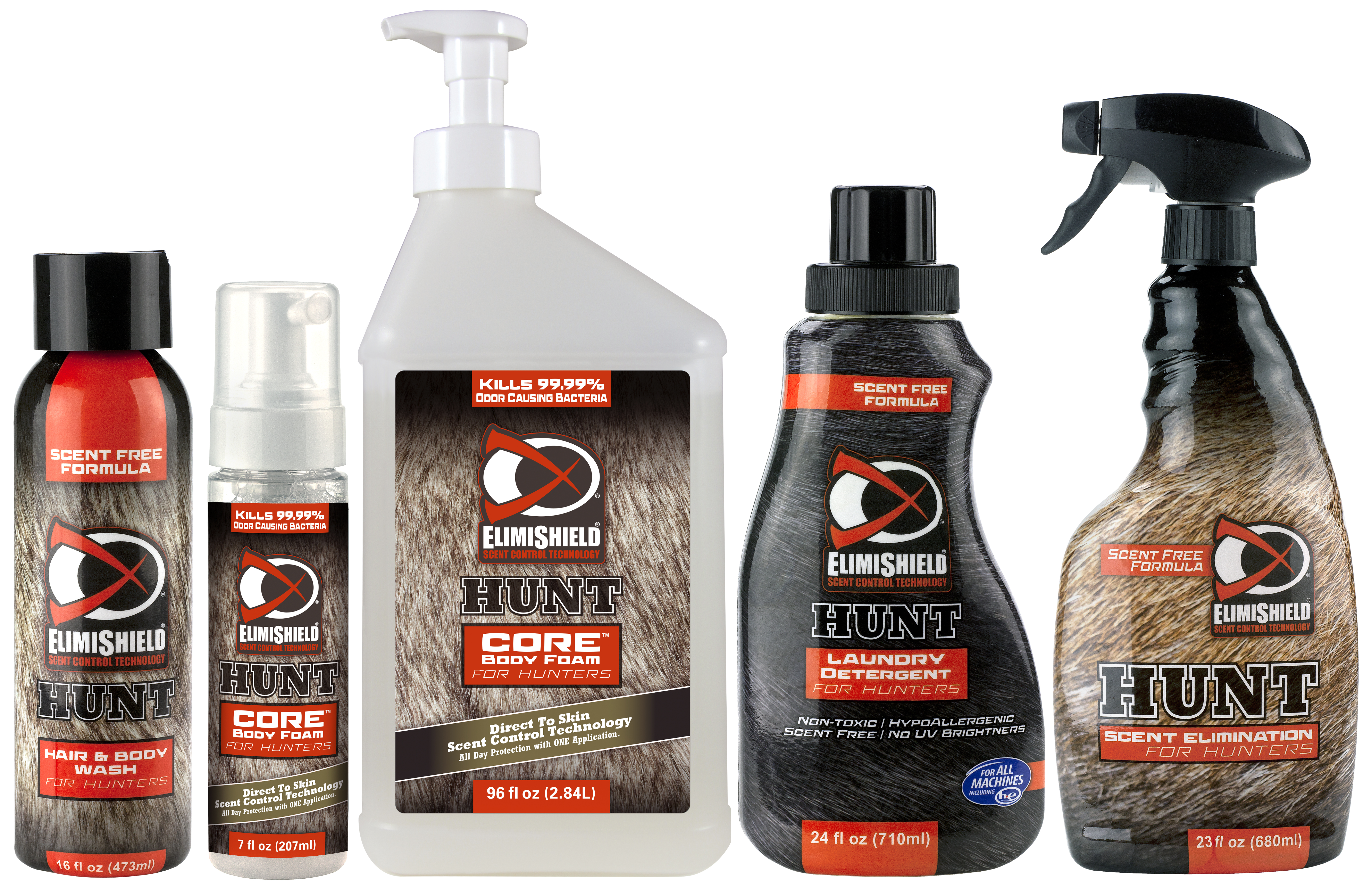
Updated Lake Erie fishing reports are available at wildohio.gov or by calling 888-HOOKFISH (888-466-5347). Information is available from ODNR Division of Wildlife staff from 8 a.m. to 5 p.m. weekdays at the Fairport Harbor station (440-352-4199) for the Central Basin and at Sandusky Station (419-625-8062) for the Western Basin.

Information on the ODNR Division of Wildlife’s Lake Erie research and management programs, fisheries resources, fishing reports, maps and links to other Lake Erie web resources are available at wildohio.gov.

ODNR ensures a balance between wise use and protection of our natural resources for the benefit of all. Visit the ODNR website at ohiodnr.gov.

2016 Bassmaster Key – Keep an Open Book!

Gear Tips, Rigging Options, New Tackle, New Tactics 

Bassmaster Classic Pro, Ott DeFoe, took home $10,000 cash while fishing in tough weather conditions at Grand Lake O’ The Cherokees

The 2016 Bassmaster Classic offered anything but stable weather on Grand Lake O’ The Cherokees.  When you’re fishing for big bucks and bragging rights, and the angler-field includes proven top-gun anglers such as Kevin Van Dam, Edwin Evers, Mike Iaconelli and a host of other big names, you know to have your gear ready and to be prepared for anything.

When nasty and changing conditions arise, successful anglers know that it helps to keep an open mind and an open tackle box.  A professional Rapala field representative professional shared with me, “With the weather conditions, that’s a lesson all of our pro staff was reminded of in this one.”

Rapala Shadow Rap

“On the first day of competition,” Rapala Pro Ott DeFoe shares, “I caught five keepers on five different baits.”  When a five-time Bassmaster Classic contender does that, the conditions might be asking for a change on every cast.  The five baits that scored for DeFoe were a Terminator(R) Spinnerbait, a #5 and #6 Rapala Shad Rap(R), a Rapala DT(R)-6 and a Terminator(R) Pro Series Jig.  How does he fish these baits?  There are secrets.

One big item that is key is attaching to the lure. Not many anglers talk about it, but weekend fishermen wonder, do you tie directly on the lure or use a swivel for more wobble?  DeFoe does not use snaps on his cranks, he ties direct.

Terminator Pro Jig

With the Shad Rap, DeFoe uses a 6’9″ medium-weight spinning rod, size 30 spinning reel and 8lb test.

With the DT-6, he switches to a medium-heavy crankbait rod, 7’3”, with a 6.4:1 baitcaster reel and 10lb fluorocarbon line.

One of his other favorite baits is the ½ ounce Terminator Pro Jig, where he uses a medium heavy 7’6” casting rod and a high-speed bait caster (7.9:1) set up with 17lb fluorocarbon test.

Because Grand Lake’s lower end traditionally features lots of clear water, Defoe and another Rapala Pro, Brandon Palaniuk, came to fish with high confidence using one of Rapala’s brand new lures, the Shadow Rap(R) Shad.  The new hardbait lure was unveiled for the public right before the Classic, though the Rapala pros had been field-testing and whacking bass on the undulating jerkbait that the lure provides.  The innovative new lure features an action that bass have never seen, it works best when the water is clear enough for bass to actually see the staggering wobble action of the lure.

Similar to the original Shadow Rap, released at last year’s Classic, the Shadow Rap Shad is taller in profile than its predecessor, but not as long.  Rather than slowly sinking on the pause, like the original Shadow Rap, a Shadow Rap Shad slowly rises when stopped, slightly wobbling and perfectly mimicking an injured shad.  It’s deadly.

Six-time Classic contender, Brandon Palaniuk, took home $14,250 for his 13th place finish in the big event.

With the action it’s got, man, I just totally expected this thing to be a big hit there at Grand Lake this year,” DeFoe said in a video recorded before Grand Lake went off limits for pre-fishing.  That was before the record rainfall deposited mud and high water in the highly respected waterway during the Christmas holidays.

“I figured there would be some off-colored water this week, but I was not expecting as much cold, off-color water as we had,” DeFoe said.  Areas with clear water were few and far between, conditions were better suited for vibration-emitting lures like Terminator spinnerbaits and Rapala crankbaits.  Once Grand Lake returns to normal form, DeFoe said, local anglers will be whacking bass on Shadow Rap Shads.

“During the Classic, I had to adjust as I went along,” DeFoe said.  That meant scrapping his initial game plan and keeping both his tackle box and his mind open.  In a tournament that saw numerous top pros fail to catch a five-bass limit, a last-minute color change resulted in one of DeFoe’s hard-to-come-by keepers.

“I had been fishing primarily craw-colored DT-6s when the water temperature was in the 40s, but something just told me on that second day to tie on a Disco Shad color instead, and then caught my first two keepers in 15 minutes.” DeFoe took home $10,000 for his 25th place finish, in the 55 member field of world class anglers.

For six-time Classic contender Brandon Palaniuk, scrapping game plans developed in practice was also necessary, as well as focusing on the current conditions as they changed rapidly. From practice to the last day of the tournament, water temp’s in many places warmed from 43 to 55 degrees.  Quite a swing!

“This week was just all about changing for me,” said Palaniuk, who turned in yet another top-12 finish in the world’s most important fishing tournament. “I changed every day.”

Terminator ½ ounce Super Stainless Spinnerbait

Although known as a crankbait fanatic, Palaniuk fished the conditions and enjoyed his best success with a chartreuse and white half-ounce Terminator Super Stainless Spinnerbait.

“That was my big key this week,” he says.  Palaniuk throws the Terminator with a medium-heavy 7’3” bait casting rod, 7.1:1 ratio reel and 15 lb fluorocarbon.  Palaniuk took home $14,250 for his 13th place finish.

Whether you’re fishing for bragging rights or in the biggest bass tournament in the world, keep an open mind and an open tackle box to adapt to changing conditions in order to catch more fish.

Most pro anglers share the view that a wide assortment of lures will keep you in the hunt for the top prize, or at least the big fish prize, and you never know just how long it will take to find that magic key to the door of a new record weigh-in.  Veteran pro’s will share, “It could happen in 10 minutes of fishing. That fast!”

So go prepared.  Good advice.

.40 Caliber S&W Packaging Mix

  • FEDERAL/Champion Ammo
  • Immediate Action Required
  • WARNING APPLIES ONLY to LOTS A27T3 and A27T4

for-sto-12012016-shooting-picture-1of1

By STOadmin

Federal Cartridge Company has identified (2) lots of Federal Champion ammunition with boxes labeled 40 S&W that may contain 9mm ammunition.  If you have 40 S&W 50-round box with Lot Number A27T3 or A27T4, DO NOT USE.

Use of 9mm ammunition in 40-caliber firearms may result in firearm damage and/or personal injury.

THIS WARNING APPLIES ONLY TO THE LOTS A27T3 AND A27T4.  If you possess ammunition from these (2) lots, or have questions concerning this warning, please contact Federal at 1-800-831-0850 or 1-800-322-2342 and ask for Product Service.  Federal Premium will provide replacement product and will cover the cost of returning the affected product.  Federal apologizes for any inconvenience this may cause.

3 Steps to Giant Bucks!

Cater to Nutrition Needs and Bump Antler Growth, Here’s How

giantbucks1

Few trophy bucks are harvested by accident and this time of year is the time to take specific steps to create your best deer season ever. You can still boost antler growth for this fall, as well as put the local herd on a healthier plan for the future.

Deer go where they like to go. Create an area that will attract deer day after day, an area they will want to visit often.

Boost Nutrition and Bump Antler Growth

Nutrition is critical to deer and like most adults, a whitetail deer has a normal diet that typically lacks the proper mineral content to maximize growth potential. Although some hunters often focus just on antler growth, a proper vitamin and mineral supplementation will also support lactating doe’s as well as bucks growing antlers. A healthier and stronger deer can better fight off disease, harsh weather, and predators.

“I am so passionate about whitetail deer hunting that I moved from New Jersey to Southern Iowa just so I could grow and hunt bigger deer,” says Randy Ferman, owner of Extreme Hunting Solutions, the company behind many innovative deer hunting products suited specifically for hunters and whitetail deer.

“Hunters and fishers are the two most gullible outdoor groups and I was tired of getting smoke and mirror products instead of products that do what they say they do, so I decided to do it myself,” Ferman says.

1 – Feed Mineral Supplements

giantbucks2Where allowed by state law (check your regulations), mineral supplements can really make a giant difference in deer health. Mineral supplements can be misleading and Ferman quickly points out the difference between “ingredients” and “guaranteed analysis.” Guaranteed analysis means that the percentages of nutrients stated are the minimum that are in the product, whereas with Ingredients you don’t know how much are in the product. A pinch of selenium means it’s in there, but how much?  One crushed acorn means the bag contains “acorn.” One of the most important things a hunter needs to know is a deer can only absorb 34%-40% sodium (salt), “so any more than that is used as filler which leaves less room for the important nutrients.”

Ferman says. “We lowered our salt content to 13% which leaves more room for the important vitamins and minerals that contribute to growing larger racks and helping the total health of the deer herd. We also addressed the way a deer’s system absorbs vitamins and minerals. Human blood pressure medicines use a vasodilator to open up “enlarge” the blood vessels and arteries for better absorption of all nutrients. Our minerals use the same principle. This process increases blood flow and distributes the nutrients throughout the deer’s body faster and allows for better absorption. I have been managing my farm for the last four years with this method and we are getting bucks with bigger bases and significantly more mass.”

Mineral supplements should be fed year round, yet it’s not too late to give local antlers a boost and help lactating does boost their health. Ferman is proud of his formula and its packaging which allows hunters to make informed decisions. Big Buck Mineral Formula from Extreme Hunting Solutions lists the guaranteed analysis of 16 vitamins and minerals. Additionally these minerals include Vasodilator technology, which is worth repeating, has the effect of enlarging blood vessels and arteries which allows for maximum absorption of all ingested vitamins and minerals. The deer will hit it hard and Ferman recommends having at least two sites per 100 acres, 40 pounds per spot and refill as needed.

2 – Establish a Mineral Site

A mineral site not only boosts the health of your deer, but attracts them to specific locations where they can be imaged with trail cameras. This way you can evaluate the growth of emerging antlers, check for fawn mortality, and get an overall snapshot of deer health. By late summer, if you are seeing adult does with one or no fawns, you may have a predator problem as most mature females produce twin offspring.

Before selecting a mineral site, consider the prevailing wind direction, approach routes, and deer traffic just as you would when hanging a deer stand. Avoid field edges and wide open woodlots as these locations are most likely visited at night. A concealed, brushy area between bedding and feeding area will allow wary bucks to sneak in and access the minerals more frequently.

giantbucks3When placing your trail cameras, be sure that you have the correct angle so that you don’t get feet or antler tips. Ferman also invented The Wedge which takes the guesswork out of positioning cameras. Instead of using a twig that will roll and rot, these inexpensive wedges allow for precise camera aiming.

*It’s a good idea to protect your land, big bucks and healthy herd so intruders don’t reap the rewards of your efforts. Extreme Hunting Solutions also offer a “No Trespassing” sign with a camera clearly and boldly displayed on the sign to further deter poachers and trespassers.

3 – Choose an Appropriate Mineral Product for your Site

Depending on terrain, foliage, time of year, state regulations and so on, you’ll need to choose a product that works best for your situation.

giantbucks4

Ferman likes to post a Big Buck Stick N Lick Deer Pop which screws into a tree or any wood surface above ground where wild turkeys won’t eat it. Their patented Weather Shield prevents water from dissolving the minerals giving you months of attraction and deer enrichment. “It takes a lot more to lick something than to eat something,” Ferman laughs. Additionally, these ultra portable mineral stations are ideal for placing nutrition in very remote locations and since they last for months you won’t have to worry about replenishing them as often.

giantbucks5If baiting is legal in your state, mix your corn or soybeans with Kandy Korn, which is like putting caramel on popcorn for children. Deer love it just as much and the aroma will draw them in from a distance. It’s also packed with protein which will keep your herd healthy.

With just minimal effort, you can have bigger bucks and a healthier herd this season and for many seasons to come. Check out Extreme Hunting Solutions here: https://www.extremehuntingsolutions.com/

Good luck in the upcoming season!

5 Good THINGS to KNOW ABOUT HUNTING

  • Environmental Preservation
  • Support Regulations
  • Save Wildlife Populations
  • Provides Nutritional Alternatives
  • Vital Part of Wildlife Conservation
A bonded connection between hunting and conservation can start at an early age when family hunts share the sacred benefits of the outdoors, wildlife, adventure and personal responsibility.  Forrest Fisher Photo

Contributed by NSSF

Recognizing that the connection between hunting and conservation can seem counterintuitive, the National Shooting and Sports Foundation (NSSF) has developed a series of infographics to help the public better understand hunting and hunters.

In truth, the values of today’s socially and environmentally conscious society are closely related to that of hunters’.

Hunting aids environmental preservation

Hunter-supported taxes on equipment and license fees have afforded wildlife agencies the money to be able to acquire and maintain land for the conservation of game and non-game species. This land also provides space for outdoor recreational activities such as hunting, fishing, hiking, kayaking, camping and more.

Hunters support regulations

Hunters demonstrate their respect for regulated hunting by taking hunter safety education courses, following the rules of ethical hunting, and adhering to regulations, seasons and permit procedures that differ from state to state and species to species in order to help strategically manage wildlife.

Hunters helped save wildlife populations

Hunters helped create a sustainable conservation model allowing Americans to participate in regulated hunting that supports the conservation of wildlife. This model, which was so successful it has been adopted around the world, has helped restore species such as Wild Turkeys, Rocky Mountain Elk and others, some that were on the brink of vanishing forever.

Hunting provides nutritional alternatives

In the old days, people regularly hunted for their food. Today, as many strive to know more about where their food comes from and how it will affect their health, they are turning back to wild game, the most organic and sustainable meat source in the world, to provide the best nutrients for their body and the most natural life for the animal.

Hunting is a vital part of wildlife conservation

Hunting is a highly regulated tool that plays an important role in wildlife management. Biologist study wildlife populations, habitats and food, then work with legislators to establish regulations on hunting that will keep wildlife populations in balance, as well as promote growth and breeding, as habitat allows.

Hunting can be difficult to understand, but NSSF encourages you to look at these infographics to get a better grasp of its benefits. Do you care about the environment, land preservation, animal conservation and personal nutrition? Then you can support hunting.

3 Boating Tips for Pokémon Go

pokemon_BOATUSDirect from BoatUS headquarters in ALEXANDRIA, Virginia, is news that much of the country has recently learned is that the reality-game-meets-exercise app currently taking the nation by storm, “Pokémon Go,” now has 21 million users every day. It is reportedly the most successful mobile game ever in the United States.

The game features characters called Pokémon that players capture in the real world using a combination of GPS and augmented reality. That also means that Pokémon-mania has also come to the water and with it, BoatUS, the national boating advocacy, services and safety group has three tips for playing Pokémon Go while boating:

Be aware:

The US Coast Guard reports “Operator Inattention” as one of the five main primary contributing factors in accidents. When searching for a “water type” Pokémon such as “Magikarp” on a waterway, let the first mate or friend handle the cell phone while the captain keeps a safe lookout.

Watch cell phone battery use:

Users report the game eats up a smartphone’s battery charge. With many recreational boaters today relying on their cell phones for communication, it would be wise to bring along a spare charger, or use battery saving mode. BoatUS also reminds boaters that only a VHF radio can summon emergency help from the closest rescuers, ensuring the fastest response.

Have fun:

The BoatUS National Headquarters in Alexandria, Virginia offers a Pokémon “gym” located next to the iconic BoatUS Buoy at 880 S. Pickett Street. At lunch, some BoatUS employees can be seen playing the game. (Insider’s tip: The yellow Pokémon Go BoatUS Marine Insurance underwriting team often battles other BoatUS Departments, and for a limited time, free boat insurance quotes will be available to all players.)

4-H Shooting Sports in Missouri

4H Shooting Sports help our youth develop LIFE SKILLS, SELF-WORTH and CONSERVATION ETHICS. Click the picture for the story.

  • Youth Learn Marksmanship
  • Youth Learn the Safe and Responsible Use of Firearms
  • Youth Learn the Principles of Hunting and Archery
  • Youth Develop LIFE SKILLS, SELF-WORTH and CONSERVATION ETHICS

By David Gray

Rachel Augustine, Director of the Development for the Missouri 4-H Foundation, and Jim Sappington, Missouri Coordinator for 4-H Shooting Sports, discuss support to enable 4-H and 4-H shooting sports for Missouri youth.

The University of Missouri, located in the city of Columbia, is like many State Universities as it offers a large, sprawling campus complex.  I have been on campus many times over the years, but had never noticed the 4-H extension building and offices.  It is not small, in fact, it is a large building with a large parking area, but it is surrounded by trees and greenery that almost places the unique site in a world of its own.

The site is so fitting, as so many 4-H youth development programs involve outdoor activities and animals for the youth of our nation in the setting of countryside areas.

Early in June, 2018, I travelled to the University of Missouri to meet with Rachel Augustine, the Director of the Missouri 4-H Foundation, and Jim Sappington, Missouri’s statewide coordinator for 4-H Shooting Sports.  We discussed ways to extend support to enable 4-H and 4-H shooting sports to deliver their service of great value to youth, our community and country.  4-H says, “We believe in the power of young people. We see that every child has valuable strengths and real influence to improve the world around us.”

“Share the Outdoors” says, “We agree!” Rachel Augustine is a 4th generation Arizona native.  She began working for the Missouri 4-H Foundation when she and her husband relocated to Missouri in 2013. When asked what she likes most about her job, Rachel responded, “Helping kids prepare to succeed by learning life skills, responsibility and ethics.” Rachel added, “I also enjoy meeting so many different people as I travel all over Missouri.”

Thanks to a recent challenge gift from Larry and Brenda Potterfield, the Missouri 4-H Foundation is partnering with the Midway USA Foundation to establish and begin building a Missouri 4-H Shooting Sports Endowment Fund. The Fund will support the long-term growth of 4-H youth shooting programs in Missouri. While the new endowment fund is exciting work, Rachel and her team also raise funds to support more than 70 statewide 4-H programs and initiatives for the University of Missouri Extension 4-H Center for Youth Development.

Jim Sappington has been state-wide coordinator for 4H Missouri Shooting Sports activities for about one year, but he brings so much experience, as he came to the position after 27 years as a 4-H volunteer.  Jim says ”The job is a tremendous amount of work, but so much work is beside the point when you watch a youngster succeed at something they thought they could never do.”

To that, we at “Share the Outdoors” say, “Thank you Rachel and Jim!” Now, “How can we help?”

If you would like to make a donation to the Missouri 4-H Foundation contact Rachel Augustine at AugustineRe@missouri.edu or by telephone, 573-884-7641. 

4 Days to IRMA: How Much Time Boaters Have to Prepare

  • Essential info for boaters, clubs, marinas at BoatUS.com/hurricanes
Recreational boat owners need to prepare for the arrival of Hurricane Irma (credit: NOAA)

ALEXANDRIA, Va., September 5, 2017 – According to the National Hurricane Center, Florida may have up to four days to prepare for the arrival of Hurricane Irma, a “potentially catastrophic Category 5” storm now approaching the Leeward Islands.

While it’s difficult to determine landfall, Boat Owners Association of The United States (BoatUS) urges boaters, marinas and boat clubs to use the valuable time to prepare, and offers free help online at BoatUS.com/hurricanes.

The boating group says that it doesn’t take a direct hit to damage or sink recreational vessels, or cause havoc at boat storage facilities.
The storm-planning available from BoatUS help includes:
1. “BoatUS Tips for Protecting Boats in Hurricanes,” a basic two-page primer that contains advice on hurricane preparation for all recreational boaters.
2. “Boater’s Guide to Preparing Boats and Marinas for Hurricanes” has more details on how to protect your boat as well as marinas.
3. “What Works: A Guide to Preparing Marinas, Yacht Clubs and Boats for Hurricanes,” a helpful resource for marina and boat-club staff, community resiliency managers and local government organizations that focuses on protecting boating facilities.
When a storm approaches, BoatUS.com/hurricanes also has up-to-the-minute storm-tracking tools with live satellite images and checklists for what to do before and after a hurricane strikes.
Much of the hurricane guide information comes from BoatUS and its Marine Insurance Catastrophe (CAT) Team, a recognized leader in hurricane preparedness with more than 30 years of post-storm boat salvage experience. Go to BoatUS.com/hurricanes for more.

About Boat Owners Association of The United States (BoatUS): Celebrating more than 50 years, BoatUS is the nation’s largest organization of recreational boaters with more than a half-million members. We are the boat owners’ voice on Capitol Hill and fight for their rights. We are The Boat Owners Auto Club and help ensure a roadside trailer breakdown doesn’t end a boating or fishing trip before it begins. When boats break down on the water, TowBoatUS brings them safely back to the launch ramp or dock, 24/7. The BoatUS Marine Insurance Program gives boat owners affordable, specialized coverage and superior service they need. We help keep boaters safe and our waters clean with assistance from the nonprofit BoatUS Foundation for Boating Safety and Clean Water. Visit BoatUS.com.

“Midwest Experience” helps first responders, vets enjoy outdoors

Midwest Experience, a local 501c3 nonprofit, is hosting a fundraiser banquet on August 25, 2018 at 6pm in Blue Springs, MO. The event will feature raffles, live and silent auctions, games and more! A CZ over and under 12 gauge, a Ruger American Rifle with scope in .308 caliber, and Sig Sauer P365 9mm, will be among several guns raffled off during the event.

Who does the Midwest Experience organization benefit?

Midwest Experience provides outdoor adventure opportunities to all of the following AND their families: current members and veterans of the Armed Forces, Gold Star Families, First Responders, and children who are less fortunate and/or disabled.


How can you sign up or support Midwest Experience?

Visit Midwest Experience online at their website https://midwestexperience.org/ or reach out to one of the organizers listed in the top photo. Phone numbers are listed for each contact.


“Whether you are an outfitter, retailer, guide, landowner, donor, or just a patriotic American who believes in giving back to those who lay it on the line every day, THANK YOU. Our goals can only be accomplished through your generosity.”

3 MYTHS ABOUT BARK-CONTROL COLLARS

By SportDOG Staff

Reliability, simplicity, and effectiveness are among the reasons to use a bark-control collar, as well as why they’ve become increasingly more common with dog owners in recent years.

However, when the electronic bark-control collar was first introduced, questions and skepticism regarding its use were brought up by multiple sources. Over time, doubts and concerns regarding no bark collars decreased as users became more familiar with the concept behind the design.

Today, these collars are widely accepted as a common training tool for dog owners. Despite their widespread acceptance, a few common misconceptions remain.

SportDOG® Brand, a leader in the design and manufacturing of some the most dependable and trusted dog-training products and accessories, has taken on the call to answer some of these remaining questions. With over a decade of experience, SportDOG has become a trusted source of information with both dog owners and professional trainers.

Here’s 3 of the most common misconceptions regarding the use of electronic bark-control collars, as encountered by the SportDOG team.

Using a Bark Collar Will Prevent My Dog From Ever Barking Again

To some pet owners, this notion can be concerning, as most don’t set out to keep their dogs quiet at all times. Whether it’s the verbal behavior their dog exhibits when playing with others, or alerting them when needed, such as a knock at the door, completely silencing their dog is not the owner’s end goal.

While it’s true that the purpose of a bark-control collar is to curb unwanted outbursts, the effects of the collar are not permanent. Should the owner want their dog to be capable of barking, he or she can simply remove the collar. Over time, the dog will begin to associate its behavior with the collar. With features like 3 selectable modes and 10 levels of static stimulation found in the SportDOG NoBark SBC-R, owners can customize the anti-bark collar to fit their dog’s specific needs, making the transition process even easier.

A Bark Collar Should Be Worn 24/7

If worn for more than the recommended amount of time, any kind of electronic collar can be dangerous to a dog’s health. This health concern doesn’t originate from the static stimulation delivered to the dog, but through the possibility of pressure necrosis.

Simply said, pressure necrosis is trauma to a dog’s skin (calluses, sores, etc.) that develops as a result of the collar remaining on for an extended period of time. This is caused by human error, and is not a failure of the collar. To prevent this, the collar must be properly fit to the dog’s neck, and rotated to different positions when used for long periods throughout the day. If the collar is too tight, continual pressure from the contact points (i.e. probes) can restrict blood flow to the tissue underneath, causing it to breakdown and deteriorate. Consequently, if the collar is too loose, it can be easily rotated around the neck or moved vertically as the dog raises or lowers its head. In either circumstance, owners need to make sure the collar is properly adjusted and remove the collar if worn longer than recommended, which is generally 8-10 hours per day. When removed, the probes of the collar should also be cleaned with alcohol wipes every 1-2 days to prevent bacteria from developing.

Bark Collars Aren’t Safe To Use on Dogs

Since the introduction of the electronic bark-control collar, one of the earliest misconceptions regarding its use is that it’s not safe for dogs. Many owners were concerned that the amount of static stimulation delivered would be too much for the dog to endure, or cause irreconcilable harm. Again, this is simply not true. SportDOG has gone to considerable lengths to make sure that each of its collars is perfectly safe for use on dogs. Through extensive research and development process and by using the most advanced technology available, SportDOG collars are considered to be among the safest designs on the market.

During its development of the company’s latest NoBark collar, the SBC-R, SportDOG incorporated 10 levels of static stimulation as well as 3 programmable modes: Temperament Learning, Progressive Correction and User-Selected. The new collar also has a built in safety feature ensuring that if your dog barks 15 times or more within an 80 second period, the SBC-R will stop issuing static stimulation for 30 seconds, and then resume normal operation. Combining these standard features along with a waterproof and submersible housing makes the SBC-R one of the safest collars on the market.

For more information on the SportDOG line of products, as well as the recently released NoBark SBC-R, visit www.sportdog.com.

2017 NSSF Boy Scout Grant Program Goes Live

Photo Courtesy of NSSF

NEWTOWN, Conn. — The National Shooting Sports Foundation® (NSSF®), the trade association for the firearms industry, is pleased to announce the launch of its annual grants partnership with the Boy Scouts of America Councils.  Through this partnership, BSA Councils can receive a portion of $100,000 in NSSF-provided grant funds to develop or expand their troop activities in target shooting and marksmanship.  Target shooting programs continue to rank among Scouting’s most popular activities, teaching firearms and range safety, teamwork building and fundraising skills.

“This seventh year of supporting the BSA Council Grant Program in this manner brings with it a new level of excitement,” said Zach Snow, NSSF Director, Range Services.  “Safety and marksmanship training through the Boy Scouts is a time-honored introduction to the shooting sports.  With recreational shooters and hunters alike realizing they’re living in an era of renewed enthusiasm for their sports, we’re looking forward to increased participation from Scouts pursuing badges in these activities and then taking those new skills afield for a lifetime of enjoyment.”

BSA Councils wishing to apply for grants should visit the grant guidelines and application procedures at nssf.org/bsagrant. Councils awarded funds through NSSF’s BSA Grant Program must use those grants to purchase of equipment and supplies for their shooting sports activities from an NSSF Member Retailer.  The full list of these retailers is available at nssf.org/retailers/find.  Examples of qualifying purchases are ammunition, eye and ear protection, firearms, targets and shooting vests.

How to apply: Download the Application PDF 

Submit according to guidelines.  Grant applications will be accepted until all challenge grant funds are exhausted.

Completed applications can be sent via email, fax or mail to:

National Shooting Sports Foundation
Attn: BSA Grant
11 Mile Hill Road
Newtown, CT 06470-2359
zsnow@nssf.org (Zach Snow)
Phone: 203-426-1320, ext. 224
Fax: 203-426-1087

About NSSF
The National Shooting Sports Foundation is the trade association for the firearms industry. Its mission is to promote, protect and preserve hunting and the shooting sports. Formed in 1961, NSSF has a membership of more than 12,000 manufacturers, distributors, firearms retailers, shooting ranges, sportsmen’s organizations and publishers. For more information, visit www.nssf.org.

(No) Duck, (No) Duck, Goose

The first waterfowl, the author’s golden retriever, Willa, ever fetched were a pair of Canada geese shot on a small pond. It tested the 55-pound puppy’s strength and determination, but was she ever proud of the accomplishment!

  • Abundant Honkers Offer Nice Compromise
  • How to Find a Goose Pond
  •   Tasting the Bounty, a Great Recipe
The first waterfowl, the author’s golden retriever, Willa, ever fetched were a pair of Canada geese shot on a small pond.  It tested the 55-pound puppy’s strength and determination, but was she ever proud of the accomplishment!
The first waterfowl, the author’s golden retriever, Willa, ever fetched were a pair of Canada geese shot on a small pond. It tested the 55-pound puppy’s strength and determination, but was she ever proud of the accomplishment!

By Jim Low

I admire perseverance as much as the next guy, but at some point in a dismal duck season, a sensible person cuts his losses and finds something else to do.  If the alternative advances state wildlife management goals, all the better.  That’s why I have shifted my hunting efforts to Canada geese.

This close to Christmas, it can be hard to devote much time to hunting, which makes hunting Canadian honkers even more attractive.  There’s not a county in the state that doesn’t have at least as many of the big birds as it needs.  Consequently, you don’t have to go far to find them.  Geese are nuisances around golf courses, city parks and subdivisions, where the combination of ponds and large expanses of mowed areas act like goose magnets.

Goose Abundance

When people can’t cross their own driveways or take a walk in the park without stepping in goose poop, they frequently ask the Missouri Department of Conservation (MDC) to do something to reduce goose numbers or at least move them away from people.  MDC encourages people to take the initiative in controlling goose numbers.  It even gives hunters and early hunting season in addition to the regular season, which runs through Feb. 6 this year, with generous daily and possession limits of three and nine respectively.

The key to cashing in on the abundance of Canada geese is finding landowners who are fed up with goose poop on their sidewalks and lawns, and convincing them that a polite, safety-conscious hunter like you is the answer to their problem.  When you spot a pond with a bunch of geese around it, put on nice clothes, shave and knock on their door with a carefully planned sales pitch.  Something like, “I noticed that you have a lot of geese around your pond and wondered if you have problems with them pooping on your driveway or tearing up your lawn?”

Request Permission – Here’s How

If they say no, that they like having geese around, thank them for their time and move on to the next place.  But if they admit that the geese sometimes are too much of a good thing, tell them that you might be able to help them with the problem.  Tell them that geese are gregarious, and if one group is using their lake, others will soon follow.  But geese also are smart, and they quickly abandon places where they don’t feel safe.  A few visits by a hunter during the three-month hunting season will discourage some of the flocks, keeping the number that visit their property to a manageable level.  Don’t overpromise.  Your chances of permanently scaring all the geese off a particular pond are practically zero.  Anyway, most landowners want fewer geese, rather than none at all.

Be sure to mention important details, such as your willingness to call before each visit to their pond. Ask them what times of day and which parts of their property they feel comfortable with you hunting. And be sure to emphasize that you will always be careful to shoot only in safe directions, taking livestock, buildings, neighbors and nearby roads into account.  You also can offer to share the bounty, should you succeed in bagging geese.  A plucked and dressed – maybe even roasted – Christmas goose is a great way to say thank you for the privilege of hunting.

Be Ready, Go Prepared

My favorite goose pond is just two miles down the blacktop from my house.  The owner is a widow who would be just as happy if she never saw another goose.  She is so motivated that she calls me when she looks out her window and sees a bunch of geese.  She long ago told me not to bother calling before opening fire.  I can help myself any time.  I try to cruise by her house whenever leaving the house or coming home to increase my chances of surprising a bunch of honkers.  I keep my 12-gauge autoloader and a box of BB steel shot shells in the truck throughout the goose season, along with a pair of muck boots and coveralls.  That way I can suit up and go to “work” on a moment’s notice.

I have occasionally hunted from a ground blind, but I usually jump shoot geese.  The pond dam provides cover at the deep end, and a wooded draw at the other end offers cover for sneaking up on birds at the shallow end.  If the geese are near the house, I park on the road and pop up over a little rise in the yard within 20 yards if the unsuspecting birds.  Last year I bagged nine geese this way.  My neighbor was grateful, and my retriever got some work she wouldn’t have had otherwise.  I removed the breast meat from most of the birds and used to make one of my extended family’s favorite Thanksgiving appetizers – goose rumaki.

Favorite Recipe

This is a variation on the traditional recipe that uses goose liver wrapped in bacon.  Instead of liver, I substitute half-inch cubes of goose breast meat marinated in teriyaki sauce. I wrap these in bacon with a slice of either water chestnut or jalapeno pepper.  I also add fresh ginger and minced garlic to the marinade for extra flavor.  Even my daughter, who ordinarily isn’t fond of red meat, thinks these are extraordinary.

Farm ponds in rural areas also are great places for this kind of hunting, though you might have to spend some time identifying the owner.  Plat maps (land owner property/lot map) at the county assessor’s office are an excellent resource for this.  I prefer knocking on doors and asking for information.  It increases your opportunities to talk with landowners who might welcome a hunter thinning local goose numbers.  Keep this in mind next time you pass a pond crowded with geese.  It’s a great way to extend the fun of waterfowl season past the point when the ducks depart for Arkansas.

6 Tips for Staying Warm

stayingwarm
A group of lady hunters in South Dakota in one of the state’s worst cold spells. They used many of the tips found here to help them enjoy the cold, works for hunting or fishing.

A group of women hunt in South Dakota in one of the state’s worst cold spells.  They used many of the above tips to help them enjoy the cold.  By Joe & Vel Byers

Staying dry and dressing in layers are a one-two punch that will tap out the cold on the worst of days.  Regardless of the quality of your gear, once you become sweaty, staying warm for any length of time is nearly impossible. Try these five tips to stay longer and enjoy winter more.

  1. Allow extra time to reach a distant tree stand or driving post.  Carry as many layers as needed over your shoulder or on a pack.  Then suit up. Walk with your shirt un-tucked and zippers open to allow for maximum air flow.  Carry an extra pair of warm socks and don’t double up unless your boots handle them easily.  The more compressed socks become, the poorer they insulate. Today’s wicking under-layers are terrific for keeping you dry, warm, and scent free.  Products from Under Armour, Scent Blocker, Scent Loc, Medalist, and other can reduce scent and lay a warm foundation.  Add an insulating fleece mid layer and an outer shell and you’ll be toasty for some time.  Pack a down vest to cover your lap and legs, a super solution if your knees tend to get cold.

    Late season hunting harbors all types of game. Autumn Ifland took this good muely buck on a drive that resulted in a well-placed shot.
    Late season hunting harbors all types of game. Autumn Ifland took this good muely buck on a drive that resulted in a well-placed shot.
  2. Today’s wicking under-layers are terrific for keeping you dry,warm, and scent free.  Products from Under Armour, Scent Blocker, Scent Loc, Medalist, and other can reduce scent and lay a warm foundation.  Add an insulating fleece mid layer and an outer shell and you’ll be toasty for some time.  Pack a down vest to cover your lap and legs, a super solution if your knees tend to get cold.
  3. Oxidizing hand and body warmers work incredibly well.  Pop one in each shirt pocket and feel the warmth.  Instead of holding a heat packet in your hand, which often causes sweating, put the heater on your wrist so it will heat the blood going to your fingers.  When it’s really cold, put one under your hat.
  4. Keep your buns warm.  A thick insulated cushion will help you hunt more comfortably and don’t forget your feet.  If you’ll be standing on the ground in snow cover, carry a small piece of carpet pad or other insulator to stand on. 

    Keeping your head warm is paramount. Kim Cahalan chose a face cover and multiple layers as her keep-warm strategy.
    Keeping your head warm is paramount. Kim Cahalan chose a face cover and multiple layers as her keep-warm strategy.
  5. In frigid weather, keeping our head warm is paramount.  If youhave to walk some distance to a stand, tuck your hat under your arm.  Covering your face is equally important, especially on windy days.  A light head net, like turkey hunters use, will make a surprising difference.  Ski masks are also ideal, especially if they allow your breath to flow without causing condensation on the mask. 
  6. Finally, think old-school and carry a small thermos of hot chocolate or coffee and your favorite snacks.  A sip or two of steaming liquid will warm your core and tasty munchies help pass time and keep your spirits high.  Remember, every monster buck harvested was just a little smaller the season before.  Unless you’re out there, you’re not in the game.

6 Tips to Prevent Tragedy or Death at a Boat Slip – From BoatUS

  • Never Swim Near Boat Docks that have Electrical Power.
  • Freshwater Docks are More Dangerous than Saltwater Docks.
  • Someone in Trouble? Shut Down Power to Dock First.
  • Follow this Rule: “Reach, Throw, Row, but DON’T GO.”
Swimming near boat docks with electrical power can be deadly. Read what you need to know. Forrest Fisher Photo

ANNAPOLIS, Md. – The fatalities over the weekend of an 11-year-old girl in New Jersey and 19-year-old young man in Ohio are bringing scrutiny to an age-old summer ritual that’s common on waterfronts across America: swimming near boat docks.  Initial reports say the youngster died when touching a dock’s electrified boatlift, and the Ohio teen died as a result of dangerous electrical current in the water while trying to save his father and family dog that also appeared to be stricken by the electrical current.

The BoatUS Foundation, the boating-safety arm of the nations’ largest recreational boat owners group, has some tips to prevent an electrocution tragedy.  While swimming deaths due to electricity fall into two categories, electrocution and electric shock drowning (ESD), both can be prevented the same way.  Electrocution can happen in freshwater or saltwater, when swimmers make contact with energized metal dock fittings, boats or other structures due to faulty alternating current (AC) wiring.

ESD occurs when AC gets into freshwater from faulty wiring and passes through a swimmer, causing paralysis or even sudden death.  Unlike electrocution, with ESD a swimmer does not need to be touching a boat or dock structure, and even minute amounts of electricity can be incapacitating and lead to drowning.  The risk of ESD is greatest in freshwater or brackish water, so some areas such as estuaries or rivers may only be in the danger zone after heavy rains.

In saltwater, electrical current takes the path of least resistance, bypassing swimmers. Unlike a drowning swimmer, who typically can’t yell out for help because their mouth is mostly underwater, an ESD victim is often confused about what is happening, may be able to shout, and will feel numbness, tingling, pain and paralysis.  Tingling in the swimmer’s body is one of the early warning signs of ESD.

What can you do to prevent an electrocution or ESD fatality? Here are 6 tips:

  1. Never Swim around boat docks that use electricity.
  2. Post “no swimming” signs.
  3. Have a qualified electrician with experience in dock electrical service inspect your private dock annually.
  4. Install ground-fault protection on your boat and private dock.
  5. Ask your marina if they have installed ground-fault protection, and if the electrical system is inspected and tested annually-just in case someone falls overboard. No one should ever swim in a marina

    Swimmers near boat docks can be affected and shocked in the water near to the dock because of this technical wiring deficiency. Courtesy of BOATUS
  6. Periodically test your boat for electrical leakage into the water. What do you do if you see a distressed person in the water near a boat dock?

A drowning victim often looks “playful,” while an electric shock drowning victim looks “distressed.”  It may be difficult, however, to immediately determine either, so play it safe by not jumping in.  The first task is to shut off power to the dock at the breaker panel, and if equipped, disconnect any power cable to the vessel.

If power cannot be shut down, follow the “reach, throw, row, but don’t go” mantra by using an oar, boat hook or throw a floatation device to reach the stricken person.

For more information, parents, dock owners, boaters, and marina and boat club operators can go to the BoatUS Electric Shock Drowning Resource Center at www.BoatUS.com/Seaworthy/ESD.

See more at: http://www.thefishingwire.com/story/406710#sthash.hku6iXil.dpuf.

A Cane Pole, a Catfish and Great Grandma

canepolecatfish

Bobbers, Patience and that Twinkle in Grandma’s Eye

By Kenneth L. Kieser

My great grandmother grew up in a simpler time when fishing meant feeding your family.  She was old, bent over and gray by the time I came along in the early 1950’s, but she always had a smile and a twinkle in her eyes for me.

Our farm pond was easy to access in my great grandfather’s Model-A Ford, the only car they ever owned. We bounced over the pasture while grandpa tried to steer around sticks or other obstacles, creating quite a bumpy ride for me in the dusty, musty-smelling, black leather backseat.

Cane poles and my great grandfather’s old steel rod that had a J.C. Higgins red baitcast reel were tucked neatly to one side with his Sears tackle box that was about the size of a loaf of bread.  I could hear hooks, bobbers and other fishing stuff rattling as the car bounced.  Grandma occasionally glanced back at me to make sure I was surviving the sometimes wild ride.  She always returned my big grin.

The pond was surrounded by pasture so we drove up to the shoreline. The air smelled sweet on the spring mornings when we went fishing, unless you walked by a cow pie or two.  But that was just part of country life and we paid little attention, unless a misstep landed in the squishy mess.

Grandpa pulled out all the equipment and carried it to an appropriate spot on the pond dam.  He always gave us the best fishing spot.  He made sure grandma had a can of worms, then smiled at me and walked to the opposite end of the pond.

Then grandpa found a quiet spot to fish in peaceful solitude.  I learned later that he had bouts with depression earlier in life.  His quiet fishing moments became therapy, a term that did not exist for Missouri farm people in those days.  They just solved problems their own way.

Grandma loved to let me hook an earth worm.  She would smile at my struggles with the squirmy worm and always took over before frustration set in.  Soon the worm was firmly threaded on a genuine Mustad hook, the kind sold in round metal boxes in those days.  I always turned the red and white bobber over and over in my hand as she patiently waited for me to hand it over.

The bobber was added about a foot up the nylon line.  She stepped closer to the shoreline before leaning forward to expertly flip the rigging with a long cane pole.  The hooked worm and bobber seemed to always be perfectly positioned at the end of our thoroughly stretched-out fishing line.

“Now honey, you sit and watch that bobber,” she said in a soft voice.  “Hold the pole still and don’t move the bait.  You never know when a great big catfish is going to eat that worm.  But don’t move it.  You might take it away just before he takes a big bite.”

I had no idea that she was giving me a lesson in patience, an important aspect of fishing to be used the rest of my life.

Then we sat and waited.  Both of us held canes poles and studied our bobbers that drifted on the surface.  I occasionally got impatient and started lifting my fishing pole.  She would lay a hand on my shoulder and reassure me.

“The bait is fine, just wait and watch,” she said in a patient voice.

Sometimes she would slip me a Lifesaver, green or red because they were my favorites.

We generally caught small bluegill, commonly called sunfish by their generation.  Grandma always got a smile out of watching me pick up the long cane pole to drag the fish ashore.  I always held the fish up for grandpa to see before tossing it back to grow.  You could see his smile from across the pond.

Then one day my bobber slashed under the surface and stayed down.  I picked up the cane pole and felt more pull than a three-year old could handle.

“Take the pole grandma,” I urged. “I’m afraid the fish is going to pull me in.”

“No honey,” she said in a calm voice. ”You hang on and I’ll help.”

Grandma stepped behind me to grab part of the cane pole and we fought the big catfish as it ran back and forth.  I did not know to set the hook so the fish apparently hooked itself through a savage strike.  The fish had a lot of power, sometimes pulling me forward even though grandma was holding the pole too.

Grandpa heard the commotion of a good fish slapping the surface and came to help.  Somehow we all three grabbed the pole and dragged the five-pound channel catfish on shore.  I remember jumping up and down as my grandmother smiled at my youthful energy and excitement.  He held the fine fish up for me to see and proclaimed it my first catfish, even though I had plenty of help landing the good fighter.

We decided to leave. The commotion and excitement of landing the fish and my jumping around no doubt spooked the other fish a bit.  Besides, that catfish was enough to feed our family.  Other fish in the pond meant more meals later, my first conservation lesson; although in 1956 I didn’t realize what that meant.

Grandpa cut up the catfish and then grandma took over.  Few will ever fry a fish better, generally in fresh hog lard.  My grandparents arrived later with my mom and dad to enjoy a beautiful catfish dinner with friend potatoes, peas and a fresh blackberry cobbler.  Everyone, of course made a big deal about me catching dinner.  I wish they were all here so we could talk about that day.  Maybe they were with me as I wrote this memory.

Great grandpa and grandma were gone a few years later.  I wonder if their fishing spirits have prompted me to make a living writing about their favorite sport.

Somehow I think so and I’m trying to pass the same on to other youngsters too.

Author Kenneth L. Keiser was inducted into the National Fresh Water Fishing Hall of Fame in 2010 as a Legendary Communicator, he pays homage and love to his great grandmother for getting him started on fishing and the outdoors as a very young boy.

7-minute Fish Dinner, Fat-Free and Delicious

7minutefish

  1. 7minutefish_recipeCoat the bottom of a micro-wave baking dish with Pam, olive oil, coconut oil or your favorite oil.
  2. Mix the following “crumb mixture” together in a small bowl: 2 melted TBS of margarine, 1/2 cup seasoned bread crumbs, chopped onion and garlic — 1/2 tsp each (or use garlic and onion powder instead of fresh), and 1 tsp. lemon juice.
  3. Place ½ inch thick fish fillets in baking dish, flat side down.
  4. Sprinkle crumb mixture on top of fillets.
  5. Cover baking dish with plastic wrap or tight micro-wave cover. Do not turn over during cooking process. Microwave 6 to 7 minutes on high or until fish flakes (slightly longer if very thick fish pieces are used )
  6. Add a twig of fresh parsley or two and serve with other dinner meal plans, cottage cheese or brown rice, fresh vegetable (beans, peas, etc.), any other favorites you like, such as hot sauce. Easy-Peasy and healthy!

Note: microwave cooking rate is usually about 6 minutes per 1/2 inch of fillet thickness.  ENJOY!

7minutefish2Place ½ inch thick fish fillets in baking dish, flat side down.

7minutefish3Sprinkle crumb mixture on top of fillets.

7minutefish4Cover baking dish with plastic wrap or tight micro-wave cover. Do not turn over during cooking process. Microwave 6 to 7 minutes on high or until fish flakes (slightly longer if very thick fish pieces are used )

7minutefish5Remove from microwave, remove plastic-wrap, add a twig of fresh parsley or two. Serve with other dinner meal plans, cottage cheese or brown rice, fresh vegetable (beans, peas, etc.), any other favorites as you like.

A “Sneak Peek” at the 10 BERKLEY TOPWATER LURES introduced at ICAST-2018

Berkley Cane Walker has a weighted tail and is easy to cast.

  • New moderately priced line from Berkley includes walking baits, waking baits, poppers, ploppers and prop baits
  • Ten lure types in 16 size variants and 23 colors
  • Designed by Bassmaster Elite Angler Justin Lucas and Forrest Wood Cup Champ Scott Suggs

By Mike Pehanich

The new Berkley topwater line introduced at ICAST 2018 straddles the surface lure spectrum, from ploppers and poppers to walkers and wakers! 

Pure Fishing has been the subject of sales and contraction rumors since Newell Brands completed purchase of its then-parent Jarden Corp. in spring of 2016. Much of the speculation focused on whether Newell would sell Pure Fishing intact or allow buyers to cherry pick from a stable of venerable tackle brands that includes Berkley, PowerBait, Abu Garcia, Gulp, Pflueger, Shakespeare, Penn, Stren, Fenwick and more.

A big flow of new products appeared highly unlikely, but such was not the case at ICAST 2018 last week, at least not for PF’s flagship Berkley brand. Pure Fishing paraded 1,100 new products for the coming season under the Berkley banner in Orlando.

Topwater line

Berkley is better known for fishing lines and its soft bait supply, a reputation that tends to shroud the success of products like the Flicker Shad and Flicker Minnow.

For the new topwater line, Berkley looked for fresh pro staff inspiration, recruiting Bassmaster Elite pro Justin Lucas for input on eight designs and Forrest Wood Cup champ and MLF/FLW pro Scott Suggs for the other two bait styles. The line includes 10 lure types in 16 size and design variants and 23 colors. All baits are equipped with sticky Fusion 19 hooks.

Poppers

Berkley Bullet Pop comes in three sizes and performs well in both popping and walking presentations.

Bullet Pop 60, 70, 80 – Popper/chugger-style baits have been springboard lures for countless anglers. They compel focus on presentation and invite experimentation, often bringing the first touch of true artistry to a budding angler’s game. Justin Lucas may have had this thought in mind when he designed this trio of popping lures to facilitate popping, spitting and walking retrieves. With three Bullet Pop sizes ranging from 60 to 80 mm in length and 14 colors, there’s a Bullet Pop to match any hatch. Feathered treble hooks tail all three sizes.

Bullet Pop 60: 2-1/4 inches (60 mm); 1/5 ounce (6 g)

Bullet Pop 70: 2-3/4  inches (70mm); 2/5 ounce (11 g)

Bullet Pop 80: 3-1/4 inches (80 mm); ½ ounce (15g)

MSRP: $6.99

Berkley Choppo Lure is a Plopper that generates strikes from a wide range of predator species.

Ploppers

Choppo 90, 120 – You can’t help but anticipate action from the Choppo from the first “plop” of its tail prop! Berkley’s entry into the “plopper” category generates a powerful fish-attracting chop as it churns the water, attracting bass, stripers, pike, musky and other husky predators. Try the smaller Choppo 90 for smallmouth bass and smaller game fish, as well as the usual suspects. Available in 10 colors.

Choppo 90:  3-2/7 inches (90 mm); ½ ounce (15 g)

Choppo 120: 4-5/7 inches (120 mm); 1 ounce (28 g)

MSRP: $9.99

Berkley Drift Walker has a long stride action, perfect for those fish that have seen everything else…till now.

Walking Baits

J-Walker 100  – Justin Lucas made subtle changes to the original cigar-shaped walking bait design to welcome newcomers to the bait walking art. The J-Walker is weighted and fitted with rattles. Available in 14 colors.

J-Walker 100:  4 inches (100 mm); ½ ounce (15 g)

J-Walker 120: 4-3/4 inches (120 mm); 2/3 ounce (20 g)

MSRP: $7.99

Drift Walker 110 – With its broad back and keel design, the Drift Walker is a walking bait with a long-stride finesse style. Three Fusion 19 treble hooks up the hook-up ratio.

Drift Walker 110:  4-1/4 inches (110 mm); ½ ounce (14 g)

MSRP: $7.99

HighJacker 100 – The “fishiest” of the walking baits in the series, the HighJacker’s hydrodynamic tail-weighted fish-shaped body casts long and produces tantalizing tail-down walking action, even when worked at a rapid cadence. Lucas counts it a key tool with schooling bass busting baitfish at the surface. Available in 10 colors.

High Jacker 100: 4 inches (100 mm); 3/5 ounce (18 g)

MSRP: $7.99

The weighted tail and tapered body of the Berkley Cane Walker makes it easy to cast.

Cane Walker 125 – Big fish like big mouthfuls, and large bass, stripers, hybrid stripers and toothy pike and musky are all likely to awaken to the commotion of the tail-weighted Cane Walker. With three sizes of weights confined to separate body cavity compartments, this “pencil” style walking bait delivers a distinctive rattle. Comes with feathered tail treble and in 12 colors.

Cane Walker 125: 5 inches (125mm); 5/6 ounce (24 g)

MSRP: $7.99

Prop Baits

Spin Rocket 110 – Prop bait aficionados may find a new love crush in the Spin Rocket. With its slim profile and flat back, the Spin Rocket draws strikes from a wider range of fish than conventional prop baits. Three Fusion 19 treble hooks promise a high hook-up ratio. Plastic propellers fore and aft generate the surface commotion.

Spin Rocket 110: 4-1/4 inches (100mm); ½ ounce (13 g)

MSRP: $7.99

Spin Bomb 60 – Count on this compact prop bait to count coup when predators are feasting on small forage. A conventional twitch-and-pause retrieve should get ‘er done. Comes with skirted tail treble. Watch the spray fly from this little bait.

Spin Bomb 60: 2-2/5 inches (60 mm); 2/5 ounce (12 g)

MSRP: $7.99

Berkley topwater baits, like this Berkley HighJacker in “Perfect Ghost” color, attract fish from a distance and bring vicious strikes .

Wake Baits

Wake Bull 60, 70 –Crankbait-style wake baits were once well-kept secrets. No more! The Wake Bull’s spacious body cavity emits a deep one-knocker rattle that draws fish from a distance. A Scott Suggs creation.

Wake Bull 60: 2-2/5 inches (60 mm); 2/5 ounce (12 g)

Wake Bull 70: 2-3/4 inches (70 mm); 3/5 ounce (18 g)

MSRP: $6.99

Surge Shad 130, Jointed 130 – Berkley took special pride in presenting its Surge Shad duo. Scott Suggs, who no doubt spent a lot of hours tweaking ancestors of this long minnow-style waker, directed both high-riding wake bait designs. The bait’s patent-pending weight system helped deliver the “exaggerated wobbling action” he was after. The single-bodied Surge Shad, only entry in Berkley’s topwater line-up without rattles, is a stealth tool, ideal for calm conditions and spooky fish. The jointed model produces a more aggressive action and sports rattle attraction as well, making it a better choice in murky water and windy conditions. Both the Surge Shad and the Surge Shad Jointed models come in eight custom-paint finishes, all with FlashDisc attractors on the belly.

Surge Shad 130: 5-1/5 inches (130 mm); 3/5 ounce (17 g)

Surge Shad Jointed 130: 5-1/5 inches (130 mm); 2/3 ounce (19 g)

MSRP: $7.99

Tags: Berkley, ICAST, 2018, Choppo, Bullet Pop, J-Walker, J Walker, Drift Walker, Cane Walker, High Jacker, Spin Rocket, Spin Bomb, Wake Bull, Wakebull, Surge Shad. Justin Lucas, Scott Suggs, Pure Fishing, Mike Pehanich, Small Waters Fishing, Share the Outdoors, Small Waters Outdoors, poppers, chuggers, propeller, lures, bait, walking lure, wakebait, wake bait, prop,


A Girl’s First Deer

  • Learning about Nature, Patience, Heritage and Traditions
  • Hoping for Sweet Venison of my own
  • Using my Savage Axis 6.5 Creedmoor Deer Rifle

By Hanna Lucey w/Forrest Fisher (Hanna’s words are in italics)

One happy Hanna Lucey with her first deer, a beautiful doe taken near Ellicottville, NY. Terry Lucey Photo

Hunting is about sharing the heritage of our forefathers and conservation, and understanding it, about leaving the protection of home and finding new solace and a new undefined protection in the hunting woods.

For Hanna Lucey, a senior high school teenager from Amherst, NY, it was the time to discover deer hunting, something that she said, “I have always wanted to do.”

“This was my first year deer hunting, I was certified to hunt from a course in Rochester, New York, and I was so excited to be at hunting camp with my dad (Terry), mom (Joie), Uncle Danny, cousin Brendan, my sister Serena and Serena’s boyfriend, Fred.  We were hunting on 85 acres of private land near Ellicottville, New York, about 60 miles south of where we live. There are lots of deer where we live in Amherst, but we are not allowed to hunt there.”  

Hanna discovered that hunting teaches us about nature and each other, and about developing respect for wildlife. Hunting is about forming a new understanding with nature and with our outdoor hunting family, and it’s about tradition, mentoring, listening closely, and the unforgettable experience of new encounters in the wild. It is also about the discovery that deer hunting is a big challenge, but that hunting is also about fun too.

Deer hunting for younger hunters provides them with hands-on, life-long, learning experience, and it is about much more than big bucks. It is about learning patience.

Hanna was hunting for her first deer on the second weekend of the New York State southern zone big game hunting season. It was Nov. 25, 2017. She had spent much time prior to this learning from her hunter family and mentors.

 “I was excited, a little scared, but I wanted to be brave, cautious and accurate in case I did see a deer and could take a shot, so I was trying to stay calm. Nothing happened in the morning, but my afternoon hunt started just before 2:00 p.m. Uncle Danny and Brendan went behind the hill, I was going to hunt alone and was heading to our chairs in the ravine.   

Finding deer sign, a new buck rub, all part of the learning experience for new hunters. Joe Forma Photo


The weather was perfect and almost too warm, it was sunny and 45 degrees. As I walked above the ravine to get there, I stopped and looked around every few steps, like I was taught.

My plan was to sit and wait for a deer. Just then I heard a noise and watched three deer running away. They stopped and were around 20 yards away from our chairs.  I stayed quiet, just watching, and then I saw them. There they were, two deer through the trees.  The one right behind the other staring right at me. I was trembling a bit. I slowly lowered myself to a squat so I could aim steady, then I shot the deer that wasn’t looking at me.

It was 2:05 p.m., my sister texted me when she heard the shot asking if it was me. I was holding my Savage Axis 6.5 Creedmoor bolt-action rifle and I was trembling.

After I took that shot, I’ve felt feelings that I’ve never felt before, such as the biggest adrenaline rush of my life, especially when I walked up to the deer laying on the ground. 

I called my sister to tell her to come to me because I was so shaken up and clueless on what to do next. Then she called my uncle and all of them came down to me. We field dressed it and took it back to the cabin to hang. I felt so proud and so lucky!


Hanna is looking forward to the moment that she has a big buck in her sights, the things that dreams and lifelong hunters are made of. Joe Forma Photo


I’ve always loved venison and thought it would be great to be able to eat a deer of my own.  

I had plans to hunt the rest of the season to see if I could get myself a big buck.”   

Hunting encourages quality family time and can result in great table fare that can be shared together. When starting kids out in the world of hunting, the parents know when the time is right.  In this case, it took this young lady a few more years than when most kids start. Right now, it looks like she may become a lifelong hunter.

At the end of the day, after shooting her first deer, when you hear this young lady hunter say, “I can’t wait for next week,” you know that Hanna’s dad and uncle, all her mentors, have done their job of teaching responsible hunting very well.


Advantage Blinds Provide Great SAFE Options for Hunters

While many hunters know that permanent hunting blinds can be very comfortable, they also picture blinds that are made of old plywood, are hard to see out of, and might not be safe if they are a couple of seasons old.
If you’re dismissing rigid-sided hunting blinds because that’s what you think they are like, you should take some time to check out the flexibility and options available in modern blinds like those made by Advantage Hunting.
Advantage Hunting makes a range of blinds in different configurations: a dual-threat bow/gun combo blind, the 2-person Advantage Hunting Blind, a Whitetail 2-person blind, and a Whitetail 4-person blind.
All these blinds are rigid-sided and wind- and waterproof. They provide for a comfortable hunt, keeping your movement hidden and the weather outside. They are easy to see out of, but difficult for game to see into. You hunt in comfort, dry and out of the wind – and your trophy won’t know you are there. They are also designed to be safe and, once set up, are virtually maintenance free.
Common features include gasketed windows and doors for a no-breeze, no-noise tight fit, locking doors, and no-rot floors.
They are also designed so that the blinds can be placed on the ground, or in an elevated position with an optional kit, so whatever the requirements of your hunting position, an Advantage Blind will work for you.
The Dual Threat blind has a 7-foot interior height and special vertical windows for hunters using compound or traditional bows. Like other Advantage blinds, the Dual Threat blind was developed with input from top professionals in the hunting industry. The result is that unlike many blinds on the market, the Dual Option blind allows for easy, quick and comfortable stand-up vertical bow shots. No awkward contortions to get in position, no banging your head or the limbs of your bow just before the shot. You just see the deer, stand up, draw and shoot. Silent. Fast. Effective.
But the blind also has horizontal windows set at sitting height for firearm or crossbow hunters. For any firearm or bow that you are shooting, you have a 360-degree view and can take game no matter what direction it comes from.
The Whitetail Blind is a more traditional format, with horizontal windows that can be quickly secured out of the way, and fixed windows in each corner so that you never lose sight of an approaching deer. The 2-man version provides 25 square feet of floor space. The four-man versions offer even more space – 45-square-feet, and a carrying capacity of 1,000 pounds.
Advantage blinds have an option for carpeted flooring for noise reduction. Full, locking doors are standard. The floors are heavy-duty polyethylene that is completely rot proof. Windows are tinted polycarbonate that flip up and out of your way. There are even tinted corner windows, so once you position your seat, you can see out of the blind in any direction without having to shift your position.
Hunting long and hard doesn’t have to mean you have to have long, hard days. This year, resolve to hunt better – and more comfortably – all season long in an Advantage Blind.
For more information on Advantage Blinds’ models, options, and accessories, check out http://www.advantagehunting.com.