Orleans County/Lake Ontario Fishing Report – Dec. 26, 2017

  • Winter is Here, Temps in Single Digits, use CAUTION
  • Look for Browns, Steelies in Deep Pools
  • Erie Canal Repairs and Dewatering Complete

The Today is Tuesday December 26, 2017.

The winter season is now in full swing with us having a very white Christmas.  Temperatures will dip into the teens during the day and single digits at night.

The Erie Canal crews have completed their work and also the dewatering process, which gave some of our tributaries an extra boost of water for the tributary season.

Both brown trout and rainbow/steelhead trout are heading toward the deeper pools and areas of open waters.

Although fishing pressure is on the light side, there are still plenty of good fishing opportunities available.

Please remember that icing conditions can deteriorate very quickly this time of year, so be mindful of your surrounding conditions.

The New Year will also bring a new season for outdoor sport shows and a very busy season is in the works with six shows in the plan for 2018.

The end of this year will also bring the end of my time as Sportfishing Coordinator of Orleans County.

It has been my extreme pleasure to serve in this position for the last 12 years, but it has also become time to move on and enjoy retirement with all of the new opportunities that it has to offer.

I only hope that each and every one of you will continue with all of the great fishing opportunities that Lake Ontario and its tributaries within Orleans County have to offer.

From Point Breeze on Lake Ontario, the World Fishing Network’s Ultimate Fishing Town USA and the rest of Orleans County.  We try to make everyday a great fishing day in Orleans County.

Email: sportfishing@orleansny.com


TIP-UP LOCATIONS FOR EARLY-ICE PIKE

Northern Pike Through the Ice!

By Dave Csanda, Target Walleye

The Inside Scoop, some fish-catching info for you GATOR-CHASERS:

Bill Lindner Photography
  • Large bays are good early-ice options because they tend to freeze first — well before main lake areas — and offer the safest early ice, often just a short walk from shore.
  • Avoid small weedbeds or areas of sparse cover at first ice. Prominent weedbeds at the mouths of bays, or in the deeper centers of bays, provide big pike with plenty of habitat and room to feed and roam.
  • If you’ve fished open water there…and remember which areas offered the best weed growth, make those your starting points…. If the weeds are still healthy, pike are likely still using them under the ice.
  • If you’re unfamiliar with the lake, note large underwater structures on your map offering broad areas, perhaps 6-18′, bordered by deeper water. Chances are these will have the most weed growth — typically broadleaf cabbage or coontail. More weeds typically equals more pike.
  • Focus along or slightly inside the deep edges of weedbeds, and dangle a dead sucker, cisco, goldeye or other large baitfish below a tip-up, using a wire or fluorocarbon leader rig to prevent bite-offs.
  • Some anglers question the use of dead bait for large pike, assuming that lively minnows would be better. The fact is, large pike are as much scavengers as they are predators, and regularly pick up and eat freshly-killed baitfish off the bottom.
  • 10-12″ dead sucker, cisco, alewife, shad, goldeye or other oily baitfish…you can obtain these baits in advance, keep them in your freezer, and pack up a sufficient amount for your next trip….

Dave breaks down the types of rigs he uses in the full write-up here.

Click below to sign up or Target Walleye and Target Walleye/Ice:

The Arctic National Wildlife Refuge: The Epitome of Remoteness

  • If you are opposed to drilling in Arctic National Wildlife Refuge, now is the time to speak up and let your senators and representatives know.

Posted by Don Carpenter | December, 2017; w/Backcountry Hunters and Anglers (BHA)

As an avid elk hunter in Idaho and Wyoming, I often marvel at how elk country, even when very close to cars and civilization, can feel wild. Entering a tight, timbered canyon, especially when elk may be near, is awe inspiring, even when the trailhead is only a quarter mile away.

Click on picture for the Video Story of ANWR in the eyes of Don Carpenter.

The Arctic National Wildlife Refuge feels wild in a different way. The 19-million-acre refuge is the epitome of remoteness. The feeling of being immersed in such a large tract of land largely untouched by man is staggering. It is a truly intact ecosystem that stretches from the southern slopes of the Brooks Range over high, glaciated peaks and across the Coastal Plain to the Arctic Ocean. This place is unique and there is nothing else like it. We would never be able to create its equal. But you don’t need to take my word for, check it out for yourself here: 

I have had the opportunity to travel to the Refuge several times. Prior to my most recent trip last June, I had the chance to meet Dr. Bob Krear. Dr. Krear is a biologist and was part of the 1956 Sheenjek Expedition to the Brooks Range, which was organized by conservation legends Olaus and Mardy Murie. A biological survey and a film created by the team were used to convince Congress and President Eisenhower to designate the Arctic National Wildlife Refuge in 1960.
Dr. Krear is also a World War II veteran. He fought in the mountains of Italy with the 10th Mountain Division. In his memoir, he writes that the 1956 Sheenjek Expedition and the small part he played in the formation of the Arctic Refuge were was among the proudest achievements of his life. Those are powerful words coming from a World War II veteran.
The Central Arctic around Barrow and Prudhoe Bay have been developed into the some of the largest oil fields in the country. The Western Arctic is designated as the National Petroleum Reserve. The Coastal Plain of the Arctic National Wildlife Refuge, the only remaining segment of our Arctic Ocean Coastline, is now being strongly considered for oil and gas development. This debate has gone on for decades, but now there is language in the recently passed Senate tax bill that would allow drilling in the Refuge. The Senate and House need to reconcile their bills that will go to the president.

If you are opposed to drilling in Arctic National Wildlife Refuge, now is the time to speak up and let your senators and representatives know.

These words from Mardy Murie are even more powerful for me today, as drilling in the Arctic Refuge becomes a real possibility, than when I first read them:

“Beauty is a resource in and of itself. Alaska must be allowed to be Alaska, that is her greatest economy. I hope that the United States of America is no so rich that she can afford to let these wildernesses pass by – or so poor that she cannot afford to keep them.”- Mardy Murie, Alaska Lands Bill testimony June 5, 1977, in Denver, Colorado.


Outdoor Adventure is No Coincidence – Get the Kids, Pack Up the Car

  • Define a New Resolution Milepost for this New Year! 
  • Outdoor Adventure for your Family ONLY BEGINS WITH YOU
  • Teach your Kids to Find Clear Skies and Share Real Outdoor Tales
  • Cast a Line, Pitch a Tent, Pan-Fry Dinner, Hunt, Shoot or Watch for Shooting Stars…Here’s How

By Forrest Fisher

The littlest fish can provide the greatest thrill when you’re 3-years old! She screamed and said, “Help! I have a giant fish! Help!” Unforgettable moments that will last a lifetime – for both of us.  

If you are a wanna-be outdoorsman, no matter where you live, you might or might not already know that there is no end to the fun to be found outdoors through all 12 months of the year.  You sense the need for new outdoor discovery, but what to do, where to go, who to call?

You can fish from shore or boat or ice – and score on fun and food for the family.  You can hunt for small game, big game or many game birds and enjoy in the sacred traditions of our forefathers.  You can camp in any of hundreds, maybe thousands, of wildlife management areas.  You can hike to your heart’s content for miles along your favorite trails, a lake shore, around your favorite pond, along a mountain stream or in any of many state and national parks.  There many places to find the roads less travelled.

You can keep up with seasonal changes and best places to do all these “outdoor things” by joining a local outdoor club where you live.  Find a phonebook to look them up to find them, but these outdoor club groups abound all across the country.  Nationally, look for Trout Unlimited, the Safari Club, Ducks Unlimited, the Rocky Mountain Elk Foundation, Back Country Hunters and Anglers, Theodore Roosevelt Conservation Partnership,  the National Wildlife Federation, the National Rifle Association or the National Shooting Sports Foundation.  Experts share their innermost outdoor secrets in many of these groups.

If you would rather “see” to learn, visually, you can take a side-seat to recorded adventure and excitement outdoors.  You can absorb and learn from that one moment of  truth that only occurs in the wilds – setting the hook, taking the shot – there is outdoor television.  We have today, a choice of outdoor channels that cater to the wonderful specialized outdoor interests of fishing, hunting, camping and capturing to share that special spirit to be discovered in the wild outdoors.

Bowhunting with my grandson started when he was 6-years old, we hiked, scouted the woods and made sure we had enough face camo to blend in – the most fun part at that age.

For myself, I was so fortunate to have had parents that understood just how important starting kids off in the outdoors was, teaching us three kids to fish from when we were very young – I was four years old.  My mom and dad have both passed on now, I so miss them, but their lessons of living an honest life and their lessons for functional simplicity live on with me each day. They kept things easy for us kids to understand. Starting a fire, baiting a hook, stopping to listen to the water run through the rocks of a stream or over a waterfall.  They would stop and say, “Isn’t that beautiful? We would watch deer from a distance all summer, then hunt in fall. We learned to love every season.

In January, my oldest granddaughter and I would tap the maple trees in our nearby woods to make a few gallons of delicious maple syrup. Today, this young lady is in her last year of college studying to be an environmental scientist. 

Now, especially during the holiday season and with the joy of Christmas, I think of the delicious family recipes they passed on that always included the bounty of the outdoors.  Our Christmas dinner included the whole family sitting around the table.  At first, there was just my mom and dad, my brother, sister and me.  We quickly grew to more than 20 people bonded by our love of family, the outdoors and an understanding of our supreme Creator, who we thanked before the grand meal at every Christmas dinner.  There were specialty dishes mom would make and these included old-fashioned, handmade delicacies.  Potato soup, fish dinner, homemade sweet bread and honey, a side salad of garden vegetables that included lettuce, carrots, radishes, tomatoes and ground salt and pepper.  As we slurped the soup, my dad would pass out four walnuts to each of us. We passed the nutcracker around and broke these open to eat with the salad, each nut reflected the forecast for your health through each quarter of the following year.  A good nut meant good health, a crumbly nut meant you better be careful in that quarter. Mystical? Maybe, but you know, it was just something they passed on from their parents and, as kids, we believed every word.  If we received a bad nut, mom would hold us to eat more fruits and vegetables in that quarter to “make sure” we did not get sick. It worked too. There were no magical pills, of course, we were all “good nuts.”

Fishing for Lake Erie smallmouth bass is fun when you’re 7-years old and grandpa says, “Set the hook!” When the drag starts screaming and your grandkids are screaming louder…special moments for all time.

We lived in Western New York, the fish dinner included walleye from Lake Erie, perch and crappie came from Silver Lake and Chautauqua Lake, and bass from Buffalo Creek near Blossom, New York.  I rode my bike to that creek about three or four days each week in summer, met my cousin there who came from the other direction, and we would fish all day to catch our limit of smallmouth bass.  On most days, we used small crayfish (freshwater crabs) we caught by hand, they lived under the rocks in the creek. Fun? It was unforgettable! The big crabs would often be faster than we were, they would pinch our fingers. Yep, we yelped like little babies that needed a diaper change. Learned some new words too.

Dessert followed the Christmas meal, warm homemade apple pie topped with French vanilla ice cream. Ten minutes later, most of us were dozing off as we watched TV in legendary satisfaction, right before we started to sing our famous off-tune Christmas carols. No one slept through that.

Our tradition of sharing the bounty of the outdoors with family started nearly 70 years ago for me and is a keepsake that my wife and I try to maintain each year with our kids and grandkids.  In hindsight, there is not much I would ever change.

If there is one thing to share it is this: Get your kids started in the outdoors early.

They’ll find peace, joy, confidence in themselves and fun, and love of life and nature, and when you’re old and gray, if you are lucky enough, they will never stop thanking you. My better half and I smile to each other quite a lot these days.

Start the new year off this way and next year at Christmas time, you may find that the best wishes for the happiest holiday and adventure season of sharing love in the outdoors started last year…right after New Years Day.


Niagara Falls USA Fishing Forecast for Dec. 28, 2017 – Destination Niagara USA


Bob Rustowicz of Cheektowaga, New York, with a nice upper Niagara River walleye during Christmas week!

Record-breaking cold and adverse weather conditions have put a damper on fishing action in Western New York.

The lower Niagara River was too stained to fish on Tuesday, but there is hope for the weekend if not before.  However, the extreme cold may keep people from being on the water or casting from shorelines along the Niagara River.  Just before this most recent cold snap, some walleye were hitting jigs, both above and below Niagara Falls.

Perch were hitting in some of the marinas in the upper river and trout were cooperating below the falls from Devil’s Hole to the Niagara Bar.  From the boats, lots of charters captains are running, call first, w/MagLips and Kwikfish lures working off three-way rigs.  Egg sacs also produced some steelhead, browns and a mixed bag of other fish species.

In the tributaries of Lake Ontario, the only hope was 18 Mile Creek at Burt Dam, but water flow has been slow. By the time you read this, there will probably be ice below the trestle at Fisherman’s Park.

While fishing with Capt. Matt Yablonsky of Wet Net Charters, Randy from Tonawanda, New York, hit some steelhead in the lower Niagara River. MagLips was the hot lure.

The only other good news could be for hard water anglers in Niagara County.  Wilson and Olcott harbors could have some safe ice by the weekend, but make sure there is at least 4 inches of ice.  Follow all of the usual hardwater safety protocols.

The New Year is here on Monday, which means that lake trout season will be underway in the lower Niagara River.  The walleye limit in those same lower river waters will be one per person and the new license year in the Province of Ontario waters will be in effect.  From a competitive fishing standpoint, the New York State Winter Classic Fishing Tournament will be going on (starting Jan. 1st) for the next two months until February 28th.  Check out www.nyswinterclassic.com for details.

At the same time, Capt. Bob’s Outdoors in Clarence has a derby going on Jan. 2 through March 15.  You will need to stop down to the Main Street store to register.

In three weeks the Greater Niagara Fishing and Outdoor Expo will be held at the Conference and Event Center Niagara Falls January 19th to the 21st. The three-day event is a must-attend if you want to learn more about fish and fishing. With 70-some speakers and over 120 different seminars to choose from, the education during this event is second to none on the Great Lakes. Bass fans will be clamoring over the likes of Bass Elite pros Shaw Grigsby and Mark Menendez. Walleye chasers will be able to learn from Mark Romanack, Lance Valentine, Sam Cappelli, Joe Fonzi and Don Ruppert. For salmon there’s Dan Keating, Mark McClutchey, Greg Amiel, Matt Yablonsky and Rick Hajecki. In the trout arena, there’s Frank Campbell, Danny Colville, and Drew Nisbet . And the sold-out show floor has 150 top quality exhibitors, too. Check out www.niagarafishingexpo.com for all of the details.

Happy New Year!

Bill Hilts, Jr. – Outdoor Promotions Director

 
Inline image 2
Destination Niagara USA, 10 Rainbow Blvd., Niagara Falls, NY 14303


Bristol Bay, Alaska – BREAKING NEWS, Pebble has Applied for Mining Permits

  • Bristol Bay May Soon Be Endangered, Sign Up to Help

After over a decade of threats, today the Pebble Partnership announced it will apply for permits to build a massive mine in Bristol Bay. Thousands of you have been fighting with us since we first learned about this proposal. Without your help, Pebble would already be digging up Bristol Bay and destroying our wild salmon streams.

But they’re not, thanks to your help.
Today’s news means only one thing: it’s time to get even more serious about defeating Pebble Mine and protecting Bristol Bay. 
Pebble has a long road ahead of them before they can actually start mining. They’ll need dozens of permits, more investors, and billions of dollars. With your financial support, we will be there every step of the way to defend Bristol Bay’s thousands of jobs, local cultures and way of life. 
Thank you for sticking with us as this fight heats up.
Sincerely,
The Save Bristol Bay Campaign

BROWNING Holiday Cash – Up to $100 in rebate savings

November 27 – December 31, 2017

·         100 Rebate on over and under and autoloading shotguns.

·         $75 Rebate on pump shotguns, centerfire rifles and rimfire rifles and pistols.

·         $50 Rebate on centerfire pistols.

VALID FOR THE CONSUMER PURCHASE OF NEW ELIGIBLE FIREARMS PURCHASED BETWEEN NOVEMBER 27, 2017 AND DECEMBER 31, 2017.

OFFER AVAILABLE IN THE U.S. AND CANADA.

If you have questions about any Browning promotions or have difficulty submitting or receiving a rebate, contact us by email.

(Response times may vary due to the number of e-mails received.)  Or, you can call our rebate department at: 1-800-945-6427

Win $30,000 at the Vegas Shoot in February 2018 : The New Gearhead Ultimate Bow Hunting System – made by Engineers that Hunt

  • Compact Bows, Imagine Axle-to-Axle lengths of 18.5 to 24 inches
  • Add, Faster Arrows and High Impact Energy
  • Ground Blinds for Archers…Plenty of Room NOW

By Forrest Fisher

I’ve never seen anything like these Gearhead bows.  They are unique in appearance, are shorter and lighter than most other bows and they offer superior performance too.  Gearhead is offering a $30,000 cash prize to the winner of the Bowhunter Division at the 2018 Las Vegas Archery Shoot, set for Feb. 9th – 11th, 2018, with payouts to 5th place.  Read up on the rules at this website: https://www.gearheadarchery.com/pages/winwithgearhead.

Gearhead Archery started an archery company based a new concept of compact and powerful bows they call their T-Series because they wanted to build the ultimate hunting bow. Gearhead Archery believes, that once you begin to hunt with and experience the benefits of their compact T-Series bows, you will never want to carry a large bow into the field again.  Check ‘em out.

The Gearhead Archery compact line of T-S series bows include the T18, T20, and T24; that is, axle to axle 18.5”, 20.5” and 24.5”. The compact line comes standard with a backpack of your choice, to allow you to take these bows anywhere.  The compact line is specifically designed for difficult hunting conditions, whether you are in the confined space of a ground blind or tree stand, or on an extreme backcountry hunt, the compact T-Series bow will be there with you.

All of the compact line of T-Series bows deliver plenty of kinetic energy, speed, and accuracy, despite their deceptive small size.  In fact, these bows deliver the same punch as any full size bow with an equivalent draw length, don’t let the size fool you!  Size and Accuracy how can that be? The single biggest myth of short ATA bows is accuracy, we can tell you this is NOT true,

Gearhead Archery currently has Pro Staff shooters shooting the T24 and have won and placed at multiple events.  The dual riser plate design on all Gearhead bows is more precise and true that any other bow on the market.  The simple fact is that the Gearhead Archery dual plate riser design is engineered like a bridge, giving them the repeatability, strength, and rigidity like no other bows built.

Gearhead Archery engineers will tell you that one of the biggest telltale signs of a rigid and well-built bow is shooting very light arrows to induce sound and vibration to draw out any weakness.  They have evidence that Gearhead bows eat light arrows and don’t cringe like other bows.

The compact line can accommodate draw lengths from 24″ to 30″ and with the use of a custom FTR release aid that can extend draw lengths up to 34″, simply incredible.  The PATENTED FTR release aids can adjust your draw length from 1 to 4 inches with one of the FTR-series releases.  Another benefit of the release option is that it allows one bow to fit multiple shooters by simply changing to a different release.

Finally, all Gearhead Archery bows can be converted from a true Right to true Left-handed in minutes, without a bow press. Another incredible feat.


It’s Christmas, let the good times Roll…and Rattle! Hang on!

  • LIVETARGET’s Lipless Rattlebait ICE FISHING PRIMER for HARDWATER WALLEYES
  • Mission Critical ADVICE in the story that follows
  • Step-by-Step Technique that will WORK FOR YOU
  • Click the Image to the right to go right to…
The LIVETARGET Yearling Rattlebait 65 is Chad Maloy’s go-to tool when conditions call for downsizing.

Ontario-on-the-Lake, Ontario (December 23, 2017) – Recent years have witnessed explosive growth in our understanding of the hardwater walleye. As more anglers tread familiar and exotic walleye waters, our repertoire of productive techniques for everyone’s favorite Perciformes has expanded rapidly. Gone are the days when we were limited to set lines dangling sucker minnows along weedlines, hoping for a random bite or two as the sun tucked behind the trees. The most successful walleye anglers have adopted a power fishing approach, running-and-gunning with big baits and aggressive presentations; a mobile mindset that has been rewarded with more and bigger fish.

Ground Zero for this hardwater walleye revolution is the lipless rattlebait. A mainstay of open water anglers throughout North America, the lipless rattlebait is just as deadly when presented through an eight-inch hole. Wait, better make that a ten-inch hole, because when you fish lipless rattlebaits to their full potential, you’ll need that extra space.

The LIVETARGET Golden Shiner is the gold-standard of lipless rattlebaits for hardwater walleyes.

There is no better way to shorten the learning curve on a new technique than to pick the brain of an expert. North Dakota-based angler Chad Maloy, past president of Fargo-Moorhead Walleyes Unlimited and a veteran of the Masters Walleye Circuit, is a lipless rattlebait specialist, bringing trophy walleyes topside using ice fishing’s hottest presentation on both sides of the international border. We asked Chad to help direct budding rattlebait warriors along the path to success, and he did much more: Chad provided a veritable roadmap that is guaranteed to help you catch your first lipless rattlebait walleye this season.

Maloy is a big believer in LIVETARGET lipless rattlebaits, which he fishes throughout the hardwater season. “I use LIVETARGET lipless rattlebaits all season long. They do an awesome job of locating and attracting the most active fish in an area, and turning those fish into biters.

“First of all, LIVETARGET rattlebaits have an infinite dive curve. They can literally be fished from shallow water, less than a foot deep, to the deepest section of the lake. That allows me to target walleyes with lipless rattlebaits all season long, and at all hours of the day.”

Money where his mouth is. On the left, Chad Maloy hoists a Leviathan walleye he fooled with a LIVETARGET Golden Shiner Rattlebait.

What is the most effective way to present the lipless rattlebait through the ice? Maloy continues, “I start out dropping the lure to the bottom. There have been times when it never gets there because it’s intercepted. If that doesn’t happen, I give it a few very long and aggressive rips to the lure, which sends out a shock wave of sound and vibration.”

That shock wave, easily audible to anglers on the ice, originates from LIVETARGET’s unsurpassed internal rattle system. “What I have witnessed over the years, landing giant walleyes from Devil’s Lake in North Dakota to greenbacks from Lake Winnipeg, is that the rattles in LIVETARGET rattlebaits are unlike any other. They have a special, effective sound that others don’t…and it’s killer!”

LIVETARGET Golden Shiner Rattlebait in Glow White. (Photo courtesy of Target Walleye)

Let’s get back to that hole in the ice.

Once Maloy rips his LIVETARGET rattlebait to call fish in, he starts paying close attention to his electronics, watching for, “any blip in the water column.

It’s not uncommon for larger fish to be anywhere from bottom to 3 feet below the ice. I see a promising mark, I bring my lure right above the fish and try to seal the deal with one of three different moves. First, I get the lure to shake, activating the rattles without making large vertical moves. Alternately, I imitate a fleeing baitfish by giving the bait shorter rips.

My ace-in-the-hole is to slowly lift the lure an inch or so, then drop the rod tip quickly to throw slack in the line. This makes the lure freefall, and shimmy dramatically on the fall. All that’s left to do is set the hook and enjoy the ride!”

(Grab a pen and notepad, because what Maloy just said is mission critical. Let that rattlebait fall with zero resistance to maximize the flutter. With even a touch of tension on the line, the shimmy is marginalized, even negated.)   

Setting up shop over the biggest, most aggressive walleyes on your favorite frozen lake is no time to break out the whippy noodle rods, either. Thirty to thirty-six-inch rods with a medium to medium-heavy power rating are preferred. Consider the St. Croix Mojo Ice (MIR36MH) while hole-hopping, or the Frabill Bro Series 30” Large Walleye/Pike Combo for fish house operations where lateral space is limited.

The ridiculously accurate LIVETARGET Sunfish Rattlebait is a threat to weed-walleyes. Yes, walleyes eat more juvenile panfish than meets the eye. 

When it comes to line, a stout braided line like 10 lb. test Seaguar Smackdown, tipped with a leader of 15 lb. test Seaguar Blue Label 100% fluorocarbon, will bring lipless rattlebait walleyes topside. Rather than joining the braided main line to the fluorocarbon leader with a typical Double Uni or Alberto knot, use a small swivel instead, which will further reduce line twist with the added benefit of being easier to tie in bone-chilling winter walleye weather.

Back to the baits… “I normally carry two sizes of LIVETARGET rattlebaits, size 70 and size 60,” said Maloy. “If we have had a severe cold front I will use the smaller size 60, and if the fish are on the chew, I use the larger size 70. During the later part if the ice season, when the fish are very aggressive in advance of the spawn, I will also start with size 70.

“The first lure I rig is a LIVETARGET silver/blue Golden Shiner Rattlebait. I would guess this lure has put more Manitoba Master Angler walleyes on the ice for me than any other lure. The size and shape of the lure will match the hatch of several baitfish, including shad, but certainly is a dead ringer for a golden shiner minnow. The paint and finish are extremely realistic, and the lure produces lots of flash and contrast. And did I mention the sound? The rattle output is deadly, and unmatched by anything else on the market.”

“My second choice is the LIVETARGET Yearling Rattlebait 65. The Yearling Rattlebait mimics the appearance of a baitball of minnows, but with the action and sound of a rattlebait. An equally productive alternative is the LIVETARGET Sunfish Rattlebait. Its three sizes bracket perfectly around the sizes of the Golden Shiner. These three baits: the LIVETARGET Golden Shiner, Yearling, and Sunfish Rattlebait have produced the biggest hardwater walleyes of my life.”

The LIVETARGET Yearling Rattlebait 65 is Chad Maloy’s go-to tool when conditions call for downsizing.

While LIVETARGET baits are widely recognized as having the most anatomically accurate, 3-dimensional designs and incredibly detailed, lifelike finishes, there are times when a hint of other-worldly glow will help to close the deal. Maloy remarks, “When water clarity is low due to sediment or tannic stain, I turn to the four glow colors in the Golden Shiner family. Unlike most hyper-bright glow lures, these LIVETARGET patterns offer a subtle hint of glow, and have been excellent the past two seasons.”

Welcome to the future of hardwater walleye angling, produced by a decade of refinements in baits, tackle and presentations. Fold the family of LIVETARGET lipless rattlebaits into your walleye repertoire this winter, and let the good times roll…and rattle!

ABOUT LIVETARGET: Since its launch in 2008, LIVETARGET has grown into a full family of life-like fishing lures that Match-the-Hatch™ to specific game fish forage, with over 750 styles and colors of lures for fresh and saltwater fishing. The lures feature industry-leading designs in realism and workmanship that closely mimic nature’s different baitfish species. Headquartered in Ontario, Canada, LIVETARGET won ICAST Best of Show awards in the hard and soft lure categories in 2010, 2011, 2012, 2013, 2015 and 2017.
 

Niagara Falls USA Fishing Forecast for Dec. 21, 2017 – Destination Niagara USA

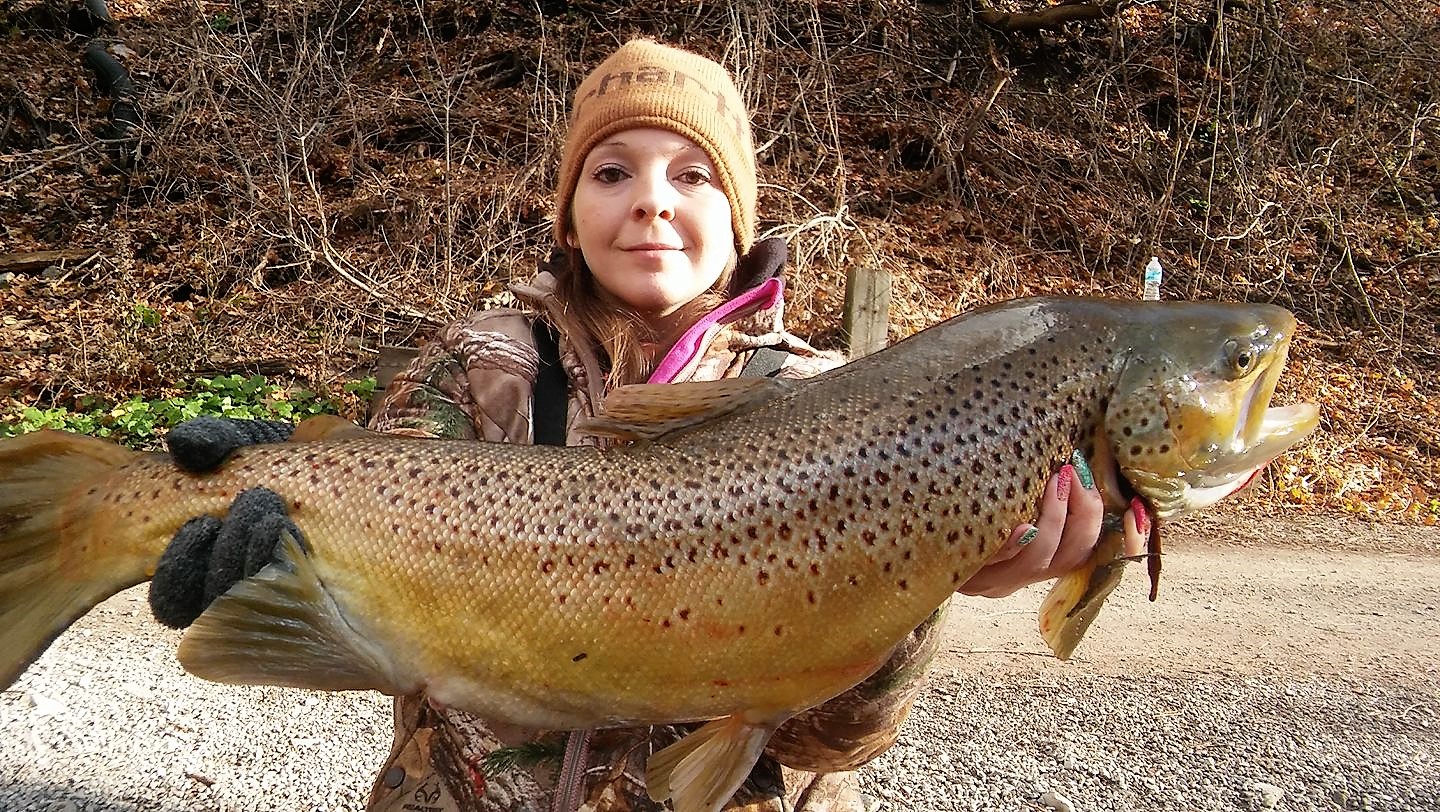
Bob Rustowicz of Cheektowaga won the brown trout division of the Capt. Bob’s Outdoors fall derby with a 30-inch Johnson Creek fish.

While weather forecasters are calling for a white Christmas followed by a blast of Arctic air from the North Country, anglers right now have been limited in where they can get a line wet.  High winds, rain and snow melt contributed to muddy conditions in the Niagara River both above and below Niagara Falls.

Shore fishermen should be the first to be able to target trout in the lower river from the Whirlpool to Artpark.  Jigs, egg sacs or egg imitations like trout beads fished under a float are good options for drifters.  Casters can use spoons, spinners or jigs to hook up with a steelhead or brown trout.  Lake trout are still around, too.  Remember that laker season opens on January 1.  January 1 is also the start of a special walleye regulation. The daily limit drops from three to one until March 15 to help protect spawning females.

Patrick Vinh Truong of Buffalo caught this nice steelhead from the Artpark area of the Niagara Gorge on an egg sac.

In the upper river you can try to target trout with egg sacs just above the upper rapids before the white water. Some perch can be found in some of the marinas where water clarity is a bit better. Find some emerald shiners for best success.

Lake Ontario tributaries have been low and slow in Niagara Falls USA.  At Eighteen Mile Creek at Burt Dam, the water flow was limited and more clear than stained.  In those situations with clear water, downsize your presentation with lighter line, smaller hooks and smaller baits.  Steelhead and brown trout are available, but they have been limited in numbers.  In Wilson, the harbor ice that had started to form was busted up from the weather conditions. With temperatures soaring into the mid-40s on Saturday with rain, we are probably back to square one.

Here are a few last minute gift items for Christmas to consider: A Lake Ontario Counties derbies Season Pass at www.loc.org.  You can save $20 by purchasing one before Dec. 31 – a great stocking stuffer.  You can also buy tickets for the Greater Niagara Fishing and Outdoor Expo Jan. 19-21 at the Conference and Event Center Niagara Falls. Admission tickets and special clinic tickets are available.  However, the popular LOTSA Salmon School is already sold out – the earliest ever!  Check out www.niagarafishingexpo.com. Here’s wishing you and yours a very Merry Christmas!

Bill Hilts, Jr.

Outdoor Promotions Director
Destination Niagara USA
10 Rainbow Blvd., Niagara Falls, NY 14303
p: 1-877 FALLS US | 716-282-8992 x. 303

Fluoro is NICE ON ICE

  • While fluorocarbon’s been available for decades, anglers are just now taking note of its superiority for ice fishing

By David A. Rose

Surprise walleye are often part of the fun when fishing for smaller perch and crappie.  Here are some thoughts to help win the battle.

My thoughts often turn wistful when I step onto a frozen lake these days. It’s not that I’m sentimental from four-plus decades of ice fishing the waters near my home in Michigan’s Northwest Lower Peninsula, but it’s more a recollection of the fish I caught as a kid and my absolute astonishment of how I was even able to fool a fish into biting with the makeshift equipment I used back then. My rods were literally wooden dowels — nails pounded in at one end to wrap line on and an eyelet screw twisted in as a guide on the other. To call them anything but a stick would be elaboration. My jigs were more like crudely-painted blobs of lead sporting dull, rusty hooks. And the line connecting the two? It was whatever heavy, stiff monofilament a kid could afford. Detecting a strike with that snarled line, let alone just attempting to get my offering down through the hole chopped with my grandfather’s handmade spud, was by far the most frustrating part of the day.


But a lot’s changed from those days of me dragging archaic gear onto the ice within a sled made from an old wooden crate secured to a pair of short downhill skis; nowadays I’m toting a Frabill flip-over shanty full of graphite rods and ice-fishing-specific reels, sonar with GPS and mapping, Aqua-Vu underwater camera and a super-sharp auger to slice the ice and quickly bore holes. But even all that technology I have in tow is not going to help me catch more fish if I don’t have one simple, yet critically important piece of the fish-catching puzzle: high-quality line made for the brutal conditions of ice fishing. Thank goodness, the choices are getting better by the year. And fluorocarbon line is getting noticed more and more as the go-to for catching more fish through the ice.

To know then what we know now

Seaguar AbrazX Ice affords the sensitivity to see your lure bob on a spring-bobber. (Legend Black ice rod image courtesy of St. Croix Rod)

Seaguar introduced the initial spindles of fluorocarbon into the United States just a few years before my first-ever ice fishing trip – in 1971, to be exact.

During this timeframe, there were only two types of line ice angers would even consider: braided Dacron and monofilament. The former was used mostly on tip-ups or for jigging in extremely deep water, and the latter everything else. Overall, it’s probably a good thing angler’s didn’t understand the advantages of fluorocarbon for ice fishing as catch and release was rarely practiced during this era and fish populations could easily have suffered.

The line’s benefits?

Fluorocarbon is very dense in its makeup. It’s more compressed because the fluorocarbon resin, which has more fluorine atoms and less hydrogen, packs more mass into the same space. This means it’s as close to neutral buoyancy as line can be, and, a great choice for vertical personations. It also has less stretch due to its denseness, which is crucial when it comes to getting good hook sets; especially when using the light-pound-tests lines needed for proper presentations during the winter months. And less elasticity makes it much more sensitive, to boot, not only allowing anglers improved feel, but the actual fish strike is telegraphed through a spring bobber or super-sensitive rod tip better.

Using line with such a thin diameter as fluorocarbon is key when using tiny jigs for panfish and the like. Not only is thin line less visible — which fluorocarbon is much more translucent than monofilament to begin with — it also your gives your offering a more natural presentation. Consider the minuscule aquatic insect’s fish forage on most this time of year. Not only do they waggle wildly on their own, they also waft about in even the most minute water currents. Thick, rigid line doesn’t allow lightweight lures to drift naturally and weary fish will turn tail without as much as taking a second look.

“The evolution of fluorocarbon line has been amazing,” says Troy Peterson of Mr. Bluegill Guide Service. “There was a time when I only used it as a leader because line on a reel would come off coiled like a Slinky, and worse, stay that way. But fluoro is so much softer now, and when spooled onto an in-line reel there is absolutely no looping or line twist.”

Lipless ice fishing lures, such as this LIVETARGET Sunfish Rattlebait, perform to maximum capacity tethered to Seaguar AbrazX Ice.

The Wisconsin ice-fishing guide’s preferred line is Seaguar’s AbrazX Ice, which is offered in 50-yard spools of 2-, 3-, 4- and 6-pound test. The same manufacturer’s Blue Label is another great choice, and is offered in higher-pound tests.

“And it’s not just AbrazX’s softness and thin diameter, but its abrasion resistance [2X’s more than any other] that really sets it apart,” Peterson adds. “The bottom of a hole is rough and will shred inferior line as a fish swirls below the ice. But since I started spooling with Seaguar, my clients have lost less fish at the hole from being cut off.”

Last but not least, is how fluorocarbon comes off a reel in extreme air temperatures. Superline tends to hold water, which will freeze up quickly. Monofilament may expand once you’re in a heated shanty and fill the gaps in the wraps and come off with a jerky motion rather than nice and smooth. Fluorocarbon’s compressed nature keeps it water free and with less condensing and expansion. No more wondering

While fluorocarbon’s been around for a while, anglers are just starting to take note of its superiority when ice fishing. Soft, less stretch and a thin diameter… That’s the modern-day fluoro.

More than likely, the next time I step foot on the ice I’ll once again be in wonderment of how, as a kid, I was even able to fool a fish into biting with the crude equipment I had. I guess I’ll just chalk it up to dumb luck. In the meantime, I’m planning on upping my catch rate by spooling fluorocarbon.

Resistant to abrasions at the hole is just one reason Mr. Bluegill (aka: Troy Peterson) prefers fluorocarbon line when ice fishing. (Photo courtesy of Troy Peterson)

  Niagara Falls USA Fishing Forecast for Dec. 14, 2017 – Destination Niagara USA

  • Coho Salmon Making NEWS in Lake Ontario Trib’s RIGHT NOW
  • Big Brown Trout are Numerous this Season
  • Cold Weather Slowing Down Shore and Boat Access this Week
Buffy Frank Brown at Burt Dam, 18-Mile Creek, below the trestle, just a few miles above Olcott Harbor, New York.

Back-to-back storms in Western New York had an impact on some of the fishing opportunities last week and weather continues to influence where and when you can fish. As this report is being written, it is 15 degrees out with a wind chill in the single digits. It is cold! The high winds last week led to terrible conditions in the Niagara River.

As of mid-week, though, shore casters were using egg sacs to take some nice steelhead in the gorge area with three feet of visibility.  Other baits worthy of consideration are spinners, trout beads and even wobble baits like Kwikfish or MagLips.

Boaters should be able to get out this weekend if the weather cooperates. Egg sacs, those same wobbling baits and beads will all work from a three-way rig as you drift from Devil’s Hole down to the Niagara Bar – not one big drift but a series of smaller drifts.  Before the water muddied up, they were doing pretty good on brown trout around the Coast Guard drift and out on the Niagara Bar.  Lake trout season is open on the Canadian side of the river.  It opens in New York on Jan. 1, 2018. Musky season in the lower river and Lake Ontario closes Dec. 15 so essentially that is over for the year until the season reopens the third Saturday in June.

Mike Rzucidlo with a 12-11 steelhead in the Lower Niagara River.

In the Lake Ontario tributaries, a late run of Coho salmon have been surprising anglers with black marabou jigs tipped with a wax worm working well.  Egg sacs or egg imitations have been working on steelhead and browns in places like 18 Mile Creek at Burt Dam, as well as some of the streams to the east.  At Burt, the flow has been low and slow with stained conditions. It’s more of a waiting game, but you can do well if you put your time in.  Jigs fished under a float is being more of a staple.

If you want to learn more about fishing, join a local club like the Niagara River Anglers Assn. or the Lake Ontario Trout and Salmon Assn.  It would make a great stocking stuffer, too.  The Lake Ontario Counties Trout and Salmon Derby has a Christmas special going on – $20 off a season’s pass.

The Greater Niagara Fishing and Outdoor Expo has a weekend pass for $20 at www.niagarafishingexpo.com. There are also pay-to-play clinics and special schools like the LOTSA Salmon School set for Jan. 20 at the Conference and Event Center Niagara Falls.  Sign up at www.lotsa1.org.

This is also a good time to pick up a book or two like the Ultimate Guide to Kayak Fishing by Joel Spring, a local author.  Other authors to consider include Rick Kustich, J. Michael Kelly, Spider Rybaak and Jim Lorentz – all fishing books that offer some great insight into fish and fishing.

Bill Hilts, Jr. – Outdoor Promotions Director

Destination Niagara USA
10 Rainbow Blvd.
Niagara Falls, NY 14303
p: 1-877 FALLS US | 716-282-8992 x. 303
f: 716-285-0809
www.niagarafallsusa.com


Sportsmen Call on Interior Dept. to PROTECT FISH and WILDLIFE HABITAT on public lands

WASHINGTON – As the Interior Department focuses on streamlining energy leasing and permitting on publics lands, a national sportsmen’s coalition is urging the agency to use all its tools to safeguard fish and wildlife habitat as well as fishing and hunting opportunities.

The Sportsmen for Responsible Energy Development coalition noted that Interior Secretary Ryan Zinke signed an order Sept. 15 that supports expanding hunting, fishing and recreation on public lands and enhancing conservation and wildlife management. The coalition, led by the National Wildlife Federation, the Theodore Roosevelt Conservation Partnership and Trout Unlimited, has advocated using master leasing plans and other strategies to protect fish and wildlife habitat through upfront, comprehensive planning and more grassroots public involvement.

A new report by Interior aimed at what it sees as obstacles to energy development on public lands says master leasing plans and policies to mitigate the impacts of development are among the rules to be eliminated or overhauled to streamline approval of leases and permits.

“The secretarial order on expanding hunting, fishing on public lands and enhancing conservation directs all federal agencies to use the best available science to develop guidelines and avoid or minimize harmful impacts on wildlife. We urge Interior to support effective upfront planning and mitigation policies to fulfill that directive and the mandate of accommodating multiple uses of our public lands,” coalition members said Thursday.

A report released in August by 19 sportsmen’s organizations and businesses called for well-planned oil and gas drilling and production by featuring examples of where this has and has not been done. The report, “Lessons Learned: A Blueprint for Securing our Energy Future While Preserving America’s Sporting Heritage,” also highlighted areas wehre the potential remains to do things right, because of the involvement of sportsmen and other community members.

“We agree with Secretary Zinke’s recent statement that hunting and fishing make up a cornerstone of the American tradition and hunters and anglers are the backbone of land and wildlife conservation. To sustain our outdoor heritage, we need robust and sustainable fish and wildlife populations and that means healthy lands and waters that are balanced with development,” said Kate Zimmerman, public lands policy director for the National Wildlife Federation.

Click the logo above to sign up for the Trout Unlimited Newsletter, it’s FREE.

“Our coalition has always supported responsible development of our public-land resources, and though we could support some streamlining of processes, we cannot support revoking approaches that help avoid damage to critical habitats, improve mitigation, and hold developers accountable for their actions,” said Ed Arnett, senior scientist for the Theodore Roosevelt Conservation Partnership. “We look forward to continuing to work with DOI to improve balancing energy development with the needs of fish, wildlife, and recreational opportunities.”

“We can protect our rivers and streams and the incredible hunting and fishing opportunities on our public lands while allowing responsible energy development—but finding that balance takes careful planning,” said Andy Rasmussen, Utah sportsmen’s coordinator for Trout Unlimited. “We urge Interior to renew its commitment to commonsense, upfront planning and siting that involves all stakeholders and identifies where and how energy development can take place.”

Sportsmen for Responsible Energy Development is a coalition of more than 1500 businesses, organizations and individuals dedicated to conserving irreplaceable habitats so future generations can hunt and fish on public lands. The coalition is led by Trout Unlimited, the Theodore Roosevelt Conservation Partnership and the National Wildlife Federation.

Contacts: Judith Kohler, National Wildlife Federation, kohlerj@nwf.org, 720-315-0855; Randy Scholfield, Trout Unlimited, rscholfield@tu.org, 720-375-3961; Kristyn Brady, Theodore Roosevelt Conservation Partnership, kbrady@trcp.org, 617-501-6352.


Orleans County/Lake Ontario Fishing Report – Dec. 19, 2017

  • Salmon Still Can be Found at Waterport Dam
  • Trib Fishing is Good
  • Winter Fishing, Be safe, Watch for Shore Ice

The Erie Canal is in the process of being dewatered again, which is providing good water flows in many of the tributaries within Orleans County.

On the “Oak” there are still some salmon available for the right offering, mainly at the dam.

Brown trout and steelhead/rainbow trout are on the move with the good water flow.

The warmer temperatures of the past day or two have helped clear some of the snow and shore ice, providing more safe access and some extra water flow.

Temperatures will continue their roller coaster ride through this coming weekend, but then return to more seasonal levels as winter will finally be upon us.

This is the time of year that taking a few extra minutes to review safety precautions and paying more attention to your surrounding conditions, this is of the utmost importance.  Conditions can change quickly this time of year.

This is the last fishing report before Christmas, so let me take this opportunity to wish each and everyone of you the happiest and safest of holidays, and a bright new year in 2018.

From Point Breeze on Lake Ontario, the World Fishing Network’s Ultimate Fishing Town USA and the rest of Orleans County.  We try to make everyday a great fishing day in Orleans County.

Email: sportfishing@orleansny.com

Boundary Waters Wilderness Ecosystems UNDER NEW THREAT of TOXIC COPPER MINING

  • Sulfide-Ore Copper Mining can be Toxic to Watersheds
  • Mineral Leases Have Been Granted, Industrial Proposals are Underway
  • Ecosystems, Streams, Lakes, Forests, Fish, Wildlife and PEOPLE will be Threatened
  • Conservation Group is ASKING FOR YOUR HELP

By Forrest Fisher

Sulfide-ore mining on the edge of America’s most visited wilderness will threatens undisturbed ecosystems, clean air and water, and the local economy of thousands of people. Brian O’Keefe Photo

Did you know that the Boundary Waters Wilderness is America’s most-visited wilderness?  It is, yet this pristine area of more than one million acres located in northeast Minnesota in under threat.  While it includes a watershed of backwoods streams, lakes and lush forests, the watershed and habitat is under imminent, toxic threat of Sulfide-ore copper mining.  Sulfide-ore copper mining has never before been permitted in this pristine Minnesota watershed, yet it appears that mining is imminent.  Mineral leases have been granted.  Industrial proposals are underway.  Locals are asking for help, asking for others in the outdoor media and worldwide conservation media to let the public to know.  Many say we need an immediate public outcry.

According to experts, the short science to understand is this: sulfide-ore copper mining threatens aquatic and terrestrial ecosystems of the South Kawishiwi River area, Mining Protection Area, Boundary Waters Canoe Area Wilderness, and other parts of the Superior National Forest including the Withdrawal Study Area, Voyageurs National Park and Boundary Water Region of Quetico Provincial Park.           

Partners to protect the border waters area include the American Fly Fishing Trade Association, Izaak Walton League of America, National Wildlife Federation, American Sportfishing Association and many others. Brian O’Keefe Photo

Local protection and conservation groups are no longer local and have formed a nationwide coalition. “Sportsmen for the Boundary Waters” is a coalition of hunters and anglers joined by campers, hikers and conservationists from Minnesota communities and America, working together to protect the Boundary Waters Canoe Area Wilderness (BWCAW).  The coalition was formed in 2015 to speak up and has grown to include major conservation, outdoors and sporting partners, all committed to the common goal of permanently protecting the habitat for fish and game, nature, and people, in the Boundary Waters Wilderness, and protecting the stable economies of the wilderness edge communities that reside nearby.

Opposition to copper mining partners include American Fly Fishing Trade Association AFTA, Backcountry Hunters and Anglers, International Federation of Fly Fishers – Upper Midwest Council, Izaak Walton League of America, Minnesota Conservation Federation, Minnesota Kayak Fishing Association, National Wildlife Federation, Orion – the Hunter’s Institution, Pope and Young Club and Wildlife Forever, American Sportfishing Association, Bear Trust International and others.  Sportsmen for the Boundary Waters also has a growing list of business supporters, including the world’s largest fishing lure company, Rapala.

CLICK TO JOIN the petition and activities to protect this region.

How can you help? Take Action Right Now. 

Sulfide-ore mining on the edge of America’s most visited Wilderness threatens clean air and water, and the local economy of thousands of people.  As hunters, anglers and conservationists, it seems common sense and vital to take a stand to oppose the practice of mining that can alter the future and change undisturbed nature so much.  This is a national issue that requires congressional action.  Let your elected officials know, wherever you live, that you oppose sulfide-ore mining near the Boundary Waters Wilderness.  Get educated and spread the word. Let your friends and family know about the issue, then please follow us on social media.

Visit SportsmenfortheBoundaryWaters.org.  How much support is there to oppose this mining action?  Visit us Facebook to learn that and so much more, and know that we need you and all of your friends too.  Please pass the word.

Catch More CRAPPIES thru the ICE, Plankton is the Key!

  • Crappies follow plankton, What To Do.
  • Who needs a road pass…Bro’s plastic mods
Understanding the story of finding slab crappie in winter is explained here.

Hitting that magical window where crappies and zooplankton collide can produce some seriously impressive results. It’s all about finessing your way onto their dinner plate, on their schedule.  Full tip on Full tip on TargetWalleye.com, few excerpts:

> Deepwater crappies can often be found following the vertical migration of zooplankton. Typically we think of the ‘magic hour’ as being sunrise or sunset, but that sunrise can be as much as an hour later under the ice (and sunset an hour earlier) thanks to the lack of light penetration.

> Increased light levels in the morning trigger zooplankton to vacate areas higher in the water column and slide back towards bottom. It’s a similar situation towards evening.

> Maybe you’ve noticed the bottom ‘lighting up’ on your flasher near dusk? Zooplankton will begin to rise off bottom as the light levels drop, and they feed on microscopic plant-like organisms called phytoplankton.

> Mud basins in the 22-34′ range are where the magic happens.

> Aside from fishing super-clear or heavily-pressured lakes, this is another time I feel fluorocarbon plays a big role. Not only does Sufix Invisiline Fluoro actually sink, but it drops 4x more quickly than mono.

> For me it’s not so much about the bait’s drop speed as it is to help keep the line tight using light jigs in deep water.

Ultra-finesse tungsten jigs are key for these filter-feeding crappies. Baits like VMC Tungsten Fly Jigs, or Jeffs Jigs and Flies Tungsten Shrimp and Zoo Bugs have that perfect compact profile yet are still fishable in deeper water.

Tiny jigs and assorted ultra-finesse freshwater filter-feeder creature critters add to the mix of being prepared when you look for winter crappie giants.

Basic colors such as straight glow, white and occasionally black work great as zooplankton are virtually translucent. Working the lure fairly aggressively will help to call fish in, but use subtle — almost quivering — jigging movements to seal the deal.

Of course, if those deep fish are aggressive and “flying up” to intercept your baits, you can throw on a 4-5mm tungsten jig or a jigging spoon instead and light ’em up FAST.

Niagara Falls USA Fishing Forecast for Dec. 7, 2017 – from Destination Niagara USA

Drew Nisbet with a Lower Niagara River steelhead from shore.

A good old-fashioned snow storm hit Western New York this week. In fact, it’s still going on south of Buffalo.  So far, it hasn’t touched Niagara Falls USA with snow, but it did impact water conditions in the Niagara River.  Rain and high winds hit first, creating a muddy mess in the Niagara River that was quite severe.  Just prior to the change though, the Niagara River was on fire with a focus on steelhead but offering anglers a mixed bag of fish all the way around – from Devil’s Hole to the Niagara Bar.

Tributary brown trout are in!

Capt. Frank Campbell of Niagara Region Charter Service was using MagLip plugs in 3.0 size to take steelhead, brown trout, lake trout, Atlantic salmon, walleye and Coho salmon just prior to the storm.  The plugs were fished off three-way rigs.  Along Artpark and in Devil’s Hole, boat drifters were also using egg sacs and beads to take trout.  Shore fishermen have been picking up trout, too, but it had slowed a bit.  With the storm still going on, we don’t know if anyone will be able to fish by the weekend.   We may see some of the white stuff by then, too. Water temperatures were still in the low 40’s.

In the John Henning Memorial Musky Tournament, Frank Alcorn of Pennsylvania won the Niagara Musky event last Sunday with a fat 47-inch muskellunge trolling with a Legend perch bait.  Also just prior to the storm, Mike Rzucidlo of Niagara Falls used egg sacs and spinners to take some small trout in the smooth water before the upper rapids area just before the water plummets over the falls.  Remember that lake trout season is closed in the lower river and bass season is now catch and release only all around the state (except Lake Erie).

Bob Rustowicz with a beautiful coho salmon from a local tributary stream in Niagara County.

In the tributaries off Lake Ontario, water continues to be stained but fishable.  Some nice steelhead and browns have been caught on egg sacs or egg imitations, jigs tipped with wax worms and fished under a float, beads fished under a float and a variety of flies and streamers.

Burt Dam and Fisherman’s Park has fish in it and is probably the most consistent producer.

With this being the end of the year, there are a few Christmas parties going on you should be aware of.  The Niagara River Anglers Association will be holding it’s Christmas meeting on Monday, Dec. 11 at the Sanborn Farm Museum on Route 31 starting at 6:30 p.m. and the Lake Ontario Trout and Salmon Assn. has their Christmas meeting Dec. 14 at Cornell Cooperative Extension in Lockport starting at 7 p.m. with the Niagara County Fisheries Board.  Also, the Niagara County Federation of Conservation Clubs will have its year-end holiday gathering at the Hartland Conservationists Club located on Orangeport Road in Gasport starting at 7 p.m.

Bill Hilts, Jr.
Outdoor Promotions Director
 
Inline image 2
Destination Niagara USA
10 Rainbow Blvd.
Niagara Falls, NY 14303
p: 1-877 FALLS US | 716-282-8992 x. 303
f: 716-285-0809

New Element 1×30 Red Dot Sight from Sightmark

  • 2-MOA Red Dot Precision
  • 15,000 Hour Battery Life
  • Windage and Elevation Adjustments

Delivering tough-to-beat accuracy and a crisp, wide field of view, the new Sightmark Element 1×30 (SM26040) is their update to the popular Tactical Red Dot Sight (SM13041). Enhancements include a smaller, more precise 2-MOA red dot, improved brightness settings and two night vision compatibility modes.

Sightmark has integrated improvements based on customer suggestions, and added more of their own, including a longer range of adjustment for both windage and elevation, battery life (up to 15,000 hours) and an improved IP67 waterproof rating. Notably, the Elements’ windage and elevation caps can now be flipped and used as tools for making adjustments.

Shipping with a reliable cantilever mount, the Element 1×30 absolute cowitness height fits all magnifiers set up on the Aimpoint T1 mounting system, allowing shooters to engage targets at further distances. The Sightmark Element 1×30 red dot sight includes flip-up lens covers, a manual and a CR2032 battery in the box.

Visit Facebook, Twitter, Instagram and YouTube to learn more about Sightmark® products.

About Sightmark®

Sightmark manufactures award-winning products including riflescopes, gun sights, laser sights, night vision, flashlights, bore sights and other cutting edge, premium shooting accessories. Inspired by military and law enforcement technology, Sightmark products are designed for competition, shooting, home defense, personal safety and other tactical applications, as well as hunting. For more information about Sightmark products, visit www.sightmark.com. For media requests related to Sightmark, please email mediarelations@sightmark.com.

SO SMALL, SO BIG! New Cooking Gear for Smart Outdoor People

  • Compact, Durable, Affordable
  • Fits in Your Pockets
  • Great Holiday Gifts

By Forrest Fisher

New GSI Outdoor stoves can literally fit in your pocket and are good to go anywhere.

 Usually with unexpected gunboat diplomacy, winter delivers nasty weather.  Bone-chilling cold is predicted for the 2017 Christmas holiday period in many parts of the country, but don’t panic. 

For outdoor folks, heading out on a hunting trip or planning to fish from a blind on the ice, it could still be great fun with the right gear.  If you are a biker or hiker and live where the air is not so chilly, this outdoor gear story will also be helpful for you.

For indoor folks, it’s a good cost-effective time to shop for those you love that are outdoor folks.  Read on.

This is my personal choice for a field accessible stove.

I’m new to the modern sub-compact gear for cooking, warming, staying comfortable and surviving by any other term.  What I have recently discovered is that the new gear is startlingly small, surprisingly efficient and pleasingly affordable. 

In fact, I’m from a retired engineering career and I found the gear to be more than durable.  I’m not easy on gear, my grandkids are worse.  This gear has become my legitimate partner for just about everything in my outdoor life. AND, maybe best of all, it is so small. 

The stove will fit into your hiking, hunting or fishing jacket pocket, or your parka, or easily into a small backpack or fanny pack with room to spare.  The stove can go anywhere because it is so small and light. Made from stainless steel and aluminum, the GSI Outdoors Pinnacle 4-Season Stove (Item 56003) measures 2” x 1.8” x 3.2” in size! Imagine that. As I said, I’m startled by the small size and weight.  It weighs under 6 ounces. Purchase just one in your lifetime and keep it for your lifetime.

This 13.4 ounce isobutane canister is perfect for size and provides lots of energy for the stove.

The stove is powered by a small fuel source (isobutane) in canister form (Item 56022) that also fits into your pocket at a size of 4.3” x 4.3” x 3.7”.  So compact, yet so powerful, it will warm your chilled fingers or cook a mini-gourmet meal of your choice wherever you are. I carry two of these…just in case.  Just in case we need to cook fish, deer, alligator, elk, or the simple things like soup and hot dogs.  It’s good to be prepared!

Down south in the Florida warm weather of December through April, beachcombers and picnickers find good use for such compact gear, kayakers too, for an island picnic lunch.  For outdoor folks anywhere, this gear is just right.

With the compact source of heat and stove all set, the Glacier Stainless Camper Set (Item 68181) adds a 3-liter pot, 2-liter pot, strainer lid, 9” fry pan, four 14 ounce mugs, four 14 ounce bowls, four plates 7-1/2’ across, four sip-it tops, and a folding pot/pan gripper, and it all is nested within itself to form a rugged, compact stack that fits into a wash basin carrier.  All of that in a size of 8.3” x 8.3” x 5.3” if you can imagine that.  It weighs 4 lbs 9 oz.  Unbelievable.

This is a cooking set where everything is there and it all STILL FITS into such a small space. Truly an amazing feat for all to cheer.

If you are as demanding as I am on my gear, this system represents a unique solution of ingenious cookware and eating-ware designed to finally meet the needs for those of us that enjoy great outdoor meals without the baggage and volume of usual home style cookware.

Plus, the modular design can be configured for backpacking, camping or anything in-between, with the exact pieces required for 2-4 people to enjoy a gourmet meal on the go, or just to warm your buns, if you know what I mean.

I’m sure we agree that eating, drinking, keeping warm and staying comfortable are life necessities wherever you go in the outdoors.  With all the compact gear identified, what did we forget?  We need a table!

More exactly what is in the 68181 cooking set. It’s all there for 4.

There is a new small, ultralight table designed to keep food and drink off the ground. It is multi-purpose, can fit in your pocket, can be used for picnics, lawn concerts, on the beach, for backpacking, fishing, hiking, biking and kayaking anywhere that food and drink can be enjoyed. The 14-ounce table is an 8.5” x 12” folding platform that compacts to just 0.6” thick x 4” wide. So small. It’s strong too, constructed of sturdy, flame and heat resistant aluminum and

This tiny tidbit of a table is MOST USEFUL and is strong, will hold 20 lbs.

stainless, it will hold 20 lbs. Raised edges help keep items from sliding off. I carry two of these on my trips in search of crisp morning mist and the serenity of a beautiful orange sunset.  I carry it all, because it could just be me on a scouting adventure or could be me, my wife and all of our hungry grandkids tagging along on that next adventure.  But, it’s all so small and so big.

GSI Outdoors also offers a larger table too. Download the catalog and order a few new holiday gifts for your favorite people. Amazon carries most of the above with free shipping options.  For more details on the specific gear mentioned here, check it out online at http://www.gsioutdoors.com/.  Download the “GSI 2018 Workbook.”

Transform your next adventure with this compact outdoor gear that allows you to be prepared to satisfy many needs, literally.


Orleans County, NY – Fishing Report for Dec. 12, 2017

Today is Tuesday December 12, 2017.
  Well the crews must have finished their work on the Erie Canal and the canal has been refilled to check the repairs.  Once everything passes inspection the system should be dewatered again for the winter.  For the tributaries within Orleans County this means added water flow until possibly the end of December this year.
  Fish are spread throughout the tributary system and decent numbers of both brown trout and steelhead/rainbow trout are being reported.  Right now, water levels are good to very good with 2 feet or better visibility.
  On the lower stretches of the “Oak,” perch fishing has been fairly consistent.  Interestingly, perch caught at Point Breeze have Gobies in them and perch caught farther upstream had items (forage) in them colored orange.
  Finally, with winter starting on December 22nd, this means that the white stuff that is on the ground now is just leaves that have turned from red to orange to yellow to brown and finally to white

Can-Am Defender XMR: CONQUER the MUD…and ANYTHING ELSE!

  • 72hp Rotax V-twin HD10 engine
  • 30-in ITP Cryptid mud tires
  • 13.5-in ground clearance

The aggressive Defender XMR-HD10 side-by-side vehicle is factory built to tackle the nastiest of mud, where traction and torque are in high demand. An authentic mud monster, the muscular Defender not only reinforces the Can-Am brand’s leadership in the mud-riding spectrum, but it does so with unmatched styling and engineering ingenuity. The specialized Defender XMR HD10 vehicle — available in either a Carbon Black & Sunburst Yellow finish or premium Mossy Oak Break-Up Country camo — includes all the Defender XT HD10 package features, but expands upon those conveniences with its own advancements for greater success in the mud.

The state-of-the-art Smart-Lok lockable front differential and large 30-in. (76.2 cm) ITP Cryptid mud tires, when mated to the existing 72hp Rotax V-twin HD10 engine, durable PRO-TORQ Transmission supply unprecedented levels of grip and sure-footed control in the mud. The Smart-Lok differential includes dual modes (Trail and Mud) for added convenience and ingenious terrain adaptation. The factory-installed snorkeled CVT and engine intakes ensure flawless execution when tackling wet and muddy conditions.


DEFENDER XMR  FEATURES 

  • Smart-Lok™ front differential
  • 72hp Rotax V-twin HD10 engine
  • Snorkeled CVT and engine intakes
  • Double arched A-arm Front Suspension
  • X-Package Front bumper
  • Aluminum Rock Sliders
  • 30-in ITP Cryptid mud tires
  • 13.5-in ground clearance

NY Deer Hunting Season is LONG, Cost is CHEAP – Still TOO MANY DEER

  • Imagine 79 days of Legal Big Game Hunting
  • Imagine 79 days of Hunting for $52 Cost
  • Imagine 7 Deer Harvest Bag Limit
  • All True, yet there are STILL TOO MANY DEER
  • New York NEEDS MORE HUNTERS!

By Forrest Fisher

Car collision rates say New York has too many deer, but hunters have trouble finding them. There is a cure. Joe Forma Photo

Remember those days in school when the teacher said, “Time up, pens down!”

New York deer hunters take note, time is almost up. The close of the New York southern zone firearm season (shotgun, rifle, handgun) for deer and bear hunting is just ahead, ending this Sunday, Dec. 10, at sunset. The next morning at sunrise, the extended combination late big game season opens for an additional nine days, to include crossbow, late archery and muzzleloader (black powder) season, ending on Tuesday, Dec. 19, at sunset.

When you consider that the big game season in New York’s southern zone (area south and west of the Adirondacks) actually started on the first Saturday of October, then ran for 6-1/2 weeks through the start of firearm season that began on Nov. 18 for three weeks and two days, and now the late season for nine days. That adds up to a little more than 11 weeks of big game hunting season for deer and bear. Wow, that’s 79 days of big game hunting!

The annual cost for the regular resident season firearms hunting privilege (license) in New York is $22 (includes big game and small game), the resident archery privilege is an additional $15 and the muzzleloader/crossbow privilege is also an additional $15. Total cost for all possible combinations during the big game season is a mere $52 for those 16 years of age and over (through 69 years old), or about 65 cents a day.  AND, if you purchase the archery and muzzleloader license, you are provided with a free (no additional fee) either-sex deer permit and a free antlerless deer permit.  So for $52, you can harvest 2 bucks and 1 doe over those 79 days of New York big game hunting seasons.  The regular season license will allow the hunter to bag one antlered deer (a buck).

For just $10 more, the hunter can purchase an application to enter a random drawing for two deer management permits allowing the harvest of one antlerless deer (doe) per permit in a designated wildlife management unit (WMU) of the hunter’s choice – if the management unit doe harvest is deemed available by the DEC and you are among the lucky hunters to win in the random drawing to help control deer overpopulation. Hence, while it is common knowledge that scientific deer management is based upon controlling the population of female deer, in New York, hunters have to pay for the privilege of helping to administer the science.  

New York is so interesting.

In addition, if you happen to hunt in a wildlife management unit where there are too many deer, additional doe permits can be purchased for, you guessed it, $10 for two.  For example, in WMU-9F, that is Elma, northern East Aurora and related adjacent areas, a hunter could obtain two more permits. If you have a lifetime license, those permits are free.

New York is so interesting.

If you add all that up, that’s seven possible deer for the freezer or the food pantry. Over 79 days of hunting, that is an average of about one deer every 10 days if you’re really good at this hunting thing, but if you are like me and many other hunters at this point of the season, you might still be looking for your first deer for the year. Hmmm, so what’s up with that?

Well, in a state with about 590,000 big game hunters, the annual harvest is 230,000 deer or so (buck and doe). While the numbers say that only about one in every three hunters will even harvest a deer, the DEC seems to be doing their part in providing hunters with access (long season), affordability (low cost) and opportunity (many state forests and access areas open to hunting).  Kudo’s to New York for this. 

Not without purpose, New York wildlife management groups appear to be working with safety management and insurance groups that report about 70,000 deer-vehicle collisions annually in the Empire State, with an average cost of about $4,000 per incident.  Across the country, 238 people were killed in 2015 when their vehicle struck an animal or when they tried to avoid striking an animal.

Add that deer also are also responsible for transportation of deer ticks that carry Lyme disease, it would seem New York needs even more harvest by hunters to control the malady of too many deer. So why is New York charging hunters $10 to purchase a deer management permit application?

New York is so interesting.

Because this is New York, the land of nothing is free. Your guess is as good as mine.

It would seem that with these data, the doe permits should be cheaper than free for every hunter. I like that hunting for deer is affordable in New York when compared to other states, but understanding the issues present (collisions, Lyme disease, property damage), New York needs to do more to raise the number of hunters out there and reduce the numbers of deer.  

How about if NY were to pay every hunter $25 for every deer harvest? Yes! Could such a simple incentive help the deer management group and would it also achieve the goal of accurate hunter harvest reporting?

How about if NY were to plant food plots in state forest areas?  We would see far less deer, safer highways, etc., etc.

New York is so interesting.

C’mon NY.

That’s my 2 cents.


Planning to Visit Alaska? FREE Fairbanks Visitors Guide

  • Learn WHEN TO SEE the Aurora Borealis and the Midnight Sun
  • Learn About WHERE TO STAY 
  • Learn WHEN TO VISIT Denali National Park
Click on the picture to obtain your free visitors guide.

Fairbanks, Alaska (AK) – The Explore Fairbanks 2018 Official Visitors Guide, a 78-page, full-color booklet that describes Fairbanks’ year-round opportunities, is now available for free. The annual publication is designed to capture the features and attractions specific to life in the region. Fairbanks is defined by the midnight sun, the Aurora Borealis, the centrally located Chena and Yukon Rivers and many miles of wilderness.

Fairbanks delineates the Aurora Season as August 21 through April 21, when visitors have the opportunity of seeing the Aurora Borealis. Fairbanks’ location is ideal for northern lights viewing because it is under the “Auroral Oval,” a ring-shaped zone where aurora activity is concentrated. Additionally, Fairbanks’ low precipitation and distance from coastal areas contributes to consistently clear nights. All combined, these conditions make the Fairbanks Region an outstanding destination for Aurora viewing. Conversely, the Midnight Sun Season runs from April 22 through August 20. The midnight sun shines brightly for the whole summer with the most sunlight occurring between May 17 and July 27, when Fairbanks experiences 70 straight days of light.

Known as the “Golden Heart of Alaska,” Fairbanks is located in the center of Alaska and serves as the basecamp for Alaska’s vast Interior and Arctic. Places situated nearby are Denali National Park and Preserve, the Arctic Circle, Chena Hot Springs, North Pole and a myriad of villages, refuges and parks. The Arctic is featured prominently as Fairbanks is the hub for travel, research, supplies and transportation to the area. The guide highlights year-round activities available in the frontier community that include fishing, wildlife viewing, birdwatching, hiking, visiting museums and floating the Chena River. Additional activities take place during the winter months, such as dog mushing, ice sculpting, snowmobiling and skiing. The guide also features exhibitions, attractions and performances focused on Alaska Native heritage, contemporary arts and gold rush history.

The calendar section details significant events including the World Eskimo-Indian Olympics, the Yukon Quest International Sled Dog Race and the Midnight Sun Festival. The guide also lists a wide variety of seasonal and year-round accommodations, services, restaurants, shopping and attractions.

For a free copy of the 2018 Fairbanks Visitors Guide and the companion piece, the 2017-2018 Fairbanks Winter Guide, contact Explore Fairbanks at 1-800-327-5774 or (907) 456-5774 or write to Explore Fairbanks, 101 Dunkel St, Suite 111, Fairbanks, AK 99701-4806. View both guides online at explorefairbanks.com.

About Explore Fairbanks: Explore Fairbanks is a non-profit marketing and management organization whose mission is to be an economic driver in the Fairbanks region by marketing to potential visitors and optimizing the visitor experience. Explore Fairbanks markets Fairbanks as a year-round destination by promoting local events, attractions and activities to independent travelers, group tour operators, travel agents, meeting planners and the media as well as by developing public policy and infrastructure to achieve marketing objectives. Find out more at explorefairbanks.com.


Christmas Gift Book Idea…IN THE LAND OF THE BEAR

By Denny Geurink

  • Published by Target Communications Outdoor Books, LLC
  • Danger & Adventure Hunting Brown Bears in Russia’s Forbidding Siberia

IN THE LAND OF THE BEAR, by Denny Geurink, is an inside look at the excitement, mystery, danger and adventure of hunting huge, aggressive brown bears in Siberia and traveling in Russia from 1991 through 2011, a time of political turmoil when the Soviet Union was evolving into Russia.

In addition to hair-raising stories of lethal brown bear attacks on people and livestock, bears digging up coffins in cemeteries, bears invading camps, and brown and grizzly bear hunting in general, IN THE LAND OF THE BEAR contains historical perspective of what was happening politically at that time in Russia, detailing how the Siberian people lived, worked, survived … and how they viewed ordinary Americans — favorably.  Siberia is a long way from Moscow and politics.)

Geurink was the first American guide/outfitter to take clients to Siberia, the brown bear capital of the world. Nearly 70 percent of the world’s brown bear population is in Russia, with much of that in Siberia. Russia is a game rich country; few residents are allowed to own firearms. There is little hunting and game animals get the chance to grow bigger and older…and bring in needed cash flow to local economies.

IN THE LAND OF THE BEAR is an outdoor adventure book. Fascinating stories all, in 23 engrossing chapters, 284 pages, 6” x 9”, paperback, available at www.targetcommbooks.com  or on Amazon.

IN THE LAND OF THE BEAR — 23 CHAPTERS OF ADVENTURE

  1. Journey to the Evil Empire
  2. Hanging Out with the KGB
  3. Brown Bear Natural History
  4. Bear Attacks: Girl Calls to Say Goodbye as Bear Kills & Eats Her, Bear Drags Off Sleeping Bag and Man, Killer Bears
  5. The People
  6. The Food: Fish Bread, That’s Not Pasta, Moose Meat Surprise, Nothing Goes to Waste
  7. The Culture
  8. Surrounded by Bears
  9. A Lesson on Fear
  10. An Encounter with the WWF
  11. American Hunter Taken to Police Station
  12. The Good, the Bad, and the Ugly (hunters)
  13. Tales from Grizzly Camp
  14. If It Weren’t for Bad Luck
  15. Russian Bear Stalks U.S. Astronaut
  16. Excitement in Camp: The Russian Way of Dealing with Poachers, Bear in Camp, Bear in the Creek, Baby Snatchers
  17. Big Stags on The Black Sea
  18. Lady and the Bull
  19. The Capercaillie Two-Step
  20. Encounter with Rut-Crazed Bull Moose
  21. Bear Charges Snowmobile
  22. More Tales of Bear Attacks
  23. They’re All Heart and Determination

AUTHOR’S BIO — DENNIS GEURINK: Michigan native Denny Geurink has been a teacher (now retired) and was for several years the Midwest Regional Editor of Field & Stream magazine. He wrote a newspaper weekly outdoor column for nearly 40 years. He guided/outfitted in Siberia from 1992 through 2011, when he sold his outfitting business, then bought it back just recently because he couldn’t stay away.  He missed the adventure, the hunting, and the people he worked with in Siberia.

BACKGROUND INFO: In the early 1990s, the USSR wanted to boost its tourism industry and the revenue it would bring.  Hunters and fishermen usually aren’t at the head of any list of tourist invitees, but in 1991 the Soviet Union, working with a U.S.-based travel agency, looked primarily at the spectacular hunting and fishing opportunities in Siberia and invited Denny Geurink, a Michigan-based outdoor writer, on a moose and brown bear hunt. He had excellent success, but even more, enjoyed learning about and adapting to an unfamiliar culture and existence that he felt more-closely resembled the U. S. Wild West 150 to 175 years ago.

Geurink liked the total experience so much he became a hunting outfitter for Siberian brown bear (the largest, most aggressive in the world), grizzly bear and moose hunts, plus incidental hunts for bighorn/snow sheep, wild Russian boar (the largest in the world), with now and then a grouse or wolf hunt added. 

For nearly 25 years Geurink lived adventure with a capital A, enjoying every minute of the hunts, the people, the culture, the political discussions, the travel throughout Russia … and in the process developing strong attachments to the Siberian people and the land, sometimes staying for 90-day stretches to serve groups of hunting clients.  He has traveled there more than 50 times and continues to hunt Siberia annually.


YOU ASKED for LESS ETHANOL With Your Gas; EPA ADDS MORE

Ethanol has been demonstrated to cause harm to marine engines.

ALEXANDRIA, Va., December 4, 2017 – This summer, the Environmental Protection Agency (EPA) asked the public how much ethanol it wanted to be added to the nation’s gasoline supply and recreational boaters, as well as many other owners of gasoline engines and vehicles, spoke up against increasing ethanol volumes under the Renewable Fuel Standard (RFS). On Friday, EPA set the 2018 RFS at 19.29 billion gallons, a 0.05 percent increase over the 2017 standard. Signed into law in 2005, the RFS requires an increasing amount of biofuels, such as corn ethanol, to be blended into the gasoline supply.

“In August, EPA originally proposed a slight lowering of the overall ethanol mandate. However, bowing to pressure from the ethanol backers, the agency actually notched the mandate higher,” said BoatUS Government Affairs Manager David Kennedy. “We think the EPA’s decision unfairly supports the ethanol industry over-protecting consumers, recreational boaters, and the environment. If ethanol is as good for America’s fuel supply as Big Ethanol would like you to believe, then why do we have a law that forces more ethanol each year into the market? The RFS no longer works for Americans.”

When it was written, RFS assumed that America’s use of gasoline would continue to grow. Since 2005, however, gasoline usage has not increased as forecasted, which today forces more ethanol into each gallon of gas. To keep up with the RFS mandate, in 2010, EPA granted a waiver to allow E15 (15 percent ethanol) into the marketplace. However, only fuels containing up to 10 percent ethanol (E10) are permitted for use in recreational boats. As higher blends enter the gas supply, the chance of misfueling increases.

“Ethanol has been demonstrated to cause harm to many gasoline engines at the present 10 percent ethanol level, especially legacy outboard motors, decreases fuel efficiency, increases fuel costs for consumers, and has questionable environmental benefits,” added Kennedy. “BoatUS will continue to fight on behalf of America’s recreational boaters to fix the RFS.”

Go to BoatUS.com/gov/rfs for more information on the Renewable Fuel Standard. BoatUS is a member of the Smarter Fuel Future coalition.

Deer Hunter’s…5 BIGGEST MISTAKES, May Still be Time to Fix Your 2017 Hunt – Part 2 of 2

  • Know the Deer You Hunt
  • Scouting, Being Detected
  • Gear & Gadgets, Over-Dependence
  • Patterning our Hunting Pattern
  • Where, When and How 

By John Sloan

Mistake #4: We get patterned doing the patterning.
Can we pattern a mature buck? I don’t think so. If we could, the odds are that we’d get patterned long before we could pattern the buck. We spend too much time at the wrong time walking, exploring, hanging stands and generally polluting the woods with our scent when we should have been prepared and just biding our time, waiting for the perfect day.

The very best chance we have to kill a mature buck is the very first time we hunt him. Yet we continue to walk around our stands, looking for fresh sign, freshening scrapes and generally messing things up. We repeatedly walk to our stands on the same trail. We think our scent spray will keep him from smelling us, or our rubber boots will keep him from smelling where we walked.

But we push limbs out of the way with our hands and we wear the same hat every day. Deer smell where we place our hands far more than they smell where we walk. Rubber boots are of no advantage, I believe, and our hats stink (our hair holds odors for a long time). To think otherwise is a mistake, a big one.

Proper stand placement is crucial to success. Good scouting will give you the necessary info.

Mistake #5: Despite knowledge to the contrary, hunting the wrong times.

When do deer move? The plain fact is they move whenever they want. Except for truly hot weather, as a general rule deer are no more active at daylight than they are at 10:30. In fact, more mature deer are killed between 10 a.m. and two p.m. than at any other time. The hunter who can effectively hunt all day has a huge advantage, but very few can. The operative word is effective. After three or four hours, most of us are just occupying space, not effectively hunting. By limiting our hunts to three or four hours in the morning and afternoon, we often miss the prime hunting time for mature whitetails.

During the rut, I routinely hunt four stands in one day, spending two or three hours in each. My final stand is usually on an approach trail or edge of a field. Often it is a ground blind, because a deer in a field is twice as likely to spot you in a tree stand as when you are in a properly placed ground blind. The other stands are in the timber.

I have killed as many bucks from 10:30-11:30 a.m. as at any other time. Think about it. Often, I am the only hunter in the woods at that time. And the deer know it. To skip midday hunting is a mistake.

Obviously, there are other mistakes we make and, just as obviously, we can make these five mistakes and still get lucky.

Luck is when preparation meets opportunity. If you are making these mistakes, you are not properly prepared.

Until Now.

TREASURE on the Beach! Metal Detecting is FUN

  • Too Windy to Fish? Fish another Way!
  • On a Small Beach central Florida, a retirement community…4 gold rings, 1 silver ring, over 100 coins, toys, fishing lures, and some trash.  All in one day.
  • How? “Cold wet hands loosen rings, as does hot, sweaty hands, then throw a ball or Frisbee, the ring flies off.  Not lost forever if you are looking.”

By Rich Creason

The author provides hands-on instruction for a newcomer to the art and fun science of metal detecting…treasure hunting, on the beach.

Most folks who enjoy metal detecting start by looking for lost coins in backyards, but once given a choice to try beach hunting, it often becomes their favorite spot to search.

This is the case with my wife and me. We have detected for over 40 years, from Montana to the east coast, and from Florida to northern Canada. We have searched yards, fields, school grounds, Civil War camp sites, seeded hunts, and beaches. Sifting through the sand is the best.

Unfortunately, we live in central Indiana, about as far from a saltwater beach as you can get, but we are fairly close to all of the Great Lakes, plus some fresh water lakes and reservoirs with large beach areas. Another unfortunate fact is many State Parks have water with swimming beaches, but they don’t allow metal detecting. I’ve never understood why, because kids can take their buckets and shovels and dig in the sand all they want with no problem. Also, when we are detecting, we take a lot of pull tabs, bottle caps, hooks, scrap metal, and other trash off the beach which are dangerous for those enjoying the sand without shoes.

Another very productive area is a campground with a swimming beach. These are often busy and sometimes no one has ever detecting these areas. As any other private property, we always ask for permission to search. Since we are causing no damage and usually show the owners all the trash we cleaned up for them, permission is seldom a problem. So, regardless of where you live, some type of sand beach is probably close to where you live.

It doesn’t matter whether you detect around fresh or saltwater beaches, close to water is the best place to find lost jewelry. Not the only place, but the best. Cold wet hands will loosen rings, as does hot, sweaty ones. Throw a ball or Frisbee and the ring flies off. In the water, or even in the sand, it will be hard to find without a machine. Teenagers horseplay and a delicate gold chain is broken and both the chain and the pendant, locket, medallion, or whatever is on the chain is lost in the water until someone with a detector finds them. My best water find so far is a gold ring with three large garnets which appraised at $500.

Another way valuables get lost at the beach is by placing a nice watch or other item on a blanket or towel. It gets accidentally knocked off by kids playing or when the towel is picked up to shake sand off and the item is forgotten. And this happens many times a day on a popular beach.

Of course, the east coast of Florida is famous for giving up gold and silver coins and relics from sunken Spanish ships, especially after strong storms. These items are washed in from offshore and brought close where someone with a detector can find them. This brings up the question, how do you get your share of these lost treasures?

Naturally, the first step is getting a metal detector. New ones range from around $200 up to ten times that much. The basic difference is like a Chevrolet and a Mercedes. Both will get you around. One just has more bells and whistles. Most detectors are waterproof from the coil at the bottom, up to the control box. The electronics inside the box tend to freak out when they get wet. Some brands offer water proof machines up to, and including, the earphones. These are more costly, probably starting around $500. But, one good ring (see above) can pay for this machine. Add a sand scoop for retrieving your finds from the beach ($20) and you are ready to find some treasures.

As soon as you find a sandy beach (gain permission to hunt if needed), you need to decide where to start. If it’s a small fresh water pond or lake, it’s fairly obvious where people hang out. On a huge saltwater area, you need to decide where the most activity is located. If possible, check it out on a hot, summer day. Blankets are usually placed above the high tide line. If young people are having a volleyball game, move into that spot as soon as they are finished. While the girls often are in tiny bikinis with no pockets, we have found several nice rings there. They tend to fly off when hitting the ball. Of course, spend some time hunting in the water. I usually search in water up to my knees. It’s easier to stand in the waves and more people use the shallow water.

If you are walking the beach and notice an area which looks like rain has washed a trough out from the high sand line down to the water, hunt that carefully. Anyplace the sand has been disturbed can bring treasures from deep up to near the surface.

If you are lucky enough to live near big water, search the shoreline (or in the water) after a large storm. The high winds will turn the sand over, bringing treasures to the top. You will often see people with detectors out looking almost before the hurricane winds are gone. Remember where the large crowds were active when the days were nice. Hunt there!

Metal detecting in the water can be fun, provide exercise and a can provide a nice, small payoff in treasure too.

Think outside the box. If you can hunt an out-of-the-way spot, which is not frequented a lot, you may be the first one there. I hunted a small beach on a neighborhood lake in central Florida. It was a retirement community and not a lot of folks spent time there. But apparently enough. I found four gold rings, a silver ring, over100 coins, toys, fishing lures, and a lot of trash in one day. My wife hunted the dry part of the sand and found coins, toys, and a large silver belt buckle. We have hunted several small campground swimming holes and had the same kind of results. If we find any valuable jewelry, we try to find the owner, but usually, there are no markings on the item to identify the owner. The only exception to the rule is class rings. Usually, they have the school, year, and a name or initials on them. We Goggle the school, and call the office. We tell them what we found, and ask if they can look in their yearbooks and help us find the owner.

When we leave home on a fishing trip, or any other kind of vacation, we always pack our machines. Many times when planning a trip on large waters, weather changes our mind. Fishing is out when the wind is too high. Rather than having our visit turn into a bust, we find the nearest beach and start hunting. I have never been west of Montana, but I imagine finding treasures on the west coast is the same as on our side of the continent.  

I always consider metal detecting as the best hobby. Like other activities, (fishing, bowling, golfing, etc.), you must purchase your original equipment to start, but any of those other hobbies will cost you more money each time you participate in it.  Then realize that every time you use your detector, you make money. Sometimes only a few clad coins, but occasionally a nice ring or a valuable coin or relic. My only additional cost is batteries once or twice a year. 

See you on the beach!

The author may be reached at eyewrite4u@aol.com.


In Orleans County, NY- Winter is Headed Our Way!

Today is Tuesday December 5, 2017.

Well it looks like the vacation from warm weather may be over with rain and snow in the forecast over the next week or two.  With the on and off rain today, tributary levels and clarity of the tributaries within Orleans County should remain at slightly high to high levels and visibility should stay at around 2 feet.

Decent catches of both brown trout and steelhead/rainbow trout are being reported along with an occasional late run salmon thrown into the mix.

Fly patterns remain with Stone Flies in black, brown or green, Wooly buggers, Egg-sucking Leeches and Egg Pattern flies.

Live baits being mentioned are wax worms, spikes and good old nightcrawlers.

Things seem to be quiet on the lower stretches of the “Oak,” but on Lake Alice catches of most of the species are being reported.

The Erie Canal is still partially watered while crews work on some areas that could be a problem if not attended to.

From Point Breeze on Lake Ontario, the World Fishing Network’s Ultimate Fishing Town USA and the rest of Orleans County.  We try to make everyday a great fishing day in Orleans County.

Email: sportfishing@orleansny.com

Ground Meat Mix for Basic DEER SAUSAGE – Do it Yourself!

By Forrest Fisher w/Missouri Dept. of Conservation

Ingredients:

A season supply of finished venison sausage looks and tastes good.  Nick Hattler photo

5 lbs. venison
1 lb. fresh pork fat
2-4 tablespoons salt (I use Morton’s Tenderquick)

Instructions:
Grind the meat and fat thoroughly, mix in salt and add one of the seasoning recipes. Knead one of the seasoning mixes listed below into meat. Keep mixture cold.

Salami Seasoning:
2 tablespoons sugar
1 tablespoon cayenne pepper
1 teaspoon ground cloves
1 tablespoon fine-ground pepper
2 teaspoons garlic powder
3/4 cup dry milk (mix to a thin paste)

Sausage Seasoning:
2 tablespoons sugar
1 teaspoon cayenne pepper
1 1/2 tablespoons chili powder
1 tablespoon garlic powder
1 1/2 teaspoons ground celery seed
3/4 cup dry milk (mix to a thin paste)

Pepperoni Seasoning:
2 tablespoons sugar
1 teaspoon ground cumin
1 1/2 teaspoons leaf oregano
1 teaspoon thyme
1 tablespoon cracked pepper
1 tablespoon fine-ground pepper
3 tablespoons chili powder
1 teaspoon whole anise
3/4 cup dry milk (mix to a thin paste)

To stuff and cook the sausage, you can use casings available from a local meat processor or aluminum foil wrapping.

If using casings, follow instructions for the type (run water through animal casings). To fill, use stuffing attachments for your meat grinder and pack tightly into casings.

For foil wrapping, place 1-2 pounds of mixture on a rectangle of foil and pull up opposite sides. Press to pack meat tightly, then fold the foil tightly against the meat. Turn and roll ends until tight.

Bake sausage in the oven by placing the stuffed casings or foil on a rack in a baking pan. Bake for 1 hour and 20 minutes at 300F. Remove and cool rapidly.

Many thanks to the Missouri Dept. of Conservation for sharing their recipe with us: https://nature.mdc.mo.gov/discover-nature/recipes/venison/basic-deer-sausage-three-seasoning-mixes.

Hunt SMART! Hunt SAFE! WEAR ORANGE

With several more weeks of Big Game Season left to enjoy in New York State (and many other states), The NYS Department of Environmental Conservation reminds hunters to put safety–your own and others’–FIRST!

Check and abide by the legal hunting hours

Check New York’s official sunrise and sunset hours every time you go out hunting. They change every day and in different locations in New York State!

Watch DEC’s new video on hunting safely.

Firearm Safety Rules Save Lives

  • Assume every gun is loaded.
  • Control the muzzle. Point your gun in a safe direction.
  • Keep your finger off the trigger until you are ready to shoot.
  • Be sure you can clearly identify your target and be sure you can see what’s beyond your target.

Wear Hunter Orange

Did you know…

…More than 80 percent of big game hunters wear blaze orange?

…Hunters who wear blaze orange  are seven times less likely to be shot?

…Deer cannot tell blaze orange (or pink) from green?

Both hunters shown below (one wearing camo and the other wearing  orange) are invisible to deer if they don’t move. What would you want to be wearing if there were another hunter nearby with a deer between you?

Niagara Falls USA Fishing Report & Forecast for Nov. 22, 2017 – Destination Niagara USA

  • New York Power Authority fishing platform FISHING IS STILL HOT
  • Jigs, ¼ ounce, Working to Fool Walleye and Brown Trout
  • Trib’s have Fish TOO

The water in the Niagara River is still in bad shape according to many of the local charter captains looking to target musky in the upper river or trout in the lower river. It could be fishable by the weekend.

Shore fishermen have a bit of an advantage over the boaters when the water turns muddy. Find some clean water and you should catch fish. One spot that is still available is the New York Power Authority fishing platform. The announcement just came through today that (weather permitting) the final day for fishing will be Dec. 3. Mike Rzucidlo of Niagara Falls has been casting his homemade ¼ ounce jigs to take some more walleye and even a nice brown trout the past week off the platform.

Downriver along Artpark, chartreuse trout beads and egg sacs fished under a float was the ticket for trout. While the water was off color a bit earlier in the week, the scent emitted by the sac helped the trout to locate the bait. Spoons and spinners still work as well.

Remember that lake trout season is closed in New York until the end of the year but the season opens Dec. 1 in the Province of Ontario waters. If you do catch a lake trout incidentally, release it quickly and unharmed. If you take a photo, make sure it’s a quick one.

In the Lake Ontario tributaries, there have been good numbers of fish and not too many fishermen at Burt Dam and the Fisherman’s Park area of 18 Mile Creek. The final day of charging (fees) at the park will be today. Good numbers of fresh Coho salmon are still working their way up to the dam with eggs, egg imitations (like trout beads), and jigs tipped with wax worms all working under a float. Live bait could catch some fish, too. Move around to find the active fish.

Four mile and 12 Mile were both high and muddy on Tuesday. No report out of Keg Creek but that had fish last week.

Happy Thanksgiving to everyone!

Bill Hilts, Jr.
Outdoor Promotions Director

Destination Niagara USA
10 Rainbow Blvd.
Niagara Falls, NY 14303
p: 1-877 FALLS US | 716-282-8992 x. 303
f: 716-285-0809
www.niagarafallsusa.com

facebook | twitter | instagram

Fishing Report, Orleans County, NY – Lale Ontario, Inland Waters

Today is Tuesday November 21, 2017.

Milder weather seems to be the rule over the next week or two with only a slight chance of snow in the forecast.

Although this is a great forecast for tributary fishermen, I’m sure that the hunters would prefer to have at least some snow to help with tracking their game.

All of the tributaries within Orleans County are offering very fishable conditions for brown trout, steelhead/rainbow trout and even some fresh salmon yet.  On the lower stretches of the “Oak”, Perch fishing has slowed a bit, Northern pike are spotty and bass are still fairly active.

Speaking of bass, the season ends November 30th so as of December 1st it’s catch and release until the 3rd Saturday of June next year.

On Lake Alice fishing for all of the species has slowed slightly.

The Erie Canal has been partially de-watered but from what I have been told, will be refilled to check on some work that is being done.
This means that when they do the final dewatering for the year, it will provide water for our tributaries well into December this year.\

I hope that you all have a happy and safe Thanksgiving this year.

From Point Breeze on Lake Ontario, the World Fishing Network’s Ultimate Fishing Town USA and the rest of Orleans County, let’s make everyday a great fishing day right here in Orleans County, New York.

TILLY, TILLY – It’s a Thankful Season for Walleye Fishing

  • A Highly Versatile Walleye Bait that Produces in a Variety of Situations
                                                                                                 Tilly TL 5-7 , 1/4 oz, Bumble Bee

Ramsey, MN (Nov 13, 2017) – Phantom Lures, widely known for its design and manufacture of high-quality proven fishing baits is pleased to introduce the arrival of the Tilly, a new walleye catcher that has the versatility to tackle a wide variety of fishing situations.

“We are thrilled to bring our latest innovation, the Tilly, to market for the 2017-2018 Ice Fishing Season,” stated Operations Manager Jeff Schulte. “The entire Phantom Lures Team is passionate about fishing year-round, and with the close of the open water season, comes frozen lakes for those of us located in the Ice Belt. We feel the Tilly is a great entry point into the growing sport of ice fishing, and we expect that with the introduction of Tilly, our brand can bridge the gap between open and hard water seasons.”

The Phantom Tilly is a drop-the-gloves vertical jigging bait with an aggressive flutter on the fall that also incorporates a strong BB rattle for when it’s time to ring the dinner bell. The Tilly is 2.5 inches of individually hand-painted fury. From hardwater to open water this bait is no one trick pony, the Tilly puts Walleyes on the board in all situations, making it a multipurpose, battle-born product anywhere there’s a fight to be had.

The bait is available in two sizes, the Tilly TL5-7 at ¼ oz and the TL-9 at 5/16 oz, both are identical in length, but weighted differently to accommodate fishing in deeper or shallower water, weather conditions and presentations.

For more information about the full product lines from Phantom Lures, visit the Phantom Lures website or contact Jack Gavin at: jack@providencemarketinggroup.net.

About Phantom Lures:Since 1996, Phantom Lures has built a strong and loyal reputation in the muskie fishing industry by making excellent, custom, quality baits that are used by first time fishermen, guides and tournament anglers. This reputation is now migrating to the walleye and bass world. Our tournament –winning baits produce actions that put trophy fish on your line, leaving you with great pictures and lifelong memories. For more information about Phantom Lures, visit PhantomLures.com or call 763.951.2902.

Fix NICS to Ensure Background Checks are More Reliable

  • Your Immediate Action is Needed and Appreciated

Senator John Cornyn (R-TX) introduced S. 2135, the Fix NICS Act to encourage and incentivize states to enter all applicable disqualifying records into the FBI’s National Instant Criminal Background Check System (NICS) and help provide states the resources to do so. S. 2135 would also require federal agencies to properly report relevant records and hold those who fail to do so accountable.

There are currently several states and some federal agencies withholding disqualifying records that would help prevent prohibited persons under current law from possessing firearms. Federal Firearms License holders rely upon the NICS to be accurate in order to prevent the sale and transfer of firearms to prohibited persons.

Please take this opportunity to email or call today to urge your U.S. Senators to cosponsor S. 2135, the Fix NICS Act.

Email your Senator here

United States Capitol Switchboard: 202-224-3121

Look up your U.S. Senators, here.

SEARCHING for the BIGGEST GAME EVER

  • Join Up To Be Part of a DINO-DIG
  • You Might Meet a T-Rex….FACE-to-FACE
  • Learn that We Live Among Much History

By Rich Creason
The rain began. Slowly at first, then turning into a torrential downpour. The water started running over the top edge of the high bluff along the river. As it ran downward, it washed dirt away forming small grooves in the bluff wall which became larger as the erosion continued, eventually forming several large gullies leading to the river below. The water level in the river rose and quickened, carving away the base of the hillside and allowing more earth to be washed away.

The storm eventually ended and the sky cleared. The local rancher rode his horse across his land surveying the damage. As he rode along the bluff, he noticed a large, dark object protruding from the hillside. Closer examination revealed it to be a bone of some type. The rancher took his find to a nearby museum and was informed he had found a dinosaur bone!

He did not know that before his cattle fed on this pasture, a small herd of 30 or 40 duck-bill dinosaurs grazed along his riverbank. The huge creatures were unaware in the not so distant future, they would all be extinct. The Edmontosaurus annectens were around 30 foot long, weighed four metric tons, and walked on either two or four legs depending on their current activity.

65 million years ago they were plentiful, eating grasses and other plants with their huge mouths, containing hundreds of teeth which were constantly being replaced. Now, the fossilized bones, teeth, and other parts of these giants can sometimes be found in the western part of the U.S. and Canada, usually beginning as a chance find such as the rancher riding by. Some of these bones can also be found on display in the Children’s Museum in Indianapolis, Indiana.

Each year, the Children’s Museum takes a trip to the far northwest corner of South Dakota to the tiny town of Faith, population 500. Near this town, the Tyrannosaurus rex skeleton named Sue was found. This is one of the most complete T.rex skeletons ever found. Another T.rex skeleton called Bucky, found near this town, is now on exhibit in the Children’s Museum. Then, another one was found here, but we were going to this area to search for the remains of the duck-bill dinosaur.

Early last year, my wife, Susie, and I heard about the “dino dig” on one of our frequent visits to the Museum. Members (and also non-members) are invited to join staff at the dig site in South Dakota. For a reasonable fee, we signed up for one day of dinosaur fossil hunting. We were taught how to dig the bones properly, do all the paperwork involved with documenting where each piece was found, and how to actually get each item out of the ground carefully and protect it for its long trip back to Indianapolis.

We enjoyed last year so much we signed up for a five day dig this year. We arrived in Faith on July 10th and checked into the Prairie Vista Inn, the same place we stayed last year. The rooms are large, inexpensive, and extremely clean. Owners Roxanne and Terry Ensz greeted us and even remembered us from the year before. Shortly after we checked in, the Museum van loaded with our fellow dinosaur hunters pulled in, they had flown into the Rapid City airport. Most were from the central Indiana area, but there was one lady from Boston and a couple from New Hampshire. We had about eight total. Dallas, William, and Michelle, Museum staff members, and Jayne, a volunteer, would be supervising our digging. Nicole, another Museum staff was on site the week before we arrived, but had to return to Indy. Cindy, a local EMT from the Faith Ambulance Service, also joined us to look after our health, treat bug bites, bandage blisters, and take care of other, hopefully, minor problems.
Everyone present had been on numerous digs in previous years. My wife and I were the “rookies,” having been here only once before. Later in the week, a few more diggers showed up including Shelley, an administrator at the Museum, and Will, her son. Victor, another dinosaur expert, unfortunately had to stay back at the Museum so the visitors there had someone to answer questions.

Monday morning, we loaded our gear and coolers full of ice water, and headed for the dig site. Due to the extreme heat possible and the exertion required to dig all day, staying hydrated was a necessity. About a block out of town, we left paved road. We then traveled a gravel road to the ranch cutoff which was mostly dirt, maneuvered around a washed out bridge, through several barbed wire gates, crossed cattle guards, followed two wheel tracks across pastures, jumped gullies and finally arrived at our destination.

It looked the same as last year. There was a long structure covered with tarp to give us some shade. Underneath was a dirt ledge with flagged off sections so the finds could be accurately mapped. Since all of us had been here before and knew what to do, we each grabbed a good looking spot and started digging. Our tools consisted of clam shuckers, a small, wide, dull blade used to open clams and dig dinosaur bones, Exacto knives for fine digging, paint brushes for dusting off bones, and bottles of very liquid super glue (like water) called Paleobond. This was used to patch the numerous small cracks in the bones. The bones are very brittle and have to be glued often during the digging process.
We dug carefully with our clam shuckers until we heard a “crunch”. This is the sound when the blade hits a bone.

Then we had to clear all the dirt surrounding the find with the Exacto knife. We left a dirt pedestal intact under the bone to support it until the find could be mapped and removed. When we reached this point, the scientific part began.
My first find was a four inch piece of rib. These are common finds and are often short because they break easily.

Before removing any bone from the ground, the fossil is given a number, pictures are taken, the grid number where it was found is recorded, and the date, name of collector, body part (if known) and other pertinent information, is written down. Then a one meter square frame, divided into 10 square centimeter squares, is placed over the find and its location is drawn on graph paper. When this is finished, the bone is carefully lifted from its multi-million year old home, still on its dirt pedestal, and wrapped in several layers of paper towel to cushion and protect it, then wrapped again in aluminum foil, and taped shut. The tape is then labeled with name, numbers, etc. to correspond with the paperwork. The package is then placed in a large plastic container for its journey back to the Children’s Museum.

In our five days of digging, Susie and I found, dug, and documented 22 bones including five rib pieces about four to eight inches long, several pieces of vertebra from the neck to the tail, a couple chevrons (the underside of the tail), three skull elements (pieces), two jugals (cheek bone), a toe bone, and a couple of yet unidentified pieces. My best find of the week was a 28 inch rib. It is very unusual to find a piece of rib this long.

Numerous other bones were found including two femurs (the large leg bone). These were both around three feet long and took many hours to dig out. A large humerus (upper arm bone) and a large jaw bone were also found. The larger bones (including my rib piece) were wrapped in foil and then had a plaster cast applied to them before moving to help prevent breakage. These bones all went back to Indiana to be cleaned, repaired, and put on display or be used for research.

While duckbill bones are the most common finds at this site, other finds also include bones and teeth from other animals. Some of these include Triceratops, Tyrannosaurus rex, Dromaeosaurs, Oviraptors, Troodons, and Pachycephalosaurs. Bones from other non-dinosaur critters are turtles, crocodiles, champosaurs (a croc-like creature) and gar fish.

The site we dig at is called a secondary deposit. This means the animal died somewhere else, but a river or stream washed their remains into this area. All the bones are “disarticulated”. This means the skeleton is not whole. The bones found side by side are almost never from the same animal. It is estimated around 2,000 different duckbills are buried at this site.

If you think this sounds like something you would be interested in doing next year, contact the Children’s Museum of Indianapolis at 317-334-3322, or visit www.childrensmuseum.org. You can get information on “Dino Digs”, memberships, events, exhibits, or anything else you need to know about the Museum. Visit the Dinosphere to see the dinosaur fossils, displays, and touch actual bones millions of years old. You can also meet many of the staff who supervise our dino digs and try to stump them with questions you’ve always wanted to ask about dinosaurs.

From author Creason: “If you live anywhere near central Indiana, I would highly recommend getting a membership of some type to the Museum. We purchased a Premier Membership. This allows two grandparents (us), one grandchild and two guests to enjoy the attractions as often as we want, plus it includes many other privileges and discounts. Many other types of memberships are also available. With the large variety of exhibits at the Museum, you don’t even have to be a kid to enjoy visiting.”   The author may be reached at eyewrite4u@aol.com.

Deer Hunter’s…5 BIGGEST MISTAKES, May Still be Time to Fix Your 2017 Hunt – Part 1 of 2

  • Know the Deer You Hunt
  • Scouting, Being Detected
  • Gear & Gadgets, Over-Dependence
  • Patterning our Hunting Pattern
  • Where, When and How

By John Sloan

Deer cross obstacles such as roads and fences in the same place, most of the time. Learn to recognize these crossings.

Each year deer hunters, all of us, make mistakes. Sometimes they are minor mistakes, sometimes major. Not always do even the major mistakes turn out badly in terms of killing a deer or getting a shot. But sometimes they do. Over the 60 years I have hunted whitetail deer, I have determined what I feel to be the five biggest mistakes a hunter makes. Here they are in the order I rank them.

Keep these items in mind for hunting now, for scouting after this season, and for scouting next summer and fall for next year’s season.

Mistake #1: Failure to understand the animal you are hunting.

I have been a student of whitetail deer for more than six decades. I am still learning. I am still constantly reminded of how little I know. I have always wondered how a hunter can expect regular success on bucks over age 3-1/2 if they don’t work to learn all they can, and then test what they have learned.

Persimmon is a preferred food source when dropping. Did you know there are two types of persimmons, early and late, and deer don’t always eat them?  

Just reading and asking questions are not enough. You must get out in the woods and read sign, see what the deer has done. Then ask yourself why. Why did that deer do that? What caused that reaction? Will it happen every time?

If you ask any deer hunter what the deer’s preferred food source is right now, and they don’t know, they have not learned enough about the animal they hunt. Does the hunter know what will be the next preferred food source? Does he or she know why the deer are crossing a road in a particular place?

The questions and the answers are endless. It takes much more than just spending time in a stand. The more you ask and the more you learn, the better prepared hunter you will be, and it is a serious mistake not to be prepared.

A successful deer hunter will always have more questions than he or she has answers.

Mistake #2: Improper Scouting

Nothing prepares you for success more than proper scouting. Nothing costs you more than improper scouting.

Far too many hunters wait until the week or maybe the month before the season to begin scouting. However, proper scouting never stops. By far the most informative scouting is done in the weeks just after the season closes. That sets the stage for the rest of the scouting. It is then you learn what the bucks were doing when you were hunting them. It is then you find their hiding spots and secure travel trails. It is then you formulate your game plan for the next season.

Summer means long distance, non-invasive scouting with good optics. It is a prime way to spot where a buck enters and leaves a field without spooking him and may be a clue to finding autumn food sources.

In the summer, your scouting is non-invasive. You glass open fields just at sundown. There is little to be learned other than there are some deer here. That’s all you need to know at that point. There is little reason to be in the woods. That starts when the mast begins to form on trees. You are now looking for food sources. You couldn’t care less if you see deer. In fact, you hope you don’t. You are looking for where the deer are going to be, not where they are.

Hang a stand in the right place and stay away until you plan to kill him.

In early fall, you combine your hunting with your scouting, you are looking for new rubs, early scrapes, previously unknown creek or road crossings. You adjust as the deer do, as new travel patterns emerge.

In late season, you adjust again. The stand that was so hot in November may be useless now. Look for the trails in deep cover and secure food sources. Look for the trails that lead to agricultural crops and, in doing so, pass through the really thick stuff.

To scout for only a day or so in September or October is a serious mistake. It will cost you deer.

Do plenty of post-season scouting and make notes. This often can be the key to next year’s success.

Mistake #3: Over-Dependence on Equipment and Gadgets

As technology developed new and improved products, deer hunters got lazy. Magic potions in bottles or in spray cans replaced knowledge and work and study. We began to depend on our equipment to compensate for inaccurate shooting, good yardage judging, clean clothes and proper stand placement. We began to believe the advertisements and all the new theories. The latest call couldn’t fail. The hottest new camo couldn’t fail. The most popular new scent couldn’t fail. The new scent eliminators couldn’t fail. But they did… and do.

Don’t be afraid to hunt from the ground. With the right setup in the right place, it can be productive. Doesn’t always need to be a ground blind.

There are no magic potions or gimmicks. They are all aids and, yes, they are an aid. Properly used, under the right conditions they do work sometimes. None of them work all the time and some of them are counterproductive. Unless you understand what the product is; know how it works; know how to use it properly and understand the limitations of the product, you are making a mistake. If you depend on a spray or clothing to prevent deer from smelling you and do not take advantage of the wind, you are making a mistake.

These products and others can be invaluable for the unforeseen vagaries of hunting. But to depend on them alone is a mistake and it will cost you.

Consistently successful callers (deer, elk, turkey, etc.) always anticipate success and prepare for a response.  This anticipation is what I call the confidence factor, and it usually comes from experience and a working knowledge of the language of the game you’re hunting.  You don’t have to learn the hard way.  Learn the language, and when you make a deer call expect a deer to show up.


Personal Carry Live Bait Container, a BEST GIFT IDEA for your Fisherman

  • Personal CARRY-IN-YOUR-POCKET Live Bait Container…it’s called “BAIT-UP”
  • KEEP the LIVE BAIT ALIVE!
  • No Nets, No Wet Hands, No Lost Bait…GREAT FOR WADING ANGLERS
  • Innovative, Portable, Durable, Inexpensive….Convenient and Effective
  • WORKS GREAT for Kayakers, Ice Anglers, Shore Fishing Anglers that Wade, for Everyone Else
The Bait-Up bait product keeps live bait fresh in your pocket without batteries. Click the picture to see how it works.

By Forrest Fisher

Are you one of those anglers dedicated to simple fishing with live bait? If you wade a stream or walk the shoreline of a small pond or lake, fishing with live bait just become easier and more fun with this product.  This product is versatile enough to allow live bait angler to carry minnows, leeches, hellgrammites, shrimp, crayfish and baits, even sand fleas for coastal waters, and at the same time, this device eliminates the usual hassles that hinder keeping live bait functional and alive. No batteries are required!
CLICK ON THE PICTURE TO THE RIGHT to see a video on how it works.

“Bait Up” and its patent-pending Dual-Lid/Floating Basket design allows the angler to quickly choose live bait without searching through water, sometimes it can be icy cold! The design of Bait-Up also allows the angler to completely submerse the device to replenish stale, low-oxygenated water without the loss of any live bait. What does this mean for today’s active angler?

No more carrying those large, bulky and sometimes, battery-operated bait buckets, with you when you are wading or walking your favorite river, stream, or creek. The same thing goes with the limited space in a kayak or canoe, or while attending your ice fishing tip-ups.

No more reaching into a large bucket of icy cold water to search for your live bait and no more need to empty out the water each time to easily retrieve a bait fish.
No more losing bait fish each time you need to replace the water with fresh water.

Bait Up allows the live bait angler to conveniently keep, carry, view, and select live bait without any problems.

FLOATING BASKET
Lifts bait out of the water instead of the angler searching through the water for their live bait.
DUAL LID DESIGN
Select Lid allows for quick bait selection.
Fill Lid eliminates bait loss when the angler needs to refresh water.
DURABLE CLEAR CONTAINER
Allows the angler to constantly monitor live bait activity to determine when water needs to be refreshed.
Perfect for the walking and wading angler. The included lanyard easily attaches to a fishing vest accessory loop, belt loop, or it can be worn by the angler.

There are two sizes:
Bait Up 20:
SIZE: 7″ tall x 3″ round
HOLDS: 20oz. of water and can carry smaller sizes or amounts of live bait.
COMES WITH: Lanyard
Bait Up 35:
SIZE: 8.5″ tall x 3.625″ round
HOLDS: 35oz. of water and can carry larger sizes or amounts of live bait.
COMES WITH: Lanyard
“Bait UpTM” allows the live bait angler to conveniently keep, carry, view, and select live bait without being bothered by the movements and demands essential to be successful while fishing with live bait.

Learn more at this link: www.bait-up.com.


STORM® 360GT SEARCHBAIT® JIGS & BODIES NOW Sold SEPARATELY

Like peanut butter and jelly, Storm® 360GT Searchbait® jigs and bodies work best together, but are also available on their own. Storm is now offering its 360GT jigs and boot-tail soft-bodies separately, in two-packs and six-packs, respectively.

“While this bait and jig head were initially released in one package, paired to be the perfect lure to catch everything that swims, it’s great that they’re available now on their own,” says Davy Hite, a Bassmaster Classic champion and seven-time Bassmaster tournament winner. “Often times, you’ll run out of one sooner than the other, and this just makes it easier to always have the right amount of what you need.”

“Anglers pair 360GT jigs and bodies for a “go-to” bait,” says Storm Product Development Director Mark Fisher, explaining the inspiration behind the “360GT” name. “It’s that simple — ‘GT’ is shorthand for ‘go-to.’”

The 360GT jig features a life-like design, 3D holographic eyes, a single-ball rattle, an exclusive VMC® Coastal Black® hook and an extended, 60-degree line-tie “leg.” They come two per pack in three weights and five color patterns: Chartreuse Ice, Gaga, Smokin’ Ghost, Smelt and Tru Blue.

The 1/8 ounce jig is designed to pair with a 3-1/2 inch 360GT body and comes armed with a 2/0 hook. The 1/4 ounce jig fits a 4-1/2 inch body and has a 4/0 hook. The 3/8 ounce jig accommodates a 5-1/2 inch body and sports a 7/0 hook.

Creating the ultimate illusion of natural baitfish movement, the 360GT body is a realistic-looking, phthalate-free, soft plastic featuring a toe-in boot-tail that elicits incredible fish-attracting action at any retrieve speed.

“The boot tail does a couple things,” Hite explains. “It gives the bait vibration, which the fish can feel in the water. And the slim tail going to the boot gives the bait another action — it moves side to side, just like a fish trying to propel through the water.”

Easy to rig, 360GT bodies feature a handy hook channel and well-marked exit hole. They are available in 3-1/2, 4-1/2 and 5-1/2 inch models. They come six per pack in a re-sealable bag containing an insert tray that protects each individual paddle tail. They’re available in 11 color patterns: Chartreuse Ice, Gaga, Herring, Houdini, Hot Olive, Marilyn, Pearl Ice, Smokin’ Ghost, Smelt, Tru Blue and Volunteer.

Multi-species anglers can expect to catch bass, walleye and pike with 360GT Searchbaits. Ease of use will ensure that they become the go-to choices of anglers of all skill levels. A simple, steady retrieve gives them a fish-attracting swimming motion.

“The 360GT is in a league all its own,” says Jacob Wheeler, a Forrest Wood Cup Champion and two-time Bassmaster tournament winner. “It’s a bait that’s going to work in many different applications — in many different situations,” he says. “It flat-out catches ‘em, no matter what you’re doing.”
Start by fan-casting a 360GT in all directions until the fish reveal where they’re holding. “Basically, throw it in any direction, 360 degrees around where you’re standing,” says Fisher, explaining more of the inspiration for the bait’s name.

See Storm® 360GT Searchbait Jig
See Storm® 360GT Searchbait Bodies
See Storm® 360GT Searchbait

Catching Crappie on the Original Road Runner – PART 1

  • “We just wanted a lure that would catch fish.”
  • Spinner beneath Horsehead-Type Jig is MOST EFFECTIVE
  • No Line Tangles, No Missed Strikes
  • Fish it SLOW…’Nuff Said!

By Keith Sutton

Author, Keith Sutton, with a nice crappie.

That’s how the late Bert Hall described the rationale behind his Road Runner lure. He designed it in 1958, but rather than target only bass, trout or panfish, he wanted a generalist lure that would attract almost any fish.

Click picture to Learn More.

That’s exactly what Hall produced. A Road Runner slowly retrieved on light line will draw strikes from black bass, white bass, crappie, bluegills, sauger, walleyes, trout, stripers—you name it. Anything that eats minnows or insects is likely to nab it. It’s my guess, however, that the Blakemore Road Runner is more popular with crappie anglers than other types of fishermen because it can be used so many ways to catch America’s favorite panfish.

Click picture to Learn More.

The Road Runner is unique among spinner-type lures because the spinner is beneath a horsehead-type lead where it’s more easily seen by fish striking from the side or below. The blade rarely tangles with your fishing line like “safety pin” spinners, nor does it interfere with hook-ups.

Several body styles are available (Bubble Belly, Marabou, Curly Tail, Turbo Tail, Buck Tail and Crappie Thunder) and two blade styles (Colorado and willow) in sizes from 1/32 to 1 ounce and every color of the rainbow.

Bert Hall, the Missouri Ozarks stream fisherman who invented the little spinner, also crafted the wise slogan that, “You can’t fish a Road Runner wrong as long as you fish it slow.” In many cases, slow is best, but crappie anglers shouldn’t be buttonholed into fishing the Road Runner just one way. Depending on water conditions and the mood of the fish, this fabulous, famous, fishing-catching lure can be fished slow or fast, deep or shallow, vertically or horizontally.

The simplest method, perhaps, is just casting the lure and reeling it in at a snail’s pace—just fast enough so the blade turns. You also can drop a Road Runner beneath your boat and fish different depths with little hops and twitches that will get a big slab’s attention.

To look over the Road Runner selection of colors and weight options, visit: http://www.ttiblakemore.com/product-category/road-runner/.

For some of the best action, however, you might want to add some variations to your Road Runner repertoire. The techniques described in Part 2 of this Road Runner fishing lure series are tried and proven.

They’re sure to give you an edge next time you want a mess of crappie for the deep fryer.

(Editor’s Note: Keith Sutton is the author of “The Crappie Book: Basics and Beyond.” To order an autographed copy, send a check or money order for $19.45 to C & C Outdoor Productions, 15601 Mountain Dr., Alexander, AR 72002. For credit card and PayPal orders, visit www.catfishsutton.com.) 

Orleans County/Lake Ontario Fishing Report – Nov. 28, 2017

  • Trout/Salmon Trib Fishing is GOOD
  • Mile Weather this Week
  • Erie Canal Continues to Supply Trib Water Flow

Mild and pleasant weather conditions continue for our area well into the next week or so with just a slight chance of rain.  Fishing conditions on all of the tributaries within Orleans County are very good to great with good numbers of fish spread throughout all of the systems.

There are still some fresh salmon entering our waters which is a bit unusual for this time of year.

Water levels remain just slightly high with about 2 feet of visibility on most of the tributaries.

The Erie Canal is only partially dewatered while crews continue to work on the system.

When they have completed their work the canal should be filled again to check their work and then the final dewatering will be done. What this means for our tributaries is extra water well into December this year.

I haven’t had any reports on the lower section of the “Oak” or on Lake Alice,  but December 1st is right around the corner which means the close of bass season for keeping them and the opening of catch and release season.

From Point Breeze on Lake Ontario, the World Fishing Network’s Ultimate Fishing Town USA and the rest of Orleans County.  We try to make everyday a great fishing day in Orleans County.

Email: sportfishing@orleansny.com

WOMEN ICE ANGLER Project on the Move in Minnesota’s OTTER TAIL LAKE COUNTRY

  • Women Empowered to FISH ON ICE
  • Women Anglers Encouraged TO POST ICE FISHING PIX at #WOMENONICE
  • Women Ice Angler OUTREACH PROGRAM – Skill Development, see details

Otter Tail County, MN – Nov. 8, 2017: The Women Ice Angler Project (WIAP #womenonice) will be on the move in 2018—literally. The fourth year of #womenonice will focus on moving from lake-to-lake in Otter Tail Lakes Country (Otter Tail County, Minnesota) highlighting the ease of mobility and moving from spot to spot. Otter Tail Lakes Country Association (OTLCA) and East Silent Lake Resort will host the media event along with Clam Outdoors.

Otter County is unique in that it boasts more than 1,000 lakes inside county borders. Communities include Perham, Fergus Falls and Pelican Rapids to name a few. The largest lakes include Otter Tail, Dead Lake, Rush Lake, Big Pine Lake and Pelican.

The ladies will fish for generous-sized panfish including sunfish, bluegills and crappies, as well as nice eater-size walleyes. “The ladies might not catch a personal best walleye here, but they have a chance at landing some trophy-sized panfish. This is a panfish paradise,” said Erik Osberg, Rural Rebound Initiative Coordinator for Otter Tail County.

Several media/video partners will follow the “ladies-on-the-ice” for video production and TV shows, including Larry Smith Outdoors, Grass Fed and Outdoors First Media. “We’ve seen our media coverage grow, and we enjoy interacting within the communities when we arrive onsite,” said founder of WI Women Fish and the Women Ice Angler Project, Barb Carey. “While it isn’t a done deal yet, we have a huge media partner finalizing their plans to follow us as well. This initiative to showcase and empower women to ice fish has really gained momentum.”

A community-wide “Meet & Greet” is in the planning stages and will include helpful tips on preparing fish.

In addition to Carey, the following ladies will fish in #womenonice this year, pro-staff anglers:

  • Shelly Holland
  • Bonnie Timm
  • Shantel Wittstruck
  • Rikki Pardun
  • Outdoor Photographer: Hannah Stonehouse Hudson
  • Outdoor Writer: Kristine (K.J.) Houtman.

The goal of the Women Ice Angler Project is to encourage women to try ice fishing, as well as mentor those who already enjoy it and want to improve their skills. An additional plus has been moving the industry forward to show women ice anglers in corporate marketing efforts and social media.

“We don’t underestimate the skill level of women ice anglers,” Barb Carey said. “Sure, we’re happy to introduce some new participants, but there are many women who want to grow in their skills and our powerful group of gals can help them do just that.”

Award-winning outdoor photographer Hannah Stonehouse Hudson (Stonehouse Photography, http://stonehousephotoblog.com/) is a big part of the success of WIAP. “The colder it is, the happier I am,” Hudson said about her photography. “The light is incredible when it’s really cold and I love it.” WIAP photos can be found in retail stores, on product packaging, in corporate catalogs as well as throughout tourism and ice-fishing social media.

For the entire winter, all women anglers are encouraged to post their ice fishing photos and share their stories with #womenonice and follow theiceangler.com. “Our sponsors are totally behind the message women can and do enjoy this great sport,” Carey concluded.

The Women Ice Angler Project sponsors include Clam Outdoors, Outdoor First Media, Larry Smith Outdoors, The Great Wild Radio Show, Fish On Kids Books, Stonehouse Photography, WI Women Fish, East Silent Lake Resort of Dent, Minn. and Otter Tail Lakes Country Association.

Contact Barb Carey for more information at icefishher@gmail.com or call 608-692-7386.

Niagara Falls USA Fishing Forecast for Nov. 30, 2017 – Brought to you by Destination Niagara USA

At the time of this report, it was starting to rain.

Using a home-made spinner, Mike Rzucidlo landed this beautiful 15-pound rainbow trout from Devils Hole, just upstream of the NY Power Authority Fishing Platform.

After a very windy day yesterday, the wind and/or rain combo could negatively affect water clarity in places like the Niagara River or some of the smaller streams off Lake Ontario. However, that doesn’t mean you can’t catch fish.

The lower Niagara River was stained yesterday, but a few captains decided to give it a go since their customers were already in town.  Capt. Vince Pierleoni of Newfane managed to hit double digit trout – half steelhead and half lake trout – using egg sacs off three-way rigs.  Use bright colored baits when the water is stained.  MagLips and Kwikfish in silver and chartreuse will also work when drifting from a boat. When the water is stained, though, there is no guarantee you can catch fish from a boat.

Shore fishermen can actually do a little better than the boaters in that some cleaner water can sometimes be found closer to the shoreline. Egg sacs or egg imitations work well, as do spoons and spinners. You need something to get the attention of the fish.

There are still a few King Salmon remaining in the Lower Niagara River, as Mike Rzucidlo landed this one from the NYPA Fishing Platform, open to the public for fishing access (FREE).

Today is the final day of the musky season in most of the state.  However, the lower Niagara River and Lake Ontario are both open until Dec. 15.  To take advantage of the extra couple of weeks of action, the Niagara Musky Association will be holding the John Henning Memorial Lower River Musky Tournament on Dec. 3 from 7 a.m. to 4 p.m.  We’ll have to see if Mother Nature – and the fish – cooperate for the anglers. 

Dec. 1 is the opening of lake trout season in the lower river and Lake Ontario for the Province of Ontario.  New York’s laker season opens on Jan. 1, 2018. If you do catch a lake trout, be sure to release it quickly and unharmed.

The NYPA Fishing Platform, as well as the other NYPA fishing access points like the reservoir and water intakes, will be closing down for the season after Dec. 3. They will not re-open until the spring. Speaking of the platform, Mike Rzucidlo of Niagara Falls caught a 16 pound salmon on 8 pound test line earlier this week and it took him and hour and 20 minutes to reel in!

Burt Dam and 18 Mile Creek has been muddy and flow has been slow with around 80 to 100 cfs coming through Burt dam. Some fresh kings and cohos are still being reported, but the run is essentially over.  Those are being replaced by steelhead and browns but not in huge numbers according to Wes Walker at The Slippery Sinker.

Some big perch have been coming out of Wilson and Olcott harbors, as well as from the creeks in those locations. The piers have been productive when you can stand on them.

The Lake Ontario Counties Trout and Salmon Derbies are offering a Christmas deal right now.  Check out www.loc.org and make sure you mark Jan. 19-21, 2018 on your calendar for the 5th Annual Greater Niagara Fishing and Outdoor Expo at the Conference and Event Center Niagara Falls. It’s going to be a good one.  Check out www.niagarafishingexpo.com. 

If you want to find out what else is happening around the Western New York area, be sure to check out www.buffalonews.com/section/sports/outdoors/ and follow the outdoor section every Wednesday or Thursday. 

Another good stocking stuffer is the NYS Winter Classic, set for Jan. 1 to Feb. 28. Sign up at www.nyswinterclassic.com. 

Bill Hilts, Jr.; Outdoor Promotions Director

Destination Niagara USA, 10 Rainbow Blvd.,

Niagara Falls, NY 14303
p: 1-877 FALLS US | 716-282-8992 x. 303
f: 716-285-0809
www.niagarafallsusa.com

Muzzy Expands Trocar Hybrid Broadhead Line with New 125-Grain HBX

  • Crossbow Broadhead Blends Fixed and Mechanical Technology
SUPERIOR, Wis. (Oct. 3, 2017) — Due to customer demand, the popular Trocar HBX hybrid crossbow broadhead that blends the most lethal and accurate fixed-blade broadhead with a pair of center-pivot blades that deploy on contact for massive cuts on large animals is now available in a 125-grain.
Like the 100-grain, the new 125-grain Trocar HBX features 0.35-inch-thick surgically sharp stainless steel mechanical blades that remain tucked in tight to the solid-steel ferrule during flight, but they deploy on impact for a total cutting diameter of 2 5/8 inches on impact. For added accuracy and stability, the 0.35-inch thick fixed blades are slightly offset. The new heavier Trocar HBX also features the popular Muzzy bone-crushing chisel tip.
This new 125-grain hybrid broadhead is now available at retailers nationwide and conveniently online at www.muzzy.com. Suggested retail price for a three-pack of either the new 125-grain or the 100-grain Muzzy Trocar HBX broadheads is $39.95.
Founded in 1984, Muzzy is the number-one name in fixed-blade broadheads, and it is a pioneer in the art of bowfishing. A division of FeraDyne Outdoors, Muzzy is headquartered in Superior, Wis. For more information on the full line of Muzzy’s fixed-blade broadheads and state-of-the-art bowfishing equipment, contact Muzzy Outdoors, LLC, 101 Main Street, Superior, WI 54880; call 866-387-9307; or visit www.muzzy.com.

Rapala® Ice Baits, It’s Time!

Rapala Ice Bait Family:

  • Jigging Rap® — the world’s No. 1 ice lure
  • Slab Rap®
  • Ultra Light Rippin’ Rap® No. 3

Nothing will excite a hardwater die-hard like unwrapping a selection of Rapala’s best-in-class baits. Including world-renowned options like the iconic Jigging Rap® — the world’s No. 1 ice lure — and innovative models like the Slab Rap® and new smaller-sized Ultra Light Rippin’ Rap® No. 3, Rapala’s family of ice baits is sure to help any angler land their fill of fish this season.

Swimming in tantalizing circles under the ice, the Jigging Rap features a balanced, weighted minnow profile. Single reversed hooks with center treble and eyelet, this bait can also be bottom-bounced yo-yo style with unbeatable results.

Available in a wide range of sizes and color patterns, no adventure on the ice is complete without a handful of these bad boys.

Another outstanding option when anglers impart quick rod snaps, the Slab Rap delivers a wide-searching, erratic action beneath the ice, circling back to center after each pause. A simple lift-and-drop presentation creates a subtle vibration on the rise, followed by evasive side-to-side motion on the fall. The lure’s weight-forward design enables a rocking action for triggering negative fish in extra-frigid conditions.

Last, but certainly not least, the new Ultra Light Rippin’ Rap No. 3 may be the hardwater scene’s most anticipated new weapon. This walleye magnet flutters on the drop with a hard-vibrating action accented by a loud, distinctive BB rattle system. Drop it above a bottom-transition area, give it a few aggressive rips, then shake it gently in place to trigger big bites all day long.

A versatile new option, the Ultra Light Rippin’ Rap No. 3 is sure to nab its share of bruiser perch and pike in addition to coveted ‘eyes.

New Report IDENTIFIES the CHANGING MARKET for HANDGUNS

  • More Women and Minorities are Planning to Purchase Handguns
  • More Beginners Plan to Purchase a Handgun
  • Younger Adults are Planning to Purchase a Handgun
  • Report Helps Explain Needs of the Changing Demographic

FERNANDINA BEACH, FL.The handgun market has many different types of consumers, each wanting to buy for different reasons and uses. Two of these types, women and minorities, are a significant growth opportunity for handgun sales. They share the same passion to become proficient shooters like more experienced handgun owners and are seeking reliable handguns from reputable brands. When this group is combined with active target shooters and hunters who are looking to buy another handgun, the new handgun consumer is now younger, skews female and is ethnically-diverse (click here to view infographic)

As a supplement to the Customer Segmentation Analysis of the U.S. Commercial Firearms and Accessories Market report, Southwick Associates and NSSF have published a new handgun market report examining the demographics, firearm-related activities, motivations, needs, purchase drivers and shopping habits of those who own a handgun and those looking to buy one. Designed to help companies better understand the different factors that motivate consumers to buy a handgun and why they select specific models, this report identifies the major consumer segments that make up more than half of the U.S. handgun market.

This report is the next in a series based on Southwick Associates and NSSF’s recent consumer segmentation analysis of the U.S. firearms market. “With emerging audiences wanting to purchase a firearm, it’s important to really understand why they want to own a handgun and the specific features they look for in a handgun. The insights from this report will help manufacturers and retailers improve their strategic and tactical marketing decisions,” commented Rob Southwick, President of Southwick Associates.

The report, “Handgun Consumers: An In-depth Exploration,” is now available from Southwick Associates. Custom segmentation research is also available based on the proprietary database containing responses from more than 100,000 detailed consumer surveys.

Where is the Guide?

  • Lake of the Woods: Walleye Capital of the World
  • Anchor, Relax, Catch Fish All Day…Seriously
  • Simple Jig-Minnow Fishing

By David Gray

Captain Cassy Geurkink makes happy anglers when they come to fish Lake of the Woods near Baudette, Mn.  Dave Gray Photo

“Where is the guide?” was my second question.  My first question was, “Which boat is mine?” 

The boat was one of many 27-foot long Sportcraft walleye charter boats neatly tied-up to the Border View Lodge docks on Lake of the Woods, Baudette, Minnesota.

This was my first experience going out on a walleye charter.   I really was not excited, a walleye charter never did sound like my kind of fun fishing.   

I was attending a conference at Lake of the Woods in Minnesota and fishing buddy, Dave Barus, a skilled Lake Erie angler, had arranged this Walleye Charter.  Going out in a big boat on big water with six anglers and a guide did not appeal to me.  By the end of the day, I found out it was not only productive, it was great fun!  It was a very enjoyable way to spend a day on water…in the rain!  

I enjoyed every minute of our fishing trip on Lake of the Woods, catching walleye and sauger at an unbelievable rate. Forrest Fisher Photo

Tom at Border View Lodge answered my first question, “Your boat is the one in that slip.”  “The one with the girl in it?” I asked.  “Yes, that is your boat.”

The girl, Cassy, answered my other question.  “Good morning, I am your guide.  Get in and we’ll get going.”  My first thought was this local trip has been engineered as a tourism publicity moment with a lady guide.  Preconceived notions are not good things, but one crept into my brain that Cassy did not look like an experienced or hardened north woods woman.  Of course, I really can’t describe what an experienced north woods woman should look like.

Cassy had a very serious look on her face as she readied six anglers and their gear, nosed the boat out into the river current and headed for the open water on Lake of the Woods.  I would come to understand this serious look latter in the day, it was pure focus.

The new Kamooki Lure is spreading like wildfire across the fishing world. They’re a unique vertical jerkbait that will invoke a strike even when fish are not hungry.  Forrest Fisher Photo

My thoughts turned back to Border View Lodge.   Part of the charm of fishing in the North Country is visiting a new lodge.   All have a charm of their own.   Border View Lodge had a special charm that makes any angler feel at home the minute you walk in the door.   Wood paneling, fish mounts on the wall, dining area overlooking the docks and river and friendly people saying welcome.   

Border View Lodge is a family owned and run business.  The original lodge was a commercial fish operation when burbot was harvested to make cod liver oil.  Around 1962, Border View became a fishing lodge serving anglers.  In 1981 the current family purchased the resort.  Today, Mike and Lisa Kinsella run the resort, oversee nine guides and 10 launch boats.  In the winter they have 60 Ice Houses on the lake.  Border View is a full service resort for people that like to fish and the resort has amenities all anglers like.  Mike has a variety of packages to fit the needs of any group.   Call Mike at 1-800-ProFish, tell him what you want and he will take care of you.

Another glance at our guide, Cassy, and the same serious look was locked on her face as she stopped, put out the anchor and baited up six rods with a jig and minnow. 

Charter Captain Cassy Geurkink at the helm, showed us a fun time on a rainy day when nearly no other boats dared to leave the dock due to the weather.  With the best country and western music playing from Sirius, we knocked the socks off the fish!  David Gray Photo

It wasn’t long before the first walleye hooked up.  A nice walleye and as Cassy skillfully netted it I noticed the serious look was replaced by a huge smile.  That was it, serious look when getting clients loaded and handling the boat, but all smiles when the bite starts.  That is my kind of guide!  

The rest of the day made me smile.  I went from never wanting to do a walleye charter to, “Can’t wait to do this again.”   We hooked more than 75 walleye and sauger, some to 28 inches long, and we put six fish apiece in the cooler.  Cassy kept minnows on the jigs – baiting every one with her secret hook-up method, netted every single fish, and kept everyone fishing and in conversation. Quite a feat. 

So much for pre-conceived ideas! 

Share the Outdoors editor Dave Barus says, “We learned that walleye and sauger, big and small, live and thrive here thanks to a good fisheries management program and plentiful baitfish supply.  David Gray Photo

Cassy Geurkink is currently the only lady guide in the area, we found this out when we returned to shore, AND, she is considered one of the best guides on this part of the Rainy River and Lake of the Woods.  Cassy grew up fishing and hunting with her dad Tom who is also a guide.  Before becoming a guide, Cassy worked at a Chevy Dealer in the Minneapolis, St Paul area. Cassy eventually worked her way up to the Sales Manager position.  She would visit Dad on the weekends and started not wanting to go home.  Cassy left the car dealership and for a season worked in the lodge office.  But, as she says, “I am an outdoor girl and wanted to be outdoors.”  To be a guide on a waterway that borders another country, you have to have a Charter Captain’s license which involves study and a lengthy Coast Guard test.   So I started studying and passed the tests.

Cassy now guides four to seven days a week.  On days off, she takes her 7-year old son Finley out jig fishing.  Cassy said the best part of guiding is meeting different people.  She says, “Guiding teaches you even more about fishing.”  She learned how to be patient and how to help people catch fish.   When Cassy first started guiding, a lot of guys looked and said, “Oh boy a girl guide.”   Now many of those have become regular repeat customers and ask for Cassy.  I can understand why.  Pure dedication, highly skilled, not afraid to try new things and focus with a smile.

Cassy puts you on the fish and makes a happy boat.  If you can book her, say, “Oh Boy,” because you are going to have a great fishing day.   

Catching fish with Cassy explaining the details, the options, the reasoning behind using chosen jig colors, that was pure fun.  It was an education in fishing.  We pay for the fishing, the fun and instruction is free.  Can’t wait to do it again. 

For more info, here is the link: http://www.borderviewlodge.com/.

Orleans County/Lake Ontario Fishing Report – Nov. 7, 2017

  • Fresh Trout/Salmon are in Trib’s
  • Upper Oak is HOT with BROWN TROUT
  • Lake Alice Crappie Bite Starting

Today is Tuesday November 7, 2017

More seasonal weather has finally arrived along with an abundance of rain.  Here in Western New York we are well on the way to setting new records for the amount or precipitation in 2017.

Let’s start the fish report with the lower stretches of the “Oak”: Perch fishing is good to very good, bass are active and northern pike are being caught occasionally.

On the upper stretches of the “Oak” it’s brown trout time.  Brown trout in the upper teens are being caught and numbers are very good.

Fresh salmon are still entering the system along with the very start of the steelhead/rainbow trout run.

Water levels on all of the tributaries within Orleans County are slightly high to high and, with all of the rain we have experienced over the past few days, should go higher.  Water color will go from stained to muddy for a day or two.

On Lake Alice, some crappie are starting to show up and bass fishing remains as good as ever.

Please remember that this coming weekend will be the last weekend for the Archers Club to be serving meals.  Speaking of the Archers Club here are the winners of their Catch and Release Derby: In the Adult Division, Mia Stone had a 26.555 pound salmon, Nat Smith had a 11.115 Pound brown trout and Paul Davidson had a 6.12 pound steelhead.  In the Youth Division, Ben Smith had a 16.630 Pound salmon.

Next year’s Archers Club Catch and Release Fly Fishing Derby will be held on October 17 – 19, 2018.

From Point Breeze on Lake Ontario, the World Fishing Network’s Ultimate Fishing Town USA and the rest of Orleans County.  We try to make everyday a great fishing day in Orleans County.

Email: sportfishing@orleansny.com

Niagara Falls USA Fishing Forecast for Nov. 2, 2017

  • Fishing is Switching Gears with Colder Weather
  • Smaller Streams HAVE FISH NOW, especially AFTER EVERY RAIN
  • Musky Tournament is ON, Nov. 5
Tyler Dannhauser of Wilson was fishing in the gorge this week and caught a mixed bag of salmon and trout.

Weather conditions have certainly impacted the fishing this past week. High winds and rain resulted in water temperatures dropping 5 degrees since last weekend. That said, it could be just what the “Fish Doctor” ordered to force a transition into the next phase of fall fishing.

In the Upper Niagara River, the last month of musky fishing action improved with the adverse weather, just in time for the Niagara Musky Association’s Tim Wittek Memorial Catch and Release Tournament. The action will take place on Nov. 5 out of the launch ramp area at the foot of Sheridan from 7 a.m. to 4 p.m. To get your blood circulating again, there will be a post-tourney chili-fest at the foot of Sheridan in Tonawanda. Cost is $25 to enter this catch-and-release “iron man” tournament. Call Scott McKee at 716-225-3816 for more information. If you just want to find our more information about fall musky fishing in the Niagara, stop in at the NMA monthly meeting at the Eldredge Club, 17 Broad St., Tonawanda, NY, on Tuesday night (Nov. 7) starting at 7 p.m. Guest speaker will be Marc Arena with Red October Baits. Water conditions were murky this week thanks to the wind. The lower river musky season extends to Dec. 15.

Mike Rzucidlo with another great Lower Niagara River king salmon caught from the NYPA fishing pier.

And speaking of the lower Niagara River, we had a report that there were some boats on the water today, just prior to the weekend. The first fish they caught was a musky – drifting MagLips off three-way rigs. They also caught a walleye before they hit some trout – steelhead and lake trout. Lake trout season is closed until the end of the year, but sometimes you just can keep them off the hook!

In the gorge area of the lower river, shoreline casters are still catching a mix of salmon and trout. Treated egg skein fished under a float has been a consistent producer for Rich Pisa of Kenmore around the whirlpool area. Mike Rzucidlo of Niagara Falls was picking off some steelhead and salmon on a No. 4 spinner while casting the New York Power Authority Fishing Platform before he was chased off due to high water levels (probably due to the high winds).

If you want to check whether or not the Fishing Platform is open, call 716-796-0135, ext. 45. It usually closes down for the winter around Dec. 1.

Tyler Dannhauser of Wilson was fishing in the gorge this week and caught a mixed bag of salmon and trout.

At Olcott Harbor and 18 Mile Creek, good reports of steelhead and brown trout have surfaced to complement the salmon that are still hanging around upstream at Burt Dam. Karen Evarts at The Boat Doctors in Olcott reports that there are king and Coho salmon in various stages of their life cycle, including some fresh ones entering into the system. Egg skein and egg sacs work best. If the water is stained, chartreuse and orange-colored egg sacs are best. If we get the rain we are supposed to receive, you can try drifting an egg sac or a single egg in some of the smaller streams like Keg Creek to the east of Olcott, or 12 Mile Creek at Wilson, west of Olcott. Fishing pressure should drop off a little bit as whitetail deer fall into their rut stage and as crossbow season opens Nov. 4.

The regular big game season kicks off for the Southern Zone on Nov. 18. Waterfowl and other small game are also open to spread the activity out. No reports on perch in the harbors, but if the waters are clear enough, they should be starting to move in and become active. If you catch any nice fish, please share with us at bhilts@niagarafallsusa.com.

Stay safe!

Bill Hilts, Jr., Director, Outdoor Promotions
Niagara Tourism & Convention Corporation, 10 Rainbow Blvd., Niagara Falls, NY USA 14303
p: 716.282.8992 x.303| 1.877 FALLS US, f:716.285.0809
website | facebook | twitter | blog
Sportfishing has a $30 million annual economic impact in Niagara USA!

Sportsmen Urge Senate to Reject Plan to Drill Arctic Refuge

  • Backcountry Hunters & Anglers – The Sportsmen’s Voice for Our Wild Public Lands, Waters and Wildlife

As Senate considers opening energy development in Arctic National Wildlife Refuge,
hunting/fishing opportunities in America’s ‘last frontier’ showcased in new film from BHA

MISSOULA, Mont., Nov. 14, 2017 – As Senate members prepare to advance legislation that would open the Arctic National Wildlife Refuge in Alaska to oil and gas development, public lands sportsmen and women are amplifying calls to reject the measure.

On Wednesday, the Senate Energy and Natural Resources Committee will hold a markup of the bill, introduced by Sen. Lisa Murkowski of Alaska and touted as an economic booster. In a short film released today, Backcountry Hunters & Anglers members visit the Arctic Refuge for an epic, once-in-a-lifetime caribou hunt, fishing trip and exploration of the region’s awe-inspiring terrain. The film ends with a call to action: urging public lands advocates to contact their senators to oppose drilling the refuge.

“This is the crown jewel that every backcountry hunter and angler should have the opportunity to fulfill in their lifetime,” said BHA member Barry Whitehill, of Fairbanks, Alaska, who appears in the film and traveled to Washington, D.C., recently to meet with members of Congress in support of the region’s conservation. “It’s the dream for anybody that’s passionate about hunting and fishing.”

“You can’t be seen as a public lands champion if you’re on the wrong side of history,” said BHA Conservation Director John Gale. “Sportsmen and women are looking to our elected officials to take action at this crucial moment in support of this unique place, its irreplaceable fish and wildlife habitat and hunting and fishing opportunities it provides. Strong, sound Senate leadership is needed now more than ever to ensure that the Arctic National Wildlife Refuge remains wild and free from energy development that belongs in more appropriate and productive places.”

BHA has emerged as a leading voice in support of conserving the Arctic Refuge. BHA supports responsible energy development in places where we can achieve balance and limit impacts to fish and wildlife, but polls commissioned over the summer in Arizona and Colorado show strong public opposition to energy development in the refuge. In Arizona, 61 percent of voters opposed the proposal, along with 58 percent of Colorado voters.

Established in 1960 by President Eisenhower “for the purpose of preserving unique wildlife, wilderness and recreational values,” the refuge’s 19.5 million acres, including 8 million acres of wilderness, provide habitat to iconic game species including grizzlies, Dall sheep and caribou.

Said Whitehill in the BHA video, “Last frontier…you know, you take this out of the equation we have no more frontier. I don’t know if that’s a world I’d want to spend much time in.”

The Senate last month rejected a budget amendment that would have prevented oil and gas development within the refuge.

Watch the BHA film on the Arctic National Wildlife Refuge – and take action.

What would Theodore Roosevelt do?

Contact: Katie McKalip, 406-240-9262, mckalip@backcountryhunters.org


Ruger Precision Rifle Recall

Ruger has issued a Product Safety Bulletin for certain Ruger Precision Rifles due to the potential for interference between the aluminum bolt shroud and the cocking piece (also known as the firing pin back). Although only a small percentage of rifles appear to be affected and we are not aware of any injuries, Ruger is firmly committed to safety and is offering replacement aluminum bolt shrouds for affected rifles in order to eliminate the possibility of such interference. View Safety Bulletin PDF

Go to this site to enter your serial number to see if your rifle is affected by the recall: https://ruger.com/dataProcess/rprSafety/index.php

What Causes Shotgun Choke Tubes To Lock Up Or Freeze In The Barrel? (Part 2 of 2)

  • STUCK CHOKE TUBES from USE of STEEL SHOT

By George Trulock

Rust, residue build-up and choke expansion CAN ALL OCCUR at the same time, making the removal of your choke tube a very difficult task.

Choke tubes frozen in place from expansion is different from rust or residue build up.

Keep in mind, however, that rust, residue build-up and choke expansion CAN ALL OCCUR at the same time.

Without getting to deeply involved in the science of metals you need to know that when a shot charge passes through a choke tube it exerts a force in two different directions.  Force is applied to the choke tube when the shot charge strikes the choke forcing cone.

The first direction is longitudinal.  The force in this direction simply tries to push the choke out of the barrel.  This is prevented from happening by the interlocked threads on both the choke and the internal threads of the barrel.  If enough force is exerted then the threads in the barrel and or the threads on the choke shear and out it goes.  I have never seen a choke fail from thread shear.

The second direction is at approximately right angles to the bore.  In this direction the applied force tries to make the choke expand. As the shot column moves through the choke tube forcing cone, the pellets are in constant movement to rearrange themselves so that the shot column becomes smaller in diameter and elongated.  This generates a force that wants to expand the choke tube.

Factors to consider:
* Steel is elastic to some degree.
* If enough force is applied the choke tube will expand by a small amount and when the force is removed it will contract to its original size and shape.
* One of the ways we measure the strength of steel is by “Yield Strength”.
* For our purpose we can define yield strength as the maximum amount of force that is applied that does not cause any permanent deformation of the steel.
* If we increase the level of force past the yield strength of the steel used in that choke, it will expand past its elastic limit and stay in this expanded size.
* If you continue to shoot this load in this choke tube it will expand a small amount each time and at some point it will be solidly locked into the barrel.
* This force reaches its peak nominally at the intersection of the choke forcing cone and the parallel section. This is the area where choke expansion will occur.
* Choke tubes in this condition cannot be removed by normal methods.

The actual force is generated from a number of combined factors:
1. Size of steel shot. The larger the diameter of the shot the more force is created
2. Weight of the shot charge. Heavier payloads cause higher forces
3. Choke constriction. More constriction causes higher forces
4. Velocity. The higher the velocity the more force is created
Very high velocity steel shot shells with large diameter (particularly size B and larger pellets) through tighter (typically full or tighter) constriction chokes are usually the culprit causing choke expansion.

One of the best ways to prevent choke expansion is to follow the choke manufacturer’s recommendations.

* Some choke manufacturers will mark the choke “no steel” if it is not rated for steel.
* Some mark the choke “approved for steel”
* All factory chokes, as a rule, are rated for steel shot loads from cylinder bore through modified constriction, at least all that I have seen.
* If you use a factory choke tighter than modified that is not marked for use with steel, I would check it on a regular basis for choke expansion.
* If you find a choke tube that gets progressively harder to remove and replace each time you do so, examine it carefully as it is probably failing from expansion.
* If in doubt whether a choke is rated for steel, contact the manufacturer.

In my experience with steel shot I have found that if a choke does not expand with a given steel load after 25 shots it will never expand. Don’t take that as a fact as nothing is 100% when it comes to shotguns. However to date, this rule of thumb has never failed me.
While this is certainly not intended to be a true technical paper, hopefully it has given you a basic understanding of why choke tubes can and do freeze in the barrel.

For more information on Trulock Choke Tubes, visit http://www.trulockchokes.com.
Sincerely,
George Trulock

1-800-293-9402 work; 229-762-4050 fax
Email: trulock@trulockchokes.com


RAM TRUCKS Unveils Special-edition 2018 Hydro Blue Sport

  • 2018 Ram 1500 Hydro Blue is this year’s final special-edition Sport model
  • Hydro Blue monochromatic appearance package is loaded with custom details
  • MSRP starts at $46,060  

Nov. 7, 2017. San Antonio – Ram today pulled the wraps off a new, special-edition 2018 Ram 1500 Hydro Blue Sport.

“The custom look and high-impact colors have been well received in the marketplace and this new Ram 1500 Hydro Blue Sport will surely stand out on dealers’ lots and in customers’ driveways,” said Mike Manley, Head of Jeep & Ram Brands. “Enthusiasts demand that their trucks get noticed and our Ram 1500 Sport lineup delivers a durable, powerful alternative with great visual appeal.”

The 2018 Ram 1500 Hydro Blue Sport will be the final special-edition Sport the Ram brand will offer in the 2017 calendar year. Previously, Ram launched Sublime (Green) and Copper Sport limited-edition trucks earlier this year and an Ignition Orange edition in late 2016.

Special standard features on the Hydro Blue Sport include a black-decaled Sport performance hood, new-for-2018 body-colored Sport grille with black billet inserts and black R-A-M letter badge, as well as flat black exterior body-side and tailgate badging. Black bezel projector headlamps and LED tail lights complement the black body badging.

The Ram 1500 Hydro Blue Sport ties the monochromatic exterior theme together with body-colored front fascia, rear bumper, side mirrors and door handles. Forged, polished 22-inch aluminum wheels are standard on 4×2 models; polished 20-inch wheels are standard on 4×4 models.

Ram 1500 Hydro Blue Sport interior features include blue color-matched highlight stitching on the instrument panel, heated steering wheel and door trim. Blue Sport embroidery accents the deluxe high-back, black, bucket, heated seats with mesh inserts, while blue Ram’s head logos flank the headrests. Blue anodized surfaces cover the instrument panel bezels, center console trim and door spears, as well as a new instrument panel badge. A black headliner completes the interior package. Full leather seating and trim is optional.

Optional features include 22-inch (4×2 only) and 20-inch gloss black aluminum wheels, black tubular side steps, chrome wheel-to-wheel side steps, Active Level air suspension, ParkSense and the RamBox storage system.

Production of the uniquely colored Ram 1500 Hydro Blue Sport will be limited to 2,000 trucks in the U.S. Base Manufacturers Suggested Retail Price is $46,060, plus $1,395 destination.

The Hydro Blue pearl coat paint option is available on Ram 1500 Sport crew cab, short-bed body styles with the 5.7-liter HEMI® V-8. Both two- and four-wheel-drive models will be available.

The Ram 1500 Hydro Blue Sport will go on sale in November 2017.

About Ram Truck Brand
Since its launch as a stand-alone division in 2009, the Ram Truck brand has steadily emerged as an industry leader with trucks that are proven to last.

Creating a distinct identity for Ram trucks has allowed the brand to concentrate on core customers and the features they find valuable. Whether focusing on a family that uses a Ram 1500 day-in and day-out, a hard-working Ram 3500 Heavy Duty owner or a business that depends on its Ram ProMaster commercial van every day for deliveries, Ram has the truck market covered.

In order to be the best, it takes a commitment to innovation, capability, efficiency and durability. Ram Truck invests substantially in its products, infusing them with great looks, refined interiors, durable engines and exclusive features that further enhance their capabilities.

Ram continues to beat the competition in the most sought-after titles:

  • Over the last 30 years, Ram has the highest percentage of pickups still on the road
  • Highest owner loyalty of any half-ton pickup
  • Highest torque ever – 930 lb.-ft. with Ram 3500  Cummins Turbo Diesel
  • Highest 5th wheel towing capacity – 30,000 lbs. with Ram 3500 Cummins Turbo Diesel
  • Best ride and handling with exclusive link coil rear and auto-level air suspensions
  • Best-in-class fuel economy and longest range with exclusive EcoDiesel – 27 mpg with Ram 1500
  • Best-in-class gas towing – 16,320 pounds with Ram 2500
  • Highest snow plow rating – Ram 2500 and 3500
  • Most luxurious trim available in pickups with Ram Tungsten Limited Edition
  • Most interior space with Ram Mega Cab
  • Most capable full-size off-road pickup – Ram Power Wagon

Truck customers, from half-ton to commercial, have a demanding range of needs and require their vehicles to provide high levels of capability. Ram trucks are designed to deliver a total package.

Ram Truck brand: www.ramtrucks.com


Kidde Recalls 40 Million Fire Extinguishers with Plastic Handles Due to Failure to Discharge and Nozzle Detachment: One Death Reported

Name of product:

Kidde Fire Extinguishers with PLASTIC HANDLES

Hazard:

The fire extinguishers can become clogged or require excessive force to discharge and can fail to activate during a fire emergency. In addition, the nozzle can detach with enough force to pose an impact hazard.

Remedy:  Replace (Free Replacement)

Recall date: November 2, 2017

Recall number: 18-022

Consumer Contact:

Kidde toll-free at 855-271-0773 from 8:30 a.m. to 5 p.m. ET Monday through Friday, 9 a.m. to 3 p.m. ET Saturday and Sunday, or online at www.kidde.com and click on “Product Safety Recall” for more information.

Fire Extinguisher RECALL Description:

This recall involves two styles of Kidde fire extinguishers: plastic handle fire extinguishers and push-button P-indicator fire extinguishers.

Plastic handle fire extinguishers: The recall involves 134 models of Kidde fire extinguishers manufactured between January 1, 1973 and August 15, 2017, including models that were previously recalled in March 2009 and February 2015. The extinguishers were sold in red, white and silver, and are either ABC- or BC-rated. The model number is printed on the fire extinguisher label. For units produced in 2007 and beyond, the date of manufacture is a 10-digit date code printed on the side of the cylinder, near the bottom.  Digits five through nine represent the day and year of manufacture in DDDYY format. Date codes for recalled models manufactured from January 2, 2012 through August 15, 2017 are 00212 through 22717.  For units produced before 2007, a date code is not printed on the fire extinguisher.

Remedy:

Consumers should immediately contact Kidde to request a free replacement fire extinguisher and for instructions on returning the recalled unit, as it may not work properly in a fire emergency.

Note: This recall includes fire extinguisher models that were previously recalled in March 2009 and February 2015. Kidde branded fire extinguishers included in these previously announced recalls should also be replaced. All affected model numbers are listed in the charts above.

Recall information for fire extinguishers used in RVs and motor vehicles can be found on NHTSA’s website.

Incidents/Injuries:

The firm is aware of a 2014 death involving a car fire following a crash. Emergency responders could not get the recalled Kidde fire extinguishers to work. There have been approximately 391 reports of failed or limited activation or nozzle detachment, including the fatality, approximately 16 injuries, including smoke inhalation and minor burns, and approximately 91 reports of property damage.

Sold At:

Menards, Montgomery Ward, Sears, The Home Depot, Walmart and other department, home and hardware stores nationwide, and online at Amazon.com, ShopKidde.com and other online retailers for between $12 and $50 and for about $200 for model XL 5MR. These fire extinguishers were also sold with commercial trucks, recreational vehicles, personal watercraft and boats.

Importer(s):

Walter Kidde Portable Equipment Company Inc., of Mebane, N.C.

Manufactured In: United States and Mexico

Units: About 37.8 million (in addition, 2.7 million in Canada)

Report an Incident Involving this Product

The U.S. Consumer Product Safety Commission is charged with protecting the public from unreasonable risks of injury or death associated with the use of thousands of types of consumer products under the agency’s jurisdiction. Deaths, injuries, and property damage from consumer product incidents cost the nation more than $1 trillion annually. CPSC is committed to protecting consumers and families from products that pose a fire, electrical, chemical or mechanical hazard. CPSC’s work to help ensure the safety of consumer products – such as toys, cribs, power tools, cigarette lighters and household chemicals -– contributed to a decline in the rate of deaths and injuries associated with consumer products over the past 40 years.

Federal law bars any person from selling products subject to a publicly-announced voluntary recall by a manufacturer or a mandatory recall ordered by the Commission.

To report a dangerous product or a product-related injury go online to www.SaferProducts.gov or call CPSC’s Hotline at 800-638-2772 or teletypewriter at 301-595-7054 for the hearing impaired. Consumers can obtain news release and recall information at www.cpsc.gov, on Twitter @USCPSC or by subscribing to CPSC’s free e-mail newsletters.

Niagara Falls USA Fishing Forecast for October 26, 2017

  • Olcott Pier: Salmon and ONE BIG MUSKY!
  • Trib’s Hold Lots of Fish after Every Rain
  • Shore Fishing and Boat Fishing is VERY GOOD

There are many fishing activities going on right now so you will have to pick

Young Ethan Brolinski of Lewiston with one of his three Coho salmon caught at Lewiston Landing.

and choose what you want to do.

For example, salmon fishing is good in Olcott right now at 18 Mile Creek and the lower Niagara River still has a mix of king salmon, Coho salmon and steelhead.  If you want trout, you can catch them wherever there is good water flow.  The most popular areas are the Niagara River and 18 Mile Creek, but you can do well after a rain in some of the smaller streams, too.  Fishermen were picking up some trout in places like Keg and 12 Mile Creeks last week.  Anglers are getting a few perch on Lake Erie and there are some hungry bass around as well.  There are lots of fish to cast for if you so choose.

Sean Keen of Grand Island shows off his first salmon ever, caught off the NYPA fishing platform in the gorge.

The piers in Wilson and Olcott are both good spots with spoons or spinners.  The talk of Olcott this past week was the huge musky that was caught off the Olcott pier by a fisherman using a homemade spinner.  According to reports, the fish was over 60-inches long, which would put it into a 50 pound class of fish. Huge! It was released to fight another day. The same angler did manage to catch a nice brown trout for the smoker later in the day.

In Olcott Harbor and up the creek, some nice salmon and trout are being caught by casters and drifters. One salmon caught by John Miller of Pennsylvania stretched 45 inches long! At Burt Dam and Fisherman’s Park, there have been lots of fish, but also lots of fishermen. Mostly salmon right now, but steelhead and browns are both being taken as well.

Lower Niagara River action for salmon has been slowing down for boat drifters in the Devil’s Hole area.  A few kings are still being caught, but Coho salmon have arrived, as well as a few trout.  Steelhead and browns are both possible catches.  Lake trout season is closed, but you may start to catch a few when the water temperatures finally drop below 60 degrees – probably this weekend.

Father and son team of Rich and Richard Pisa caught a double on king salmon in the Whirlpool area of the gorge.

Shore casters are still doing well in the gorge on salmon, but it is starting to slow a little bit. Spoons and spinners with glow in the dark tape is one approach; treated egg skein under a float is another option.

Downriver, boat drifters are started to target steelhead along Artpark.  Capt. Joe Marra of Lewiston even managed to pick up a few salmon there while targeting trout.  Ethan Brolinski, a 7 year-old fisherman from Lewiston, was casting around the launch ramp in Lewiston this past week when local captain Frank Campbell of Niagara Falls tossed him a “lucky” fishing lure to use.  Before Ethan’s day was up, he managed to catch 3 Coho salmon from the docks.

Let’s go fishing!

Bill Hilts, Jr., Director, Outdoor Promotions

Niagara Tourism & Convention Corporation, 10 Rainbow Blvd., Niagara Falls, NY USA 14303 p: 716.282.8992 x.303| 1.877 FALLS US, f:716.285.0809 website | facebook | twitter | blog

Sportfishing has a $30 million annual economic impact in Niagara USA!

Orleans County/Lake Ontario Fishing Report – Oct. 31, 2017

  • Trout/Salmon are in Trib’s
  • Trib’s will Offer GOOD Action into Winter
  • Lake Alice Bass Action Good on Upper Stretch

Today is Tuesday October 31, 2017.
This Halloween, the trick is to make the perfect cast with that special fly to that very special spot and catch that ever-elusive fish you have been dreaming about for years.
This fall has been an absolute bonus year for both Lake Ontario and the tributaries of Orleans County.
Those with small boats are still doing well in the near-shore waters of Lake Ontario, while all of our tributaries within Orleans County are alive and producing an abundance of the cold-water species.
Salmon are still entering the tributaries from the lake in good numbers, and the brown trout and rainbow/steelhead trout are starting to really pick up in numbers.
With temperatures falling to more seasonal levels and with water flows at excellent levels, great fishing is in the forecast for well into the future this year.
The Erie Canal has yet to start their dewatering process, so good water flows should continue well into the winter months.
On the lower stretches of the “Oak,” perch fishing has been good and reports have an occasional northern pike being taken, along with a bass or two in the mix.
On Lake Alice it’s been mostly bass in the upper stretches.
I haven’t had any fishing reports from the Erie Canal, but I have to believe that at least bass are still active.
From Point Breeze on Lake Ontario, the World Fishing Network’s Ultimate Fishing Town USA and the rest of Orleans County. We try to make everyday a great fishing day in Orleans County.
Email: sportfishing@orleansny.com

Orleans County/Lake Ontario Fishing Report – Oct. 24, 2017

  • Runs of Trout/Salmon ON_AGAIN, OFF-AGAIN
  • Lake Alice Bass Action Good on Upper Stretch
  • St. Mary’s Archers Club Derby was SUCCESSFUL

Today is Tuesday October 24, 2017.
The temperature yo-yo continues with the temperatures looking more like late September than late October.
Runs of all of the cold-water species are on again and off again on all of the tributaries within Orleans County.
That’s not to say that there is any shortage of any of the cold-water species in our tributaries, they are not the bigger runs that one would normally see this time of year.
Temperatures will be above average into late next week and beyond.
What this means to me and others is that the tributary season will be extended this year and that is great news.
Another positive part of this whole weather thing is that people with boats still in the water have been having great success in the near-shore waters of Lake Ontario off Orleans County.
All of the inland stream and lakes have been fairly quiet right now, but bass fishing is still doing well, especially on the upper reaches of Lake Alice. Please don’t forget that bass season closes on November 30th this year, so bass catch and release starts on December 1st.
Yellow perch are being caught on the lower Stretches of the “Oak”.
The Catch and Release Fly Fishing Derby at the St. Mary’s Archers Club was, once again, a great success with some fantastic fish being weighed in. There was great food being served, great prizes being awarded and great new friends made.
From Point Breeze on Lake Ontario, the World Fishing Network’s Ultimate Fishing Town USA and the rest of Orleans County. We try to make everyday a great fishing day in Orleans County.
Email: sportfishing@orleansny.com

Call that Deer to You, TIPS THAT WORK for Deer Calling Success

  • How to Be Ready
  • See a Deer, What to Do
  • Using the Right Call

By Gary Sefton

Big, healthy bucks follow hot and ready doe’s, the hunter has many options, learn some of them here. Joe Forma Photo

Be Ready

“You’re not going to believe this,” the excited deer hunter said.  “I haven’t seen anything all morning, so I let my bow down and started to unfasten my safety belt.  I remembered my brand new, never used, deer call and thought “What the heck”.  I let go with a couple of parting shots on the call before beginning to climb down.  Just then, the buck of a lifetime came boiling out of the brush like his tail was on fire.  He stopped broadside, 20 yards from my stand, but I’m holding 25 feet of rope with my bow tied on the other end. “He was huge,” he said, holding his hands about two feet apart.

I had this conversation at one of the early Deer Classics and have had many more like it since.  I believed him.

This hunter’s experience was not that unusual, especially for first-time callers or callers trying a new technique.  With no confidence in the call or the technique, he’s thinking “I never heard a deer make a sound like that” or “This will probably run off anything within hearing”.

He has no idea what he is saying when he makes the call.  He has no clue what it should sound like, and/or he has never had a deer respond to calling, so he has no real reason to believe his deer call will work. So he sets himself up for failure by making a call and not expecting anything to show up.

I began working with game call companies in 1986, doing field testing and research on every aspect of deer calling, including interpreting and dissecting unusual and possibly significant vocalizations.  There’s not much you can do or say to a deer that I haven’t tried for experiments’ sake and/or in hunting situations, and there aren’t many reactions to calls that I haven’t seen. This article is from my book CALLING WHITETAILS: Methods, Myths & Magic. It is available at www.targetcommbooks.com.

When he’s trailing and he’s grunting!

I can’t begin to tell you how many tales of woe I’ve heard from seasoned deer hunters who missed out on golden opportunities because their brains were on pause when a buck showed up.  If you believe in something enough to buy it and haul it to the woods with you, then you should believe something is going to happen when you use it. You want the deer to come into the area to investigate the deer making the call.  He may come in hard and fast or he may slip in and be gone before you know he was there.

Make the call, then wait for him! Look for him!  Stay on ‘red alert’ for 15 to 20 minutes after you make the call.  Expect a response and anticipate success.  You will still get caught with your guard down from time to time, but you won’t feel so dumb about it.

Consistently successful callers (deer, elk, turkey, etc.) always anticipate success and prepare for a response.  This anticipation is what I call the confidence factor, and it usually comes from experience and a working knowledge of the language of the game you’re hunting.  You don’t have to learn the hard way.  Learn the language, and when you make a deer call expect a deer to show up.

When You See a Deer

Deer have big ears.  They are good at pinpointing the precise location of a sound’s origin, so my rule is: If you can see a deer coming toward you, let it come, even if it is dawdling and taking its time.

You are in good shape as long as it is headed your way.  If you make a sound while it is enroute, you will call its attention to your location and increase the possibility of getting picked off.

She smells a rat!

The doe’s that are ready to breed are in charge. Learn the details to pay attention to.  Joe Forma Photo

If the deer veers off in another direction, a soft doe or buck grunt could be the right invitation to bring it back on course.  You don’t have anything to lose in those situations.

When I’m in this situation (the deer is not heading my way) I’ll call to any deer I see wandering around, but I keep it soft and passive unless I see or hear a buck trailing a doe.  When that happens, I’m going to get more aggressive, with some heavy breathing doe bleats to try to turn his head.  I have called several bucks to me that were trailing does. They thought the bleating doe was the same one they were trailing.

When you are doing blind calling, always take a hard look around before you make a call, to be sure the immediate area is clear of deer that could bust you. If you get busted, let him go.  There’s no reason to call to a deer that you know you have spooked. He won’t come back once he has you pegged, and he might very well associate the call to human presence.  What do you think he will do the next time he hears a call?

Learn the Language

Before your start blowing on your deer call, be make sure you know what you are saying so you don’t say the wrong thing at the wrong time. Deer can’t change their language, so just be sure you are familiar with the basics.  Beyond that, you have to be the judge of what is right for you.  Knowing the right sound to make to trigger a specific response gets you in the game.  Making the proper sound in the correct sequence gives you a chance to score.

When she talks, they listen!  Set Up to Call

An important but often overlooked aspect of calling success is in the caller’s location and set-up. Do your calling in a high-deer-use area where deer are comfortable making and responding to calls.  You are not going to call many deer when they are alarmed or distressed.

“What do you do when a buck comes almost close enough to shoot and won’t come any closer?” I wish I had a quarter for every time I’ve been asked that question.

The reason he won’t come any closer is because he can’t see the deer he’s been hearing.  He wants visual reinforcement to the audio signals he’s been getting. A warning – if you call to him while he’s looking in your direction (he usually will be if he’s responding to a call), he’ll most likely look you right in the eye and the hunt will be over. Your best bet is to let him walk, then try to call him back when he gets out of sight.

If you plan to call, try to position your stand on a rise or in thick cover so the deer will be in range when he comes into view.  Don’t forget: if you’re going to do aggressive calling or horn rattling, always try to set up with a natural barrier downwind of your stand.  If you can keep a buck from scent checking your position when responding to your calling, your chances for success are much better, especially with older, smarter deer.

Gary is an expert caller of deer and turkeys and has been so for a long time.  A competition caller as well as an active hunter, he won the 1993 and 1994 World Deer Calling Championship and has conducted far more than 1,000 deer calling seminars throughout the U.S. to help hunters understand and successfully communicate with deer. He has written articles for Deer & Deer Hunting magazine and other regional and national outdoor publications.  He has appeared on nationally syndicated radio and television outdoor shows and is featured on several DVDs.

His book – CALLING WHITETAILS / Methods, Myths & Magic –is a no-nonsense, back-to-basics guide to calling deer, and other deceptions to help. Chapters include whitetail deer practical vocabulary, deer calling basics (why deer respond to calls), calling during the rut (mating anticipation), antler rattling, other deceptions (scents, blinds, decoys), tips to increase your calling success, be familiar with your calls, and have a plan. CALLING WHITETAILS is available at www.targetcommunications.com. 


HAWKE a SCOPE for Air-Powered Rifle ACCURACY

  • Air-Powered Rifles Generate High Shock and Vibration
  • Special Optical Scopes are Essential
  • Hawke AIRMAX fixed my Airgun Shooting Accuracy Troubles

By Forrest Fisher

The AIRMAX reticle is glass-etched and based on the spacing of a 10x Mil Dot with multiple aim points, great for multiple weight projectile pellets.

Airguns today are growing in popularity all over the world and they are now offered in many ballistic sizes. Airguns appeal to the other craze in the world too, they offer “green shooting,” with no gunpowder, no catridge casings, no toxic outgas and no garbage in the woods, and more, they are affordable and reusable at little or no cost. The one problem with shooting airguns accurately at long range though, is finding an optical scope that can handle the shock and vibration.

With my GAMO Big Cat 1250 pellet rifle (.177 caliber), I’ve tried two brands of scopes, names unmentioned, to discover that airguns can have a devastating effect on optics when the right products aren’t used. After two years of some shooting frustration – target plinking with constant creep accuracy, I have found a scope that actually works more than three weeks with repeat, same hole accuracy, week after week. My Hawke AIRMAX 3-9×40 offers the right specialized optics for the serious airgun shooter that I am.

Hawke sells this “super airgun scope” in either 30mm or 1 inch chassis design, and has one model (Airmax 30) that offers an illuminated reticle. My Airmax (Model 13-110) uses the non-illuminated AMX reticle in a traditional scope design.

The AIRMAX solved my air gun accuracy problems. This 3-9 x 40 AMX model has a 1-inch or 30mm tube chassis option for easy mounting and matched the fast-focus eyeball of for quick shooting style.

To be absolutely sure of your pellet rifle accuracy, go purchase your 4, 6, 8 or 10 grain pellets, then use a micro-gram archery scale to identify and remove the outliers (the heavy and light pellets) that contribute to shot placement inaccuracy.

The adjustable objective is integrated into the scope rear end for accurate focus and parallax error elimination.

We zero the scope to the middle of the paper and it is not unusual for us to place 5 shots within ¼ inch of each other at 50 yards. Our country backyard rodents are no longer a problem and fun of shooting for free (no bullets) is fun again.

Check out this airgun scope they call the Hawke AIRMAX, it’s affordable at about $200 and most important, it holds accuracy shot after shot.

For technical details visit: https://us.hawkeoptics.com/airmax-3-9×40-amx.html.

What Causes Shotgun Choke Tubes to Lock-Up or Freeze-Up in the Barrel? (Part 1 of 2)

By George Trulock

I’m sure a lot of shotgun shooters have encountered this dreaded problem.

You start to remove the choke from your shotgun and it will not budge.

You increase the pressure on your choke wrench and still get no movement.

You eventually end up putting enough torque on the wrench that it causes your face to turn red and your arms too start to tremble. The choke still does not move.

You then find some sort of tool to give you additional leverage on the wrench and the darn choke tube still refuses to budge.

You start to wonder what you did to cause this problem!!

There are BASICALLY THREE THINGS THAT WILL FREESE UPA SHOTGUN CHOKE IN THE BARREL:

  1. Rust
  2. Residue build up from fired shells (unburned powder, fiber, plastic, etc.)
  3. Choke tube expansion (Creep)

If you want to keep your shotgun chokes functioning as they were intended, then TAKE CARE OF THESE BASIC MAINTENANCE ITEMS ON A REGULAR BASIS:

  1. LOOSEN & RETIGHTEN the choke on occasion. Even better if you REMOVE the choke and REINSTALL in the barrel on a regular basis. This will break any bond that is attempting to form.
  2. CLEAN CHOKE BODY and REMOVE RESIDUE from the threads with a stiff brush and solvent of some kind.
  3. CLEAN INTERNAL THREADS and CHOKE COUNTERBORE in the barrel.  USE BRONZE BORE BRUSH and SOLVENT.
  4. WIPE SURFACES DRY, then LUBRICATE them with a few drops of high quality GUN OIL.

Sincerely,

George Trulock


1-800-293-9402 work, 229-762-4050 fax

trulock@trulockchokes.com


New York State DEC Announces Nov. 18 Start of Regular Firearms Season for Deer and Bear Hunting in Southern Zone

Hunters are Encouraged to Pass on Young Bucks

NYSDEC encourages hunters to pass up the shot on young bucks. Joe Forma Photo

With the start of New York’s most popular big game season slated for Saturday, Nov. 18, New York State Department of Environmental Conservation (DEC) Commissioner Basil Seggos is encouraging hunters to be safe, enjoy the natural beauty of the environment, and consider passing up shots on young bucks.

“New York has some of the best hunting opportunities in the nation, and our ongoing conservation efforts and hunter safety programs are providing ample opportunities for residents and visitors to enjoy all New York has to offer,” said DEC Commissioner Basil Seggos. “Deer and bear hunting is also an important tool for New Yorkers to assist our wildlife management efforts and critical for controlling populations especially in areas and habitats where deer overabundance are causing ecological damage. The opening of the Southern Zone regular season is a cherished tradition for many families, drawing friends and relatives together for a weekend afield. I wish all hunters a safe and successful season.”

Deer hunting has been changing in New York, with more hunters opting to voluntarily pass up shots at young, small-antlered bucks in favor of letting them grow to be older, larger bucks. DEC is encouraging hunters to make a difference for the future of the deer herd and increase their likelihood of seeing older, larger bucks by choosing to Let Young Bucks Go and Watch Them Grow.

Regular Firearms Season for Deer and Bear Begins Nov. 18
The 2017 regular deer and bear hunting seasons in New York’s Southern Zone begin at sunrise on Saturday, Nov. 18, and continue through Sunday, Dec. 10. The Southern Zone regular season is New York’s most popular hunting season; approximately 85 percent of New York’s 575,000 licensed hunters participate. Harvest during this season accounts for nearly 60 percent of the total statewide deer harvest and between 30 to 60 percent of the statewide bear harvest.

Maybe some of the most fun is just seeing deer come toward your stand on opening day, but choosing to take a doe early or not, especially during the rut, is a tough call for many hunters.  Joe Forma Photo

Following the regular deer and bear seasons in the Southern Zone, late bowhunting and muzzleloading seasons will run from Dec. 11 through Dec. 19. Hunters taking part in these special seasons must possess a hunting license and either bowhunting or muzzleloading privilege(s).

In the Northern Zone, the regular deer and bear hunting season opened Oct. 21, and will close at sunset on Dec. 3. The Northern Zone includes the Adirondacks, Tug Hill Plateau, Eastern Lake Ontario Plain, and the Champlain and St. Lawrence valleys. A late bowhunting and muzzleloading season for deer will be open in portions of the Northern Zone from Dec. 4 to Dec. 10.

DEC Encourages Hunter Safety
While statistics show that hunting in New York State is safer than ever, mistakes are made every year. DEC believes every hunting-related shooting incident is preventable, and Commissioner Seggos is encouraging hunters to use common sense this season and to remember what they were taught in their DEC Hunters Education Course.

Firearms Safety:

  1. Point your gun in a safe direction.
  2. Treat every gun as if it were loaded.
  3. Be sure of your target and beyond.
  4. Keep your finger off the trigger until ready to shoot.

DEC also encourages hunters to wear blaze orange or pink. Wearing orange or pink prevents other hunters from mistaking a person for an animal, or shooting in a hunter’s direction. Hunters who wear hunter orange are seven times less likely to be shot.

When hunting in tree stands, use a safety harness and a climbing belt, as most tree stand accidents occur when hunters are climbing in and out of the stand. Also, hunters should never climb in or out of a tree stand with a loaded rifle and never set a tree stand above 20 feet.

Help Protect New York Deer from Chronic Wasting Disease
Although no new cases of Chronic Wasting Disease (CWD) in New York deer have been found since 2005, DEC continues to take the threat of CWD seriously. CWD is fatal to deer, and if introduced, could spread rapidly. Once established, CWD is practically impossible to eliminate from the wild deer herd. Preventing CWD from entering New York is the most effective disease-management strategy. Hunters can help protect New York’s deer herd from CWD by following these tips:

  • If hunting outside of New York, debone or quarter the deer before returning to the state, and follow the law about importing carcasses or carcass parts from outside of New York. CWD Regulations for Hunters.
  • Use only lures or attractant scents that do not contain deer-based urine.
  • Dispose of carcass waste in a landfill, not on the landscape.
  • Report any deer that appears sick or is acting abnormally.

Report Your Harvest – Remember: Take It – Tag It – Report It
Hunter contributions to deer and bear management don’t end when an animal is harvested. All successful hunters are required to report their harvest of deer and bear within seven days. Failure to report is a violation of the Environmental Conservation Law and reduces the data DEC uses to manage deer and bear populations. Hunters may report via DEC’s online game harvest reporting system or by calling the toll-free automated reporting system at 1-866-GAME-RPT (1-866-426-3778).

Additional Reminders for the 2017 Southern Zone Regular Hunting Season
Choose non-lead ammunition for high quality meat and reduced risk of lead exposure to humans and wildlife.

Hunger Has A Cure… The Venison Donation Program (link leaves DEC’s website) is a great way to help those less fortunate while assisting with deer management in New York.

For specific descriptions of regulations and open areas, hunters should refer to the 2017-2018 Hunting and Trapping Regulations Guide available on DEC’s website. Hunters are urged to review all regulations and safety tips in the guide. Hunters may also be interested in DEC’s Hunting the Black Bear in New York (PDF, 727 KB) or reviewing DEC’s unit-by-unit Deer Hunting Forecasts.

Niagara Falls USA Fishing Forecast for Thursday, Nov. 16, 2017 from Destination Niagara USA

  • Devil’s Hole Stairs to Gorge – Repaired and Reopened!
  • Big Musky on a Good Bite All Week
  • Walleye, Steelhead and Lake Trout fishing good from Shore and Boat
Mike Rzucidlo of Niagara Falls is still doing well off the New York Power Authority fishing platform, catching walleye, trout and occasional Coho salmon, all on homemade jigs.

There’s another storm blowing in this weekend, but Niagara County could luck out on some of the rain and white stuff, should it arrive. Keep your fingers crossed!

This just in from New York State Parks: The stairs into the Niagara Gorge at Devil’s Hole State Park will be reopened on Saturday, November 18, after having been closed all summer so that they could be rebuilt.  The stairs had been expected to be closed until Spring 2018.  This is great news for shore fishermen who like to cast for trout in the Devil’s Hole area.

Lower Niagara River trout fishing has been good from both boat and shore. We will have to wait and see what the storm blows in for water clarity. Rain and wind in Lake Erie can sometimes impact the lower river fishing. Conditions were near perfect the past week and steelhead are cooperating nicely along the Artpark shoreline. Boaters were bouncing egg sacs off three-way rigs to take some nice steelhead. Of course, you will catch some lake trout along the way. Be careful with them and release the fish immediately. Lake trout season is closed until Jan. 1 in New York waters, Dec. 1 in Canadian waters. Other baits that you should try if the egg sacs don’t work for you include plugs like MagLips and Kwikfish. Minnows will also catch you a fish or two, as will egg imitations like yarn flies.

From shore, any egg or egg imitation will catch fish as will spoons, spinners and jigs. Mike Rzucidlo of Niagara Falls is still doing well off the New York Power Authority fishing platform to catch walleye, trout and the occasional Coho salmon. This week he was using homemade jigs.

Rich Pisa with a nice steelhead from Niagara County, NY.

Upper Niagara River musky fishing was good the past week according to Capt. Chris Cinelli of Grand Island. He caught three on Monday using large common shiners.

In the Niagara Musky Association’s Tim Wittek Memorial Musky Tournament last Sunday, a total of 28 anglers competed – catching 16 fish for the day. Top fish was a 50 and a half inch fish caught by Jeremy Schneider of Stratford, Ontario using a homemade body bait. Second place was John Pensyl of Lockport with a 48-inch fish jigged a Red October Tube. Third place was Stratford with a 46-inch ‘lunge jigging a Red October Tube. All the fish were released unharmed to fight another day. Other notable catches included a 46-inch musky reeled in by Daniel Lacko of Kenmore, a 43-inch fish hauled in by Andrew Lacko of Kenmore (Dan’s father) and Andrew Porzio of East Aurora with a 40-inch ‘lunge. The season closes on Nov. 30 in the upper river and around the state – except in the lower river and Lake Ontario. That season closes on Dec. 15.

The Lake Ontario tributaries like 18 Mile Creek are still muddy but not high. Some salmon are still struggling to swim around as the browns and steelhead are taking over. While eggs and egg imitations are still good baits to use, the past week seemed to switch over to more of a live bait presentation like crawlers, wax worms and spikes according to Karen Evarts at The Boat Doctors.

Bill Hilts, Jr.
Outdoor Promotions Director

Inline image 2
Destination Niagara USA
10 Rainbow Blvd., Niagara Falls, NY 14303
p: 1-877 FALLS US | 716-282-8992 x. 303, f: 716-285-0809

Niagara Falls USA Fishing Forecast for Nov. 9, 2017

  • FREE FISHING DAY in New York on Veteran’s Day, Nov. 11
  • Orange/Blue are Hot Colors for Eggs, Lures and Wooly Booger’s
  • Musky Tournament Rescheduled from Nov. 5 to Nov. 12
Fish of the day was this 40-inch lake trout caught by 9 year old Ty Nichols. He is backed up by Tim Finney.

After some intense weather over the weekend and cold weather blowing in the end of this week, you will have to pick and choose how and where you want to fish.

Niagara Falls USA waters fared better than most in Western New York, just in time for the Veteran’s Day – Free Fishing Day, on Nov. 11.  In honor of our veterans, Nov. 11 is a designated free fishing day in New York State. It means you don’t need to purchase a license for that day. However, you still have to abide by the fishing regulations!

In the lower Niagara River, the water turned to mud and chased away the boaters until waters start to clear a little.  Capt. John DeLorenzo of Niagara Falls got a jump on the Veteran’s Day celebration by taking out a mother and son through Western New York Heroes, when the weather was decent last Saturday.  WNY Heroes is a non-profit veteran’s assistance organization.  Along for the ride was Tim Finney of Wheatfield, who was helping DeLorenzo, Danielle Nichols and her 9 year old son, Ty.  They caught two nice steelhead up to 11 pounds and lake trout up to 40 inches for the morning.  Best bait was a chartreuse trout bead fished on a three-way rig.  Other captains working the drifts were doing well on MagLips and Kwikfish.

Danielle Nichols of Clarence holds up an 11 pound steelhead.

Shoreline anglers have been casting spoons and spinners, as well as drifting eggs or egg imitations, to take a mix of trout and a few salmon. Mike Rzucidlo of Niagara Falls has been hitting the New York Power Authority fishing platform to catch both salmon and steelhead.  A No. 4 spinner has been working best for him. Further up the gorge, state parks announced that the lower trail (trail 3) that connects the Schoellkopf site to the Great Gorge Railway Trail has been re-opened.  Anglers will be able to use improved access to the water via a new set of stairs. Take the elevator adjacent to the Discovery Center for easy access.

In the upper Niagara River, musky action should improve as waters clear.  Last Sunday’s annual Tim Wittek Memorial Musky Tournament hosted by the Niagara Musky Association was cancelled due to weather. It has been rescheduled for Nov. 12 from 7 a.m. to 4 p.m.  Cost is $25 to enter this catch-and-release event.  Call Scott McKee at 225-3816 for more information.

Capt. John DeLorenzo holds up a lake trout caught by Danielle and Ty Nichols of Clarence. They both lost their husband/dad in a helicopter accident while serving in the U.S. Coast Guard.

The Lake Ontario tributaries, like 18-Mile Creek, are muddy, but not high.  Some salmon are still struggling to swim around as the browns and steelhead are starting to move in.  According to Karen Evarts at The Boat Doctors in Olcott, large numbers of fish are in the creeks. Orange and blue were the hot colors for eggs, poppers and wooly buggers.  Keg Creek was too low for fish passage. Twelve-Mile Creek in Wilson was stained.  If you are wondering why you haven’t seen more water flow there, blame it on the beavers.  They have dammed some of the upper stretches and it’s been impacting the flow.

Bill Hilts, Jr., Director, Outdoor Promotions

Niagara Tourism & Convention Corporation, 10 Rainbow Blvd., Niagara Falls, NY USA 14303 p: 716.282.8992 x.303| 1.877 FALLS US, f:716.285.0809 website | facebook | twitter | blog

Sportfishing has a $30 million annual economic impact in Niagara USA!

Quantum Gravity Fright, RISING MOON Hunting Night

  • Big Bucks, Acorns and Apples
  • Dreaming about Scent Control
  • Elevated Hunting Stands REQUIRE SAFETY AWARENESS
  • Prusik, Gravity, Your Whitetail Deer Hunting Future

By Forrest Fisher

Healthy bucks roamed near the field edges along the apple trees and oak woods, captivating my attention with scrapes and rubs.  Jim Monteleone Photo

The phrase “Whitetails Unlimited” is catchy if you are a deer hunter, especially a whitetail deer hunter.  It’s also the name of an organization that has more than 100,000 members because the hunting messages they share are effective, useful and are delivered from the experience of real hunters and field contributors.  There is more than beginner value.

Whitetails Unlimited Communications Director, Jeff Davis, was his usual self. Modest and humble, unassuming, friendly and confident, as he extemporaneously addressed more than 150 outdoor communicators at the opening luncheon of the Association of Great Lakes Outdoor Writers (AGLOW) Annual Conference at the Sportsman’s Lodge, on the Lake-of-the-Woods in Baudette, Minnesota.

His voice was passionate, descriptive and implicit with experience from encounters with an army of ardent whitetail deer hunters.  Davis has met hundreds of hunters and shared in many their most exciting tales and hunter secrets.  Hunter’s trust this hunter-gentleman because not many questions are ever left unanswered, at least not until the next issue of their extensive quarterly conservation and hunting magazine.  Magazine issue content is an art and delivery science.

Jeff Davis, Whitetails Unlimited Communications Director, is modest, humble, unassuming and highly experienced.  Davis delivered the message of “Tree Stand Safety” to outdoor communicators at the 61st Annual Conference of the Association of Great Lakes Outdoor Writers, held at Sportsman’s Lodge on Lake of the Woods in Baudette, Minnesota.  Forrest Fisher Photo

With a slight grin that emerged to also offer a note of truth and sadness, “Not every tale has a happy ending,” Davis said.  He postured his oncoming message from experience and history, with an element of approach intended to share and impart his high concern for hunter success and safety.  His audible expression was unmistakable and optimistic. He was delivering advice for hunting and addressing an eager and robust audience that was all ears.  We all felt comfortable to learn more.

As Davis continued, my mind drifted off. Was his smooth delivery hypnosis? Not sure. Was I bored? No, but my tummy was full from lunch. Like listening to a short sermon in church, my brain had transcended into an imaginary place and I was on a hunt. All the elements of what Davis had been talking about were in my dream. I think I drifted into dreamland for just a minute or two, but I clearly remember the details of my dream.

There was a succulent white oak tree forest with mounds of sweet acorns next to a row of apple trees where my trail cams had chronicled bucks rumbling antlers with each other in the previous weeks. There was a highly traveled rub line and it was near sunset in my aspiration.   A full moon had just started rising in the eastern sky, it had a tinge of orange color.  Scrapes every 25 yards were visible. There were the sounds of apples and acorns crunching in the distance from my tree stand about 95 yards downwind. Yes, I had audio, and many deer. Imagine such unlimited whitetails. I was in my place of reverie as a deer hunter.

As summer wanes, the bucks lose their velvet and seek safe resting spots in heavy cover for daytime vigils and the annual “doe watch” in wait for the upcoming rut cycle. Jim Monteleone Photo

My tree stand was situated where it was because I wanted to be safe about human scent dispersal.  There I was, sitting in a hanging tree stand elevated 20-feet, vertical access from a stick-ladder and feeling very happy and safe.  I knew this was a good spot.  It was so quiet, except for those inconsiderate munching deer chewing in the distance.

Sitting on my butt in my stand, full-body harness in place – I wear it every time, my bow was resting on my lap. The deer on this night had dispersed and had no interest for my grunt and bleat combinations. Probably a wind direction issue. The sun had disappeared and it was time to head back. Disappointed, I started to think about what to do next time.  I dropped my bow down on the lift-line, my backpack too.  Then I started down the ladder.  Oops!  My foot slips on the top step and I was suddenly airborne.  In a split second, I crashed hard into the ground and could not move.  I could not feel my arms or legs.  What happened I thought to myself?  I had been in my dream spot.  I started to grunt a bit from my perceived pain when my better half woke me up and said, “Hey Forrest, the speaker just called your name from the raffle.”

There were people clapping warmly. “Oh, I said, sorry honey, I must have dozed off.”

I got up and approached the speaker’s stand when Jeff Davis said, “You win a THE Safe-Line from MUDDY!  Congratulations!  Enjoy.”  Wow.  Thank goodness I was dreaming!  I was literally trembling as I walked back to my seat, the dream had been so real for a brief moment, then at the end, a nightmare.  I smiled, trying to hide my brief moment of fear from far away in dreamland.

When used with a full body harness (fall-arrest system), the MUDDY Safe-Line allows hunters climbing up or down to stay connected to safety and avoid a fall that could result in serious injury or death. (Photo Courtesy of GoMUDDY.com)

As I sat there in a semi-stupor, I realized that in the dream I had been so focused on the next hunt, that safely getting down from the tree came second.  My safety came second.  My life came second.  My safety and how important I was to my family was not even part of my thinking in the dream.  It was now.  So I took a step back to really think about it.  I knew that another force from far away must have been talking to me to even have this dream, or maybe that Jeff Davis was one of those magic-maker speakers where everyone can get up and talk like a chicken upon request.  You’ve seen the act.  I laughed to myself and grinned over to my wife who said, “You’re so lucky!”  No kidding, especially this time, I thought.

So I continued in my post-dream thought, how could this accident have been prevented?  We know how my safety was compromised because every solid hunter has thought about the next hunt at the end of a fruitless day.  We can lose our focus for safety during “thinking moments” like that.

A MUDDY Safe-Line for secure descent would have saved me from this dream accident.  Under $40 worth of gear (www.gomuddy.com), the same gear I had just won.  I felt connected to another source of energy for a second or two.  Sort of unreal.  For a moment, no kidding, I felt an angel must have been telling me that I need to be more aware of safety.  Thank you Lord.

To use the Safe-Line, you attach the line to the tree just above your tree stand with the loop knot provided.  You leave this rope in place now during hunting season.  The body harness Carabiner Clip latches right onto the Prusik knot loop of the Safe-Line – it comes with two Prusik slip knots (for a two-man stand), the Prusik loop slides down the Safe-Line as you proceed one step at a time and down you go.  Safely.  The bottom of the Safe-Line is then tied around the tree at ground level.  Going up or down on slippery steps wet from rain, snow or ice is no longer a safety concern.  The Prusik knot will go with you as you gently push it up or slide it down with you in either direction.  If you should drop quickly, it immediately locks into place, saving you from rapid descent, a fall and possible death.

Fall arrest systems are comprised of a full body harness such as these from Hunter Safety Systems and include a tree belt, lanyard, relief device and climbing belt. When used in conjunction with a “Safe-Line” and Prusik Loop Knots, hunters are protected from ever falling to injury during ascent or descent. Photo courtesy of www.hssvest.com.

Davis’s message from Whitetails Unlimited Magazine for the attending outdoor journalists visiting from across the country was TREE STAND SAFETY.

I think I got the message. In my case, Davis had help even he did not know about. No, I’m not superstitious, but I am listening to thoughts of safety much more now.  The dream honestly scared me.

My grandkids are just coming of age to hunt deer and the kids will be just like many of us in the outdoors, hunting from that one place that deer rarely see, an elevated tree stand.  Safety will be the first concern for each of us when we consider the future safety of our grandkids.

Write it down as a MUST-HAVE:

One (1) Safe-Line (MUDDY, www.gomuddy.com) for every tree stand and one (1) full-body harness (HUNTER SAFETY SYSTEM, www.hssvest.com) for every hunter in your party. 

Then and only then, can you go up and down from your elevated tree stand in total safety while thinking about the strategy for the exciting day ahead, or for the strategy on that next deer hunt.  I had a lucky dream, then a lucky raffle.  Don’t you be unlucky by choice.  Conquer safety. Make it habit. Start now.

Pass it on. Please.

About Whitetails Unlimited: Founded in 1982, Whitetails Unlimited is a national nonprofit conservation organization that has remained true to its mission, making great strides in the field of conservation. We have gained the reputation of being the nation’s premier organization dedicating our resources to the betterment of the white-tailed deer and its environment.  On behalf of our 105,000 plus members, we welcome you to browse our site and learn more about WTU, our past accomplishments, and the organization’s commitment to caring for our priceless renewable natural resources. We appreciate your interest in Whitetails Unlimited and hope that after reviewing our site, you will consider joining the whitetail team “Working for an American Tradition.”  The Whitetails Unlimited quarterly magazine (60-80 pages, 4 times per year) is not available on newsstands, only through membership.

Niagara Falls USA Fishing Forecast for October 12, 2017

  • Rainy Week Triggered King’s and Coho in all the Trib’s
  • Kings, Browns and Coho’s Wacking Baits – FROM SHORE TOO
  • Bass, Walleye Still Biting in Upper Niagara/Lake Erie
Rich Pisa from Kenmore, NY, with a Lower River King Salmon.

Recent rains earlier in the week triggered a big slug of salmon and trout to run into many of the Lake Ontario tributaries, including 18-Mile Creek in Newfane. While the water is a bit high from all the rain, conditions should be good in a day or two. There’s plenty of fish in the system for anglers to catch.
Scott Scheffler, Marina Director for the Town of Newfane and heading up Fisherman’s Park at Burt Dam, also noted that they have been using a Ranger ATV to haul people to and from the fishing areas. A welcomed benefit for those fishermen who could use a little helping hand for access.
Fresh fish can be found in all of the deeper holes further down towards the harbor and fish are still being caught off the piers and in the lake according to Wes Walker at The Slippery Sinker. At least when there isn’t northeast or northwest wind chasing anglers off the piers. Casting spoons, spinners or stickbaits are all good approaches off the piers or from anchored boats. Another popular method is to use treated egg skein under a float. You can anchor or drift.

Chris Walczak with an Olcott pier King Salmon.

Over in Wilson, Terry Swann of Wilson sends word they are picking up some perch off the piers, as well as some nice trout. Use spinners and spoons for trout; live bait for the perch.
The lower river salmon action has been continuing on a consistent clip to the delight of boat fishermen and shoreline anglers. Casting glow-in-the-dark spinners and Little Gem spoons under low light conditions work best. Rat-L-Traps can also produce salmon, but some brown trout started showing up in the gorge this past week.
According to Mike Rzucidlo of Niagara Falls, the fish are hitting rattle baits and spinners. One angler, who preferred to remain nameless (because he called in sick) was 10 for 16 on salmon (9 kings and a coho), while fishing with his father in the gorge. Treated egg skein fished under a float did the trick. That was from shore! Sounds like some more fresh fish hit the river.

Mike Rzucidlo with a Lower Niagara Steelhead from shore.

The fishing platform has not been as productive as in years past for some reason, though fish are available there. It won’t be long before lake trout start showing up to spawn. Remember that the lake trout season is closed now until the end of the year.
In the upper Niagara River, bass and walleye are still available. For musky, water temperatures are still an issue, as Lake Erie is still 67 degrees, the warmest it’s ever been for this time of year.
A lot of work has been accomplished on the 2018 version of the Greater Niagara Fishing and Outdoor Expo at the Conference and Event Center Niagara Falls. The dates will be Jan. 19-21. Mark your calendar. Check the website out at www.niagarafishingexpo.com.
Bill Hilts, Jr., Director, Outdoor Promotions
Niagara Tourism & Convention Corporation, 10 Rainbow Blvd., Niagara Falls, NY USA 14303
p: 716.282.8992 x.303| 1.877 FALLS US, f:716.285.0809
website | facebook | twitter | blog
Sportfishing has a $30 million annual economic impact in Niagara USA!

MAG-12 BUZZ Worm: MASSIVE Action & GIANT Motion ATTRACTION

By Forrest Fisher
So just what’s in a worm that is not a real worm? Why do fish even think about biting it?
It might be a lot of things, but there is simple mystery, appetite, movement, unusual size, smell, color, contrast and perhaps…hunger.
Mister Twister’s NEW 12″ Mag 12 BUZZ Worm is a large profile, big bass worm with a length that is BIG with a tail designed to provide maximum action and vibration while fishing, especially around structure.
The latest addition to Mister Twister’s bass fishing line-up works great for targeting bass on structure such as ledges, reeds and brush piles in deeper water. It is exceptional for flipping, Carolina rigging and Texas rigging. Use a 5/0, 6/0 or 7/0 hook.
In Florida golf ponds, especially in winter months, the biggest bass will only eat the BIG worms. This Mag 12 worm works on those bass, fish that top the 10-pound mark.

The Mag 12 BUZZ Worm’s tail has a natural, free-falling action imitating wounded baitfish. When a bass’s metabolism heats up during the summer, the Mag 12 BUZZ Worm is sure to satisfy big bass appetites. In autumn, like now, this is an energy storage candy bar for big bass looking ahead to winterize their consumption system.
“I’ve caught them flipping reeds in Florida to dragging ledges on the Tennessee River system,” says Bass Elite Series Pro Clent Davis. This bait is a bass getter. When the bite gets tough and when I am looking for that kicker, I turn to the Mag 12 BUZZ Worm”.
The Mag 12 BUZZ Worm was in Clent’s lure rotation for his 5th place finish at the FLW Costa event on Kentucky Lake in June, 2017.
“The 12″ BUZZ worm is one of those game changers for me,” says two-time BASSMASTER Classic Qualifier, 2015 Bass Nation Champion, 2014 ABA National Champion, and 2012 BASSMASTER Weekend Series Nation Champion Albert Collins. “I catch big fish on the Hang 10!, but with the Mag 12 BUZZ Worm, I have the confidence that at some point I will get some upgrades,” he says.
Watch this video tosee a bit more about catching fush with this BIG WORM: https://www.youtube.com/watch?v=HU–Y-dnNiU&feature=youtu.be.
Mister Twister’s NEW 12″ Mag 12 BUZZ Worm is available in 10 fish-catching colors, including Cranapple, Watermelon Red, Green Pumpkin, Red River Special, Red Bug, Plum, Blue Fleck, Rayburn Bug, Black/Blue Flake and Junebug. These colors were selected by our Pro Team members. View the NEW Mister Twister 12″ Mag 12 BUZZ Worm.


Orleans County/Lake Ontario Fishing Report – Oct. 10, 2017

  • Trout/Salmon in the Trib’s Now
  • Lake Alice Bass Action Still Good
  • St. Mary’s Archers Club Tourney set for Oct. 18-20th

Today is Tuesday October 10, 2017.

This is the time of year that the crispness in the air and the changing of the leaves begs us to get outside and enjoy the wonders that Mother Nature is providing us with.

With the amount of rain we have received over the past several days, flows on all of the tributaries within Orleans County are at a slightly high level with a slightly stained water clarity.

Salmon are being reported in all our tributaries and the water flows are keeping them on the move and spread out.  Brown trout are starting to enter the tributaries.

When the weather cooperates, fish are still being taken in Lake Ontario especially in those close-to-shore waters.

On the lower stretches of the “Oak” perch are starting to show up in some decent numbers from the County Marine Park to the bridges area.

The upper stretches of Lake Alice are still producing some nice bass, mostly smallmouth, while bluegill and crappie fishing has dropped off a bit.

The Archers Club Catch and Release Fly Fishing Derby will be held on October 18th, 19th and 20th this year which is always a great event.

Tomorrow will be the last day of operation for the Erie Canal System but will not signal the beginning of the dewatering procedure. There is work to be done on the canal so water will remain in the system for a while yet.

From Point Breeze on Lake Ontario, the World Fishing Network’s Ultimate Fishing Town USA and the rest of Orleans County.  We try to make everyday a great fishing day in Orleans County.

Email: sportfishing@orleansny.com

HENRY REPEATING ARMS Helps Raise Over $70,000 for Sick 14-Year-Old Volunteer Firefighter

  • Henry Repeating Arms Donates 54 Custom-Designed Octagon Barrel Firearms to Help Cause
  • Special Edition Bids, Open to Public…Bid on GunBroker.com, item #705771173
Joe Petrucelli (L), Owner of Tri-County Sporting Goods, presenting check for $70,000 to Joshua Brennan and his family (C) with Anthony Imperato (R), President of Henry Repeating Arms.

BAYONNE, NJ, October 9, 2017– Henry Repeating Arms of Bayonne, NJ, and Rice Lake, WI, designed 54 SPECIAL EDITION custom .22 caliber Henry Lever Action Octagon barrel rifles to help raise funds for 14-year-old Joshua Brennan of New York.  Joshua was diagnosed with Hypoplastic Left-Heart Syndrome before he was even born.

The first 24 of these rifles were donated directly to the Firemen for Joshua Foundation, a 510(c)(3) organization, the remaining 30 were purchased by Joe Petrucelli of Tri-County Sporting Goods.  Petrucelli then organized further fundraising efforts to benefit the charitable foundation formed in Joshua’s name.

For the past few years Joshua has served the emergency service community by volunteering at the Pawling Fire Department in Dutchess County.  While he is too young to fight fires, he is a critical member of the Pawling Fire Department.

Washing trucks, keeping the firehouse in good order, lending a helping hand in the kitchen, and attending special events are just some of the tasks that Joshua tends to.  Joshua’s efforts all stem from his love for the department and his call to volunteerism instilled in him by his father Tom, who is also a volunteer firefighter.

Joshua Brennan suffered heart failure last year and surgery provided a pacemaker and two valves to keep him alive.  Joshua now needs a heart transplant.

In 2014, a similar partnership between Henry Repeating Arms and Tri-County Sporting Goods raised over $60,000 for 4-year-old Grayson Sutton of Sedan, KS, who was battling Primary Pulmonary Hypertension and facing a series of costly surgeries.

President of Henry Repeating Arms, Anthony Imperato explains, “Tri-County Sporting Goods has always stepped up to the plate to help Henry with any of our “Guns for Great Causes” program initiatives. When they told me about this great young man, Joshua…and his battle, we instantly decided to reciprocate.”

The 54 special edition rifles are currently being sold through Tri-County Sporting Goods in Patterson, NY, and all proceeds are going to benefit the Firemen for Joshua Foundation, which goes directly to Joshua and his family.

Petrucelli organized Firemen for Joshua Day at Tri-County Sporting Goods on September 30th where over 200 people from the local community came together to show their support.  Joshua was nominated for the Make-A-Wish Foundation, and he and his family were presented with a $70,000 check from the proceeds of the rifles sold to date along with donations from local businesses. Proceeds are expected to raise over $100,000 before the end of the year.

Serial number “JOSHUA001,” the first of 54 made is currently up for auction on GunBroker.com, item #705771173.

Tri-County Sporting Goods will continue to sell the Firemen for Joshua rifles while supplies last, as well as custom serial numbered Henry Heirloom rifles. Proceeds from these sales will continue to fund the Firemen for Joshua foundation.  To purchase one of these rifles contact Joe Petrucelli at (845) 878-6084. General donations are being accepted here: https://www.gofundme.com/firemen-for-joshua.


Where Fishing is King

  • Walleye Capital of the World – Lake of the Woods
  • Sportsman’s Lodge, Oak Island Resort, Eagle Ridge Lodge
  • Catch a Sturgeon here too!

By David Gray

Thanks to the fisheries management program for Lake of the Woods, happy angler and book author, Bob Holzhei, caught many healthy and plentiful walleye like this one, while fishing with guides from Sportsman’s Lodge.  Forrest Fisher Photo

It goes without saying that Sportsman’s Lodge on Lake of the Woods, Minnesota, is one of those iconic destinations where everybody with a fishing rod meets to catch fish. If you are a walleye angler and live in the north or mid-west, you have probably visited (or heard of) The Sportsman’s Lodge. It’s a bucket list destination for every honest angler.
If you have never been to Sportsman’s Lodge, you need to go. You WILL enjoy the lodge, the staff and most of all, the fishing. Anglers can target walleye, sauger, northern pike, musky, sturgeon, smallmouth bass, largemouth bass, yellow perch or crappie. Choices. A good thing. I’m drooling again! On each of three trips there, my friends and I caught more than 50 walleye and sauger per trip, simply jigging with a minnow, the old-fashioned fun way. Hard to beat the fun. So many fish.
Located right on the Rainy River, Sportsman’s Lodge offers long-standing fishing success story traditions with a proven heritage. The service of hosting outdoor guests started here in the 1940’s (Jesmes Resort) and has continued to grow since. For the last decade, Gregg and Diana Hennum have expanded services with modernization and new comforts for guests.

Walleye and sauger during September and October can fill the sonar screen just a half-mile from the outlet of the Rainy River.  Forrest Fisher Photo

For 46 years Sportsman’s Lodge has been a family owned and operated resort. Family-owned means the guests are treated like family and that is evident the minute you walk thru the door.
The staff are hard-working, friendly folks, dedicated to assuring that your stay is nothing but the best. Sportsman’s Lodge can handle groups from 2 to 200. They host weddings, family reunions, corporate groups, meetings and father-son fishing trips. The Lodge is full service. They provide anything and everything you need.
The great restaurant selections are offered in two large dining rooms: the Dockside and Riverside. At the end of the day, the “Sandbar” will accommodate your fish catching tales and provide refreshments for relaxation, the bar is over 70 feet long! A choice of hotel rooms, cabins, villas, ice houses and, of course, fishing guide services are at your option and are available. You only need to bring your clothes, a camera, yourself and be ready to put some fish in the boat.
In 2003, Sportsman’s Lodge expanded with the addition of Oak Island Resort, 34 miles up the lake by water. Oak Island is smaller, but a full service operation for multi-species fishing. Favorite fishing targets from this location include musky, walleye and smallmouth.
Not far from Oak Island Resort is Eagle Ridge Lodge, a beautiful and ultra-private vacation home resort with all the allure of the wilderness and all the comforts of home. Eagle Ridge provides the best of both worlds not often found on an island located in one of the worlds best sport fisheries.

Gregg and Diana Hennum have provided coordinated programs for fishing, food and accommodations at the Sportsman’s Lodge.  David Gray Photo

In any location, you have choice of meals and guides, or if you are an accomplished angler, bring your own boat and guide yourself.
Gregg shared that a new “Adventure Package” is becoming popular. You leave Sportsman’s Lodge main location in Baudette on a Charter Boat, then fish your way up the 34 miles to Oak Island, stay overnight, then fish your way back. A no-hassle fun fishing outing, though customized trip packages are also available.

The new villa accommodations offer brand new rustic seating that is accompanied with a view of the Rainy River and a beautiful sunset each evening.

Fishing is king at Sportsman’s Lodge and Oak Island Resort. Winter Ice fishing is very popular and Gregg added, “More people are coming in the summer to get some relief from the heat of farther south, but winter fishing is also a tradition here for hundreds of families.”
Sportsman’s Lodge is a large, family-owned resort that has not forgotten its roots of treating guests like family. Fishing is king at Sportsman’s Lodge. This location on the Rainy River area of Lake of the Woods is noted to be the Walleye Capitol of the World. I asked Gregg Hennum why, he answered, “Because we have 10 Million of them!” After just spending three great days at Sportsman’s Lodge, I think it may be more than 10 Million!
My buddies and I can’t wait to go back next year.

Lake George Village, October Smallmouth Bass ON-THE-BITE…40 feet down!

  • Paddle-tail Jigs Entice Deepwater Smallmouth Bass during PEAK Color Foliage
  • October Fishing on Lake George offers Exhilarating FUN, Finesse Fishing    
  • Morning Fog is Part of Stirring Fishing ADVENTURE

By Forrest Fisher

Walt Lockhart with one of many smallmouth bass we landed fishing the southern basin of Lake George in eastern New York State. Forrest Fisher Photo

The air tasted fresh.  One ray of sunlight was flickering through a tall tree to the east, lighting up the top layer of fog not far from Lake George Village.  We were here to fish for October bass.

The steamy vapor of hot coffee was bidding to escape my thermos lock-top cup.  The morning chill and hot java was perfect for a wake-up solution that followed a late campfire with friends the night before.  The coffee sparked my step as I studied the heavy fog cover on Lake George at 7:15 in the morning.

Adirondack serenity was everywhere.  Nature in this Warren County (New York) location was complete with stunning foliage color.  Very satisfying.  It’s hard to find wilderness-perfect moments in time, but I knew this was one of those.

A blue heron was beak fishing for breakfast to my immediate left.  A dozen wood ducks were bobbing the weeds along a shoreline of boat docks in Dunham Bay.  Overhead, there was a flock of Canada Geese silently flapping southward high above the fog.  They were not honking, they were apparently in stealth mode, except their wings created a slick-moving wind sound that had caught my attention.  More to study about that species, I thought.  We never stop learning.  I grinned.  Getting to 70 years young and still learning, life is good when you visit Lake George.

My fishing partner for the day was an old friend and fishing guide, Frank Tennity, who had brought along his usual 35 pounds, or so, of jigs, rigs, hooks, plastic worms, hard body lures, sinkers, a few fishing rods and related “other stuff” to catch fish, no matter the conditions.

I brought my coffee cup.  Ready here.

My fishing partner, Frank Tennity, is a charter captain from Conesus Lake, NY, but he was able to charm those Lake George smallmouth bass into the boat as well.  Forrest Fisher Photo

We met up with a fishing and hunting friend of local outdoor columnist, Dan Ladd (www.ADKhunter.com).  Moored at the Dunham Bay docks, Walt Lockhart welcomed us with a warm smile to the usual October morning fog of Lake George.  One warm and hearty handshake later, we hopped aboard his very comfortable 23-foot fishing boat.  The canvas cockpit made a difference, protecting from the fresh-smelling dew.

Convenience is important when the fog is so heavy you cannot see across the road.  We enjoyed the wait and sat in the comfy, covered boat.  We talked fishing, sipped coffee, joked about alarm clocks and after about 30 minutes, we could see 100 yards.

That was our green light.

The Lowrance sonar unit provided a split screen with a plotter and GPS coordinates using the Navionics (https://www.navionics.com/usa/) Lake George depth map.  The Navionics software helped us navigate to the “right spots.”

While we came to bass fish, Lake George is more well-known for lake trout and landlocked salmon in autumn, but we were up for the challenge of smallmouth bass.  Walt knew the waters from his many years of fishing experience at Lake George and we newbies to the area had high hopes to hook up with some fish.

“We have crayfish, emerald shiner minnows and smelt as the main forage here,” Walt explained.  “So we’ll throw something that will sort of imitate all of those.  I did also bring some live shiners if you want to try those.“

Some of the rods were already rigged with a ¼ ounce jig head that featured a large thin-wire hook threaded with a 4-inch Keitech plastic paddle-tail.  I was excited.

The boat moved slowly as the motor kicked into and out of gear at Walt’s direction.  We were drifting and fishing in between motor drive connections.  We made progressive motion along the south shoreline of Dunham’s Bay toward Crooked Tree Point and Lake George Village.  We casted our lines along the drop-offs near the weedline edge there without any response from the fish, but our first morning objective was to fish the sharp drop-offs with middle-level gravel shoals near Diamond Island and Dick’s Island.

The fog slowed us down, but we arrived after about 30 minutes of careful boat control.  The rocky shoals were marked with a bright buoy line and the sonar showed fish on top of the shoals in 25 feet or so.  The sun was rising and the fog was lifting.  The water was VERY clear and clean, as I could see my jig down about 15 feet.

Using his Lowrance sonar with Navionics map chip, Walt found lots of fish for us to catch.  Forrest Fisher Photo

Our 6-pound monofilament was thin and clear, a necessary tool to catch fish here with the extreme water clarity.  Over the next 20 minutes, we caught five bass, no giants, but the fish were so healthy looking and strong.  They each jumped above the water surface and electrified the chilly morning for all of us, but Walt wasn’t happy, he wanted to find bigger fish.

The wind was calm with a slight surface movement from the south as we moved to fish the steep drop-offs near Wood’s Point and Plum Point.  As we approached visibility to Lake George Village, we found fish.

Tightly packed schools of smallmouth bass were holding 40 feet down in 80 feet of water.  The fish were less than 100 feet from shore, that’s how fast the bottom drops in this location.  The bass were there and on a binge feed.  Sheer fun!  Among the three of us, we landed and released about 30 smallmouth bass, not giants, but up to 2 pounds.  Fun fishing.  It was one exciting hour!

For size and color details on the highly effective jig tail we were tossing, visit: (http://www.tacklewarehouse.com/Keitech_Swing_Impact_FAT_Swimbait/descpage-KSIF.html), we were using the Sun Gill color.

The Keitech fat swimbait jig tails we used were VERY effective. The fish would hit them on the descent.  Forrest Fisher Photo

We carefully released all the fish as we caught them, then we moved to fish shallower water.  New challenge, same lures, the paddle-tail jigs.  We stopped to flip the docks along the Burnt Ridge Road boat slips on the way back “just to see” if any largemouth might savor an invigorating nibble for a freshly-delivered breakfast jig.

Sure enough, we hooked up with a few 2-pound largemouth bass to finish our short trip.

A complete morning, by 10:30 a.m. we were back at the dock with a late morning schedule to fill.

Our next destination was lunch with outdoor friends at the Docksider Restaurant (http://docksiderrestaurant.com/), a quaint little eatery with a cozy bar on nearby Glen Lake, just 10 minutes east.  The food was scrumptious and while there, we met other fishing friends that had just enjoyed a great morning of fishing Glen Lake for their renowned giant bluegills.

Located right on Glen Lake, 10 minutes south of Lake George Village, the Docksider Restaurant was a cozy place to relax for lunch and meet with friends. Forrest Fisher Photo

They wouldn’t tell us their fishing hotspot until we traded our Lake George smallmouth bass news.  Deal.

Tales of fishermen secrets continue every day, no matter where you are.  Even among strangers, it’s half the fun of fishing!

There is one very helpful free fishing booklet with maps, directions and tips on where to fish Adirondack lakes, ponds, rivers and streams, even offering what to use, where to access and who to call for more information.  The link: www.visitadirondacks.com, for Warren County see page 32.  For a list of local fishing guides and charter captains, or for accommodation contacts, drop a note to Kristen Hanifin at LGRCCCVB@LakeGeorgeChamber.com.

Orleans County/Lake Ontario Fishing Report – Oct. 17, 2017

  • Trout/Salmon in the Trib’s Now, but Spotty
  • Lake Alice Bass Action Still Good in Upper Stretch
  • St. Mary’s Archers Club Tourney ON – Oct. 18-20th

Today is Tuesday October 17, 2017.

The cool down of last night brought frost to some areas, but not the nearby shoreline of Lake Ontario.  Temperatures will be back up into the 60s and 70s for the rest of the week with no rain in sight.

There are salmon all through the “Oak”, Johnson Creek, Marsh Creek and Sandy Creek, but they are spotty due to the fact that they are spread out so much.

Water conditions on all of the tributaries within Orleans County are slowing slightly and clearing, but still are very fishable.

Fishing has slowed on Lake Alice, except for bass fishing on the upper reaches of the lake.

Tomorrow is the start of the Archer’s Club Catch and Release Derby and it runs through Friday October 20th this year.

The weather should be perfect, the water flow is the best in years, the food is always tremendous, the prizes are great and the size of the winning fish is up to you so enter now for a great time.

From Point Breeze on Lake Ontario, the World Fishing Network’s Ultimate Fishing Town USA and the rest of Orleans County.  We try to make everyday a great fishing day in Orleans County.

Email: sportfishing@orleansny.com

It’s #DeerWeek for 7-nites on your TV, through Oct. 21…Outdoor Channel & Sportsman Channel

  • Non-Stop Deer Action Starts at 7PM E.T. Each Nite
  • Get Educated with hosts Michael Waddell and Tom McMillan
  • Learn Hunting, Unique Recipes, Countless Tips

The world’s largest content provider of outdoor lifestyle programming (Outdoor Sportsman Group – OSG) is providing 7 consecutive nights of deer hunts for outdoor enthusiasts with “deer-centric” television from Sunday, October 15 at 7 p.m. ET through Saturday, October 21.

Michael Waddell offers tips, tricks and helps others learn more about the fun of the outdoors through deer hunting this week.

#DeerWeek will provide the best of deer hunting television show programming during prime-time from 7 p.m. to midnight ET each night.  Hosted by Michael Waddell and Tom McMillan”, this premier television event will allow viewers to experience non-stop deer action and incorporate educational information, unique recipes, hunting tips, and more through OSG’s print, digital and social media platforms.  The action will air on both Outdoor Channel and Sportsman Channel.

During every October, many hunters are in the woods during the day, at night they’ll want to flip on for tips and experts in the field with more strategy and deer action.  This week, hunters and viewers can do that with shows that canvas all of North America in search of big deer and lots of bucks.

Tom McMillan adds expertise and provides information for use in the woods for every deer hunter.

The Outdoor Channel and Sportsman Channel will include a mini-marathon featuring the best deer hunts, watch for these:

  • The Bone Collector
  • Luke Bryan on Buck Commander
  • The Drury Outdoors shows
  • The exciting premiere episode of Bowhunter
  • The best of MCMILLIAN with Tom McMillian filming nearly the entire episode
  • The premiere episode of North American Whitetail entitled: “Sweet Home Alabama”
  • …so much more

No matter if taken deer with a compound bow or rifle, recurve or slug gun, each episode airing during #DeerWeek was carefully curated to show the best cervid-centric moments.

“As we prepare for the fall hunting season, we are thrilled to be offering an entire week of prime-time uninterrupted deer content and special programming for our viewers,” Outdoor Sportsman Group President and CEO, Jim Liberatore said. “We are confident #DeerWeek will be fun, entertaining and informative. We look forward to growing this event in the years to come.”

For more information, visit www.deerweek.com and follow us on Facebook, Twitter and Instagram using #DeerWeek.


Niagara Falls USA Fishing Forecast for October 19, 2017

  • Olcott Pier and Burt Dam turn on!
  • Watch wind for Pier Action hot bite.
  • Lower River Shore Fishing has been HOT

There are plenty of fish around to be caught!

Scott Scheffler, Marina Director for the Town of Newfane and heading up Fisherman’s Park at Burt Dam/18 Mile Creek, reports that some dandy brown trout are starting to show up in the creek a bit more readily. It’s a nice complement to the salmon and steelhead that are already on the scene. Fresh fish can be found in all of the deeper holes further down towards the harbor and fish are still being caught off the piers and in the lake.

When there’s a northeast wind, you can’t fish the piers at all because of the waves. However, when those winds subside, get out there and start casting spoons, spinners, rattlebaits, stickbaits or whatever. The fishing usually turns on! Another popular method is to use treated egg skein under a float. You can anchor or drift from a boat, too.

Over in Wilson, they are still picking up some yellow perch off the piers, as well as some nice trout. Use spinners and spoons for trout.  Use minnows for the perch. Don’t rule out lake fishing either. If the weather cooperates – and it will be this weekend – don’t be afraid to try trolling for salmon and trout off the creek mouths or even out deep. There are plenty of fish to be caught!

The lower Niagara River salmon action is starting to wind down a little, but they are catching some silver fish that are fresh in the system. Casting glow-in-the-dark spinners and Little Gem spoons under low light conditions work best.  Rat-L-Traps can also produce salmon.

Rich Pisa of Kenmore caught six kings from shore on Monday and four on Tuesday, so they are still getting them just fine. Even his father Richard picked up a few nice kings, fishing the Whirlpool area with treated egg skein. Boaters are still catching kings and coho’s as well, with an occasional trout. It won’t be long before lake trout start showing up to spawn. Remember that the lake trout season is closed now until the end of the year.

In the upper Niagara River, bass action has been good in the east river (east side of Grand Island) on shiners. A few musky are starting to show up, too.

Bill Hilts, Jr., Director, Outdoor Promotions

Niagara Tourism & Convention Corporation, 10 Rainbow Blvd., Niagara Falls, NY USA 14303 p: 716.282.8992 x.303| 1.877 FALLS US, f:716.285.0809 website | facebook | twitter | blog

Sportfishing has a $30 million annual economic impact in Niagara USA!

Ecstasy & Empathy: Dichotomy of Hunting

Killing two young turkeys and watching a mother hen’s reaction to their loss set the writer to thinking about the nature of hunting.  Jim Low Photo

  • If hunting doesn’t occasionally tug at your heartstrings, you might need to think a bit more deeply about it.
  • Far from threatening the natural world, hunting is its best hope for survival.
  • Turkeys share a sacred lesson about Hunting, Kindred Spirits, the Circle of Life

By Jim Low

One of the reasons I love hunting is the way it takes me inside the natural world.

Blood sports make me part of natural processes in ways that are unavailable through nature photography, nature study and other “non-consumptive” activities, which I also enjoy.  Opening day of fall firearms turkey season this year made me keenly aware of this difference.

Dawn found me tucked beneath the screening branches of cedar trees between two pastures.  Just at sunrise, I heard soft clucks issuing from the bordering woods.  I made a few “sleepy yelps” on my slate call, then put it aside and rested my shotgun on my knee.

My pulse rate ticked up a few beats.

Moments later, a young turkey glided down and landed directly in front of me, in easy shotgun range.  It was followed in quick succession by six more poults (turkeys hatched this year) and one hen.

Any turkey, young or old, male or female, is legal during Missouri’s fall hunting season.  I had wanted to shoot a gobbler, but now I began thinking otherwise.  I am a mediocre fall turkey hunter at best, so this was a rare opportunity to harvest the centerpiece of Thanksgiving dinner.

Also, the fact that you can shoot two turkeys on the same day in the fall season meant I might be able to kill two tender young birds that would be amazing table fare.  So, when two of the small birds stood with their heads inches apart, I dropped the hammer, and both went down.

Hunting turkeys in the fall opens the door to a whole different set of insights into the complicated lives of these amazing birds.  Jim Low Photo

As often happens, the remaining six birds did not scatter immediately.  Inexperienced and bewildered by a thunderclap out of a clear sky, they milled around excitedly, stopping occasionally to gawk at their stricken flock-mates.  I lowered my gun slowly and settled in to watch, expecting the survivors to vacate the premises fairly quickly.

Moments after my shot, a mature hen came on the run from the west, near the center of the pasture.

This open area, unapproachable by predators without being spotted, is where a cautious old bird would fly down.  In the flurry of arrivals in front of me, I hadn’t noticed her leaving the roost.

The old hen quickly made her way to the two downed birds, which were in their final death throes.  She watched until their struggles ceased, then began pecking them gently, first one and then the other.  After a few minutes, she began grasping their wattles in her beak and lifting their heads, then dropping them.  This went on for quite a while, gradually escalating to her taking a step or two backward and tugging at the dead poults.

After this had gone on for perhaps half an hour, she stepped over one of the dead poults, spread her wings and settled down as if brooding a clutch of eggs.  After a brief interval, she arose and did the same thing to the other downed bird.

This dispelled any doubt in my mind that all the hen’s actions were an effort to revive the lifeless poults.

Turkey broods in the fall hang close together and they watch out for each other, sounding the “time to go” call when danger appears to be near. Joe Forma Photo

This was a revelation to me.

Such maternal devotion would not have been surprising in a mammal, but I never expected it from a bird.  During the hen’s ministrations, the rest of the flock made repeated moves to leave, led by another hen.  They would drift away a few yards before looking back to see if the devoted mother was following.  Seeing that she wasn’t, the flock would drift back for a while, but as time went on, the flock’s tentative departures took them farther and farther away.

Finally, drawn by the pull of her flock, the mother hen began her own series of departures and returns.  An hour or so after the fateful shot, she finally abandoned the dead poults and followed the flock out of sight.

For many years, I resisted the urge to attribute human-like behavior to other animals.  Anthropomorphizing wildlife is frowned upon by many biologists and hunters, but well after over half-century of watching quadrupeds, including dogs, I am forced to conclude that “lower” animals share a great deal – perhaps most of human emotional responses.

I don’t know what went on in the brains of that mother hen and her companions, but it’s difficult for me to attribute it to mere instinct.  For that matter, who’s to say that human emotions aren’t instinctive?

This line of reasoning might raise the hackles of some hunters who refuse to concede anything to people whose empathy leads them to eschew or even disapprove of hunting.  But, it seems to me that if we are willing to take the lives of animals, we ought to be willing to think critically about it.

For me, the notion that turkeys and other game animals experience grief and other human-like emotions is not a reason to stop hunting.

All animals, human and nonhuman alike, take life and have it taken from them.

Turkeys eat grasshoppers and lizards.

Deer kill one another and have been photographed eating small mammals.

Strict herbivores kill plants.

Modern-day humans seldom fall victim to predators, but it matters little whether you die in the jaws of a grizzly bear or in the grip of Streptococcus pneumoniea.

Either way, you are dead at the “hands” of something that wants to eat you.

The predator-prey relationship between humans and game animals is as old as our respective species.  They, and we, are intricately adapted for the fateful dance we share.  The predatory urge encoded in human DNA is why many of us still feel a powerful pull to re-enact the timeless drama of the chase.  It reminds us of what we have been and what we remain as, at a very deep level.  And it can tell us much about why we are how we are.

Hunters since time immemorial have felt deep connections to the animals they pursue.

This connection goes deeper than nutritional necessity.

Our hunting forebears saw game in the same light that I saw those turkey poults and their devoted hen.  They saw kindred spirits, worthy of respect and empathy, worthy of immortalizing on cave walls.  They knew themselves to be integral parts of the pulsing, exultant, poignant pageant of life.

Hunting allows us to maintain that intimate connection to the natural world. 

Hunting allows us to maintain that intimate and sacred connection to the natural world, it binds us to the circle of life.  Joe Forma Photo

Without it, we risk thinking ourselves above and outside the circle of life.  We could fail to recall our connection to the natural world at our own peril as a species.

It is no mere coincidence that hunters are, and always have been, the beating heart of the conservation movement.  We don’t only do it simply to ensure the availability of living targets or merely because we like killing things.

As the Spanish philosopher Jose Ortega y Gasset observed, modern humans do not hunt to kill.  We no longer need to pursue game to sustain life.  Rather, we kill in order to have hunted, to maintain an authentic and utterly irreplaceable connection to the natural world.

My exultation in a successful turkey hunt was tinged, as it ought to be, with reflection about what it means to take a life.

I wonder how often nonhunters give similar consideration to the deaths they farm out to others.

In spite of the pang it sometimes gives me, I am more than proud of my hunting.  I see in it the best hope for the future of things “natural, wild and free.”

-end-

Fall Frenzy – Northern Pike

  • Catch more and bigger autumn pike by following their favorite prey

By Gord Pyzer

The author with a giant northern pike caught during their fall binge feeding period. Gord Pyzer Photo

When school resumes in the fall, have you ever noticed how moms and dads

eagerly wait at street corners for their kids to get off the buses? Northern pike can also be found congregating in specific places during the fall, but they’re certainly not waiting to hug their young. No, they’re waiting to ambush and devour their prey instead, making autumn the best time of the year to find and catch scores of the big toothy critters.

Indeed, unlike pike during late winter and early spring—two other prime periods—gargantuan fall northern’s are not side-tracked by events such as the upcoming spawn. Instead, they have only one thing on their minds: quickly shoveling as much food down their throats as possible. This makes for a great scenario for anglers, especially given how easy it is to locate the bus stops where the action is unfolding.

Location

Fall is the period of consolidation, when northern pike move away from the deep weed edges and main-lake structures they’ve been frequenting all summer. It’s an interesting transition, because different groups of fish are moving to the same gathering spots from multiple directions.

My favorite way to pinpoint the terminals is by noting the location of the best late-summer spots, then identifying the nearest main-lake or large island points that break into deep water. If there’s an associated ledge or feeding flat in 10 to 20 feet of water, so much the better.

It’s worth noting, too, that the migration out of the back bays has nothing to do with withering or decaying vegetation, or a decline in oxygen levels, as so many anglers mistakenly believe. Instead, the pike are merely following prey, including yellow perch and walleye, that are transitioning to their deep-water fall, and eventually winter, locations.

Even more importantly, however, the big toothy critters are setting the stage for a feast as they intercept pelagic ciscoes and whitefish—and in some cases, lake trout—that are shifting toward shallow rocks to spawn. And once you’ve found one of these bus stops, the great thing is, it will remain productive in perpetuity, as the fish will return to it every fall.

Conditions

I should mention, too, that this pattern begins falling into place once the water temperature drops below 15°C (59F). It then peaks at 10°C (50F) and continues until 7°C (44F) or so, especially when we’re blessed with unseasonably warm weather. By late fall, however, the fish will have finally moved to their winter locations.

Meanwhile, a good bus stop becomes a great bus stop when it’s exposed to wind and waves. And by parking your boat over deep water, casting up shallow and retrieving your lure out over the break, you’ll always get better results than you would if you stopped in the shallow water and started casting.

Gear

Few lures have accounted for more King Kong northern pike than 4½- or five-inch paddletail swimbaits sporting embedded jigheads, such as those in the LiveTarget and Storm WildEye swimbait series. Also effective are five- or six-inch Bass Magnet Shift’R Shads, XZone Swammers and …..

To continue to the end of Gord’s great pike story, please click on this link: http://www.outdoorcanada.ca/One-simple-trick-to-catch-more-and-bigger-northern-pike-this-fall.

King’s, Coho’s and Brown Trout Wacking Baits from Boat & Shore in Lower Niagara River

  • King’s, Coho Salmon on Niagara Bar ON-THE-MOVE to Devil’s Hole
  • Browns Biting at Night from Shore
  • Rainy Weather May Cause Big Run
  • Bass & Walleye Biting in Upper Niagara/Lake Erie
Mike Rzucidlo with an October brown trout casting from shore in the Lower Niagara River.
Jon Gwara with a nice King Salmon fishing with Captain Frank Campbell.
Ricardo Davila with a King Salmon caught from shore.

Get ready for another slug of fish to arrive in the lower Niagara River and area tributaries off Lake Ontario! Both wind and rain are in the forecast and that could be the trigger to bring some more fish into area waters.
In the lower Niagara River, Capt. Frank Campbell of Niagara Region Charters called me at 9:30 a.m. to say he had limited out for his two customers. That’s six salmon in just a couple hours. Not every day is like that, but if the rains in the afternoon trigger a run, there are a bunch of fish – kings and Coho salmon – hanging out on the Niagara Bar waiting for a push from Mother Nature.
We haven’t seen good numbers of Coho salmon in the fall in a number of years. This is great news! For boaters, the Devil’s Hole area is the place to be. Pautzke-treated egg skein is the ticket for taking Pacific salmon, fished off three-way rigs.
Shore fishermen have been doing pretty well too. Ricardo Davila of Wheatfield has been tossing glow-in-the-dark spoons and spinners to take salmon early in the morning. When that sun comes up though, fishing gets a bit tougher in that Devil’s Hole area.
From shore, Mike Rzucidlo of Niagara Falls has been using the same kind of hardware. He’ll also toss a Rat-L-Trap. Today he started catching some brown trout mixed in with his salmon in the Whirlpool area. He also reported some good bass fishing along the shoreline at Artpark.
If you enjoy fishing around the Schoellkopf Site near the Discovery Center (yes, there’s an elevator there), this new access point will be closed Oct. 11-12, next week, as they use a crane to complete some work.
Over at Olcott and 18 Mile Creek, Burt Dam has seen more fishermen than fish. Hopefully that will change soon. Some fish are being caught from boats anchored around the harbor, as well as around the piers.
Pier casters are only picking a few fish up now, but hopefully that will change, too. Spoons and spinners will work, but harbor boats are using treated egg skein and fished under a float.
Boat trollers are still pounding the mature salmon with flasher and fly or meat until they hit. Sometimes it’s tough getting them mad enough to strike, but when they do you have your hands full. If the weather cooperates, you can always run out deep off Wilson and Olcott to take a mix of salmon and trout.

Captain Chris Cinelli with another nice walleye rom the Upper Niagara River / Lake Erie.

Capt. Alan Sauerland of Instigators Charters out of Wilson found some salmon and trout in 450-plus feet of water, but he had to go deep to find the right temperatures. His riggers were from 75 to 110 feet deep, the divers were 280 and 300 feet back and he needed 500 feet of copper line to hit the fish zone with spoons and flasher-fly presentations.
In the Upper Niagara River, bass and walleye are still the primary focus. Capt. Chris Cinelli has been hitting some nice fish at the head of the river with shiners and spinner-worm combos.
Bill Hilts, Jr., Director, Outdoor Promotions
Niagara Tourism & Convention Corporation, 10 Rainbow Blvd., Niagara Falls, NY USA 14303
p: 716.282.8992 x.303| 1.877 FALLS US, f:716.285.0809
website | facebook | twitter | blog
Sportfishing has a $30 million annual economic impact in Niagara USA!


USA Heads to World Bass Fishing Championships In South Africa

  • Competition Begins Oct. 5, 2017
  • Live Weigh-In Results Available On-Line
  • Follow David Fritts, Scott Martin, Fred Roumbanis and many other top pro’s
  • No Surprise What Lures are Catching Bass in South Africa…Read On.
The U.S. Angling Board of Directors selected the USA Bass team (L to R): Lionel Botha, Fred Roumbanis, David Dudley, Team Captain – Scott Martin, Scott Canterbury, Mark Rose, James Watson and David Fritts.

From State College, Pa., we learn that fishing fans are in for a Gold Medal fishing competition treat this week.  The USA Bass Team (Capital City/Lake Murray Country RTB USA Bass Team) competes in the 2017 WORLD BASS FISHING CHAMPIONSHIPS.

Team Manager John Knight says, “We are ready to compete, we are also going to keep everyone posted on Team USA via several social media outlets. We want America’s sports fan to be right there with us.” The USA Bass team consists of top anglers from FLW and BASS.

The contest starts with practice on October 2nd – 4th, and competition on October 5th, 6th and 7th.  Team USA will be vying for the World Championship Gold medal versus teams from across the globe on South Africa’s River Vaal.

The Capital City/Lake Murray Country RTB USA Bass team will take on South Africa, Russia, Mexico, Portugal, Swaziland, Namibia, Italy, Zambia, Germany, Zimbabwe, Spain and Croatia. The competition begins October 5 and runs for three days.

Daily weigh-in’s will be updated beginning 10 a.m. Eastern Time at: https://www.weighmasters.net

Hottest lures during the practice days?  Senko’s and Bay Rat’s.  Follow the daily hot lure trail on USA Bass Facebook site listed below.

Bass World Championship Event pages:

Thanks to the USA Bass supporters that made this trip to South Africa possible:

Gold “Title” sponsor:  Capital City/Lake Murray Country RTB.


Silver sponsors:  Hidden Bay Graphics, Gary Yamamoto Custom Baits, Bay Rat Lures, Regional Jet Center:

Bronze sponsors: Kid Casters, Careco TV, Bass Kickin’ Tackle, Uranus Fudge Factory, Bob’s Machine Shop

U.S. Angling is a 501c3 charitable organization that supports the Capital City/Lake Murray Country RTB USA Bass team as they compete in world championship fishing events around the world. Businesses and individuals wishing to support the USA Bass team in South Africa are encouraged to visit our website at www.usabass.org for sponsorship opportunities, or contribute at Go Fund Me: https://www.gofundme.com/usabass.

New Rear-Deploying, SlipCam, “Trypan” Broadhead from RAGE

  • 2+ inch Cut, thickest blades ever
  • Low flight drag, high accuracy
  • Titanium blades, lightweight, tough, lethal

By Forrest Fisher

Last week, I had the pleasure to spend some time with a few outdoor friends that understand archery hunting, arrow flight, broadhead efficiency and the needs that many hunters have for when they hunt big game: penetration and durability.  Talking with product experts, Karen Lutto and Mike Nischalke, I cited my proud success history using Rage broadheads in the past, but I asked if Rage was working on anything new for the future, not that they needed to.  Indeed, they had been.

How does a company improve upon a design that has proven as wildly successful and immensely popular as the Rage Hypodermic?

Rage engineers answered that question with a new broadhead that boasts ridiculous strength, huge slap-cuts on entry and a sweptback blade angle for unprecedented penetration.  They named it the “Trypan.”

Trypanophobia is the fear of needles.  The new 100-grain Hypodermic “Trypan” is just about the scariest broadhead that Rage has ever introduced to the hunting woods.  With its needle-like, streamlined titanium ferrule and 2-inch cutting diameter, the “Trypan” creates a slap-cut entry hole well in excess of 2.5 inches.  Afterward, the Trypan’s .039-inch-thick razor-sharp stainless steel blades settle into a sweptback blade-angle configuration.  These are the heaviest and thickest blades from Rage so far, hence, they are made from super-light, super-tough titanium alloy.  Even though the blades are monstrous once deployed, they create only a 3/4-diameter in-flight profile.  The result is low aerodynamic drag in flight.

In summary, check out these features:

  • 100 Grain, 2″ Cutting Diameter, 3-Pack
  • Super Swept-Back Blade Design w/Trypan-specific SHOCK COLLAR
  • .039 Blade Thickness Titanium Streamlined Ferrule

The grey polymer Trypan-specific Shock Collar™ provides exceptional blade retention and consistently reliable blade deployment. The one-time use Shock Collars are indexed to notches in the Trypan’s titanium ferrule, so they never can be put on incorrectly.

The new Rage Hypodermic Trypan comes in a three-pack with a practice tip, and it is available at retailers nationwide and conveniently online at www.ragebroadheads.com.  I stopped into Cabela’s last night and they are in the $50 range retail.

I coined a new word after one use in the woods, these new Trypan broadheads are “Out-Rageous.” They are also effective, deadly, tough, lightweight and if you are a good shot, they are surgical.

Try ‘em.

Rage Broadheads is the world’s number-one manufacturer of expandable broadheads. It also manufactures quivers and accessories. A FeraDyne Outdoors brand, Rage is headquartered at 101 Main Street, Superior, WI 54880; call 866-387-9307; or visit www.ragebroadheads.com.

Fort Myers & Sanibel Island Beaches ARE OPEN

  • We HAVE SURVIVED Hurricane Irma VERY WELL
  • Come Enjoy, Explore, Swim, Fish, Cruise
  • It is a Shell Collectors Bonanza Adventure Time

By Forrest Fisher

If you know Lee County, Florida, you know that homeowners and snowbird visitors alike had safety and property concerns after Hurricane Irma sent a measure of fear throughout Florida in September.  It’s over.  The area is back in the swing of Florida fun.

The great warm weather and sunshine is back, though for adventure visitors, it might be good to know that the waves from Irma’s passing along our shell-drenched beaches on the Gulf of Mexico have brought in more shells than ever.

On a recent trip to Sanibel with my family, we met local treasure hunters that explained how post-storm periods are the one great time to bring out your best metal detector to find ancient treasure.  The Beaches of Fort Myers & Sanibel Island in southwest Florida continue to provide new experiences for visitors to Florida’s unspoiled island destination.

If you love wildlife, the J.N. “Ding” Darling National Wildlife Refuge plans to celebrate National Wildlife Refuge Week with “Ding” Darling Days, Oct. 15-22.  The refuge will offer free admission access days on several occasions during that week.  For a full “Ding” Darling Days schedule, call 239-472-1100 or visit www.dingdarlingdays.com.

For more information with the latest vacation information, please visit www.FortMyersSanibel.com.

The Beaches of Fort Myers & Sanibel in Southwest Florida includes: Sanibel Island, Captiva Island, Fort Myers Beach, Fort Myers, Bonita Springs, Estero, Cape Coral, Pine Island, Boca Grande & Outer Islands, North Fort Myers, Lehigh Acres.

Orleans County/Lake Ontario Fishing Report – Oct. 3, 2017

  • Trout/Salmon Hitting Early Mornings and Evenings
  • St. Mary’s Archers Club Tourney Oct. 18-20th

Today is Tuesday October 3, 2017.

With temperatures warming back up again the migration of fish up our tributaries has slowed just a bit.

There are a good number of salmon at the Oak Orchard dam below Waterport Reservoir (Lake Alice) and at the Archer’s Club, but not as good as it is likely to get.  Reports have brown trout, steelhead/rainbow trout and even Atlantic salmon being caught in the deeper holes around the Archer’s Club area.  Late last week, a 13-pound brown trout was caught at the Archer’s Club.  Could this be the sign of things to come?

There are fish being taken at the jetties and from small boats right along the shoreline, but just in the early morning and late evening time periods.

The “Oak” is still producing perch, bass and an occasional pike.

The Erie Canal still has good water flow and good fishing, but will close to traffic on October 11th this year.  The good news is that Erie Canal dewatering will not take place until either late October or early November.  Then it will be a partial dewatering followed by a partial refilling to check the work being done.

The Archer’s Club Catch & Release Fly Fishing Derby will be held on October 18th, 19th and 20th this year, always a great event.

The water flow at the Archers Club is the very best that I’ve seen in many years, which should lead to some of the very best fishing seen in a long time.

From Lake Ontario, they are still doing well on trout and salmon in the 100 to150 feet of water range.

It just keeps getting better and better!

From Point Breeze on Lake Ontario, the World Fishing Network’s Ultimate Fishing Town USA and the rest of Orleans County.  We try to make everyday a great fishing day in Orleans County.

Email: sportfishing@orleansny.com

Get a SMART Plinker-Cleaner, the Bore Boss®. UNDER $10!

  • Fast, easy, bore cleaning
  • Simple, clean storing solution
  • Ergonomic grip for ease of use
  • Compact design to go where you go
  • Made by REAL AVID

By Forrest Fisher

From the Real Avid folks and their barrel of innovation, comes the ultra-compact Bore Boss®.  It’s the first ever self-storing, easy-feeding, clean-pulling, field-ready, hassle-free, pure-genius bore cleaner that I have ever used, even (and especially) for small calibers like the .22 caliber rifle you like to use for inexpensive plinking and target shooting.   

The unit functions by using a single-piece cable with an integrated phosphor-bronze brush and braided mop wraps around the unique Flex-Case Handle to keep the system stowed and organized, and it fits in your pants pocket. Hard to beat that.  

To use, simply flip open the small case, feed the cable, clip on the handle and pull.  Throw it in your pack or put it in your pocket. It’s the next best thing to a self-cleaning gun.  Love this thing and I have provided one for all my grandkids that like to shoot. They also have a pocket copy of “Firearms Safety: 10 Rules for Safe Gun Handling” from the National shooting Sports foundation (NSSF) and they know the rules inside out.

This plinker cleaner is compact, ergonomically adjusted for comfort in your hand during use and it completes the task of cleaning your barrel FAST.

Available in several calibers, the .22 cleaning kit will be most popular with “plinksters” and the cost is under 10 bucks.  

Visit this link for more details: https://www.realavid.com/shop/bore-boss-22.

Walleye & Sauger Slamming Jigs at Lake-of-the-Woods – Baudette, Minnesota

  • Usual Fish Catch Rate is 4-7 Fish/Hour
  • Hot Lure: 3/8 Ounce Jig (hammered gold/pink) Tipped with a Minnow
  • Angler Qwest Pontoon Boat Rig was Safe and Extra-Comfy

By Forrest Fisher

Lake of the Woods offers top notch walleye and sauger fishing just 5 to 15 minutes from the dock.  This graph is typical for fall fishing stints. Forrest Fisher Photo

Brad Dupuie and Roger Nieson treated several friends from the Association of Great Lakes Outdoor Writers (AGLOW) to a short afternoon “Angler Qwest Pontoon Boat fishing trip” for walleye and sauger on Lake of the Woods near Baudette, Minnesota.

Roger Nieson with a nice walleye from LOTW (Lake of the Woods). Forrest Fisher Photo

With the lake in turnover mode and the water with a tea-like water color, we still landed over 30 fish, keeping 18 in the 3-hours.

Executive Director, Julie Knutson, from the Watertown, South Dakota, Visitor’s and Tourism Bureau, were visiting and fishing with us at the conference…the action was non-stop!Forrest Fisher Photo

We dropped lines with simple jig/minnow rigs and VMC jigging spoons in 26 feet of water off the Rainy River outlet to the lake.   The technique that produced good fish was to release the jig straight down alongside the boat, let it hit bottom, then lift sharply about 6 inched to one-foot, then let the jig flop back to bottom, wait 5 seconds, then lift about 4-6 inches off bottom and wait.  Repeat every 20 seconds or so.  Slam, dunk!.

Welded stainless steel side plates and fixturing is standard gear with this Angler Qwest pontoon boat model. Forrest Fisher Photo

The Angler Qwest pontoon boat was not ordinary, powered by a 200HP, 4-stroke Merc that used very little fuel (regular gas).  The well-outfitted boat could outrun (speed) more ordinary 27-30 foot fishing craft designed for six anglers and a charter captain.

The boat featured extra special build items that included a teak floor, live wells, rod holders, deck wash-down hose, measuring board table, sidewall cupboards, set up for downriggers, welded stainless steel fixturing all around, side-deck grill options, all equipped to handle 4-ft waves in the Great Lakes.  AND, it travels at 45 mph!

Trax Tech Rod Holders  allow high-tech fishing with boards, riggers and divers. Forrest Fisher Photo

We had 8 of us friends on board too.  Rods were 6-7 feet lightweight open-face spinning reel rigs with 8-pound monofilament line, though many anglers use lightweight braided lines tied direct to the jigs.  The stained water color allows the line color of any type.

David Gray of the VEXPO North American Sportshow shared fish-catching fun moments. Forrest Fisher Photo

All of us enjoyed a great time fishing out of the Sportsman’s Lodge in Baudette, Minnesota, where special fall rates are in effect or the next few weeks.  Visit http://sportsmanslodges.com/ for more information on lodging.

Lovin autumn life in the outdoors!


Wonders of Wildlife NOW OPEN, An Amazing Adventure into the WORLD of WILDLIFE

  • Wonders of Wildlife provides Tribute to Fish and Wildlife
  • Wonders of Wildlife NATIONAL MUSEUM & AQUARIUM is Extraordinary
  • Founder, Johnny Morris, Has Provided a Trail to Lifelong Conservation in the Outdoors through Fishing, Bass Pro Shops and now, WONDERS OF WILDLIFE
  • Rick Clunn will Attend

By Forrest Fisher

Wonders of Wildlife National Museum and Aquarium Opens Sep. 20, 2017 – An Extraordinary Experience! 

One of the most respected professional bass anglers in the world is Rick Clunn.  I was humbled to fish with Rick on three different fishing tournament occasions in the mid-90s.  Having done that, It was easy to understand why this southern gentleman was such a successful angler. 

In one word, Rick Clunn has “FOCUS” when he is fishing.  He “TUNES-IN” to every spot, every situation, every cast.  His success as a 5-time BASS Champion demonstrates his “UNDERSTANDING” for fishing.  Above all his fishing success, Rick Clunn is humble, soft-spoken and a true conservationist.   Today Rick will be in Springfield, Missouri, and he has this to share with everyone through his Facebook account:  

Rick Clunn is humble, successful and a role model for all anglers – he will be on hand today at the grand opening.  Rick Clunn Feature Photo

“Melissa and I will be privileged to attend the Grand Opening of the Wonders of Wildlife.  I am sure, like everything Johnny Morris has created, it will defy even the most complimentary descriptions possible.  I made the statement after winning the B.A.S.S. St. John’s River Tournament, “Never accept that all your greatest moments are in the past.”  This man has lived that philosophy his whole life and continues to.  Most will see and be inspired by the Wonders of Wildlife, but I fear there are some who will see it as only a capitalistic venture or a monument to an individual’s ego.

For those of you who might feel that way, I offer my observations and understanding.  I present this view because I cannot tell you how many times I have heard people ask, “Why does he build these museum style stores to sell fishing tackle? Why not be like others in the industry and just put up a metal building and have a lot less overhead?”

I will tell you, to me these are monuments, but not to Johnny Morris! These are monuments to all outdoors people and to the Natural World that he continuously and tirelessly fights for.  At Big Cedar Lodge on Table Rock Lake, there is a Convention Center whose walls are lined with some of the greatest conservation mind’s, thoughts and quotes.  If you think the many Bass Pro Outdoor Worlds are only about selling fishing and hunting tackle I offer the following: “If I fished only to capture fish, my fishing trips would have ended long ago.” Zane Grey.”

I grew up an Angler when being an Angler was observed as nothing more than playing hooky from school or work.  It did not share the status of football, basketball, golf, or other sports.  One of my supervisors at Exxon Oil would talk with you about golf all day, but don’t dare waste company time talking about fishing.  Even after I quit my socially excepted profession, working for the 2nd largest computing center in the world, and started my angling career most thought I had a bad case of sun stroke.  I confess, I will never forget the first time I was proud to be an Angler.  I had gone to Springfield, Missouri, to represent one of my sponsors at the grand-daddy of all fishing stores, at their Spring Fishing Classic.  I had been in a lot of tackle fishing shops, but nothing could have prepared me for this.  When I walked in the front door of the Bass Pro Shop Outdoor World, I was moved.  It was beautiful and I had never seen anything like it.  But more than its beauty, I felt a sense of pride in who I was that I had not felt before.  To this day I challenge every outdoor person to tell me that they did not feel a little of the same, their first time there.  I now know that Johnny saw the Outdoors – and those who enjoy it, as important elements in the conservation of the fast disappearance of our natural world.

“Many men go fishing all of their lives without knowing that it is not fish they are after.” Henry David Thoreau.

I recognize now, like Johnny did from the beginning, that to conserve the natural world we have to expose as many people to its Wonders as possible.  He knew that fishing is one of the last remaining vehicles for the masses to experience the natural world and understand its importance to the sanity of man’s world.  Johnny’s Conservation efforts are never ending.  So when you tour the Wonders of Wildlife, remember the words of Theodore Roosevelt, “There can be no greater issue than that of conservation in this country.”

Please stay tuned to the Wonders of Wildlife Facebook account for Live streams Sept 20th www.facebook.com/wondersofwildlife

Events start at 3:00 PM the 20th. #WondersofWildlife.

Hope to see you there soon.


CWD Testing More Important NOW Than Ever

  • MDC will conduct mandatory CWD sampling in 25 counties Nov. 11 and 12.
  • Check the fall deer and turkey booklet to see if your county is included.
  • Hunters can get deer tested for free throughout archery and firearms deer seasons.

By Jim Low

The thrills of deer hunting – not to mention the pleasure of eating venison, are worth taking precautions to protect.  Jim Low Photo

The Missouri Department of Conservation (MDC) needs help from hunters to keep the deadly deer disease called chronic wasting disease (CWD) from spreading to more deer in more areas of Missouri. In light of recent developments, hunters might want to take advantage of free testing for personal reasons, too.
MDC will conduct mandatory CWD sampling of hunter-harvested deer in 25 counties during the opening weekend of the fall firearms deer season, Nov. 11 and 12. Counties included in this year’s sampling effort are: Adair, Barry, Benton, Cedar, Cole, Crawford, Dade, Franklin, Hickory, Jefferson, Knox, Linn, Macon, Moniteau, Ozark, Polk, St. Charles, St. Clair, St. Francois, Ste. Genevieve, Stone, Sullivan, Taney, Warren, and Washington. These counties comprise Missouri’s CWD Management Zone. It includes counties where MDC conducted mandatory CWD testing last year, plus St. Clair County, where a new outbreak was detected earlier this year, and five adjacent counties.

Concerns about possible exposure to CWD can be addressed by taking advantage of free testing. Jim Low Photo

MDC also has added four counties along the Arkansas border in southwest Missouri to the CWD Management Zone. CWD has not been detected in any of these counties yet, but a serious outbreak of the fatal deer disease just across the border is cause for extra vigilance there.
Hunters who harvest deer in these 25 counties during opening weekend must present their harvested deer at one of the Department’s 56 CWD sampling stations so staff can collect tissue samples to test the animals for CWD. You can find a list of sampling stations at www.mdc.mo.gov/cwd, or in the 2017 Fall Deer and Turkey Hunting Regulations booklet, which is available wherever hunting permits are sold.
In addition to the mandatory testing, MDC offers free testing for hunters who wants their deer checked for CWD. This is particularly important considering recent news about the susceptibility of some monkeys to the brain-wasting disease.
In a study led by the Canadian Food Inspection Agency, macaques that were fed venison from CWD-infected deer developed the disease. The researchers noted that there still is no known case of CWD affecting humans. However, the apparent susceptibility of physiologically similar primates led them to conclude that, “the most prudent approach is to consider that CWD has the potential to infect humans.”
I am not an alarmist person by nature, and I am not going to let the small risk of shooting a CWD infected deer or the equally small risk of contracting CWD from eating infected meat, deprive me of a sport that I love and the pleasure of eating venison. However, with free testing available, I certainly will take every deer I kill to one of the eight MDC offices and 55 taxidermists around the state who are participating in the voluntary CWD sampling program. I put venison in the freezer, labeled with the date I shot the deer, and wait for test results before consuming it. That just seems sensible to me.
I also do what I can to avoid spreading CWD. For years, I put corn around my trail cameras to get better deer pictures. I stopped several years ago, when it became clear that anything that unnaturally concentrates deer and increases the potential for CWD transmission. I stopped putting out salt licks and mineral blocks for the same reason. The prions that cause CWD are shed in deer urine, so I also have stopped using urine-based deer lures.

Baiting the area around trail cameras brings deer up close, but it also increases the likelihood of disease transmission.  Jim Low Photo

After field-dressing deer, I usually take them home and process them myself. In the past, I got rid of carcass by putting them in the woods behind our house and letting scavengers dispose of them. No more. Now I put them in heavy trash bags and send them to the landfill, just in case they had CWD. If you take your deer to a commercial processor, you’re covered. In Missouri, they are required to send all their carcasses to approved landfills.
MDC’s regulation guide has more ideas for reducing the spread of CWD, along with tips for making the sampling process quicker and easier.
-end-

Orleans County Fishing Report – Sep. 4, 2017

  • Cool-down Has Lake Ontario Fish Moving
  • Point Breeze Pier Casters Getting Some Fish
  • Bass Fishing Still Good on Lake Alice & Erie Canal

Today is Tuesday, Sep. 12, 2017.

Ken Shaffer with a 12lb-10oz steelhead to put him in 5th place on the last full day of the LOC. Photo Courtesy of Narby’s Superette & Tackle

The cool down in the temperatures at night have started to move pre-spawn trout and salmon even closer to the tributaries that they will be spawning in.

Early morning and late evening fishermen working the waters around the jetties on Point Breeze have had some success catching brown trout, rainbow/steelhead trout and Chinook salmon.

Those trolling around the point have had their best luck in that early morning period.

There are still some fresh fish in the 80 to 200 feet of water range, but with the changing winds of the past week it’s hard to pin down an area any closer than that.

The weather over the next week returns to more summer-like conditions with daytime temperatures in the high 70’s.

On the inland waters of Orleans County, yellow perch fishing has slowed a bit on the lower stretches of the “Oak,” but some decent catches are still being reported.

Fishermen on Lake Alice are still reporting bluegill catches, but smaller sizes.

Bass fishing on the upper stretches of Lake Alice is good to very good, as is fishing on the Erie Canal.

From Point Breeze on Lake Ontario, the World Fishing Network’s Ultimate Fishing Town USA and the rest of Orleans County.  We try to make everyday a great fishing day in Orleans County.

Email: sportfishing@orleansny.com


Lake Ontario King Salmon: FISHING FROM SHORE “IS-ON”

  • Niagara Falls USA Fishing Forecast for Sept. 7, 2017
  • 39-3 King Salmon WINS LOC!
  • King Salmon Fishing IS ON for SHORE ANGLERS
  • Reports for Lake Ontario, Lower Niagara River, Upper Niagara River, Lake Erie
Mike Rzucidlo of Niagara Falls, NY, with Lower Niagara River King Salmon caught from shore.

Daniel Clinger from Jersey Shore, Pennsylvania, won the Fall Lake Ontario Counties Trout and Salmon Derby with a huge king salmon that weighed in at 39 pounds, 3 ounces. Wow! It was the biggest salmon he’s ever caught and they won the $25,000 Grand Prize hands-down by nearly 5 pounds. He caught it on a DW flasher and an A-Tom-Mik meat rig while fishing out of Sodus Point. First place in the salmon division was a 34 pound, 11 ounce king reeled in by Robert Reynolds of Auburn while fishing out of Fair Haven. He narrowly beat out Joe Oakes of Lockport who weighed in a 34 pound 8 ounce king off Wilson. In the steelhead division, Steve Gardinsky of Ohio set the pace with a 16 pound, 9 ounce fish out of Point Breeze. Second place was Rebecca Frye of Ashville while fishing out of Olcott. In the Brown Trout Division, Anthony DiGiovanni of Rochester took the top prize with a 16 pound, 15 ounce fish caught off Webster. Second place was a 15 pound, 5 ounce brown hauled in by John Nardone of Wayland. Go to www.loc.org for a complete leaderboard.
Good news in the shore fishing department. First, the east pier at Olcott will be open this weekend, starting Friday afternoon around 4 p.m. In the lower Niagara River, the NYPA fishing platform has re-opened, just in time for some salmon action. Fish are being caught in the lower river and many salmon are seen porpoising. If you are casting the piers or the shoreline, use glow Cleo spoons, rattle baits, stickbaits and crankbaits. Skein under a float will also work. Try some different things. If you want to learn more about fishing the lower Niagara River from shore, check out this week’s edition of the Outdoor Beat on Spectrum Cable at www.lctv.net in the “On Demand” section of the website. Local fishing guru, Mike Rzucidlo of Niagara Falls, is the featured guest. Capt. Frank Campbell of Niagara Falls did catch his first salmon of the river season from his boat in Devil’s Hole using a K-11 Kwikfish. Bass fishing continues to be good in the river. According to Capt. Arnie Jonathan of Lockport, leeches and shiners have been working the best for him, fished off three-way rigs.

The Olcott pier action has started, the east pier will open at 4 p.m. on Friday (Sep. 8).

In the Upper Niagara River and around Buffalo there are still plenty of walleyes around. Capt. Chris Cinelli of Grand Island reports that he had 8 fish by 10 a.m. on Tuesday, dragging a spinner and worm rig. That same general area was also working for Capt. Jim Rores on smallmouth bass.
Out in Lake Ontario, Capt. Bob Cinelli of Olcott reports that there is a good offshore bite from the 24 line to the 28 line offering up a mix of steelhead and salmon. Spoons and flasher-flies are working there. The inside bite for mature kings is also going on, too, out to 140 feet of water. Spoons, plugs and flasher-fly or flasher- meat rigs are the baits of choice. Stay away from the other boats to limit pressure on the fish. A few trout are being caught inside, too, according to Cinelli.
There will be a DEC meeting next week, on Sept. 13, in Lockport, to discuss the spring forage base trawl results. Also part of the discussion will be the stocking target for 2018. The public is invited to attend starting at 6:30 p.m. at the 4-H Building of Cornell Cooperative Extension Niagara, 4487 Lake Avenue, Lockport. Also coming up is the monthly meeting of the Lake Ontario Trout and Salmon Association, set for Sept. 14 at the same 4-H Building of Cooperative Extension in Lockport starting at 7 p.m. There will be a round table discussion on the past fishing season.
Bill Hilts, Jr. – Outdoor Promotions Director; Destination Niagara USA, 10 Rainbow Blvd., Niagara Falls, NY 14303; p: 1-877 FALLS US, 716-282-8992 x. 303; f: 716-285-0809
WEB: www.niagarafallsusa.com

Orleans County Fishing Report – Sep. 19, 2017

  • Weather Warm-Up will Cool-Down Lake Ontario Fish Movement in Trib’s
  • Archer’s Club Tourney Coming Up on the “Oak,” see Details
  • Smallmouth Fishing Good on Lake Alice

Today is Tuesday September 19, 2017.

Well it looks like we are in for another long stretch of pleasant summerlike weather conditions.  This should slow down the migration of trout and salmon towards their spawning grounds just a bit.

Early morning and late evening fishing from the pier heads have been fairly productive, as has been trolling the “wall” at those times.

There are still a good number of fish and bait in the 70 to 200 feet of water range for those who still have boats in the water.

This past weekend I was at a function at the Archers Club and conditions never looked better.  There is a good water flow throughout the entire area which should make for some fantastic fishing this fall.  They also have made some great improvements to the facilities in the enlarged kitchen area.

Mark on your calendar October 18th, 19th and 20th for the St. Mary’s Archers Club Catch and Release Fly Fishing Derby.  This great event features 3 days of great fishing, fantastic food and some wonderful prizes, truly an event not to be missed.

With the warm up, fishing in the lower stretches of the “Oak”, Lake Alice and the Erie Canal has slowed a bit except for the smallmouth bass fishing.  That will all change once some cooler temperatures return to our area.

Initial reports from the DEC creel census folks look like this has been one of the highest catch rate years for trout and salmon they have ever seen.  This proves, once again, that Lake Ontario and its tributaries are alive and very healthy, even with the little extra water Mother Nature has given us.

From Point Breeze on Lake Ontario, the World Fishing Network’s Ultimate Fishing Town USA and the rest of Orleans County.  We try to make everyday a great fishing day in Orleans County.

Email: sportfishing@orleansny.com


King Salmon, Coho’s Walleye, Steelhead – Lower Niagara River & Lake Ontario IS HOT

  • Niagara Falls USA Fishing Forecast for September 21, 2017
  • Egg Skein from Boats is #1
  • Glow-In Dark Spoons are Hot from Shore
  • Increasing Near-Record Temp’s Could Slow Run
Jim Rores King Salmon in the Lower Niagara River.

The salmon run is happening in the Niagara River right now from both boat and shore.  From boat, treated egg skein is the ticket.  From shore, try tossing glow in the dark spoons or spinners under low conditions.

The amazing weather we’ve been experiencing does have a down side. Water temperatures in the river have risen by 4 degrees already and it could impact the salmon run.

Joe Czyrny with a nice King.

If the Chinook and Coho’s make it up into the warm water, they probably won’t last long…or they could head over to the tailrace of the power plant and the fishing platform guys and gals will do better.  Things have slowed down a little there.  Some bass and walleye are still available in the river, too.  One area is just north of the Lewiston Landing area, where they have also been taking some perch.  Directly relating to the run of salmon in the river is the Niagara Bar fishing.

Capt. Matt Yablonsky of Wet Net Charters reports that the Chinook (kings) are staging again at the drop-off in 70 to 80 feet of water with E-Chip flashers and A-Tom-Mik flies or meat.  Glow in the dark spoons work early morning and at dusk.

In Olcott and Wilson, there has been some pier action for salmon and trout. Again, spoons and spinners work best. There was actually a hot bite for steelhead the past 24 hours for some reason up a Burt Dam, but with the warm temperatures near record-breaking the next 4 or 5 days, those fish will probably head back out into the lake.

Young Keegan Walczak with a nice Steelhead.

Speaking about out in the lake, trollers are using spoons, flasher-fly, flasher-cut bait or J-plugs to take salmon and the occasional trout inside of 100 feet of water.  Fish are also available out deep.

Wilson harbor was also producing some nice northern pike on spinnerbaits.

Check out some of the catches featured this week in the Buffalo News website to see what’s really happening here fishing-wise (www.buffalonews.com).

Upper Niagara River action has been good for bass and walleye the past week. Try fishing around the head of Strawberry Island, at the head of the river and around the walls off Buffalo.

National Hunting and Fishing Day is Sept. 23. Niagara County’s version of this celebration is tied directly to the Wildlife Festival sponsored each year by the New York Power Authority and the Niagara County Federation of Conservation Clubs.  The Festival is held both Saturday and Sunday from 10 a.m. to 5 p.m. at the NYPA Visitor’s Center located at 5777 Lewiston Road, Lewiston.  Call 716-286-6661 for more information.

All of the old stand-by presenters and vendors will be in attendance like the Primate Sanctuary, the Buffalo Zoo-mobile, Hawk Creek and Nickel City Reptiles.

Ricardo Davila with a nighttime walleye from Artpark.

The Niagara River Anglers has their fishing pond set up and the Niagara Federation’s shooting trailer will be up for some plinking.  Did we mention that this is ALL FREE?  It’s great fun for the whole family.  This event will be held, rain or shine.

If you are a goose hunter, this is the final weekend for the nuisance goose season, ending on September 25.

Bill Hilts, Jr., Director, Outdoor Promotions

Niagara Tourism & Convention Corporation, 10 Rainbow Blvd., Niagara Falls, NY USA 14303 p: 716.282.8992 x.303| 1.877 FALLS US, f:716.285.0809 website | facebook | twitter | blog

Sportfishing has a $30 million annual economic impact in Niagara USA!


Vincent DeLoraenzo with a giant King rom the Lower River.

Orleans County Fishing Report – Sep. 26, 2017

  • Trout/Salmon Moving from Trib’s Back to Lake
  • St. Mary’s Archers Club Tourney Oct. 18th-20th
  • ERIE CANAL SET TO CLOSE on Oct. 11

Today is Tuesday September 26, 2017.
Where have these summerlike temperatures been all summer?
Trout and salmon are moving back out into the lake from their near-shore haunts and lake fishing is fantastic right now.
Fishing in the 50 to 200 feet of water range is producing some great catches of a mixed bag of fish.
When this warm-up started a few salmon scooted to the dam on Oak Orchard but by far the majority went back to the lake.
This has been like a bonus season for those who still have their boats in the water and this is after an already bonus season.
The tributary fishermen will have to be patient just a little while longer, but not too much longer.
The weather forecast calls for a drastic cool down to more seasonal temperatures by the end of this week which should bring these confused fish back to shore to the delight of tributary fishermen young and old.
Don’t forget to register for the St. Mary’s Archers Club Catch and Release Fly Fishing Derby, set to take place October 18th, 19th and 20th this year. Great food, fantastic fishing and the chance to meet people from all over the states await you.
The “Oak” is producing a fair number of largemouth bass, pike, and perch.
On Lake Alice, these warmer temperatures have moved the fish to deeper waters for now, but that may be very short lived with the cool down close at hand.
The Erie Canal is scheduled to close on October 11th this year but it is my understanding that dewatering will not begin immediately.
From Point Breeze on Lake Ontario, the World Fishing Network’s Ultimate Fishing Town USA and the rest of Orleans County. We try to make everyday a great fishing day in Orleans County.
Email: sportfishing@orleansny.com

Federal Firearms Licensee Protection Act of 2017 Increases Penalties for Theft of Firearms

National Shooting Sports Foundation Photo

WASHINGTON, D.C., Sep. 26, 2017 — The National Shooting Sports Foundation® (NSSF®) today is commending U.S. Sen. Lindsay Graham’s (R-S.C.) introduction of S.1854, the Federal Firearms Licensee Protection Act of 2017, which will strengthen the criminal penalties for thefts of firearms from retailers and impose mandatory minimum sentences.

“Thefts from federally licensed firearms retailers represent particularly brazen offenses that hold potential for additional crime when stolen guns are sold on the street,” said Lawrence G. Keane, NSSF Senior Vice President and General Counsel. “The Federal Firearms Licensee Protection Act is a significant reinforcement of our federal laws to help deter both first-time and repeat violators and to ensure those convicted of these crimes serve serious time. We thank Senator Graham for his leadership to help make America safer.” 

Sen. Graham’s proposed legislation would impose a minimum sentence for a successful conviction of not less than three years for burglary and five years for robbery.

The bill gained the support of Sens. John Boozman, (R-Ark.), Bill Cassidy (R-La.), John Cornyn (R-Texas), Mike Crapo (R-Idaho), Heidi Heitkamp (D-N.D.), Jim Inhofe (R-Okla.), Jim Risch, (R-Idaho) and Luther Strange (R-Ala.).

The Bureau of Alcohol, Tobacco, Firearms and Explosives (ATF) has reported a 48 percent increase in the number of burglaries and a 175 percent in the number of robberies over the past five years. In 2016, about 7,758 firearms were stolen from Federal Firearms Licensees (FFLs) in burglaries and robberies.

The firearms industry through NSSF is an active partner in helping to reduce thefts and aiding ATF in identifying those involved in these crimes. As part of Operation Secure Store, NSSF helps educate FFLs on steps they can take to reduce theft. NSSF, in cooperation with ATF, also conducts retailer store security seminars, assists retailers with store security audits, and encourages the use of methods and technologies to reduce the likelihood firearms will be stolen. NSSF also continues to match ATF reward offers for information that leads to the arrest of criminals responsible for thefts from FFLs.

About NSSF

The National Shooting Sports Foundation is the trade association for the firearms industry. Its mission is to promote, protect and preserve hunting and the shooting sports. Formed in 1961, NSSF has a membership of more than 12,000 manufacturers, distributors, firearms retailers, shooting ranges, sportsmen’s organizations and publishers. For more information, log on to www.nssf.org/.

FLW Costa Bass-Fishing Series Moves to Buffalo, NY, in 2018

  • FLW Costa Series to Buffalo, NY
  • Competition Event Set for July 26-28, 2018 
  • Eastern Lake Erie Bass Fishing Resource DRAWS WORLD CLASS ANGLERS 
  • Abundant Smallmouth and Largemouth Bass will Provide Highlight for Region
Patrick Kaler, President and CEO of Visit Buffalo Niagara and Buffalo Niagara Sports Commission, has worked with FLW executives, local bass fishing organizations and  local members of the Erie County Fish Advisory Board to bring the Costa FLW Bass Fishing Series to Buffalo in 2018. Forrest Fisher Photo

BUFFALO, N.Y. – September 8, 2017 – On July 26th – 28th, Buffalo will welcome an estimated field of 150 boats and 350 anglers plus staff to compete in the 2018 Costa Fishing League Worldwide (FLW) Tournament Series.  The bass fishing tournament will take place in Lake Erie with boat launch action from Safe Harbor Marina at Buffalo Harbor State Park, located in Buffalo’s growing recreational resource area known as the “Outer Harbor.”   

Fishing League Worldwide (FLW) is the world’s largest tournament fishing organization consisting of three events among five divisions.  The top 40 pro-anglers and co-anglers in each division will advance to the FLW Bass Championship in Lake Guntersville, Alabama.  The Buffalo event is expected to generate approximately 1,200 hotel room nights and produce over $836,000 in economic impact.

Lake Erie’s great renown as a bass fishery helped propel its selection for the 2018 event, tournament organizers said. Bassmaster Magazine recently ranked Lake Erie as the country’s seventh best and the Northeast’s top bass fishery.

“We are thrilled to visit Buffalo, New York, and the world-class Lake Erie fishery for a Costa FLW Series tournament in 2018.  Buffalo hosted FLW’s All-American Championship in 1990 and 1991, plus FLW Series events in 2004 and 2011, and a College Fishing qualifier in 2011.  

Each of these tournaments rank among the best ever held, so our return to Buffalo is welcomed and long overdue.  This is a highly anticipated event for our staff and competitors,” said Kathy Fennel, President of Operations, Fishing League Worldwide 

“The COSTA FLW Championship Series will bring some of the world’s best fishermen here to Lake Erie, which is itself home to some of the best freshwater fishing in the world and a perfect site for this competition.  This three-day event will be a great opportunity to see bass fishing pros using every lure in their tackle box in pursuit of trophy fish and the top prize.  Avid anglers, weekend warriors, and anyone who’s ever dipped a line should be excited about this competition, which will put our world-class bass fishing in the national spotlight,” said Mark Poloncarz, County Executive Erie County

“This tournament’s return to our area is just one more example of the Buffalo Niagara region’s growing reputation as a world-class destination for anglers,” said Buffalo Niagara and Buffalo Niagara Sports Commission President and CEO Patrick Kaler. “The FLW series exemplifies how fishing tournaments and tourism can reel in major returns for the local economy.” For more information regarding the Costa FLW Series tournament in Buffalo visit: https://www.flwfishing.com/tournaments/costa.   

The Buffalo Niagara Sports Commission is a subsidiary of Visit Buffalo Niagara that promotes Buffalo and Erie County nationally and internationally as a premier sports tourism destination for the economic benefit of the community by boosting hotel occupancy and encouraging visitor spending. http://www.visitbuffaloniagara.com/sports-commission/.      

Fishing League Worldwide (“FLW”) is the premier tournament fishing organization that provides unparalleled fishing resources and entertainment to the anglers, sponsors, fans and host communities.  FLW is committed to providing a lifestyle experience that is the best in fishing on and off the water. 

FLW fishing coming to Buffalo, New York, is exciting news covered by several local and regional communication and news networks.  Forrest Fisher Photo

Niagara Falls USA Fishing Forecast for September 15, 2017

  • King Salmon are SNAPPING!  The Run is ON.
  • Lake Ontario, Niagara River, Piers, Creeks – All Have Fish.
  • Shore or Boat, Grab Your Gear.
Captain Jeff Draper with another mature King Salmon caught in the Lower Niagara River. Fishing if HOT right now.

The salmon are snapping all around Niagara Falls USA as the mighty fish have shown up in the Niagara River and off the piers in Olcott.  Lake action is continuing too, for pier head trollers seeking a mature king.  Out deep, some salmon are available along with a mix of two and three year olds, as well as steelhead.

Let’s start with the Niagara River where king salmon action in Devil’s Hole area was on fire from both boat and shore.  Boaters were drifting treated egg skein all week to take some limits of kings.  Three way rigs get the presentation on the bottom.  Capt. Frank Campbell of Niagara Falls reported good success every day he’s been out, with his best day being 9 mature kings.

For shore casters along Artpark, Devil’s Hole and the Whirlpool, glow in the dark spoons and spinners have been taking fish under low light conditions.

A few walleye and bass are around, too. Ricardo Davila of Wheatfield was 5 for 7 on kings Tuesday, before he went into work in the Hole.  Remember that the stairs at Devil’s Hole State Park are closed for improvements until next spring.  The New York Power Authority fishing platform is open and kings are being taken by hardware tossers, especially in the tailrace of the power generators.  If you want bass and walleye, fish are hitting drop shot rigs and tubes, as well as live bait like leeches, crabs and shiner.

Even the kids are enjoying the salmon fishing this year! Ricardo Davila’s daughter is one happy angler!

Out in the lake, the Niagara Bar has been a little slow for king action.  Your better bet is to target mature kings on J-plugs, spoons, flasher-fly and flasher-meat rigs inside 100 feet.  Capt. Mike Johannes of On-the-Rocks Charters out of Wilson, reports that the Niagara Bar was ice water after the recent northeast winds.  He was finding good action in 300 to 400 feet of water straight out from his home port, 40 to 80 feet down on the riggers, 300 copper and 10 colors of lead core.  Use flashers and meat for the biggest kings, UV orange spoons for steelhead.  Out of Olcott, Capt. Vince Pierleoni of Newfane was doing some thrill-seeking out to 500 foot depths, focusing his DW spoons and A-Tom-Mik flies in the top 80 feet of water.

Gary Hall with a nice King Salmon in the Lower Niagara.

Off the piers, Cleo’s and other heavy spoons are taking both salmon and trout, but the action isn’t hot and heavy. We need a good cool rain to really trigger a run. The east pier at Olcott is now open.

Mark your calendars for National Hunting and Fishing Day on Sept. 23.  The big celebration in Niagara County is the Wildlife Festival at the New York Power Authority’s Visitors Center, set for both Sept. 23 and 24.  Doors are open from 10 a.m. to 5 p.m. and it’s free.  This event is cosponsored by the Niagara County Federation of Conservation Clubs and there will be a fishing pond, shooting trailer, archery and crossbow demos and more.  Carmen Presti with the Primate Sanctuary will be there along with a pile of kids activities.  Bring the whole family!  Good luck and good fishing in Niagara Falls USA.

Bill Hilts, Jr., Director, Outdoor Promotions

Niagara Tourism & Convention Corporation, 10 Rainbow Blvd., Niagara Falls, NY USA 14303 p: 716.282.8992 x.303| 1.877 FALLS US, f:716.285.0809 website | facebook | twitter | blog

Sportfishing has a $30 million annual economic impact in Niagara USA!

NRA’s Eddie Eagle GunSafe® Program Reaches 30 Million Children

This simple Eddie Eagle GunSafe® lesson can save a child’s life.  From the NRA, please PASS IT ON! Courtesy www.EddieEagle.com

FAIRFAX, Va. – The Eddie Eagle GunSafe® Program, NRA’s groundbreaking gun accident prevention course for children, has achieved another milestone by reaching its 30 millionth child.

Created in 1988 by past NRA President Marion P. Hammer, in consultation with elementary school teachers, law enforcement officers and child psychologists, the program provides pre-K through fourth grade children with simple, effective rules to follow should they encounter a firearm in an unsupervised setting: “If you see a gun: STOP! Don’t Touch. Run Away. Tell a Grown-Up.”

Volunteers for the Eddie Eagle program come from diverse backgrounds, but they share a commitment to keeping children safe. Those involved include NRA members, teachers, law enforcement officers and community activists who teach the program, as well as private donors and Friends of NRA volunteers who raise funds to provide the program’s educational materials.

More than 26,000 educators, law enforcement agencies, and civic organizations have taught the program since 1988. According to the National Center for Health Statistics, incidental firearm-related deaths among children in Eddie Eagle’s targeted age group have declined more than 80 percent since the program’s launch.

The Eddie Eagle program has been praised by numerous groups and elected officials, including the Association of American Educators, the Youth Activities Division of the National Safety Council, the National Sheriffs’ Association, the U.S. Department of Justice (through its Office of Juvenile Justice and Delinquency), and 26 state governors.

Law enforcement partnerships with Eddie Eagle have proven to be very effective. In fact, almost 400 Eddie Eagle mascot costumes are in use by law enforcement officers across the county. NRA also offers free Eddie Eagle materials to any law enforcement agency, educational facility, hospital, or library across the nation.

Funds raised through Friends of NRA and distributed through The NRA Foundation enable schools and police departments to teach the program at little or no cost. The NRA encourages citizens nationwide to participate in heightening gun accident prevention awareness within their local communities.

Schools, law enforcement agencies, civic groups, and others interested in more information about The Eddie Eagle GunSafe® Program, or persons who wish to see if free materials are available in their communities, should email the NRA Community Outreach Department at eddie@nrahq.org or visit www.eddieeagle.com.

About the National Rifle Association: Established in 1871, the National Rifle Association is America’s oldest civil rights and sportsmen’s group. Five million members strong, NRA continues its mission to uphold Second Amendment rights and is the leader in firearm education and training for law-abiding gun owners, law enforcement and the military. Visit http://www.nra.org.

Niagara Falls USA Fishing Forecast for September 28, 2017

  • King’s and Coho Salmon Slowed by Warm Weather
  • Bass, Walleye, Silver Bass being caught by Shore Anglers
  • Cold Front this Weekend Will Bring Fish Back to Lower River and Trib’s
Cameron Huntley with a nice Olcott King Salmon

A cold front finally came through the Western New York area, bringing some much-needed relief from the heat.
With some 15 days of 80-plus degree temperatures during the month of September, water temperatures in area waters shot back up. Combined with the lack of precipitation, some of the fishing has been put on hold.
Lake action for mature kings at the Niagara Bar, Wilson and Olcott is still holding on, but you do have to work for them. Some mature king and Coho salmon are being taken regularly by pier head trollers pounding the waters with flasher-fly, flasher-meat, J-plugs or magnum spoons.
Niagara Bar anglers are still reporting good numbers of salmon on the drop off in 70 to 80 feet of water using the same hardware that the pier head guys are using. Right now, there have been an equal number of Coho salmon and Kings being caught. This means that they are staging, hopefully to run up the Niagara River.

Cameron Cinelli is catching smallmouth bass in Niagara County.

Another option in the lake is to head out deep to 400-plus feet of water for a mix of salmon and steelhead. Target the top 80 feet of water with spoons or flasher-fly offerings. Make sure you throw on a free-floating slider spoon on your downrigger lines to pick up steelhead up high.
If you want to learn more about salmon fishing in the lake, consider taking the LOTSA Salmon School set for Jan. 20 at the Conference and Event Center Niagara Falls. Sign up at www.lotsa1.org.
Pier head casters are picking up a few salmon and trout off Wilson and Olcott, but a solid rain should trigger a run of fish. There could be some decent rain on Friday, just what the fish doctor ordered.
Burt Dam and 18 Mile Creek has a few fish showing up, but the best is yet to come. The dam area is ready for fishermen after some extensive work by the Town of Newfane to repair paths and the shoreline.
Meanwhile, in the Lower Niagara River, salmon fishing in Devil’s Hole has slowed a bit because water temperatures have come up some 5 degrees in the last couple of weeks. While some salmon are being caught, many anglers are reporting a mixed bag of fish that have included bass, walleye, silver bass, catfish and even the occasional sturgeon. River shoreline casters are still picking up some salmon and walleye by tossing spoons or spinners. Glow in the dark Little Gem spoons are working at dawn or just before. Glow in the dark spinners will also work under low light conditions. Walleye and bass are still being caught in the river from Lewiston on down. Tubes and shiners work for bass; spinner and a worm for walleye if you want to try and target them. Of course you will catch other warm water species of fish.
Remember lake trout season closes on Oct. 1 for three months. While they have not arrived in any big numbers yet, remember that they must be released unharmed.
Upper Niagara River action has been decent for a mix of bass and walleye. Spinner and a worm for walleye at the head of the river and around Strawberry Island; bass will frequent those same spots with tubes, shiners or crabs being the best enticements.

The King Salmon have moved out the Niagara Bar this week.

Bill Hilts, Jr., Director, Outdoor Promotions
Niagara Tourism & Convention Corporation, 10 Rainbow Blvd., Niagara Falls, NY USA 14303
p: 716.282.8992 x.303| 1.877 FALLS US, f:716.285.0809
website | facebook | twitter | blog
Sportfishing has a $30 million annual economic impact in Niagara USA!

Fish-Catching Fun in Comfort on Lake Ontario

  • Lower Niagara River, Wilson Harbor and Olcott Harbor ALL Provide Easy Access to Big Ocean-sized Fish
  • Boat Trollers and Pier Casters both SCORE on Fall King Salmon
  • Charter Fishing from a Boat is FUN, Affordable and Comfortable

By Forrest Fisher

Whopper steelhead are among usual late summer catches when your lure and feeding time for the fish are in-sync, as they were for Rick Updegrove the last week of August. Forrest Fisher Photo

With water levels slowly returning to normal, late summer on Lake Ontario means fishing fun at nearly every port of angler access, from shore and boat. 

The end of August is the start of peak fishing for King Salmon, but steelhead, lake trout and other cold water species also add to the reel-sizzling, fish-catching fun.

Fishing out of Wilson Harbor with Charter Captain Bob Cinelli aboard his aptly named “White Mule,” a 36-foot Tiara – ask him how that name came to be, was a simple day of fishing pleasure.  The boat is big, bold and beautiful.  Rest room below decks, sleeping compartments…nice.

The fishing rigs aboard “White Mule” are brand new models of time-tested rods, reels, lines and lures.  Cinelli only uses the best and he should know after more than 30 years of fishing experience on the “Big-O.”  Daiwa 4011 hi-speed reels, Heartland rods, Big Jon downriggers, 20-pound test Ande monofilament lines on the downriggers – tipped with Seaguar fluorocarbon leaders, copper line for use with the giant “Otter” planer boards, and the sharpest hooks on his select set of favored spoons. 

Fishing with friends Mike Norris, Rick Updegrove and John Syracuse, we all took turns landing King salmon and steelhead.  Our trip started early at sunrise and we were back to port at noon or so, with plenty of fillets for the smoker. 

The big question for many anglers is how to fish and with what. What color? What spoon? How Deep? Charter captains often have ALL THOSE ANSWERS.  Forrest Fisher Photo

North winds over the previous few days had started a small turnover offshore, but that did not hold up the fishing action with Captain Bob, as he revised the fishing program to find the winning combination to find King Salmon and steelhead.

We started out running lines at 30, 40 and 50 feet down using downriggers with 8-foot sliders, diving planes off copper out 100 feet, all with some variation of green-colored spoons in 125 feet of water.  To find the hot fish, we slowly trolled out to 300 feet and then back shallower, looking for active fish on the feed.  Back and forth Captain Bob moved us around, then we found active steelhead off the planer boards and riggers.

Just like fishing for marlin in the ocean, steelhead in Lake Ontario fly out of the water.  Up, up and away. The fish not only soar above the water, they swim fast to the left, to the right, and then right at you.  When that happens, you need to test your shoulder and arms for durability, and turn the reel handle very fast.

I had a nice steelhead on, it was my turn when the port side Otter board with the copper line jerked free with a jolting, rod-throbbing pulse as it exited the line release.  We all thought it was a King as John hollered, “Forrest, you’re up!”  I vaulted from my seat to take the rod from first mate, Nick, and moved to the padded rear railing on the boat.  A very safe and adequate spot to lean on as the fish was battled back to the boat.

“How much line is out Nick?” I asked. “About 400 feet, just keep reeling, you’re doing just fine.”  Rick joined in the verbal fun, “Feel that burn Forrest?!”  How did he know?  Indeed, my shoulders were on fire.  How could this be? I was being worn out by a less-than-monster fish.  Mike shared, “Hang on to him, it looks like the biggest one so far.”  Easy for him to say.  Then John added, “If you’re tired, I can take the rod.”  I didn’t say anything, but was thinking, “No way John,”…I’m not sure I even heard that. 

Maybe I was just hearing voices in my subconscious state of fish-fighting mindset? 

Nope, on the other hand, these are what fishing friends are for.  Heckling.  Bantering.  Funning.  A few minutes later, my arms really were actually getting numb – 400 feet of copper is a LONG WAY, but we landed the fish just fine.  I turned to grin at “my friends” not saying a word about my frozen arm joints.  It was 65 degrees out and I was forming sweat on my brow.  

Love this fishing!

John added, “Imagine how that guy felt yesterday that caught that 51-inch King, 39 pounds – 3 ounces, to take the lead in the LOC Derby?” He was not making me feel any better.  “Honestly,” I returned, “I cannot imagine that.  I think you might need to share the rod with your friends in that case.”  John grinned and said, “Hey, that’s what fishing friends are for.”  

We were having a great day.

O

Success is a double header with some high-flying steelhead.  L-R: Mike Norris, John Syracuse, Rick Updegrove.  Forrest Fisher Photo

Over the course of the morning trip, we had 12 releases and this was a “SLOW DAY” according to Captain Bob.  My sore shoulders did not agree.  I gotta start working out harder.   We caught lots of “shakers,” the term for young-of-the-year King Salmon that weigh 2-3 pounds.  The future fishery. All were released unharmed.

This fishing trip was fun.  Maybe the best part of such a trip is that when four guys head out to fish this way in total comfort with the latest gear, hottest lures, a captain that can navigate and a first mate that coaches you along the way, and it’s affordable.  

“Leave the dock at sunrise and back by about 12-12:30 with four guys,” Captain Bob said, “Our usual pricing is not expensive at $150 apiece.  $25 more each and you can fish the whole day.”  Unreal.  Affordable fun.  We all chipped in to tip the first mate.

A lot of us spend that much on just one good fishing reel (I do). 

My new view, I’m getting older – save time, save money, fish with a charter.  Not only do you get to fish with the best gear and fish with friends, you go the hottest fishing places at the best times and someone else cleans your catch! Then you  just head home for the freezer with all of your healthy dinner meals for the next few months.  

Need the right sensor gear to catch fish? Sonar, radar, surface water temp, water temp at the ball, boat speed, and a radiotelephone to phone home are all part of the half-day fish trip.  Forrest Fisher Photo

If you’re looking to do this, you can contact Captain Bob Cinelli Sportfishing directly by calling 716-860-5774.  You might also learn a lot about the lake, the fishery, the forage, the predator fish, invasive species, why the fish are able to be caught on certain lures and bait, the Lake Ontario water level, issues and more. 

Captain Cinelli is the chairman of the Niagara County Fishery Advisory Board.  He has the inside line on what’s happening on Lake Ontario and the Lower Niagara River.  And with the hottest fishing.

Fish on! Who’s up?!

Niagara Falls USA Fishing Forecast for Labor Day Weekend

  • LOC Ends Soon: 39 lbs – 3 oz King in Lead(51 inches long!)
  • Recent North Wind, Lake Turnover, Cold Water Close to Shore
  • PIER FISHING Fishing for King Salmon is STARTING
  • FISH ODYSSEY Tourney Winners Announced

Brought to you by Destination Niagara USA, Aug. 31, 2017

Assemblyman Mike Norris (L), Dr. John Syracuse (C) a Niagara County legislator, and Rick Updegrove (R), Niagara County Manager, show off some of the fish they caught aboard the White Mule with Capt. Bob Cinelli (Forrest Fisher Photo)

The 41st Annual Greater Niagara Fish Odyssey Derby ended on a high note as the awards ceremony was held last Sunday at the Olcott Fire Hall.  This year, the $3,000 Grand Prize winner was the Lake Trout Division and the lucky angler was Ed Klejdys of North Tonawanda.  He earned the right to be in the drawing by weighing in a 21-pound, 6-ounce lake trout caught on the Niagara Bar.

In the Walleye Division, Tony LaRosa of Lewiston was dragging a worm harness along the bottom on the Niagara Bar off the mouth of the Niagara River to reel in an 11 pound, 6 ounce winner.  The most interesting thing about his catch is that it came during the solar eclipse.  In the Smallmouth Bass Division, there was a tie for first place. Both were 5 pound smallmouth bass from Lake Erie and they were caught by a husband and wife fishing duo – Dave and Kathy Muir of North Tonawanda.  Since Dave’s was weighed in first, that was the tie breaker.

Biggest salmon for the Odyssey was a 34 pound, 8 ounce King caught out of Wilson in Lake Ontario by Joe Oakes of Lockport.  Oakes also won a special $500 prize for the largest salmon caught by a LOTSA member.  Biggest brown or rainbow trout was a 13 pound, 9 ounce brown reeled in by Ken Trontel of Sharon, Pa.  In the Carp Division, Paul Natiella of South Lima reeled in the winner from the Oak Orchard River using corn – a 30 pound, 9 ounce fish.  Nice catch!

There is also a Junior Division for kids 15 and under.  For the second year in a row, the Grand Prize species category was panfish.  And, for the second year in a row, the lucky winner was 6 year old Alyssa McGrath of Niagara Falls.  This time it was a 1 pound, 2 ounce Lake Erie perch that did it for her.

Joe Szcafranski from West Seneca, NY, with a King Salmon he caught while fishing from shore off the Olcott Pier. (Slippery Sinker photo)

Other Junior Division winners were: Megan Walsh of Niagara Falls with a 7 pound, 14 ounce Lower Niagara River walleye; Abigail McGrath of Niagara Falls (Alyssa’s sister) with a 4 pound, 5 ounce Lake Erie bass; Cole Gallo of E. Amherst with an 8 pound Wilson steelhead; Alex Heath of Sanborn with a 26 pound, 3 ounce Niagara Bar King salmon; and Jacob Velesko of Middleport with a 16 pound 6 ounce carp from the Oak Orchard River.

The LOC Derby is still going on through Labor Day and the Grand Prize leader is now a 39 pound, 3 ounce king salmon reeled in by Daniel Klinger of Auburn.  Top steelhead is a 16 pound, 9 ounce fish from the Oak, weighed in by Steve Gardinsky of Ohio.  Big Brown is a 16 pound, 15 ounce Rochester fish checked in by Anthony DiGiovanni of Rochester.  We still have a few days to go. Check out www.loc.org.

Lake Ontario rolled over and there is cold water close to shore. In fact, a nice salmon was caught off the pier in Olcott (west pier) by casting a Moonshine spoon.  The east pier should be ready to go by Sept. 15 as they are doing some renovations and clean up from the high water earlier this year.  Lots of steelhead around and many fish were caught off Wilson in 150 to 300 feet of water in the top 50 feet. Spoons seem to work the best.  For salmon, flasher-fly or flasher-cutbait has been the ticket. The Niagara Bar was tough with the roll-over, but it should pick back up by the weekend if past performance is any indication.  Lower river bass action has been great on leeches, crabs and shiners.  Worm harnesses are working for walleye.  Shad Rap’s and Rapala’s are producing walleye in the gorge under low light conditions.  No word on the NYPA fish platform, but it could be opening soon.

Bill Hilts, Jr., Director, Outdoor Promotions

Niagara Tourism & Convention Corporation, 10 Rainbow Blvd., Niagara Falls, NY USA 14303 p: 716.282.8992 x.303| 1.877 FALLS US, f:716.285.0809 website | facebook | twitter | blog

Tru-Fire® Introduces the Bulldog Foldback Buckle Release

Made in the USA, Tru-Fire, has introduced the single-jaw Bulldog Foldback™ Buckle strap-style archery release. It’s time to hunt!

SUPERIOR, Wis.. (Aug. 15, 2017) — Tru-Fire, the leading brand for mechanical archery releases, has introduced the single-jaw Bulldog Foldback™ Buckle strap-style archery release.  Like all Tru-Fire releases, the new Bulldog is made in the USA, and it features several patented Tru-Fire innovations and a wide range of adjustments.  It also fits both left- and right-handed archers.

The Bulldog’s hardened-steel single jaw provides versatility and allows it to be used on aluminum loops as well as string loops.  Its ultra-smooth roller jaw is spring-loaded and works in unison with the trigger, so it automatically returns to the closed position when the trigger is released.  The trigger travel is adjustable via a single Allen screw at the trigger’s base.  The compact, machined-aluminum head is clear anodized for a corrosion-resistant natural finish, and it is length adjustable.

The Bulldog’s Foldback Buckle strap is comprised of high-strength nylon webbing sandwiched between two layers of felt for maximum comfort and sound absorption.  A TrapTab™ at the end of the elastic portion of the strap and a clip integrated to the strap prevents it from completely opening when putting it on or taking it off.  The patented Foldback Ring design allows the release’s head to be easily flipped back 180-degrees, where it stays in position against the buckle strap and tight to the archer’s arm to prevent the head from hitting anything while moving around the stand.

The head can be flipped forward in an instant to engage the string loop.

The new Tru-Fire Bulldog release is available at retailers nationwide and conveniently online at www.trufire.com for a suggested retail price of $69.99.

About Tru-Fire:  Headquartered in Superior, Wis., Tru-Fire is the world’s largest manufacturer of bowhunting releases, and all of its products are proudly made in the U.S.A. Every Tru-Fire release is designed to provide years of trouble-free use and dependability. Before any new design can wear the Tru-Fire logo, it is tested extensively on the company’s exclusively designed pneumatic release tester that can automatically load the release to 100 lbs. for 5,000 consecutive pulls, then an additional 100 pulls at a staggering 200 pounds. The release is then live fired 2,000 times to evaluate component fatigue and string loop wear. All of this testing proves that your Tru-Fire release will be absolutely reliable the moment you need it most. For more information on the company or its products, write to: Tru-Fire, 101 Main Street, Superior, WI 54880; call 800-282-4868 or visit www.trufire.com. Like Tru-Fire on Facebook at https://www.facebook.com/TruFire.

Enjoy MISSOURI’S GREAT OUTDOORS this September

  • Hike and Explore the Deer Trails
  • Hang Your Tree Stands
  • Enjoy Watching the Bird Migrations
  • Fall is On-The-Way
Acorns are not the only thing you’ll find walking the September trails.

By Larry Whitely

August has been unusually mild and wonderfully cool and comfortable here in Missouri.  Some mornings call for a light jacket and pants instead of shorts and t-shirt.  It has felt more like late September or early October.  I didn’t hear anyone complain about the weather.

Most years, September can still be hot, muggy and buggy here in Missouri, but this year the weatherman is telling us to continue to expect even cooler weather than we had in August.  Here in southwest Missouri they are even predicting some nights in the 40s.  Lake water temperatures have already dropped into the low 70s in some places.

After Labor Day the summer crowds will be gone from our local lakes and rivers, and the waters will be quieter and more enjoyable.  Because of this cooler weather, fish are starting to become more active and fattening up for the long winter months ahead.  It’s a great time to stock the freezer with fish to enjoy on the cold days to come.

Mornings are beginning to chill early this year.

If you don’t fish, it’s a great time to paddle around the lake or go float a river.  Maybe stop for a rest on the bank or gravel bar and build a campfire to sit around to relax and enjoy the flickering flames.

The cooler weather has also got the squirrels busy storing nuts sooner than usual.  The whitetail deer coats are changing from reddish brown to gray.

If you’re a hunter it’s time to get ready or go hunting.  Dove hunting opened September 1st and teal season opens September 9th.  

A handful of delight for our wildlife abounds this year.

Deer and turkey archery season opens September 15th.  Firearms turkey goes from October 1st to the 31st.  If you’re one of the lucky ones that head west to hunt, the majestic elk are waiting, so are the mule deer and pronghorn antelope.

This cooler weather will also make all your preparations for the hunting seasons a lot more tolerable than usual too.  Now you can make sure you can get those deer stands up and blinds set, get in more bow practice, make sure your rifle or shotgun is properly sighted, and get all your gear inventoried and ready.

If you are not a hunter but love to camp don’t put away your camping gear yet.  Campgrounds are a lot less crowded than summer days.  Sometimes you may even have the whole place to yourself.

The cooler September weather this year is also great for hiking the multitude of trails Missouri has to offer so get out there and enjoy. There’s no better way to get the exercise we all need and enjoy nature’s beauty at the same time.

Birds tell us that fall is at hand long before our human senses detect it. At wetlands and marshes throughout the state, shorebirds are already beginning to head to more exotic places than here.

Bird watching trips might offer the opportunity to see migratory birds that you don’t normally see at any other time of year in Missouri.

A cool and foggy September morning.

The bug-eating Purple Martin’s are growing restless and some are already bound for their winter home in Brazil.  Hummingbird feeders are suddenly abuzz with hummers energizing for their long flight south.

Other winged creatures sensing the cooler weather are also on the move.  Bats flutter and dive through the early night sky consuming the last of the insect crop.  What few Monarch butterflies we still get coming through Missouri are getting ready to begin their incredible journey to Mexico or have already left.

Leaves are turning on the Dogwood trees.

The buckeye tree has already lost most of its leaves, but a few buckeyes might still cling to the bare branches.  I was always told a buckeye in your pocket brings you good luck.  Maybe I need to make sure I have one in my pocket for deer season.

Papaw and persimmon trees have fruited and will soon be ripening for the enjoyment of the wildlife, and those of us humans who still enjoy them too.  Acorns are also falling to the ground, much to the delight of the squirrels, chipmunks, deer, turkey and other critters. 

The leaves of poison ivy and Virginia Creeper vines have begun to turn a crimson red.  So have the leaves of our Missouri State tree, the Dogwood.  The rest of the trees will soon follow with their special colors to give us the glorious fall kaleidoscope of colors that awaits us in October.

All of these are signs that summer is almost gone and come September 22nd it officially is.  Now, let’s just hope the weatherman’s predictions are accurate and we can get out in this year’s cooler September weather and enjoy Missouri’s great outdoors.


What to Do with Firearms and Ammunition Affected by Flood Waters

  • NSSF and SAAMI Provide Guidance on Dealing with Submerged Guns and Ammunition

NEWTOWN, Conn., Sep. 7, 2017 — Firearms owners who have seen their guns and stored ammunition submerged by flood waters in storm-wracked areas are probably wondering if their firearms and ammunition can be salvaged and safely used.

The Sporting Arms and Ammunition Manufacturers’ Institute® (SAAMI®) and National Shooting Sports Foundation® (NSSF®) point to two helpful documents containing guidelines to assist gun owners in making sound decisions related to safely handling and treating or disposing of these items, emphasizing to always err on the side of caution and safety.

SAAMI, founded in 1926, is an organization that creates and publishes industry standards on firearms and ammunition. NSSF is the trade association for the firearms and ammunition industry.

The SAAMI document “Guidance on Firearms That Have Been Submerged or Exposed to Extensive Amounts of Water” points out two major concerns about firearms that have been exposed to water: parts susceptible to moisture and rust damage such as metal parts, wood stocks and grips, and optics; and, secondly, infiltration of the action, barrel and safety systems by grit, silt and other foreign debris.

Always unload firearms before beginning any treatment process.

It’s important to limit moisture and corrosion damage to the component parts of the firearm. This can be accomplished by disassembling the component parts and using up to two coats of a moisture-displacing lubricant such as Hoppes #9 MDL or WD-40 to clean and stabilize the parts while, importantly, following the product’s directions so as not to damage, for instance, plastic or synthetic parts. Another tip is to allow wood stocks and grips to air-dry and not be force dried by exposure to heat.

The document emphasizes that once the firearm has been thoroughly dried, consideration must be given to having the firearm inspected and serviced by the manufacturer, an authorized service center, or a qualified gunsmith before putting the firearm back in service.

Dealing with Submerged Ammunition

To help firearms owners determine what to do with ammunition that has been affected by water and moisture, SAAMI offers another helpful document, “Guidance on Ammunition That Has Been Submerged in Water.”

Discussed are differences in moisture resistance between centerfire, rimfire and shotshell ammunition, and potential hazards associated with “drying out” cartridges, including possible deterioration and damage to cartridges due to drying methods.

Another serious hazard that could result from using compromised ammunition is the potential for a bore obstruction due to partial ignition of either the priming compound or the propellant powder charge, or both. Firing a subsequent round through an obstructed barrel can result in bodily injury, death and property damage.

SAAMI provides the following cautionary conclusion: “It would be impossible to ascertain for certain the extent of the deteriorating affect, if any, the water may have had on each individual cartridge. Therefore, the safe answer is that no attempt be made to salvage or use submerged ammunition. The ammunition should be disposed of in a safe and responsible manner. Contact your local law enforcement agency for disposal instructions in your area.

Resources:

About NSSF: The National Shooting Sports Foundation is the trade association for the firearms industry. Its mission is to promote, protect and preserve hunting and the shooting sports. Formed in 1961, NSSF has a membership of more than 12,000 manufacturers, distributors, firearms retailers, shooting ranges, sportsmen’s organizations and publishers. For more information, visit www.nssf.org.

Winchester® Repeating Arms Offers New Model 1866 Short Rifle

The iconic Winchester Model 1866 is available in 44-40 Win. and 38 Special calibers, new for 2017.

The Model 1866 lever-action was the very first rifle to wear the Winchester® brand.  This rifle defines the 19th century.  Its bright brass receiver was the basis for the nickname of “Yellow Boy.”  

For 2017 the legendary Model 1866 rifle is now available from Winchester® Repeating Arms in a Grade I Short Rifle.

This makes the “Yellow Boy” experience readily affordable for cowboy action competitors, hunters, casual shooters and everyone who enjoys spending a day at the range with a genuine Winchester lever-action classic. 

The receiver, crescent butt plate and forearm cap, are crafted from solid brass with a full bright polish finish.  

The stock and forearm are Grade I American black walnut with a satin oil finish.  

The folding ladder rear sight and Marble Arms® gold bead front sight get you on target quickly.

A full-length magazine tube, open top ejection port and blued steel loading gate and action screws are also featured.

Barrel length is 20” and the average weight is 7¼ lbs.

It is available in 44-40 Win. and 38 Special calibers at a suggested retail price of $1,299.99.

Features:

·       Grade I American black walnut straight grip stock

·       Classic rifle-style forearm

·       Full bright polish brass surfaces

·       Brass crescent buttplate

·       Folding ladder rear sight with Marble Arms® gold bead front sight

·       Open top ejection port

·       Full-length tube magazine

·       Blued steel loading gate

·       Blued steel action screws

For more information on Winchester Firearms, please visit http://www.winchesterguns.com/products/rifles/model-1866/model-1866s-in-current-production/1866-short-rifle.html.

Customized options and engraving are available for many of the Winchester model firearms.

FAST-RIPPING, HARD-STOPPING RAPALA® RIPSTOP® ELICITS EPIC BITES

  • Cast. Reel. Twitch.
  • Reel. Rip! Reel. Stop!
  • Wait for it … Set the hook!
The RipStop™ tail design creates a fast-ripping, flashing swimbait action. Hard-stopping, forward motion stops on a dime, with a subtle shimmy before coming to a rest, then ever so slightly lifts its head with a super slow-rise. (Photo Credit: Rapala)

Boat your latest trophy catch courtesy of the groundbreaking RipStop®, the exhilarating new fast-ripping, hard-stopping, hard-plastic boot-tail rip bait from Rapala®.
“This is the kind of bait that gives you goose bumps,” says Rapala Director of Field Promotions, Mark Fisher, who helped dream up and design the RipStop.  “It’s a cross between a swimbait and a jerking, twitching bait that suspends.”
“Those characteristics and the new bait’s ability to “stop on a dime” make the RipStop unique,” says Brandon Palaniuk, a seven-time Bassmaster Classic competitor.  “If you watch a live baitfish swim around, it’s often in a stop-and-go type of motion.  This bait has that ability to stop right on the spot.”
“The ability to stop and suspend is the missing link that swimbaits don’t have,” Fisher explains.  “And Rapala has that.  The lure comes to a fast stop, almost as if it’s making a collision.  And it doesn’t go out of the strike zone — it stays right in front of the fish.  That is the integral part of this whole philosophy.”
Also integral is the RipStop’s unique hard-plastic-boot tail, which creates what Fisher describes as a “hard-rolling, slashing action” that mimics the live-minnow moves of a soft-plastic swimbait.  “But it’s not a hybrid,” he says.  “It’s not incorporating soft plastics into the element of the bait.  It’s a hard bait with a soft-bait action.”
“That’s something fish have never seen before,” says 2013 Forrest Wood Cup Champion Randall Tharp.
“We’ve never had a hard bait with a boot tail molded into it like that,” says Tharp, a four-time Bassmaster Classic qualifier. “That feature of the bait creates its unique action.”
“RipStop’s can be fished as a twitch bait, popped and ripped like a jerkbait, cast and retrieved at a steady retrieve, or with modifying your speed or cadence,” Fisher says.  They feature Rapala’s new Dual Control System design, which enhances action by offering greater stability and unbelievable control at any speed.
They suspend with a very slow, heads-up rise on the pause, shimmying slightly before coming to rest. “I’ve never seen anything like that,” Tharp says.
Although soft-plastic boot-tail swimbaits elicit bites well on the retrieve, many sink like a stone when paused, scaring off fish still considering whether to commit.  The RipStop’s ability to stop, suspend and then resume swimming will convert lookers into biters.
“The only problem with a swimbait is when you get a negative fish that comes up behind it, there are times when they’ll just bump it,” Fisher explains. “And most often, it happens with soft plastics. But when anglers get that bump-bump on a RipStop, they know they’re going to make that fish bite. They’re going to catch it with the treble hook.”
Weighing ¼ of an ounce, RipStops cast far with little effort and dive up to 3 feet.  Featuring modified flat-sided bodies, they cut easily through the water and give off maximum flash.  Their two-part plastic construction includes non-inserted lips.  Containing no rattles, they swim silently. RipStop’s come armed with two sticky-sharp, light-wire VMC® Treble Hooks.  They measure 9 centimeters and are available in 14 color patterns.
For the best results, fish RipStops on a spinning rod spooled with 6- to 10-pound-test Sufix® 832 Advanced Superline® braid tipped with an 8- to 10-pound-test leader of Sufix Invisiline 100 percent Fluorocarbon.
“Anglers want a supple line that’s going to allow that bait to really get its action,” Palaniuk says.
Tharp agrees.  “The lighter the line the better,” he says.  “It’s going to allow that bait to do what it’s designed to do – give it more of a natural appearance.”
For more information, visit www.Rapala.com.

And, be sure to check out Facebook.com/RapalaUSA for the latest tips and tricks to take your angling acumen to the next level.